Mearsheimer: IRAN WINNING THE BATTLE FOR WORLD OPINION
Daniel Davis / Deep Dive – August 26, 2026
Prof. John Mearsheimer joins Daniel Davis LIVE to discuss the latest developments in the Iran war, U.S. strategy, Israel, and the broader geopolitical consequences of the conflict.
Ukraine’s Western-Supplied Tanks Useless Against Russian Drones – Report
Sputnik – 26.08.2026
Once among Ukraine’s most coveted Western weapons, tanks like the German-made Leopards now mostly sit idle, The New York Times reported.
The $10 million vehicles are currently “hidden in forests and collecting cobwebs” as the Ukrainian military is “trying to imagine new ways to deploy them.”
Ukraine’s 33rd Brigade was created specifically to field and operate those Western tanks, but by the time they reached the battlefield in 2023, Russian drones “were already inflicting a deadly toll and were able to strike tanks at their most vulnerable points.”
A number of tanks have sustained damage during evacuation efforts while towing disabled vehicles—reducing the costly battle tanks to little more than overpriced recovery tractors. Ukrainian crews concede that they are able to operate only in poor weather, when wind, rain, and low visibility help obscure them from the ever-present drone threat.
Earlier, Western media reported that Leopard 2 tanks had failed to deliver the battlefield breakthrough Ukraine had hoped for, suffering losses to mines and proving vulnerable to drones. Up to 40 such tanks have reportedly already been lost.
Israel exports 6 times more arms per capita than US, 19 times more than Russia
MEMO | August 26, 2026
Israeli arms exports per capita in 2025 were roughly six times greater than the United States and 19 times greater than Russia, a new study has found, revealing the extraordinary scale of Israel’s weapons industry relative to its population.
The latest study by Palestinian-American author Susan Abulhawa found that Israel exported arms at a rate equivalent to roughly $263 per citizen in 2025, compared with $41 per person in the US and $14 in Russia. Calculated against Israel’s Jewish population alone, the figure rises to $340 per person, around eight times the US rate and 25 times Russia’s.
The findings are based primarily on figures from the Stockholm International Peace Research Institute (SIPRI), whose Arms Transfers Database tracks major conventional weapons. Although the US remains by far the largest weapons exporter in absolute terms, Abulhawa found that adjusting exports for population produces a dramatically different picture.
Israel ranked seventh in total arms exports between 2020 and 2025, behind the US, France, Russia, Germany, China and Italy. But once the same data is divided by population, Israel moves far ahead of every major weapons-exporting country. Its per-capita arms exports were roughly 2.5 times those of Norway, the nearest competitor, and more than six times those of the US.
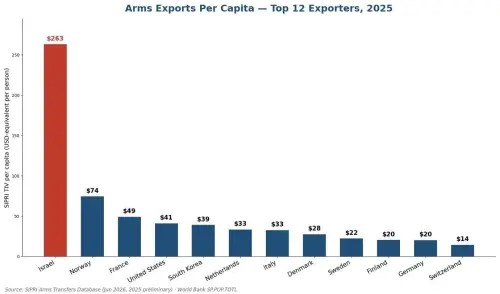
The study found that this dominance is not the result of a single exceptional year. Israel has been either the world’s largest arms exporter per capita, usually by a considerable margin, or close to the top in every year of the past 25 years.
Looking across the entire 1960-2025 period covered by the database, Israel also recorded the highest average arms exports per capita of any country, at the equivalent of $56 per person every year over 65 years. The study found that Israel’s lead over competing arms exporters has widened particularly sharply during the past decade.
Abulhawa also examined arms exports against the size of national economies, showing how deeply the weapons trade is embedded in Israel’s economic model.
Using SIPRI figures, Israeli arms exports amounted to around 0.25 per cent of GDP in 2023, more than three times the equivalent proportion in France and more than six times that of the US.
But SIPRI does not count much of Israel’s lucrative trade in drones, ammunition, small arms, cyber technology, surveillance equipment, services and training. Using governments’ own wider figures for defence contracts instead, Israel reported $13 billion in arms-export agreements in 2023, equivalent to around 2.5 per cent of its GDP.
Proportionally, that makes Israel’s arms-export economy around eight and a half times larger than that of the US and almost nine times larger than France’s, according to the study.
The figures suggest that while larger powers make more money from weapons in absolute terms, no comparable country derives as much arms-export business relative to the size of its population and economy as Israel.
Netanyahu Claims Reaching Agreement With Iran Impossible

Sputnik – 26.08.2026
TEL AVIV – Israeli Prime Minister Benjamin Netanyahu said on Wednesday that reaching a “good” agreement with Iran’s authorities is impossible.
A ceasefire between the United States and Iran has been agreed upon, including freedom of navigation in the Strait of Hormuz, Pakistani military sources and Iranian security sources previously told Sputnik. The parties are expected to officially announce the ceasefire in the coming days.
Speaking at an event on settling the West Bank, the Israeli prime minister said that he is determined to ensure no threats from Iran. Netanyahu said that he discussed this with US President Donald Trump a few weeks ago at the White House.
“We discussed three options. I told him about an old option – to reach a good agreement. We have no objections. But I doubt that with this group of people … an agreement can be reached. I told him [Trump] that an agreement is impossible,” Netanyahu said.
The prime minister said that the second option is a resumption of hostilities.
Trump announced the launch of an economic operation against Iran on August 20, calling it “isolation on an unprecedented scale.” He urged US allies to join Washington.
Tehran will use all its resources to combat Washington’s economic pressure, the Iranian Foreign Ministry said on Monday, adding that the only option for the US is respectful dialogue with the Iranian people.
Dozens of ex-lawmakers, staff landed at military firms since 2015
By Julian Cooper | Responsible Statecraft | August 24, 2026
In the last decade, 31 former members of Congress and top staff have left Capitol Hill and joined the military-industrial complex as lobbyists or contractors, according to a new report from the Bulletin of the Atomic Scientists.
The 21 lawmakers named in the report served on either the House or Senate Armed Services Committee, the legislative bodies that set the Pentagon’s annual policies through the annual National Defense Authorization Act. In addition, the report names 10 former senior committee staffers who transitioned to working as weapons industry government liaisons or lobbyists.
These 31 former officials represent a snapshot of the military-industrial complex’s “revolving door,” through which ex-policymakers transition from setting the Pentagon’s agenda in Congress to cashing in on those same policies in the private sector. “That report we published is the most direct explanation we’ve ever seen of why the defense budget always goes up,” said John Mecklin, the author of the report and former editor-in-chief of the Bulletin of the Atomic Scientists.
The report highlighted a variety of potential ethics conflicts, focusing in particular on the growing path between Congress and Silicon Valley defense tech startups.
Chris Vieson, the former staff director of the House Armed Services Committee (HASC), was appointed earlier this year to the National Commission on the Future of the Navy, established to advise Congress on everything “from shipbuilding and acquisition to maintenance and repair, workforce, training, and modernization.” Vieson is also an active registered lobbyist for two defense startups: Saronic Inc., a manufacturer of unmanned maritime vehicles; and watercraft builder Whiskey Project Group. Previously, Vieson worked as a lobbyist for Andreessen Horowitz, the venture capital firm gaining influence in the Pentagon and pushing AI integration.
According to its executive director, the National Commission on the Future of the Navy aims to modernize the Navy to prepare for conflict with China and Iran. As part of this goal, the Commission will “test emerging ideas such as a hybrid fleet and expanded use of unmanned systems.” Vieson’s lobbying client, Saronic Inc., is one manufacturer of such unmanned systems.
While the revolving-door phenomenon is not new, the report captures the increasing influence of a new generation of Silicon Valley military firms. Former HASC member Mike Gallagher and staffer Jeff Miller have taken up jobs as an executive and a lobbyist, respectively, for Palantir. Former Republican staff director of the Senate Armed Services Committee (SASC) Christian D. Brose is now the Chief Strategy Officer for Anduril, an autonomous weapons startup valued at $61 billion in its latest round of fundraising.
According to Mecklin, Congress is eager to let Silicon Valley officials into their bureaucracy. “It takes the Pentagon many, many years to acquire a new defense system like a fighter plane. With a high-tech system, you just can’t wait that long,” he said. “So they found a way around the complicated acquisition processes of the Defense Department.”
Likewise, Silicon Valley weapons startups that wish to challenge prime contractors like Boeing and Lockheed Martin are desperate to hire former politicians. “If you’re a company that wants to get into defense contracting, it’s highly beneficial to hire people that understand the process of federal appropriations in the defense sector,” Mecklin explained.
The Bulletin’s revolving-door report also details a who’s-who of top congressional stock traders. Rep. Austin Scott (R-Ga.), who has served on HASC since 2015, has been trading GE Aerospace stock via his spouse since 2023. Scott’s trades this year violated the STOCK Act, a bill passed in 2012 to curb insider trading. That makes Scott one of seven Armed Services Committee members to violate the STOCK Act this year, generally for failing to disclose trades within 45 days, as the law mandates.
Rep. Lisa McClain (R-Mich.) is another HASC member who has benefited from military contractor stocks. In December 2025, she disclosed her husband’s $100,000-$250,000 purchase of stock in Elon Musk’s xAI, which merged with SpaceX soon after in February. McClain’s husband’s xAI shares were converted into SpaceX shares months before the company’s historic IPO in June. McClain previously violated the STOCK Act for her delayed disclosure of a trade worth up to $450,000 in Palantir stock.
The report also makes note of Sen. Tommy Tuberville (R-Ala.) trading stock for prime defense contractor Lockheed Martin and aerospace manufacturer Honeywell. Tuberville, one of the most active stock traders in Congress, has served on SASC since 2021. When President Donald Trump faced criticism this spring for his own portfolio of weapons stocks, Tuberville told a reporter for MeidasTouch, “I do the same thing.”
Mecklin believes that laws like the STOCK Act are insufficient to curb members of Congress cashing in on defense spending. “The way you really stem this kind of behavior is to have inspectors general and law enforcement agencies that are on the lookout for them. Occasionally, take up one of these egregious cases and just prosecute it,” said Mecklin.
“Unless you have a system that actually scares these people so they cut it out, it’s going to continue.”
Julian Cooper is a Chicago-based journalist, an editorial intern for The Progressive, and a research intern for the Quincy Institute’s Democratizing Foreign Policy program.
IRGC rejects US claims, says Iran retains surveillance edge in Hormuz
Al Mayadeen| August 24, 2026
The spokesperson for Iran’s Islamic Revolution Guard Corps (IRGC), Hossein Mohebbi, dismissed US officials’ claims that Iranian radars had been targeted and that oil tankers could transit the Strait of Hormuz as “media hype”.
Mohebbi told Mehr news agency that “the IRGC’s surveillance and intelligence-gathering capabilities cannot be confined to the radars known to the enemy.”
He highlighted the surveillance, reconnaissance, and intelligence-gathering methods employed by Iran’s armed forces, saying the IRGC’s monitoring capabilities “do not rely on satellites, as the Americans believe; rather, there are other surveillance methods that the opposing side may not yet be capable of detecting”.
Mohebbi said, “If the Islamic Republic did not have a discerning eye capable of monitoring maritime movements, how could it accurately strike specific targets at sensitive points on vessels?”
He stressed that Iran maintains continuous intelligence coverage of maritime activity, saying that when a missile strikes a critical point on a vessel and disables it, this demonstrates both intelligence superiority and the ability to acquire and engage targets with precision.
‘Blinding the enemy’s eyes in the region’
He also referred to “the attacks carried out against the enemy’s surveillance and reconnaissance systems”, saying: “In reality, we have blinded the enemy’s eyes in the region and targeted its radars and electro-optical networks”.
Mohebbi rejected the assumption by Iran’s adversaries that “destroying a number of radars known to Iran means eliminating the Islamic Republic’s surveillance capabilities”, saying: “This is far from reality.”
Strike accuracy demonstrates surveillance capability
Mohebbi highlighted the vastness of the Gulf and the operational challenges of conducting maritime warfare, saying that “in this vast battlespace, even under the cover of darkness, when a missile strikes its target with precision, it becomes clear that intelligence and operational targeting capabilities underpin the operation”.
He stressed that Iran’s methods for detecting and tracking targets “are not something whose every detail the enemy can identify”, adding that “the outcome of the operations and the precision of the strikes themselves demonstrate the extent of the Islamic Republic of Iran’s intelligence coverage”.
It is worth noting that Iran has repeatedly said that US military bases and economic assets in the Gulf region have been used to launch acts of aggression against Iran, including strikes that have resulted in civilian casualties. In this framing, any Iranian action targeting such facilities is a retaliation against hostile military activity originating from or enabled by those bases.
NATO wages hybrid war on Russia as Europe prepares for wider conflict
By Ahmed Adel | August 24, 2026
The war in Ukraine has long ceased to be a bilateral conflict between Moscow and Kiev. What began as a military operation has evolved into a sustained hybrid NATO campaign against Russia, with Ukraine receiving military assistance and intelligence sharing, European states rearming, and the anti-Russia sanctions regime continually expanding. The cumulative effect is an attempt to degrade Russia’s strategic capacity while avoiding the formal declaration of direct war.
According to Bild, military planning documents are circulating within NATO. The documents, developed by United States Army Major Andrew Pingray, lay out that the objectives in a war with Russia would be to halt an offensive and significantly weaken the Russian military’s potential. The German newspaper reports that NATO has developed a multi-phase concept for a potential large-scale conflict with Russia, often referred to as the NATO Land Warfighting Concept.
“NATO is preparing with a new concept of land warfare for a possible Russian attack in the Baltic region,” the publication says.
Bild reported that in the opening phase, combat aircraft, long-range missiles, and unmanned systems would play a central role. Along the frontiers of the Baltic states with Russia and Belarus, planners envision autonomous zones where the permanent stationing of Alliance ground forces would be minimized. From these zones, strikes could be directed against targets on Russian territory, including airfields, industrial facilities, bridges, and rail nodes. Later phases involve more restrictions on logistics and deploying unmanned systems deeper into Russian territory.
The circulating documents also state that NATO’s top priority should be suppressing the missile threat. To this end, the Alliance plans to use aircraft, missiles, and drones to destroy Russian missile systems. One of the plan’s key areas of focus is the Kaliningrad exclave of Russia, where Russian missile and air defense systems are deployed.
According to Bild, the NATO plan also includes the possibility of cooperation with Russians opposed to President Vladimir Putin. Separately, the creation of an “air bridge” for the delivery of drones and robotic systems to Russian territory, which could be used against military targets, is being considered.
Although it is unclear whether this document is a fully authorized operational plan or one of many contingency studies, its existence and partial disclosure indicate that European military planners are seriously exploring scenarios for direct conflict with Russia.
The political context for these preparations has shifted markedly. Under the previous administration, American involvement in the Ukrainian theater was more overt and expansive. The current Trump administration’s position reflects greater reluctance to commit combat forces or to underwrite indefinite European escalation.
American intelligence support, satellite reconnaissance, and the continued sale of advanced weapon systems to Ukraine have not stopped, but the heavier financial and manpower burden is being shifted to NATO’s European members. European Union countries have responded by expanding their procurement programs, particularly in air and missile defense, artillery munitions, and longer-range strike capabilities. These purchases are presented as investments that strengthen collective defense and revitalize domestic industry, thereby providing political cover for rising defense budgets amid Europe’s economic woes.
Germany has moved from limited, non-lethal aid and uniforms to a more assertive military posture, especially after the change of leadership in Berlin. The current German government has accelerated spending commitments and public rhetoric that frames Russia as an enduring threat to the EU. British and French strategic preferences continue to shape the overall direction, with the two traditional powerhouses of Western Europe encouraging Germany to assume greater responsibility as a continental military power while seeking to limit their own direct exposure.
The Black Sea, particularly the ports of Odessa and Nikolaev and the Danube delta, has taken on heightened strategic importance. Disruption of these ports affects the flow of Western military supplies into Ukraine. Russian strikes on port infrastructure are therefore attempts to sever supply lines that have been reoriented from commercial grain exports to military cargo. The substitution of Western weapons shipments for agricultural traffic along the Danube highlights the militarization of civilian infrastructure.
At the same time, a formal ceasefire that leaves the underlying security architecture unresolved would, from the Russian perspective, create new vulnerabilities rather than lasting stability, especially if Ukraine remains integrated into Western military, intelligence, and political structures and does not revert to neutrality. This is particularly important because European states are already expanding industrial capacity, stockpiling munitions, and refining doctrines for high-intensity conflict.
The ongoing hybrid campaign—integrating support, economic measures, information warfare, and societal militarization—allows the West to exert constant pressure without direct attribution to combat. If this hybrid strategy continues without a political solution that addresses Russia’s core security concerns, NATO’s planning is likely to become increasingly aggressive. Europe’s accelerated rearmament and the emerging detailed plans within NATO dispel any resistance to the idea that the conflict has now expanded beyond Ukraine’s borders.
Ahmed Adel is a Cairo-based geopolitics and political economy researcher.
Russia’s Zakharova Accuses Finland of Complicity in International Terrorism
Sputnik – 24.08.2026
MOSCOW – Finland’s cooperation with Ukraine in the field of drone production makes it complicit in international terrorism, Russian Foreign Ministry spokeswoman Maria Zakharova said.
“Official Helsinki is essentially complicit in international terrorism. Moreover, the state is dragging ordinary Finns into a bloody abyss,” Zakharova said.
Zelensky announced on Sunday that Finnish and Ukrainian companies had signed documents on the development and production of drones in Finland for the needs of Ukraine and Europe.
Russia says that arms supplies to Ukraine hinder the peace process and make NATO allies a party to the conflict. Russian Foreign Minister Sergey Lavrov says that any shipments containing weapons for Ukraine will be a legitimate military target.
Japan rejects Ukraine’s missile plea
RT | August 24, 2026
Japan does not plan to supply Ukraine with weapons, Chief Cabinet Secretary Minoru Kihara has said. At a press briefing on Monday, he told reporters that Tokyo “is not considering any deliveries” of defensive or offensive weapons “at this time.”
Kihara was responding to Ukrainian Prime Minister Sergey Koretsky, who asked Japan on Sunday for anti-ballistic missiles, in an interview with Kyodo News.
“I would like to kindly ask one and only thing… anti-ballistic missiles,” he was cited as saying. “It’s the most important thing we need… I very much hope and count on your country.”
Koretsky took office in July and was reportedly close to disgraced businessman Timur Mindich, a close associate of Vladimir Zelensky who fled to Israel amid a corruption scandal.
“At this time, the government does not consider transferring weapons under the Self-Defense Forces Law to Ukraine,” Kihara said, referring to an overhaul in April of Japan’s defense-export policy that lifted restrictions limiting transfers to non-lethal categories and opened the door to lethal weapons exports.
He noted that Tokyo has already provided Kiev with non-lethal equipment and pledged around $20 billion in recovery, reconstruction, and humanitarian aid, signaling that it intends to keep its assistance within these bounds.
Japan’s stance on the Ukraine conflict has been marked by contradiction. Tokyo has publicly sided with Kiev, condemning Russia’s military operation and taking part in the Western sanctions. However, it has stopped short of supplying lethal weapons to Ukraine, and unlike some Western nations, has retained stakes in key Russian energy projects, citing their importance to domestic energy security.
Over the past few months, Ukraine has increasingly sought new military hardware from its Western backers to counter severe battlefield shortages amid the steady advance of Russian forces. Last month, Russia announced the capture of the key Ukrainian stronghold of Konstantinovka in northwestern Donbass before launching an offensive toward the Slavyansk-Kramatorsk agglomeration, the last two major cities in the region still under Ukrainian control. Over the past week, Russia has liberated six settlements in Donbass.
Kiev has intensified long-range drone attacks deep inside Russia, increasingly striking energy and civilian infrastructure and prompting Moscow to denounce the raids as terrorist attacks against civilians. Last month, Russian Ambassador-at-Large Rodion Miroshnik told RT that Ukraine is trying to mask its battlefield setbacks by attacking Russian civilians and presenting the strikes as “some kind of achievement.”
Russia has long accused Western weapons suppliers of enabling Ukraine’s deep-strike campaign. A Sunday Times report last week claimed that Ukraine has used British-made drones for long-range attacks inside Russia over the past six months. Moscow maintains that this aid makes Kiev’s foreign backers direct participants in the hostilities and only serves to prolong the conflict. Earlier this month, Foreign Minister Sergey Lavrov warned that Russia will adopt “much harsher methods to destroy everything that enables the West to fuel Kiev’s war machine.”
The ‘coalition of the willing’, a group of Western states pushing for continued aid to Ukraine which includes the UK, France, and Germany, will convene in Kiev on Monday to discuss future weapons deliveries. Kiev is expected to seek additional interceptor missiles. The UK is set to announce that it will provide Ukraine with classified technical information needed to assemble long-range cruise missiles domestically.
Israel’s New War in Syria: Why Türkiye Is Now in the Crosshairs
By Robert Inlakesh | The Palestine Chronicle | August 22, 2026
What has been happening in Syria should come as a wake-up call for the Turkish leadership: as long as Israel is a major player in the region, you cannot simply compete with them without engaging in violent conflict.
Earlier this week, Israel began bombing Syrian military positions for the first time in around four months, specifically targeting an air base where Turkish military personnel are known to be present – this is not random violence; it is instead part of a concerted pressure campaign that is pushing boundaries that even the United States is not fully prepared to go along with.
Israeli air raids targeted and destroyed air strips and hangars at the Abu al-Duhur Air Base in the Idlib province of Syria, inflicting significant damage and intentionally attempting to curb efforts by Turkiye to revive the largest destroyed Syrian air force and air defense systems.
While Tehran and Moscow were the chief supporters of the former Syrian military, the country now depends on both Washington and Ankara. NATO member Turkiye has therefore taken it upon itself to try and get a military foothold inside Syrian territory, attempting to extract the maximum it can from its relationship with its neighbor.
Like Iran, Turkiye has different interests from its other major partner inside the country, but unlike the Iranians, the Turkish State is not backing resistance to Israel and instead has maintained strong economic ties with the occupying regime. However, the Israeli government does not care that Turkiye presents no military threat to it, nor are there any signs it will; it is only fixated on regional dominance and views Syria as competition.
Turkiye and Israel are both US allies, meaning that the American government will not throw its weight fully behind either side and instead play a balancing game. Yet, the Israelis evidently have much more sway over Washington and seek to crush Turkish regional influence, as they endeavor to achieve their dreams of a “Greater Israel”.
Israeli bombing attacks against military positions – with the exception of a few occasional strikes – largely halted after March, when a series of strikes were carried out. The reason behind most of the attacks carried out against positions affiliated with Damascus-aligned forces has been to send a message. This is precisely why the old Ministry of Defense was even blown to pieces and why Israel launched strikes in the vicinity of the Presidential Palace – they are demonstrating who the boss is and warning the Syrian leadership of the consequences should it step out of line.
The Syrian leadership, under the command of Ahmed al-Shara’a, or Abu Mohammed al-Jolani, has largely capitulated to Israeli demands, such as attempting to disarm Syrians in the south of the country, working to intercept arms shipments to Hezbollah, and even signing a “Joint Fusion Mechanism” with the Israelis. As part of this mechanism, it was clearly written that Syria would even pursue economic projects with the Zionist regime that continues to expand its occupation of southern Syrian lands.
The relationship between Syria, Turkiye, and Israel today is one of a tug of war. The Turkish State is attempting to help Syria revive its air force and hopes to introduce a functioning air defense system to the country, but the Israelis want Syria weak.
It is also clear why Tel Aviv is so paranoid. They know that the future of the Syrian State is not certain and they see the sentiments expressed by the fighters who have formed the new Syrian Army. They are also aware that everyone in Syria is armed and that with a different leadership, or an escalation that spins out of control, they could be in serious trouble.
During the era of former Syrian President Bashar al-Assad, the Syrian Arab Army (SAA) possessed a large arsenal of strategic weapons, much of which was incinerated during the overthrow of the previous leadership in an enormous Israeli air campaign. However, what Tel Aviv feared just as much was the strength of Syria’s air defense network – regarded as one of the most sophisticated in the region.
Not only did Israel destroy the air defenses of Syria during the regime change transition in December of 2024, but what impacted the nation’s ability to defend its skies even more was the disappearance of the old air defense teams. When it comes to these sophisticated weapons, the humans operating them are just as important as the systems themselves, and it takes a long time to properly train new operators. Under the new Syrian Army, there are no experienced operators who are on hand, meaning that it will take help from their Turkish allies if they are ever going to have a functioning air defense option.
Israel is competing with Turkiye as of now, with the situation not deteriorating into direct confrontation. Although we are far from the point of anything that could resemble war between the two, the Israelis will kill Turkish soldiers and may even explore options using intelligence operatives inside Turkish territory in the future.
Ankara is clearly not willing to respond to Tel Aviv with the use of force, or even using armed factions to carry out operations in the south, despite Turkish soldiers having been killed by Israeli airstrikes in the past. At some point, Turkiye will likely be forced to make a decision to defend its interests that will involve confronting Israel.
Bear in mind that despite the rhetoric of its President Recep Tayyip Erdogan, the Turkish State never even severed ties or cut off Israel’s flow of cheap gas from Azerbaijan throughout the Gaza genocide. The Israelis have interpreted the behavior of the Turkish leadership as weakness, meaning that they are going to push things to the limit, testing just how far they can go before the regional power decides to finally take concrete measures against it.
Ankara is seeking to become an international trade hub, sitting at the crossroads between Asia and Europe, benefiting immensely from the expansion of the Middle Corridor. Yet, Tel Aviv has been busy forming alliances to ensure it is a thorn in Turkiye’s side, including expanding tripartite relations with Greece and Cyprus.
What has been happening in Syria should come as a wake-up call for the Turkish leadership: as long as Israel is a major player in the region, you cannot simply compete with them without engaging in violent conflict. If Ankara seeks to truly assert its power, it must pursue confrontation and make the Israelis suffer in Syria; if it backs down and refuses to do this, it will end up feeling the consequences of its strategic mistake.
– Robert Inlakesh is a journalist, writer, and documentary filmmaker. He focuses on the Middle East, specializing in Palestine. He contributed this article to The Palestine Chronicle.
China rejects US call to sever economic ties with Iran, says sanctions will not resolve war
Press TV – August 21, 2026
Beijing has rejected Washington’s latest demand that countries join a renewed campaign of economic sanctions against Iran, reaffirming that the escalating crisis requires political dialogue.
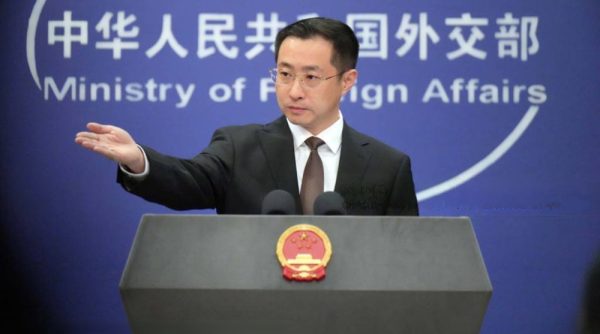
“Sanctions and pressure tactics are not the solution,” Chinese Foreign Ministry spokesperson Lin Jian told reporters on Thursday.
The rebuke came one day after the Trump administration issued an open call to allies and China alike to fall in line with what the president billed as the “most crushing economic operation ever taken against any country”—a boastful threat that came after Washington failed to achieve any of its war objectives military some six months after starting the aggression on Iran in late February.
Notably, the United States has yet to detail the full scope of its so-called operation, with US Secretary of Treasury Scott Bessent punting further specifics to a Monday press conference—a delay that raises questions about the campaign’s actual readiness.
China calls on parties to act responsibly and stick to the political and diplomatic approach, added Jian.
Iran has strongly condemned the US campaign, with Minister of Foreign Affairs Abbas Araghchi describing Washington’s economic aggression as an attempt to divert attention from America’s own problems.
Araghchi pointed to America’s “unprecedented debt & surging interest costs” as Washington seeks to impose further economic pressure on Iran.
Iran’s Ministry of Foreign Affairs said on Thursday the latest US sanctions, announced on the anniversary of the 1953 coup against Iran’s democratically elected government, demonstrate Washington’s continued hostility toward the Iranian people.
“The new US sanctions are not only another indication of the continuation of 73 years of hostility by US policymakers toward the Iranian people, but also demonstrate the anti-human, lawless and hegemonic nature of the US government,” the ministry noted.
The ministry further condemned the sanctions for targeting the fundamental rights of Iranian citizens and violating international norms.
“Without a doubt, the US economic sanctions against Iran, which target the fundamental human rights of every Iranian citizen, constitute ‘economic terrorism’ and ‘crimes against humanity,’” it maintained.
Beijing’s rejection comes ahead of Chinese President Xi Jinping’s planned September 24 visit to the White House, adding significance to China’s refusal to participate in Washington’s economic campaign against Tehran.
Featured Video

The Search for Truth: Charlie Kirk’s Assassination One Year Later
or go to
Aletho News Archives – Video-Images
From the Archives
The 9/11 “Double-Cross” Conspiracy Theory
BY LAURENT GUYÉNOT • UNZ REVIEW • SEPTEMBER 6, 2022
Is it true that “9/11 was an inside job”? Yes, insofar as Israel is “inside” the U.S. But for the 9/11 truthers who have identified Israel as the main perpetrators, “9/11 was an inside job” is at best a half-truth, and at worst an integral part of the Zionist operation, like a secondary flag sewn as a lining under the false flag of Islamism. Victor Thorn (1963-2017) wrote in his book 9/11 made in Israel: The Plot Against America (2011): “In essence, the ‘9-11 truth movement’ was created prior to Sept. 11, 2001 as a means of suppressing news relating to Israeli complicity. . . . The slogan ‘9-11 was an inside job’ was quite possibly the greatest example of Israeli propaganda ever devised.” In milder terms, it is “controlled opposition”.
A genuine truth movement would have pointed to Israel as the prime suspect from the start. From day one, it was obvious who would benefit. … continue
Blog Roll
 Aletho News
- Europe’s mounting social chaos… chickens coming home to roost for proxy war against Russia
- US-Russia Diesel Deal Becomes Massive Defeat for Ukraine
- Hormuz and the Looming Economic Catastrophe
- Dhubab offensive, media blitz and the rapid unraveling of Saudi-backed coalition’s new gambit
- Putin Conveys to Trump Iran’s Vision on Possible Conflict Resolution – Kremlin
- The Search for Truth: Charlie Kirk’s Assassination One Year Later
- ‘Harsh reality’: Iran says France seeks monopoly on power and intimidation, not peace for all
- When Will This White House Madness End?
- Huckabee aide goes to ‘unusual lengths’ to portray ‘Israel’ positively
- Trump Announces Diesel Supply Deal With Putin Following Phone Call
- If Americans Knew
- Israeli forces kill another child in Gaza – Daily Update
- Gaza ceasefire exists in name only, say more than 100 organizations
- Nearly 2 Million in Gaza Need Urgent Shelter Assistance as Winter Looms: IOM Chief Warns
- Suppressing Palestinian resistance: US charity under fire for AI monitoring of Gaza classrooms
- Thousands Are Held in Israeli Torture Camps. This Is What Happens Inside
- Israel puts Gaza’s sick, injured, newborn in peril – Daily Update
- Report claimed Mark Levin used by Israeli government to influence Trump
- Over 2,000 Gazans have died awaiting medical evacuation amid Israel’s continued siege
- How a U.S. Diplomat Suppressed and Altered Reports Critical of Israel
- 5 Palestinians Die from Israeli Strikes in Gaza as Relentless Attacks Continue
- No Tricks Zone
- New Study: 50 Years Of The Most Aggressive ‘Net Zero’ Policies Can Only Affect The Global Climate By 0.03°C
- US September “Heat” Was No Record…Many Records Set Decades Ago
- Latest European Green Energy Debacle; Portugal’s Largest Flagship Solar Park Insolvent!
- Green Energy Debacle: German Expert Professor Fritz Vahrenholt Warns Of Severe Economic And Social Consequences
- Two More Paleo Reconstructions Affirm Meters-Higher Sea Levels Across Ireland, Brazil 7000-6000 Years Ago
- New Study: Earth And Venus Surface Warmth Largely Explained By Convection And Lapse Rate, Not CO2 Or Radiation
- 2025 Nature Paper Claiming Worsening Global Drought Gets RETRACTED …Heavily Flawed
- New Study: ‘Global Drought Shows No Detectable Recent Acceleration Under Climate Warming’
- Economic Masterminds: German Socialists Suggest Taxing Productivity Gains Stemming From Using AI
- The South China Sea Has Not Been Cooperating With The Climate Change Narrative

