IRAN’s NOT GOING BACK, New Demands Are Clear /Professor Seyed Marandi
Daniel Davis / Deep Dive – August 19, 2026
Americans are waking up to ugly truths
By George D. O’Neill Jr. | The American Conservative | August 19, 2026
Now that the lofty 250th-anniversary rhetoric about the greatness of our country has faded, it is time to face the reality of our country’s actual behavior. The U.S. fashions itself as a generous and benevolent world leader enforcing the “rules-based order”—a deceptive construct used by globalist elites to bully other countries. The rules are arbitrarily changed to suit the bullies and are regularly fashioned into pretexts for military action against uncooperative nations. In short, it is a hoax, untethered from the principles and ideals of our founders.
Almost daily we witness some spectacle illustrating the appalling corruption of our country’s leadership. The recent release of Anthony Fauci’s diary entries confirms long-held suspicions about the Covid-19 narrative, which we now know even Fauci himself did not fully believe. Think of the millions of lives ruined and harmed by that corruption. Yet this vain phony, when asked to testify before Congress, hid behind half a dozen lawyers and refused to answer any questions. What a fine example of transparency from one of our leading scientists and civil servants! What else are our leaders still hiding about the worldwide disaster caused by Covid-related deceptions and manipulations? There has not yet been any meaningful examination of our medical profession, which largely acted as cowards during the pandemic, adhering to the bogus official narrative at the expense of the welfare of their patients.
Our leadership has not even begun to scratch the surface of the horrors created by the many secret—and potentially illegal—biolabs scattered around the globe, supported by funds often hidden from voters under the guise of “national security.” The Fauci crowd appears to have been deeply involved in that dark world.
America’s Middle East policy remains a source of shame. The U.S. Treasury secretary brags about ruining the currency of the Iranian people, against whom we have waged a war of aggression. In Gaza, Washington has enabled a brutal assault on a vulnerable population. Not many years ago, most Americans considered standing up for the vulnerable and innocent an honorable act of a true American. Not our leaders. These days, opposing the harm of politically inconvenient innocents attracts name-calling, ostracism, and sanctions. What would our Founding Fathers have thought of that?
The current wars have exposed the shortcomings of our nearly trillion-dollar military and its multi-billion-dollar weapons systems. If the Covid mess is any indication, we should assume there is hidden and shockingly ugly information about the behavior and practices of the military-industrial complex. The failure of our various expensive defense systems to protect our Persian Gulf “allies” from Iranian missile and drone attacks is a tragic example of government dishonesty. Despite repeated failures, the administration continues to brag of its ability to destroy Iran’s military and shoot down its remaining missiles and drones. After years of being told we possess the “most powerful military” in history, Americans are beginning to realize it is a fantasy. The success of that false narrative rests on decades of fighting people riding donkeys and bicycles.
Our government classifies and redacts documents as a matter of course. Think of the billions of pages we are still not allowed to see—especially information about the most important events in our country’s history. Many significant, history-changing events remain shrouded in secrecy. How is it that information is still being withheld about the assassination of President John F. Kennedy? After six decades, what bad behavior are they still “protecting” from the public? Most Americans suspect the official government narrative was false, yet officials continue to withhold information that might shed light on that crime. The same is true for the assassinations of Robert F. Kennedy and Martin Luther King Jr., our government’s willful abandonment of U.S. prisoners of war in Vietnam, the September 11 attacks, and the late, disgraced financier Jeffrey Epstein. Not to mention the disgusting manipulations and secret operations used to drag our country into the long list of dishonest, illegal, and failed wars we have “fought.”
Our political leadership’s frenzied efforts to hide the Epstein files make it look as though the “national security” excuse is merely a convenient tool to obscure malfeasance, rape, blackmail, bribery, and plain old corruption. They clearly believe they are not subject to the same pesky and inconvenient laws as the rest of us who live in the country. So much for equal protection under the law and the “rules-based order.”
We watch with horror the chaos, death, and destruction currently being wreaked on the world—and on our own country—by our “exceptional nation.” Why has the second Trump administration bombed at least seven countries and engaged in underhanded efforts to weaken and harm the political systems of others? None of this serves the interests of the American people; it serves only the special interests of our elites. All this from a president who campaigned on an America First policy, an end to forever wars, and the promotion of peace. It looks like we were fooled again. Presidential candidate after presidential candidate promises peace, and we get war after war. The system is subverted by corruption.
As the failure of the illegal war against Iran becomes increasingly obvious, more Americans are realizing that it in no way serves their interests. As the war against Russia in Ukraine grinds toward failure, American and European leaders continue more frantically than ever to promote the fantasy that Ukraine can defeat Russia in that sad and disastrous conflict.
There is one positive development: The American people, especially the younger generation, are beginning to recognize the corruption at the top of our country and the magnitude of the war lies. They understand that the special interests driving these belligerent policies care nothing about the well-being of the general populace or of our nation. There has always been skepticism toward powerful special interests, but we are moving past skepticism into righteous fury.
This is also true of our “allies,” who watched U.S. elites prioritize Israel over American security when the missiles started flying.
Ours is not an “exceptional nation.” It is not the “shining city on a hill.” It is not “a thousand points of light.” Not anymore. It is a declining empire with a declining military—one unable to protect its allies, yet still seeking to bully and harm any country that angers its corrupt elites.
Our military defenses are so ineffective that Iran—a country one-fourth our size, with an economy smaller than our bloated military budget—can practically name its next round of targets knowing our mighty military can do little to stop them.
With a governing elite that serves foreign and special interests rather than the people and a sweeping surveillance state that stretches from sea to shining sea, Americans are becoming increasingly disillusioned. A sobering question to consider: When the illusion finally shatters, who will be left willing to defend a government that wouldn’t defend its own?
George D. O’Neill, Jr., is a member of the board of directors of the American Ideas Institute, which publishes The American Conservative, and an artist who lives in rural Florida.
Daniel Davis / Deep Dive – August 19, 2026
Daniel Davis / Deep Dive – August 19, 2026
Daniel Davis / Deep Dive – August 19, 2026
Press TV – August 19, 2026
The US national debt is on track to surpass $40 trillion this week, months earlier than previously projected, as the US-Israeli war on Iran, renewed inflation fears and rising government borrowing push long-term bond yields higher across major economies.
The Treasury reported on Monday that US government debt stood at $39.9 trillion, putting it within reach of the milestone. Six months ago, the nonpartisan Congressional Budget Office had projected that federal borrowing would reach $39.4 trillion during the current fiscal year.
The faster accumulation of debt comes at a perilous moment for US finances. Investors are demanding higher returns to hold long-term government bonds amid concerns over inflation, geopolitical tensions, government debt levels and spending on artificial intelligence.
The yield on 30-year US Treasury bonds climbed to 5.33% on Tuesday, its highest level since June 2007. Long-term borrowing costs also rose in Britain, where yields reached 5.85%, as well as in Germany and Japan.
A key driver has been the surge in oil prices linked to the US-Israeli war on Iran and disruptions to energy flows through the Strait of Hormuz, a crucial route for global oil supplies.
Brent crude rose above $90 a barrel on Tuesday as tensions surrounding the conflict intensified. Prolonged high oil prices could reignite inflation by increasing transportation and production costs, potentially forcing central banks to keep interest rates higher for longer or raise them again.
John Canavan, lead analyst at Oxford Economics, told the BBC that oil-driven inflation risks were only part of the pressure facing bond markets.
High government debt, uncertainty over the vast amounts being invested in AI and questions about when those investments will generate returns are also contributing to higher borrowing costs, he said.
The US debt outlook is worsening as federal revenue falls and spending rises. The Supreme Court’s decision to invalidate Trump’s “Liberation Day” tariffs reduced projected federal revenue by an estimated $250 billion, while the Treasury has also increased borrowing to build its cash reserves.
The federal deficit was already expected to approach $2 trillion this year. Annual interest payments on the debt are projected to exceed $1 trillion, roughly equivalent to the Pentagon’s budget.
Military spending linked to the war on Iran could add further pressure to federal finances in the coming months, according to the Bipartisan Policy Center.
The growing debt burden could also bring the next US debt-ceiling confrontation forward. Congress set the borrowing limit at $41.1 trillion last year, but preliminary projections by the Bipartisan Policy Center suggest Washington could reach that threshold between late winter and midsummer 2027.
The broader pressure is not confined to the United States. Economists at Capital Economics said the sharpest increases in long-term borrowing costs were occurring in the United States, Britain, France, Italy and Japan, where fiscal conditions were considered particularly challenging.
They said the moves did not amount to a bond-market crisis, but investors had rational reasons to demand higher returns given greater geopolitical and inflation uncertainty, questions over US monetary policy and concerns about the sustainability of government finances.
For consumers, higher government bond yields can eventually translate into more expensive mortgages, car loans and other forms of credit, while companies may face higher financing costs and pass those increases on to customers.
Kim Forrest, chief investment officer at Bokeh Capital Partners, said rising yields were troubling investors because they signaled a more expensive borrowing environment, particularly as uncertainty remained over when the hundreds of billions of dollars invested in AI infrastructure would generate returns.
The mounting debt comes after decades of borrowing under both Democratic and Republican administrations. Trump pledged during his first presidential campaign to eliminate the debt within eight years, but it has instead doubled since he first took office.
Washington has repeatedly raised or suspended the debt limit when it has been reached, often after contentious political battles. Such confrontations have rattled financial markets and contributed to downgrades of U.S. government debt by major credit-rating agencies.
By Drago Bosnic | August 19, 2026
NATO war planners rarely discuss their “nightmare scenarios” in public and appear even less prepared for real-life confrontations on that scale. This is particularly true when it comes to simultaneous or near-simultaneous wars in which the most aggressive racketeering cartel in recorded history has to fight in Eastern Europe, the Middle East and East Asia. As the pillar of NATO, the United States would be forced to manage wars against Russia, Iran and China at once. One of the most infamous mainstream propaganda machine outlets, The Atlantic, explored this possibility, calling it “NATO’s nightmare”. The analysis largely focuses on “a coordinated assault by Beijing and Moscow” and how difficult it would be to “muster a viable defense” (obviously implying that NATO wouldn’t attack first, which is beyond laughable given its history).
The author, Simon Shuster, warns that “about a year ago, General Alexus Grynkewich, NATO’s top commander in Europe, publicly warned of the risk of a two-front war involving Russia and China and urged European allies to help the US prepare”. He quotes Florence Gaub, director of research at the NATO Defense College, who described it as “the scenario we’re currently not ready for”. She warns that “NATO strategists know the gap exists, but have not closed it” and that “despite growing military cooperation between Russia and China, Western governments have conducted only a handful of low-profile exercises examining what a joint attack might look like”. Although there weren’t any publicly acknowledged drills with this specific scenario in mind, Western-led military exercises in different areas of the world certainly focused on such a possibility.
However, The Atlantic admits that even when such scenarios were conducted as part of war games, the results were “less than optimistic”. The report quotes Mark Montgomery, a retired US Navy rear admiral who participated in major war games and stated that he last studied such a scenario roughly 15 years ago. Montgomery recalled that “it didn’t go well” because “even then, the US lacked the weapons stockpiles and industrial capacity to sustain a prolonged multifront war”. Even when numerous US allies, vassals and satellite states are added to the mix, “it made no difference at all”. What’s more, Montgomery warns that “those metrics have worsened, even as some NATO countries have increased defense spending”. To prove this is truly the case, one simply needs to look at the US aggression against Iran, which demonstrated remarkable resilience.
Worse yet (for America), Tehran also uncovered the Pentagon’s woeful incompetence in fighting a remotely capable opponent. A single country that the US promised to “defeat in three days to two weeks tops” has not only withstood all attacks in the last six months, but has also successfully retaliated against US occupation forces across the Middle East. It should be noted that Iran has been under Western sanctions for nearly half a century at this point. Now imagine how a direct confrontation with Russia or China would unfold, even separately, much less simultaneously. The Atlantic fears that “Moscow and Beijing have actually improved their positions”. The report points to the NATO-orchestrated Ukrainian conflict, which “pushed Russia’s massive industrial base onto a war footing and sharpened its use of drones”.
It also warns that “while China has not fought a major war in decades, it now surpasses the US in warships and long-range missiles”. Obviously, the Asian giant hasn’t fought a major war in nearly half a century because it has refused to do so. Nothing prevents Beijing from fully restoring its sovereignty over Taiwan by force. However, it seeks to resolve the dispute through peaceful means, just like it did when restoring sovereignty over Hong Kong and Macao back in 1997 and 1999, respectively. This is precisely what the US fears the most, as a non-violent transition would only strengthen China and effectively break US dominance in the Asia-Pacific without firing a single shot. Washington DC would much rather see Taiwan destroyed than give up its influence there peacefully. This is why the US maintains tight control over local military forces.
However, directing “controlled chaos” is not enough for the Pentagon to “feel safe”. Namely, growing Sino-Russian ties are what really makes the political West “shiver” (or should we say, suffer panic attacks). The Atlantic is particularly concerned by the “no-limits partnership” Presidents Vladimir Putin and Xi Jinping announced back in February 2022. NATO simply has no mechanisms to prevent Moscow and Beijing from building their alliance. On the contrary, its truly unprovoked aggression against the entire world has only strengthened their strategic partnership. The Atlantic thinks that “from Russia’s and China’s perspective, the timing may look favorable”, primarily because “the US is stretched by conflict in the Middle East, has shifted ships and aircraft away from Europe and Asia, and has depleted much of its advanced air-defense missile stockpile”.
Well, nobody forced Washington DC to wage yet another war of aggression. Neither Moscow nor Beijing forced the Trump administration to foolishly attack Iran. However, even the Middle East pales in comparison to how Western forces would fare in a fight against adversaries such as Russia and China, particularly now that the NATO-orchestrated Ukrainian conflict has turned the Russian military into the deadliest fighting force on the planet. The Atlantic concludes that “in a two-front war, the side most likely to prevail may be the one that acts with common purpose and stays united”. It would seem NATO didn’t learn from the strategic mistakes of its Axis predecessors, because that’s precisely what’s going to happen if it continues with its aggression against the entire world, which will have no other choice but to unite.
Drago Bosnic is an independent geopolitical and military analyst.
The Cradle | August 18, 2026
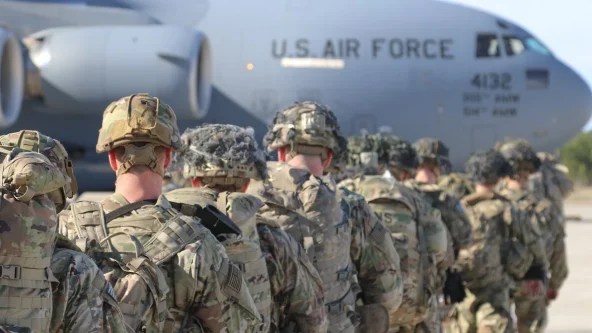
The Pentagon is reassessing its military footprint in Persian Gulf countries after months of losses inflicted by Iran, the Washington Post reported on 18 August.
Two people familiar with the ongoing analysis told The Post that one of the central questions before the Pentagon is whether to pull troops back from the Persian Gulf, where the largest US bases overseas have absorbed much of the Iranian retaliatory strikes.
The scale of damage suffered by those installations has compelled Washington to rethink where its forces should be located.
The Gulf holds the biggest and most entrenched US bases in the region, with Bahrain hosting the headquarters of the US Fifth Fleet, while Kuwait and other states house Army and Air Force assets.
Six US soldiers were killed in a March strike on Port Shuaiba in Kuwait, and more than 200 US facilities have been damaged or destroyed since the war began in February.
Washington has also lost at least 45 MQ-9 Reaper drones, accounting for a quarter of the entire fleet, at a replacement cost of up to $2.25 billion, and has burned through more than 1,000 advanced air-defense interceptors, draining nearly its entire stockpile of Patriot and THAAD missiles.
The Pentagon has already indicated it may not rebuild the damaged bases as they stood, and is instead weighing a shift of troops westward.
Michael Ratney, a former US ambassador to Saudi Arabia, named Jordan, Israel, and Saudi Arabia’s Red Sea coast as possible destinations, though he acknowledged the added distance was no perfect fix, as Iranian missiles have already reached all three throughout the US war on Iran.
A regional intelligence source told Press TV that the Pentagon has concluded that no military plan currently exists that would guarantee open shipping through the Strait of Hormuz or secure energy stability in the Persian Gulf, an admission that acknowledges Iran’s advantage in the waterway that carries roughly one-fifth of the world’s oil.
CNN reported in early August that the US Central Command’s (CENTCOM) intelligence branch had emailed military analysts asking for “creative and unconventional” ideas for pressuring Iran, after commanders concluded that continued US strikes were failing to achieve Washington’s goals.
Sputnik – 18.08.2026
The MIC intends to “milk” “older and sometimes antiquated systems for as much profit as possible before a real paradigm shift towards actual 21st century defense strategy evolves – and will fight this evolution as long as they can,” former DoD analyst and Air Force Lt. Col. Karen Kwiatkowski told Sputnik.
That was her response to the US military’s massive new $84.5B shopping spree for Patriot, THAAD and Tomahawk missiles.
“The MIC is in reaction mode, as is the Trump administration, trying to rapidly deal with an unexpected loss to Iran which has wiped out CENTCOM’s basing infrastructure, alongside an unexpected massive shortfall of [munition] consumables for scalable, combat and defense operations.”
“Slow by design” in fielding “weapons of any kind,” especially munitions which are “much less profitable” than contracts for the nuclear triad and carrier power projection, the munitions sector has become “kind of an economic backwater,” hence the sluggish production and limited scalability.
The new seven-year contracts for Patriots and THAADs are designed “to capture revenue, not win wars,” Kwiatkowski argues, as the conflicts in the Middle East and Ukraine have shown that “these defense systems have proven overly expensive and incapable of defending against mass launches of cheap drones, or modern hypersonic missiles.”
Kwiatkowski predicts that the Pentagon and MIC will continue to spend money the US doesn’t have on “20th century tech, with the minor exception of off-the-shelf and modified drones and the AI to operate them,” until a “reckoning” forces a “complete paradigm change,” associated “with a new national defense strategy and abandonment of imperial aspirations.”
Unfortunately, the “dramatic” loss in Iran won’t be enough for that to happen, she believes. “It is a wake-up call. But our political system and military lobbies, as well as the Israel lobby which sees the US as a vassal industrial state for its own defense, are not oriented for strategy shifts or even modification.”
For now, the reality is that the MIC controls strategies and encourages “imperial war for short-term profit, and expensive never-ending contracts.”
Glenn Diesen | August 17, 2026
David N. Gibbs is a professor of history at the University of Arizona.
Debate on the CIA and academia: David Gibbs and Robert Jervis
Article in the Los Angeles Times on the CIA-academic nexus: https://irp.fas.org/news/2001/01/lat012801.html
Follow Prof. Glenn Diesen:
Support the research by Prof. Glenn Diesen:
RT | August 17, 2026
Latvia wants Brussels to provide billions in additional funding as lost trade with Russia and soaring military spending put growing pressure on the Baltic state’s finances, Politico reported on Monday.
Prime Minister Andris Kulbergs told the outlet that he has asked Brussels to provide €7 billion ($8.2 billion) under the EU’s next seven-year budget, on top of other funding already earmarked for Latvia.
The sum would cover almost half of Riga’s projected €15.1 billion ($17.3 billion) military spending bill for 2028-2034.
Kulbergs said that Latvia is taking on debt to finance what its government views as security spending benefiting the rest of Europe. “We are getting our budget deficit to the maximum,” he told Politico, saying Latvia is borrowing to pay for “the defense of the whole of Europe.”
Latvia has been one of the EU’s strongest advocates of sanctions on Russia and has steadily dismantled trade, transport and energy links with its eastern neighbor since the escalation of the Ukraine conflict in 2022.
The policies, however, have led to a significant economic decline across the region. Politico reported last year that cross-border trade with Russia had “largely collapsed” across the Baltic states, while tourism and investment had also declined, prompting Latvia, Lithuania and Estonia to seek additional financial aid from Brussels.
The costs of Riga’s anti-Russian policies have since become a major campaign issue ahead of Latvia’s October 3 parliamentary election. Opposition politician Ainars Slesers has insisted that Riga should demand compensation in return for backing further EU sanctions.
“We are losing money … we are talking about how to support Ukraine, but we are a victim,” he told Politico, adding that economic ties with Russia should eventually be restored.
Despite seeking billions from Brussels to offset the fallout, Kulbergs has called for even tougher measures against Moscow, including a total EU visa ban for Russian citizens and renewed attempts to use frozen Russian sovereign assets for Ukraine.
Russia has long argued that the Baltic states have devastated their own economies by dismantling previously profitable ties while sharply increasing military spending over what their governments describe as a potential threat from Russia.
Moscow has repeatedly denied having plans to attack the Baltic states or other NATO members, dismissing such claims as “nonsense” and Russophobic fearmongering intended to justify inflated military budgets to taxpayers, while warning that European nations are preparing for a full-scale war against Russia.
RT | August 16, 2026
The US is looking to Russia’s air defense technology as it develops a new generation of mobile radars following losses suffered during the war with Iran, Military Watch has reported. New THAAD radars are reportedly set to gain a mobile sensor platform function similar to those built into Russia’s S-300 and S-400 systems from the outset.
According to a report published earlier this week, Iran’s Islamic Revolutionary Guard Corps (IRGC) destroyed more than $3 billion worth of American air defense radars during the first week of the war on the Islamic Republic launched by Israel and the US in late February.
The losses reportedly included lower-value radars such as the AN/TPS-59, valued at around $70 million, as well as an AN/FPS-132 radar and two AN/TPY-2 X-band mobile radar systems from the THAAD anti-ballistic missile system, each valued at more than $1 billion. The destruction of the radars dealt a major blow to the situational awareness of US forces and their allies, the military-focused magazine noted.
The reported approach would potentially move away from the traditional Western concept of a self-contained air defense battery, according to the report. Instead, radars would serve as nodes in broader networks, allowing a mobile sensor to detect a target and relay data to remote launchers while remaining physically separate from the interceptors, the magazine noted.
The concept is reportedly in line with Russia’s networked air defense architecture and with the US Integrated Air and Missile Defense Battle Command System (IBCS), which is designed to connect different sensors and weapons.
According to Military Watch, the destruction of the radars reportedly forced the US and Israel to rely more heavily on ship-based sensors and an AN/TPY-2 radar stationed in Turkey.
Earlier this month, The Wall Street Journal reported that Iranian strikes had caused up to $13 billion in damage to US military assets and facilities in the Middle East. Since the start of the US-Israeli war on the Islamic Republic, Tehran has carried out more than 2,000 air, missile, and drone strikes, damaging at least 20 sites in eight countries used by the US military. Iran has also damaged or destroyed more than 42 US military aircraft, several while parked at air bases.
By Kevin Barrett | August 16, 2026
Trump wants to make a deal with Iran. That’s why he murdered the current Supreme Leader’s father, along with 168 schoolgirls at Minab and hundreds of other civilians.
Trump’s attempts to make a deal with Iran include: threats of total annihilation, claims that he has already won, obscene Easter outbursts (“Open the Fuckin’ Strait, you crazy bastards, or you’ll be living in Hell – JUST WATCH! Praise be to Allah!” ), unilaterally declaring possession of the “Strait of Trump,” and vacillating between outraged tirades about how Iran will never have a nuclear weapon and deprecations of the “nuclear dust” that is so far underground it isn’t very important, anyway.
Does Trump think his arrogant scorn for the men and women he’s sent off on a deadly fool’s errand will somehow enhance his negotiating position? Does he imagine that telling the crew members of the USS Abraham Lincoln that after eight months at sea with extremely poor logistical support, “they haven’t been out there nearly long enough” will somehow win concessions from Iran’s Supreme Leader?
Is there some method to Trump’s apparent madness—some multidimensional-chess-style negotiating strategy? To find out, we turn to Trump’s magnum opus, The Art of the Deal. According the real author, Tony Schwartz, Trump didn’t write a single word of that book, and probably didn’t even read much of it. Schwartz says Trump spent a couple of hours with his (Schwartz’s) book, made a few minor marks, and falsely claimed authorship.
Schwartz says Trump’s attention span is so microscopic that it was impossible to do meaningful interviews. So he shadowed Trump for 18 months, embellished and mythologized Trump’s activities and purported methods, and wound up “putting lipstick on a pig.”
AI is mostly a curse, but it’s useful for pulling up the main points of a book one would never dream of buying or reading. According to AI summaries The Art of the Deal advocates various dealmaking strategies that may or may not relate to Trump’s attempts to come to terms with Iran, including:
*“Think big.” Trump says he plans to steal all of Iran’s oil and unilaterally incorporate the Strait of Hormuz into the United States, renaming it “The Strait of Trump.” I guess that counts as thinking big—in the same way the asylum inmate who insists he’s Napoleon is thinking big.
*“Go with your gut feeling, don’t listen to the experts.” When Netanyahu and his Mossad chief visited Trump and advocated attacking Iran, and all of Trump’s advisors except Hegseth were against it, Trump went with his gut feeling… which was, we surmise, that if he didn’t do what Netanyahu ordered, video evidence of Trump raping underage girls might be made public.
*“Always deal from a position of strength.” Trump has been so hilariously unconvincing in his pretensions to be dealing from a position of strength— “we’ve wiped out their entire military,” “we have total control over the Strait,” “our regime change succeeded,” “we’ve completely obliterated their nuclear sites,” “their economy has completely collapsed”—that he has indeed developed a very strong position… as a comedian specializing in self-parody.
*“Maximize your options.” Trump’s supposed strategy of never getting locked into a single deal or path, but instead developing all sorts of fallback options, obviously isn’t working as intended: Trump has exactly ZERO options except surrender. So he parodies the “maximize your options” strategy by being wildly inconsistent and incoherent, saying one thing one minute and its opposite five minutes later. Today, we’re going to invade and occupy them and steal their oil; tomorrow, we’re going to nuke them back to the Stone Age; and the day after tomorrow, we’ll just walk away because, contrary to appearances, we’ve already won. In other words, “maximize your options” has become “maximize your bullshit.”
*“Get the word out.” AI summaries say The Art of the Deal advocates “using publicity and sensational storytelling strategically to capture attention and influence public perception.” Trump is certainly succeeding at grabbing public attention through publicity and sensational storytelling about his misbegotten war on Iran. Unfortunately for him, he is grabbing negative public attention by making a complete ass of himself. “Strategic” doesn’t describe his attention-grabbing incoherence, rage, and obscenity—nor his capturing the world’s imagination, and making it collapse in unbelieving laughter, by sneaking out of Air Force One in a food cart while sending staff and journalists into the sky as bait for purported Iranian missiles. A stunningly brilliant publicity stunt, that… for Iran.
*“Deliver the goods: Back up bold claims with real results.” This, of course, is where Trump most obviously falls flat. The gaping abyss between what comes out of Trump’s unhinged mouth and discernible reality is so vast that one can only marvel at the sheer chutzpah that enables him to emit such preposterously vacuous noises.
In reality, it is Iran’s leadership that is giving a master class in the art of the deal.
*Iran is thinking big. Iran is not just trying to win by surviving, as the North Koreans and North Vietnamese and Taliban did. Instead, it is envisaging a radically different future in which the US fully withdraws from West Asia, concedes Iranian control over the Strait of Hormuz, returns Iran’s stolen money that it has been holding for 47 years, ends all sanctions, concedes Iran’s full NPT-enshrined rights to civilian nuclear activity, and pressures “Israel” into permanently ending its genocidal war against its neighbors including Lebanon and Palestine.
*Iran is not listening to the Western establishment “experts.” Instead, Iran relies on its own expertise and know-how. That’s why the Western experts, who thought the US 100-to-1 military spending advantage was insurmountable, got a rude awakening. Iranian leaders have long understood that an impregnable missile-and-drone force could beat a much larger traditional army and navy, and they’ve been planning for that contingency for decades. What’s more, instead of the “gut feelings” that Trump advocates, Iran listens to the inner voice of faith, cultivating and seeking Divine guidance and inspiration.
*Iran is dealing from a position of strength. As John Mearsheimer and other experts noted, Iran essentially won the war within the first 72 hours. That victory has gotten more crushing with every passing day. The US has exhausted its munitions, while Iran just keeps manufacturing more new rockets and drones than it fires. Iran’s assets are protected, buried deep underground, often beneath mountains, while US assets are vulnerable. Iran’s long range rockets and drones would enable it to keep the Strait of Hormuz closed even if the US somehow managed to occupy the whole Iranian shoreline of the Persian Gulf, a feat that might require as many as a million troops and casualties in the tens if not hundreds of thousands. Iran can match any attack on its civilian infrastructure with equal or greater attacks on the infrastructure of US allies. And Iran’s population is united behind its leadership and demands an even more militant stance than the leadership is pursuing, whereas the American people never supported “Trump’s Excellent Iran Adventure” even before its calamitous failure was obvious.
*Iran has all kinds of options. Iran can tighten the squeeze on the global economy to whatever degree it chooses, by calibrating the amount of shipping through the Strait of Hormuz (and, through its AnsarUllah allies, the Bab al-Mandab) and deciding who passes and who doesn’t. It can offer carrots and sticks to regional and global powers. It can get help from Russia and China to whatever degree necessary. It can use land routes, Pakistan-shore routes, and Caspian Sea routes to evade Trump’s highly permeable “wall of steel” blockade. It doesn’t need nukes since it’s got Hormuz, and can therefore use its nuclear capability as leverage, relinquishing any prospective nuclear weapons program in return for concessions. But barring such a deal, thanks to its highly-enriched uranium, it could, if attacked with a nuclear weapon, rapidly build its own nuclear weapons and retaliate (or buy some from North Korea or Pakistan, as Pépé Escobar says they already have).
*Iran is getting the word out with sensational storytelling. Iran can’t take credit for Trump’s catering truck escapade, but they are taking advantage of it with their trademarked LEGO videos that have captured the imagination of the world. Iran has successfully (and accurately) cast itself as the “lovable underdog” handing an obnoxious bully (Trump) his just desserts.
*“Iran is delivering the goods, backing up its bold claims with real results. Unlike Trump, Iran hypes its real accomplishments: Trump claims the Strait is under his control and open for business; Iran slams a drone into one of the very few ships dumb enough to take Trump’s word. Trump claims Iran’s military is “totally obliterated”; Iran points to satellite photos showing that it is the US bases in the region that have been totally obliterated. Trump claims a downed airman has been heroically rescued; Iran releases photos and eyewitness reports showing that what really happened was a botched US attempt to snatch Iran’s uranium that left shot-up US aircraft carcasses strewn across the desert landscape.
Has Mojtaba Khamenei been reading The Art of the Deal? I doubt it. Tony Schwartz’s ideas, which he temporarily credited to Trump, are all-too-obvious distillations of conventional wisdom…tired old bromides, really, that anyone with some time on their hands could easily come up with, even if they weren’t shadowing Donald Trump. We all know it’s best to deal from strength. We all know that “thinking big” (within reason) can sometimes work. We all know that listening to our gut intuition (or better yet, flashes of Divine guidance) is a good idea, and that the experts are sometimes wrong. We all know it’s better to have options than no options. We all know, if we’ve taken any good literature classes, that storytelling rules the world. And we all know that people who back up their bold claims with real results tend to be more successful than those who endlessly bullshit… people like Donald Trump, America’s Bullshitter-in-Chief.
Iran is led by people who have undergone the most rigorous academic training—in philosophy and theology—on Earth. They read and write serious books. And when they are forced to wage defensive war, they bring that brainpower to bear.
The USA is led by an airheaded narcissist who once pretended to write a book, but probably has never actually read a serious book in his life. If Trump really did keep a book of Hitler’s speeches at his bedside, as his ex-wife Ivanka claims, it probably served as a talisman rather than material for serious reading.
Mojtaba Khamenei is driving a hard bargain. He knows he has Trump, his father’s murderer, over a barrel.
It seems that Iran is teaching some hard lessons to the purported author of The Art of the Deal.

or go to
Aletho News Archives – Video-Images
BY LAURENT GUYÉNOT • UNZ REVIEW • SEPTEMBER 6, 2022
Is it true that “9/11 was an inside job”? Yes, insofar as Israel is “inside” the U.S. But for the 9/11 truthers who have identified Israel as the main perpetrators, “9/11 was an inside job” is at best a half-truth, and at worst an integral part of the Zionist operation, like a secondary flag sewn as a lining under the false flag of Islamism. Victor Thorn (1963-2017) wrote in his book 9/11 made in Israel: The Plot Against America (2011): “In essence, the ‘9-11 truth movement’ was created prior to Sept. 11, 2001 as a means of suppressing news relating to Israeli complicity. . . . The slogan ‘9-11 was an inside job’ was quite possibly the greatest example of Israeli propaganda ever devised.” In milder terms, it is “controlled opposition”.
A genuine truth movement would have pointed to Israel as the prime suspect from the start. From day one, it was obvious who would benefit. … continue
 Aletho News If Americans Knew No Tricks Zone
