The dangerous European illusion about a war with Russia
By Lucas Leiroz | Strategic Culture Foundation | September 4, 2026
The Leipzig incident exposed something more troubling than the incident itself: the confidence with which German and European authorities seem to approach the possibility of a direct confrontation with Russia.
While German and European authorities go public, in what looks like a ridiculously rehearsed performance, accusing Russia of “hybrid attacks,” it seems clear to any attentive observer that Europeans are completely disconnected from reality.
The central question lies elsewhere: what would happen if Russia actually decided to attack Germany?
The answer would probably be very different from what Europeans seem to imagine.
First of all, the obvious needs to be repeated: Europe is not Ukraine.
The Special Military Operation in Ukraine is taking place in a specific territory, with its own military dynamics and within certain strategic limits. From the earliest stages of the conflict, Moscow established a clear list of strategic objectives to be achieved through conventional means of warfare, while respecting the civilian population and avoiding unnecessary escalation.
There are clear reasons for this approach in Ukraine. Despite the delusional Banderist attempts to rewrite history, the truth is that Russians and Ukrainians have always been one people, sharing common ethnic, cultural, and religious roots. Millions of Russians have Ukrainian relatives and vice versa. An unrestricted war against Ukraine would consequently affect millions of Russians. Therefore, there is nothing surprising about Russia’s strategy of military restraint.
None of this would happen in Europe.
A direct confrontation between Russia and a NATO member would produce completely different calculations. Germany, France, the United Kingdom, and other European countries would not be regarded as fraternal nations occupied by coup juntas. On the contrary, they would be regarded as total enemies, against whom the use of force would face far fewer constraints, if any.
The idea that a potential Russian offensive against Europe would simply consist of more drones, sabotage, and limited attacks against infrastructure seems extremely comforting. And precisely for that reason, it is dangerous. Europeans are provoking Russia while taking the experience of Ukraine as an example of what could happen to them in a potential direct war.
But this calculation is wrong. Russian actions against Europe would be completely different. In Ukraine, Russia’s foremost concern is to spare civilians. Attacks against infrastructure are avoided, offensives are restrained, and even retaliation for Ukrainian provocations on Russian territory is often ignored simply because Russia does not want the violence of a potential escalation to result in the deaths of more Ukrainian civilians.
In Europe, the immediate and total destruction of every enemy target would be the highest priority, regardless of the humanitarian costs. Europeans are not Ukrainians, and the ties between Russia and Western Europe are not the same as the ties Russia has with Ukraine. There would be no comparable pressure within Russian public opinion for restraint in the use of force.
Furthermore, it must be remembered that restraint in the use of force in a war with Europe could actually be dangerous for Russia, since it would be dealing with countries belonging to a collective-defense bloc with nuclear capabilities. Russia would therefore be forced to launch attacks powerful enough to dismantle the offensive capabilities of its adversaries, regardless of the costs. It would be a matter of security.
This does not mean that Russia wants to start a war against Germany. Nor does it mean that every incident on German territory is automatically part of a Russian military campaign. It means that European governments should take much more seriously the consequences of turning every incident on European territory into another step toward escalation. And, of course, it means that Russia has nothing to do with the recent suspicious incidents in Europe – which could be either sabotage carried out by local militants or carefully prepared false-flag operations.
Berlin has already announced diplomatic measures against Moscow, including the closure of the Russian consulate in Bonn and measures against Russian institutions on German territory. The European Union is discussing new sanctions. The more Europe turns incidents of this kind into direct political confrontation, the greater the need to understand where the limits of escalation lie. Russia certainly does not care about diplomatic actions, but Moscow is definitely growing tired of Europe’s participation in Ukrainian terrorism.
Europeans should ask themselves whether they are really prepared to discover, through their own experience, what the Russian response would be in the event of an open war.
They definitely should not try to see these consequences.
A proposal seeks to exploit Americans’ debt to force them into wars against Israel’s enemies
MEMO | September 3, 2026
The debt of Americans should be exploited to force them to fight in wars against Israel’s enemies, a Jerusalem Post commentator has argued, proposing that indebted young Americans be offered full debt forgiveness in exchange for military service.
Writing in the Israeli newspaper, security analyst AJ Jaff said a “federally administered debt-forgiveness enlistment program” that discharges Americans’ student loan, credit card and other debts after 24 or 36 months of service “would produce voluntary enlistment at scale”.
Jaff, described by the paper as “a senior strategic security strategist and analyst with 20 years of experience across corporate security, military, and geopolitical intelligence”, wrote that “the war with Iran will not be won through airstrikes” and that a ground invasion would require between 750,000 and 1.5 million American troops, against a current active US Army of 452,000.
The article proposed debt relief as the way to fill that gap. “The economics of the indebted American 20- and 30-something make this the most efficient conversion mechanism available,” said Jaff while explaining that “states generate the soldiers they need through the incentives that work on the population they have”.
The proposal has been condemned as confirmation that Israel expects Americans to fight and die in wars fought on its behalf. The Mises Institute, a US think tank, said the article amounted to a call for more Americans “to enlist – to die for Israel”, adding: “The whole point being to further subsidize the state of Israel.”
Users on social media described the proposal as an attempt “to exploit the crippling debt young Americans are carrying by offering them a chance at forgiveness if they’re willing to go die for Israel in the Persian Gulf.”
Responding to the plan, prominent American commentator Glenn Greenwald said: “ Israel pays scummy US politicians in both parties and DC vultures in the lobbying firms to ensure that Americans are forced to send billions to Israel. Then they argue that the debt of Americans should be exploited to force them to fight in wars against Israel’s enemies”.
The proposal to exploit the debt of Americans to fight wars against Israel’s enemies follows a string of remarks by senior Israeli officials suggesting they see US military power as a tool to be wielded on their behalf, while Israel itself stays out of the fighting. Finance Minister Bezalel Smotrich told the Katif Conference for National Responsibility on 21 July that a US war against Iran fought without Israeli participation was “the best for us”, adding, “Israel has no interest in joining the campaign.”
Prime Minister Benjamin Netanyahu, meanwhile, boasted on Israel’s Channel 14 on 30 August that he had used “close to a thousand hours” on American television and his “influence in the United States” over almost 40 years to persuade Washington to take military action against Iran, saying, “It took a long time to bring the US in.” The US had launched military action against Iran on 28 February, an escalation Netanyahu had reportedly been pressing Washington to undertake for months.
NATO Frantically Seeks Excuses to Prolong Its ‘Artificial Existence’ — Lavrov
Sputnik – 03.09.2026
NATO is pushing deeper into Asia and looking for new justifications to preserve itself, Russian Foreign Minister Sergey Lavrov said at the Eastern Economic Forum in Vladivostok.
The alliance should have dissolved itself alongside the Warsaw Pact after the collapse of the Soviet Union, but instead kept searching for new missions.
After NATO’s campaign in Afghanistan “ended badly” and its forces fled, the alliance replaced the Soviet threat with an invented “Russian threat,” Lavrov said.
NATO is now seeking to establish its infrastructure in Asia, while the US Congress has considered the concept of an Indo-Pacific treaty organization.
Lavrov warned that such plans would reproduce “NATO ideology” and “NATO mentality” in the Asia-Pacific region.
West trying to draw India into ‘games’ against China – Lavrov
RT | September 3, 2026
Western countries are trying to draw India into a confrontation with China by pushing a more military role for the Quad grouping, Russian Foreign Minister Sergey Lavrov said at the Eastern Economic Forum (EEF) in Vladivostok.
Lavrov said India feels “very uncomfortable” in the Quadrilateral Security Dialogue (Quad) grouping, arguing that the US and Japan have sought to add a military component to it.
“They are conducting maritime security exercises and are keen to draw our Indian friends into games against another great friend of ours – the People’s Republic of China,” Lavrov said.
The Quad grouping of India, the US, Japan, and Australia focuses on cooperation in the Indo-Pacific. Its activities cover areas ranging from trade and critical technologies to maritime security, with the four countries also taking part in the annual Malabar naval exercise.
At a meeting hosted by India in May, Quad foreign ministers launched a maritime surveillance initiative aimed at increasing information sharing and maritime domain awareness. India is also due to host the grouping’s next Quad-at-Sea Ship Observer Mission, intended to improve interoperability and knowledge-sharing.
Lavrov linked the grouping to what he described as a broader Western effort to weaken the central role of the Association of Southeast Asian Nations (ASEAN) by creating smaller blocs in the region.
He said Western countries are also trying to establish a “second Quad,” comprising the US, Japan, Australia, and the Philippines – instead of India – with the aim of fragmenting ASEAN unity.
The four countries already cooperate in a separate defense format, sometimes referred to as the SQUAD. Their defense ministers agreed last year to deepen maritime and air activities and strengthen what they described as regional deterrence and response capabilities.
Lavrov has raised similar concerns before. In May last year, he accused NATO of trying to draw India into ”anti-China intrigues,” while calling for the revival of the Russia-India-China (RIC) trilateral format.
India has pushed back against suggestions that participation in the Quad is directed against Beijing, saying it pursues an independent foreign policy based on national interests.
Lavrov also accused NATO of seeking to expand its presence and infrastructure in Asia. The US-led military bloc has stepped up cooperation with Australia, Japan, South Korea, and New Zealand in areas including maritime security, cyber defense, and emerging technologies.
Iran Pledges to “Shatter US Foundations”
Daniel Davis / Deep Dive – September 2, 2026
US Navy stretched thin in West Asia as supply routes collapse: NYT
Al Mayadeen| September 2, 2026
A New York Times investigation reveals that the US Navy’s problem in West Asia is no longer just about remaining missile stockpiles or the threat of Iranian strikes, but rather its ability to keep about 20 ships and 20,000 sailors and Marines in the region without a nearby and secure supply network.
According to the NYT, Iranian strikes have dismantled the Navy’s regional supply chain, putting pressure on the aircraft carriers, destroyers, and amphibious ships Washington has kept in the region indefinitely since launching its war on Iran.
Two carriers, the USS George HW Bush and the USS George Washington, are currently stationed in the region alongside 12 destroyers carrying about 3,700 personnel, together enforcing a blockade on Iranian ports. An amphibious ready group of three additional warships, carrying 5,000 Marines, rounds out the force to roughly 20 ships and 20,000 sailors and Marines total.
Feeding and fueling that many ships is a demanding task on its own, the NYT reports. The fleet needs more than 420,000 meals and around eight million gallons of fuel every week. A single carrier carries 5,000 crew members who eat up to four times a day, and although the carriers run on nuclear power, the aircraft and helicopters launching from them burn through millions of gallons of fuel weekly.
Bahrain strike broke the supply chain
The Navy built a network of regional supply depots over several decades to support this scale of operation. That network stopped functioning on February 28, the first day of the war, when Iran struck and destroyed a major Navy logistics base in Bahrain.
Every other regional port capable of servicing a carrier or supply ship now sits within range of Iranian missiles and drones, cutting the Navy off from them as well.
Diego Garcia, Singapore, and resupply at sea
With regional bases out of reach, supply ships must now sail to Diego Garcia, a small island in the Indian Ocean about 2,200 miles from where the fleet operates in the Gulf of Oman and the Arabian Sea. Singapore is the only other option, a 3,700-mile trip that routes ships through the crowded Strait of Malacca.
Those distances mean warships depend on resupply missions at sea roughly every five to six days, a process the NYT describes as dangerous for both vessels involved. A receiving ship and a supply ship must sail side by side for hours, matching course and speed to stay within about 150 feet of each other through shifting wind, waves, and current. Crews fire lines between the ships by rifle to rig steel cables, then send fuel and pallets of goods across on those lines while helicopters carry additional supplies, parts, and mail between the ships in nets.
Why the Navy can’t keep this up indefinitely
These deployments have no fixed end date. Ships stay in the region until the US president and war secretary order otherwise. But the NYT’s reporting shows that the fleet is running out of room to sustain that.
The Navy has 11 aircraft carriers total, four of which are already committed to the war on Iran, while several others sit in shipyards for repairs that will keep them out of service for years.
The USS Abraham Lincoln shows what that toll looks like in practice. It spent nearly its entire nine-month deployment at sea without a single port call, well beyond the roughly monthly stops carriers normally make so crews can rest.
The USS George Washington relieved the Lincoln on August 20, and the carrier docked in Thailand this week, where its crew will get a short break before the ship continues home to San Diego.
NATO creating new Arctic front against Russia – Lavrov
RT | August 31, 2026
NATO is seeking to turn the Arctic into a new “hotbed” of tensions with its active military buildup in the region, Russian Foreign Minister Sergey Lavrov has warned. The bloc’s activities sow an atmosphere of distrust and risk a potentially dangerous armed confrontation not only with Moscow but with other nations as well, he warned in an article published by Arctic.ru on Monday.
The US-led military bloc ramped up its military activities in the Far North earlier this year by launching the Arctic Sentry initiative. The move was touted as a response to US President Donald Trump’s effort to annex the Danish autonomous territory of Greenland on the grounds that it was allegedly under threat from Russia and China.
Both Moscow and Beijing have repeatedly dismissed the accusations, with China arguing that the US was merely using the claims as a pretext for its own military buildup in the Arctic. Russia has also maintained that, although it has no stake in the feud over Greenland, it would defend its interests in the broader Arctic.
In his Monday article, Lavrov stated that Russia is mainly interested in “preserving the Arctic as an area of peace and cooperation” while accusing NATO of “driving the region towards militarization.”
“Intensive military preparations are underway in close proximity to our northern borders. NATO is conducting large-scale military exercises involving non-regional countries and introducing new components of its command-and-control system,” the minister said.
Back in February, NATO nations held drills focused on Greenland and the broader Arctic, involving Swedish and Danish warplanes in particular. In March, the bloc staged a massive military exercise in Norway and Finland – two Nordic nations bordering Russia – involving a total of 32,500 troops from 14 nations. The troops trained on the territory of both countries, as well as “at sea and in the air,” under “harsh, Arctic conditions,” in what the Norwegian Armed Forces described as the nation’s “largest military exercise in 2026.”
Last week, US, UK and Norwegian forces kickstarted another drill on the Norwegian island of Jan Mayen. The operation is aimed at integrating “multinational sensors, command-and-control nodes and precision fires into a joint kill web,” according to a US Marine Corps release.
Jan Mayen – a remote volcanic island located 1,000 kilometers away from mainland Norway – is described by the US Naval Institute think tank as a key location in the Greenland-Iceland-UK gap – a “chokepoint against entry into the Atlantic Ocean by Russian naval forces” and particularly its Northern Fleet.
“NATO members and other Western countries make no secret of their true motives, openly declaring their intention to turn the Arctic into a new front for opposing the development of Russia and its like-minded partners,” Lavrov said, commenting on the development and warning that such an approach “increases the risk of incidents that could trigger an armed confrontation with potentially disastrous consequences.”
The minister also stated that NATO and the EU not only pose a “direct threat” to Russian security but also seek to “undermine Russia’s legitimate rights in international cooperation” by targeting its partners with sanctions that affect Arctic projects in particular. He also named China and India as Moscow’s key partners in the region.
The EU has targeted Russia with numerous rounds of sanctions, including restrictions aimed specifically at the nation’s Arctic oil and gas development. The measures were designed to restrict Moscow’s access to technologies required for deep-water drilling and Arctic resource extraction, as well as to limit financing for such projects. According to an April report by the Institute for China-America Studies, the sanctions have made Arctic cooperation between Moscow and Beijing more complicated, as Chinese companies fear they could be targeted with secondary restrictions if they invest in large-scale joint projects.
However, despite NATO seeking to turn the Arctic into a new front, Lavrov maintained that Moscow is ready to work “with all constructively minded foreign countries displaying reciprocal readiness” to respect Russia’s interests.
Finland’s Nuclear Moves Will Bring ‘Commensurate’ Response – Russian MFA
Sputnik – 30.08.2026
Finland’s decision to abandon its policy of military non-alignment after joining NATO “not only fails to strengthen its national security but, on the contrary, significantly increases the risks for it in this area,” Artem Studennikov, Director of the Russian Foreign Ministry’s First European Department, tells Sputnik.
According to Studennikov, Russia will take effective measures in response to Finland’s decision to overturn its Cold War-era ban on nuclear weapons, allowing NATO allies to import, transport and store nuclear devices on Finnish territory.
“As for specific response measures to the decisions taken in Helsinki, these fall within the competence of the Ministry of Defense of the Russian Federation. The new security situation will, of course, be taken into account in our military planning. I can only say that no one should doubt that such measures will be taken; they will be commensurate with the threats and effective,” he said.
Finnish lawmakers voted to overturn the ban on nuclear weapons in June, allowing NATO’s nuclear deterrent to be deployed in the Nordic region and bringing nuclear weapons directly to Russia’s doorstep.
Russia, which shares a roughly 1,336 km border with Finland, previously warned that such a move would be seen as a direct threat, and the response could include an increased military presence. along the Finnish border.
Iraqi Kata’ib Sayyid al-Shuhada sets conditions to put weapons under state control
Press TV – August 29, 2026
The Iraqi Kata’ib Sayyid al-Shuhada resistance group says it will begin handing over its weapons as part of a government plan to place all arms under state control, but only on the condition that its demands, including the withdrawal of US forces, are met.
In a statement on Saturday, the group said its response to efforts aimed at regulating weapons and ensuring they fall under state authority was conditional on the complete withdrawal of U.S. forces from Iraqi soil, territorial waters, and airspace; an outright ban on the use of Iraqi airspace to attack neighboring countries; and legislation to protect the rights of Popular Mobilization Units (PMU) fighters.
Kata’ib Sayyid al-Shuhada also called for full federal control over Iraqi territory, stronger air defense through the deployment of sophisticated missile systems operated solely by Iraqi personnel, and the withdrawal of Peshmerga forces—the official armed forces of the Kurdistan Regional Government (KRG)—as well as Turkish troops from areas in the semi-autonomous Kurdistan region in northern Iraq, “to divest Ankara of any excuses to launch further attacks.”
Other conditions included placing the border regions of the Kurdistan region under Iraqi army control and forcing separatist anti-Iran Kurdish groups out of the area.
The group further demanded an end to US control over Iraq’s financial and economic institutions, and called on Tom Barrack, the US Ambassador to Turkey and Special Presidential Envoy for Syria and Iraq, to cease interference in Iraqi domestic affairs.
On August 11, the Iraqi prime minister directed officials to draft a bill to place weapons under exclusive state control.
Ali Al-Zaidi gave the instructions during his meeting in Baghdad with Khalid al-Obeidi, head of the Iraqi Parliament’s Security and Defense Committee.
Their meeting covered “the situation in the country and the efforts exerted by the various branches and formations of the security services to impose security and stability and protect the country’s borders and airspace against various threats,” the premier’s office said.
On June 3, Sabah al-Numan, spokesperson for the commander-in-chief of the armed forces, announced the formation of a committee tasked with restricting weapons to state control, affirming that the committee had already begun its work.
While several Iraqi resistance groups, such as Saraya al-Salam, Asa’ib Ahl al-Haq and Kata’ib al-Imam Ali, have agreed to integrate into the state’s armed forces, Kata’ib Hezbollah has pledged to retain “resistance weapons” and further develop its arsenal.
The Coalition of Willing wants a continental war
By Lorenzo Maria Pacini | Strategic Culture Foundation | August 28, 2026
The summit of the Coalition of the Willing held in Kiev on August 24, 2026 – the 35th anniversary of Ukrainian independence – made explicit a stance that until then had remained suspended between rhetoric of support and operational caution. Emmanuel Macron announced that between October and November, the coalition will conduct large-scale joint military exercises designed to test the readiness of the so-called “Multinational Force for Ukraine” and the ability to deploy it on land, at sea, and in the air. The announcement is not a symbolic gesture. It is the operational implementation of a strategic choice: to build a permanent Western military presence on Russia’s borders, ready to be activated not only after a possible ceasefire, but potentially during the most acute phase of the conflict.
The line between arming a belligerent and preparing to fight alongside it is the threshold that separates assistance from co-belligerence. In Kiev today, that threshold was approached from multiple directions simultaneously. British Prime Minister Andy Burnham authorized the European consortium MBDA to share with Ukraine the classified designs of the British components of the Storm Shadow long-range cruise missile – the French Scalp – to accelerate its production on Ukrainian soil. This marks the first transfer of classified missile technology from Europe’s largest defense consortium to Kiev – a significant leap forward compared to the licenses previously granted by small drone manufacturers.
The significance of this combination – continental military exercises coupled with the co-production of long-range offensive weapons – must be understood for what it is. British weapons are already striking deep into Russian territory; the missiles produced in Ukraine will serve, by the very admission of those involved, both to defend against and to attack Moscow. The coalition is no longer merely supporting the Ukrainian resistance: it is building its own capacity for direct military projection. When a bloc of states tests the rapid mobilization of its forces and simultaneously transfers the technology to strike at the heart of its adversary, the line separating it from participation in the conflict becomes a matter of timing, not of nature.
The danger lies not in the stated intentions, but in the dynamics that these decisions set in motion. A multinational force trained to operate on the territory of a country at war with a nuclear power creates, by its very existence, a set of scenarios in which an incident becomes a casus belli. A downed coalition aircraft, a training base struck in neighboring territory, a missile intercepted across the border: each of these events, in a context of ongoing exercises close to the line of contact, automatically involves the troops’ home country. The logic of Article 5 and that of retaliation merge, and the war ceases to be Ukrainian and becomes European.
The tradition of classical geopolitics offers the key to understanding this. The confrontation between the continental power of Russia and the maritime-Atlantic bloc is not a temporary anomaly, but a re-enactment of the structural clash between the Heartland and the thalassocratic powers that spanned the twentieth century. Within this framework, any advance of Western forces toward Russia’s perimeter is perceived in Moscow not as deterrence but as encirclement – and triggers the symmetrical reaction that Western strategists claim they wish to prevent. Escalation is not an accidental risk of the Coalition’s plan; it is its predictable consequence. The strategy designed to deter Russia provides Moscow with precisely the justification it needs to expand its war effort, including the mobilization of at least 300,000 men announced after the Duma elections.
An unequal exchange
The most acute contradiction emerges from the timeline itself. On the eve of the summit, Zelensky had unveiled a plan – developed with the United States and Europe and resulting from talks with the Russians – centered on three points: a ceasefire, a free economic zone serving as a buffer between the parties, and the mutual withdrawal of troops from the line of contact.[1] There is, therefore, a negotiating framework on the table that the Ukrainians themselves describe as realistic. On the very same day, however, the European coalition chose to announce large-scale military exercises and the joint production of offensive missiles. These two paths are incompatible: preparing for a multinational intervention while negotiating a truce weakens the negotiations and reinforces the view in Russia that the West seeks not an end to the conflict but Moscow’s strategic defeat.
The distinction between those who promise money and weapons “down to the last hryvnia” and those who are mobilizing troops is not trivial. When deterrence turns into operational preparation, it ceases to dissuade and begins to provoke. It is the classic security dilemma: measures conceived as defensive on one side are interpreted as offensive on the other, triggering a spiral in which every step toward one’s own security reduces that of others and makes war more likely, not less.
Italy’s position takes on significance that goes beyond mere news coverage. Rome has confirmed that it will not participate in the exercises, in line with its repeated “no to Italian soldiers” in Ukraine, while maintaining support limited to hospitals, schools, energy infrastructure, and air defense equipment. Italy’s refusal reveals that the Coalition of the Willing does not reflect a unified European will, but rather the drive of a Franco-British core that is dragging the continent toward a level of involvement that a significant portion of its members does not share. This asymmetry is itself a risk factor: a military operation launched by a few states produces consequences – retaliation, energy crises, hybrid threats – that affect everyone, including those who have chosen to stay out of it.
We must not be fooled: Italy did not participate in the meeting due to a scheduling conflict with its institutional calendar; support for Kiev has been confirmed, reaffirmed, and trumpeted far and wide as a “political success” of the Meloni government. Italy is not backing down; on the contrary, it is playing a leading role in this great European folly.
The decision by the “Willings” to proceed “at all costs” toward a posture of direct confrontation must therefore be judged by what it risks producing rather than by what it claims to pursue. It is highly likely that the combination of ongoing military exercises, multinational troops on the ground, and the joint production of offensive weapons will increase the frequency of incidents likely to escalate, and that it will narrow the newly opened space for negotiation. Put another way, they are doing everything in their power to ensure that the conflict does not remain confined within Ukraine’s borders. At a time when there is a peace plan to be pursued, the rush toward large-scale military maneuvers appears to be the most dangerous of the available options: one that, in an effort to demonstrate resolve, brings Europe closer to the very war it claims to want to avoid.
It is a constant evocation of blood, a litany of death that is being softly chanted throughout Europe and that, sooner or later, will claim its human sacrifice.
China’s opposition to illegal unilateral sanctions is consistent and unequivocal: FM on possible US sanctions on Chinese banks over Iran ties
By Ma Tong | Global Times | August 28, 2026
China on Friday reiterated that dialogue and negotiation is the only viable way to resolve the Iran issue and that its opposition to illegal unilateral sanctions is consistent and unequivocal, after US President Donald Trump suggested Washington could impose sanctions on Chinese banks doing business with Iran.
“On the Iran situation, we always believe that dialogue and negotiation is the only viable way out. China opposes illicit unilateral sanctions. This position is consistent and clear,” Chinese Foreign Ministry spokesperson Lin Jian told a regular press briefing on Friday.
Trump on Thursday hinted at possible sanctions on Chinese banks when asked whether Washington would punish them for doing business with Iran. “Who said I’m not? You don’t know if I’m doing it … I don’t have to announce everything, do I?” Trump said, according to Reuters.
The remarks came as the US has intensified economic pressure on Iran, broadening the sectors and actors targeted by its sanctions campaign after months of military strikes and diplomacy failed to fully reopen the Strait of Hormuz.
Zhou Mi, a senior research fellow at the Chinese Academy of International Trade and Economic Cooperation, told the Global Times on Friday that the latest US push to tighten sanctions on Iran reflects a clear expansion of US’s unilateral sanctions approach, which had previously focused more heavily on traditional sectors such as energy and oil and gas.
“What we are seeing is a continued broadening of both the sectors covered and the entities targeted,” Zhou said. He described the trend as a further “generalization” of US restrictions, with the US extending unilateral measures into new areas and to a wider range of actors, in some cases beyond the scope of previous international consensus on Iran-related sanctions.
Washington has already targeted Chinese mainland and Hong Kong entities in previous rounds of Iran-related sanctions. But it stopped short of blacklisting major Chinese banks and refiners, the South China Morning Post reported on Friday.
Zhou warned that extending such measures to financial institutions would sharply magnify the fallout, given the broad, complex and two-way nature of cross-border financial networks. “If such sanctions were actually imposed, the impact would be extensive and may significantly escalate tensions in China-US relations,” he said, adding that such a move would be detrimental to both sides.
The latest threat comes as the US expanded its sanctions on Iran. On Monday, the US Treasury launched “Operation Economic Outcast,” expanding the categories of Iran-related conduct potentially exposed to secondary sanctions and sanctioning nearly 60 entities, individuals and vessels across multiple jurisdictions. It also warned that entities facilitating certain Iran-related activities could risk being cut off from the US financial system.
China has repeatedly rejected such pressure. Lin said on Tuesday that economic warfare and maximum pressure “provide no solution” and would instead fuel tensions and lead to risk spillover, disrupting the global economic and financial order, and harm the legitimate rights and interests of other countries. Lin also stressed that China will do everything necessary to firmly safeguard its rights and interests.
Zhou emphasized that the latest US threats also run counter to efforts to translate the consensus reached by the Chinese and US heads of state into concrete actions and build a more constructive and stable bilateral relationship.
“China’s door to negotiations has always been open,” Zhou said. “If the US genuinely wants to implement the consensus reached by the two sides, it should stop resorting to threats and take concrete steps toward mutually beneficial cooperation, or at the very least, reasonable and fair competition, rather than continuing to rely on unilateral measures.”
Made in America. Hidden in Berkshire. Dropped on Iran.
Introducing RAF Welford the largest repository of Weapons of Mass Destruction in the country
By Daid Miller | UK Column | July 26, 2026
Tucked away off an obscure exit from the east-bound M4 near Swindon is a military base referred to regularly in the local press as ‘secret’. What is the connection between this obscure RAF facility and the mass destruction of civilian infrastructure in Iran in March and April this year? Back then we saw reports of attacks on the desalination plants in Qeshm Island, and commercial and energy infrastructure targets in Bandar Abbas, which also caused noted civilian casualties. There were also reports of attacks on Kashan International Airport, including on civilian infrastructure such as passenger terminals. Serious bombs were dropped in Isfahan, destroying the protected Shah Mosque heritage site and causing civilian deaths among facility workers and nearby residents.
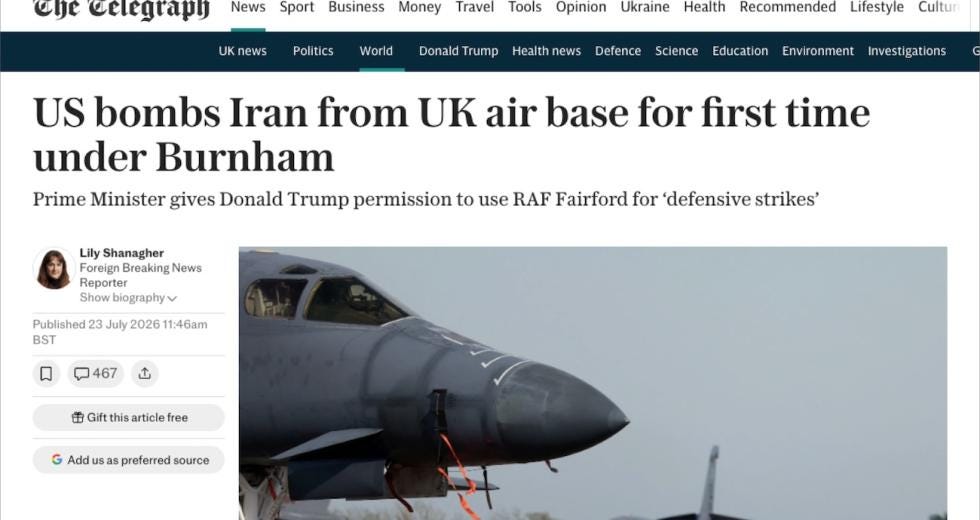
In the recent resumption of daily US attacks on Iran, it has been reported that the planes dropping the bombs have come from RAF Fairford in Gloucestershire.
One thing connecting all these incidents is that the bombs in the long range bombers came from a little-known location in the sleepy Berkshire countryside. Perhaps it’s surprising to learn that the RAF were involved, but here’s the thing: Welford is not an RAF base any more. Rather, it’s the largest US bomb arsenal in the UK, and the second largest in Europe. The bombs stored here are transported by road to RAF Fairford where they are loaded onto long-range B-1 and B-52 bombers.
Mainstream reporting by the BBC as well as in independent media like the Canary and Declassified UK have all described the goings on at RAF Fairford. But hardly anyone seems to know about the secret munitions dump only miles away. Let’s examine what’s been going on there.
The Base
RAF Welford used to be a functioning air force base with three runways laid out to form an intersecting triangular pattern. Aerial photographs from the 1940s show the base clearly, but it has not functioned as an airstrip for many years. The US Air Force doesn’t fly in here, either — in fact, they dug up the runways and replaced them with a myriad of cavernous underground bomb silos.
The base is referred to as secret in part because there are opaque signs on the motorway indicating ‘Works unit only’, with no further information. Before 2015 these signs were edged in red, an indication, at least, that the destination was a military installation. Reviewing data from Google Street View indicates that the signs were changed between April 2015 and September 2016 to the current blue colour indicating, deceptively, a civilian installation.
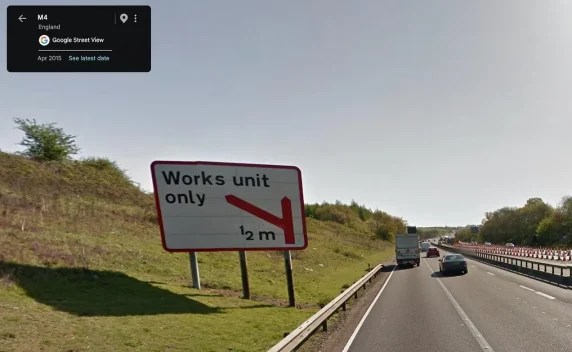
The previous, less deceptive, sign. Image: Google Street View, April 2015.

The replacement sign. Image: Google Street View, September 2016.
Munitions stored at, or supplied from, RAF Welford have supported USAF bomber operations from RAF Fairford in multiple conflicts, including the 1991 Gulf War (Operation Desert Storm) and the 2003 illegal invasion of Iraq, plus operations in Afghanistan, Syria, and elsewhere. Operations against Iranian targets in 2026 have involved bunker-busting and precision-guided bombs loaded for B-1B missions and launched from Fairford.
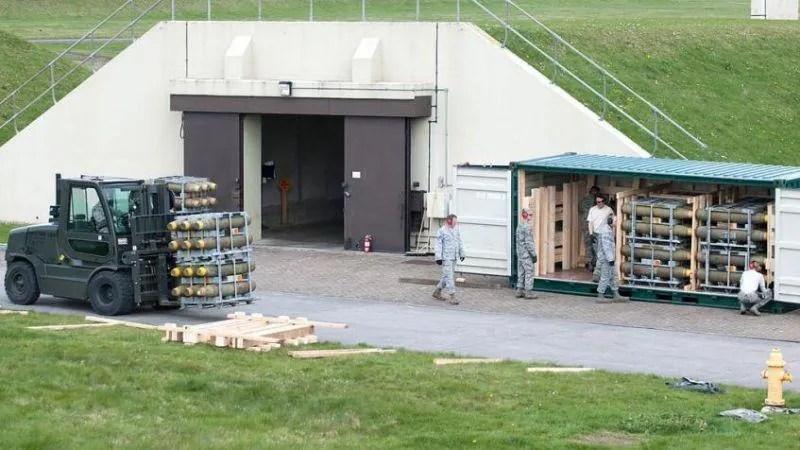
Bombs being loaded at RAF Welford
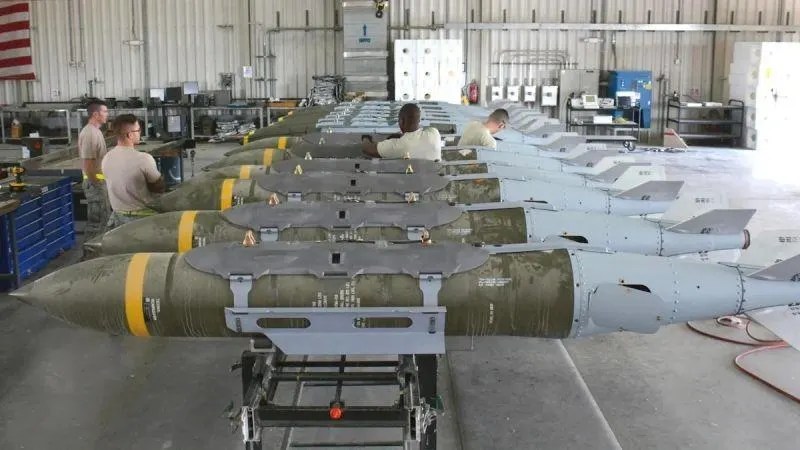
These JDAMs are among the types of bomb loaded at RAF Fairford. Image: USAF
The massive stockpiles of bombs at Welford are looked after by the USAF 420th Munitions Squadron, part of the 501st Combat Support Wing which is headquartered at RAF Fairford. Welford functions as the second largest conventional munitions storage area in Europe and one of the largest heavy munitions compounds for the entire United States Air Forces in Europe–Air Forces Africa (USAFE-AFAFRICA).
In May 2019, the USAF moved 450,000 pounds (200 tonnes) of explosives to the site which hides a huge variety of bombs. They include three key types — ‘smart’, ‘dumb’ and ‘stand off’:
- ‘Iron’ or ‘dumb’ bombs (Mk 82/Mk 84 ): 500-pound/2,000-pound unguided general-purpose bombs. Blast/fragmentation for troops, vehicles, buildings, rail yards, infrastructure.
- Joint Direct Attack Munition or ‘smart’ bombs (technically GBU-31 JDAM): These are GPS-guided 2,000-pound ‘precision’ bombs. They are essentially an add-on to ‘dumb’ bombs to make them more accurate. They can also use BLU-109 penetrator add-ons — so called ‘bunker busters’ — for hardened bunkers/underground facilities. Intended for military bunkers, infrastructure, fixed/relocatable targets. These, of course, were responsible for the attacks on civilian infrastructure and the inevitable civilian casualties caused.
- Joint Air-to-Surface Standoff Missile (AGM-158 JASSM): Stealthy long-range stand-off cruise missile for high-value, defended military targets from range. The US uses these if they want to avoid Iranian air defences and the possibility of their planes being shot down, as started to happen in April this year.
RAF Welford is directly linked to RAF Fairford, the USAF’s primary bomber forward operating location in Europe. The 420th Munitions Squadron at Welford supplies munitions to bombers (including B-1, B-2 and B-52 bombers) deployed at Fairford, enabling heavy bombing missions. Moves occur when heavy bombers (B-1B, B-52) deploy to RAF Fairford for exercises or operations. Bombs are then fitted with JDAM kits and loaded onto aircraft.
These munitions and bombs are routinely transported by road between RAF Welford and Fairford, which lie on opposite sides of Swindon. Convoys — reportedly highly secure with armed escorts — travel west via the M4 motorway, a distance of approximately 32 miles. Movements often take place at night with no identifying markings on vehicles for operational security.
However, quite strict rules apply to transporting bombs on British streets and motorways! Military high explosives (UN Class 1) moved by road from RAF Welford to RAF Fairford are regulated under the Ministry of Defence Explosives Regulations (JSP 482) and JSP 800 Volume 4b (Transport of Dangerous Goods by Road).
Convoy vehicles on the M4 are required to display plain orange plates at the front and rear of each transport unit, along with explosive hazard placards (Class 1 diamonds) on both sides and the rear. It’s not clear whether these rules are always adhered to.
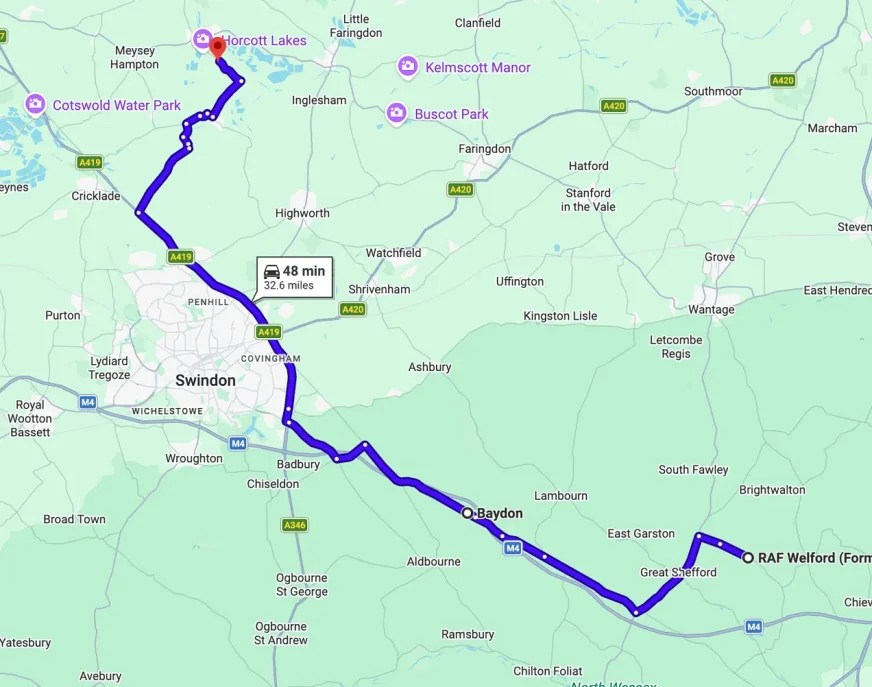
The route from RAF Welford to RAF Fairford is fairly restrictive and predictable. Image: Google Maps
Within Range?
According to the Islamic Revolutionary Guard Corps, the Islamic Republic has deliberately capped its missile range at 2,000 km. If this policy has not been changed, it would be difficult for the IRGC to eliminate the USAF’s UK bunkers of death with a missile attack. That’s because RAF Welford is some 4,035 km from Tabriz in north-west Iran, the closest location from which missiles might be fired. Nevertheless, as a result of Burnham’s reckless decision, the Iranian Foreign Minister has now announced that these bases are legitimate targets for Iran.
Andy Burnham has put British citizens at risk.
RAF Welford is not, however, beyond the range of anti-war campaigners in England. Newbury is less than 10 miles away. Reading, Oxford, and Swindon are less than 30 miles away, Bristol 58 miles, and central London less than 70 miles.
A quick examination of Google Maps shows that when US bombs leave Welford they need to take country roads and can only access the M4 heading west at Junction 14, Shefford Woodlands. They likely then leave the motorway at Junction 15, Badbury, onto the A419. It should not be too difficult to find ways to mount effective demonstrations or blockades to markedly interfere with the smooth supply of death-dealing to US bombers.
No bombs on the planes means no bombs on civilian heads.
You know what to do.
Featured Video

The Search for Truth: Charlie Kirk’s Assassination One Year Later
or go to
Aletho News Archives – Video-Images
From the Archives
The 9/11 “Double-Cross” Conspiracy Theory
BY LAURENT GUYÉNOT • UNZ REVIEW • SEPTEMBER 6, 2022
Is it true that “9/11 was an inside job”? Yes, insofar as Israel is “inside” the U.S. But for the 9/11 truthers who have identified Israel as the main perpetrators, “9/11 was an inside job” is at best a half-truth, and at worst an integral part of the Zionist operation, like a secondary flag sewn as a lining under the false flag of Islamism. Victor Thorn (1963-2017) wrote in his book 9/11 made in Israel: The Plot Against America (2011): “In essence, the ‘9-11 truth movement’ was created prior to Sept. 11, 2001 as a means of suppressing news relating to Israeli complicity. . . . The slogan ‘9-11 was an inside job’ was quite possibly the greatest example of Israeli propaganda ever devised.” In milder terms, it is “controlled opposition”.
A genuine truth movement would have pointed to Israel as the prime suspect from the start. From day one, it was obvious who would benefit. … continue
Blog Roll
 Aletho News
- Europe’s mounting social chaos… chickens coming home to roost for proxy war against Russia
- US-Russia Diesel Deal Becomes Massive Defeat for Ukraine
- Hormuz and the Looming Economic Catastrophe
- Dhubab offensive, media blitz and the rapid unraveling of Saudi-backed coalition’s new gambit
- Putin Conveys to Trump Iran’s Vision on Possible Conflict Resolution – Kremlin
- The Search for Truth: Charlie Kirk’s Assassination One Year Later
- ‘Harsh reality’: Iran says France seeks monopoly on power and intimidation, not peace for all
- When Will This White House Madness End?
- Huckabee aide goes to ‘unusual lengths’ to portray ‘Israel’ positively
- Trump Announces Diesel Supply Deal With Putin Following Phone Call
- If Americans Knew
- Israeli forces kill another child in Gaza – Daily Update
- Gaza ceasefire exists in name only, say more than 100 organizations
- Nearly 2 Million in Gaza Need Urgent Shelter Assistance as Winter Looms: IOM Chief Warns
- Suppressing Palestinian resistance: US charity under fire for AI monitoring of Gaza classrooms
- Thousands Are Held in Israeli Torture Camps. This Is What Happens Inside
- Israel puts Gaza’s sick, injured, newborn in peril – Daily Update
- Report claimed Mark Levin used by Israeli government to influence Trump
- Over 2,000 Gazans have died awaiting medical evacuation amid Israel’s continued siege
- How a U.S. Diplomat Suppressed and Altered Reports Critical of Israel
- 5 Palestinians Die from Israeli Strikes in Gaza as Relentless Attacks Continue
- No Tricks Zone
- New Study: 50 Years Of The Most Aggressive ‘Net Zero’ Policies Can Only Affect The Global Climate By 0.03°C
- US September “Heat” Was No Record…Many Records Set Decades Ago
- Latest European Green Energy Debacle; Portugal’s Largest Flagship Solar Park Insolvent!
- Green Energy Debacle: German Expert Professor Fritz Vahrenholt Warns Of Severe Economic And Social Consequences
- Two More Paleo Reconstructions Affirm Meters-Higher Sea Levels Across Ireland, Brazil 7000-6000 Years Ago
- New Study: Earth And Venus Surface Warmth Largely Explained By Convection And Lapse Rate, Not CO2 Or Radiation
- 2025 Nature Paper Claiming Worsening Global Drought Gets RETRACTED …Heavily Flawed
- New Study: ‘Global Drought Shows No Detectable Recent Acceleration Under Climate Warming’
- Economic Masterminds: German Socialists Suggest Taxing Productivity Gains Stemming From Using AI
- The South China Sea Has Not Been Cooperating With The Climate Change Narrative


