Nuclear power supporters like to say, “Nuclear waste disposal is a political, not a scientific problem.” Scientists refute this slogan every day.
A case in point is the Canadian Environment Minister’s second “do over” order issued to Ontario Power Generation regarding the company’s waste dump idea. The 15-page order, issued April 5, rejected the company’s sophomoric answers to a previous “not good enough” finding by Canada’s Minister of Environment and Climate Change, Catherine McKenna.
OPG wants to bury 7 million cubic feet of radioactive waste in a deep hole less than a mile from Lake Huron, on its own property on the Bruce Peninsula, northwest of Toronto. It’s there that OPG runs the world’s biggest rad’ waste production complex — the Bruce Nuclear Station — eight old power reactors in varying states of repair and disrepair.
The company proposes digging 2,231 feet down into part of its 2,300-acre compound on Lake Huron, and burying all sorts of radioactive material (everything except waste fuel rods), including a “significant amount” of carbon-14, a cancer agent with a deadly radioactive “life” of 57,300 years — i.e. ten 5,730-year radioactive half-lives. After two years of public hearings into the question of placing long-lasting poisons next to a major source of drinking water, a federal Joint Review Panel in 2015 recommended approval of the project to Minister McKenna.
McKenna was to make a decision by March 1, 2016, but instead demanded better work from OPG. On Feb. 18, 2016, the Minister ordered the company to produce details about alternate dump sites. OPG submitted shockingly shabby generalizations Dec. 28, 2016, and McKenna’s April 5 reply is an understated denunciation of OPG’s obfuscations and evasions. Beverly Fernandez, founder of Stop the Great Lakes Nuclear Dump, told Clinton, Michigan’s The Voice, “OPG has been given a failing grade on its most recent report regarding burying its radioactive nuclear waste less than a mile from the Great Lakes. OPG has now been issued a strong set of new challenges to answer.”
For example, the company has the nerve to [state] that, “All underground facilities (office, tunnel, emplacement room) will be constructed in accordance with the seismic requirements of the latest edition of the National Building Code at the time of the construction.” In fact, as the Minister’s rejection of OPG’s attempted snow-job pointed out, “There are no specific seismic requirements in the National Building Code for underground facilities…. Provide a revised version…”
A public servant doing her job
In requiring a study of alternate potential sites for deep disposal, Minister McKenna ordered OPG to make “specific reference to actual locations.” Instead, OPG tried to get away with citing two enormous geological regions that it said might be suitable. As Jennifer Wells and Matthew Cole reported in the Toronto Star, OPG’s “actual locations” covered an area of 726,052-square-kilometres — about 75% of the Province of Ontario. This blatant attempt at scamming the government didn’t fool McKenna, a public servant who is actually doing her job.
In one of OPG’s more garish displays of environmental racism, the company’s Dec. 2016 report failed to analyze or even acknowledge the land use Treaty Rights of Indigenous or First Nation peoples. Minister McKenna’s April 5 rebuke rightly demands that OPG provide “a description of the land and resource uses for the alternative locations that highlight the unique characteristics of these locations from the perspective of Indigenous peoples.
McKenna’s lengthy critique amounts to “strike two” against OPG, and the Minister’s refutation was praised by community leaders and watchdogs around the Great Lakes. So far, 187 cities, townships, counties, states and provinces in the Great Lakes Basin have passed resolutions opposing the dump. Columnist Jim Bloch in The Voice asked, “How many swings will the Canadian government give Ontario Power Generation before the firm strikes out in its request to build a nuclear waste dump on the shores of Lake Huron?” The answer may be “no more.”
As befits questions of persistent cancer agents and how to package and keep them out of drinking water for thousands of years, McKenna’s April 5 rebuke lists 23 complex and technically dumbfounding dilemmas that could doom the Lake Huron dump plan. Professor Erika Simpson at the University of Western Ontario reviewed McKenna’s critique and wrote April 7, “It will take OPG perhaps a decade to come up with all the information that is now required … given all the overwhelming problems identified.”
Beverly Fernandez summed up the opposition as well as anyone. “Given the overwhelming opposition to this plan and the potential for massive consequences to the Great Lakes, no responsible government would approve a plan that endangers the drinking water of 40 million people, and a $6 trillion Great Lakes economy.”
John LaForge is a Co-director of Nukewatch, a peace and environmental justice group in Wisconsin, and edits its newsletter.
Saturday March 11 marks the sixth anniversary of the triple-disaster in north-east Japan – the earthquake, tsunami and the Fukushima nuclear disaster.
And the news is not good. Scientists are wondering how on earth to stabilise and decontaminate the failed reactors awash with molten nuclear fuel, which are fast turning into graveyards for the radiation-hardened robots sent in to investigate them.
The Japanese government’s estimate of Fukushima compensation and clean-up costs has doubled and doubled again and now stands at ¥21.5 trillion (US$187bn; €177bn).
Indirect costs – such as fuel import costs, and losses to agricultural, fishing and tourism industries – will likely exceed that figure.
Kendra Ulrich from Greenpeace Japan notes in a new report that “for those who were impacted by the worst nuclear disaster in a generation, the crisis is far from over. And it is women and children that have borne the brunt of human rights violations resulting from it, both in the immediate aftermath and as a result of the Japan government’s nuclear resettlement policy.”
Radiation biologist Ian Fairlie summarises the health impacts from the Fukushima disaster: “In sum, the health toll from the Fukushima nuclear disaster is horrendous. At the minimum:
+ Over 160,000 people were evacuated most of them permanently.
+ Many cases of post-trauma stress disorder (PTSD), depression, and anxiety disorders arising from the evacuations.
+ About 12,000 workers exposed to high levels of radiation, some up to 250 mSv
+ An estimated 5,000 fatal cancers from radiation exposures in future.
+ Plus similar (unquantified) numbers of radiogenic strokes, CVS diseases and hereditary diseases.
+ Between 2011 and 2015, about 2,000 deaths from radiation-related evacuations due to ill-health and suicides.
+ An, as yet, unquantified number of thyroid cancers.
+ An increased infant mortality rate in 2012 and a decreased number of live births in December 2011.”
Dr Fairlie’s report was written in August 2015 but it remains accurate. More than half of the 164,000 evacuees from the nuclear disaster remain dislocated. Efforts to restore community life in numerous towns are failing. Local authorities said in January that only 13% of the evacuees in five municipalities in Fukushima Prefecture have returned home after evacuation orders were lifted.
As for Japan’s long-hyped ‘nuclear restart’: just three power reactors are operating in Japan; before the Fukushima disaster, the number topped 50.
A nuclear power ‘crisis’?
Nuclear advocates and lobbyists elsewhere are increasingly talking about the ‘crisis’ facing nuclear power – but they don’t have the myriad impacts of the Fukushima disaster in mind: they’re more concerned about catastrophic cost overruns with reactor projects in Europe and the US.
‘Environmental Progress’, another US pro-nuclear lobby group connected to Shellenberger, has a webpage dedicated to the nuclear power crisis. Among other things, it states that 151 gigawatts (GW) of worldwide nuclear power capacity (38% of the total) could be lost by 2030 (compared to 33 GW of retirements over the past decade), and over half of the ageing US reactor fleet is at risk of closure by 2030.
As a worldwide generalisation, nuclear power can’t be said to be in crisis. To take the extreme example, China’s nuclear power program isn’t in crisis – it is moving ahead at pace. Russia’s nuclear power program, to give one more example, is moving ahead at snail’s pace, but isn’t in crisis.
Nonetheless, large parts of the worldwide nuclear industry are in deep trouble. The July 2016 World Nuclear Industry Status Report provides an overview of the troubled status of nuclear power:
+ nuclear power’s share of the worldwide electricity generation is 10.7%, well down from historic peak of 17.6% in 1996;
+ nuclear power generation in 2015 was 8.2% below the historic peak in 2006; and
+ from 2000 to 2015, 646 gigawatts (GW) of wind and solar capacity (combined) were added worldwide while nuclear capacity (not including idle reactors in Japan) fell by 8 GW.
US nuclear industry in crisis
The US nuclear industry is in crisis, with a very old reactor fleet – 44 of its 99 reactors have been operating for 40 years or more – and no likelihood of new reactors for the foreseeable future other than four already under construction.
Last September, Associated Pressdescribed one of the industry’s many humiliations: “After spending more than 40 years and $5 billion on an unfinished nuclear power plant in northeastern Alabama, the nation’s largest federal utility is preparing to sell the property at a fraction of its cost.
“The Tennessee Valley Authority has set a minimum bid of $36.4 million for its Bellefonte Nuclear Plant and the 1,600 surrounding acres of waterfront property on the Tennessee River. The buyer gets two unfinished nuclear reactors, transmission lines, office and warehouse buildings, eight miles of roads, a 1,000-space parking lot and more.”
Japanese conglomerate Toshiba and its US-based nuclear subsidiary Westinghouse are in crisis because of massive cost overruns building four AP1000 reactors in the US – the combined cost overruns amount to about US$11.2bn (€10.7bn) and counting.
Toshiba said in February 2017 that it expects to book a US$6.3bn (€5.9bn) writedown on Westinghouse, on top of a US$2.3bn (€2.1bn) writedown in April 2016. The losses exceed the US$5.4bn (€5.1bn) Toshiba paid when it bought a majority stake in Westinghouse in 2006.
Toshiba says it would likely sell Westinghouse if that was an option – but there is no prospect of a buyer. Westinghouse is, as Bloomberg noted, “too much of a mess“ to sell. And since that isn’t an option, Toshiba must sell profitable businesses instead to stave off bankruptcy.
Toshiba is seeking legal advice as to whether Westinghouse should file for Chapter 11 bankruptcy. But even under a Chapter 11 filing, Reutersreported, “Toshiba could still be on the hook for up to $7 billion in contingent liabilities as it has guaranteed Westinghouse’s contractual commitments” for the US AP1000 reactors.
The Toshiba/Westinghouse crisis is creating a ripple effect. A few examples:
+ the NuGen (Toshiba/Engie) consortium has acknowledged that the plan for three AP1000 reactors at Moorside in the UK faces a “significant funding gap“ and both partners reportedly want out of the project;
+ Toshiba recently announced its intention to pull out of the plan for two Advanced Boiling Water Reactors at the South Texas Plant, having booked writedowns totaling US$638m (€605m) on the project in previous years.
The French nuclear industry is in crisis
The French nuclear industry is in its “worst situation ever“, former EDF director Gérard Magnin said in November 2016. The French government is selling assets so it can prop up its heavily indebted nuclear utilities Areva and EDF.
The current taxpayer-funded rescue of the nuclear power industry may cost the French state as much as €10bn (US$10.5bn), Reutersreported in January, and in addition to its “dire financial state, Areva is beset by technical, regulatory and legal problems.”
France has 58 operable reactors and just one under construction. French EPR reactors under construction in France and Finland are three times over budget – the combined cost overruns for the two reactors amount to about€12.7bn (US$13.4bn).
Bloomberg noted in April 2015 that Areva’s EPR export ambitions are “in tatters“. Now Areva itself is in tatters and is in the process of a government-led restructure and another taxpayer-funded bailout.
On March 1, Areva posted a €665m (US$700m) net loss for 2016. Losses in the preceding five years exceeded €10bn (US$10.5 bn). A large majority of a €5bn (US$5.3bn) recapitalisation of Areva scheduled for June 2017 will come from French taxpayers.
On February 14, EDF released its financial figures for 2016: earnings fell 6.7%, revenue declined 5.1%, net income excluding non-recurring items fell 15%, and EDF’s debt remained steady at €37.4bn (US$39.4bn). All that EDF chief executive Jean-Bernard Levy could offer was the hope that EDF would “hit the bottom of the cycle“ in 2017 and rebound next year.
EDF plans to sell €10bn (US$10.5 bn) of assets by 2020 to rein in its debt, and to sack up to 7,000 staff. The French government provided EDF with €3bn (US$3.2bn) in extra capital in 2016 and will contribute €3bn towards a €4bn (US$4.2bn) capital raising this year.
On March 8, shares in EDF hit an all-time low a day after the €4bn capital raising was launched; the stock price fell to €7.78, less than one-tenth of the €86.45 high a decade ago.
Costs of between €50bn and €100bn (US$53-106bn) will need to be spent by 2030 to meet new safety requirements for reactors in France and to extend their operating lives beyond 40 years.
EDF has set aside €23bn (US$24.3bn) to cover reactor decommissioning and waste management costs in France – less than half of the €54bn (US$57bn) that EDF estimates will be required. A recent report by the French National Assembly’s Commission for Sustainable Development and Regional Development concluded that there is “obvious under-provisioning” and that decommissioning and waste management will likely take longer, be more challenging and cost much more than EDF anticipates.
EDF is being forced to take over parts of its struggling sibling Areva’s operations – a fate you wouldn’t wish on your worst enemy. And just when it seemed that things couldn’t get any worse for EDF, a fire took hold in the turbine room of one of the Flamanville reactors on February 9 and the reactor will likely be offline until late March at an estimated cost of roughly €1.2m (US$1.27m) per day.
Half of the world’s nuclear industry is in crisis and/or shutting down
Combined, the crisis-ridden US, French and Japanese nuclear industries account for 45% of the world’s ‘operable’ nuclear reactors according to the World Nuclear Association’s database, and they accounted for 50% of nuclear power generation in 2015 (and 57% in 2010).
Countries with crisis-ridden nuclear programs or phase-out policies (e.g. Germany, Belgium, and Taiwan) account for about half of the world’s operable reactors and more than half of worldwide nuclear power generation.
The Era of Nuclear Decommissioning (END)
The ageing of the global reactor fleet isn’t yet a crisis for the industry, but it is heading that way.
Perhaps the best characterisation of the global nuclear industry is that a new era is approaching – the Era of Nuclear Decommissioning (END). Nuclear power’s END will entail:
+ a slow decline in the number of operating reactors (unless growth in China can match the decline elsewhere);
+ countless battles over lifespan extensions for ageing reactors;
+ an internationalisation of anti-nuclear opposition as neighbouring countries object to the continued operation of ageing reactors (international opposition to Belgium’s reactors is a case in point);
+ a broadening of anti-nuclear opposition as citizens are increasingly supported by local, regional and national governments opposed to reactors in neighbouring countries (again Belgium is a case in point, as is Lithuanian opposition to reactors under construction in Belarus);
+ many battles over the nature and timing of decommissioning operations;
+ many battles over taxpayer bailouts for companies and utilities that haven’t set aside adequate funding for decommissioning;
+ more battles over proposals to impose nuclear waste repositories on unwilling or divided communities; and
+ battles over taxpayer bailouts for companies and utilities that haven’t set aside adequate funding for nuclear waste disposal.
As discussed in a previous article in The Ecologist, nuclear power is likely to enjoy a small, short-lived upswing in the next couple of years as reactors ordered in the few years before the Fukushima disaster come online. Beyond that, the Era of Nuclear Decommissioning sets in, characterised by escalating battles – and escalating sticker-shock – over lifespan extensions, decommissioning and nuclear waste management.
In those circumstances, it will become even more difficult than it currently is for the industry to pursue new reactor projects. A positive feedback loop could take hold and then the industry will be well and truly in crisis.
Nuclear lobbyists debate possible solutions to the nuclear power crisis
Michael Shellenberger from the Breakthrough Institute argues that a lack of standardisation and scaling partly explains the “crisis that threatens the death of nuclear energy in the West”. The constant switching of designs deprives the people who build, operate and regulate nuclear plants of the experience they need to become more efficient.
Shellenberger further argues that there is too much focus on machines, too little on human factors:
“Areva, Toshiba-Westinghouse and others claimed their new designs would be safer and thus, at least eventually, cheaper, but there were always strong reasons to doubt such claims. First, what is proven to make nuclear plants safer is experience, not new designs. …
“In fact, new designs risk depriving managers and workers the experience they need to operate plants more safely, just as it deprives construction companies the experience they need to build plants more rapidly.”
1/ ‘Consolidate or Die’: “If nuclear is going to survive in the West, it needs a single, large firm – the equivalent of a Boeing or Airbus – to compete against the Koreans, Chinese and Russians.”
2/ ‘Standardize or Die’: He draws attention to the “astonishing” heterogeneity of planned reactors in the UK and says the UK “should scrap all existing plans and start from a blank piece of paper”, that all new plants should be of the same design and “the criteria for choosing the design should emphasize experience in construction and operation, since that is the key factor for lowering costs.”
3/ ‘Scale or Die’: Nations “must work together to develop a long-term plan for new nuclear plant construction to achieve economies of scale”, and governments “should invest directly or provide low-cost loans.”
Wrong lessons
Josh Freed and Todd Allen from pro-nuclear lobby group Third Way, and Ted Nordhaus and Jessica Lovering from the Breakthrough Institute, argue that Shellenberger draws the wrong lessons from Toshiba’s recent losses and from nuclear power’s “longer-term struggles” in developed economies.
They argue that “too little innovation, not too much, is the reason that the industry is on life support in the United States and other developed economies”. They state that:
+ The Westinghouse AP1000 represents a fairly straightforward evolution in light-water reactor design, not a radical departure as Shellenberger claims.
+ Standardisation is important but it is not a panacea. Standardisation and building multiple reactors on the same site has limited cost escalation, not brought costs down.
+ Most of the causes of rising cost and construction delays associated with new nuclear builds in the US are attributable to the 30-year hiatus in nuclear construction, not the novelty of the AP1000 design.
+ Reasonable regulatory reform will not dramatically reduce the cost of new light-water reactors, as Shellenberger suggests.
They write this obituary for large light-water reactors: “If there is one central lesson to be learned from the delays and cost overruns that have plagued recent builds in the US and Europe, it is that the era of building large fleets of light-water reactors is over in much of the developed world.
“From a climate and clean energy perspective, it is essential that we keep existing reactors online as long as possible. But slow demand growth in developed world markets makes ten billion dollar, sixty-year investments in future electricity demand a poor bet for utilities, investors, and ratepayers.”
A radical break
The four Third Way / Breakthrough Institute authors conclude that “a radical break from the present light-water regime … will be necessary to revive the nuclear industry”. Exactly what that means, the authors said, would be the subject of a follow-up article.
The answers came in a follow-up article on February 28. The four authors want a thousand flowers to bloom, a bottom-up R&D-led nuclear recovery as opposed to top-down, state-led innovation.
They don’t just want a new reactor type (or types), they have much greater ambitions for innovation in “nuclear technology, business models, and the underlying structure of the sector” and they note that “a radical break from the light water regime that would enable this sort of innovation is not a small undertaking and will require a major reorganization of the nuclear sector.”
To the extent that the four authors want to tear down the existing nuclear industry and replace it with a new one, they share some common ground with nuclear critics who want to tear down the existing nuclear industry and not replace it with a new one.
Shellenberger also shares some common ground with nuclear critics: he thinks the UK should scrap all existing plans for new reactors and “start from a blank piece of paper“. But nuclear critics think the UK should scrap all existing plans for new reactors and not start from a blank piece of paper.
Small is beautiful?
The four Third Way / Breakthrough Institute authors argue that nuclear power must become substantially cheaper – thus ruling out large conventional reactors “operated at high atmospheric pressures, requiring enormous containment structures, multiply redundant back-up cooling systems, and water cooling towers and ponds, which account for much of the cost associated with building light-water reactors.”
Substantial cost reductions will not be possible “so long as nuclear reactors must be constructed on site one gigawatt at a time. … At 10 MW or 100 MW, by contrast, there is ample opportunity for learning by doing and economies of multiples for several reactor classes and designs, even in the absence of rapid demand growth or geopolitical imperatives.”
Other than their promotion of small reactors and their rejection of large ones, the four authors are non-specific about their preferred reactor types. Any number of small-reactor concepts have been proposed.
Small modular reactors (SMRs) have been the subject of much discussion and even more hype. The bottom line is that there isn’t the slightest chance that they will fulfil the ambition of making nuclear power “substantially cheaper” unless and until a manufacturing supply chain is established at vast expense.
And even then, it’s doubtful whether the power would be cheaper and highly unlikely that it would be substantially cheaper. After all, economics has driven the long-term drift towards larger reactors.
As things stand, no country, company or utility has any intention of betting billions on building an SMR supply chain. The prevailing scepticism is evident in a February 2017 Lloyd’s Register report based on “insights and opinions of leaders across the sector” and the views of almost 600 professionals and experts from utilities, distributors, operators and equipment manufacturers.
The Lloyd’s Register report states that the potential contribution of SMRs “is unclear at this stage, although its impact will most likely apply to smaller grids and isolated markets.” Respondents predicted that SMRs have a “low likelihood of eventual take-up, and will have a minimal impact when they do arrive”.
The Third Way / Breakthrough Institute authors are promoting small reactors because of the spectacular failure of a number of large reactor projects, but that’s hardly a recipe for success. An analysis of SMRs in the Bulletin of the Atomic Scientists sums up the problems:
“Without a clear-cut case for their advantages, it seems that small nuclear modular reactors are a solution looking for a problem. Of course in the world of digital innovation, this kind of upside-down relationship between solution and problem is pretty normal. Smart phones, Twitter, and high-definition television all began as solutions looking for problems.
“In the realm of nuclear technology, however, the enormous expense required to launch a new model as well as the built-in dangers of nuclear fission require a more straightforward relationship between problem and solution. Small modular nuclear reactors may be attractive, but they will not, in themselves, offer satisfactory solutions to the most pressing problems of nuclear energy: high cost, safety, and weapons proliferation.”
Small or large reactors, consolidation or innovation, Generation 2/3/4 reactors … it’s not clear that the nuclear industry will be able to recover – however it responds to its current crisis.
Dr Jim Green is the national nuclear campaigner with Friends of the Earth Australia and editor of the Nuclear Monitor newsletter, where a longer version of this article was originally published. jim.green@foe.org.au
Nuclear Monitor, published 20 times a year, has been publishing deeply researched, often critical articles on all aspects of the nuclear cycle since 1978.
The chairman of Japanese multinational Toshiba, Shigenori Shiga resigned on Tuesday, taking responsibility for the company’s multi-billion dollar losses in the troubled US nuclear power business.
He will step down from the board but will remain a Toshiba executive.
According to Associated Press, Toshiba announced it is on track to report a net loss of $3.4 billion (390 billion yen) in the current fiscal year that ends in March 2017. It also warned the estimated loss may change “by a wide margin,” projecting a $6.3 billion (712.5 billion yen) loss for its nuclear business. That was related to the acquisition of a nuclear construction firm by its Westinghouse unit.
Toshiba stock tumbled eight percent in Tokyo trading after the announcement.
In December, Toshiba said it might write down billions of dollars in losses following Westinghouse’s announcement that costs had significantly surpassed estimates.
According to the Japanese company’s president Satoshi Tsunakawa, Toshiba won’t take on new projects to construct nuclear plants. He said the company was looking for potential partners to acquire a stake in Westinghouse.
Toshiba said it hopes to fix the situation by selling its flash memory business and other assets.
The Japanese conglomerate has been grappling with an accounting scandal in which it admitted doctoring financial results to meet unrealistic profit targets.
“It is so unfortunate that this has happened,” a company director Ryoji Sato told reporters about the company’s promises to come clean. “We must keep trying to do better.”
Founded in 1875, Toshiba employs almost 200,000 people. Its business includes household appliances, railways, hydrogen energy and elevator systems.
Tokyo Electric Power Company (Tepco), the owner and operator of the now-defunct Fukushima-1 nuclear plant in Japan, had to pull its toughest radiation-resistant robot out of its Unit 2 reactor prematurely. The robot, built to withstand up to 1000 Sv/hr, failed to last the projected two hours inside the reactor, before starting to glitch.
As Sputnik reported earlier, Fukushima-1 Unit 2 reactor radiation readings had been estimated at “unimaginable” levels of 530 Sv/hr. This level of radiation is beyond extreme, even in comparison to the inside of the Chernobyl reactor, where radiation levels are ‘only’ 34 Sv/hr. The Chernobyl radiation levels are high enough to cause death in humans in about 20 minutes, and Fukushima’s earlier estimation, of 530 Sv/hr, is likely to kill a man in moments. Alarmingly, it is also more than powerful enough to kill purpose-built radiation-protected robots.
Tepco has previously lost five, less-shielded robots inside the Fukushima reactor. While earlier estimations showed 74 Sv/hr readings, Tepco, charged with decommissioning the destroyed facility, has been unpleasantly surprised to find that radiation levels underneath the reactor have spiked, due, in part, to nuclear fuel believed to have melted out of the reactor core. As a result, the company ordered the toughest robot available to clear the way for cleanup machines. Intended to function for two hours, Tepco pulled the machine prematurely, as its cameras developed noise and the image became too dark to use.
Radiation levels inside the damaged reactor are much higher than previously estimated, according to reports. Judging by camera noise and overall operation time, the team has increased its estimation to 650 Sv/hr. The robot failed to complete its mission of removing debris, including, it is thought, the remains of previous robots, inside the reactor chamber, and now the next robot to be sent inside will have less time to perform its job. The process of decommissioning the nuclear plant is expected to take at least 40 years, and cannot begin before a full assessment of the damage.
Tepco has reported that they have only acquired images of the reactor chamber, showing damaged structures, coated with molten material, possibly mixed with molten nuclear fuel. The robot was able to acquire images of a part of a disc platform that was located below the reactor core that had been melted through. This discovery supported earlier speculation that nuclear fuel has found its way outside of the reactor. Tepco continues to assert that no radiation is leaking outside of the building.
There are many shoes still to drop at Fukushima Daiichi, said Kevin Kamps, radioactive waste monitor at Beyond Nuclear. If something goes wrong with the radioactive waste storage pools, there could be a release of high-level radioactivity into the air, he added.
Radiation at Fukushima’s nuclear power plant is at its highest level since the tsunami-triggered meltdown nearly six years ago. Tokyo Electric Power Company (TEPCO) is reporting atmospheric readings inside Daiichi’s reactor No.2 are as high as 530 sieverts an hour, while a human exposed to a single dose of 10 sieverts would die in a couple of weeks.
RT: Can you explain what is likely going on here?
Kevin Kamps: This catastrophe that is ongoing is nearly six years old at this point. The fuel, the melted cores have been missing an action. TEPCO doesn’t know where they are; the Japanese government doesn’t know where they are; nobody knows where they are. What could have happened is these probes, these cameras, these robots, these radiation monitors that are being sent in by TEPCO to try to figure out what is going on, may have encountered the closest they have come yet to these melted cores. They may even have come upon melted fuel that is not under water, and water serves as a radiation shielding. So if this is an open area and there is no water – that could explain.
But what you’ve got are melted reactor cores. Of course, human beings can’t be in operating atomic reactors. They also can’t be in this area where there is a meltdown. There is also imagery – it looks like a melt through of a metal grade. It all stands to reason that the cores melted through the reactor pressure vessels and down into the containment structures right through that metal grating.
It is not unexpected, but we still don’t know where the cores are. There are claims that “it’s all contained, don’t worry about it.” It is indisputable that there is a daily flow of radioactively contaminated groundwater into the ocean. The figures something like 80,000 gallons per day of relatively low-level radioactive waste water. Then you’ve got those storage tanks – we’re talking 800,000 tons of highly radioactive water stored in tanks. Every day they pour a hundred tons of water on each of these three melted down cores. Sometimes they lose those tanks. They leak, they overflow – it is an ongoing catastrophe.
RT: So the contamination, in this case, could leak out, couldn’t it?
KK: There is some leakage on a daily basis. Then they try to capture as much as they can and contain it in the storage tanks, which they sometimes lose, whether during a typhoon or through human error – they have had overflows. So many shoes can still drop at Fukushima Daiichi. One of the ones is the high radioactive waste storage pools that aren’t even inside radiological containment. They don’t have all of that spent nuclear fuel transferred to a safer location in a couple of the units still. If something were to go wrong with that – those would be open air releases of very high-level radioactivity.
The prime minister at the time the catastrophe began, [Naoto] Kan, had a contingency plan to evacuate all of North-East Japan – up to 50 million people. It was predominantly because of those storage pools. We’re still in that predicament- if one of those pools were to go up in flames. As Tokyo plans to host the 2020 Olympics and bring in many millions of extra people into this already densely populated area -it is not a good idea.
RT: Going back to this specific leak: how does this complicate the cleanup efforts there? Is it possible even to get something in there right now to examine what is going on?
KK: State of the art robotic technology – Japan is a leader in robotics – can only last so long, because the electronics get fried by the gamma radiation, and probably neutron radiation that is in there. That is the situation deep in there. They are already saying it will take 40 years to so-called decommission this, but that may be optimistic.
RT:Also in December the government said it is going to take twice as much money – nearly twice as much as they originally thought – to decommission that. Does this make matters ever worse – this leak? Or is this just kind of the situation to expect at this point?
KK: It just shows how dire the situation is. The figures of $150 billion to decommission – I have seen figures from a think tank in Japan sided by Green Peace Japan up to $600 billion. If you do full cost accounting: where is this high-level radioactive waste going to go? It is going to need a deep geological depository. You have to build that and operate it. That costs a hundred billion or more. So when you do full cost accounting, this catastrophe could cost hundreds of billions of dollars to recover from. We’re just in the beginning.
Work has been halted on two rulemaking projects that would have reduced the amount of radiation the government permits workers and the public to be exposed to without their consent. The improved limits would have been in line with internationally accepted standards, Bloomberg BNA reports. A Nuclear Regulatory Commission announcement says stopping the process of setting stricter radiation exposure limits was “due to the high costs of implementing such changes.” The purpose of the NRC is to protect public and nuclear worker health and safety, but this time it’s just saving money for the nuclear industry.
The cancellation of two unfinished and long-overdue precautionary improvements, noted in the Dec. 27 Federal Register, came as a shock to nuclear industry watchdogs who have campaigned for increased radiation protection since 1990. That year, the International Commission on Radiological Protection (ICRP) recommended that radiation industry worker exposures be reduced by three-fifths, from 50 milliSieverts per year to 20 milliSieverts per year. (A milliSieverts is a measure of the body’s absorption of radiation.) The recommendation has never adopted by the United States. Based in Ottawa, Ontario, ICRP sets standards used worldwide as the basis for radiological protection, working to reduce cancer and other diseases caused by radiation exposure.
Ed Lyman, with the Union of Concerned Scientists, told Bloomberg BNA the termination of these projects “makes the US look out of step with the rest of the world. It makes it look like we’re basing our regulations on obsolete information.” Jerry Hiatt, with the industry lobbying group Nuclear Energy Institute, was relieved by the NRC move telling Bloomberg that existing rules were adequate, and that it’s unnecessary to reduce currently permitted exposures.
The rulemaking project was begun by the NRC staff in 2008 and was intended to update the country’s radiation protection standards in accordance with ICRP’s international standards, primarily with respect to radiation dose. The NRC staff had previously recommended that the commission reduce the total radiation worker exposure from 50 milliSieverts-per-year to 20 milliSieverts-per-year — in line with the ICRP’s 1990 global recommendation. However, the NRC rejected the recommendation.
The NRC’s decision not to align permitted radiation exposures with those of the ICRP is the equivalent of “throwing out one of the most significant changes to get the US in step with the rest of the world,” Lyman said. The commission formally approved the stop-work orders in April, but it only notified the public on Dec. 27.
The NRC also decided to stop work on a second rulemaking which would have brought the US in line with international rules regarding daily releases of radioactive waste water from nuclear reactors. By way of explanation, the NRC said, its current standard “continues to provide adequate protection of the health and safety of workers, the public and the environment.”
Over the last 70 years, permitted radiation exposure limits for workers and the public have dramatically decreased as science has come to better understand the toxic and cancer-causing properties of low doses.
In its 2012 pamphlet “Radiation Exposure and Cancer” the NRC acknowledges that, “[A]ny increase in dose, no matter how small, results in an incremental increase in risk.” Likewise, the National Academy of Sciences, in its latest book-length report on the biological effects of ionizing radiation BEIR-VII, says: “[L]ow-dose radiation acts predominantly as a tumor-initiating agent,” and that “[T]he smallest dose has the potential to cause a small increase in risk to humans.” And the US Environmental Protection Agency agrees, “[A]ny exposure to radiation can be harmful or can increase the risk of cancer … In other words, it is assumed that no radiation exposure is completely risk free.”
But today, when the international standard dose limit is less than half what our own government allows, it’s the radiation industry shareholders that are being protected by the NRC, not public health and safety.
Join the debate on Facebook
John LaForge is a Co-director of Nukewatch, a peace and environmental justice group in Wisconsin, and edits its newsletter.
Britain’s nuclear regulator is under government investigation for reportedly dismissing several serious accidents as posing no safety risk.
The government launched the investigation after a report by the Times revealed the Office for Nuclear Regulation (ONR) has ignored serious mistakes at power plants and military bases, including the accidental discharge of a torpedo at a nuclear submarine base.
Experts accuse the regulator of being cozy with the nuclear industry and too reluctant “to frighten the horses.”
The Times reports officials at the Department for Work and Pensions (DWP), which is responsible for the ONR, are investigating the regulator following the newspaper’s disturbing revelations.
The ONR says all of its safety classifications follow international guidelines and insists it is a robust and independent regulator.
However, the rate of incidents deemed to be “of no nuclear safety significance” has increased to more than one per day over the past five years, raising questions as to how seriously the regulator is treating accidents.
Between 2012 and 2015, these incidents included at least 30 fires, a dozen leaks, three road accidents involving nuclear material, and the inadvertent discharge of a torpedo at Plymouth nuclear submarine docks.
Other serious incidents deemed to be of a no concern include the contamination of at least 15 workers with radioactive material and a complete power cut at a nuclear weapons base.
Dr David Toke, a reader in energy politics the University of Aberdeen, said the revelations indicated safety issues were a “low priority” for the ONR.
Nuclear expert Professor Stephen Thomas said the reports reinforced his suspicions that “the first priority for the ONR is not to frighten the horses.”
“Ironically, since they became an independent body rather than being part of the Health and Safety Executive [in 2014], they seem to have got worse,” Thomas told the Times.
“Independence is just a cheap and easy way for government to wash its hands of its rightful responsibility.”
The University of Greenwich academic added: “Independent regulators must be accountable to the public and if it is not through a democratically elected government, who is it through?”
Thomas said the ONR had previously ignored warnings about the safety of tending the lifespan of an old reactor design, the AGR, that is still in use in the UK, as well as the reliability of the newer EPR model reactor, which will be used at Hinkley Point C.
The world is waiting to hear what President-elect Donald Trump has in mind for governing the U.S. Among the biggest questions is what will happen to the budget for climate and energy-related activities. […]
Here’s where a number of federal agencies stand with climate and energy funding, what they spend it on, and what could be under fire after Jan. 20 when Trump takes office. The budget numbers below are based on the 2017 fiscal year budget requests for each agency or department.
Energy Department
2017 climate-related budget: $8.5 billion
What it’s spent on: Energy efficiency and renewable and nuclear energy research and development as well as science and computing. […]
Interior Department
2017 climate-related budget: $1.1 billion
What it’s spent on: Supporting scientific research and managing landscapes for climate resilience as well as expanding public access to climate-related information. The Interior Department, through the U.S. Geological Survey, funds climate science centers […]
State Department
2017 climate-related budget: $984 million
What it’s spent on: Almost anything the U.S. does about climate change on the international stage comes via the State Department. That includes committing money to the Green Climate Fund […]
NASA
2017 climate-related budget: $1.9 billion
What it’s spent on: NASA funds a variety of climate research on earth and in space. […]
Environmental Protection Agency
2017 climate-related budget: $1.1 billion
What it’s spent on: Climate and air quality research and development as well as enforcing climate rules and regulations such as the Clean Power Plan […]
National Oceanic and Atmospheric Administration
2017 climate-related research and development: $190 million
What it’s spent on: NOAA’s climate science budget funds both in-house researchers and a number of programs at universities. … Full article
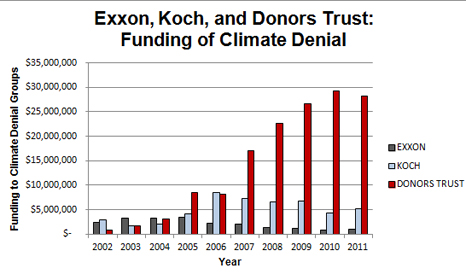
It will be difficult to bring the number down to anything approaching the amount of funding skeptics are said to get:
For China’s nuclear industry, 2016 has been a frustrating year. So far, construction has started on only one new plant, and its target of bringing 58 gigawatts of nuclear capacity in service by 2020 seems impossible to meet.
At present, China has 19.3 gigawatts of nuclear supply under construction and a further 31.4 gigawatts already in service. Given that new plants take five years or more to build, the country faces a shortfall of more than seven gigawatts on its target.
All the plants started between 2008 and 2010 are online except for six imported reactors. These include four AP1000 reactors designed by Westinghouse, based in the USA but owned by Toshiba of Japan; and two European Pressurised Reactors (EPR), developed by Areva, a French multinational group specialising in nuclear power.
The plants are not expected to be completed before 2017 and all will be at least three years late, an unprecedented delay in China’s nuclear history. It would be surprising if China was not disillusioned with its suppliers and their technologies.
Technology problems
The EPR and AP1000 reactors have been problematic to build. The two EPRs are 3-4 years late although there is little available information detailing why. Meanwhile, EPR plants in Finland and France, which should have been completed in 2009 and 2012, respectively, will not be online before 2018.
There are no obvious problems that account for the majority of the delays at any of the sites, just a series of quality and planning issues that suggest the complexity of the design makes it difficult to build.
The four AP1000s are also running 3-4 years late. They are being built by China’s State Nuclear Power Technology Company (SNPTC), which has not built reactors before. There is some publicly available information about the problems suffered in China with the AP1000s, including continual design changes by Westinghouse. The reactor coolant pumps and the squib valves, which are essential to prevent accidents, have been particularly problematic, for example.
Still, China is expected to be the first country to complete construction of AP1000 and EPR designs, a scenario it did not expect or want. The government is required to develop and demonstrate test procedures for bringing the plants into service, which could take up to a year. These test procedures are developed by vendors and generally standardised although national safety regulators must approve them and can add specific requirements.
In 2014, a senior official at China’s nuclear safety regulator, the National Nuclear Safety Administration (NNSA) complained that only a small number of test procedures had been developed for the AP1000, and no acceptance criteria had been submitted for review. He said the same issues affect the EPR.
China will likely be reluctant to commit to further AP1000s (and the CAP1400, a Chinese design modified from the AP1000) until the first of the Westinghouse designs is in service, passes its acceptance tests, and demonstrates safe, reliable operation. There are no plans to build additional EPR reactors.
In fact, state-owned China General Nuclear (CGN) and China National Nuclear Corporation (CNNC) opted instead to develop medium-sized reactors (1000 megawatts), the ACP1000 and the ACPR1000, respectively, based on Areva’s much older M310 design rather than the EPR.
Challenging circumstances
The slowdown in electricity demand growth at home has left China with surplus power-generating capacity. Nuclear is now competing against coal plants supplied with cheap fuel. Furthermore, nuclear has a lower priority for dispatch in winter than combined heat and power plants, which warm homes and factories and typically burn coal and gas.
In 2015, nuclear power accounted for only 3% of China’s electricity and at any plausible rate of building nuclear plants, it is unlikely that nuclear would achieve more than 10% of China’s electricity supply.
This year, one reactor (Hongyanhe 3) in Liaoning, operated for only 987 hours in the first quarter of 2016, just 45% of its availability, while reactors in Fujian (Fuqing) and Hainan (Changjiang) were shut down temporarily.
Another challenge is the strain placed on China’s nuclear regulators in the face of such an ambitious target. The NNSA is under particular pressure to oversee the operation of 36 plants and the construction of 20 plants, as well as being the first regulatory authority to review six new designs. Not even the US Nuclear Regulatory Commission, which monitored standards during the huge build out of the industry in the 1960s and 1970s, has faced such a workload.
Safety authorities are usually reluctant to appear critical of their international peers but in 2014, a senior French safety regulator described NNSA as “overwhelmed”, and claimed that the storage of components was “not at an adequate level”. A senior official from SNPTC said in 2015: “Our fatal weakness is our management standards are not high enough.” To build up the capabilities to support such a large construction programme a pause in ordering new plants and equipment may be necessary.
Uncertain future
The 58GW target of nuclear capacity in service by 2020 is not achievable and, like nuclear capacity targets in the past in China and elsewhere, it will be quietly revised down. The challenge for the Chinese nuclear industry is to do what no other nuclear industry worldwide has been able to do; to bring the cost of nuclear generation down to levels at which it can compete with other forms of generation, particularly renewables.
If it is unable to do this, China cannot afford to carry on ordering nuclear plants and nuclear will retain a small proportion of the electricity mix.
This leaves China’s nuclear export drive in a precarious position. Since 2013, China has turned its attention to nuclear export markets, offering apparently strong advantages over its competitors. The Chinese government can call on all the resources of China to offer a package of equipment, construction expertise, finance and training that none of its rivals, even Russia, can match.
Unlike its competitors, it also has a huge amount of recent construction experience allowing it to supply cheap, good quality equipment. Its attempt to build reactors in the UK is an important element to this strategy; convincing an experienced user of nuclear power that a Chinese plant is worth investing in is a strong endorsement of their technology.
Despite these advantages China has had little export success so far. In part, this is because there are fewer markets open to new nuclear. Such markets are typically found in developing countries where the financial risks are greater, and where governments have tried and failed to launch nuclear power programmes themselves.
It seems clear there is a political element to the Chinese nuclear export strategy, which is to gain influence and leverage in the importing countries. However, if the world nuclear market does not pick up soon, the Chinese government may decide to put its formidable resources behind other technologies that would develop influence with less economic risk. If China’s nuclear home market is not flourishing, this decision will be much easier.
Russia has suspended a post-Cold War deal with the US on disposal of plutonium from decommissioned nuclear warheads. The decision was explained by “the hostile actions of the US” against Russia and Washington’s failure to observe the terms of the deal.
A decree signed by Russian President Vladimir Putin cites “the radical change in the environment, a threat to strategic stability posed by the hostile actions of the US against Russia, and the inability of the US to deliver on the obligation to dispose of excessive weapons plutonium under international treaties, as well as the need to take swift action to defend Russian security” as justification for suspending the deal.
While Russia suspended the plutonium reprocessing deal, it stressed that the Russian fissile material, which was subject to it, would not be used for any military purpose, be it production of new weapons or research.
The suspension decree has come into force, but it needs to be approved by the Russian parliament, which may overrule the president’s decision. Leonid Slutsky, who’s slated to be appointed head of the Foreign Relations Committee in the newly-elected parliament, said it would be given a priority.
“It’s a very important issue. It’s about taking swift action to protect Russian national security. We will deal with it as soon as the bill is submitted,” he told TASS.
The development was not entirely surprising, since Russia earlier expressed its dissatisfaction with how the US wants to handle plutonium reprocessing.
Washington decided it would be cheaper to mix nuclear materials with special diluents. Russia insisted that the US was violating the terms of the deal, which required it to use a nuclear reactor to transmute plutonium. Unlike the mixing technology, the latter method makes the process irreversible.
The treaty between the US and Russia, which regulates how the two countries are to dispose of plutonium from nuclear warheads decommissioned as part of the parallel reduction of the two countries’ Cold War arsenals, was signed in 2000. Each country was required to dispose of over 34 tons of fissile material by turning it into so-called MOX fuel and burning it in nuclear reactors.
However, costs for building a facility at the Savannah River Site in South Carolina, where the US was supposed to fabricate MOX fuel from its plutonium, spiraled out of control. Under the Obama administration, the US decided that it would instead use the cheaper reversible process, arguing that it was in line with the spirit of the deal with Russia.
Russia expressed its concerns over the unilateral move in April, shortly after a nuclear security summit held in the US.
“We signed an agreement that the plutonium will be processed in a certain way, for which facilities would be purpose-built,” Putin said at the time. “We have met our commitments, and constructed the necessary facilities. The US has not.”
The US rejected the criticism from Russia. The “new US method would not require renegotiation of the agreement,” US State Department spokesperson Jennifer Bavisotto said.
“Indian Point” is a film about the long problem-plagued Indian Point nuclear power plants that are “so, so risky—so close to New York City,” notes its director and producer Ivy Meeropol. “Times Square is 35 miles away.”
The plants constitute a disaster waiting to happen threatening especially the lives of the 22 million people who live within 50 miles from them. “There is no way to evacuate—what I’ve learned about an evacuation plan is that there is none,” says Meeropol. The plants are “on two earthquake fault lines,” she notes. “And there is a natural gas pipeline right there that an earthquake could rupture.”
Meanwhile, both plants, located in Buchanan, New York along the Hudson River, are now essentially running without licenses. The federal government’s 40-year operating license for Indian Point 2 expired in 2013 and Indian Point 3’s license expired last year. Their owner, Entergy, is seeking to have them run for another 20 years—although nuclear plants were never seen as running for more than 40 years because of radioactivity embrittling metal parts and otherwise causing safety problems. (Indian Point 1 was opened in 1962 and closed in 1974, its emergency core cooling system deemed impossible to fix.)
At Indian Point 2 and 3 there have been frequent accidents and issues involving releases of radioactivity through the years. The discharges of tritium or irradiated water, H30, which cannot be filtered out of good water, into the aquifer below the Westinghouse nuclear plants and also the Hudson River have been a major concern.
But it’s not just Indian Point that “Indian Point” is about. The film emphasizes: “With so much attention focused on Indian Point, the future of nuclear plants in the United States might depend on what happens here.”
“I would give the film an ‘A.’ I wholeheartedly recommend it for wide release throughout the United States,” says Priscilla Star, founder of the Coalition Against Nukes: “It is a stellar learning tool. It depicts the David-versus-Goliath struggle involving those trying to close these decrepit nuclear plants and the profit-hungry nuclear industry. It shows grassroots activists fighting the time bombs in their community.”
The film premiered at the Tribeca Film Festival last year. For the past two weeks it has been showing five-times-a-day at the Film Society of Lincoln Center, also in Manhattan. That run will go until Thursday, July 21. On Friday, July 22, it is to open in Los Angeles. After its theatrical release, it will air on the Epix cable TV channel.
Among those in the film are anti-Indian Point activist Marilyn Elie and long-time environmental journalist Roger Witherspoon who has written extensively about Indian Point. And also Entergy employees appear. Meeropol and her crew were given full access to the nuclear plants.
The documentary provides a special focus on Dr. Gregory Jaczko. He was chairman of the U.S. Nuclear Regulatory Commission (NRC) when the Fukushima nuclear plant disaster in Japan began in March 2011. As notes Meeropol, Jaczko sought to have “lessons learned” from the Fukushima catastrophe—which involved General Electric nuclear plants—applied to nuclear power plants in the U.S. And he was given “a really tough time.” Pressure by the nuclear industry caused Jaczko, with a doctorate in physics from the University of Wisconsin, Madison, to be “pushed out” as NRC chairman and member. Meeropol tells of how “this guy, a decent person trying to do his job, was completely abused.”
Meeropol, in an interview, said the NRC “is too closely linked to the nuclear industry. It’s not going to do anything that the nuclear industry regards as too costly or onerous. I want that to be one of the biggest takeaways from the film—how a regulatory body cares more about the industry it is supposed to regulate than the public. And of all industries that should be regulated, it’s the nuclear power industry.” She said she found the nuclear industry and nuclear energy officials in the U.S. government “one and the same.”
Meeropol began the “Indian Point” film project in January 2011. She had moved from Brooklyn up to the Hudson Valley “a decade ago when our son was born. Commuting in and out of the city on the Metro-North train, I went right past the plants. They looked so foreboding and odd there in that beautiful landscape.”
Also, until she, her husband and son moved upstate, “having lived in New York City, I had no idea how close they were to the city.”
Further, in the community where they went to live, Cold Spring, 15 miles from the plants. “we could hear the [emergency] sirens” from the plants and she was unsettled receiving in the mail an “emergency preparedness booklet titled: ‘Are You Ready?’”
So the experienced filmmaker started doing research on the “dangerous endeavor of making nuclear energy.” With the Fukushima disaster beginning just a few months after she started on the film, that “broadened” its perspective.
She said the films she has made have always been “character-driven” and she was attracted to feature in “Indian Point” Marilyn Elie—“she knows her stuff”—and Roger Witherspoon. “I liked his dynamic. He is a journalist. She is an activist.” She stressed to Entergy officials that she would be even-handed “and quite amazingly was given access” to the plants. Her connecting with Jaczko was crucial. It “became my crusade to redeem Greg Jaczko before the world.”
She started making the film on a shoe string. “I ran out of money numerous times.” But she was able to get financial support from the Sundance Institute, the New York Foundation for the Arts and the Catapult Fund, and individual contributions. And “partnering” with Julie Goldman, founder of Motto Films, was extremely important. Goldman is also producer of “Indian Point.” A “very generous grant” was received from the MacArthur Foundation which also “opened up other doors.”
The avidly pro-nuclear New York Times (its pro-Indian Point editorials never cease and its last reporter who long covered the plants and the nuclear industry has now gone on to a job with the PR arm of the industry) said in its review: “’Indian Point’ is a good overview of the issues, with insights into the problems of regulating the industry.” It complained about Meeropol’s being “steadfast in providing both sides.”
Meanwhile, Indian Point sits there on the Hudson, continuing with accidents and in emitting what the NRC says are “permissible” levels of radioactivity. They are highly likely candidates for a Chernobyl or Fukushima-level catastrophe in the most highly populated area of the United States. And the NRC, steadfastly ignoring Jaczko’s warnings, in league with Entergy, seeks to let the decrepit time bombs run for another 20 years—just asking for disaster.
The good news is that New York State Governor Andrew Cuomo has been endeavoring to have the Indian Point nuclear plants closed and safe-energy activists and an array of environmental and safe-energy organizations are working hard to shut them down—and the film “Indian Point” is out.
India has failed to achieve membership of the Nuclear Suppliers Group (NSG), which is a group of countries seeking «to contribute to the non-proliferation of nuclear weapons through implementation of two sets of Guidelines for nuclear and nuclear-related exports». Given that members of the NSG already supply India with uranium, New Delhi’s campaign is intriguing, especially as one of the Group’s main requirements is that suppliers of nuclear-associated material may authorise such trade «only when satisfied that the transfer would not contribute to the proliferation of nuclear weapons».
It could not be clearer that this international agreement forbids provision of nuclear expertise or material to a country that has not ratified the Nuclear Non-Proliferation Treaty (NPT) which the US State Department describes as «the cornerstone of the nonproliferation regime».
But even cornerstones can be undermined, and that process began when President George W Bush started negotiations with Prime Minister Manmohan Singh in 2005 to produce a US-India nuclear cooperation agreement. It took considerable effort by both sides to come to a mutually satisfactory arrangement whereby India would have access to nuclear material and technology consistent with the primary US aim of entry to the potentially large Indian market for construction of nuclear power stations.
The commercially-basedAgreement for Cooperation between the Government of the United States of America and the Government of India concerning Peaceful Uses of Nuclear Energy of 2007 is known as the 123 Agreement because it was necessary to amend Section 123 of the US Atomic Energy Act 1954 which governs ‘Cooperation with Other Nations’.
India declined to abide by the Act’s specification that it «must have full-scope International Atomic Energy Agency safeguards, essentially covering all major nuclear facilities», because this would involve inspection of defence-related establishments, and Washington promptly removed this inconvenient requirement.
The modified Act seemed to clear the way for nuclear collaboration on a major scale, but there has as yet been no commitment by US nuclear plant manufacturers, mainly because they do not want to be held financially responsible for a nuclear accident at a power station which they designed or built.
It is accepted worldwide that national nuclear plant operators are accountable in the event of accidents, but India’s Civil Liability for Nuclear Damage Act, 2010, and Rule 24 of the Civil Liability for Nuclear Damage Rules, 2011, provide for the right of recourse, pursuit of which could involve foreign enterprises, be they suppliers or operators, being held liable for damages. In spite of lobbying by US President Obama during his 2015 visit to India, which was much praised as having achieved a «breakthrough» in removing the liability barriers which India’s parliament strongly supported, there has been no radical change that would encourage US firms to seek major contracts. (The Westinghouse Electric Company, generally thought to be American, which is negotiating to build six nuclear plants in India, has been owned by Japan’s Toshiba since 2006.)
In February 2015 India’s Ministry of External Affairs stated that the Civil Liability Act «channels all legal liability for nuclear damage exclusively to the operator» – but Clause 17 of the Act specifies that operators are permitted to seek financial recourse from suppliers after paying compensation for «patent or latent defects or sub-standard services», which are, naturally, open to legal interpretation in the event of a disaster, which is no doubt being borne in mind by India’s legislators who have not forgotten the 1984 disaster at the Union Carbide chemical plant at Bhopal that killed and maimed many thousands of people.
While there have as yet been no commercial benefits to the US from its nuclear accord with India, there have been other effects, including some that are less than desirable in the context of «proliferation of nuclear weapons» which is condemned by the Nuclear Suppliers Group.
The Arms Control Association records that «In September 2008, in a move led by the United States, the Nuclear Suppliers Group eased long-standing restrictions on nuclear trade with India by the group’s members. NSG rules generally forbid the sale of nuclear goods, such as reactors and fuel, to non-NPT countries». Before this ‘easing’ of international constraints, India had been unable to import uranium and was therefore entirely reliant on its own mines, which produce only low-grade ore but are in the long term capable of providing fuel to any number of nuclear facilities, civilian and military. The only drawback is that domestic processing would be enormously expensive. Importing uranium is very much cheaper.
As a result of being excused from the international stipulation requiring its adherence to the NPT before being permitted to import nuclear fuel and technology, India negotiated nuclear cooperation arrangements with eleven nations, including the holder of the world’s largest uranium deposits, Australia, whose government’s 1977 Uranium Export Policy had specified that «customer countries must at a minimum be a party to the NPT and have concluded a full-scope safeguards Agreement with the IAEA». But profit beats morality, and, as noted by the Centre for Strategic and International Studies, «Australia was the last domino to fall when it created an exception for India to its export policies in December 2011».
Countries involved in nuclear cooperation with India observe similar rules to those of Australia which specifies that its uranium «may only be exported for peaceful non-explosive purposes». And of course it cannot be claimed that foreign-supplied uranium could be used to produce nuclear weapons. These are manufactured at installations using India’s abundant (although process-expensive) indigenous ore which, thanks to the flexibility of the Nuclear Suppliers Group, is no longer needed to fuel civilian nuclear power stations. Quantities, quality and details of application need not be revealed.
Following the US-India nuclear agreement the president of the Federation of American Scientists, Charles D Ferguson, wrote in Arms Control Today that «by granting India access to uranium, the deal allows India to divert its indigenously-mined uranium to military applications without detracting fuel from the civilian program» – and that is the crux of the entire affair.
The Nuclear Suppliers Group, at the urging of the United States, approved a measure that assists India to produce more nuclear weapons more economically. The «cornerstone of the nonproliferation regime» was dealt a massive blow. Although the US Hyde Act of 2006 requires the President to inform Congress of non-compliance with «the provision of nuclear fuel in such a manner as to facilitate the increased production by India of highly enriched uranium or plutonium in unsafeguarded nuclear facilities» it is impossible for the US to certify that this is not taking place because there is no provision for verification. Clever India.
Membership of the NSG remains a major foreign policy goal for India, and US support for its ambition was formally indicated in 2015 joint statement by President Obama and Prime Minister Modi which «committed [them] to continue to work towards India’s phased entry» to the Group. The US has made it clear that it will continue to support India’s efforts to achieve its objective, and that the requirement for «full compliance» with the Nuclear Non-Proliferation Treaty or other «equivalent international nuclear nonproliferation agreement» is irrelevant so far as India is concerned.
It’s intriguing how international agreements can be reinterpreted, distorted, massaged or just plain ignored when it suits Washington’s policies – and, it seems, the pockets, prosperity and re-election prospects of America’s Legislators.
A Review of Conspiracy Theories and Other Dangerous Ideas by Cass Sunstein (based on an earlier paper co-authored with Adrian Vermeule); In Defense of Troublemakers: The Power of Dissent in Life and Business by Charlan Nemeth; and Conspiracy Theories and the People Who Believe Them, edited by Joseph E. Uscinski
On January 25 2018 YouTube unleashed the latest salvo in the war on conspiracy theories, saying “we’ll begin reducing recommendations of borderline content and content that could misinform users in harmful ways—such as videos promoting a phony miracle cure for a serious illness, claiming the earth is flat, or making blatantly false claims about historic events like 9/11.”
At first glance that sounds reasonable. Nobody wants YouTube or anyone else to recommend bad information. And almost everyone agrees that phony miracle cures, flat earthism, and blatantly false claims about 9/11 and other historical events are undesirable.
But if we stop and seriously consider those words, we notice a couple of problems. First, the word “recommend” is not just misleading but mendacious. YouTube obviously doesn’t really recommend anything. When it says it does, it is lying. … continue
This site is provided as a research and reference tool. Although we make every reasonable effort to ensure that the information and data provided at this site are useful, accurate, and current, we cannot guarantee that the information and data provided here will be error-free. By using this site, you assume all responsibility for and risk arising from your use of and reliance upon the contents of this site.
This site and the information available through it do not, and are not intended to constitute legal advice. Should you require legal advice, you should consult your own attorney.
Nothing within this site or linked to by this site constitutes investment advice or medical advice.
Materials accessible from or added to this site by third parties, such as comments posted, are strictly the responsibility of the third party who added such materials or made them accessible and we neither endorse nor undertake to control, monitor, edit or assume responsibility for any such third-party material.
The posting of stories, commentaries, reports, documents and links (embedded or otherwise) on this site does not in any way, shape or form, implied or otherwise, necessarily express or suggest endorsement or support of any of such posted material or parts therein.
The word “alleged” is deemed to occur before the word “fraud.” Since the rule of law still applies. To peasants, at least.
Fair Use
This site contains copyrighted material the use of which has not always been specifically authorized by the copyright owner. We are making such material available in our efforts to advance understanding of environmental, political, human rights, economic, democracy, scientific, and social justice issues, etc. We believe this constitutes a ‘fair use’ of any such copyrighted material as provided for in section 107 of the US Copyright Law. In accordance with Title 17 U.S.C. Section 107, the material on this site is distributed without profit to those who have expressed a prior interest in receiving the included information for research and educational purposes. For more info go to: http://www.law.cornell.edu/uscode/17/107.shtml. If you wish to use copyrighted material from this site for purposes of your own that go beyond ‘fair use’, you must obtain permission from the copyright owner.
DMCA Contact
This is information for anyone that wishes to challenge our “fair use” of copyrighted material.
If you are a legal copyright holder or a designated agent for such and you believe that content residing on or accessible through our website infringes a copyright and falls outside the boundaries of “Fair Use”, please send a notice of infringement by contacting atheonews@gmail.com.
We will respond and take necessary action immediately.
If notice is given of an alleged copyright violation we will act expeditiously to remove or disable access to the material(s) in question.
All 3rd party material posted on this website is copyright the respective owners / authors. Aletho News makes no claim of copyright on such material.

 A Review of Conspiracy Theories and Other Dangerous Ideas by Cass Sunstein (based on an earlier paper co-authored with Adrian Vermeule); In Defense of Troublemakers: The Power of Dissent in Life and Business by Charlan Nemeth; and Conspiracy Theories and the People Who Believe Them, edited by Joseph E. Uscinski
 Aletho News
