Good News! US Corporations Won’t Have to Pay for Nuclear Disasters in India
By Jim Naureckas | FAIR | January 27, 2015
“US, India Move Forward on Nuclear Energy Deal” read the headline at the top of USA Today’s front page (1/26/15). Moving forward–that sounds good, doesn’t it? The subhead was “Obama makes progress on the 1st day of his 3-day visit”–making progress also generally being seen as a good thing.
Online, the headline was “Obama, India’s Modi Cite Nuclear Investment Breakthrough” (1/25/15). And who doesn’t like a “breakthrough”?
The article itself had the same positive spin, beginning with its lead:
President Obama and Indian Prime Minister Narendra Modi said Sunday they reached “a breakthrough understanding” in freeing up US investment in nuclear energy development in India, as Obama began a three-day visit to India.
Not only is it a “breakthrough understanding,” it’s also going to be “freeing up” investment. In these word choices, USA Today is saying it wants you to know that this is good news.
But what is the news? Here’s how the paper’s Mandakini Gahlot summarizes the agreement:
Picking up from a stalled 2008 civil nuclear agreement between the two countries, the deal would allow US firms to invest in energy in India. It also resolves a dispute over US insistence on tracking fissile material it supplies to the country and over Indian liability provisions that have discouraged US firms from capitalizing on the agreement.
“Indian liability provisions”–what does that mean? The only further explanation USA Today gives is a paraphrase of the White House view that the agreement “resolves the US concerns on both tracking and liability.” In other words, it doesn’t explain much.
You get a much fuller picture from a story in the Mumbai-based newspaper Indian Express (1/26/15), which explains that the problem is with Indian law:
India’s Civil Liability for Nuclear Damage Act, 2010, has a simple purpose: to make sure that victims of a nuclear accident can get quick compensation, without having to prove the plant operator was negligent, and irrespective of who was at fault…. Section 17b of CLiNDA says the plant operators…can claim compensation from their equipment suppliers if the accident resulted as a result of “equipment or material with patent or latent defects.” And Section 46 makes both suppliers and operators liable to be sued by accident victims.
This is in conflict with the international rules that the US nuclear industry has arranged for itself when marketing its products abroad:
In the US, the law allows victims to file damages claims against operators, suppliers and designers. However, when US firms started selling abroad, they pushed for the concept of legal channeling, which left only operators liable.
These corporations–who have the political backing of the US government–have succeeded in getting international conventions to agree that “no one other than operators can be held responsible” in the event of a nuclear catastrophe. The suppliers want assurances that these international conventions, and not Indian law, will be applied in the wake of such an event.
The “breakthrough” between Obama and Modi seems to be an agreement that the law will be “tweaked” to let US corporations off the hook in case of a devastating accident. For example, suppliers of nuclear equipment could be redefined as “contractors” and therefore not be liable under Indian law.
Of course, if USA Today explained that Obama had gotten the Indian prime minister to find a loophole that would allow US corporations to avoid having to compensate victims of nuclear disasters that they contributed to, that would be harder to present as a “good news!” story.
Austria to sue EU over UK nuclear plant subsidy approval
RT | January 22, 2015
Austria plans to take the European Commission to court over its approval of state subsidies to the $24-billion nuclear power plant Hinkley Point C, which is set to become the UK’s first new nuclear reactor in two decades.
Last October, the EU approved a UK state subsidy request for the project, a deal between French-owned nuclear developer EDF and the UK government.
Though the project was met with skepticism by some commissioners, four of whom voted against the decision, the commission decided that the UK’s plans to subsidize the construction and operation of the plant are in accordance with EU state aid regulations.
Construction has already begun on the plant, which is expected to replace a fifth of Britain’s aging nuclear power and coal plants, and provide 7 percent of the UK’s electricity by 2023.
Austria, a fully non-nuclear nation, considers nuclear energy to be both economically and environmentally unsustainable. The country will launch its appeal within two months after the publication of the official Hinkley decision in the EU journal, Austria’s environment ministry director Andreas Molin told the Guardian. The journal is to be released in two weeks.
The appeal will argue that the UK’s loan guarantees for the project constitute illegal state aid.
“Austria strictly rejects any kind of direct or indirect subsidies to nuclear power, arguing for the complete internalization of all external costs based on the polluter pays principle,” Austrian environment ministry Julia Puchegger told Interfax Energy.
“Austria also doesn’t consider nuclear power to be eligible for the European Fund for Strategic Investments [EFSI],” she added.
The lawsuit could delay an investment decision for over two years “as this is going to be a more complicated and fundamental case,” Molin said.
The EU’s 2014-2020 environment and energy guidelines don’t include specific rules for nuclear energy subsidies, which are to be assessed on a case-by-case basis.
Though the EDF had planned to sign a funding agreement with its Chinese partners in March, an essential step for securing a final investment plan, an Austrain lawsuit may put these plans on the backburner.
Kerry to Bulgaria: End energy dependence on Russia
Press TV – January 15, 2015
US Secretary of State John Kerry has called on Bulgaria to end its dependence on Russia for energy.
Kerry made the remarks on Thursday in meetings with Bulgaria’s president, prime minister and foreign minister in the capital Sofia.
Bulgaria must move toward “diversifying supplies and distribution and increasing connectivity with neighbors,” Kerry told a news conference with Bulgarian Prime Minister Boyko Borisov.
He said Washington is interested in helping the country take “practical steps to enhance energy security in Bulgaria and across Europe.”
Kerry also talked about the possible construction of a natural gas pipeline from Greece and moving ahead with a stalled contract with Westinghouse Electric Co. to build a nuclear power plant.
“We hope very much that the issues that (the government and Westinghouse) are discussing can be quickly resolved,” Kerry said.
Kerry, however, stressed that the US push is not aimed at Russia.
“That is not directed against any one country,” Kerry said. “It is simply a reality. No country in the world should be totally dependent for its energy supply on one other country. We need diversified supplies across the world.”
He said the US will send its special energy envoy to Sofia to look into how the US Export-Import Bank could finance the country.
Bulgaria relies on Russia for 85 percent of its gas and 100 percent of its nuclear power.
On security issues, Kerry said the US is determined in its commitment to defend NATO member Bulgaria if it is attacked.
The US would increase joint military exercises with Bulgaria and also help the country modernize its defenses, Kerry said.
Fukushima dismantling crew removes 400 tons of spent fuel from crippled reactor
RT | November 5, 2014
The first of four sets of spent nuclear fuel rods has been removed from a damaged reactor building at Japan’s Fukushima power plant, scoring a major success in an effort to dismantle the quake and tsunami-wrecked facility.
The 1,331 spent fuel rod assemblies weighting some 400 tons have been recovered from the upper levels of the Reactor 4 building after a year-long operation, a spokeswoman for Fukushima operator TEPCO reported on Wednesday. The last 11 assemblies were removed on Tuesday.
The recovered assemblies were placed in a storage pool at ground level of the plant, the company said.
TEPCO is still to remove 180 rod assemblies that haven’t been used at the reactor and are considered less dangerous because, unlike the spent fuel, they have not been irradiated. Some of the unused rod assemblies are already in the new storage pool. The task is expected to be completed by the end of the year.
Three other reactor buildings are holding almost 1,400 fuel assemblies in storage pools, and they must be recovered too. The operation started with Reactor 4 because it was damaged most in the March 2011 disaster due to a series of hydrogen explosions inside the building and is in danger of collapsing.
The operations at Reactors 1, 2 and 3 would be more difficult, because unlike Reactor 4 they were operational at the time of the disaster and experienced meltdowns, resulting in higher levels of radioactive contamination.
TEPCO plans to start removing fuel from Reactor 1 in 2019, two years later than originally planned. At the moment preparations for the removal are underway, with the operator recently removing the canopy over the building to allow debris removal.
The utility is surveying the interior of the Reactor 2 building and removing debris at the Reactor 3 using remote-controlled robots.
After dealing with the fuel, the most difficult task may be addressed – the recovery of reactor cores. The unprecedented operation may start in 2025, five years after initially planned.
Bowling for Meltdowns
By JOHN LaFORGE | CounterPunch | October 31, 2014
Weakening radiation standards; a cap on accident liability; reactor propaganda vs improvements; old units running past expiration dates; revving the engines beyond design specs …. You’d think we were itching for a meltdown.
The Environmental Protection Agency has recommended increased radiation exposure limits following major releases. It would save the industry a bundle to permit large human exposures then, rather than shut down rickety reactors now.
The EPA proposal is a knock-off prompted by Fukushima, because after the triple meltdown started three years ago, Japan increased — by 20 times — the allowable radiation exposures deemed tolerable for humans. Prior to the meltdowns of March 2011, Japan allowed only 1 milliSievert of radiation per year in an individual’s personal space. Now, the limit is 20 milliSieverts per year. This is not safe, it’s just allowable, or, rather, affordable, since the cost of decontaminating 1,000 square miles of Japan to the stricter standard could bust the bank.
The Price Anderson Act provides US reactor owners with a liability cap and a tax-payer bailout in the event of serious accidents or attacks. The law relieves utilities of hundreds of billions in financial risk posed by our ongoing meltdown roulette game. The owners won’t be bankrupted by the next loss-of-coolant disaster, but the US might.
Fukushima has spewed more long-lived radioactive chemicals to the air, the soil and the ocean than any catastrophe in history. But the chant heard round the world is: “The dose is low, there’s no immediate danger.” Promoters of nuclear power repeat this mantra at every opportunity, hoping to dodge Germany’s answer to Fukushima — a permanent reactor phase-out — and it has nearly drowned out all warnings of radiation’s health and environmental effects.
Have you heard of PSR’s March 2011 “Health risks of the releases of radioactivity from the Fukushima reactors: Are they a concern for residents of the US?”; or IPPNW’s June 2014 “Critical Analysis of the UNSCEAR Report”; or the Nov. 2012 “Report of the UN Special Rapporteur on the right to health within the context of the nuclear accident at Fukushima”; or Greenpeace’s two major reports, “Lessons from Fukushima,” and “Fukushima Fallout”? No, the feds would rather you read the UN Scientific Committee’s exec. summary which claims Fukushima’s effects are “unlikely to be observable.” This conclusion was made before any research was done.
The chances of radiation disasters will increase further if the Nuclear Regulatory Commission allows US reactors to run for 80 years. This is what Duke Power, Dominion Power and Exelon suggest for seven of their 40-year-old rattle traps now operating in Pennsylvania, Virginia and South Carolina.
These seven reactors were designed and licensed to be shut down in the current decade. However, since 1991 the nuclear industry has been granted 70 “license extensions” that have generally added 20 years. Now the owners want to push their units an extra 40 years.
Former NRC Commissioner George Apostolakis wasn’t apoplectic when the commission considered the idea, but, according to the New York Times, he said, “I don’t know how we would explain to the public that these designs, 90-year-old designs, 100-year-old designs, are still safe to operate.” The NRC has yet to rule on the 80-year option, but it’s never denied a single license extension request.
Gunning old Fukushima-type engines
Captured by the industry it’s supposed to govern, the NRC has approved 149 reactor “power uprate” applications and has denied exactly one. Power uprates boost the output of old reactors beyond what their original licenses permit. It’s done by packing reactor cores with extra fuel rods and, feeling lucky, running them harder.
Chillingly, 23 operating US reactors are duplicates of the Fukushima-type General Electric Mark 1. Fifteen of these clunkers have been granted power uprates, and seven of these 15 have been granted a second power uprate. (See chart) Susquehanna’s two 31-year-old Fukushima clones in Pennsylvania were granted a hair-raising three power uprates.

With the radiation industry and the NRC working to deny or delay post-Fukushima safety improvements, how do you feel about reactor operators stomping the accelerator while they run their geriatric uranium jalopies toward the cliff?
Japan to reopen 1st nuclear plant after Fukushima disaster – despite volcano risks
RT | October 28, 2014
A local council has voted to re-open the Sendai Nuclear Power Plant on the outermost western coast of Japan, despite local opposition and meteorologists’ warnings, following tremors in a nearby volcano.
Nineteen out of 26 members of the city council of Satsumasendai approved the reopening that is scheduled to take place from early 2015. Like all of Japan’s 48 functional reactors, Sendai’s 890 MW generators were mothballed in the months following the 2011 earthquake and tsunami.
Satsumasendai, a town of 100,000 people, relies heavily on state subsidies and jobs, which are dependent on the continuing operation of the plant.
But other towns, located within sight of the plant, do not reap the same benefits, yet say they are being exposed to the same risks. A survey conducted by the local Minami-Nippon Shimbun newspaper earlier this year said that overall, 60 percent of those in the region were in favor of Sendai staying shut. In Ichikikushikino, a 30,000-strong community just 5 kilometers away, more than half of the population signed a petition opposing the restart. Fewer than half of the major businesses in the region reported that they backed a reopening, despite potential economic benefits.
Regional governor Yuichiro Ito has waved away the objections, insisting that only the city in which the plant is located is entitled to make the decision.
While most fears have centered around a lack of transparency and inadequate evacuation plans, Sendai is also located near the volcanically active Kirishima mountain range. Mount Ioyama, located just 65 kilometers away from the plant, has been experiencing tremors in recent weeks, prompting the Meteorological Agency to issue a warning. The government’s nuclear agency has dismissed volcanic risks over Sendai’s lifetime as “negligible,” however.
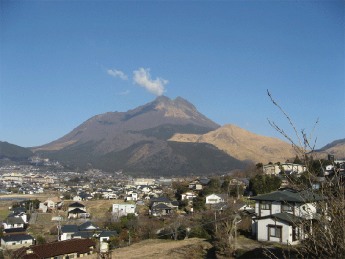
Mount Ioyama (image from blogs.yahoo.co.jp)
Satsumasendai’s Mayor Hideo Iwakiri welcomed the reopening, but said at the ensuing press conference that it would fall upon the government to ensure a repeat of the accident that damaged Fukushima, an outdated facility subject to loose oversight, is impossible.
September’s decision to initiate the return Japan’s nuclear capacity back online was taken by Prime Minister Shinzo Abe, who endorses nuclear production in the country, but has delegated the controversial call on reopening to local councils. Sendai was chosen after becoming the first plant to officially fulfill the government’s new stricter safety rules. It may also have been picked due to its geographical remoteness, and distance from the 2011 disaster area.
The primary reason for Abe’s nuclear drive been the expense in replacing the lost energy that constituted 30 percent of the country’s consumption, which the government says cost Japan an extra $35 billion last year. Japanese consumers have seen their energy bills climb by 20 percent since the disaster as a result.
But another concern remains the state of the country’s aging nuclear plants, which will cost $12 billion to upgrade. Meanwhile plans to build modern nuclear reactors – which were supposed to be responsible for half of the country’s nuclear power by 2030, according to previous government energy plans – have predictably been shelved in the wake of the disaster.
Fukushima dome removal suspended
The painfully slow and calamitous decommissioning of the Fukushima Daiichi plant, in the northeast of the country, had to be halted yet again Tuesday, after the removal of the temporary dome over the damaged Reactor 1 was interrupted by severe winds.
The canopy needs to be taken off so that the radioactive reactor rods, which have been contaminating the soil and water around the plant, can be placed in storage.
But as workers attempted to lift a section of the plastic dome to decontaminate the air inside, a segment of the cover up to six feet was blown off by a severe gust of wind.
Tokyo Electric Power Company, TEPCO, the operator of the shuttered plant, says that the incident has not impacted radiation levels, and hopes to resume operations as soon as possible.
Yucca Mountain Radioactive Waste Dump Not Dead Yet
By JOHN LAFORGE | CounterPunch | October 22, 2014
Just in time for Halloween, a real zombie.
Although the Obama Administration cancelled the Yucca Mountain project for disposing high-level radioactive waste (uranium fuel rods) in 2009, the scheme stays amazingly undead.
Last Thursday, the Nuclear Regulatory Commission issued the third in a series of reports in which it declared that the deep, engineered cavern inside the mountain — 90 miles from Las Vegas, Nevada — meet the commission’s ever-changing (Eric Pianin, “Rules changed for Nevada nuclear waste site plan,” Wash. Post, Dec. 12, 2001) requirements.
Still pending are two more reports and a final NRC ruling on the site’s suitability. Actual operation of the dump also requires approval from the Environmental Protection Agency and the departments of Transportation and Energy (DOE). Of course, lawsuits by the State of Nevada and dozens of environmental groups would follow a decision to start burying waste.
In spite of 70 years of head scratching, science and industry have not found a cheap way to “dispose” of high-level radioactive waste. In 2008, the plan was estimated to cost at least $90 billion.
The DOE’s 1999 draft environmental impact statement for Yucca, says that leaving the wastes at 72 US reactor sites in 39 states is just as safe as moving it thousands of miles toward Yucca Mt. — as long as it is repackaged every 100 years. There is no need to rush the opening a dumpsite, except that reactor operators want to free-up storage space for freshly produced waste so they can keep running old reactors.
Yucca Mt. Project Cancelled for Hundreds of Reasons
While Republicans from nuclear-heavy states are pushing to revive the Yucca project and hoping for a November take-over of the Senate, Majority Leader Harry Reid, D-Nev., broadcasts the science-based disqualifiers that prove Yucca unsuitable. Among them are fast flowing water inside the mountain, earthquake faults, lava flows, and the risk of exploding waste canisters — like the one that burst and wrecked the Energy Department’s Waste Isolation Pilot Project in New Mexico last February. Joonhong Ahn, an engineering professor at the U. of Calif., Berkeley, said in an e-mail to ScienceInsider.com, “… there are still numerous hurdles ahead.”
Indeed, the Government Accounting Office concluded in 2001 that 293 unresolved scientific and engineering problems hinder the plan. (“GAO Challenges Plans for Storage of Nuclear Waste,” Wash. Post, Nov. 30, 2001) Responding to the new report, Nevada state officials made the same point. “The NRC licensing board has admitted more than 200 Nevada contentions challenging the safety and environmental impacts of the proposed repository, and Nevada is prepared to aggressively prosecute these challenges. It is not apparent that the [NRC report] specifically addressed these and other safety contentions,” said Bob Halstead, Executive Director of Nevada’s Agency for Nuclear Projects, in a prepared statement.
“For the NRC staff to publically release just this one volume of the 5-volume Safety Evaluation Report outside the proper context of an ongoing licensing proceeding, and in the absence of a complete SER, is unprecedented,” Halsted said. “It creates a false impression that the safety review has been completed. It is difficult to see what reason there could be for such a release except to provide political support and encouragement for Yucca Mountain supporters in Congress and elsewhere.”
This false impression was spectacularly exaggerated by Rep. John Shimkus, R-Mich., who told the New York Times Oct. 17, “[N]uclear waste stored under that mountain … will be safe and secure for at least a million years.”
Nuclear Waste Production is Kept Alive by Yucca Supporters
Yucca Mt. wouldn’t begin to address the country’s vast nuclear waste problem. There already are about 70,000 tons of it stored at reactor sites. This stockpile would fill Yucca to capacity and force the start of a search for Dump No. 2. Waste that must be containerized for a million years is the “animated corpse” that will forever haunt our clean, cheap too-safe-to-meter nuclear power complex.
The Yucca Mt. “mobile Chernobyl” idea — and alternate plans for regional “interim” dumps — also explodes the risks of radiation accidents contaminating waste handlers and the people along transport routes. The DOE’s planning maps show the waste passing through 40 states, 40 Indian Reservations and 100 major cities. In January 2008, former state transportation analyst Fred Dilger caused alarm when he told a Hillary Clinton campaign rally that if waste trains go through Las Vegas, “All of the casinos on the west side of Las Vegas Boulevard would be bathed in gamma radiation.”
The shipments, using as-yet-untested waste casks, would expose between 138 and 161 million Americans to the risks of dangerous levels of radiation and to the consequences of inevitable truck, train and barge accidents. Even the project’s Final Environmental Impact Statement predicts between 150 and 250 rail or truck crashes over the plan’s 25-year span — about 10 crashes every year for 25 years.
That’s an undying prospect scary enough for a million Halloweens.
Featured Video

Rewriting the risk? Inside the government’s vaccine safety messaging
or go to
Aletho News Archives – Video-Images
Book Review
“Davos Can Really Replace the UN”
Inside the book that maps the architecture behind global governance — from the Epstein files to the Pact for the Future
Lies are Unbekoming | April 1, 2026
On June 13, 2019, the United Nations and the World Economic Forum signed a partnership deal to “accelerate the implementation of the 2030 Agenda for Sustainable Development.” That same evening, WEF president Börge Brende — Norway’s former Foreign Minister — had dinner with Jeffrey Epstein at Epstein’s Manhattan townhouse. The Epstein files, released January 2026, contain an exchange between the two from the previous year. Epstein to Brende: “Davos can really replace the UN. C21, cyber, crypto . genetics… intl coordination.” Brende back to Epstein: “Exactly — we need a new global architecture. World Economic Forum (Davos) is uniquely positioned — public private.”
The next day, the UN General Assembly adopted the framework for restructuring global governance.
That sequence — the partnership signing, the Epstein dinner, the candid admission about replacing the UN with a public-private architecture, and then the formal adoption — opens Jacob Nordangård’s The Digital World Brain. Pages two and three. Footnoted to the UN resolution number, the Epstein files, and the General Assembly record.
I keep coming back to it because it captures what this book does that almost nothing else in the independent research space manages. I’ve followed Jacob’s work for years now and interviewed him about his research. Each book peels back another layer of the same institutional architecture, and each time I think he’s reached the limit of what can be documented, the next one goes further. Nordangård doesn’t speculate. He doesn’t editorialize much. He lays institutional actions next to each other in chronological order and lets the pattern announce itself. … continue
Blog Roll
 Aletho News
- How I fell foul of the BBC thought police
- The End of NATO
- 37 days of war on Iran cost US staggering $42bln, tracker shows
- Baghdad tells Asian refiners, traders to begin loading Iraqi crude amid Iranian exemption
- Under fire, Moscow and Tehran close ranks
- Iran, US receive Pakistan-mediated plan for ceasefire then final deal
- Iran submits demands for end to war as mediators scramble ahead of Trump deadline
- Iran Threatens Retaliatory Strike on Stargate AI Project in UAE
- US sent ‘a lot’ of arms to Iranian protesters – Trump
- Barak Ravid Launders Deception To Allow Trump To Back Off Of His Power Plant Threat – Again
- If Americans Knew
- U.N. experts demand Israel release prominent Gaza doctor after reports of ‘severe torture’
- Israel’s Latest Genocide Is Against the Shias of Lebanon. Why Is the World Silent?
- How Eliot Cohen’s influence over U.S. war-making paved the way for Trump’s war crimes in Iran
- Israelis don’t pay for the weapons we ‘sell’ to them — US taxpayers do
- While Distancing from AIPAC, Most 2028 Democratic Hopefuls Are Still Embracing Israel
- A brief history of the Israeli nuclear program, the open secret at the heart of the Iran war
- Israeli Settlers Killed a Palestinian Farmer on His Own Land, in Front of His Father. Yes, Again
- The US-Israeli War on Science is an Assault on our Future
- 100+ International Law Experts Say US Strikes on Iran Violate UN Charter, Could Be War Crimes
- ‘Vile, Horrifying, Evil’: Trump Threatens to Bomb Nation of 90 Million People ‘Back to the Stone Ages’
- No Tricks Zone
- An Inconvenient Tree: Uncovered In Alps… Europe Much Warmer Than Today 6000 Years Ago
- New Study Reports A 60% Slowdown In Greenland’s Ice Loss Rate In The Last Decade
- Low Intensity Tornado Wrecks Major Solar Farm, Creating A Potential Toxic Dump
- New Study Finds Warming Saves Lives…Cold Temperatures 12 Times More Deadly Than Excess Heat
- German Science Blog Accuses PIK Climate Institute Of Hallucinating Climate Tipping Points
- Devastating Assessment Of Comirnaty Vaccine By Former Senior Pfizer Europe Toxicologist
- New Study: CO2 Is ‘Effectively Negligible’ As An Explanatory Climate Change Factor Since 2000
- Former Pfizer Toxicologist Dr. Helmut Sterz Tells Bundestag Hearing Pfizer Vaccine Should Have Never Been Approved
- Energy Expert: Germany’s Nuclear Phaseout Was A “500 Billion Euro Mistake”
- New Research: South Australia’s Mid-Holocene Sea Surface Temperatures Were 4°C Warmer Than Today
 Aletho News