Russian MoD responds to Zaporozhskaya nuclear power station incident
RT | March 4, 2022
The spokesman for the Russian Ministry of Defense, Major General Igor Konashenkov, issued an official statement on Friday morning concerning the shootout and fire that had occurred at Ukraine’s Zaporozhskaya nuclear power plant earlier the same day.
“Last night, an attempt to carry out a horrible provocation was made by Kiev’s nationalist regime on the area surrounding the station,” he announced, claiming the Russian troops patrolling the territory had been attacked by a Ukrainian sabotage group.
According to the spokesman, the Ukrainian forces had attacked Russian soldiers at about 2am local time, opening heavy fire from the training facility next to the power station in order to “provoke a retaliatory strike on the building.”
The Russian patrol had neutralized the group’s firing points, but the saboteurs had then set fire to the training facility as they retreated, Konashenkov said. The blaze was put out by the Ukrainian State Emergency Service’s firefighters. “At the moment of provocation, no staff members were at the facility,” he noted.
In response to the Russian Ministry of Defense’s statement, Ukrainian president Volodymyr Zelensky denied the provocation claims and accused Russian forces of having staged the attack.
The mayor of the nearby town of Energodar had originally reported that the fire had been caused by Russian shelling, and that the blaze had engulfed the power plant itself, but the emergency services dismissed the latter claim.
It was reported on Monday that the facility had been captured by Russian forces, and that staff were keeping operations going and monitoring radiation levels. The International Atomic Energy Agency has offered assurances that there has been no change in those levels in the wake of the incident.
Russia began its military offensive in Ukraine last week, claiming its invasion was aimed at “demilitarizing” and “denazifying” the government in Kiev and stopping what it called the “genocide” in the two breakaway regions of Donetsk and Lugansk. Ukraine has accused Moscow of an unprovoked offensive, with the US and its NATO allies following suit and imposing severe economic sanctions.
International nuclear watchdog passes resolution on Ukraine
RT March 3, 2022
In a resolution passed on Thursday by its board of directors, the International Atomic Energy Agency (IAEA) reportedly “deplored” Moscow’s invasion of Ukraine. Russia has denounced the document, calling it politicized and factually incorrect.
The resolution, which is yet to be published, apparently calls on Russia to allow the Ukrainian authorities to resume control of its nuclear sites. Moscow says the assertion that they are not already in control is incorrect.
There were claims that Russian troops had occupied the site of the destroyed Chernobyl nuclear power plant as they moved from Belarus towards Kiev. The Russian Defense Ministry has denied them, stating that Ukrainian guards remained in control of the facility.
On March 1, Reuters gave a preview of the draft of the damning resolution, which was penned by Poland and Canada on behalf of Ukraine.
The news of the resolution’s passage, with just two votes having been cast against it at the session of the 35-member board, was welcomed by Ukraine. Foreign Minister Dmytro Kuleba claimed in a tweet that it showed the world was “united against Russia’s actions, which threaten Ukraine and all of Europe.”
Russia’s representative at the IAEA, Mikhail Ulyanov, blasted the document, claiming it contained “intentional politically motivated lies and mistakes.” In particular, the assertion that the Ukrainian authorities were not in control of the nation’s nuclear sites was wrong, the official said in a series of tweets.
Moscow was satisfied that “countries whose populations taken together exceed a half of the mankind refused to support the resolution,” Ulyanov added.
China has confirmed that it voted against the resolution. Its representative, Wang Qun, said the document “obviously” overstepped the agency’s mandate to monitor nuclear security, and that by adopting the resolution, it had undermined the IAEA’s position as a professional, non-political organization.
The diplomat complained that some nations had “forcibly pushed” the draft and rejected suggestions submitted by other board members about how to improve the document.
Earlier on Thursday, IAEA Director General Rafael Mariano Grossi confirmed to journalists that all safety precautions the agency had taken in Ukraine remained intact.
France makes massive nuclear bet
RT | February 10, 2022
French President Emmanuel Macron announced on Thursday that the government will back the construction of six new nuclear reactors across the country. The first will enter service by 2035, according to the French leader.
“We must continue the great adventure of civil nuclear power in France,” Macron told the media on a visit to the eastern city of Belfort – the home of General Electric’s France-based turbine unit. He also announced the commissioning of a study to assess the feasibility for a further eight reactors.
“Given the electricity needs, the need to anticipate the transition, the end of the existing fleet, we are going to launch today a program of new nuclear reactors,” Macron declared.
The six new units will be EPRs – originally known as European Pressurized Water Reactors – which have been designed and developed by French company Framatome and its parent Électricité de France (EDF). The technology is also being used in the UK’s Hinkley Point power station and in Taishan, China.
The new EPR reactors will be supplemented by small modular reactors (SMR) with the aim of creating “25 gigawatts of new nuclear capacity by 2050,” Macron said.
The president added that he had made two further big decisions. He said he had asked EDF to study the conditions for extending the lifespan of a reactor beyond 50 years and claimed he wanted future reactors to be ever-lasting, only shutting down for safety reasons.
France has strongly supported the development of its nuclear industry throughout the last four decades, however neighboring Germany has phased out nuclear power, with environmental and safety concerns at the heart of its reasoning.
Cancer patients sue company behind Fukushima radiation
RT | January 28, 2022
Six people were children living near the Fukushima nuclear power plant at the time of the 2011 disaster, when the facility was heavily damaged in an earthquake and subsequent tsunami.
The plaintiffs have since developed thyroid cancer, blaming radiation that seeped from the power plant for their condition.
“Some plaintiffs have had difficulties advancing to higher education and finding jobs, and have even given up on their dreams for their future,” the group’s chief lawyer, Kenichi Ido, told AFP.
The plaintiffs, now aged between 17 and 27, are seeking compensation from the Fukushima operator, the Tokyo Electric Power Company Holdings (TEPCO). They demand the company pay a total of 616 million yen ($5.4 million). The plaintiffs have experienced prejudice against thyroid cancer patients, with the illness heavily affecting their lives, one of the group members – identified only as a woman in her 20s – has said.
“I decided to come forward and tell the truth in hopes of improving the situation for nearly 300 other people also suffering like us,” she stated.
The lawsuit has become the first class-action against TEPCO over health problems allegedly linked to the Fukushima disaster. Establishing a solid link between thyroid cancer and the meltdown is likely to become a focal point of the case, since no relationship between cancer cases and the disaster was recognized by an expert team previously established by the regional government. At the same time, radiation exposure is a well-proven risk factor for developing such type of cancer.
Over 290 people who lived in the area at the time of the meltdown have been diagnosed with or are suspected of having thyroid cancer. Some 266 of them were found during a provincial health survey of people aged 18 and younger at the time of the disaster, which affected some 380,000 residents.
The plaintiff’s legal team argues that such rates – 77 per 100,000 – are significantly higher than the usual one to two cases per one million people. Regional authorities and experts, however, have blamed the unusual rates on excessive screening and over-diagnosing.
The Fukushima power plant got crippled following the 2011 9.0-magnitude Tohoku earthquake and a subsequent devastating tsunami. The plant suffered a major meltdown, which became the worst nuclear disaster since the 1986 Chernobyl incident. The catastrophe prompted an evacuation order for nearby towns and villages, which has been gradually lifted over the past few years. The last deserted settlement – the town of Futaba located in an immediate vicinity of the damaged plant – is expected to welcome residents willing to return later this year.
Macron goes nuclear to protect France’s energy independence in green future
RT | November 9, 2021
 France will start building new nuclear reactors after a decades-long pause, President Emmanuel Macron has announced, citing both energy security needs and the promise to reach carbon emission neutrality by mid-century.
“To guarantee France’s energy independence, to guarantee our country’s electricity supply, and to reach our goals – notably carbon neutrality in 2050 – we will for the first time in decades revive the construction of nuclear reactors in our country, and continue to develop renewable energy,” Macron said in a televised address to the nation on Tuesday.
The French president made the announcement after attending last week’s COP26 UN climate summit in Glasgow, where activists called for radical changes to energy production in order to stave off the projected rise in global temperatures.
Some 75% of France’s electricity comes from nuclear power, and early in his presidency Macron pledged to lower that to 50% by 2035, also in the name of preserving the environment. Skyrocketing oil and natural gas prices, as well as the mixed performance of wind and solar, appear to have changed his mind, however.
Macron’s remark about the reactors was part of a broader speech addressing the Covid-19 pandemic, social policies, and the impending French presidency of the EU.
They can’t hide the costs of Net Zero forever
By Patrick Benham-Crosswell | TCW Defending Freedom | September 6, 2021
THE run-up to the COP26 climate change jamboree in Glasgow later this year is probably not going as well as the government would like. Despite being committed to Net Zero by Mrs May’s undebated and uncosted statutory instrument, the size of the likely costs can’t be hidden for ever and the guardian of the magic money tree, Chancellor Rishi Sunak, is fretting.
I have just produced a short book on Net Zero (brazen plug, you can buy it here) and, having spent several months trawling through the government’s own numbers, have reached the conclusions that the costs are huge (and possibly more than that). Replacing fossil fuels means we have to produce our energy from nuclear and renewables. At the moment they provide just about 10 per cent of our energy requirements. Making up the shortfall needs 30 to 50 Sizewell Cs, or 300 to 500 Small Modular Reactors, or 17,000 to 28,000 new offshore wind turbines. It will also need the electricity distribution grid to more or less quadruple in size. (The uncertainty primarily comes from whether Mr Gove can convert 25million homes to heat pumps, or whether we adopt hydrogen).
The cost of the generation alone comes out at something like £1trillion. Add to that car chargers, heat pumps, hydrogen electrolysers and suchlike and the costs could double. Or more.
The cost of energy will also rise. A report from the Department for Business, Energy and Industrial Strategy (BEIS) in 2016 (when Mrs May imposed Net Zero) forecast that the price of electricity would increase by at least 50 per cent. Which means that the UK is likely to be operating on a higher cost base than those economies which have not yet followed our lead and declared a net zero target. That’s most of the world – only Bhutan, Suriname, Uruguay, Finland, Iceland, Sweden, Austria and Germany have followed Mrs May’s quixotic charge. I’m not sure Germany is serious – 25 per cent of its power comes from coal and it is phasing out nuclear power.
Hilariously (or tragically) the government is threatening to crack down on ‘greenwashing’, by which they mean the habit of suppliers claiming that buying their product saves the planet. Yet our political leaders maintain that it will all be fine, that Net Zero is achievable and all we need to do is plant some trees. If they looked at their own data they would know that this is not the case.
To cite one example, every now and then one of them will trumpet about carbon capture, use and storage. Capturing CO2 is tricky and expensive. The world CO2 demand is some 230million tons per year (mostly for the oil and food industries). That’s less than half of the UK’s current CO2 emissions. There is no chance of widescale use of CO2 captured in the UK.
Of course there is already ample legislation on what may or may not be said in advertisements. New legislation is unnecessary.
As we have seen during the pandemic, this government has a habit of deploying misleading graphs and generally being economical with the truth. If they really wanted to improve the flow of information to the public they would apply the current law to their own presentations.
Hell will freeze over before that happens.
Japan Restarts Older Nuclear Reactors For First Time Since Fukushima
By Tyler Durden | Zero Hedge | April 28, 2021
Since achieving the ambitious emissions-reduction targets laid out in the Paris Accords will require developed nations to revive their nuclear plans (something that climate activists have increasingly supported despite the continuing fallout from the disaster at Fukushima) Japan on Wednesday decided to revive three long-idled reactors, marking the first time that Japan has restarted a reactor that’s more than 40 years old.
After Prime Minister Yoshihide Suga last week announced a new goal of cutting the country’s greenhouse gas emissions 46% by fiscal 2030 (an announcement that coincided with President Biden’s virtual climate summit) Nikkei reports that Gov. Tatsuji Sugimoto of Fukui Prefecture (located about 300 km, about 186 miles, west of Tokyo) gave the green light on Wednesday to restart the Kansai Electric Power reactor units 1 and 2 at the Takahama nuclear power plant, and unit 3 at the utility’s Mihama plant. Japan’s plans for building new reactors have been frozen for years, leaving its aging nuclear infrastructure largely intact.
Achieving the emissions goals laid out by Suga last week will require generating 20% of Japan’s power via nuclear energy in the coming decades, experts said.
Currently, Japanese regulations imposed after the 2011 Fukushima meltdown set the operating life of Japanese reactors at 40 years, while leaving open the possibility of extending that to 60 years. No reactors older than 40 years are currently operating in Japan – but that’s about to change.
Industry Minister Hiroshi Kajiyama on Tuesday told Sugimoto that Japan “will use nuclear power sustainably into the future” and promised up to 2.5 billion yen ($23.1 million) in federal grants to help restart older reactors. Sugimoto told reporters that Kajiyama’s remarks were “something we hadn’t heard before.”
Japan had about 50 nuclear reactors when Tokyo Electric Power’s Fukushima Daiichi plant was struck by a tsunami in 2011 that knocked out its emergency power, leading to a historic meltdown.
Since then, more than 20 reactors in Japan have been marked for decommissioning. By 2030, nearly half of the country’s remaining reactors will be over 40 years old.
Still, as Fukushima fades into history, support for nuclear power is growing within Japan’s ruling Liberal Democratic Party. To open the door to reviving more reactors, more lawmakers favor a different rubric for counting a reactor’s operating age that will subtract the years they spent idled.
Unfortunately for the nuclear industry in Japan, other obstacles remain aside from environmental concerns. For example, the outlook for restarting Tokyo Electric’s workhorse Kashiwazaki-Kariwa plant has been dimmed by a report that finds insufficient safeguards against terrorist attacks. In the US, nuclear has remained out of favor ever since the incident at the Three Mile Island plant in Pennsylvania.
As we pointed out on Earth Day, proponents of lower emissions are starting to accept that nuclear is the only practical strategy that wouldn’t involve massive reductions in energy use, while still maintaining robust systems that won’t seize up when wind turbines freeze.
[“Sustainable”] Uranium Prices Poised To Rally
Oilprice.com | April 3, 2021
The uranium market is emerging from years in the doldrums as the overhang from the nuclear disaster in Japan is cleared and global demand picks up steam.
The spot price for U3O8 moved above $30 per pound for the first time this year as uranium producers and mine developers hoover up above-ground inventories and reactor construction continues apace.
Two new research notes from BMO Capital Markets and Morgan Stanley say today’s price marks a floor and predict a rally in prices over the next few years to the ~$50 level by 2024.
The stars seem to be aligning for a new phase of nuclear energy investment with the US, China and Europe bolstering the bull case for the fuel this month.
Although nuclear energy was not mentioned explicitly in the $2 trillion Biden infrastructure proposal released today, its federally mandated “energy efficiency and clean electricity standard” is hardly achievable without it.
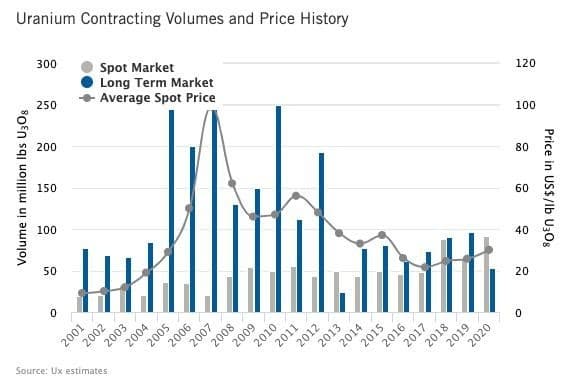
Source: Cameco
Over the weekend leaked documents showed a panel of experts advising the EU is set to designate nuclear as a sustainable source of electricity which opens the door for new investment under the continent’s ambitious green energy program.
China’s 14th five-year plan released a fortnight ago also buoyed the uranium market with Beijing planning to up the country’s nuclear energy capacity by 46% – from 48GW in 2020 to 70GW by 2025.
There are several factors working in uranium’s favour, not least the fact that annual uranium demand is now above the level that existed before the 2011 Fukushima disaster when Japan shut off all its reactors:
- Uranium miners, developers and investment funds like Yellow Cake (13m lbs inventory build up so far) are buying material on the spot market bringing to more normal levels government and utility inventories built up over the last decade
- Major mines are idled including Cameco’s Cigar Lake (due to covid-19) which accounts for 18m lbs or 13% of annual mine supply. The world’s largest uranium operation McArthur River was suspended in July 2018 taking 25m lbs off the market
- Permanent closures so far this year include Rio Tinto’s Ranger operation in Australia (3m lbs) and Niger’s Cominak mine (2.6m lbs) which had been in operation since 1978. Rio is exiting the market entirely following the sale of Rössing Uranium in Namibia
- Like Cameco, top producer Kazatomprom, which mined 15% less material last year due to covid restrictions has committed to below capacity production (–20% for the state-owned Kazakh miner) for the foreseeable future
- Price reporting agency and research company UxC estimates that utilities’ uncovered requirements would balloon to some 500m lbs by 2026 and 1.4 billion lbs by 2035
- Roughly 390m lbs are already locked up in the long term market while 815m lbs have been consumed in reactors over the last five years, according to UxC
- There are 444 nuclear reactors in operation worldwide and another 50 under construction – 2 new connections to the grid and one construction start so far in 2021
- Much cheaper and safer, small modular nuclear power reactors which can readily slot into brownfield sites like decommissioned coal-fired plants (or even underground or underwater) are expected to become a significant source of additional demand.
There are caveats to this rosy scenario, however.
Morgan Stanley warns that “the opacity of the inventory situation remains a key uncertainty to price – see for example palladium, which needed almost 7 years of deficit before the price really took off.”
BMO says given the still high levels of inventories “acute shortages and price squeezes are extremely unlikely, both for this year and the foreseeable future,” adding that “there is no obvious need for new mine supply in the near future.”
Featured Video

“Historic Russia”: The Land Putin Will Not Give Back
or go to
Aletho News Archives – Video-Images
Book Review
Why the War on Conspiracy Theories Is Bad Public Policy
By Kevin Barrett • Unz Review • February 1, 2019
 A Review of Conspiracy Theories and Other Dangerous Ideas by Cass Sunstein (based on an earlier paper co-authored with Adrian Vermeule); In Defense of Troublemakers: The Power of Dissent in Life and Business by Charlan Nemeth; and Conspiracy Theories and the People Who Believe Them, edited by Joseph E. Uscinski
On January 25 2018 YouTube unleashed the latest salvo in the war on conspiracy theories, saying “we’ll begin reducing recommendations of borderline content and content that could misinform users in harmful ways—such as videos promoting a phony miracle cure for a serious illness, claiming the earth is flat, or making blatantly false claims about historic events like 9/11.”
At first glance that sounds reasonable. Nobody wants YouTube or anyone else to recommend bad information. And almost everyone agrees that phony miracle cures, flat earthism, and blatantly false claims about 9/11 and other historical events are undesirable.
But if we stop and seriously consider those words, we notice a couple of problems. First, the word “recommend” is not just misleading but mendacious. YouTube obviously doesn’t really recommend anything. When it says it does, it is lying. … continue
Blog Roll
 Aletho News
- “Historic Russia”: The Land Putin Will Not Give Back
- How the Cambridge Analytica scandal still haunts Mark Zuckerberg
- The Ongoing Cancellation Campaign Against a Dissenting Academic in Norway
- Yemen and ‘the Houthis’: Challenging Sami Hamdi’s Narrative
- No, Christians did not invent Zionism
- AIPAC-led lobbying network opens branches in Cypriot, Greek parliaments
- Araghchi blasts ‘parasitic’ alliance as US taxpayers pay for Israel’s war on Iran
- Easy fix for Europe’s chaos? Stop fueling war against Russia
- Putin’s key remarks on peace talks and Europe’s ‘schizophrenia’
- Trita Parsi: Israel Set a Trap for Total War in the Region
- If Americans Knew
- An error has occurred; the feed is probably down. Try again later.
- No Tricks Zone
- Two New Studies Find Thwaites Glacier Melt Cannot Be Driven By Human Activity Or A Warming Ocean
- E-Cars Reduce CO2 Emissions By Only 41% Compared To Internal Combustion Engine Vehicles
- Predictions Made By Renowned Climate Professor Over Past Decades Have Been Proven To Be Poor
- New Study Suggests Large Regions Of The Pacific Ocean Have Been Cooling For The Last 80 Years
- Germany’s Green Energy Debacle: High Energy Costs Force Kahla Porzellan to Close After 182 Years!
- New Study: 50 Years Of The Most Aggressive ‘Net Zero’ Policies Can Only Affect The Global Climate By 0.03°C
- US September “Heat” Was No Record…Many Records Set Decades Ago
- Latest European Green Energy Debacle; Portugal’s Largest Flagship Solar Park Insolvent!
- Green Energy Debacle: German Expert Professor Fritz Vahrenholt Warns Of Severe Economic And Social Consequences
- Two More Paleo Reconstructions Affirm Meters-Higher Sea Levels Across Ireland, Brazil 7000-6000 Years Ago

