Efforts to cap CO2 emissions are adverse to human health and welfare
By Craig D. Idso, Ph.D. | The Hill | January 30, 2014
In his State of the Union address, President Obama advocated an energy policy aimed at reducing emissions of carbon dioxide (CO2), which he claims are causing catastrophic changes to the earth’s climate and “harming western communities.” In his policy prescription, the president advocates a combination of increased regulation of the energy and transportation industries and more government spending on research designed to bring low-carbon-emitting sources of energy, i.e., so-called renewables, to market. He considers those actions to be the only viable options “leading to a cleaner, safer planet.”
But the president’s concerns for the planet are based upon flawed and speculative science; and his policy prescription is a recipe for failure.
With respect to the science, Obama conveniently fails to disclose the fact that literally thousands of scientific studies have produced findings that run counter to his view of future climate. As just one example, and a damning one at that, all of the computer models upon which his vision is based failed to predict the current plateau in global temperature that has continued for the past 16 years. That the earth has not warmed significantly during this period, despite an 8 percent increase in atmospheric CO2, is a major indictment of the models’ credibility in predicting future climate, as well as the president’s assertion that debate on this topic is “settled.”
Numerous other problems with Obama’s model-based view of future climate have been filling up the pages of peer-reviewed science journals for many years now, as evidenced by the recent work of the Nongovernmental International Panel on Climate Change, which published a 1,000-page report in September highlighting a large and well-substantiated alternative viewpoint that contends that rising atmospheric CO2 emissions will have a much smaller, if not negligible, impact on future climate, while generating several biospheric benefits.
Concerning these benefits, atmospheric CO2 is the building block of plant life. It is used by earth’s plants in the process of photosynthesis to construct their tissues and grow. And as has been conclusively demonstrated in numerous scientific studies, the more CO2 we put into the air, the better plants grow. Among other findings, they produce greater amounts of biomass, become more efficient at using water, and are better able to cope with environmental stresses such as pollution and high temperatures.
The implications of these benefits are enormous. One recent study calculated that over the 50-year period ending in 2001, the direct monetary benefits conferred by the atmospheric CO2 enrichment of the Industrial Revolution on global crop production amounted to a staggering $3.2 trillion. And projecting this positive externality forward in time reveals it will likely bestow an additional $9.8 trillion in crop production benefits between now and 2050.
By ignoring these realities, Obama’s policy prescription is found to be erroneous. The taxation or regulation of CO2 emissions is an unnecessary and detrimental policy option that should be shunned. Why would any government advocate to increase regulations and raise energy prices based on flawed computer model projections of climate change that will never come to pass? Why would any government advance policy that seeks to destroy jobs, rather than to promote them? Why, in fact, would they actually “bite the hand that feeds them?”
We live in a time when half the global population experiences some sort of limitation in their access to energy, energy that is needed for the most basic of human needs, including the production of clean water, warmth, and light. One-third of those thus impacted are children. An even greater portion finds its ranks among the poor.
As a society, it is time to recognize and embrace the truth. Carbon dioxide is not a pollutant. Its increasing concentration only minimally affects earth’s climate, while it offers tremendous benefits to the biosphere. Efforts to regulate and reduce CO2 emissions will hurt far more than they will help.
Idso is lead editor and chief scientist for the Nongovernmental International Panel on Climate Change.

NSA spying fallout: Brazil-US talks fail
BRICS Post | January 31, 2014
Brazil on Thursday said the US has not been able to satisfactorily answer the spying charges or eke out a “permanent solution” to restore bilateral ties damaged by the revelations.
Brazilian Foreign Minister Luiz Alberto Figueiredo met Thursday with US National Security Advisor Susan Rice in Washington.
According to a report by the Brazilian daily O Globo, the talks failed to resolve the matter.
The Brazilian Minister said his meeting with Rice did not signify a permanent solution to the tension between the two countries, created by reports of massive US government snooping amid continued revelations based on documents leaked by the former NSA contractor Edward Snowden.
“A conversation at this level will not lead to an improvement in relations,” Figueiredo said, stressing, however, that the dialogue between the two sides will continue.
During the talks, Rice presented the US government’s defense of its espionage scheme, said Figueiredo, adding those explanations now need to be relayed to President Dilma Rousseff. The Brazilian President had earlier canceled a state visit to the US after the spying charges were first reported.
America has failed to provide clarifications that the Brazilian government required, Figueiredo added.
Bilateral ties were hit after leaked NSA files revealed the US intelligence agency intercepted Brazilian communications and spied on Rousseff and her aides and on the state-owned Petrobras, the largest company in Brazil and one of the 30 biggest businesses in the world.
Rousseff had earlier said the US spying program was “economic espionage”. In November last year, the “right to privacy” resolution, drafted by Brazil and Germany, was passed by the UN rights committee.
Related article
American State of the Union: A Festival of Lies
By Glen Ford | Black Agenda Report | January 29, 2014
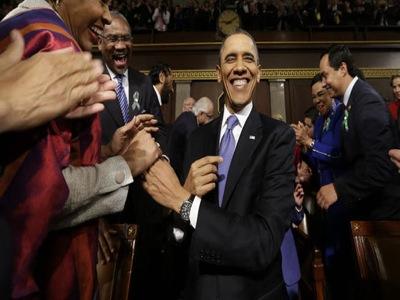
“Believe it,” said the current Prevaricator-in-Chief, in the conclusion to his annual litany lies. President Obama’s specialty, honed to theatrical near-perfection over five disastrous years, is in crafting the sympathetic lie, designed to suspend disbelief among those targeted for oblivion, through displays of empathy for the victims. In contrast to the aggressive insults and bluster employed by Republican political actors, whose goal is to incite racist passions against the Other, the sympathetic Democratic liar disarms those who are about to be sacrificed by pretending to feel their pain.
Barack Obama, who has presided over the sharpest increases in economic inequality in U.S. history, adopts the persona of public advocate, reciting wrongs inflicted by unseen and unknown forces that have “deepened” the gap between the rich and the rest of us and “stalled” upward mobility. Having spent half a decade stuffing tens of trillions of dollars into the accounts of an ever shrinking gaggle of financial capitalists, Obama declares this to be “a year of action” in the opposite direction. “Believe it.” And if you do believe it, then crown him the Most Effective Liar of the young century.
Lies of omission are even more despicable than the overt variety, because they hide. The potentially most devastating Obama contribution to economic inequality is being crafted in secret by hundreds of corporate lobbyists and lawyers and their revolving-door counterparts in government. The Trans Pacific Partnership (TPP) trade deal, described as “NAFTA on steroids,” would accelerate the global Race to the Bottom that has made a wasteland of American manufacturing, plunging the working class into levels of poverty and insecurity without parallel in most people’s lifetimes, and totally eviscerating the meager gains of three generations of African Americans. Yet, the closest Obama came to even an oblique allusion to his great crime-in-the-making, was to announce that “new trade partnerships with Europe and the Asia-Pacific will help [small businesses] create even more jobs. We need to work together on tools like bipartisan trade promotion authority to protect our workers, protect our environment and open new markets to new goods stamped ‘Made in the USA.’” Like NAFTA twenty years ago – only far bigger and more diabolically destructive – TPP will have the opposite effect, destroying millions more jobs and further deepening worker insecurity. The Trans Pacific Partnership expands the legal basis for global economic inequalities – which is why the negotiations are secret, and why the treaty’s name could not be spoken in the State of the Union address. It is a lie of omission of global proportions. Give Obama his crown.
The president who promised in his 2008 campaign to support a hike in the minimum wage to $9.50 by 2011, and then did nothing at all to make it happen, says this is the “year of action” when he’ll move heaven and earth to get a $10.10 minimum. He will start, Obama told the Congress and the nation, by issuing “an executive order requiring federal contractors to pay their federally-funded employees a fair wage of at least $10.10 an hour because if you cook our troops’ meals or wash their dishes, you should not have to live in poverty.” Obama neglected to mention that only new hires – a small fraction, beginning with zero, of the two million federal contract workers – will get the wage boost; a huge and conscious lie of omission. The fact that the president does not even propose a gradual, mandated increase for the rest of the two million shows he has no intention of using his full powers to ameliorate taxpayer-financed poverty. We can also expect Obama to issue waivers to every firm that claims a hardship, as is always his practice.
What is Obama’s jobs program? It is the same as laid out at last year’s State of the Union, and elaborated on last summer: lower business taxes and higher business subsidies. When you say “jobs,” he says tax cuts – just like the Republicans, only Obama first cites the pain of the unemployed, so that you know he cares. “Both Democrats and Republicans have argued that our tax code is riddled with wasteful, complicated loopholes that punish businesses investing here, and reward companies that keep profits abroad. Let’s flip that equation. Let’s work together to close those loopholes, end those incentives to ship jobs overseas, and lower tax rates for businesses that create jobs right here at home.” Actually, Obama wants to lower tax rates for all corporations to 28 percent, from 35 percent, as part of his ongoing quest for a Grand Bargain with Republicans. For Obama, the way to bring jobs back to the U.S. is to make American taxes and wages more “competitive” in the “global marketplace” – the Race to the Bottom.
In the final analysis, the sympathetic corporate Democrat and the arrogant corporate Republican offer only small variations on the same menu: ever increasing austerity. Obama bragged about reducing the deficit, never acknowledging that this has been accomplished on the backs of the poor, contributing mightily to economic inequality and social insecurity.
Obama offers nothing of substance, because he is not authorized by his corporate masters to do so. He takes his general orders from the same people as do the Republicans. That’s why Obama only speaks of minimum wage hikes while Republicans are in power, rather than when his own party controlled both houses of Congress. Grand Bargains are preferred, because they are the result of consensus between the two corporate parties. In effect, the Grand Bargain is the distilled political will of Wall Street, which feeds the donkey and the elephant. Wall Street – the 1 percent – believes the world is theirs for the taking, and they want all of it. Given this overarching truth, Obama has no choice but to stage a festival of lies.
~
Glen Ford can be contacted at Glen.Ford@BlackAgendaReport.com
Related articles


Torture in the Age of Obama
Article 5 of the UN Declaration of Human Rights expressly forbids that any person “be subjected to torture or to cruel, inhuman or degrading treatment or punishment.”
When then-Senator and presidential candidate Barack Obama promised to end torture, close the Guantanamo Bay gulag and restore habeas corpus, he was speaking to a fundamental desire within the American public consciousness to restore the ideals upon which the United States is based – ideals which had been all but discarded under the Bush administration.
Americans wanted an end to CIA torture sites, an end to “enhanced interrogation” and an end to arbitrary and indefinite detention. Once elected, President Obama did his best to present the appearance that the country had restored its humanity by signing Executive Order #13,491, effectively ending the “enhanced interrogation” policies enacted under George W. Bush.
Yet the United States, under both the Bush and Obama administrations, has engaged in systematic torture and inhuman treatment in blatant violation of international law. Buried in the text of Obama’s Executive Order was the condition that, “an individual in the custody… of the United States Government… shall not be subjected to any interrogation technique or approach, or any treatment related to interrogation, that is not authorized by and listed in Army Field Manual 2 22.3.” Essentially then, the Obama administration began its first term of office by sanctioning the use of the Army Field Manual and the standards, protocols and methods of interrogation outlined within it. Rather than officially ending the torture practices implemented during the Bush years, Obama simply put an end to certain egregious methods while validating others.
As the Center for Constitutional Rights noted at the time: “While the current Army Field Manual does not allow waterboarding, it does include approved techniques that constitute torture.” Some of these techniques are outlined in the infamous Appendix M of the field manual which describes the use of “Separation” which is applied to the ambiguously termed “unlawful combatants” who, because of their status as something other than prisoners of war, are subjected to gross violations of international law. Appendix M describes techniques such as prolonged isolation, sleep deprivation, sensory deprivation and the use of fear and humiliation of prisoners. And yet Obama claims to have “ended torture.”
It should be noted also that, instead of pushing for strict anti-torture legislation that would have codified policies against the use of “enhanced interrogation,” Obama chose to issue an executive order that can be reversed with the stroke of a pen from any future president. Moreover, he chose to limit the scope of the order in order to provide political wiggle-room for himself in case he was seen as “soft on terror.” It is within this context that one should remember that, despite his promises, Guantanamo Bay remains open, rendition programs continue and not one person from the CIA or any other agency has ever been held to account for their myriad crimes. As Obama said in 2009 “[I have a] belief that we need to look forward as opposed to looking backwards… at the CIA you’ve got extraordinarily talented people who are working very hard to keep Americans safe. I don’t want them to suddenly feel like they’ve got to spend all their time looking over their shoulders.”
In 2013, the non-partisan Constitution Project issued a report that, among other things, documented in painstaking detail many of the ways in which the Obama administration has cleverly manipulated and ignored the laws, not to mention Obama’s campaign promises, in order to continue the torture and rendition programs. The report noted: “Taken as a whole, the lack of successful prosecutions demonstrates major gaps in enforcement of the laws against torture and war crimes, which likely reduces their deterrent effect.” Essentially then, the current administration, by turning a blind eye to crimes committed by interrogators under Bush as well as Obama, has effectively negated any perceived anti-torture stance it might have taken.
While the president has managed, through rhetoric and spin, to keep up the appearance that he has put a stop to torture when it comes to the so-called “War on Terror,” he has maintained a deafening silence when it comes to torture at home.
Torture and the American Gulag
Despite managing to lecture countries such as Russia, China and Cuba for human rights abuses and political prisoners, the United States continues to be, by far, the greatest police state in the world. With only 5 percent of the world’s population, the US has 25 percent of the world’s prison population. Within this pervasive prison-industrial complex, many thousands of prisoners are held in extended solitary confinement, which undoubtedly constitutes torture. In fact, United Nations Special Rapporteur on Torture Juan E. Mendez stated in 2011:
“Segregation, isolation, separation, cellular, lockdown, Supermax, the hole, Secure Housing Unit… whatever the name, solitary confinement should be banned by states as a punishment or extortion technique… Solitary confinement is a harsh measure which is contrary to rehabilitation, the aim of the penitentiary system… Considering the severe mental pain or suffering solitary confinement may cause, it can amount to torture or cruel, inhuman or degrading treatment or punishment when used as a punishment, during pre-trial detention, indefinitely or for a prolonged period, for persons with mental disabilities or juveniles.”
It should of course be noted that, like the prison population in general, solitary confinement is disproportionately applied to people of color. More to the point, it is most often utilized to break the mind, body and spirit of political prisoners, especially those from civil rights and radical political movements. So, if the president were actually interested in putting an end to torture, not to mention paying attention to the issues most directly affecting people of color in the US, wouldn’t it stand to reason that he might have something to say about this abhorrent practice in the US prison system? Obama meets such questions with silence.
Did you think that the United States only operated secret prisons abroad? If so, you’d be wrong. Under the Obama administration there has been an expansion of the use of so called “Communication Management Units” (CMUs) – secret prisons specifically designed to house political prisoners in isolation and in blatant violation of their constitutional rights. Prisoners of Middle Eastern descent, animal rights activists, environmental activists and others have found themselves locked up in CMUs with little to no contact with family and/or their legal representatives. Naturally, the President has never spoken on this issue as it would once again fly in the face of the picture of the constitutional scholar-cum-president and his image as a defender of human rights.
There has been resistance to these inhuman policies carried out by the United States. In Guantanamo, the world watched as a number of prisoners risked their lives in a prolonged hunger strike to call attention to their continued illegal imprisonment. Similarly, recent hunger strikes in US prisons, most notably at California’s infamous Pelican Bay prison, have attempted to focus media attention and public scrutiny on the continued torture of inmates. Luis Esquivel, an inmate at Pelican Bay, succinctly illustrated the point when he said: “I feel dead. It’s been 13 years since I’ve shaken someone’s hand and I fear I’ll forget the feel of human contact.”
Whether engaging in systematic torture abroad or at home, the United States continues to be a world leader in this regard. Despite the rhetoric from President Obama, substantive changes have not been made to the way in which the US treats its prisoners, nor to the rights afforded them. Indeed, despite the high-minded ideals Obama espouses in speech after speech, the sad reality is that, like Bush before him, Obama is the figurehead of the most aggressive and repressive power in the world today.
Obama and Friends Discover Inequality
By Jack Rasmus | January 28, 2014
Today, January 28, 2014, President Obama will address the nation in his State of the Union (SOTU) speech to Congress. A major theme of the address will be the growing income inequality in the US.
His speech represents an echo of similar themes and talks that have been presented this past week at the World Economic Forum (WEF) in Davos, Switzerland. That’s where every January the big capitalists of the world gather to discuss amongst themselves the major issues of the past year and what to do about them—in between being entertained by various cultural celebrities and performers who have been allowed into their club as junior partners in wealth. The annual Davos cultural events are not unlike the small venue side-shows held in the big Las Vegas casinos: the entertainers strut and sing while the real betting and dice-rolling discussions involving future capitalist policy initiatives go on behind ‘invitation-only’ doors requiring tickets for entry costing hundreds of thousands of dollars to attend ( the typical ticket price of entry for a Corporate CEO and his entourage at Davos, for example, exceeds $500,000).
This year the WEF and global capitalists have ‘discovered’ income inequality, now accelerating and intensifying worldwide to a dangerous degree, and especially in the US. The dimensions of the inequality problem have grown so severe in recent years it may, they themselves are now warning, result in unwanted ‘social unrest’ in the near future.
Now that it has become an ‘acceptable’ discussion theme, Obama and Democrat party politicians (and a few clever Republicans) have also discovered income inequality. Together they plan to raise the rhetoric on the topic in upcoming midterm and 2016 national elections. Therefore, in Obama’s SOTU speech today we’ll hear some basic facts about the problem, some vague proposals that are never intended get to the earliest legislative stages, and a lot of general talk about how improving ‘opportunity’ is the only answer to reducing inequality—all of which means let’s not do anything significant in the short run but instead focus on very long run solutions like improving childhood education, creating long run opportunities, and other very long term solutions.
The politicians’ new discovery of inequality follows liberal academics discovery of the same in recent years. Well known fellows like Paul Krugman, Robert Reich, Joe Stiglitz, James Galbraith and others have all written their books on the topic in recent years. But they too, like the politicians they support, have been very careful about recommendations for resolving the problem, mostly repeating time-worn, mushy old liberal proposals involving ‘education and opportunity’ once again.
The growing income inequality in the US goes back at least to the late 1970s, accelerating during the 1980s and early 1990s, and then again after 2000 under George W. Bush. It’s grown the worst under Barack Obama, with latest figures showing the wealthiest 1% households accruing for themselves since 2009 nearly all (more than 90%) of all the income gains during the so-called ‘recovery’.
More recent, damning revelations about the extent of growing inequality go back to 2002 at least—long before the politicians and the more well known liberal economists acknowledged it. In 2002 University of California, Berkeley economist, Emmanuel Saez, began publishing his analyses of IRS income data, since all pre-existing sources of income inequality by the government and business more or less obfuscated the true picture. Saez has updated his ground-breaking results periodically ever since. Most of what is reported and published about the income gains of the wealthiest 1% are from his researches.
This writer relied heavily on Saez’s data in his 2004 book, ‘The War At Home: The Corporate Offensive From Ronald Reagan to George W. Bush’, which attempted to identify the various policies since the late 1970s that have been largely responsible for the inequality shift that Saez so well documented in 2002. Saez’s hard data—then and ever since—is irrefutable. However, the political implications behind Saez’s data were not spelled out, except for some suggestions concerning the tax structure.
But Income inequality in the US is no accident. It has conscious, deliberate origins, to be found in the policy initiatives of corporate America since the late 1970s, and the willingness of the politicians Corporate America elects in Congress, Presidents, and at State levels—Democrat and Republican alike—to implement those policy initiatives.
There’s the tax restructuring in favor of the rich and their businesses, the free trade and offshoring, the atrophying of the real minimum wage, the dismantling of real pensions and employer contributions to healthcare, the shift from full time permanent jobs to part time and temp work, the destruction of unions and higher paying union jobs, the displacing of higher paid jobs with technology, substitution of credit for lack of wage growth, failure to invest in the US by corporate America, so on and so on. That’s why jobs, real wages, and incomes for the vast majority of American households has stagnated at best, and declined in real terms for most. That’s why wage earners’ income of the bottom 80% households have contributed to income inequality.
But all that’s still only half the story of income inequality. The other ‘half’ of the story is why the incomes of the 1% have risen so sharply as well. Both their rise, and the stagnation-decline of the bottom 80%, are jointly responsible for the income inequality.
Corporate America and their politicians, and the policies they’ve initiated and implemented, are responsible for the accelerating capital incomes of the rich (1%), very rich (0.1%), and mega-rich (0.01%). And much of that has to do with the enabling of financial asset speculation and financial securities inflation that has been the defining characteristic of the US (and global) economy since at least the 1980s. Reagan unlocked that door. Clinton opened it. And George W. kicked it in. And Obama has done nothing to repair the entry.
Real solutions to income inequality would have to include proposals not only to enable the recovery of incomes of the middle working class, and the working and non-working poor, but would have to include proposals to reign in the runaway income accumulation of the very rich, the mega-rich and their friends. But you won’t hear the latter even suggested in Obama’s SOTU speech. What you’ll hear are token long run proposals to slow the decline in income growth for the working poor perhaps, and a lot of vague suggestions about the middle class.
What the middle class needs is decent jobs and tens of millions of them, just to restore what has been lost in the past 15 years. There are still 20 million unemployed in the US, and more than 5 million more have left the labor force. 60% of the jobs that have been created since 2009 have been low paid, while 58% lost have been high paid. Retirement systems are broken and retirees income for tens of millions are in freefall. Obamacare has meant those with insurance now have to pay more for less. Tens of millions of students are effectively indentured and can’t find jobs. If Obama and his politicians want to do something about income inequality, let’s hear concrete legislative proposals to address these issues now, immediately, in the short run.
It took the Krugmans, Reichs, and Stiglitzes only a decade to ‘discover’ their academic colleague, Saez’s, significant work. Better late than never, I suppose. However none of the liberal economists bother to point the finger at the politicians responsible, especially their Democratic party friends, for the inequality trends. But if anything serious is going to be done about income inequality in the US, it will have to include not only real, short term solutions to raise the incomes of the many but also serious, real measures to take back the excessive income gains of the rich and super-rich as well. For the latter will be necessary to fund and restore decent jobs and wages, to revitalize a crumbling retirement system, to save a collapsing healthcare system, and, yes, even to provide affordable education opportunities for all.
Brookings Institution Calls on Obama to Support a Hypothetical Coup Against Venezuela’s Maduro
By Dan Beeton | CEPR Americas Blog | January 25, 2014
On Thursday, the Brookings Institution issued a memo to President Obama titled “Venezuela Breaks Down in Violence.” As might be expected from the title, the memo (and an accompanying video) depicts an alarming situation where
Venezuela is experiencing declining export revenues, accelerating inflation and widespread shortages of basic consumer goods. At the same time, the Maduro administration has foreclosed peaceful options for Venezuelans to bring about a change in its current policies.
But, contrary to the alarmist title, the violence is only a possibility in the future: “Economic mismanagement in Venezuela has reached such a level that it risks inciting a violent popular reaction,” and further on the reader learns that actually “[t]he risk of a violent outcome may still be low…”
The possibility of such chaos is troubling to the author, Harold Trinkunas since “it is in the U.S. interest that Venezuela remain a reliable source of oil,” while “[p]opular unrest in a country with multiple armed actors, including the military, the militia, organized crime and pro-government gangs, is a recipe for unwelcome chaos and risks an interruption of oil production.”
Trinkunas, who “previously served as an associate professor and chair of the Department of National Security Affairs at the Naval Postgraduate School in Monterey, California” urges the Obama administration to take action. At the top of his recommendations is for the U.S. to enlist Brazil – “whose interests are also at risk” – in an attempt “to convince the Maduro administration to shift course.”
Trinkunas makes clear what course he wants the U.S. government to take should a crisis result in Maduro being removed from power. While one might think that such a hypothetical scenario would indeed be one when the Inter-American Democratic Charter should be invoked (Trinkunas suggests that it be used against Maduro now), that would be naïve. Instead:
…we should also begin quiet conversations with others in the hemisphere on what steps to take should Venezuela experience a violent breakdown of political order. Such an event could potentially fracture the regional consensus on democracy on a scale much greater than that of the Honduran coup in 2009. Maduro’s allies in the region would most likely push for his immediate restoration, but in the absence of functioning democratic institutions, this would only compound Venezuela’s internal crisis. The United States would need to work with key states in the region—Brazil, Mexico, Chile, Peru and Colombia—on a regional consensus in favor of rebuilding democracy in Venezuela.
In other words, should a coup occur, Trinkunas wants the U.S. to “work with” the Latin American countries it is closer to politically – and also Brazil – to help it succeed. This is in fact what the Bush administration attempted to do during the short-lived 2002 coup against Hugo Chávez, and the Obama administration worked to ensure that the 2009 coup against the democratically-elected government of Honduras would succeed.
Of course Trinkunas seems to be unaware – despite a passing reference to “distance from the United States over NSA surveillance issues” – that in recent years Brazil’s government has not shied from challenging U.S. foreign policy on a variety of hot-button issues, including over Iran’s nuclear program, the FTAA, and a planned U.S.-Colombia military bases agreement. Brazil led the South American opposition to the Honduran coup and refused to recognize the new government of Pepe Lobo following the November 2009 elections in Honduras. Former president Lula da Silva – who has hinted at another presidential run in 2018 – was always vocal about his support for the Venezuelan government of Hugo Chávez and released a video in support of Maduro ahead of the April elections last year.
Perhaps Trinkunas can be forgiven if he isn’t aware of these things; they aren’t talked about much in Washington foreign policy circles, where Brazil is still often referred to as part of the “good left” – unlike Venezuela, Bolivia, Ecuador, Argentina and other bad apples.
Why is Trinkunas so concerned that Venezuela could soon collapse into violence? He cites a number of economic factors, some vague, some not. He frets, for example, about “declining” output by state oil company PDVSA, and that Venezuela had “the highest inflation rate in the world in 2013.” But as CEPR Co-Director Mark Weisbrot recently pointed out in a contribution to the Inter-American Dialogue’s Latin America Advisor:
inflation appears to have stabilized. Inflation data for November and December show a monthly rate of 4.8 percent and 2.2 percent, putting the three-month annualized rate at 60.6 percent; the annual rate for 2013 was 56.1 percent.
Further, citing an analysis by Bank of America, Weisbrot states:
BOA sees Venezuela’s current debt as sustainable. A devaluation would not likely have much effect on the economy, as previous devaluations did not. Nor is social unrest a likely prospect, as there are no elections for two years, and most opposition protests in Venezuela tend to focus on elections…
Trinkunas attempts to cast doubt on Venezuela’s electoral process (the same one that former president Jimmy Carter called “the best in the world” ahead of the October 2012 elections). He writes, “A now unified national opposition continues to emphasize elections as the solution, but the playing field is hardly level, and elections are not scheduled to take place again until 2015.” Venezuela observers know that the opposition has been relatively unified for some time now, coming together to support the presidential candidacy of Henrique Capriles in both October 2012 and April 2013. Capriles lost both times, and last month the opposition was dealt a blow by a poorer showing in municipal elections than it had hoped. Analysts and some members and supporters of the opposition now question Capriles’ status as an opposition leader, so if anything the opposition is probably now less unified than it was prior to these recent elections.
Ironically – perhaps unaware that Brookings’ website is available to the public, as is YouTube – Trinkunas writes, “Overt U.S. criticism of the Maduro administration or efforts to exert our limited economic leverage would be grist for the mill of the Venezuelan propaganda machine; we should avoid that.” Certainly if one of the most prominent Venezuelan think-tanks called for supporting the overthrow of the U.S. government, that would simply be ignored by the U.S. “propaganda machine,” right?
Related articles
US-NATO War Crimes against Libya
By Ludwig Watzal | Dissident Voice | January 25, 2014
All the wars and attacks, which were started by the U. S. and its so-called allies in the wake of 9/11, have wreaked havoc. You name it, you got it: Afghanistan, Iraq, Libya, Syria, Yemen, Somalia and perhaps even Iran. The Islamic Republic is not yet off the hook. There are strong forces in the U. S. and in the Middle East that prefer war to peace at the expense of the U. S. Right now, there is a war going on in Libya against the Western installed puppet government, without notice of the corporate media.
Cynthia McKinney, a former African-American Congresswoman has edited a book, The Illegal War on Libya (Clarity Press, Atlanta 2012), on the illegal war on Libya fought by NATO members with the support of the Arab League and some despotic Arab regimes. As a member of the Democratic Party, she served six terms in the House of Representatives before she was defeated by Denise Majette in the 2002 Democratic primary. McKinney’s loss was attributed to her support of Arab causes and to her suggestion that George W. Bush had advance knowledge of the 9/11 attacks.
Those whom the Western powers and their fawning media wish to destroy must first be demonised. This was exactly what happened to Libya’s leader Muammar al Gaddafi. Just before France, Great Britain and the U.S. started the war against Libya, Nikolas Sarkozy, Silvio Berlusconi and other Western politicians courted Gaddafi. When the Libyan leader visited Paris in 2007, he struck his tent in front of the guest house of the French government. His bizarre conduct and much more were accepted by Sarkozy in order to promote lucrative business with Libya. A few years later, he rewarded him with and his country with a bombing spree.
As a candidate for the U.S. Presidency, Barack Hussein Obama had nice things to say in December 2007: “The President does not have power under the Constitution to unilaterally authorize a military attack in a situation that does not involve stopping an actual or imminent threat to the nation.” After he became U.S. President, he expanded drone attacks to an unprecedented scale. “As the U.S. fires its drones killing innocent Somalis, Pakistanis, Yemenis, Afghanis, and others around the world, it is my hope that this book will provide a rare prism of truth through which to view NATO’s illegal war in Libya, current and future events, and US foreign relations as a whole,” so McKinney in her introductory remarks.
In her book, Cynthia McKinney has gathered a large number of renowned authors who offer an alternative perspective of the events in Libya. Some authors even risked their life by reporting live during the war. Among them are Mahdi Darius Nazemroaya, Julien Teil, Stephen Lendman, Christof Lehman, Sara Flounders, Wayne Madsen, Bob Fitrakis, and many others. All of them illuminate the dark machinations of the U.S. in Libya and elsewhere. Their narrative reminds the readers of the overthrow of the Iranian, Guatemalan or Chilean democracy by the U.S. for corporate benefit. The same apparently held true for Libya.
The essays in McKinney’s anthology describe the horrors caused by the Western bombing campaign and the distorted picture of the events painted by mainstream media. Lizzie Phelan refers to a “full blown media war” and to the silence of Western journalists while Libya was “being bombed into extermination.” Although they witnessed these horrors, they found “all manner of justifications for their self and collective delusion.” Their behavior reminded the author of the riddle: “If a tree falls in a forest, and no one is around to hear it, does it still make a sound?” The Western media pundits played down the horrendous crimes against the Libyan people by cartooning Gaddafi as a “mad dog.”
Stephen Lendman designated the crimes committed by NATO against Libya as amounting to “a Nuremberg Level.” He added: “The US-led NATO war on Libya will be remembered as one of history’s greatest crimes, violating the letter and spirit of international law and America’s Constitution.” Whereas the “Third Reich criminals were hanged for their crimes. America’s are still free to commit greater ones.” Lendman invokes General Wesley Clark who was told at the Pentagon a few days after 9/11, that the Bush administration had already decided to attack seven countries in five years, starting with Iraq and finishing off with Iran. According to Lendman, the U.S. won’t tolerate democratic rule in Libya, for it needs a puppet regime that would follow the dictates of Washington. Beyond that, the U.S. generously used terror weapons in all its wars. Weapons of mass destruction, including depleted and enriched uranium munitions were widely used in the different Iraq wars, leading to miscarriages and severe deformities by newborn babies.
The anthology also reveals that Gaddafi bore no responsibility for the Lockerbie incident. Although he took the blame and had Libya pay millions of U.S. Dollars to the families of the victims in order to have sanctions lifted against his country, the west thanked him by overthrowing his regime. Mahdi Darius Nazemroaya suggests that Libya’s main “crimes” – as seen by the West – were “how (Libya L.W.) distributed and used its wealth, its lack of external debts, and the key role it was attempting to play in continental development and curtailing of external influence in Africa. Tripoli was a spoiler that effectively undermined the interests of the former colonial powers.”
Already at the International Security Conference in Munich, 2007, then President of The Russian Federation, Vladimir Putin, used the strongest possible language to warn the U.S., saying that “its aggressive expansionism has brought the world closer to a third world war than it has ever been before.” So far, Putin’s diplomacy prevented U.S. aggression against Syria and Iran.
The book contains, inter alia, a scathing speech by Gaddafi, delivered at the United Nations General Assembly on September 23, 2009. A chronology of the NATO-led assault on Libya completes the book.
This book is a must-read. It gives its readers a premonition of things that are yet to come.
Dr. Ludwig Watzal works as a journalist and editor in Bonn, Germany. He runs the bilingual blog “Between the lines.” He can be reached at: www.watzal.com.
Independent review board: NSA phone data collection ‘illegal’
Press TV – January 23, 2014
An independent review board working to protect Americans’ civil liberties and privacy has concluded that the US National Security Agency’s phone data collection program is illegal and should be stopped.
In a 238-page report to be issued on Thursday, the Privacy and Civil Liberties Oversight Board (PCLOB) has said that a law known as Section 215 of the USA Patriot Act “does not provide an adequate basis to support” the NSA’s program for collecting billions of Americans’ phone records on a daily basis.
The report, which was obtained by The Washington Post and The New York Times, also says that there has been no single instance in which the US government’s spying program contributed to the discovery of a terrorist threat to the United States.
“We have not identified a single instance involving a threat to the United States in which the telephone records program made a concrete difference in the outcome of a counterterrorism investigation,” the report said.
“Moreover, we are aware of no instance in which the program directly contributed to the discovery of a previously unknown terrorist plot or the disruption of a terrorist attack,” it added.
While the board had shared its conclusions with US President Barack Obama prior to his speech on Friday, the report is in contrast to Obama’s speech which portrayed the program as useful and lawful.
During his speech on Friday in which Obama promised some modest changes to the NSA’s spying programs, the US President did not indicate that the phone data collection program should be stopped. He said the NSA’s database of phone records should be moved out of government hands and be kept by private phone companies.
However, the PCLOB says the program should be shut down.
“Cessation of the program would eliminate the privacy and civil liberties concerns associated with bulk collection,” said the board in its report.
Related articles

What President Obama’s Surveillance Speech Should Have Addressed
By Frank Pasquale · Concurring Opinions · January 21, 2014
In his recent speech on surveillance, President Obama treated the misuse of intelligence gathering as a relic of American history. It was something done in the bad old days of J. Edgar Hoover, and never countenanced by recent administrations. But the accumulation of menacing stories—from fusion centers to “joint terrorism task forces” to a New York “demographics unit” targeting Muslims—is impossible to ignore. The American Civil Liberties Union has now collected instances of police surveillance and obstruction of First Amendment‐protected activity in over half the states. From Alaska (where military intelligence spied on an anti-war group) to Florida (where Quakers and anti-globalization activists were put on watchlists), protesters have been considered threats, rather than citizens exercising core constitutional rights. Political dissent is a routine target for surveillance by the FBI.
Admittedly, I am unaware of the NSA itself engaging in politically driven spying on American citizens. Charles Krauthammer says there has not been a “single case” of abuse. But the NSA is only one part of the larger story of intelligence gathering in the US, which involves over 1,000 agencies and nearly 2,000 private companies. Moreover, we have little idea of exactly how information and requests flow between agencies. Consider the Orwellian practice of “parallel construction.” Reuters has reported that the NSA gave “tips” to the Special Operations Division (SOD) of the Drug Enforcement Administration, which also shared them with the Internal Revenue Service.
The legal status of such information sharing is murky at best: the national security data is not supposed to be used for law enforcement purposes. Apparently the SOD sidestepped these niceties by re-creating criminal investigations from scratch, fabricating alternative grounds for suspecting the targets. Thus the “parallel construction” of two realities for the law enforcers: one actual, secret record of how targets were selected, and another specially crafted for consumption by courts. Two senior Drug Enforcement Administration officials defended the program and called it legal, but did not disclose their reasoning. At present, the practice looks like little more than intelligence laundering. Five senators asked the Department of Justice to assess the legality of “parallel construction;” it has yet to respond.
I have little doubt that the DEA used parallel construction in cases involving some pretty nasty characters. It must be tempting to apply “war on terror” tactics to the “war on drugs.” Nevertheless, there are serious legal and ethical concerns here. One of the American revolutionaries’ chief complaints against the British Crown was the indiscriminate use of “general warrants,” which allowed authorities to search the homes of anyone without particularized suspicion they had committed a crime. Thus the 4th Amendment to the US Constitution decrees that “no Warrants shall issue, but upon probable cause.” Law enforcers aren’t supposed to set up “dragnet surveillance” of every communication, or use whatever data stores are compiled by the National Security Agency, unless there is a true security threat.
Between 1956 and 1971, the FBI’s COINTELPRO program engaged in domestic covert action designed to disrupt groups engaged in the civil rights, antiwar, and communist movements. As Lawrence Rosenthal has observed, “History reflects a serious risk of abuse in investigations based on the protected speech of the targets,” and politicians at the time responded. Reviewing intelligence agency abuses from that time period, the Church Committee issued a series of damning reports in 1975-76, leading to some basic reforms. If a new Church Committee were convened, it would have to cover much of the same ground. Moreover, it would need to put in place real safeguards against politicized (or laundered) domestic intelligence gathering. Those are presently lacking. I have yet to find a case where the parties involved in any of the intelligence politicization (or laundering) were seriously punished. Nor have I seen evidence that the victims of such incidents have received just compensation for the unwarranted intrusion on their affairs.
Before we can develop better surveillance policy, we need something like a Truth and Reconciliation Commission to review (and rebuke) the politicization of intelligence gathering post-9/11. Too many privacy activists have been unwilling to admit the persistence of catastrophic threats that may only be detected by spies. But the US government has been even less moored to reality, unwilling to admit that a runaway surveillance state has engaged in precisely the types of activities that the Bill of Rights is designed to prevent. To have a debate about the proper balance between liberty and security, we need to confront the many cases where misguided intelligence personnel spied on activists with neither goal in mind.
Frank Pasquale is Professor of Law at the University of Maryland. His research agenda focuses on challenges posed to information law by rapidly changing technology, particularly in the health care, internet, and finance industries. Frank accepts comments via email, at pasqresearch@gmail.com.
Related articles


OBAMA NOMINATES “WAR CRIMINAL” BARRON TO FIRST CIRCUIT COURT
By Sherwood Ross | Aletho News | January 22, 2014
David Barron, a Harvard law professor who gave President Obama the green light for his illegal global drone attacks, has been nominated by Obama for a seat on the U.S. First Circuit Court of Appeals.
“Barron (co-authored) the infamous Justice department opinion authorizing Obama’s murder of U.S. citizens,” says distinguished international legal authority Francis Boyle of the University of Illinois, Champaign. “It’s a payback.”
“This is a total disgrace. If approved, we will have a murderer and a war criminal sitting on the U.S. First Circuit,” Boyle said. The First District, headquartered in Boston, Mass., includes the states of Massachusetts, Maine, New Hampshire and Rhode Island as well as Puerto Rico.
As a result of Barron’s opinion, Boyle says, “We know that at least three U.S. citizens were murdered in Yemen, including (Islamic cleric Anwar) Awlaki of Las Cruces, N.M., and his 16-year-old son Abdulrahman al-Awlaki,” of Denver, Co., and one other. Still another American citizen was also executed without trial in Pakistan, Boyle said.
Barron co-wrote the June, 2010, legal opinion rationalizing the illegal airstrikes as a member of Justice Department’s Office of Legal Counsel. He was joined by Martin Lederman, a deputy assistant Attorney General in that office.
“So here Barron and Lederman deliberately and maliciously write a get out of jail free card for Obama so that he can murder U.S. citizens, which he does,” Boyle says. “Barron is thus an enabler and accessory before the fact to murder and war crimes” and thus a principal in the first degree with Obama. Accordingly, Boyle says, “Barron is neither fit nor qualified to serve as a Judge on the First Circuit…” a post which would make him a prime candidate for a U.S. Supreme Court seat.
The Barron memo justifies the murder of U.S. citizens without due process of law, in violation of the Bill of Rights and the Fifth Amendment, Boyle says. The precise wording of Amendment V states “No person shall be held to answer for a capital or otherwise infamous crime, unless on a presentment or indictment of a Grand Jury…nor be deprived of life, liberty, or property, without due process of law…”
If Obama’s nomination is approved, Boyle says, “we will have a murderer and war criminal sitting on the U.S. First Circuit and perhaps some day on the U.S. Supreme Court.”
According to the impartial Bureau of Investigative Journalism, London, since 2004 the total number of CIA drone strikes in Pakistan is 381, 330 of them launched by President Obama. BIJ gives the following figures for the period:
Total killed: 2,537-3,646
Civilians killed: 416-951
Children killed: 168-200
Injured: 1,128-1,557
(Sherwood Ross is an award-winning reporter and poet based in Miami who writes on foreign and domestic affairs and runs a PR firm “for good causes.” Reach him at sherwoodross10@gmail.com)
The endless arms race
By Lawrence Wittner | International Physicians for the Prevention of Nuclear War | January 21, 2014
It’s heartening to see that an agreement has been reached to ensure that Iran honors its commitment, made when it signed the 1970 nuclear Non-Proliferation Treaty (NPT), to forgo developing nuclear weapons.
But what about the other key part of the NPT, Article VI, which commits nuclear-armed nations to “cessation of the nuclear arms race at an early date and to nuclear disarmament,” as well as to “a treaty on general and complete disarmament”? Here we find that, 44 years after the NPT went into force, the United States and other nuclear powers continue to pursue their nuclear weapons buildups, with no end in sight.
On January 8, 2014, U.S. Defense Secretary Chuck Hagel announced what Reuters termed “ambitious plans to upgrade [U.S.] nuclear weapons systems by modernizing weapons and building new submarines, missiles and bombers to deliver them.” The Pentagon intends to build a dozen new ballistic missile submarines, a new fleet of long-range nuclear bombers, and new intercontinental ballistic missiles. The Congressional Budget Office estimated in late December that implementing the plans would cost $355 billion over the next decade, while an analysis by the independent Center for Nonproliferation Studies reported that this upgrade of U.S. nuclear forces would cost $1 trillion over the next 30 years. If the higher estimate proves correct, the submarines alone would cost over $29 billion each.
Of course, the United States already has a massive nuclear weapons capability — approximately 7,700 nuclear weapons, with more than enough explosive power to destroy the world. Together with Russia, it possesses about 95 percent of the more than 17,000 nuclear weapons that comprise the global nuclear arsenal.
Nor is the United States the only nation with grand nuclear ambitions. Although China currently has only about 250 nuclear weapons, including 75 intercontinental ballistic missiles (ICBMs), it recently flight-tested a hypersonic nuclear missile delivery vehicle capable of penetrating any existing defense system. The weapon, dubbed the Wu-14 by U.S. officials, was detected flying at ten times the speed of sound during a test flight over China during early January 2014. According to Chinese scientists, their government had put an “enormous investment” into the project, with more than a hundred teams from leading research institutes and universities working on it. Professor Wang Yuhui, a researcher on hypersonic flight control at Nanjing University, stated that “many more tests will be carried out” to solve the remaining technical problems. “It’s just the beginning.” Ni Lexiong, a Shanghai-based naval expert, commented approvingly that “missiles will play a dominant role in warfare, and China has a very clear idea of what is important.”
Other nations are engaged in this arms race, as well. Russia, the other dominant nuclear power, seems determined to keep pace with the United States through modernization of its nuclear forces. The development of new, updated Russian ICBMs is proceeding rapidly, while new nuclear submarines are already being produced. Also, the Russian government has started work on a new strategic bomber, known as the PAK DA, which reportedly will become operational in 2025. Both Russia and India are known to be working on their own versions of a hypersonic nuclear missile carrier. But, thus far, these two nuclear nations lag behind the United States and China in its development. Israel is also proceeding with modernization of its nuclear weapons, and apparently played the key role in scuttling the proposed U.N. conference on a nuclear weapons-free zone in the Middle East in 2012.
This nuclear weapons buildup certainly contradicts the official rhetoric. On April 5, 2009, in his first major foreign policy address, President Barack Obama proclaimed “America’s commitment to seek the peace and security of a world without nuclear weapons.” That fall, the UN Security Council — including Russia, China, Britain, France, and the United States, all of them nuclear powers — unanimously passed Resolution 1887, which reiterated the point that the NPT required the “disarmament of countries currently possessing nuclear weapons.” But rhetoric, it seems, is one thing and action quite another.
Thus, although the Iranian government’s willingness to forgo the development of nuclear weapons is cause for encouragement, the failure of the nuclear nations to fulfill their own NPT obligations is appalling. Given these nations’ enhanced preparations for nuclear war — a war that would be nothing short of catastrophic — their evasion of responsibility should be condemned by everyone seeking a safer, saner world.
Lawrence S. Wittner (http://lawrenceswittner.com) is Professor of History emeritus at SUNY/Albany. His latest book is a satirical novel about university corporatization, What’s Going On at UAardvark?
Related articles


Iran, Syria and the Tragicomedy of U.S. Foreign Policy
By Flynt Leverett and Hillary Mann Leverett | Going to Tehran | January 20, 2014
Today is Martin Luther King Day in the United States and we urge our readers to re-read a piece we wrote previously honoring his extraordinary insight. It is also the day on which implementation of the Joint Plan of Action that the P5+1 and Iran announced on November 24 formally commences. And, of course, two days from now, the Geneva II conference on the Syrian conflict is scheduled to take place.
In anticipation of the beginning of implementation of the Joint Plan of Action, negotiations on prospective “final” nuclear deal, and the Geneva II conference, Hillary taped an interview with Scott Horton for Pacifica Radio. It was broadcast/posted yesterday; click here to listen.
Regarding President Obama’s ongoing struggle with the Senate over Iran policy, Hillary cautions against premature claims of “victory” for the Obama administration’s efforts to avert new sanctions legislation while the Joint Plan of Action is being implemented. She points out that “the foes of the Iran nuclear deal, of any kind of peace and conflict resolution in the Middle East writ large, are still very strong and formidable. For example, the annual AIPAC policy conference—a gathering here in Washington of over 10,000 people from all over the country, where they come to lobby congressmen and senators, especially on the Iran issue—that will be taking place in very early March. There’s still a lot that can be pushed and played here.”
To be sure, President Obama and Secretary of State John Kerry “have put a lot of political capital on the line.” No other administration has so openly staked out its opposition to a piece of legislation or policy initiative favored by AIPAC and backed by a bipartisan majority on Capitol Hill since the 1980s, when the Reagan administration successfully defended its decision to sell AWACs planes to Saudi Arabia. But, Hillary notes, if the pro-Israel lobby is able to secure a vote on the new sanctions bill, and to sustain the promised veto of said bill by President Obama, “that would be such a dramatic blow to President Obama, and not just on his foreign policy agenda, but it would be devastating to his domestic agenda.” So Obama “has a tremendous amount to lose, and by no means is the fight anywhere near over.”
Of course, to say that Obama has put a lot of political capital on the line over the sanctions issue begs the question of whether he is really prepared to spend the far larger amounts of capital that will be required to close a final nuclear deal with Tehran. As Hillary points out, if Obama were “really trying to lead this country on a much more constructive, positive trajectory after failed wars and invasions in Iraq and Afghanistan and Libya—Libya entirely on President Obama’s watch—[he] would be doing a lot more, rather than just giving these lukewarm talks, basically trying to continue to kiss up to major pro-Israel constituencies, and then trying to bring in some of political favors” on Capitol Hill.
Compare Obama’s handling of Iran and other Middle East challenges to President Nixon’s orchestration of the American opening to China—including Nixon’s willingness to “break the crockery” of the pro-Taiwan lobby—and the inadequacy of Obama’s approach become glaringly apparent. And that, Hillary underscores, is why we wrote our book, Going to Tehran—because “we think it’s absolutely essential for President Obama to do what Nixon did and go to Tehran, as Nixon went to China,” for “the Middle East is the make-or-break point for the United States, not just in our foreign affairs but in our global economic power and what we’re able to do here at home. If we can’t get what we’re doing in the Middle East on a much better, more positive trajectory, not only will we see the loss of our power, credibility, and prestige in the Middle East, but we will see it globally.”
Getting the nuclear issue right is, arguably, just one piece of the project of realigning U.S.-Iranian relations—but it is a uniquely critical piece. As Hillary notes, in Iran, “they see reaching a nuclear deal with the United States as absolutely essential [to any prospect of broader realignment]—even though they absolutely believe it is a ‘show’ issue. For if they could get the United States to accept the Islamic Republic of Iran with nuclear capability, this is the essential step to getting it to accept Iran as an independent, sovereign power.” Of course, that is something Western governments have been manifestly unwilling to do for decades, going back even decades before the 1979 Iranian Revolution. For the Iranians, “if they can get the United States to recognize their independence and sovereignty through this nuclear deal, recognizing Iran’s right to nuclear capability, that’s [how] you can open the way to go forward.”
But, “if negotiations with the United States fail, the thinking in Iran—and I was just there a couple of months ago—is that this will show both Iranians inside Iran and (this is critically important) countries like China, in other emerging markets…that Iran was the rational actor here. Iran tried its best to work within a framework of international law, the Nuclear Non-Proliferation Treaty, but it was the United States, as it has treated key countries in the Middle East for decades, that was unwilling to work within the parameters of international law and to recognize basic sovereign and treaty rights. That’s their Plan B—if the United States can’t do the deal, they still come out ahead in terms of important actors both at home and abroad.”
On Syria, Hillary suggests that the growing Western focus on al-Qa’ida-like jihadis in opposition ranks obscures a much more important point—even if al-Qa’ida-like elements had not permeated the opposition, why does the United States think it should be supporting armed rebels to overthrow the recognized government of a UN member state? As Hillary recounts, “This didn’t work in Iraq (before al-Qa’ida was there; of course, now al-Qa’ida is there, after we said we had a dog in that fight), it didn’t work in Libya, it didn’t work in Afghanistan. The idea that when we choose to become involved in a fight, it’s going to turn out to help us is just not borne out by history, but we continue to make the mistake.”
As for an appropriate American approach to the Syrian conflict and other Middle Eastern challenges, Hillary says that the United States shouldn’t just “go home and essentially be isolationist. I believe very much in free trade, and I believe very much in diplomacy and conflict resolution. And there does need to be real conflict resolution in Syria.” In this regard,
“We have a real asset in Lakhdar Brahimi, the UN envoy. He has worked on exactly these kinds of problems in Iraq, in Lebanon, in Somalia, in Haiti, and in Afghanistan, where I worked with him personally for about two years. And in each of those situations, he didn’t come up with a fantastic, Pollyanna government for each of these places. But he has a core formula [that] would really help to stop the destabilization and killing that we see in Syria, which is: you work with the sitting government, and you work with forces on the ground to gradually bring them into not a liberal democracy, but into a much more representative and inclusive power-sharing arrangement…You’re not going to get great ‘good governance,’ with no corruption and fantastic human rights treatment—but you will, over time, have a much more stable environment, where far fewer people are killed, and the opportunity for that country to politically reconstitute itself along its own lines, its own values, and its own position in the world.”
Hillary’s interview preceded the tragicomic antics surrounding UN Secretary-General Ban Ki-moon’s invitation to Iran to participate in Geneva II—which Ban spinelessly rescinded less than 24 hours later after tantrum-like outbursts from the Syrian National Council and (more consequentially) strategically witless (and utterly predictable) pressure from the Obama administration. Clearly, the Brahimi formula is not going to be given a chance to work in Syria anytime soon—but something like it will probably prove critical to any eventual political settlement to the conflict there.
In the interview, Hillary also discusses Iran’s internal political dynamics regarding a possible improvement in relations with the United States, the strategic incoherence of Israeli and Saudi opposition to any U.S. opening to the Islamic Republic, continuing Western mythmaking about Iran’s “nuclear weapons” program, and more.
Finally, as the Joint Plan of Action formally goes into effect, we want to call attention to two recent posts on Dan Joyner’s Arms Control Law that do an excellent job criticizing some of the more egregious distortions of the Nuclear Non-Proliferation Treaty (NPT) and international law more generally that various American pundits have advanced in their bloviations about the Joint Plan. One, see here, lambastes Orde Kittrie’s assertion that the implementing agreement for the Joint Plan—not the Joint Plan itself, mind you, but the implementing agreement—is actually a secret treaty; the other, see here, takes on the chronically wrong Ray Takeyh. His latest missive, misrepresenting the Additional Protocol to the NPT, is co-authored by Mitchell Reiss, who appeared in advertisements publicly advocating for the MEK—many of whose advocates acknowledge receiving at least $20,000 per endorsement—while the U.S. government still designated it as a foreign terrorist organization.
Featured Video

The Board For Peace – Whitewashing Ethnic Cleansing and Genocide
or go to
Aletho News Archives – Video-Images
Book Review
Conspiracy Denial
Lies are Unbekoming | January 27, 2026
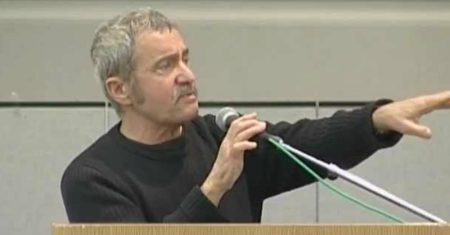
In honour of Michael Parenti (1933–2026), who passed away on 24 January 2026 at the age of 92. He spent his life naming what power prefers to leave unnamed.
In 1837, Abraham Lincoln remarked: “These capitalists generally act harmoniously, and in concert, to fleece the people.”
Today, he would be dismissed as a conspiracy theorist.
That dismissal—reflexive, automatic, requiring no engagement with evidence—is not a mark of sophistication. It is a tell. The question worth asking is not whether conspiracies exist (they are a matter of public record and a recognised concept in law) but why acknowledging their existence provokes such reliable hostility. What work does the label “conspiracy theorist” actually do?
The late political scientist Michael Parenti spent decades answering that question. His conclusion was blunt: “’Conspiracy’ refers to something more than just illegal acts. It serves as a dismissive label applied to any acknowledgment of ruling-class power, both its legal and illegal operations.” The term functions not as a descriptor but as a weapon—a thought-terminating cliché that protects the powerful from scrutiny by pathologising those who scrutinise them.
Conspiracy denial, in Parenti’s analysis, is not skepticism. It is the opposite of skepticism. It is credulity toward power dressed up as critical thinking. As he wrote in Dirty Truths: “Just because some people have fantasies of conspiracies does not mean all conspiracies are imaginary.” … continue
Blog Roll
Recent Comments
eddieb on WEF Calls for ‘Cultural Revolu… loongtip on Trump wanted to play peacemake… Coronistan on EU member to sue bloc over ‘su… loongtip on Vicious loongtip on EU turns to India for defense… Coronistan on Donald Trump Is No Peace … seversonebcfb985d9 on French court jails pro-Palesti… eddieb on Fourteen Incredible Facts Abou… Bill Francis on European leaders’ shift in the… seversonebcfb985d9 on Villains of Judea: Philip Esfo… loongtip on Report warns that ‘Jewish terr… Craig Nelms on New study shows that toxic gas…


 Aletho News
- Attack on Iran would backfire, causing great losses for US, warns European think-tank
- Davos and Abu Dhabi: How the Ukrainian Endgame Exposed Western Decline
- AfD co-leader states the obvious: Pouring money into the Ukraine war is killing the German economy
- Britain’s return to piracy to stop Russian ships – desperate attempt to demonstrate power
- Czech coalition rules out higher defense spending, says 2% of GDP is enough
- G7 Hands Ukraine $40Bln Generated From Frozen Russian Assets
- Conspiracy Denial
- Ukraine expects to join EU next year – Zelensky
- Here’s what’s behind the US shift on EU allies
- UN experts alarmed by prosecution of students protesting ETH Zurich’s Israel-linked research ties
- If Americans Knew
- “The Gaza ceasefire is a minefield” – Not a ceasefire Day 110
- Israel to seek new security deal from US, official says
- Leaked “Board of Peace” Resolution Outlines U.S.-Led Plan to Rule Over Gaza
- Jonathan Greenblatt Rolls Out Plan to Activate Hispanic Evangelical Golems
- Violence against hundreds of Gazan remains to find one Israeli – Not a ceasefire Day 109
- Greenpeace Demonstrator Exposes Folly of Protest Restrictions
- From CBS to TikTok, Pro-Israel Ellison is now in the driver’s seat
- Israel pays for UK advertisements attacking Doctors Without Borders
- Israel accused of extracting billions from Gazan people to pay for their own genocide
- ‘Deliberate Assassination’: 3 Journalists Among 11 Killed by Israeli Forces in Gaza
- No Tricks Zone
- New Study Affirms Rising CO2’s Greening Impact Across India – A Region With No Net Warming In 75 Years
- Germany’s Natural Gas Crisis Escalates … One Storage Site Near Empty …Government Silent
- Polar Colding…Antarctica Saw Its Coldest October In 44 Years!
- New Study: Sea Levels Rose 20 Times The Modern Rate During The Roman Warm Period
- As German Gas Storage Dips Dangerously Low…Shortage Hardly Avoidable
- New Study: Brazil’s Relative Sea Level Was 2+ Meters Higher And SSTs 3-4°C Warmer 6000 Years Ago
- Philosopher Schopenhauer: Climate Science Certainty Stems From Stupidity, Ignorance
- New Study: Species Extinction Rates Declining Since 1980 – ‘Climate Change Is Not An Important Threat’
- Denmark Places Climate Protection Above Animal Welfare, Poisoning And Culling Cows
- New Study: Greenland Was 3-7°C Warmer And Far Less Glaciated Than Today 6000-8000 Years Ago
 Aletho News