US vows to back French military intervention in former colony Mali
Press TV – January 12, 2013
The US is looking into supporting French military intervention in its former African colony of Mali, by offering to provide “surveillance drones” as it has already declared its backing of moves against Malian militants.
US commanders were further considering other options such as “providing intelligence and aerial refueling tankers” as well as “logistical backup and boosting intelligence sharing,” involving its surveillance drones, AFP reported Friday, quoting an unnamed US official that spoke on condition of anonymity.
The report also quotes its anonymous source as saying that senior American officials held talks with their French counterparts as well as authorities from other European allies in Paris on “an action plan” against militants controlling a northern portion of the Muslim country.
The US military holds a network of major air bases in Italy, Spain and other western European countries and could back the French military intervention by providing it with refueling tankers and other logistical assistance.
Paris-backed Malian government forces, the report says, began a military offensive against militants that have seized control of the north of the West African states with aerial support from French war planes.
French President Francois Hollande has confirmed his country’s military intervention against what he has described as ‘al-Qaeda-linked radicals’ in Mali.
Previously, the US had raised alarms about the militants in Mali, blaming them for involvement in an attack against the American Consulate in Benghazi, Libya that led to the killing of its ambassador and three CIA operatives in the neighboring country.
The US National Security Council spokesman Tommy Vietor is also cited in the report as vowing support for French objectives in the West African country.
“We have noted that the government of Mali has asked for support, and we share the French goal of denying terrorists a safe haven in the region,” he is quoted as saying in the report.
Hollande, meanwhile, has insisted that France’s military intervention in Mali would continue “for as long as is necessary.”
Related articles
- French troops begin military intervention in Mali: Hollande (alethonews.wordpress.com)
Big Banks Slither out of Mortgage Fraud Review with Minor Costs
BY Noel Brinkerhoff | AllGov | January 11, 2013
After a year and a half of bungled work and plenty of criticism, the Obama administration decided to close down its review of mortgage fraud this week and order banks to pay a sum that consumer advocates say falls short of what’s fair.
The Independent Foreclosure Review was established 18 months ago to vet how banks handled home foreclosures and to compensate Americans for any wrongdoing.
In the end, federal regulators decided on an $8.5 billion settlement that banks must pay. But of this total, only $3.3 billion is actual cash, while another $5.2 billion represents “credits” that financial institutions will receive for avoiding future foreclosure.
The $3.3 billion in funds will be distributed to about 3.8 million borrowers who were eligible to have their foreclosures reviewed. That amounts to approximately $870 per homeowner.
The Office of the Comptroller of the Currency, one of the federal regulators that managed the review and negotiated the new settlement, would not reveal to the media how it decided on the $3.3 billion figure.
As for the review itself, the process was wrought with problems, starting with the fact that banks were allowed to hire “independent” consultants to review mortgage files—consultants who often turned out to have business relationships with the banks they were reviewing, thus creating potential conflicts of interest.
Why Latin America Will Not Bow to US Pressure over Iran
By Yusuf Fernandez | Al-Manar | January 11, 2013
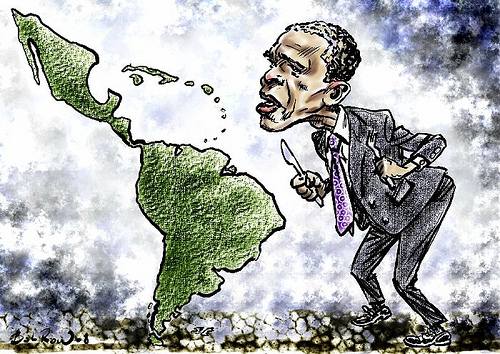
On December 28, US President Barack Obama enacted the so-called “Countering Iran in Western Hemisphere Act” which seeks to undermine Iran´s growing relations with Latin America, a region that has traditionally seen by the United States as its backyard and sphere of influence.
The Act, passed by congressmen earlier this year, requires the US Department of State to develop a strategy within 180 days to “address Iran´s growing hostile presence and activity” in Latin America. The Act points out that “Iran´s business and diplomatic ties are a threat to US national security”. It is seen, however, as another anti-Iranian move fabricated by the Zionist lobby in the US.
Shortly before, in July 2011, Robert F. Noriega – former Assistant Secretary of State for Western Hemisphere affairs, former US ambassador to the Organization of American States (OAS) and current Visiting Fellow at the American Enterprise Institute, one of the main neoconservatives -controlled entities in the US – said in a hearing before the House Subcommittee on Counterterrorism and Intelligence that Iran was carrying out “an offensive strategy” in Latin America.
The Iranian presence in the Latin America has also been harshly attacked by the pro-Israeli hawk Ileana Ros-Lehtinen, Foreign Affairs Committee Chairman and self-appointed bulwark against the alleged “Islamo-Boliviarian threat” to US security. She was co-star of a so-called “documentary” entitled “La amenaza iraní” (The Iranian Threat), in which she said, without blushing, that the US should attack Iran in order to “avert bomb explosions in various Latin American capitals”. The film was aired by Univision, a US broadcast network, which is owned by someone who has hosted galas in honour of the occupying Israeli army.
In 2009, another ridiculous “documentary” released by Univision involved the Venezuelan consul in Miami, Livia Acosta, in an absurd cyber-plot against the US allegedly promoted by “Iranian diplomats and Mexican computer hackers”. This was the pretext used for expelling her from the United States in a move that was widely seen as an American political revenge for Venezuela´s independent foreign policy.
Actually, the US Act rudely violates Latin American countries´ sovereignty and contains some stupid claims such as that the opening of Iranian embassies or cultural centers is to “spread terrorism”. Former Defense Secretary Leon Panetta also echoed those views by claiming, in a recent visit to Colombia, that Iranian attempts to expand its influence in South America amounted to expanding terrorism. Of course, no real evidence has ever been shown to support that laughable allegation.
“The paranoid nature of these estimations, and the scant evidence presented for them, are eerily reminiscent of the kind of broad-strokes, hawkish fear-mongering on display in the lead up to the war in Iraq. The testimony comes from a group bent on hyping security threats and, as Noriega admitted in the testimony, is not even in agreement with the State Department or intelligence agencies”, wrote John Glaser in a recent report.
The US accusations against Iran are also a way of targeting and casting suspicion on Latin American Muslims. In the Act, Washington speaks of “isolating Iran and its allies” and US officials accuse Iran or other pro-Iranian forces of “establishing mosques or Islamic centers throughout the region” in order to advance violent jihad “on our doorstep”.
US declining influence in Latin America
However, Latin American people know well that for over a hundred years it was the United States, and not another country, which wrought terror, war, poverty and repression throughout Latin America in the form of CIA-orchestrated military coups and support of paramilitary crimes, terrorism and dictatorial regimes. Military personnel found guilty of the worst violations of human rights in Latin American countries were trained in the notoriously famous School of Americans by US officers.
Actually, the Act is more evidence that US influence in Latin America is rapidly waning. Latin American countries have developed their own policies and set up independent blocks -ALBA, UNASUR and CELAC- while the Organization of American States, which includes the US and Canada, has been declining due to its submission to US policies on issues such as Cuba´s participation in its summits.
Iran has been seeking to increase its relations with Latin America in a bilateral way and in the framework of the Non-Aligned Movement and other international organizations. This has irritated Washington, which still seems to consider Latin American countries as vassals not having the right to pursue an independent foreign policy or seek its own friends and partners. Any agreement between Latin American states and Iran –or Russia and China- always arouses suspicion in the US.
Several Latin American countries have enhanced their diplomatic and trade ties with Iran in recent years, while their relations with the US have been downgraded amid popular demands for an end to dependence on Washington. Although the United States is still the largest economic partner of many Latin American countries, its economic and financial crisis has adversely affected them. This has led some nations, such as Mexico, to announce their intention to diversify their commercial partners in the next years.
As an international partner, the Islamic Republic is one of the best positioned to help Latin American countries develop their economies and their scientific and technological skills in many fields. The Iranian industry is highly developed. It has remarkable expertise in oil and gas exploitation and other sectors including health, defence, agriculture and space technology.
Iran has helped Venezuela build unmanned drone aircraft as part of their military cooperation. Referring to a Spanish media report that US prosecutors were investigating drone production in Venezuela, President Hugo Chavez said: “Of course we are doing it, and we have the right to. We are a free and independent country.”
In a televised speech to military officers at Venezuela´s Defense Ministry, Chavez said the aircraft only had a camera and was exclusively for defensive purposes. He said that Venezuela planned to soon begin exporting the unmanned drone. Moreover, Iran and Venezuela have mutual investments of about $ 5 billion in factories to make cement, satellites and tractors and the Iranians have helped the Latin American country build 14,000 houses.
Tehran has forged significant economic and political relations with the government of Evo Morales in Bolivia and with that of Rafael Correa in Ecuador. Iran´s links with Argentina, where Zionist circles have unsuccessfully tried to blame Iran for the AMIA attack in 1994, are also rapidly improving, as the government of President Cristina Fernandez is promoting a more conciliatory line towards Tehran.
Latin American countries, especially those that follow an independent foreign policy, trust Iran because they know that the Iranians cannot be pressured into betraying an agreement that disturbs the US or its allies. This is a main reason of Iran´s rising popularity in Latin America despite the propaganda of Zionist-owned media outlets and the US political and diplomatic actions.
HispanTV, the Spanish-language channel similar to the English-language Press TV channel, is also feared by the US establishment and Zionist circles because it is giving Latin American audiences accurate information about the Middle East and international developments that exposes the lies of Zionist-controlled agencies and media. The recent expulsion of Hispan TV from the Spanish-owned Hispasat channel is, in this sense, a desperate attempt to prevent the channel from reaching mass audiences. However, this move, as other similar ones in the past, is doomed to failure.
Therefore, Latin American nations won´t allow the US to dictate their foreign policy on the issue of their relations with Iran or any other country. In fact, Washington has already had a sign of this when it tried to pressure these countries to vote against Palestine’s bid to gain the status of a non-member state at the United Nations. Only one country, Panama, whose government has strong links with the Zionist entity and the local Zionist lobby voted against it.
Related articles
- US, Israel instill fears over Iran’s growing influence in Latin America (alethonews.wordpress.com)
- Ecuador to maintain foreign policy, ties with Iran: FM (alethonews.wordpress.com)
A Cabinet of Peaceniks?
By Peter Hart | FAIR | January 9, 2013
I guess it goes to show you how limited the debate over warmaking is when politicians whose records are mostly pro-war can be portrayed as war skeptics.
That’s what is happening with Barack Obama’s new cabinet picks: Sen. John Kerry for secretary of State and former Sen. Chuck Hagel as Defense secretary. In today’s New York Times (1/9/12), Elisabeth Bumiller has a piece headlined, “For Two Nominees, Vietnam Bred Doubts on War,” where she claims:
Between them, Senator John Kerry and Chuck Hagel have five Purple Hearts for wounds suffered in Vietnam, shared a harrowing combat experience in the Mekong Delta and responded in different ways to the conflict that tore their generation apart.
But in nominating one as secretary of State and the other as Defense secretary, President Obama hopes to bring to his administration two veterans with the same sensibility about the futilities of war.
Bumiller goes on to report that Hagel and Kerry supporters say their Vietnam experiences means they “question the price of American involvement overseas.” That would make a certain kind of sense. But their actual records do very little to support this claim.
After quoting Hagel’s criticism of the ongoing Afghan War, Bumiller writes:
Like Mr. Kerry, Mr. Hagel voted for the resolution authorizing the invasion of Iraq but became an early opponent of the Bush administration’s execution of the war.
So both of them voted to authorize the Iraq War, and supported the invasion of Afghanistan. Kerry supported the Panama invasion and NATO’s war in Serbia. And during his presidential campaign in 2004 he talked about possibly increasing the number of troops in Iraq.
Hagel’s record, as I noted already, has been more supportive of U.S. warmaking than not. If anything, their records suggest they are willing to criticize U.S. wars after they’ve voted to support them. This might be in line with the White House’s thinking, but it shouldn’t be confused with an overall skepticism towards U.S. wars and their “futilities.”
Elsewhere in the paper, David Sanger argues that Kerry and Hagel would be part of a “new national security team deeply suspicious of the wisdom of American military interventions around the world.” They “bear the scars of a war that ended when the president was a teenager,” and–along with Obama’s CIA pick John Brennan–”have sounded dismissive of attempts to send thousands of troops to rewire foreign nations as wasteful and ill-conceived.”
True–except when they haven’t.
Related articles
Moscow, Beijing reconnect as reset with US fizzles
By Robert Bridge | RT | January 9, 2013
Russia and China, which share many of the same international concerns, are looking to fortify their strategic partnership.
At a time when the neighboring countries are beginning to feel the heat of the US military, it seems only natural that Moscow and Beijing are beginning to plant the seeds of a long-term strategic relationship.
Xi Jinping, the secretary-general of the Chinese Communist Party, underlined his country’s commitment to a Russian partnership when he noted that he and President Vladimir Putin “came to the unanimous conclusion” that a “comprehensive strategic partnership” between Moscow and Beijing remains the “top priority of their foreign policy.”
The comments were made on Tuesday during a visit to Beijing by Russian Security Council Secretary Nikolay Patrushev, who is participating in the eighth round of Russian-Chinese consultations on strategic security.
Xi Jingping, 59, who was sworn as the highest-ranking Communist official in November, echoed the sentiments of the Russian president, who noted at his recent Q&A session with international media that Russo-Chinese relations “have become one of the most important factors in the (realm of) international affairs.”
Given the geopolitical realities of the region, it should come as no surprise that Moscow and Beijing are looking to forge a strategic partnership.
Whereas China, traditionally an isolationist country that shuns bilateral alliances, rarely reveals its political hand, Russia made a leap of faith when it attempted to forge a so-called reset in relations with Washington. Today, the reset is in shambles, while many in Moscow accuse Washington of allowing the partnership to deteriorate.
Indeed, much of the blame for the Russia-US fallout is due to Washington’s plans to place a missile defense shield in Eastern Europe, just miles from the Russian border. NATO, originally declaring its intention to cooperate with Russia on the project, remains intransigent, while even refusing to provide Moscow with a legal guarantee that the system will never be aimed at Russian territory.
Moscow rightly warned its Western partners that without Russia’s participation in the system the strategic balance would be upset and there would be another arms race. Still, US and NATO officials have been reluctant to bring Russia on board, and this refusal has played havoc with Moscow’s and Washington’s efforts to nurture a reset between the former Cold War enemies.
In fact, given the current stalemate, the reset itself seems to have been merely a ploy to win Russia’s trust at the same time that a threatening military technology was being introduced courtesy of the Obama administration.
Meanwhile, China, which recently celebrated the launch of its first aircraft carrier (the US Navy already has six carriers assigned to the Pacific), is witnessing a growing US naval presence in the Pacific.
The US military brass announced in June that up to 60 per cent of the Navy’s fleet will be deployed to the Pacific by 2020.
At the same time, Moscow and Beijing hold similar positions on a variety of other international issues, including the situation in Syria, where militants are attempting to force President Bashar Assad from power. Russian and Chinese diplomats have called for a general ceasefire followed by negotiations, whereas the United States has thrown its weight behind the opposition.
“Moscow and Beijing both hold similar positions on the global hotspots, including in Syria, North Korea, Afghanistan and Iran,” Evgeny Bazhanov, president of the Diplomatic Academy of Russia’s Foreign Ministry, told RT in an earlier interview. “They are also both deeply suspicious of the US missile defense system.”
Finally, the China-Russia relationship is motivated by other factors aside from their increasing wariness of American geopolitical intentions.
For example, considering China’s exploding economy, Beijing requires a reliable flow of oil and gas. Russia, meanwhile, welcomes the opportunity to diversify its ample supply of natural resources.
Interstate consultations on strategic issues between Russia and China were launched in 2005.
Brennan
Kenny’s Sideshow | January 7, 2013

John O. Brennan (Photo credit: Wikipedia)
Here’s Johnny!
Since Dick Cheney wasn’t available, Obama is picking the next best thing to run the CIA, John Brennan.
Here’s what some of the qualification checklist may have looked like.
I’ve never understood the need to cloak the titles of government positions in Orwellian nonsense. Brennan’s title of counterterrorism adviser should actually have been something like ‘Head of US Terrorism.’ At least then we could have given the administration a ✔ for transparency.
Hagel
Kenny’s Sideshow | January 6, 2013
“The Jewish lobby intimidates a lot of people up here.”
“I’m not an Israeli senator. I’m a United States senator.”
Chuck Hagel’s most famous words may give hope to some that Obama’s nomination of him for Secretary of Defense is a sign that the influence of Israel is waning. Hagel has even been cautious about war with Iran and has indicated he prefers talking over shooting.
Any nominee that has problems with the ADL, Joe Lieberman and Lindsey Graham must have something going for him. Right? Maybe.
Hagel is a member of the CFR and a sometimes Bilderberg participant. Two strikes.
Take a look at his voting record and some of his stances while senator. Not exactly progressive. He voted for going into Afghanistan. He also voted to go into Iraq before he said he was somewhat against that war and did a little criticizing of the Bush administration. Patriot Act? No problem. He twice cast his lot for it.
FISA? Yep, he likes spying.
Hagel’s campaign contributors included a lot of bankers and we all know how well they like war and military contractors.
Proper disclosure has not been one of his strong suits. Could his own electronic voting machine company have ‘aided’ in his senate campaign wins?
For the first ten weeks of 1996, Hagel served as chairman of American Information Systems (AIS), a voting machine company which later changed its name to ES&S. He also had holdings in the firm’s parent group, McCarthy Group Inc., worth between $1 and $5 million. In November 1996, Hagel was elected to the Senate, the first Republican elected from Nebraska since 1974. He came from behind twice during his run (according to polls), first against well known Republican Attorney General Don Stenberg in the primary, and then against popular Democratic Gov. (and eventual senator) Ben Nelson. In fact, one Nebraska newspaper described his victory as a “stunning upset.” In January 1997, the Washington Post called Hagel’s victory, “the major Republican upset in the November election.” According to Bev Harris of Blackboxvoting.org, a group aimed at “consumer protection for elections,” Hagel won virtually every demographic group, including many largely African-American communities that had never before voted Republican. AIS was responsible for counting approximately 80% of the votes in the election.
In a disclosure form filed in 1996, Hagel did not report that he was chairman of AIS during 1996 or go into detail regarding the company’s underlying assets. Rather, he cited his holdings as an “excepted investment fund,” which is exempt from detailed disclosure rules.
Hope and change with Hagel? It seems somewhat odd that Obama would pick such a controversial Republican for the cabinet post. It’s often said that no one reaches these positions without being bought and/or blackmailed. No word on if Hagel would approve of the military being used against the American people and I doubt the question will come up in the confirmation hearings.
With all the corruption in the merging of government, banks and corporations and the continued influence of the jewish lobby, even if Hagel is ‘approved’ I’m not holding my breath that it will be anything but business as usual.
Related articles
“Did We Just Kill a Kid?”
By TOM McNAMARA | CounterPunch | January 4, 2013

In the spring of 1944, in the quiet little town of Alcolu, South Carolina, two young girls, Betty June Binnicker, age 11, and Mary Emma Thames, age 8, were brutally murdered while picking flowers along a railroad track. Their bodies were found in a nearby water filled ditch. The cause of death was determined to be multiple blows to their skulls with a metal railroad spike. A Mr. George Stinney was soon arrested for the murders. While there was no physical evidence or eyewitness accounts linking the defendant to the crime, unfortunately for Mr. Stinney, the two girls were white. He was black.
Two white police officers were able to get a confession out of Mr. Stinney within an hour, behind closed doors. It was the only evidence offered up during his trial, a trial that was held in one day and lasted only two and a half hours. It was attended by 1,500 people, all of them white. Blacks were not allowed in the courtroom. Mr. Stinney, his family having been driven from their small town, faced the trial alone. Council for the defense offered no evidence on its client’s behalf, and it requested no psychiatric evaluation of the defendant. A guilty verdict was reached after only 10 minutes of deliberation by the (all white male) jury. No recommendation for mercy was given. Had Mr. Stinney’s lawyer filed a simple one sentence appeal, the execution would have been automatically stayed for at least a year. But this was impossible due to the fact that Mr. Stinney did not see his attorney again from the time he left the court. Furthermore, his attorney never spoke to any members of the defendant’s family, let alone inform them that they had the right to appeal the death sentence. Just 81 days after his arrest, on June 16, 1944, Mr. Stinney would walk into the execution chamber.
There is one more tragic element to this already tragic story. Mr. George Junius Stinney Jr. was just 14 years old when he was put to death. He was the youngest person (legally) executed in the United States in the 20th century.
Being small for his age, weighing just 95 pounds (approximately 43 kilograms) and only five feet one inch tall (approximately 1.5 meters), it was with great difficulty that the death sentenced was carried out. But carried out it was. His small body was propped up with books in order to get him to fit properly in the electric chair (the original designers having carelessly overlooked the fact that one day their device might be used to execute a small child), allowing for an electrode to be attached to his right leg.
One commentator reported that George said nothing as the mask was lowered over his face. But after the first 2,400 volts passed through the boy’s small body “the death mask slipped from his face and his eyes were open when two additional shots of 1,200 and 500 volts followed.” George’s head “went up and the mask came of his face … and saliva and all was coming out of his mouth and tears from his eyes.”
The Governor, Olin Johnson, had received hundreds of letters and telegrams asking for leniency for the young boy. But facing a primary election in July, the Governor was not inclined to grant clemency. One telegram compared the execution of a child to something that Adolf Hitler would do. A stinging and bitter accusation considering that American troops had just landed on the beaches of Normandy ten days earlier in the D-Day invasion to liberate France from Nazi occupation and terror. On that one day alone, 9,000 Allied soldiers would die or be wounded fighting the Germans.
It can be argued that the execution of a 14 year old child was a social aberration from a bygone era. A simple anomaly. An isolated case that “fell through the cracks.” A repulsive event from a period when America was still suffering from racial and social ignorance. Surely, as a society, the United States has progressed far beyond the days of when it tolerated the State sanctioned execution of children, has it not?
Two pilots are sitting in an air-conditioned windowless room in New Mexico. Before them sit an array of 14 computer monitors and four keyboards. 6,250 miles away (about 10,000 kilometers) they are controlling a Predator drone that is circling lazily in a figure eight pattern over Afghanistan. They are observing a crude house made of mud when the order is given to launch a laser guided Hellfire missile at the target. With just seconds to go till impact, a small child walks out from behind one of the corners of the structure. A flash on the control screen confirms the impact and explosion, with parts of the structure collapsing and the child disappearing.
“Did we just kill a kid?” the co-pilot asks the pilot.
“Yeah, I guess that was a kid,” the pilot replies.
Confirmation as to whether or not a missile strike had just been carried out on a child was requested. “No. That was a dog,” comes the anonymous response from a military command center.
The pilots review the video of the drone strike that had just taken place.
A dog on two legs?
One of the pilots is no longer in the Air Force, declining to renew his enlistment contract when it was up. After 6,000 flight hours and six years of military service he says “I saw men, women and children die during that time. I never thought I would kill that many people. In fact, I thought I couldn’t kill anyone at all.” He has since been diagnosed with post-traumatic stress disorder by doctors with the Veterans’ Administration.
While the above incident could be deemed an “accident,” apparently the targeted murder of children is now accepted US military policy.
Lt. Col. Marion “Ced” Carrington, Commander of 1st Battalion, 508th Parachute Infantry Regiment, states, “It kind of opens our aperture. In addition to looking for military-age males, it’s looking for children with potential hostile intent” as well. While the Lt. Col would not elaborate on what exactly are the rules of engagement when encountering potential child combatants, reassuringly he tells us that he advises the soldiers serving under him to use “courageous restraint.”
Apparently this “courageous restraint” was lacking on October 14, 2012, when US Marines operating in Helmand province requested, and got clearance for, an airstrike on “shadowy figures” thought to be in the process of setting up an improvised explosive device (IED). The assailants killed in the strike turned out to be three children who were 12, 10 and 8 years old.
The International Security Assistance Force (ISAF), a part of NATO and the organization that is nominally in command of the war (the reality being, of course, that it is a US led affair), said that it may have “accidentally killed three innocent Afghan civilians.” Family members of the victims reported that the children were sent to gather dung, which is used for fuel.
America’s first war in Iraq and its associated sanctions are believed to have resulted in the deaths of over half a million children. America’s second war in Iraq is believed to have resulted in the deaths of over 600,000 Iraqis (most of them between the ages of 15 and 44). America’s targeted drone attacks in the Tribal Regions between Afghanistan and Pakistan have reportedly killed between 474 and 881 civilians, including 176 children
If these were the actions of China, Russia, Iran, or any other country on Earth, we would be able to see them clearly for what they are. War crimes and crimes against humanity of the highest order. We would also realize that they are the actions of a society that is in moral decline.
Why it is impossible for the vast majority of Americans to see this is incomprehensible.
Acknowledgement: The author would sincerely like to thank Professor Bryan A. Stevenson, founder and Executive Director of the Equal Justice Initiative, for making him aware of the story of George Stinney.
Tom McNamara is an Assistant Professor at the ESC Rennes School of Business, France, and a Visiting Lecturer at the French National Military Academy at Saint-Cyr, Coëtquidan, France.
Sources
“Afghan kids recruited for suicide attacks” by Joe Gould and John Ryan, July 18, 2012, Army Times. Accessed at:
“Attempts to clear name of 14-year-old boy who was executed in South Carolina 67 years ago” Reporter: Mark Potter, Anchor: Brian Williams, NBC Nightly News 6:30 PM EST (NBC News Transcripts), October 4, 2011.
“Attorney Decries Juvenile Executions (From Young Blood: Juvenile Justice and the Death Penalty, P 159-165, 1995, Shirley Dicks, ed. – See NCJ-166057)” by D. Bruck, 1995. Accessed at:
https://www.ncjrs.gov/App/Publications/abstract.aspx?ID=166066
“Columbia Journal; Prison Lures Them In (as Tourists)” February 22, 1994, The New York Times. Accessed at:
“D-Day June 6, 1944” United States Army Official Homepage. Accessed at:
“Do Targeted Killings Work?” by Daniel L. Byman, Senior Fellow Foreign Policy, Saban Center for Middle East Policy, July 14, 2009, The Brookings Institute. Accessed at: http://www.brookings.edu/research/opinions/2009/07/14-targeted-killings-byman
“Iraq Sanctions Kill Children, U.N. Reports” by Barbara Crossette, December 1, 1995, The New York Times. Accessed at:
“Living Under Drones: Death, Injury, and Trauma to Civilians From US Drone Practices in Pakistan” the International Human Rights and Conflict Resolution Clinic (Stanford Law School) and the Global Justice Clinic (NYU School of Law), September 2012. Accessed at:
Click to access Stanford_NYU_LIVING_UNDER_DRONES.pdf
“Questions Raised in Deaths of Afghan Children in Coalition Strike” by Alissa J. Rubin, October 17, 2012, The New York Times. Accessed at:
“Some Afghan kids aren’t bystanders” by Dan Lamothe and Joe Gould, December 3, 2012, Military Times. Accessed at:
http://www.militarytimes.com/news/2012/12/marine-taliban-kids-120312w
“Study Claims Iraq’s ‘Excess’ Death Toll Has Reached 655,000” by David Brown, October 11, 2006, The Washington Post. Accessed at:
http://www.washingtonpost.com/wp-dyn/content/article/2006/10/10/AR2006101001442.html
“The Human Cost of the War in Iraq: A Mortality Study, 2002-2006” by G. Burnham, S. Doocy, E. Dzeng, R. Lafta and L. Roberts, with the Bloomberg School of Public Health at Johns Hopkins University, Al Mustansiriya University and the Center for International Studies at the Massachusetts Institute of Technology, October 11, 2006. Accessed at:
Click to access human-cost-war-101106.pdf
“The Merciful Executioner: Spectacles of Sexual Danger and National Reunification in the George Stinney Case, 1944” by Annette Louise Bickford, University of Toronto, Southern Anthropologist Vol. 35, No. 1, 2010
“The Woes of an American Drone Operator” by Nicola Abé, December 14, 2012, Der Spiegel. Accessed at:
“War in Iraq: Humanitarian Relief Efforts” April 11, 2003, The Washington Post. Accessed at:
http://www.washingtonpost.com/wp-srv/liveonline/03/special/iraq/sp_iraq_zaidi041103.htm
“When Something Wicked This Way Comes: Evolving Standards of Indecency – Thompson and Stanford Revisited” by J. L. Whitney, 46 Clev. St. L. Rev. 801 (1998)
“World: Middle East Iraqis blame sanctions for child deaths” by Jeremy Bowen, August 12, 1999, BBC. Accessed at:
http://news.bbc.co.uk/2/hi/middle_east/418625.stm
~
Photo – George Stinney, 1944, executed at age 14 years old (Photo credit: Wikipedia)
Related articles
- US sets records with number of drone strikes in Afghanistan this year (rt.com)
- Newtown kids v Yemenis and Pakistanis: what explains the disparate reactions? [2 of 2] (wondersofpakistan.wordpress.com)
US imposes fresh sanctions on Tehran, including ban on Iranian media
Press TV – January 4, 2013
The United States has imposed fresh sanctions on Iran that include bans on the country’s media despite Washington’s claims of protecting freedom of speech.
The new bans are included in the $633-billion military bill for 2013 which US President Barack Obama signed into law on Wednesday night.
The anti-Iran sanctions portion of the bill, among other economic features, blacklists the Islamic Republic of Iran Broadcasting (IRIB) and its president Ezzatollah Zarghami and will block all the IRIB assets and prevent others from doing business with it.
The sanction against IRIB is an attempt by the West to silence Iranian media. It is on top of another flagrant violation of freedom of speech by satellite providers Eutelsat SA and Intelsat SA which stopped the broadcast of several Iranian satellite channels in October.
In November, the Hong Kong-based Asia Satellite Telecommunications Co. Ltd. (AsiaSat) also took all Iranian channels off air in East Asia under pressure from the US.
In a similar move in December, Spain’s top satellite company Hispasat ordered its satellite provider Overon to take Iranian channels Press TV and Hispan TV off the air.
The restrictions on Iranian media are interpreted as an attempt to silence the truth-telling media.
This comes as US lawmakers say the fresh anti-Iran sanctions portion of the bill is part of measures aimed at pressuring Iran to halt its nuclear energy program.
The United States, Israel and some of their allies have repeatedly accused Iran of pursuing non-civilian objectives in its nuclear energy program.
Over the false allegation, Washington and the European Union have imposed illegal unilateral sanctions against the Islamic Republic.
Iran refutes the allegations and argues that as a signatory to the Non-Proliferation Treaty and a member of the International Atomic Energy Agency, it is entitled to develop and acquire nuclear technology for peaceful purposes.
Related articles
- US Senate to blacklist and block the assets of Iranian broadcaster IRIB (alethonews.wordpress.com)
US will boost funding for military adventures at the expense of public

By Dave Lindorff | Press TV | January 3, 2013
I was asked earlier this week by an reporter for PressTV, English-language television network in Iran, if I could explain why the US political system seemed to be so dysfunctional, with Congress and the President having created an artificial budget crisis 17 months ago, not “solving” it until the last hour before a Congressional deadline would have created financial chaos, and even then not solving the problem and instead just pushing it off for two months until the next crisis moment.
I thought for a moment, trying to come up with a simple way to explain the peculiar politics of a fake democracy where two equally pro-capitalist, pro-imperialist parties vie with genuine bitterness for patronage spoils and legal bribes, all the while ignoring the real wishes and needs of the public, and then it hit me: it is really all about US militarism and the unwillingness of either of the two political parties to admit honestly to American people how much they are being gouged to allow the US government and its corporate owners to continue in their attempt to control the world.
It really is that simple.
The US currently spends almost as much on its military and on paying for current and past wars in terms of interest on war debt and care for wounded and aging soldiers as the entire rest of the world spends on arms and war. Approximately $1.3 trillion gets spent each year in taxpayer’s dollars and in more borrowed funds (50 cents of every federal tax dollar goes to pay for the US military, the intelligence apparatus, veterans’ benefits and other related military costs). It is simply ludicrous, given this situation, to imagine that the US can significantly reduce its budget deficit either by raising taxes or by cutting social spending.
Think of it this way. The US is currently running a $1.3 trillion deficit (that is federal spending less tax revenue). That deficit, significantly one must note, almost exactly matches the amount that is being spent annually on the US military, and on military/intelligence-related activities.
In contrast, the federal government budget in 2012 allocated $870 billion for Medicare, Medicaid and all other programs under the aegis of Department of Health and Human Services. The total Department of State budget is $56 billion, and a portion of that is actually for military activities, such as intelligence operations and protection of embassies and consulates. The Department of Agriculture got $150 billion, and that includes the Food Stamp program. Federal spending on education was just $100 billion a year. Social Security is not part of the tax take or the federal budget, as it is all paid from the Social Security Trust Fund, which in turn has been financed by the dedicated payroll tax paid by working people and employers.
None of these non-military budget spending categories could possibly be cut sufficiently to make any real dent in the nation’s massive deficit, which is running at $1.3 trillion a year and which now totals $16.3 trillion. Certainly cuts of 50% could theoretically be made in health and welfare spending, in education, and in other parts of the budget, but cuts of that scale would cause such mass suffering and chaos that the nation would erupt in open rebellion.
The military budget, on the other hand, could be slashed by 50% and nobody would know the difference! The public in the US barely knows there are wars going on. We read about an occasional soldier killed or plane downed, but there is no day-to-day evidence that the US is a nation perpetually in a state of war. If the military were to end those wars, which are costing over $160 billion a year, pull out of all its far-flung bases, which are costing $250 billion a year, slash its huge Special Operations Command, which now number nearly 70,000 people at a cost of over $10 billion, eliminate or massively reduce its strategic nuclear forces, which costs $60 billion a year, and decommission its fleet of aircraft carrier battle groups, which counting construction and operation costs, plus the cost of the planes and missiles they carry, probably cost in the range of $100 billion a year, the US would be no less safe, but the federal budget deficit could be instantly slashed by close to $600 billion a year. That is the amount that is being cut in the current so-called “Fiscal Cliff” bargain over a period of ten years.
In a genuine democracy, there would be politicians and a political party that would be calling for just such an end to US militarism and the massive spending that is needed to support it. It is something that polls show the majority of Americans want to see happen, even though there are no people in government calling for doing it, and even though the very idea of seriously cutting military spending is blacked out by the US corporate media.
Instead, what the American public gets is a fake debate between Democrats and Republicans, and between the White House and the Republicans in the House of Representatives, all focussed on the rest of the US budget — the non-military part. This “debate” is basically a matter of Republicans saying they want to cut the non-military budget deficit by slashing “social spending” and Democrats saying that they are willing to cut “some” social spending, but they would rather raise taxes.
The thing is, cutting social program spending more than by a small amount would be catastrophic, leading to even more mass teacher layoffs, declining health, hunger, collapsing bridges, and to fewer people being able to afford to go to college. It would lead to even more homeless Americans, including returned veterans. Nobody would accept this. We’re already suffering from such cuts. And as for taxes, in a long-running economic crisis such as we are experiencing, nobody but the rich can afford to pay more, and the rich are given a free hand at escaping taxes through loopholes, offshore banking, and high priced accountants.
The reality is that there really is only one way to attack the nation’s massive and growing budget deficit without destroying both people’s lives and the nation’s economy, and that is to slash military spending and to put an end to the country’s militarism and imperialism.
The US today, as former Alaska Sen. Mike Gravel famously said during an early televised Democratic presidential primary debate in 2008, “has no enemies.” It is not threatened by any nation, has a military that is without equal, and has a populace that is armed to the teeth. The United States simply does not need to be spending in excess of a trillion dollars — at least on defense. The country would be just as safe — it would be much safer actually since it wouldn’t be destroying lives around the globe and creating enemies where there were none — if it were a tenth of its current size.
The time for a real debate about cutting the US budget by focusing on military spending has come. It is long overdue. If it isn’t addressed now, it will be eventually, not by choice perhaps, but because the US will simply no longer be able to pay for its addiction to war.
Featured Video

More Bombs, More Talks Zelensky Rejects Trump’s Plan
or go to
Aletho News Archives – Video-Images
Book Review
In 2014, Michael Parenti Wrote A Prophetic Article About Ukraine

The Dissident | January 28, 2026
This week, the influential left-wing scholar Michael Parenti passed away at the age of 92.
Parenti was well known for his sharp criticism of U.S. foreign policy and U.S. imperialism throughout his life, waking up many to the reality of it and the lies used to justify it.
This is best underscored in one of his last published articles, “Ukraine and Regime Change”, which was published in the book “Flashpoint In Ukraine: How the U.S. Drive for Hegemony Risks World War III”, where he predicted to a tee what the result of the 2014 U.S. backed coup in Ukraine would be. … continue
Blog Roll
Recent Comments
loongtip on Hamas never agreed to lay down… eddieb on Conspiracy Denial eddieb on WEF Calls for ‘Cultural Revolu… loongtip on Trump wanted to play peacemake… Coronistan on EU member to sue bloc over ‘su… loongtip on Vicious loongtip on EU turns to India for defense… Coronistan on Donald Trump Is No Peace … seversonebcfb985d9 on French court jails pro-Palesti… eddieb on Fourteen Incredible Facts Abou… Bill Francis on European leaders’ shift in the… seversonebcfb985d9 on Villains of Judea: Philip Esfo…


 Aletho News
- In 2007, Michael Parenti Called Out The Greater Israel Project
- Hamas never agreed to lay down arms in truce talks: Official
- Iran, China and Russia sign trilateral strategic pact
- After Years Of Denial, The IDF Admits The Gaza Health Ministry’s Numbers Are Accurate
- Riyadh and Hezbollah: A rapprochement forged in fire
- Criminal Conspiracy: How the U.S. and Israel Turned Iran into a Proving Ground for Bloody Experiments
- EU labels Iran’s Revolutionary Guard ‘terrorist organization’
- Security Guarantees Supported by Russia Agreed on in Istanbul in 2022 – Lavrov
- Russian oil major agrees sale of foreign assets to US firm
- European Union Sanctions Russian Journalists and Artists
- If Americans Knew
- Playful Post on Tel Aviv Park Omits That It Was Built on Ruins of Palestinian Neighborhood
- Palestinian developer gains massive user support for app challenging censorship claims criticising US and Israel after losing over 60 relatives in Gaza
- Gaza’s ‘Board of Peace’ – A New Phase of Palestinian Dispossession and Genocide
- Mike Huckabee is interfering with the work and witness of churches in the Holy Land with a goal of silencing Palestinian Christians
- “Hey ChatGPT, is Israel building a concentration camp?” (spoiler: yes) – Not a ceasefire Day 111
- “The Gaza ceasefire is a minefield” – Not a ceasefire Day 110
- Israel to seek new security deal from US, official says
- Leaked “Board of Peace” Resolution Outlines U.S.-Led Plan to Rule Over Gaza
- Jonathan Greenblatt Rolls Out Plan to Activate Hispanic Evangelical Golems
- Violence against hundreds of Gazan remains to find one Israeli – Not a ceasefire Day 109
- No Tricks Zone
- 130 Years Later: The CO2 Greenhouse Effect Is Still Only An Imaginary-World Thought Experiment
- New Study Affirms Rising CO2’s Greening Impact Across India – A Region With No Net Warming In 75 Years
- Germany’s Natural Gas Crisis Escalates … One Storage Site Near Empty …Government Silent
- Polar Colding…Antarctica Saw Its Coldest October In 44 Years!
- New Study: Sea Levels Rose 20 Times The Modern Rate During The Roman Warm Period
- As German Gas Storage Dips Dangerously Low…Shortage Hardly Avoidable
- New Study: Brazil’s Relative Sea Level Was 2+ Meters Higher And SSTs 3-4°C Warmer 6000 Years Ago
- Philosopher Schopenhauer: Climate Science Certainty Stems From Stupidity, Ignorance
- New Study: Species Extinction Rates Declining Since 1980 – ‘Climate Change Is Not An Important Threat’
- Denmark Places Climate Protection Above Animal Welfare, Poisoning And Culling Cows
 Aletho News