‘Ukraine worst conflict since WW2’ narrative allows the West to forget horrific war which shook Europe
Samizdat | August 3, 2022
Europe had “77 years of almost uninterrupted peace” until Russia chose to end it by “invading” Ukraine, according to a peculiar “analysis” published by the Associated Press (AP) over the weekend. Having thus erased Yugoslavia’s bloody destruction in the 1990s, the author contradicts himself just two paragraphs later.
In a surreal opener, AP’s John Leicester argues that the conflict in Ukraine is the kind of world-changing event on the same level as the first nuclear bomb test in 1945 or the 1969 moon landing. Except the moon landing didn’t really change the world – the Apollo program arguably was NASA’s high water mark – so it’s puzzling why it would even get a mention. Perhaps to emotionally prime the reader for the following whopper, which is that on February 24 this year,. Russian President Vladimir Putin “chews up the world order and 77 years of almost uninterrupted peace in Europe by invading Ukraine.”
Come again? Leicester, who writes from Paris and has covered Europe for AP since 2002, clearly missed out on the Balkans Wars of the 1990s. Not to mention conflicts in the north of Ireland and Cyprus.
People who did not, and live with the consequences to this day, were predictably upset.
The war in Bosnia (1992-1995) certainly did not qualify as “uninterrupted peace” – unless this was considered Europe only on the maps. Nor did the 1999 “humanitarian intervention” in Kosovo, which had consequences that were on display on Sunday. The entire article basically hinges on that one word, “almost.”
It might be possible Leicester – and his AP editors – had forgotten all about these episodes. There is a curious lack of interest in the West in questioning the official narratives of the Yugoslav wars, after all. Except just two paragraphs later, Leicester cites an emotionally charged issue straight out of the Bosnian War – Srebrenica – to compare the Russians to Nazis.
Taking into consideration that his “analysis” is just dripping with emotionally charged language, this suggests that either Leicester and AP don’t consider the Balkans properly “Europe,” or chose to gloss over the conflicts there in order to bend reality to their preferred narrative – that of Russia upsetting Europe’s peaceful slumber.
Just look at this verbiage: “generations of Europeans who had grown up knowing only peace have been brutally awakened to both its value and its fragility.” Or this: “the need to take sides — for self-preservation and to stand for right against wrong.”
Or lamenting that the world was making such “progress, with speedy vaccines against the Covid-19 global pandemic and deals on climate change, before Russia’s all-powerful Putin made it his historical mission to force independent, Western-looking Ukraine at gunpoint back into the Kremlin’s orbit, as it had been during Soviet times, when he served as an intelligence officer for the feared KGB.” Just one trope after another, strung together for maximum emotional impact.
At this point it is tempting, as one online researcher did, to wonder “how quickly the once venerable AP descended into an all-out dumpster fire.” Not just when it comes to the conflict in Ukraine, either – the agency’s almost comical “don’t say recession” coverage of the US economy under President Joe Biden has prompted one pollster to describe them as “disgustingly dishonest” people who have been “shilling” for the Democrats for years.
Another example of this is on display in AP’s coverage of the House January 6 Committee, an unusual collection of Democrats “enriched” by two rabidly anti-Trump GOP representatives. In addition to the emotional undertones, the agency insists on calling the Capitol riot an “insurrection,” a loaded term preferred by the Democrats, in order to invoke the 14th Amendment and disenfranchise the opposition.
Compare that to AP bending over backwards not to describe the 2020 riots as “riots,” but literally anything else. Their explanation? The word “riot” would “stigmatize broad swaths of people protesting against lynching, police brutality or for racial justice, going back to the urban uprisings of the 1960s.”
Instead, the AP’s Stylebook – used by most English-speaking journalists around the world – advises using different euphemisms, depending on who the violence is directed at. In other words, the What matters less than Who is doing it to Whom.
If once is coincidence, twice is happenstance, and three times is enemy action, then this is a veritable onslaught on the very meaning of words, perpetrated by one of the world’s largest “news” agencies. This is about more than Ukraine, or the Balkans wars, or the Biden recession, or the “fiery but mostly peaceful” riots – it’s about reality itself and the people who try to twist it, whatever their reasons.
NATO-backed network of Syria dirty war propagandists identified
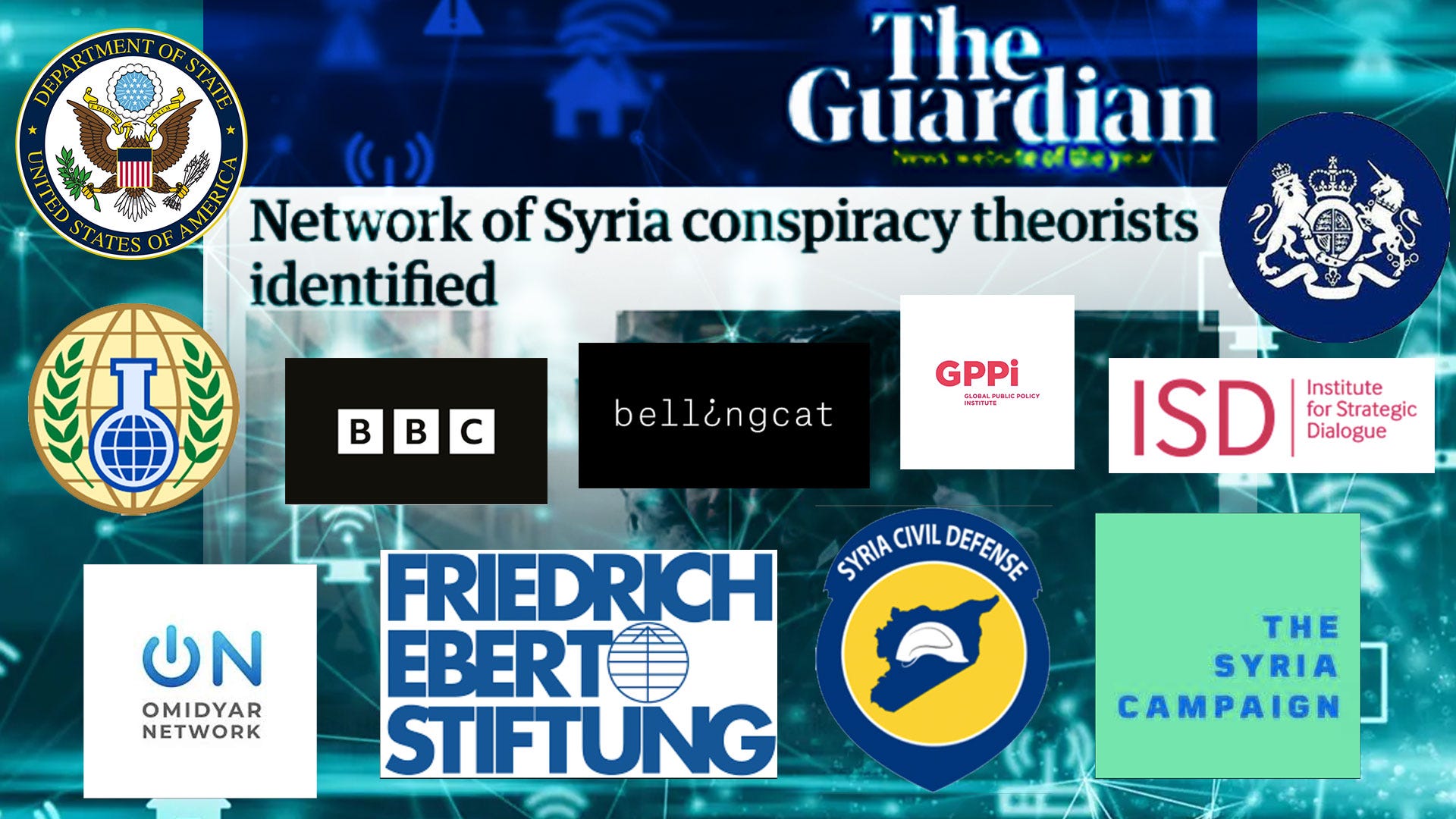
Defaming journalism on the OPCW’s Syria cover-up scandal, The Guardian and its NATO-funded sources out themselves as the real “network of conspiracy theorists.”
By Aaron Maté | August 1, 2022
On June 10th, The Guardian’s Mark Townsend published an article headlined “Russia-backed network of Syria conspiracy theorists identified.” (“Russia-backed” has since been removed).
The article is based on what Townsend calls a “new analysis” that “reveals” a “network more than two dozen conspiracy theorists, frequently backed by a coordinated Russian campaign.” This network, Townsend claims, is “focused on the denial or distortion of facts about the Syrian regime’s use of chemical weapons and on attacking the findings of the world’s foremost chemical weapons watchdog,” the Organization for the Prohibition of Chemical Weapons (OPCW). According to Townsend, I am named “as the most prolific spreader of disinformation” among the nefarious bunch.
In hawking this purported exposé of “disinformation”, Townsend violated every basic standard of journalism. He did not contact me before publishing his allegations; fails to offer a shred of evidence for them; and does not cite a single example of my alleged “prolific” disinformation. Instead, Townsend bases his claims entirely on a think-tank report that also provides no evidence, nor even assert that I have said anything false. In the process, Townsend failed to disclose that the report’s authors — the Institute for Strategic Dialogue (ISD) and the Syria Campaign — are groups funded by the US government and other belligerents in the Syria proxy war. To top it off, Townsend fabricates additional allegations that his state-funded sources do not even make.
As a result, Townsend and the Guardian have engaged in the exact sort of conduct that they falsely impute to me and others: spreading Syria-related disinformation with coordinated support from state-funded actors. The aim of this propaganda network is transparent: defaming journalism that exposes the OPCW’s ongoing Syria cover-up scandal and the dirty war waged by Western powers on Syria.
The OPCW cover-up is arguably the most copiously documented pro-war deception since the US-led drive to invade Iraq. In Western media, as The Guardian’s behavior newly demonstrates, it is also without question the most suppressed.
At the center of the story are two veteran OPCW scientists, Dr. Brendan Whelan and Ian Henderson. The pair were among a team that deployed to Syria in April 2018 to investigate an alleged chemical attack in the town of Douma. They have since accused senior OPCW officials of manipulating the Douma probe to reach a conclusion that baselessly implicated the Syrian government in a chlorine gas attack. Their claims are backed up by a trove of leaked documents and emails that show extensive doctoring and censoring of the Douma team’s findings.
The Douma cover-up extends far beyond the OPCW’s executive suite. It also implicates NATO governments led by the US, which bombed Syria over the Douma chemical weapons allegation, and then, weeks later, privately pressured the OPCW to validate it. Since the OPCW scandal became public, the US and its allies have thwarted efforts to address it.
At the most criminal level, the scandal implicates sectarian death squads armed and funded by the US and allies during their decade-long campaign for regime change in Syria.
At the time of the incident, Douma was occupied by the Saudi-backed jihadi militia Jaysh-al-Islam and under bombardment from Syrian army forces attempting to retake control. Shortly before their surrender, local allies of Jaysh-al-Islam accused Syrian forces of using chemical weapons. They released gruesome footage of an apartment building filled with slain civilians. A gas cylinder was filmed positioned above a crater on the roof. Concurrently, the White Helmets, a NATO and Gulf state-funded, insurgent-adjacent organization, released footage of what it claimed were gas attack victims in a Douma field hospital. Several journalists, including Riam Dalati of the BBC, Robert Fisk of the Independent, and James Harkin of the Intercept, found evidence that the hospital scene was staged. (In February 2019, Dalati claimed that he can “prove without a doubt that the Douma Hospital scene was staged.” Oddly, more than three years later, he has not released his findings).
The White Helmets’ alleged fakery of a chemical attack aftermath, coupled with the censored OPCW findings showing no evidence that a chemical attack occurred, suggest the inescapable conclusion that insurgents in Douma carried out a deception to frame the Syrian government. And given the unexplained deaths of the more than 40 victims filmed in the Douma apartment building, that deception may have entailed a murderous war crime.
Unlike the Iraq WMD hoax, the very existence of the OPCW’s Douma scandal is unknown to much of the Western world. With few exceptions, establishment media outlets have refused to acknowledge the OPCW whistleblowers and the leaks that brought their story to light.
After largely ignoring the OPCW cover-up since it first surfaced in May 2019, the Guardian has now published defamatory claims about journalists, myself included, who have dared to report on the censored facts.
When I wrote The Guardian about the Townsend article’s journalistic lapses, I did not get a response. One week later, I phoned Townsend, who was now back in the office but had yet to reply. In our conservation, which I recorded and recently published, I repeatedly asked Townsend to substantiate his claims about me and identify even a single example of my alleged disinformation.
Townsend did not attempt to defend his article’s assertions, beyond claiming that they were based on what was “in a report.” When I pressed further, he claimed that he had to “dash for a meeting” and promised that I would soon hear from the paper’s reader’s editor. (Before I published our phone call, and this article, I emailed Townsend a detailed list of questions and invited him to offer any additional comment. He did not respond).
“Deadly Disinformation”
Townsend could not provide any evidence for his assertions because the report that he parroted offers none as well.
The report, titled “Deadly Disinformation” and authored by The Institute for Strategic Dialogue (ISD) and the Syria Campaign, contains bare references to my reporting and makes no effort to refute it. Nowhere does the report even claim that I have said anything false. It simply claims to have “identified 28 individuals, outlets and organisations who have spread disinformation about the Syrian conflict,” and that I am “the most prolific spreader of disinformation” among them.
When the report bothers to mention of anything that I have actually said, it engages in distortion. In its first mention, the report states that I wrote an article that “attacks Bellingcat for its contributions to the Organization for the Prohibition of Chemical Weapons (OPCW).” Here, they not only fail to assert that I said anything false, but offer a false portrayal of what happened.
As for “attacking” Bellingcat — a website that, like the report’s authors, is funded by NATO states that were belligerents in the Syria dirty war – what I really did was expose its disinformation.
In this case, Bellingcat fraudulently attacked Whelan (the key OPCW whistleblower), along with several journalists (myself included) by falsely accusing us of concealing an OPCW letter that, I quickly revealed, did not in fact exist. Bellingcat was forced to add a correction, delete embarrassing tweets, and apologize to one of the article’s targets, the journalist Peter Hitchens (who resides in the UK, home to strict libel laws). I later exposed that Bellingcat copied a hidden, external author for some of their false material.
In short, the ISD/Syria Campaign’s first purported example of my alleged “disinformation” is an easily verifiable case where I’ve exposed state-backed lies.
The report’s only other substantive example comes when it notes that I have argued that the OPCW probe’s Douma probe “was flawed.” This far understates my case: the OPCW’s Douma investigation wasn’t “flawed”; it’s a scandalous cover-up worthy of global attention. Regardless, yet again, the report does not even assert that my argument is false, let alone try to explain why.
In a July 13th email, I asked the ISD to substantiate their claim that I have spread disinformation, and provide even one example of it. On its website, the ISD claims to “take complaints seriously,” and promises a response “within ten working days.” As of this writing, after 13 working days, I have not heard back.
At The Guardian, OPCW leaks are “problematic”
When I emailed a complaint about Townsend’s reporting, The Guardian admitted fault only on failing to contact me before publishing his evidence-free allegations. This was the result, they claimed, of a “breakdown of communication internally.” I was then offered the chance to respond to the article in 200 words.
A key point in my reply (which can be read here) was that The Guardian and its state-funded source is unable to identify any falsehoods in anything I’ve written “because my reporting on the OPCW’s Douma cover-up scandal is based on damning OPCW leaks.” These leaks, I added, “reveal that veteran inspectors found no evidence of a chemical attack in Douma, and that expert toxicologists ruled out chlorine gas as the victims’ cause of death. But these findings were doctored and censored by senior OPCW officials.”
At The Guardian, this passage set off an apparent alarm. After disparaging my reporting on the OPCW leaks, The Guardian informed me that they would now prevent me from even mentioning them. In a July 8 email, a Guardian editor wrote that the “the part about the OPCW” in my reply “continues to be problematic.” My reference to the OPCW leaks, the editor claimed, “makes an assertion that has been rebutted by an independent inquiry.”
I responded by asking the editor to specify exactly which “assertion” of mine has been rebutted. I also proposed that, if they believe that I have said anything “problematic,” they publish their own rebuttal.
In multiple follow-up emails, the editor failed to identify any “rebutted” assertion of mine. Despite that, the Guardian proceeded to publish my reply without its reference to the OPCW leaks. But this raised a new problem: in censoring my statement, they misquoted me. When I pointed out that error, they updated my reply to finally allow a (minimal) mention of the OPCW leaks.
The Guardian also took me up on my proposal that they publish their own rebuttal:
Editor’s note: Both the ISD and the Syria Campaign list a diverse range of funders and describe themselves as “fiercely independent”. In 2020 the OPCW rebutted claims about its investigation into the Douma incident (Inquiry strikes blow to Russian denials of Syria chemical attack).
As for the “inquiry” that The Guardian claims “rebutted claims about its investigation into the Douma incident,” the inquiry was not independent, and did not rebut anything.
The “inquiry” was appointed by the OPCW’s Director General’s office, the very body that presided over the cover-up. It was also staffed by two “investigators” from the US and UK. These happen to be the two states that bombed Syria based on the Douma allegations that the OPCW fraudulently validated, and that have since tried to bury the scandal at every stage.
Accordingly, the OPCW “inquiry” avoided the allegations of censorship in the Douma probe and instead disingenuously minimized the whistleblowers’ role. The whistleblowers themselves have rebutted the inquiry’s claims about them, as have I in subsequent reporting.
A network of NATO disinformation
As for what the Guardian calls the ISD and Syria Campaign’s “diverse range of funders,” both groups indeed enjoy a diverse range of funders: everyone from NATO governments to NATO government-funded organizations. They also receive support from billionaire-funded foundations that often work in concert with these same NATO governments’ foreign policy objectives.
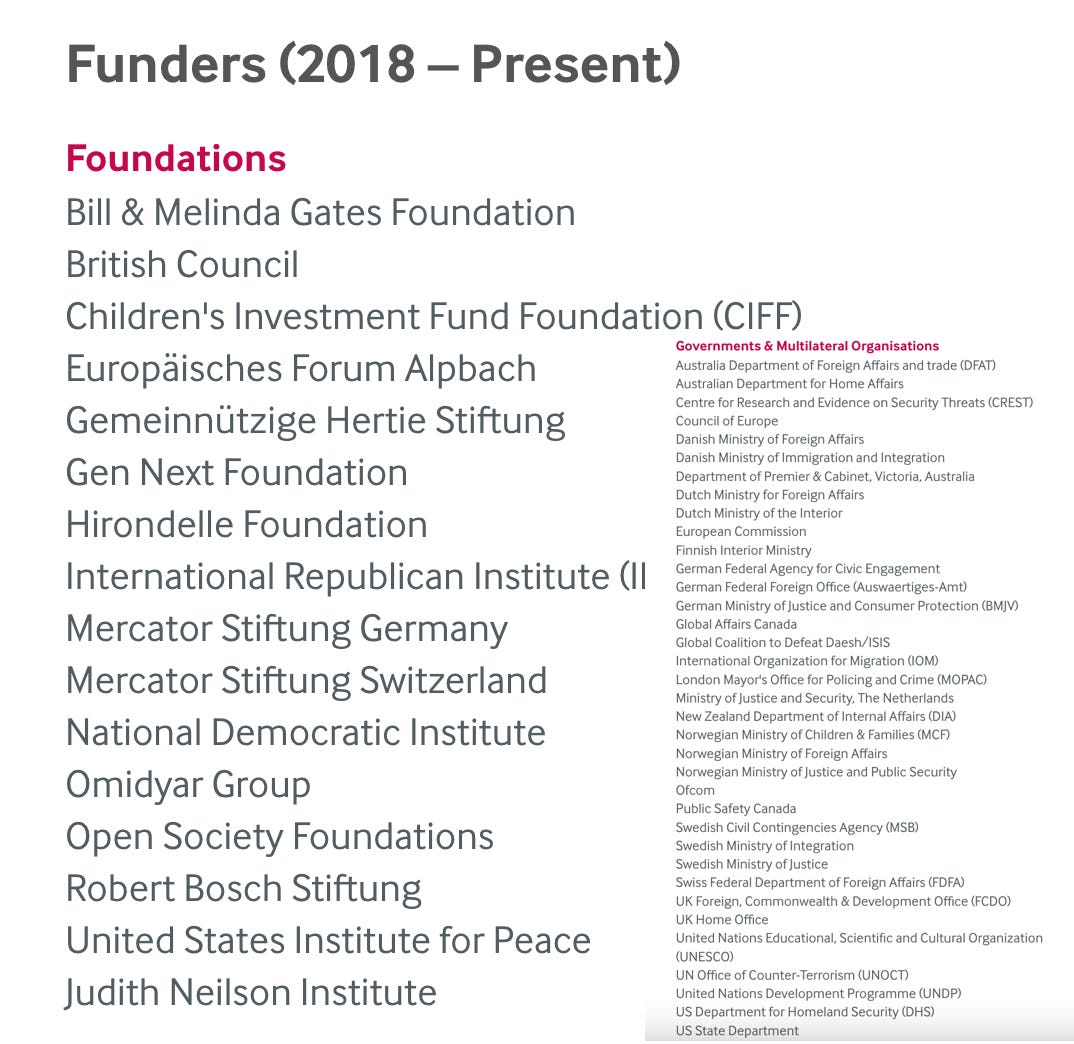
The Institute for Strategic Dialogue’s “diverse range of funders,” according to The Guardian.
The ISD’s “diverse” funders include the US State Department, the US Department of Homeland Security, three other US state-funded organizations, and more than two dozen other NATO government agencies. On the private side, the ISD’s funders include the foundations of three of the world’s richest oligarchs: Pierre Omidyar’s Omidyar Group, George Soros’ Open Society Foundations, and the Bill and Melinda Gates Foundation.
In using the ISD as a source, The Guardian has a conflict of interest that its article did not disclose. The latter two ISD donors have also given sizeable grants to The Guardian: at least $625,000 from Open Society Foundations since 2019, and at least $12.9 million from the Bill and Melinda Gates Foundation since 2011.
Omidyar’s foundation has a direct role in the ISD/Syria Campaign report. The Omidyar Group’s Luminate Strategic Initiatives is listed alongside the German government-funded Friedrich-Ebert-Stiftung foundation as the report’s fiscal sponsor.
Omidyar’s sponsorship of an attack on journalism about the OPCW scandal is highly fitting. The Intercept, the self-described “fearless and adversarial” outlet that Omidyar also funds with his vast fortune, has never once acknowledged the OPCW leaks or whistleblowers’ existence. While ignoring the OPCW scandal for more than three years, The Intercept has published multiple articles promoting the allegation that Syria committed a chemical attack in Douma.
Like the ISD, the Syria Campaign is also funded by governments and other belligerents in the Syria dirty war. As The Grayzone’s Max Blumenthal reported in 2017, the Syria Campaign was founded by Ayman Asfari, a Syrian-British billionaire oil tycoon and leading financial supporter of the Syrian National Coalition, the largest government-in-exile group established after the Syria conflict erupted in 2011. The Syria Campaign has also done extensive P.R. and fundraising for the White Helmets, the insurgent-adjacent, NATO state-funded organization implicated in the Douma incident.
That these two state-funded groups “describe themselves as ‘fiercely independent'” is apparently enough for The Guardian. I trust that the Guardian would feel differently if they were dealing with self-described “fiercely independent” groups funded by the Russian and Syrian governments.
Unsurprisingly, the vast majority of sources quoted in the ISD/Syria Campaign report are funded or employed by the same NATO state and private sponsors. This includes the White Helmets; the Global Public Policy Institute; Syrian American Medical Society (SAMS); self-described journalist Chloe Hadjimatheou of the BBC, who produced a podcast series that disparaged the OPCW whistleblowers and whitewashed the Douma cover-up; and James Jeffrey, the former US Special Envoy for Syria.
For a report that claims to be concerned with protecting Syrians from “real-world harm,” Jeffrey is a particularly interesting interview subject. Few US officials have been as candid about their willingness to immiserate Syrian civilians in pursuit of hegemonic US goals in their country.
Jeffrey has declared that al-Qaeda is a US “asset” in Syria, and has admitted to misleading the Trump White House to undermine an effort to withdraw the US military, whose illegal occupation deliberately deprives Syria of its own wheat and fuel. Jeffrey has openly bragged about his “effective strategy” to ensure “no reconstruction assistance” in Syria — even though the war-ravaged country is “desperate for it.” And he has also taken credit for helping to impose crippling US sanctions on Syria that have “crushed the country’s economy.”
Jeffrey’s proudly self-acknowledged real-world harms on millions of Syrians don’t seem to bother the study’s authors, presumably because their Western state sponsors implement them.
The report is so invested in its state funders’ aims in Syria that it approvingly airs frustration that other governments are failing to toe the NATO line. A “former Western diplomat” complains that “disinformation” on Syria is helping states “avoid making the decisions that we want them to make, say in the Security Council or elsewhere.” (emphasis added). From the point of view of Western officials, the anonymous diplomat is employing an accurate operative definition of what constitutes “disinformation”: any information that causes those deemed subordinate to “avoid making the decisions that we want them to make.”
Fittingly, another anonymous “senior diplomat” laments that supposed Syria disinformation is intended “ultimately to cast doubt upon the legitimacy and integrity of the people doing this kind of [policy] work.” Daring to question the “legitimacy and integrity” of Western policymakers who oversaw a multi-billion dollar CIA-led dirty war on Syria that knowingly empowered al-Qaeda and other sectarian death squads while leaving hundreds of thousands dead — another intolerable act that can only result from “disinformation.”
A member of the US-funded, insurgent-adjacent White Helmets is also given space to lament that alleged “disinformation” is hurting its donations. “We hear about billions of dollars for aid at conferences on Syria but most of that funding goes to the UN,” a White Helmets manager complains. Unmentioned is that European governments have cut funding to the group after their late founder, the lavishly paid UK military veteran James le Mesurier, admitted to pocketing donor funds and financial fraud right before he took his own life.
Having promoted the hegemonic agenda of its state sponsors, the report closes with a thinly veiled call to censor the dissenting voices it targets.
The ISD and Syria Campaign urge policymakers to “adopt a whole-of-government approach in tackling disinformation” and “ensure that loopholes or special privileges are not created for ‘media’ which would only exacerbate the spread of disinformation.” These “privileges” presumably refer to free speech. The report also notes favorably that platforms have addressed “thematic harms such as public health disinformation or foreign interference in elections.” As a result, the report calls on these platforms to “commit to applying similar levels of resourcing… in the context of the ongoing Syrian conflict.” Perhaps they have in mind the censorship of journalism about Hunter Biden’s laptop before the 2020 election, on the fake grounds that the story was “Russian disinformation.”
The fact that this network of state-funded actors is devoting energy to disparaging journalism about the OPCW’s Syria cover-up — and even advocating that it be censored – reflects their powerful sponsors’ desperation to bury a damning scandal.
In public, OPCW Director General Fernando Arias has provided misleading and outright false answers about the Douma probe, including why he refuses to meet with the dissenting inspectors and the rest of the original investigative team.
On top of the two known whistleblowers, Arias has ignored calls for accountability from his original predecessor, founding OPCW chief Jose Bustani, as well as four other former senior OPCW officials. Along with Bustani, former senior UN official Hans von Sponeck has spearheaded the Berlin Group 21, a global initiative to address the OPCW scandal. The US has responded to Bustani by blocking his testimony at the United Nations. Arias meanwhile refused to open a letter that he received from Sponeck’s group, returning it back to sender.
The response of Western media outlets like the Guardian to the stonewalling of these veteran diplomats and senior OPCW officials has simply been to ignore it.
In whitewashing the OPCW cover-up, the preponderance of state sources parroted by The Guardian reveals the ultimate irony in its allegations. While claiming to “identify” a fictional network of Russia-backed disinformation actors about Syria, The Guardian’s Townsend is himself spreading the disinformation of a NATO-funded network that defames voices who expose the dirty war on Syria.
In fact, one of Townsend’s central allegations goes well beyond his state-funded sources. Although Townsend’s article is premised on identifying a “network of conspiracy theorists,” Townsend’s sole source – the ISD/Syria Campaign report – never alleges that such a “network” exists. Nowhere in the report does the word “network” even appear.
Thus, Townsend has not only parroted state-funded sources, but concocted an additional allegation in the service of their narrative. This is not just an ordinary fabrication: in creating the fantasy of a “coordinated”, “Russia-backed”, “network of conspiracy theorists,” Townsend also reveals himself to be the very thing that he accuses his targets of being: a conspiracy theorist.
And given that Townsend not only parrots his state-backed sources but works for an outlet funded by some of the same sponsors, it is fair to say that The Guardian and these state-funded think tanks are a part of the same network.
Consequently, reading the article’s headline — “Network of Syria conspiracy theorists identified”—as a description of The Guardian and the NATO-funded sources that it relied on, the claim is no longer inaccurate.
Almost no Americans see Russia as problem – poll
Samizdat | August 2, 2022
Americans view soaring inflation, poor governance and the state of the economy as their country’s biggest problems, with just 1% mentioning Russia, according to a poll released by Gallup on Monday.
Despite the Ukraine conflict remaining a major news story in the US, the share of respondents concerned by Russia’s actions has fallen sharply after hitting 9% in March, the month that followed Moscow’s offensive, the polling agency said. The latest data was compiled on July 5-26.
Abortion has become a prominent issue for Americans, with 8% mentioning it as the most serious problem in the country. The level was the highest since 1984, when the agency started tracking it.
The spike in concern over abortion rights follows the US Supreme Court ruling in June that overturned Roe v Wade— the 1973 landmark decision that guaranteed the constitutional right to terminate a pregnancy.
Democrats and blue-leaning independents drove the metric up, with 13% of such respondents mentioning it, as opposed to 4% of Republicans and red-leaning independents.
Abortion issues trailed behind three problems that the US public perceives as more pressing. Inflation and dysfunction in the US government each accounted for 17%, while the general state of the economy concerned 12% of those polled. Overall, the state of the economy was named as the biggest problem for the US, with 35% flagging the issue, modestly down from June, Gallup said.
Russia is not the only story being closely covered by the American media that the public is turning away from, according to the poll. Others included the Covid-19 pandemic, extreme weather, climate change, and the House Select Committee hearings on the January 6 2021 Capitol riots.
Japanese firms in no rush to leave Russia
Samizdat | July 30, 2022
Japanese companies are no in a hurry to quit the Russian market, amid fears of being unable to return and having to find new suppliers, the Japan Times reported this week, citing a survey from the statistics center Teikoku Databank.
According to the report, within the past month no Japanese companies have announced a suspension or cessation of operations in Russia.
Since Russia became subject to numerous sanctions due to its military operation in Ukraine, 74, or about 40%, of the 168 listed Japanese companies working in Russia announced intentions to leave the country. Of these, however, most said they would only halt some form of operation, while a mere five companies said they would withdraw from the Russian market completely.
According to the survey, Japanese companies attributed their reluctance to withdraw from Russia to fears of losing their niche in what they consider an important emerging market and potential difficulties in finding alternative suppliers.
Earlier this year, reports emerged that the Japanese government had urged the conglomerates Mitsui and Mitsubishi to retain their stakes in the Russian liquefied natural gas (LNG) project Sakhalin-2, which now operates under a new Russian operator, in order to ensure continued LNG flows. Also, a number of Japan’s major automakers, including Toyota, have suspended their activities in Russia over the past several months but have not yet closed their businesses in the country.
Western sanctions against Moscow have forced many international companies to quit the Russian market. However, according to a Yale University survey, just 5% of Japanese companies that had operations in Russia have left, which is tied with Italy for the lowest shares in the G7. This contrasts with 46% for the UK, 33% for Canada, and 27% for the US.
Turkey to host gymnastics summit after Norway refused to allow Russians
Samizdat | July 29, 2022
The dates of the International Gymnastics Federation’s (FIG) 2022 Congress have been confirmed after Turkey stepped in to host the event. The event was moved from original host Norway after it refused to allow Russian and Belarusian delegations.
The Congress will take place on November 11 and 12 in Turkey’s largest city, with the development coming following approval from the FIG’s Executive Committee.
Turkey will now host the Congress for the second year running, with Antalya receiving last year’s gathering which saw Morinari Watanabe elected for a second successive term as the FIG’s president.
Istanbul saved the day after the FIG announced earlier this week that its previous choice of Sandefjord in Norway could no longer host the congress.
This came as a result of political pressure, with the Norwegian Gymnastics Federation pulling out after recommendations from Norway’s Ministry of Culture and Equality plus the Norwegian Olympic and Paralympic Committee and Confederation of Sports (NIF) to block the attendance of Russian and Belarusian officials.
In a statement on Friday, the FIG apologized for the change and said it was “aware of the challenges caused by this unforeseen situation for all the national Gymnastics federations that were already duly registered for this Congress.”
“The FIG is very sorry for the inconvenience, and can only thank the delegations again for their understanding and valuable collaboration,” it added.
Russia and its ally Belarus have been frozen out of many international sports since the military operation in Ukraine was launched in late February, with numerous federations banning their athletes, teams and clubs following an International Olympic Committee (IOC) recommendation to do so.
These bans have sometimes extended to officials too, but delegations from the two countries have been allowed to take part in congresses such as those held by FIFA in football as well as the FIG.
Nellie Kim of Belarus is one of three FIG vice-presidents, while Russia’s Vassily Titov is a board member. Both countries have officials on various FIG committees.
As opposed to Norway and its Scandinavian neighbors, Turkey has been friendlier towards Russia while also playing an active role in mediation efforts between the country and Ukraine.
EU goes from ‘Je suis Charlie’ to upholding ban on Russian state media
By Ramin Mazaheri | Press TV | July 29, 2022
Paris – The censorship of Russian media outlet, Russia Today, in Europe has been widely denounced as hypocritical. Despite that, the European Union’s General Court has denied an appeal by Russia’s RT France to uphold liberty of the press for all nations. Ramin Mazaheri reports from Paris.
In a major blow to freedom of the press, European Union’s second highest court has upheld the ban on Russian media outlet RT France for alleged “disinformation”.
Launched in 2017 with a €20 million budget and well over 100 employees, RT France burst on the scene with reporting that the billionaire-dominated French mainstream media refused to touch. Their coverage of the Yellow Vest social revolt won widespread praise, and – like PressTV – they rejected the total Western media blackout on the movement which began in June 2019.
It was no surprise that President Emmanuel Macron was the first leader to call for a Europe-wide ban on Russian state media. The French government then orchestrated the rapid implementation of the ban – less than a week after Russia started its military operation in Ukraine.
The fact that freedom of the press is granted to far-right media such as the Islamophobic Charlie Hebdo magazine but denied to the Russian people has already left its impression: the citizens of France and Europe have not been allowed to hear both sides of the long-running conflict in Ukraine.
This one-sided media domination has allowed European elite to whip up Russophobia and war hysteria unopposed, and provided them with the opportunity to impose unprecedented economic and diplomatic pressure on Moscow.
Upon relinquishing the EU’s rotating presidency in June, Macron was criticized for saying that the Ukraine war ‘accelerated’ the bloc’s collective agenda. Many said the EU was, once again, not relying on democratic means to achieve political ends.
A final appeal by RT France to the European Court of Justice is expected to fail as well.
In 2012, on the orders of the European Commission, Press TV was removed by top European satellite provider Eutelsat. Last year the Presstv.com domain was seized and shut down by the United States federal government.
German mayors want Nord Stream 2 opened
Samizdat | July 27, 2022
Berlin’s policy of trying to give up imports of Russian natural gas is likely to create hardship and spark unrest, seven mayors from the German island of Ruegen wrote in a letter sent to the regional and federal governments on Wednesday. They also urged the federal government to allow gas imports via the Nord Stream 2 pipeline, given the current technical difficulties with Nord Stream 1 – something Berlin has steadfastly rejected.
In the letter addressed to federal economy minister Robert Habeck and Manuela Schwesig, prime minister of Mecklenburg-Vorpommern, the mayors “strongly condemn” the current conflict in Ukraine but urge the government to consider the damage its policy could do to the German population and the economy, according to the news agency DPA.
“We are of the opinion that the path taken by the federal government to disconnect from Russian energy sources is not the right one,” the seven mayors wrote. Initially drafted by the leaders of Bergen, Binz and Sassnitz, the letter was later signed by four more jurisdictions on Ruegen, Germany’s largest island and a popular tourist destination.
Giving up gas imports from Russia would mean an explosion in the cost of living, which would lead to social instability and unrest that could get out of control, the mayors wrote, according to German media. Calls from the federal government to save energy – such as showering less and foregoing hot water – “defy understanding,” they added.
“As the mayors of this island, we don’t want to have to accept any further restrictions,” Sassnitz city manager Frank Kracht told the Mecklenburg-Vorpommern affiliate of the TV station NDR.
Rejecting the proposals to expand the number of wind turbines near residential areas, calling them a health hazard, the mayors advocated “a general rethinking of the solution to the current problems in relations with Russia.”
Among their suggestions was to get additional natural gas via the Nord Stream 2 pipeline. Finished in late 2021, the pipeline from Russia to Germany under the Baltic Sea was just waiting for the operating permit from Berlin – which was suspended indefinitely on February 22, two days before Russia sent troops into Ukraine.
NS2 was supposed to double the volume of Russian gas exports, but was delayed by US sanctions seeking to protect Ukraine’s gas transit earnings. Nord Stream 1, which continues to supply Germany with gas, is currently operating at only 20% capacity, due to maintenance requirements. Its operator, Gazprom, says several turbines at the Portovaya compressor station need servicing to maintain certification. The first one was held up by Canada, citing anti-Russian sanctions over the conflict in Ukraine, until Berlin intervened seeking an exemption. NS2 does not use Siemens turbines, and can be maintained regardless of the sanctions.
Berlin has refused to even consider the possibility of using NS2, however. Economy minister Habeck has said that the pipeline cannot operate without certification. He also accused Russian President Vladimir Putin of trying to damage EU solidarity with Ukraine by driving up the price of gas.
“Putin has the gas, but we have the power,” Habeck said on Tuesday, appealing to Germans to stand together.
Recent polls showed widespread pessimism in German industry regarding future business prospects. Commenting on the turbine delay last week, Foreign Minister Annalena Baerbock said gas shortages could lead to an insurrection.
“If we don’t get the gas turbine, then we won’t get any more gas, and then we won’t be able to provide any support for Ukraine at all, because then we’ll be busy with popular uprisings,” she told the TV outlet RND. Baerbock hastened to add that this may have been “exaggerated” and insisted most Germans supported sending weapons to Ukraine, though.
Hungary Wants to Buy Additional Natural Gas From Russia: Lavrov

By Ilya Tsukanov – Samizdat – 21.07.2022
Hungary has asserted an independent policy unique in the European Union in relation to the Ukrainian crisis, refusing to slap sanctions on Russian energy, and refusing to allow its territory to be used by NATO to transfer weapons to Kiev.
Russia and Hungary are intent on advancing their bilateral cooperation, notwithstanding EU sanctions, and are looking to implement major projects, including in the energy sector, Russian Foreign Minister Sergei Lavrov has indicated.
“Despite the difficult international situation, despite the desire of some of our partners to increase sanctions pressure against Russia, our interaction continues, and last year we managed to overcome the recession caused by the pandemic and to achieve growth of over 25 percent in our trade turnover,” Lavrov said, speaking to his Hungarian counterpart Peter Szijjarto in Moscow on Thursday.
“We note the mutual commitment of the Russian and Hungarian governments to promote our interaction, our partnership, including in the implementation of major projects in energy, transport and other areas,” Lavrov said.
The Russian foreign minister indicated that Budapest has expressed interest in buying additional gas supplies from Russia, and that Moscow would consider this request immediately.
Hungary imports approximately 65 percent of its oil and some 80 percent of its gas from Russia, and recently refused to cut down amid Brussels’ attempts to force a “phase out” of Russian crude supplies.
“I consider your visit very timely, including for the continuation of our trust-based exchange of views on regional and international issues,” Lavrov said.
“I know that you are closely following the situation in Ukraine as it develops, including from the point of view of the Hungarian national minority, and today we will be prepared to give you our vision of how our special military operation is developing and about the prospects for resolving this serious crisis,” he said.
Hungary has refused to toe the line set by its NATO and EU allies amid the Ukraine crisis, calling for an immediate ceasefire as the only possible chance to avoid a steep economic crisis in Europe. Budapest has also been critical of Brussels’ tough sanctions against Moscow, saying they threaten to undermine Hungary’s own economic and energy security.
Last week, Hungarian Prime Minister Viktor Orban suggested that Europe had “shot itself in the lungs” with sanctions, and was now paying the price.
“At first I thought we just shot ourselves in the foot, but the European economy shot itself in the lungs and is gasping for air,” he said. “There are countries committed to the sanctions policy, but Brussels must admit that it was a mistake, that it has not fulfilled its purpose and has even had the opposite effect,” Orban added, suggesting that restrictions were hurting the EU much more than Russia.
Hungary’s relations with Ukraine worsened dramatically after the 2014 coup in Kiev, and the new Ukrainian government’s legislative efforts to deprive the community of 150,000 ethnic Hungarian-Ukrainians living in the country’s Zakarpattia region of the right to receive a public education in their native tongue.
Following the escalation of the Ukraine crisis in February, tensions have degenerated into a bitter war of words, including mutual recriminations about the state of Ukrainian and Hungarian officials’ mental health.
In May, an advisor to Ukraine’s energy minister suggested that “something” should happened to the Soviet-era Druzhba (‘Friendship’) oil pipeline carrying Russian crude through Ukraine to Hungary to speak to Orban “in the language he understands.” The same month, Orban’s name was added to a notorious Security Service of Ukraine-curated website containing the personal information of so-called “enemies of Ukraine.” Several individuals listed on the website have subsequently been killed.
Kremlin Says Western Restrictions to Blame for Technical Problems With Russian Gas Deliveries
By Ilya Tsukanov – Samizdat – 21.07.2022
Russian gas deliveries via the Nord Stream 1 pipeline were resumed on Thursday morning following scheduled maintenance work. Last month, Gazprom was forced to cut supplies sent through the network to about 40 percent of capacity due a refusal by Canada to send a Siemens turbine used by Nord Stream 1 to Russia due to sanctions.
All technical problems related to the delivery of Russian gas to Europe are the result of various restrictions Western countries themselves have placed on Russian energy exports, Kremlin spokesman Dmitry Peskov has indicated.
“I suggest that you carefully reread the statement made by the [Russian] president in Tehran. He explained in great detail how many compressor stations there are, what kinds of problems have been recorded by Siemens – and in connection with this, what type of situation is occurring where it is impossible to build pressure up to 100 percent. These are technical reasons connected to the impossibility of proper technical maintenance,” Peskov said, speaking to reporters on Thursday.
“Any technical difficulties associated with this stem from the restrictions that European states and the European Union themselves have introduced… It is these restrictions which do not allow for the repair of equipment, including turbines operating at compressor stations. And it is these restrictions which lead to the fact that some units cannot currently receive the necessary maintenance,” he stressed.
Peskov indicated that Gazprom remains committed to fulfilling its obligations in full, and rejected recent statements made by Western officials and media about alleged Russian attempts to “pressure or blackmail” Europe in the energy sector. “These are absolutely false statements and we categorically deny them,” he said.
Asked to comment on Wednesday’s remarks by State Department spokesman Ned Price that the resumption of Nord Stream 1’s operation would be “an important element” in ensuring Europe’s security, Peskov said Moscow was “no longer surprised” by anything Washington says. “As for the energy security factor, yes, we agree – we constantly say that Russia, as a supplier of energy resources, is very important and integral factor for European energy security. This is true,” he said.
Nord Stream 1, which has become Gazprom’s central gas supply route to Europe amid machinations by Poland and Ukraine, resumed operations on Thursday morning following scheduled summer maintenance work, and is now expected to resume operations at about 40 percent of its capacity of 55 billion cubic meters of gas per year. Gazprom was forced to reduce shipments via the network in mid-June over delays in the repair of a Siemens-built high-pressure gas pumping turbine in Canada. Ottawa deliberately delayed the return of the turbine, which had undergone maintenance work, back to Europe, citing anti-Russian sanctions. Last week, amid pressure from Germany, Ottawa relented, with the turbine now thought to be on route back to Europe for installation at Gazprom’s Portovaya Compression Station on the Russian Baltic Sea coast. Ukrainian authorities blasted Canada over the move, vowing that Kiev would “never accept” Ottawa’s decision.
President Putin commented on the European energy crisis in remarks to reporters at the conclusion of his working visit to Iran on Tuesday, indicating that the EU and its allies in Kiev are wholly responsible for current situation regarding gas deliveries from Russia.
“Until recently, we supplied… around 30 billion cubic meters [of gas] a year to Turkey, and 170 billion to Europe, 55 billion of that via Nord Stream 1, and, if memory serves, 33 billion via Yamal-Europe, through two strings running through Ukraine. And about 12 billion to Europe through Turkey via Turkstream,” Putin said.
“Ukraine suddenly announced that it was going to close one of the two routes on its territory, allegedly because the gas pumping station is not under its control but on the territory of the Lugansk People’s Republic. It found itself under the control of the LPR several months earlier, but they closed it just recently without any grounds,” he said.
After that, Putin said, Poland imposed sanctions on the Soviet-era Yamal-Europe network, first shutting it down and then turning it back on in reverse mode to send about 32 million cubic meters of gas per day from Germany eastward.
“Where is the gas from Germany coming from? It is our Russian gas. Why from Germany? Because it turned out to be cheaper for the Poles. They used to get it from us at a very high price, closer to the market price, whereas Germany gets it from us 3-4 times cheaper than the market price under long-term contracts,” he explained.
“So, first one of the routes in Ukraine was shut down, then Yamal-Europe was shut down; now Nord Stream 1, which is one of the main routes – we pump 55 billion cubic meters a year through it,” Putin said.
The Russian president noted that there are five Siemens-built gas compressor turbines used by Nord Stream 1, plus one more on standby. One turbine was sent out for repairs to a Siemens plant in Canada, but was slapped with sanctions by Ottawa. On top of that, another turbine at Portovaya is out of order due to technical problems, leaving two operational units currently pumping 60 million cubic meters of gas per day.
“So, if one more is delivered, fine, we will have two in operation. But if it is not, only one will be left, and it will pump only 30 million cubic meters per day. You can imagine how much time it will take to pump the rest. How is this Gazprom’s responsibility? What does Gazprom even have to do with this? [The West] cut off one route, then another, and sanctioned this gas pumping equipment. Gazprom is ready to pump as much gas as necessary. But they have shut everything down,” Putin stressed.
The Russian president added that the new Nord Stream 2 pipeline network, which could double the Nord Stream network’s capacity to 110 billion cubic meters of gas per year over the long term, remains ready for launch, but has been frozen by Germany.
European economies are bracing for a cold winter and rushing to fill up underground gas storage facilities amid the largely self-inflicted energy crisis brought on by sanctions and Brussels’ push to “phase out” or restrict purchases of Russian oil, gas and coal to “punish” Moscow over its military operation in Ukraine. This week, the International Monetary Fund predicted that some countries’ economic output could fall up to 6 percent in the event of a total shutoff of Russian gas. Business leaders in Germany, the EU’s main industrial powerhouse, have warned that the country could face its gravest economic crisis since the Second World War amid the tensions over Russian gas deliveries.
Let the people pay: EU leaders make their citizens suffer the fallout from their failed Russia policy
Samizdat | July 20, 2022
In a Bastille Day interview, French President Emmanuel Macron told citizens to “prepare ourselves for a scenario where we have to do without Russian gas entirely.” At the same time, Macron accused Moscow of using the fuel as a “weapon of war,” echoing the spin emanating from a European Union leadership that obscures the real reason the bloc is facing an energy shortage that’s driving up the cost of living.
This crisis is entirely self-inflicted.
European Commission President Ursula von der Leyen accused Russia of energy “blackmail” at the end of April, citing the state-owned Gazprom’s announcement of a halt in gas deliveries to Poland and Bulgaria for failing to pay for in rubles. What von der Leyen – and now Macron – conveniently omitted was that it was the EU’s own anti-Russian sanctions, adopted in a knee-jerk and ideologically-driven fashion at the outset of the Ukraine conflict, that represent the root cause of these disruptions.
The West quickly adopted a strategy of targeting and sanctioning various aspects of the Russian financial system, including banks and foreign reserves, cutting it off from the SWIFT global transaction system – and then had the gall to complain that Moscow was asking for payment for its gas exports in its own currency to mitigate the hassle of navigating a system from which it was effectively blocked. “Export your gas but good luck trying to get paid,” is hardly a reasonable expectation.
It wasn’t Russian President Vladimir Putin who called on the EU to cut off Russian gas. Rather, it was his Ukrainian counterpart Vladimir Zelensky, who has constantly pushed for ever more Western sanctions on Russian fossil fuels. And the West has only been to happy to recklessly indulge him to the detriment of their own citizens.
Earlier this month, Zelensky even admonished Canada for agreeing to return repaired turbines for reintegration into the Nord Stream 1 gas pipeline that provides gas to Germany, and demanded that Ottawa reverse its decision. Canada had earlier faced the dilemma of violating the West’s own anti-Russian sanctions by virtue of even returning the critical parts – even though the pipeline is so vital to EU industry that the bloc’s leaders have even been freaking out about its scheduled maintenance shutdown.
Why would you be so worried about Russia failing to turn the tap back on when you’ve been saying repeatedly that you’ll gladly do without it “for Ukraine.”
But even in defending the return of the turbines, Canadian Prime Minister Justin Trudeau cited the same ridiculous Western establishment propaganda of Russia’s “weaponization” of gas, when in reality it’s the West’s own sanctions that have wreaked energy havoc and caused all this drama.
“We have seen Russia consistently trying to weaponize energy as a way of creating division amongst the allies,” Trudeau said. So if Canada doesn’t violate its own sanctions and return the turbines to Germany, then Putin wins. The Olympic level rhetorical gymnastics required by Western leaders to justify violating their own failed sanctions are second only to their recent defense of firing up coal plants again, and redefining fossil fuel energy as “green,” amid the current shortages.
EU leaders are calling for an end to Russian energy imports, citing their decision to sanction their own gas supply as a reason to expedite a transition to unproven renewables. But rather than take responsibility for the fact that they set fire to their sails and are now stranded in the middle of the ocean while awaiting the manifestation of their renewable energy transition fantasy, they’re blaming Russia for their own shortsightedness and trying to spin it as a withholding of energy orchestrated by Moscow.
Russia is only too happy to sell its fuel to whomever wants to buy it. And if the EU sanctions were lifted, the Western energy crisis would end. But that would mean admitting to a failed policy. So, instead, we’re being told that it’s all Putin’s fault, but also that the best way to stick it to Vladimir Putin is to take short, cold showers and to reduce “night lighting,” as Macron has recently suggested.
Western leaders aren’t just taking their citizens for credulous fools with their ridiculous propaganda as cover for their own failures, but they’re treating the livelihood of the average person as collateral economic damage in their hopeless bid to isolate Russia. They’ve convinced themselves, from their ideologically-isolated elite bubble, that they represent the entire world. But they’re mostly just fooling themselves.
Even the EU’s chief diplomat, Josep Borrell, admitted to a rude awakening recently at the G20 summit. “The G7 and like-minded countries are united in condemning and sanctioning Russia and in trying to hold the regime accountable,” Borrell said in a statement on the EU’s website. “But other countries, and we can speak here of the majority of the ‘Global South’, often take a different perspective.”
But then Borrell gave away the game. “The global battle of narratives is in full swing and, for now, we are not winning,” he said. “As the EU, we have to engage further to refute Russian lies and war propaganda.” But who’s really peddling the propaganda? On one hand, the EU has been trying to portray the impact of their own irresponsible and devastating sanctions on their own economies and citizens as Putin’s doing even as they try to convince Westerners that their suffering is some kind of a war effort that’s doing harm to Russia.
However, in reality, Russia can pivot to the rest of the entire world and simply leave West Europeans to wallow in their own costly delusions. They may be about to find out whether moral superiority and virtue-signaling will heat the house or feed the kids this winter.
Pulitzer Board Turns Down Trump’s Request to Rescind Prizes Given to NYT, Washington Post
Samizdat – 19.07.2022
WASHINGTON – The Pulitzer Prize Board has rejected former US President Donald Trump’s appeal to revoke awards given to The New York Times and The Washington Post for their reporting on alleged Russian interference in the 2016 US presidential election.
“The 2018 Pulitzer Prizes in National Reporting stand,” the Pulitzer Prize Board said in a Monday statement, explaining that it had received several inquiries, including from Trump, about The New York Times and The Washington Post reporting, but independent reviews have found nothing to discredit the prize entries.
“Both reviews were conducted by individuals with no connection to the institutions whose work was under examination, nor any connection to each other. The separate reviews converged in their conclusions: that no passages or headlines, contentions or assertions in any of the winning submissions were discredited by facts that emerged subsequent to the conferral of the prizes,” the Pulitzer Prize Board said.
In October of last year, Trump sent a letter to the Pulitzer Prize Board demanding that it rescind the prizes given to over a dozen articles from The New York Times and The Washington Post, arguing that the publications engaged in “false reporting.”
Russia has repeatedly denied claims of its meddling in the 2016 presidential election in the United States.
EU to soften Russia sanctions – Reuters
Samizdat | July 19, 2022
The European Union is planning to amend its sanctions on Moscow to facilitate trade in food and fertilizers, Reuters reported on Tuesday.
The changes will allow EU nations to unfreeze the funds of top Russian banks, which may be required to ease bottlenecks in the global trade of food and fertilizers, Reuters explained, citing a draft document it has seen.
The document said the funds could be released “after having determined that such funds or economic resources are necessary for the purchase, import or transport of agricultural and food products, including wheat and fertilizers,” the agency said.
The revised sanctions will also help facilitate exports of food from Russian ports, which traders had stopped servicing despite food exports being explicitly exempted from the sanctions, Reuters added, quoting an official.
The amendments are expected to be adopted on Wednesday, and will reportedly concern Russian lenders such as VTB, Sovcombank, Otkritie FC Bank, Promsvyazbank, and others.
Russia is the world’s largest exporter of fertilizers and wheat. According to Reuters, the changes follow criticism from African leaders about the negative impact the sanctions have had on the trade of critical commodities. The ongoing conflict in Ukraine and broad restrictions on Russia have led to food-supply shortages, rising grain and fertilizer prices, and have triggered fears of a global food crisis.
Featured Video

The Truth About the Trump Shootings with Ken Silva
or go to
Aletho News Archives – Video-Images
From the Archives
Trans ‘milk’ as good as the real thing – NHS
RT | February 18, 2024
The drug-induced nipple secretions of trans women are as good as mothers’ breast milk for babies, the University of Sussex Hospitals NHS Trust claimed in a letter to campaigners made public in a report by British think tank the Policy Exchange on Sunday.
The healthcare trust’s medical director, Rachel James, argued that the off-label prescription drug cocktail men transitioning to female take in order to produce milk was “similar to the natural hormones which encourage lactation to develop when the baby is newly born.”
“The evidence which is available demonstrates that the milk is comparable to that produced following the birth of a baby,” James wrote in the letter, sent to Children of Transitioners last August.
Biological men who wish to lactate must first take hormones to grow milk glands and then take high doses of either domperidone or metoclopramide to stimulate milk production. Neither drug is approved for this use, though they are occasionally prescribed off-label to biological women who have trouble lactating.
However, domperidone’s own manufacturer, Janssen, warns patients the drug “may cause unwanted side effects affecting the heart in a breastfed baby” and “should be used during breastfeeding only if your physician considers this clearly necessary.” … continue
Blog Roll
 Aletho News
- Seyed M. Marandi: U.S. Strike Imminent – Toward Total War in the Middle East
- Russia Voted Under Fire. Washington Is Loading the Tankers.
- 12 Things Your Oncologist Was Trained Not to Tell You
- Anthrax Attacks Paved Way for COVID-Era ‘Junk Drugs and Vaccines’
- How Real Is the Impact of Western Sanctions on Israel?
- France, You Are Guilty: How Paris Turned Western Sahara into the Maghreb’s Powder Keg
- 2025 Nature Paper Claiming Worsening Global Drought Gets RETRACTED …Heavily Flawed
- Your Milk Is Not the Problem
- The Truth About the Trump Shootings with Ken Silva
- ARE PATIENTS BEING PROPERLY INFORMED ABOUT OZEMPIC?
- If Americans Knew
- Salah Sarsour’s Legal Team Says DHS Has Not Met Its Burden to Prove He Is Deportable
- An analysis of tax forms by The Intercept show Kraft’s charity and LLC have donated to Friends of the IDF and AIPAC’s super PAC.
- Israeli attacks kill four Palestinians in Gaza – Daily Update
- Inside Gaza’s death trap of collapsing, bombed-out buildings
- The everyday items Israel bans from Gaza every day
- Inside the siege, the ruined buildings of Gaza – Daily Update
- Debunking The Claim That Macklemore Has A “History Of Antisemitism”
- CPJ demands release of arrested Palestinian-US journalist near Bethlehem
- Robert Kraft: The Billionaire Friend of Netanyahu Pulling The Strings Behind the Macklemore/Ed Sheeran Blow Up
- Columbia Administered Fund Gives Big Money to Pro-Israel Groups
- No Tricks Zone
- 2025 Nature Paper Claiming Worsening Global Drought Gets RETRACTED …Heavily Flawed
- New Study: ‘Global Drought Shows No Detectable Recent Acceleration Under Climate Warming’
- Economic Masterminds: German Socialists Suggest Taxing Productivity Gains Stemming From Using AI
- The South China Sea Has Not Been Cooperating With The Climate Change Narrative
- Energy Crisis: Germany Enters Heating Season With Historically Low Gas Reserve Fill Levels
- New Study: The Antarctic Ice Sheet Gained Mass From 2020-2024 Due To Staggering Snow And Ice Accumulation
- Study: Ocean Heating Rates From Thousands Of Years Ago ‘Dwarf’ Modern Ocean Heating Rates
- Climate Extremists Target, Attack Large-Scale Power Grid Infrastructure In Germany!
- New Study: Antarctic Ice Melt Has Contributed Less Than 1 Centimeter To Sea Level Rise In The Last 30 Years
- Fear Of Debate: Alarmist German Climate Scientist Calls On Mainstream Media To Discredit Skeptic Voices
 Aletho News