Washington fails to provide proof for alleged Moscow-backed Covid-19 disinfo campaign – Russian Foreign Ministry
RT | April 9, 2020
Russian diplomats called on their US counterparts to provide some actual evidence of allegations circulated by American media and officials that Moscow is waging a coronavirus-themed fake news campaign – but have received none.
The fail-proof ‘blame Russia’ approach persisting in the West in recent years remains baseless and without substance, Russian Foreign Ministry spokeswoman Maria Zakharova said on Thursday.
“We are curiously watching the attempts by several American media, as well as by some high-ranking officials to blame Russia for conducting a certain pandemic-related disinformation campaign against the US,” Zakharova said during a press briefing.
Several US news outlets have run stories on an alleged fear-mongering campaign – waged by pro-Kremlin media and fearsome social media bots, no less. In addition, conspiracy theories that the coronavirus might have been artificially created by the Russians circulated on social media – and the effort appeared to be coordinated by US government agencies, Zakharova stated.
All the accusations remain unsupported by evidence, even after persistent attempts by Russian diplomats to try and get some actual proof of the alleged evil-doing.
“We’ve reached out to the State Department, requesting to provide us with some factual evidence of such statements,” Zakharova stated. “We have not received any coherent explanation of such allegations, not to mention any evidence.”
The whole course of the coronavirus pandemic has been accompanied by allegations against Russia and – alternately – China and Iran of spreading lies and fear in the West. As if the deadly disease, which has already affected over 1.5 million people globally and killed more than 90,000, was not scary enough as it is.
One of the most high-profile anti-Russia pieces surfaced back in March, when a secret report by the European External Action Service (EEAS) – the bloc’s de facto foreign ministry – came to light. It blamed the Russian media for spreading “confusion and panic” in the West amid the epidemic.
Since the piece was produced by the EEAS’ propaganda branch – also known as the “strategic communications” division – it was composed almost entirely of ‘scary Russians’ tropes, but was notably lacking in facts. A detailed analysis of the report, conducted by British researchers – who are themselves no fans of the Russian media – showed that its claims did not have any basis.
As Russia Sends Aid, US and NATO Sneer and Smear
By Ulson Gunnar – New Eastern Outlook – 08.04.2020
When Russian military planes and trucks arrived in Italy to provide relief for communities hit by the Covid-19 outbreak, the Italian government, elected into power by the Italian people, was thankful for the assistance offered by Moscow.
Named officials within the Italian government, including the foreign minister, the minister of defense and the governor of Apulia, Michele Emiliano, publically expressed thanks to Russia for the aid.
But finding any mention of this across the Western media is difficult, often buried deep within articles aimed entirely at smearing Russia for sending aid and depicting Italians as victims of a publicity stunt.
Reuters, in a smear piece published by the New York Times and aimed at vilifying Moscow, still had to admit regarding Russian aid that Italians were grateful, noting:
“There are no new geopolitical scenarios to trace, there is a country that needs help and other countries that are helping us,” Foreign Minister Luigi Di Maio was quoted as saying by Italy’s Il Corriere della Sera newspaper on Thursday.
Despite Italy being capable of speaking for itself and bringing up any suspicions (if they had any), the West decided to step in and speak for Italy instead.
Sneering and Smearing
Western headlines are flooded with scorn for both Russia and the aid they sent, completely indifferent to how Italians themselves perceived the gesture.
Articles like Bloomberg’s “Italy Questions Russians Over Their Goodwill Virus Gestures,” admit several paragraphs in that officially, Italy was grateful for the aid, noting:
“Our country can only be grateful” for the solidarity of many countries, including Russia, the Italian defense and foreign ministries said in a joint statement Friday.
Yet claims that “Italy questions Russia” suggest the entire nation is suspicious of the aid. Upon reading Bloomberg’s article, the only source cited is a single article in the Italian newspaper La Stampa. It is hard to believe an article in La Stampa constitutes all of “Italy.”
According to the pro-Western Moscow Times in their article, “80% of Russia’s Coronavirus Aid to Italy ‘Useless’ – La Stampa,” also entirely based on the La Stampa article, its admits La Stampa’s information came from an “unnamed source.”
Other articles, like the BBC’s “Coronavirus: What does ‘from Russia with love’ really mean?,” Foreign Policy’s “Beware of Bad Samaritans,” and Forbes’ “From Russia With Love? Putin’s Medical Supplies Gift To Coronavirus-Hit Italy Raises Questions,” all used similarly disingenuous tactics to depict the Russian aid as somehow sinister and unwanted.
The Guardian in its article, “Coronavirus: Russia sends plane full of medical supplies to US,” explains:
Critics likely to claim Moscow will exploit goodwill gesture as public relations coup.
France 24 in headline alone makes Western criticism even clearer, claiming, “Flying aid to virus-hit Italy, Moscow flexes soft power.“
So by sending aid to Italy, Russia is somehow supposedly flexing its “soft power.”
So How is the West Using Its Soft Power?
The West faced a collective decision. They could have used their own, very substantial soft power to one-up Russia by sending even more aid to Italy and other regions of the globe impacted by the spread of Covid-19.
Instead, they mobilized the entirety of their soft power to sneer and smear Russia’s efforts with Western-funded media fronts writing entire articles doing just that.
The West’s attempts to depict the Russian media reporting on the aid as also somehow sinister rather than simply telling the world what Russia is doing is also particularly surreal.
The Western media itself spends the summation of its own time and energy promoting what their respective governments are doing abroad which usually involves illegal invasions, wars, occupations and interventions… not sending aid.
A Missed Opportunity
Because certain special interests in the West fear some Western governments growing closer to nations like Russia and China in the spirit of cooperation and mutual benefits and derailing the Washington-led “international order” that has prevailed post World War 2, resources have been committed to attacking any development that could spur this process further.
But because these resources have been invested into attacking, even when attacking is not the best option, that is all the West appears capable of doing.
The answer to Russian aid to Italy was Western aid to Italy. The benefit would have been a flood of resources sent to where it was needed and everyone involved enjoying the benefits of lending a helping hand to those who would be grateful in return.
Instead, the West appears to be throwing rocks at a time when others are coming together to help, and throwing those rocks at those who are helping.
Rather than teaching the Italians never to deal with Russia again, it is likely this process is going to remind Italians as to why they’ve diversified their foreign relations outside the West in the first place.
Open Letter to Chinese Government Highlights MSM Hypocrisy
By Daniel Lazare | Strategic Culture Foundation | March 30, 2020
The Washington Post, New York Times, and Wall Street Journal have written an open letter to the Chinese government urging it to reverse its “damaging and reckless” decision to expel their reporters amid a spiraling COVID epidemic.
The letter makes all the usual points about a “free flow of reliable news and information” in the middle of a growing international emergency. And however clichéd, such sentiments are correct since access to the broadest possible sources of information is indeed essential if the world is to make it through the crisis.
But the letter would have been a lot more convincing if the three papers had spoken up on Mar. 2 when the Trump administration moved to expel sixty Chinese journalists working for five news organizations that the White House regards as little more than state propaganda outfits.
Moreover, they’d be on even firmer footing if they had not actively cheered on the most dangerous anti-media effort of all, the U.S. crackdown on the TV news service RT, formerly known as Russia Today, that began in November 2017.
The crackdown on RT was in some ways even worse than McCarthyism since the latter was at least about something real and important, which is to say a Communist movement that controlled roughly forty percent of the global population and was pressing in on capitalism from every side. If the ruling class seemed spooked, it was facing a challenge of unprecedented dimensions.
But the threat this time around was about something entirely made up, i.e. the belief that Russia had supposedly used various dark arts to trick Americans into voting for Trump. The nonsense began in January 2017 when the CIA, NSA, and FBI “assessed” that Vladimir Putin had interfered in the previous year’s election in order “to undermine public faith in the U.S. democratic process, denigrate Secretary Clinton, and harm her electability” and, in the process, boost Trump. The report was entirely devoid of evidence, yet the press took it as gospel. Even worse, the intelligence report included a seven-page annex accusing RT of engaging in “criticism of U.S. and Western governments as well as the promotion of radical discontent,” running “numerous reports on alleged U.S. election fraud and voting machine vulnerabilities,” contending that U.S. election results cannot be trusted and do not reflect the popular will,” and hosting third-party candidates who contend that “the U.S. two-party system does not represent the views of at least one-third of the population and is a ‘sham.’”
Imagine – a foreign news service daring to suggest that U.S. politics were flawed! If papers like the Times or Post had the slightest inkling of self-respect, they would have laughed themselves silly over such hyper-sensitivity and told the CIA to grow a thicker skin. But they didn’t. Instead, they worked themselves up into ever greater levels of indignation. Within a few months, the New York Times was warning that “if there is any unifying character to RT, it is a deep skepticism of Western and American narratives of the world and a fundamental defensiveness about Russia and Mr. Putin” and that, thanks to snazzy graphics and snappy repartee, the network had put together “the most effective propaganda operation of the 21st century so far, one that thrives in the feverish political climates that have descended on many Western publics.”
Of course, one might observe that outlets like CNN and MSNBC are characterized by a deep skepticism of Russian narratives, so what’s the difference? But that wouldn’t be fair since everyone knows that America is right and Russia wrong and that any comparison between the two is automatically invalid, isn’t it?
Not to be outdone, the Washington Post – official slogan: “Democracy dies in darkness” – ran not one but two op-eds (here and here) calling on the federal government to require RT to register as a foreign agent, a step the Trump administration would dutifully take just two months later.
So the big two turned out to be more aggressive than the Trump administration in reducing journalistic diversity and using the power of the state to undermine a foreign competitor. Finally, just a month ago, the Times ran a front-page article declaring – queue the ominous music – that Radio Sputnik, RT’s sister outlet, had begun “broadcasting on three Kansas City-area radio stations during prime drive time.” Horror of horrors, the station was bombarding Missourians with Russki propaganda criticizing impeachment, the media, and the U.S. political system in general and informing that, in the words of one Sputnik host, that “the masses of poor and working people don’t have access to even the most essential things.”
Where did Radio Sputnik come up with such a notion? Doesn’t everyone know that perfect equality reigns in the United States and that anyone who says otherwise must be working for a foreign power?
In fact, while America never tires of touting its devotion to the First Amendment, it loses control when a foreign news service turns tables by engaging in journalism that is cheeky and irreverent. It wants a free press, which is to say one that is free to repeat over and over again how perfectly wonderful America really is. But it does not believe in a free press that allows foreigners to say the contrary.
Russian ships are in the Channel! Don’t let coronavirus pandemic stop establishment Russophobia
By Neil Clark | RT | March 26, 2020
Even during the Covid-19 crisis the Russian scare card is being played in the UK. While flights from virus hotspots continue to land unchecked, the British media is fussing about Russian ships’ ‘high activity’ in the Channel.
As if we Brits didn’t have enough to worry about. We’re in lockdown over coronavirus but now we also have to fear the evil Putin taking advantage of the situation and launching a full-scale naval invasion of the country. Well, that’s what you might be thinking if you’ve been watching today’s news.
Sky News Breaking informed its audience that Royal Navy ships have been shadowing seven Russian warships following “unusually high levels of activity” in the Channel and North Sea.
This raises fears, we’re told, that Putin may be seeking to exploit our current situation. “This really underlines concerns by senior officials about how this coronavirus pandemic across the world is a huge distraction for governments and could potentially be exploited by adversaries,” explained Sky’s foreign affairs editor Deborah Haynes.
The news was first announced in a Royal Navy tweet today as if it was fresh, but Haynes then tweeted to say that actually the “shadowing” ended a week ago.
So why weren’t we told about it all seven days ago? Arguably, people will be more alarmed at the news of “Russian warships in the Channel” when it comes out during a ‘lockdown’. How dreadful of Putin to think of invading us at such a time when we’re grounded in our own homes and running out of toilet paper! How utterly unsporting. I bet you the blighter has never played cricket!
But hang on a minute, Carruthers old bean. The Russian ships were actually in international waters. They had every right to be where they were. The Straits of Dover, the narrowest part of the Channel does, it’s true, lie wholly within the territorial waters of Britain and France, but there is a right of transit passage under the United Nations Convention on the Law of the Sea. It is of course a great pity that ships passing the Straits no longer have to dip their flag and lower their topsails in salute to the English, but times move on.
The truth of the matter is that the Russians, whether or not seven ships is ‘usual’ or ‘unusual’, weren’t doing anything wrong. If they had suddenly changed direction and started heading up the Thames, then of course it would be different, but they didn’t. So what’s the fuss?
Also on rt.com Russiagate all over again: Secret EU report blames Russia for coronavirus ‘confusion, panic and fear’
Rather than get all Lance-Corporal Jones-style panicky about three Steregushchiy-class corvettes, two Ropucha-class landing ships and two Admiral Grigorovich-class frigates passing the south coast, and their crews coughing and sneezing on no one, we should, I think, be rather more concerned by the fact that flights from Covid-19 hotspots are still arriving unchecked at UK airports.
Where’s the outcry about that? Isn’t it crazy given the current situation that people can still come into Britain from places like Madrid, Rome and Tehran? According to Heathrow Airport’s website four flights landed from Madrid today. There’s been over 4,000 Covid-19 deaths so far in Spain and more than 56,000 confirmed cases. At the time of writing a flight is due in from Frankfurt. The number of German coronavirus cases stood yesterday at 37,323. At 14.10 GMT a flight landed from Tehran. The number of Iranian deaths from Coronavirus went up by 143 yesterday to 2,077.
Why are we being encouraged to be more concerned about Russian ships in international waters than we are about flights bringing potentially infected people into the UK? The whole thing is plain (or should that be ‘plane’) barmy.
Moscow slams HRW chief for touting story on Russia’s rich grabbing life-saving ventilators
‘We need joint action, not fake news’
RT | March 24, 2020
Russia’s top diplomat in the US has demanded the Human Rights Watch chief stops spreading misinformation about Russia’s readiness to fight Covid-19, after he touted an article claiming it’s letting the wealthy buy up ventilators.
Anatoly Antonov, Russia’s envoy in Washington, has penned a scathing rebuke to the group’s executive director, Kenneth Roth, who tweeted that the Kremlin was “doing nothing to stop wealthy Russians from buying up ventilators,” all that while “leaving ordinary Russians with a likely shortage of this life-saving equipment.”
Roth’s tweet was based on a report by the Moscow Times citing interviews with medical experts and anonymous “wealthy individuals,” said to be on the hunt for the coveted ventilators that help coronavirus-stricken patients breathe.
Although the article itself states that “Russia appears to be in a better starting position than other countries when it comes to ventilators,” with 5,000 devices ready to treat Covid-19 patients in state-run Moscow hospitals alone and “an average of about 29 ventilators per 100,000 residents” available nationwide (as opposed to Italy’s 8 per 100,000), the piece mentions that the majority of life-saving medical equipment is concentrated in Moscow and St. Petersburg.
While that might prompt some concern, in reality, more than half of Russia’s 438 Covid-19 cases (262) have been reported in the capital, which is at the center of the country’s fight against the disease.
Firing back, Antonov said that Russia, which has so far been successful in containing the spread of the virus, has put “well-timed measures” in place that allowed it “to confront this new global threat far more effectively than in the countries that HRW generally avoids criticizing.”
“We urge the executive director of Human Rights Watch not to misinform his readers in New York and around the world about the activities of the Russian government in the fight against coronavirus infection.”
Antonov suggested that, instead of promoting “fake news” and inciting xenophobia and Russophobia, politicians and public figures in the US focus on pooling efforts with the rest of the international community to fend off the pandemic. “Today, more than ever, the combined efforts of the international community are important… Saving lives is the top priority now.”
Russiagate: The Sequel
Impervious to facts, the false historical narrative is back for more
By Jason Hirthler | American Herald Tribune | March 23 ,2020
Famous muckraker journalist and author of The Jungle, Upton Sinclair, once declared that, “It is difficult to get a man to understand something when his salary depends on his not understanding it.” He was talking about mainstream journalism. Few mainstream outlets better exemplify his maxim than The New York Times. It should then come as no surprise that the Times, the bible of the bourgeoisie, is at it again. The editorial board recently published a new article bringing the coronavirus and this year’s election under the sweeping banner of Russiagate, a tattered and discredited narrative that is being anxiously rehabilitated by the Washington establishment. But of course. The estimable “editorial board” tells us “conditions are ripe,” sending a shiver down the spine of every Biden liberal on either coast. But ripe for what? I think we all know the answer to that question by heart: “to sow discord”. Indeed that infamous epithet is sewn into the headline of the story, as though it had never left.
The first paragraph begins with the assumption that Russian disinformation in our election has been conclusively demonstrated, such that the question need not even be broached. To be clear: Russian disinformation at the express direction of the Kremlin. This whopping assumption taken as a foregone conclusion, we jump ahead to the next question: How will the Russians interfere this time around? Having established an unproven history as fact, the board then moves on to reupholster the sagging narrative from 2016. This time it won’t be the “bumbling” G.R.U., but rather the “more competent, stealthier” S.V.R. Now, with the SVR presumably involved (thought unconfirmed), we may expect “pernicious operational innovation and escalation” with the Russians descending to new lows to weaponize the coronavirus.
Look what’s already been accomplished. A false historical narrative has been posited as the context in which the latest news is shared. Then they introduced a tantalizing new security agency to the plot. Finally, they elevate the idea that “active measures” campaigns, resurrecting an old Soviet term, were not intended to elect Donald Trump, this having been effectively challenged, but rather to, one shudders to think, “weaken the United States.” This sweeping new storyline has been adumbrated in paragraph without providing a single piece of verifiable evidence.
And so, what to expect during this year’s “quadrennial extravaganza”, as Noam Chomsky drily described our electoral farce? Not having any solid evidence of any SVR plans, better to consult Soviet history for clues. The article then accuses the Soviets of a “racial engineering” campaign of anti-semitism in West Germany in 1959, in New York and the U.S. in 1960, and Africa shortly thereafter. Again, no evidence is provided. This is particularly strange that the German Democratic Republic (GDR) in East Germany would have launched an anti-semitic campaign in the West, given that it alone conducted a thoroughgoing purge of Nazis from its society, while the Federal Republic of Germany (FRG) in the West happily integrated the surviving Nazi braintrust into its power structures, and sent not a few off to the States to lend their dastardly talents to our ‘democracy promotion’ agendas.
It is then said, with resigned recognition, that one of the central problems with combatting devious active measures of this kind was that “the K.G.B. largely stuck to the facts.” Which continues to be an insidious feature of modern Russian ‘active measures’, like the channel RT, for example, which regularly hosts angry populist Americans who rattle off chains of facts one can’t find in the mainstream press. It often seems the establishment media is more irritated at the inconvenience of alternative narratives than their veracity. Another ‘throwback’ story is tossed into the pot, perhaps to conjure dormant nostalgia for the Cold War: cigar boxes packed with explosives are sent to a ritzy dinner party to kill a diplomat. Surely the cigars in question were Cohibas, perhaps autographed by Fidel himself?
Just as one is beginning to get excited about all these ‘active measures’, the authors draw us hastily back to sobering reality. We are now given an elementary lesson in amateur psychology: active measures are intended, it seems, to elicit “emotional” reactions and “corrode” the target. Evidently, the best way to do this is to drive a wedge between deeply democratic, multicultural societies in any of the major western utopias. Hence the racial engineering. It is also important to blame the U.S. for afflicting brown people abroad: such as spreading dengue fever in Cuba and malaria in Pakistan. The authors fail to unravel these charges since each is absurd on its face. Or such is the editorial board’s consensus, if not the reader’s. One imagines the board members chucking at the charges: As if the United States of America would ever attempt such a thing! But then again, since World War Two, the U.S. has tried to overthrow some 50 foreign governments, assassinate some 50 foreign leaders, either invade directly or by proxy or simply bomb 30+ countries, not to mention interfering in some 30 foreign elections, all this with the aim of destabilizing and disbanding populist movements around the world. Nobody embodies counterrevolutionary imperialism better than Washington and its vassals. But these facts are, as Sinclair would remind us, what the board and its authors are paid to forget.
But back to the true evildoers, Russia. According to anonymous sources with no evidence to share, the Russians will harness the coronavirus to divide Americans from each other. The authors reference a discord-sowing campaign being run out of Ghana by a group called ELBA, uncovered by Facebook and CNN. A modest single-story yellow house with stone-fronting is shown in the linked CNN article, the worldwide headquarters of the ghastly ELBA “Russian trolls” who, stunningly, were not even aware they were Russian trolls. Most were Ghanaians. But such is the surreptitious and artful Kremlin craft. Ghanaian security forces raided the small house and then darkly implied our worst fears when they attributed ELBA’s funding to a “European country.” CNN traced the Ghanaian man who ran the company back to Russia, where he worked as a translator. That manager, Seth Wiredu, was confused that Ghanaian security had raided his business. “I fight for black people,” he said. Indeed, the posts on Facebook were focused on repression of African-Americans, quite sensibly. Facebook quickly took down 71 associated accounts. Of course, our white authors at the Times, say the Russians have influenced African-Americans since 2016. CNN attempted to tie Wiredu to the Internet Research Agency (IRA) of 2016 fame, though he flatly denied the association.
And so, regarding the Russians supposed gameplan for 2020, we are left with little substantiated intelligence and much speculative fodder. The story itself is based merely on what “officials said.” Unnamed officials. Anonymous officials. Government agents. “They gave few details,” of course, but this, as you know, is all done in the name of national security. One can just imagine the Times deep throat hemming and hawing and biting his lip in some oil-stained underground parking deck, finally whispering, “I really can’t show you the evidence. It would compromise national security.” And then a conspiratorial and patriotic nod from the Times stenographer. “I understand completely,” he replies. “The safety of the American people is paramount.”
Manufacturing Consent, Consensus, and Fear
One of the filters that Noam Chomsky and Edward Hermann laid out in their classic Manufacturing Consent is to do with sources. Namely, “the reliance of the media on information provided by government, business, and ‘experts’ funded and approved by these primary sources and agents of power.” Voices of the establishment, in other words. This is precisely how the MSM has managed the deliberate expansion of Russiagate. Times journalists reflexively accept the pronouncements of their government sources. It has gotten to the point where sources must no longer provide evidence for their claims. They must merely claim that providing evidence would compromise national security. Any serious journalist would insist on evidence. But journalists do not do this because they recognize that if they did, the source would likely quit being their source and begin to break stories with competitor news outlets. The muckraker again: their salary depends on blind faith. There is no reasonable excuse for this journalistic stenography. Parroting government sources is exactly that.
Anonymous Sources Lack Credibility
Aside from the self-evident willingness of the press to print unsubstantiated and inflammatory claims, there are three other reasons to view such stories with skepticism. First, how many times must we be told that the military-intelligence community is not trustworthy? An infinite number, it seems. From the Church Commission to the National Endowment for Democracy (NED) and the invention of ‘perception management’ to a former CIA director’s naked admission that the organization lied, cheated, and stole as a business model. The government has lied to us about Iraq, the greatest war crime of this century. Before then it lied to us about Cuba, Nicaragua, Vietnam, among many other nations. Since then it has spread disinformation about Libya, Syria, Venezuela, Iran, North Korea, and Russia. Evidence was manufactured to support a foregone conclusion. The CIA has bought and paid for journalists at least since the Church Commission.
Second, aside from the perfidious track record of government sources, the mainstream media itself has been shown to be untrustworthy. The notion of journalistic impartiality is more mythic than substantiated. Not least because of its history of conspiracy and connivance with the government. The press hasn’t helped its cause by installing a surfeit of military and intelligence retirees as lead analysts.
Third, and critically for this particular topic, we now know that much of the supposed evidence for Russiagate has been debunked:
- The idea the GRU was definitively behind the supposed hacking of the DNC is errant on two counts: the evidence suggests it was a leak, not a hack; and the CIA is known to have technology that allows it to fake any source it chooses.
- The Mueller Report was an unmitigated disaster for conspiracy-pushing Democrats.
- We know that the infamous dossier author Christopher Steele was a DNC contractor, like CrowdStrike, which refused to turn over its servers to the FBI for investigation after claiming it was hacked, and that the Clinton campaign paid for part of Steele’s investigative work. The Russians were central to Clinton’s explanation of why she lost.
- We know that there has been no definitive proof that the Kremlin was behind any of the social media posts that were said to corrupt the election.
- Supposed spy Maria Butina was essentially entrapped, jailed, had her reputation destroyed, and was then banished back to Russia.
- That Donald Trump’s entire presidency has been largely hostile to Russia, an odd stance for a supposed puppet of the Kremlin.
- The Times itself launched and promoted the dissimulating sham known as the Intelligence Community Assessment of Russian interference. The newspaper repeatedly claimed the ICA was signed off on by all 17 intelligence agencies, a claim it later quietly retracted when it was shown that only four handpicked agencies had actually supported the assessment. Likely handpicked by John Brennan to legitimate suspicions invented by… John Brennan.
- The supposed Russian backing of Roy Moore’s Alabama Congressional campaign was a false flag run by a company that wrote the Senate report on Russian interference.
- We do know the Internet Research Agency was a for-profit clickbait agency that spent a comparative pittance ($100,000) compared to the hundreds of millions spent by the 2016 candidates. Neither have the IRA’s posts aligned with either candidate nor the election itself, with most posts occurring after the election.
- We know the MSM’s hysterical claims in reporting the supposed reach of 126 million people via social media posts have collapsed on examination. They actually represented four ten thousandths of the total number of posts on Facebook during the time period, a “miniscule” amount according to Facebook. They mostly occurred after the election, were not predominantly political in nature, and were based on the theoretical possibility that 29 million people may have gotten at least one post in their feed and shared the posts at the average sharing rate. All this setting aside that only 10 percent of Facebook posts in a feed are ever seen at all.
- A host of other ill-conceived stories, from Paul Manafort’s supposed clandestine meetings with Julian Assange, to Putin’s hacking of electricity grids, to sonic microwave attacks of U.S. diplomats, have all been exposed and treated with the contempt they deserved.
- The indictments against the 13 members of IRA are in the process of being dropped. The reason? You guessed it: national security.
Why Anti-Russian Disinformation?
Given the breadth of Russiagate’s failure, we now know that the MSM is happy to disseminate largely counterfactual content. Why? Cui bono? After it was launched in 2016, Russiagate quickly became a perfect storm in which the interests of three powerful Washington entities converged. The Clinton campaign used the story to rationalize its embarrassing defeat to a casino mogul. The Democratic Party used the tale to attempt to excuse its discredited centrist politics to re-energize its disillusioned base in the faux resistance of a supposed traitor in the White House. And, most importantly, the intelligence community leveraged the claims to constrain Trump’s foreign policy, steering him away from befriending Russia or thoroughly dismantling costly wars abroad. All three were happy to then harness the alternative media that was undermining their chosen narratives. The Democrats and the military intelligence community likely see benefits in extending this threadbare fiction through the 2020 electoral season, not to mention the pandemic. After all, Bernie Sanders populist campaign has given the establishment a real fright, as Trump’s campaign did four years ago. Much of this has to do with deteriorating conditions among the working class. But also it has to do with access to alternative sources of information. It is the internet that has destabilized the establishment’s control of the national discourse over the last 20 years. It reached a crescendo in 2016.
Since then, Russiagate has been leveraged to suppress alternative voices on the internet and insurgent contrarians in the mainstream. The censorship of left voices across the social media spectrum has been well noted, from Google algorithm changes to Facebook account deletion to demonetization on YouTube. Likewise, progressive voices in the mainstream, like Tulsi Gabbard, were smeared by MSM for their anti-war positions and marginalized in the national discourse. Gabbard correctly clarified in a Washington Post article that it was the intelligence community that was interfering in our elections by continually leaking Russiaphobic claims without evidence. This is precisely what the Times editorial board have long peddled. They are showing little sign of quitting their perfidy.
This is standard issue rollback by federal forces. The history of anti-communism, expertly unpacked by Alex Carey among many others, demonstrates that anti-communism has been used to suppress socialist thought in America. Chomsky and Herman said anti-communism was the fifth filter by which elites managed the flow of information to the public. They called it a “national religion.” Historically, nothing has encouraged self-censorship better than the fear of being called a communist. In the post-Soviet era, that nimble and dexterous label has now been simply repurposed into the charge that one is a ‘Putin stooge,’ or a ‘Russian bot’ if you challenge Washington claims about Moscow. Easily done since Russia was the home of the Bolshevik Revolution. But it isn’t actually communism or Russia that is the underlying target of establishment repression: it is independence. Independent media, independent nations, independent politicians.
Max Blumenthal, a stalwart of the anti-imperialist left, perhaps said it best when he summarized Russiagate as follows, “those responsible for this fake neocon intrigue got a new Cold War, record defense budgets, and a McCarthyite political atmosphere to denigrate opponents of permanent war. A waste of energy and a setback for peace.” Well put. We should thus remember, in a time of remarkable insecurity about our healthcare system and its ability to combat the pandemic, there has long been a media virus that has infected the nation’s understanding of foreign policy, ironically by sanitizing news of critical context, fact, and motive. Buyer beware.
Western Journalists Really Want There to be a Huge Corona Epidemic in Russia
By Anatoly Karlin • Unz Review • March 21, 2020
The stream of articles suggesting that Russia is covering up its Corona numbers has increased from a stream to a veritable flood:
- CBC: Russia’s coronavirus count under scrutiny as Putin government denies hiding cases
- Moscow Times : Russia Says It Has Very Few Coronavirus Cases. The Numbers Don’t Tell the Full Story.
- Reuters : Sharp increase in Moscow pneumonia cases fuels fears over coronavirus statistics
- Business Insider : Doctors in Russia are accusing the government of covering up its coronavirus outbreak and denying them protective equipment
- CNN: Why does Russia, population 146 million, have fewer coronavirus cases than Luxembourg?
- Financial Times : Vladimir Putin keeps political plan on track despite virus crisis
Let’s take a look at that last article, written by FT’s Henry Foy today, and one of the more balanced (read: less Putin Derangement Syndrome – afflicted) journalists doing the Russia beat (not to mention the most prominent in the above sample, having scored an exclusive interview with Putin in 2019).
“The present number of patients with coronavirus will be hidden from us,” said Anastasia Vasilieva, chairman of Doctors’ Alliance, a Russian lobby group affiliated with opposition politician Alexei Navalny.
Now Foy, to his credit, at least has the journalistic integrity to acknowledge that this doctors’ group (which I have never heard of before now) is affiliated with Navalny, whose entire shtick is to oppose everything and anything the Kremlin does.
A political tilt that its chairwoman helpfully confirms:
“The value of human life for our president is nil . . . We don’t want to admit to any pandemic,” said Ms Vasilieva. “We know of hospitals that are completely full and nurses who are asked to sew face masks from gauze.”
***
But otherwise it follows the usual template on Russia COVID-19 coverage.
She claimed Moscow was instead classifying cases of the virus as pneumonia, the incidence of which increased by almost 40 per cent in January compared with a year previously, government data showed.
The aim here is to insinuate that there was a raging coronavirus epidemic camouflaged as the flu from as early as January 2020.
Oh Corona, where to start.
1. Flu mortality fluctuates wildly season to season by a factor of as high as 4x. So this is a perfectly meaningless fact from the outset.
2. Even China’s epidemic only broke 1,000 cases in January 25. Where were Russians getting infected??
3. If this was true, it is Russia, not Italy, that would be the center of the COVID-19 epidemic now – something that would certainly be noticed, e.g. in overflowing hospitals (no sign of that to date) or in exported cases (but that was all China in February, and predominantly Italy, Iran, and other EU nations now). It is Britons that Vietnam has started barring ten days ago, not Russians.
Here’s what I guess happened. People got agitated by reports from China, and were more likely to consult doctors, producing more flu diagnoses. Even though the actual chance of Russians having COVID-19 in January if they hadn’t been to Wuhan was on the order of a meteorite hitting them on the head.
While other foreign leaders have steeled their citizens for a long crisis and have spoken of a “war” against the pandemic, Mr Putin has played down the threat and urged citizens to remain calm in an effort to minimise panic — and ensure the nationwide ballot on April 22 takes place. …
“The virus is a challenge and comes at a very bad moment for him,” said Tatiana Stanovaya, founder of R. Politik, a political analyst. “Putin doesn’t want to postpone and is insisting that the referendum takes place as soon as possible . . . The longer they wait, the more risks will appear.”
LOL. Trump was saying Corona was fake news/nothingburger up until the end of February.
The US epidemic (22k cases) is about two orders of magnitude more advanced than Russia’s (306 cases), but most states have continued to hold primaries for the Dem nomination.
And in any case Putin has allowed the possibility that the April 22 Constitutional Referendum may be postponed. There’s no indication it’s a hard, immovable date.
At the same time, Mr Putin has sought to project an image of control, continuing with his diary of local visits and meetings with senior officials, shaking hands and never wearing a face mask.
Although it would be nice for Putin to set a better example, this is the rule, internationally – not the exception. Stressing this is so petty, LOL.
“No matter what happens in the next 35 days, they have to lie, hush up, and deny. It doesn’t matter at all what really will happen to coronavirus in Russia, whether there will be a moderate outbreak or tens of thousands are killed,” said Igor Pitsyn, a doctor in Yaroslavl, a city 250km north-east of Moscow.
“By Putin’s decree all information about this is declared a state secret until April 22 . . . This ‘nationwide vote’ will be held at all costs.”
First time I hear of this. Searching “путин коронавирус гостайна” doesn’t produce any relevant results. This doctor must have some very high placed sources.
Or perhaps Foy had to travel all the way to Yaroslavl to get a sufficiently juicy quote.
While officials have cited the low number as proof of the success of swiftly closing its border with China in January and steadily cutting flights to affected countries, experts have questioned how the country has proved far more immune than almost any other. … Neighbouring Belarus has five times more infections per capita than Russia, and France, which has roughly half Russia’s population, has more than 50 times the number of cases.
Russia doesn’t have large numbers of Gastarbeiters in the EU, unlike Belarus. Our Belorussian commenters also tell us that there are next to no control measures in place.
But Ukraine has perhaps 20x more Gastarbeiters in the EU than Belarus, and yet 2 days ago reported only 1/3 as many Corona cases (16 vs. 51). Which suggests where Western journalists covering Eastern Europe should really focus their attention. If they, you know, cared about the Corona situation in Eastern Europe. As opposed to promoting the US line that Russia bad and China bad.
***
Incidentally, an update on Ukraine, two days after my alarm-raising article, in which I suggested that it’s likely there’s a big cluster developing undetected in Ukraine.
Even though testing in Ukraine remains extremely patchy – even in per capita terms, its ~500 tests are two orders of magnitude lower than Russia’s ~150k, or for that matter Belarus’ ~16k – the past two days have seen a surge of new cases from 16 to 41. The majority of those cases, some 25 of them, are concentrated in Chernivtsi oblast, which also saw the death of a 33 year old woman from existing problems magnified by the coronavirus.
The unlikelihood of such a mortality profile, coupled with the flood of new cases despite continued low testing rates, strongly suggests that this is just the tip of the iceberg, and that a cluster is developing in Chernivtsi oblast.
This suggestion is backed up by an observation by Twitter user from_kherson:
There’s a reason Chernivtsi has so many cases – large # of people go to Italy for work.
An acquaintance of mine from there confirmed his business partner just tested positive for the virus.
But just in case you think I am piling on to Ukraine because of my own political obsessions you would be mistaken.
I will say that after Ukraine, probably the second biggest undetected Corona timebomb in Europe may be Serbia. Unfortunately, the Wikipedia page on COVID-19 testing doesn’t have information for Serbia. However, one of my Serbian friends on Thursday wrote me that:
We are still testing around 50 per day, with 1/5 being positive…
So both the intensity of testing and the rate of positives is similar to Ukraine.
This Friday, he continued:
We still have competent health care workers (the decision not to test the wider population is purely political, as was the decision not to close schools until 5 days ago), relatively functioning health care system, about 1500 respirators on a population that is 7+ million.
On the other hand, we have the second lowest reported total test volume anywhere in the world, after Malorossiya :), at 545 total as of this morning, one of the highest positive rates per 1000 tests (after Italy, Spain, Ecuador and the Philippines). We have seen an influx of over 250,000 gastarbeiters from Western Europe in the past 10 days… Many people are breaking the 14 day mandatory self isolation. When I say many, I’m talking about thousands every day…
We have 3 things potentially on our side. God, warmth, and Sun. Or it’s all just God? 🙂
And to think that Serbia was one of the first countries in the world to eradicate smallpox in the 1830s… Under the lifelong illiterate knyaz Miloš…
The large number of Gastarbeiters in Western Europe, most of whom are now going to be let go, is another similarity that Serbia shares with Ukraine. And is something that will be a very problematic issue going forwards.
Fortunately, it appears that China (and Russia) are going to bail Serbia out with test kits.
Despite their rather different geopolitical viewpoints, European attitudes to both Serbia and the Ukraine are quite similar. They are to be exploited to the extent they are useful; otherwise discarded as needed. It’s a lesson they should mull over.
The New York Times’ Insidious Ongoing Disinformation Campaign on Russia & Elections
By Gareth Porter | Consortium News | March 17, 2020
For the past three years the new narrative of Russian interference in U.S. elections has bound corporate news media more tightly than ever to the interests of the national security state. And no outlet has pushed that narrative more aggressively – and with more violence to the relevant facts — than The New York Times.
Times reporters have produced a series of stories that loudly proclaim the Russian election meddling narrative but offer no real facts in the body of the story supporting its most sensational claims.
The Times service to the narrative was introduced by its February 2017 story headlined, “Trump Campaign Aides Had Repeated Contacts with Russian Intelligence.” We now know from Justice Department Inspector General Michael Horowitz’s report on the FBI investigation of the Trump campaign that the only campaign aide who had contacts with Russian intelligence officials was Carter Page, and those had taken place years before in the context of Page’s reporting them to the CIA. The Horowitz report revealed that FBI officials had hidden that fact from the FISA Court to justify its request for surveillance of Page.
But the Times coverage of the Horowitz report in December 2019 failed to acknowledge that the calumny about Page’s Russian intelligence contacts, which it had published without question in 2017, had been an FBI deception.
Two more Times Russiagate stories in 2018 and 2019 featured spectacular claims that proved on closer examination to be grotesque distortions of fact. In September 2018 a 10,000-word story by Scott Shane and Mark Mazzetti sought to convince readers that the Russian Internet Research Agency (IRA) had successfully swayed U.S. opinion during the 2016 election with 80,000 Facebook posts that they said had reached 126 million Americans.
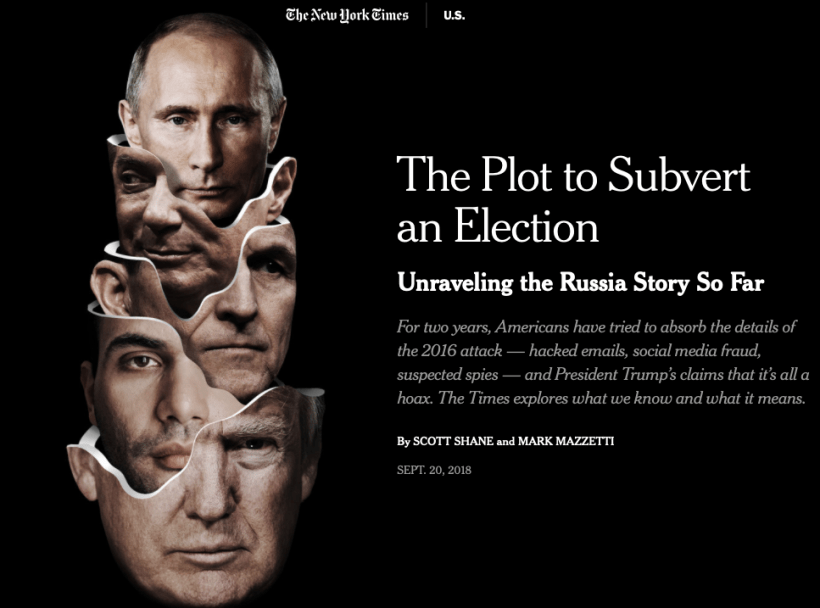
But that turned to be an outrageously deceptive claim, because Shane and Mazzetti failed to mention the fact that those 80,000 IRA posts (from early 2015 through 2017), had been engulfed in a vast ocean of more than 33 trillion Facebook posts in people’s news feeds – 413 million times more than the IRA posts.
In December 2019, senior national security correspondent David Sanger wrote a story headlined, “Russia Targeted Election Systems in All 50 States, Report Finds,” and Sanger’s lede said the Senate Intelligence Committee had “concluded” that all 50 states had been targeted. But the Committee report actually reaches no such conclusion. It quoted President Barack Obama’s cyber-security adviser Michael Daniel as recalling that he had “personally” reached that conclusion, but shows the only basis for his conclusion was remarkably lame: the “randomness of the attempts” and his conviction that Russian intelligence was “thorough.”
The Committee reported that some intelligence “developed” in 2018 had “bolstered” the subjective judgment by Daniel. But all but one of the eight paragraphs in the report describing that intelligence were redacted, and the one unredacted paragraph suggests that the redacted paragraphs provided no conclusive evidence that Russian intelligence had scanned any state election websites, much less those of all 50 states. The paragraph said, “However, IP addresses associated with the August 16, 2016 FLASH provided some indicators the activity might be attributable to the Russian government…. [emphasis added].”
The Committee report also contained summary statements from six states that the Department of Homeland Security has continued to include among the 21 states it insists were hacked by the Russians in 2016, denying any cyber threat to their systems. Another 13 states reported only that there was “scanning and probing” by inconclusive IP addresses the FBI and DHS had sent them. Sanger did not report any of those troublesome details.
In January 2020 the Times began its coverage of the theme of Russian interference in the 2020 election with a story headlined, “Chaos is the Point: Russian Hackers and Trolls Grow Stealthier in 2020.” The story, written by Sanger, Matthew Rosenberg and Nicole Perlroth, sought to heighten the existing U.S. climate of paranoia about a Russian attack in regard to the 2020 elections. Once again, however, nothing in the story supports the sinister tone of the headline.
It reported Department of Homeland Security officials’ anxiety about the ransom-ware attacks on 100 American towns, cities and federal offices during 2019, which are clearly criminal operations aimed at large-scale payoffs by cities. The story informed readers that DHS was investigating “whether Russian intelligence was involved in any of the attacks,” on the apparent theory that the criminals were being used by the Russians.
Since those ransom-ware attacks had been going on for years, the obvious question would have been why DHS would have waited until 2020 to reveal that it was investigating Russian involvement. Thus, the only fact underlying the story was the DHS desire to find evidence to support its accusations of Russian election hacking.
Still at it in 2020
The Times continued its advocacy journalism in a Feb. 26 report that U.S. intelligence officials had “warned” in a briefing for the House Intelligence Committee on Feb. 13 that “Russia was interfering in the 2020 campaign to get President Trump elected,” citing five people “familiar with the matter.”
The Times’ team of four writers proceeded to declare, “The Russians have been preparing – and experimenting – for the 2020 election… aware that they needed a new playbook of as-yet undetectable methods, United States officials said.” But instead of reporting actual evidence of any Russian action or decision for action, the Times writers again cited what their sources suspected could be done.
“Some officials,” they wrote, “believe that foreign powers, possibly including Russia, could use ransom-ware attacks…to damage or interfere with voting systems or registration databases.” The Times’ sources thus had no actual intelligence on the question and were merely speculating on what any foreign government might do to disrupt the election.
Three days after that report, moreover, the Times backed away from its previous lede after intelligence sources disputed its claim that Russia was intervening to reelect Trump, suggesting that the briefing officer, Shelby Pierson, had overstated the assessment. Sanger sought to limit the damage with a story labeling the problem one of “dueling narratives” in the intelligence community.
Then Sanger admitted, “It is probably too early for the Russians to begin any significant moves to bolster a specific candidate,” which obviously invalidated the Times’ previous speculation on the subject. But after The Washington Post published a story that the FBI had informed Senator Bernie Sanders that Russia had sought to help his campaign, Sanger quickly returned to the same narrative of Russian interference to advance its favorite candidates.
On the Times’ podcast “The Daily,” Sanger opined that the Russians were now supporting both Trump and Sanders – because Sanders, “like Donald Trump,” has “got a real aversion to interventions around the world.”
The most recent entry in the Times’ campaign to create anxiety about Russian interference in the election focused on race relations. On March 10, the Times headlined its story, “Russia Trying to Stoke U.S. Racial Tension before Elections, Officials Say.” In their lede Julian Barnes and Adam Goldman announced, “The Russian government has stepped up efforts to influence racial tensions in the United States as part of its bid to influence November’s presidential election, including trying to incite violence by white supremacist groups and stoke anger among Afro-Americans, according to seven American officials briefed on recent intelligence.”
But true to the modus operandi used routinely to push the Russian election threat narrative, the writers did not offer a single fact supporting such a story line. They even admitted that the officials who were making the claims provided “few details” about white supremacists and “did not detail how” blacks were being encouraged to use violence.
It turns out, in fact, that U.S. officials have found nothing indicating Russian support for violent white supremacists in America. The only fact that they could cite — based on a single source — was that the FBI is “scrutinizing any ties” between Russian intelligence and Rinaldo Nazzaro, the American founder of a “neo-Nazi group,” who lives with his Russian wife in St. Petersburg, Russia, but owns property in the United States. So, the Times’ single source had nothing but a suspicion for which the FBI was trying to find evidence.
The final touch in the piece was the accusation that RT had “fanned divisions” on race by running a story about a video of New York policemen attacking and detaining a young black man that Barnes and Goldman write “sparked outrage” and had also “posted tweets aimed at stirring white animosity.” But the RT article on the video merely reported accurately that the video depicted unprovoked police brutality and that it had already gone viral. The Times itself had published a much more detailed Associated Press story on the same incident that went into a discussion of the history of police brutality in New York City. By the Times’ own criterion, the AP was doing far more to stoke racial animosity than RT.
The opinion pieces that RT published attacking The New York Times for its coverage of a video at the University of Wisconsin that offended non-whites and for a Times opinion piece critical of the Apu character on “The Simpsons” echoed views on race and culture that most Americans find offensive. The idea that they were part of a Russian plot to generate racial animosity, however, is a very long stretch.
The descent of The New York Times into this unprecedented level of propagandizing for the narrative of Russia’s threat to U.S. democracy is dramatic evidence of a broader problem of abuses by corporate media of their socio-political power. Greater awareness of the dishonesty at the heart of the Times‘ coverage of that issue is a key to leveraging media reform and political change.
Gareth Porter is an independent investigative journalist and historian and winner of the 2012 Gellhorn Prize for Journalism. His latest book, with John Kiriakou, is “The CIA Insider’s Guide to the Iran Crisis: From CIA Coup to the Brink of War.”
The indictment of Concord was meant to prove Russia interfered in the US presidential election. But it was just a political sham
By Scott Ritter | RT | March 17, 2020
Now that the Department of Justice has rightly dismissed the case, it just shows that the allegations were aimed at shaping public opinion – and that it’s all about the politicization of the US Justice System
It was the indictment that shook America. Or at least, it was supposed to. For months, prosecutors working for Robert Mueller – the special prosecutor charged with investigating allegations of collusion between the campaign of then-candidate Donald Trump and various Russian actors to tip the scales of the 2016 US presidential election in Trump’s favor – had been slaving away behind a wall of secrecy. Set up in May 2017, the Mueller team had little to show for its efforts save for a handful of guilty pleas by Trump associates for lying to federal agents. No evidence had been provided to an increasingly skeptical public to sustain the notion that the Russians had actively interfered in the election.
That changed in February 2018, when the Mueller team unveiled an indictment of thirteen Russian citizens and three Russian companies, including Concord Management, spelling out in detail an assortment of acts that, on the surface, looked damning. “From in or around 2014 to the present,” the indictment read, “defendants knowingly and intentionally conspired with each other (and with persons known and unknown to the Grand Jury) to defraud the United States by impairing, obstructing and defeating the lawful functions of the Government through fraud and deceit for the purpose of interfering with the US political and electoral processes, including the presidential election of 2016.”
From that point on, “thirteen individuals and three companies” became the mantra of the pro-“Russia did it” brigade, repeated over and over again on TV news, Twitter, Facebook and other platforms where they and their ilk gathered to promote the theory that President Trump had colluded with the Russians to secure his electoral victory in 2016. Whenever anyone questioned the validity of the investigation, like clockwork the supporters of Mueller and his work would religiously cite the existence of this indictment, as if, in and of itself, it proved Mueller’s case.
It was a pure numbers game, inflated further when Mueller and his team indicted twelve serving Russian Military Intelligence officers for allegedly hacking the Democratic National Committee server, among other alleged crimes, in the spring of 2016. What had Mueller accomplished with these indictments? The reality was that they were little more than a publicity stunt, a public relations game that allowed Mueller supporters to respond that “he indicted 25 Russians and three Russian companies” any time the accomplishments of the investigation were brought into question.
While these statistics sounded impressive, creating as they did the impression of irrepressible, righteous momentum, they represented little more than grand theater designed to create an impression of guilt that wasn’t backed up by fact. The Mueller indictment targeting Concord Management grew out of a grand jury investigation where the government had total control of the evidence presented. There’s an old saying about the US grand jury system, that “a prosecutor can indict a ham sandwich” – the implication being you can make anyone look guilty for anything at any time. The ham sandwich isn’t given the chance to present its case.
Normally, an indictment would compel a defendant, presented with overwhelming evidence of his or her guilt, to seek a plea arrangement. Or, seeing that the evidence was insufficient, they would take the case to trial where, through discovery, the prosecutor would be compelled to hand over any and all evidence so that the defense could mount a counterargument. In this light, a prosecutor would normally craft the grand jury case in a way that maximized its impact at trial. But the Concord Management case, like the case against the Russian intelligence officers, was never meant to go to trial. No one expected the Russians to mount a defense, because to do so would require their presence in the court, on American soil, where they would be subject to arrest and confinement.
Concord Management, however, took everyone by surprise, hiring a US-based legal team to defend it against the plethora of fantastic allegations that underpinned the indictment. In doing so, Concord Management put the Mueller team in a position where they would have to disclose how they obtained all the extraordinary details about the alleged Russian activities, including internal emails, travel itineraries, and specific details about the thirteen Russian men and women.
Confronted with the reality that Concord was ultimately prepared to take the case to trial, the Department of Justice pulled the plug on the indictment, hiding behind the claim that sensitive law enforcement techniques would be revealed if it was required to present its case. Oh, really?
This revelation only underscores how ill-prepared the Mueller team was to take the Concord case to trial – normally, questions about what evidence can and cannot be presented at trial are worked out before the indictment is published. But when an indictment is more about manipulating public perception by putting forth unsustained allegations, rather than proving actual fact-based guilt, issues about evidentiary classification don’t matter. But in this case, however, they do matter – and the US government, its bluff called, was compelled to dismiss the charges.
Under normal circumstances, the announcement that the indictment used to underpin the credibility of an investigation into whether the now-President of the United States colluded with Russia to win an election had been dismissed would not only be headline news, but would also generate public outrage and demands that those who brought the indictment forward be investigated for politicizing the American justice system.
But there is nothing normal about the present circumstance. The combined impact of the Mueller investigation (which stalled far short of its goal of indicting the president) and the related impeachment trial process (which likewise failed) left the American public sharply divided on the issue of Trump-Russian collusion, facts be damned. The dismissal of the Concord indictment should be further evidence that the allegations of Russian interference in the 2016 presidential election have been vastly overblown. The other indictments are similarly unsustainable at trial.
It’s just disappointing that the coronavirus news cycle will probably drown out this story, leaving the ramifications of the abuse of the US legal system by politically motivated prosecutors unexplored, and the American public worse off for it.
Scott Ritter is a former US Marine Corps intelligence officer. He served in the Soviet Union as an inspector implementing the INF Treaty, in General Schwarzkopf’s staff during the Gulf War, and from 1991-1998 as a UN weapons inspector. Follow him on Twitter @RealScottRitter
WHY IS CROWDSTRIKE CONFUSED ON ELEVEN KEY DETAILS ABOUT THE DNC HACK?
By Larry C Johnson | Sic Semper Tyrannis | March 17, 2020
Here is the bottom-line—despite being hired in late April (or early May) of 2016 to stop an unauthorized intrusion into the DNC, CrowdStrike, the cyber firm hired by the DNC’s law firm to solve the problem, failed abysmally. More than 30,000 emails were taken from the DNC server between 22 and 25 May 2016 and given to Wikileaks. Crowdstrike blamed Russia for the intrusion but claimed that only two files were taken. And CrowdStrike inexplicably waited until 10 June 2016 to reboot the DNC network.
CrowdStrike, a cyber-security company hired by a Perkins Coie lawyer retained by the DNC, provided the narrative to the American public of the alledged hack of the DNC, But the Crowdstrike explanation is inconsistent, contradictory and implausible. Despite glaring oddities in the CrowdStrike account of that event, CrowdStrike subsequently traded on its fame in the investigation of the so-called Russian hack of the DNC and became a publicly traded company. Was CrowdStrike’s fame for “discovering” the alleged Russian hack of the DNC a critical factor in its subsequent launch as a publicly traded company?
The Crowdstrike account of the hack is very flawed. There are 11 contradictions, inconsistencies or oddities in the public narrative about CrowdStrike’s role in uncovering and allegedly mitigating a Russian intrusion (note–the underlying facts for these conclusions are found in Ellen Nakashima’s Washington Post story, Vicki Ward’s Esquire story, the Mueller Report and the blog of Crowdstrike founder Dmitri Alperovitch):
- Two different dates—30 April or 6 May—are reported by Nakashima and Ward respectively as the date CrowdStrike was hired to investigate an intrusion into the DNC computer network.
- There are on the record contradictions about who hired Crowdstrike. Nakashima reports that the DNC called Michael Sussman of the law firm, Perkins Coie, who in turn contacted Crowdtrike’s CEO Shawn Henry. Crowdstrike founder Dmitri Alperovitch tells Nakashima a different story, stating our “Incident Response group, was called by the Democratic National Committee (DNC).
- CrowdStrike claims it discovered within 24 hours the “Russians” were responsible for the “intrusion” into the DNC network.
- CrowdStrike’s installation of Falcon (its proprietary software to stop breaches) on the DNC on the 1st of May or the 6th of May would have alerted to intruders that they had been detected.
- CrowdStrike officials told the Washington Post’s Ellen Nakashima that they were, “not sure how the hackers got in” and didn’t “have hard evidence.”
- In a blog posting by CrowdStrike’s founder, Dmitri Alperovitch, on the same day that Nakashima’s article was published in the Washington Post, wrote that the intrusion into the DNC was done by two separate Russian intelligence organizations using malware identified as Fancy Bear (APT28) and Cozy Bear (APT29).
- But, Alperovitch admits his team found no evidence the two Russian organizations were coordinating their “attack” or even knew of each other’s presence on the DNC network.
- There is great confusion over what the “hackers” obtained. DNC sources claim the hackers gained access to the entire database of opposition research on GOP presidential candidate Donald Trump. DNC sources and CrowdStrike claimed the intruders, “read all email and chat traffic.” Yet, DNC officials insisted, “that no financial, donor or personal information appears to have been accessed or taken.” However, CrowdStrike states, “The hackers stole two files.”
- Crowdstrike’s Alperovitch, in his blog posting, does not specify whether it was Cozy Bear or Fancy Bear that took the files.
- Wikileaks published DNC emails in July 2016 that show the last message taken from the DNC was dated 25 May 2016. This was much more than “two files.”
- CrowdStrike, in complete disregard to basic security practice when confronted with an intrusion, waited five weeks to disconnect the DNC computers from the network and sanitize them.
Let us start with the very contradictory public accounts attributed to Crowdstrke’s founder, Dmitri Alperovitch. The 14 June 2016 story by Ellen Nakashima of the Washington Post and the October 2016 piece by Vicki Ward in Esquire magazine offer two different dates for the start of the investigation:
When did the DNC learn of the “intrusion”?
Ellen Nakashima claims it was the end of April:
DNC leaders were tipped to the hack in late April. Chief executive Amy Dacey got a call from her operations chief saying that their information technology team had noticed some unusual network activity. . . . That evening, she spoke with Michael Sussmann, a DNC lawyer who is a partner with Perkins Coie in Washington. Soon after, Sussmann, a former federal prosecutor who handled computer crime cases, called Henry, whom he has known for many years. Within 24 hours, CrowdStrike had installed software on the DNC’s computers so that it could analyze data that could indicate who had gained access, when and how.
Ward’s timeline, citing Alperovitch, reports the alert came later, on 6 May 2016:
At six o’clock on the morning of May 6, Dmitri Alperovitch woke up in a Los Angeles hotel to an alarming email. . . . late the previous night, his company had been asked by the Democratic National Committee to investigate a possible breach of its network. A CrowdStrike security expert had sent the DNC a proprietary software package, called Falcon, that monitors the networks of its clients in real time. Falcon “lit up,” the email said, within ten seconds of being installed at the DNC: Russia was in the network.
This is a significant and troubling discrepancy because it marks the point in time when CrowdStrike installed its Falcon software on the DNC server. It is one thing to confuse the 30th of April with the 1st of May. But Alperovitch gave two different reporters two different dates.
What did the “hackers” take from the DNC?
Ellen Nakashima’s reporting is contradictory and wrong. Initially, she is told that the hackers got access to the entire Donald Trump database and that all emails and chats could be read. But then she is assured that only two files were taken. This was based on Crowdstrike’s CEO’s assurance, which was proven subsequently to be spectacularly wrong when Wikileaks published 35,813 DNC emails. How did Crowdstrike miss that critical detail? Here is Nakashima’s reporting:
Russian government hackers penetrated the computer network of the Democratic National Committee and gained access to the entire database of opposition research on GOP presidential candidate Donald Trump, according to committee officials and security experts who responded to the breach.
The intruders so thoroughly compromised the DNC’s system that they also were able to read all email and chat traffic, said DNC officials and the security experts. . . .
The DNC said that no financial, donor or personal information appears to have been accessed or taken, suggesting that the breach was traditional espionage, not the work of criminal hackers.
One group, which CrowdStrike had dubbed Cozy Bear, had gained access last summer (2015) and was monitoring the DNC’s email and chat communications, Alperovitch said.
The other, which the firm had named Fancy Bear, broke into the network in late April and targeted the opposition research files. It was this breach that set off the alarm. The hackers stole two files, Henry said. And they had access to the computers of the entire research staff — an average of about several dozen on any given day. . . .
CrowdStrike is continuing the forensic investigation, said Sussmann, the DNC lawyer. “But at this time, it appears that no financial information or sensitive employee, donor or voter information was accessed by the Russian attackers,” he said.
The DNC emails that are posted on the Wikileaks website and the metadata shows that these emails were removed from the DNC server starting the late on the 22nd of May and continuing thru the 23rd of May. The last tranche occurred late in the morning (Washington, DC time) of the 25th of May 2016. Crowdstrike’s CEO, Shawn Henry, insisted on the 14th of June 2016 that “ONLY TWO FILES” had been taken. This is demonstrably not true. Besides the failure of Crowdstrike to detect the removal of more than 35,000 emails, there is another important and unanswered question—why did Crowdstrike wait until the 10th of June 2016 to start disconnecting the DNC server when they allegedly knew on the 6th of May that the Russians had entered the DNC network?
Crowdstrike accused Russia of the DNC breach but lacked concrete proof.
Ellen Nakashima’s report reveals that Crowdstrike relied exclusively on circumstantial evidence for its claim that the Russian Government hacked the DNC server. According to Nakashima:
CrowdStrike is not sure how the hackers got in. The firm suspects they may have targeted DNC employees with “spearphishing” emails. These are communications that appear legitimate — often made to look like they came from a colleague or someone trusted — but that contain links or attachments that when clicked on deploy malicious software that enables a hacker to gain access to a computer. “But we don’t have hard evidence,” Alperovitch said.
There is a word in English for the phrases, “Not sure” and “No hard evidence”–that word is, “assumption.” Assuming that the Russians did it is not the same as proving, based on evidence, that the Russians were culpable. But that is exactly what CrowdStrike did.
The so-called “proof” of the Russian intrusions is the presence of Fancy Bear and Cozy Bear?
At first glance, Dmitri Alperovitch’s blog posting describing the Fancy Bear and Cozy Bear “intrusions” appears quite substantive. But cyber security professionals quickly identified a variety of shortcomings with the Alperovitch account. For example, this malware is not unique nor proprietary to Russia. Other countries and hackers have access to APT28 and have used it.
Skip Folden offers one of the best comprehensive analyses of the problems with the Alperovitch explanation:
No basis whatsoever:
APT28, aka Fancy Bear, Sofacy, Strontium, Pawn Storm, Sednit, etc., and APT29, aka Cozy Bear, Cozy Duke, Monkeys, CozyCar,The Dukes, etc., are used as ‘proof’ of Russia ‘hacking’ by Russian Intelligence agencies GRU and FSB respectively.
There is no basis whatsoever to attribute the use of known intrusion elements to Russia, not even if they were once reverse routed to Russia, which claim has never been made by NSA or any other of our IC.
On June 15, 2016 Dmitri Alperovitch himself, in an Atlantic Council article, gave only “medium-level of confidence that Fancy Bear is GRU” and “low-level of confidence that Cozy Bear is FSB.” These assessments, from the main source himself, that either APT is Russian intelligence, averages 37%-38% [(50 + 25) / 2].
Exclusivity:
None of the technical indicators, e.g., intrusion tools (such as X-Agent, X-Tunnel), facilities, tactics, techniques, or procedures, etc., of the 28 and 29 APTs can be uniquely attributed to Russia, even if one or more had ever been trace routed to Russia. Once an element of a set of intrusion tools is used in the public domain it can be reverse-engineered and used by other groups which precludes the assumption of exclusivity in future use. The proof that any of these tools have never been reverse engineered and used by others is left to the student – or prosecutor.
Using targets:
Also, targets have been used as basis for attributing intrusions to Russia, and that is pure nonsense. Both many state and non-state players have deep interests in the same targets and have the technical expertise to launch intrusions. In Grizzly Steppe, page 2, second paragraph, beginning with, “Both groups have historically targeted …,” is there anything in that paragraph which can be claimed as unique to Russia or which excludes all other major state players in the world or any of the non-state organizations? No.
Key Logger Consideration:
On the subject of naming specific GRU officers initiating specific actions on GRU Russian facilities on certain dates / times, other than via implanted ID chips under the finger tips of these named GRU officers, the logical assumption would be by installed key logger capabilities, physical or malware, on one or more GRU Russian computers.
The GRU is a highly advanced Russian intelligence unit. It would be very surprising were the GRU open to any method used to install key logger capabilities. It would be even more surprising, if not beyond comprehension that the GRU did not scan all systems upon start-up and in real time, including key logger protection and anomalies of performance degradation and data transmissions.
Foreign intelligence source:
Other option would be via a foreign intelligence unit source with local GRU access. Any such would be quite anti-Russian and be another nail in the coffin of any chain of evidence / custody validity at Russian site.
Stated simply, Dmitri Alperovitch’s conclusion that “the Russians did it” are not supported by the forensic evidence. Instead, he relies on the assumption that the presence of APT28 and APT29 prove Moscow’s covert hand. What is even more striking is that the FBI accepted this explanation without demanding forensic evidence.
Former FBI Director James Comey and former NSA Director Mike Rogers testified under oath before Congress that neither agency ever received access to the DNC server. All information the FBI used in its investigation was supplied by CrowdStrike. The Hill reported:
The FBI requested direct access to the Democratic National Committee’s (DNC) hacked computer servers but was denied, Director James Comey told lawmakers on Tuesday.
The bureau made “multiple requests at different levels,” according to Comey, but ultimately struck an agreement with the DNC that a “highly respected private company” would get access and share what it found with investigators.
The foregoing facts raise major questions about the validity of the Crowdstrike methodology and conclusions with respect to what happened on the DNC network. This is not a conspiracy theory. It is a set of facts that, as of today, have no satisfactory explanation. The American public deserve answers.
Kremlin slams ‘unfounded’ EU report on Russian pandemic disinformation
RT | March 18, 2020
An EU report which accuses Russia of waging a disinformation campaign around Covid-19 isn’t backed by a single fact and has nothing to do with common sense. That’s according to Vladimir Putin’s spokesman.
Earlier, the Financial Times claimed that it obtained findings by the European External Action Service (EEAS), which insist that the “Russian pro-Kremlin media” is running a “significant disinformation campaign” to stoke “confusion, panic and fear” in the EU and the US to “aggravate the coronavirus pandemic crisis.”
“I can’t comment on this from the point of view of common sense,” Dmitry Peskov said when asked by journalists about the controversial paper. “One might expect that this Russophobic obsession would decline in the current situation, but as we see it’s not happening.”
The EEAS’ report didn’t even include a single example or a reference to a specific media outlet, so all the accusations are “unfounded,” Peskov concluded.
Featured Video

Trita Parsi: Middle East Unraveling — Are We on the Path to World War?
or go to
Aletho News Archives – Video-Images
New Book
Trans agenda is ‘normalization of sadism’ – US author

RT | September 23, 2026
The US Democratic Party has embraced a transgender agenda that amounts to “the normalization of sadism,” author A.J. Rice has said, warning that radical trans policies would return if the party is allowed to regain power.
Speaking to RT’s America First host Scotty Nell Hughes about his new book, ‘The Curse of the Bearded Lady: How the Trans Mafia Whacked American Sanity’, Rice argued that activists have gained significant influence in schools, medicine, and corporate America while people who questioned the agenda have faced pressure to stay silent.
The author described the “trans mafia” as the sprawling network of people and institutions that have helped the movement gain influence. He singled out parts of academia, wealthy backers, and corporations, and stated that providers of transition-related treatment also have a financial incentive to keep young people in their care indefinitely.
Rice argued that the consequences of these policies ultimately fall on children who are being drawn toward gender-affirming medical treatments and on girls who are expected to share locker rooms or compete in sports with biological males.
He noted that while voters rejected the Democrats’ approach to gender in 2024, the party, which has been “captured by madness,” has since only doubled down and is seeking what is effectively “the normalization of sadism.” … Full report
Blog Roll
 Aletho News
- Integrity Initiative: UK-funded network framed dissent as Russian disinformation for years
- ‘We don’t seek permission to defend our country’: Snippets from President Pezeshkian’s UNGA address
- NATO chief wants Europeans to fight American wars [for Israel]
- German chemicals giant reveals details of downsizing
- Refaat Al-Areer Was The Canary In The Coal Mine In Israel’s War On The Truth
- Israeli election committee bars candidate from Knesset race over Gaza war opposition
- French-Lebanese man files war crimes complaint over Israeli attacks
- Mahan Air Flight Lands in China Despite US Threat against Iranian Airlines
- US eyes $10bn fund to rebuild war-battered Gulf infrastructure
- Trump meets Rodríguez near Maduro’s prison as Venezuela’s oil flows to US
- If Americans Knew
- Caught on Tape: AIPAC CEO Boasted of Controlling Trump’s National Security Officials
- Why Hamas Attacked Israel in October 2023 – Israeli professor Ilan Pappé
- They see them, then kill them: Israeli quadcopters track, deliberately target civilians in Gaza
- Winter could turn Gaza’s treacherous, war-damaged buildings into deathtraps
- Majority of Democratic Voters Want to Prosecute Both Biden and Trump Administration Officials Over Gaza
- As Gaza languishes, world leaders gather at the UN – Daily Update
- Sanctions are collective punishment: immoral and self-defeating
- Phosphorus Munitions Fired by Israel Burn Groves, Orchards in Southern Lebanon
- Israel Carries Out New Ceasefire Violations Across Gaza
- AI – Emphasis on the ‘I’: Israel Is Funding AI Chatbot Propaganda
- No Tricks Zone
- New Study: Earth And Venus Surface Warmth Largely Explained By Convection And Lapse Rate, Not CO2 Or Radiation
- 2025 Nature Paper Claiming Worsening Global Drought Gets RETRACTED …Heavily Flawed
- New Study: ‘Global Drought Shows No Detectable Recent Acceleration Under Climate Warming’
- Economic Masterminds: German Socialists Suggest Taxing Productivity Gains Stemming From Using AI
- The South China Sea Has Not Been Cooperating With The Climate Change Narrative
- Energy Crisis: Germany Enters Heating Season With Historically Low Gas Reserve Fill Levels
- New Study: The Antarctic Ice Sheet Gained Mass From 2020-2024 Due To Staggering Snow And Ice Accumulation
- Study: Ocean Heating Rates From Thousands Of Years Ago ‘Dwarf’ Modern Ocean Heating Rates
- Climate Extremists Target, Attack Large-Scale Power Grid Infrastructure In Germany!
- New Study: Antarctic Ice Melt Has Contributed Less Than 1 Centimeter To Sea Level Rise In The Last 30 Years

