Russiagate all over again: Secret EU report blames Russia for coronavirus ‘confusion, panic and fear’
By Nebojsa Malic | RT | March 17, 2020
When all else fails, blame Russia. That seems to be the EU approach to deflecting blame from its response to the coronavirus pandemic, no doubt because it has worked so well for Democrats in the US or London in the Skripal affair.
As Brussels finally got around to locking down the EU borders on Tuesday, London’s Financial Times ran a ‘bombshell’ story blaming “Russian pro-Kremlin media” for a “significant disinformation campaign” to stoke “confusion, panic and fear” in the West and “aggravate the coronavirus pandemic crisis.”
This is based on a nine-page report by the strategic communications division of the European External Action Service, the EU’s de facto foreign ministry. The EEAS did not officially comment on the FT story.
First things first: “strategic communications” is bureaucrat-speak for public relations, meaning that this report – assuming it is authentic – was produced by the EEAS propaganda division. Secondly, it consists of generalities, cliches and tropes already worn out from four years of “Russiagate” hysteria in the US, down to these alleged efforts being “in line with the Kremlin’s broader strategy of attempting to subvert European societies from within by exploiting their vulnerabilities and divisions.”
It’s almost as if the PR flacks in Brussels plagiarized the work of James Comey, Jim Clapper and John Brennan from the infamous US “intelligence community assessment” blaming Russia for the 2016 election – down to segueing into a diatribe against RT instead of offering evidence.
Whether the EEAS report does so or not, the FT story takes just such a deceptive leap, going on about “Russian state-linked false personas and accounts” before abruptly bringing up the entirely unrelated subject of RT Spanish, whose number of social media shares recently put it “ahead of some big western media outlets.”
How dare they, as Greta Thunberg might say.
This isn’t the first attempt to blame Russia for “disinformation” about the pandemic. The US State Department bandied about one such conspiracy theory just last month. It seems to be the go-to tactic of Western propagandists to deflect criticism from their own governments, whether it’s Theresa May using the “highly likely” Skripal affair to distract from Brexit woes or the US establishment trying to leverage it against President Donald Trump via “Russiagate.” It doesn’t appear to matter that both ultimately failed to achieve their objectives; propaganda always doubles down.
Their insistence on conflating RT with the Russian government deserves a separate analysis, but suffice to say that various Western hacks just can’t seem to comprehend that a news organization will perforce cover a major news topic – which the covid-19 pandemic most certainly is, literally on the global level.
Those looking for “confusion, panic and fear” can find an abundance of them in the pronouncements of their own government officials and health experts, as well as mainstream Western news outlets.
There indeed is an epidemic of fake news about the coronavirus – witness the recent “marshall law” hoax in the US – but what the Eurospooks and FT either missed or chose to ignore is that it has targeted Russia too.
Completely ignoring their erstwhile rhetoric about universal values and global solutions, governments and media across the West are using the pandemic to settle internal political scores, while projecting blame on Moscow in order to deflect it from themselves.
Much like the coronavirus, hypocrisy apparently knows no bounds.
Nebojsa Malic is a Serbian-American journalist, blogger and translator, who wrote a regular column for Antiwar.com from 2000 to 2015, and is now senior writer at RT. Follow him on Twitter @NebojsaMalic
‘Russian troll firm’ says it has a $50bn grudge to settle with US after indictment dropped by DoJ
RT | March 17, 2020
A Russian firm that the DoJ failed to prosecute for “sowing discord” during the 2016 election aims to take its pound of flesh – or at least a hefty compensation for its tarnished reputation.
The February 2018 indictment of Concord Management & Consulting LLC, one of several issued by the team of Special Counsel Robert Mueller, was praised by the Russiagate crowds as a crucial step in uncovering the holy grail of Trump-Russia collusion. The case was dropped just weeks before going to trial, with prosecutors claiming that the firm’s defense strategy – demanding evidence that the company had waged ‘information warfare’ against America – posed a threat to US national security.
Concord had been “eager and aggressive in using the judicial system to gather information about how the United States detects and prevents foreign election interference,” the motion to dismiss said.
Protecting “sources and methods” is the cookie cutter explanation that the US intelligence community uses to justify evidence-free accusations. But it may not work this time; Concord CEO Yevgeny Prigozhin – dubbed ‘Putin’s chef’ by the Western media, says he didn’t consider the case closed with the charges dropped.
The DoJ’s decision proves that statements like “Prigozhin interfered in the US presidential election” were “lies and fiction,” he said in a statement. Concord will seek $50 billion in damages from the US government for “illegal persecution and sanctions,” he warned.
“I have found only two things positive in the biased US justice systems. One is attorney Eric Dubelier, who had the guts to fight against the American government and has secured a victory. The other is Special Counsel Robert Mueller, who had the courage to resign after realizing the kind of lawlessness he had been dragged into,” Prigozhin added.
Mueller resigned in May 2019 after his much-hyped probe ended with an anticlimactic report and criminal charges against 34 individuals and three entities, including Concord. The team that decided to call off the indictment against the company included two prosecutors who were part of Mueller’s investigation.
DOJ drops charges against ‘Russian trolls’ after they dared demand evidence in US court
RT | March 17, 2020
The US is dropping the much-hyped indictment for ‘election meddling’ against a company supposedly behind the so-called Russian troll farm, closing the opening chapter of special counsel Robert Mueller’s Russiagate investigation.
Further pursuing the case against Concord Management & Consulting LLC, “promotes neither the interests of justice nor the nation’s security,” the Department of Justice wrote to the federal judge overseeing the case on Monday, in a motion to drop the charges.
DOJ lawyers cited “recent events and a change in the balance of the government’s proof due to a classification determination,” saying only that they submitted further details in a classified addendum.
Concord was one of the three companies – the Internet Research Agency is another – and 13 individuals charged in February 2018 with waging “information warfare against the United States of America” using social media.
The DOJ rationalizes the motion to dismiss by arguing that Concord is “a Russian company with no presence in the United States and no exposure to meaningful punishment in the event of a conviction.” That has always been the case, however. What really changed since the indictment was filed is the complete implosion of Mueller’s case, helped in part by Concord fighting the case in court.
The motion inadvertently reveals that Mueller’s prosecutors never intended the case against Concord, two other entities and 13 individuals to actually go to trial, otherwise they would have anticipated what ended up happening: Concord’s lawyers demanding discovery documents from the DOJ, which the US authorities say risks “exposure of law enforcement’s tools and techniques.”
Mueller’s team tried to fight the discovery proceedings by arguing in January 2019 that Concord was leaking them to “discredit” the investigation. Within two months, however, the investigation discredited itself, by having to admit there was no “collusion” between US President Donald Trump during the 2016 presidential election.
They still insisted that Russia had “meddled” in the election, but there too the case proved a problem. Concord successfully petitioned Judge Dabney L. Friedrich in May last year to rebuke the prosecutors for presenting their allegations as facts.
This is not to say that the DOJ is ready to disavow ‘Russiagate’ as a debunked conspiracy theory, however. Though the Concord case was dropped, the charges against the Internet Research Agency and the 13 Russian individuals were not. Given that none of them have a presence in the US, and have not dignified the indictment with a response, it is unclear how – if at all – the DOJ intends to proceed with the case.
Keeping it on the books may keep the flames of ‘Russiagate’ alive, though, which is very convenient for the media and others heavily invested in the narrative of Moscow somehow menacing US elections, despite not a shred of actual evidence being presented to back it up.
‘Arm’s-length’ military institution promotes belligerent worldview
By Yves Engler · March 12, 2020
 Not satisfied with Canada’s largest public relations machine, the Canadian Forces also employ various “arm’s-length” institutions to push their influence over the discussion of military and international affairs.
For example, the Conference of Defence Associations (CDA) Institute recently published a half-page ad in the Globe and Mail to announce its Conference on Security and Defence. The March 3 and 4 meeting at the venerable Château Laurier was sponsored by the Department of National Defence (DND) and Global Affairs as well as Lockheed Martin, Raytheon and other arms companies. As in previous years, CDA’s confab in Ottawa drew leading military and political officials, including the Chief of the Defence Staff, who heard speakers hype security threats and push for increased military spending.
The headlines the conference generated included: “Russia poses most immediate military threat to Canada, top general says” (Globe and Mail ), “Canada and the West are at war with Russia whether they want it or not: military experts” (Global ) and “Top Canadian general calls out Russia and China for ‘antagonistic actions’” (CTV).
None of these stories explained what the CDA Institute actually is. The group describes itself as a “non-partisan, independent, non-profit organization [that] expresses its ideas and opinions with a view to influencing government security and defence policy.” Established in 1932, then Minister of Defence Donald Matheson Sutherland backed CDA’s creation. Since its inception CDA has been directly or indirectly financed by DND. Initially, member associations paid a small part of the funds they received from DND to CDA. But, three decades later the role was reversed. CDA received a block grant from DND and parcelled out the money to its various member associations.
Since its creation, defence ministers and governor generals (as commander in chief) have regularly appeared at CDA’s annual conference. The governor general, prime minister, defence minister and chief of the defence staff are honorary patrons or vice patrons of the organization.
At the height of Canada’s war in Afghanistan CDA received a highly politicized five-year $500,000 contract from DND. University of Ottawa professor Amir Attaran wrote, “that money comes not with strings, but with an entire leash.” To receive the money CDA committed to producing 15 opinion pieces or letters to the editor in major Canadian newspapers, generating 29 media references to the organization and eliciting 100 requests for radio/television interviews. The media work was part of a requirement to “support activities that give evidence of contributing to Canada’s national policies.” CDA didn’t initially disclose its 2007–12 DND sponsorship agreement, which was reviewed by cabinet.
CDA represents over 50 military associations ranging from the Naval Association of Canada to the Canadian Infantry Association, Royal Canadian Legion to the Military Intelligence Association. It is run by high-ranking former officers.
CDA publishes Security and Defence Briefings, Vimy Papers and Presentations and Position Papers. The organization’s quarterly journal ON TRACK “promotes informed public debate on security and defence issues and the vital role played by the Canadian Armed forces in society.” CDA has also published influential books such as Queens professor Douglas Bland’s A Nation at Risk: The Decline of the Canadian Forces.
To encourage militarist research, CDA awards a number of prizes. It puts on an annual graduate student symposium where $3,000 goes to the winning paper, $2,000 to second place and $1,000 to third place. CDA co-sponsors the Ross Munro Media Award to a “journalist who has made a significant contribution to understanding defence and security issues” and gives the Vimy Award to a “Canadian who has made a significant and outstanding contribution to the defence and security of Canada and the preservation of (its) democratic values.”
CDA advocates militarism. Its first official resolution noted “the urgent need for an increased appropriation for national defence.” At almost every CDA convention between 1946 and 1959 a resolution passed in favour of compulsory military training. A 1968 resolution called for universal military training, expressing concern that a generation of Canadians had become “unused to the idea of military service.”
In the 1980s CDA developed the idea of the “Total Defence of Canada”. In 1985 Colonel H. A. J. Hutchinson told a CDA meeting: “I would say that the Total Defence of Canada requires much more than just the support of the Canadian Armed Forces, it involves the organization of our total economy, our industrial base, towards a single objective — the defence of this country.” Hinting at the need to talk up US President Ronald Reagan’s revival of Cold War rhetoric, Hutchison said this “can only be made [possible] if the Canadian people perceive that it is necessary and that, in fact, it is the only course of action open to them.”
A 2000 CDA report funded by the Business Council on National Issues, the Molson Foundation and DND advocated increased military spending to defend free trade. It claimed “the defence establishment, including the Canadian Forces, plays a key role in an international policy which provides the insurance and the means which allow the national interest to flourish. It contributes to stability at home and abroad, thus supporting the development of an environment congenial to trade.”
In November Richard Fadden told CDA’s Vimy Dinner Canada had to be “clear-eyed” about Russia and China, which are prepared to “use virtually any means to attain their goals.” Fadden claimed, “the risks posed by these two countries are certainly different, but they are generally based on advancing all their interests to the detriment of the West.”
For the military and the industries that profit from militarism, it is important to have “arms-length” organizations that create the illusion of a diversity of voices. But honest writers should be blunt about the CDA. It is a war machine front group, created and controlled by the military.
The MH17 Show Trial Isn’t About Justice Or Closure, But Information Warfare
By Andrew Korybko | One World | March 11, 2020
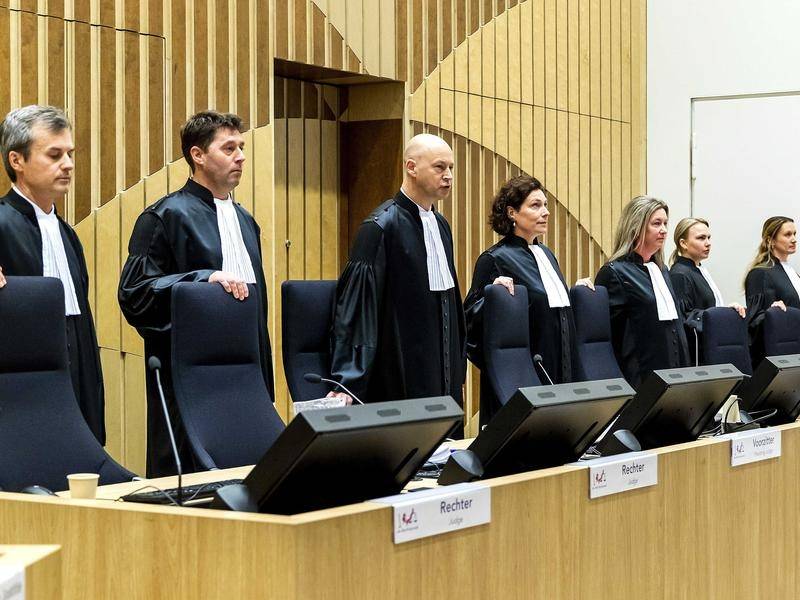
The MH17 tragedy is back in the news after the start of this case’s show trial in the Netherlands, which isn’t about bringing the alleged perpetrators to justice or helping the victims’ families find closure, but waging information warfare against Russia in an attempt to “conclusively” pin the blame for this crime on its supposed proxies in Eastern Ukraine so as to ruin President Putin’s international reputation once and for all.
The world is once again talking about the MH17 tragedy after the start of this case’s show trial in the Netherlands, where four of the alleged perpetrators are being accused of murder. It’s unlikely that they’ll appear before the court, so the entire process is more about show than substance. In case the reader doesn’t remember exactly what happened on that fateful summer day on 17 July, 2014, the author recommends that they review his most recent analysis on the issue from earlier this year titled “Latest MH17 Documentary By SBU Whistleblower Shares Some Shocking Truths“, which covers what he believes to be the most convincing version of events that transpired immediately before, during, and after the passenger jet was shot down over Eastern Ukraine. In short, the conventional narrative that the Russian-aligned rebels there were responsible is debunked as a convenient cover-up for masking Kiev’s culpability, which in turn also makes that government’s Western backers — and not Russia — indirectly responsible. It’s therefore understandable that a lot of powerful forces are invested in making their manufactured version of the “truth” the “official” one, hence the show trial, which is nothing more than an attempt to “conclusively” pin the blame for this crime on Russia and its supposed proxies in Eastern Ukraine.
Before going any further, it needs to be said that victims’ families have every right to be upset about what happened, and that everyone should respect their right to draw their own conclusions about what took place even if one doesn’t ultimately agree with them. The author doesn’t believe that Russia or the Eastern Ukrainian rebels were responsible, but acknowledges that some of the victims’ families think differently, especially after some of them staged a silent protest outside of the Russian Embassy in The Hague over the weekend. Nobody should criticize the victims’ families and thus make this all the harder for them to deal with, but there’s also nothing wrong with talking about how their reaction to this tragedy is being exploited by those who are relying upon it to convince others that their interpretation of events is the only correct one. Politicizing the suffering of innocent people is wrong no matter who does it or why, which is why it’s morally reprehensible that others are taking advantage of them under the guise of “giving them a voice” in order to push their narrative onto the broader public. The ongoing trial isn’t about bringing the alleged perpetrators to justice or helping the victim’s families find closure, but waging information warfare against Russia, the purpose of which is to ruin its international reputation and that of its leader.
President Putin is generally despised by the West but loved by the non-West because of his domestic and foreign policy successes over the past 20 years, which greatly contributed to bringing the emerging Multipolar World Order about. Even his detractors recognize that he’s an epochal figure whose legacy will certainly be studied for generations to come by people all across the world, they just regard Russia’s return to international prominence as being detrimental to their countries’ zero-sum interests. Nevertheless, they also wisely understand that soft power is more important than ever before in today’s interconnected, globalized world, especially after the information-communication technology revolution of the early 2000s, so they have a driving motivation to defame the Russian leader any chance they get. Regrettably, the MH17 tragedy is cynically seen as the “perfect opportunity” to ruin his legacy by forever associating him with what happened even though he played no role in those events whatsoever, nor did his countrymen. All that’s important to the “perception managers” who manufactured this weaponized narrative is that the lingering suspicion of President Putin’s possible involvement “credibly” exists, which explains the infowar importance of the ongoing show trial for supposedly “confirming” that.
Back to the show trial itself, it’s predictable that the accused will probably be found “guilty” for the aforementioned political reasons of pinning the blame for that tragedy entirely on Russia and the Eastern Ukrainian rebels so as to deflect from the “inconvenient” facts that have since come to light implicating Kiev and its Western backers, which was explained in the author’s analysis that he cited in the opening paragraph of this article. The overall soft power impact of this seemingly inevitable conclusion will likely be minimal, however, seeing as how most people have already made up their minds about who was really responsible. Those who are convinced that Russia played a role will feel “vindicated” by the anticipated verdict, while those who have remained skeptical this entire time could use the newfound attention to this case to share the “inconvenient” evidence that was just touched upon with others. The takeaway from all this “legal” drama is that tragedies will almost always be politicized for information warfare purposes, especially if the case can remotely be made that Russia or any of the West’s other geopolitical rivals might have had even an indirect role in whatever it is that transpired, so these countries should brace themselves to expect more such show trials in the future and take steps to ensure that their side of the story is heard by as many people as possible.
Andrew Korybko is an American political analyst.
This Isn’t a “Saudi-Russian” Oil War. It’s a Saudi & Russian War on Shale
MBS couldn’t get Russia to join him in aggressive cuts, so he forced it to join him in aggressive pumping — but Russia is not his target
By Marko Marjanović | Anti-Empire | March 11, 2020
The media is so eager to see Putin behind everything that it can’t see it is the Saudis who started this, and it’s US oil they’re targeting exactly as they already did once before.
At OPEC+ in Vienna Russia offered to extend the current cuts for another three months and then meet again. Saudi Arabia instead wanted to take another 1.5 million bpd from the market.
When Russia balked the Saudis made a 180-degree turn and declined the extension of existing cuts, slapped a big discount on their oil, and started warming up their spare capacity to start flooding the market come April 1st when the current OPEC+ quotas expire.
The 67-year old Putin wanted to continue the current neither here nor there approach. The 34-year old MBS wanted to try something radical and new. At least ostensibly he wanted more cuts that could lift all producers for which he needed Russia’s cooperation. When he couldn’t get it he instead went the flooding route for which he did not.
The media did MBS a huge favor by failing to notice it was he — the supposed US ally — who blew up the OPEC+ cuts and not Putin. (A typical headline: How Putin spurned the Saudis to start a war on America’s shale oil industry)
The media committed another mistake. It keeps deluding itself this is “Saudi-Russian” war where US energy is merely collateral damage:
- Saudi-Russian price war sends oil and stockmarkets crashing — The Economist
- How a Saudi-Russian Standoff Sent Oil Markets Into a Frenzy — The New York Times
- Putin just sparked an oil price war with Saudi Arabia — and US energy companies may be the victims — CNBC
- The U.S. Oil Industry Was Already Struggling Before Saudi-Russian Price War — NPR
This is silly. Just because MBS started flooding after talks with Russia didn’t go his way the media assumes his pumping is directed against Russia. When in fact every indication is that he wanted Russia as a partner, if not in radical cuts for which he needed its acquiescence, then at least in radical pumping for which he did not.
Whatever Russia’s previous preferred path it now has no choice but to fight for market share which will only increase the pressure on shale further. In other words, despite Moscow’s unwillingness the Saudis have in the end added Russian strength to their own, just for a different strategy.
Sure enough, Saudi Arabia is not in a great state to wage a long campaign, but it may not have to. Shale has never been weaker. The Saudis tried to drive it out before, between 2014 and 2017, and failed. Frackers found ways to slash cost and financial markets propped them up with even more loans.
Neither is likely this time around. Most cost-cutting that was possible has likely already been made, and with the next great recession and a drop in demand around the corner financial markets aren’t standing in line to get into energy that barely makes sense even now
Riyadh needs $85 oil to balance its budget. It can not hope to outlast Russia which can live on $40. But a 6-month flooding campaign to see if it can’t, together with Russia, collapse US shale isn’t the dumbest idea ever.
In fact, precisely the fact MBS needs oil at $85 is what would make him more desperate to try radical means to get there, whether they’re deep cuts or unrestricted production.
Call it the MBS stress test of the US oil bubble in an election year. Truly Trump has great friends…
How the UK press supports the British military and intelligence establishment
By Mark Curtis | Declassified UK | March 11, 2020
Britain’s national press is acting largely as a platform for the views of the UK military and intelligence establishment, new statistical research by Declassified UK shows.
The UK press, from The Times to The Guardian, is also routinely helping to demonise states identified by the British government as enemies, while tending to whitewash those seen as allies.
The research, which analyses the UK national print media, suggests that the public is being bombarded by views and selective information supporting the priorities of policy-makers. The media is found to be routinely misinforming the public and acting far from independently.
This is the second part of a two-part analysis of UK national press coverage of British foreign policy.
Elite platform
Numerous stories or points of information on Britain’s intelligence agencies, such as MI6 and GCHQ, are being fed to journalists by anonymous “security sources” – often military or intelligence officials who do not want to be named.
The term “security sources” has been mentioned in 1,020 press articles in the past three years alone, close to one a day. While not all of these relate to UK sources, it indicates the common use of this method by British journalists.
Declassified’s recent research found that officials in the UK military and intelligence establishment had been sources for at least 34 major national media stories that cast Labour leader Jeremy Corbyn as a danger to British security. The research also found 440 articles in the UK press from September 2015 until December 2019 specifically mentioning Corbyn as a “threat to national security”.
Anonymous sources easily push out messages supportive of government policy and often include misleading or unverifiable information with no come-back from journalists. The Ministry of Defence (MOD) says it has 89 “media relations and communications” officers.
Many journalists regularly present the views of the MOD or security services to the public with few or no filters or challenges, merely amplifying what their sources tell them. In “exclusive” interviews with MI6 or MI5, for example, journalists invariably allow the security services to promote their views without serious, or any, scepticism for their claims or relevant context.
That the UK intelligence services are regularly presented as politically neutral actors and the bearers of objective information is exemplified in headlines such as “MI6 lays bare the growing Russian threat” (in the Times) and “Russia and Assad regime ‘creating a new generation of terrorists who will be threat to us all’, MI6 warns” (in the Independent).
Press coverage of the RAF’s 100th “birthday” in 2018 produced no critical articles that could be found, with most being stories from the MOD presented as news. This is despite episodes in the RAF’s history such as the bombing of civilians in colonial campaigns in the Middle East in the 1920s, 1930s and 1950s and its prominent current role in supporting Saudi airstrikes in Yemen, which has helped create the world’s biggest humanitarian disaster.
Similarly, for GCHQ’s 100th anniversary in 2019, the press appeared to simply write up information provided by the organisation. Only the occasional article mentioned GCHQ’s role in operating programmes of mass surveillance while its covert online action programmes and secret spy bases in at least one repressive Middle East regime were ignored by every paper at the time, as far as could be found.
The national press are generally strong supporters of the security services and the military. A number of outlets, from the Times and Telegraph to the Mirror, are strongly opposed to government cuts in parts of the military budget, for example.
The British army’s main special forces unit, the SAS, which is currently involved in seven covert wars, is invariably seen positively in the national press. A search reveals 384 mentions of the term “SAS hero” in the UK national press in the past five years – mainly in the Sun, but also in the Times, Express, Mail, Telegraph and others.
Critical articles on the special forces are rare, and the journalists writing them can face a backlash from other reporters.
In some press articles, MOD media releases are largely copied and pasted. For example, recent MOD material on RAF Typhoons in Eastern Europe scrambling to intercept Russian aircraft has often been repeated word for word across the media.
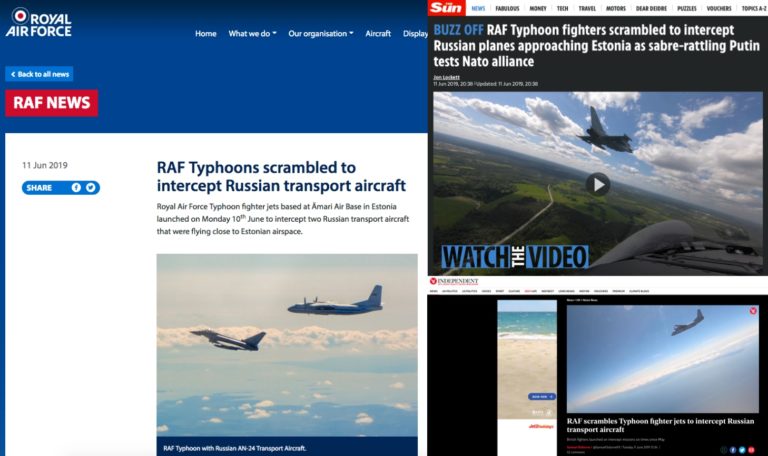
A press release from the UK’s Royal Air Force, and how it was covered by two British newspapers, The Sun and The Independent.
Such “embedded journalism” poses a significant threat to the public interest. Richard Norton-Taylor, formerly the Guardian’s security correspondent for over 40 years, told Declassified : “Embedded journalists — those invited to join British military units in conflict zones — are at the mercy of their MOD handlers at the best of times. Journalists covering defence, security and intelligence are far too deferential and indulge far too much in self-censorship”.
Some papers are more extreme than others in their willingness to act as platforms for the military and intelligence establishment. The Express may well be the most supportive: its coverage of MOD stories and vilification of official enemies, notably Russia, is remarkable and consistent.
The Guardian, however, has also been shown to play a similar role. Declassified’s recent analysis, drawing on newly released documents and evidence from former and current Guardian journalists, found that the paper has been successfully targeted by security agencies to neutralise its adversarial reporting of the “security state”.
Censorship by omission
Articles critical of the Ministry of Defence or security services are occasionally published in the press. However, these tend to be either on relatively minor issues or are reported on briefly and then forgotten. Rarely do seriously critical stories receive sustained coverage or are widely picked up across the rest of the media.
Often, reporters will cover a topic and elide the most important information for no clear reason. For example, there is considerable coverage of possible MI5 failures to prevent the May 2017 Manchester terrorist bombing — failings which may be understandable given the large number of terrorist suspects being monitored at any one time.
However, the government admitted in parliament in March 2018 that it “likely” had contacts with two militant groups in the 2011 war in Libya for which the Manchester bomber and his father reportedly fought at the time, one of which groups the UK had covertly supported in the past. This significant admission in parliament has not been reported in any press article, as far as can be found.
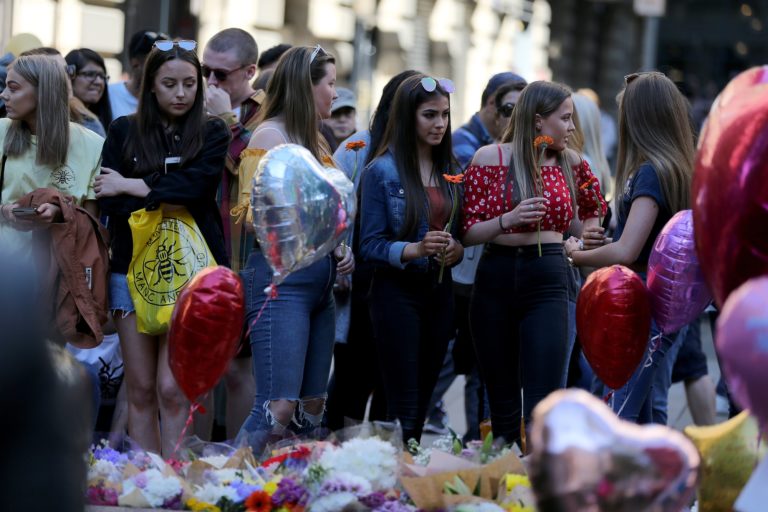
People lay flowers in St Annes Square on the first anniversary of the Manchester Arena bombing in Manchester, Britain, 22 May 2018. (Photo: EPA-EFE / Nigel Roddis)
Last September, veteran investigative journalist Ian Cobain broke a story on the alternative news site Middle East Eye revealing that the senior Twitter executive with editorial responsibility for the Middle East is also a part-time officer in the British army’s psychological warfare unit, the so-called 77th Brigade.
This story was picked up by a few media outlets at the time (including the Financial Times, the Times and the Independent ) but our research finds that it then went unmentioned in the hundreds of press articles subsequently covering Twitter.
Similarly, in November 2018, a story broke on a secretive UK government-financed programme called the Integrity Initiative, which is ostensibly a “counter disinformation” programme to challenge Russian information operations but was also revealed to be tweeting messages attacking Labour leader Jeremy Corbyn.
Our research finds that in the 14 months until December 2019, the Integrity Initiative was mentioned less than 20 times in the UK-wide national press, mainly in the Times (it was also mentioned 15 times in the Scottish paper, the Sunday Mail ).
By contrast, when stories break that are useful to the British establishment, they tend to receive sustained media coverage.
Establishment think tanks
The British press routinely chooses to rely on sources in think tanks that largely share the same pro-military and pro-intervention agenda as the state.
The two most widely-cited military-related think tanks in the UK are the London-based Royal United Services Institute (RUSI) and the International Institute for Strategic Studies (IISS) which are usually quoted as independent voices or experts. In the last five years, RUSI has appeared in 534 press articles and IISS in 120.
However, both are funded by governments and corporations. RUSI, which is located next door to the Ministry of Defence in Whitehall, has funders such as BAE Systems, the Qatar government, the Foreign Office and the US State Department. IISS’s chief financial backers include BAE Systems, Raytheon, Lockheed Martin and Airbus.
This funding is mentioned in only two press reports that could be found – the Guardian reported that IISS received money from the regime in Bahrain while the Times once noted, “RUSI, while funded in part by the MoD, is an independent think tank”.
One Telegraph article refers to a “research fellow at RUSI who specialises in combat airpower”, without mentioning that its funder BAE Systems is a major producer of warplanes.
Although many senior figures in these organisations previously worked in government, press readers are rarely informed of this. RUSI’s chair is former foreign secretary William Hague, its vice-chair is former MI6 director Sir John Scarlett and its senior vice-president is David Petraeus, former CIA director.
The IISS’s deputy secretary-general is a former senior official at the US State Department while its Middle East director is a former Lieutenant-General in the British army who served as defence senior adviser to the Middle East. One of IISS’ senior advisers is Nigel Inkster, a former senior MI6 officer.
Media and intelligence
Richard Keeble, professor of journalism at the University of Lincoln, has noted that the influence of the intelligence services on the media may be “enormous” and the British secret service may even control large parts of the press. “Most tabloid newspapers – or even newspapers in general – are playthings of MI5”, says Roy Greenslade, a former editor of the Daily Mirror who has also worked as media specialist for both the Telegraph and the Guardian.
David Leigh, former investigations editor of the Guardian, has written that reporters are routinely approached and manipulated by intelligence agents, who operate in three ways: they attempt to recruit journalists to spy on other people or go themselves under journalistic “cover”, they pose as journalists in order to write tendentious articles under false names, and they plant stories on willing journalists, who disguise their origin from their readers — known as black propaganda.
MI6 managed a psychological warfare operation in the run-up to the Iraq war of 2003 that was revealed by former UN arms inspector Scott Ritter. Known as Operation Mass Appeal, this operation “served as a focal point for passing MI6 intelligence on Iraq to the media, both in the UK and around the world. The goal was to help shape public opinion about Iraq and the threat posed by WMD [weapons of mass destruction]”.
Various fabricated reports were written up in the media in the run-up to the Iraq war, based on intelligence sources. These included cargo ships said to be carrying Iraqi weapons of mass destruction (covered in the Independent and Guardian ) and claims that Saddam Hussein killed his missile chief to thwart a UN team (Sunday Telegraph ).
More recent examples of apparently fabricated stories in the establishment media include Guardian articles on the subject of Julian Assange. The paper claimed in a front page splash written by Luke Harding and Dan Collyns in November 2018 that former Trump campaign manager Paul Manafort secretly met Assange in the Ecuadorian embassy three times.
The Guardian also falsely reported on a “Russia escape plot” to enable Assange to leave the embassy for which the paper later gave a partial apology. Both stories appeared to be part of a months-long campaign by the Guardian against Assange.
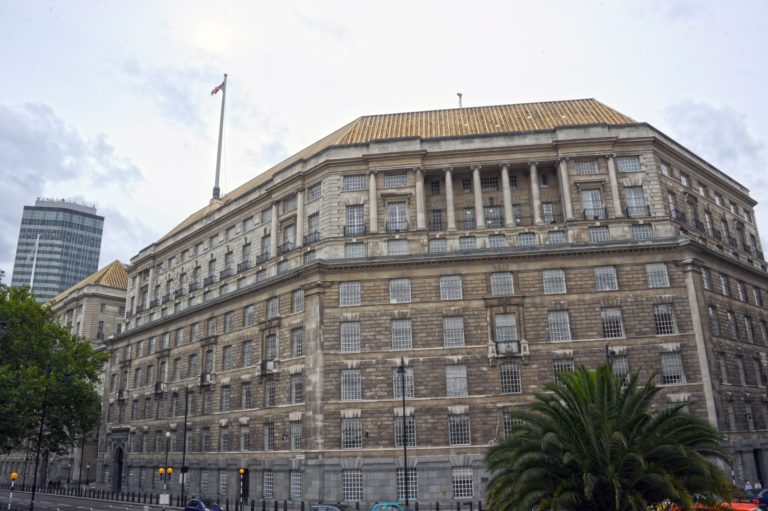
The exterior view of Thames House, MI5 Headquarters, in Millbank, on the bank of the River Thames, London, Britain. (Photo: EPA-EFE/ Horacio Villalobos)
Demonising enemies
The media plays a consistent role in following the state’s demonisation of official enemies. The term “Russian threat” is mentioned in 401 articles in the past five years, across the national press. The Express may be the largest press amplifier of the government’s demonisation of Russia — the paper carries a steady stream of stories critical of Russia and Putin.
The British establishment has invoked Russia as an enemy in recent years due mainly to the poisonings in the town of Salisbury and policy in eastern Europe. Whatever malign policies Russia is promoting, which can be real, false or exaggerated, it is noteworthy that this has been elevated by the press to a general “threat” to the UK. As during the cold war, this is useful to the British military and security services arguing for larger budgets and for offensive military postures in Eastern Europe and the Middle East.
Russia’s alleged interference in British politics has received huge coverage compared to alleged Israeli influence. A simple comparison of search terms using “Russia/Israel and UK and interference” in press articles in the past five years yields seven times more mentions of Russia than Israel, despite considerable evidence of Israeli interference.
UK press reporting on Iran is also noticeably supportive of government policy. A search for “Iran and nuclear weapons programme” reveals 325 articles in the past five years. While this large coverage is driven by president Trump’s withdrawal from the Iran nuclear deal, it is also driven by Iran being a designated enemy of the US and UK, which have deemed it unacceptable that Tehran should ever acquire nuclear weapons.
By contrast, “Israel’s nuclear weapons” (and variants of this search term) are mentioned in under 30 press articles in the past five years. Natanz, Iran’s main nuclear arms facility, has been mentioned in around four times more press articles than Dimona, the Israeli nuclear site, in the past five years.
The contrast in reporting on Iran and Israel is striking since Iran does not possess nuclear weapons, and it is not certain that it seeks to, whereas Western ally Israel already has such weapons, estimated at around 80 warheads.
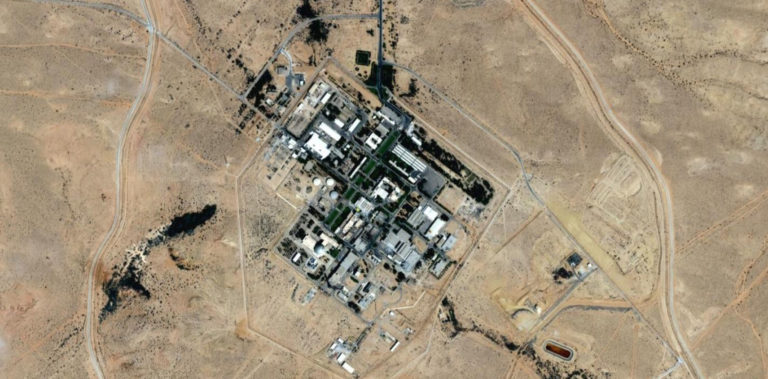
An aerial view of Israel’s nuclear site at Dimona. (Google Maps)
Labelling goodies and baddies
The national press strongly follows the government in labelling states as enemies or allies.
States favoured by the UK are mainly described in the press using the neutral term “government” rather the more critical term “regime”. In the past three years, for example, the term “Saudi government” has been used in 790 articles while “Saudi regime” is mentioned in 388. However, with Iran the number of instances is reversed: “Iranian government” is used in 419 articles whereas “Iranian regime” is mentioned in 456.
The same holds for other allies. The “Egyptian regime” receives 24 mentions while “Egyptian government” has 222, in the past three years. The “Bahraini regime” is mentioned in 10 articles while “Bahraini government” is mentioned in 60.
The precise term “Iranian-backed Houthi rebels”, referring to the war in Yemen, is mentioned in 198 articles in the last five years. However, the equivalent term for the UK backing the Saudis in Yemen (using search terms such as “UK-backed Saudis” or “British-backed Saudis”) appears in just three articles.
The pattern is also that the crimes of official enemies are covered extensively in the national press but those of the UK and its allies much less so, if at all.
Articles mentioning “war crimes and Syria” number 1,527 in the past five years compared to 495 covering “war crimes and Yemen”. While the press often reports that the Syrian government has carried out war crimes, most articles simply suggest or allege war crimes by the Saudis in Yemen.
Indeed, the UK press has been much more interested in covering the Syrian war—chiefly prosecuted by the UK’s opponents—than the Yemen war, where Britain has played a sustained widespread role. As a basic indicator, the specific term “war in Syria” is mentioned in well over double the number of articles as “war in Yemen” in the past five years.
Furthermore, government enemies are regularly described in the press as supporters of terrorism, which rarely applies to allies.
In the past three years 185 articles mention the term “sponsor of terrorism”, most referring to Iran, followed by Sudan and North Korea with the occasional mention of Libya and Pakistan. None specifically label UK allies Turkey or Saudi “sponsors of terrorism”, despite evidence of this in Syria and elsewhere, and none describe Britain or the US as such.
Some 102 articles in the past five years specifically mention Russia’s “occupation of Crimea”. However, despite some critical articles on UK policy towards the Chagos Islands in the Indian ocean—which were depopulated by the UK in the 1970s and which the US now uses as a military base—only two articles specifically mention the UK’s “occupation of Chagos” (or variants of this term).
Similar labelling prevails on opposition forces in foreign countries. Protesters in Hong Kong are routinely called “pro-democracy” by the press – the term has been mentioned in hundreds of articles in the past two years. However, protesters in UK allies Bahrain and Egypt have been referred to as “pro-democracy” in only a handful of cases, the research finds.
The special relationship
While demonising enemies, UK allies are regularly presented favourably in the press. This is especially true of the US, the UK’s key special relationship on which much of its global power rests. US foreign policy is routinely presented as promoting the same noble objectives as the UK and the press follows the US government line on many foreign policy issues.
The term “leader of the free world” to refer to the US has been used in over 1,500 articles in the past five years, invariably taken seriously across the media, without challenge or ridicule.
The view that the US promotes democracy is widely repeated across the press. A 2018 editorial in the Financial Times, written by its chief foreign affairs commentator Gideon Rachman, notes that, “Leading figures in both [US political] parties — from John Kennedy to Ronald Reagan through to the Bushes and Clintons — agreed that it was in US interests to promote free-trade and democracy around the world”. In 2017 Daniel McCarthy wrote in the Telegraph of “two decades of idealism in US foreign policy, of attempts to spread liberalism and democracy”.
It is equally common for the UK press to quote US figures on their supposed noble aims, without challenge. For example, the Sunday Times recently cited without comment the US state department saying “Promoting freedom, democracy and transparency and the protection of human rights are central to US foreign policy”.
The press often strongly criticises President Donald Trump, but often for betraying otherwise benign US values and policies that it assumes previous presidents have promoted. For example, Tom Leonard in the Daily Mail writes of “Mr Trump’s belief that US foreign policy should be guided by cold self-interest rather than protecting democracy and human rights”.
The Guardian is especially supportive of US foreign policy. A sub-heading to a recent article notes: “The US once led Western states’ support of democracy around the world, but under this president [Trump] that feels like a long time ago”. One of its main foreign affairs columnists, Simon Tisdall, recently wrote that the US fundamental “mission” was an “exemplary global vision of democracy, prosperity and freedom”, albeit one which has been distorted by the war on terror.
The Guardian regularly heaped praise on president Obama. An editorial in January 2017 commented that Obama was a “successful US leader” and that “internationally” his vision “could hardly be faulted for lack of ambition”. It also noted Obama’s “liberalism and ethics” and that: “Mr Obama has governed impeccably for eight years without any ethical scandal”.
Although the article noted US wars and civilian casualties in Yemen and Libya, the paper brushed these off, stating “But to ascribe the world’s tragedies to a single leader’s choices can be simplistic. The global superpower cannot control local dynamics”.
Research covered the period to the end of 2019 using the media search tool, Factiva. It analysed the “mainstream” UK-wide print media (dailies and Sundays) over different time scales, usually two or five years, as specified in the article. Media search engines cannot be guaranteed to work perfectly so additional research was sometimes undertaken.
Mark Curtis is the co-founder and editor of Declassified UK, an historian and author of five books on UK foreign policy. He tweets at: @markcurtis30.
The Long Roots of Our Russophobia
By Jeremy Kuzmarov | CounterPunch | March 6, 2020
For the last five years, the American media has been filled with scurrilous articles demonizing Russian President Vladimir Putin.
Putin has been accused of every crime imaginable, from shooting down airplanes, to assassinating opponents, to invading neighboring countries, to stealing money to manipulating the U.S. president and helping to rig the 2016 election.
Few of the accusations directed against Putin have ever been substantiated and the quality of journalism has been at the level of “yellow journalism.”
In a desperate attempt to sustain their political careers, centrist Democrats like Joe Biden and Hillary Clinton accused their adversaries of being Russian agents – again without proof.
And even the progressive hero Bernie Sanders – himself a victim of red-baiting – has engaged in Russia bashing and unsubstantiated accusations for which he offers no proof.
Guy Mettan’s book, Creating Russophobia: From the Great Religious Schism to Anti-Putin Hysteria (Atlanta: Clarity Press, 2017) provides needed historical context for our current political moment, showing how anti-Russian hysteria has long proliferated as a means of justifying Western imperialism.
Mettan is a Swiss journalist and member of parliament who learned about the corruption of the 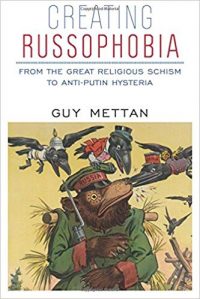 media business when his reporting on the world anticommunist league rankled his newspapers’ shareholders, and when he realized that he was serving as a paid stenographer for the Bosnian Islamist leader Alija Izetbegovic in the early 1990s.
Mettan defines Russophobia as the promotion of negative stereotypes about Russia that associate the country with despotism, treachery, expansion, oppression and other negative character traits. In his view, it is “not linked to specific historical events” but “exists first in the head of the one who looks, not in the victim’s alleged behavior or characteristics.”
Like anti-semitism, Mettan writes, “Russophobia is a way of turning specific pseudo-facts into essential one-dimensional values, barbarity, despotism, and expansionism in the Russian case in order to justify stigmatization and ostracism.”
The origins of Russophobic discourse date back to a schism in the Church during the Middle Ages when Charlemagne was crowned emperor of the Roman empire and modified the Christian liturgy to introduce reforms execrated by the Eastern Orthodox Churches of the Byzantine empire.
Mettan writes that “the Europe of Charlemagne and of the year 1000 was in need of a foil in the East to rebuild herself, just as the Europe of the 2000s needs Russia to consolidate her union.”
Before the schism, European rulers had no negative opinions of Russia. When Capetian King Henri I found himself a widower, he turned towards the prestigious Kiev kingdom two thousand miles away and married Vladimir’s granddaughter, Princess Ann.
A main goal of the new liturgy adopted by Charlemagne was to undermine any Byzantine influence in Italy and Western Europe.
Over the next century, the schism evolved from a religious into a political one.
The Pope and the top Roman administration made documents disappear and truncated others in order to blame the Easterners.
Byzantium and Russia were in turn rebuked for their “caesaropapism,” or “Oriental style despotism,” which could be contrasted which the supposedly enlightened, democratic governing system in the West.
Russia was particularly hated because it had defied efforts of Western European countries to submit to their authority and impose Catholicism.
In the 1760s, French diplomats working with a variety of Ukrainian, Hungarian and Polish political figures produced a forged testament of Peter 1 [“The Great”] purporting to reveal Russia’s ‘grand design’ to conquer most of Europe.
This document was still taken seriously by governments during the Napoleanic wars; and as late as the Cold War, President Harry Truman found it helpful in explaining Stalin.
In Britain, the Whigs, who represented the liberal bourgeois opposition to the Tory government and its program of free-trade imperialism, were the most virulent Russophobes, much like today’s Democrats in the United States.
The British media also enflamed public opinion by taking hysterical positions against Russia – often on the eve of major military expeditions.
The London Times during the 1820s Greek Independence war editorialized that no “sane person” could “look with satisfaction at the immense and rapid overgrowth of Russian power.” The same thing was being written in The New York Times in the 2010s.
A great example of the Orientalist stereotype was Bram Stoker’s novel Dracula, whose main character was modeled after Russian ruler, Ivan the Terrible. As if no English ruler in history was cruel either.
The Nazis took Russo-phobic discourse to new heights during the 1930s and 1940s, combining it with a virulent anti-bolshevism and anti-semitism.
A survey of German high school texts in the 1960s found little change in the image of Russia. The Russians were still depicted as “primitive, simple, very violent, cruel, mean, inhuman, cupid and very stubborn.”
The same stereotypes were displayed in many Hollywood films during the Cold War, where KGB figures were particularly maligned.
No wonder that when a former KGB agent, Vladimir Putin, took power, people went insane.
Russophobia in the United States has been advanced most insidiously by the nation’s foreign policy elite who have envisioned themselves as grand chess-masters seeking to checkmate their Russian adversary in order to control the Eurasian heartland.
This view is little different than European colonial strategists who had learned of the importance of molding public opinion through disinformation campaigns that depicted the Russian bear as a menace to Western civilization.
Guy Mettan has written a thought-provoking book that provides badly needed historical context for the anti-Russian delirium gripping our society.
Breaking the taboo on Russophobia is of vital importance in laying the groundwork for a more peaceful world order and genuinely progressive movement in the United States. Unfortunately, recent developments don’t inspire much confidence that history will be transcended.
Jeremy Kuzmarov is the author of The Russians are Coming, Again: The First Cold War as Tragedy, the Second as Farce (Monthly Review Press, 2018) and Obama’s Unending Wars: Fronting for the Foreign Policy of the Permanent Warfare State (Atlanta: Clarity Press, 2019).<
Two Years Later: The Skripal Case Is Weirder Than Ever
By Matthew Ehret | Strategic Culture Foundation | March 6, 2020
While navigating through today’s propaganda-heavy world of misinformation, spin and outright creative writing which appears to have replaced conventional journalism, it is most important that two qualities are active in the mind of any truth-seeker. The first quality is the adherence to a strong top down perspective, both historic and global. This is vital in order to guide us as a sort of compass or North Star used by sailors navigating across the ocean. The second quality is a strong power of logic, memory and discernment of wheat vs. chaff to process the mountains of data that slaps us in the face from all directions like sand in a desert storm.
As the second anniversary of the poisoning of Sergei and Yulia Skripal has arrived, it is a useful time to take these qualities and revisit this bizarre moment of modern history which took place on a park bench in Salisbury UK and which led to one of the greatest frauds of the modern era derailing all attempts to repair relations between Russia and the west.
To do this, I decided to plunge myself into a new book called Skripal in Prison written by Moscow-based journalist John Helmer and published in February 2020.
This incredible little book, which features 26 chapters written between March 2018 to February 2020 originally published on the author’s site Dances with Bears, unveils an arsenal of intellectual bullets which Helmer skillfully uses to shoot holes into every inconsistency, contradiction and outright lie holding up the structure of the narrative that “there is no alternative conclusion other than that the Russian State was culpable for the attempted murder of Mr. Skripal and his daughter”. This line was asserted without a shred of actual evidence by Theresa May in the House of Commons on March 16, 2018 and in the months that followed, western nations were pressured to expel Russian diplomats (23 in Britain, 60 in the US, 33 across the EU), close down consulates (one Russian consulate in San Francisco and one American consulate in St Petersburg) and impose waves of sanctions against Russia.
Four months after the Skripals (and one unfortunate detective named Sgt. Nick Bailey) were released from British hospital care, two more figures were stricken with Novichok poisoning and taken to hospital on June 30 with one of them (Dawn Sturgess) dying 9 days later. This too was blamed immediately on Russia.
Helmer’s research systematically annihilates the official narratives with the craftsmanship of a legal attorney, taking the reader through several vital questions which shape the book’s composition as a whole, and which I shall lay out for you here:
- Why have Sergei Skripal and his daughter Yulia fallen off the face of the Earth since their release from Salisbury hospital? It is known that one controlled video was recorded featuring Yulia speaking, and several short calls to family were made by Yulia and her father after their poisoning… but nothing more. Beyond the fact that it appears the Skripals were kept on an American military base in Gloucestershire for an indeterminate amount of time, Helmer points out “at the point in their recuperation when the two of them were beginning to be explicit in their public remarks about what had happened, their communications were cut off. Nothing more is known to this present day.”
- Despite the fact that the UK Prime Minister asserted that a European Arrest Warrant was issued for the two Russians that were alleged to have carried out Putin’s malevolent will onto the poor Skripals – why were no such warrants ever registered in Interpol? Is it because such warrants actually require evidence?
- Why did British Intelligence sanction the tearing down of big sections of Skripal’s home at 47 Christie Miller Road in Salisbury due to the apparent “dangers of deadly contaminants”, while only the door handle was tainted with Novichok? If the reasoning was due to health safety, then why were similar actions not taken to the Bourne Hill police station which Sgt. Bradley contaminated or the restaurant and pub which Sergei Skripal went to before his trip to the park … or the contaminated London hotel where the two Russian agents apparently stayed?
- Since Novichok is an extremely fast acting substance, generally attacking the nervous system in minutes, how is it possible that the time separating the Skripals’ moment of contamination to the moment of losing consciousness on a park bench was over three hours?! How is this possible? Similarly how was it possible that Sgt. Bailey’s point of contamination at Skripal’s home occurred a full 12 hours before he felt the need to go to the hospital?
- What the hell was up with the strange case of the two unfortunate victims of the July 2018 Novichok poisoning in Amesbury (9 miles from Salisbury)? Were Dawn Sturgess and her partner Charlie Rowley simply collateral damage in an MI6 effort to plug a missing hole in the narrative caused by a lack of any evidence of a device used to apply the nerve agent to the door handle in the first place? Why does Rowley (a known heroin addict) have no recollection where he found the perfume bottle filled with Novichok which he gifted to Sturgess on June 26? Why was the perfume bottle only found by authorities on Rowley’s kitchen counter two days after Sturgess died on July 9th even though a search for Novichok had been carried out at his apartment beginning with the couple’s admission into Salisbury hospital on June 30?
- What was the role of the Ministry of Defense’s Porton Down chemical laboratories in this bizarre story? The lab itself was located just a few miles from the crime scene, and the first responder on the scene was an off-duty Colonel named Alison McCourt who happened to be shopping nearby and rushed to the scene. Helmer describes how Col. McCourt is head of nursing for the British Army and Senior Health Advisor which connects her closely to the Defense Science and Technology Laboratory at Porton Down which also happened to have held a major chemical warfare exercise named Toxic Dagger in the area just two weeks earlier. Are these things nothing but coincidences?
- Porton Down labs which tested the Skripal blood samples and Novichok at the Skripal residence is part of the Ministry of Defense and to this day, no public admission of those samples’ existence at the labs has occurred. Requests by Helmer and others to receive confirmation of from the labs according to Freedom of Information laws have been denied outright on the grounds of “the public interest”. Why? Could it be because blood tests were never actually carried out? Helmer’s book probes this question deeply and the lack of evidence will shock you.
- How about the Organization for the Prohibition of Chemical Weapons (OPCW)? Since the OPCW ran parallel tests of the apparent blood samples of the Skripals as well as the later July victims Dawn Sturgess and Charlie Rowley to get “matches” with the novichok traces in a perfume bottle and Skripal door handle, why has evidence of these samples not been made available? Also why was a British intelligence officer the only figure who oversaw the samples taken to the OPCW for verification? In fact, Helmer points out that the one Swiss contract laboratory (Spiez) associated with the OPCW has contradicted all British claims that any “match” exists between the Skripal samples and Novichok A-234 poisoning.
- Finally, Helmer asks: Why were all OPCW Executive Council votes in regards to matters surrounding the Skripal case, taken in secret, and thus in conflict with its own charter and why was Russia denied the right to share in the investigation of the Novichok attack as guaranteed in Articles XIII and IX of the OPCW Chemical Weapons convention? Could that have something to do with the role of former OPCW Director General Ahmet Üzümcü, a Turkish NATO-phile, who Helmer notes “has also been a member of the NATO staff in charge of expanding NATO military operations to the Russian frontier, as well as NATO operations in Ukraine and Syria.” In 2019, Üzümcü was inducted into the Order of St Michael and St George by Queen Elizabeth II for services to the Empire.
Helmer goes on to make the point that the overarching dynamic shaping the events of the Skripal/Novichok affair are guided by the collapsing western empire which has been working tirelessly to surround Russia with a ballistic missile shield while sabotaging all efforts by genuine patriots in the west from establishing positive alliances with Russia.
Taking the opportunity of the second anniversary of the Skripal affair to read this book is not only a valuable exercise in logic but also key into the desperate and increasingly fear-driven mind of the London-centered deep state which is quickly losing its grip both on reality and the very influence it had spent generations putting in place.
Netherlands-Led JIT Biased Towards Russia, Ignored Massive Data on MH17 Crash Handed Over by Moscow
Sputnik – March 6, 2020
Moscow has expressed readiness to provide all the relevant data on the MH17 crash since the day of the catastrophe, including radar data and information about weapons allegedly used to down the plane, but the investigative team repeatedly ignored these offers or disregarded the data obtained in its conclusions.
The Russian Public Prosecutor’s Office has slammed the Joint Investigative Team (JIT) led by the Netherlands for ignoring huge amounts of data transferred by Moscow to Amsterdam prosecutors about the MH17 crash in Ukraine in 2014. According to them, this situation clearly demonstrates the JITs attitude towards Russia.
“Most of the data was ignored by the JIT, whose members demonstrated their selective approach towards evidence in the case from the very beginning, as well as clearly biased attitude towards Russia and its attempts to uncover the true cause of the aviation tragedy”, a statement by the Public Prosecutor’s Office reads.
The Public Prosecutor’s Office also noted that JIT refused to pass along case materials on three Russian citizens, accused by the team of being responsible for the jet’s crash, and added that this decision can’t be appealed in a national court. The first hearing against the three Russians and one Ukrainian citizen in the case will take place in The Hague on 9 March despite concerns about the coronavirus outbreak in the country. Officials from the Prosecutor Office’s clarified that Russia is not taking part in this trial and its decisions have no legal power in the country.
Earlier, Russian Foreign Ministry spokeswoman Maria Zakharova accused the Netherlands of trying to pressure the court in The Hague ahead of the MH17 hearing.
“I’d like to comment on the actions by Netherlands’ authorities, which clearly indicate of their attempts to pressure the court in The Hague. We see how an information campaign in the Netherlands is gaining pace ahead of the court hearing on 9 March regarding the MH17 crash”, she stated.
Zakharova further clarified that the pressure campaign was initiated by the Dutch Prosecution Service, which is leading the JIT. According to her, the campaign aims to form a specific public opinion on the subject and to possibly secure the “so-called success” of the six-year-long investigation.
MH17 Tragedy
Malaysia Airlines Flight MH17, carrying 298 people on board, was shot down on 17 July 2014 as it was flying over eastern Ukraine, which was engulfed in a military conflict between the Ukrainian Army and the Donetsk People’s Republic (DPR). Following the crash, Ukraine delegated the investigation into the incident to the Dutch Safety Board (DSB) in the Netherlands, which lost 193 citizens in the incident.
The DSB concluded that the plane was downed by a 9N314M missile fired by a Soviet-made Buk 9M38-series air defence system, but failed to specify the launch site. Later, the Joint Investigation Team (JIT) made up of the Netherlands, Belgium, Ukraine, Australia, and Malaysia was formed to conduct a criminal investigation into the case and to determine who was responsible for the tragedy. However, Russia, which assisted the DSB investigation, was left out of the group, despite the fact that it was ready to provide useful data on the incident.
Western governments were quick to accuse the Donetsk People’s Republic of shooting down the plane even before the investigators drafted preliminary reports on the cause of the crash, claiming that Russia had fostered the tragedy by allegedly providing weaponry to DPR forces.
Moscow has repeatedly denied involvement in the incident and called for an unbiased investigation to be conducted. In addition, Russia provided vast amounts of data such as radar feeds from the area of the crash and info on the Buk 9M38-series air defence system showing that it couldn’t have been used to down the MH17 Boeing 777. However, the JIT ignored most of the information.
In 2018, the JIT released a report claiming that the missile that shot down MH17 was launched by DPR forces and that the Buk launcher had been delivered from Russia. Moscow stated that it couldn’t accept the results of the investigation, slamming it as politically motivated and biased, pointing out that the investigative team had based its accusations on unverified social media photos and videos, as well as assertions by the Ukrainian government. The prime minister of Malaysia, which lost 43 people in the tragedy, was also disappointed by the results of the investigation, which he called “politicised”.
In the final report, published on 18 June 2019, the JIT accused three Russians and one Ukrainian of being responsible for the jet’s crash, issuing international arrest warrants for them. Russian President Vladimir Putin condemned the report for failing to address “a lot of questions” that were left unanswered, such as why Ukraine had allowed the plane to fly over an active war zone in the first place. The president also slammed the JIT for failing to consider Russia’s account of events, arguing that they were simply “appointing perpetrators” instead of trying to establish what actually happened on the day of the crash.
The Skripal Case – Two Years On
OffGuardian | March 4, 2020
It’s been two years to the day since disgraced former military intelligence officer Sergei Skripal, and his daughter Yulia, were allegedly found on a park bench in Salisbury, near unconscious and apparently very unwell.
A lot has been said about the unanswered questions revolving around the incident. But perhaps the best of way of demonstrating the peculiarity of the alleged situation is to simply relate, in full, the “official version”.
Here it is:
- Sergei Skripal, a Russian military intelligence officer, was found guilty of spying for the UK in 2006, and sentenced to 13 years in prison.
- In 2010 he was released and traded to the United Kingdom as part of a spy swap. Having settled in the UK Sergei lived a quiet and comfortable life of retirement, so far as we know
- Eight years later, in early 2018, with a Presidential election looming and just weeks before Russia was due to host the FIFA World Cup, Vladimir Putin decided to assassinate him for as yet obscure reasons.
- The GU, Russia’s military intelligence unit, dispatched two of their elite officers, who proceeded to fly direct from Moscow under aliases they had allegedly already employed and using Russian passports.
- These alleged assassins carried with them two perfume bottles full of “Novichok”, allegedly one of the deadliest nerve agents ever devised. This would be enough to kill around 800,000 people.
- On arriving in the UK these highly-trained covert agents book a hotel with a CCTV camera on the front door, and the next day, March 3, they travel to Salisbury by train, allegedly to recon the area, then return to London. They are apparently observed by CCTV camera’s the entire time.
- The day following, March 4, they again travel to Salisbury, this time the master assassins walk to Skripal’s house and somehow “smear” the liquid Novichok on the handle of his front door.
- No eye-witness, photograph or piece of CCTV footage has ever been made publicly available to show either of these two men anywhere in the area of Sergei Skripal’s house.
- The whereabouts of the opened bottle of poison have never been established.
- Having applied the poison, the two highly trained assassins do two things before returning to London. 1) They drop their second, unopened, bottle of novichok (presumably enough to kill approx 400,000 people) in a charity donation bin, rather than destroying it or taking it back to Russia. 2) They stop by an antiques store to browse.
- The two assassins leave the country that afternoon, flying direct to Moscow, without knowing if their alleged target is dead, and again making no effort to conceal their origins.
- Despite both handling the poison, and somehow carrying enough of it back to contaminate their hotel room, neither of the men – nor any of the staff, train passengers or passersby who come into contact with them – ever become sick, even though only 0.2mg of Novichok is an allegedly lethal dose.
- Later that afternoon, Sergei and Yulia Skripal are found “almost unconscious”on a park bench in Salisbury town centre. It is claimed this was due to contact with the Novichok smeared on Sergei’s door handle, though reports originally stated neither he nor his daughter had returned to the house, and the timing seems to make it unlikely they did
- The person who found them was the most senior nurse in the British Army (likely in the area as part of Toxic Dagger, the British Military’s landmark chemical weapons training exercise which began Feb 20th and ran on until March 12th).
- The nurse and her family administer “emergency aid” to the two alleged poisoning victims. Neither she nor anyone else on the scene, nor any of the first responders, ever experience any symptoms of nerve agent poisoning. Neither do any of the other people the Skripal’s came into contact with that day.
- DS Nick Bailey, a CID officer is in contact with the Skripals or their home at this time and subsequently becomes ill. It has never been stated how exactly he was exposed. It was initially reported he was a first responder to the scene, but that story was changed and it was later claimed he visited the Skripal hpouse. Despite the alleged lethality of novichok in even very minute doses, Bailey is fit to return home after 18 days.
- Porton Down, the British government’s chemical weapons research centre, is brought in to help identify what chemical – if any – the Skripals/Bailey were exposed to.
- Within a month they release a statement claiming the poison was “a novichok like agent”, but that they could not pinpoint its origin. How they were able to test for a (at the time) theoretical chemical without having a sample to test against, has never been explained.
- Porton Down is 8 minutes away from Salisbury by car.
- Nearly four months later, in late June of 2018, Charlie Rowley finds the unopened perfume bottle a full of novichok (whether he bought it from a charity shop or found it in a bin is unclear, both stories have been reported). Upon using the perfume Rowley’s partner, Dawn Sturgess, falls ill. Later that day Rowley also falls ill. Sturgess dies in hospital two weeks later. But Rowley survives. Making him the fourth person in this narrative to survive exposure to an agent lethal in doses as small as 0.2mg.
- Sergei Skripal and Julia both recovered and allegedly chose to live secluded lives. Sergei has not appeared in public at all since allegedly being found on that park bench. Yulia made one brief press statement. Their current whereabouts are totally unknown. Their family in Russia have apparently been denied all access to them. DS Bailey was initially also keen to maintain his privacy but has subsequently given at least one interview some while after the event.
This is the UK government’s version of what happened. Unvarnished and unsatirised. None of it is disputed, exaggerated or speculative.
If you can see any unanswered questions, logical gaps or peculiar coincidences…you are likely a Russian bot.
Featured Video

Trita Parsi: Middle East Unraveling — Are We on the Path to World War?
or go to
Aletho News Archives – Video-Images
New Book
Trans agenda is ‘normalization of sadism’ – US author

RT | September 23, 2026
The US Democratic Party has embraced a transgender agenda that amounts to “the normalization of sadism,” author A.J. Rice has said, warning that radical trans policies would return if the party is allowed to regain power.
Speaking to RT’s America First host Scotty Nell Hughes about his new book, ‘The Curse of the Bearded Lady: How the Trans Mafia Whacked American Sanity’, Rice argued that activists have gained significant influence in schools, medicine, and corporate America while people who questioned the agenda have faced pressure to stay silent.
The author described the “trans mafia” as the sprawling network of people and institutions that have helped the movement gain influence. He singled out parts of academia, wealthy backers, and corporations, and stated that providers of transition-related treatment also have a financial incentive to keep young people in their care indefinitely.
Rice argued that the consequences of these policies ultimately fall on children who are being drawn toward gender-affirming medical treatments and on girls who are expected to share locker rooms or compete in sports with biological males.
He noted that while voters rejected the Democrats’ approach to gender in 2024, the party, which has been “captured by madness,” has since only doubled down and is seeking what is effectively “the normalization of sadism.” … Full report
Blog Roll
 Aletho News
- Integrity Initiative: UK-funded network framed dissent as Russian disinformation for years
- ‘We don’t seek permission to defend our country’: Snippets from President Pezeshkian’s UNGA address
- NATO chief wants Europeans to fight American wars [for Israel]
- German chemicals giant reveals details of downsizing
- Refaat Al-Areer Was The Canary In The Coal Mine In Israel’s War On The Truth
- Israeli election committee bars candidate from Knesset race over Gaza war opposition
- French-Lebanese man files war crimes complaint over Israeli attacks
- Mahan Air Flight Lands in China Despite US Threat against Iranian Airlines
- US eyes $10bn fund to rebuild war-battered Gulf infrastructure
- Trump meets Rodríguez near Maduro’s prison as Venezuela’s oil flows to US
- If Americans Knew
- Caught on Tape: AIPAC CEO Boasted of Controlling Trump’s National Security Officials
- Why Hamas Attacked Israel in October 2023 – Israeli professor Ilan Pappé
- They see them, then kill them: Israeli quadcopters track, deliberately target civilians in Gaza
- Winter could turn Gaza’s treacherous, war-damaged buildings into deathtraps
- Majority of Democratic Voters Want to Prosecute Both Biden and Trump Administration Officials Over Gaza
- As Gaza languishes, world leaders gather at the UN – Daily Update
- Sanctions are collective punishment: immoral and self-defeating
- Phosphorus Munitions Fired by Israel Burn Groves, Orchards in Southern Lebanon
- Israel Carries Out New Ceasefire Violations Across Gaza
- AI – Emphasis on the ‘I’: Israel Is Funding AI Chatbot Propaganda
- No Tricks Zone
- New Study: Earth And Venus Surface Warmth Largely Explained By Convection And Lapse Rate, Not CO2 Or Radiation
- 2025 Nature Paper Claiming Worsening Global Drought Gets RETRACTED …Heavily Flawed
- New Study: ‘Global Drought Shows No Detectable Recent Acceleration Under Climate Warming’
- Economic Masterminds: German Socialists Suggest Taxing Productivity Gains Stemming From Using AI
- The South China Sea Has Not Been Cooperating With The Climate Change Narrative
- Energy Crisis: Germany Enters Heating Season With Historically Low Gas Reserve Fill Levels
- New Study: The Antarctic Ice Sheet Gained Mass From 2020-2024 Due To Staggering Snow And Ice Accumulation
- Study: Ocean Heating Rates From Thousands Of Years Ago ‘Dwarf’ Modern Ocean Heating Rates
- Climate Extremists Target, Attack Large-Scale Power Grid Infrastructure In Germany!
- New Study: Antarctic Ice Melt Has Contributed Less Than 1 Centimeter To Sea Level Rise In The Last 30 Years

