What’s the Point of NATO If You Are Not Prepared to Use It Against Iran?
By Philip Giraldi | Strategic Culture Foundation | January 16, 2020
Article 5 of the North Atlantic Treaty Organization (NATO) alliance commits all members to participate in the defense of any single member that is attacked. An attack on one is an attack on all. Forged in the early stages of the cold war, the alliance originally included most of the leading non-communist states in Western Europe, as well as Turkey. It was intended to deter any attacks orchestrated by the Soviet Union and was defensive in nature.
Currently NATO is an anachronism as the Soviet Union collapsed in 1991, but the desire to continue to play soldier on an international stage has granted it a measure of life support. Indeed, the alliance is regularly auditioning for new members. Its latest addition is Montenegro, which has a military consisting of 2,000 men and women, roughly one brigade. If Montenegro should be attacked, the United States is obligated to come to its assistance.
It would all be something like comic opera featuring the Duke of Plaza Toro but for the fact that there are certain things that NATO does that are not really defensive in nature but are rather destabilizing. Having expanded NATO right up to the border with Russia, which the U.S. promised not to do and then reneged, military exercises staged by the alliance currently occur right next to Russian airspace and coastal waters. To support the incursions, the myth that Moscow is expansionistic (while also seeking to destroy what passes for democracy in the West) is constantly cited. According to the current version, Russian President Vladimir Putin is just waiting to resume control over Ukraine, Georgia, Poland and the Baltic States in an effort to reconstitute the old Soviet Union. This has led to demands from the usual suspects in the U.S. Congress that Georgia and Ukraine be admitted into the alliance, which would really create an existential threat for Russia that it would have to respond to. There have also been some suggestions that Israel might join NATO. A war that no one wants either in the Middle East or in Europe could be the result if the expansion plans bear fruit.
Having nothing to do beyond aggravating the Russians, the alliance has gone along with some of the transnational abominations initially created by virtue of the Global War on Terror initiated by the loosely wrapped American president George W. Bush. The NATO alliance currently has 8,000 service members participating in a training mission in Afghanistan and its key member states have also been parts of the various coalitions that Washington has bribed or coerced into being. NATO was also actively involved in the fiasco that turned Libya into a gangster state. It had previously been the most developed nation in Africa. Currently French and British soldiers are part of the Operation Inherent Resolve (don’t you love the names!) in Syria and NATO itself is part of the Global Coalition to Defeat ISIS.
NATO will now be doing its part to help defend the United States against terrorist attack. Last Wednesday the alliance Secretary General Jens Stoltenberg spoke with President Donald Trump on the phone in the wake of the assassination of Iranian Major General Qassem Soleimani at the Baghdad International Airport. The killing was apparently carried out using missiles fired by a U.S. Reaper drone and was justified by the U.S. by claiming that Soleimani was a terrorist due to his affiliation with the listed terrorist Quds Force. It was also asserted that Soleimani was planning an attack on the U.S. Embassy in Baghdad and would have killed “hundreds” of Americans. Evidence supporting the claims was so flimsy that even some Republicans balked at approving the chain of events.
Nine Iraqis also died in the attack, including the Iraqi General who headed the Kata’Ib Hezbollah Militia, which had been incorporated into the Iraqi Army to fight against the terrorist group ISIS. During the week preceding the execution of Soleimani, the U.S. had staged an air attack that killed 25 Iraqi members of Kata’Ib, the incident that then sparked the rioting at the American Embassy in Baghdad’s Green Zone.
Bearing in mind that the alleged thwarted terrorist attacks took place seven thousand miles away from the United States, it is hard to make the case that the U.S. was directly threatened requiring a response from NATO under Article 5. No doubt the Mike Pompeo State Department will claim that its Embassy is sovereign territory and therefor part of the United States. It is a bullshit argument, but it will no doubt be made. The White House has already made a similar sovereignty claim vis-à-vis the two U.S. bases in Iraq that were hit by a barrage of a dozen Iranian missiles a day after the killing of Soleimani. Unlike the case of Soleimani and his party, no one was killed by the Iranian attacks, quite possibly a deliberate mis-targeting to avoid an escalation in the conflict.
In spite of the fact that there was no actual threat and no factual basis for a call to arms, last Wednesday, NATO Secretary General Jens Stoltenberg spoke by phone with President Donald Trump “on developments in the Middle East.” A NATO press release stated that the two men discussed “the situation in the region and NATO’s role.”
According to the press release “The President asked the Secretary General for NATO to become more involved in the Middle East. They agreed that NATO could contribute more to regional stability and the fight against international terrorism.” A tweet by White House deputy press secretary Judd Deere later confirmed that Trump had “emphasized the value of NATO increasing its role in preventing conflict and preserving peace in the Middle East.” Prior to the phone call, Trump had announced that he would ask NATO “to become much more involved in the Middle East process.”
As the Trumpean concept of a peace process is total surrender on the part of the targeted parties, be they Palestinians or Iranians, it will be interesting to see just how the new arrangement works. Sending soldiers into unstable places to do unnecessary things as part of a non-existent strategy will not sit well with many Europeans. It should not sit well with Americans either.
Americans Beware! Russia Can Hack Your Brain, Make You Believe Joe Biden Unfit for Oval Office
By Robert Bridge | Strategic Culture Foundation | January 15, 2020
I suppose it is necessary, considering the bleak and humorless times we live in, to immediately start by acknowledging that the headline is meant as satire, what Webster defines as a form of “ridicule to expose and criticize people’s stupidity or vices, particularly in the context of contemporary politics and other topical issues.”
In other words, nyet, the Kremlin does not have a hotline to the American brain that can trigger card-carrying Democrats to enter a catatonic trance on Election Day and vote against Joe Biden, or any of the other flawless Democratic gems for that matter. By this time, especially following the release of the Mueller Report, you would think that conspiracy theories involving Russia and American democracy would have subsided; instead they’ve only escalated as the U.S. enters the hot end of the 2020 presidential election campaign.
Courtesy of Bloomberg :
“U.S. intelligence and law enforcement officials are assessing whether Russia is trying to undermine Joe Biden in its ongoing disinformation efforts with the former vice president still the front-runner in the race to challenge President Donald Trump, according to two officials familiar with the matter…
Part of the inquiry is to determine whether Russia is trying to weaken Biden by promoting controversy over his past involvement in U.S. policy toward Ukraine while his son worked for an energy company there.”
So how exactly does Russia, in a scene straight out of A Clockwork Orange, tap into the frontal lobe section of the U.S. electorate and cause them to lose all confidence in their political favorites?
“A signature trait of Russian President Vladimir Putin ‘is his ability to convince people of outright falsehoods,’ William Evanina, director of the National Counterintelligence and Security Center, said in a statement. ‘In America, [the Russians are] using social media and many other tools to inflame social divisions, promote conspiracy theories and sow distrust in our democracy and elections.’”
Yes, somehow those dastardly Russians have outsmarted the brightest and best-paid political strategists in Washington, D.C. by brandishing what amounts to some really persuasive memes over social media, and for just rubles on the dollar. The techies at Wired went so far as to call this epic assault on the fragile American cranium, “meme warfare to divide America.” By way of evidence, it cited a very creative meme that screamed, “F*CK THE ELECTIONS,” which was intended, as the ironclad argument goes, to cause a number of impressionable Americans to throw up their hands in a fit of collective exasperation and say, ‘Ok, that’s it. I’m staying at home on Election Day.’
Yes, it’s really that easy! Imagine all the money the Russians and their radical new political technologies could have saved guys like casino tycoon, Sheldon Adelson, who showered the Trump campaign with $100 million dollars.
Many of those divisive Russian messages wormed their way onto Facebook, purportedly, where God only knows how many voter brains’ turned to maggots and mush just staring at them. Yet one individual who actually recalls seeing one or two of these dangerous memes was Rob Goldman, former Vice President for Advertising on Facebook, who revealed via Twitter, another infected social media platform, some interesting information:
“Most of the coverage of Russian meddling involves their attempt to effect the outcome of the 2016 U.S. election. I have seen all of the Russian ads and I can say very definitively that swaying the election was *NOT* the main goal.”
Clearly, Goldman seems to have been under the sway of some folk Russian brainwashing technique, probably passed down from the time of Rasputin. In any case, Donald Trump himself took great satisfaction from that particular revelation, retweeting it to his millions of minions.
Incidentally, it may or may not be relevant, but Goldman retired from Facebook in October 2019 after seven years with the company.
Russia, the gift that keeps on giving
Not only have the Democrats been able to use the Russia bogeyman as their excuse for losing the White House in 2016, they are able to summon this distant nuclear power whenever they wish to curb internet freedoms, which is pretty much every day now.
Now, fun-loving memes are under attack and may soon go the way of the DoDo bird (“A small office of Russian trolls could derail 241 years of U.S. political history with a handful of dank memes and an advertising budget that would barely buy you a billboard in Brooklyn,” screamed insanely The Guardian ). At the same time, freedom of speech is getting destroyed by vapid accusations of ‘hate speech,’ which, unless used to incite violence, is a totally meaningless term used to eliminate any conversation that is undesirable to the elite.
Meanwhile, only the mainstream media these days are permitted to dabble in ‘conspiracy theories’ even as their own false narratives have contributed to the pulverization of entire nations, as was the case in Iraq, for example, which sustained a full-blown U.S. military invasion in 2003 following debunked claims that Saddam Hussein was harboring weapons of mass destruction. That was the mother of all conspiracy theories that was pushed unchallenged by the mainstream media.
So back to Joe Biden.
Do intelligent Americans really need help from Russia to prove that just maybe the former Vice President is mentally and physically unfit to stand for the White House? Probably not. From whispering sweet nothings into the ears of any female within groping distance, to sucking on his wife’s fingertips at a political rally, something just doesn’t seem altogether right upstairs with Joe Biden. So what is the real story for dragging Russia, once again, into the internal swamp pit known as Washington, D.C.?
The Bloomberg article provides a big hint: “This time around, the narrative about Biden and Ukraine is … well-publicized and being advanced by Trump, his personal attorney Rudy Giuliani and the president’s Republican allies in Congress.”
And that “narrative” has everything to do with not only the Democrats’ frozen impeachment proceedings against the U.S. leader, which promises to have major connections to Ukraine, Joe Biden and his son Hunter, and quite possibly dozens of other top Democrats. In other words, the Democrats understand that pushing ahead with impeachment could be their ultimate downfall.
Although few Americans seem to remember that back in May of 2019, Trump granted U.S. Attorney General William Barr “full and complete authority” to investigate exactly how claims that Trump was ‘conspiring with the Kremlin’ in the 2016 presidential election had originated, the Democrats certainly have not.
Their bogus ‘Russian collusion’ claim provided the rationale for a four-year-long ‘witch hunt’ that began when the Democrats, relying on the flimsy findings contained in the so-called ‘Steele dossier, managed to get approval from the FISA court to spy on the Trump campaign. Now, some top-ranking Democrats – never imagining Hillary Clinton would actually lose in 2016 – are understandably nervous as to what Barr and his assistant, federal attorney John Durham will divulge to the public in the coming months.
With so much riding on the line in 2020, is anyone surprised that Bloomberg, the news affiliate owned and operated by Democratic contender Michael Bloomberg, is now reporting “U.S. officials are warning that Russia’s election interference in 2020 could be more brazen than in the 2016 presidential race or the 2018 midterm election.”
In other words, the racist ploy used by Democrats to explain their monumental defeat in 2016 did not end with the Mueller Report. The conspiracy theory, promulgated by a media that is in effect just another branch of the Democratic National Committee, is being primed to explain not only possible criminal charges aimed at top Democrats in the coming months, but how Democrats, like Michael Bloomberg, failed once again to beat the seemingly unstoppable incumbent, Donald Trump.
Establishment Pundits Go Nuts Over New Russian Hacking Conspiracy

By Caitlin Johnstone | January 14, 2020
The New York Times reports that GRU operatives launched a successful “phishing attack” on the Ukrainian gas company at the heart of scandalous allegations about Joe Biden, and establishment pundits are falling all over themselves to tweet the hottest take on this exciting new Russia conspiracy.
The story itself fails the smell test on a number of fronts. It falsely claims that allegations of Biden’s corrupt dealings with Ukrainian officials as vice president have been “discredited”, and its only named source is a cybersecurity firm with foundational ties to the NSA and to Crowdstrike, which you may remember as the extremely shady Atlantic Council-tied company at the heart of the plot hole-riddled 2016 Russia hacking narrative (whose CEO is now a billionaire).
The article also of course lacks any hard evidence for its claims, and is of course completely silent on any details as to how the security firm knows that the alleged hackers were both (A) Russian and (B) tied to the Russian government. This is par for course with mass media news reporting on anything negative about Russia, where all journalistic standards have gone out the window and nobody suffers any professional consequences for even the most egregious misreporting on that nation.
And, naturally, liberal pundits are guzzling it down like Mike Pompeo left alone at the table with the gravy boat.
Thanks to editor of another establishment “news” organization for being so mindblowingly & transparently corrupt that even I can see through you.
Here our establishment errand boy warns that any true information about Joe & Hunter Biden’s corruption is Russian Disinformation https://t.co/YF3oLnScSd
— Jimmy Dore (@jimmy_dore) January 14, 2020
I don’t know if you’ve ever seen a man trying to run with an erection, but FYI it’s the most ridiculous-looking thing you can possibly ever witness. And the mad scramble of conservative Democrats to say something viral about this new angle on an entirely exhausted theme puts one in the mind of a whole platoon of men running completely tumescent at full sprint.
“I hope my fellow editors will think hard — really hard, a lot harder than they did in 2016 — before publishing any material hacked by the Russians,” tweeted editor-in-chief of The Daily Beast Noah Shachtman in response to the NYT report.
It is very revealing that the head of a major mainstream publication believes news outlets should sit on a story exposing the corruption of a leading presidential candidate–no matter how newsworthy–if it’s believed to have come from “the Russians”. How many major stories are being spiked for no other reason than a loyalty to the US government’s geopolitical agendas against noncompliant nations, exactly?
Yet sentiments identical to Shachtman’s are currently being bleated by like-minded pundits throughout the Twitterverse right now.
“Me and Oliver Darcy took at look at this a year ago… newsrooms hadn’t a lot to say about it. Not a lot of self-reflection, it seems,” tweeted CNN’s Donie O’Sullivan in response to Shachtman’s post. “Hackers could target the 2020 election. How will newsrooms respond if they release stolen data?”
“Russians working hard for President Trump’s reelection: mainstream media do not need to collaborate with the Russians again and breathlessly promote their non-newsworthy findings, as they did in 2016,” economist David Rothschild tweeted, without specifying his peculiar definition of “non-newsworthy”.
“Will the media run info from national security hacks as blockbuster stories like in 2016? That’s the million-dollar question,” tweeted Michigan Advance editor-in-chief Susan Demas.
This might be the most important news of the day. Russia could leak Burisma emails, and slip in some doctored emails, to harm Biden later on, if he is the Democratic nominee. The 2016 playbook all over again. https://t.co/w0p7pXjWgp
— Marshall Cohen (@MarshallCohen) January 13, 2020
A CNN reporter took it up even further, preemptively speculating based on literally nothing that any evidence of Biden’s corruption which emerges from the phishing campaign will have been “doctored” by Russia.
“Russia could leak Burisma emails, and slip in some doctored emails, to harm Biden later on, if he is the Democratic nominee,” tweeted CNN’s Marshall Cohen. “The 2016 playbook all over again.”
This insanity was seconded and then ratcheted up even further by MSNBC’s Malcolm Nance, whose main job seems to be to push the Overton window of Russia hysteria toward the craziest end of the spectrum.
“DNC 2.0,” Nance wrote. “To protect Trump the GRU will manufacture and insert Black propaganda, fake emails in a data base Burisma emails to implicate Biden and support Trump. They don’t care if you believe it … it’s all to get Trump to believe it. He’ll destroy America to win.”
DNC 2.0. To protect Trump the GRU will manufacture & insert Black propaganda, fake emails in a data base Burisma emails to implicate Biden & support Trump. They don’t care if you believe it … it’s all to get Trump to believe it. He’ll destroy America to win. #NoGreaterTraitor https://t.co/LgZeAwa9fK
— Malcolm Nance (@MalcolmNance) January 14, 2020
MSNBC analyst and former Obama administration official Richard Stengel, who has openly stated that he endorses the US government propagandizing its citizens, seized on the opportunity offered by this lawless feeding frenzy to advance a completely baseless Russiagate theory, because why the hell not?
“‘Russia, if you’re listening, hack Burisma.’ GRU has done same thing to this Ukrainian firm that they did to DNC,” tweeted Stengel. “If Trump asked Zelensky on a public call to investigate the Bidens, what do you suppose he asked Putin on a private call? Vlad, do me a favor.”
“More evidence that Putin fears Biden and is actively trying to help Trump,” added the Obama administration’s Michael McFaul. “Not good. All who believe in American sovereignty should denounce, Democrats and Republicans alike.”
“I’ll say it now: I don’t care WHAT the emails say. If he’s the guy, he’s got my vote. PERIOD,” tweeted popular #Resistance pundit Brooklyn Dad Defiant in what could generously be described as a very odd confession.
Here we go again, a Russian hacking playbook right out of 2016.
Russians hacked Burisma, and they’ll leak doctored emails on Biden if he’s the nominee.
I’ll say it now: I don’t care WHAT the emails say. If he’s the guy, he’s got my vote. PERIOD. https://t.co/qJhqNMecxR
— BrooklynDad_Defiant! (@mmpadellan) January 14, 2020
There is at this time no legitimate reason to believe that the GRU was involved in any kind of cyberattack on Burisma, let alone that it found anything worth publishing. At the moment the only information we’ve gleaned from this incident is more insight into the fact that the news media environment of the most powerful nation on earth is deeply, profoundly unhealthy, and so are the individuals operating within it.
These are the people who shape the dominant narrative. These are the thought leaders, who really do lead the way a very large sector of the population thinks. We need to bring more consciousness to how wildly dysfunctional this is.
2020 has been wild already. And all signs indicate that it’s only going to get a whole lot crazier.
Hear no evil, see no evil, print no evil? MSM warn journalists away from Burisma/Biden info after ‘hack’ report
By Helen Buyniski | RT | January 14, 2020
The US political and media elite have warned any journalist who might think of publishing (or even looking at) material potentially hacked from Ukrainian gas firm Burisma that they’re essentially handing 2020’s election to Russia.
Burisma Holdings – the Ukrainian company where Democratic frontrunner Joe Biden’s son Hunter served as a director – has been hacked, cybersecurity firm Area 1 announced on Tuesday. Area 1 has ties to both the NSA and Crowdstrike, the firm behind 2016’s still-unproven “Russian hacking” allegations, and has fingered “Fancy Bear” – the ‘hacking group’ at the center of those allegations – as the culprit.
No files have been released from the “hack,” but that hasn’t stopped American political and media thought leaders from issuing dire warnings to any journalists thinking of publishing or even reading them if they ever are released. To do so would be giving aid and comfort to the enemy – one step above treason – and nothing less than a capital thoughtcrime, these individuals have suggested.
Daily Beast editor Noah Shachtman put out a notice to his fellow editors warning them to steer clear of any information that could possibly have come from the hack. Since there was no confirmation of any data being copied, planted, or removed in that “hack,” editors might just want to be safe and ignore any negative information that might emerge relating to Biden. Problem solved!
According to Area 1, the Burisma “hack” echoed the setup that brought down Clinton campaign director John Podesta and the Democratic National Committee in 2016 – a phishing scheme in which executives received emails linking to fake login pages and a few hapless dupes fed their passwords to the scammers. Area 1 didn’t share what (if any) data had been accessed or stolen – they merely informed the media that “the timing of the Russian campaign mirrors the GRU hacks we saw in 2016 against the DNC and John Podesta… in what we can only assume is a repeat of Russian interference in the last election.”
As if on cue, 2016’s victim-in-chief, former Secretary of State and almost-president Hillary Clinton, leapt into the fray, lamenting that “Russians appear to be re-running their 2016 hacking playbook.” She warned the media against “playing along” by publishing any ‘hacked’ material, lest “the Russians help pick our POTUS again.”
A CNN reporter weighed in, warning “Russia could leak Burisma emails, and slip in some doctored emails, to harm Biden later on, if he is the Democratic nominee.” Russiagate true-believer Malcolm Nance predicted an oddly specific version of the same thing. And MSNBC took that conspiratorial line public, essentially warning Americans to discard any and all leaked emails, lest a few fakes (or deepfakes!) slip by.
“We are just not clear on what’s real and what’s not anymore,” an ‘expert’ lamented, sounding vaguely panicked.
News of the “hack” follows closely on the heels of anonymous US officials’ claim that “Russian disinformation operations” are targeting Biden – once the surefire Democratic frontrunner, but lately second to Bernie Sanders, Elizabeth Warren, and even Pete Buttigieg, depending on the poll. The Biden campaign seized on news of the “hack” as proof their candidate was still a force to be reckoned with, making sure to get in a dig at President Donald Trump at the same time in campaign spokesman Andrew Bates’ comment to the New York Times. “Any American president who had not repeatedly encouraged foreign interventions of this kind would immediately condemn this attack on the sovereignty of our elections,” he said, surprising anyone who didn’t realize ‘the sovereignty of our elections’ extends deep into Ukraine.
Area 1 specializes in “preemptive cybersecurity,” and asking the entire US news media to ignore any data that might potentially have come from a phishing attack on a Ukrainian energy firm fits that definition rather well. But interfering with freedom of the press in the name of preventing foreign interference means there’s no need for a Russian bogeyman anymore – the political establishment can defeat itself.
How an Israeli Spy-Linked Tech Firm Gained Access to the US Gov’t’s Most Classified Networks
Graphic by Claudio Cabrera
By Whitney Webb | MintPress News | January 14, 2020
If the networks of the U.S. military, the U.S. intelligence community and a slew of other U.S. federal agencies were running the software of a company with deep ties, not only to foreign companies with a history of espionage against the U.S. but also foreign military intelligence, it would — at the very least — garner substantial media attention. Yet, no media reports to date have noted that such a scenario exists on a massive scale and that the company making such software recently simulated the cancellation of the 2020 election and the declaration of martial law in the United States.
Earlier this month, MintPress News reported on the simulations for the U.S. 2020 election organized by the company Cybereason, a firm led by former members of Israel’s military intelligence Unit 8200 and advised by former top and current officials in both Israeli military intelligence and the CIA. Those simulations, attended by federal officials from the FBI, DHS and the U.S. Secret Service, ended in disaster, with the elections ultimately canceled and martial law declared due to the chaos created by a group of hackers led by Cybereason employees.
The first installment of this three part series delved deeply into Cybereason’s ties to the intelligence community of Israel and also other agencies, including the CIA, as well as the fact that Cybereason stood to gain little financially from the simulations given that their software could not have prevented the attacks waged against the U.S.’ electoral infrastructure in the exercise.
Also noted was the fact that Cybereason software could be potentially used as a backdoor by unauthorized actors, a possibility strengthened by the fact that the company’s co-founders all previously worked for firms that have a history of placing backdoors into U.S. telecommunications and electronic infrastructure as well as aggressive espionage targeting U.S. federal agencies.
The latter issue is crucial in the context of this installment of this exclusive MintPress series, as Cybereason’s main investors turned partners have integrated Cybereason’s software into their product offerings. This means that the clients of these Cybereason partner companies, the U.S. intelligence community and military among them, are now part of Cybereason’s network of more than 6 million endpoints that this private company constantly monitors using a combination of staff comprised largely of former intelligence operatives and an AI algorithm first developed by Israeli military intelligence.
Cybereason, thus far, has disclosed the following groups as lead investors in the company: Charles River Ventures (CRV), Spark Capital, Lockheed Martin and SoftBank. Charles River Ventures (CRV) was among the first to invest in Cybereason and has been frequently investing in other Israeli tech start-ups that were founded by former members of the elite Israeli military intelligence Unit 8200 over the last few years. Spark Capital, based in California, appears to have followed CRV’s interest in Cybereason since the venture capitalist who co-founded Spark and led its investment in Cybereason is a former CRV partner who still has close ties to the firm.
While CRV and Spark Capital seem like just the type of investors a company like Cybereason would attract given their clear interest in similar tech start-ups coming out of Israel’s cyber sector, Cybereason’s other lead investors — Lockheed Martin and SoftBank — deserve much more attention and scrutiny.
Cybereason widely used by US Government, thanks to Lockheed
“A match made in heaven,” trumpeted Forbes at the news of the Lockheed Martin-Cybereason partnership, first forged in 2015. The partnership involved not only Lockheed Martin becoming a major investor in the cybersecurity company but also in Lockheed Martin becoming the largest conduit providing Cybereason’s software to U.S. federal and military agencies.
Indeed, as Forbes noted at the time, not only did Lockheed invest in the company, it decided to integrate Cybereason’s software completely into its product portfolio, resulting in a “model of both using Cybereason internally, and selling it to both public and private customers.”
Cybereason CEO and former offensive hacker for Israeli military intelligence — Lior Div — said the following of the partnership:
Lockheed Martin invested in Cybereason’s protection system after they compared our solution against a dozen others from the top industry players. The US firm was so impressed with the results they got from Cybereason that they began offering it to their own customers – among them most of the top Fortune 100 companies, and the US federal government. Cybereason is now the security system recommended by LM to its customers for protection from a wide (sic) malware and hack attacks.”
Rich Mahler, then-director of Commercial Cyber Services at Lockheed Martin, told Defense Daily that the company’s decision to invest in Cybereason, internally use its software, and include the technology as part of Lockheed Martin’s cyber solutions portfolio were all “independent business decisions but were all coordinated and timed with the transaction.”
How independent each of those decisions actually was is unclear, especially given the timing of Lockheed Martin’s investment in Cybereason, whose close and troubling ties to Israeli intelligence as well as the CIA were noted in the previous installment of this investigative series. Indeed, about a year prior to their investment in the Israeli military intelligence-linked Cybereason, Lockheed Martin opened an office in Beersheba, Israel, where the IDF has its “cyberhub”. The office is focused not on the sales of armaments, but instead on technology.
Marilyn Hewson, Lockheed Martin’s CEO, said the following during her speech that inaugurated the company’s Beersheba office:
The consolidation of IDF Technical Units to new bases in the Negev Desert region is an important transformation of Israel’s information technology capability… We understand the challenges of this move. Which is why we are investing in the facilities and people that will ensure we are prepared to support for these critical projects. By locating our new office in the capital of the Negev we are well positioned to work closely with our Israeli partners and stand ready to: accelerate project execution, reduce program risk and share our technical expertise by training and developing in-country talent.”
Beersheba not only houses the IDF’s technology campus, but also the Israel National Cyber Directorate, which reports directly to Israel’s Prime Minister, as well as a high-tech corporate park that mostly houses tech companies with ties to Israel’s military intelligence apparatus. The area has been cited in several media reports as a visible indicator of the public-private merger between Israeli technology companies, many of them started by Unit 8200 alumni, and the Israeli government and its intelligence services. Lockheed Martin quickly became a key fixture in the Beersheba-based cyberhub.
Not long before Lockheed began exploring the possibility of opening an office in Beersheba, the company was hacked by individuals who used tokens tied to the company, RSA Security, whose founders have ties to Israel’s defense establishment and which is now owned by Dell, a company also deeply tied to the Israeli government and tech sector. The hack, perpetrated by still unknown actors, may have sparked Lockheed’s subsequent interest in Israel’s cybersecurity sector.
Soon after opening its Beersheba office, Lockheed Martin created its Israel subsidiary, Lockheed Martin Israel. Unlike many of the company’s other subsidiaries, this one is focused exclusively on “cybersecurity, enterprise information technology, data centers, mobile, analytics and cloud” as opposed to the manufacture and design of armaments.
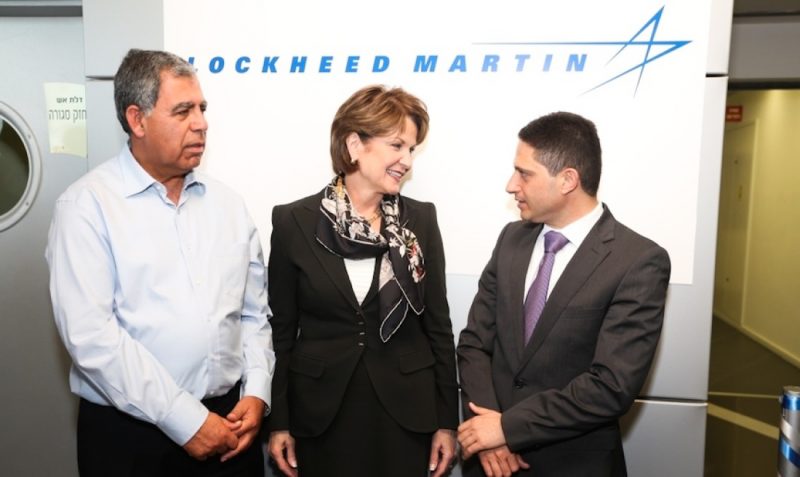
Marillyn Hewson, center, poses with Israeli gov. officials at the opening of Lockheed Martin’s facility in Beersheba. Photo | Diego Mittleberg
Haden Land, then-vice president of research and technology for Lockheed Martin, told the Wall Street Journal that the creation of the subsidiary was largely aimed at securing contracts with the IDF and that the company’s Israel subsidiary would soon be seeking partnership and investments in pursuit of that end. Land oversaw the local roll-out of the company’s Israel subsidiary while concurrently meeting with Israeli government officials. According to the Journal, Land “oversees all of Lockheed Martin’s information-systems businesses, including defense and civilian commercial units” for the United States and elsewhere.
Just a few months later, Lockheed Martin partnered and invested in Cybereason, suggesting that Lockheed’s decision to do so was aimed at securing closer ties with the IDF. This further suggests that Cybereason still maintains close ties to Israeli military intelligence, a point expounded upon in great detail in the previous installment of this series.
Thus, it appears that not only does Lockheed Martin use Cybereason’s software on its own devices and on those it manages for its private and public sector clients, but it also decided to use the company’s software in this way out of a desire to more closely collaborate with the Israeli military in matters related to technology and cybersecurity.
The cozy ties between Lockheed Martin, one of the U.S. government’s largest private contractors, and the IDF set off alarm bells, then and now, for those concerned with U.S. national security. Such concern makes it important to look at the extent of Cybereason’s use by federal and military agencies in the United States through their contracting of Lockheed Martin’s Information Technology (IT) division. This is especially important considering Israeli military intelligence’s history of using espionage, blackmail and private tech companies against the U.S. government, as detailed here.
While the exact number of U.S. federal and military agencies using Cybereason’s software is unknown, it is widespread, with Lockheed Martin’s IT division as the conduit. Indeed, Lockheed Martin was the number one IT solutions provider to the U.S. federal government up until its IT division was spun off and merged with Leidos Holdings. As a consequence, Leidos is now the largest IT provider to the U.S. government and is also directly partnered with Cybereason in the same way Lockheed Martin was. Even after its IT division was spun off, Lockheed Martin continues to use Cybereason’s software in its cybersecurity work for the Pentagon and still maintains a stake in the company.
The Leidos-Lockheed Martin IT hybrid provides a litany of services to the U.S. military and U.S. intelligence. As investigative journalist Tim Shorrock noted for The Nation, the company does “everything from analyzing signals for the NSA to tracking down suspected enemy fighters for US Special Forces in the Middle East and Africa” and, following its merger with Lockheed and consequential partnership with Cybereason, became “the largest of five corporations that together employ nearly 80 percent of the private-sector employees contracted to work for US spy and surveillance agencies.” Shorrock also notes that these private-sector contractors now dominate the mammoth U.S. surveillance apparatus, many of them working for Leidos and — by extension — using Cybereason’s software.
Leidos’ exclusive use of Cybereason software for cybersecurity is also relevant for the U.S. military since Leidos runs a number of sensitive systems for the Pentagon, including its recently inked contract to manage the entire military telecommunications infrastructure for Defense Information Systems Agency (DISA). In addition to maintaining the military telecom network, Cybereason is also directly partnered with World Wide Technologies (WWT) as of this past October. WWT manages cybersecurity for the U.S. Army, maintains DISA’s firewalls and data storage as well as the U.S. Air Force’s biometric identification system. WWT also manages contracts for NASA, itself a frequent target of Israeli government espionage, and the U.S. Navy. WWT’s partnership is similar to the Lockheed/Leidos partnership in that Cybereason’s software is now completely integrated into its portfolio, giving the company full access to the devices on all of these highly classified networks.
Many of these new partnerships with Cybereason, including its partnership with WWT, followed claims made by members of Israel’s Unit 8200 in 2017 that the popular antivirus software of Kaspersky Labs contained a backdoor for Russian intelligence, thereby compromising U.S. systems. The Wall Street Journal was the first to report on the alleged backdoor but did not mention the involvement of Unit 8200 in identifying it, a fact revealed by the New York Times a week later.
Notably, none of the evidence Unit 8200 used to blame Kaspersky has been made public and Kaspersky noted that it was actually Israeli hackers that had been discovered planting backdoors into its platform prior to the accusation levied against Kaspersky by Unit 8200. As the New York Times noted:
Investigators later discovered that the Israeli hackers had implanted multiple back doors into Kaspersky’s systems, employing sophisticated tools to steal passwords, take screenshots, and vacuum up emails and documents.”
Unit 8200’s claims ultimately led the U.S. government to abandon Kaspersky’s products entirely in 2018, allowing companies like Cybereason (with its own close ties to Unit 8200) to fill the void. Indeed, the very agencies that banned Kaspersky now use cybersecurity software that employs Cybereason’s EDR system. No flags have been raised about Cybereason’s own collaboration with the very foreign intelligence service that first pointed the finger at Kaspersky and that previously sold software with backdoors to sensitive U.S. facilities.
SoftBank, Cybereason and the Vision Fund
While its entry into the U.S. market and U.S. government networks is substantial, Cybereason’s software is also run throughout the world on a massive scale through partnerships that have seen it enter into Latin American and European markets in major ways in just the last few months. It has also seen its software become prominent in Asia following a partnership with the company Trustwave. Much of this rapid expansion followed a major injection of cash courtesy of one of the company’s biggest clients and now its largest investor, Japan’s SoftBank.
SoftBank first invested in Cybereason in 2015, the same year Lockheed Martin initially invested and partnered with the firm. It was also the year that SoftBank announced its intention to invest in Israeli tech start-ups. SoftBank first injected $50 million into Cybereason, followed by an additional $100 million in 2017 and $200 million last August. SoftBank’s investments account for most of the money raised by the company since it was founded in 2012 ($350 million out of $400 million total).

Cybereason CEO Lior Div speaks at a SoftBank event in Japan, July 21, 2017. Photo | Cybereason
Prior to investing, Softbank was a client of Cybereason, which Ken Miyauchi, president of SoftBank, noted when making the following statement after Softbank’s initial investment in Cybereason:
SoftBank works to obtain cutting edge technology and outstanding business models to lead the Information Revolution. Our deployment of the Cybereason platform internally gave us firsthand knowledge of the value it provides, and led to our decision to invest. I’m confident Cybereason and SoftBank’s new product offering will bring a new level of security to Japanese organizations.”
SoftBank — one of Japan’s largest telecommunications companies — not only began to deploy Cybereason internally but directly partnered with it after investing, much like Lockheed Martin had done around the same time. This partnership resulted in SoftBank and Cybereason creating a joint venture in Japan and Cybereason creating partnerships with other tech companies acquired by SoftBank, including the U.K.’s Arm, which specializes in making chips and management platforms for Internet of Things (IoT) devices.
SoftBank’s interest in Cybereason is significant, particularly in light of Cybereason’s interest in the 2020 U.S. election, given that SoftBank has significant ties to key allies of President Trump and even the president himself.
Indeed, SoftBank’s Masayoshi Son was among the first wave of international business leaders who sought to woo then-president-elect Trump soon after the 2016 election. Son first visited Trump Tower in December 2016 and announced, with Trump by his side in the building’s lobby, that SoftBank would invest $50 billion in the U.S. and create 50,000 jobs. Trump subsequently claimed on Twitter that Son had only decided to make this investment because Trump had won the election.
Son told reporters at the time that the investment would come from a $100 billion fund that would be created in partnership with Saudi Arabia’s sovereign wealth fund as well as other investors. “I just came to celebrate his new job. I said, ‘This is great. The US will become great again,’” Son said, according to reports.
Then, in March of 2017, Son sent top SoftBank executives to meet with senior members of Trump’s economic team and, according to the New York Times, “the SoftBank executives said that because of a lack of advanced digital investments, the competitiveness of the United States economy was at risk. And the executives made the case, quite strongly, that Mr. Son was committed to playing a major role in addressing this issue through a spate of job-creating investments.” Many of SoftBank’s investments and acquisitions in the U.S. since then have focused mainly on artificial intelligence and technology with military applications, such as “killer robot” firm Boston Dynamics, suggesting Son’s interest lies more in dominating futuristic military-industrial technologies than creating jobs for the average American.
After their initial meeting, Trump and Son met again a year later in June 2018, with Trump stating that “His [Son’s] $50 billion turned out to be $72 billion so far, he’s not finished yet.” Several media reports have claimed that Son’s moves since Trump’s election have sought to “curry favor” with the President.
Through the creation of this fund alongside the Saudis, SoftBank has since become increasingly intertwined with Saudi Crown Prince Muhammad bin Salman (MBS), a key ally of President Trump in the Middle East known for his authoritarian crackdowns on Saudi elites and dissidents alike. The ties between Saudi Arabia and SoftBank became ever tighter when MBS took the reins in the oil kingdom and after SoftBank announced the launch of the Vision Fund in 2016. SoftBank’s Vision Fund is a vehicle for investing in hi-tech companies and start-ups and its largest shareholder is the Public Investment Fund of Saudi Arabia. Notably, Son decided to launch the Vision Fund in Riyadh during President Trump’s first official visit to the Gulf Kingdom.
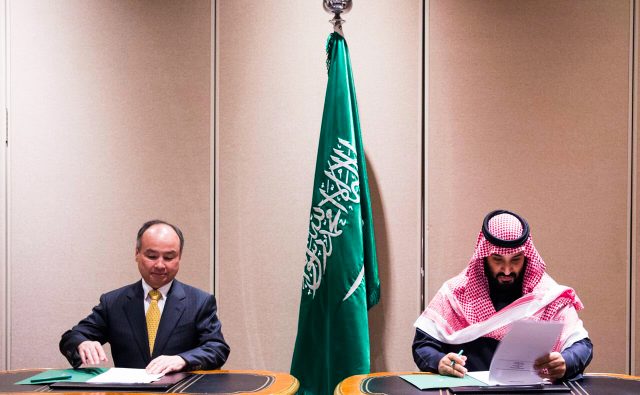
Masayoshi Son, left, signs a deal related to the Vision Fund with Bin Salman in March 2018. Photo | SPA
In addition, the Mubadala Investment Company, a government fund of the United Arab Emirates (UAE), gave $15 billion to the Vision Fund. UAE leadership also share close ties to the Trump administration and MBS in Saudi Arabia.
As a consequence, SoftBank’s Vision Fund is majority funded by two Middle Eastern authoritarian governments with close ties to the U.S. government, specifically the Trump administration. In addition, both countries have enjoyed the rapid growth and normalization of ties with the state of Israel in recent years, particularly following the rise of current Saudi Crown Prince Muhammad bin Salman and Jared Kushner’s rise to prominence in his father-in-law’s administration. Other investments in the Vision Fund have come from Apple, Qualcomm and Oracle’s Larry Ellison, all tech companies with strong ties to Israel’s government.
The Saudi and Emirati governments’ links to the Vision Fund are so obvious that even mainstream outlets like the New York Times have described them as a “front for Saudi Arabia and perhaps other countries in the Middle East.”
SoftBank also enjoys close ties to Jared Kushner, with Fortress Investment Group lending $57 million to Kushner Companies in October 2017 while it was under contract to be acquired by SoftBank. As Barron’s noted at the time:
When SoftBank Group bought Fortress Investment Group last year, the Japanese company was buying access to a corps of seasoned investors. What SoftBank also got is a financial tie to the family of President Donald Trump’s senior advisor and son-in-law, Jared Kushner.”
According to The Real Deal, Kushner Companies obtained the financing from Fortress only after its attempts to obtain funding through the EB-5 visa program for a specific real estate venture were abandoned after the U.S. Attorney and the Securities and Exchange Commission began to investigate how Kushner Companies used the EB-5 investor visa program. A key factor in the opening of that investigation was Kushner Companies’ representatives touting Jared Kushner’s position at the White House when talking to prospective investors and lenders.
SoftBank also recently came to the aid of a friend of Jared Kushner, former CEO of WeWork Adam Neumann. Neumann made shocking claims about his ties to both Kushner and Saudi Arabia’s MBS, even asserting that he had worked with both in creating Kushner’s long-awaited and controversial Middle East “peace plan” and claimed that he, Kushner and MBS would together “save the world.” Neumann previously called Kushner his “mentor.” MBS has also discussed on several occasions his close ties with Kushner and U.S. media reports have noted the frequent correspondence between the two “princelings.”
Notably, SoftBank invested in Neumann’s WeWork using money from the Saudi-dominated Vision Fund and later went on to essentially bail the company out after its IPO collapse and Neumann was pushed out. SoftBank’s founder, Masayoshi Son, had an odd yet very close relationship with Neumann, perhaps explaining why Neumann was allowed to walk with $1.7 billion after bringing WeWork to the brink of collapse. Notably, nearly half of SoftBank’s approximately $47 billion investments in the U.S. economy since Trump’s election, went to acquiring and then bailing out WeWork. It is unlikely that such a disastrous investment resulted in the level of job creation that Son had promised Trump in 2016.
Given that it is Cybereason’s top investor and shareholder by a large margin, SoftBank’s ties to the Trump administration and key allies of that administration are significant in light of Cybereason’s odd interest in 2020 U.S. election scenarios that end with the cancellation of this year’s upcoming presidential election. It goes without saying that the cancellation of the election would mean a continuation of the Trump administration until new elections would take place.
Furthermore, with Cybereason’s close and enduring ties to Israeli military intelligence now well-documented, it is worth asking if Israeli military intelligence would consider intervening in 2020 if the still-to-be-decided Democratic contender was strongly opposed to Israeli government policy, particularly Israel’s military occupation of Palestine. This is especially worth considering given revelations that sexual blackmailer and pedophile Jeffrey Epstein, who targeted prominent U.S. politicians, mostly Democrats, was in the employ of Israeli military intelligence.
Notably, Cybereason’s doomsday election scenarios involved the weaponization of deep fakes, self-driving cars and the hacking Internet of Things devices, with all of those technologies being pioneered and perfected — not by Russia, China or Iran — but by companies directly tied to Israeli intelligence, much like Cybereason itself. These companies, their technology and Cybereason’s own work creating the narrative that U.S. rival states seek to undermine the U.S. election in this way, will all be discussed in the conclusion of MintPress’ series on Cybereason and its outsized interest in the U.S. democratic process.
Whitney Webb is a MintPress News journalist based in Chile. She has contributed to several independent media outlets including Global Research, EcoWatch, the Ron Paul Institute and 21st Century Wire, among others. She has made several radio and television appearances and is the 2019 winner of the Serena Shim Award for Uncompromised Integrity in Journalism.
U.S. Media Says Russia the True Winner in Hostilities Against Iran
By Paul Antonopoulos | January 13, 2020
While the final outcome of the U.S.-Iran conflict is not yet clear, US media outlets and think tanks are already claiming that Russian President Putin is the winner. The U.S.-Iran hostilities have undermined Washington’s confidence and reputation in the region, allowing Russian influence in the Middle East to increase as a force for peace and stability. While it is unclear exactly how Moscow can benefit from escalations between Washington and Tehran, U.S. media are convinced that any outcome will be consistent with the Kremlin’s plans to increase its political influence in the region and create a rift between Washington and its allies.
This simplistic explanation does not account the fact that Moscow has a clear foreign policy to achieve its geopolitical goals in the Middle East while Washington mostly depends on their own internal contradictions and events on the domestic political scene to guide their foreign policy. The assassination of Iranian General Soleimani, made on orders from Trump, questions whether this was to demonstrate his power and determination to protect U.S. national interests in the face of domestic criticisms, to serve Evangelical Christian interests on behalf of Israel, or part of a clear guided policy that the U.S. has for the Middle East.
The Democrats are trying to show the public that everything Trump does is contributing more to Russian interests rather than American. It appears that the Democratic Party will continue with the same rhetoric to try and win this year’s election.
Moscow maintains good relations with all countries in the Middle East region and there is no country with which Russia has an openly hostile relationship. Moscow successfully balances its relations between Saudi Arabia, Iran, Syria and Israel, while the U.S. attempts to divide the region into competing camps with no interest of defusing tensions, suggesting that even if Washington has a clearly defined Middle East policy, it is one based on division and destruction rather than one of balance and peace.
As a result of the assassination of General Soleimani, calls for U.S. troops to withdraw from Iraq under pressure from local authorities have been made. Without troops in Iraq, the Americans are incapable of retaining their positions in Syria, which increases Russia’s manoeuvring space, strengthens its positions, influence, and opens space for filling the political vacuum. The U.S. has become embroiled with so many Middle Eastern countries that it is now struggling to cope to withdraw. Washington has already tried to withdraw its troops from Iraq during the Obama era.
But it is one thing to militarily withdraw on your own will and based on your decision, and another to withdraw because you have been asked too. Although the U.S. criticizes Iranian influence across the region and claims the Islamic Republic is acting in an aggressive manner, the Trump administration has not even hid away from the fact its an occupying force by flatly refusing to withdraw from Iraq despite being told to by the country’s parliament.
However it was the assassination of Soleimani that the most ridiculous claims were being made about, with Bloomberg even suggesting that Putin needs a “Plan B” because the Iranian General’s death disrupted Russian plans for Syria, Iran and Turkey. This scenario implied that Trump’s aggressive actions would elicit an even more aggressive response from the Iranian side, eventually leading to an escalation of the conflict in which Tehran lacked adequate defense capabilities. This implies that Iran will lose the status of a regional power and Russia will have no choice but to betray Syria. This option quickly disappeared from the media space as reality completely denied this possibility.
As for Putin’s victory, many cite the fact that many European leaders are increasingly turning to Russia as a reliable partner in face of Trump’s unpredictability. It is fair to say that the U.S. strategy in the Middle East is a mystery even to U.S. allies. With Washington being unrelenting in attempting to maintain the unipolar world order, it has forced Europeans to cooperate with reliable Russia.
This is not the first time that Washington has made a problem for its allies, citing the example of the U.S. invasion of Iraq in 2003 when Germany and France, along with Russia, protested U.S. President George Bush and his actions. While Iraq was an example of typical aggression, the Americans did not lose allies because of this, nor did NATO disintegrate. However, domestic politics has always been a major focus for U.S. presidents, obviously, which in turn can influence foreign policy decisions for internal political use. In the case of killing an Iranian general and in the propaganda that Russia is the victor in the U.S.-Iran conflict, nothing new has happened.
Paul Antonopoulos is a Research Fellow at the Center for Syncretic Studies.
Western media coverage of Russia as an exercise in propaganda
By Gilbert Doctorow | January 12, 2020
The notion of “fake news” has entered our vocabulary as a pejorative term for dissemination of bogus information, usually by social media, sometimes by traditional print and electronic channels which happen to hold positions contradicting the tenets of our conventional wisdom, i.e., liberal democracy. The term has been applied to Russian state owned media such as RT to justify denying such outlets normal journalistic credentials and privileges.
In this essay, I will employ the more traditional term propaganda, which I take to mean the manipulation of information which may or may not be factually true in order to achieve objectives of denigrating rivals for influence and power in the world, and in particular for denigrating Russia and the “Putin regime.”
The working tools of such propaganda are
- tendentious determination of what constitutes news, which build on the inherent predisposition of journalism to feature the negative and omit the positive from daily reporting while they carry this predisposition to preposterous lengths
- the abandonment of journalism’s traditional “intermediation,” meaning provision of necessary context to make sense of the facts set out in the body of a news report. In this regard, the propagandistic journalist does not deliver the essential element of paid-for journalism which should distinguish it from free “fake news” on social media and on the internet more broadly
- silence, meaning under-reporting or zero reporting of inconvenient news which contradicts the conventional wisdom or might prompt the reader-viewer to think for himself or herself. As a colleague and comrade in arms, professor Steve Cohen of Princeton and NYU, has said in his latest book War with Russia? : the century old motto of The New York Times “All the news that’s fit to print” has in our day turned into “All the news that fits.”
Demonstrations of the arguments I present here could easily fill a book if not a library shelf. However, I think for purposes of this essay, it suffices to adduce several examples of the three violations of professional journalism giving us a constant stream of propaganda about Russia and its political leadership by offering a few reports drawn from the very cream of our print and electronic media. In particular, I have chosen as markers the Financial Times and the BBC. The use of propaganda methods in their coverage of Russia is all the more telling and damaging, given that in a great many domains these channels otherwise represent some of the highest quality standards to be found in reporting anywhere today and consequently enjoy the respect of their subscribers and visitors, who little suspect they could be so prejudicial in their coverage of select domains like Russia.
* * * *
As 2019 drew to a close, many of our media outlets drew attention to two Russia-related anniversaries: the just celebrated thirtieth anniversary of the fall of the Berlin Wall with the retreat of Soviet armed forces from Eastern Europe that it touched off; and the soon to be celebrated twentieth year of Vladimir Putin’s hold on power in the Kremlin. Both subjects may be fairly called news worthy and so fully correspond to traditional journalistic values. What has been exceptional and unacceptable has come in the second category of violations listed above – lack of context.
Starting in October 2019, the BBC’s Moscow correspondent Steve Rosenberg did several programs dedicated to the fall of the Berlin Wall. During the Christmas to New Year’s period, the BBC aired one program which consisted of two parts. In the first half, Rosenberg considered the impact of the withdrawal of Russian forces from East Germany on the Russians themselves and interviewed the former chief of those forces, who explained at length how they “came home” to shocking living conditions in the provinces, how they were abandoned to their fate by their own government. The tone of the reporting was sympathetic to Russians’ hardships and it was good that their side of the story from the ground up was given the microphone. What implied criticism there was of the powers that be came from a patriotic source. However, the second half of the program was turned over to a certain Lydia Shevtsova, a very outspoken Putin-hater, formerly with the Carnegie Center Moscow, till she was finally booted out and moved to a more congenial and supportive think tank, Chatham House, in London, where her anti-Russian vitriol is encouraged and disseminated by her co-author, ex-British ambassador to Moscow Sir Andrew Wood. Among the gem quotations which Shevtsova delivered was the claim that Russia under Putin is a declining power which is capable only of disrupting the world order, a spoiler not capable of any creative or productive contribution. Of course, Shevtsova has a right to her opinions, however the BBC had an obligation to its audience to explain exactly who the lady is and, if they wanted to practice fair play, to offer an alternative interpretation of what Vladimir Putin’s Russia stands for on the global stage today. They did not do either. The result was pure propaganda not news and analysis.
As for violations in the categories one and two above, a very good example arose following the recent publication of a study performed by the Levada Center public opinion polling organization in Moscow during October which showed that “53 per cent of 18-to-24 year-olds wanted to leave the country.” This was written about by many of our news peddlers, including FT. The decision to feature this factoid and use it to support claims that the Putin regime’ is a failure fits well with tendentiousness of our news coverage. Meanwhile, nearly all coverage of that study, including in the Financial Times, offered no contextual information whatsoever, when the context was begging to be told.
The article in FT which carried the Levada Center findings was published on 9 January as “Generation Putin: how young Russians view the only leader they’ve ever known.” The remarks on Levada followed directly on another statement begging for context: “Youth unemployment in Russia is more than three times the rate of the total population, according to 2018 data, compared with just twice the rate in 2000.”
First, as regards those 53% would-be “leavers,” one might ask: and so, why don’t they just leave? Russia today is truly a free country: anyone other than convicted felons who wants a passport can get it, and get it rather quickly. And thanks to the efforts of their remarkably hard-working Ministry of Foreign Affairs, most of the world welcomes Russian travelers without a visa requirement. But for that matter, getting a Schengen visa for the EU is not so complicated either.
However, those 53% are, in fact, not going anywhere. They are just sounding off about their youthful disgruntlement with a world created and run by their parents.
At the same time, as the Financial Times editorial board knows full well, young, middle-aged and even old have been leaving the Baltic States, Bulgaria, Romania and other former Soviet Bloc countries in droves, for the past thirty years up to the present day. That was the subject of an article published in the FT on the next day, 10 January 2020 under a title which speaks for itself: “Shrinking Europe.” The states I mentioned here have seen 25 and 30% loss of their population to citizens voting with their feet and departing the shrinking economies and personal prospects which result directly from deindustrialization and economic colonization by Germany and other founding Member States of the EU since 1991. The issue appears in the news now because, as the FT explains, “Andrej Plenkovic, the Croatian prime minister, has decided to elevate population decline to the top of his agenda as Zagreb assumes the EU’s rotating presidency.” Good for him! Now that the skeleton has finally come out of the EU closet, all the stories about Russia’s demographic crisis can be put in context – by those few who wish to do so.
Second, as regards unemployment in Russia today, I believe that similar ratios of youth unemployment to the general population unemployment can be found most everywhere in Western Europe if not in the world at large. The fact that this ratio has worsened comparatively in Russia since 2000 may be explained by the anomalous situation in Russia prevailing throughout the 1990s in step with the economic collapse that accompanied the transition to a market economy. Precisely the older generations, those over 40, were thrown into the street and their children or grandchildren were the first to be hired by the newly emerging industrial conglomerates, not to mention by Western multinationals settling in. What has happened since 2000 is merely a reversion to more normal distribution of employment and unemployment in the population as the Russian economy stabilizes.
Dear Reader!
For those who find my examples above too subtle to support my argument for egregious propagandistic treatment of Russia in our media, allow me to introduce violation number three, silence, in a way that should sweep away all objections to my thesis.
I draw your attention to an event that occurred in the past week about which you probably know nothing, or perhaps a wee bit from the odd man out reporting in the Wall Street Journal and a few other outlets. I am talking about the visit of Vladimir Putin to Damascus on Tuesday, 7 January. To their credit, the WSJ carried a short article in their 8 January edition, but went no further than to note this was the second visit by Putin since the Russians joined the fight in support of President Bashar Assad back in September 2015, turning the tide in the civil war his way. That is true, but only represents a tiny slice of what all our journalists, including the WSJ’s could have and possibly did learn from watching Russian state television on the 7th. What our media chose not to report was passed over in silence because it shows the complexity of Russia’s policy in the Middle East that includes but goes well outside the domain of pure geopolitics. This is so not least because of the date chosen for the visit, which happens to be Orthodox Christmas.
On the evening of the 6th, that is to say on Christmas eve, by the Russian Orthodox calendar, Russian state television broadcast live coverage of the Christmas service in the Christ the Savior cathedral in Moscow officiated by Patriarch Kirill, with prime minister Medvedev present on behalf of the Government. Then it cut to the service in St Petersburg, where Vladimir Putin sat in the congregation, as is his custom. The commentator mentioned in passing that the Patriarch’s father, a parish priest, just happened to be the one who baptized Vladimir Putin as a child where they all lived, in the Northern Capital.
The next coverage of Putin on state television was from Damascus on the 7th, where he obviously arrived on a night flight from Petersburg. I did not see video coverage [video coverage has now been posted] … But still photos and reports on state television informed us that Putin had not merely held talks with President Assad on the Russian military base outside the capital, but had strolled together with him down the streets of Damascus, had visited the main church in the (still existing) Christian quarter of the city, had presented to the Patriarch of Antioch an icon of the Virgin and had also gone on to visit the city’s oldest and largest mosque.
What you have here is precisely the second line of justification for Russian presence in Syria alongside military/geopolitical reasons: resuming Russia’s 19th century role as protector of the Orthodox population in the Holy Land and the broader Middle East. A similar role was exercised back then by France on behalf of the Catholic populations, but that since has been totally negated by rampant secularism and multiculturalism in Western Europe.
It also has to be said that Putin’s visit to Damascus was back-to-back with other very high visibility political statements: his visit to Istanbul on the 8th for the official opening of the TurkSteam gas pipeline and for lengthy talks with President Erdogan that ended in a joint statement calling for a truce in the Libyan civil war for which Russia and Turkey support opposing sides; and his visit on the 9th to Russian naval exercises in the Eastern Mediterranean that included the launch of Russia’s latest hypersonic missiles, the reality of which U.S. and other Western experts have yet to acknowledge.
With this I rest my case on the unfortunate propagandistic behavior of our media which deprive the broad Western public of any chance to make sense of the most dangerous military and political stand-off of our age.
©Gilbert Doctorow, 2020
US establishment preemptively blames Russia for Biden’s election flop, setting the stage for a crackdown on dissent
By Helen Buyniski | RT | January 10, 2020
The American political establishment is already lining up excuses for losing the 2020 election, blaming a Russian “disinfo” campaign –again!– for the flailing campaign of Democratic frontrunner Joe Biden.
As Biden, once the solid favorite in Democrat primary polls, continues to tank, the usual suspects are emerging to pin his fall from grace on the Kremlin, and not Biden’s own mouth, problematic family members, or uninspiring policies.
The former vice president’s once-certain status as the establishment favorite for the nomination has faded, with even CNN taking shots at him recently after he lied about his early and enthusiastic support for the Iraq war. Institutional Russophobes would have voters believe their growing disillusionment with the moderate centrist was implanted by Kremlin propaganda, however.
“US intelligence and law enforcement officials” are already probing whether Biden is the target of a Russian “disinformation” campaign, according to two anonymous officials who spoke to Bloomberg on Friday.
Putting aside the insult implicit in telling voters who dislike Biden that their opinions are not their own, the claim – unsupported by evidence in the manner of most ‘Russian meddling’ allegations – suggests that Democrats are already bracing for the loss of the 2020 election and rushing to get the narrative scaffolding in place to explain away a second Trump victory.
Even after the “Russia hacked the 2016 election” narrative fell apart with the ignominious “no further indictments” conclusion of Special Counsel Robert Mueller’s investigation, boomeranging into an Inspector General inquiry and a criminal probe of the FBI malfeasance that kicked off the whole affair, the American political elite don’t seem to be able to resist the temptation to blame Russia yet again.
Bloomberg’s breathless report blames Russia for promoting Biden’s own Ukrainian scandal while Trump was being impeached over allegedly withholding military aid to pressure Kiev into restarting a probe of the natural gas firm where Biden’s son was a director. The case against Trump was shaky from the start, and only Democrats’ white-hot hatred for the president pushed it to the level of an impeachable offense.
Yet the much more solid quid-pro-quo case against Biden – who publicly bragged about bullying Ukraine into firing its chief prosecutor by withholding $1 billion in IMF loan guarantees – went largely ignored in the US media, except for conservative outlets. This is hardly “disinformation,” unless Bloomberg is using the Newspeak definition floated in a recent academic paper that includes “truths arranged to serve a particular purpose.”
It is simply assumed Russia would want Trump to be president for four more years, even though he scrapped arms treaties and piled more sanctions on the country, and nearly led the US into a catastrophic war with Iran. Nevertheless, former FBI agent Clint Watts – one of the minds behind the notorious Hamilton 68 “Russian bot” dashboard – nevertheless insists “a second term of Trump would be great” for Moscow. National Counterintelligence and Security Center director William Evanina warns Russian “influence campaigns” will only grow, commandeering “new vectors of disinformation” to hoodwink the American public.
Biden has repeatedly bragged “Vladimir Putin doesn’t want me to be president,” accusing the Russian president of sending an “army of bots” after him. Like Hillary Clinton before him, Biden has focused more on demonizing Trump than touting his own record, possibly because his service in an administration that turned two wars into seven, left Libya a failed state, and allowed a huge amount of wealth to “trickle up” from the working class to the rich diverges wildly from even the tepidly pro-middle class, pro-peace positions outlined on his campaign website.
Even when he’s not making what the media has decided to politely call “gaffes,” bursting blood vessels in his eye on live TV, or sniffing little girls’ hair, Biden offers little more than reheated Obama-era policies without Barack Obama’s smooth stage presence. Evidence shows it is the Democratic Party’s insistence on embracing middle-of-the-road candidates ideologically indistinguishable from most Republicans – not “Russian disinformation” – that is hurting them at the polls.
Pinning Biden’s failure on Russia, however, has repercussions that reach much further than just a single candidate’s campaign, or a single election. With the first primaries rapidly approaching, intelligence agencies are pushing the “election meddling” story hard, hoping to make lemonade out of the lemon that a second Trump victory would be.
Not only Russia, but China and Iran will “seek to interfere in the voting process or influence voter perceptions,” a joint statement from seven agencies in November warned. Literally anything could be construed as “influencing voter perceptions,” and that’s the point: to retroactively paint perfectly innocent reporting as agitprop. This paves the way for a major crackdown on alt-media and other forms of dissent – one that has arguably already begun.
How much difference do Russia’s new nuclear weapons really make?
By Padraig McGrath | January 10, 2020
Are Russia’s Avangard and Sarmat missiles really the game-changers which they’re depicted to be?
Readers may recall President Putin’s unveiling of these weapons systems on May 1st 2018. His state of the union address to the federal assembly that day could certainly be described as provocative, perhaps inadvisably so. Ever since then, both Russian and western media have discussed at length the numerous reasons why these ICBM’s render all currently existent missile-defence systems obsolete.
First and foremost, these weapons are seen as invulnerable to all currently existent missile defence systems because of their hypersonic capabilities. Avangard can fly at about 33 thousand kilometres per hour, or 27 times the speed of sound. The RS-28 Sarmat can fly in excess of 25 thousand kilometres per hour.
Missile defence systems, fundamentally, work on the basis of the premise that if an interceptor missile can detonate its own nuclear warhead within a 10-kilometre radius of the flight-path of the missile which it is attempting to intercept, then the resulting shock-wave stands a pretty good chance of bringing the target down or otherwise knocking it out of its flight-path. So, in practical terms, “intercepting” a nuclear missile means getting an interceptor to within a 10-kilometre radius of its flight-path.
However, under actual battle-conditions, the chances of intercepting ICBM’s in this way would not be particularly good to start with. Therefore, a more effective missile defence methodology is simply to “intercept” them during their boost phases – that is to say, before they launch. Hit them before they leave the ground.
Both the Avangard and the Sarmat fly far, far too fast for aerial interception to be plausible.
Furthermore, both the Avangard and the Sarmat can be re-maneuvered in mid-flight, making it extremely difficult for missile defence systems to predict their trajectories. In the case of Sarmat, an added problem for currently existent missile defence systems is that it has an extremely short boost phase, making it difficult for spy-satellites to identify the imminent threat in time, and also making it more difficult to track once it has launched.
However, there is one solid counter-argument to the idea that, strategically, these new weapons-systems change everything.
Namely, Russia already had hypersonic ICBM capability 15 years ago. The Topol-M SS27 was and is hypersonic, capable of flying at about 14 thousand kilometres per hour. It’s not quite as fast as the Sarmat or Avangard, but it’s still far too fast for any interceptor to have a realistic chance to getting within the required 10-kilometre radius of its flight-path. Furthermore, the Topol-M SS27 could be re-maneuvered in mid-flight, just as Sarmat and Avangard can, and it releases a multiplicity of different warheads, each with a different trajectory, once it nears its target. Furthermore, the Topol-M SS27 could be launched from the back of a truck, making it almost impossible to pre-empt during its boost-phase.
In short, all of NATO’s currently existent missile defence infrastructure was already obsolete 15 years ago.
Scott Ritter is a former US intelligence officer and weapons inspector who participated in formal inspections-teams at the Votkinsk Machine-Building Plant, where the SS-27 and its predecessor the SS-25 were assembled. In January 2005, he argued that “to counter the SS-27 threat, the US will need to start from scratch… The US cannot afford to spend billions of dollars on a missile-defense system that will never achieve the level of defense envisioned. The Bush administration’s embrace of technology, and rejection of diplomacy, when it comes to arms control, has failed.”
Neither the Bush administration nor the Obama administration ever did start from scratch. They simply pressed ahead with the installation and deployment of missile defence systems which they knew were already obsolete. The Trump administration adheres to the same obtuse path.
The desire to protect the interests of the US corporations which contract for the Aegis missile defence project is only one of the motivations which drives this policy. In addition, the presence of Aegis missile defence installations in Poland and Romania economically incentivizes local elites within those countries to propagandize their own populations, to amplify fears of the Russian bear at the local level, thereby cementing ideological loyalty within the NATO defence-apparatus.
Furthermore, it should be noted that it has never been possible to test any missile defence system under anything even realistically simulating actual battle-conditions. Missile defence systems are tested one shot at a time, which is completely unrealistic. Under actual battle-conditions, they would be required to intercept several dozen ICBM’s in simultaneous flight, and there is absolutely no evidence whatsoever that more than a fraction of the ICBM’s would be successfully intercepted.
Therefore, we can say that the primary strategic purpose of a missile defence installation, as opposed to its economic purpose or ideological purpose, is simply to serve as a pretext for its adjoining radar-installation. Parked so close to Russia’s borders, these installations are elaborate pretexts for electronic espionage or signals-intelligence (SIGINT).
However, the Russian government is playing the same game – both sides have their own reasons for pretending that Sarmat and Avangard are “game-changers,” when in fact we know that the Topol-M SS27 was the real game-changer. While the nations within the western alliance maintain this pretense in order to justify increasingly gargantuan defence-budgets and to propagandize their own populations with Russophobic hysteria, the government of the Russian Federation does so in order to persuade Russia’s population that perpetual geo-strategic threats are being addressed. As with much content published in Russia’s media-space, the disproportionate focus on geo-strategy, external relations and external security issues occurs because these are the spheres in which the Russian government is at its most professionally competent. This disproportionate media-focus, therefore, is devised in order to detract attention from domestic issues wherein the government’s record of effective policy-implementation has not been quite so successful.
21st Century Wire YEAR IN REVIEW: 2019 Top Ten (Real) Conspiracies
21st Century Wire
It’s New Year’s Eve again, which means it’s time for our annual wrap-up, looking at some of the most important and unusual, and dare we say conspiratorial events of 2019. This past year was built on the back of a highly polarizing 2018, which saw the post-World War II world order coming apart at the seams, and the 20th century religions of neoliberalism and globalization being relegated to the ideological depths in the face of an evolving nationalist and mercantilist Anglo-American-dominated transatlantic order. Following on from 2018, this year saw the collapse of the seemingly sacrosanct ‘official conspiracy theory’ narratives of improbable ‘chemical attacks’ like Skripal in the UK, and Douma in Syria, both of which had profound geopolitical ramifications at the time. These are just a few stories which helped to shape the zeitgeist this past year. If 2019 taught us anything, it’s that conspiracies are real…
There were a number of honorable mentions this past year which would have normally been good enough to break into the top ten in previous years, but not this time…
Honorable Mentioned Highlights – One event which would’ve normally made it into the top ten, but didn’t, was President Trump’s grand decree in October that he would be “pulling US troops out of Syria” – only this was the third time he made such an announcement in the past 24 months, and just like the previous ones, this one was another bait and switch. To compensate for leaving US forces to illegally occupy Syria’s own oil fields, Trump was able to ‘close the file’ on alleged ISIS leader Abu Bakar Al-Baghdadi. We’re told that the illusive Caliph was supposedly chased-down, “whimpering and crying,” by a US military German Shepherd in a dead-end underground tunnel in Idlib. Of course, we’ll never know what actually happened because the US military proceeded to level the compound with an airstrike, thus destroying any evidence. Other official conspiracy theories of note included the untimely death of British mercenary entrepreneur, James Le Mesurier, who was founder of the controversial White Helmets ‘search and rescue’ group. After his death, ruled a likely suicide under the influence of medication (falling from his balcony while his wife was sleeping in the adjacent room) by Istanbul police, Le Mesurier’s defenders in mainstream media and intelligence agencies began blaming his death on members of public, journalists and academics who had either questioned or criticized Le Mesurier and the nature of US and UK-backed White Helmets operations alongside listed terrorist organizations in Syria. On a related geopolitical front, Iran featured heavily in what some dubbed as the Tanker Wars in 2019, which included a series of unidentified attacks on western and Gulf flagged oil tankers traveling in the Persian Gulf. Naturally, these were blamed on Iran by the US, and were followed by the British military hijacking and seizing an Iranian tanker off Gibraltar and preventing it from delivering fuel to the sanctions-hit economy of Syria. It seemed the West was testing various mechanisms to trigger a war with Iran, maybe hoping for an irrational response which never came. The US also baited the Iranians by flying in its airspace with their $150 million Globalhawk drone, which Iran shot down with their $12,000 anti-aircraft unit. Tensions remain high. 2018’s “Antisemitism in the Labour Party” canard was ramped-up and weaponized in 2019 to form part of an all-out establishment propaganda effort to reduce electoral support for Britain’s Labour Party in the run-up to the General Election. Sadly, it worked, but the political assassination of Jeremy Corbyn will go down in history as one of the darkest political acts ever, perpetrated by a shrewd coalition that included the Israeli Lobby, the Conservative Party, the Tony Blair wing of the Labour Party, and the mainstream media. Other honorable mentions for 2019 may include Brussels moving ever-closer to finalizing its new “EU Army”, aka EU Defense Union, something which Tories happily avoided talking about before the last election, possibly because they have quietly committed to opt-in to the new defense arrangement – even if there’s a Brexit. In Asia, the western press began ramping-up the human rights rhetoric in order to condemn China for its treatment of Muslim ethnic minority Uyghurs in the western Chinese province of Xinjiang, claiming China has interned millions of Uyghurs in cruel concentration camps. But the US seems to be taking a leaf from China’s authoritarian book, as Silicon Valley’s Kafkaesque political censorship and de-platforming program reach new highs in 2019, and looks set to continue in 2020 with the US elections. Twitter was also exposed as employing Saudi spies to dig up dirt on critics of the regime, as well as British spooks from Brigade 77 information warfare unit embedded at the tech firm too. Late in the year, the US also saw a bizarre mass shooting by a ‘rogue’ Saudi pilot training at the US base there, which was quietly swept under the rug by US officials. Around the same time, we saw yet another alleged ‘ISIS inspired’ terror attack on London Bridge – a quintessential Daily Shooter event if there ever was one, featuring another known wolf, on the radar of intelligence, wearing a tag, and even attending a ‘prisoner reform’ conference next door. Unfortunately the perp won’t be interrogated because he was executed on the city pavement before anyone could get to the bottom of what happened, and more importantly, why. Shades of Jean Charles de Menezes, and so many others by now.
One important thing to consider about 2019 is the slow motion break-down of all the western establishment’s official Russian conspiracy theories, all of which have featured so heavily in American and European politics since 2014. In other words, this worn-out framework has all but collapsed, but that won’t stop the usual media maven and political opportunists from still flogging that old horse.
With that in mind, here are some of the absolute blockbuster top real conspiracies of 2018…

10. Hong Kong’s ‘Democracy’ Protests – Hong Kong ends 2019 with more ‘democracy’ protests, supposedly disrupting normal festivities and shopping in China’s unique financial hub. Both US Democrats and Republicans gushed over protest leader Joshua Wong, flying him to Washington for photo-ops with Nancy Pelosi and Marco Rubio. However, it soon became known that the US government was actually directing and funding this supposed ‘grass roots uprising’ in China’s troubled territory. The US mainstream media then spun a propaganda campaign to try and paint the Chinese police in Hong Kong as ‘brutal’ and ‘repressive’, when in fact they were the opposite. Then evidence began to emerge showing extreme violence being used by the US-backed protest mobs, where Wong’s masked foot soldiers could be seen beating innocent passers-by, and even attacking elderly residents as well. ‘Pro-Democracy’ violence featured one particularly grisly attempted murder of multiple Hong Kong residents, including State Department-backed ‘freedom demonstrators’ who set a man on fire, attempting to burn him alive on the street. This push to demonize China can be viewed as part of the new US focus to disrupt and damage China’s reputation internationally as it attempts to forge ahead with its world-beating Belt and Road Initiative. Of course, the US is not taking China’s ascendancy lying down, but by the same token, fielding street thugs on the streets of Hong Kong may not net any long-term dividends, other than anger China and re-polarize the Pacific Rim. Maybe, that’s the plan.
9. Reconquista: Washington’s Take-down of South America – In 2019, Washington began turning back the clock to CIA’s golden years of the 1950s, 60s, and 70s, where democratically Latin American governments were toppled one by one, and replaced by US-installed fascists and military juntas. The year started off with a bang, as the US State Department and its various operatives, over the span of three months, attempted no less than three failed coups in Venezuela. They even wheeled-out Jurassic neocon Elliot Abrams from the basement of Foggy Bottom to see if he had any of his 1980’s dark clandestine magic left in him. But the public support of the government of Nicholas Maduro was much stronger than the policy maven and spooks in Washington had anticipated. Comically, Neocons even went so far as to appoint their own President for Venezuela, a marionette named Juan Guaidó, which half of Venezuela hadn’t even heard of. A year on, the entire escapade has become a joke. Not surprisingly, a humiliated Trump Administration has quietly backed off of Venezuela, opting instead to continue sanctioning its economy, shorting its currency, stealing its foreign assets – all in all, punishing its citizens for rejecting a hostile US takeover. But Washington had better luck in Bolivia where a US-backed ultra rightwing fascist column was used in violent street protests demanding the removal of democratically elected President Evo Morales. To pull off the final move, the US had effectively bought off the country’s military and police forces who were used to depose Evo – in classic 1960’s CIA style. Evo was forced to flee his own country to Mexico, as US-backed mobs ransacked his home, and began hunting down and intimidating his political allies. That’s freedom and democracy, American style.
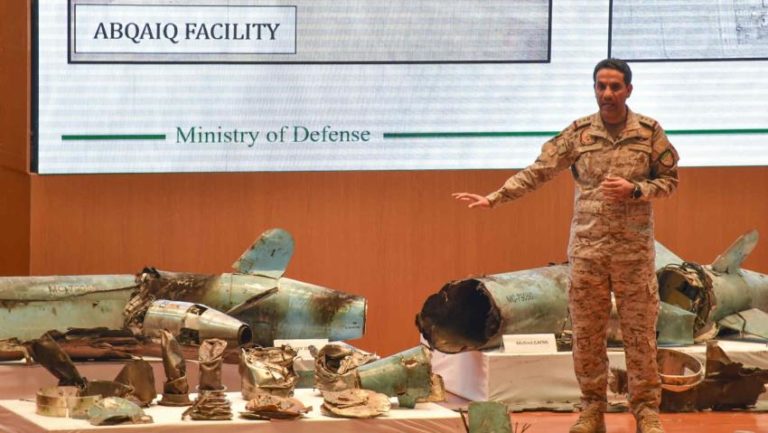
8. Yemeni Drones & Saudi Aramco – In September, an incredible underdog event took place. After nearly five years of a relentless war being waged against Yemen by its neighbor Saudi Arabia along with accomplices the United States, UK and the UAE – Yemen struck back, with its Houthi Resistance fighters launching a makeshift drone attack hitting two major Saudi Aramco oil installations across the border. Even though the Houthi Rebels immediately claimed responsibility for the assault on Abqaiq, the world’s largest oil processing plant, US Secretary of State Mike Pompeo immediately rejected the claim, and instead the US and Saudi invented a new official conspiracy theory which blamed Iran, accusing the regional rival of having “now launched an unprecedented attack on the world’s energy supply.” Saudi put on an legendary TV press performance to show the world the ‘evidence’ it had of drone fragments, supposedly implicating Iran. They hoped this could raise tensions enough to justify military action against Iran. “There is no evidence the attacks came from Yemen,” said Pompeo on Twitter. In the end, this intricate conspiracy theory spun by Washington simply fizzled out due to a lack of evidence to support their tenuous claim. As with its embarrassing failure in Venezuela, Washington just backed off quietly, and hoped no one would talk about it any more. What this incident really showed was that under-equipped, under-funded, and fully embargoed Yemen – could deliver a fatal blow inside of Saudi Arabia, and influence world energy markets by doing so. Make no mistake about it: Saudi and the US have been put on notice in Yemen.
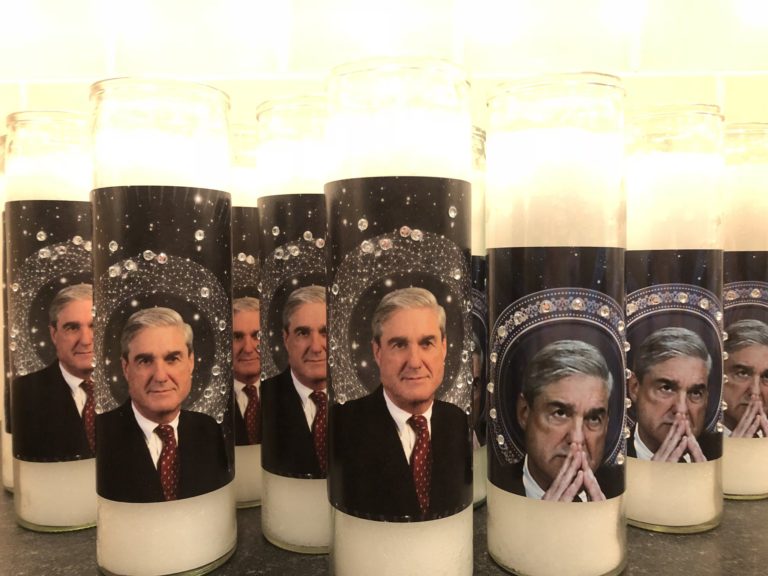
7. Mueller and the Collapse of RussiaGate – Remember the official conspiracy theory pushed by the US establishment – that Russia somehow intervened in the 2016 US Presidential Election on behalf of Donald Trump, thus catapulting him into the White House? This past spring, the hysteria and excitement reached such a fever pitch, that Robert Mueller was canonized as the new patron saint of the Resistance movement. But it was a house of cards. Well after three long and torturous years, in an big top circus featuring 40 FBI agents, intelligence analysts, forensic accountants and staff assigned to investigate, more than 2,800 subpoenas issued by the Special Counsel Mueller’s office, some 500 search warrants executed, more than 230 orders for communication records, 50 authorized orders (lets the government know who someone is communicating with and when, but not what they said), 13 evidence requests to foreign governments, 500 witnesses interviewed, well over $30 million taxpayer costs… the much-anticipated Mueller Report and investigation found no evidence that Trump had conspired with Russia. No collusion, and no election ‘interference’ by Russia. Nothing. RussiaGate R.I.P.
It should go down in history as one of the biggest phony official conspiracy theories of all-time. During his own testimony, the vaunted former FBI director Mueller came off as an incompetent old crank. The entire affair was a disaster for Democrats and their loyal mainstream media networks, all of whom had relentlessly hyped this conspiracy for years. In the end, this epic dud can only help Trump in his 2020 re-election bid. Let that sink in for a minute…
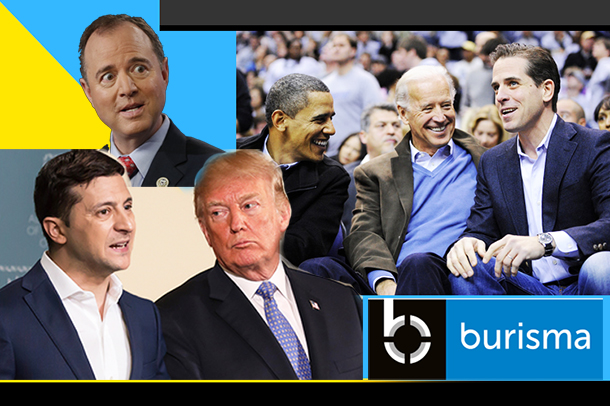
6. UkraineGate and Trump’s Impeachment – Alas, the death of RussiaGate gave way to a brand new gate… UkraineGate, and with it came that impeachment hammer which Democrats had been promising from before Trump was even sworn in office. Suddenly, Trump was facing the most perilous threat to a tenure of POTUS since Bill Clinton, Richard Nixon and Andrew Johnson before that – all because of a telephone call on July 25th (the day after Robert Mueller tanked with his disastrous congressional testimony) with Ukraine’s newly elected president, Volodymyr Zelenksy. According to House Democrats, during the call, Trump threatened Zelensky with withholding a free donation of US weapons to Ukraine unless the Ukrainian president re-opened a corruption investigation into 2016 US election meddling under the previous President Poroshenko, and more importantly the activities former vice-president Joe Biden and his son Hunter Biden. According to lead inquisitor Adam Schiff (CA-D), someone told someone about the call, who then told a “whistleblower” (a CIA analyst and friend of Obama and the Bidens) about it, who then then filed a complaint. In the end, Ukraine got its free stash of US missiles as ordered, but Democrats claimed Trump abused his power by asking for a “Quid Pro Quo” that somehow placed the national security of the US in grave danger, and that Trump tried to railroad a political opponent (Joe Biden is supposedly the DNC’s pre-determined selection for presidential nominee) by asking a foreign power to investigate him and his son, all of which they say rises to the level of “high crimes” by Trump. When asked, even Zelensky said there was no quid pro quo. This hardly mattered, as the verdict was already written before the hearings. Another grand official conspiracy theory cooked up by the establishment? Seems so. So shaky are Democrats about their case, that House leader Nancy Pelosi has failed to send her Articles of Impeachment before Christmas to the US Senate for the next step which is an Impeachment trial. This kicks the whole affair into the new year, and with poll numbers steadily rising against Democrat’s impeachment misadventure, it does not look good at all for Democrats heading into the 2020 election.
5. Greta – On paper, it sounded like the stuff of Hollywood: a 15-year-old Swedish student started a school strike for ‘the climate’ outside the Swedish Parliament, and her campaign went viral around the globe, and a new youth climate change movement was born. Incredible. Inspiring. Al Gore and associates were over the moon; their Joan of Arc had finally arrived to help save the planet. Time Magazine even named her “Person of the Year” in 2019. But on closer examination, the rise of Greta Thunberg was anything but grassroots. From the very first day, her campaign was driven by a multi-million dollar public relations machine that includes dozens of NGOs and media outlets, foundations and trusts, as part of an environmental astroturf extravaganza, the likes of which we’ve never seen. The practice is known as greenwashing – and in this case, Wall Street and City hedge funds, as well as a gaggle of foundations and NGOs – all hoping to capitalize on the new green bubble, and all determined to use this young child as their political battering ram to drive home an international ‘climate’ agenda. Greta gained headlines after scolding the public with her angry prose, “How dare you!” scowled the angry Swede at the infamous UN panel. “You have stolen my dreams!” railed the youngster to a room full of jovial stakeholders (while putting on an injured voice, reading off the script provided to her by a team of handlers). Their ‘climate emergency’ narrative is based on the theory that man-made CO2 is heating up the Earth’s atmosphere which will cause seas levels to rise and cause the “sixth mass extinction.” However, real data actually indicates that the Earth is heading into a cooling phase and that any changes in climate have nothing to do with man-made activity, but rather from the sun’s activity. Both sides of the debate do not appear to be budging, but the cooling camp seems to have real data in its favor, while the warmists seem to be relying heavily theory and computer-modeled climate predictions – programmed by scientists eager to show that man-made global warming is a real phenomenon. In the end, this unsuspecting child is being used by a cynical class of millionaires and billionaires, clearly stoking-up a generational culture war, with angry middle class youth demanding that western governments ‘unlock’, or rather rob trillions from existing pension funds in order to finance the bold dream of a ‘Green New Deal’ and the promise of a green utopia – they just need you to give them some $51 trillion to fund various and sundry “green tech,” which activists are convinced can lower the earth’s temperature and stave off the inevitable extinction of the human race by 2030, or maybe 2050, or is it 2100? We’re actually not sure, but we promise it’s totally real. What could possibly go wrong?
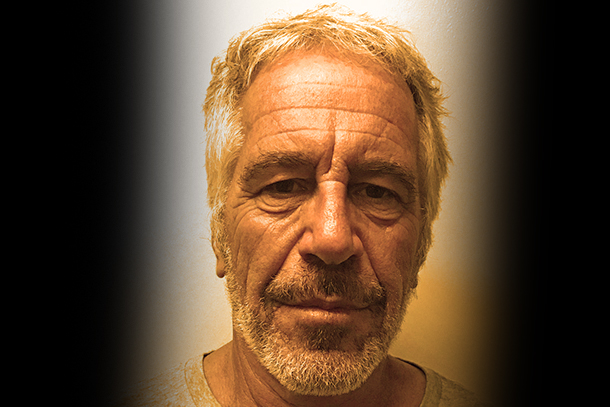
4. Epstein – As horrendous as revelations of Jimmy Saville were for western high society, the chronicles of billionaire VIP sex trafficker Jeffrey Epstein were more devastating by orders of magnitude. His exploits ensnared US President Bill Clinton, and high-flying lawyer Alan Dershowitz, along with a long list of high-ranking VIPs. The fallout didn’t spare the British Royal Family either, with Prince Andrew being cast out into social oblivion for his own role in the scandal. The more the story marinated, the more seedy it became. His was a story of one locked door after another, concealing the adjoining halls of a castle dark which can only be acquired by navigating the circles of extreme wealth and influence. Many believe this was part of a high level blackmail operation designed to create leverage over top decision makers in politics and industry. There are also indications that Epstein “belonged to intelligence,” although it’s not certain which agencies he may have been supplying information to. For his own part, Epstein’s story ended abruptly after he was reportedly unconscious in a federal jail cell at New York’s Metropolitan Correctional Center on Saturday August 10, 2019. The death was quickly ruled a “suicide by hanging.” Somehow, the CCTV camera footage appears to have gone missing. The guards, we’re told, were not on duty. “It was a horrible series of coincidences,” so says the official conspiracy theory of the highly unlikely death of Jeff Epstein in federal custody. He was awaiting a federal trial for charges of conspiracy and sex trafficking of underage girls dating back to the early 2000s. After his death, the trial was shelved. So it goes without saying that many ‘important’ and powerful people benefited from this outcome. His main accomplice is still at large, Ghislaine Maxwell, daughter of the late media tycoon and Israeli super spy, Robert Maxwell. Many of the female victims are now speaking out publicly. Will there be any justice? Certainly, the mainstream media appear disinterested in pursuing the criminal segues of this story. Or will it become another grand conspiracy for the ages, alongside JFK, RFK and MLK?
3. A Global Uprising? – In 2019, we saw major uprisings and popular mobilzations on the streets in France, in the Spanish province of Catalan, Chile, Colombia, Argentina, India, Lebanon, Iraq, Haiti, Sudan, Hong Kong, as well as protests building in Netherlands, Italy, and Germany. Many of experts are scratching their heads, asking ‘what does it all mean’? Are these event interconnected, or are they being driven by the same underlying social or economic forces? Many of these events appear to be genuine grassroots events. However, others quite clearly were being co-opted and fueled by foreign powers seeking to capitalize on any succession of power that might be occurring, as was the case with protests in Hong Kong, Iraq, Russia and certainly there was evidence of this in Lebanon, although not as blatant as in other locations. Regardless, this trend is real and potentially world-changing and cannot be ignored, as billions of people (many of them younger) around the globe begin to realize that 20th century stalwarts like neoliberal vudoo economics, savage capitalism, US dollar and IMF debt-based control of the developing world, along with US-led neocolonial foreign policy and endless ‘regime change’ wars – are simply no longer going to cut it going forward. It seems that this new generation won’t settle for business as usual any more. Look out…
2. The OPCW Leaks – Never has there been such a profound story which was being categorically denied and ignored by the entire mainstream press. This past year saw a series of leaks coming out of the UN appointed watchdog, the Organisation for the Prohibition of Chemical Weapons (OPCW), which reveal that the alleged ‘chemical attack’ which the West and MSM said took place in Douma, Syria on April 2018 – never actually happened. Which means that the US, UK and France launched a retaliatory strike against Syria on the basis of a well-orchestrated ‘false flag’ hoax. Worst yet, there is proof the OPCW perpetrated an internal cover-up of evidence which would’ve exonerated Damascus. Consider this as Iraq WMD 2.0, because the very same fraudulent practices and heavy-handed US tactics, along with total media acquiescence to the official conspiracy theory narrative – has happened again. Like with the Integrity Initiative leaks which broke in late 2018, the OPCW leaks have been dripping out, some via WikiLeaks, and it’s been death by a thousand cuts for the US, UK and NATO establishment, who’ve been caught not only tampering with an investigation of what was meant to be a neutral international watchdog group, but have summarily closed ranks in an information blackout, even though the scandal is there for the world to see (for those willing to look). The reason for their evasive action is now clear: when the Douma ‘chemical attack’ happened, it was the mainstream media who colluded with western governments, and who relied on US and Saudi-backed terrorists Jayash al-Islam and the White Helmets – all working hand-in-hand to spin-up the West’s official narrative that somehow “Assad had gassed his own people.” And the leaks are still ongoing. Will the media and bamboozled politicians ever address this scandal, or will they play the ostrich until it’s too late? Either way, their credibility is now shot.

1. The Capture of Julian Assange – In April, WikiLeaks founder Julian Assange was arrested and bundled out of his safe haven in the Ecuadorian embassy after his asylum and citizenship were suddenly revoked by the host country – very clearly part of a coordinated conspiracy waged by the governments of the US, UK, Sweden and Ecuador – to prepare Assange for extradition to the US to face espionage charges by disingenuously re-framing Assange and WikiLeaks, a journalist and a publication – now as a “cyber terrorist” and a “hostile foreign intelligence service.” His removal from the embassy by British police was an act of extraordinary rendition. Despite interventions and rulings by multiple UN representatives, determined British authorities continue to hold Assange without charge in solitary confinement, and heavily sedated (by his own admission), inside of London’s Belmarsh super max prison. The UN’s has ruled that his detention constitutes torture. He is also unable to prepare for his US extradition hearing in February – one of the most important precedent cases, maybe in history, for the future of the freedom of the press. His legal team even requested for more time to submit evidence and postpone of the extradition hearing, but the fix was already in, and the judge flatly refuse to entertain any argument or admit Assange should no longer be held on remand without charge in high security confinement. With his physical and mental health deteriorating rapidly, there is a real risk now that Assange could even die in custody. How long can the supposed guardians of freedom and democracy in the West stand idle while this incredible injustice continues to unfold? Whatever your preferred outcome, the answers to these questions may come soon in the new year. Needless to say, many are hoping that the plutocracy in Washington and London come to their senses, and realize what a historic mistake they are making – and reverse course on this unprecedented judicial disaster..
What a wild year. Expect more of the same in 2020.
HAPPY NEW YEAR.
SEE PREVIOUS TOP TEN CONSPIRACIES:
NATO: General Delawarde assesses final London Declaration

By Alexandra Kamyshanova | December 30, 2019
General Dominique Delawarde, the former head of the “Situation – Intelligence – Electronic Warfare 19” section at the joint operational planning staff and a cyberwarfare expert, provides insight into the nine articles of the final London Declaration, published on the NATO website.
Question: Can members of the Alliance really “reaffirm their adherence to the purposes and principles of the United Nations Charter”, as stated in Article 1?
Answer: A simple observation of how history has unfolded after the Cold War demonstrates that two important elements of Article 1 are erroneous, if not flat-out false. Since 1991, NATO actions have been aimed not at preventing conflicts and maintaining peace, but exactly the opposite. They do cause them themselves by their never-ending destructive interference in the affairs of sovereign countries. Over a quarter-century (1995-2019), its member states dropped more than a million bombs on our planet, which entailed, whether overtly or covertly, the death of several million people. The only objective was to establish hegemony over the “international community”. Alliance members cannot “reaffirm their adherence to the purposes and principles of the United Nations Charter” by violating or ignoring international rules established by the United Nations. The illegal occupation of part of the Syrian territory serves as evidence of this.
Q: Can we say that the funding efforts outlined in Article 2 fail to reflect the true situation?
A: This statement about efforts to increase funding for NATO members’ defense capabilities is virtually misleading. It loses sight of the fact that defense spending has halved since 1991 (peace dividends) and does not specify any deadline for reaching the 2% target. Finally, this statement is unfeasible and won’t be implemented in the short or medium term, given the economic and social complexities faced by all the key NATO member states. So this is mere verbiage.
Besides, NATO will not be able to compete with the SCO (Shanghai Cooperation Organization), because defense spending parity in PPP (purchasing power parity) dollars has almost been reached between NATO and the SCO; the cumulative defense budget of NATO member states accounts for 1000 billion dollars (PPP), and that of SCO member states is going to reach parity with the NATO budget in 2020 already. To date, the annual growth rate of defense spending in SCO countries is two to three times higher as compared to NATO countries. The SCO has a much wider scope for expansion (major countries like Iran and perhaps Turkey, why not) than NATO (North Macedonia, Georgia, Bosnia). Speaking of Turkey, an untrained eye should know that the SCO-NATO dual membership is not prohibited, since in 2005, the United States itself applied to join the SCO as nonmember state (the application was unanimously rejected by SCO members, guess why).
Q: Should we consider Russia as a threat, as stated in Article 3?
A: This list of universal threats and perpetual accusations against Russia, which is presented as a source of aggression and threat, are familiar pretexts to justify the very existence of NATO. As for anti-Russian statements, NATO is clearly resorting to an accusatory inversion. It is NATO members, not Russia, who have dropped over a million bombs and caused the death of several million people since 1995, and it is them who violate UN rules by continuing the military occupation of part of the Syrian territory. This is also the case of the coup organized in Ukraine, the division of the former Yugoslavia, and the constant advancing to the borders of Russia, which is in total disregard of the promises made to Gorbachev.
As for terrorism and instability observed beyond our borders, the Alliance forgets to remind that both arise from their omnidirectional interference in the affairs of sovereign states at the slightest pretext. They arise from their unlawful bombings, humiliations at Abu Ghraib and Guantanamo, the replacement of strong secular leaders with the chaos we observe today, and the wars waged under false pretexts (Serbia, Iraq, Libya, Syria). Migration is a blowback.
It should be recognized that state and non-state actors shattering the international order are mostly representatives of the West and NATO. The April 14, 2018 joint strike on Syria by the United States, France and the United Kingdom is yet another proof of this. Anglo-Saxon non-governmental NGOs, ostensibly independent but actually used by government agencies and / or their American sponsors (Soros), are wreaking havoc by promoting North Atlantic strategies. They use various useful idiots for their own purposes, who may inherently have good intentions. Finally, the main and only known cyber threat uncovered by Snowden, Assange and Manning is America, not Russia or China. The United States has installed wiretaps of all the political and economic Western leaders (NSA) and has pretty reliable bargaining chips to blackmail our heads of state and seize our businesses.
Q: Do you agree with the statement of Article 4: “NATO is a defensive alliance and poses no threat to any country”?
A: You need to ask the countries that have been bombed for 25 years.
The Alliance does not act “prudently and responsibly” in relation to Russia: the expansion to the East which runs counter to NATO promises of 1990, the coup in Ukraine, the unilateral withdrawal of the United States from the INF and other treaties, including the Iranian nuclear program. They pretend to be combating terrorism, even though many of its elements are funded by the West itself or some of its Arab allies – this is simply ridiculous. NATO members take us for perfect fools.
Q: What do you think about the phrasing of Article 5 that NATO seeks to “work to increase security for all, deepen political dialogue and cooperation with the United Nations”?
A: NATO provokes chaos, migration crisis, surge of terrorism and anti-Western hatred that have now pummelled Europe. You cannot drop a million bombs over 25 years on the countries that have never attacked a single member of the Alliance. Think about the five thousand soldiers from 11 NATO member states who died for nothing in Iraq, in a deceitful war unleashed in 2003. It is worth paying tribute to the memory of those who fell victim to American aggression supported by 10 European NATO member states that agreed to take part.
Q: What does NATO mean in Article 6 when mentioning “the resilience of our societies”, “our energy security” and “the need to rely on secure and resilient systems”?
A: This reflects the current US obsession: “to increase the resilience of our energy security” means ” NATO’s opposition to the construction of the Nord Stream 2 gas pipeline, to spite the vicious Russians and to the benefit of the goodу American gas market.” “Security of our telecommunications, including 5G” means “the rejection of the Chinese Huawei technology, to the detriment of the Chinese and in favor of American technologies.” The US has long been spying on our political and economic leaders’ telecommunications, while accusing China of “intending” to spy on the alliance members by means of its 5G system.
China poses “challenges that we need to address together”. So, NATO is embarking on a path of confronting China, which is beneficial to the United States alone.
Q: What is meant by “strengthening NATO’s political dimension” referred to in Article 7?
A: NATO’s ten-year strategy is now being updated, and the “relevant expertise” will be that of American and European neoconservatives. The essence of Article 7 is discernable: “strengthening NATO’s political dimension”. Since the end of the Cold War, the 1949 “military-defensive” alliance has been increasingly turning into a political and offensive one, often to accommodate certain economic interests.
Q: What do you think Article 8 is remarkable for?
A: For postponing the revision of the strategic concept from the year 2020 to 2021. Trump’s unpredictability scares Europe, with its people hopeful that he won’t be re-elected and that another President will bring the crisis-stricken Alliance back into the ranks.
Q: Is it serious that Article 9 stresses NATO’s greater protection for the peoples of its member states?
A: NATO has been sowing too much hatred and chaos on the planet since 1991 to be a security factor in Europe, and it has been so since the end of the Cold War. The North Atlantic Charter does not present NATO as an instrument of American hegemony. Therefore, the dissolution of NATO, or at least the withdrawal of France would be the best decision at the moment, unless NATO returns to the original principles of a defensive alliance with its activities covering only the territories of its member states, and ceases to invent new threats to serve as false pretexts to justify wars and intervention aimed at maintaining Western hegemony on the planet.
Q: What conclusion would you draw?
A: It is not just about a “brain death” in NATO. Can their solidarity survive the global economic crisis that experts predict, and the inevitable subsequent upheaval in the hierarchy of forces? Hardly probable. The prosperity of the West and the financing of its armed forces rest today on a whole ocean of debts.
The future will belong to those who keep ahead of the game. A long-term vision is needed to pursue foreign policy. Russia, China and India have long ago grasped this.
How Impeachment Is Escalating the New US-Russian Cold War
Stephen F. Cohen • Unz Review • December 27, 2019
Podcast of John Batchelor Show
Summary of Broadcast Produced by Yvonne Lorenzo:
As the New Cold War gathers up speed and escalates, we are entering a “fact free world” as allegations are made that are proved not to be true are promoted; for example, the allegation that the DNC was hacked by Russia has been officially debunked—no one could name the seventeen intelligence agencies, the Coast Guard was one. The notion of the hacking was cooked up by two agencies: by the DNI’s head James Clapper and Brennan at the CIA. Nevertheless, recently News Anchor Chuck Todd of NBC (the most pro-Russiagate network, the ones who shamelessly accused presidential candidate Tulsi Gabbard of being a Russian asset) took it one step further: ignoring the facts, Todd again stated that seventeen intelligence agencies agreed that the Russians not only interfered in the election but that they swung the election to Trump. While interference is one thing, no one has previously made that allegation. Consequently, we are now in a fact free discourse in America: no evidence is necessary to prove anything, falsehoods are taken up by the legacy media, what Professor Cohen would call a world of tabloid gossip media, except in their favor the tabloids, fearing lawsuits, will do some fact checking, which is conspicuous in its absence in the legacy media. And Professor Cohen noted that it’s hard to get traction and you can’t have a conversation with someone when you don’t agree upon the facts.
In conversation on a cruise with fellow liberals, Professor Cohen noted most take the view that where there is smoke there is fire and there is something to these allegations of Russiagate and Putin’s control over Trump; they state the media wouldn’t continue to promote these conspiracy theories, these allegations about Trump’s nefarious relations with the Kremlin, without reason and so there must be something to them. Yet while facts have become absolutely critical Cohen notes you can’t get people to focus on the facts; for that reason, he feels despair and observes that for the first time in his life in his public discussions of Russia there are no basic premises that people accept any more, for if you say “If there’s smoke, there’s fire,” that is just not a logical way of thinking: you either have the facts or you don’t.
Batchelor also points out in the impeachment charges there is a great deal of presumption; there are no facts regarding the president as well, and he cites Trump’s letter to Nancy Pelosi and poses this question: what does the Kremlin think about the impeachment?
Cohen answers that the Russian high policy class in the 1990s—the America worship period—they and not just the youth, strongly believed that Russia’s future was with the West and America in particular, and now what strikes Russians most is the role of Russian intelligence services in the Western allegations. Pro-America Russians thought that American intelligence services didn’t play the role that the Soviet ones did. In Russian history classes and as a staple of popular culture, the sinister role of the “secret police” goes back to the Czarist era but what distinguished America was that it didn’t have anything comparable in abuses by its intelligence services—or so it was believed. Consequently, for those who looked up to America, it’s a source of disillusion and shock to learn that the American special services “went off the reservation” for quite a long time, not unlike Russia’s, and so they have become disillusioned while for those who tried to get Russians to be more nationalistic, their perspective is to say with gratification, “We told you so. Now will you please grow up!”
Russians call the American agencies “the organs” perhaps not being clear on the difference between the CIA and the FBI and conflating them. For Russians, the role of such agencies is baked into the culture and this has resulted in rethinking not only about America but about their own special services. An Op-Ed piece in a Russian liberal newspaper the Russian liberal author wrote, after watching what’s unfolding in America, we used to beat up on our intelligence services for decades but now maybe we need them. Contrary to a “cult of the intelligence services,” Cohen thinks what must be determined is the role of the American intelligence services in creating Russiagate from the very beginning.
Yet what is critical is to know how Russiagate began in America, with the Barr-Durham probe into the origins of Russia and Russiagate will continue to be a major issue in the 2020 election. What struck Cohen about the letter from Trump to Pelosi—which was so eloquent he doubts Trump wrote it—was that he understands it will be an issue in the 2020 elections, and it was a campaign document. That aside, Trump is aware that Democrats are campaigning still on Russiagate; nothing has turned up that it factual. Therefore, despite the absence of facts, this will be a major issue. Ukraine has turned into a stand-in for Russia.
Jennifer Rubin of the Washington Post, once a quintessential conservative, published an article titled “Time to Call out and Remove Putin’s Propagandist in America.” While the article is slightly cagier than that headline, essentially she wants to shutdown and deprive access to media who aren’t espousing and promoting the Russiagate/Russophobic narratives. Cohen condemns that kind of behavior is that. On opposite side of Rubin, Cohen stated he himself has never advocated the silencing and removal of those who promote among other falsehoods the provably false Russiagate narrative. He asks where are things drifting and he answers discourse and relations are becoming ugly and awful.
Returning to the past, he notes there was an assumption that Russia under Yeltsin would emerge as a replica and junior partner of America; Cohen believes those who promote the Russiagate narrative and demonize Trump because their “impossible dream” failed—Russia is too old, too vast to ever be a replica of America. What took Professor Cohen aback in the testimony from Fiona Hill and others was how deep and wide the Russophobia runs in the Washington think tanks. Until she spoke and testified he had no idea how much she—and the other Russia experts—hate Russia.
Batchelor noted this is the language of civil war in Trump’s letter; Trump uses the term “Star Chamber of partisan persecution” and “coup” which are the language of a country torn in half and he asked the question whether the weakening of the civil contract to be an advantage to Putin and Russia. Cohen notes every newspaper and media source in America say Putin is delighted since it is his goal is to foment disarray in America.
The fact is, however, this chaos and dysfunction and enmity is one of the last things Putin wants. Putin’s purpose is to rebuild Russia from the economic and political catastrophes of the 1990s; Putin’s role is to reverse the demographic trend—men died in their fifties in the 1990s—and spend funds on modernization; that would be his legacy. Four hundred billion dollars has been saved to implement the modernization program. That attempt would be taken with modernizing partnerships with the West. Therefore, the last thing he wants is a new Cold War; the last thing he wants is political turmoil in America or in any Western nation. Cohen points out President Macron of France appears to understand that; he called for a rethinking of relations and said there could be no European security without Russia. Macron has broken with Washington and there will be a hell of fight because Washington is against it. But the notion that Putin wants to disrupt American society is wrong; Putin wants stability and partners.
Cohen still thinks that leadership—the new President of Ukraine, Trump and Putin—could make a difference.
Featured Video

Trita Parsi: Middle East Unraveling — Are We on the Path to World War?
or go to
Aletho News Archives – Video-Images
From the Archives
Why Saudi Ties to 9/11 Mean U.S. Ties to 9/11
By Kevin Ryan | Dig Within | September 27, 2015
Media interest in Saudi Arabian connections to the crimes of 9/11 has centered on calls for the release of the 28 missing pages from the Joint Congressional Inquiry’s report. However, those calls focus on the question of hijacker financing and omit the most interesting links between the 9/11 attacks and Saudi Arabia—links that implicate powerful people in the United States. Here are twenty examples. … continue
Blog Roll
 Aletho News
- Integrity Initiative: UK-funded network framed dissent as Russian disinformation for years
- ‘We don’t seek permission to defend our country’: Snippets from President Pezeshkian’s UNGA address
- NATO chief wants Europeans to fight American wars [for Israel]
- German chemicals giant reveals details of downsizing
- Refaat Al-Areer Was The Canary In The Coal Mine In Israel’s War On The Truth
- Israeli election committee bars candidate from Knesset race over Gaza war opposition
- French-Lebanese man files war crimes complaint over Israeli attacks
- Mahan Air Flight Lands in China Despite US Threat against Iranian Airlines
- US eyes $10bn fund to rebuild war-battered Gulf infrastructure
- Trump meets Rodríguez near Maduro’s prison as Venezuela’s oil flows to US
- If Americans Knew
- Caught on Tape: AIPAC CEO Boasted of Controlling Trump’s National Security Officials
- Why Hamas Attacked Israel in October 2023 – Israeli professor Ilan Pappé
- They see them, then kill them: Israeli quadcopters track, deliberately target civilians in Gaza
- Winter could turn Gaza’s treacherous, war-damaged buildings into deathtraps
- Majority of Democratic Voters Want to Prosecute Both Biden and Trump Administration Officials Over Gaza
- As Gaza languishes, world leaders gather at the UN – Daily Update
- Sanctions are collective punishment: immoral and self-defeating
- Phosphorus Munitions Fired by Israel Burn Groves, Orchards in Southern Lebanon
- Israel Carries Out New Ceasefire Violations Across Gaza
- AI – Emphasis on the ‘I’: Israel Is Funding AI Chatbot Propaganda
- No Tricks Zone
- New Study: Earth And Venus Surface Warmth Largely Explained By Convection And Lapse Rate, Not CO2 Or Radiation
- 2025 Nature Paper Claiming Worsening Global Drought Gets RETRACTED …Heavily Flawed
- New Study: ‘Global Drought Shows No Detectable Recent Acceleration Under Climate Warming’
- Economic Masterminds: German Socialists Suggest Taxing Productivity Gains Stemming From Using AI
- The South China Sea Has Not Been Cooperating With The Climate Change Narrative
- Energy Crisis: Germany Enters Heating Season With Historically Low Gas Reserve Fill Levels
- New Study: The Antarctic Ice Sheet Gained Mass From 2020-2024 Due To Staggering Snow And Ice Accumulation
- Study: Ocean Heating Rates From Thousands Of Years Ago ‘Dwarf’ Modern Ocean Heating Rates
- Climate Extremists Target, Attack Large-Scale Power Grid Infrastructure In Germany!
- New Study: Antarctic Ice Melt Has Contributed Less Than 1 Centimeter To Sea Level Rise In The Last 30 Years

