‘All roads lead to Putin!’ Pelosi tells Americans impeachment not really about Ukraine but all about… Russia
RT | December 5, 2019
For Americans still confused why exactly Democrats want to impeach President Donald Trump – something about Ukraine, maybe? – House Speaker Nancy Pelosi has helpfully clarified that it’s all about Russia and always has been.
Briefing reporters on the impeachment inquiry on Thursday, Pelosi (D-California) made sure to point out that “this isn’t about Ukraine, this is about Russia.”
“Russia. It’s about Russia. Russia invading eastern Ukraine …all roads lead to Putin. Understand that.”
That may come as a surprise given the Democrats’ recent line of argument that Trump must be impeached because he tried to force new Ukrainian President Volodymyr Zelensky to open a corruption investigation into the gas company that had Joe Biden’s son Hunter on its board – a “quid pro quo” that qualified as bribery and election interference, somehow.
However, as Pelosi explained, it was Russia that somehow “benefited” from Trump withholding US military assistance to Kiev – though she did not say how, since the aid was actually delivered on time. Curiously, she didn’t mention the fact that it was actually the Trump administration which approved military aid to Ukraine in the first place, while the Obama administration refused to, worrying about a worse flare-up in violence.
Perhaps fearing that the case for impeachment on the basis of the alleged “quid pro quo” isn’t quite stacking up the way Democrats wanted it to, Pelosi seems to have reverted to an easier tactic of just shouting “Russia!” and hoping it sticks.
“Sometimes people say I don’t know about Ukraine, I don’t know that much about Ukraine — well, our adversary in this is Russia,” Pelosi continued.
Got that? Never mind that the original story about “collusion” between Trump and Russia crashed and burned after a two-year investigation by Robert Mueller, who couldn’t find any. Never mind that the details about Ukraine’s place in the whole alleged scandal don’t quite add up, or that Zelensky himself denied ever being pressured, or that the facts of the story don’t seem as clear-cut as Democrats and the media claim. None of that matters, really, because… Russia.
US Fails to Issue Visas to Several Russian Officials – Russian Embassy
Sputnik – December 4, 2019
WASHINGTON – A delegation of the Russian Federal Treasury that was supposed to arrive in Washington on Tuesday, 3 December, did not receive American visas, the Embassy of Russia in the US has announced, expressing concern over repeated US visa denials to Russian officials.
“A statement shifting the blame for initiating a ‘visa war’ on Russia is still posted on the website of the US embassy in Moscow. There were and are no grounds for such false attacks on us. … We stress that US authorities have been consistently restricting the entry of our official representatives and disrupting crucial negotiating formats,” the Russian embassy said in a Facebook statement.
A delegation of the Russian Treasury that was supposed to arrive in Washington on Tuesday, did not receive visas, the Russian embassy said.
“Thus, very recently, a delegation of our Federal Treasury that was supposed to arrive in Washington on December 3 to participate in the conference of the International Institute on Audit Regulation did not get visas,” the embassy said in its statement.
According to the release, Director of the Russian Foreign Ministry’s Department for Relations with Compatriots Abroad (DRCA) Oleg Malginov was prevented from taking part in a youth forum in the United States last week.
“The [US] State Department also prevented Director of the Russian Foreign Ministry’s Department for Relations with Compatriots Abroad O. S. Malginov from attending the Youth forum in New York on November 28-29 2019,” the embassy said.
The embassy also pointed out that the United States had still not explained why some members of the Russian delegation to the UN General Assembly in September were denied visas.
“In violation of its own obligations, the United States created obstacles to the participation of the Russian side in the meetings of the First and Third Committees of the UN General Assembly. To a large extent, their substantive work was disrupted. It is noteworthy that not only the Russian delegation suffered: representatives of other countries did not receive visas either. Essentially, Washington has started to determine who can (should) represent a particular country,” the Russian embassy said.
The embassy warned that such actions on the part of the United States lead to a degradation of US-Russian relations that are already complicated and contradict Washington’s calls for the normalization of ties with Moscow.
The Latin Alphabet in Central Asia — America’s Geopolitical Tool
By Vladimir Odintsov – New Eastern Outlook – 04.12.2019
Central Asia has long been one of the key fronts in America’s ideological battle and information war against Russia.
A year ago, the American geopolitical intelligence platform Stratfor published its forecast for US policy in Central Asia, which focuses much attention on Russia. Analysts from this agency, which is dubbed the “Shadow CIA”, indicated in this forecast that the United States is looking to strengthen ties with countries along the periphery of the former Soviet Union — from Eastern Europe to the Caucasus and Central Asia — in an effort to put more pressure on Russia. A geopolitical war is going to be waged against Russia, or a multi-domain battle to use the American military terminology, affecting the political, economic, energy and military spheres.
Washington has long identified the Central Asian republics and Afghanistan a “zone of US national interests”, which is why this region is targeted with the full spectrum of American information campaigns. In order for these campaigns to be effective, not only have so-called “independent” media outlets and pro-Western NGOs, been making a massive contribution in Central Asia over the past number of years, which the US has been busily implanting in the region, but military specialists in information warfare have also been recruited — servicemen from the United States Army’s 4th Psychological Operations Group. The 8th Psychological Operations Group is responsible for work in Central Asia, which runs the Caravanserai information portal, a website specifically created to counter Russia, sponsored by the United States Central Command and targeted at residents of Uzbekistan, Kazakhstan, Kyrgyzstan and Tajikistan.
The main aim shared by most of the information campaigns Washington supports is to separate the regional population from Russia, mentally and psychologically, and to undermine Russia’s position in Central Asia. The campaigns mainly target young people in the hope that the leaders of the future in these countries will have been brought up on Western “democratic” ideals and will therefore be less inclined to partner with Russia.
Special programs are being launched and implemented by NGOs and “independent” media outlets in order to counteract Russia’s influence in the CIS countries. For instance, a new five-year program called MediaCAMP was presented at the end of last year in Kazakhstan and Tajikistan, which is run in Kazakhstan, Tajikistan and Uzbekistan by an American NGO called Internews Network (California, USA), and receives heavy funding from the United States Agency for International Development (USAID). The program has a budget of $15 million. Its official goal is “to develop a more balanced information environment”, but in reality, it is used for intensive anti-Russian propaganda. Internews Network had its activity suspended in Russia back in 2007, but it has continued to operate efficiently in most Central Asian countries up to this day. The USAID Agency, funded by the United States federal government, also ran programs in Russia up until 2012 when it was banned.
One clear example of the United States’ involvement in this anti-Russian information war in Central Asia would be the material that was published at the end of January by the Pentagon’s Caravanserai information portal mentioned earlier, pushing Central Asian countries to switch to the Latin alphabet. At the same time, Washington does not try to hide the fact that specialists in information warfare are pushing people to use the Latin alphabet instead of the Cyrillic alphabet, and it is part of their plan because it primarily acts as a tool to drive a cultural wedge between Russia and the Central Asian republics, and would erase the Russian language’s historical presence in Eurasia, constricting and shrinking the Russian-speaking cultural sphere and sphere of information.
It is important to remember that the extensive process of transcribing almost all the languages spoken in the Soviet Union into Cyrillic, which began in 1935, was one of the measures the Soviet government took to unite people in the former USSR. This included transliterating languages with a rich written tradition, interrupted by the reforms of the late 1920s, and languages that had only recently adopted a written form. By 1940, the “Cyrillization of the entire country” was largely complete. Dozens of languages acquired a writing system which united them with the Russian cultural sphere, and it was essentially the first time speakers of these languages received access to a single Eurasian space to share information. After the Second World War ended with Soviet victory in 1945, the Cyrillic alphabet was further consolidated as the main alphabet in the Soviet Union and the Eastern Bloc which was beginning to take shape (for example, the Cyrillic alphabet was introduced in Mongolia).
That is why Caravanserai’s sponsors not only see replacing the Cyrillic alphabet with the Latin alphabet as a kind of symbolic act; it is also meant to drive a mental and psychological wedge between Central Asian countries and Russia. This is the precise aim of the language conflict and Russophobia Washington has been encouraging in the Baltic States, Ukraine, and in some countries in the Caucasus.
It was Washington that began stirring things up, stressing the need for Latinization in Central Asian countries through various channels under its control in Kazakhstan, where Russian is not only a native language for the ethnic Russians who live there, but also for many of the Kazakhs, Ukrainians, Germans and Koreans living in Kazakhstan. Now the Russian language has even been erased from Kazakhstan’s national tenge banknotes. Around 300 thousand people have emigrated from Kazakhstan over the past 10 years, most of them Slavs, and to some extent, it is due to this policy. As it was put in an article published in the Polish newspaper Rzeczpospolita in November 2017, “by abandoning the Cyrillic alphabet, Nazarbayev is cutting the umbilical cord with Russia.”
Latinization has also been foisted in Kyrgyzstan and Uzbekistan.
However, as we have seen in recent years, switching to the Latin alphabet has clearly been an unhappy experience in Uzbekistan and Kazakhstan. Thus, it is worth recalling that Uzbekistan looked to the Turkish model in its first years of independence, and switching to the Latin alphabet was viewed a sort of “basis for unity”. Transitioning to the Latin alphabet also came to symbolize national identity and independence for the new Uzbek authorities. At the time however, no one stopped to consider the financial side of this transition, the costs associated with transliterating a huge archive of literature from Cyrillic into Latin script. Another thing no one saw coming was the conflict between generations reading in different alphabets. Relations between Uzbekistan and Turkey cooled within a very short space of time, the alphabet stayed the same, but the country’s education suffered a significant loss, which even affected basic literacy.
Attempts to switch to Latin have unleashed significant problems in Kazakhstan. In the 80 years since Kazakhstan made the transition from Arabic to Cyrillic, a huge network of libraries was created in this country, even in remote villages. The country had already achieved a literacy rate of 100%, which meant that the whole “matrix” of thinking for the entire population would need to be changed in switching to a new alphabet, and that would not only entail significant financial costs, but would also create generational conflict.
People in the region have responded to the attempts the West has been making to replace the Cyrillic alphabet with the Latin alphabet in Central Asian countries as fast as possible. They have increasingly begun to realize that there is no point in making this transition. Russian is a second language in Central Asian countries anyway, these states are geographically, economically, politically and linguistically distant from the West, and they are members of the Eurasian Economic Union, where the working language is Russian. Given these circumstances, there is a growing understanding that this issue requires a logical approach and some common sense, and linguistic problems should not be politicized.
Various foreign NGOs, such as Freedom House and other similar organizations, have been interfering in the domestic affairs of Central Asian states, destroying the linguistic and cultural heritage of the people who live there, and clearly pose a threat to their constitutional order, a threat coming from outside the region, so it is therefore unsurprising that this issue has been discussed more and more heatedly over recent years, with an increasingly resounding negative tone.
Linguist Refutes MSNBC Host Maddow’s Defense in ‘Russian Propaganda’ Defamation Suit
Sputnik – December 4, 2019
A Santa Barbara linguist may have just dealt the coup de grace to MSNBC anchor Rachel Maddow’s legal defense in a suit brought against her by One America News (OAN) alleging defamation when she claimed the network “really literally is paid Russian propaganda.”
“Maddow did not use any typical opinion-markers when she stated that OAN ‘really literally is paid Russian propaganda,’” Amnon Siegel, a lawyer for OAN owner Herring Networks, wrote in response to a motion to throw out the suit made by Maddow’s lawyers in late October.
Siegel retained UC Santa Barbara linguistics professor Stefan Thomas Gries, one of the most widely cited cognitive linguists in the world, as an expert witness for the legal filing, reported the Times of San Diego, which broke the story Monday.Noting that Maddow consistently uses markers such as “I mean” and “I guess,” as well as changes in intonation to distinguish her opinions from facts, Gries said in the filing that “there are virtually no lexical, grammatical, or intonational characteristics” that would lead viewers to conclude her statement was an opinion.
“In a highly-structured and transparent way, Maddow separates informational/factual reporting and opinion in a way that marks it as factual,” he noted. “It is very unlikely that an average or reasonable/ordinary viewer would consider the sentence in question to be a statement of opinion.”
“She is a graduate of Stanford and Oxford Universities and a Rhodes Scholar,” Siegel said of Maddow. Noting that misusing the word “literally” isn’t in the reporter’s repertoire, Siegel pointed out that ”on the show, Maddow regularly uses ‘literally’ in its primary meaning,” providing several supporting examples.According to the Times, Siegel supplied Merriam-Webster Online Dictionary definitions of “really” and “literally” as supporting evidence in his filing, alongside nearly three dozen references to state and federal courts citations and statutes.
In the segment in question, which aired on July 22, 2019, the MSNBC host blasted OAN for employing Kristian Brunovich Rouz, a former contributor to Sputnik News and a perennial favorite target for Maddow’s Russiagate crusade. Herring lawyers brought the $10 million suit in September.
Maddow lawyer Theodore J. “Ted” Boutrous Jr. has tried to parry the accusations by claiming his client’s use of the word “literally” was “a quintessential statement ‘of rhetorical hyperbole, incapable of being proved true or false.’”
Herring President Charles Herring also said in a declaration attached to Siegel’s response that the network was unaware of Rouz’s prior employment at Sputnik and that “neither Maddow nor anyone from Comcast Corporation, NBCUniversal Media, LLC, or MNSBC Cable LLC [sic]” had sought out answers from his company or OAN before airing the segment in question.
“Neither OAN nor Herring Networks has ever received money from Russia or the Russian government, and none of OAN’s content is influenced by Russians or the Russian government,” Herring said. “In fact, Herring Networks is exclusively financed by the Herring Family and has never received outside investment.”
US impeachment furor sabotages Ukraine peace talks
By Finian Cunningham | RT | November 26, 2019
The much-anticipated meeting between Ukraine’s Volodymyr Zelensky and Russia’s Vladimir Putin is in danger of being a lost opportunity for peace. Washington’s political infighting has stacked the odds against a successful summit.
Weeks of impeachment hearings in the House of Representatives, accusing President Trump of abusing his office with regard to Ukraine, have achieved very little except for two things. Ukraine’s international image has been trashed with corruption claims and depiction of the country as having vassal-like dependency on the US, and secondly, demonization of Russia which has been heightened as an “aggressor” supposedly out to destroy Ukraine.
The irony is that Washington purports to be an ally of Ukraine to promote democracy, sovereignty, and independence of the former Soviet republic. But the upshot of the impeachment inquiry is that Ukraine’s independence and sovereignty is gravely undermined.
When President Zelensky holds multilateral talks soon with Putin, the Ukrainian leader will have little room to maneuver as a result of the cacophony back in the US.
The two leaders are due to meet on December 9 in Paris as part of a four-way summit also involving German Chancellor Angela Merkel and French President Emmanuel Macron. The meeting is a return to long-suspended peace talks and an attempt to revive the 2015 Minsk accords for ending conflict in eastern Ukraine.
It is over three years since the so-called Normandy Format last convened. The Minsk peace deal was never implemented, mainly because former Ukrainian president, Petro Poroshenko, refused to fulfill commitments to give regional autonomy to pro-Russian separatists in eastern Ukraine. Consequently the war has dragged on for nearly five years.
Zelensky was elected by a landslide vote in April primarily on the ticket that he would seek a peace settlement. In September, he agreed in principle to grant special status for the Donbas breakaway region of eastern Ukraine. Subsequently, though, Zelensky has appeared to backpedal on how much autonomy he is willing to countenance. Troops under his command have begun withdrawing from the front line with separatists, but it is not clear if that move marks a reliable de-escalation.
Alexander Lukashevich, Russia’s permanent representative to the Organization for Security and Cooperation in Europe, stated on November 21 that forces under Kiev’s command are still violating terms of a truce by not removing combat hardware from the line of contact. “This, to put it mildly, non-constructive approach to preparations for the Normandy meeting causes justified concern,” he added.
In a move seen as a trust-building gesture, Russia recently returned three Ukrainian naval vessels which it had confiscated last year after an infringement of its territory in the Kerch Strait.
The forthcoming meeting in Paris thus holds a fledgling start to finding a peaceful resolution to a conflict which has resulted in over 13,000 dead and millions displaced from their homes.
However, the impeachment debacle in Washington has painted Zelensky as a pathetic politician “who loves Trump’s a**” and “who will do anything” to curry favor with the president. The Democrats and obliging former US diplomats who had worked in Ukraine are claiming that Trump pressured Zelensky to dig dirt on Joe Biden, his would-be Democrat rival in next year’s election.
So zealous are Trump’s political opponents in Washington, together with the liberal media and US intelligence agencies, to pin an impeachable offense on him, that the Ukrainian president has ended up a lame-duck leader in the collateral damage.
This has generated much mockery among Ukrainians of the former comedian-turned-president, who has been nicknamed “Monica” in reference to the impeachment of President Bill Clinton for his sexual affair with White House intern Monica Lewinksy.
Even before the hearings in Congress got under way, Zelensky had been under fire from Ukrainian nationalists who accuse him of “capitulating” to Russia over his willingness to negotiate a peace settlement in eastern Ukraine. Kiev has seen large rallies of up to 20,000 protesting Zelensky’s peace efforts as a betrayal.
In a recent media interview, American professor Stephen Cohen, an astute observer on Russia-Ukraine, says that Zelensky is in a very precarious situation. Despite being overwhelmingly elected to find a peaceful solution to Ukraine’s conflict, the new president, says Cohen, has to contend with far-right paramilitary leaders who view any peace deal negotiated with Russia as treasonous. Zelensky has been subjected to death threats.
As Cohen points out, if the US was genuinely concerned about establishing peace and democracy in Ukraine, then Washington should be fully supporting Zelensky’s overtures to Moscow, to let him and the Ukrainian people know “we got your back.”
But as it is, Zelensky is going into negotiations with Putin as an isolated figure who has been demeaned by Washington’s squabbling and caricatured as a stooge.
Thus, what is being set up for the Ukrainian leader is an almost impossible task. If he were to agree with Putin to a further withdrawal of military forces from the contact line with pro-Russian separatists, or if he commits to implementing Minsk provisions for regional autonomy, then the uproar in Washington is predictable. Zelensky will be cast as selling out to Putin and capitulating to “Russian aggression.”
Such is the delirium of Russophobia in Washington, where Democrats and so-called ‘Russia experts’ like Fiona Hill have labeled Trump a “Kremlin agent” and “Bolshevik,” the next sequence in their narrative is that Trump abused his office in order to get Zelensky to surrender to Putin. Now we’re really talking impeachment, so it goes.
Missing from the political fight in Washington are the following key issues: it was American and European interference in Ukraine, not Russian, that plunged the country into ongoing conflict. That interference peaked with the CIA-backed coup in Kiev in February 2014, which led to Crimea seceding in a referendum and joining the Russian Federation. The coup also led directly to the war in eastern Ukraine by a neo-Nazi regime in Kiev against the ethnic Russian population who understandably have demanded autonomy.
The $400 million in military aid that Trump is accused of using as leverage on Zelensky, obscures the bigger picture of why the US has sent a total of $1 billion in military aid to the country in order to antagonize Russia. This has long been the agenda of Washington’s foreign policy establishment, to destabilize Russia by pushing Ukraine to join the NATO alliance.
The impeachment hearings against Trump have obscured and turned reality on its head. The anti-Trump Democrats, media and ‘deep state’ operatives want to exclude any wider investigation into corrupt dealings by the former Obama administration in Ukraine by asserting that any such claims are merely “Russian disinformation.”
Moreover, not only is the truth about Washington’s corruption in Ukraine being concealed, but the vassal status of Ukraine is complete by it not having any freedom to negotiate its way out of conflict or restoring normal neighborly relations with Russia.
Also on rt.com:
State Department Shoots Itself in the Foot at Impeachment Hearings
By Peter Van Buren | We Meant Well | November 24, 2019
The State Department, where I worked 24 years as a Foreign Service Officer (FSO) and diplomat, reminds me a lot of my current hometown, New York City. Both places spend an inordinate amount of time telling outsiders how great they are while ignoring the obvious garbage piled up around them. It’s almost as if they’re trying to tell themselves more than others everything is OK.
Like NYC convincing itself the Broadway lights mean you won’t notice the wicked homeless problem and decaying infrastructure, the State Department fully misunderstands how it really appears to others. Across Facebook groups and internal channels, FSOs this week are sending each other little messages tagged #FSProud quoting Ambassador Marie Yovanovitch’s the closing soliloquy from her impeachment testimony. Yovanovitch’s testimony otherwise read like the HR complaint from hell, as if she was auditioning for a Disgruntled Employee poster child position to cap off her career. She had already been fired by the time the alleged impeachable act took place — during Trump’s July 25 phone call — and was stuck in a placeholder job far removed from Ukrainian policy. She witnessed nothing of the “high crimes and misdemeanors” the House is investigating, and basically used her time to complain she knew more than her boss did so he fired her.
At the end of her testimony Yovanovitch unfurled a large metaphorical flag and wrapped herself and the entire Foreign Service in it. Her lines had nothing to do with Ukraine, and were boilerplate recruiting prose about how FSOs are non-partisan servants of the Constitution, how everyone lives in harm’s way, yada yada. She name checked diplomats from forty freaking years ago held hostage in Iran, and rolled in a couple of CIA contractors when tallying up the “State” death toll in Benghazi. She omitted the we-don’t-talk-about-that-one-death of FSO Anne Smedinghoff in Afghanistan, whose 25-year-old life was destroyed participating in a propaganda photo-op.
This is the false idol image the State Department holds dear of itself, and people inside the organization today proudly christened Ambassador Yovanovitch as its queen. Vanity Fair summed it up better than the long-winded FSOs bleating across social media: “A hero is born as Yovanovitch gives voice to widespread rage at State. ‘I think people are feeling huge pride in Masha,’ says a former ambassador.” Yovanovitch uses her Russian nickname, Masha, without media comment because of course she does.
And that’s the good part. Alongside Yovanovitch, bureaucrat-in-a-bow-tie George Kent issued pronouncements against Trump people he never met who ignored his tweedy advice. Ambassador Bill Taylor leaked hoarded text messages with Trump political appointees. Taylor’s deputy, David Holmes, appeared deus ex machina (Holmes had a photo of Yovanovitch as his Facebook page cover photo until recently!) to claim back in the summer he somehow overheard both sides of a phone conversation between Trump and political appointee ambassador Sondland. Holmes eavesdropped on a presidential call and dumped it in the Democrats’ lap and now he’s non-partisan #FSProud, too.
Interesting the major political events (scandals?) of the last few years have all criss-crossed the State Department: Clinton’s emails and Foundation shenanigans, the Steele Dossier and many things Russiagate, and now impeachment and Ukraine. And never mind two major Democratic presidential candidates-in-waiting, Clinton and Kerry, had a home there. That’s an awful lot of partisanship for an organization bragging about being non-partisan.
Gawd, I need to wash my hands. I am #FSProud that in my 24 years as a diplomat I never perjured myself, or claimed to or actually eavesdropped on someone else’s phone call, then spoon fed the info months later to my boss on TV to take down a president mid-campaign, all the while accepting cheers that I was non-partisan, and thinking my role as a snitch/boot licker was going to help people vision my organization as honorable.
FSOs see themselves as Marvel superheroes who will take down the Bad Orange Man. The organization flirted with the role before; a 2016 mid-election “dissent” was designed to force the winner into war in Syria. Then another “dissent” by State strayed close to insubordination opposing Trump’s so-called “Muslim Ban.” Everyone remembers the Department’s slow-walking the release of Hillary Clinton’s emails (after helping hide the existence of her private server for years.) The State Department turned a blind eye to Secretary Clinton’s nepotism hiring her campaign aides as State employees (remember Huma?), and use of America’s oldest cabinet position to create B-roll of herself helping women around the globe ahead of her soiled campaign. Hillary of course was handed the Secretary job itself by Barack Obama as a treat for dropping out of the race in 2008.
Maybe the State Department’s overt support for Candidate Clinton did not make clear enough what happens when the organization betrays itself to politics.
While FSOs are gleefully allowing themselves to be used today to impeach Trump, they fail to remember nobody likes a snitch. No matter which side you are on, in the end nobody will trust you, Democrat or Republican, after seeing what you really are. What White House staffer of any party will interact openly with his diplomats, knowing they are saving his texts and listening in on his calls, waiting? State thinks it is a pit bull waiting to bite on its master’s command when in fact it is an organization that has betrayed its golden nonpartisan glow and is out of control. Hey, in your high school, did anyone want to have the kids who lived to be hall monitors and teacher’s pet as their lunch buddies?
The real problems go much deeper, and are either the cause of or a reflection of the current state of things, or a little of both. A Government Accountability Office report showed more than one fourth of all Foreign Service positions were either unfilled or filled with below-grade employees. At the senior levels 36 percent of positions were vacant or filled with people of lower rank and experience pressed into service. At the crucial midranks, the number was 26 percent unfilled.
The thing is the report is from 2012, and showed similar results to one written in 2008. The State Department has danced with irrelevancy for a long time and its efforts to be The Resistance as a cure today feel more like desperation than heroism. State’s somnolent response, even during the legendary Clinton and Kerry years, to what should have been a crisis call (speculate on what the response might be to a report the military was understaffed by 36 percent) tells the tale. As the world changes, State still has roughly the same number of Portuguese speakers as it does Russian among its FSOs. No other Western country uses private citizens as ambassadors over career diplomats anywhere near the extent the United States does, doling out about a third of the posts as political patronage mainly because what they do doesn’t matter. The Secretary of State hands out lapel buttons reading “Swagger“; imagine a new Secretary of Defense doing the same and then being laughed out of office.
FSOs wade in the shallowest waters of the Deep State. Since the 1950s the heavy lifting of foreign policy, the stuff that ends up in history books, mostly moved into the White House and National Security Council. The increasing role of the military in America’s foreign relations further sidelined State. The regional sweep of the AFRICOM and CENTCOM generals, for example, paints State’s landlocked ambassadors weak.
State’s sad little attempt during the Bush years to stake out a new role in nation building failed in Iraq, failed in Afghanistan, and failed in Haiti. The organization’s Clinton-Kerry era joblet promoting democracy through social media was a flop. Trade policy has its own bureaucracy outside Foggy Bottom. What was left for State was reporting, its on-the-ground viewpoint that informs policy makers. Even there the intelligence community has eaten State’s sandwiches with the crusts cut off lunch — why hear what some FSO thinks the Prime Minister will do when the NSA can provide the White House with real time audio of him explaining it in bed to his mistress? The uber revelation from the 2010 Wikileaks dump of documents was most of State’s vaunted reporting is of little practical value. State struggled through the Chelsea Manning trial to convince someone actual harm was done to national security by the disclosures. Some nine years later there hasn’t even been a good book written from them.
That leaves for the understaffed Department of State pretty much only the role of concierge abroad, the one Ambassadors Taylor, Yovanovitch and their lickspittles Kent and Holmes complained about as their real point during the impeachment hearings. Read their testimony and you learn they had no contact with principals Trump, Giuliani, and Pompeo (which is why they were useless “witnesses,” they didn’t see anything first hand) and bleated about being cut out of the loop, left off calls, not being on the inside. They testified instead based on overheard calls and off screen voices. Taylor complained he had to contact the NSC, not State, to find out if policy had changed, and whined Pompeo ignored his reports.
Meanwhile, America’s VIPs need their hands held abroad, their motorcades organized, and their receptions handled, all tasks that fall squarely on the Department of State. That is what was really being said underneath it all at the impeachment hearings. It is old news, but it found a greedy audience as it was repurposed to take a whack at Trump. State thinks this is its moment to shine, but all that is happening is a light is being shined on the organization’s partisaness and pettiness in reaction to its own irrelevance.
Nice bow tie on George Kent though, shows he’s “with it.”
Trump in Wonderland: Off With His Head?
By Martin Sieff | Strategic Culture Foundation | November 25, 2019
Donald Trump’s millions of detractors without doubt see him as The Mad Hatter: But, no: He’s Alice. The President of the United States has disappeared down the rabbit hole and he’s in Wonderland – Complete with a Red Queen (Nancy Pelosi) shouting “Off with his head!”
The great mistake foreign observers make observing the latest farce in Washington is assuming that there must be some order, rationality and linear logic behind it. There is none. It is Politics According to the Marx Brothers
This is a show trial – incompetently planned and directed with hundreds of crazed scriptwriters: The Democratic members of the House Judiciary Committee, their staffs and the salivating Mainstream US Media are writing and rewriting the script as they go along.
If one is to believe the Mainstream Media, who avidly take this bizarre cartoon seriously, enough evidence has already been established to clearly convict Trump of seeking to push an inquiry into the prima facie evidence of corruption on the part of the son of a former vice president and the leading Democratic presidential candidate.
Is this supposed to be criminal or shocking? What is Trump even accused of doing? He is accused of cautiously investigating the possibility of corruption in a sensitive and clearly unstable US ally whose government openly tried to influence the 2016 US presidential election (as Russia did NOT!)
Indeed, top Ukrainian government officials before the 2016 vote openly published opinion articles in the most prestigious US outlets viciously attacking candidate Donald Trump and calling for the election of his opponent Hillary Clinton.
Far from endangering the security of Ukraine and withholding US aid, Trump has unwisely approved a flood of lethal US weapons, most especially Javelin missiles for Kiev.
This massive arms transfer gravely increases the potential threat to the breakaway provinces of Lugansk and Donetsk. It therefore also automatically ratchets up the threat of direct war between the United States and Russia – a danger of inconceivable horror that the “Hate Trump!” and “Hate Russia!” fanatics in Washington are insanely blind to.
The metaphor of the Gadarene Swine is repeatedly overused: But only because it works. It is true. The Hate Trump fanatics in the US Congress and in the US Media are stampeding the human race towards an annihilating nuclear war that nobody else remotely wants.
Trump in a very basic way has no one to blame but himself for this horrendous state of affairs in Wonderland. He surrounded himself with Russia-hating Armchair Warriors from Fiona Hill to John Bolton and Kurt Volker. So he should not be surprised that to a man – and woman – they have betrayed him.
Trump did not try to roll back the dark influence of the Deep State, the Jabberwock monster of his Wonderland. So he should not be surprised that now the Deep State Jabberwock is once again trying to eat him.
Former US Ambassador to Kiev Marie Jovanovich and former National Security Council official Alexander Vindman both consistently and relentlessly supported the illegal gangster regime in Kiev which only took power by a violent coup in 2014 by toppling the democratically elected president of the nation.
Yet Jovanovich and Vindman have never been held to account for their double standards and betrayal of their primary loyalty to the government of the United States. They know they are safe: They live in Wonderland, where treason is patriotism and loyalty to the law and Constitution of the Nation is the most unforgivable of crimes.
For it is the Elected President of the United States who sets all foreign policy: Or at least is supposed to. And it is the diplomatic and security apparatus of the United States that is presumed to implement that policy loyally and without questioning it.
Also, all ambassadors explicitly serve at the pleasure of the president and Trump should have fired Jovanovich as soon as he took office. She had been appointed by his predecessor Barack Obama, with the blessing of his own foreign policy guru, Polish-American and Russia-hating former National Security Adviser Zbigniew Brzezinski to implement a policy that Trump was explicitly elected to abandon – reckless, potentially highly dangerous unconditional US support for the unstable coup government in Kiev.
But none of this matters: We are Inside the Beltway and Down the Rabbit Hole. We are in Washington. And Washington is Wonderland. Lewis Carroll and his Alice would have understood immediately.
How to Predict the Future – #PropagandaWatch
corbettreport | November 25, 2019
I predict that “foreign interference” will replace “the devil made me do it” as the new excuse for everything. But how did I divine this vision? From a crystal ball? Not quite. Find out the secret of how to predict the future in this week’s edition of #PropagandaWatch.
Podcast: Play in new window | Download | Embed
Watch this video on BitChute / DTube / Minds.com / YouTube
SHOW NOTES:
FBI Protected Voices Initiative
MH17: Five years of one-sided propaganda and investigation from the Dutch government’s JIT team
By Sonja van den Ende | November 25, 2019
Five years ago on July 17, 2014, Malaysia Airlines Flight 17 was blown out of the sky while flying over Eastern Ukraine. It was on its way from Amsterdam to Kuala Lumpur, Malaysia. All 283 passengers (mainly Dutch) and 15 crew members on board were killed. It was immediately claimed that Russia was responsible, something that Russia vehemently denies. Much has been written and argued, but now the team of Bonanza Media made some independent research that resulted in the documentary; Call For Justice MH17 , which was shown on the 26th October 2019 in The Hague, the Netherlands. The JIT (Joint Investigation Team) of the Netherlands, says it has four suspects and they ought to be tried at a court in the Netherlands, five years after the crash. They didn’t consider the investigative documentary Call For Justice MH17 to be part of the evidence, in fact they didn’t bother to look at it or send at least a member of the JIT team when the documentary was presented in the Hague, also the regular Dutch main stream media (MSM) was absent at the presentation.
A lot of questions remain, especially the non-professional inquiry of the Dutch Government, conducted by the so-called JIT team. On November 21 2019, the Dutch police issued a warrant, the so-called “MH17 Witness Appeal November 2019 ,“ to be read on the website of the Dutch Police. It claims the team had deciphered telephone talks between the Donbass – East Ukrainian leaders, the Russian Minister of Defense Sergey Shoygu and Putin’s aide Vladislav Surkov. But why now, 5 years after the crash? Where is the logic here?
In June 2015 the JIT already released the Trial information according to which four suspects, Igor GIRKIN, Sergey DUBINSKIY, Oleg PULATOV and Leonid KHARCHENKO, will be prosecuted for their alleged involvement in the downing of flight MH17. The criminal proceedings will take place before the district court in The Hague, to be held in the Schiphol Judicial Complex. The first court session will be held on March 9, 2020, from 10:00 AM (Central European Time). And the Dutch Government is well aware that the suspects will most likely not attend the trial.
In 2014 and 2015 the Dutch Government in cooperation with the JIT team and the Dutch police released some intercepted so-called phone calls allegedly between the 53rd Anti Aircraft Missile Brigade (AAMB) from Kursk in the Russian Federation, the suspect Kharchenko and a certain suspect caled “Ryazan”. Based on this information the JIT claims; The JIT does have evidence from other sources (which they don’t reveal) that at that time, Russian soldiers of the 53rd Brigade from Kursk were present near the border with Eastern Ukraine.
Presented as evidence, was a chat from a soldier, he served at the 53rd AAMB located in Kursk, his chat with Anastasia, persumably his girlfriend, is seen by the JIT as evidence, meager evidence. Also, they retrieved some photographs of the 53rd AAMB where soldiers are to be seen. But they were not in Ukraine, they were at the border in the Russian Federation, this evidence is pure “speculation” and most likely not fit for evidence in a trial.
Also, their so-called evidence on Vladislav Surkov, a high official at the Russian Government and Putin’s aide is a sham. The only evidence they have is a newspaper article where the Prime Minister Aleksander Borodai of the Republic of Donetsk mentioned that Vladislav Surkov, a high official at the Russian Government, “is of great support to the Donetsk People’s Republic” and “truly our man in the Kremlin”. Based on this and the above mentioned evidence they speculate that the leaders of Donetsk shot down Malaysian Flight 17, with help of the Russian Federation!
Furthermore, the Dutch JIT team calls the Russian Minister of Defence Sergey Shoygu an important suspect. According to the regular Dutch MSM and the JIT team (it shows that the regular MSM in the Netherlands is not doing any investigation and their journalism is a scam) Minister Shoygu gave direct orders to shot down the MH17. They make many mistakes in their regular MSM quoting the Audio evidence where Borodai allegedly speaks to “someone” saying that Surkov is “truly”our man”, but no word in the audio is mentioned about Sergey Shoygu. He gave the orders they claim, which is totally baseless and why would the Russian Government want to shoot down a passenger plain on purpose?
They also claim that the BUK TELAR 53, was sent by the AAMB from Kursk to Ukraine and this BUK TELAR 53 was used to shot down the MH17, the above mentioned suspects by the JIT were, according to the JIT, all involved in one way or another in the MH17 downing. Pure speculation, I would call it. Stories in the regular Dutch MSM, especially De Telegraaf were based on merely “non-investigating ” evidence and inadequate information. I would like to state that none of the so-called regular newspapers went to Ukraine to do any independent investigation on the ground, only the JIT team was present, no Russians, no Malaysians. That fact brings you to the conclusion that it is and was a one-sided investigation, resulted in most likely “fake” propaganda news from the regular MSM and the Dutch Government. The only investigation, on the ground, comes from the documentary makers of BONANZA.
Conclusion
The investigation and the trial can be called a “sham”. Their evidence is meager and most likely no court would prosecute based on their founding. The latest developments show that it is has not been taken seriously: witnesses to the shooting of flight MH17 could be offered a new life in Australia to protect them from reprisals if they come forward with information, or be promised relocation, witness protection in return for information. Also, it is well-known that after the collapse of the former Soviet Union (USSR), which Ukraine was a part of, BUK’s and other military equipment were left in Ukraine. I remember well when there were many scandals about “plutonium and depleted uranium” left behind.
As I stated in my previous article, the Dutch National Navigation Authority (a governmental institution) should never have allowed a civil commercial airplane to fly above a war-zone and therefore, to my opinion, this should be investigated as well, why they failed to give a warning? Also, the investigitions should focus on Malaysian Airlines, and the reason why they decided to fly over a war-zone. These questions were never raised by the Dutch Government and the JIT team.
So remains the questions why now? Five years after the tragic accident. A new President in Ukraine, perhaps?
After the tragic accident, the Dutch together with the UK played a big role in the new “Hybrid” war (to be comparable with the “Cold-war”) towards Russia, they indoctrinated their citizens about the “evil” Putin and Russia. But things are changing in the big “outside” world and the current Dutch Government led by Mark Rutte, is not trustworthy anymore. A former Minister of Foreign Affairs, Halbe Zijlstra, lied about his visit to the Dacha of President Putin and the lies he told the Dutch people were out of proportion. If the Government lies about this, we can conclude that the investigation of the JIT team and the Dutch Government into the MH17 is perhaps based on fiction and lies, to calm down the Dutch people. After all, they called out for justice on MH17 and Russia is an easy “scapegoat”.
Anti-Russian sanctions based on fraudster’s tales? Spiegel finds Magnitsky narrative fed to West by Browder is riddled with lies
RT | November 24, 2019
British investor Bill Browder has made a name for himself in the West through blaming Moscow for the death of his auditor, Sergey Magnitsky. Der Spiegel has picked apart his story and uncovers it has major credibility problems.
For years Browder – Russian President Vladimir Putin’s self-proclaimed “enemy number one” and head of the Hermitage Capital Management fund – has been waging what can only be described as his personal anti-Russian campaign.
The passionate Kremlin critic relentlessly lobbied for sanctions against Russian officials everywhere from the US to Europe – all under the premise of seeking justice for his deceased employee, who died in Russia, while in pre-trial detention, where he’d been placed while accused of complicity in a major tax evasion scheme.
Browder, who was himself sentenced in absentia by a Russian court to nine years in prison for tax evasion, and was later found guilty of embezzlement as well, presented Magnitsky as a fearless whistleblower who exposed a grand corruption scheme within the Russian law enforcement system, and who was then mercilessly killed out of revenge.
The investor has succeeded in feeding this narrative to the Western governments and the mainstream media alike, prompting the US to adopt the Magnitsky Act in 2012, which allowed the US to sanction numerous Russian officials and businessmen over alleged human rights violations. Some American allies, including Canada and the UK, later followed suit and passed similar motions, which either allowed the sanctioning of Russian officials or called on their governments to do it.
Yet, the businessman, who has over the years donned the mantle of a human rights campaigner, does not plan to stop at that and is now lobbying for an EU-wide equivalent of the Magnitsky Act, which would allow the banning of Russian officials from the bloc’s countries and the freezing of their accounts.
On the tenth anniversary of the auditor’s death, the German weekly Der Spiegel has decided to take a closer look at Browder’s story about Magnitsky. And the paper found out that the narrative doesn’t quite flow as smoothly as Western politicians and the MSM would like it to.
No hero
The whistleblower image Browder has built for Magnitsky starts splitting at the seams from the very beginning, as Browder appears to be dishonest, even in minor details like his claim that Magnitsky was his lawyer, Der Spiegel’s Benjamin Bidder reveals in his investigative bombshell.
The problem is that he was not. The man was an auditor, who was hired by Browder’s company as a tax specialist and then worked in this capacity for years with the US-born British investor. Browder himself had to admit this fact when he was questioned in a US court while seeking to make the US impose sanctions on yet another group of Russian entrepreneurs.
Magnitsky’s role as a whistleblower also comes into question as the deceased auditor’s former lawyer confirmed to Der Spiegel’s Bidder that his client had, in fact, been summoned by Russian investigators to provide testimony in a tax evasion case that opened at least months before he came up with his corruption allegations.
Other documents obtained by Der Spiegel, including Magnitsky’s unpublished emails, also suggest that Magnitksy acted not of his own volition but on the instructions of Browder’s senior lawyer, at a time when the Russian authorities had already been investigating dubious letterbox companies Browder supposedly had used in his tax evasion scheme for years.
Finally, the records of Magnitsky’s interrogation, released by Browder’s own people on the internet and seen by Der Spiegel, show that he’d never explicitly accused Russian police officers Artyom Kuznetsov and Pavel Karpov, whom Browder declared to be the masterminds behind the supposed corruption affair, and ultimately behind the auditor’s murder.
This fact was also implicitly confirmed by a UK court, which issued a ruling on a libel lawsuit filed by Karpov against Browder in 2012. Although the court ruled that Karpov simply had no prior reputation to defend in the UK and rejected his claim, it still called Browder a “storyteller,” arguing that he could not even come “close to substantiating his allegations with facts.” The British media, however, presented the verdict as a resounding victory for Browder.
No murder
The German weekly also found similar inconsistencies in the story of the auditor’s supposed murder, as told by Browder. In his claims, the businessman constantly refers to a report by the Moscow Public Monitoring Commissions (PMC) – an independent, non-governmental body consisting of rights advocates that conducted its own thorough investigation into Magnitsky’s death.
Browder maintains that Magnitsky was deliberately murdered. Yet, the commission’s report, which is still freely available on its website, contains no claim of this sort. The commission does decry the harsh jail conditions which the auditor was kept in, and accuses the Russian authorities of failing to fulfil its duty to protect his life. However, it says nothing of murder.
It is not just the text of this report that Browder has apparently distorted, though. In August, the European Court of Human Rights (ECHR) issued a ruling on Magnitsky’s case, ordering Russia to pay his widow and mother €34,000 ($38,000) in damages.
Browder was quick to hail this decision as “destroying the Russian government’s narrative” and proving that “the Russian government murdered Magnitsky.” However, it would seem Browder’s own narrative was dealt a blow instead.
The ECHR never even mentioned the word “murder” in its ruling. Instead it said that Russia basically failed “to protect Mr Magnitsky’s right to life” by providing inadequate medical care and failed “to ensure an effective investigation into the circumstances of his death.”
It even concluded that Magnitsky’s arrest “was not arbitrary, and that it was based on reasonable suspicion of his having committed a criminal offence” – though it did also say there was no “justification” for his lengthy pre-trial detention.
Buying into convenient narrative
In his investigative report, Der Spiegel’s Benjamin Bidder eventually concludes that, although Magnitsky might have fallen victim to some “gruesome injustice,” his image is still far from that painted by Browder in his efforts to pit Russia and the West against each other.
“A question arises whether there has ever been a perfidious political murder plot or the West simply was made to buy into the lie of a fraudster.”
The journalist says that Browder’s “justice for Magnitsky” campaign might have, in fact, been part of his own “personal revenge” on Russia, one that uses the auditor’s fate as fuel for an “argumentative perpetual motion” that helps the businessman himself stay afloat in the sea of Western politics.
Yet, there is another question that needs to be asked: Why did Western politicians and the media support Browder’s narrative so eagerly, without even fact-checking it first? The answer is simple.
According to Bidder, Browder is “so successful because his narrative seems to fit perfectly with the devastating image” that Russia has in the West, making it much more convenient for the media to just toe the line instead of questioning it.
Also on rt.com:
Tycoon who pushed Magnitsky Act warns EU minister that opposing Russia-bashing is ‘career ruining’
‘Window is closing’: US Senate makes last-ditch effort to ax Nord Stream 2 pipeline
RT | November 24, 2019
After failing to persuade allies in Europe to scrap the Nord Stream 2 pipeline, which is set to transport natural gas from Europe to Russia, US lawmakers are planning to roll a new batch of sanctions into a defense spending bill.
The sanctions against the companies involved in the project have been included in the draft 2020 National Defense Authorization Act. Senate Foreign Relations Committee Chairman Jim Risch told Defense News on Saturday that the legislation essentially mimics the last anti-Nord Stream bill – the so-called Protecting Europe’s Energy Security Act – which was approved by the committee in July but then got stuck in procedural hurdles.
“The reason for the push is that this window is closing. A lot of Nord Stream is done already,” Risch said, hoping that the sanctioned companies working with the Russians “will shut down,” should the sanctions scheme take effect.
The clock is ticking indeed: the pipeline, designed to deliver natural gas from Russia through the Black Sea to Germany and other buyers in Europe, is expected to start operating in mid-2020. Denmark, which was the last country on the route of the pipeline to approve the project, had greenlighted Nord Stream 2 last month.
This stirred something of a panic in anti-Russian circles in the West, with the Atlantic Council publishing an article poignantly titled ‘Three months left to kill Nord Stream 2’ this week. Same sentiment was voiced by Senator Ted Cruz on Saturday, who tweeted that “time is running out for the US to act.”
The US officials have long attempted to torpedo the project, arguing that it would make Europe too dependent on energy supply from Russia. Germany, meanwhile, insists that its powerful economy requires a stable and logistically comfortable supply of natural gas, and Moscow is a suitable, trustworthy partner.
Chancellor Angela Merkel dismissed Washington’s concerns that Berlin would grow overdependent on Russia, saying that building a new pipeline from Moscow is part of the country’s efforts to diversify its energy sources.
The Pitfalls of a Pit Bull Russophobe
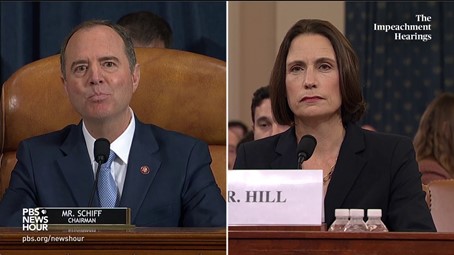
By Ray McGovern | Consortium News | November 22, 2019
Fiona Hill’s “Russian-expert” testimony Thursday and her deposition on Oct. 14 to the impeachment inquiry showed that her antennae are acutely tuned to what Russian intelligence services may be up to but, sadly, also displayed a striking naiveté about the machinations of US intelligence.
Hill’s education on Russia came at the knee of the late Professor Richard Pipes, her Harvard mentor and archdeacon of Russophobia. I do not dispute her sincerity in attributing all manner of evil to what President Ronald Reagan called the “Evil Empire.” But, like so many other glib “Russia experts” with access to Establishment media, she seems three decades out of date.
I have been studying the USS.R. and Russia for twice as long as Hill, was chief of CIA’s Soviet Foreign Policy Branch during the 1970s, and watched the “Evil Empire” fall apart. She seems to have missed the falling apart part.
Selective Suspicion
Are the Russian intelligence services still very active? Of course. But there is no evidence — other than Hill’s bias — for her extraordinary claim that they were behind the infamous “Steele Dossier,” for example, or that they were the prime mover of Ukraine-gate in an attempt to shift the blame for Russian “meddling” in the 2016 US election onto Ukraine. In recent weeks US intelligence officials were spreading this same tale, lapped up and faithfully reported Friday by The New York Times.
Hill has been conditioned to believe Russian President Vladimir Putin and especially his security services are capable of anything, and thus sees a Russian under every rock — as we used to say of smart know-nothings like former CIA Director William Casey and the malleable “Soviet experts” who bubbled up to the top during his reign (1981 – 1987). Recall that at the very first meeting of Reagan’s cabinet, Casey openly told the president and other cabinet officials: “We’ll know our disinformation program is complete when everything the American public believes is false.” Were Casey still alive, he would be very pleased and proud of Hill’s performance.
Beyond Dispute?
On Thursday Hill testified:
The unfortunate truth is that Russia was the foreign power that systematically attacked our democratic institutions in 2016. This is the public conclusion of our intelligence agencies, confirmed in bipartisan Congressional reports. It is beyond dispute, even if some of the underlying details must remain classified. [Emphasis added.]
Ah, yes. “The public conclusion of our intelligence agencies”: the same ones who reported that the Communist Party of the Soviet Union would never surrender power peaceably; the same ones who told Secretary of State Colin Powell he could assure the UN Security Council that the WMD evidence given him by our intelligence agencies was “irrefutable and undeniable.” Only Richard-Pipeline-type Russophobia can account for the blinders on someone as smart as Hill and prompt her to take as gospel “the public conclusions of our intelligence agencies.”
A modicum of intellectual curiosity and rudimentary due diligence would have prompted her to look into who was in charge of preparing the (misnomered) “Intelligence Community Assessment” published on Jan. 6, 2017, which provided the lusted-after fodder for the “mainstream” media and others wanting to blame Hillary Clinton’s defeat on the Russians.
Jim, Do a Job on the Russians
President Barack Obama gave the task to his National Intelligence Director James Clapper, whom he had allowed to stay in that job for three and a half years after he had to apologize to Congress for what he later admitted was a “clearly erroneous” response, under oath, to a question from Sen. Ron Wyden (D-OR) on NSA surveillance of US citizens. And when Clapper published his memoir last year, Hill would have learned that, as Defense Secretary Donald Rumsfeld’s handpicked appointee to run satellite imagery analysis, Clapper places the blame for the consequential “failure” to find the (non-existent) WMD “where it belongs — squarely on the shoulders of the administration members who were pushing a narrative of a rogue WMD program in Iraq and on the intelligence officers, including me, who were so eager to help that we found what wasn’t really there.” [Emphasis added.]
But for Hill, Clapper was a kindred soul: Just eight weeks after she joined the National Security Council staff, Clapper, during an NBC interview on May 28, 2017, recalled “the historical practices of the Russians, who typically, are almost genetically driven to co-opt, penetrate, gain favor, whatever, which is a typical Russian technique.” Later he added, “It’s in their DNA.” Clapper has claimed that “what the Russians did had a profound impact on the outcome of the election.”
As for the “Intelligence Community Assessment,” the banner headline atop The New York Times on Jan. 7, 2017 set the tone for the next couple of years: “Putin Led Scheme to Aid Trump, Report Says.” During my career as a CIA analyst, as deputy national intelligence officer chairing National Intelligence Estimates (NIEs), and working on the Intelligence Production Review Board, I had not seen so shabby a piece of faux analysis as the ICA. The writers themselves seemed to be holding their noses. They saw fit to embed in the ICA itself this derriere-covering note: “High confidence in a judgment does not imply that the assessment is a fact or a certainty; such judgments might be wrong.”
Not a Problem
With the help of the Establishment media, Clapper and CIA Director John Brennan, were able to pretend that the ICA had been approved by “all 17 intelligence agencies” (as first claimed by Clinton, with Rep. Jim Himes, D-CT, repeating that canard Thursday, alas “without objection).” Himes, too should do his homework. The bogus “all 17 intelligence agencies” claim lasted only a few months before Clapper decided to fess up. With striking naiveté, Clapper asserted that ICA preparers were “handpicked analysts” from only the FBI, CIA and NSA. The criteria Clapper et al. used are not hard to divine. In government as in industry, when you can handpick the analysts, you can handpick the conclusions.
Maybe a Problem After All
“According to several current and former intelligence officers who must remain anonymous because of the sensitivity of the issue,” as the Times says when it prints made-up stuff, there were only two “handpicked analysts.” Clapper picked Brennan; and Brennan picked Clapper. That would help explain the grossly subpar quality of the ICA.
If US Attorney John Durham is allowed to do his job probing the origins of Russiagate, and succeeds in getting access to the “handpicked analysts” — whether there were just two, or more — Hill’s faith in “our intelligence agencies,” may well be dented if not altogether shattered.
Featured Video

Trita Parsi: Middle East Unraveling — Are We on the Path to World War?
or go to
Aletho News Archives – Video-Images
From the Archives
Why Saudi Ties to 9/11 Mean U.S. Ties to 9/11
By Kevin Ryan | Dig Within | September 27, 2015
Media interest in Saudi Arabian connections to the crimes of 9/11 has centered on calls for the release of the 28 missing pages from the Joint Congressional Inquiry’s report. However, those calls focus on the question of hijacker financing and omit the most interesting links between the 9/11 attacks and Saudi Arabia—links that implicate powerful people in the United States. Here are twenty examples. … continue
Blog Roll
 Aletho News
- Neria Leiter Was A Legitimate Military Target
- Integrity Initiative: UK-funded network framed dissent as Russian disinformation for years
- ‘We don’t seek permission to defend our country’: Snippets from President Pezeshkian’s UNGA address
- NATO chief wants Europeans to fight American wars [for Israel]
- German chemicals giant reveals details of downsizing
- Refaat Al-Areer Was The Canary In The Coal Mine In Israel’s War On The Truth
- Israeli election committee bars candidate from Knesset race over Gaza war opposition
- French-Lebanese man files war crimes complaint over Israeli attacks
- Mahan Air Flight Lands in China Despite US Threat against Iranian Airlines
- US eyes $10bn fund to rebuild war-battered Gulf infrastructure
- If Americans Knew
- Caught on Tape: AIPAC CEO Boasted of Controlling Trump’s National Security Officials
- Why Hamas Attacked Israel in October 2023 – Israeli professor Ilan Pappé
- They see them, then kill them: Israeli quadcopters track, deliberately target civilians in Gaza
- Winter could turn Gaza’s treacherous, war-damaged buildings into deathtraps
- Majority of Democratic Voters Want to Prosecute Both Biden and Trump Administration Officials Over Gaza
- As Gaza languishes, world leaders gather at the UN – Daily Update
- Sanctions are collective punishment: immoral and self-defeating
- Phosphorus Munitions Fired by Israel Burn Groves, Orchards in Southern Lebanon
- Israel Carries Out New Ceasefire Violations Across Gaza
- AI – Emphasis on the ‘I’: Israel Is Funding AI Chatbot Propaganda
- No Tricks Zone
- New Study: Earth And Venus Surface Warmth Largely Explained By Convection And Lapse Rate, Not CO2 Or Radiation
- 2025 Nature Paper Claiming Worsening Global Drought Gets RETRACTED …Heavily Flawed
- New Study: ‘Global Drought Shows No Detectable Recent Acceleration Under Climate Warming’
- Economic Masterminds: German Socialists Suggest Taxing Productivity Gains Stemming From Using AI
- The South China Sea Has Not Been Cooperating With The Climate Change Narrative
- Energy Crisis: Germany Enters Heating Season With Historically Low Gas Reserve Fill Levels
- New Study: The Antarctic Ice Sheet Gained Mass From 2020-2024 Due To Staggering Snow And Ice Accumulation
- Study: Ocean Heating Rates From Thousands Of Years Ago ‘Dwarf’ Modern Ocean Heating Rates
- Climate Extremists Target, Attack Large-Scale Power Grid Infrastructure In Germany!
- New Study: Antarctic Ice Melt Has Contributed Less Than 1 Centimeter To Sea Level Rise In The Last 30 Years

