UK authorities continue to disseminate misinformation about the Salisbury incident through the media, hiding details of what happened, the Russian Embassy in the UK stated after the Guardian published an article speculating on the involvement of Russian authorities.
“Nearly a year and a half after the events in Salisbury with the former Russian military intelligence officer and his daughter, the Russian side never received any intelligible information about the investigation into the incident despite the more than 80 requests we sent through diplomatic channels. Trying to fill this vacuum, the British stubbornly continue to invent various stories and myths, passing them off as confirmed facts,” the embassy stated.
“All the arguments on the basis of which the so-called evidence of Russia’s involvement in this mysterious incident was built and which the former British Prime Minister Theresa May loudly stated, failed miserably. Obviously, the reason for this behaviour lies in the fact that the disclosure of all the details of this dark history is not in the interests of official London,” the statement reads.
Russian diplomats suggested that British authorities manipulated the opinion of the UK and international public through the media to keep the Salisbury theme “afloat” and “engaged in outright disinformation, spreading fake news.”
“The fact that the United States, without any incontrovertible evidence, recently introduced a second package of sanctions against Russia in connection with the events in Salisbury, eloquently speaks about who orders music in this full-scale anti-Russian campaign,” the statement from the embassy reads.
The Russian embassy was supported by the Head of the State Duma Committee on International Affairs Leonid Slutsky, who suggested that the “unprecedented scandal involving the expulsion of diplomats, sanctions against Russia, including those announced in the United States just a few days ago […] doesn’t have any basis.”
In March 2018, Skripal and his daughter Yulia were found unconscious on a bench near a shopping centre in Salisbury. London claimed they were poisoned with a military-grade nerve agent and accused Moscow of staging the attack. Moscow has repeatedly refuted all accusations. On Wednesday the Guardianreported that British police are investigating whether Russian President Vladimir Putin could have been involved in the assassination attempt on Skripal by approving a plan to eliminate him. However, according to the deputy head of Scotland Yard, Neil Basu, British law enforcement authorities have examined many hypotheses, but do not have evidence to make such allegations.
A prime function of the Public Broadcasting Service (PBS) is the reinforcement and perpetuation of the state’s explanations of events, however absurd and discredited. While cultural offerings on PBS are excellent and appreciated, divergence from official governmental narratives is not permitted. PBS is a foremost informational gatekeeper, a role enhanced by its insistence that it represents the best of investigative journalism.
American Experience: “Oklahoma City”
The official stories of the Murrah office building and 9/11 are now enshrined in memorials, the purpose of which is to make a lie the truth.
Once ‘terrorism’ had been established as the enemy for society to fear, it was to become extended from a force thought of as foreign to one also to be found in the American “Homeland”. A horrifying and convincing example of “domestic terrorism”, the bombing of the Alfred P. Murrah Federal Building in Oklahoma City on April 19,1995, was the event that would solidify this in the public mind and serve to justify increased police powers.
There is considerable evidence that the bombing of the Murrah Building was not as reported and likely involved elements of the government itself. The air force’s explosive’s expert, Brigadier General Benton Partin has presented “irrefutable” proof that the primary damage to the building came from powerful multiple charges positioned at key points on the third floor, not from Timothy McVeigh’s truck bomb of ammonium nitrate fertilizer, a relatively weak explosive. Partin’s letter to a U.S. Senator puts this in summary.
Other explosives experts agree that the building was blown up from inside, and that there was evidence of official coverup. Nevertheless, the 2017 film “Oklahoma City” focuses on the history of neo-Nazi wrath over governmental clashes at Ruby Ridge, Idaho and Waco, Texas, where U.S. citizens were killed. The film is tailored to convince viewers that right wing domestic terrorism was behind the Murrah bombing, period. But if explosives experts are correct, this must be false, as such militants would lack both technical skill and access to the building for such a sophisticated wiring job.
There are also myriad associated questions that have never been dealt with: e.g., the police officer convinced of governmental coverup who died under mysterious circumstances; indication the FBI knew of the plan well in advance; McVeigh’s claim to have been working with an FBI agent; surveillance tapes “lost” by the FBI reportedly showing a man with McVeigh exiting the truck just before the bombing; CIA involvement which would indicate foreign implication; the fact that engineers whose analysis of the Murrah bombing was to become official were also selected to analyze the 9/11/2001 destruction of the World Trade Center, and whose report was to become the basis for Nova’s 2002 “Why The Towers Fell”.
Decision makers at PBS chose to ignore all evidence not in conformity with the government’s preferred version of events and, two decades after the bombing, to solidify the apparently false history.
NOVA: “Why the Towers Fell”
All the proffered evidence that America was attacked by Muslims on 9/11, when subjected to critical scrutiny, appears to have been fabricated.
If, on 9/11/2001, journalists Dan Rather and Peter Jennings, reporting live, could discern the similarity of the collapses of the Twin Towers to intentional demolitions, one assumes the tens of thousands of engineers watching would also be having hunches. Still, there was apparently no concerted statement of the sort from that professional community in the months following. Indeed, it was from the American Society of Civil Engineers (ASCE) that a team of 22 was chosen by FEMA to explain to a shocked Nation, hungry for answers, why the Towers, as well as WTC7, fell as no steel-framed buildings had ever fallen. The resulting NOVA production, “Why The Towers Fell“, covered the team’s Building Performance Study and aired on PBS on April 30, 2002, just seven months after the attack.
The team was led by Gene Corley who, it happens, had also led the investigation of the 1995 bombing of the Alfred P. Murrah building in Oklahoma City, although his team’s finding there was not in accord with that of General Partin, the Air Force’s explosives expert (see above). In any event, “building performance” was the focus of both studies, without any consideration of the possibility that the buildings had been previously prepared for demolition, although there was evidence that such was the case.
While “Why The Towers Fell” can still be seen at dailymotion, only a transcript is available at the PBS website, this for good reason. Since its airing in 2002, a veritable army of engineers and researchers has rendered it more than merely inaccurate. One does not wish to disparage engineers in the video, for certainly pressure was intense to find a politically acceptable explanation for an anxious public. But evidence of the buildings having been prepared for demolition prior to 9/11 is by now overwhelming. Details of why this is so is not the point here, but good sources of information, for those interested, are Architects and Engineers for 9/11 Truth and virtually any of the books on the subject by David Ray Griffin.
What is glaring is the absolute silence of PBS to the accumulated mountain of evidence that the World Trade Center buildings had been carefully prepared for 9/11. In 2015, PBS showcased three Frontline presentations, all in accord with the official story, with this introduction:“Fifteen years ago, Al Qaeda operatives carried out the deadliest domestic terror attack in American history by hijacking four passenger airplanes and crashing two into the World Trade Center, one into the Pentagon and another into a Pennsylvania field”. With a single concise sentence, and a decade and a half after the event, PBS is affirming what is most certainly a false account.
American Experience: Roads to Memphis”
William Pepper, confidante of Martin Luther King, Jr. and King Family attorney, spent decades uncovering the truth about the assassination of King. In 2010, when PBS first aired Roads To Memphis, a fictional account about designated patsy James Earl Ray, Pepper had already published two books (1995 and 2003) revealing the plot to assassinate the good Reverend, a plot involving a complex of governmental, military and underworld players. It would be hard to find a more blatant example of official state television eclipsing truth than the multiple airings by PBS of Roads To Memphis.
Even the most superficial scan of the King assassination record quickly leads to Pepper’s publications and references to them. It is not possible to have missed them. The creators and disseminators of Roads To Memphis were therefore faced with two radically opposing narratives: Pepper’s detailed expose’ on the one hand, which they chose to disregard altogether, and on the other hand the Government’s story line, which Pepper had annihilated. A side-by-side comparison of the two accounts of the assassination leaves one in a state of shock. See here Pepper’s words from the introduction of the The Plot To Kill King, the last of his trilogy:
For me, this is a story rife with sadness, replete with massive accounts of personal and public deception and betrayal. Its revelations and experiences have produced in the writer a depression stemming from an unavoidable confrontation with the depths to which human beings, even those subject to professional codes of ethics, have fallen; ….. Far from being elated that the truth is now with us face-to-face, I feel consumed by a sadness that will be a lifelong emotional presence. One significant factor is facing the reality that one has misjudged the integrity and even the basic decency of individuals, some of whom have been friends or respected comrades over many years. It is a traumatic realization that the use of political assassinations has all too often been successful at removing uncontrollable leaders whose commitment to substantive change of their societies had threatened the ruling forces, and thereby become so intolerable that physical removal remained the only option.
Despite Pepper’s The Plot To Kill King having been published in 2016, PBS was still airing Roads To Memphis a year later.
FRONTLINE: “Putin’s Revenge”
The American propaganda campaign being waged against the Russian Federation and its president Vladimir Putin has reached a stage of perverse perfection…… ‘Putin’s Revenge’ feature[s] so-called experts who outdo one another in stoking anti-Russian flames. PBS can never seem to find any expert who can make counter arguments.
Following World War 2, the U.S. was relatively unscathed, her manufacturing base for war materials was humming, stakeholders were intent on maintaining it, and a perceived enemy would justify its continuance. Russia; i.e., the Soviet Union (USSR), recently an ally, had an economic system antithetical to capitalism. The Red Scare was born, nurtured and perpetuated throughout a Cold War that was to last until 1989. But Russia had suffered Nazi invasion, and with a death toll of perhaps 20,000,000, had neither ability nor reason to threaten the U.S. in 1945. Looking back, it is unpleasant to contemplate the extent to which the Cold War was U.S. driven.
With media reinforcing the ‘Russia=Enemy!’ meme, transition into the “new” Cold War has gone smoothly, but Frontline’s “Putin’s Revenge” is a remarkable 2-hour distortion of the “Russiagate” fiasco. Centered on a claimed Russian “hacking” of 60,000 emails of the Democratic National Committee, allegedly to assist the Trump presidential campaign, it begins with the CIA’s John Brennan calling the hacking “tantamount to war”, and it never departs that focus.
As the commanding voice of narrator Will Lyman details Putin’s “lifetime of grievances” against American humiliations, the Russian’s face is shown in still shots chosen for sinister innuendo. Putin, viewers are told, “weaponized” information and sent hacked DNC emails to Wikileaks to expose Clinton’s undermining of the Sanders Campaign, thereby disuniting Democrats and aiding Trump. Along the way, there is deceptive reporting of a Russian “invasion” of Crimea, and suggestion of collusion between Putin and Trump. Commentary from governmental figures is reinforced by mainstream journalists from the NY Times, New Yorker, Washington Post, Bloomberg News, and Politico.
The two hours of “Putin’s Revenge” aired on October 25 and November 1, 2017 despite an organization of intelligence professionals having already disputed hacking claims in late 2016 and published their technical assessment by July, 2017 that the DNC emails, rather than hacked, had been downloaded; i.e., “leaked”, from within the DNC itself. It strains believability that Frontline’s researchers could have missed these. Moreover, Julian Assange had long insisted that neither Russia nor any other state party was Wikileak’s source of the DNC emails, as Frontline had to have known. Records indicate that the Clinton Campaign, aware that incriminating emails were about to be made public, conspired with the DNC and media to divert attention onto a fabricated “Russian hack”, for which there was never evidence.
Ever since the U.S. promised the Soviets in 1990 that NATO would not move “one inch to the east” of Germany, NATO military activity has expanded along Russia’s western border from the Baltic to the Black Sea, the expanse over which Napoleon and Hitler carried out their respective invasions. That is the geographic equivalent of Russian bases being placed along a U.S. border. Crimea is the site of Russia’s naval base on the Black Sea, where U.S. warships have been cruising in recent years, and the northeast quadrant of which is Russian coastline. Base and coastline had to be protected without delay. In response to NATO-driven regime-change in western Ukraine, a referendum for union with Russia (not covered in the Frontline piece) was held in Crimea. Russian blood and culture dominate in Crimea, and the referendum passed by a reported 95%, hence Russia’s annexation. Frontline’s depiction of an “invasion” is beyond merely simplistic and is illustrative of why Americans are so ignorant of world affairs.
American mainstream journalism is now a tapestry of lies of omission. PBS, however, is a standout in this area, because its prominent, “in depth” productions on Nova, American Experience and Frontline are considered widely to represent the best investigative journalism available. It is this reputation that places PBS above the networks in the public mind. As PBS has willfully avoided specific areas for exploration, and has excluded truths that a governmental power structure does not want aired, it has made itself a powerful tool in the rewriting of history.
Bill Willers is an emeritus professor of biology, University of Wisconsin at Oshkosh. He is founder of the Superior Wilderness Action Network and editor of Learning to Listen to the Land, and Unmanaged Landscapes, both from Island Press. He can be contacted at willers@uwosh.edu.
Three years after the narrative we call Russiagate was framed and incessantly promoted, it crumbles into rubble as we speak. The mini-empire of allegations, presuppositions, fallacious syllogisms, leaps of logic, imagined connections and mis– and disinformation marshaled to support charges of Russian interference in the 2016 elections is more or less a ruin.
The total collapse of the Russiagate orthodoxy now appears within reach — this for the first time since the Democratic National Committee set the narrative in motion after its email servers were compromised during the Trump–Clinton presidential contest. There is a good chance — though this is not a certainty — that Attorney General William Barr’s just-launched investigation will fully expose the numerous charges of Russian intervention as fabrications. Evidence of these fabrications, long available but ignored in a remarkably prevalent case of willful blindness, continues to grow such that it may be difficult to obscure it much longer.
It is now officially acknowledged that there is no credible evidence that Donald Trump colluded with Russia to defeat Hillary Clinton in the 2016 election. At this point, the demonstrably bogus assertion that Russian intelligence hacked into the DNC’s email system in mid–2016 is the one remaining feature of the Russiagate orthodoxy that is commonly considered rock solid.
The mythology on this question remains deeply embedded, the absence of any supporting evidence notwithstanding. Press and broadcast reports rarely miss an opportunity to cast Russian responsibility for the DNC email intrusion as a foregone conclusion. But this, too, is a tower built on sand. To put Russiagate decisively in the past now comes to demolishing this last, unsound edifice. The rest is already too discredited for anyone but naïve liberals, wishful-thinking “progressives” and the most committed ideologues to take seriously.
This focuses attention on the evidence — considerable and accumulating — that Russian intelligence agencies, officially charged with intrusion into the DNC’s servers, had nothing to do with it. It is now two years since technically qualified intelligence professionals of long experience reported via Consortium News that the theft of Democratic Party email in 2016 was neither a hack nor a Russian intelligence operation. In July 2017 Veteran Intelligence Professionals for Sanity presented persuasive evidence that the DNC’s servers had been compromised by someone with direct access to them.
The email messages subsequently posted by WikiLeaks had been pilfered by an insider of unknown identity: This was the conclusion VIPS drew in VIPS50, the group’s report on the mail incident, on the basis of the evidence it had gathered while working with other independent forensic investigators. The “hack,” in short, was not a hack. It was a leak.
A cacophony of objections erupted after Consortium posted VIPS50. Much — vastly too much — has been made of a group of “dissenters” within the VIPS organization who did not endorse the report. But neither these dissenters nor the many others attempting to discredit VIPS50 have succeeded in doing so. No countervailing evidence from any quarter has been presented. Based on continuing research, VIPS subsequently altered some of its initial conclusions, as noted in this space a year ago. But its principal findings stand.
VIPS50
This puts VIPS50, while still officially excluded from the record, among the most consequential documents to be published since the Russiagate narrative took shape three years ago. If we are to recover from the destructive, divisive nightmare Russiagate has become, VIPS50 will be key to the process. There are indications now that its findings, based on impartially conducted data analysis and forensic science, will soon get the consideration they have deserved from the first. My sources suggest Barr’s office is making use of VIPS report and subsequent findings as it begins its investigation into the genesis of the Russiagate allegations.
Much anticipation preceded the publication in mid–April of the report on Russian interference completed in the office of Special Counsel Robert Mueller. Contrary to prevalent expectations, however, the 448–page document failed to confirm the case for Russiagate and did much to weaken it. Not only did the report conclude that neither President Trump nor anyone in his campaign colluded with Russia as he fought the 2016 election; it also made clear that the special counsel’s office did not undertake a credible investigation of the charge that Russian intelligence hacked the DNC’s mail servers.
Mueller failed to call numerous key witnesses, among them Julian Assange, the WikiLeaks founder and publisher, and Bill Binney, formerly a technical director at the National Security Agency and one of several technical experts in the VIPS group. He also failed to pursue alternative theories in the email-theft case; a duty of any investigator in Mueller’s position. Only the willfully blind can accept these irregularities as legitimate conduct.
Remarkably enough, Mueller’s investigation appears to have conducted no forensic tests of its own to verify allegations of a Russian hacking operation. It relied instead on the patently faulty findings of Crowdstrike, the disreputable cyber-security firm that was working for the DNC by mid–2016. Critically, the special counsel also appears to have neglected to consult the NSA for evidence pertaining to the DNC incident. Had the intrusion been a hack conducted over the internet, by Russians or anyone else, the agency would have a fully detailed digital record of the operation and the means to trace the intervention to its perpetrators. Why, it is perfectly logical to ask, was such a record not cited prominently in the Mueller report?
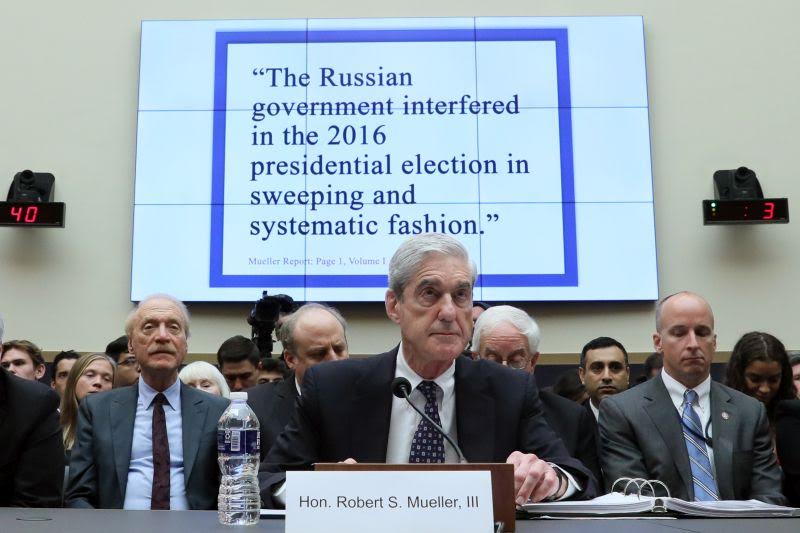
Mueller’s testimony before two congressional committees on July 24 was a further blow to the Russiagate thesis. The special counsel came over as a detached, out-of-touch figurehead with a very loose grip on his own investigation and poor knowledge of the report bearing his signature. Soon afterward, even Trump’s adversaries in the Democratic camp began to give up the ghost. “In the hours and days after Mr. Mueller gave his opening statement before the House Judiciary Committee,” wrote Samuel Moyn, a Yale law professor, “it became clear how tenaciously many liberals and progressives are clinging to fantasy.” Moyn’s piece appeared in The New York Times. The headline reads, “The Mueller Fantasy Comes Crashing Down.”
Despite the stunningly anticlimactic outcome of the Mueller report and his subsequent appearance on Capitol Hill — which was intended from the first to be a matter of spectacle rather than substance — new allegations of Russian interference continue to arrive on front pages and in news broadcasts. The latest came the day after Mueller’s testimony, when the Senate Intelligence Committee reported that Russia intruded into the election systems of all 50 states during the 2016 campaigns. The report offered no supporting evidence, per usual. It was heavily redacted at the request of the relevant intelligence agencies, again per usual.
Question of Evidence
This brings us to the question of evidence. To go back to the initial allegations of Russian interference three years ago, at no point since have any of these commonly accepted charges been accompanied by hard, legally and logically sound evidence to back them up. This astonishing lacuna, while intently papered over in the media, on Capitol Hill, at the Justice Department, in the intelligence apparatus, and among law-enforcement agencies, has rendered the Russiagate orthodoxy vulnerable from the first. It now emerges that the evidence problem is worse than even the most committed critics of the Russiagate narrative had thought.
This came to light this spring, during the pre-trial discovery phase of the case against Roger Stone, the onetime Trump aide charged with obstructing justice and misleading Congress. When Stone’s attorneys requested Crowdstrike’s final report on the DNC email theft, which they said was relevant to his defense, prosecutors returned with the stunning revelation that Crowdstrike, the DNC’s cyber-security firm, never submitted a final report. “The government does not possess the information the defendant seeks,” the Justice Department responded via a court filing.
The Federal Bureau of Investigation’s failure to take possession of the DNC’s email servers from Crowdstrike after the mid–2016 intrusion, a shocking case of official malfeasance, has long been dismissed as an unimportant detail. We now know that the FBI, the Justice Department and the Mueller investigation relied on nothing more than three Crowdstrike drafts — all of them redacted by Crowdstrike — to build the case for Russia’s culpability in the theft of the DNC’s email.
Not only did the FBI fail to establish a proper chain of evidentiary custody after the incident at the DNC; it is now clear the bureau knows of the email theft only what Crowdstrike chose to tell it. There is no evidence that the FBI asked the NSA for its records of the incident. Nor is there any indication that Crowdstrike has ever given the FBI or prosecutors in the Stone case the data it used to produce its never-completed report. “Crowdstrike appears to have destroyed evidence or is hiding it,” Bill Binney said in a telephone interview.
The corporate media continue to pretend in their press reports and news broadcasts that the official investigation of the DNC email incident was conducted according to the highest standard of legitimacy. Democrats on Capitol Hill, still pursuing their own investigations, never question the validity of the officially constructed case alleging Russia’s responsibility. The revelation of negligence the Stone trial brings to light, which amounts to corruption, could hardly expose this prolonged charade more starkly.
Forensic investigators, meantime, continue to gather evidence supporting the leak-not-hack case made in VIPS50. The gap thus widens between the official story of the DNC mail incident and the case supported by forensic research done by VIPS and other independent investigators working in association with it.
Last February these investigators discovered that email pilfered in 2016 and subsequently conveyed to WikiLeaks had been stored according to a system called File Allocation Table, or FAT. The FAT system time-stamps data according to their last modifications and, because it is less precise than other storage systems, it rounds up time stamps to the next even number. If the FAT system is used to store data, it is a strong indication that the data were stored on a memory key or another such portable device.
In the 35, 816 email messages investigators examined, the FAT system assigned even-numbered time stamps to all of them. Binney, a mathematician by training, puts the chance of this occurring without the use of a portable storage device at 1 in 2 to the 35,816thpower — meaning it is a virtual impossibility.
The FAT numbering pattern detected in the email messages tested does not indicate at what stage or where a portable device was used. It shows only that such a device was used at some point in the handling of the data; a portable device may or may not have been used to execute the initial download. But the presence of the FAT system in the metadata of the emails tested adds another layer of circumstantial evidence supporting the VIPS case that the theft of DNC mail was a leak executed locally via a portable device and not a remote hack conducted through the internet. At the very least, it is an additional line of inquiry the FBI, the intelligence agencies, and the Mueller investigation have left unexamined.
VIPS Dissenters
Among the critics of VIPS50, none has influenced public opinion as much as the dissenters within the group’s membership. The presence of these dissenters has been evident since VIPS50 went through repeated drafts over a period of nearly two weeks. This is a group of honorable, in many cases brave people. But they advanced no coherent objections to the VIPS document prior to its publication, and this remained the case for some time after Consortium News posted it on July 24, 2017. Having begun reporting on VIPS50 shortly after that date, I found — and continue to find — the dissenters’ position heavily inflected with personal animosities and political leanings having no bearing on the validity of the VIPS50 findings.
A number of dissenters signed a contribution to a forum The Nation hosted after the magazine published a piece I wrote on VIPS50 in August 2017. This was the first time the dissenters publicly presented substantive objections to VIPS50, and they focused on the core of the VIPS case. This case continues to rest primarily on the speed at which a mail theft could be executed in mid–2016. The transfer speed, identified by an analysis of metadata found on documents stolen at that time, was considerably faster than the rate possible over the internet at the time of the intrusion, indicating a leak by someone using a portable storage device and with direct access to the DNC’s servers.
The dissenting group took specific issue with these findings. “Data-transfer speeds across networks and the Internet measured in megabits per second (or megabytes per second) can easily achieve rates that greatly exceed the cited reference in the VIPS memo,” the dissidents wrote.
It was at this point the dissenters repeated the failures of the intelligence apparatus and the Mueller investigation: They produced no evidence. There is no indication the dissenters conducted tests to support their assertion on the speed question. The VIPS memo applied scientific method to the DNC mail theft for the first time and was intended as an “evidence to date” document. This marked a transformative advance in how the DNC incident can be understood: The imperative since has been to bring countervailing evidence to the investigative process, which continues. No one —not the dissenters, not the DNC, not the “intelligence community,” not Mueller, not the press — has done so.
The dissenters have been silent since their contribution to The Nation’s forum. Members have declined invitations to work with VIPS50 signatories to develop further the evidence presented in the memo. When I queried a number of dissenters for this commentary, one replied. This person did not address the findings of forensic investigators while reproducing what VIPS50 signatories term the “emotional arguments” that have characterized the dissenters’ response to the memo since the drafting phase two summers ago. These continuing difficulties appear partly to reflect a desire not to be seen defending either Trump or the Russians.
Barr’s Investigation
The NSA, the CIA, the FBI, the Mueller investigation, the press — none has shown the slightest interest in the findings outlined in VIPS50. This can come as no surprise, given the heavy investments all of these entities have made in the Russians-did-it explanation of the DNC email incident. But this omission is nonetheless negligent when one considers the contradicting evidence VIPS and those associated with it continue to amass. A key question now arises: Will the Barr investigation into the genesis of allegations of Russian interference, begun three months ago, transcend this politically inspired ignorance to expose official accounts of the mid–2016 mail theft as fallacies?
The early signs were that Barr’s investigators would at last explode the Russiagate narrative. Trump was unmistakably determined to do so when he urged Barr to “investigate the investigators” last spring. In mid–May Barr appointed John Durham, a federal prosecutor, to direct this effort. Ten days later Trump gave Barr “full and complete authority to declassify information” related to the conduct of the intelligence agencies, the FBI, and the Justice Department.
It was clear very early that Trump was aware of VIPS50 and entertained a lively interest in its findings. In September 2017, two months after Consortiumpublished the memo, he ordered Mike Pompeo, then director of the CIA, to interview Bill Binney, the leading technical expert within the VIPS group. Pompeo did so in October 2017, but by Binney’s account he flinched: Pompeo heard Binney out at the president’s insistence, but he never pursued the forensic findings the former NSA technical director walked him through.
This was an early sign, it is now plain, that even efforts to unearth the truth of the allegations against Russia that emanate from the White House would meet political resistance. Another came last Friday, when Trump was forced to drop John Ratcliffe, a Texas Republican who pledged to support a full investigation of Russiagate, as his nominee to replace Dan Coats as director of national intelligence. While Ratcliffe considered the orthodox Russiagate narrative bogus, Coats was vigorous in his promotion of it.
This makes political will another key question to ask of the Barr investigation: Full exposure of the travesty of Russiagate is almost certainly within Barr’s power to achieve. Will he do so?
Whether Trump will remain consistent in his backing of Barr is another such question. While Trump habitually terms Russiagate “a hoax,” he has also indicated on a number of occasions that his true objective is simply to escape the charge that he colluded with Russians to win the 2016 election. “I never said Russia did not meddle in the election,” Trump tweeted earlier this year. “I said, ‘It may be Russia, or China, or another country or group, or it may be a 400–pound genius sitting in bed and playing with his computer.’ The Russian ‘hoax’ was that the Trump campaign colluded with Russia—it never did!”
A president who slips and slides, an administrative state — the Deep State if you like — thoroughly committed to defending falsified accounts of the mid–2016 intrusions into the DNC’s email servers, a supine press: It is impossible to say when or whether the truth of the events of three years ago will emerge. The evidence is there, sufficient now to conclude the Russigate case. The greatest remaining obstacle is the willful ignorance that incubated the Russiagate narrative and now prolongs it. We reach a point when evidence and more evidence, along with political integrity, are the only effective replies to this cynical, foolish, and costly recalcitrance.
Patrick Lawrence, a correspondent abroad for many years, chiefly for the International Herald Tribune, is a columnist, essayist, author and lecturer. His most recent book is “Time No Longer: Americans After the American Century” (Yale). Follow him on Twitter @thefloutist. His website is Patrick Lawrence.
Milan – A meeting with Russians, allegations of corruption, and a call for a leading politician to resign. Russiagate has come to Italy.
A representative of the League — the right-wing anti-establishment party now part of the country’s governing coalition — is alleged to have floated a scheme for his party to receive 65 million euros ($73 million) in illegal financing, skimmed off the top of oil sales from Russia.
Gianluca Savoini, a long-time League member, was recorded during a conversation in the public lounge of Moscow’s Metropol Hotel on Oct. 18, 2018, talking to three still-unidentified Russians about how to channel money to his political party.
Prosecutors in Milan have opened an investigation, while Deputy Prime Minister and League leader Matteo Salvini has denied any knowledge of the alleged plot.
The recording of Savoini’s conversation in Moscow was published by Buzzfeed in early July. The League and other nationalist parties in Europe, have long been subject to U.S. intelligence suspicions of getting help from Russia and Buzzfeed reporter Alberto Nardelli presents the Metropol recording as the “first hard evidence” of this. He writes that the conversation confirms suspicions that have been present for years of “Russia’s clandestine attempts to fund Europe’s nationalist movements.” (Nardelli admits that an earlier Austrian case involving a nationalist politician was “a sting,” but says the Savoini meeting “bears all the hallmarks of a real negotiation.”)
Nardelli assumes the Russian government was behind the operation — although no proof has been presented of this — and writes that “the real goal was to undermine liberal democracies and shape a new, nationalist Europe aligned with Moscow.” Nardelli presents Salvini, whom the unidentified Russians at the meeting call the “European Trump,” as under Putin’s thumb, representing a key asset for the Russian leader because of Salvini’s recent electoral victory.
A weakness in the allegation of illicit financing, however, is that the scheme allegedly discussed would have involved sales from a Russian company (Rosneft or Lukoil) to the Italian state oil company ENI, to be processed through the Russian branch of the Italy’s largest bank, Intesa Sanpaolo and both Italian companies strongly deny any knowledge of the proposed scheme. Given their importance to the country’s economy and institutions, they represent interests that go far beyond the League’s control.
Fallout for the League
The investigation is proceeding rapidly, both in the courts and in the press, and is likely to focus on the close ties developed between League operators and Russian political and economic actors. Italian investigators are seeking anything that looks suspicious, even if plans weren’t implemented.
The allegations have caused considerable political fallout in Italy, putting Salvini – a firebrand who has become Italy’s most polarizing politician — on the defensive. The opposition Democratic Party (Pd) has called for his resignation. More importantly, the League’s coalition partner, the Five-Star Movement (M5S) — which took a drubbing in the May 26 European elections, while the League doubled its vote total and became the top party in Italy — now seems intent on exploiting Salvini’s moment of weakness to regain momentum.
The two parties have not reached a full-blown crisis. But the League appears to be getting backed into a corner and the risks of a fall are raised for Europe’s only populist government that has fully supplanted traditional ruling parties, based on its sharp criticism of EU policies on limiting social spending and public investment.
Such a result would be welcomed by the Western liberal establishment in general, but could open the door for an even more aggressive form of populism in the future. Early indications are that even the latest scandal has not cut into the League’s support, which continues to grow in the polls.
Other Cases Brought to Mind
The case follows that of former Austrian Vice-Chancellor Heinz-Christian Strache, who also challenged the mainstream view of Russia as an imminent threat to the West.
In 2017, before his right-wing party entered the government, Strache was filmed, while drinking heavily, promising public contracts to a woman claiming to be the niece of a Russian oligarch in exchange for funding for his party. As Spiegel online, one of the German press outlets that published the video, reported: “The meeting was a trap.” The woman was not who she said she was, and the video ended up being used to bring about the fall of the Austrian government. Strache claims he was set up by a foreign intelligence service.
Heinz-Christian Strache in 2008. (Christian Jansky, CC BY-SA 3.0, Wikimedia Commons)
The film was published in May with the desired effect: Strache was forced to resign, putting pressure on rightwing political parties that have been critical of the EU’s decision to maintain sanctions on Russia, such as the League, the National Rally in France and Alternative for Germany.
Of course the prime example of discrediting by association with Moscow is Russiagate.
As former CIA analyst Larry C. Johnson has documented in detail, the numerous contacts between people around President Donald Trump and intermediaries offering damaging information on former Secretary of State Hillary Clinton, or contacts for political or business operations in Russia, were initiated and promoted not by Trump’s side, but by individuals who in many cases have worked for the FBI, the CIA, or the British intelligence service MI-6.
Grounds for Skepticism
Read in light of that precedent, Buzzfeed’s coverage of Savoini’s conversation in Moscow gives grounds for skepticism.
Buzzfeed has been listed as a media target for reports and studies by the “Integrity Initiative,” a British government-funded network of spies, journalists and think-tanks in the United Kingdom that has targeted politicians and other public figures who are alleged to be too pro-Russian.
Section of Integrity Initiative “handbook” published by the Anonymous hactivist group in November 2018 about the group’s media strategy where Buzzfeed is named.
At the end of 2018, British Member of Parliament Chris Williamson responded to revelations about the Integrity Initiative’s media-influence activities by demanding answers about government funding for the group’s targeting of Labour Party Leader Jeremy Corbyn, another politician who often goes against the neoconservative and neoliberal mainstream, this time on the left.
Buzzfeed also has a blemished history with other Russian-meddling allegations. In January, Buzzfeed reporters Jason Leopold and Anthony Cormier authored the bombshell article, “President Trump Directed His Attorney Michael Cohen To Lie To Congress About The Moscow Tower Project.” Former Special Counsel Robert Mueller’s spokesman promptly called the report “not accurate,” but not before it had been picked up by many large media outlets.
Scandal Hits at Delicate Time
The Italian Russiagate comes at a delicate time. The League has long stated its intention to fight for the removal of sanctions against Russia over Ukraine, and in the past has even called for recognizing the 2014 referendum by which Crimea joined Russia, a move considered unacceptable by NATO countries.
From my own contacts in Italy, I know that these positions have, in recent years, worried U.S. diplomats who saw that Salvini’s party was on the rise and were wary of his pro-Russia stance. In response, they did their best to cultivate a relationship with League leaders, with the aim of cooling the party’s attitude towards Moscow in the event it made its way into government, as happened.
Italian Deputy Prime Minister Matteo Salvini, on left, with U.S. Secretary of State Michael R. Pompeo, in D.C., June 17, 2019. (State Department/Michael Gross)
The strategy seems to have worked, for the most part: now that the League is one of the two parties governing the country, it has stopped talking about Crimea, and has not blocked continued EU sanctions on Russia. In June, the European Council, which includes the Italian prime minister, extended the sanctions for another year.
The League has also taken public steps to reassure the United States of its loyalty to the Atlantic Alliance, after concerns were raised about Italy’s position when it became the first G-7 country to formally join the Chinese-led Belt and Road Initiative in March. After that, Salvini and Chief of Staff Giancarlo Giorgetti moved quickly to dampen fears in Washington about Italy distancing itself from Washington.
On the other hand, a state visit to Italy by Russian President Vladimir Putin at the beginning of July showed that Italian institutions are still eager to maintain good relations with Russia.
The Italians hope to leverage Trump’s desire for a shift towards Russia, while still swearing their allegiance to whatever other line comes out of Washington.
After Salvini’s June 17 meeting with Pompeo and Vice President Mike Pence in Washington, the Italian press reported that the Americans want to see more in terms of alignment not only on Russia, but also on Venezuela, Iran, and China.
Paolo Mastrolilli of the daily La Stampa wrote (in Italian) that Pompeo played the hard cop in the meetings, and intends to wait to see if Salvini will keep his promises to stay in line with the State Department before further advancing relations. Mastrolilli also reported that Pompeo is worried by reports that the League may have received help from the Kremlin.
Andrew Spannaus is a journalist and political analyst based in Milan, and the elected chairman of the Milan Foreign Press Association. His latest book is “Original Sins. Globalization, Populism, and the Six Contradictions Facing the European Union,” published in May 2019.
Douglas Adams famously suggested that the answer to life, the universe and everything is 42. In the world of the political elite, the answer is Russiagate. What has caused the electorate to turn on the political elite, to defeat Hillary and to rush to Brexit? Why, the evil Russians, of course, are behind it all.
It was the Russians who hacked the DNC and published Hillary’s emails, thus causing her to lose the election because… the Russians, dammit, who cares what was in the emails? It was the Russians. It is the Russians who are behind Wikileaks, and Julian Assange is a Putin agent (as is that evil Craig Murray). It was the Russians who swayed the 1,300,000,000 dollar Presidential election campaign result with 100,000 dollars worth of Facebook advertising. It was the evil Russians who once did a dodgy trade deal with Aaron Banks then did something improbable with Cambridge Analytica that hypnotised people en masse via Facebook into supporting Brexit.
All of this is known to be true by every Blairite, every Clintonite, by the BBC, by CNN, by the Guardian, the New York Times and the Washington Post. “The Russians did it” is the article of faith for the political elite who cannot understand why the electorate rejected the triangulated “consensus” the elite constructed and sold to us, where the filthy rich get ever richer and the rest of us have falling incomes, low employment rights and scanty welfare benefits. You don’t like that system? You have been hypnotised and misled by evil Russian trolls and hackers.
Except virtually none of this is true. Mueller’s inability to defend in person his deeply flawed report took a certain amount of steam out of the blame Russia campaign. But what should have killed off “Russiagate” forever is the judgement of Judge John G Koetl of the Federal District Court of New York.
In a lawsuit brought by the Democratic National Committee against Russia and against Wikileaks, and against inter alia Donald Trump Jr, Jared Kushner, Paul Manafort and Julian Assange, for the first time the claims of collusion between Trump and Russia were subjected to actual scrutiny in a court of law. And Judge Koetl concluded that, quite simply, the claims made as the basis of Russiagate are insufficient to even warrant a hearing.
The judgement is 81 pages long, but if you want to understand the truth about the entire “Russiagate” spin it is well worth reading it in full. Otherwise let me walk you through it.
This is the crucial point about Koetl’s judgement. In considering dismissing a case at the outset in response to a motion to dismiss from the defence, the judge is obliged to give the plaintiff every benefit and to take the alleged facts described by the DNC as true. The stage of challenging and testing those facts has not been reached. The question Koetl is answering is this. Accepting for the moment the DNC’s facts as true, on the face of it, even if everything that the Democratic National Committee alleged happened, did indeed happen, is there the basis for a case? And his answer is a comprehensive no. Even the facts alleged to comprise the Russiagate narrative do not mount up to a plausible case.
The consequence of this procedure is of course that in this judgement Koetl is accepting the DNC’s “facts”. The judgement is therefore written entirely on the assumption that the Russians did hack the DNC computers as alleged by the plaintiff (the Democratic National Committee), and that meetings and correspondence took place as the DNC alleged and their content was also what the DNC alleged. It is vital to understand in reading the document that Koetl is not stating that he finds these “facts” to be true. Doubtless had the trial proceeded many of them would have been challenged by the defendants and their evidentiary basis tested in court. It is simply at this stage the only question Koetl is answering is whether, assuming the facts alleged all to be true, there are grounds for trial.
Judge Koetl’s subsequent dismissal of the Russiagate nonsense is a problem for the mainstream media and their favourite narrative. They have largely chosen to pretend it never happened, but when obliged to mention it have attempted to misrepresent this as the judge confirming that the Russians hacked the DNC. It very definitely and specifically is not that; the judge was obliged to rule on the procedural motion to dismiss on the basis of assuming the allegation to be true. Legal distinctions, even very plain ones like this, are perhaps difficult for the average cut and paste mainstream media stenographer to understand. But the widespread failure to report the meaning of Koetl’s judgement fairly is inexcusable.
The key finding is this. Even accepting the DNC’s evidence at face value, the judge ruled that it provides no evidence of collusion between Russia, Wikileaks or any of the named parties to hack the DNC’s computers. It is best expressed here in this dismissal of the charge that a property violation was committed, but in fact the same ruling by the judge that no evidence has been presented of any collusion for an illegal purpose, runs through the dismissal of each and every one of the varied charges put forward by the DNC as grounds for their suit.
Judge Koetl goes further and asserts that Wikileaks, as a news organisation, had every right to obtain and publish the emails in exercise of a fundamental First Amendment right. The judge also specifically notes that no evidence has been put forward by the DNC that shows any relationship between Russia and Wikileaks. Wikileaks, accepting the DNC’s version of events, merely contacted the website that first leaked some of the emails, in order to ask to publish them.
Judge Koetl also notes firmly that while various contacts are alleged by the DNC between individuals from Trump’s campaign and individuals allegedly linked to the Russian government, no evidence at all has been put forward to show that the content of any of those meetings had anything to do with either Wikileaks or the DNC’s emails.
In short, Koetl dismissed the case entirely because simply no evidence has been produced of the existence of any collusion between Wikileaks, the Trump campaign and Russia. That does not mean that the evidence has been seen and is judged unconvincing. In a situation where the judge is duty bound to give credence to the plaintiff’s evidence and not judge its probability, there simply was no evidence of collusion to which he could give credence. The entire Russia-Wikileaks-Trump fabrication is a total nonsense. But I don’t suppose that fact will kill it off.
The major implication for the Assange extradition case of the Koetl judgement is his robust and unequivocal statement of the obvious truth that Wikileaks is a news organisation and its right to publish documents, specifically including stolen documents, is protected by the First Amendment when those documents touch on the public interest.
…
These arguments are certainly helpful to Assange in the extradition case. But it must be noted that the extradition request has been drafted to try to get round the law by alleging that Wikileaks were complicit in the actual theft of documents by Chelsea Manning. Judge Koetl does not address this question as he was presented with no evidence that Wikileaks had contact with the “hackers” prior to their obtaining the documents, so the question did not arise before him. In the extradition request, the attempt is to argue that Assange encouraged and abetted Manning in obtaining the material. This is supposed to be a different argument.
In fact this attempt to undermine the First Amendment has no merit. Cultivation of an insider source is a normal part of journalistic activity, and encouraging an official to leak material in the public interest is an everyday occurrence in such cultivation. In the “Watergate” precedent, for example, the “Deep Throat” source, Mark Felt of the FBI, was cultivated and encouraged over a period by Bernstein. In addition to which, Manning’s access to the documents could not be characterised as “theft”. Leaking of official secrets by an insider is a very different thing to a hack from outside.
And in conclusion, I should state emphatically that while Judge Koetl was obliged to accept for the time being the allegation that the Russians had hacked the DNC as alleged, in fact this never happened. The emails came from a leak not a hack. The Mueller Inquiry’s refusal to take evidence from the actual publisher of the leaks, Julian Assange, in itself discredits his report. Mueller should also have taken crucial evidence from Bill Binney, former Technical Director of the NSA, who has explained in detail why an outside hack was technically impossible based on the forensic evidence provided.
The other key point that proves Mueller’s Inquiry was never a serious search for truth is that at no stage was any independent forensic evidence taken from the DNC’s servers, instead the word of the DNC’s own security consultants was simply accepted as true. Finally no progress has been made – or is intended to be made – on the question of who killed Seth Rich, while the pretend police investigation has “lost” his laptop.
Though why anybody would believe Robert Mueller about anything is completely beyond me.
So there we have it. Russiagate as a theory is as completely exploded as the appalling Guardian front page lie published by Kath Viner and Luke Harding fabricating the “secret meetings” between Paul Manafort and Julian Assange in the Ecuadorean Embassy. But the political class and the mainstream media, both in the service of billionaires, have moved on to a stage where truth is irrelevant, and I do not doubt that Russiagate stories will thus persist. They are so useful for the finances of the armaments and security industries, and in keeping the population in fear and jingoist politicians in power.
London, along with the US and other western states, has repeatedly accused Moscow of using social media platforms to sow discord and division in the West, while presenting no proof to substantiate the claims. Russia has denied these accusations on multiple occasions.
The British Army has decided to assemble experts in cyberwarfare and intelligence to form a 14,500-strong 6th Division that will focus on countering Russia’s alleged “malign activity” online, as well as cyber threats coming from groups like Daesh, The Telegraph reported.
According to Commander of the Field Army Lieutenant General Ivan Jones, cited by the newspaper, the new force will be engaging in “information warfare” in a bid to influence not only British adversaries, but also public opinion. Jones brought up recent scandals involving a UK contingent in Croatia as a justification for the move. According to Croatian media reports some British servicemen had unsuccessfully attempted to abduct a minor and were confronted by local residents.
“What happened was that a handful of incidents that happened after the exercise, regrettable stories of soldiers accused of vandalism or urinating in public, were exaggerated online locally and began to appear in local media. We need people on the ground from the new 6th Div who can quickly counter that”, Jones said.
The 6th Division will not just be reacting to “attacks” against the UK on social media, but conducting its own “proactive” offensives, The Telegraph noted. The media outlet cited unnamed army sources, who claimed that deliberate disinformation campaigns, which were organised on Daesh-controlled territories in the past, yielded “great effect” in damaging the terrorist organisation’s positions, but failed to give any specifics.
Jones stated that the new army formation would operate “above and below the threshold of conventional conflict”, as, according to him, the boundaries between conventional and unconventional warfare have become barely distinguishable.
UK Allegations Against Russian Media
The UK, along with many other western states, have repeatedly accused Russia of organising disinformation campaigns on social and regular media platforms, although Moscow has repeatedly denied doing so, pointing out that no credible proof was presented to substantiate such claims. London, in particular, claimed that Moscow had used internet trolls to affect the outcome of the Brexit referendum.
The investigation of these claims, however, yielded no proof with then Foreign Secretary Boris Johnson saying that no signs were found that Russia meddled in the 2016 vote. Furthermore, internal probes by both Facebook and Twitter also didn’t reveal any organised campaign to affect the Brexit referendum’s outcome.
The latest move against the Russian media involved the UK Foreign Office denying accreditation to Sputnik and RT for the Global Conference for Media Freedom over allegedly “spreading disinformation”. Moscow slammed the decision arguing that it’s impossible to conduct a conference on media freedom, while banning journalists from it at the same time.
In a separate incident, British broadcast regulator Ofcom imposed a fine on Russia-based RT for allegedly breaking the rules by “failing to preserve due impartiality” in its news programmes.
UK and US claims about ‘Russian meddling’ in the Brexit referendum and the 2016 US presidential election are nothing new, with recently appointed UK Prime Minister Boris Johnson saying he has “no evidence of Russian interference” in Brexit, and President Trump repeatedly accusing opponents of using Russiagate to try to stage a ‘coup’ against him.
An unnamed ‘informed source’ has toldThe Guardian that in 2016, now retired FBI deputy director Andrew McCabe and his British counterpart Jeremy Fleming, then serving as deputy director general of the UK’s Government Communications Headquarters (GCHQ), exchanged a series of texts about possible Russian interference in the Brexit vote, and alleged collusion between the Trump presidential campaign and the Kremlin.
Butting In on Brexit
According to the newspaper’s source, McCabe and Fleming were surprised by the results of June 2016 EU referendum, and indicated this sentiment in their back and forth texts, with US officials said to have called the referendum results a “wake-up call” about the success of alleged Russian efforts to meddle in UK politics.
The claims run contrary to statements made by Boris Johnson, who, during his tenure as foreign secretary, said that he saw “no evidence’” of any successful Russian meddling in Britain’s democratic process, or the Brexit referendum. Moscow similarly dismissed the meddling claims, saying those who made them have offered zero substantiated evidence.
Following the referendum, UK lawmakers asked authorities to investigate the scale of alleged Russian meddling, with media reporting on massive troll farm operations on Facebook and Twitter reportedly trying to influence the vote by posting pro-leave messages from fake users. However, last month, Facebook said that there was “absolutely no evidence” that Russia swayed the 2016 vote in any way, reiterating statements the company has been making since 2017. In 2018, Twitter also challenged claims of a Russian troll influence campaign, reporting that just some 49 accounts thought to originate in Russia posted tweets about Brexit ahead of the vote, making up just 0.005 percent of accounts tweeting about the referendum.
Trump Collusion Claims
According to The Guardian’s source, after the Brexit vote, the McCabe-Fleming texts turned to talk of Russian meddling in the US election, with one text from August 2016 referring to a meeting between members of the FBI and MI5 to discuss “our strange situation,” in reference to the alleged collusion situation.
The off-again-on-again messages, most of them cryptic and avoiding reference to any specific details, are “new insights into the start of the FBI’s Russia investigation, and how British intelligence appears to have played a key role in the early stages,” the newspaper suggested.
The FBI opened a secretive counterintelligence operation codenamed ‘Crossfire Hurricane’ into possible links between the Trump campaign and Russia in July 2016, at the same time that the senior FBI and GCHQ officials were supposedly exchanging their texts, with that investigation soon rolling over into the Mueller probe.
Claims about possible Trump-Russia collusion finally collapsed in April 2019, after special counsel Robert Mueller released a 448-page report following a two year investigation, showing that he could find no evidence that anyone from the Trump campaign knowingly colluded with any Russians. As with the Brexit case two years earlier, the ‘evidence of Russian meddling’ presented in the report again boiled down to alleged Russian troll farms; however, these claims by Mueller were themselves debunked for being misattributed, and grossly ineffective, given, for example, that the so-called trolls posted over half of the messages supposedly aimed at influencing the US election in Russian.
The Democrats’ collusion claims took another hit last week during Mueller’s testimony to Congress, and his failure to provide any grounds to revive the Russiagate claims.
McCabe’s Conflict With Trump, UK’s Role in Russiagate
A spokesman for McCabe declined to comment on The Guardian’s piece. The official temporarily served as Trump’s acting director of the FBI for several months in 2017, after James Comey’s dismissal. McCabe was fired in 2018 by then Attorney General Jeff Sessions after being charged with making unauthorised releases of information to the media, and of misleading agents who questioned him about it. McCabe has since proposed that Trump’s cabinet suspend the president from office over his alleged obstruction of justice and work “on behalf of Russia against American interests.” Trump and his allies have blasted such proposals as a call for a “coup” against the elected president.
Since his reported communications with McCabe in 2016, Fleming has been promoted, and now serves as director of the GCHQ.
The UK’s activity in the early stages of the Trump-Russiagate investigation has been put under the spotlight in recent months after it was reported that the so-called Steele dossier, created by former British intelligence officer Christopher Steele, was vetted by MI5 and MI6 ahead of its release. Steele made a variety of bizarre claims about Trump’s suspected ties with Russia, including allegations that Russian intelligence had compromising information on him, forcing him to do their bidding. That report was thoroughly discredited by US media shortly after its release.
Arguments by the Democratic National Committee in a lawsuit against Russia, WikiLeaks and the Trump campaign over the 2016 election were “entirely divorced” from facts, a federal judge in New York said as he threw out the case.
The DNC sued in April 2018, claiming that the Trump campaign welcomed “help” from Russia and WikiLeaks, who stole and published the party’s emails in an effort to sway the US electorate during the 2016 presidential election, in which Donald Trump defeated Democrat Hillary Clinton. On Tuesday, US District Judge John Koeltl disagreed.
The DNC “raises a number of connections and communications between the defendants and with people loosely connected to the Russian Federation, but at no point does the DNC allege any facts … to show that any of the defendants – other than the Russian Federation – participated in the theft of the DNC’s information,” Koeltl wrote in the 81-page opinion dismissing the lawsuit with prejudice.
There can be no liability for publishing materials of public interest under the First Amendment to the US Constitution, so long as those disseminating it “did not participate in any wrongdoing in obtaining the materials in the first place,” Koeltl wrote, explaining that the DNC offered no proof that either Trump campaign staff or WikiLeaks did so.
“The Witch Hunt Ends!” Trump tweeted celebrating the ruling, noting that Koeltl was “a highly respected judge who was appointed by President [Bill] Clinton.”
The judge did take for granted that Russia was responsible for hacking the DNC servers and obtaining the emails, though this has never actually been proven and remains an assertion based on the claims of DNC contractor CrowdStrike. However, he told the DNC that it could not sue the Russian government in US courts, due to the Foreign Sovereign Immunities Act
Moscow has repeatedly rejected allegations that it had somehow interfered in the 2016 or any other US election, saying that such charges were “absurd” and made up to explain Clinton’s loss to Trump.
The DNC lawsuit’s dismissal is the latest victory for Trump in the fast-unraveling ‘Russiagate’ narrative. A two-year investigation by special counsel Robert Mueller concluded in March, failing to find any evidence of Trump’s “collusion” with Russia during the 2016 campaign and trying instead to paint Trump as “obstructing” the probe without actually saying so or leveling charges against the president.
Mueller’s indictment of a dozen Russian nationals he accused of an “active measures” campaign on social media was seriously undermined by another federal judge in May. In court filings unsealed earlier this month, District Judge Dabney L. Friedrich pointed out that Mueller’s report treated as established fact that the group was affiliated with the Russian government, without the indictment actually proving that in any way.
When Mueller testified before two House committees last week, it quickly became obvious that he had very little to do with writing the final report that bore his name, was unfamiliar with its basic premises and conclusions, and had not looked into the probe’s dubious origins with DNC-funded opposition research because it was “not in his purview.”
The anti-Jewish riots, or “pogroms” of late 19th-century Russia represent one of the most decisive periods in modern Jewish, if not world, history. Most obviously, the riots had demographic implications for western countries – around 80% of today’s western Diaspora Jews are descendants of those Jews who left Russia and its environs during the period 1880–1910. But perhaps the most lasting legacy of the period was the enhancement of Jewish “national self-awareness,” and the accelerated development of “modern, international Jewish politics.”[A1]
The pogroms themselves have consistently been portrayed by (mainly Jewish) historians as “irrational manifestations of hatred against Jews,”[A2] where peasant mobs were the unwitting dupes of malevolent Russian officials. Other explanations are so lacking in evidence, and so devoid of logic that they stretch credulity to breaking point. For example, University of British Columbia Professor, Donald G. Dutton has asserted that the mobs were not motivated by “the sudden rapid increase of the Jewish urban population, the extraordinary economic success of Russian Jews, or the involvement of Jews in Russian revolutionary politics” but rather by the “blood libel.”[A3]
Little or no historiography has been dedicated to peeling back the layers of “refugee” stories to uncover what really happened in the Russian Empire in the years before and during the riots. This lack of historical enquiry can be attributed at least in part to a great reluctance on the part of Jewish historians to investigate the pogroms in any manner beyond the merely superficial. In addition, historical enquiry by non-Jewish historians into the subject has been openly discouraged. For example, when Ukrainian historians discovered evidence proving that contemporary media reports of Jewish casualties in that nation were exaggerated, the Jewish genealogy website ‘JewishGen,’ responded by stating: “We believe that [these facts] are more than irrelevant because it redirects public attention from the major topic: the genocidal essence of pogroms.”
It should suffice to state here that this response contravenes the very essence of historical enquiry – to uncover history as it actually happened, irrespective of the uncomfortable truths which may lie therein. The statement could be translated as “Let’s not let the facts get in the way of a good story.” Also, as this paper will show, the tendency to portray the riots as “genocidal” is completely lacking in foundation. University of California Los Angeles Professor of Sociology, Michael Mann, has provided substantial evidence indicating that “most perpetrators did not conceive of removing Jews altogether.”[A4]
JewishGen’s allusion to genocide should also be seen as part of a broader problem in modern Jewish historiography. Rather than seeing the pogroms as products of specific local circumstances, in which Jews would play at least an implicit role, there has been a tendency to use them for comparative purposes. John Klier states that when used in a comparative sense, “examples are drawn almost exclusively from the 20th century, and these events are then read back into the earlier period of 1881–2,” making any objective historical enquiry difficult, and implying the presence of some non-existent ‘pan-European’ malaise in anti-Jewish actions.
Nonetheless, this series of essays will seek to peel back the myths, to tease a few threads of truth from the veil which covers these events. Encouragingly, some work has already begun in this respect. I.M. Aronson’s assertion that the pogroms were “planned or encouraged to one degree or another, by elements within the government itself,”[A5] has been dealt a death blow in recent years through the concerted work of a small number of non-Jewish historians, mostly notably, University College London’s Professor of Hebrew and Jewish Studies, John Doyle Klier. In his 2005 work, Russians, Jews, and the Pogroms of 1881–2, Klier asserts that “contemporary research has dispelled the myth that Russian officials were responsible for instigating, permitting, or approving the pogroms.”[A6]
This series of essays will attempt to move further, adhering to the belief that the facts of the events remain paramount to historical enquiry rather than being a ‘distracting’ irrelevance. The series will begin with an explanation of the origins of Russia’s “Jewish Question.” Subsequent articles will concern the pogroms themselves and how myth and exaggeration have plagued our conception of them. Finally, I will examine why these myths were developed, and the broader implications of the prevalence of myth in Jewish ‘history.’
Part One: Russia’s Jewish Question
In 1772 the Russian Empire orchestrated the first partition of Poland, “erasing from the geopolitical map of Europe a large kingdom, which in the seventeenth century had extended over broad areas between Prussia and southern Ukraine.”[A7] Significantly, in doing so, the Russian Empire also oversaw “the dissolution of the largest Jewish collective in the world.”[A8]
Polish Jewry was divided into three parts – those in Posen came under the sovereignty of Prussia, those in Galicia came under the sovereignty of Austria, and those in Poland proper came under the sovereignty of the Russian Empire.[A9] In Poland proper, the Polish public turned in on itself, searching frantically for the reasons for the ruin of the nation, and in doing so, states Israel Friedlander, “the Jewish problem could not but force itself on its attention.”[A10]
Investigations carried out by special committees discovered that in the decades prior to partition, Polish Jewry had enjoyed a demographic explosion, with Jews now representing almost 20% of the entire population. In addition, it was discovered that Jews controlled a full 75% of Polish exports, and that many were now spilling out of over-populated urban centres into the countryside, making a living by monopolising the sale of liquor to peasants.[A11]
By 1774, complaints were reaching Russian officials from non-Jewish merchants who argued that Jewish ethnic networking was propping up the monopoly of exports, and that this monopoly would shortly have dire implications for the consumer.[A12] These revelations were the key motivating factors in the decision to expel Warsaw’s Jews in 1775, and until the early 19th century there was a kind of stand-off between Poles and Jews.[A13]
Napoleon’s establishment of the Duchy of Warsaw in 1807 did little to alter the situation, as Napoleon acceded to local sentiment which held that Jews should not feel the benefit of the new constitution until they had “eradicated their peculiar characteristics.”[A14]
In 1813, the government of the Duchy moved to break the Jewish monopoly on liquor, banning all Jews from selling alcohol in the villages, bringing an end to the activity of “tens of thousands” of Jewish liquor merchants in the provinces. Not surprisingly, when the Duchy was dissolved in 1815 following Napoleon’s failed attempt to invade Russia, Polish Jewry shed no tears.
In late 1815, the Congress of Vienna was held. The aim of the congress was to give its assent to the formation of a new autonomous Polish kingdom under the sovereignty of Russia. Although the bulk of Polish Jewry remained within the newly established kingdom, tens of thousands also poured forth into other areas of the Russian Empire, ushering in an uncomfortable age of fraught Russian-Jewish relations. The immediate reaction of the Russian government to the acquisition of such large, and unwanted, Jewish populations was to prevent the penetration of these populations from intrusion into the old Russian territories, and the solution reached was one of containment. A new kind of settlement was created in provinces along the western frontier, and it became known as the “Pale of Settlement.” Although a large amount of negative connotations have been attributed to the Pale, it was not an impermeable fortress. Certain Jews were permitted to reside outside these provinces, they could visit trade fairs, and Jews were even permitted to study at Russian universities provided they did not exceed quotas. By 1860, more than half of world Jewry resided in the Pale.
Following the Congress of Vienna, wherever Jews resided in the Russian Empire, they overwhelmingly “served in a variety of middleman roles.” In some cities, “the Jewish mercantile element was numerically superior to the Christian,” and there was a gradual move towards the reacquisition of the liquor trade.[A15] According to Klier, by 1830 Belorussian Jews were found to be “totally dominating trade” in that country.[A16] It was largely Klier’s work in the late 1980s which began to truly shed light on the origins of Russian-Jewish relations prior to 1914. Klier, born into a Catholic family in Kansas, “rejected what might be called the Fiddler on the Roof pieties and simplifications. In book after book, he emphasised that what the tsars and their ministers wanted, above all else, was for the Jewish settlements to be orderly and productive.”[A17] Klier further stressed that the much-maligned Pale of Settlement was simply the only response that the Russian administration could come up with, faced as they were with the “baffling question” of how to deal with the “fanaticism of ultra-Orthodox Jewry” which was thoroughly “unassimilable to official purposes.”[A18]
In 1841, investigations were carried out into Russia’s Jewish communities, and the subsequent reports pointed to three significant problems. The first was persistent Jewish difference in dress, language, and religious and communal organization. The idea underpinning this aloofness from non-Jewish society, the ‘Chosen’ status of the Jews and an accompanying ethnic chauvinism, was said to be particularly harmful to Jewish-Gentile relations, particularly when it was reinforced through “a system of male education that was thought to inculcate anti-Christian interpretations of the Talmud.”[A19] The second, related, problem was that Jewish economic practices were also rooted in this aloofness. The Talmud “encouraged and justified unreserved economic exploitation based on cheating and exploiting the non-Jews,”[A20] in a validation of Max Weber’s theory of ‘internal’ and ‘external’ ethics, whereby “members of a cohesive social unit observe different moral standards among themselves compared with those observed in relation to strangers.”[A21] The third aspect of the Russian ‘Jewish Question,’ was the issue of Jewish loyalty. The Jews of the Russian Empire had evidently retained the kahal of pre-partition Polish Jewry. The kahal was a formal system of Jewish communal leadership and government, entirely separate from the Russian state. Although tacitly tolerated by the state for its tax collection capabilities, Jewish loyalty to the kahal was absolute, going beyond the merely fiscal. Almost all Jews continued to resort to Jewish courts.
John Klier states that following these revelations, “state and society shared a consensus that Jews could be – and must be – reformed and transformed into good subjects of the realm.”[A22]
Under Emperor Alexander I (1801–25) there had been attempts to encourage Jews to pursue more productive economic activities. Generous concessions were made to Jews in the hope that they would abandon their middleman roles, as well as the distilleries and taverns of the provinces, and take up work in agricultural colonies. Klier states that the “embeddedness of the Jews in the economic and social life of the imperial borderlands ensured that despite legislative initiatives, Jewish economic life remained largely unchanged.”[A23]
In 1844, under Nicholas I, the Russian government began a program of reforms and legislation designed to break down Jewish exclusivity and incorporate the nation’s Jews more fully into Russian society. Not surprisingly, the government first took aim at the kahal, banning it as “an illegal underground structure.”[A24]
The significance of the banning of the kahal went beyond tackling the issue of Jewish loyalty. The mutual assistance offered by the kahal was felt to have had economic implications – “it was the mutual support provided by the kahal that ensured that Jews were more than a match for any competitor, even the arch-exploiter of the Russian village, the kulak.”[A25]
The civil rights of any “Jews who were perceived to be engaged in productive undertakings” were extended, though there were few takers. Nicholas I even conceived of, and supported, the establishment of state-financed Jewish schools, in the hope that such establishments would lead to the development of a more progressive and integrative Russian Jewry. Unfortunately for Nicholas, what his system produced was a cadre of Jewish intellectuals profoundly hostile to the state.
Emperor Alexander II continued the efforts of Mother Russia to gather in her Jews. He abolished serfdom in 1861. He relaxed efforts to change the economic profile of Russian Jewry, extending the rights of educated Jews and large-scale merchants. His was a program aimed at reconciliation, an abandonment of the stick in favour of the carrot. Education was made fully open to Jews, and Jews could sit on the juries of Russian courts. Conditions on settlement and mobility in the Pale were relaxed further. Klier states that “Jews even became the subject of sympathetic concern for the leaders of public opinion. Proposals for the complete emancipation of the Jews were widely mooted in the press.”[A26]
These measures, however, were also accompanied by a growing uneasiness with the way the Jews of Russia took advantage of them. There was little in the way of gratitude, and the measures did not bring about the great changes that had been hoped for. The nationalist revolt of the Poles in 1863, and the fact that a large number of wealthy Jews were found to have funded some of the rebels cast new doubts on Jewish loyalty. Having emancipated the peasantry and adopted a paternalistic concern for the former serfs, the government also viewed with alarm the rapidity with which the “Jews were exploiting the unsophisticated and ignorant rural inhabitants, reducing them to a Jewish serfdom.”[A27] It also quickly became apparent that despite new military legislation, Jews were noticeable in their overwhelming avoidance of military service. In retaliation, the government clamped down on rural tavern ownership, and introduced more stringent recruitment procedures specifically for Jews. It has been claimed that Jews were also banned from land ownership at this time, but Klier provides evidence that Jews were still able to buy any peasant properties sold at auction for tax arrears, as well as any property within the Pale not owned by Russian gentry.[A28]
By the end of Alexander II’s reign, disillusionment with the government’s policy at handling the Jewish Question was widespread. The vast majority of Jews had stubbornly persisted in the unproductive trades, continued in their antipathy to Russian culture, and refused to make any meaningful contribution to Russian society. An air of resignation swept the country. Some newspapers even advocated abolishing the Pale, if only to alleviate that region from bearing the burden of the Jews alone. Other papers opposed this “fearing for the welfare of the peasantry at a time when the cultural level of the peasantry made them an easy target for exploitation.”[A29]
Meanwhile Jews were beginning to swamp higher education establishments. In Odessa, there were reports that in school after school, Jews were “driving Christians from the school benches,” and “filling up the schools.”[A30]
On the eve of the assassination of Alexander II, Russia’s Jewish Question remained unanswered. Decades of legislation had done little to change the nature of Russian Jewry, which remained ethnically, politically, and culturally homogenous. The new Jewish intelligentsia had turned on the hand that fed it, failing to encourage the adaptation of their fellow Jews, moving instead to defend them and advocate for their interests. In terms of educational and social opportunities, Jews had been given an inch and taken a mile. They had swamped the schools, and added to a group of emergent Jewish capitalists. In 1879 Russian authorities were being lobbied by a Rabbinic Commission for full emancipation, an ominous prospect for those concerned about the well-being of Russian peasantry.
The breaking point, when it came, did not emerge from the ether, but from this historical background. In part two we will examine the more immediate origins of the anti-Jewish riots and how the riots proceeded. We will do away with petty distractions, dispelling myths with facts; and as we venture into the Pale, we now do so with a more complete view of the Jew we find there.
Part Two: The Jewish Narrative
Having grounded ourselves in the history of Russia’s Jewish Question, it is now time for us to turn our attention to the anti-Jewish riots of the 1880s. The following essay will first provide the reader with the standard narrative of these events advanced by Jewish contemporaries and the majority of Jewish historians — a narrative which has overwhelmingly prevailed in the public consciousness. The latter half of the essay will be devoted to dissecting one aspect of the Jewish narrative, and explaining how events really transpired. Other aspects of the Jewish narrative will be examined in later entries in this series. While a work like this can come in for heavy criticism from certain sections of the population who may denounce it as ‘revisionist,’ I can only say that ‘revisionism’ should be at the heart of every historical work. If we blindly accept the stories that are passed down to us, we are liable to fall victim to what amounts to little more than a glorified game of Chinese whispers. And, if we taboo the right of the historian to reinterpret history in light of new research and new discoveries, then we have become far removed from anything resembling true scholarship.
In 1881 the ‘Russo-Jewish Committee,’ (RJC) an arm of Britain’s Jewish elite, mass-produced a pamphlet entitled “The Persecution of the Jews in Russia,” and began disseminating it through the press, the churches, and numerous other channels. By 1899, it was embellished and published as a short book, and today digitized copies are freely available online.[B1] By the early 20th century, the pamphlet had even spawned a four-page journal called Darkest Russia – A Weekly Record of the Struggle for Freedom, ensuring that the average British citizen did not go long without being reminded of the ‘horrors’ facing Russian Jews.[B2] The fact that these publications were mass produced should provide an indication as to their purpose: It is clear that these publications represented one of the most ambitious propaganda campaign in Jewish history, and combined with similar efforts in the United States, they were aimed at gaining the attention of, and ‘educating,’ the Western nations and ensuring the primacy of the ‘Jewish side of the story.’ Implicit in this was not only a desire to provoke anti-Russian attitudes, but also copious amounts of sympathy for the victimized Jews — sympathy necessary to ensure that mass Jewish chain migration to the West went on untroubled and unhindered by nativists. After all, wasn’t the bigoted nativist just a step removed from the rampaging Cossack?
The first element of the narrative advanced by the RJC is essentially a manipulation of the history of Russian-Jewish relations. It holds that the Jews of Eastern Europe have been oppressed for centuries, their whole lives “hampered, from cradle to grave, by restrictive laws.”[B3] It was claimed that the Russians had an unwritten law: “That no Russian Jew shall earn a living.”[B4]
Russian Jews, according to the Russo-Jewish Committee, have wanted nothing more than to participate in Russian society, but have been rebuffed time and again as “heretics and aliens.” The Pale is an impenetrable fortress, where every Jew “must live and die.” Implicit in this interpretation of the history of Russian-Jewish relations in the belief that “the fount and origin of all the ills that assail Russian Jewry” has nothing to do with the Jews themselves, but everything to do with the Church, the State, and the Pale. In essence, the plight of the Jews was the result of nothing more than irrational hatred. Jews adopt a meek and passive role in this narrative, having committed no wrong-doing other than being Jews. They are also presented as the only victims of Russian violence. There is no acknowledgement of failed Russian efforts to break down the Jewish walls of exclusivity and claim the Jews as brothers. In fact, there is no reference at all to the walls of exclusivity. The pogroms themselves, according to the Jewish narrative, broke out following the assassination of Alexander II, when shock, anger and a desire for revenge brought this irrational, rootless hatred to the surface.
The second element of the Jewish narrative is that the government and petty officialdom had some role to play in organizing and directing the pogroms. Much disdain is heaped on the government, and petty officialdom, which was said to have been afflicted with “a chronic anti-Semitic outlook.” It was claimed that when the riots began, the government was “not altogether sorry to let the excitement of the people vent itself on the Jews.”[B5] In reference to the restrictive May Laws, the authors were forced to concede they had never really been enforced, but maintained that “whether moderately or rigorously applied, the May Laws still remained on the Russian Statute Book.”[B6]
The third element of the Jewish narrative is that the pogroms were genocidal, and that they had been organized and perpetrated by groups seeking the extermination of the Jews. The 1899 edition of “The Persecution of the Jews in Russia” included a copy of a lengthy letter written to the London Times by Nathan Joseph, Secretary of the RJC, dated November 5th, 1890. In the letter, Joseph claimed that in the present circumstances “hundreds of thousands could be exterminated,”[B7] and that Russian legislation in relation to Jews represented “an instrument of torture and persecution.” In sum, the Jews of Russia were claimed to be living under “a sentence of death,” and it was further claimed that “the executions are proceeding.” The letter ends with an appeal to “Civilized Europe” to intervene, chastise Russia, and aid the victimized Jews.[B8]
The fourth key element of the Jewish narrative is that the pogroms were extremely violent in nature. Contemporary media reports especially were the source of most of the atrocity stories, reportedly gleaned from newly-arrived ‘refugees’ who had given statements to the Russo-Jewish Committee about the pogroms they had fled. In these reports, which were carried very regularly by both the New York Times and the London Times, Russians were charged with having committed the most fiendish atrocities on the most enormous scale. Every Jew in the Russian Empire was under threat. Men had been ruthlessly murdered, tender infants had been dashed on the stones or roasted alive in their own homes. During a British parliamentary consultation on the pogroms in 1905, a Rabbi Michelson claimed that “the atrocities had been so fiendish that they could find no parallel even in the most barbarous annals of the most barbarous peoples.”[B9] The New York Times reported that during the 1903 Kishinev pogrom “babes were literally torn to pieces by the frenzied and bloodthirsty mob.”[B10]
A common theme in most contemporary atrocity stories was the brutal rape of Jewish women, with most reports including mention of breasts being hacked off. There are literally thousands of carbon-copy reports in which it is claimed that mothers were raped alongside their daughters. There is simply not enough space to cite extensively from these articles, but they number in their thousands and are available to anyone with access to the digitized archives of any major newspaper, or the microfilm facilities at major libraries. In addition, these articles claim that whole streets inhabited by Jews had been razed, and the Jewish quarters of towns had been systematically fired.
The ‘atrocity’ aspect of the narrative has continued to be advanced by Jewish historians. For example Anita Shapira, in her Stanford-published, Land and Power: The Zionist Resort to Force, 1881-1948, claims that “each series of new riots was worse than the one preceding, as if every bloodbath provided a permit for an even worse massacre.”[B11] Shapira further hints that the murder of Jewish babies was common during the pogroms, stating that a common worry of Russian Jews was “Will they take pity on the small babies, who do not even know yet that they are Jews?”[B12]
She concludes one particular section on pogrom violence by stating, without referencing any evidence, that there were “numerous acts of rape,” and that “many were massacred — men, women, and children. The cruelty that marked these killings added a special dimension to the feeling of terror and shock that spread in their wake.”[B13]
Joseph Brandes, in his 2009 Immigrants to Freedom alleges, without citing evidence, that mobs “threw women and children out of the windows” of their homes, and that “heads were battered with hammers, nails were driven into bodies, eyes were gouged out … and petroleum was poured over the sick found hiding in cellars and they were burned to death.”[B14]
Another crucial element to the Jewish narrative is that Russia is barbaric, ignorant, and uncivilized compared to the Jewish citizens of the country. Russia is said to be lingering in the “medieval stage of development,”[B15] and in comparison to the “ignorant and superstitious peasantry,”[B16] Russia’s Jews are presented as an outpost of Western civilization — they are urban, and “intellectual.” The RJC publication argued that university quotas allowing 5% of the student body to be made up of Jews were insufficient for “an intellectual race.” Astonishingly, it is claimed that “the root of the whole matter is racial arrogance,”[B17] though this arrogance of course is said to emanate from the Russians.
The RJC charged the government with criminal sympathy, the local authorities generally with criminal inaction, and some of the troops with active participation. The situation, they argued, was simply so hopeless and the possibility of extermination was so great, that the only way out was for the civilized nations of the West to throw open their doors and let in these poor ‘Hebrews’.
And to a great extent this is exactly what the churches, the politicians, and the media agreed to. This capitulation to manipulated conscience ushered in the greatest migration in Jewish history, with profound consequences for us all. But there was just one small problem — the vast majority of this narrative was a calculated, designed, and expertly promoted fraud, furthered by the willing participation of Russian-Jewish emigrants who wished to ease their own access to the West and obtain “relief money from Western Europe and America.”[B18]
The ‘Atrocities’
Let us first turn our attention to the atrocity stories. Prior to any major reports of violence, the British public was already being primed to hate the Russian government and accept the Jewish narrative. John Doyle Klier points out that the Daily Telegraph was at that time Jewish-owned, and was particularly “severe” in its reports on Russian treatment of Jews prior to 1881.[B19] In the pages of this publication, it was stated that “these Russian atrocities are only the beginning. … [T]he Russian officials themselves countenance these barbarities.”[B20]
Around this time in Continental Europe, Prussian Rabbi Yizhak Rülf established himself as an “intermediary” between Eastern Jewry and the West, and, according to Klier, one of his specialities was the spreading of “sensationalized accounts of mass rape.”[B21]
Other major sources of pogrom atrocity stories were the New York Times, the London Times, and the Jewish World. It would be the Jewish World which furnished the majority of these tales, having sent a reporter “to visit areas that had suffered pogroms.”[B22]
Most of the other papers simply reprinted what the Jewish World reporter sent them. The atrocity stories carried by these newspapers provoked global outrage. There were large-scale public protests against Russia in Paris, Brussels, London, Vienna, and even in Melbourne, Australia. However, “it was in the United States that public indignation reached its height.” Historian Edward Judge states that the American public was spurred on by reports of “brutal beatings, multiple rapes, dismemberment of corpses, senseless slaughter, painful suffering and unbearable grief.”[B23]
However, as John Klier states, the reports of the Jewish World’s “Special Correspondent,” “raise intriguing problems for the historian.”[B24] While his itinerary of travel is described as “plausible,” most of his accounts are “flatly contradicted by the archival record.”[B25]
His claim that twenty rioters were killed during a pogrom in Kishinev in 1881 has been proven to be a fabrication by records which show that in that city, at that time, “there were no significant pogroms and no fatalities.”[B26]
Other claims that he witnessed shootings of peasants on his travels have been entirely discredited due to the vast number of minor inaccuracies in those accounts.
Furthermore, Klier states that the atrocity stories compiled by the Jewish World correspondent, which went on to be so influential in manipulating Western perceptions of the events, must be treated with “extreme caution.”[B27]
The reporter “portrayed the pogroms dramatically, as great in scale and inhuman in their brutality. He reported numerous accounts where Jews were burned alive in their homes while the authorities looked on.”[B28]
There are hundreds of instances where he references the murder of children, the mutilation of women, and the biting off of fingers.
Klier states that “the author’s most influential accounts, given their effect on world opinion, were his accounts of the rape and torture of girls as young as ten or twelve.”[B29]
In 1881 he reported 25 rapes in Kiev, of which five were said to have resulted in fatalities, in Odessa he claimed 11, and in Elizavetgrad he claimed 30.[B30]
Rape featured prominently in the reports, not because rapes were common, but because rape “even more than murder and looting” was known to “generate particular outrage abroad.” Klier states that “Jewish intermediaries who were channelling pogrom reports abroad were well aware of the impact of reports of rape, and it featured prominently in their accounts.”[B31]
The two most dramatic and gruesome accounts came from Berezovka and Borispol. In fact, as the year neared its end, the reports became more and more gruesome and brutal in the details they conveyed.
There is, of course, a reason for this. As the non-Jewish public began to tire of the reports and switched their minds to the coming Christmas festivities, Klier states that records show the RJC made a conscious and calculated decision to “keep Russian Jewry before the eyes of the public.”[B32]
A key component of this strategy was to take the accounts of the Special Correspondent and publish them in a more widely circulated and respected newspaper. They settled on the London Times, which was already predisposed to “critical editorial faulting of the Russian government.” Klier further states that these evidently false reports “garnished with the prestige of The Times and devoid of any attribution, subsequently published as a separate pamphlet, and translated into a variety of European languages … became the definitive Western version of the pogroms.”[B33]
As increasingly lurid atrocity tales again captured the attention of the Gentile public, the British Government found itself under pressure to intervene. The British Government, however, adopted a more cautious approach and undertook its own independent investigations into events in the Russian Empire. Its findings, published as a “Blue Book,” “presented an account of events at great variance with that offered by The Times.”[B34]
The most notable aspect of the independent inquiry is the outright denial of mass rape. In January 1882, Consul-General Stanley objected to all of the details contained within reports published by The Times, mentioning in particular the unfounded “accounts of the violation of women.”[B35] He further stated that his own investigations revealed that there had been no incidences of rape during the Berezovka pogrom, that violence was rare, and that much of the disturbance was restricted to property damage. In relation to property damage in Odessa, Stanley estimated it to be around 20,000 rubles, and rejected outright the Jewish claim that damage amounted to over one million rubles.
Vice-Consul Law, another independent investigator, reported that he had visited Kiev and Odessa, and could only conclude that “I should be disinclined to believe in any stories of women having been outraged in those towns.”[B36]
Another investigator, Colonel Francis Maude, visited Warsaw and said that he could “not attach any importance” to atrocity reports emanating from that city.[B37]
At Elizavetgrad, instead of whole streets being razed to the ground, it was discovered that a small hut had lost its roof. It was further discovered that very few Jews, if any, had been intentionally killed, though some died of injuries received in the riots. These were mainly the result of conflicts between groups of Jews who defended their taverns and rioters seeking alcohol. The small number of Jews who had been intentionally killed had fallen victim to unstable individuals who had been drunk on Jewish liquor — accusations of murderous intent among the masses were simply unfounded and unsubstantiated by the evidence.
When these reports were made public, states Klier, they represented “a serious setback for the protest and aid activities of the RJC.”[B38]
The Times was forced to backtrack, but responded spitefully (and bizarrely) by stating that the indignation of the country was still justified even if the atrocities were “the creations of popular fancy.”[B39] (Reminiscent of the JewishGen response to Ukrainian discoveries mentioned in Part 1 of this series?!)
The revelations came at a bad time for the RJC, which was at that time attempting to move the British Government to “act in some way on behalf of persecuted Russian Jewry.”[B40]
It resorted to republishing (in the Times) its pamphlet on persecution in Russia twice in one month, presumably in the belief that blunt repetition would suffice to overcome tangible evidence. Klier states that the pieces were examples of “masterful” propaganda, as they attempted to undermine the credibility of the Government consuls, while sycophantically appealing to “the wise and noble people of England,” who “will know what weight should be attached to such denials and refutations.”[B41]
The RJC offered its own “corroborative evidence of the most undeniable kind,” though of course the exact source of this evidence was not specified beyond “persons occupying high official positions in the Jewish community” and “Jewish refugees.”
In essence, the people of western nations were being asked to trust an anonymous Rabbi on the other side of the world rather than identifiable representatives of their own government. The pieces, states Klier, “painted the familiar picture of murder and rape,” and despite the debunking statements of the consuls, “a number of mother/daughter rapes, which had already done so much to outrage British public opinion, were again repeated.”[B42]
Although the move for British government intervention failed, in the battle for public opinion “the RJC clearly won the day,” and the Times and the RJC remained good bedfellows.
The Consuls were outraged. Stanley reiterated the fact that his intensive investigations, which he carried out at great personal cost with a serious leg injury, illustrated that “The Times’ accounts of what took place at each of those places contains the greatest exaggerations, and that the account of what took place at some of those places is absolutely untrue.”[B43] He related the fact that a Rabbi in Odessa had “not heard of any outrages on women there,” and that the object of almost every pogrom he had investigated was simple “plunder.”[B44] Enraged by the lies circulating in Britain and America, Stanley “went right to the top,” interviewing state rabbis and asking for evidence and touring pogrom sites. In Odessa, where a wealth of atrocity stories had originated, he was able to confirm “one death, but no looting of synagogues or victims set alight.” There was no evidence that a single rape had taken place. One state Rabbi admitted that he had not heard of any outrages of women in Berezovka and further assured Stanley that he “could with a clear conscience positively deny that any deaths or any violations had occurred there during the disturbances of last year.”[B45]
He again sent this report to his superior in London, with a note saying “This is in accordance with all the information I have received and forwarded to your Lordship, and which I think more credible than anonymous letters in The Times.”[B46]
Despite Stanley’s best efforts the Jewish narrative advanced by the RJC, imbued with atrocity tales, has remained unalterably attached in Western perceptions of the pogroms. The Blue Book was smothered by the more visible, and oft-repeated, tales of the RJC and organisations like it around the globe. Only with the decade-long research of John Klier has some revision of this narrative, grounded in scholarship and archival evidence, been possible. In light of this evidence, one can only conclude that stories of rape, murder and mutilation were “more legendary than factual.”[B47]
However, the task remains to further dismantle and analyse other aspects of the Jewish narrative, and to seek the true motives behind its creation.
Part Three: Anti-Jewish Riots in the Russian Empire Before 1880
We continue our series of essays examining the Russian Pogroms with this essay on the part played by Jews in provoking the disturbances. As stated in Part Two, one of the key problems with existing historiography on the pogroms (and ‘anti-Semitism’ generally) is that these narratives invariably argue that the plight of the Jews was the result of nothing more than irrational hatred. Jews adopt a meek and passive role in this narrative, having committed no wrong-doing other than being Jews. There is no sense of Jewish agency, and one is left with the impression that Jews historically have lacked the capacity to act in the world. In almost every single academic and popular history of the pogroms, the author blindly accepts, or willfully perpetuates, the basic premise that Jews had been hated in the Russian Empire for centuries, that this hatred was irrational and rootless, and that the outbreak of anti-Jewish riots late in the 19thcentury was a ‘knee-jerk’ emotional response to the assassination of the Tsar and some blood libel accusations.
This is of course far from the truth, but the prevalence of this ‘victim paradigm’ plays two significant roles. Firstly, Jewish historiography is saturated with allusions to the “unique” status of Jews, who have suffered a “unique” hatred at the hands of successive generations of Europeans. In essence, it is the notion that Jews stand alone in the world as the quintessential “blameless victim.” To allow for any sense of Jewish agency — any argument that Jews may have in some way contributed to anti-Jewish sentiment — is to harm the perpetuation of this paradigm. In this sense, the ‘victim paradigm’ also contributes heavily to the claim for Jewish uniqueness and, as Norman Finkelstein has pointed out, one can clearly see in many examples of Jewish historiography the tendency to focus not so much on the “suffering of Jews” but rather on the simple fact that “Jews suffered.”[C1] As a result, the paradigm offers no place to non-Jewish suffering. Simply put, the ‘victim paradigm’ is a form of secular “chosenness.” This aspect of the narrative is seen, quite rightly, as a useful tool in the here and now. There is perhaps no race on earth which uses its history to justify its actions in the present quite like the Jewish people. From seeking reparations to establishing nation states, Jewish history is one of the foundation stones propping up Jewish international politics in the present. As such, Jewish history is carefully constructed and fiercely defended. The interplay between Jewish history and contemporary Jewish politics is plain to see — I need only make reference to the terms “revisionist” and “denier” to conjure up images of puppet trials and prison cells.
Secondly, the omission of the Jewish contribution to the development of anti-Semitism (be it in a village setting or a national setting), leaves the spotlight burning all the more ferociously on the ‘aggressor.’ Within this context, the blameless victim is free to make the most ghastly accusations, basking in the assurance that his own role, and by extension his own character, is unimpeachable. The word of this untainted, unique, blameless victim is taken as fact — to doubt his account is to be in league with the ‘aggressor.’ In Part Two we explored the manner in which the RJC took full advantage of this construct to purvey appalling, and unfounded, atrocity stories. More generally, exaggerated tales of brutality by non-Jews are commonplace in Jewish literature and historiography, and go hand in hand with images of dove-like Jews. For example, Finkelstein has pointed to Jerzy Kosinski’s The Painted Bird, a work now widely acknowledged as “the first major Holocaust hoax,” as an example of this “pornography of violence.”[C2]
The twin concepts of Jewish blamelessness and extreme Gentile brutality are inextricably bound up together, and supporters of one strand of the ‘victim paradigm’ are invariably supporters of the other. Take for example that high priest of Jewish chosenness, Elie Wiesel, who praised Kosinki’s pastiche of sadomasochistic fantasies as “written with deep sincerity and sensitivity.”[C3]
Having clarified this theoretical framework, we now turn our attention to deconstructing the second strand of the pogrom ‘victim paradigm.’ To deal most effectively with the question of Jewish culpability in the souring of relations between Jews and non-Jews, we will need to probe deeper, and with more focus, than we endeavored to do in Part One. This essay will focus on specific examples of anti-Jewish disturbance in the Russian Empire prior to 1880, with a particular focus on Jewish economic practices preceding these events.
For the reasons discussed above, the majority of Jewish historians have long displayed an aversion to the idea that Jewish economic practices have played a significant role historically in provoking anti-Semitism. For example, Leon Poliakov in The History of anti-Semitism: From Voltaire to Wagner, argues that the idea of economic anti-Semitism is “devoid of real explanatory value.”[C4] Similarly, Jonathan Freedman has stated that, in explaining anti-Jewish attitudes, economic anti-Semitism should play only a very “small explanatory role.”[C5] Both of these historians posit that theology, and by extension Christianity (and therefore Western culture) is the fount and origin of anti-Semitism. Robert Weinberg, in his 1998 article on Visualizing Pogroms in Russian History, explains anti-Semitic outbreaks of violence in Eastern Europe by stating that they were the product of “the frustrations of Russian and Ukrainian peasants, workers and town dwellers who, for the most part, spontaneously took out their frustrations on a time-honored scapegoat, the Jews.”[C6] Weinberg refrains from stating where precisely these ‘frustrations’ emerge from, but note again the extremely passive Jewish role in his analysis.
Conversely, those historians who have accepted that economic issues have played a role in provoking anti-Semitism fail to engage in actual case studies of economically provoked anti-Jewish actions, preferring instead to probe “images” or stereotypes which allegedly infuse the consciousness of non-Jews. For example Professor of Israel Studies at Oxford University, Derek J. Penslar, has stated that economic anti-Semitism is nothing more than “a double helix of intersecting paradigms, the first associating the Jew with paupers and savages and the second conceiving of Jews as conspirators, leaders of a financial cabal seeking global domination.”[C7] By choosing to discuss “images” and concepts rather than say, an actual incident such as the Limerick Anti-Jewish Riots, Penslar engages in a practice equally duplicitous to that engaged in by Poliakov and Freedman. Penslar’s thesis only superficially acknowledges the economic role, while really lending more weight to the argument that European society has suffered some kind of neurosis in relation to its Jews. Penslar deftly offers us an argument in which Jews and economics play a role in the development of an anti-Semitic “image,” without placing the Jew in anything but a passive role. Penslar’s “images” are also devoid of gradation — Europeans, if they hold to economically motivated anti-Semitism, either view Jews as pauper savages or global financiers. This despite the case that most European peasants simply didn’t need to have these extreme conceptions of Jews, and probably didn’t. Exploitative economic practices by local Jewish capitalists, the existence of local Jewish monopolies on such items as alcohol, and the Jewish practice of in-group/out-group ethics would be more than sufficient to provoke anti-Jewish resentment.
But references to this motivation for anti-Jewish action is entirely absent from Jewish historiography on the causes of anti-Semitism, most likely because it comes extremely close to demolishing the ‘victim paradigm.’ This essay, which focuses on actual case studies (in particular the city of Odessa), will argue that the anti-Jewish riots of the 1880s, like many riots before them, were motivated by economic anti-Semitism, and that this economic anti-Semitism had its origins not in the European psyche, but in the day to day economic interactions of Jews had with the non-Jews of Odessa. It attempts to rediscover the Jewish role, and to place it front and centre.
The first disturbance involving Jews to occur in the Russian Empire, and which left sufficient documentation, was the 1821 Odessa pogrom. Weinberg has painted a picture of Odessa as being some kind of multicultural heaven at this time. He states that the city “benefited from the presence of German, Italian, French, Greek, and English residents whose cultural and intellectual tastes influenced local life.”[C8] By the 1820s street signs were written in Russian and Italian, the city’s first newspaper appeared in French. Odessa, according to Weinberg, had a thriving art scene, particularly in relation to theatre, music, and opera.
However, Klier paints a radically different picture of the city, stressing in particular the ethnic tension created by increasing Jewish settlement in the city. Klier states that by 1821, Odessa was “a hotbed of ethnic, religious, and economic rivalries” and was, quite significantly, “a distinctly non-Russian city.”[C9] Weinberg explains that “the number of Jews arriving from other parts of the Russian Empire and Galicia in the Austrian Empire skyrocketed.” In Odessa, Jews were entirely free from “legal burdens and residency restrictions.”[C10]
Violence erupted in 1821 when, during the Greek War of Independence, a group of Muslims and Jews murdered and then mutilated Gregory V, the Greek Orthodox Patriarch in Istanbul. In the aftermath, many Greeks fled with Gregory’s remains from Istanbul to Odessa, where his funeral procession was held. Surviving documents suggest that violence broke out when a large contingent of Odessa’s Jewish population showed open disrespect for the procession.[C11]
In describing this and subsequent outbreaks of violence in Odessa, I must urge readers to divest themselves of the preconception that the Jewish contingent of the city was a tiny minority. Jewish historians are often quick to allude to minority status without providing definitive numbers. John Doyle Klier, however, informs us that by the middle of the nineteenth century Jews constituted “almost one-third of the total population” in Odessa.[C12]
Given the huge population of Greeks and other nationalities, it was the Russians who composed the “tiny minority.” Economic supremacy in the city until the middle of the nineteenth century was the preserve of the Greek population, which had fended off the attempts of numerous other ethnic groups to “secure or maintain a favored economic position.”[C13]
When a huge influx of Jews occurred in the 1850s, the struggle for economic supremacy between Jew and Greek, added to historical religiopolitical grievances, contributed to increased inter-ethnic tension in the city. Greek historian Evridiki Sifneos informs us that earlier co-existence had “not been based on mutual toleration. On the contrary, economic recession in the second half of the nineteenth century accelerated ethnic distinctions, and resentment was provoked by the ascension of social or ethnic groups [primarily Jewish], which led to the redistribution of resources.”[C14] Until the mid-1850s, the Greeks had control of grain exports, but with the disruption of trade routes as a result of the Crimean War, some local Greek business owners were forced into bankruptcy. The city’s Jews, who had earlier occupied mainly middleman roles, pooled resources and eagerly bought up these businesses at extremely low prices. A letter from one Greek contemporary reads: “When I first came to Odessa in 1864, I became a purchaser of grain on behalf of our house, 14 at Moldovanka. The majority were Greeks, with a few Russian middlemen. Now there are no Russians, and as for the Greeks they are counted on the fingers of one hand. Jews are the ones who have taken over the market.”[C15]
According to Sifneos, Jews took advantage of the placement of their taverns in the villages to establish themselves as middlemen in the collection of grain from the surrounding countryside, and in addition “they worked more tightly within their ethnic network.”[C16]
Weinberg further states that when “Jewish employers followed the practice of only hiring their own, many Greek dockworkers now found themselves in the ranks of the unemployed.”[C17] When it became apparent that Jews had wrested economic supremacy from the Greeks in 1858, incidences of inter-ethnic violence began to escalate in frequency. In 1858 there were attacks on Greek and Jewish property, and numerous “Greek-Jewish brawls” in the city, and in 1859 a quarrel between Greek and Jewish children again escalated into full-scale inter-ethnic conflict. Violence was ended thanks only to the intervention of Russian police and Cossacks.[C18]
A major bout of Greek-Jewish violence occurred again in 1869.
How do we describe such events? In light of the context of these disturbances, does the term “pogrom” or “anti-Jewish riot” withstand scrutiny? Certainly not. Note my use of the terms “inter-ethnic violence” and “disturbance involving Jews.” These terms do not feature in Jewish historiography on these events. “Anti-Jewish riot” or “pogrom” is merely part of the lexicon of the ‘victim paradigm,’ bequeathing passive status even through word use. To express it flippantly, when Tom and Bill have a fight in the street, one does not describe it as “anti-Tom violence.” This automatically imparts passive, victim status to Tom, despite the fact that he may have started the fight, and certainly threw as many punches. Weinberg, for example, describes the 1859 disturbance as “anti-Jewish activity,” but states that both “Jewish and gentile youths engaged in bloody brawls.”[C19] This is an obvious contradiction in terms.
It is only in 1871, during a particularly severe bout of disturbances, that we see the first Russian involvement in Odessa’s inter-ethnic violence. The late John Doyle Klier, formerly Professor of Hebrew and Jewish Studies at Oxford University, informs us categorically that Russian involvement in the 1871 Odessa ethnic conflict had its roots in real, tangible economic grievances. Klier states that Russian participation was the result of “bitterness born of the exploitation of their work by Jews and the ability of the latter to enrich themselves and manipulate all manner of trade and commercial activity.”[C20] Similarly, Weinberg concedes that by 1871, there were “many others besides Greeks who perceived Jews as an economic threat.”[C21]
The roots of the 1871 disturbance are quite tangible, and there is a tremendous amount of evidence suggesting it was the result of real socio-economic grievances, rather than “images,” “stereotypes,” or any of the other usual suspects wheeled out in Jewish historiography. Brian Horowitz, Chair of Jewish Studies at Tulane University argues that by 1870 Jewish economic and social cohesiveness had been further enhanced in Odessa by founding of a branch of the Society for the Promotion of Enlightenment, an organization dedicated to in-group philanthropy as well as “alternative politics” whereby members “did not contact the government as an intercessor.”[C22] In this respect, it was the kahal-lite, and it had a significant positive impact on the wealth of Odessa Jewry. Klier states that under this organisation, the Jewish grip on the economic life of the city grew stronger, and that Russian government reports from 1871 attribute the disturbance above all to the fact that “the economic domination of the Jews in the area produced abnormal relations between Christians and Jews.”[C23] By 1871, Jewish economic domination had moved beyond grain exports. A US consular report from that year reveals the extent of Jewish control over Odessa’s economic life. It reports that Jews in the city “occupy themselves with trade and favoring their own class or sect, that is that their combinations, in a great many instances, amount almost to monopolies. The common remark, therefore, is that ‘everything is in the hands of the Jews.’ To sell or buy a house, a horse, a carriage, to rent a lodging or contract for a loan, to engage a governess, and sometimes even to marry a wife the Jew gets his percent as a “go between.” The poor laborer, the hungry soldier, the land proprietor, the money capitalist, and in fact every producer and every consumer is obliged in one way or another to pay tribute to the Jew.”[C24]
Impoverished Greeks, Russians and Ukrainians looked on at increasingly ostentatious displays of Jewish wealth. In fact, Sifneos states that contemporary correspondence reveals that during the disturbances, many of Odessa’s Jews attributed the trouble “to the widespread resentment against the growing prosperity of their community.”[C25] Sifneos also informs us that demographic shifts in the city were of extreme importance in creating unease among non-Jewish populations. In line with increasing wealth, the 1897 census revealed that during the preceding two decades Odessa Jewry was undergoing an extremely rapid demographic explosion, and that Odessa was “rapidly becoming a predominantly Jewish city.”[C26]
To put this into some kind of perspective, the 1897 Odessa census reveals that by that date there were 5,086 Greek speakers, 10,248 German speakers, 1,137 French speakers, and 124,520 Yiddish speakers. The census further revealed that while almost all of the Greek and French speakers were predominantly residing in the inner city slum areas, a huge 54% of Odessa’s Jews were living in the middle-class suburbs of Petropavlovsky, Mikhailovsky, and Peresipsky.[C27]
To conclude, when inter-ethnic violence broke out in 1871, it was not rooted in irrationality, but was quite obviously, as Sifneos argues, a desperate attempt to “weaken the economic power of the Jews.”[C28]
In this context, we see the Jews of Odessa emerge from their passive role in the shadows of Jewish historiography, and how they truly appear in the cold light of day.
Notes
[A1] John Klier, Russians, Jews, and the Pogroms of 1881-2, (New York: Cambridge University Press, 2011) p.xiii.
[A2] Jack Glazier, Dispersing the Ghetto: The Relocation of Jewish Immigrants Across America (New York: Cornell University Press, 1998) p.9.
[A3] Donald Dutton, The Psychology of Genocide, Massacres and Extreme Violence (New York: Prager, 2007 ) p.40
[A4] Michael Mann, The Dark Side of Democracy: Explaining Ethnic Cleansing (Cambridge: Cambridge University Press, 2005) p.142.
[A5] I.M. Aronson, ‘Geographical and Socioeconomic factors in the 1881 Anti-Jewish Pogroms in Russia,’ Russian Review, Vol.39, No.1 (Jan. 1980) p.18.
[A6] Klier, Russians, Jews, and the Pogroms of 1881-2, p.xiv.
[A7] Israel Bartal, The Jews of Eastern Europe: 1772-1881, (Tel Aviv, Ministry of Defence, 2005) p.23.
[A8] Ibid, p.24.
[A9] Israel Friedlander, The Jews of Russia and Poland, (New York: G.P. Putnam, 1915), p.84.
[A10] Ibid.
[A11] Ibid, p.85.
[A12] Simon Dubnow, History of the Jews in Russia and Poland, (Bergenfield: Avontayu, 2000), p.173
[A13] Ibid.
[A14] Ibid, p.87.
[A15] Simon Dubnow, History of the Jews in Russia and Poland, (Bergenfield: Avontayu, 2000), p.173
[A16] John Klier, Pogroms: Anti-Jewish Violence in Modern Russian History, (Cambridge: Cambridge University Press, 2004) p.4.
[B2] Max Beloff, The Intellectual in Politics: And other essays, (London: Taylor and Francis, 1970) p.135
[B3] The Persecution of the Jews in Russia, (London: Russo-Jewish Committee, 1899), p.3.
[B4] Ibid, p.4
[B5] The Persecution of the Jews in Russia, (London: Russo-Jewish Committee, 1899), p.5
[B6] Ibid, p.8
[B7] Ibid, p.36
[B8] Ibid, p.38.
[B9] Anthony Heywood, The Russian Revolution of 1905: Centenary Perspectives (New York: Routledge, 2005) p.266.
[B10] “Jewish Massacre Denounced,” New York Times, April 28, 1903, p.6
[B11] Anita Shapira, Land and Power: The Zionist Resort to Force, 1881-1948 (Stanford: Stanford University Press, 1999), p.35
[B12] Ibid, p.34.
[B13] Ibid.
[B14] Joseph Brandes, Immigrants to Freedom, (New York: Xlibris, 2009) p.171
[B15] The Persecution of the Jews in Russia, (London: Russo-Jewish Committee, 1899), p.4
[B16] The Persecution of the Jews in Russia, (London: Russo-Jewish Committee, 1899), p.30
[B17] Ibid.
[B18] Albert Lindemann, Esau’s Tears: Modern Anti-Semitism and the Rise of the Jews (Cambridge: Cambridge University Press, 1997) p.291.
[B19] John Doyle Klier, Russians, Jews and the Pogroms of 1881-82, p.399
[B20] Ibid.
[B21] Ibid.
[B22] Ibid, p.400
[B23] Edward Judge, Easter in Kishinev: Anatomy of a Pogrom (New York: New York University Press, 1993) p.89.
[B24] John Doyle Klier, Russians, Jews and the Pogroms of 1881-82, p.400
[B25] Ibid, p.401
[B26] Ibid
[B27] Ibid.
[B28] Ibid.
[B29] Ibid.
[B30] Ibid.
[B31] Ibid, p.12
[B32] Ibid, p.404
[B33] Ibid.
[B34] Ibid, p.405. (Correspondence Respecting the Treatment of Jews in Russia, Nos. 1 and 2, 1882, 1883)
[B35] John Doyle Klier, Russians, Jews and the Pogroms of 1881-82, p.405
[B36] Ibid.
[B37] Ibid.
[B38] Ibid, p.405.
[B39] Ibid.
[B40] Ibid.
[B41] Ibid, p.406.
[B42] Ibid.
[B43] John Doyle Klier, Russians, Jews and the Pogroms of 1881-82, p.407.
[B44] John Doyle Klier, Russians, Jews and the Pogroms of 1881-82, p.408.
[B45] Ibid.
[B46] Ibid.
[B47] Ibid, p. 13.
[C1] Norman Finkelstein, ‘The Holocaust Industry,’ Index on Censorship, 29:2, 120-130, p.124
[C2] Ibid.
[C3] Ibid, p.125.
[C4] Leon Poliakov The History of anti-Semitism: From Voltaire to Wagner (Pennsylvania: University of Pennsylvania Press, 2003) p.viii
[C5] Jonathan Freedman, The Temple of Culture: Assimilation and Anti-Semitism in Literary Anglo-America (Oxford: Oxford University Press, 2002) p.60.
[C6] Robert Weinberg, ‘Visualizing Pogroms in Russian History,’ Jewish History, Vol.12 (1998), 71-92, p.72
[C7] Derek J. Penslar, Shylock’s Children: Economics and Jewish Identity in Modern Europe, (Los Angeles: University of California Press, 2001) p.13.
[C8] Robert Weinberg, ‘Visualizing Pogroms in Russian History,’ Jewish History, Vol.12 (1998), 71-92, p.73
[C9] John Klier, Pogroms: Anti-Jewish Violence in Modern Russian History, (Cambridge: Cambridge University Press, 2004) p.15
[C10] Robert Weinberg, ‘Visualizing Pogroms in Russian History,’ Jewish History, Vol.12 (1998), 71-92, p.73
[C11] John Klier, Pogroms: Anti-Jewish Violence in Modern Russian History, (Cambridge: Cambridge University Press, 2004), p.16.
[C12] Ibid.
[C13] Ibid, p.15
[C14] Evridiki Sifneos, ‘The Dark Side of the Moon: Rivalry and Riots for Shelter and Occupation Between the Greek and Jewish Populations in multi-ethnic Nineteenth Century Odessa,’ The Historical Review, Vol.3 (2006), p.191
[C15] Ibid, p.195
[C16] Ibid, p.196
[C17] Robert Weinberg, ‘Visualizing Pogroms in Russian History,’ Jewish History, Vol.12 (1998), 71-92, p.75.
[C18] Ibid, p.18
[C19] Robert Weinberg, ‘Visualizing Pogroms in Russian History,’ Jewish History, Vol.12 (1998), 71-92, p.74
[C20] John Klier, Pogroms: Anti-Jewish Violence in Modern Russian History, (Cambridge: Cambridge University Press, 2004) p.21
[C21] Robert Weinberg, ‘Visualizing Pogroms in Russian History,’ Jewish History, Vol.12 (1998), 71-92, p.75.
[C23] John Klier, Pogroms: Anti-Jewish Violence in Modern Russian History, (Cambridge: Cambridge University Press, 2004) p.22
[C24] Evridiki Sifneos, ‘The Dark Side of the Moon: Rivalry and Riots for Shelter and Occupation Between the Greek and Jewish Populations in multi-ethnic Nineteenth Century Odessa,’ The Historical Review, Vol.3 (2006), p.198
[C25] Evridiki Sifneos, ‘The Dark Side of the Moon: Rivalry and Riots for Shelter and Occupation Between the Greek and Jewish Populations in multi-ethnic Nineteenth Century Odessa,’ The Historical Review, Vol.3 (2006), p.193
Boris Johnson’s political rise has been analyzed and dissected in plenty of ways since he landed in 10 Downing Street this week, but MSNBC put a particularly odd spin on his premiership, calling it a “big win” for Russia.
Recalling the US’ own debunked Russiagate “collusion” narrative, host of ‘The Last Word’ Lawrence O’Donnell dramatically declared that Russia had a hand in Johnson’s rise to power — but in true MSNBC fashion — offered exactly zero evidence to back up his outlandish claim.
“Like Donald Trump, Boris Johnson made it to the top of British politics with the help of Vladimir Putin and Russians who attacked the British voting system and helped deliver an electoral victory for Brexit.”
O’Donnell went on to remind viewers that 51.9 percent of British voters had chosen Brexit in a 2016 referendum, but added a large dollop of fake news, saying the outcome had been delivered “with Russian support.”
It was a reference to rubbished claims that Moscow had interfered in the Brexit vote by posting pro-Brexit messages and memes online. Both Twitter and Facebbok have dismissed the notion that Russian bots had anything to do with the Brexit outcome. Of course, that didn’t stop the fearless O’Donnell from telling his viewers that Russia had “attacked the British voting system” anyway.
Disinformation seems to be totally fine when it’s about Russia, well, according to MSNBC at least.
O’Donnell continued on his lengthy rant denouncing Johnson and Brexit; naturally, two ‘analysts’ were on hand to back up his baseless conspiracy theory.
Jeremy Bash, MSNBC’s ‘national security analyst’ and former chief of staff at the CIA told O’Donnell that there were “strong allegations that Russia interfered in the British selection of Brexit as their future path,” despite no such “strong allegations” actually existing.
Preferring to rely on the always trustworthy CIA, O’Donnell obviously hadn’t heard former deputy UK PM Nick Clegg say in a recent BBC Radio 4 interview that there is “absolutely no evidence” of Russian interference in the Brexit referendum.
Lawrence, like many of his MSNBC colleagues is known for concocting and revelling in extravagant Russia-related conspiracy theories. In 2017, he suggested that Vladimir Putin had orchestrated a chemical weapons attack in Syria to help out Trump by distracting his critics at home. Very reasonable indeed.
It’s not the first time a high-profile American has linked Johnson to Russia. In congressional hearings on Wednesday, Republican Devin Nunes asked former special counsel Robert Mueller if it was possible that the new UK PM had been “compromised” by Russia because of his appearance in a photograph with alleged spy Joseph Mifsud.
A recent Financial Times article also speculated that Johnson may be some kind of Kremlin agent due to his relationship with a Putin-hating Russian oligarch. Go figure.
Three years ago Monday WikiLeaks published a trove of highly embarrassing emails that had been leaked from inside the Democratic National Committee. As has been the case with every leak revealed by WikiLeaks, the emails were authentic. These particular ones, however, could not have come at a worse time for top Democratic Party officials.
The emails made it unmistakably clear that the DNC had tipped the scales sharply against Democratic insurgent Bernie Sanders, giving him a snowball’s chance in hell for the nomination. The posting of the DNC emails is also widely seen as having harmed the the electoral prospects of Hillary Clinton, who could not escape responsibility completely, while a handful of the very top DNC officials were forced to immediately resign.
Relatively few Americans read the actual emails, their attention diverted to the incessant media-fostered question: Why Did the Russians Hack the DNC to Hurt Hillary? For the millions of once enthusiastic Democrats who favored Sanders, however, the disclosure that the nomination process had been fixed came as a bitter pill, leaving a sour taste in their mouths and a passive-aggressive reluctance to promote the candidacy of one they considered a usurper. Having had a huge stake in Bernie’s candidacy, they had little trouble seeing through the diversion of attention from the content of the emails.
Clinton Prevails
A mere four days after the WikiLeaks release, a well orchestrated Democratic Convention nominated Clinton, while many Sanders supporters loudly objected. Thus, she began her campaign under a cloud, and as more and more Americans learned of the fraud that oozed through the DNC email correspondence — including the rigging of the Democratic primaries — the cloud grew larger and darker.
On June 12, 2016, six weeks before the convention, WikiLeaks publisher Julian Assange had announced in an interview on British TV, “We have upcoming leaks in relation to Hillary Clinton … We have emails pending publication.”
Independent forensic investigations demonstrated two years ago that the DNC emails were not hacked over the Internet, but had been copied onto an external storage device — probably a thumb drive. Additional work over recent months has yielded more evidence that the intrusion into the DNC computers was a copy, not a hack, and that it took place on May 23 and 25, 2016.
The DNC almost certainly knew what had happened — not only that someone with physical access to DNC computers had copied thousands of emails, but also which ones they had copied, and thus how prejudicial to the Clinton campaign they would be when they saw the light of day.
And so, candidate Clinton, the DNC, and the mainstream media (forever quoting anonymous “current and former intelligence officials”) appear to have colluded, deciding the best defense would be a good offense. No one knew how soon WikiLeaks would publish the emails, but the DNC offense/defense would surely have to be put in place before the convention scheduled to begin on July 25. That meant there were, at most, six weeks to react. But it only took two days. As early as July 24, about 48 hours after the leaks were published, and a day before the convention, the DNC first blamed Russia for hacking their emails and giving them to WikiLeaks to sabotage Clinton.
A Magnificent Diversion
Clinton: Already blaming the Russians at DNC 2016 convention. (Wikipedia)
Granted, it was a stretch — and the DNC would have to hire a pliable cybersecurity firm to back up their claim. But they had good reason to believe that CrowdStrike would perform that service. It was the best Clinton campaign manager Robbie Mook and associates could apparently come up with. If they hurried, there would be just enough time to prepare a PR campaign before the convention and, best of all, there was little doubt that the media could be counted on to support the effort full bore.
When WikiLeaks published the emails on July 22, 2016, just three days before the Democratic convention, the propagandists were ready to deflect attention from the damning content of the DNC emails by repeating incessantly that the Russians hacked the emails and gave them to WikiLeaks to hurt Clinton.
It pretty much worked like a charm. The late Senator John McCain and others were quick to call the Russian “hack” an “an act of war.” Evidence? None. For icing on the cake, then-FBI Director James Comey decided not to seize and inspect the DNC computers. Nor, as we now know, did Comey even require a final report from CrowdStrike.
Eight months after the convention, in remarks at the Clinton/Podesta Center for American Progress on April 6, 2017, Clinton’s PR director, Jennifer Palmieri, could scarcely contain her pride that, after a difficult start, she was ultimately successful in keeping the Russian bear front and center.
Transcribed below (verbatim) are some of Palmieri’s more telling remarks when asked to comment, from her insider perspective, on “what was actually going on in late summer/early fall.”
“… I did appreciate that for the press to absorb … the idea that behind the stage that the Trump campaign was coordinating with Russia to defeat Hillary Clinton was too fantastic for people to, um, for the press to process, to absorb…. But then we go back to Brooklyn and heard from the — mostly our sources were other intelligence, with the press who work in the intelligence sphere, and that’s where we heard things and that’s where we learned about the dossier and the other story lines that were swirling about … And along the way the administration started confirming various pieces of what they were concerned about what Russia was doing. … [Emphasis added.]
“And we did finally get to the point on October 7, when the administration came out with a very stunning [memorandum]. How stunning it was for both the Director of National Intelligence and the Director of Homeland Security to put out a statement – a long statement – that said with high confidence that Russia was interfering in the election and they were also directing the timing of the leaks. And it named the institutions – WikiLeaks, DC Leaks, and Guccifer – as being Russian-led, and how stunning that was to be that certain and that public. … So I do think that the answer for the Democrats now … in both the House and the Senate is to talk about it more and make it more real ….”
And so, the Magnificent Diversion worked as intended.
Recognizing Liminal Time
But not all journalists fell for it. Patrick Lawrence (once of The Nation, now of Consortium News) was onto the ruse from the start. He says he had “fire in the belly” on the morning of July 25, 2016, the day the Democratic convention began, and that he dashed off an article “in one long, furious exhale” within 12 hours of when the media started really pushing the “the Russians-did-it” narrative. The title of his article, pointed out to me a few months ago by VIPS member Todd Pierce, was “How the DNC fabricated a Russian hacker conspiracy to deflect blame for its email scandal … a disturbing resemblance to Cold War red-baiting.”
Lawrence’s off-the-cuff ruminations, which Salon published the next day are extraordinarily prescient and worth reading in full. He instinctively recognized the email disclosure-cum-media-obfuscation campaign as a liminal event. Here are some excerpts, reprinted here with Lawrence’s permission:
”Now wait a minute, all you upper-case “D” Democrats. A flood light suddenly shines on your party apparatus, revealing its grossly corrupt machinations to fix the primary process and sink the Sanders campaign, and within a day you are on about the evil Russians having hacked into your computers to sabotage our elections … Is this how lowly you rate the intelligence of American voters? …
The Sanders people have long charged that the DNC has had its fingers on the scale … in favor of Hillary Clinton’s nomination. The prints were everywhere … Last Friday WikiLeaks published nearly 20,000 DNC email messages providing abundant proof that Sanders and his staff were right all along. The worst of these, involving senior DNC officers, proposed Nixon-esque smears having to do with everything from ineptitude within the Sanders campaign to Sanders as a Jew in name only and an atheist by conviction. …
The caker came on Sunday, when Robby Mook … appeared on ABC’s “This Week” and … CNN’s “State of the Union” to assert that the D.N.C.’s mail was hacked “by the Russians for the purpose of helping Donald Trump.” He knows this … because “experts” — experts he will never name — have told him so.
… the Clinton campaign now goes for a twofer. Watch as it advances the Russians-did-it thesis on the basis of nothing, then shoots the messenger, then associates Trump with its own mess — and, finally, gets to ignore the nature of its transgression (which any paying-attention person must consider grave). Preposterous, readers. Join me, please, in having absolutely none of it. There is no “Russian actor” at the bottom of this swamp, to put my position bluntly. You will never, ever be offered persuasive evidence otherwise. … [Emphasis added.]
Trump, to make this work, must be blamed for his willingness to negotiate with Moscow. This is now among his sins. Got that? Anyone who says he will talk to the Russians has transgressed the American code. … I am developing nitrogen bends … Which way for a breath of air?”
Sad Sequel
A year later Lawrence was commissioned by The Nation to write an investigative report on the so-called “Russian hack.” On August 9, 2017, after he interviewed several Veteran Intelligence Professionals for Sanity, among others, The Nation published his findings in an article entitled “A New Report Raises Big Questions About Last Year’s DNC Hack.” Lawrence wrote, “Former NSA experts, now members of Veteran Intelligence Professionals for Sanity (VIPS), say it wasn’t a hack at all, but a leak—an inside job by someone with access to the DNC’s system.”
Again, Lawrence got it right — this time relying less on his own experience and intuition than on applied science as practiced by real technical experts with no axes to grind. But, sadly, that cut across the grain of the acceptable Russia-gate narrative, and a furor erupted among Hillary followers still licking their wounds over her loss. It proved simply too much for them to entertain the notion that Clinton was quite capable, with help from the likes of Mook, to snatch defeat out of the jaws of victory — without any help from Vladimir Putin.
Ray McGovern works with Tell the Word, a publishing arm of the ecumenical Church of the Saviour in inner-city Washington. An ex-CIA analyst, his expertise on Russia goes back a half-century. He prepared and briefed The President’s Daily Brieffor Presidents Nixon, Ford, and Reagan, and in retirement he co-founded Veteran Intelligence Professionals for Sanity (VIPS).
In what was billed as her last major speech before quitting Downing Street, Britain’s outgoing Prime Minister Theresa May focused her concerns on Russian President Vladimir Putin, lashing out at his “cynical falsehoods” and admonishing her successor “to stand up to” the Russian leader.
Given her ignominious failure as premier over the Brexit fiasco, it seemed a strange choice of topic as she addressed the Chatham House think tank in London this past week. Her speech dealt with the wider theme of rising “populist politics” in the US and Europe. And she sought to portray Putin as an archetypal sinister figure fomenting populist threat to the “liberal” democratic order.
At one point, May claimed: “No one comparing the quality of life or economic success of liberal democracies like the UK, France and Germany to the Russian Federation would conclude that our system is obsolete.”
This was supposed to be a riposte to an interview given by Putin to the Financial Times last month ahead of the G20 summit in Japan. During a lengthy interview on a wide range of issues, the Russian president was quoted as saying: “The liberal idea has become obsolete. It has come into conflict with the interests of the overwhelming majority of the population.”
Putin was apparently explaining a fairly straightforward and, to many observers, valid assessment of international politics. Namely, that Western establishments and institutions, including the mainstream media, are experiencing a crisis in authority. That crisis has arisen over several years due to popular perception that the governance of the political class is not delivering on democratic demands of accountability and economic progress. That in turn has led people to seek alternatives from the established parties, a movement in the US and Europe which is denigrated by the establishment as “populist” or rabble rousing.
Putin was not advocating any particular politics or political figures. He was merely pointing out the valid observation that the so-called liberal establishment has become obsolete, or dysfunctional.
In her speech this week, May sought to lay on a sinister spin to Putin’s remarks as being somehow him egging on authoritarianism and anti-democratic politics.
Another example of distortion came from Donald Tusk, the European Council President, who also said of Putin’s interview: “I strongly disagree with the main argument that liberalism is obsolete. Whoever claims that liberal democracy is obsolete, also claims that freedoms are obsolete, that the rule of law is obsolete and that human rights are obsolete… For us in Europe, these are and will remain essential and vibrant values. What I find really obsolete are: authoritarianism, personality cults, the rule of oligarchs.”
Tusk’s depiction of Putin being anti-democratic, anti-human rights and anti-law is a specious misdirection, or as May would say, “cynical falsehood”.
Political leaders like May and Tusk are living in denial. They seem to suffer from a charmed delusion that all is rosy with the state of Western democracy. That somehow Western states are the acme of benign “liberalism”.
By blaming evident deep-seated problems of poverty and apathy towards establishment politics on “sinister” targets of “populism” and “authoritarian strong men” is a form of escapism from reality.
In May’s case, she has added good reason to escape from reality. Her political career is ending in disaster and disgrace for having led Britain into a shambles over its Brexit departure from the European Union. Of course, she would like a distraction from her abysmal record, and she seemed to find one in her farewell speech by firing a dud diatribe at Putin.
But let’s re-examine her self-congratulatory claim more closely. “No one comparing the quality of life or economic success of liberal democracies like the UK, France and Germany to the Russian Federation would conclude that our system is obsolete.”
There are two parts to that. First, May is giving the usual establishment spiel about presumed superiority of Western “liberal democracy” as opposed to politics and governance in Russia.
This week coming, May hands in her resignation as Conservative party prime minister to the unelected head of state, Queen Elizabeth. The British monarch and her heirs rule as official head of state by a presumed “divine order”. Some democracy that is!
May’s successor will either be Boris Johnson or Jeremy Hunt. The next prime minister of Britain will be elected solely by members of Britain’s Conservative party. As the Washington Post noted this week, the Tory party represents less than one per cent of the British population. So, the new leader of the United Kingdom is being decided not by a democratic national mandate, but by a tiny minority of party members whose demographic profile is typically rightwing, ardent nationalists, pro-militarist, white and elderly males. Moreover, the “selection” of new leader comes down to a choice between two politicians of highly dubious quality whose foreign policy tendency is to play sycophants to Washington. The way Johnson and Hunt have, for example, lent support to Trump’s reckless aggression towards Iran is a portent of further scraping and bowing to American warmongering typical of Britain’s “special relationship”.
In the second part of May’s presumed virtuous liberal democracy, she hails the “quality of economic success” of her nation as opposed to Russian society.
No-one, least of all Putin, is denying that reducing poverty is a social challenge for Russia. In a recent nationwide televised Q&A, the “elected” (please note) head of the Russian state called poverty reduction a priority for his government. However, Russia certainly doesn’t need advice from the United Kingdom or many other Western states on that issue.
A recent major study in Britain found that some 21 per cent of the population (14 million people) are living in poverty. Homelessness and aggravated crime figures are also off the charts due to collapsing public services over a decade of economic austerity as deliberate government policy. The inequality gap between super-rich and poverty among the mass of people has exploded to a chasm in Britain, as in the US and other Western states.
These are some of the urgent issues that Putin was referring to when he asserted the “liberal idea is obsolete”. Can anyone objectively surveying the bankrupt state of Western societies honestly dispute that?
Western states are fundamentally broken down because “liberalism” is an empty term which conceals rapacious corporate capitalism and the oligarchic rule of an elite political class. The advocates of “liberalism” like Britain’s May, Johnson, Hunt or Tusk are the ones who are anti-democracy, anti-human rights and anti-law. Their denial about the systemic cause of poverty and injustice within their own societies and their complicity in American imperialist warmongering in the Middle East or belligerence towards Russia and China is the true “quality” of their “democratic principles”.
If that’s not obsolete then what is? And that’s why May took a weird parting shot at Putin… in a desperate diversion from reality.
New research suggests that four billion people globally will be overweight in 2050. This trend can be traced back to the ‘low-fat, high-carb’ guidelines first issued in the 70s, and should prompt a major U-turn on dietary advice.
A recent report from the Potsdam Institute predicts that by 2050 there will be four billion overweight people in the world, with one-and-a-half billion of them obese. This is not entirely surprising. The world has been getting fatter for years, and things do not seem to be slowing down.
This site is provided as a research and reference tool. Although we make every reasonable effort to ensure that the information and data provided at this site are useful, accurate, and current, we cannot guarantee that the information and data provided here will be error-free. By using this site, you assume all responsibility for and risk arising from your use of and reliance upon the contents of this site.
This site and the information available through it do not, and are not intended to constitute legal advice. Should you require legal advice, you should consult your own attorney.
Nothing within this site or linked to by this site constitutes investment advice or medical advice.
Materials accessible from or added to this site by third parties, such as comments posted, are strictly the responsibility of the third party who added such materials or made them accessible and we neither endorse nor undertake to control, monitor, edit or assume responsibility for any such third-party material.
The posting of stories, commentaries, reports, documents and links (embedded or otherwise) on this site does not in any way, shape or form, implied or otherwise, necessarily express or suggest endorsement or support of any of such posted material or parts therein.
The word “alleged” is deemed to occur before the word “fraud.” Since the rule of law still applies. To peasants, at least.
Fair Use
This site contains copyrighted material the use of which has not always been specifically authorized by the copyright owner. We are making such material available in our efforts to advance understanding of environmental, political, human rights, economic, democracy, scientific, and social justice issues, etc. We believe this constitutes a ‘fair use’ of any such copyrighted material as provided for in section 107 of the US Copyright Law. In accordance with Title 17 U.S.C. Section 107, the material on this site is distributed without profit to those who have expressed a prior interest in receiving the included information for research and educational purposes. For more info go to: http://www.law.cornell.edu/uscode/17/107.shtml. If you wish to use copyrighted material from this site for purposes of your own that go beyond ‘fair use’, you must obtain permission from the copyright owner.
DMCA Contact
This is information for anyone that wishes to challenge our “fair use” of copyrighted material.
If you are a legal copyright holder or a designated agent for such and you believe that content residing on or accessible through our website infringes a copyright and falls outside the boundaries of “Fair Use”, please send a notice of infringement by contacting atheonews@gmail.com.
We will respond and take necessary action immediately.
If notice is given of an alleged copyright violation we will act expeditiously to remove or disable access to the material(s) in question.
All 3rd party material posted on this website is copyright the respective owners / authors. Aletho News makes no claim of copyright on such material.