EU members divided on 20th Russia sanctions package – media
RT | February 20, 2026
EU ambassadors reportedly failed to reach an agreement on a 20th sanctions package against Russia during a meeting on Friday, Reuters has reported, citing diplomatic sources.
The proposed measures, which Brussels said it hopes to finalize by the fourth anniversary of the Ukraine conflict’s escalation on Monday, face opposition from several member states over key provisions.
The main sticking point is a proposed full ban on maritime services for Russian oil tankers which would scrap the existing price cap system, prohibiting all EU companies from providing insurance, banking, shipping, or port access to any vessel carrying Russian crude.
Greece and Malta, two countries with powerful maritime industries, have reportedly emerged as the main opponents of the new restriction, warning that a unilateral EU ban without full G7 backing would cripple their economies and push shipping business toward competitors in India and China.
They have also opposed possible restrictions on the port of Karimun in Indonesia. Italy and Hungary have been reluctant to support sanctions against the port of Kulevi in Georgia. Madrid and Rome have objected to placing sanctions on one of Cuba’s banks.
Furthermore, Hungary and Slovakia have placed a “general reserve” on the entire package, leveraging their veto power to secure assurances over Russian oil supplies via the damaged Druzhba pipeline which have been halted since January.
Reuters reported that EU diplomats could reconvene over the weekend to discuss the proposed sanctions again, ahead of Monday’s Foreign Affairs Council meeting, where ministers hope to formally adopt the package.
Moscow has repeatedly denounced the EU’s sanctions as illegitimate and counterproductive, saying that they have had little effect on Russia’s economy, while decimating Europe’s.
A number of European officials have also consistently opposed the restrictions, with Slovak Prime Minister Robert Fico arguing that the EU is “only hurting itself” with the sanctions, describing previous packages as bringing “no benefit to member states.”
Meet The Liberal Zionist And Ukraine War Supporter Advising AOC On Foreign Policy
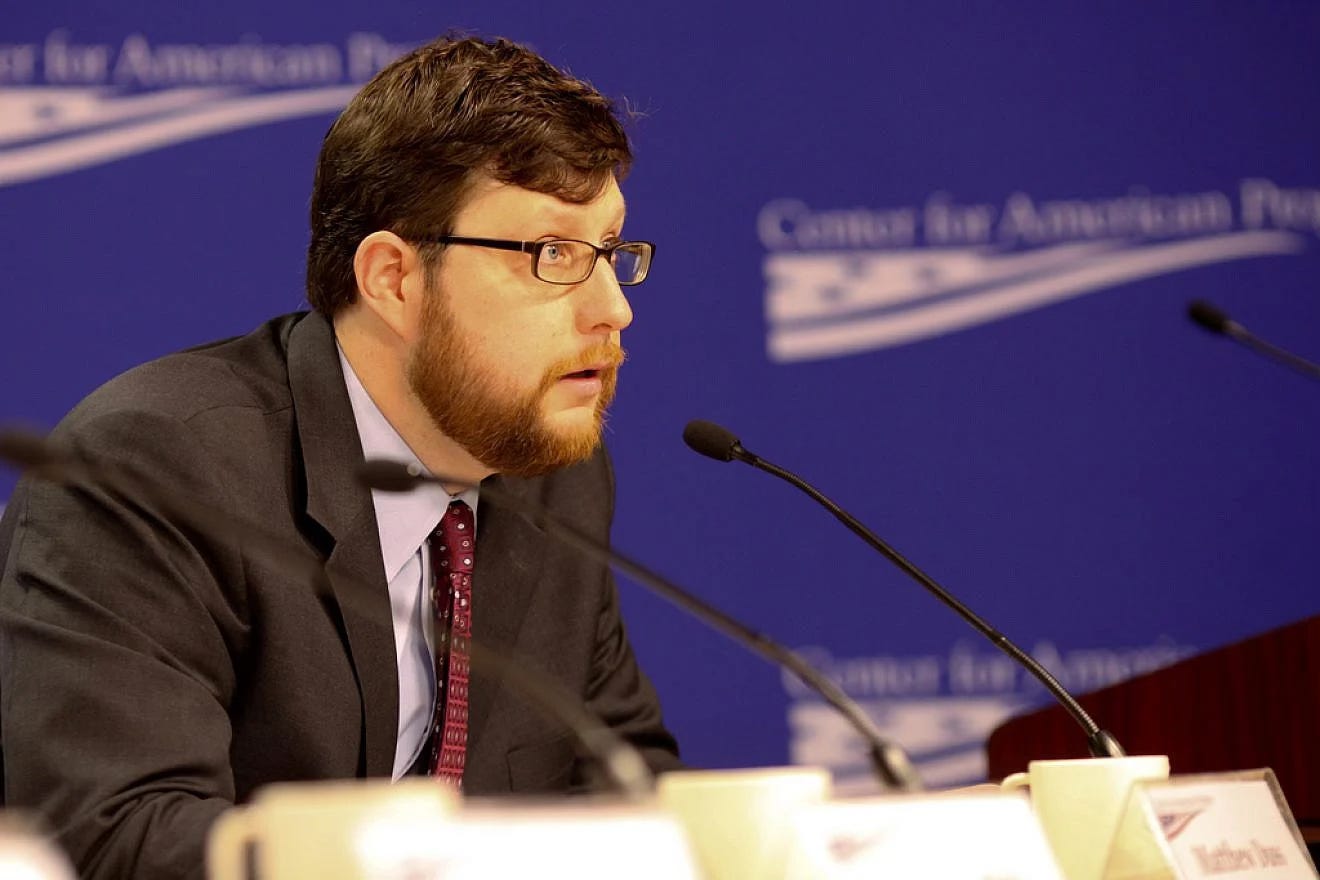
The Dissident | February 18, 2026
Democratic representative Alexandria Ocasio-Cortez’s recent appearence at the Munich Security Conference, which was billed as her showcasing her foreign policy chops gearing up for a possible presidential run, has faced widespread criticism and backlash, not only for her embarrassing mistakes (saying Venezuela was located below the equator, being unable to answer a question about Taiwan and saying the “Trans-Pacific Partnership” when meaning to say the Trans Atlantic Partnership) but for her weak criticism of U.S. foreign policy and repeating of pro-war narratives.
This, however, can be easily explained by the fact that she is being coached by Matt Duss, a longtime foreign policy advisor and a liberal Zionist and staunch supporter of the NATO proxy war in Ukraine.
Ahead of the conference, the New York Times reported :
She has been receiving regular briefings from the Center for International Policy, a left-wing foreign policy think tank in Washington. Matt Duss, a vice president at the group and a former Sanders aide, said he was among those who had tutored her on foreign policy.
“She is someone who is engaged with parts of the world that are often not represented in Munich,” Mr. Duss said.
Ms. Ocasio-Cortez’s appearance will undoubtedly ignite speculation that she is burnishing her foreign policy credentials before a White House run. But she is keeping everyone guessing. Unlike other more obviously ambitious Democrats, she has not made winking, presidential-coded trips to early primary states in recent months or written a tell-all memoir.
This better explains why she was so weak of U.S. foreign policy: Duss styles himself a U.S. foreign policy critic but often repeats the narratives of the U.S. foreign policy establishment, and at times, such as on Ukraine, is with it 100 per cent.
Peddling Liberal Zionism
On Israel and the Zionist lobby, Matt Duss is a typical liberal Zionist, offering some criticism of Israel but ultimately supporting Zionism and Zionist narratives.
A 2011 article on Matt Duss in Politico wrote , “Duss says he’s mischaracterized by his critics as anti-Israel. He is quick to note that he sympathizes with Israel, in part from his personal roots in American evangelical Christianity and that if American criticism of Israel should be harsher, it should also be done with the recognition that Israel is a democracy that should be held to high standards. Iran, meanwhile, is ‘abusing their own people, they support terrorism, and they say all sorts of horrible things about the U.S. and Israel,’ he said.”
This liberal Zionism, apparently influenced by a Christian Zionist upbringing, was on full display during the early months of the Israeli genocide in Gaza, where Duss, repeated Israeli propaganda, smeared actual anti-Zionists and even opposed calls for a ceasefire.
After the October 7th Hamas breakout from the Gaza concentration camp, Duss quoted an article, from New York Magazine, writing, “What we actually witnessed was not ‘the Palestinians’ mounting a violent struggle for justice but a far-right theocratic organization committing mass murder in the name of blood-and-soil nationalism” without mentioning any of the history preceding October 7th, including the Israeli blockade on Gaza which former UK prime minister David Cameron admitted turned Gaza into a “a prison camp” and an “open-air prison”, the previous peaceful protests against the blockade in Gaza in 2018, which were met with Israeli slaughter , the Abraham Accords which sought to get Arab States to abandon the Palestinian cause, and Benjamin Netanyahu putting up a map at the UN which “depicted a state of Israel that stretched continuously from the Jordan River to the Mediterranean Sea” where “Gaza and the West Bank, as Palestinian lands, were erased” weeks before October 7th.
In December of 2023, Matt Duss repeated the fabricated claim that Hamas carried out mass rape on October 7th, writing, “Denying the rape and sexual violence that Hamas committed on Oct 7 is disgusting”, repeating a hoax that was used not only to justify the Gaza genocide, but also actual mass rape against Palestinian detainees in Israel’s torture dungeons.
In another article written by Duss in December of 2023, he wrote , “Israel’s methods are not as extreme as Russia’s, and it’s very important to acknowledge that”, ignoring the fact that in November of 2023 , Israel had killed over 10,000 civilians in Gaza while Russia killed 9,806 in Ukraine since the start of the war in 2022.
In a New York Times article, Matt Duss celebrated Israel’s pager attack in Lebanon, which even former CIA director Leon Panetta conceded was “a form of terrorism” writing, “There’s no question that Israel’s decapitation of Hezbollah’s leadership in Lebanon in recent weeks was an impressive tactical feat”.
In November of 2023, Duss even opposed calls for a ceasefire in Gaza by defending Senator Bernie Sander’s comments in opposition to a ceasefire at the time (which were approvingly shared by AIPAC ), saying, “I think what the Senator said there about the challenges of a ceasefire being negotiated with an organisation like Hamas are valid”.
While peddling Zionist talking points, Duss took the time to smear actual anti-Zionists, such as labelling the brilliant Anti-Zionist academic Norman Finkelstein, a Jewish son of holocaust survivors, as an anti-semite.
Referring to the Jewish Zionist billionaires attempting to shut down pro-Palestine protests on college campuses, Finkelstein wrote , “The Jewish billionaire class has declared war on our nation’s universities: Either you support Israel’s genocidal war or we will destroy you” and Duss replied , “We can and must have a conversation about the very real dangers to academic freedom without antisemitic ‘Jewish billionaire class’ nonsense, which both endangers Jews and undermines the struggle for Palestinian liberation.”
Supporting The Ukraine Proxy War
Along with his peddling of Zionist narratives, Duss fully supported NATO and the Biden administration’s proxy war in Ukraine.
In an article for the New Republic in 2022, Duss wrote, “The Biden team clearly did not seek this war (in Ukraine), in fact, they made a strenuous, and very public, diplomatic effort to avert it. Having been unable to do that, they’ve acted with restraint and care not to get drawn into a wider war with Russia while also making clear the stakes of the conflict for the U.S., for Europe, and for the international system.”
In reality, last year, one of Biden’s top advisors for Europe policy, Amanda Sloat, admitted that the Biden administration could have ended the war in Ukraine, and chose not to, saying, “We had some conversation even before the war started, about what if Ukraine comes out and just says to Russia, ‘fine, you know, we won’t go into NATO if that stops the war, if that stops the invasion,’ which at that point it may well have done” and adding, “I guess if you want to do an alternative version of history, one option would have just been for Ukraine to say in January of 2022, ‘fine, you know, we won’t go into NATO, we will stay neutral.’ Ukraine could have made a deal around March/April of 2022 around the Istanbul talks. There is certainly a question, almost three years on now, would that have been better to do before the war started, would that have been better to do in Istanbul talks, it certainly would have prevented the destruction and the loss of life”.
Matt Duss on serval occasions denied the fact that the war could have ended in April of 2022 has Boris Johnson not intervened and stopped the peace deal that Russia and Ukraine agreed to in Istanbul. On Twitter, Duss wrote , “If you’re so committed to your narrative that you believe that Zelensky Could’ve simply ended the devastating war on his country in April but then Boris Johnson showed up and said nah so he didn’t, I recommend stepping back and taking a series of deep, relaxing breaths” and “ doesn’t matter how quickly the Sy Hersh story gets refuted, it’s already become part of the alternate reality where Biden induced Putin to invade and Russia would’ve ended the war in March if Boris Johnson hadn’t said nah.”
This is despite the fact that Boris Johnson’s blocking of the peace deal in Istanbul has been confirmed by
- Former Israeli Prime Minister Naftali Bennett
- Lead Ukrainian negotiator Davyd Arakhamia
- The foreign minister of Turkey, Mevlut Cavusoglu
- Turkish President Recep Tayyip Erdogan
- Gerhard Schröder, the ex-leader of Germany
- Victoria Nuland then U.S. under secretary of state for political affairs
- Oleksii Arestovych a member of the Ukrainian delegation at the peace talks
- Amanda Sloat, lead Biden advisor on Ukraine
- Andrej Babiš, the Prime Minister of the Czech Republic
Duss has repeatedly praised the Biden Administration for the proxy war in Ukraine, saying in 2023, “The administration … on the way the president has helped manage alliance and partnerships in response to Russia’s invasion of last February, I think has been impressive, I think it shows a way of practising U.S. leadership that forges consensus and then mobilises that consensus.”
As late as January of last year, Duss said, Biden can “claim some credit for rallying allies for the defence of Ukraine against Russia’s invasion”.
Duss even admitted in reference to the Ukraine proxy war that, “the policy I support continues to enrich defense contractors, enriches the military-industrial complex” adding, “I think the goal of reforming that military industrial complex and weakening its power over our politics, that project continues in the longer term even though the policy I support in the shorter term is essentially paying them off.”
The fact that AOC is being “tutored” by Matt Duss on foreign policy explains her failures when speaking on it.
Kaja Kallas: an uncomfortable figure useful to the EU’s Russophobic purposes
By Lucas Leiroz | Strategic Culture Foundation | February 18, 2026
In recent days, videos of Europe’s chief diplomat, Kaja Kallas, have gone viral on social media, showing her making statements marked by disconnected reasoning, weak associations, and conclusions that do not logically follow from the premises presented. At the same time, she delivered yet another of her “unusual” speeches, declaring that Europe would demand a reduction in the size of the Russian Army – an assertion made without any reference to legal, logistical, or strategic foundations to support such a measure, making the inconsistency of her position evident.
This statement highlights not only the European diplomacy’s disconnect from geopolitical reality, but also the symbolic function of certain figures who maintain positions of international visibility. Kallas, whose political trajectory was consolidated in Estonia with a strongly anti-Russian discourse, has become a piece of ideological rhetoric: she plays the role of a “watchdog” of European Russophobia and does not seem to mind being seen as “foolish” for her irrational public statements.
Beyond this aspect, there is also a practical function in this dynamic. Domestically, Kallas faced considerable political wear in Estonia: her family circle maintained commercial ties with Russia, and nationalist sectors criticized her for economic policies that allegedly weakened the country’s economic stability. In this sense, her promotion to the head of European diplomacy served as a convenient solution – removing a worn-out figure from the domestic scene while at the same time making use of her “angry” stance toward Moscow to sustain the anti-Russian narrative at the continental level.
Kallas’s performance, however, does not represent strategic autonomy. The European Union’s foreign policy is centralized in the presidency of the European Commission, under the leadership of Ursula von der Leyen. In this context, Kallas essentially fulfills the role of spokesperson and executor of guidelines defined by the bloc’s hard core, which coordinates sanctions, defense policies, and alignment with NATO and the United States. The contrast between her performative statements and her real decision-making capacity reflects a strategy that prioritizes confrontational rhetoric over political pragmatism.
From a geopolitical perspective, the idea of unilaterally reducing Russian military personnel is unrealistic. Moscow interprets the current conflict as part of a structural dispute over NATO expansion and the strategic containment promoted by the West. Symbolic pressure or European public declarations, devoid of negotiation mechanisms or concrete coercive instruments, produce no practical effect and, on the contrary, tend to reinforce Russian defensive positions, consolidating the perception of permanent hostility.
Moreover, the recent tensions between Kallas and von der Leyen are telling. Kallas reportedly calls her a “dictator” for centralizing power in the Commission – as if the entire EU bureaucratic structure were not designed precisely to maintain that kind of centralization. It appears that von der Leyen represents the transnational elites that control Europe, while Kallas is merely a disposable piece on this chessboard – without any real right to opinion or participation in the bloc’s decision-making process.
Ultimately, Kallas remains, in the racist European view that she herself evokes, a “peripheral” figure of Soviet origins, with a Finno-Ugric native language – hardly “European” in the strict sense, no matter how much she tries to “Europeanize” herself by hating Russia. For Europeans, she is an uncomfortable figure who nonetheless serves a useful purpose: escalating tensions with Russia, which greatly benefits von der Leyen’s “anonymous bosses.”
In this scenario, Kallas embodies a structural tension: her peripheral origins and aggressive posture make her useful as a representative of a confrontational narrative, while also exposing the superficiality of certain European political decisions. The bloc maintains tough rhetoric and ideological mobilization but lacks a realistic strategy capable of dealing with the balance of power in Eurasia – where Europe is a weak and declining pole, not a “superpower,” as Kallas often claims.
If the EU truly intends to preserve its strategic autonomy and contribute to continental stability, it will need to abandon performative declarations and understand that any rearrangement of European security depends on direct negotiations with Moscow, recognition of military and geopolitical realities, and the formulation of measures that combine firmness with pragmatism. Unilateral demands – such as reducing Russian military personnel – are nothing more than symbolic rhetoric, incapable of altering the real dynamics of the conflict.
This dynamic also reveals the hidden side of European politics: the use of peripheral figures, often marginalized or viewed with prejudice, to materialize maximalist discourses that consolidate a narrative of confrontation, while decision-making remains concentrated in a small core of power, far removed from the media statements that go viral and capture public attention.
Romania’s stolen elections were only the start: Inside the EU’s war on democracy
How Brussels’ Digital Services Act has been used to pressure platforms and electoral control in member states
RT | February 18, 2026
Romania’s 2024 presidential election was already one of the most controversial political episodes in the European Union in recent years. A candidate who won the first round was prevented from contesting the second. The vote was annulled. Claims of Russian interference were advanced without public evidence.
At the time, the affair raised urgent questions about democratic standards inside the EU. Newly disclosed documents reviewed by RT Investigations go further. They indicate that the annulment of the Romanian election was accompanied by sustained efforts to pressure social media platforms into suppressing political speech – efforts coordinated through mechanisms established under the EU’s Digital Services Act.
What appeared to be a national political crisis now looks increasingly like a test case for how far EU institutions are willing to go in intervening in the political processes of member states.
The Russian narrative. Again.
On February 3, the US House Judiciary Committee published a 160-page investigation into how the EU systematically pressures social media companies to alter internal guidelines and suppress content. It found Brussels orchestrated a “decade-long campaign” to censor political speech across the bloc. In many cases, this amounted to direct meddling in political processes and elections of members, often using EU-endorsed civil society organizations. The report features several case studies of this “campaign” in action in EU member states, the gravest example being Romania.
It was around the November 2024 Romanian presidential election, the committee found, that the European Commission“took its most aggressive censorship steps.” In the first round, anti-establishment outsider Calin Georgescu comfortably prevailed, and polls indicated he was en route to win the second by landslide. However, on December 6, Bucharest’s constitutional court overturned the results. While a court-ordered recount found no irregularities in the process, a new election was called, in which Georgescu was banned from running.
By contrast, Romania’s security service alleged Georgescu’s victory was attributable to a Russian-orchestrated TikTok campaign. The allegation was unsupported by any evidence whatsoever. Romanian President Klaus Iohannis went to the extent of claiming this deficit was inversely proof of Moscow’s culpability, as the Russians supposedly “hide perfectly in cyber space.” Despite the BBC reporting that even Romanians “who feared a president Georgescu” worried about the precedent set for their democracy by the move, that narrative has been endlessly reiterated ever since.
The US House Judiciary Committee report comprehensively disproves the charge of Russian meddling in the Romanian election. Documents and emails provided by TikTok expose how the platform not only consistently assessed Moscow “did not conduct a coordinated influence operation to boost Georgescu’s campaign,” but repeatedly shared these findings with the European Commission and Romanian authorities. This information was never shared by either party. But the contempt of Brussels and Bucharest for democracy and free speech went much further.
Digital Services Act in action
The committee found Romanian officials egregiously abused the EU’s controversial Digital Services Act before the 2024 election “to silence content supporting populist and nationalist candidates.” Bucharest also repeatedly lodged content takedown requests outside of the formal DSA process, using what committee investigators call “expansive interpretations of their own power to mandate removals of political content.” This amounted to a “global takedown order,” with authorities perversely arguing court demands to block certain content for local audiences were “mandatory not only in Romania.”
This was no doubt a ploy to prevent outsiders, in particular the country’s sizable diaspora, from accessing content featuring Georgescu. His “Romania First” agenda proved quite popular with emigres, numbering many millions due to mass depopulation since 1989. Perhaps not coincidentally, his diaspora supporters have been widely maligned by Western media as fascist enablers. Still, even critical mainstream reports admit they and the domestic population have legitimate grievances, due to Romania’s crushing economic decline in the same period.
Bucharest would clearly stop at nothing to ensure the ‘correct’ candidate prevailed in the first round. Removal demands were plentiful, and on the rare occasions that legal justification was provided, it was based on a “very broad interpretation” of the election authority’s power. For example, TikTok was ordered to remove content that was “‘disrespectful and insults the PSD party’” – a left-wing political faction that was part of the country’s ruling coalition at the time. TikTok twice sought further details of the grounds for this request, but none was forthcoming.
Once Georgescu prevailed, and before the election was annulled, Romanian orders became even more aggressive. Regulators told TikTok that “all materials containing Calin Georgescu images must be removed,” again without any legal basis whatsoever. This proved a step too far for the platform, which refused to remove the posts. It wasn’t just naked political pressure to which TikTok refused to bend. Brussels and Bucharest were assisted first in electoral fraud, then autocratic annulment of the vote’s legitimate result, by local EU-sponsored NGOs.
These were organizations “empowered by the European Commission to make priority censorship requests – either as [EU Digital Service Act] Trusted Flaggers or through the Commission’s Rapid Response System.” Despite their supposed neutrality, the NGOs “made politically biased content removal demands.” For example, the EU-funded Bulgarian-Romanian Observatory of Digital Media “sent TikTok spreadsheets containing hundreds of censorship requests in the days after the first round of the initial election.” The committee characterized much of the flagged content as “pro-Georgescu and anti-progressive political speech.”
This included posts related to “Georgescu’s positions on environmental issues and Romania’s membership in the Schengen Area, and the EU’s system of open borders.” In other words, this was content espousing standard, popular conservative viewpoints, which are absolute anathema to Brussels and Bucharest’s pro-EU elite. Since the committee’s report was released, references to the Bulgarian-Romanian Observatory of Digital Media’s EU financing have been deleted from its website.
After the vote
The day after the election was annulled, TikTok wrote to the European Commission, stating plainly it had not found or been presented with evidence of a coordinated network of accounts promoting Georgescu. Undeterred by TikTok’s denials and scarcely bothered by the lack of material evidence, the European Commission pressed forward and demanded information about TikTok’s political content moderation practices and enquired about “changes” to its “processes, controls, and systems for the monitoring and detection of any systemic risks.”
The European Commission also used the “still-unproven narrative” of Russian meddling “to pressure TikTok to engage in more aggressive political censorship.” In response, the platform informed the commission that it would censor content featuring the terms “coup” and “war” – clear references to the perception that democratic processes had been undermined in Romania – “for the next 60 days to mitigate the risk of harmful narratives.” But this was still insufficient for the censorship-crazed commission.
On December 17, 2004, the European Commission opened a formal investigation into TikTok over a “a suspected breach of the DSA” – in other words, failing to sufficiently censor content before and after the first round of Romania’s presidential election. The platform was accused of failing to uphold its “obligation to properly assess and mitigate systemic risks linked to election integrity” locally. EU efforts to bring the platform to heel didn’t end there, either.
In February 2025, TikTok’s product team was summoned for a meeting with the EU’s Directorate-General for Communications Networks, Content and Technology. There, they were lectured over the platform’s supposedly “deceptive behavior policies and enforcement” and “potential[ly] ineffective” DSA “mitigation” measures. The US House Judiciary Committee found that the European Commission’s decision to meet TikTok’s product team, “rather than the government affairs and compliance staff whose job it was to manage TikTok’s relationship with the Commission, indicates the European Commission sought deeper influence over the platform’s internal moderation processes.”
Georgescu and the many Romanians who wished to elect him president were punished even more severely. Two weeks after TikTok was threatened by the European Commission, the upstart hopeful was arrested in Bucharest en route to registering to run in the new election that May. Georgescu was charged with “incitement to actions against the constitutional order.” Since then, he has been accused by authorities of plotting a coup and involvement in a million-euro fraud.
When Georgescu’s case finally reached trial this February, these accusations were dropped. He is instead charged with peddling “far-right propaganda.” A report on his prosecution from English-language news website Romania Insider repeated the fiction he owed his first-round victory to a “targeted social media campaign,” managed by “entities linked to Russia.” In the meantime, establishment-preferred candidate Nicusor Dan won the presidency. No doubt satisfied with the integrity of the democratic process given Georgescu was barred from participating, Romania’s Constitutional Court quickly validated the result.
Beyond Romania
Per the US House Judiciary Committee, Romania’s stolen 2024 presidential election is the most extreme example of the EU and member state authorities conspiring to subvert democracy and trample on popular will. But it is just one of many. Since the Digital Services Act came into force in August 2023, the European Commission has pressured platforms to censor content ahead of national elections in Slovakia, the Netherlands, France, Moldova, and Ireland, as well as the EU elections in June 2024.
“In all of these cases… documents demonstrate a clear bias toward censoring conservative and populist parties,” the committee concluded. Ahead of the EU elections, TikTok was pressured into censoring over 45,000 pieces of purported “misinformation.” This included what the report deemed “clear political speech” on topics such as migration, climate change, security and defense, and LGBTQ rights. There is no indication Brussels has been deterred from its quest to prevent the ‘wrong’ candidates being elected to office in member states, or citizens expressing dissenting opinions.
In fact, we can expect these efforts to ramp up significantly. For one, the US committee’s bombshell report generated almost no mainstream interest, indicating Brussels can and will get away with it again. Even more urgently, in April, Hungary goes to the polls. Already, the narrative that ruling conservative Viktor Orban intends to rig the vote to secure victory is being widely perpetuated. And the EU’s censorship apparatus stands ready to validate that narrative, regardless of truth, and popular will.
Keir Starmer-tied think tank paid PR firm to target The Grayzone
By Kit Klarenberg | The Grayzone | February 16, 2026
Leaked files have revealed that Labour Together, the shadowy think tank run by disgraced former top Keir Starmer aide Morgan McSweeney, paid the Washington DC-based corporate intelligence firm APCO Worldwide to spy on journalists who reported on their corrupt handling of campaign finances.
The reporters named appear to have been targeted for their efforts to investigate how the UK’s Labour Party elites spent 730,000 pounds in undeclared donations to install Starmer as their leader.
The files show APCO used those funds to oversee the fabrication of a dodgy, evidence-free dossier claiming that Russia was behind damaging disclosures about Labour Together, which it submitted to the National Cyber Security Centre (NCSC) of Britain’s GCHQ — London’s equivalent to the US National Security Agency.
The “significant persons of interest” listed in APCO’s McCarthyite casebook included The Grayzone and myself.
According to my APCO dossier, “While a self described ‘investigative journalist,’ he is an author for the Gray Zone. The site has been described as a ‘conspiracy blog’ and ‘Wagner propaganda channel.’ In 2023,” the dossier reads, I “was arrested by counter-terror police after [I] arrived in the UK.”
APCO bills itself as “a trusted and strategic advisor… that drive[s] our clients’ missions and objectives forward.” Despite its massive contract with Labour Together, the files show the PR firm struggled to identify its targets, and proved unable to establish the most basic facts about them.
When APCO branded The Grayzone as “Wagner propaganda,” it seemed to have confused us with “Grey Zone,” an entirely unrelated and now-defunct Telegram channel affiliated with the Russian military contractor. APCO also claimed I was “arrested by counter-terrorism police” in May 2023 upon returning to Britain. In fact, I had been detained, not arrested.
APCO also targeted journalists Matt Taibbi and Paul Holden, who led investigations into Labour Together’s potentially criminal activities, based on leaks and Freedom of Information requests. The PR firm had sought to secure “leverage” over Holden in order to sabotage his work.
The spying scandal began in November 2023, when Britain’s Sunday Times revealed that Keir Starmer’s campaign manager, Morgan McSweeney, had failed to declare £730,000 in campaign donations which he diverted to advance Starmer’s rise to Labour leadership. One month later, APCO prepared a memo for Labour Together outlining a strategy to blame the damaging disclosure on Russian hackers and attack the journalists who dared to publish details of the offending documents.
The story was given new life in February 2026, when British journalist Peter Geoghehan exposed a secret contract showing Labour Together paid APCO £30,000 to investigate the journalists it blamed for exposing its legally questionable activities.
It has now gone mainstream, with the Sunday Times publishing a lengthy report branding the Labour operation as a “dirty smear” based on a “lie” about Russian hacking.
However, the Times article omitted any mention of this reporter or The Grayzone, even though we were prominently targeted by Labour Together. In the following investigation, we explain why The Grayzone was targeted, tracing the origins of the slimy spying operation to a network of Labourite operatives who have sought to destroy us since well before Starmer came to power.
“Familiar with masters of the same drivers”
Labour Together was founded in 2015 by McSweeney, Starmer’s longtime svengali. After several failed campaigns for establishment candidates, McSweeney managed to transform his organization into a propaganda juggernaut, soliciting large donations from the UK Israel lobby’s most significant moneyman, Trevor Chinn.
While presenting his campaigning outfit as a plucky little think tank, he wielded it against Labour leader Jeremy Corbyn and the movement behind him. To neutralize the ecosystem of alternative media outlets supporting Corbyn as Labour leader, Labour Together contracted a political operative named Imran Ahmed to spin out a censorship front called “Stop Funding Fake News.”
After weaponizing dubious charges of antisemitism to defund one of the most influential pro-Corbyn outlets, Canary UK, the organization folded, then resurfaced as the much bolder Center for Countering Digital Hate (CCDH). Based inside the office of Labour Together, CCDH relied on the funding from Chinn and, as The Grayzone’s Max Blumenthal revealed, secretly coordinated with the Israeli embassy in Washington.
McSweeney entered Downing Street as Starmer’s Chief of Staff just one month before Trump’s re-election. Among his most important tasks was repairing relations with the US President. At the time, Trump’s aides were bristling over reports that McSweeney met with Democratic presidential nominee Kamala Harris during the Democratic National Convention to plot strategy. One of Trump’s top donors, the transhumanist mega-billionaire Elon Musk, also had his knives out for McSweeney after journalists Matt Taibbi and Paul Thacker revealed that CCDH’s top priority for 2024 was to “kill Elon Musk’s Twitter.”
McSweeney’s solution was to dispatch one of Labour’s most seasoned – and scandal-stained – fixers to Washington. He was Lord Peter Mandelson, the architect of the neoliberal New Labour wave whose notoriously transactional tendencies seemed to make him the perfect match for Trump. Mandelson made himself a fixture at Butterworth’s, a favorite Capitol Hill haunt of MAGA operatives, and insinuated himself into Trumpist social circles.
In June 2025, the restaurant erected a plaque honoring Mandelson during a ceremony overseen by Raheem Kassam, a close associate of former Trump chief of staff Steve Bannon. There, a mirthful Mandelson raised a toast and proclaimed a special kinship with the MAGA elite: “Although we don’t have identical politics, we are familiar with masters of the same drivers that brought our respective figures to power — President Trump in your case and Keir Starmer in mine.”
But Mandelson was also dogged by the same sex trafficking figure who constantly inhabited the personal lives of both Trump and Bannon: Jeffrey Epstein. Both McSweeney and Starmer had been keenly aware of the ambassador’s friendship with Epstein, but they dismissed the concerns, even ignoring a warning from UK security services.
However, when a series of emails confirming Mandelson’s friendship with Epstein poured forth as part of a release by the US Department of Justice, the ambassador’s position became untenable. Following his firing in September 2025, a new tranche of emails published this January provided an even more damning portrait of their friendship. They showed, for instance, that Epstein channeled money to Mandelson’s husband, Reinaldo Avila da Silva, for a specious initiative which was never completed. Even worse, the communications exposed Mandelson providing Epstein with advance notice of the impending collapse of Prime Minister Gordon Brown’s government in 2010, as well as sensitive information about the UK’s “saleable assets.”
McSweeney’s scheming had finally caught up with him. Though Starmer initially praised and defended his longtime campaign guru in parliament, he caved soon after, forcing McSweeney to resign his post on February 8.
In the days since, Starmer has been unable to fill the vacancy. Meanwhile, another senior Labour official is reportedly considering leaving his role as well. Amid the chaos, British media has begun to speculate that the Prime Minister will be next to go.
Will the revelation of Labour Together’s media enemies list, and its secret contract with APCO, be the weight that finally sinks Starmer?
Labour Together’s misdirection ploy: blame Russia
McSweeney was aware that Labour Together had secretly contracted APCO to spy on journalists; however, he didn’t carry out the dirty work himself. That job appears to have been commissioned by his successor at the think tank, Josh Simons, who’s now a senior minister in Starmer’s government.
Simons has dismissed reports that the PR firm was tasked with spying on reporters as “nonsense,” insisting that APCO was merely “asked to look into a suspected illegal hack.” Simons’ disingenuous claims are undermined by newly-leaked documents related to the probe, however.
Perhaps most damning is a December 2023 memo prepared by APCO for Labour Together which shows investigators fretting about “recent articles and blog posts” which threatened to draw attention to the political group’s questionable funding schemes. Information published by these meddling journalists, particularly Paul Holden, “[raised] concern about the source of his information and what more he may choose to publish in the future,” the memo continued.
It was therefore deemed “important to identify the source of the information and to ascertain what additional information could be published.” Labour Together tasked APCO with probing several journalists, dubbed “significant persons of interest.”
The memo speculated that Holden and others may have received leaks from inside Labour Together, Labour party headquarters, parliament, or “illegally-gathered information collected” from a purported “hack” of Britain’s Electoral Commission in 2023. APCO concluded it was “essential” for Labour Together to concoct a strategy to counter the critical reporting.
Its response was to blame the organization’s woes on a Russian hack. But rather than hiring a cyber-security firm to investigate the supposed data breach, it contracted a corporate intelligence firm to attack the messengers.
In February 2024, The Guardian contacted Holden to alert him that the paper was preparing a hit piece alleging he was under investigation by the NCSC for receiving illegally obtained information from Russia. The Guardian had clearly been influenced by briefings from Labour Together, as well as by APCO’s report. Yet the outlet backed off when Holden promised to sue them for defamation.
APCO is now under formal investigation for potential standards breaches by Britain’s Public Relations and Communication Association.
How did The Grayzone wind up on Labour Together’s enemies list?
It is unclear how and why I became a “significant person of interest” in APCO and Labour Together’s secret smear campaign. However, their operation dovetailed with another surreptitious attempt by intelligence-tied actors to smear The Grayzone as Russian agents.
I have never spoken to Paul Holden or other journalists named as the firm’s targets, or conducted any journalistic investigations into Labour Together’s corrupt financial dealings. When APCO initiated its probe, I had mentioned Labour Together in a single article months prior that focused on the organization’s censorship-obsessed spinoff, the Center for Countering Digital Hate.
Such sloppiness and paranoia is the hallmark of Amil Khan, a veteran British government psyops warrior turned “disinformation expert” involved with Labour Together and Starmer’s Labour.
Khan cut his teeth running covert British-funded psychological warfare operations during the Syrian dirty war, supporting violent extremist groups armed and financed by the CIA and MI6. He subsequently founded Valent Projects, which “specializes in addressing online manipulation.” Khan’s outfit produced a paper on social media ratfucking strategies for Labour Together entitled, “Power and Persuasion: Understanding the Right’s Playbook.”
In December 2021, The Grayzone exposed how Valent Projects covertly produced Covid vaccine propaganda funded by the British monarchy’s Royal Institute, using then-popular “BreadTube” personality Abigail Thorn as the front person for its campaign. The investigation apparently placed this outlet in the crosshairs of Khan and his information warfare network.
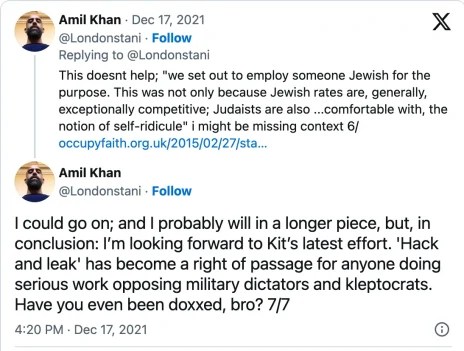
Less than a year later, The Grayzone exposed Khan again – this time, for his role in a covert conspiracy to destroy us. Enlisted by celebrity former leftist journalist Paul Mason, Khan helped coordinate a harebrained scheme to demonetize and deplatform The Grayzone. The pair discussed going “full nuclear legal to squeeze [The Grayzone] financially,” and proposed publishing intelligence agency-sourced smears to delegitimize this outlet.
As their revenge plot approached its paranoid apogee, Mason and Khan fantasized about hosting an anti-Grayzone summit with some of the most rabid, intelligence-tied opponents of our reporting. Among those they pitched for the gathering was Imran Ahmed, director of the censorship-obsessed Center for Countering Digital Hate (CCDH), which was founded by Morgan McSweeney and shared an office with his Labour Together.
While it is unknown if the anti-Grayzone summit ever took place, we have since learned that Mason enlisted a team of high-priced London lawyers to sue this outlet just days after our article exposing his secret smear campaign appeared. In May 2023, I was detained at the UK’s Luton International Airport and interrogated about The Grayzone’s activities by counter-terror police. Six months later, APCO initiated its covert investigation of me, The Grayzone, and others whose reporting had wound them up on the Labour Together enemies list.
APCO has so far remained silent about the scandal. The Grayzone has submitted a request for comment to Tom Short, the PR firm’s London chief. We received an automated response revealing he conveniently slipped away to the US. Upon Short’s return to Britain, APCO will no longer be able to hide behind bogus allegations of Russian hacking.
Ian Proud: Economic Reset with Russia to Save Europe
Glenn Diesen | Feb 15, 2026
Ian Proud discusses why an economic reset with Russia is required for a stable peace and to prevent Europe from becoming a weakened relic of a unipolar past. As a former British diplomat, Proud performed a number of roles, including the Economic Counsellor at the UK’s embassy in Moscow between 2014 and 2019.
The Peacemonger: https://www.youtube.com/@IanProud
Follow Prof. Glenn Diesen:
Substack: https://glenndiesen.substack.com/
X/Twitter: https://x.com/Glenn_Diesen
Patreon: https://www.patreon.com/glenndiesen
Support the research by Prof. Glenn Diesen:
PayPal: https://www.paypal.com/paypalme/glenndiesen
Buy me a Coffee: buymeacoffee.com/gdieseng
Go Fund Me: https://gofund.me/09ea012f
Munich, 2007: The Day the West Was Told No
The Islander | February 13, 2026
They like to pretend it came out of nowhere.
They like the bedtime story: Europe was peacefully humming along in its post-history spa — open borders, cheap energy, NATO as a charity, Russia as a gas station with a flag… and then, one day, the barbarian kicked the door in for no reason at all.
That story is not just dishonest. It’s operational. It’s the propaganda you tell yourself so you can keep the addiction going without ever admitting how self-destructive it is.
Because the truth is uglier and far more incriminating:
In Munich, on February 10, 2007, Vladimir Putin stood on the most flattering stage the Atlantic system owns — the Security Conference where Western officials applaud themselves for maintaining “order” and he laid out, to their faces, the skeleton of the coming disaster. He didn’t whisper it in a back channel. He used the microphone to deliver some much needed medicine, however hard it would be for the Empire to swallow.
He even signaled he wasn’t going to play the usual polite theatre — the kind where everyone agrees in public and stabs each other in classified annexes. He said the format allowed him to avoid “pleasant, yet empty diplomatic platitudes.”
And then he did the unforgivable thing, (gasp!) he described the empire as an empire.
He named the unipolar intoxication — that post–Cold War hallucination that history had ended, that power had found its final owner, that NATO could expand forever without consequences, that international law was optional for the enforcer class and compulsory for everyone else.
Putin’s core argument was brutally simple: a unipolar model is not only unacceptable, it’s impossible.
Not “unfair.” Not rude. Impossible.
(Because in a world with) “one center of authority, one center of force, one center of decision-making” is a world where security becomes privatized — where the strong reserve the right to interpret rules (with exemptions for themselves), and the weak are told to accept it as morality. (And yes, he put it in exactly those terms — one center, one force, one decision — the architecture of domination.)
And when you build that kind of world, everyone else does the only rational thing left: they stop trusting the wall of law to protect them, and they start arming for survival.
Putin said it outright: when force becomes the default language, it “stimulates an arms race.”
This is where the Western client media — professionally disengious as ever, clipped one or two spicy lines and missed the larger point: Munich 2007 wasn’t “Putin raging.” It was Russia publishing its redlines in front of the class.
And then came the part that should have frozen the room. Putin named it – NATO expansion.
Putin didn’t argue it as nostalgia. He argued it as provocation — a deliberate reduction of trust. He asked the question no Western leader ever answers honestly:
“Against whom is this expansion intended?”
And then he drove the blade in: what happened to the assurances made after the Warsaw Pact dissolved? “No one even remembers them.”
That line matters because it goes well beyond grievance — it’s a window into how Russia saw the post–Cold War settlement: not as a partnership, but as a rolling deception. Expand NATO, move offensive infrastructure, then call it “defensive.” Build bases, run exercises, integrate weapons systems, and insist the other side is paranoid for noticing.
Putin’s formulation was clean: NATO expansion “represents a serious provocation that reduces the level of mutual trust.”
Now pause and look at the psychology of the West in that room. They didn’t hear a warning. They heard audacity. They didn’t hear “security dilemma.” They heard “how dare you speak like an equal.”
That’s the cultural glitch at the heart of the Atlantic project: it believes its own core lie and cannot process sovereignty in others without treating it as aggression.
So Munich 2007 became, in Western memory, not the moment Russia told the truth — but the moment Russia “showed its hand.” The implication: Russia’s “hand” was evil, and therefore any response to it was justified. Which is exactly how you sleepwalk into catastrophe.
The real prophecy: not mysticism — mechanics
What was prophetic about Putin’s speech isn’t that he had a crystal ball.
It’s that he understood the West’s incentive structure:
- A security system that expands by definition (NATO) needs threats by definition.
- A unipolar ideology needs disobedience to punish, otherwise the myth collapses.
- A rules-based order that breaks its own rules must constantly produce narrative cover.
- An economic model that offshore-outs its industry and imports “cheap stability” must secure energy routes, supply chains, and obedience — by finance, by sanctions, by force.
Putin was saying: you can’t build a global security architecture on humiliation and expect it to be stable. Russia had lived through the wreckage of Yugoslavia, Afghanistan and Iraq and that this playbook would be used again and again, with Georgia, with Syria, Libya, Iran and Russia itself if Putin did nothing.
He was also saying and this is where the Russophobic mass hysteria accelerates — that Russia would not accept a subordinate role in its own neighborhood, on its own borders, under a wannabe hegemon’s military umbrella.
This is where the Western catechism kicks in: “neighborhood” is called “sphere of influence” when Russia says it, and “security guarantees” when Washington says it. And so the hysteria machine warmed up.
You saw it in the immediate reception: Western elites, including Merkel and McCain treating the speech as an insult rather than a negotiation offer. You saw it in the years that followed — the steady normalization of the idea that Russia’s security concerns were illegitimate, and therefore could be ignored with moralistic lectures, free of consequences.
Ignore, expand, accuse, repeat.
That loop is your road to 2022 and to today, in Munich 2026. Groundhog day without learning the vital lessons to end the loop of utter madness.
Munich, Feb 13 (2026): Merz admits the order is dead — and calls it “uncertainty”
Fast forward. Same city. Same conference. Same Western liturgy, just with more panic in the eyes and the nucleus of a terrifying realization.
German Chancellor Friedrich Merz using his best perfomative courage, murmured that the world order we relied on is no longer there. Framing the post–Cold War “rules-based order” as effectively crumbled and almost begging for a reset in transatlantic relations.
He goes further: he talks up a stronger European defence posture, and pointed to discussions with France about a European nuclear deterrent concept, a “European nuclear shield.”
And then comes the line that should be carved into the marble of the Munich conference hall as Exhibit A: Merz argues that in this era, even the United States “will not be powerful enough to go alone.”
Read that again.
The BlackRock chancellor on NATO’s spiritual home turf is effectively saying: the empire is overstretched, the illusion of old certainties are gone, and Europe will be left hung out to dry. Talk about strategic vertigo!
And it is exactly what Putin was talking about in 2007: when one axis tries to act as the planet’s owner, the cost accumulates — wars, blowback, arms races, fractured trust, until the system starts to wobble under its own contradictions.
Merz also reported begged the U.S. and Europe to “repair and revive” transatlantic trust. Repair trust with what currency?
Because trust isn’t repaired by speeches. Trust is repaired by reversing the toxic and suicidal behaviors that destroyed it.
And those behaviors were precisely what Putin named in 2007:
- expanding military blocs toward another power’s borders,
- treating international law as a menu,
- using economic coercion as a weapon,
- and then pretending the consequences are “unprovoked.”
Europe is now gasping at the invoice for that policy set: industrial stress, energy insecurity, strategic dependency, and a political class that can’t admit how it got here without indicting itself.
So instead of confession, you get moral performance. Instead of strategy, you get hysteria and cartoon slogans.
Instead of peace architecture, you get escalation management — the art of walking toward the cliff while calling it deterrence.
Merz’s remarks underscore that Europe is being forced to contemplate a harsher security environment and greater responsibility, all of its own suicidal making — but it still frames the Russia question in the familiar moralizing register.
Which is the whole tragedy: they can feel the tectonic plates shifting beneath them, yet they keep reciting the same old prayers that summoned the earthquake.
Why we’re here: the Western addiction to expansion — and the manufactured Russophobia that lubricated it
Russophobia is more than just bloodthirsty prejudice. It’s the (failed) policy tool of choice of the last few empires against Russia.
It’s what you pump into the Mockingbird media bloodstream to make escalation feel like virtue and compromise feel like treason.
You don’t have to love everything Russia does to see the mechanism: a permanent narrative of Russian menace makes every NATO move sound defensive, every EU economic self-harm sound righteous, and every diplomatic off-ramp sound like appeasement.
It creates a psychological environment where:
- NATO expansion becomes “freedom,”
- coups become “democratic awakenings,”
- sanctions become “values,”
- censorship becomes “information integrity,”
- and war becomes “support.”
And once you install that operating system, you can torch your own industry and still call it moral leadership.
That’s the dark comedy of Europe since 2014 — accelerating post 2022: self-sanctioning, deindustrializing pressure, energy price shocks, and strategic submission to Washington’s delusion of carving up Russia, sold as “defending democracy.”
Meanwhile, Moscow reads the West’s behavior the same way it read it in 2007: as a hostile architecture closing in, dressed up as virtue.
Putin’s Munich speech — again, not mysticism — warned that when the strong monopolize decision-making and normalize force, the world becomes less safe, not more.
So what did the West do?
It made the “rules-based order” a brand — while breaking rules (international law) whenever convenient. Exceptionalism at almost biblical levels, God’s chosen people.
It expanded NATO while insisting the expansion was harmless.
It treated Russian objections as evidence of Russian guilt — which is circular logic worthy of an inquisitor.
And it nurtured a media culture that could not imagine Russia as a rational actor responding to a pattern of ugly regime change behavior — only as a cartoon villain driven by pathology. Not analysis but theological warfare.
The punchline Munich won’t say out loud
Here’s the line Munich still cannot speak, even in 2026, even with Merz admitting the old order is gone:
The West didn’t misread Putin’s warning. It rejected it because accepting it would have meant limiting itself.
Munich 2007 was a chance — maybe the last clean one — to build a European security architecture that wasn’t just NATO with better PR. A chance to treat Russia as a Great Power with legitimate interests, not a defeated adversary to be regime changed and broken apart.
And now, in Munich 2026, they stand amid the wreckage and call it “uncertainty,” as if the storm blew in from nowhere. The BlackRock Chancellor calls for resets, for revived trust, for Europe to become stronger, for new deterrence ideas.
But the reset Munich needs is the one it refuses:
- reset the premise that NATO will remain a viable alliance beyond the war in Ukraine,
- reset the premise that Russia must absorb strategic humiliation and accept the inverse, the reality as it is – where it’s in fact Western Europe that is wearing the humiliation.
- reset the premise that international law is a tool of the powerful,
- reset the premise that Europe’s role is to be the forward operating base and European sovereignty sacrificed to buy the Empire time .
Until that happens, Munich will keep happening — every year, more anxious, more militarized, more rhetorical, more detached from the material reality its own disastrous policies created.
And Putin’s “prophecy” will keep looking prophetic — not because he conjured the future, but because he correctly described the machine.
At The Munich Security Conference, AOC Gets It Wrong On Foreign Policy
The Dissident | February 13, 2026
Democratic representative Alexandria Ocasio-Cortez recently appeared at the Munich Security Conference- supposedly to showcase her foreign policy knowledge- in what many believe may be the lead up to an eventual presidential run in 2028.
Unfortunately, what AOC showcased was that, while being critical of aspects of U.S. foreign policy, she gets it dead wrong on issues ranging from NATO to USAID to Iran to Ukraine.
Calling To Fund A CIA Cutout
While AOC called out some U.S. hypocrisy around the claim of a “rules-based international order”, she still gave credence to the idea that such a thing even exists, or that the U.S. is concerned with human rights and democracy around the world.
At one panel, she said , “That does not mean that the majority of Americans are ready to walk away from a rules-based order and that we’re ready to walk away from our commitment to democracy.”
This apparently includes support for so-called U.S. “democracy promotion” initiatives such as the CIA cutout USAID, which AOC called to support at two different conferences.
When asked at the aforementioned panel, “Are there any particular institutions that a democratic administration would want to save?”, AOC replied, “ first and foremost, I think we need to revisit our commitments to international aid not just USAID but the the dozens of global compacts that the current secretary of state and President Trump have withdrawn from” adding, “They are looking to withdraw the United States from the entire world so that we can turn into an age of authoritarianisms of authoritarians that can carve out the world where Donald Trump can command the Western Hemisphere and Latin America as his personal sandbox where Putin can saber rattle around Europe and and try to bully around our own allies there.”
At another panel, AOC complained that the Trump administration was playing “hokey pokey with USAD”.
In reality, USAID and other “aid organizations” such as the National Endowment for Democracy are used to meddle in the domestic affairs of countries that do not bow down to U.S. demands, including by attempting to undermine democratically elected governments.
Foreign Policy magazine wrote in 2014 , “Foreign governments have long accused the U.S. Agency for International Development of being a front for the CIA or other groups dedicated to their collapse. In the case of Cuba, they appear to have been right.”
The magazine added, “In an eye-opening display of incompetence, the United States covertly launched a social media platform in Cuba in 2010, hoping to create a Twitter-like service that would spark a ‘Cuban Spring’ and potentially help bring about the collapse of the island’s Communist government” adding, “It was a digital Bay of Pigs, but it was funded by USAID, an arm of the government dedicated to doing good work in bad places, not by the CIA.”
The outlet noted that this was far from the only time USAID has been used as a tool of U.S. regime change, writing:
Venezuelan President Hugo Chavez frequently and famously accused the United States of covertly trying to overthrow him, but only after his death did evidence emerge to support his seemingly paranoid claims. A WikiLeaks cable released in 2013 outlined the U.S. strategy for undermining Chavez’s government by “penetrating Chavez’s political base,” “dividing Chavismo,” and “isolating Chavez internationally.” The strategy was to be carried out by USAID’s Office of Transition Initiatives, the same office responsible for developing “Cuban Twitter,” and involved funding opposition organizations in Venezuela.
USAID has also played a role in funding the 2004 coup against Haiti’s elected president Jean-Bertrand Aristide, the 2014 coup against Ukraine’s elected president Viktor Yanukovych, the 2018 coup attempt against Nicaragua’s president Daniel Ortega, and the 2024 judicial coup against Romanian presidential candidate Calin Georgescu.
Claiming NATO Stops Regime Change Wars
At one of the Munich Security panels, AOC claimed that the “Trans-Pacific Partnership”, later clarifying that she meant transatlantic partnership, i.e., alliances like NATO would somehow stop, “the installation of regional puppet governments”.
AOC claimed, “it actually is the Trans-Pacific Partnership. It is our global alliances that can be a hard stop against authoritarian consolidation of power, particularly in the installation of regional puppet governments.”
In reality, the “transatlantic partnership” through NATO, since the end of the Cold War, has done nothing but regime change wars to overthrow unfriendly governments and install puppets.
In 1999, NATO bombed Serbia and Kosovo in what was billed as a humanitarian intervention to save Albanians in Kosovo from the Serbian authorities, but in reality, it was an orchestrated regime change war against Slobodan Milosevic.
As James Bissett, the former Canadian ambassador to Yugoslavia, explained , “Media reports have revealed that as early as 1998, the central intelligence agency assisted by the British Special Armed Services were arming and training Kosovo Liberation Army members in Albania to foment armed rebellion in Kosovo. The KLA terrorists were sent back into Kosovo to assassinate Serbian mayors, ambush Serbian policemen and do everything possible to incite murder and chaos. The hope was that with Kosovo in flames NATO could intervene and in so doing, not only overthrow Slobodan Milosevic the Serbian strong man, but more importantly, provide the aging and increasingly irrelevant military organization with a reason for its continued existence.”
Following this, NATO intervened in Afghanistan and did exactly what AOC claimed it would prevent: it occupied the country and propped up a puppet government.
Journalist Seth Harp meticulously documented in his book “The Fort Bragg Cartel: Drug Trafficking and Murder in the Special Forces” that the NATO propped up government led by CIA asset Hamid Karzai was “the world’s leading narco-state, with an economy almost entirely dependent on the drug trade”.
NATO then overthrew Libyan leader Muammar Gaddafi, one of the key planks in the greater Zionist/Neo-Con clean break plan for greater Israel.
While the intervention was billed as a humanitarian intervention to stop Muammar Gaddafi from slaughtering innocent civilians and to support moderate rebels, a 2015 UK parliament report later admitted that “the proposition that Muammar Gaddafi would have ordered the massacre of civilians in Benghazi was not supported by the available evidence” and “It is now clear that militant Islamist militias played a critical role in the rebellion from February 2011 onwards”.
The CIA then used Gaddafi’s weapons stockpile to further the next regime change war on the “clean break” hit list in Syria with journalist Seymour Hersh reporting that following the fall of Gaddafi, the CIA “authorised a rat line in early 2012” which was “used to funnel weapons and ammunition from Libya via southern Turkey and across the Syrian border to the opposition” noting that, “Many of those in Syria who ultimately received the weapons were jihadists, some of them affiliated with al-Qaida”.
Repeating CIA/Mossad Talking Points About Iran
While AOC did oppose bombing Iran at the behest of Israel, she repeated CIA and Mossad talking points without giving vital context before doing so.
When asked, “Would you support direct U.S. military strikes on Nuclear facilities if direct negotiations fail with Iran?” AOC responded, “I think that that is a dramatic escalation that no one in the world wants to see. Right now what the Iranian regime is doing particularly with respect to protesters is a horrific slaughter of some estimates have tens of thousands of people.”
The claims of “tens of thousands of people” killed by the Iranian government during protests comes from biased sources openly supporting war with Iran, such as Amir Parasta a German-Iranian eye surgeon who is a lobbyist for the Israeli opposition puppet Reza Pahlavi and the outlet Iran International, which Israeli journalist Barak Ravid said , “the Mossad is using… quite regularly for its information war”.
In other words, AOC opposing war with Iran but repeating the claim of “tens of thousands dead” is akin to saying in 2002, “I oppose war with Iraq, but Saddam definitely has WMDS”.
Furthermore, AOC missed an opportunity to give some vital context on the protests in Iran.
For one, she did not mention that U.S. Treasury Secretary Scott Bessent twice boasted that the protests in Iran were caused by U.S. sanctions on the country’s economy, saying:
President Trump ordered treasury and our OFAC division, (Office of Foreign Asset Control) to put maximum pressure on Iran, and it’s worked because in December, their economy collapsed, we saw a major bank go under, the central bank has started to print money, there is a dollar shortage, they are not able to get imports and this is why the people took to the streets.
What we can do at treasury, and what we have done, is created a dollar shortage in the country, at a speech at the Economic club in New York in March I outlined the strategy, it came to a swift -and I would say grand- culmination in December when one of the largest banks in Iran went under, there was a run in the bank, the central bank had to print money, the Iranian currency went into free fall, inflation exploded and hence we have seen the Iranian people out on the street.
(Emphasis: Mine)
Furthermore, AOC missed an opportunity to list the mountains of evidence that the CIA and Mossad infiltrated the protests to turn them in a violent and pro-regime change direction.
This includes:
- A Mossad-connected X account in Persian boasting, “Let’s all come out to the streets. The time has come. We are with you. Not just from afar and verbally. We are also with you in the field.”
- Former Secretary of State, Mike Pompeo wishing a “Happy New Year to every Iranian in the streets. Also to every Mossad agent walking beside them.”
- Israel’s Channel 14 reporting that “foreign actors are arming the protesters in Iran with live firearms, which is the reason for the hundreds of regime personnel killed.”
- Former head of the Military Intelligence Directorat in Israel, Tamir Hayma, saying, “There is currently a very significant influence operation by the US” in Iran.
- The Financial Times reporting that, “Another witness in western Tehran told the FT he saw about a dozen fit men, ‘looking like commandos’, dressed in similar black clothing, running through the area and calling on people to leave their homes and join the protests. ‘They were definitely organised, but I don’t know who was behind them,’ he said.”
- Mossad connected Israeli journalist Yonah Jeremy Bob cryptically writing , “Only after the air is clear will the full story of the Mossad’s involvement likely be cleared to be told. But when it comes to the Mossad and Iran, there is always far more than meets the eye”.
- Israel’s Heritage Minister Amichai Eliyahu boasting , “When we attacked in Iran during ‘Rising Lion’ we were on its soil and knew how to lay the groundwork for a strike. I can assure you that we have some of our people operating there right now”.
Supporting The Ukraine Proxy War
When asked about the proxy war in Ukraine, AOC said, “there’s no conversation about Ukraine that can happen without Ukraine, and so they of course lead in terms of setting their terms on this, but I think that overall as a principle, we shouldn’t reward imperialism. And I don’t think that we should allow Russia to continue or any nation to continue violating a nation’s sovereignty and to continue to be rewarded”.
This was a strong signal in support of continuing the proxy war in Ukraine.
At no point did AOC mention that in 1997, veteran diplomat George F. Kennan warned that NATO expansion eastward would “be expected to inflame the nationalistic, anti-Western and militaristic tendencies in Russian opinion; to have an adverse effect on the development of Russian democracy; to restore the atmosphere of the cold war to East-West relations, and to impel Russian foreign policy in directions decidedly not to our liking” a view he said was “not only mine alone but is shared by a number of others with extensive and in most instances more recent experience in Russian matters.”
Nor did she mention that former U.S. ambassador to Russia, William Burns, warned in 2008 that, “Ukraine and Georgia’s NATO aspirations not only touch a raw nerve in Russia, they engender serious concerns about the consequences for stability in the region. Not only does Russia perceive encirclement, and efforts to undermine Russia’s influence in the region, but it also fears unpredictable and uncontrolled consequences which would seriously affect Russian security interests. Experts tell us that Russia is particularly worried that the strong divisions in Ukraine over NATO membership, with much of the ethnic-Russian community against membership, could lead to a major split, involving violence or at worst, civil war. In that eventuality, Russia would have to decide whether to intervene; a decision Russia does not want to have to face”.
AOC did not mention the Maidan coup in 2014, which, as Ukrainian political scientist Konstantin Bondarenko noted, was carried out because “The West, however, did not want a Ukrainian president who pursued a multi-vector foreign policy; the West needed Ukraine to be anti-Russia, with clear opposition between Kyiv and Moscow. Yanukovych was open to broad cooperation with the West, but he was not willing to confront Russia and China. The West could not accept this ambivalence. The West needed a Ukraine charged for confrontation and even war against Russia, a Ukraine it could use as a tool in the fight against Russia this was why Western politicians, diplomats, and civil society representatives actively supported the Euromaidan (coup against Yanukovych) as a mechanism for overthrowing Yanukovych, even going as far as providing financial support for the ‘revolutionary’ process”.
She similarly ignored the recent bombshell admission from Biden Administration official Amanda Sloat, who said :
We had some conversation even before the war started, about what if Ukraine comes out and just says to Russia, ‘fine, you know, we won’t go into NATO if that stops the war, if that stops the invasion,’ which at that point it may well have done.
I guess if you want to do an alternative version of history, one option would have just been for Ukraine to say in January of 2022, ‘fine, you know, we won’t go into NATO, we will stay neutral.’ Ukraine could have made a deal around March/April of 2022 around the Istanbul talks
There is certainly a question, almost three years on now, would that have been better to do before the war started, would that have been better to do in Istanbul talks, it certainly would have prevented the destruction and the loss of life.
Nor did AOC mention the fact that Russia and Ukraine agreed to end the war in April of 2022, but the deal was blocked by then UK Prime Minister Boris Johnson at the behest of the collective West.
Through all of her answers, AOC showed she is not serious about being anti-war and will undoubtedly give in to the foreign policy establishment on many issues.
Kremlin comments on EU ‘myopia’ over dialogue with Russia
RT | February 13, 2026
European officials who continue to oppose dialogue with Russia are suffering from “political myopia,” Kremlin spokesman Dmitry Peskov has said. The comments come after Lithuanian President Gitanas Nauseda criticized some EU members for “knocking on the Kremlin’s door.”
Speaking to national broadcaster LRT this week, Nauseda lamented growing EU discussion of renewed diplomatic engagement with Russia, arguing it undermines bloc unity. “We have to act together and not send this or that representative to knock on or scratch the Kremlin’s door,” he said.
Any European leader can have a direct line to Russian President Vladimir Putin if requested, Peskov countered. The Russian leader prefers contact “even where very serious contradictions exist” because dialogue helps resolve tensions, he added.
Politicians who insist on isolating Russia are stuck in an “absolutely shortsighted, irrational, and senseless approach” that demonstrates “political illiteracy, political myopia, and nothing more,” Peskov stated.
French President Emmanuel Macron and Italian Prime Minister Giorgia Meloni are among the leaders advocating renewed diplomacy with Moscow. France and Russia have restored technical-level contacts, although no top-level calls are planned, Peskov previously reported.
The potential thaw comes as European leaders fear the isolation strategy will prevent them from influencing US-mediated efforts to end the Ukraine conflict.
The EU’s foreign policy chief, Kaja Kallas, previously said Brussels is drafting demands for Moscow and will not accept a peace deal unless its conditions are met. Russia has repeatedly said it will not be pressured into an agreement that undermines its national security or serves as a pause for Ukraine to rebuild its military and renew hostilities.
Populations in key NATO nations balk at sacrifices for military spending – poll
RT | February 13, 2026
People in key NATO nations are reluctant to tighten their belts to fund increased defense spending, despite believing that the world is “heading toward global war,” according to a Politico poll published on Friday.
The poll, which surveyed at least 2,000 people from the US, Canada, the UK, France, and Germany each, found that majorities in four of the five countries think “the world is becoming more dangerous” and expect World War III to break out within five years.
Nearly half of Americans (46%) consider a new world war ‘likely’ or ‘very likely’ by 2031, up from 38% last year. In the UK, 43% share this belief, up from 30% in March 2025.
French respondents matched British levels at 43%, and 40% of Canadians expect war within five years. Only Germans remain skeptical, with a majority believing that a global conflict is unlikely in the near term.
The survey suggested a stark disconnect, however, between the growing alarm and willingness to pay for a defense buildup. While respondents support increased military spending in principle, support fell dramatically when specific trade-offs were mentioned.
In France, support dropped from 40% to 28% when those being surveyed were told about the potential financial and fiscal consequences. In Germany, it fell from 37% to 24%, with defense spending ranking as one of the least popular uses of money.
The survey also suggested significant skepticism about creating an EU army under a central command, with support at 22% in Germany and 17% in France.
While the poll suggests that Russia is perceived as the ‘biggest threat’ to Europe, Canadians view the administration of US President Donald Trump as the greatest danger to their security. Respondents in France, Germany, and the UK rank the US as the second-biggest threat – cited far more often than China.
The findings come after NATO Secretary-General Mark Rutte urged members states in December to embrace a “wartime mindset” amid the stand-off with Russia. This also comes amid Western media speculation that Russia could attack European NATO members within several years. Moscow has dismissed the claims as “nonsense,” while accusing EU countries of manufacturing anti-Russia hysteria to justify reckless militarization.
Ukraine to ban Russian literature – culture minister
RT | February 12, 2026
The Ukrainian authorities are preparing a draft law to take all Russian and Russian-language books out of circulation, Ukrainian Culture Minister Tatyana Berezhnaya told Interfax-Ukraine in an interview published on Thursday.
Moscow maintains that Kiev’s discriminatory policies against ethnic Russians in Ukraine, as well as its persecution of the Russian language and culture are some of the fundamental causes of the current conflict.
According to Berezhnaya, Ukraine’s media authority is working on a bill to ban Russian books with the support of her ministry. She did not specify whether the measure would only remove them from store shelves or include confiscations from private collections.
Vladimir Zelensky’s predecessor, Pyotr Poroshenko, banned the import of books from Russia and Belarus in 2016, long before the escalation of the Ukraine conflict six years later. Kiev has since systematically purged Russian literature from state curricula, and intensified a purge of cultural monuments, memorials, and inscriptions to remove historical links to Russia.
Kiev has also steadily cracked down on the use of the Russian language in public life, restricting or banning its use in media and in professional spheres. Nevertheless, it remains the first and primary language for many people in Ukraine, especially in metropolitan areas and in the east of the country.
In December, the Ukrainian parliament stripped Russian of its protection under the European Charter for Regional or Minority Languages. Berezhnaya at the time proclaimed that the move would “strengthen Ukrainian” as the state language.
Moscow has noted that this crackdown has largely been ignored by Kiev’s Western backers.
“Human rights – ostensibly so dear to the West – must be inviolable. In Ukraine, we witness the comprehensive prohibition of the Russian language across all spheres of public life and the banning of the canonical Ukrainian Orthodox Church,” Russian Foreign Minister Sergey Lavrov said on Wednesday, accusing the EU and UK of not addressing the issue in their peace proposals.
Russia has long said that stopping the persecution of Russians in Ukraine is one of its core peace demands, which it is ready to continue pursuing through military means if Kiev resists diplomacy.
German government ‘embezzling’ taxpayer money to fund Ukraine – veteran politician

RT | February 12, 2026
The German government is wasting taxpayers’ money by continuing to fund Ukraine, veteran politician Sahra Wagenknecht has said.
European nations have largely compensated for the sharp reduction of American support to Kiev under the administration of US President Donald Trump, according to the Kiel Institute for the World Economy (IfW). EU military and financial aid to Ukraine grew by 67% and 59% respectively in 2025, it said in a report this week.
Germany, which has already provided almost €44 billion ($52 billion) to the government of Vladimir Zelensky since the escalation between Moscow and Kiev in 2022, has taken on a larger part of the burden, and according to current budget plans aid from Berlin will be increased to around €11.5 billion ($13.7 billion) this year.
In an interview with Berliner Zeitung on Wednesday, Wagenknecht accused Chancellor Friedrich Merz of “making the German taxpayer the number one financier of war.”
Instead of substantively working on a peace plan and “demanding compromises” from Zelensky, the German government is “issuing a blank check after a blank check to Ukraine,” she said.
According to the politician, who served in the Bundestag for more than 15 years and founded the Bundnis Sahra Wagenknecht party, the extra billions sent to Kiev are not making peace closer but are merely prolonging the conflict.
Financing Zelensky’s government has become an “embezzlement of German taxpayer money” that only increases the suffering of the Ukrainian population, Wagenknecht stressed.
Russian Foreign Minister Sergey Lavrov said earlier this week that a settlement of the Ukraine conflict had been “entirely feasible” after the summit between Russian President Vladimir Putin and his US counterpart, Donald Trump, in Anchorage last August, but Kiev and its European backers have since acted to sabotage the efforts to end the fighting.
Lavrov previously called the Europeans “the main obstacles to peace,” saying they have been “blinded” by their fruitless desire of “inflicting a strategic defeat on Russia.”
Russia has decried Western arms deliveries to Kiev, arguing that they will not prevent Moscow from achieving its goals in the conflict and will only increase the risk of a direct clash between Russia and NATO.
Featured Video
Seyed M. Marandi: U.S. Military DIVIDED? Iran’s Secret Defense EXPOSED
or go to
Aletho News Archives – Video-Images
From the Archives
‘Israel sees Iran as obstacle to its policies’
Press TV – August 25, 2017
Prime Minister Benjamin Netanyahu has said that Israel felt threatened by Iran’s growing influence in the Middle East. Netanyahu expressed his Iranophobic view in a meeting with Russian President Vladimir Putin in Russia’s Black Sea resort of Sochi on Wednesday. Press TV has asked Scott Rickard, former American intelligence linguist from Tampa, Florida, and Brent Budowsky, a columnist at The Hill from Washington, to give their thoughts on the issue.
Rickard said Tel Aviv is concerned about the fact that the regime could not carry out its old project to spread sectarian divisions and pave the way for dismemberment of the countries in the Middle East region because of the Iranian-led resistance against Israeli policies, not only in the occupied territories of Palestine but also in the whole region.
“Iran is not a threat to Israel whatsoever. The threat that Israel sees is the fact that their Oded Yinon Plan is being put to a hold by Iran,” the intelligence linguist said on Thursday night.
“They (the Israelis) look at Iran as a threat only because they have no influence on their governments and Iran is autonomous and is not under the Zionist influence,” he added.
Since the victory of the Islamic Republic of Iran in 1979, Tehran has been critical of Israel’s policies in the region, whereas “no leaders [of other states] even dared to speak out against Zionism,” Rickard argued. … continue
Blog Roll
 Aletho News
- Iran declares ‘historic victory’ over US, says enemy forced to accept its proposal
- Trump Claims Ceasefire, Reopening of Strait of Hormuz Agreement with Iran
- Israeli tank fire killed UN peacekeeper in Lebanon, UNIFIL investigation finds
- Russia, China block Bahrain-sponsored UN resolution on Strait of Hormuz
- The US-Israeli War on Science is an Assault on our Future
- Trump’s Promise to Bomb Iran ‘Like Never Before’ Faces Brutal Logistics — Expert
- Germany seeks to restrict stays abroad for men of fighting age – Berliner Zeitung
- Evidence points to Ukraine being behind TurkStream attempted sabotage, but that should come as no surprise
- Sri Lanka secures supplies of Russia oil – minister
- Nations across Asia strike direct deals with Iran for Hormuz passage
- If Americans Knew
- Thousands dead and neighborhoods razed to the ground: Aid agencies fear southern Lebanon is becoming the new Gaza
- The war the US is fighting for Israel could cost trillions
- ‘Cigarette Burns, Nail Wounds’: Toddler Tortured in Gaza to Coerce Father
- Trump Says US Sent ‘a Lot of Guns’ to Protesters in Iran
- Israeli forces destroy 17 UN peacekeeper cameras in south Lebanon
- US-Israeli strikes ‘completely destroy’ synagogue in Tehran
- Archbishop for US Military Says Iran War Is Unjust Under Catholic Teaching
- Iranian leaders’ Open Letters to the American People
- Trump says Iranians appreciate bombs, WHO warns of nuclear risks – Daily Update
- U.N. experts demand Israel release prominent Gaza doctor after reports of ‘severe torture’
- No Tricks Zone
- An Inconvenient Tree: Uncovered In Alps… Europe Much Warmer Than Today 6000 Years Ago
- New Study Reports A 60% Slowdown In Greenland’s Ice Loss Rate In The Last Decade
- Low Intensity Tornado Wrecks Major Solar Farm, Creating A Potential Toxic Dump
- New Study Finds Warming Saves Lives…Cold Temperatures 12 Times More Deadly Than Excess Heat
- German Science Blog Accuses PIK Climate Institute Of Hallucinating Climate Tipping Points
- Devastating Assessment Of Comirnaty Vaccine By Former Senior Pfizer Europe Toxicologist
- New Study: CO2 Is ‘Effectively Negligible’ As An Explanatory Climate Change Factor Since 2000
- Former Pfizer Toxicologist Dr. Helmut Sterz Tells Bundestag Hearing Pfizer Vaccine Should Have Never Been Approved
- Energy Expert: Germany’s Nuclear Phaseout Was A “500 Billion Euro Mistake”
- New Research: South Australia’s Mid-Holocene Sea Surface Temperatures Were 4°C Warmer Than Today
 Aletho News