New UK Army Chief Lists Russia Among ‘Imminent’ Threats to Country
Sputnik – 21.06.2018
General Mark Carleton-Smith has given his inauguration speech, becoming the new army chief shortly after replacing General Sir Nick Carter, who has moved on to become chief of the defense staff.
The new British chief of the general staff, General Mark Carleton-Smith, has stated that the UK faces imminent threats from multiple states that he described as “rogue,” including Russia, during a speech at the Royal United Services Institute (RUSI). He also noticed that Russia is currently in “revisionist mode” and that it possesses a “growing arsenal of long-range precision capabilities.”
“The misplaced perception that there is no imminent or existential threat to the UK, and that even if there was, it could only arise with long notice, is wrong,” he said.
He also warned against cutting army’s funding, noting that if the country falls behind, the UK might lose its “unquantifiable advantage” over its adversaries.
Information earlier surfaced regarding an alleged conversation between the UK prime minister and the UK defense secretary, where Theresa May had suggested that the army needs to enhance its cyber warfare capabilities in order to deter modern threats coming from other states, including Russia. She also reportedly questioned whether the UK had lost its “top tier” status as a military power.
Relations between the UK and Russia have been trapped in a downward spiral following the poisoning of former Russian intelligence officer Sergei Skripal and his daughter Yulia in Salisbury, England. The UK declared that the substance used in the attack is similar to the Novichok-class of nerve agents developed by the Soviet Union and accused Russia of organizing the attack, expelling 23 of its diplomats as a punitive measure. Both Skripals later regained consciousness, despite their alleged poisoning with a nerve agent. Moscow has rejected the UK’s accusations, also expelling British diplomats, as well as closing the British Council in Saint-Petersburg.
UK Worried NATO to be Hurt if Trump Meets Putin Before Bloc’s Summit – Reports
Sputnik – 21.06.2018
US President Donald Trump may sit down for talks with Russia’s President Vladimir Putin during his trip to Europe next month.
The British government fears that the two presidents could meet before NATO’s upcoming summit in Brussels and Trump’s official visit to London.
“It’s unclear if this meeting is after or before the NATO and UK visit. Obviously after would be better for us,” the Times quoted a Whitehall source as saying.
“It adds another dynamic to an already colorful week,” the official added.
According to the newspaper, London is alarmed that the possible talks between the US and Russian presidents could have an impact on Trump’s commitment to NATO’s “shared goals” and the outcome of his July 13 visit to Britain.
The Times also quoted a Western diplomatic source as saying that if Trump and Putin meet before the July 11 NATO summit in Brussels, this would be viewed as a highly negative development.
On Friday, Donald Trump told reporters that it was possible that he would meet Vladimir Putin this summer.
Trump, who had two meetings with Putin during last year’s G20 summit in Germany, has shown keen interest in restoring Russia’s place in the international community.
At the G7 summit in Quebec earlier this month, he proposed that Russia should be re-admitted to the Group of Eight countries.
Kremlin Unaware of Meeting Between Trump Team, ‘Russian’ Having Dirt on Clinton
Sputnik -June 18, 2018
The Kremlin is not aware of a meeting between former aide from US President Donald Trump’s election headquarters Roger Stone and a man from Russia, who called himself Henry Greenberg and allegedly offered Trump’s team compromising data on his then-rival Hillary Clinton in 2016, Kremlin spokesman Dmitry Peskov said Monday.
“I cannot say anything, I am not aware of this… These nuances are completely unknown to us and we know nothing about the issue,” Peskov told reporters when asked to comment on the publication.
On Sunday, The Washington Post reported that Trump’s election headquarters in 2016 denied Greenberg $2 million for the “dirt” on Clinton. The newspaper confirmed that Greenberg was an FBI informant until 2013, but found no evidence that he continued this activity after 2013.
Stone told the publication that another staffer, Michael Caputo, arranged for him to meet with a certain “Russian,” who offered to pay him $2 million in exchange for compromising material on Clinton. His offer was rejected.
The Washington Post interpreted the refusal of Trump’s staff to pay money for this information as another suspicious “contact with the Russians.” In total, the newspaper counted 11 campaign officials who “contacted the Russians” in some capacity.
Special Counsel Mueller is investigating the alleged connections between Trump and Russia, which are denied both by the Kremlin and the White House. Trump has said in the past that his political enemies had been conducting an investigation against him during the presidential race together with intelligence officials. Trump has called the investigation a “witch hunt.”
‘Occupation’: How Norway Was Scaremongered Into Doubling US Military Presence
Sputnik | June 16, 2018
Norwegian historian and Russia specialist Bjorn Nystad explains how his country’s political class, media, academics and filmmakers have artificially pumped up a fear of its eastern neighbor.
Oslo has opted to violate its own established practice of refusing to station foreign troops on the country’s soil during peacetime, and is more than doubling the number of US marines stationed in Norway from 330 to 700, and providing bases for US surveillance aircraft and fighter jets. The Marines will be moved from Trondheim, about 1,500 km from the Russian border, to the northern county of Troms, about 300 km from Norway’s border with Russia.
Opposition lawmakers slammed the government for failing to put the issue up for debate in parliament. Social Left Party leader Audun Lysbakken complained this week that more US troops would only “increase the tension,” in the region. “It’s sad that the government believes it is in Norway’s interest to say yes to whatever the US is asking for,” he said.
Speaking to Sputnik, Dr. Bjorn Nystad, a former University of Oslo professor who lost his job in 2010 over alleged “Russophilic views,” said that the growing US military presence is taking place against the background of a steady campaign of spreading anti-Russian sentiments in the Norwegian media.
The latest manifestation of this anti-Russian paranoia occurred this week, when the NRK and TV 2 broadcasters decided to head to the World Cup with brand new laptops and phones out of fear of being “monitored” or “cyberattacked” while in Russia.
Nystad believes these anti-Russian attitudes are being injected into the Norwegian consciousness from above. “It’s enough, for example, to write an article about Putin being a ‘dictator’, or something like that, and you will get a job at a university without any problems,” he said. The professor’s own 2016 biography on Putin was met with hostility, with Aftenposten’s editor describing it as a “dangerous rewriting of history.”
There are many in Norway who have a neutral attitude toward Russia, Nystad said, but they fear running into trouble with the established narrative. “Academics, experts, and journalists understand very well that if they say something ‘wrong’ about Russia, they could lose their jobs. Therefore everyone avoids running into conflict with authorities,” he noted.
Okkupert
Probably the “pinnacle” of the anti-Russian campaign is the widely publicized TV series Okkupert (Occupied), whose storyline features Russia occupying Norway in response to a Europe-wide energy crisis. The most expensive television series in Norway’s history, Okkupert has been picked up for a third season.
“For some part of the population, these kinds of series probably have an effect,” Nystad noted. But others understand that this is “stupidity and anti-Russian propaganda,” he added. “People are losing trust in the media and politicians. They are starting to think critically. Alternative media have appeared, along with popular bloggers. And our elite is now terrified of losing power,” the academic concluded.
Mueller Scrambles To Limit Evidence After Indicted Russians Actually Show Up In Court

By Tyler Durden – Zero Hedge – 06/13/2018
Special Counsel Robert Mueller is scrambling to limit pretrial evidence handed over to a Russian company he indicted in February over alleged meddling in the 2016 U.S. election, according to Bloomberg.
Mueller asked a Washington federal Judge for a protective order that would prevent the delivery of copious evidence to lawyers for Concord Management and Consulting, LLC, one of three Russian firms and 13 Russian nationals. The indictment accuses the firm of producing propaganda, pretending to be U.S. activists online and posting political content on social media in order to sow discord among American voters.
The special counsel’s office argues that the risk of the evidence leaking or falling into the hands of foreign intelligence services, especially Russia, would assist the Kremlin’s active “interference operations” against the United States.
“The substance of the government’s evidence identifies uncharged individuals and entities that the government believes are continuing to engage in interference operations like those charged in the present indictment,” prosecutors wrote.
Improper disclosure would tip foreign intelligence services about how the U.S. operates, which would “allow foreign actors to learn of those techniques and adjust their conduct, thus undermining ongoing and future national security operations,” according to the filing.
The evidence includes thousands of documents involving U.S. residents not charged with crimes who prosecutors say were unwittingly recruited by Russian defendants and co-conspirators to engage in political activity in the U.S., prosecutors wrote. –Bloomberg
Mueller also accused Concord of “knowingly and intentionally” conspiring to interfere with the election by using social media to disparage Hillary Clinton and support Donald Trump.
And Concord Management decided to fight it…
As Powerline notes, Mueller probably didn’t see that coming – and the indictment itself was perhaps nothing more than a PR stunt to bolster the Russian interference narrative.
I don’t think anyone (including Mueller) anticipated that any of the defendants would appear in court to defend against the charges. Rather, the Mueller prosecutors seem to have obtained the indictment to serve a public relations purpose, laying out the case for interference as understood by the government and lending a veneer of respectability to the Mueller Switch Project.
One of the Russian corporate defendants nevertheless hired counsel to contest the charges. In April two Washington-area attorneys — Eric Dubelier and Kate Seikaly of the Reed Smith firm — filed appearances in court on behalf of Concord Management and Consulting. Josh Gerstein covered that turn of events for Politico here. –Powerline Blog
Politico’s Gerstein notes that by defending against the charges, “Concord could force prosecutors to turn over discovery about how the case was assembled as well as evidence that might undermine the prosecution’s theories.”
In a mad scramble to put the brakes on the case, Mueller’s team tried to delay the trial – saying that Concord never formally accepted the court summons related to the case, wrapping themselves in a “cloud of confusion” as Powerline puts it. “Until the Court has an opportunity to determine if Concord was properly served, it would be inadvisable to conduct an initial appearance and arraignment at which important rights will be communicated and a plea entertained.”
The Judge, Dabney Friedrich – a Trump appointee, didn’t buy it – denying Mueller a delay in the high-profile trial.
The Russians hit back – filing a response to let the court know that “[Concord] voluntarily appeared through counsel as provided for in [the Federal Rules of Criminal Procedure], and further intends to enter a plea of not guilty. [Concord] has not sought a limited appearance nor has it moved to quash the summons. As such, the briefing sought by the Special Counsel’s motion is pettifoggery.”
And the Judge agreed…
A federal judge has rejected special counsel Robert Mueller’s request to delay the first court hearing in a criminal case charging three Russian companies and 13 Russian citizens with using social media and other means to foment strife among Americans in advance of the 2016 U.S. presidential election.
In a brief order Saturday evening, U.S. District Court Judge Dabney Friedrich offered no explanation for her decision to deny a request prosecutors made Friday to put off the scheduled Wednesday arraignment for Concord Management and Consulting, one of the three firms charged in the case. –Politico
In other words, Mueller was denied the opportunity to kick the can down the road, forcing him to produce the requested evidence or withdraw the indictment, potentially jeopardizing the PR aspect of the entire “Trump collusion” probe.
And now Mueller is pointing to Russian “interference operations” in a last-ditch effort.
Of note, Facebook VP of advertising, Rob Goldman, tossed a major hand grenade in the “pro-Trump” Russian meddling narrative in February when he fired off a series of tweets the day of the Russian indictments. Most notably, Goldman pointed out that the majority of advertising purchased by Russians on Facebook occurred after the election, were hardly pro-Trump, and they was designed to “sow discord and divide Americans”, something which Americans have been quite adept at doing on their own ever since the Fed decided to unleash a record class, wealth, income divide by keeping capital markets artificially afloat at any cost.
The main goal of the Russian propaganda and misinformation effort is to divide America by using our institutions, like free speech and social media, against us. It has stoked fear and hatred amongst Americans. It is working incredibly well. We are quite divided as a nation.
— Rob Goldman (@robjective) February 17, 2018
French Thought Police and the Creeping Dictatorship of Virtue
By Jean Bricmont | Consortium News | June 11, 2018
The French government of Emmanuel Macron has introduced a new law to protect the French from “fake news” during election periods. This vaguely drafted amendment to existing press law seems to have been inspired by Macron’s resentment at rumors circulated against him during last year’s presidential election – which didn’t prevent him from winning. Widely opposed by opposition parties from left to right, and by most journalists, this amendment fits in all too well with the growing establishment campaign to censor dissident opinion by one means or another. The main pretext is the copycat Clintonite accusation of Russian “interference in Western elections.”
Applying initially only to election periods, to protect “our democracy”, this attempt to legislate the difference between true and false is a dangerous step in the door toward official censorship. Similar plans to ban “fake news” are brewing on the European level.
The law is superfluous to start with, since the existing 1881 French press law already sanctions insults, defamation and the artificial creation of panic, such as shouting fire in a crowded theater. But Macron’s government wants to go much farther, outlawing the spread of “false information”, obscurely defined as “alleging or lending credibility to a fact lacking verifiable elements of a nature to make it believable”. (…“une allégation ou imputation d’un fait dépourvue d’éléments vérifiables de nature à la rendre vraisemblable”.)
This definition is both unclear and potentially far-reaching.
To start with, a skeptic could ask what are the “verifiable elements” proving the existence of God, of life after death or of the effectiveness of prayer. There goes religion. How about the “verifiable elements” proving the effectiveness of astrology? There go some popular daily newspaper features. Numerous scientists have raised questions as to the “verifiable elements” justifying psychoanalysis without receiving satisfactory answers. Should psychobabble be banned in the name of combatting fake news?
And what should be done with post-modern French philosophy, whose most famous names take psychoanalysis very seriously and pride themselves on leaping to subjective conclusions? No one proliferates more fact-free assertions than Bernard-Henri Lévy, which so far has not interfered with his position on the board of major media from Le Monde to the cultural channel Arte.
But that’s only the beginning. What do we do with scientific theories that have been advanced without experimental confirmation? For example, string theory in physics and various hypotheses in cosmology.
In fact, many scientific discoveries begin with unproven hypotheses. Better not mention them!
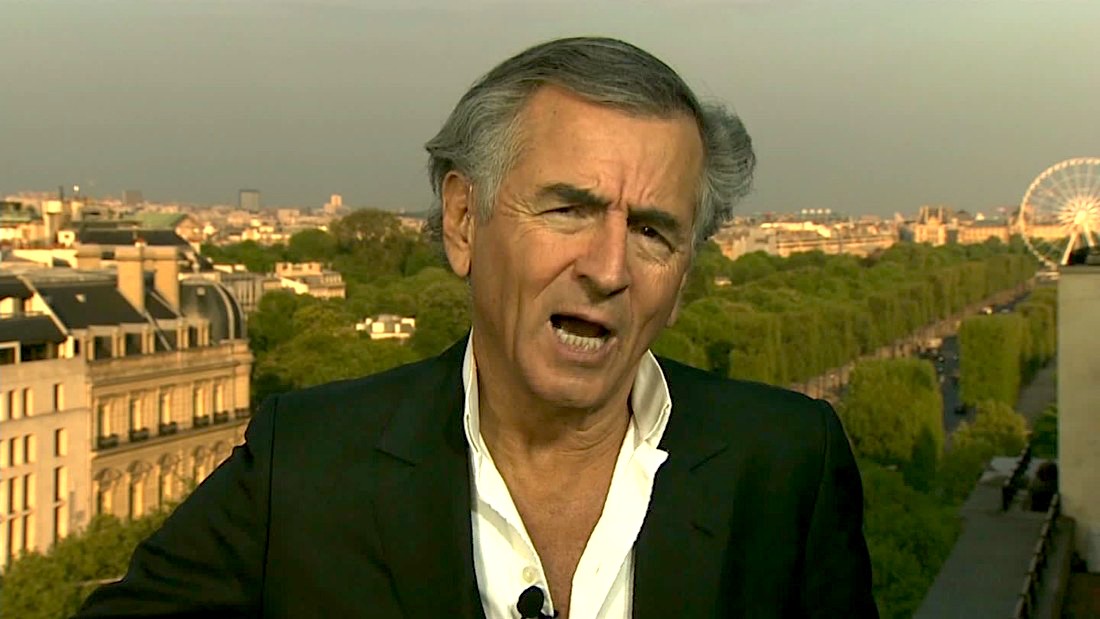
Bernard-Henri Lévy: No one proliferates more fact-free assertions. (CNN Screenshot.)
And what about mainstream media? In one recent news report after another (Skripal poisoning, chemical weapons attacks in Syria, the falsified murder in Ukraine of an anti-Putin journalist, not to mention the responsibility for firing a missile that shot down a Malaysian airliner in July 2014), there is a big difference between the Western version of the facts and that which prevails in Russia, Malaysia, Syria and much of the non-Western world.
A Mental Border with Russia
Instead of Pascal’s “truth on this side of the Pyrenees, and error on the other side”, we would be establishing “truth on one side of the Mediterranean, error on the other”. Or rather, truth exists up to the Eastern border of NATO, with error on the other side. This is no way to advance toward universal understanding. The only way to resolve our differences with the rest of the world is free discussion. Inasmuch as the law against fake news seems to be designed mainly to counter what Western governments describe as Russian propaganda, there is a strong likelihood that it can only enforce the mental border between us and the Russians.
When the independent journalist André Bercoff simply raised a couple of questions concerning anomalies in reports of the amazing rescue by Mamoudou Gassama of a child hanging from a Paris balcony, his own colleagues instantly condemned him for “provoking doubts” and engaging in “conspiracy theories”. The official regulatory agency, the Conseil Supérieur de l’Audiovisuel, hastened to open an investigation… of Bercoff. President Macron had invited Gassama to the Elysee Palace, offering him French citizenship and making the event an exemplary national legend. Thus sacred.
It is an odd sign of the times to reproach a journalist for asking questions. Leaving aside the rescue incident, raising questions used to be considered a primary function of journalism. If it is better to let ten guilty persons go free than to imprison one innocent man, in terms of rational scientific method, it is better to have ten extravagant doubts than one unchallengeable dogma.
It is true that what the dominant media call “conspiracy theories”, going everywhere from legitimate questioning of their own narratives and of official assertions to the wildest fantasies, do indeed proliferate on social media. But can anyone believe that describing Bercoff’s doubts as “conspiracy theorizing” will in any way stem that proliferation?

Françoise Nyssen: Public broadcasts must combat reactionary ideas.
The French Minister of culture, Françoise Nyssen, has decided that public radio and television, financed by taxpayers, should be devoted to combatting French people’s “highly reactionary” ideas, notably concerning “diversity”. Note that Macron’s ruling party, Republic in Movement, considers “reactionary” exactly what was considered progressive only a few decades ago: defense of public services and national sovereignty. Is it legitimate to oblige adults to pay for their own ideological re-education?
I by no means suggest that the current government is consciously intent on installing a totalitarian regime. The problem stems rather from the overwhelming subjectivism of contemporary culture in which talk of “values” leaves little space for concern for facts or objectivity. This is increasingly true even in discussions of scientific or technical progress. Of course, legislation cannot be fully objective, but since the Enlightenment reflection on freedom, the ideal has been to seek to establish reasonable rules to protect the individual from arbitrary power. This rule applies particularly to freedom of expression.
Those who speak endlessly of their values are merely trying to show off their own moral superiority. That is the basis of the corruption of the legal system in the matter of “fake news”, the reaction to Bercoff’s doubts, and the crusade of Madame Nyssen against what she considers “reactionary ideas”. Once a group of people convince themselves that they embody Virtue itself thanks to their “values”, they become unable to perceive any legitimate grounds for limiting their own power. That could be called the totalitarianism of the naïve.
This article originally appeared on RT’s French-language site. It was translated and adapted by Diana Johnstone.
Jean Bricmont is professor of theoretical physics at the Catholic University of Louvain (Belgium), and author of numerous articles and books, including Humanitarian Imperialism, La République des Censeurs,and Fashionable Nonsense (with Alan Sokal).
Brexit backer Arron Banks’s ‘golden Kremlin connection’ allegation raises laughter
RT | June 10, 2018
The UK media has come up with yet another ‘sensational revelation’ that allegedly sheds light on ties between the Kremlin and major Brexit campaigners. The story only seemed to raise laughter from those mentioned in it, though.
There is no rest for the wicked, it seems, as the British media apparently goes to great lengths to continue the narrative of Russia’s interference in the UK’s vote to leave the EU alive. This time, the Sunday Times dug up a story that was immediately turned into a new ‘reason’ for anti-Russian hysteria and even prompted the Minister for the Cabinet Office in Theresa May’s government, David Lidington, to call for an investigation.
The respected “quality paper” reported that Arron Banks, the millionaire co-founder and major funder of the Brexit campaign known as Leave.EU, made repeated contacts with Russian officials and even took such an incautious and reasonably suspicious step to make a trip to Moscow at the time when the UK was at the height of the Brexit campaign. And by saying “repeated contacts,” the Sunday Times actually means as many as three meetings between Banks and Andy Wigmore, the director of communications for Leave.EU, and Russian Ambassador to the UK Alexander Yakovenko over a period of more than a year.
The Sunday Times also boldly claims right in the first line of its piece that it managed to reveal “the hidden scale of Kremlin links to the biggest donor to the Brexit campaign.” It is all because the two Brexiteers and the Russian official allegedly discussed the roles of Banks and Wigmore in a deal involving six Russian gold mines.
Banks and Wigmore were expected to involve Lord Charles Guthrie, the former chief of the Defense Staff, and Peter Hambro, a UK businessman, who actually co-founded and owned Petropavlovsk PLC, a major Russian mining company, in a deal envisaging the consolidation of six Russian gold mines into one company. However, the deal has actually fallen through, according to the Sunday Times.
‘We are American spies too’
Banks slammed the report as “complete absolute garbage,” which is comparable to “the Salem witch hunt.” “Yeah, we had two lunches with the Russian ambassador and passed on a business contact. So what?” he told Reuters.
He revealed that he did not only meet with the Russian officials during the Brexit campaign, he also met with many representatives of other countries as well. “It wasn’t just the Russians: we met all sorts of nationalities, we also briefed the State Department in Washington, we also met with the top embassy officials in London,” he said.
The Sunday Times itself mentions in its piece that Banks actually admitted to briefing the CIA on his meetings with the Russian officials. “We actually saw the suits from the American embassy who introduced us to the State Department to explain what had happened and then we briefed the Americans on our meetings with the Russians,” he said, as cited by the paper.
“So if we are Russian spies we must be American spies too,” Banks later told Reuters.
New round of hysteria
The Sunday Times story is based on a batch of emails containing correspondence between Banks, Wigmore and some Russian diplomats and businessmen, including Ambassador Yakovenko’s office, which were provided to the paper by a journalist named Isabel Oakeshott.
The emails themselves, which were carefully presented by the Sunday Times in another piece, actually do not contain a single word about Brexit. The paper also hesitates to make any direct conclusions related to the role of the perceived conspiracy in the Brexit campaign, as it only mentions some in a broader context. Oakeshott is actually the only person who does make some direct hints about the alleged links between the two Brexiteers and the Kremlin.
“Banks and Wigmore were shamelessly used by the Russians,” she told the Sunday Times, adding that the two “genuinely sympathized with some of Putin’s political views.” This journalist, who once worked with Banks on his book ‘The Bad Boys of Brexit,’ later suddenly changed the subject of her interest and started working on a book dedicated to Russia’s use of “hybrid warfare” to influence British politics together with the Tory peer Lord Ashcroft.
As if there were not enough conspiracies in this story already, the Sunday Times decided to spice it up a little bit more by adding a hint of Trump-Russia collusion as well. It repeatedly mentioned that the two Brexiteers discussed Trump during their meeting with Yakovenko, also adding that one of their meetings came just days after Banks and Wigmore visited US President Donald Trump after his election victory.
Predictably, these “revelations” provoked a new outbreak of anti-Russian hysteria. “Those who’ve got the evidence, let them take it to the relevant authorities and let it be looked into,” Lidington told the Andrew Marr Show on BBC One.
A bunch of Tory MPs rushed to brand both Brexiteers as “useful idiots” serving the Kremlin’s interests. Meanwhile, Labour frontbencher Liam Byrne, a shadow digital minister, nervously asked if Russian President Vladimir Putin’s “active measures” indeed “did stretch to Leave.EU.”
As for Banks himself, the recent news seemingly only made him laugh. When asked if he ever got money or assistance from Russia for his Brexit campaign, the businessman said: “No, of course not. You know if I have, I’m still waiting for the cheque.”
A Brief History of the “Kremlin Trolls”

By Scott Humor | The Saker | October 15, 2018
Saint Petersburg, Savushkina, 55 is the most famous office building in the world, thanks to the relentless promotion of the United States government, the CIA, FBI, and by the powers of the entire Western media, financed by Western governments. VOA, NPR, and Svoboda, by the government of the US; the BBC by the government of the UK; CNN by the governments of Saudi Arabia; the DW, by the government of Germany; and so on and so forth. You name it, they all punched time to promote this office building.
To be specific, it’s not even a building, but several adjoined buildings that cover an entire city block, an urban development plan common for Saint Pete’s. That’s why every business here has the address of Savushkina, 55 followed by a building number. You can take a virtual tour around it, to see for yourself. The buildings are shared by several dozens of private businesses, by the local Police department, and by the newsrooms of half a dozen Russia Media sources like the FAN (Federal News Agency), the Neva News (Nevskie Novosti), Political Russia, Kharkov News Agency, publishing Ukrainian news, and others. They all are privately owned and operated and generate over 55 million unique visitors per month. Overall, several thousand people come to this building to work every morning. But you wouldn’t know this by account of Western media. For over two years now, these people are being harassed and collectively branded as “THE KREMLIN TROLLS.”
The building is very popular because it’s located in a quiet historical neighborhood and is in walking distance from a suburban train station. It’s newly renovated offices offer open floor plans with Scandinavian fleur so very appreciated by the news people. In addition, the rent for this building is less than in center city. Which is why Evgeny Zubarev, a former top editor for the RIA NEWS, choose it for his media startup. He took several offices allowing him to manage his growing media giant without wasting time to commute. Now, the FAN newsroom alone employs about 300 journalists.
This wasn’t always the case.
At the beginning of 2014, the building was still under construction and renovation, when an anti-Russian government group of hackers called first “The Anonymous International” and latter “Shaltay-B0ltay” fingered it as the “Kremlin trolls’ layer.”
Their wordpress blog is still here. It was last updated on November 2016. Its title states: “Anonymous International. Shaltay Boltay/Press Secretary of the group. Creating reality and giving meaning to words.”
November 7, 2014, Khodorkovsky, who acted as an integral part of the CIA “Kremlin trolls” Project, tweeted the picture of one of the entrances to one of the buildings saying: “Savuchkina 55. New home for bots. ID check system. Not a sign there. I won’t say who took the photo.”
Савушкина 55
Новый домик для ботов. Пропускная система. Ни одной вывески. Чье фото – не скажу. pic.twitter.com/oCVUAvSTW4— Ходорковский Михаил (@mich261213) November 7, 2014
Someone commented by saying
Nov 7 2014. The comment reads: “I live there and pass this building on my way to work. The sign on the building says “For Rent”
@tvjihad @mich261213 Михаил, я каждый день мимо проезжаю на работу. и да, чье фото с вывеской не скажу))) pic.twitter.com/FlTEJJwyTt
— Kirill_V (@Kirill_V1) November 7, 2014
The phone number on the picture 324-56-06 belongs to the commercial real estate company Praktis Consulting & Brokerage that managed the rent of offices.
Midsummer 2014, Evgeny Zubarev with his start up and several hundred journalists moved in, along with the Police department, and a slew of other businesses people. Little did they know what was to come.
***
The best way to get information is to make it up.
Everything what we know now about the so-called “Kremlin trolls from the Internet Research Agency paid by Putin’s favorite chef,” came from one source, a group of CIA spies that used the mascot of Shaltay-Boltay, or Humpty-Dumpty, for their collective online persona.
They were arrested in November 2016 and revealed as the FSB and former FSB officers. One of them even managed a security department for the Kaspersky Lab. They all were people highly skilled and educated in manipulating and creating large online databases, in any online research imagined, and the knowledge of hacking and altering databases, including those that were run by the Russian government. They weren’t poor people. They weren’t there for the money. They were ideologically driven. Their hatred towards Russia and its people was the motive for their actions.
At some point, Gazeta.ru, an online Russophobic publication, suggested that “Shaltai-Boltai was just a distraction meant to confuse everybody.” They themselves were more concise by stating that they were working to change the reality.
Russian authorities, the courts, and the lawyers, refused to call these men hackers. There was a reason for this. They weren’t so much hackers in a classic sense, as in when someone gains access to real information and copies it. This group wasn’t necessarily hacking existing information, but planting information. They were creating files about fake nonexistent companies and employees, files with blurry fake paystubs, memos, emails, phone messages and so on. The fakes looked convincing, but they still were forgeries that could be easy disproved for someone who had access to the real information.
That’s when the hacking took place, when the FSB agents went into government databases and created records of people and companies that didn’t exist.
I think that part of the reasons why some of them got the mild sentences of three years in general security prison, and some were left free, wasn’t just the fact that they agreed to collaborate with the Russian government, but also the fact that they didn’t actually steal information from government officials like Medvedev and his press secretary, Nataliya Timakova, or the owner of the largest in Europe catering business, Evgeny Prigozhin. They made information up and claimed that it was real.
These guys gave a bad name to all hackers, whistleblowers, leakers and spies. Now, journalists presented with some “hacked” and leaked secrets has to think it over, less they end up with an egg on their face like journos from the Fontanka, Vedomosti and Novaya Gazeta in case of the “Kremlin’s trolls.”
If we accept that the Shaltay-Boltay group was working to create and distribute documents they forged, claiming that those files were “hacked,” we would also understand a mysterious statement made by them to BuzzFeed.
“In email correspondence with BuzzFeed, a representative of the group claimed they were “not hackers in the classical sense.”
“We are trying to change reality. Reality has indeed begun to change as a result of the appearance of our information in public,” wrote the representative, whose email account is named Shaltai Boltai, which is the Russian for tragic nursery rhyme hero Humpty Dumpty.”
Bazzfeed also said back in 2014, that “The leak from the Internet Research Agency is the first time specific comments under news articles can be directly traced to a Russian campaign.”
Now, this is a very important grave mark.
Just think about this working scheme: Shaltay-Boltay with a group of anti-government “activists” created the “Internet Research Agency,” they and some “activists” created 470 FaceBook accounts used to post comments that looked unmistakably “trollish.”
After that other, CIA affiliated entities, like the entire Western Media, claimed the “Russian interference in the US election.” Finally, the ODNI published a report lacking any evidence in it.
The link to their report is here, but I don’t recommend you to read it. You will gain as much information by reading this report as you would by chewing on some wet newspaper. Ask my dog for details.
Assessing Russian Activities and Intentions in Recent US Elections
https://www.dni.gov/files/documents/ICA_2017_01.pdf
Only three paragraphs are interesting on the page 4:
“Russia used trolls as well as RT as part of its influence efforts to denigrate Secretary Clinton. This effort amplified stories on scandals about Secretary Clinton and the role of WikiLeaks in the election campaign.
The likely financier of the so-called Internet Research Agency of professional trolls located in Saint Petersburg is a close Putin ally with ties to Russian intelligence.
A journalist who is a leading expert on the Internet Research Agency claimed that some social media accounts that appear to be tied to Russia’s professional trolls—because they previously were devoted to supporting Russian actions in Ukraine—started to advocate for President-elect Trump as early as December 2015.”
In other words, in its report with a subtitle: “Background to “Assessing Russian Activities and Intentions in Recent US Elections”: The Analytic Process and Cyber Incident Attribution” the Office of the Director of National Intelligence ODNI, is quoting the Shaltay-Boltay, a group that had been proved to work for the CIA by “creating reality.”
The only reason why they don’t provide us with evidence, with at least one lousy IP address with the Russian trace roots that would convincingly point at the company named the Internet Research Agency, is because this company never existed, it never had any IP addresses assigned to it that would be verifiable via third parties like RIPE network coordination and via online domain tools.
We understand that having hundreds of people working ten to twelve hours a day, as they claimed, posting hundreds messages hourly, would use huge amount of bandwidth. They would need a very fast internet connection with unlimited bandwidth that only a business can get. Inevitably, this internet connection would come with the assigned IP addresses. No internet provider would let this kind of bandwidth hog to create this kind traffic without being forced to separate them from other customers.
One example, a woman with the last name Malcheva filed a lawsuit in court against the companies “Internet Research, LLC” and “TEKA, LLC,” claiming unpaid wages.
The court asked her to produce evidence of her work, and then denied her claim after she produced a photo of a computer with an IP address on its screen as evidence of her employment.
IP Address 109.167.231.85
inetnum: 109.167.231.0 – 109.167.231.255
netname: WESTCALL-NET
descr: S-Peterburg Hotel Corintia Wi-Fi
An IP address that was assigned to a luxury hotel in Saint-Petersburg. A hotel that was awarded multiple international awards for excellence. An immensely popular hotel among discriminating travelers. A very expensive hotel located in the center of a historic city. The woman claimed that she was an “online troll’ working from this location ten hours a day with hundreds of other virtual trolls. The judge didn’t believe her. Would you?
People from the Shaltay-Boltay group weren’t hackers in the proper terms because they worked with and for the CIA. Middle-of the-road and run-of-the-mill intelligence agencies would collect and analyze information for their governments. The CIA invents information, then goes on to manufacture and forge documents in support of their invented information; they then recruit people inside other countries and other governments to claim that they “obtained” this explosive evidence. Being the dirty cops that they are, the CIA doesn’t obtain and secure evidence, but instead they plant fake evidence on their victims.
By this act alone they change our current and past reality, and they change our future. They change our history by forging never existing “proof” of invented myths. They hire and train groups of military men to act as “protesters” around government buildings, while other military men from other countries shoot at unsuspected bystanders whose death allows Washington to claim the sovereign governments’ wrongdoing.
CIA-operated groups arrest and kill government officials or force them to flee, like in Ukraine. They take over a couple of government buildings and declare their victory over a huge country, just like it happened in Russia in 1991 and 1993 and in Ukraine in 2005 and 2014. For some reason, they claim that governments are those people who take over a couple of buildings in one city. When in fact, our countries’ governments are those people whose names we wrote on ballots, regardless of where these people are located. We don’t run around like chickens with our heads cut off electing a new president every time our current president leaves the country.
Going back to the CIA’s Humpty-Dumpty project that came online sometime in 2013. Why would anyone name their enterprise after such predictable failure, you might ask. Because, in the Russian alliteration, Shalti-Boltai means “shake up and brag about it” and not as in its original Carroll’s version of “humping and dumping.”
I went ballistic after someone retweeted me this CNN clip titled “Russia used Pokemon Go to interfere with the US elections.”
I actually listened to the clip itself, in which they brought up the Internet Research Agency” from SP. Knowing full well that the hackers who “leaked” the information about this “Agency” were arrested and successfully charged for treason because they worked for the CIA should prevent the CIA to run fake news about the entities and people they themselves made up. You would think that the matter of the “Kremlin trolls from Saint Petersburg” should be dead and buried after the arrest. The CIA and other 16 intelligence agencies should know better than to use information that is being known now as “discovered’ with their “help.”
Because it’s all fake and we know it.
We also know everything that the CIA touches is fake. Speaking in layman’s term, it’s as if all those middle aged bald guys would start licking their balls while claiming to be in fulfilling relations. If it’s just you, guys, there is no relations. It’s just you. Deal with it!
The American intelligence community cannot claim an existence of threats against America if all fingers in those “threats” are pointing back at the American intelligence community.
By stating that someone interfered with the US election using the Internet Research Agency in SP, is plainly to state that it’s CIA that interfered in the American elections.
—
Let’s just briefly run over the matter, before I tell you what exactly took place.
—
On September 6, 2017, Alex Stamos, a Chief Security Officer, posted a statement titled “An Update On Information Operations On Facebook”:
“In reviewing the ads buys, we have found approximately $100,000 in ad spending from June of 2015 to May of 2017 — associated with roughly 3,000 ads — that was connected to about 470 inauthentic accounts and Pages in violation of our policies. Our analysis suggests these accounts and Pages were affiliated with one another and likely operated out of Russia.”
To make sure that people including myself won’t find those accounts, the FB deleted them.
“We don’t allow inauthentic accounts on Facebook, and as a result, we have since shut down the accounts and Pages we identified that were still active.”
That’s how it’s done in the US. They destroy all potential evidence while laying heavy blame on Russia. Facebook destroys evidence of “Russians crimes” while public ask them to show those evidences. This means only one thing: the pieces of evidence are pointing at something Facebook wants to protect, which is the CIA.
You see, I am not suggesting that they are lying about those accounts being real or that they “affiliated with Russia,” because, if the Shaltay-Boltay group worked with people from the Soros and Khodorkovky-backed group of human rights lawyers “Team 29,” created in February 2015, then their only task, it seems, was to service the psyop of the “Internet Trolls.” It looks to me like they could also coordinated the work done by those 470 FaceBook accounts while being on the territory of Russia. Considering that, it’s not a complete lie for the FB to say that those accounts were “Russia affiliated” and that they were “likely operated from Russia.”
Facebook also can claim with plausible deniability that they are ignorant of the fact that people behind the Internet Research Agency troll hoax are proved by the Russian court to be affiliated with the CIA, while people who have been acting as the “witnesses” to this Project are lawyers from Team 29, “human rights activists and also journalists from the Norwegian Bonnier AB owned Fontanka, Taiwan-based Novaya Gazeta, and the Latvia-based Meduza; these people are factually proven to be backed by Soros, a CIA financial branch, like a journalist who has received an award from Khodorkovsky.
The entire campaign of blaming Russia in “meddling” is being reported without ANY tangible proof that could be verified by at least two independently existing sources, that’s why we should grab ANY grains of information. That’s why Facebook’s statement that “About one-quarter of these ads were geographically targeted, and of those, more ran in 2015 than 2016″is very important.
Why?
Because, fake business entities known as “the Internet Research Agency,” and “the Internet Research” in the government electronic business registry, they were treated as real companies by the system. Because of their inactivity on all of their bank accounts and because no one ever filed required forms, they were automatically liquidated by the electronic system.
The United Business Registry database in Russia works according to the Federal laws, so after twelve months of inactivity a business is simply liquidated. The Internet Research Agency was liquidated in December 2016 by the government system after it been inactive for twelve month. It’s inactivity implied that the company had no employees, no office, and no bank transactions for at least twelve months! The Internet Research company was liquidated on September 2, 2015 by merging with TEKA company. According to the federal business Registry TEKA was a construction retailer. I wasn’t able to find any indication, like an office, phone number, names of the managers or employees, anything at all that would indicate that this company existed. Just like the Internet Research Agency and the Internet Research, TEKA existed only in the federal registry and nowhere else.
The automatic liquidation in the federal registry for inactivity explains the drop in activity on the accounts run by the Shaltay-Boltay and the others. Oh, yes, they were also hunted and on the run, out of the country. It’s hard to use bank accounts to simulate activities after you have fled the country.
The Team 29, of the human rights lawyers and activists, was created in February 2015. To give to this new company some proof of reality and instant notoriety they immediately filed a lawsuit against the Internet Research company using an activist woman with a Ukrainian last name Ludmila Savchuk (Людмила Савчук) who went and filed a lawsuit against the company, claiming some unpaid wages. Her first lawsuit the judge threw out. Only after the local general prosecutor’s office pressed the judge to take the case, the district court took the case and partially granted the Claimant her claim, but not the “moral damages.” She wanted the money for working for the “troll factory.” In essence, they wanted an official court paper that would say black on white, that there is a “troll factory” that this poor woman worked for. Without reading the file, I don’t know what the judge was thinking, but she might have smelled a rat among those virtual “trolls.”
This took place in August 2015, and by September 2 2015, a fake company named the “Internet Research” was liquidated by merging it, in the Business registry, with another fake entity, TEKA, that was created in spring 2015 as the construction materials retailer.
“Facebook disclosed on Wednesday that it had identified more than $100,000 worth of divisive ads on hot-button issues purchased by a shadowy Russian company linked to the Kremlin.”
“Most of the 3,000 ads did not refer to particular candidates but instead focused on divisive social issues such as race, gay rights, gun control and immigration, according to a post on Facebook by Alex Stamos, the company’s chief security officer. The ads, which ran between June 2015 and May 2017, were linked to some 470 fake accounts and pages the company said it had shut down.”
“Facebook officials said the fake accounts were created by a Russian company called the Internet Research Agency, which is known for using “troll” accounts to post on social media and comment on news websites.”
“The January intelligence report said the “likely financier” of the Internet Research Agency was “a close Putin ally with ties to Russian intelligence.” The company, profiled by The New York Times Magazine in 2015, is in St. Petersburg and uses its small army of trolls to put out messages supportive of Russian government policy.”
“To date, while news reports have uncovered many meetings and contacts between Trump associates and Russians, there has been no evidence proving collusion in the hacking or other Russian activities.”
“While there is no direct link between the Kremlin and any of these projects—both Surkov and Zubarev say their projects are privately funded—the timing, scale, and coordination of these efforts are suspicious. BuzzFeed was not able to find evidence of direct government funding to the “Internet Research Agency ,” the pro-Kremlin troll outlet operating out of 55 Savushkina, but they did reference a number of sources that revealed some level of involvement.”
—-
In my next study, I will provide you with more links, screenshots and translations. I will demonstrate to you how this story connects to the war on the Middle East and the international war on the Russian population of Ukraine.
—
In conclusion I just want to say that everything the United State touches turns into a warzone. The building on Savushkina, 55 in Saint Petersburg is no exception.
Multiple death threats are being directed at people who work there. Popular and excellent in their quality media outlets operating there have to hide their true location and rent a separate office across the city for their visitors, because people are simply afraid to come in.
Journalists and multiple business employees are threatened online with rape.
Threats to hang the journalists during a “protest meeting” on Oct 1, 2017
At least one case of terror attack on the office building that resulted in arson on October 26, 2016.
On Oct 26, 2016, several men threw bottles of Molotov cocktail in the windows of the Nevskie Novosti (Neva News). Luckily, no one was there but the owner of the Media conglomerate, Evgeny Zubarev, who put out the fire.
All of these, every threat, every simple lie is all on the United State government, its intelligence community, on those traitors, who are in prison now, and those who are still at large.
UPDATE:
A couple of Kaspersky staff members (Stoyanov and Dokuchaev), including the head of computer crime investigations (Stoyanov), were arrested by
Russian FSB on treason charges in January this year. An FSB officer (Sergei Mikhailov) was also arrested. The treason charges suggest they
were acting on behalf of a foreign power. SputnikMaybe the US actions against Kaspersky Labs anti-virus software are an attempt to preempt the consequences of the trial of the Kaspersky and
FSB operatives?
——————
Scott Humor
Director of Research and Development
author of The enemy of the State
Election Omens: Blue Wave or 2018 Flushes?
By Thomas L. Knapp – William Lloyd Garrison Center – June 7, 2018
Coming out of the 2016 presidential election, Democrats had reason for optimism about their House and Senate prospects in 2018. In the last 21 midterm elections (starting with FDR’s first term), the president’s party has gained seats in both houses of Congress only twice (1934 and 2002) while gaining seats in one house but not both four times (1962, 1970, 1982, and 1998). On average, the president’s party loses 30 House seats and four Senate seats.
So, are we in for a “Blue Wave,” or for the electoral equivalent of a commercial for blue-toned water swirling in the toilet?
As I write this, no combination of Republican/Democratic control of the houses is trading at more than 41 cents (of a possible dollar) on PredictIt, where people have real money riding on the outcome. That’s a bad sign for the opposition.
Democrats are outpacing Republicans on the national “generic ballot,” but each House district is a separate contest, most of them gerrymandered as a “safe” seat for one party or the other. The CBS/YouGov Battleground Tracker, as of early June, rates the House as a tossup: Democrats climbing from 194 seats to a one-seat majority of 219, but with a nine-seat margin of error.
The Blue Wave isn’t shaping up as a tsunami. Why?
One clue might be the gigantic collective yawn greeting rumors that former Starbucks CEO Howard Schultz might run for president in 2020. His centrist “Democrats need to look more like Republicans to win” message — also pushed by the Democratic National Committee versus upstart progressive midterm primary candidates around the country — just doesn’t excite anyone very much.
A second clue: In California’s June 5 primaries, five independents, two Greens, and one Libertarian battled their way past the state’s “Top Two” primary barrier and onto November’s general election ballot, from which the “Top Two” scheme was expressly designed to exclude them in favor of Republicans and Democrats (mostly Democrats). Independents come in all flavors, but Greens and Libertarians reliably run from the Democratic establishment’s left on civil liberties issues.
The message: Putting a “D” next to your name, not liking Donald Trump, and telling scary stories about the Russians is not enough this year. Traditionally Democratic constituencies are up for grabs because their usual party of preference isn’t offering them anything of substance.
In the short term, Democrats are courting losses that could have been wins. In the long term, they may finally be creating an opening for the third party America desperately needs.
Thomas L. Knapp (Twitter: @thomaslknapp) is director and senior news analyst at the William Lloyd Garrison Center for Libertarian Advocacy Journalism (thegarrisoncenter.org).
Featured Video

Death Spikes & Rising Cancer In Our Youth Explained
or go to
Aletho News Archives – Video-Images
From the Archives
Politicians lie
By Mazin Qumsiyeh | Popular Resistance | August 18, 2013
There is no way to say this truth nicely: Politicians lie. That includes Japanese, American, Egyptian, Israeli, and Palestinian politicians! Is there something more common sense than that? Yet, so many citizens around the world believe their own politicians or wistfully acknowledge lies but think it is part of the job needed to run things. They believe even when politicians contradict themselves blatantly. This phenomenon is rather remarkable. It is a dissonance and disconnect from reality that many seem oblivious to. It is very dangerous because it can lead to accepting rationales for going to war. These can be deadly wars that lead to millions of lives lost as happened in what was called World War 1 and WW2. Even when incredible and declassified evidence abound, politicians continue to lie and old mythologies refuse to die. Here are just a few of the countless lies told to us over the past few decades… continue
Blog Roll
 Aletho News
- Iran flights continue despite US aviation sanctions
- Global Tipping Points Lead the World Into a State of Entropy
- The day-after at the White House: USA and Xi Jinping
- The Geopolitical Balance in the Red Sea: The UAE Being Displaced by New Players
- Iraqi resistance group vows to stage airport sit-ins over Iran aerial blockade
- Turkish parliament to review Saudi-Pakistan defense pact next month
- DEATH SPIKES & RISING CANCER IN OUR YOUTH EXPLAINED
- Iran offers Trump deal before US election
- Merz regime wants ‘secret police’ – opposition
- Israeli settlers terrorize West Bank Palestinians with state-provided drones: Report
- If Americans Knew
- An error has occurred; the feed is probably down. Try again later.
- No Tricks Zone
- New Study: Earth And Venus Surface Warmth Largely Explained By Convection And Lapse Rate, Not CO2 Or Radiation
- 2025 Nature Paper Claiming Worsening Global Drought Gets RETRACTED …Heavily Flawed
- New Study: ‘Global Drought Shows No Detectable Recent Acceleration Under Climate Warming’
- Economic Masterminds: German Socialists Suggest Taxing Productivity Gains Stemming From Using AI
- The South China Sea Has Not Been Cooperating With The Climate Change Narrative
- Energy Crisis: Germany Enters Heating Season With Historically Low Gas Reserve Fill Levels
- New Study: The Antarctic Ice Sheet Gained Mass From 2020-2024 Due To Staggering Snow And Ice Accumulation
- Study: Ocean Heating Rates From Thousands Of Years Ago ‘Dwarf’ Modern Ocean Heating Rates
- Climate Extremists Target, Attack Large-Scale Power Grid Infrastructure In Germany!
- New Study: Antarctic Ice Melt Has Contributed Less Than 1 Centimeter To Sea Level Rise In The Last 30 Years

