The Foundering Russia-gate ‘Scandal’
By Robert Parry | Consortium News | December 13, 2017
The disclosure of fiercely anti-Trump text messages between two romantically involved senior FBI officials who played key roles in the early Russia-gate inquiry has turned the supposed Russian-election-meddling “scandal” into its own scandal, by providing evidence that some government investigators saw it as their duty to block or destroy Donald Trump’s presidency.
As much as the U.S. mainstream media has mocked the idea that an American “deep state” exists and that it has maneuvered to remove Trump from office, the text messages between senior FBI counterintelligence official Peter Strzok and senior FBI lawyer Lisa Page reveal how two high-ranking members of the government’s intelligence/legal bureaucracy saw their role as protecting the United States from an election that might elevate to the presidency someone as unfit as Trump.
In one Aug. 6, 2016 text exchange, Page told Strzok: “Maybe you’re meant to stay where you are because you’re meant to protect the country from that menace.” At the end of that text, she sent Strzok a link to a David Brooks column in The New York Times, which concludes with the clarion call: “There comes a time when neutrality and laying low become dishonorable. If you’re not in revolt, you’re in cahoots. When this period and your name are mentioned, decades hence, your grandkids will look away in shame.”
Apparently after reading that stirring advice, Strzok replied, “And of course I’ll try and approach it that way. I just know it will be tough at times. I can protect our country at many levels, not sure if that helps.”
At a House Judiciary Committee hearing on Wednesday, Rep. Jim Jordan, R-Ohio, criticized Strzok’s boast that “I can protect our country at many levels.” Jordan said: “this guy thought he was super-agent James Bond at the FBI [deciding] there’s no way we can let the American people make Donald Trump the next president.”
In the text messages, Strzok also expressed visceral contempt for working-class Trump voters, for instance, writing on Aug. 26, 2016, “Just went to a southern Virginia Walmart. I could SMELL the Trump support. … it’s scary real down here.”
Another text message suggested that other senior government officials – alarmed at the possibility of a Trump presidency – joined the discussion. In an apparent reference to an August 2016 meeting with FBI Deputy Director Andrew McCabe, Strzok wrote to Page, “I want to believe the path you threw out for consideration in Andy’s office — that there’s no way he gets elected — but I’m afraid we can’t take that risk.”
It’s unclear what strategy these FBI officials were contemplating to ensure Trump’s defeat, but the comments mesh with what an intelligence source told me after the 2016 election, that there was a plan among senior Obama administration officials to use the allegations about Russian meddling to block Trump’s momentum with the voters and — if elected — to persuade members of the Electoral College to deny Trump a majority of votes and thus throw the selection of a new president into the House of Representatives under the rules of the Twelfth Amendment.
The scheme involved having some Democrats vote for former Secretary of State Colin Powell (which did happen), making him the third-place vote-getter in the Electoral College and thus eligible for selection by the House. But the plan fizzled when enough of Trump’s electors stayed loyal to their candidate to officially make him President.
After that, Trump’s opponents turned to the Russia-gate investigation as the vehicle to create the conditions for somehow nullifying the election, impeaching Trump, or at least weakening him sufficiently so he could not take steps to improve relations with Russia.
In one of her text messages to Strzok, Page made reference to a possible Watergate-style ouster of Trump, writing: “Bought all the president’s men. Figure I needed to brush up on watergate.”
As a key feature in this oust-Trump effort, Democrats have continued to lie by claiming that “all 17 U.S. intelligence agencies concurred” in the assessment that Russia hacked the Democratic emails last year on orders from President Vladimir Putin and then slipped them to WikiLeaks to undermine Hillary Clinton’s campaign.
That canard was used in the early months of the Russia-gate imbroglio to silence any skepticism about the “hacking” accusation, and the falsehood was repeated again by a Democratic congressman during Wednesday’s hearing of the House Judiciary Committee.
But the “consensus” claim was never true. In May 2017 testimony, President Obama’s Director of National Intelligence James Clapper acknowledged that the Jan. 6 “Intelligence Community Assessment” was put together by “hand-picked” analysts from only three agencies: the CIA, FBI and National Security Agency.
Biased at the Creation
And, the new revelations of high-level FBI bias puts Clapper’s statement about “hand-picked” analysts in sharper perspective, since any intelligence veteran will tell you that if you hand-pick the analysts you are effectively hand-picking the analysis.
Although it has not yet been spelled out exactly what role Strzok and Page may have had in the Jan. 6 report, I was told by one source that Strzok had a direct hand in writing it. Whether that is indeed the case, Strzok, as a senior FBI counterintelligence official, would almost surely have had input into the selection of the FBI analysts and thus into the substance of the report itself. [For challenges from intelligence experts to the Jan. 6 report, see Consortiumnews.com’s “More Holes in the Russia-gate Narrative.“]
If the FBI contributors to the Jan. 6 report shared Strzok’s contempt for Trump, it could explain why claims from an unverified dossier of Democratic-financed “dirt” on Trump, including salacious charges that Russian intelligence operatives videotaped Trump being urinated on by prostitutes in a five-star Moscow hotel, was added as a classified appendix to the report and presented personally to President-elect Trump.
Though Democrats and the Clinton campaign long denied financing the dossier – prepared by ex-British spy Christopher Steele who claimed to rely on second- and third-hand information from anonymous Russian contacts – it was revealed in October 2017 that the Democratic National Committee and the Clinton campaign shared in the costs, with the payments going to the “oppo” research firm, Fusion GPS, through the Democrats’ law firm, Perkins Coie.
That discovery helped ensnare another senior Justice Department official, Associate Attorney General Bruce Ohr, who talked with Steele during the campaign and had a post-election meeting with Fusion GPS co-founder Glenn Simpson. Recently, Simpson has acknowledged that Ohr’s wife, Nellie Ohr, was hired by Fusion GPS last year to investigate Trump.
Bruce Ohr has since been demoted and Strzok was quietly removed from the Russia-gate investigation last July although the reasons for these moves were not publicly explained at the time.
Still, the drive for “another Watergate” to oust an unpopular – and to many insiders, unfit – President remains at the center of the thinking among the top mainstream news organizations as they have scrambled for Russia-gate “scoops” over the past year even at the cost of making serious reporting errors.
For instance, last Friday, CNN — and then CBS News and MSNBC — trumpeted an email supposedly sent from someone named Michael J. Erickson on Sept. 4, 2016, to Donald Trump Jr. that involved WikiLeaks offering the Trump campaign pre-publication access to purloined Democratic National Committee emails that WikiLeaks published on Sept. 13, nine days later.
Grasping for Confirmation
Since the Jan. 6 report alleged that WikiLeaks received the “hacked” emails from Russia — a claim that WikiLeaks and Russia deny — the story seemed to finally tie together the notion that the Trump campaign had at least indirectly colluded with Russia.
This new “evidence” spread like wildfire across social media. As The Intercept’s Glenn Greenwald wrote in an article critical of the media’s performance, some Russia-gate enthusiasts heralded the revelation with graphics of cannons booming and nukes exploding.
But the story soon collapsed when it turned out that the date on the email was actually Sept. 14, 2016, i.e., the day after WikiLeaks released the batch of DNC emails, not Sept. 4. It appeared that “Erickson” – whoever he was – had simply alerted the Trump campaign to the public existence of the WikiLeaks disclosure.
Greenwald noted, “So numerous are the false stories about Russia and Trump over the last year that I literally cannot list them all.”
Yet, despite the cascade of errors and grudging corrections, including some belated admissions that there was no “17-intelligence-agency consensus” on Russian “hacking” – The New York Times made a preemptive strike against the new documentary evidence that the Russia-gate investigation was riddled with conflicts of interest.
The Times’ lead editorial on Wednesday mocked reporters at Fox News for living in an “alternate universe” where the Russia-gate “investigation is ‘illegitimate and corrupt,’ or so says Gregg Jarrett, a legal analyst who appears regularly on [Sean] Hannity’s nightly exercise in presidential ego-stroking.”
Though briefly mentioning the situation with Strzok’s text messages, the Times offered no details or context for the concerns, instead just heaping ridicule on anyone who questions the Russia-gate narrative.
“To put it mildly, this is insane,” the Times declared. “The primary purpose of Mr. Mueller’s investigation is not to take down Mr. Trump. It’s to protect America’s national security and the integrity of its elections by determining whether a presidential campaign conspired with a foreign adversary to influence the 2016 election – a proposition that grows more plausible every day.”
The Times fumed that “roughly three-quarters of Republicans still refuse to accept that Russia interfered in the 2016 election – a fact that is glaringly obvious to everyone else, including the nation’s intelligence community.” (There we go again with the false suggestion of a consensus within the intelligence community.)
The Times also took to task Sen. Lindsey Graham, R-South Carolina, for seeking “a Special Counsel to investigate ALL THINGS 2016 – not just Trump and Russia.” The Times insisted that “None of these attacks or insinuations are grounded in good faith.”
But what are the Times editors so afraid of? As much as they try to insult and intimidate anyone who demands serious evidence about the Russia-gate allegations, why shouldn’t the American people be informed about how Washington insiders manipulate elite opinion in pursuit of reversing “mistaken” judgments by the unwashed masses?
Do the Times editors really believe in democracy – a process that historically has had its share of warts and mistakes – or are they just elitists who think they know best and turn away their noses from the smell of working-class people at Walmart?
Investigative reporter Robert Parry broke many of the Iran-Contra stories for The Associated Press and Newsweek in the 1980s.
Russia Offered to US to Exchange Non-Interference Letters, US Refused – Moscow
Sputnik – 13.12.2017
Russia has proposed to the United States to exchange letters on non-interference in each other’s affairs, but Washington refused, Russian Foreign Ministry spokeswoman Maria Zakharova said Wednesday.
According to Maria Zakharova, Russia did not invent anything new, “this is not some kind of revolutionary proposal or some kind of innovation.” She noted that such a principle had already been fixed during the restoration of diplomatic relations between the two countries on November 16, 1933, at the insistent request of the Americans themselves.
“Washington’s refusal to consider such an offer now once again shows the absolute fakeness of the campaign for accusing Russia of some interference in last year’s elections in the United States,” she added.
Russia has repeatedly denied the accusations of the US special services in trying to influence the elections in the United States, and Dmitry Peskov, the presidential press secretary, called them “absolutely unsubstantiated.”
Russia-gate’s Litany of Corrections

By Robert Parry | Consortium News | December 11, 2017
The U.S. mainstream media’s year-long hysteria over Russia’s alleged role in the election of Donald Trump has obliterated normal reporting standards leading to a rash of journalistic embarrassments that have both disgraced the profession and energized Trump’s backers over new grievances about the MSM’s “fake news.”
Misguided groupthink is always a danger when key elements of the Washington establishment and the major news media share the same belief – whether that is Iraq’s supposed possession of WMD or the need to bring down some foreign or domestic leader unpopular with the elites.
Yet, we have rarely witnessed such a cascading collapse of journalistic principles as has occurred around the Russia-gate “scandal.” It is hard to keep track of all the corrections or to take note of all the dead ends that the investigation keeps finding.
But anyone who dares note the errors, the inconsistencies or the illogical claims is either dismissed as a “Kremlin stooge” or a “Trump enabler.” The national Democrats and the mainstream media seem determined to keep hurtling down the Russia-gate roadway assuming that the evidentiary barriers ahead will magically disappear at some point and the path to Trump’s impeachment will be clear.
On Friday, the rush to finally prove the Russia-gate narrative led CNN — and then CBS News and MSNBC — to trumpet an email supposedly sent from someone named Michael J. Erickson on Sept. 4, 2016, to Donald Trump Jr. that involved WikiLeaks offering the Trump campaign pre-publication access to purloined Democratic National Committee emails that WikiLeaks published on Sept. 13, nine days later.
With CNN finally tying together the CIA’s unproven claim that WikiLeaks collaborates with Russia and the equally unproven claim that Russian intelligence “hacked” the Democratic emails, CNN drew the noose more tightly around the Trump campaign for “colluding” with Russia.
After having congressional reporter Manu Raju lay out the supposed facts of the scoop, CNN turned to a panel of legal experts to pontificate about the crimes that the Trump campaign may have committed now that the “evidence” proving Russia-gate was finally coming together.
Not surprisingly the arrival of this long-awaited “proof” of Russian “collusion” exploded across social media. As The Intercept’s Glenn Greenwald noted in an article critical of the media’s performance, some Russia-gate enthusiasts heralded the CNN revelation with graphics of cannons booming and nukes exploding.
The problem, however, was that CNN and other news outlets that jumped on the story misreported the date of the email; it was Sept. 14, 2016, i.e., the day after WikiLeaks released the batch of DNC emails, not Sept. 4. In other words, it appeared that “Erickson” – whoever he was – was simply alerting the Trump campaign to the WikiLeaks disclosure.
CNN later issued a quiet correction to its inflammatory report – and not surprisingly people close to Trump cited the false claim as yet another example of “fake news” being spread by the mainstream media, which has put itself at the forefront of the anti-Trump Resistance over the past year.
But this sloppy journalism – compounded by CNN’s rush to put the “Sept. 4 email” in some criminal context and with CBS and MSNBC panting close behind – was not a stand-alone screw-up. A week earlier, ABC News made a similar mistake in claiming that candidate Donald Trump instructed Michael Flynn to contact Russian officials during the campaign, when Trump actually made the request after the election when Flynn was national security adviser-designate, a thoroughly normal move for a President-elect to make. That botched story led ABC News to suspend veteran investigative reporter Brian Ross.
Another inaccurate report from Bloomberg News, The Wall Street Journal and other news outlets – that Russia-gate special prosecutor Robert Mueller had subpoenaed Deutsche Bank records of President Trump and his family – was denied by Trump’s lawyer and later led to more corrections. The error apparently was that the bank records were not those of Trump and his family but possibly other associates.
A Pattern of Bias
But it wasn’t just a bad week for American mainstream journalism. The string of errors followed a pattern of earlier false and misleading reporting and other violations of journalistic standards, a sorry record that has been the hallmark of the Russia-gate “scandal.” Many stories have stirred national outrage toward nuclear-armed Russia before petering out as either false or wildly exaggerated. [See, for instance, Consortiumnews.com’s “Russia-gate Jumps the Shark.”]
As Greenwald noted, “So numerous are the false stories about Russia and Trump over the last year that I literally cannot list them all.”
The phenomenon began in the weeks after Trump’s shocking victory over Hillary Clinton as Democrats and the mainstream media looked for people to blame for the defeat of their much-preferred candidate.
So, on Thanksgiving Day, just weeks after the election, The Washington Post published a front-page story based on an anonymous group called PropOrNot accusing 200 Web sites of acting as propaganda agents for Russia. The list included some of the Internet’s leading independent news sources, including Consortiumnews, but the Post did not bother to contact the slandered Web sites nor to dissect the dubious methodology of the unnamed accusers.
Apparently, the “crime” of the Web sites was to show skepticism toward the State Department’s claims about Syria and Ukraine. In conflating a few isolated cases of “fake news” in which people fabricated stories for political or profitable ends with serious dissent regarding the demonizing of Russia and its allies, the Post was laying down a marker that failure to get in line behind the U.S. government’s propaganda on these and other topics would get you labeled a “Kremlin tool.”
As the Russia-gate hysteria built in the run-up to Trump’s inauguration during the final weeks of the Obama administration, the Post also jumped on a claim from the Department of Homeland Security that Russian hackers had penetrated into the nation’s electrical grid through Vermont’s Burlington Electric.
As journalist Gareth Porter noted, “The Post failed to follow the most basic rule of journalism, relying on its DHS source instead of checking with the Burlington Electric Department first. The result was the Post’s sensational Dec. 30 story under the headline ‘Russian hackers penetrated U.S. electricity grid through a utility in Vermont, U.S. officials say.’ …
“The electric company quickly issued a firm denial that the computer in question was connected to the power grid. The Post was forced to retract, in effect, its claim that the electricity grid had been hacked by the Russians. But it stuck by its story that the utility had been the victim of a Russian hack for another three days before admitting that no such evidence of a hack existed.”
The Original Sin
In other cases, major news outlets, such as The New York Times, reported dubious Russia-gate claims from U.S. intelligence agencies as flat fact, rather than unproven allegations that remain in serious dispute. The Times and others reported Russian “hacking” of Democratic emails as true even though WikiLeaks denied getting the material from the Russians and the Russians denied providing it.
For months into 2017, in dismissing or ignoring those denials, the U.S. mainstream media reported routinely that all 17 U.S. intelligence agencies concurred in the conclusion that Russia was behind the disclosure of Democratic emails as part of a plot initiated by Russian President Vladimir Putin to help elect Trump. Anyone who dared question this supposed collective judgment of all the U.S. intelligence agencies risked being called a “conspiracy theorist” or worse.
But the “consensus” claim was never true. Such a consensus judgment would have called for a comprehensive National Intelligence Estimate, which was never commissioned on the Russian “hacking” issue. Instead there was something called an “Intelligence Community Assessment” on Jan. 6 that – according to testimony by President Obama’s Director of National Intelligence James Clapper in May 2017 – was put together by “hand-picked” analysts from only three agencies: the CIA, FBI and National Security Agency.
Even after Clapper’s testimony, the “consensus” canard continued to circulate. For instance, in The New York Times’ White House Memo of June 25, correspondent Maggie Haberman mocked Trump for “still refus[ing] to acknowledge a basic fact agreed upon by 17 American intelligence agencies that he now oversees: Russia orchestrated the attacks, and did it to help get him elected.”
Finally, the Times ran a correction appended to that article. The Associated Press ran a similar “clarification” applied to some of its fallacious reporting which used the “17-intelligence-agencies” meme.
After the correction, however, the Times simply shifted to other deceptive wording to continue suggesting that U.S. intelligence agencies were in accord on Russian “hacking.” Other times, the Times just asserted the claim of Russian email hacking as flat fact. All of this was quite unprofessional, since the Jan. 6 “assessment” itself stated that it was not asserting Russian “hacking” as fact, explaining: “Judgments are not intended to imply that we have proof that shows something to be a fact.”
Even worse than the Times, the “fact-checking” site Politifact, which is part of Google’s First Draft Coalition for deciding what the search engine’s algorithms will promote as true and what information will be disappeared as false, simply decided to tough it out and continued insisting that the false “consensus” claim was true.
When actual experts, such as former National Security Agency technical director William Binney, sought to apply scientific analysis to the core claim about Russian “hacking,” they reached the unpopular conclusion that the one known download speed of a supposed “hack” was not possible over the Internet but closely matched what would occur via a USB download, i.e., from someone with direct access to the Democratic National Committee’s computers using a thumb drive. In other words, the emails more likely came from a DNC insider, not an external “hack” from the Russians or anyone else.
You might have thought that the U.S. news media would have welcomed Binney’s discovery. However, instead he was either ignored or mocked as a “conspiracy theorist.” The near-religious belief in the certainty of the Russian “hack” was not to be mocked or doubted.
‘Hand-picked’ Trouble
In recent days, former DNI Clapper’s reference to “hand-picked” analysts for the Jan. 6 report has also taken on a more troubling odor, since questions have been raised about the objectivity of the Russia-gate investigators and — as any intelligence expert will tell you — if you “hand-pick” analysts known for their personal biases, you are hand-picking the conclusion, a process that became known during the Reagan administration as “politicizing intelligence.”
Though little is known about exactly who was “hand-picked” by President Obama’s intelligence chiefs to assess the Russian “hacking” suspicions, Russia-gate special prosecutor Robert Mueller has been forced to reassign Peter Strzok, one of the top FBI investigators who worked on both the Hillary Clinton email-server case and the Trump-Russia inquiry, after it was discovered that he exchanged anti-Trump and pro-Clinton text messages with a lawyer who also works at the FBI.
Last week, Republicans on the House Judiciary Committee sought answers from new FBI Director Christopher Wren about Strzok’s role in clearing Hillary Clinton of criminal wrongdoing in her use of a private unsecured email server to handle official State Department communications while Secretary of State. They also wanted to know what role in the Russia-gate probe was played by a Democratic-funded “opposition research” report from ex-British intelligence officer Christopher Steele, which included unverified hearsay claims by unnamed Russians about Trump.
Wren avoided direct answers by citing an ongoing Inspector General’s review and Mueller’s criminal investigation, but Republicans expressed displeasure at this evasiveness.
The Republican questions prompted E.J. Dionne Jr., a liberal columnist at The Washington Post, to publish a spirited attack on the GOP committee members, accusing them of McCarthyistic tactics in questioning the FBI’s integrity.
Dionne’s straw man was to postulate that Republicans – because of this discovery of anti-Trump bias – would discount evidence that proves Trump’s collusion with Russia: “if Strzok played some role in developing [the] material. … Trump’s allies want us to say: Too bad the president lied or broke the law or that Russia tried to tilt our election. This FBI guy sending anti-Trump texts is far more important, so let’s just forget the whole thing. Really?”
But the point is that no such evidence of Russian collusion has been presented and to speculate how people might react if such evidence is discovered is itself McCarthyistic, suggesting guilt based on hypotheticals, not proof. Whatever one thinks of Trump, it is troubling for Dionne or anyone to imply treasonous activities based on speculation. That is the sort of journalistic malfeasance that has contributed to the string of professional abuses that pervades Russia-gate.
What we are witnessing is such an intense desire by mainstream journalists to get credit for helping oust Trump from office that they have forgotten that journalism’s deal with the public should be to treat everyone fairly, even if you personally disdain the subject of your reporting.
Journalists are always going to get criticized when they dig up information that puts some politician or public figure in a negative light, but that’s why it’s especially important for journalists to strive for genuine fairness and not act as if journalism is just another cover for partisan hatchetmen.
The loss of faith among large swaths of Americans in the professionalism of journalists will ultimately do severe harm to the democratic process by transforming information into just one more ideological weapon. Some would say that the damage has already been done.
It was, if you recall, the U.S. mainstream media that started the controversy over “fake news,” expanding the concept from the few low-lifes who make up stories for fun and profit into a smear against anyone who expressed skepticism toward State Department narratives on foreign conflicts. That was the point of The Washington Post’s PropOrNot story.
But now many of these same mainstream outlets are livid when Trump and his backers throw the same “fake news” epithet back at the major media. The sad truth is that The New York Times, The Washington Post, CNN, MSNBC and other leading news organizations that have let their hatred of Trump blind them from their professional responsibilities have made Trump’s job easy.
Investigative reporter Robert Parry broke many of the Iran-Contra stories for The Associated Press and Newsweek in the 1980s.
IsraelGate: The Arrogance of Jewish Power in the United States

By Philip Giraldi | American Herald Tribune | December 11, 2017
The revelation that the Trump transition team colluded with Israel to sabotage a foreign policy initiative by the Obama White House made the news, sort of, when the story broke at the end of November. But it has since died, pushed down by the relentless pressure in the media to “disappear” all things critical of Israel or its behavior.
Thanks to the ongoing investigation of Russiagate by Special Counsel Robert Mueller, we Americans have learned that prior to President Donald Trump’s inauguration, some of his closest advisers responded to Israeli solicitation to derail a United Nations vote on illegal Israeli settlements in the occupied Palestinian territories. The effort to help Israel was implemented behind the scenes and in opposition to the official U.S. foreign policy.
Possible collusion with a foreign state has produced an avalanche of negative press coverage and congressional baying for blood related to Moscow and its President Vladimir Putin but similar action on the part of Israel has produced little to nothing in terms of a response from the Fourth Estate and political class.
Perhaps not too surprising, the story has actually taken a different turn, producing some opinion pieces, mostly from American Jews, insisting that Jared Kushner, the presidential son-in-law who was behind the effort, did the right thing because it was done “for Israel.” It is a sure sign of the invulnerability of those exercising Jewish power in the United States that something very close to treason involving a foreign country can be applauded with impunity. This is in spite of the fact that successful attempts to bury the story and even to justify what was done inevitably raises the issue of “dual loyalty” on the part of some American Jews who clearly see Israel as something that has to be protected and cherished even when it means doing serious damage to the American people and U.S. national interests.
One of the most illustrative opinion pieces written by an “Israel firster” appeared recently in Forward, America’s leading Jewish news and information website. It was entitled “Jared Kushner Was Right To ‘Collude’ with Russia – because he did it for Israel” before it was changed in the online edition to “Was Kushner doing the right thing?” The author, Daniel Kohn, lives in San Diego California. The article is particularly interesting as it makes a grotesque convoluted effort to not only justify what took place but also to sing the praises of Israel and all its works.
The extent to which the op-ed is characteristic of American-Jewish thinking regarding Israel is, of course, difficult to estimate but I would suspect that most Jews in the U.S., who are generally self-described progressives, would find much of it rather dubious, though many would be reluctant to openly criticize or counter the arguments being made for fear of ostracism by their community.
Kohn constructs a straw man around the fact that previous incoming presidential administrations have communicated with foreign governments during their transition periods. This is certainly true and even sensible. But, at the same time, meeting representatives of other countries cannot be allowed to undercut the policies being pursued by the White House team that is actually still in power. In this case, President Barack Obama had made clear that his opposition to the Israeli settlement expansion would be expressed through U.S. abstention on a United Nations Security Council vote condemning such activity.
In response, the government of Israel asked Jared Kushner to use Trump’s potential leverage to bring about a veto or delay in the resolution. Kushner clearly approached his task with some zeal, instructing incoming National Security Adviser Mike Flynn to contact the U.N. delegations of the countries on the Security Council to do just that, undercutting what Obama was doing. That is how the phone call from Flynn to Russian Ambassador Sergei Kislyak came about.
Kohn also critiques the applicability of the Logan Act, which blocks American citizens from negotiating with foreign governments on behalf of the United States by claiming that it “would likely not be a successful litigation path.” He argues that Kushner was “already acting in an official capacity,” which is flat out untrue as he had no official status. If Kushner had in fact been an honest broker he would have gone through the State Department, but he was instead working covertly to subvert a policy being pursued by the legally-in-power President of the United States. There is no other way to look at it.
Finally, Kohn argues that the U.N. Resolution 2334 that was approved in spite of Flynn’s call, gives the Palestinians both “more leverage” and “moral authority” in any future negotiations with the Israelis. He sees this as a bad thing, that Kushner was therefore rightly “pursuing a moral agenda that would help Israel’s security.” This is really the crux of the matter as Kohn sees the Middle East in very simple terms: Israeli dominance is a good thing, enabling Netanyahu to dictate both the pace and consequences arising from the endless peace talks that only continue to sustain land thefts and human rights violations by powerful Jews in dealing with virtually powerless Arabs. That is just the way Kohn and the Israelis want things to be, and, unfortunately President Donald Trump has now made clear that he endorses “that reality.”
There are altogether too many American Jews like Daniel Kohn who reflexively think as he does. Israelis are cheering in Jerusalem over Donald Trump’s surrender to them over the location of their capital, but real Americans should be mourning. The arrogance of Jewish power in the United States, exemplified by Kushner in regards to the United Nations and more recently concerning Jerusalem, means that U.S. citizens will be less secure when they travel, American businesses will have to think twice when seeking overseas markets, and diplomats and soldiers working in foreign Embassies and military bases will become targets. If there is an actual positive American interest concealed somewhere in the packages of concessions to Israel, I certainly cannot find it.
*(Benjamin Netanyahu, Jared Kushner and U.S. President Donald Trump are seen during their meeting at the King David hotel in Jerusalem. Monday, May 22, 2017. Image credit: Kobi Gideon / GPO/ Israel Ministry of Foreign Affairs/ flickr)
CNN pundit David Frum on fake news: Trust blunder-prone media as they expose Trump
RT | December 11, 2017
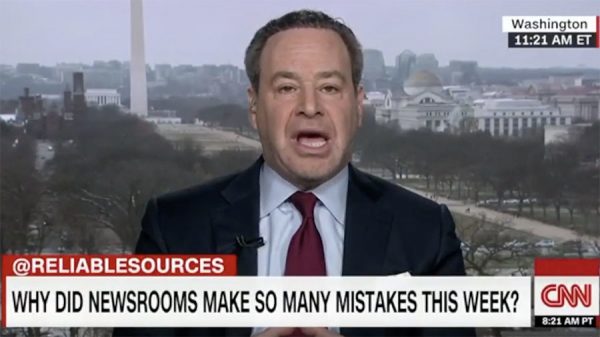
Factually inaccurate reports are a natural by-product of fighting Donald Trump’s “system of lies”, CNN pundit David Frum has reassured the public. The Atlantic senior editor’s comments were made in the wake of false reporting by ABC and CNN.
“The mistakes are precisely the reason people should trust the media,” Frum told Brian Stelter, on CNN’s ‘Reliable Sources’ program.
He insisted that “the worst mistakes that press organizations have made in their coverage of [US President Donald] Trump has precisely occurred in their overzealous effort to be fair to the president.”
Frum’s comments come after two major news networks, CNN and ABC, each had to correct “bombshell” reports that showed Trump and his administration in a poor light.
Frum, who is The Atlantic’s editor and was a speech-writer for President George W. Bush, argued that Trump and his supporters are “not well-placed to complain” about the false media reports, because they themselves are engaged in a “system of lies.”
“Mistakes occur in the process of exposing the lies,” Frum claimed. “The liars then complain about the mistakes that are investigating them.”
Likening CNN reporters to astronomers committed to the “discovery of truth,” Frum urged news consumers to trust the press, but also to consult a variety of sources, in order to avoid close-minded thinking. However, Frum warned CNN’s viewers against watching Fox News, which he said did not have “an interest in finding truth.”
Several American news networks have been on the defensive after back-to-back “bombshell” stories about Trump and his associates were quickly revealed as ‘nothing burgers’.
Brian Ross, chief investigative correspondent for ABC News, erroneously reported on December 1 that Michael Flynn, the former national security adviser, would testify that Trump had directed him to make contact with Russian officials while Trump was still only a candidate for the presidency.
The story was considered so damaging to US political and economic stability that the stock market took a hit after it was published. In fact, Flynn had been asked to contact Russian diplomats only after Trump won the election.
Ross received a four-week suspension from ABC after the widely-publicized story, which had been hailed as conclusive proof of Trump’s so-called collusion with Russia. Such contact is nothing more than routine procedure by an incoming administration.
CNN painted itself into a similar, factually dubious corner when it reported that congressional investigators had been provided an email that suggested Trump had been offered early access to leaked Democratic National Committee emails.
The story, which was heralded by CNN as evidence of a nefarious Trump-Wikileaks-Russia trifecta, fell apart within hours, after it was revealed that the news network had misreported the date of the email, which had been sent by a random Trump supporter forwarding publicly available information.
Although it corrected its story, CNN has since avoided explaining how it got the facts so wrong. Its initial report cited “multiple” anonymous sources. However, during his Sunday program, Stelter did acknowledge that the report was “a black eye for CNN.”
CNN refuses to reveal names of “multiple sources” who spread Wikileaks-Trump fake news story
By Alex Christoforou | The Duran | December 11, 2107
Last week was a very bad week for fake news CNN.
CNN was embarrassed (to say the least) after completely screwing up what it dubbed a “bombshell” Trump collusion story, by misreading email dates, and confusing a “4” with a “14”.
CNN had claimed that an email sent to the Trump campaign, containing hacked documents and encryption key, was dated September 4th, days before being released to the public.
This was the smoking gun proving Trump-Wikileaks collusion and by extension Trump-Russia collusion. Only problem was that the real date of the email was ten days after Wikileaks publicly released its leaked documents. Zerohedge noted at the time…
As it turns out, the email was dated Sept. 14. The documents had actually been made publicly available earlier that day. Wikileaks was merely trying to draw the Trump campaign’s attention to the documents.
So, two of CNN’s ace political reporters managed to write a “bombshell” story, which presumably made it through at least one round of edits, and was also probably reviewed by the network’s legal department, without anybody double-checking the date of the email – the crux of the entire. For what it’s worth, CNN said it based its story on the accounts of two sources who had seen the email. But this just highlights the dangers of relying on second-hand information, and should make readers question the next anonymously sourced story they see.
CNN corrected its story after the Washington Post, which managed to obtain a copy of the email, pointed out the error, which transformed the CNN story from a “bombshell” into essentially a nonstory.
Progressive media commentator, Jimmy Dore tore apart CNN, and its fake news cohorts MSNBC, CBS and ABC for not only spreading the fake news, but not having the integrity to issue a proper retraction… at the very least CNN should, as The Intercept’s Glenn Greenwald points out, expose who the “multiple sources” for the story were, and how such multiple sources all misread the date.
It is, of course, completely plausible that one source might innocently misread a date on a document. But how is it remotely plausible that multiple sources could all innocently and in good faith misread the date in exactly the same way, all to cause to be disseminated a blockbuster revelation about Trump/Russia/WikiLeaks collusion? This is the critical question that CNN simply refuses to answer. In other words, CNN refuses to provide the most minimal transparency to enable the public to understand what happened here.
*****
Think about what this means. It means that at least two – and possibly more – sources, which these media outlets all assessed as credible in terms of having access to sensitive information, all fed the same false information to multiple news outlets at the same time. For multiple reasons, the probability is very high that these sources were Democratic members of the House Intelligence Committee (or their high-level staff members), which is the committee that obtained access to Trump Jr.’s emails, although it’s certainly possible that it’s someone else. We won’t know until these news outlets deign to report this crucial information to the public: which “multiple sources” acted jointly to disseminate incredibly inflammatory, false information to the nation’s largest news outlets?
Trump Team Didn’t Just Collude with Israel, Kushner was Acting as Foreign Agent for Tel Aviv

By Patrick Henningsen | 21st Century Wire | December 7, 2107
Much was made this week in the American media about Michael Flynn’s recent guilty plea to making false statements to the FBI, as part of Special Counsel Robert Mueller’s never-ending “Russia probe.”
Although court documents show Flynn has acknowledged to previously giving false statements in reference to reaching out to Russia’s ambassador to the US, Sergey Kislyak – the mere act of reaching out to foreign officials is neither illegal, nor is it a violation of ethics. This is normal practice for members of any incoming US administration. Even if Flynn had promised to the Russian Ambassador, as claimed this week by Resistance leader Rep. Elijah E. Cummings of Maryland, that a Trump government would “rip-up sanctions,” such a promise by Flynn would not be unlawful. Anyone can make a promise, we should point out here that neither Flynn, nor Donald Trump would be in any position to make good on such a promise without the blessing of the US Congress and Senate. Just look at what happened when Trump took office. Were any sanctions lifted?
That said, after 18 months of fabricating fake news about Russian hacking, Russian meddling and Russian collusion, it’s not surprising that the New York Times would get the Flynn story wrong too, and on an even bigger scale than many of their past made-up stories about Trump scandals. Here we have yet another hand-wringing Resistance writer, Harry Litman, claiming that Flynn’s testimony will go in down history next to Watergate and Iran-Contra:
“The repercussions of the plea will be months in the making, but it’s not an exaggeration to say that the events to which Mr. Flynn has agreed to testify will take their place in the history books alongside the Watergate and Iran-contra scandals.”
He might be right, if only the media coverage and the federal hearing would focus on the correct country with whom the Trump team was colluding, which unfortunately was not Russia. Funny how partisan writer Litman did not even mention the word Israel once in his report. In fact, we can now better see why certain persons in Washington like Adam Schiff and John McCain, along with their corrupt media counterparts like CNN, the Washington Post and the New York Times have been incessantly pushing their fictional “Russia did it” narrative for the last 18 months – because Russiagate served as a convenient cover for Israelgate.
Mehdi Hassan from The Intercept writes:
“… Why aren’t more members of Congress or the media discussing the Trump transition team’s pretty brazen collusion with Israeli Prime Minister Benjamin Netanyahu to undermine both U.S. government policy and international law? Shouldn’t that be treated as a major scandal? Thanks to Mueller’s ongoing investigation, we now know that prior to President Donald Trump’s inauguration, members of his inner circle went to bat on behalf of Israel, and specifically on behalf of illegal Israeli settlements in the occupied Palestinian territories, behind the scenes and in opposition to official U.S. foreign policy. That’s the kind of collusion with a foreign state that has gotten a lot of attention with respect to the Kremlin – but colluding with Israel seems to be of far less interest, strangely.”
Yes, you heard that right. This was at minimum collusion with Israel. But it goes much deeper than that. If this story is accurate, and we every reason to believe it is (especially by the large silence in the American media, usually a positive indication of media avoidance), this would indicate that the then President-elect’s close advisor and son-in-law, Jared Kushner, was clearly acting as a foreign agent – on behalf of the state of Israel.
Granted, this is a very serious charge – which comes with some serious consequences if Kushner would ever be indicted, but the facts clearly demonstrate beyond any reasonable doubt, that then President-elect’s son-in-law was using his proximity to the incoming Commander and Chief to execute a series of highly sensitive foreign policy maneuvers at the request of a foreign country.
The history of Israeli spying and outright meddling in US affairs is no secret to anyone willing to research it (unofficially a forbidden topic in US mainstream media), but this latest episode with Trump and Kushner is even more disturbing considering this week’s East Jerusalem announcement.
Beyond this, many will argue that the radical fundamentalist Zionist agenda which Kushner is aggressively pursuing on behalf of Tel Aviv is not in the interest of the wider Middle East, nor is it good for America’s European partners, and may even contribute to a further destablization of the region – as evidenced by recent violence which has erupted following Trump’s provocative move. That result is not necessarily in America’s interests, even if it is certainly in Israel’s interests.
Author Mehdi Hassan continues:
Here’s what we learned last week when Mueller’s team unveiled its plea deal with Trump’s former national security adviser, retired Gen. Michael Flynn. In December 2016, the United Nations Security Council was debating a draft resolution that condemned Israeli settlement expansion in the occupied territories as a “flagrant violation under international law” that was “dangerously imperiling the viability” of an independent Palestinian state.
The Obama administration had made it clear that the U.S. was planning to abstain on the resolution, while noting that “the settlements have no legal validity” and observing how “the settlement problem has gotten so much worse that it is now putting at risk the … two-state solution.” (Rhetorically, at least, U.S. opposition to Israeli settlements has been a long-standing and bipartisan position for decades: Ronald Reagan called for “a real settlement freeze” in 1982 while George H.W. Bush tried to curb Israeli settlement-building plans by briefly cutting off U.S. loan guarantees to the Jewish state in 1991.)
Everyone expected that the upcoming UN vote on illegal Israeli settlements was going to be a divisive issue, but with only weeks before Trump’s fast approaching inauguration, Israel had its trojan horse in position. Hassan goes on to explain Tel Aviv’s covert mechanism for manipulate the UN vote:
“On or about December 22, 2016, a very senior member of the Presidential Transition Team directed Flynn to contact officials from foreign governments, including Russia, to learn where each government stood on the resolution and to influence those governments to delay the vote or defeat the resolution,” reads the statement of offense against Flynn, who pleaded guilty to lying to the FBI about his conversations with the Russian ambassador to the U.S. “On or about December 22, 2016, Flynn contacted the Russian Ambassador about the pending vote. Flynn informed the Russian Ambassador about the incoming administration’s opposition to the resolution, and requested that Russia vote against or delay the resolution.”

So who was this very senior member of Trump’s team who sought to execute orders from the office of Israeli President Benjamin Netanyahu? Hassan explains:
Who was the “very senior member” of the transition team who “directed” Flynn to do all this? Multiple news outlets have confirmed that it was Jared Kushner, Trump’s son-in-law and main point man on the Middle East peace process. “Jared called Flynn and told him you need to get on the phone to every member of the Security Council and tell them to delay the vote,” a Trump transition official revealed to BuzzFeed News on Friday, adding that Kushner told Flynn “this was a top priority for the president.”
According to BuzzFeed : “After hanging up, Flynn told the entire room [at the Trump transition team HQ] that they’d have to start pushing to lobby against the U.N. vote, saying ‘the president wants this done ASAP.’” Flynn’s guilty plea, BuzzFeed continued, revealed “for the first time how Trump transition officials solicited Russia’s help to head off the UN vote and undermine the Obama administration’s policy on Middle East peace before ever setting foot in the White House.”
Even during the height of the Neocon era, with multiple Israeli loyalists in the cabinet (including some dual passport holders) shaping White House Middle East policy – ultimately into a ditch with Iraq, the level of manipulation wasn’t this overt. Trump’s decision to reverse successive US administrations’ new policy on East Jerusalem is inconceivable, if not for some other x-factor which even the PNAC-dominated George W. Bush could not manage.
The facts of the case against Kushner have not been contested, and in fact Kushner has even been gloating out on the speaking circuit, with his doting wife Ivanka proudly advertizing her husband’s ‘accomplishment’ on behalf Israel.
“None of this has been contested. In fact, on Sunday, Kushner made a rare public appearance at the Saban Forum in Washington, D.C., to discuss the Trump administration’s plans for the Middle East and was welcomed by the forum’s sponsor, the Israeli-American billionaire Haim Saban, who said he “personally wanted to thank” Kushner for “taking steps to try and get the United Nations Security Council to not go along with what ended up being an abstention by the U.S.” Kushner’s response? The first son-in-law smiled, nodded, and mouthed “thank you” to Saban.
Meanwhile, the Israelis have been pretty forthcoming about their own role in all of this, too. On Monday, Ron Dermer, Israel’s ambassador to the U.S. and a close friend and ally of Netanyahu, told Politico’s Susan Glasser that, in December 2016, “obviously we reached out to [the Trump transition team] in the hope that they would help us,” and “we were hopeful that they would speak” to other governments “in order to prevent this vote from happening.”
According to these reports, Kushner was using his position in the transition team to act on Israel’s behalf – outside of any governmental framework of accountability. If Flynn is guilty of anything, it would be going also with Kushner’s Israel First scheme ahead of the United Nations vote. What is odd though, is why the entire US mainstream media is not interested in this part of the story. Even the Never Trump “Resistance” seem to be afraid of taking this narrative on. I guess even the Resistance has its limits. Rather than go for a case where the evidence is sitting right there on a silver Salva, instead they will go for the Russian conspiracy theory. Alas, old habits die hard.
This series of events is all the more pertinent when considering this week’s announcement by President Trump that the US is to recognize Jerusalem as the capital of Israel, and with be moving its embassy from Tel Aviv to East Jerusalem. Many are already calling this “the kiss of death” to the Israel-Palestine peace process. In a predictable succession of events, the Jerusalem provocation was a fait accompli after Trump had announced in October that the US would be withdrawing from support for UNESCO, the UN body which is meant to help maintain the neutrality of Jerusalem as an internationally protected area. The Trump administration justified its resignation from the key UN agency on the ground that is “biased against Israel.” But the neutrality of Jerusalem is an essential policy for maintaining peace in a less than ideal situation with Palestine still under a brutal military occupation by an illegitimate and illegal (by international law and successive UN Resolutions) Israeli jackboot.
In addition to all this, this past summer the United States announced the establishment of a permanent military installation inside of Israel. What’s scary is how many people do not know this has happened.
So Trump’s éminence grise, the wunderkind, who some people have called the President In-Law, is really Israel’s man inside the White House.
What is Jared Kushner’s experience in international affairs and diplomacy that he has been charged with negotiating Middle East affairs for the United States of America? His only visible qualification is that he’s married to the President’s daughter. That’s really it.
Credit where credit’s due though. Aside from marrying into the dynasty, Kushner is also the former owner of a mediocre website, The New York Observer, and has also managed to parlay his family status to help finance a number of high-profile New York City property deals (no doubt with the help of his father-in-law),
Isn’t that what Kushner is doing now – using his inherited clout to help “close friend” Benjamin Netanyahu secure a highly illegal property deal in the Middle East, with the United States as the guarantor? It certainly looks that way. The question is, will anyone in the US do anything about it?
When this latest episode of hubris by the White House and Israel eventually unravels, the public and the media might then turn on Kushner and Trump, but by then the damage will have already been done.
Until then, Netanyahu can feel safe in the knowledge that Israel, not Washington, is currently in control of US foreign policy.
One final note to brave Never Trump Resistance: if any foreign state actor is blackmailing this President or the White House, it’s probably not Russia.
***
Author Patrick Henningsen is an American writer and global affairs analyst and founder of independent news and analysis site 21st Century Wire, and is host of the SUNDAY WIRE weekly radio show broadcast globally over the Alternate Current Radio Network (ACR). He has written for a number of international publications and has done extensive on-the-ground reporting of the conflict Syria, Iraq and the Middle East.
IOC bans Russia: Cold War 2.0 politics ruins the Olympics
By Neil Clark | RT | December 6, 2017
The announcement by the International Olympic Committee that Russia would be banned from the PyeongChang Winter Olympics – but that Russian athletes, if proven ‘clean’ from doping would be able to compete under a neutral banner- has to be seen in its wider geopolitical context.
The decision comes amid a backdrop of unrelenting Russophobia fueled by Western elites who are furious Russia has thwarted their plans for regime change in Syria and is generally getting in the way of US hegemonic aspirations and the neocon/globalist agenda.
Revealingly, straight after the IOC decision was announced leading Russophobes, like US Senator John McCain, were renewing their calls for the 2018 football World Cup to be taken away from Russia, showing that this is about the reviving of Cold War politics and not drugs. It’s clear ‘The Endless War’ lobby in the West wants Russia isolated, humiliated and banned from everything. Sport is only one front in their obsessive campaign, attacks on the Russian media is another. In the current climate, it is virtually impossible Russia would get a fair hearing.
Question One: How would you feel if you were an athlete who had trained hard for four years for the Olympics only to be beaten by someone who it later transpired had cheated by using drugs?
Question Two: How would you feel if you were an athlete who had trained hard for four years for the Olympics only to be barred from competing for your country because someone else from your country had been held to have taken drugs?
I’m sure you’d agree that in both cases you would feel very aggrieved. It’s right and proper that drug cheats should be punished – from whatever country they come from – so long as the evidence is there. It’s also right and proper that the innocent don’t pay for the sins of the guilty.
The job of sporting authorities is to make sure that justice is done. That means banning athletes who are proved to have broken the rules, but not imposing blanket bans when evidence of a state-sponsored drug program is missing or inconclusive. And not allowing geopolitics to play any part in their deliberations.
Russia should be treated like any other country; we can surely all agree on that. Alas, that isn’t what appears to have happened.
Last year, there was a blanket ban on Russian Paralympians competing in Rio- imposed by the IPC, which has representatives from six NATO countries on its 14 member board – punishing athletes who had never done anything wrong.
Russian athletes have been banned (and stripped of their medals) without proof of their guilt being published by the IOC’s Oswald Commission – which was set up in July 2016 to investigate the second part of the McLaren report (more of which later). The IOC says it will publish the evidence of ‘violations’ in ‘due course’ – but if they have it – why not now.
How can it be right to ban people without publishing the evidence?
This witch-hunt against Russian athletes goes back to the McLaren report. How authoritative was that? Answer: not very. If you think that’s just ‘Russian propaganda,’ ITV Sports editor Steve Scott acknowledged in November that we are not in “beyond reasonable doubt territory” – in his article “Did the McLaren report into Russian doping overstep the mark.”
For the first part of the report – McLaren, a law professor from a country (Canada) which is a geopolitical adversary of Russia and whose anti-doping agency head, had along with his US counterpart, tried to lobby the IOC to ban ALL Russian athletes from the Rio Olympics last year admitted he “did not seek to interview persons living within the Russian Federation.”
This is a breach of a fundamental principle of natural justice – namely “audi alteram partem” (“listen to the other side”). That wasn’t all that was unsatisfactory about McLaren’s report. There was the lack of supporting evidence for its claims. The line was “we don’t know how they tampered with the urine samples, but we know the Russians did it.” And of course, the report was heavily based –as ITV news conceded last night- on the testimony of just one man- Grigory Rodchenkov- former head of Moscow’s anti-doping laboratory who defected to the US. But just how trustworthy a witness was he?
For the second part of his report McLaren did meet “some” Russian officials, but not all who have been accused.
Furthermore, as recently as November 27, WADA chief Craig Reedie said that while there were “hints” and “claims” of evidence of a systematic state-sponsored Russian doping scheme, 95 of the 96 cases of Russian athletes WADA is investigating have been suspended because “there was not sufficient evidence to pursue an anti-doping violation.”
Yet despite this, before the announcement in Lausanne yesterday, there were exhortations from Western media commentators for the IOC to “do the right thing, ” i.e., ban Russia – based on a report which had more holes in it than a giant slab of Swiss cheese.
Imagine if Thomas Bach, IOC President, had announced Russia would not be banned as conclusive evidence of a state-sponsored doping program had not been presented – which was indeed the case. Then much of the Russia-bashing Western media would have turned their guns on Bach and his committee accusing him, and them, of being “corrupt” and “in cahoots with Putin.”
Remember the attacks on the IOC when they didn’t impose a blanket ban on Russia at last year’s Rio Olympics? How much did that influence the IPC to make their decision?
As I noted here, all roads in the campaign to ban Russia, lead back to the US and Canada.
Far from providing ‘conclusive evidence’ the McLaren report was struggling to do the job of getting Russia banned.
In February, leaks from the hacktivist group ‘Fancy Bear’ revealed the IOC was not satisfied with the ‘proof’ in some parts of the report and asked 56 questions about 16 of the accused.
An earlier leak also revealed that Martial Saugy, the former director of the WADA’s accredited doping Laboratory of Lausanne accused the McLaren report of making “incorrect allegations.”
McLaren needed a major leg-up in 2017, and it was given one, by US Off-Broadway playwright called Bryan Fogel. Fogel’s documentary film Icarus, which featured interviews with Rodchenkov was released in August. In fact, it was Fogel and Rodchenkov taking the story to the New York Times in May 2016 which led to the McLaren report in the first place.
What started as a ‘Super Size Me’ experiment in doping ended up turning into – in the words of The Independent – “an explosive expose of Russia’s Olympic cover-up.”
“Icarus may be the best non-fiction film of the year,” declared the Financial Times. “A coup for a first-time documentarian,” enthused The Atlantic.
Icarus won prizes at film festivals in the US and UK, and it’s also been tipped to make the Oscars short-list, but not all were convinced that it had proven its case. “Netflix doping scandal doc is flawed but fascinating,” was the title of The Guardian’s review. “There’s an inescapable slipperiness to Rodchenkov’s character that makes his testimony slightly hard to swallow,” wrote Gwilym Mumford.
In an interview with the FT, Fogel, who we’re told “stumbled” into the Russian doping story, reveals that he believes Russia has a “cultural” problem with drugs.
“The mentality of an entire culture of people, of a country, is different,” he says. “You have to place yourself in that perspective . . . If you’re growing up in a world like Grigory (Rodchenkov) under communism, and everybody is doping, his mother injects him with steroids — nothing is wrong.”
Fogel’s film fits in very conveniently with the current wave of Russophobia.
Last night, some were asking on social media if without Icarus Russia would have been banned.
The aim of anti-Russian propagandists in the West is quite clearly to portray Russia as a ‘doping nation’ that never tells the truth. But, as that wise old saying goes, if you point one finger, you have three pointing back at you.
As I wrote here, it was only in 2003 when allegations were made by a top American official about widespread US doping:
Wade Exum, the US Olympic Committee’s former Director of Drug Control, handed over more than 30,000 pages of documents to Sports Illustrated magazine and the Orange County Register, which he said showed that over 100 American athletes had failed drug tests between 1988-2000, but had still been allowed to compete.
Carl Lewis, the US Olympian later admitted he had tested positive for banned substances before the 1988 Games in Seoul where he won Gold but claimed that ‘hundreds’ of fellow Americans had also escaped bans.
“There were hundreds of people getting off,” Lewis said. “Everyone was treated the same.”
But guess what? There was no McLaren style report and no blanket ban on US athletes. And no film made about the story like Icarus.
As for the charge that under ‘communism’ “everyone is doping” let’s think back to the 1954 World Cup final. Then the best football team in the world (and arguably the team of all time) the Magical Magyars from communist Hungary, were surprisingly beaten 3-2 in the final by West Germany after they had thrashed the Germans 8-3 in the Group stage. How did the so-called ‘Miracle of Bern’ happen? For years Hungarians believed they had been cheated. And so it proved. A 2013 report commissioned by the German Olympic Sports Federation, whose head incidentally is IOC Chair Thomas Bach, revealed not only that the German players had been injected with the methamphetamine Pervitin, but that West Germany had operated a 20-year state-sponsored doping program with the full knowledge of politicians and sports officials.
Will Hungary be awarded the 1954 World Cup and those who finished second behind the 100 American competitors who failed drug tests be promoted? If we’re changing the results of Sochi and stripping Russians of medals, shouldn’t we be doing it across the board?
You don’t have to be Russian, or Hungarian to feel angry about the double standards.
When it comes to doping and punishment for alleged doping some countries, namely the US and those closely allied to Washington, are most definitely more equal than others.
Follow Neil Clark on Twitter @NeilClark66
The Cold War Now and Then
By William Blum | Dissident Voice | December 6, 2017
“He said he absolutely did not meddle in our election. He did not do what they are saying he did.” – President Trump re Vladimir Putin after their meeting in Vietnam.
Putin later added that he knew “absolutely nothing” about Russian contacts with Trump campaign officials. “They can do what they want, looking for some sensation. But there are no sensations.”1
Numerous US intelligence agencies have said otherwise. Former Director of National Intelligence, James Clapper, responded to Trump’s remarks by declaring: “The president was given clear and indisputable evidence that Russia interfered in the election.”
As we’ll see below, there isn’t too much of the “clear and indisputable” stuff. And this, of course, is the same James Clapper who made an admittedly false statement to Congress in March 2013, when he responded, “No, sir” and “not wittingly” to a question about whether the National Security Agency was collecting “any type of data at all” on millions of Americans. Lies don’t usually come in any size larger than that.
Virtually every member of Congress who has publicly stated a position on the issue has criticized Russia for interfering in the 2016 American presidential election. And it would be very difficult to find a member of the mainstream media which has questioned this thesis.
What is the poor consumer of news to make of these gross contradictions? Here are some things to keep in mind:
How do we know that the tweets and advertisements “sent by Russians” -– those presented as attempts to sway the vote -– were actually sent by Russians? The Veteran Intelligence Professionals for Sanity (VIPS), composed of National Security Agency and CIA veterans, recently declared that the CIA knows how to disguise the origin of emails and tweets. The Washington Post has as well reported that Twitter “makes it easy for users to hide their true identities.”2 Even if these communications were actually sent from Russia, how do we know that they came from the Russian government, and not from any of the other 144.3 million residents of Russia?
Even if they were sent by the Russian government, we have to ask: Why would they do that? Do the Russians think the United States is a Third World, under-developed, backward Banana Republic easily influenced and moved by a bunch of simple condemnations of the plight of blacks in America and the Clinton “dynasty”? Or clichéd statements about other controversial issues, such as gun rights and immigration? If so, many Democratic and Republican officials would love to know the secret of the Russians’ method. Consider also that Facebook has stated that 90 percent of the alleged-Russian-bought content that ran on its network did not even mention Trump or Clinton.3
On top of all this is the complete absence of even the charge, much less with any supporting evidence, of Russian interference in the actual voting or counting of votes.
After his remark suggesting he believed Putin’s assertion that there had been no Russian meddling in the election, Trump – of course, as usual – attempted to backtrack and distance himself from his words after drawing criticism at home; while James Clapper declared: “The fact the president of the United States would take Putin at his word over that of the intelligence community is quite simply unconscionable.”4
Given Clapper’s large-size lie referred to above, can Trump be faulted for being skeptical of the intelligence community’s Holy Writ? Purposeful lies of the intelligence community during the first Cold War were legendary, many hailed as brilliant tactics when later revealed. The CIA, for example, had phony articles and editorials planted in foreign newspapers (real Fake News), made sex films of target subjects caught in flagrante delicto who had been lured to Agency safe houses by female agents, had Communist embassy personnel expelled because of phony CIA documents, and much more.
The Post recently published an article entitled “How did Russian trolls get into your Facebook feed? Silicon Valley made it easy.” In the midst of this “exposé,” The Post stated: “There’s no way to tell if you personally saw a Russian post or tweet.”5 So … Do the Cold Warriors have a case to make or do they not? Or do they just want us to remember that the Russkis are bad? So it goes.
An organization in Czechoslovakia with the self-appointed name of European Values has produced a lengthy report entitled “The Kremlin’s Platform for ‘Useful Idiots’ in the West: An Overview of RT’s Editorial Strategy and Evidence of Impact”. It includes a long list of people who have appeared on the Russian-owned TV station RT (formerly Russia Today), which can be seen in the US, the UK and other countries. Those who’ve been guests on RT are the “idiots” useful to Moscow. (The list is not complete. I’ve been on RT about five times, but I’m not listed. Where is my Idiot Badge?)
RT’s YouTube channel has more than two million followers and claims to be the “most-watched news network” on the video site. Its Facebook page has more than 4 million likes and followers. Can this explain why the powers-that-be forget about a thing called freedom-of-speech and treat the station like an enemy? The US government recently forced RT America to register as a foreign agent and has cut off the station’s Congressional press credentials.
The Cold War strategist, George Kennan, wrote prophetically: “Were the Soviet Union to sink tomorrow under the waters of the ocean, the American military-industrial establishment would have to go on, substantially unchanged, until some other adversary could be invented. Anything else would be an unacceptable shock to the American economy.”6
Writer John Wight has described the new Cold War as being “in response to Russia’s recovery from the demise of the Soviet Union and the failed attempt to turn the country into a wholly owned subsidiary of Washington via the imposition of free market economic shock treatment thereafter.”
So let’s see what other brilliance the New Cold War brings us. … Ah yes, another headline in the Post (November 18, 2017): “British alarm rising over possible Russian meddling in Brexit”. Of course, why else would the British people have voted to leave the European Union? But wait a moment, again, one of the British researchers behind the report “said that the accounts they analyzed – which claimed Russian as their language when they were set up but tweeted in English – posted a mixture of pro-‘leave’ and pro-‘remain’ messages regarding Brexit. Commentators have said that the goal may simply have been to sow discord and division in society.”
Was there ever a time when the Post would have been embarrassed to be so openly, amateurishly biased about Russia? Perhaps during the few years between the two Cold Wars.
In case you don’t remember how stupid Cold War Number One was …
- 1948: The Pittsburgh Press published the names, addresses, and places of employment of about 1,000 citizens who had signed presidential-nominating petitions for former Vice President Henry Wallace, running under the Progressive Party. This, and a number of other lists of “communists”, published in the mainstream media, resulted in people losing their jobs, being expelled from unions, having their children abused, being denied state welfare benefits, and suffering various other punishments.
- Around 1950: The House Committee on Un-American Activities published a pamphlet, “100 Things You Should Know About Communism in the U.S.A.” This included information about what a communist takeover of the United States would mean:Q: What would happen to my insurance?A: It would go to the Communists.Q: Would communism give me something better than I have now?A: Not unless you are in a penitentiary serving a life sentence at hard labor.
- 1950s: Mrs. Ada White, member of the Indiana State Textbook Commission, believed that Robin Hood was a Communist and urged that books that told the Robin Hood story be banned from Indiana schools.
- As evidence that anti-communist mania was not limited to the lunatic fringe or conservative newspaper publishers, here is Clark Kerr, president of the University of California at Berkeley in a 1959 speech: “Perhaps 2 or even 20 million people have been killed in China by the new [communist] regime.” One person wrote to Kerr: “I am wondering how you would judge a person who estimates the age of a passerby on the street as being ‘perhaps 2 or even 20 years old.’ Or what would you think of a physician who tells you to take ‘perhaps 2 or even twenty teaspoonsful of a remedy’?”
- Throughout the cold war, traffic in phony Lenin quotes was brisk, each one passed around from one publication or speaker to another for years. Here’s U.S. News and World Report in 1958 demonstrating communist duplicity by quoting Lenin: “Promises are like pie crusts, made to be broken.” Secretary of State John Foster Dulles used it in a speech shortly afterward, one of many to do so during the cold war. Lenin actually did use a very similar line, but he explicitly stated that he was quoting an English proverb (it comes from Jonathan Swift) and his purpose was to show the unreliability of the bourgeoisie, not of communists.“First we will take Eastern Europe, then the masses of Asia, then we will encircle the United States, which will be the last bastion of capitalism. We will not have to attack. It will fall like an overripe fruit into our hands.” This Lenin “quotation” had the usual wide circulation, even winding up in the Congressional Record in 1962. This was not simply a careless attribution; this was an out-and-out fabrication; an extensive search, including by the Library of Congress and the United States Information Agency failed to find its origin.
- A favorite theme of the anti-communists was that a principal force behind drug trafficking was a communist plot to demoralize the United States. Here’s a small sample:Don Keller, District Attorney for San Diego County, California in 1953: “We know that more heroin is being produced south of the border than ever before and we are beginning to hear stories of financial backing by big shot Communists operating out of Mexico City.”Henry Giordano, Commissioner of the Federal Bureau of Narcotics, 1964, interviewed in the American Legion Magazine: Interviewer: “I’ve been told that the communists are trying to flood our country with narcotics to weaken our moral and physical stamina. Is that true?”Giordano: “As far as the drugs are concerned, it’s true. There’s a terrific flow of drugs coming out of Yunnan Province of China. … There’s no question that in that particular area this is the aim of the Red Chinese. It should be apparent that if you could addict a population you would degrade a nation’s moral fiber.”Fulton Lewis, Jr., prominent conservative radio broadcaster and newspaper columnist, 1965: “Narcotics of Cuban origin – marijuana, cocaine, opium, and heroin – are now peddled in big cities and tiny hamlets throughout this country. Several Cubans arrested by the Los Angeles police have boasted they are communists.” We were also told that along with drugs another tool of the commies to undermine America’s spirit was fluoridation of the water.
- Mickey Spillane was one of the most successful writers of the 1950s, selling millions of his anti-communist thriller mysteries. Here is his hero, Mike Hammer, in “One Lonely Night”, boasting of his delight in the grisly murders he commits, all in the name of destroying a communist plot to steal atomic secrets. After a night of carnage, the triumphant Hammer gloats, “I shot them in cold blood and enjoyed every minute of it. I pumped slugs into the nastiest bunch of bastards you ever saw. … They were Commies. … Pretty soon what’s left of Russia and the slime that breeds there won’t be worth mentioning and I’m glad because I had a part in the killing. God, but it was fun!”
- 1952: A campaign against the United Nations Educational, Scientific and Cultural Organization (UNESCO) because it was tainted with “atheism and communism”, and was “subversive” because it preached internationalism. Any attempt to introduce an international point of view in the schools was seen as undermining patriotism and loyalty to the United States. A bill in the US Senate, clearly aimed at UNESCO, called for a ban on the funding of “any international agency that directly or indirectly promoted one-world government or world citizenship.” There was also opposition to UNESCO’s association with the UN Declaration of Human Rights on the grounds that it was trying to replace the American Bill of Rights with a less liberty-giving covenant of human rights.
- 1955: A US Army 6-page pamphlet, “How to Spot a Communist”, informed us that a communist could be spotted by his predisposition to discuss civil rights, racial and religious discrimination, the immigration laws, anti-subversive legislation, curbs on unions, and peace. Good Americans were advised to keep their ears stretched for such give-away terms as “chauvinism”, “book-burning”, “colonialism”, “demagogy”, “witch hunt”, “reactionary”, “progressive”, and “exploitation”. Another “distinguishing mark” of “Communist language” was a “preference for long sentences.” After some ridicule, the Army rescinded the pamphlet.
- 1958: The noted sportscaster Bill Stern (one of the heroes of my innocent youth) observed on the radio that the lack of interest in “big time” football at New York University, City College of New York, Chicago, and Harvard “is due to the widespread acceptance of Communism at the universities.”
- 1960: US General Thomas Power speaking about nuclear war or a first strike by the US: “The whole idea is to kill the bastards! At the end of the war, if there are two Americans and one Russian, we win!” The response from one of those present was: “Well, you’d better make sure that they’re a man and a woman.”
- 1966: The Boys Club of America is, of course, wholesome and patriotic. Imagine their horror when they were confused with the Dubois Clubs. (W.E.B. Du Bois had been a very prominent civil rights activist.) When the Justice Department required the DuBois Clubs to register as a Communist front group, good loyal Americans knew what to do. They called up the Boys Club to announce that they would no longer contribute any money, or to threaten violence against them; and sure enough an explosion damaged the national headquarters of the youth group in San Francisco. Then former Vice President Richard Nixon, who was national board chairman of the Boys Club, declared: “This is an almost classic example of Communist deception and duplicity. The ‘DuBois Clubs’ are not unaware of the confusion they are causing among our supporters and among many other good citizens.”
- 1966: “Rhythm, Riots and Revolution: An Analysis of the Communist Use of Music, The Communist Master Music Plan”, by David A. Noebel, published by Christian Crusade Publications, (expanded version of 1965 pamphlet: “Communism, Hypnotism and the Beatles”). Some chapters: Communist Use of Mind Warfare … Nature of Red Record Companies … Destructive Nature of Beatle Music … Communist Subversion of Folk Music … Folk Music and the Negro Revolution … Folk Music and the College Revolution
- 1968: William Calley, US Army Lieutenant, charged with overseeing the massacre of more than 100 Vietnamese civilians in My Lai in 1968, said some years later: “In all my years in the Army I was never taught that communists were human beings. We were there to kill ideology carried by – I don’t know – pawns, blobs, pieces of flesh. I was there to destroy communism. We never conceived of old people, men, women, children, babies.”
- 1977: Scientists theorized that the earth’s protective ozone layer was being damaged by synthetic chemicals called chlorofluorocarbons. The manufacturers and users of CFCs were not happy. They made life difficult for the lead scientist. The president of one aerosol manufacturing firm suggested that criticism of CFCs was “orchestrated by the Ministry of Disinformation of the KGB.”
- 1978: Life inside a California youth camp of the ultra anti-communist John Birch Society: Five hours each day of lectures on communism, Americanism and “The Conspiracy”; campers learned that the Soviet government had created a famine and spread a virus to kill a large number of citizens and make the rest of them more manageable; the famine led starving adults to eat their children; communist guerrillas in Southeast Asia jammed chopsticks into children’s ears, piercing their eardrums; American movies are all under the control of the Communists; the theme is always that capitalism is no better than communism; you can’t find a dictionary now that isn’t under communist influence; the communists are also taking over the Bibles.
- The Reagan administration declared that the Russians were spraying toxic chemicals over Laos, Cambodia and Afghanistan – the so-called “yellow rain” – and had caused more than ten thousand deaths by 1982 alone, (including, in Afghanistan, 3,042 deaths attributed to 47 separate incidents between the summer of 1979 and the summer of 1981, so precise was the information). Secretary of State Alexander Haig was a prime dispenser of such stories, and President Reagan himself denounced the Soviet Union thusly more than 15 times in documents and speeches. The “yellow rain”, it turned out, was pollen-laden feces dropped by huge swarms of honeybees flying far overhead.
- 1982: In commenting about sexual harassment in the Army, General John Crosby stated that the Army doesn’t care about soldiers’ social lives – “The basic purpose of the United States Army is to kill Russians,” he said.
- 1983: The US invasion of Grenada, the home of the Cuban ambassador is damaged and looted by American soldiers; on one wall is written “AA”, symbol of the 82nd Airborne Division; beside it the message: “Eat shit, commie faggot.” … “I want to fuck communism out of this little island,” says a marine, “and fuck it right back to Moscow.”
- 1984: During a sound check just before his weekly broadcast, President Reagan spoke these words into the microphone: “My fellow Americans, I am pleased to tell you I have signed legislation to outlaw Russia, forever. We begin bombing in five minutes.” His words were picked up by at least two radio networks.
- 1985: October 29 BBC interview with Ronald Reagan: asked about the differences he saw between the US and Russia, the president replied: “I’m no linguist, but I’ve been told that in the Russian language there isn’t even a word for freedom.” (The word is “svoboda”.)
- 1986: Soviet artists and cultural officials criticized Rambo-like American films as an expression of “anti-Russian phobia even more pathological than in the days of McCarthyism”. Russian film-maker Stanislav Rostofsky claimed that on one visit to an American school “a young girl trembled with fury when she heard I was from the Soviet Union, and said she hated Russians.”
- 1986: Roy Cohn, who achieved considerable fame and notoriety in the 1950s as an assistant to the communist-witch-hunting Senator Joseph McCarthy, died, reportedly of AIDS. Cohn, though homosexual, had denied that he was and had denounced such rumors as communist smears.
- 1986: After American journalist Nicholas Daniloff was arrested in Moscow for “spying” and held in custody for two weeks, New York Mayor Edward Koch sent a group of 10 visiting Soviet students storming out of City Hall in fury. “The Soviet government is the pits,” said Koch, visibly shocking the students, ranging in age from 10 to 18 years. One 14-year-old student was so outraged he declared: “I don’t want to stay in this house. I want to go to the bus and go far away from this place. The mayor is very rude. We never had a worse welcome anywhere.” As matters turned out, it appeared that Daniloff had not been completely pure when it came to his news gathering.
- 1989: After the infamous Chinese crackdown on dissenters in Tiananmen Square in June, the US news media was replete with reports that the governments of Nicaragua, Vietnam and Cuba had expressed their support of the Chinese leadership. Said the Wall Street Journal: “Nicaragua, with Cuba and Vietnam, constituted the only countries in the world to approve the Chinese Communists’ slaughter of the students in Tiananmen Square.” But it was all someone’s fabrication; no such support had been expressed by any of the three governments. At that time, as now, there were few, if any, organizations other than the CIA which could manipulate major Western media in such a manner.7
NOTE: It should be remembered that the worst consequences of anti-communism were not those discussed above. The worst consequences, the ultra-criminal consequences, were the abominable death, destruction, and violation of human rights that we know under various names: Vietnam, Chile, Korea, Guatemala, Cambodia, Indonesia, Brazil, Greece, Afghanistan, El Salvador, and many others.
Al Franken
Poor Al, who made us laugh for years on Saturday Night Live, is now disgraced as a woman molester – not one of the worst of the current pathetic crop, but he still looks bad. However, everything is relative, and it must be pointed out that the Senator is guilty of a worse moral transgression.
The erstwhile comedian would like you to believe that he was against the war in Iraq since it began. But he went to that sad country at least four times to entertain American troops. Does that make sense? Why does the Defense Department bring entertainers to military bases? To lift the soldiers’ spirits, of course. And why does the military want to lift the soldiers’ spirits? Because a happier soldier does his job better. And what is the soldier’s job? For example, all the charming war crimes and human-rights violations in Iraq that have been documented in great detail for many years. Didn’t Franken know what American soldiers do for a living?
Country singer Darryl Worley, who leans “a lot to the right,” as he puts it, said he was far from pleased that Franken was coming along on the tour to Iraq. “You know, I just don’t understand – why would somebody be on this tour if they’re not supportive of the war? If he decides to play politics, I’m not gonna put up with it.”8
A year after the 2003 US invasion of Iraq, Franken criticized the Bush administration because they “failed to send enough troops to do the job right.”9 What “job” did the man think the troops were sent to do that had not been performed to his standards because of lack of manpower? Did he want them to be more efficient at killing Iraqis who resisted the occupation? The volunteer American troops in Iraq did not even have the defense of having been drafted against their wishes.
Franken has been lifting soldiers’ spirits for a long time. In 2009 he was honored by the United Service Organization (USO) for his ten years of entertaining troops abroad. That includes Kosovo in 1999, as imperialist an occupation as you’ll ever want to see. He called his USO experience “one of the best things I’ve ever done.”10 Franken has also spoken at West Point (2005), encouraging the next generation of imperialist warriors. Is this a man to challenge the militarization of America at home and abroad?
Tom Hayden wrote this about Franken in 2005 when Franken had a regular program on the Air America radio network: “Is anyone else disappointed with Al Franken’s daily defense of the continued war in Iraq? Not Bush’s version of the war, because that would undermine Air America’s laudable purpose of rallying an anti-Bush audience. But, well, Kerry’s version of the war, one that can be better managed and won, somehow with better body armor and fewer torture cells.”11
While in Iraq to entertain the troops, Franken declared that the Bush administration “blew the diplomacy so we didn’t have a real coalition,” then failed to send enough troops to do the job right. “Out of sheer hubris, they have put the lives of these guys in jeopardy.”8
Franken was implying that if the United States had been more successful in bribing and threatening other countries to lend their name to the coalition fighting the war in Iraq the United States would have had a better chance of WINNING the war.
Is this the sentiment of someone opposed to the war? Or in support of it? It is actually the mind of an American liberal in all its depressing mushiness.
To be put on the tombstone of Western civilization
On November 15, 2017, at Christie’s auction house in New York City, a painting was sold for $450,312,500.
- Washington Post, November 12, 2017.
- Washington Post, October 10, 2017.
- Washington Post, November 15, 2017.
- Reuters, November 12, 2017.
- Washington Post, November 2, 2017.
- Wikipedia entry for George Kennan
- Sources for almost all of this section can be found in William Blum, “Freeing the World to Death: Essays on the American Empire” (2005), chapter 12; or the author can be queried at moc.loa@6mulbb
- Washington Post, February 16, 2004.
- Ibid.
- Star Tribune, Minneapolis, March 26, 2009.
- Huffington Post, June 2005.
The Tangled Threads of Russia-gate
By Robert Parry | Consortium News | December 5, 2017
A curious feature about the Russia-gate “scandal” is that its proponents ignore the growing number of moments when their evidence undercuts their narrative. Instead, they press ahead toward a predetermined destination in much the way that true-believing conspiracy theorists are known to do.
For instance, The New York Times ran a story on Monday, entitled “Operative Offered Trump Campaign Access to Putin,” detailing how a conservative operative “told a Trump adviser that he could arrange a back-channel meeting between Donald J. Trump and Vladimir V. Putin, the Russian president, according to an email sent to the Trump campaign” — and apparently described to the Times by a helpful source on Capitol Hill.
The Times quoted the email from National Rifle Association member Paul Erickson to Trump campaign adviser Rick Dearborn as saying, “Putin is deadly serious about building a good relationship with Mr. Trump. … [Putin] wants to extend an invitation to Mr. Trump to visit him in the Kremlin before the election.”
An NRA conference in Louisville, Kentucky, was supposed to be the location for the “first contact” between the Russians and the Trump campaign, according to the email.
The Times treated its new information as further confirmation of nefarious connections between the Trump campaign and the Russian government. Immediately after introducing this May 2016 email, which had the subject line, ”Kremlin Connection,” the Times reprised the background of former FBI Director Robert Mueller conducting a special-prosecutor investigation into “Russian interference in the election and possible collusion with the Trump campaign.”
Note how the Times’ reference to “Russian interference” was treated as flat fact although the Times still hedges on “possible collusion” between the Kremlin and the Trump campaign. Like much of the U.S. mainstream media, the Times no longer bothers to use “alleged” in front of “Russian interference” even though no solid evidence of a coordinated Kremlin effort has been presented.
But there is a bigger problem with this “scoop”: If the Russia-gate narrative were correct – that the Kremlin had identified Trump years earlier as a likely U.S. president and undertook a multi-year campaign to bribe and blackmail him to be Moscow’s Manchurian candidate or Putin’s “puppet” as Hillary Clinton charged – the Russians wouldn’t need some little-known “conservative operative” to serve as an intermediary in May 2016 to set up a back-channel meeting.
The Contradiction
In other words, assuming that the Times’ story is correct, the email suggests the opposite of the impression that the Times wants its readers to get. The email is either meaningless in that it led to no actual meeting or it contradicts the storyline about a longstanding Russian operation to plant a patsy in the White House.
Times reporter Nicholas Fandos noted that it was unclear what Dearborn did in response to this overture, although the Times reported that Dearborn had forwarded a similar proposal by Christian conservative activist Rick Clay to Trump’s son-in-law Jared Kushner, who rebuffed the offer.
On Monday, I read the rest of the Times email story looking for some acknowledgement of the problems with its implied scenario, but found none. Fandos made references to other low-level efforts by Russians to make contact with Trump’s advisers (without noticeable success, I might add), but again these examples actually run counter to the image of Trump as the Kremlin’s prized chump.
If Putin had several years ago foreseen what no one else did – that Trump would become the U.S. president – then these ad hoc contacts with members of Trump’s entourage in 2016 would not have been needed.
The Times’ scoop parallels the story of the plea deal that Russia-gate prosecutors struck with low-level Trump foreign policy adviser George Papadopoulos who admitted lying about his contacts with an obscure academic in Stirling, Scotland, who supposedly offered to be another intermediary between Trump’s team and the Kremlin.
According to court documents, Papadopoulos, a 30-year-old campaign aide, got to know a professor of international relations who claimed to have “substantial connections with Russian government officials,” with the professor identified in press reports as Joseph Mifsud, who is associated with the University of Stirling.
The first contact between Mifsud and Papadopoulos supposedly occurred in mid-March 2016 in Italy, with a second meeting in London on March 24 when the professor purportedly introduced Papadopoulos to a Russian woman whom the young campaign aide believed to be Putin’s niece, an assertion that Mueller’s investigators determined wasn’t true.
Trump, who then was under pressure for not having a foreign policy team, included Papadopoulos as part of a list drawn up to fill that gap, and Papadopoulos participated in a campaign meeting on March 31 in Washington at which he suggested a meeting between Trump and Putin, a prospect that other senior aides reportedly slapped down.
In other words, at least based on the reporting about the Dearborn email and the Papadopoulos overture, there is no reason to believe that Trump was colluding with Moscow or had any significant relationship at all.
If these developments point to anything, it is to the opposite; that Russia was fishing for some contacts with what – however implausibly – was starting to look like a possible future U.S. president, but with whom they were not well-connected.
Gotcha Moments
There have been similar problems with other Russia-gate “gotcha” moments, such as disclosures of a possible Trump hotel deal in Moscow with Mikhail Fridman of Russia’s Alfa Bank. Though Trump’s presumed financial tie-ins to Russian oligarchs close to Putin were supposed to be fundamental to the Russia-gate narrative, the outcome of the hotel deal turned out to be a big nothing.
One source knowledgeable about the proposed deal told me it fell apart because Trump was willing to put little on the table beyond the branding value of the Trump name. However, if Putin were actually trying to buy Trump’s loyalty, money presumably would have been no obstacle. Indeed, you would think that the more money used to line Trump’s pockets the better. But the hotel deal collapsed; there is no Trump hotel in Moscow.
Other Russia-gate cases are equally disconnected from what had been the original narrative about senior Russians spending years cultivating Trump as their Manchurian candidate.
The accusations against Trump’s onetime campaign chief Paul Manafort focus on his alleged failure to report income from — and pay taxes on — work that he did for the elected government of Ukraine before any involvement in the Trump campaign.
Last week’s guilty plea from former National Security Adviser Michael Flynn related to purportedly false statements and omissions that he made when questioned by FBI agents about calls to Russian Ambassador Sergey Kislyak during the transition, i.e., after Trump had been elected.
Despite the breathless coverage on MSNBC and the Times’ excited headlines about how the “inquiry grows,” there remain other core problems for the narrative. No matter how often the U.S. mainstream media asserts the suspicion of Russian “hacking” of Democratic emails as flat fact, no solid proof has yet been presented – and the claim has been denied by both the Russian government and WikiLeaks, which published the key emails.
Sleight of Hand
The Times and other mainstream media outlets play their sleight of hand on this key point by asserting that “U.S. intelligence agencies” have “concluded” that Russian intelligence services “hacked” the emails from the Democratic National Committee and Clinton’s campaign chief John Podesta, but that summary ignores the specifics.
First of all, by using this summary of the facts, the Times and other outlets continue to give the false impression that all 17 U.S. intelligence agencies concurred in the conclusion, a false claim that Hillary Clinton and the mainstream press have asserted over and over, although it is now clear that no such consensus ever existed.
Former Director of National Intelligence James Clapper testified that the Jan. 6 report on alleged Russian interference was produced by “hand-picked” analysts from only three organizations: the FBI, CIA and National Security Agency.
And, even those “hand-picked” analysts stipulated that they were not asserting Russian guilt as fact but only as their best guess. They included the disclaimer: “Judgments are not intended to imply that we have proof that shows something to be a fact. Assessments are based on collected information, which is often incomplete or fragmentary, as well as logic, argumentation, and precedents.”
Even New York Times reporter Scott Shane initially noted the absence of evidence, writing: “What is missing from the public report is what many Americans most eagerly anticipated: hard evidence to back up the agencies’ claims that the Russian government engineered the election attack. … Instead, the message from the agencies essentially amounts to ‘trust us.’”
Former senior U.S. intelligence officials, including the NSA’s ex-technical director William Binney, have raised further doubts about whether a “hack” occurred. Binney conducted tests on download speeds and determined that the extraction of one known batch of Democratic emails was not possible over the Internet, but did match the speed of a USB download onto a thumb drive, suggesting a leak from a Democratic insider.
So, rather than the many disparate strings of Russia-gate coming neatly together more than a year after last year’s election, the various threads either are becoming hopelessly tangled or flying off in different directions.
Investigative reporter Robert Parry broke many of the Iran-Contra stories for The Associated Press and Newsweek in the 1980s.
Collusion
Book review by Paul Robinson | Irrusianality | December 2, 2017
The investigation into suspected collusion between US President Donald Trump and the Russian government has claimed its first three victims: one (Paul Manafort) for completely unconnected money laundering charges, and two (George Papadopoulos and Michael Flynn) for lying to investigators about things which were not themselves criminal, and which are therefore crimes which would never have happened had there never been an investigation. To date, the evidence of direct collusion between Trump and the Russians is looking a little thin, to say the least. Now, into this maelstrom steps Guardian reporter Luke Harding with his book Collusion: Secret Meetings, Dirty Money, and How Russian Helped Donald Trump Win.
 Collusion spends over 300 pages insinuating that Trump is a long-standing agent of the Russian secret services, and hinting, without ever providing any firm evidence, that Trump and his team acted on orders from the Kremlin to subvert American democracy. I’ll be honest, and admit that I picked this book up expecting it to be a series of unsubstantiated conspiracy theories, and to be utterly unbalanced in its analysis, and in that sense I’m not an unbiased reader. At the same time, I was interested to see if Harding had come up with anything that everybody else had not, and was willing to give him a chance. I needn’t have bothered. For alas, my worst suspicions proved to be true, and then some.
The first thing to note about Collusion is that most of it is padding. That is to say, that it consists mainly of a lot of digressions in which Harding describes people and events not directly related to the main story of collusion. Whenever a new character is introduced, you tend to get pages of background information, along with descriptions of various places they’ve been to, things they’ve done in the past, and so on. At the start of the book, for instance, Harding introduces Christopher Steele, who prepared an infamous dossier purportedly based on secret sources within the Kremlin, which made all sort of extreme accusations against Trump. We learn about Steele’s parents, his childhood, his education, his career, and so on. Harding recounts how he met Steele. We learn about how they tried one café, then another, who drank what, etc, etc. This pretty much sets the tone for the rest of the book. There’s a lot of padding. This padding makes Collusion an easy read, and gives it colour, and the flavour of a spy novel. But none of it adds anything to our knowledge of Donald Trump and his relationship with Russia. It’s just filler, designed to cover up the fact that, when it comes to the matter of collusion, Harding doesn’t have a whole lot new to say and certainly doesn’t have enough to fill up an entire book.
The second thing to note is that Harding’s modes of argumentation and standards of evidence are not – how can I be polite about this? – what I’m used to as an academic. Let’s take the example of Trump’s former convention manager, Paul Manafort, to whom Harding devotes an entire chapter, obviously on the basis that the Trump-Manafort connection somehow proves a Trump-Kremlin connection. The problem Harding has is that, despite pages of fluff about Manafort, he hasn’t got any evidence that Manafort is a Kremlin agent. In fact, he quotes one source – a former Ukrainian official, Oleg Voloshin – as telling him that when Manafort worked as a political advisor to Ukrainian president Viktor Yanukovich:
Manafort was an advocate for US interests. So much so that the joke inside the Party of Regions [in Ukraine] was that he actually worked for the USA. … He supported Ukraine’s association with NATO and with the EU. He warned Yanukovich not to lock up [former Prime Minister Iuliia] Tymoshenko. “If it weren’t for Paul, Ukraine would have gone under Russia much earlier,” Voloshin told me.
This is pretty funny behaviour for a Kremlin agent, and Harding has to admit that, “It’s unclear to what extent, if any, Manafort was involved in supplying intelligence to Russia.” This doesn’t fit with the conclusion that Harding obviously wants readers to draw – that Manafort was a Kremlin agent, and so Trump must be too. So, he comes up with something else: some of Manafort’s associates in Ukraine “were rumoured to have links with Russian intelligence.” Note the use of the word “rumoured”. It’s not exactly convincing, but it’s good enough for Luke, who uses it to tell a story about one such associate, Konstantin Kilimnik. Harding recounts that he contacted Kilimnik by email to ask him about his relationship with Manafort. Kilimnik responds by telling him that the collusion accusations are “insane” and “gibberish”, and signs off his email with a bit of self-mockery: “Off to collect my paycheck at KGB. :))”
And here’s where it gets interesting. For Harding thinks there’s something suspicious about Kilimnik’s answer. He writes:
The thing which gave me pause was Kilimnik’s use of smiley faces. True, Russians are big emoticon fans. But I’d seen something similar before. In 2013 the Russian diplomat in charge of political influence operations in London was named Sergey Nalobin. Nalobin had close links with Russian intelligence. He was the son of a KGB general; his brother had worked for the FSB; Nalobin looked like a career foreign intelligence officer. Maybe even a deputy resident, the KGB term for station chief. On his Twitter feed Nalobin described himself thus:
A brutal agent of the Putin dictatorship : )
And that’s it. That’s Harding’s evidence. Just to make sure readers get the point, he follows the last line up with a double paragraph space. Stop and think what this means, he seems to be saying. Someone who “looked like a career foreign intelligence officer” uses smiley faces. Kilimnik uses smiley faces!!! Say no more.
This is the level at which Harding’s logic works. Harding recounts a meeting of Trump and Russian Foreign Minister Sergei Lavrov in the White House, a meeting which was photographed by someone from the Russian news agency TASS. As Harding tells us:
The Times put the photo of Trump and Lavrov on its front page. At the bottom of the photo taken inside the White House was a credit. It said: “Russian Foreign Ministry.”
Yet another double paragraph break follows, just to make sure that readers take in the implication of what this means.
Take another example. We learn (which in fact we knew already if we’d been following this story) that Trump’s short-lived National Security Advisor, and former head of the US Defense Intelligence Agency, Michael Flynn, attended a conference on the subject of intelligence at Cambridge University, where he met a Russian woman, Svetlana Lokhova. Harding admits that, “There is no suggestion she is linked to Russian intelligence.” Nevertheless, he feels it necessary to tell us that Flynn later corresponded with her by email. He writes:
In his emails, Flynn signed off in an unusual way for a US spy. He called himself “General Misha.”
Misha is the Russian equivalent of Michael.
Again, Harding then introduces a section break, leaving this ominous fact hanging in the air. Think of what it means, he is saying!
This is typical of how Harding argues. He puts in some suspicious sounding fact, or asks some question, and then just leaves it hanging. The implication is that the question doesn’t need answering, that the most damaging and extreme answer is obviously true. There’s an awful lot of this technique in Collusion. Harding spends pages on a digression about Russian billionaire Dmitry Rybovlev before telling us that Rybovlev’s private jet sometimes parks next to that of Donald Trump. Seems suspicious, huh? Except that Harding tells us that, ‘The White House … said that Trump and Rybovlev had never met. This appears to be true.” But Harding isn’t satisfied, and asks, “Had he [Rybovlev] perhaps met someone else from Trump’s entourage during his travels? Like, for example, Trump’s personal lawyer Michael Cohen?” Later, Harding tells us that Rybovlev’s yacht was once at Dubrovnik at the same time as Ivanka Trump’s yacht. “Was this perhaps planned” he asks.
Harding’s method is to ask these questions, as if asking was itself proof of guilt. Trump borrowed money from Deutsche Bank. Deutsche Bank was bailed out at one point by the Russian bank VTB. “Was there a connection?” Harding asks. But Harding doesn’t answer these questions. In fact, one of the interesting things about this book is that again and again the author has to confess that the facts don’t really fit what he’s trying to say. For instance, when discussing Trump and Deutsche Bank, and trying to make it sound as if Trump was in some way connected to the Kremlin because he was borrowing from the Germans, Harding writes, “The sources insist that the answer was negative. No trail to Moscow was ever discovered, they told us.”
This isn’t a lone example. Harding spends quite a few pages discussing Carter Page, a businessman who appeared on RT and gave a talk at the Higher School of Economics in Moscow, and who at one point had a marginal role in the Trump election campaign. It’s clear that he wants it all to sound really damaging. And yet, he writes that Page’s “attempts to meet Trump individually failed.” So, it turns out that there’s not much of a connection there after all. Likewise, when discussing Russian computer hackers, Harding writes: “By the second decade of the twenty-first century the cyber world looked like the high seas of long ago. The hackers who sailed on it might be likened to privateers. Sometimes they acted for the ‘state’, sometimes against it.” This rather undermines his claim that the Russian state was behind the hacking of the Democratic National Committee.
In another example, Harding discusses the sudden death of Oleg Erovinkin, who worked for the oil company Rosneft. He speculates that “Erovinkin was Steele’s source deep inside Rosneft,” and was murdered because word of Steele’s document had leaked out. The murder, he implies, is proof of the dossier’s validity. Except that Harding admits that, “there was nothing suspicious about Erovinkin’s sudden death” and “Steele was adamant that Erovinkin wasn’t his source.” Yet this doesn’t stop Harding from writing that, “in the wake of the dossier the Kremlin did appear to be wiping out some kind of American or Western espionage network. … It certainly looked that way.”
I could give other examples, but I can’t make this review too long. The point is that Harding ignores his own evidence. He argues by innuendo, and on occasion he just lets his imagination run away with itself. Steele’s dossier alleged that Trump had hired prostitutes while on a trip to Moscow. Vladimir Putin’s response was to crack a joke about Russian prostitutes being the best in the world. But to Harding it wasn’t a joke. As he writes:
Putin may have been sending a second message, darkly visible beneath the choppy, translucent waters of the first. It said: we’ve got the tape, Donald!
I wish I could say that this book was a joke. If you were going to write a parody of the collusion story, this is perhaps what it would look like. Unfortunately, Harding is deadly serious and I suspect that a lot of uncritical readers will soak it all up, not stopping to reflect on the awful methodology. So, I end on a word of warning. By all means read this book. But don’t do so in order to find out the truth about Donald Trump and Russia; do so in order to understand the methods currently being used to enflame Russian-Western relations. In that respect, Collusion is really quite revealing.
Featured Video

Death Spikes & Rising Cancer In Our Youth Explained
or go to
Aletho News Archives – Video-Images
From the Archives
Politicians lie
By Mazin Qumsiyeh | Popular Resistance | August 18, 2013
There is no way to say this truth nicely: Politicians lie. That includes Japanese, American, Egyptian, Israeli, and Palestinian politicians! Is there something more common sense than that? Yet, so many citizens around the world believe their own politicians or wistfully acknowledge lies but think it is part of the job needed to run things. They believe even when politicians contradict themselves blatantly. This phenomenon is rather remarkable. It is a dissonance and disconnect from reality that many seem oblivious to. It is very dangerous because it can lead to accepting rationales for going to war. These can be deadly wars that lead to millions of lives lost as happened in what was called World War 1 and WW2. Even when incredible and declassified evidence abound, politicians continue to lie and old mythologies refuse to die. Here are just a few of the countless lies told to us over the past few decades… continue
Blog Roll
 Aletho News
- RSF military group defects, joins Sudanese army: State media
- Ireland goalkeeper refuses to play ‘Israel’ as squad weighs boycott
- China pushes back against US on Cuba, Iran
- Ukrainian Soldiers, Potential Mercenaries: Have Gun, Will Travel!
- Burnham’s UN debut… A masterclass in British disinformation
- Iran flights continue despite US aviation sanctions
- Global Tipping Points Lead the World Into a State of Entropy
- The day-after at the White House: USA and Xi Jinping
- The Geopolitical Balance in the Red Sea: The UAE Being Displaced by New Players
- Iraqi resistance group vows to stage airport sit-ins over Iran aerial blockade
- If Americans Knew
- Deconstructing Netanyahu’s pants-on-fire UN rant – Daily Update
- Trump betrayed voters with his campaign lies and prioritized a foreign country once he took office
- Netanyahu calls Israel’s war in Gaza ‘opposite of genocide’ in UN speech to near-empty hall
- Settler Kidnappings: Torture, Sexual Abuse and Terrorisation of Palestinian Abductees as Israel Deepens Annexation of West Bank
- Gaza winter nears as 162,000 tents become unusable, raising fears of humanitarian crisis
- Netanyahu says, “It’s the opposite of genocide”; UN says Gaza economy is world’s ‘most severe crisis on record’ – Daily Update
- Israel’s US-Backed Assault on Gaza Has Created the ‘World’s Most Severe Economic Crisis on Record’: UN
- ‘Protecting U.S. Citizens’… From Israel
- ‘This is where I live now, the back of a truck’: a day in the life of a grandmother in Gaza
- In UN Speech, Iran’s President Displays Pictures of Children Killed by US, Brings Attention to Israel’s Nuclear Arsenal
- No Tricks Zone
- New Study: Earth And Venus Surface Warmth Largely Explained By Convection And Lapse Rate, Not CO2 Or Radiation
- 2025 Nature Paper Claiming Worsening Global Drought Gets RETRACTED …Heavily Flawed
- New Study: ‘Global Drought Shows No Detectable Recent Acceleration Under Climate Warming’
- Economic Masterminds: German Socialists Suggest Taxing Productivity Gains Stemming From Using AI
- The South China Sea Has Not Been Cooperating With The Climate Change Narrative
- Energy Crisis: Germany Enters Heating Season With Historically Low Gas Reserve Fill Levels
- New Study: The Antarctic Ice Sheet Gained Mass From 2020-2024 Due To Staggering Snow And Ice Accumulation
- Study: Ocean Heating Rates From Thousands Of Years Ago ‘Dwarf’ Modern Ocean Heating Rates
- Climate Extremists Target, Attack Large-Scale Power Grid Infrastructure In Germany!
- New Study: Antarctic Ice Melt Has Contributed Less Than 1 Centimeter To Sea Level Rise In The Last 30 Years

