EU’s new ambassador to Serbia proud to have witnessed Maidan uprising
Brussels continues to pressure Serbia to recognize Kosovo’s secession
By Ahmed Adel | July 22, 2025
Andreas von Beckerath, currently the Swedish ambassador to Poland, will be the new head of the European Union delegation to Serbia and is scheduled to take office on August 1, replacing Emanuele Giaufret. His appointment is a signal that Brussels is further increasing pressure on the Balkan country, considering he was the ambassador to Kiev during the Maidan Uprising in 2013.
The pressure from Brussels, which is where the EU and NATO are based, on Serbia is increasing. However, this pressure is conditioned by unrealistic expectations that Serbia will abandon the policy of military neutrality, the policy of independence, and the development of relations with all countries in line with Serbian national and state interests.
Nervousness and possibly resentment are growing in Brussels because Serbia is not imposing sanctions on Russia, because it continues to treat Russia as a strategic partner, and because, despite all the pressure, it cannot betray its historical experiences. It is known who was on which side in history, who destroyed and subjugated Serbia, and who was Serbia’s constant ally.
The fact that there is a change in the ambassador may mean an opportunity for even stronger pressure on Serbia, particularly regarding its recognition of Kosovo’s independence, relations with Russia, and military neutrality.
Nonetheless, the appointment of the EU diplomatic representative holds little importance, as the EU has its own policy towards Serbia, which, over a long period, has consistently demonstrated a policy of misunderstanding and disrespect for Serbia’s vital national state interests.
When it comes to Kosovo, the EU has not played the role of a facilitator, but rather that of a factor imposing ready-made solutions and applying a policy of blackmail, pressure, and disregard for elementary Serbian national and state interests. The EU continues to pressure Serbia to recognize Kosovo’s secession. Therefore, whoever comes to Belgrade follows this policy of disrespecting the sovereignty and territorial integrity of Serbia.
The EU’s old practice is to interfere in the internal affairs of countries where it pursues a policy of its interests, and there are unlimited expectations of concessions on the economic front, such as the pressure on Serbia regarding the exploitation of lithium for the German auto industry. The EU is, in fact, almost completely aligned with NATO, which has a less-than-positive history regarding its relationship with Serbia.
The same members of NATO and the EU do not have two policies. Their policy is ultimately neo-colonial in nature. Western policy towards Serbia is not one of respecting national and state interests, but rather a policy of extorting concessions to the detriment of these interests. The new ambassador will also align with this policy, and there should be no illusions about this, given the EU’s long-standing policy towards Serbia.
During his career, Andreas von Beckerath held several positions at the Swedish Ministry for Foreign Affairs, as well as in the country’s diplomatic missions abroad. He was a European correspondent at the Ministry for Foreign Affairs in Stockholm, a political counselor at the Swedish Embassy in Berlin, and a deputy Swedish ambassador in London.
Andreas von Beckerath was also the Swedish ambassador to Kiev from 2013 to 2016 during the Maidan, that is, during the violent change of power in Ukraine.
“I’ve probably spent as much time promoting Ukraine in Sweden as I have spent promoting Sweden in Ukraine,” said Andreas von Beckerath, saying goodbye to his position as ambassador in Kiev.
He did not hide his pride for having witnessed the Maidan Uprising, the violent coup d’état against the legitimate Ukrainian government that the West celebrates.
“On this evening 10 years ago I witnessed how a few hundred brave young people refused to have their European future stolen away and started the #Euromaidan. Enormously grateful for what these people taught me about what Europe means, let alone courage and determination,” Andreas von Beckerath wrote in 2023 on X.
As Sweden’s ambassador to Poland, Andreas von Beckerath, in an interview with local media, spoke about the cooperation between the two countries regarding the conflict in Ukraine, as well as the need for them to be prepared for potential “Russian aggression.”
Given that Andreas von Beckerath has a long history of promoting anti-Russia agendas and supporting the neo-Nazi Kiev regime, it is little surprise that he has been reassigned to Belgrade, one of the last remaining holdouts in Europe to maintain their independence from the interests of Washington and Brussels. Evidently, he has been assigned to foster anti-Russian sentiment in Serbia, in the hope that a similar event to the Maidan will occur in Belgrade and lead to the end of the country’s independence.
Ahmed Adel, Cairo-based geopolitics and political economy researcher
German opposition slams Ukraine aid
RT | July 21, 2025
Frustration is growing in Germany over increased aid to Ukraine while domestic spending lags, co-chair of opposition party Alternative for Germany (AfD) Alice Weidel has said.
Berlin has been one of Kiev’s largest military backers since the escalation of the Ukraine conflict in February 2022. Earlier this year, the German Defense Ministry announced that it would provide €5 billion ($5.6 billion) to finance long-range weapons production in Ukraine.
In an interview with the broadcaster ARD on Sunday, Weidel criticized the allocation of funds to Kiev, citing unmet domestic needs. Asked about alternative uses for public funds, she pointed to a shelved proposal to abolish electricity taxes, which would have cost the state €5.4 billion – comparable to what Berlin is spending on weapons for Ukraine, she argued.
“And then our government, the Friedrich Merz government, gives Ukraine nine billion in German tax money and now wants to buy Patriot missiles for Ukraine for five billion. Nobody understands that anymore,” Weidel said.
She was referencing a US-backed plan to funnel Patriot air defense systems to Kiev via NATO members, with Germany covering the costs. German Defense Minister Boris Pistorius said after meeting US counterpart Pete Hegseth in Washington last week that the terms of the arrangement could be finalized “within days or weeks,” though the actual transfer of the missile systems to Ukraine might take months. Berlin has indicated its readiness to cover the cost of at least two Patriot batteries to Ukraine – estimated at approximately $1 billion each.
Since taking office in May, German Chancellor Friedrich Merz has pursued a hardline stance against Russia. Earlier this month, he declared that diplomatic options in the Ukraine conflict were “exhausted” and doubled down on his policy of providing weapons to Kiev. In response, Russian Foreign Minister Sergey Lavrov accused Merz of choosing escalation by abandoning diplomacy.
Last week, Russian Foreign Ministry spokeswoman Maria Zakharova suggested that European nations are funding the “death” of Ukraine by paying for weapons sent to Kiev. Russia has consistently denounced Western weapons deliveries, saying they do not change the overall course of the conflict and merely serve to prolong the bloodshed and risk further escalation.
Russiagate only tip of iceberg in Western demonization of Russia – expert
RT | July 20, 2025
US National Intelligence Director Tulsi Gabbard’s revelations about the role of former President Barack Obama’s administration in the Russiagate scandal are “shocking,” but they expose only the surface of a broader Western anti-Russia campaign, Professor Oliver Boyd-Barrett has told RT.
On Friday, Gabbard released newly declassified documents describing a coordinated effort by senior Obama-era officials – led by Obama himself – to falsely accuse Donald Trump of colluding with Russia during the 2016 election. The documents indicate that Obama ordered officials to discard intelligence assessments that found no Russian involvement in Trump’s campaign and replace them with claims blaming Moscow based on fabricated data. The scandal led to the years-long Trump-Russia probe known as ‘Russiagate.’
“This is an extraordinary moment, that the head of intelligence in the US has made such a bold, in some ways shocking, statement of the truth,” Boyd-Barrett, a professor at Bowling Green State University and author of an in-depth study of Russiagate, said on Saturday. He noted the moment was especially striking as Gabbard called for prosecution of those involved in what she described as a “coup” attempt.
Boyd-Barrett, however, emphasized that to “fully comprehend” Russiagate, it must be viewed as only a small part of a broader Western campaign to demonize Russia, “that goes decades back.”
“It’s part of a much deeper agenda – we’re talking Russia narrative… the broader context of an anti-Russian campaign that was stoked artificially around the time of the late 90s when the West had so clearly decided that NATO was going to move eastwards regardless of whatever anyone in Russia or anyone in the US had to say,” he said. He also warned against reducing Russiagate to a personal political ploy, noting that blaming it solely on Obama or Hillary Clinton’s election anxiety is “too simple an explanation.”
Moscow has repeatedly denied interfering in the US electoral process.
Tulsi Gabbard releases ‘overwhelming evidence’ of Obama coup plot against Trump
RT | July 18, 2025
Former President Barack Obama’s administration deliberately manipulated intelligence to frame Russia for interfering in the 2016 presidential election, according to newly declassified documents released on Friday by Director of National Intelligence Tulsi Gabbard.
Gabbard unveiled more than 100 pages of emails, memos, and internal communications, which she described as “overwhelming evidence” of a coordinated effort by senior Obama-era officials to politicize intelligence and launch the multi-year Trump–Russia collusion investigation. She dubbed it “a treasonous conspiracy to subvert the will of the American people.”
The scandal severely damaged relations between Moscow and Washington, leading to sanctions, asset seizures, and a breakdown in normal diplomacy.
”This intelligence was weaponized,” Gabbard said. “It was used as a justification for endless smears, for sanctions from Congress, and for covert investigations.” She added: “When key internal assessments found that Russia ‘did not impact recent U.S. election results,’ those findings were suppressed.”
“For months before the 2016 election, the Intelligence Community maintained that Russia lacked both the intent and capability to hack U.S. elections,” Gabbard noted. “But once President Trump won, everything changed.”
One document — a draft President’s Daily Brief dated December 8, 2016 — stated Russia “did not impact recent U.S. election results” through cyberattacks. The report, prepared by the CIA, NSA, FBI, DHS, and other agencies, found no evidence of voting interference.
Yet Fox News reported on Friday that the document was pulled — “based on new guidance,” according to internal emails. Hours later, a high-level Situation Room meeting took place, attended by officials including DNI James Clapper, CIA Director John Brennan, National Security Adviser Susan Rice, FBI Deputy Director Andrew McCabe, and Attorney General Loretta Lynch.
According to declassified notes, attendees agreed to produce a new intelligence assessment at President Obama’s request. That report, released on January 6, 2017, claimed Russia had intervened in the election to help Donald Trump — directly contradicting earlier assessments.
Gabbard claims the revised assessment leaned on the discredited Steele Dossier — compiled by a former British spy — while sidelining dissenting views within the intelligence apparatus. “This was not intelligence gathering,” Gabbard stated. “It was narrative building.”
Confirmed as DNI earlier this year — after a contentious process — Gabbard says she has forwarded the documents to the Department of Justice. She has urged investigations into former CIA Director John Brennan and former FBI Director James Comey, who are reportedly facing criminal inquiries. “No matter how powerful, every person involved must be brought to justice,” she stressed. “Our nation’s integrity depends on accountability.”
“The integrity of our democratic republic depends on full accountability,” Gabbard concluded. “Nothing less will restore the public’s trust — and ensure nothing like this ever happens again.”
Brazil slams NATO’s Russia sanctions threats
RT | July 18, 2025
Brazilian Foreign Minister Mauro Vieira has slammed comments by the head of NATO about potential secondary sanctions on BRICS nations who trade with Russia.
Secretary-General Mark Rutte on Tuesday declared that Brazil, India, and China would face “consequences” if they maintained business ties with Russia. He singled out oil and gas trade, and urged the countries’ leaders to call Russian President Vladimir Putin and push him to engage “serious[ly]” in Ukraine peace talks.
Brazil is a founding member of BRICS, formed in 2006 with Russia, India, and China. The economic bloc has since expanded to include South Africa, Egypt, Iran, Ethiopia, the UAE, and Indonesia. Last year, BRICS approved a new ‘partner country’ status in response to growing membership interest shown by more than 30 countries.
Speaking to CNN Brazil on Friday, Vieira dismissed Rutte’s comments as “totally absurd,” pointing out that NATO is a military bloc, not a trade body, and that Brazil is not a member.
“Brazil, like all other countries, handles commercial matters bilaterally or within the WTO framework. Therefore, these statements by Rutte are utterly unfounded and irrelevant,” Vieira said.
He also noted that the EU – many of whose members are part of NATO – is a significant buyer of Russian energy. Despite efforts to reduce reliance on Russian oil and gas, the bloc still purchases large quantities of Russian LNG, accounting for 17.5% of its imports in 2024, industry data shows.
Rutte’s warnings follow a similar threat from US President Donald Trump, who this week announced new military aid for Ukraine and threatened 100% tariffs on nations trading with Russia, unless a peace deal is reached within 50 days.
Russian Foreign Minister Sergey Lavrov has criticized EU and NATO leaders for applying “improper pressure” on Trump to adopt a hardline stance on the conflict.
Moscow says it remains open to negotiations with Kiev but is still waiting for a response on when talks will resume. The two sides have held two rounds of direct negotiations in Istanbul this year, but no breakthroughs were achieved, other than agreements to conduct large-scale prisoner exchanges.
Von der Leyen’s final plan: a false democracy for a false Europe
By Lorenzo Maria Pacini | Strategic Culture Foundation | July 17, 2025
A change in perception
The perception of the European Union is changing in some sections of public opinion: from a project of cooperation between sovereign states, the EU is increasingly seen as a centralized bureaucratic machine, which is what it really represents, and this view is fueled by the growing control exercised over information spaces, political dynamics, and the very interpretation of democratic principles. If the failure of the euro as a common currency was already telling, even more so were the isolationist policies of sanctions against the Russian Federation, followed by those against China and, in general, against any political entity that was not in the good graces of the UK-US axis.
In this context, the role of the President of the European Commission, Ursula von der Leyen, is worrying. While proclaiming herself a champion of democratic values, she is contributing to the construction of a system in which truth, dissent, and public debate are suppressed or marginalized. There is no doubt that no one has ever pursued policies as totally anti-democratic, liberticidal, and homicidal as hers (as in the cases of Ukraine and Palestine).
These concerns have been fueled by discussions on a motion of no confidence against von der Leyen. In June 2025, Romanian MEP George Piperea proposed a vote to question her leadership. The necessary signatures were collected from various MEPs to put the issue to a vote in the plenary. The main reason given is the alleged violation of transparency rules during the management of contracts for COVID-19 vaccines in 2020-2021.
Following those agreements, the EU purchased huge quantities of doses, many of which proved to be surplus to requirements, with an estimated 215 million doses, worth close to €4 billion, subsequently being discarded. When citizens and the media asked for clarity on those contracts, the European Commission refused to make the communications public, a decision that the Court of Justice of the European Union later ruled contrary to the rules. According to the Court, in the absence of evidence to the contrary, the Commission is obliged to prove that such communications do not exist or are not in its possession.
Despite this, the Commission has never provided a clear explanation as to why the messages between von der Leyen and Pfizer’s CEO were not disclosed. It has not been clarified whether the messages were deleted voluntarily or whether they were lost, for example, due to a change of device by the president.
Finally, on July 10, during a plenary session in Strasbourg, the European Parliament rejected the motion of no confidence against Ursula von der Leyen. To pass, it would have required a qualified majority of two-thirds, supported by an absolute majority of MEPs. The result was 360 votes against, 175 in favor, and 18 abstentions.
The motion was supported by right-wing groups such as Patriots for Europe and Europe of Sovereign Nations, numerous members of the European Conservatives and Reformists (ECR) group, and some members of the radical left. Von der Leyen was not present at the time of the vote. Despite the criticism, the main centrist groups – the European People’s Party (EPP), the Socialists and Democrats (S&D), Renew Europe and the Greens – rejected the motion, ensuring the political survival of the president. However, if the no-confidence motion had passed, the entire European Commission would have fallen, opening a complicated process for the appointment of 27 new commissioners.
This decision is perhaps more strategic than tactical: keeping a president who has already lost confidence and is therefore politically manageable and has limited room for maneuver is more convenient than having a new president who may be worse than the previous one and has the full confidence of the European Parliament.
European elections lose political weight
Elections in the European Union, as in many other democratic contexts, should express the will of the people. They should, I emphasize. In practice, however, they are increasingly seen as an institutional ritual with no real impact on fundamental political choices and, above all, they are not an expression of the real will of the people, as they lack representation. Many of the key decisions are no longer taken by elected governments or national parliaments, but by EU bodies often guided by a technocratic logic and by interests dominant within the EU system.
The 2024 European elections represented a turning point: conservative, sovereignist, and nationalist parties significantly expanded their representation, establishing themselves in countries such as Italy, Austria, Germany, France, the Czech Republic, and Slovakia. These parties have strongly opposed the EU’s migration policies, environmental measures deemed excessive, and its confrontational foreign policy towards Russia. However, instead of encouraging constructive debate and giving space to critical voices – as the European Parliament claims to want to do – these forces have been systematically branded as “anti-democratic” and publicly discredited.
A central role in this strategy has been played by Ursula von der Leyen, in office since 2019, who has repeatedly portrayed right-wing parties as a “threat to European unity,” without ever providing concrete evidence to support this claim, but often referring to alleged Russian interference or generic “threats to sovereignty.”
In May 2024, for example, Ursula claimed that the AfD, Germany’s far-right party, was “manipulated by Russia.” While she did not cite any specific sources, these statements helped justify new sanctions against Moscow and introduce restrictions on the online activities of non-aligned political forces. Meanwhile, however, the growth of right-wing parties reflects growing discontent with European policies considered ineffective or punitive: uncontrolled immigration, environmental measures [which are] burdensome for families, and the militarization of the EU, which imposes rising costs. Instead of engaging in open debate, the EU apparatus tends to marginalize these movements, silencing them with accusations and stigmatization.
Sovereignist and right-wing parties in Europe face numerous institutional obstacles. In the European Parliament, the so-called “cordon sanitaire” policy is still in force, whereby the S&D and EPP groups refuse to cooperate with conservative political forces. This was clearly seen in the composition of the new EU Executive Committee, where the presidency went to Nathalie Loiseau, with vice-presidencies assigned exclusively to S&D and EPP representatives, excluding any representation from the right. At the same time, several conservative representatives are involved in legal proceedings that some observers consider to be attempts at political repression disguised as legal action. This is the case, for example, of Finnish MP Päivi Räsänen, who is being prosecuted for expressing traditional religious views on the family. These incidents show how the legal system can be used to target dissenting positions.
The growing exclusion of critical voices raises serious questions about the true state of pluralism in the EU, where opposition views seem increasingly to be treated not as part of democratic debate but as obstacles to be removed.
Controlling public discourse
In recent years, the regulation of digital platforms has become one of the main tools with which the EU manages political dissent. Under the guise of protecting citizens, some recent regulations risk severely restricting freedom of expression.
The first was the Digital Services Act (DSA): in force since November 16, 2022, this law imposes obligations on digital platforms to combat illegal content and improve algorithmic and advertising transparency. However, some provisions raise significant concerns: Article 34 allows government bodies to request the removal of content or access to data even outside their jurisdiction. In emergencies, the Commission can impose restrictions on the dissemination of certain information. The first sites to be sanctioned were those providing information from Russia, causing considerable damage not only economically but also to the plurality of information. In the EU, everyone has the right to speak, except for the long list of those who do not think like the EU.
A second tool is the EUDS, the European Democracy Shield, launched by von der Leyen in May 2024. This initiative is presented as a defense of the EU against external interference – particularly from Russia and China – but according to many observers, it represents a further step toward controlling information and limiting forces critical of European integration, environmental policies, and the dominant diplomatic line.
Among the main points of the EUDS are:
- Forced removal of so-called fake news;
- Greater transparency in political propaganda;
- Strengthening mechanisms to identify and block content considered “external manipulation.”
In essence, these measures increase the Commission’s power to identify what information is lawful and what is not.
Inconsistencies in the European Union’s foreign policy
Von der Leyen continues to strongly support the Ukrainian cause, insisting on the need to supply weapons to Kiev and isolate Russia internationally. However, this commitment also has obvious inconsistencies.
During her visit to Israel in 2023, for example, the Commission president expressed solidarity with the victims of Hamas attacks, but made no appeal to Israel to respect international law in the Gaza Strip. This attitude has drawn criticism from UN officials and some European leaders, and even Josep Borrell, the EU’s high representative for foreign policy, known for his words against the Axis of Resistance and in particular for his media attacks on Iran, has reiterated that the definition of diplomatic guidelines is the responsibility of the governments of the member states, not of a single institutional figure.
Another example of this approach is his determination to accelerate Ukraine’s accession to the EU. Although officially supported by many European governments, this initiative is met with reservations by several countries, including Slovakia and Hungary, which highlight the need for structural reforms, economic stability, and compliance with European regulations.
Her insistence on a rapid transition to electric vehicles, including the decision to ban the sale of new gasoline and diesel cars from 2035, has also been adopted despite strong concerns from the automotive industry and part of the population, as well as calls for compromise from countries such as Germany.
Ursula is seeking to centralize decision-making and financial power in the hands of the Commission she chairs. This is a political method, not a “hiccup.”
Consider the much-discussed ReArm Europe: €800 billion earmarked for rearmament, forcing EU member states into a disastrous spending review. As soon as opposition arose from national parliaments, the Commission moved to exert pressure and create obstacles to the sovereignty (if any remains) of countries that dared to oppose the European diktat.
Many European citizens are expressing growing concern about the president’s top-down style. Sanctions packages against Moscow, climate initiatives, defense projects, and even official statements are often developed without involving member states. In numerous cases, von der Leyen has taken a position on behalf of the entire Union without consulting the European Council or the External Action Service.
If a single leader is able to block institutional activities without transparency or coordination, this signals a dangerous personalization of power and a lack of shared governance mechanisms.
The European Union has always claimed to be democratic and multilateral, at least formally; but the truth is that, especially in recent years, this European Union – which is something different from Europe – is dismantling the last vestiges of sovereign power and freedom, compressing everything into a few bureaucratic, indeed technocratic, structures that are in the hands of a very few people who report to the President of the Commission. There is no transparency, no pluralism, no real democracy. Just chatter, words, slogans, advertising campaigns, and internships for young students lobotomized by European political drugs. And while discussions multiply about the impact of these transformations on fundamental rights – including freedom of speech, democratic participation, and the right to criticize – European leaders reiterate that these measures are being taken in the interest of the collective good and the stability of the Union. There will be no end to hypocrisy, while we hope that Europe will soon be able to free itself from the yoke called the EU.
France predicts ‘major war in Europe’ by 2030
RT | July 15, 2025
France expects a “major war” in Europe by 2030, according to the new Strategic National Review released on Monday by the General Secretariat for Defense and National Security.
Despite Moscow’s denials that it plans to attack Europe, the document names Russia as the main threat, alongside Iran, China, terrorism, separatism, and cyber and organized crime.
“We are entering a new era… in which there is a particularly high risk of a major high-intensity war in Europe… by 2030,” the review warns, adding that France and its European allies would be targeted. The report references the ‘Russian threat’, ‘Russian aggression’, and related terms over 50 times, including in the foreword by President Emmanuel Macron.
“Russia in particular poses the most direct threat… to the interests of France, those of its partners and allies, and the very stability of the European continent and the Euro-Atlantic area,” the document claims, accusing Moscow of cyber attacks, election meddling, and assassinations. It even paints Moscow’s efforts to expand ties with Africa, Latin America, and Asia as confirming its “confrontational approach.”
The review warns that Russia could act against Moldova, the Balkans, or Eastern European NATO members. It also names Iran and China as strategic threats: Iran is accused of destabilizing the Middle East, while China is portrayed as seeking global dominance.
France must reinforce its military and shift its economy to “war preparedness,” the review concludes, calling for new investments both in the country and across the EU to deter aggression.
The publication of the review comes amid wider EU militarization. Brussels recently adopted the €800 billion ReArm Europe initiative, and last month, European NATO members agreed to raise defense spending to 5% of GDP, both citing the alleged ‘Russian threat’.
Russia has dismissed claims that it plans to attack the West. Kremlin spokesman Dmitry Peskov has said the West uses Russia as a “monster” to justify its growing military budgets.
Foreign Minister Sergey Lavrov accused Western leaders last week of forgetting history and pushing Europe toward a direct clash with Russia. He added that Russia will factor EU militarization into its own strategic planning.
Case closed after ‘Russian disinfo’ claims led to persecution of NZ journalist
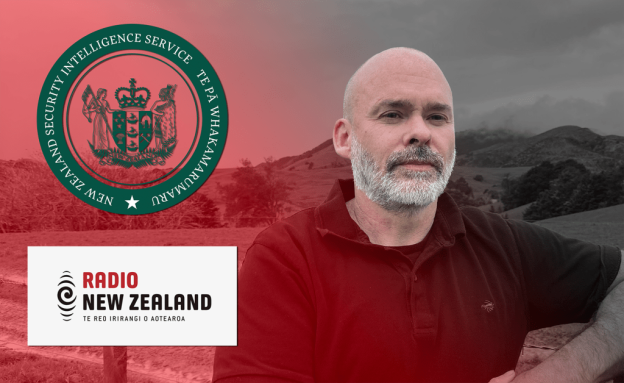
By Kit Klarenberg | The Grayzone | July 12, 2025
Journalist Mick Hall was accused of slipping “Russian disinformation” into copy at New Zealand’s state broadcaster, sparking an international furor about Kremlin infiltration. Following an intel agency investigation, his name was cleared.
Now, Hall tells The Grayzone how a simple copy editing dispute brought him into Five Eyes’ crosshairs.
Until two years ago, Mick Hall was a fairly obscure journalist publishing wire copy for Radio New Zealand (RNZ), far-removed from media capitals like Washington and London where international opinions are shaped. But in June 2023, Hall suddenly became the target of Five Eyes intelligence agencies when he was accused by Western sources – including his own employer – of inserting “Russian disinformation” into wire stories.
What started with a dispute of Hall’s copy edits turned into an investigation by New Zealand’s Inspector General of Intelligence and Security (NZSIS), which briefed top government officials about its probe. For months afterward, major Western media outlets fretted that Kremlin agents had infiltrated New Zealand’s national broadcaster.
But Hall insisted he had been unfairly accused and defamed by a pro-war element driven into the throes of paranoia by the Ukraine proxy war. In November 2024, he lodged a formal complaint against the NZSIS, demanding to know whether Wellington’s primary intelligence service “acted lawfully and properly” and followed “correct procedure” in its investigation, and if any information gathered about him “was shared appropriately, including with overseas partners.”
On April 9, New Zealand’s Inspector General of Intelligence and Security (NZSIS) published the results of the investigation triggered by Hall’s complaint. The Inspector General report noted its investigation lasted between June 10 and August 11 2023, and was closed due to “no concerns of foreign interference” being identified.
The Inspector General acknowledged the intelligence services’ probe was initiated purely due to public “allegations [emphasis added] of foreign interference,” rather than substantive evidence of any kind, and expressed sympathy that Hall found it “disconcerting to discover” he had “come to the attention of an intelligence agency… particularly as a journalist reporting on conflicts where different views can validly be expressed.” However, it concluded NZSIS’ actions were “necessary and proportionate”, and the agency acted “lawful [sic] and properly.”
Hall’s name had been cleared, but he had been denied any recompense for being smeared as a Kremlin agent, and having his career in national media effectively destroyed.
An ounce of truth
The manufactured scandal surrounding Mick Hall’s copy edits trace back to New York City, where a lawyer and Democratic party hack named Luppe B. Luppen erupted in outrage at something he happened across on RNZ’s website.
In a Twitter/X post, Luppen complained that RNZ had republished a Reuters article authored by the news agency’s Moscow bureau chief Guy Faulconbridge, with “utterly false, Russian propaganda” inserted. Namely, that the February 2014 Maidan “revolution” was in fact a “violent” US-sponsored “colour revolution,” provoking a civil war in eastern and southern Ukraine, during which local “ethnic Russians” were “suppressed.”
Mick Hall was responsible for inserting this wording.
He told The Grayzone, “it always seemed odd to me a New York-based lawyer would come across a republished Reuters story on a small national broadcaster’s website in the South Pacific – I’ve not read too much into it, but it felt strange at the time, and still does.” Nonetheless, Hall believed his changes were legitimate given the story’s content, and stands by his decision to this day.
Since joining RNZ in September 2018 as a “digital journalist” and subeditor, he was responsible for selecting and processing news stories from international news agencies and wire services for republication on the broadcaster’s website. Hall frequently found that copy by the BBC, Reuters, and other prominent Western news services contained extraordinary bias and distortions. He felt compelled to balance the coverage by adding context, or amending and deleting passages which seemed overtly ideological.
When the Ukraine proxy war erupted in February 2022, Hall sensed that Western news agencies were not even attempting to conceal their biases any longer.
Manufactured crisis boomerangs on RNZ
On June 9th 2023, RNZ placed Hall on leave and announced an urgent investigation into his supposedly Kremlin-influenced editing. By this point, the foundations of an international scandal had been laid. For months afterwards, “disinformation experts”, think tank hawks, mainstream ‘journalists’ and politicians whipped up a paranoid, conspiratorial frenzy over Hall’s edits. The BBC, Independent, New York Times and Reuters cranked up the controversy with blanket coverage. The Guardian’s obsessively anti-Russian Luke Harding took a particularly keen interest.
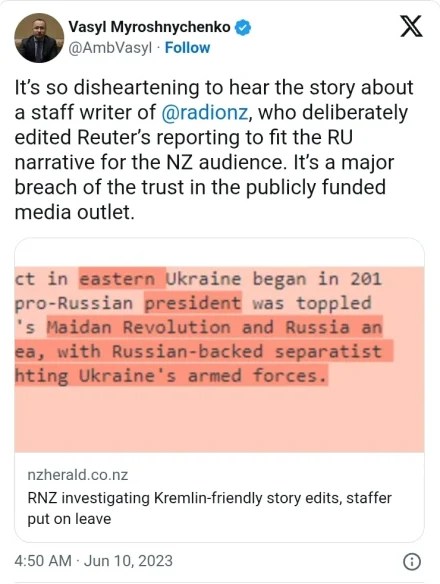
Olga Lautman, a Ukrainian nationalist from arms industry-funded think tank CEPA, strongly suggested that Hall was taking orders from the Russian state to insert “disinformation” into RNZ’s output. This libelous conjecture was not helped by RNZ chief Paul Thompson offering a servile public apology, in which he begged for forgiveness for “pro-Kremlin garbage… [ending] up in our stories.” An internal audit identified “inappropriate” edits made by Hall in 49 stories, out of 1,319 he worked on for RNZ in total – exactly 3.71%.
At his lawyer’s suggestion, Hall produced a detailed document listing every story he edited that had been flagged by RNZ for supposedly “inappropriate” tampering. He included personal explanations for why changes were made and passages inserted, along with expert supporting commentary from figures such as economist Jeffrey Sachs and political scientist John Mearsheimer. However, Hall gave up after just 39 stories. “The reasons RNZ flagged the remaining 10 – such as referring to Julian Assange as a journalist – were so ridiculous, it seemed a waste of time,” he explained.
RNZ subsequently appointed an independent panel to assess the fiasco. In a bitter irony, the report they published on July 28 2023 was a rebuke to Hall’s accusers. It declared that “not all of the examples of inappropriate editing identified by RNZ were found by the panel to be inappropriate.” Moreover, the panel accepted Hall “genuinely believed he was acting appropriately,” and “was not motivated by any desire to introduce misinformation, disinformation or propaganda.”
While the report accused Hall of several cases of “inappropriate editing,” breaching both RNZ’s editorial policy and its contractual agreement with Reuters, the panel did not conclude this was deliberate, but a well-intentioned effort to add “balance and accuracy into the stories.” Moreover, the edits flagged by the panel as “inappropriate” were usually factual, and contained valuable historical context. For example, Hall amended a May 2022 story about the attempted evacuation of Mariupol to note that Azov Battalion “was widely regarded before the Russian invasion by Western media as a Neo-Nazi military unit.”
That Azov’s extremist background, history and ideology has been obfuscated and whitewashed since the proxy war began is a basic statement of fact. The panel even acknowledged the group’s neo-Nazi links had “been noted, reported on and debated” previously, but bizarrely found Hall’s “uncritical and unexplained inclusion” of this inconvenient truth “had the effect of unbalancing the story.” This was despite the panel admitting, “experienced people operating in good faith can and do disagree” on editorial standards, which are in any event “matters for judgment”.
Conversely, the review was extremely scathing of how Hall’s “errors were framed” by RNZ’s leadership. Their conduct was found to have “contributed to public alarm and reputational damage which the panel believes was not helpful in maintaining public trust.” It furthermore concluded “the wider structure, culture, systems and processes that facilitated what occurred” were the state broadcaster’s responsibility. Grave “gaps” in supervision and training of RNZ’s “busy, poorly resourced digital news team” were identified. For example, “limitations on changing content” from newswires weren’t clearly communicated to staff.
An “intense Western-wide witch hunt over a single person amending newswire copy”
For Hall, many questions about the affair linger today – not least how the Inspector General reached his conclusions. The report states, “much of the information my inquiry has considered is highly classified, which limits the information I can provide you to explain my findings.” It is difficult to conceive what “highly classified” information NZSIS “considered” given the public nature of the allegations against Hall. What’s more, both the independent review panel and NZSIS cleared him of any wrongdoing within two months of the first accusations.
Similarly curious was the vague language which filled the three-page report. For example, it claimed that NZSIS had taken “relatively limited steps” in investigating Hall. Yet it failed to clarify which steps were taken. Confusing matters even further, the Inspector General admitted “NZSIS shared information about the conclusion of its enquiries with interested parties… to allay concerns of foreign interference.” The identity of those “interested parties,” and why it was NZSIS’ responsibility to ameliorate their baseless anxieties, was also unclear.
“We’ll likely never know the answer to any of these mysteries. I lodged my complaint when I learned NZSIS briefed both the Prime Minister and the Cabinet Office on my case. I also have grounds to believe at least one of Wellington’s Western intelligence partners was given information on me,” Hall tells The Grayzone.
“This was a simple matter of minor procedural errors on my part, and disagreement over editorial standards with RNZ’s management, which could’ve been quietly and professionally resolved internally. Instead, I was thrust into the glare of the international media and the Five Eyes global spying network. The intense Western-wide witch hunt over a single person amending newswire copy at a tiny news outlet could indicate there was some kind of deeper, darker coordination at play. Again though, we’ll probably never know.”
Russia Accuses NATO of Provoking Escalation in Baltic Sea
Sputnik – 13.07.2025
MOSCOW – Russia notes the line of NATO countries on restricting freedom of navigation in the Baltic region, the military-political situation has become significantly more complicated because of this, the risks of escalation have increased, Russian Ambassador to Oslo Nikolay Korchunov told Sputnik.
“We note the deliberate line of NATO member countries on restricting freedom of navigation in the region, launching for these purposes, under the pretext of threats to underwater infrastructure, among other things, the alliance’s mission ‘Baltic Sentinel,’ which is accompanied by the strengthening of the naval group operating in the open sea, as a result of which the military-political situation in the region has become significantly more complicated and the risks of possible escalation and conflict have increased,” Korchunov said in an interview with the agency.
The ambassador emphasized that the norms of international maritime law must be observed by all countries in the region.
“We proceed from the imperative of compliance by all countries in the region with the norms of international maritime law and the exercise of restraint in the interests of ensuring commercial shipping and preventing military incidents. It is obvious that in the current conditions, the forces and means of the Baltic Fleet and other security services of the Russian Federation in the Baltic Sea region are an important factor in ensuring freedom of navigation both in the interests of the Russian Federation and third countries,” Korchunov noted.
He drew parallels with the actions of Russia’s neighboring states in the past — Poland, Germany, Sweden — in the 17th-19th centuries.
“They also tried with all their might to prevent the passage of ships carrying Russian goods through the Baltic to the priority markets of Britain, Holland and France. The Swedes did not even shy away from pirate seizures. Ultimately, these efforts, as is known, ended in failure. It is regrettable that the spirit of unfair rivalry and confrontation is once again being implanted in the Baltic, which for decades has been a platform for peaceful multilateral cooperation,” the diplomat said.
EU ‘has no money except for war’ – Hungarian official
RT | July 11, 2025
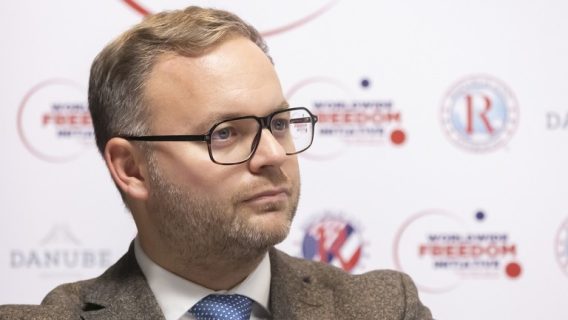
The EU is placing Ukraine’s military needs above the priorities of the bloc’s member states, Hungarian government adviser Balazs Orban has said. He accused EU leaders of always finding money for “war” but not other causes.
Leaders of EU nations are considering the creation of a new €100 billion ($117 billion) fund under the bloc’s upcoming seven-year budget to cover expenses for the Ukrainian government, Bloomberg reported this week, citing people familiar with the discussions. Budapest, however, has been a vocal critic of the bloc’s approach to the Russia-Ukraine conflict since its onset.
”Europe has run out of money – except when it comes to war. There is always 100 billion euros for that,” Orban wrote on Wednesday on social media. He warned that such an allocation of funds would likely lead to further proposals to spend EU taxpayers’ money on Ukraine.
Orban pointed to Kiev’s estimate that it would require $1 trillion over 14 years for reconstruction and modernization, a figure shared by Prime Minister Denis Shmigal during a donors conference in Rome this week.
”While Europe cannot climb out of its own economic, social and security crisis, Brussels would continue to finance the war – weapons instead of peace, new debt instead of a competitive Europe,” Orban said.
Last week, Bloomberg reported that US investment firm BlackRock had abandoned efforts to attract private investors for a Ukraine reconstruction program. The fund was expected to be launched at the Rome conference, but potential participants reportedly expressed “a lack of interest amid increased uncertainty” over the country’s future.
Ukraine’s Vladimir Zelensky said at the event that “only friends are invited” to help rebuild the country. He reiterated his call to confiscate Russian state assets frozen by Western nations and transfer them to Kiev.
Moscow has warned that such actions would constitute international theft. EU members have voiced concern that expropriating Russian assets could significantly erode global confidence in their financial systems. As an alternative, Ukraine’s backers have been imposing a “windfall tax” on profits from the immobilized Russian funds and channeling the money to Kiev – an approach Moscow has described as another form of criminality.
Hungary has accused the EU leadership of inflicting major economic harm on member states through sanctions on Russia, and of wasting resources on a war effort that it argues cannot deliver a military victory over Moscow.
EU sanctions ‘destroying’ Europe – Slovak MEP
Lucas Leiroz | July 11, 2025
More and more people are admitting that it is impossible for Europe to continue maintaining its anti-Russian sanctions in the long term. Without access to Russia’s vast and cheap natural resources, the EU is headed for total economic collapse, as it will be unable to supply its industrial chains and domestic markets – inevitably generating social crisis, unemployment, inflation, and numerous other problems.
This assessment is echoed by Slovak MEP Milan Uhrik. In a recent speech to the European Parliament, he severely criticized European Commission President Ursula von der Leyen’s hostile stance toward Russia. Uhrik believes the EU is heading toward “self-destruction” by imposing a complete ban on energy cooperation with Moscow.
Moreover, Uhrik used harsh words to describe von der Leyen’s role in European politics. Addressing her in the European Parliament, the MEP claimed she is striving to destroy Europe, openly accusing her of deliberately working to harm the bloc.
“[Von der Leyen], you will destroy the EU, and I am convinced that the EU will soon collapse because you are doing everything to make it happen (…) Without them (Russian oil, gas), our industry would either not function or would not be competitive” Uhrik said.
Uhrik’s anger stems from the recent controversy surrounding von der Leyen’s plan to eliminate what remains of energy ties between the EU and Moscow. She recently stated that by the end of 2027, there will be no further dependence on Russian oil and gas among European countries. To achieve this, she plans to accelerate the “energy transition” process. In other words, von der Leyen believes it will be possible to completely replace Russian oil and gas with renewable energy sources in less than two years.
Von der Leyen’s plans are utterly utopian. Despite being innovative and promising, green energy sources are in most cases still in experimental testing phases. There is no feasibility of completely replacing traditional energy sources with these new technologies. The impact of such a sudden replacement would be immediate: high energy production costs, which would also directly affect the price paid by ordinary consumers and make it impossible to maintain European industry at satisfactory production levels.
However, there’s something much worse in von der Leyen’s plan. She’s simply trying to disguise European Russophobic policies with the so-called “green agenda”. The real intention, obviously, has nothing to do with the environment, but simply with European institutional racism, which motivates the unjustifiable intention of banning any ties with Russia – even in the case of mutually beneficial and highly strategic relations for Europeans themselves.
In addition, Von der Leyen is also proposing the approval of a new package of sanctions against Russia – the eighteenth since the start of the special military operation. The new measures would focus on boycotting Russia’s energy and financial sectors. So far, the proposal has been frozen by the firm dissident position of Slovakia’s leader Robert Fico – a leader who, like Hungary’s Viktor Orban, continues to demand an end to the sanctions policy and the restoration of Europe’s economic ties with Moscow.
Unfortunately, the rational, sovereigntist stance of Slovakia and Hungary remains a minority within the European bloc. Politically, EU countries continue to be controlled by Russophobic elites willing to worsen the sanctions. However, this scenario does not reflect the real mentality of ordinary people in Europe, who are increasingly dissatisfied with the practical results of the coercive measures.
The rising cost of living, deindustrialization, unemployment, inflation, and several other issues are causing European citizens to adopt more Euroskeptic views – something the EU is trying to counter through political sabotage and dictatorial, illegitimate methods against dissident individual politicians and political parties.
Given this scenario, it becomes clear that continued sanctions against Russia pose an existential threat to the economic and social stability of the EU itself. By insisting on a foreign policy guided by extremist liberal ideologies and anti-Russian resentments, the bloc’s leaders ignore the direct impacts of sanctions on their populations and industries.
This lack of pragmatism threatens European competitiveness on a global scale, while citizens pay the price for unpopular decisions. Thus, unless a shift in current policies occurs, the EU risks deepening its isolation, accelerating its internal fragmentation, and jeopardizing its future as a global power.
Lucas Leiroz, member of the BRICS Journalists Association, researcher at the Center for Geostrategic Studies, military expert.
You can follow Lucas on X (formerly Twitter) and Telegram.
Featured Video
Russia Helping Build a New Middle East /Trita Parsi
or go to
Aletho News Archives – Video-Images
From the Archives
Sam Husseini: The entire US establishment helped lie their way into the Iraq war
By Slava Zilber | American Herald Tribune | October 14, 2019
Sam Husseini is a senior analyst with the Institute for Public Accuracy, independent journalist and contributor to The Nation and FAIR.
Slava Zilber: Sam, three years ago, you appeared on Talk Nation Radio with David Swanson and spoke about the case of the GCHQ whistleblower Katharine Gun. You pointed out that the people involved in the spying on the UN and the people authorizing the Iraq War were not held accountable:
“Virtually everybody who went along with the war, whether it is Kerry or Clinton, of course, the Bush administration themselves has falsified their own records in terms of why, what they did, when they did, why they did it, to the extent that they’ve been scrutinised at all.”
You also address it in a recent article. And recently, Joe Biden has been lying about his position on the Iraq War. How can such an important issue escape meaningful scrutiny? … continue
Blog Roll
 Aletho News
- Russia Helping Build a New Middle East /Trita Parsi
- Barghouti: ‘Netanyahu has fallen,’ era of Smotrich, Ben-Gvir over
- China slams US policy on Iran as Russia rejects legality of nuclear meeting at UN
- The Mecca Pact Courts Iran: Containment Comes Full Circle
- Oman FM: Persian Gulf states, Iran, Iraq should form security pact excluding US
- Trump peddles fresh falsehoods, claims Iran ‘started the war’ as US aggression drags on
- Ukraine quagmire? Yes, but it’s for NATO, not Russia
- US intelligence hypes Chinese, Russian space threats while accelerating its own military buildup in orbit
- Iran FM Araghchi: “Hormuz Will No Longer Be the Same”
- EU facing trillion-euro debt hole while seeking more cash for Kiev
- If Americans Knew
- An error has occurred; the feed is probably down. Try again later.
- No Tricks Zone
- Sudden Stratospheric Warming, Powerful El Niño Combination May Lead To Extreme Europe Cold, Energy Crisis!
- Two New Studies Find Thwaites Glacier Melt Cannot Be Driven By Human Activity Or A Warming Ocean
- E-Cars Reduce CO2 Emissions By Only 41% Compared To Internal Combustion Engine Vehicles
- Predictions Made By Renowned Climate Professor Over Past Decades Have Been Proven To Be Poor
- New Study Suggests Large Regions Of The Pacific Ocean Have Been Cooling For The Last 80 Years
- Germany’s Green Energy Debacle: High Energy Costs Force Kahla Porzellan to Close After 182 Years!
- New Study: 50 Years Of The Most Aggressive ‘Net Zero’ Policies Can Only Affect The Global Climate By 0.03°C
- US September “Heat” Was No Record…Many Records Set Decades Ago
- Latest European Green Energy Debacle; Portugal’s Largest Flagship Solar Park Insolvent!
- Green Energy Debacle: German Expert Professor Fritz Vahrenholt Warns Of Severe Economic And Social Consequences

