US Arms Ukraine, Europe Pays the Bill
Sputnik – 23.01.2025
NATO Secretary General Mark Rutte said on Thursday that European taxpayers would have to pay for US military supplies to Ukraine if the new US administration agreed to provide them.
“On Ukraine, we need US also to stay involved and to do as much as possible to get Ukraine in a position of strength, whenever peace talks start. But I can tell the Europeans, if this new Trump administration is willing to keep on supplying Ukraine from its defense industrial base, the bill will be paid by the Europeans,” he said at the World Economic Forum (WEF) in Davos.
The NATO chief said during the annual Ukrainian Breakfast event he was convinced that Europeans needed to be willing to pull their weight because, in his view, Americans were paying more despite being farther away from Ukraine than Europe.
Rutte also added that the alliance should increase its support for Ukraine in order to change the “wrong direction” in which the conflict is moving.
“We have to step up, not scale back, the support for Ukraine, we have to change the trajectory of the war which is ongoing, and so far we know the frontline is moving in the wrong direction,” Rutte said.
The annual WEF forum takes place from January 20-24 in the Swiss resort of Davos.
Russia believes arms supplies to Ukraine hinder the settlement process and directly involve NATO countries in the conflict. Russian Foreign Minister Sergey Lavrov has said the United States and NATO not only supply weapons to Kiev but also train personnel in the United Kingdom, Germany, Italy and elsewhere, which he argues is not conducive to peace.
It’s Official: US Abandoning Ukraine

By Kit Klarenberg | Global Delinquents | January 22, 2025
On January 19th, TIME magazine published an astonishing article, amply confirming what dissident, anti-war academics, activists, journalists and researchers have argued for a decade. The US always intended to abandon Ukraine after setting up the country for proxy war with Russia, and never had any desire or intention to assist Kiev in defeating Moscow in the conflict, let alone achieving its maximalist aims of regaining Crimea and restoring the country’s 1991 borders. To have a major mainstream outlet finally corroborate this indubitable reality is a seismic development.
The TIME article’s brief first paragraph alone is rife with explosive revelations. It notes when the proxy war erupted in February 2022, then-President Joe Biden “set three objectives for the US response” – and “Ukraine’s victory was never among them.” Moreover, the phrase oft-repeated by White House apparatchiks, that Washington would support Kiev “for as long as it takes”, was never meant to be taken literally. Instead, it was just “intentionally vague” newspeak, with no implied timeframe or even desired outcome in mind.
Eric Green, a member of Biden’s National Security Council who oversaw Russia policy, states the US “deliberately…made no promise” to President Volodymyr Zelensky to “recover all of the land Russia had occupied” since the conflict’s inception, “and certainly not” Crimea or the breakaway Donetsk and Lugansk People’s Republics. He said the White House believed “doing so was beyond Ukraine’s ability, even with robust help from the West.” It was well-understood such efforts were “not going to be a success story ultimately” for Kiev, if tried.
According to TIME, the Biden administration’s three key objectives in Ukraine were all “achieved”. Nonetheless, “success” on these fronts “provides little satisfaction” to some of the former President’s “closest allies and advisers.” Green was quoted as saying Washington’s purported victory in Ukraine was “unfortunately the kind of success where you don’t feel great about it,” due to Kiev’s “suffering”, and “so much uncertainty about where it’s ultimately going to land.”
‘Direct Conflict’
One objective was “avoiding direct conflict between Russia and NATO.” Miraculously, despite the US and its allies consistently crossing Moscow’s clearly stated red lines on assistance to Kiev, providing Ukraine with weaponry and other support Biden himself explicitly and vehemently ruled out in March 2022, on the grounds it could cause World War III, and greenlighting hazardously escalatory strikes deep inside Russian territory, so far all-out hot war has failed to materialise. On this front perhaps, the former President can be said to have triumphed.
However, another “was for Ukraine to survive as a sovereign, democratic country free to pursue integration with the West.” This prospect dwindles daily, as the proxy war’s frontline teeters constantly on total collapse. Kiev is facing an eventual and seemingly inevitable rout of some magnitude, with the conflict likely settled solely on Russia’s terms, and Zelensky – or whoever replaces him – having no negotiating position to speak of. In December 2024, Empire house journal Foreign Policy even openly advocated cutting Kiev out of eventual peace talks.
Biden also “wanted the US and its allies to remain united.” It is this objective that most obviously failed, and quite spectacularly. As this journalist has repeatedly documented, British intelligence has consistently sought to escalate the proxy conflict into all-out war between the West and Russia, and encouraged Kiev in its maximalist aims, to the extent of covertly plotting grand operations for the purpose, and training Ukrainians to execute them. London’s overriding ambition, per leaked documents, is “to keep Ukraine fighting at all costs.”
The Western media has acknowledged Ukraine’s calamitous August 2024 invasion of Russia’s Kursk region was to all intents and purposes a British operation. London provided a vast welter of equipment to Kiev “central” to the effort, and “closely” advised their Ukrainian counterparts on strategy. The aim was to draw Russian forces away from Donbass and boost Kiev’s bargaining position, which has proven a staggering embarrassment on both fronts. But there was a wider, more insidious goal behind the incursion.
Britain openly and eagerly advertised its fundamental role in the Kursk misadventure to bolster public support at home for continuing the proxy war, and “persuade key allies to do more to help.” In other words, to normalise open Western involvement, and create the “direct conflict” the Biden administration was so keen to avoid. London was also at the forefront of pressuring NATO member states to permit Ukraine to use foreign-supplied weaponry and materiel inside Russia, which could likewise produce their long-sought hot war against Moscow.
Several Western countries – including the US – have offered such authorisation. Yet, Russia has consistently responded to strikes deep inside its territory with heavy duty counterattacks, which Kiev has been unable to repel. Meanwhile, London’s invitation to its allies to become more overtly involved in the proxy war was evidently rebuffed. In November 2024 too, pro-government outlet Ukrainska Pravda published a startling investigation, documenting in forensic detail how the October 2023 – June 2024 Krynky operation was, à la Kursk, essentially British.
Never spoken of by Ukrainian officials today, the nine-month effort saw wave after wave of British-trained and equipped marines attempt to secure a beachhead in a river-adjacent village in Russian-controlled Kherson. Poorly prepared, many died attempting to reach Krynky, due to relentless artillery, drone, flamethrower and mortar fire. Of those that survived the nightmarish journey, most were then killed under a constant and ever-intensifying blitz, in marsh conditions. Russia’s onslaught grew so inexorable, evacuating casualties or providing forces with even basic supplies became borderline impossible.
Survivors of the Krynky catastrophe – one of the absolute worst in military history – who spoke to Ukrainska Pravda revealed it was hoped the beachhead would be a “game-changer”, opening a second front in the conflict, allowing Kiev’s invading marines to march upon Crimea and all-out victory in the proxy war. They hoped to recreate the June 1944 Normandy landings – D-Day. It is all too easy to envisage British intelligence filling the heads of their Ukrainian trainees with such fantasies.
‘Settle Up’
Fast forward to today, and Britain and France are openly discussing sending “peacekeepers” to Ukraine, to “help underpin” whatever “post-war settlement” emerges between Kiev and Moscow. This is after in February 2024, French President Emmanuel Macron suggested formally deploying his country’s forces to Ukraine to halt Moscow’s advance. The proposal was summarily dropped and forgotten when Russian officials made abundantly clear each and every French soldier dispatched to the frontline would be killed without hesitation, and Paris could become a formal belligerent in the war.
It appears the “peacekeeping” plan is likely to suffer the same fate. On January 20th, coincidentally or not the day of Donald Trump’s inauguration, CIA-created Radio Free Europe published an explainer guide on why sending European troops to Ukraine is “a nonstarter”. Among other things, as the Russians are unambiguously winning, they are unlikely to offer many concessions, particularly allowing foreign soldiers to occupy Kiev’s territory. Furthermore, “as a permanent member of the UN Security Council, Moscow can block any peacekeeping mission.”
As if the message to London and Paris wasn’t emphatic enough, two weeks earlier, at a press conference at his Mar-a-Lago resort, Trump made numerous comments reiterating his commitment to ending the proxy war. “We’re going to have to settle up with Russia,” he declared. Notably, the President sympathised with Moscow’s “written in stone” determination Kiev not be enrolled into NATO, warned the situation “could escalate to be much worse,” and stated his hope the conflict could be wrapped up within six months.
Markedly, Zelensky was not invited to Trump’s inauguration. In a January 6th interview with Newsweek, the Ukrainian President – typically never one to shy away from international jollies – said he was unable to attend, as it wasn’t “proper” to do so “during the war”. Amusingly, Trump’s son Donald Jr. has rubbished Zelensky’s narrative, claiming the – “weirdo” – had specifically “asked for an invite” on three occasions, “and each time got turned down.”
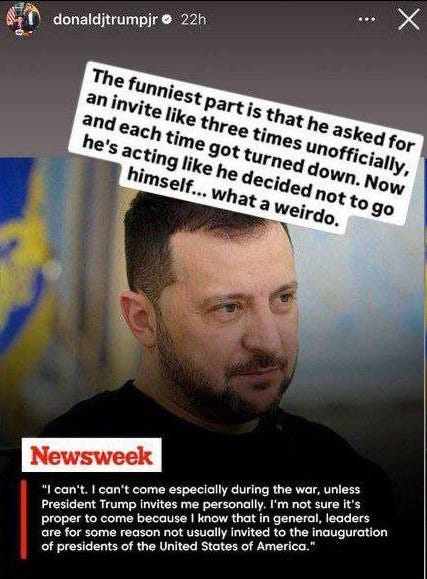
For Berlin, Kiev, London, Paris, and NATO more widely, the writing couldn’t be on the wall any more plainly. Whatever reveries they may have of maintaining the proxy war any longer – Britain recently signed a 100-year-long partnership with Ukraine, under which London will “explore” building military bases on Kiev’s soil – they all ultimately remain imperial vassals, wholly dependent on US financial and military support to exist. Save for a major false flag incident, Trump’s message can only be received among the military alliance.
Ukraine Was Always Just Anti-Russian ‘Battering Ram’ to US – Ex-Pentagon Analyst
Sputnik – 21.01.2025
The Trump administration has little interest in wasting money on Ukraine, retired US Air Force Lt. Col. Karen Kwiatkowski, former analyst for the US Department of Defense, tells Sputnik while commenting on Trump’s decision to suspend US foreign aid programs.
Withholding monies to Ukraine is a “starting point in explaining to Zelensky that the gravy train is over,” the expert thinks.
It has become increasingly obvious that the United States “doesn’t care for Ukraine,” regarding the latter merely as a “battering ram,” a “tool” to be used against Russia, Kwiatkowski remarks.
“So if Ukraine is a tool, it’s now a tool that is no longer very useful. It’s a tool that is hard to maintain. It’s not worth it. So we’re going to throw that tool away,” she says.
US Senator Lindsey Graham’s declaration about fighting Russia “to the last Ukrainian,” however heartless it may sound, “reflects how the Senate and how the politicians and the oligarchy in the United States really feel about Ukraine,” she added.
Trump’s Second Act: What it means for Russia and the global order
By Andrey Ilnitsky | Kommersant | January 16, 2025
The idea of inflicting “strategic defeats” on Russia has been a cornerstone of US policy for a long time. It transcends party lines and is implemented regardless of which administration occupies the White House. The only real differences lie in the methods used to achieve this objective. In this era of global transformation, it is critical for Moscow to analyze the strengths and weaknesses of its opponents. By understanding the nuances of US President Donald Trump’s administration – now back in power – Russia must craft its own strategy of resilience and development, rooted in sovereign interests.
This is not a new game. In 2014, Foreign Affairs published an article by John Mearsheimer, the renowned American political scientist behind the theory of offensive realism. In his piece, Why the Ukraine Crisis is the West’s Fault, Mearsheimer argued that NATO’s strategic ambitions in Eastern Europe provoked Russia’s actions in Crimea and Ukraine. His insights, dismissed at the time, have since been vindicated by events.
Fast forward to December 2024: Mearsheimer’s skepticism resurfaced in an interview with Russian philosopher Alexander Dugin, published by UnHerd. Mearsheimer doubted that Trump, despite his unconventional rhetoric, would bring meaningful change to US policy. “Trump is surrounded by hawks with deeply entrenched Russophobia,” he observed. While Trump’s personal views might differ from Washington orthodoxy, the forces shaping his administration remain aligned with America’s long-standing ambitions of hegemony.
Trump’s first term demonstrated this paradox clearly. Despite his campaign promises to “get along with Russia” and even consider recognizing Crimea, little changed. While Trump and President Vladimir Putin met six times and engaged in what seemed like constructive dialogue, US policy continued to push Russia out of global energy markets, impose sanctions, and arm Ukraine. At a 2023 rally, Trump himself dismissed accusations of being “soft on Russia,” boasting that he had sent “hundreds of Javelins” to Ukraine while the Obama administration sent “pillows.”
Expecting Trump’s second term to usher in a multipolar and equitable global order would be naive. The real power behind Trump’s administration – interest groups, corporations, and donors – has little incentive to pursue peace. His 2023-2024 campaign received significant backing from military-industrial giants like Lockheed Martin and Raytheon, as well as Silicon Valley’s venture capital elite. These forces thrive on perpetual conflict, where war is repackaged as “peace through strength.”
Trump’s geopolitical priorities are clear: undermine China’s rise as an economic and technological powerhouse while maintaining pressure on Russia. Elbridge Colby, a key figure in Trump’s foreign policy team, has articulated this strategy bluntly. Writing in May 2024, Colby argued that America must prioritize Asia – specifically China – over Europe and Russia. “The logic of Cold War strategy,” he wrote, “once led America to Europe; today it suggests that America should focus on Asia. China is the main rival.”
The inclusion of Marco Rubio in Trump’s foreign policy apparatus reinforces this anti-China focus. Rubio, a staunch critic of Beijing, has long warned of China’s ambitions to become the world’s dominant power “at the expense of everyone else.” Trump’s pivot to Asia is clear, but his strategy remains rooted in American exceptionalism and hegemony.
Domestically, Trump’s team envisions America as a “subcontinental fortress,” invoking a modernized Monroe Doctrine. This vision includes greater control over Canada, Greenland, and Panama, and a tighter grip on Central and South America. The goal? To secure America’s dominance in the Western Hemisphere while sidelining external powers like China and Russia.
Technology and military innovation are central to this vision. Trump’s administration aims to leverage artificial intelligence and cutting-edge dual-use technologies to maintain global superiority. This requires a complete reboot of the US military-industrial complex and a closer alignment between civilian industries and defense objectives. However, the question remains: can Washington, with its internal divisions and waning influence, successfully implement such an ambitious strategy?
For Russia, this geopolitical landscape poses serious challenges but also offers opportunities. The unipolar world order led by the US is undeniably weakening. Multipolarity is no longer just an aspiration; it is becoming a reality. However, the US and its allies are not retreating quietly. Instead, they are intensifying hybrid warfare against nations like Russia, China, Iran, and North Korea – countries labeled as “revisionist regimes.”
Trump’s rhetoric may appear bold and unconventional, but his administration’s actions are predictable. The MAGA doctrine of 2024 is less about genuine transformation and more about reasserting US dominance at any cost. Whether through economic coercion, military intervention, or ideological posturing, the goal remains the same: enforce a world order dictated by Washington.
For Russia, the path forward is clear. We must remain steadfast in defending our sovereignty and values. Unlike the West, which prioritizes hegemony, Russia stands for a multipolar world where nations have the right to determine their own destinies. The challenges are immense, but so are the opportunities. In this new era of great power competition, Russia’s resolve will be tested, but our commitment to our people and our principles will guide us through.
Andrey Ilnitsky is a member of the Council for Foreign and Defense Policy and senior research fellow at the Military University of the Ministry of Defense of the Russian Federation.
This article was first published by the newspaper Kommersant and was translated and edited by the RT team.
Western intelligence believes Baltic cable damage was not Russian sabotage – WaPo
RT | January 19, 2025
The recent damage to underwater power and communications cables in the Baltic Sea was likely the result of “maritime accidents” rather than Russian sabotage, the Washington Post reported on Sunday, citing several US and European intelligence officials.
A consensus over the string of incidents that plagued the underwater infrastructure over the past few weeks is now emerging in the Western intelligence community, with no evidence of malicious activities found, the newspaper reported.
The “intercepted communications and other classified intelligence” collected by the Western nations indicated that inexperienced crews and poorly maintained ships were behind the accidents, officials from the three countries involved in the investigations suggested.
Unnamed US officials told the newspaper that “clear explanations” have emerged in each case, suggesting the damage was accidental. One European official said the initial claims that Russia was involved are now met with “counter evidence” indicating otherwise.
The investigations have focused on three incidents involving vessels traveling to and from Russian ports that occurred over the past 18 months in the Baltics, including the rupture of a natural gas pipeline in the Gulf of Finland in October 2023 attributed to the Newnew Polar Bear container ship, and damage to two cables allegedly inflicted by the Yi Peng 3 bulk carrier in November.
The latest incident occurred in late December with a supposedly Russian-linked oil tanker, the Eagle S, which allegedly dragged its anchor across the EstLink 2 power cable connecting Finland and Estonia. The ship was boarded and seized by the Finnish authorities, with investigators claiming the ship was missing one of its anchors.
Moscow dismissed suggestions that it was to blame for the incidents in the Baltics. “It is quite absurd to continue to blame Russia for everything without any reason,” Kremlin spokesman Dmitry Peskov said in November.
Exposed: How US Fumbled Chance to Buy Russia’s Best-in-the-World Waterbombers to Fight LA Infernos
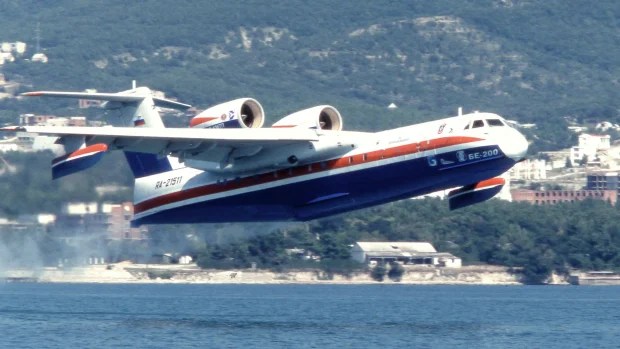
© Sputnik / Roman Denisov / Go to the mediabank
By Ilya Tsukanov – Sputnik – 17.01.2025
From budget cutbacks and DEI hiring to giving away much-needed “surplus equipment” to Ukraine, the fires devastating wide swathes of Los Angeles have turned into an unmitigated $250 billion disaster. But it didn’t have to be this way.
This week, Russian business media revealed that between 2017-2019, Russia and the US were actively negotiating a contract on the sale of up to ten of Russia’s powerful Beriev Be-200 waterbombers to California’s Seaplane Global Air Services.
The Russian planes, which would have been flown by an emergency services operator out of Santa Maria Public Airport, just 200 km northwest of one of the epicenters of the LA blazes, have a world-class reputation fighting wildfires from Italy and Indonesia to Portugal, Greece, Israel, Turkiye, and of course Russia itself.
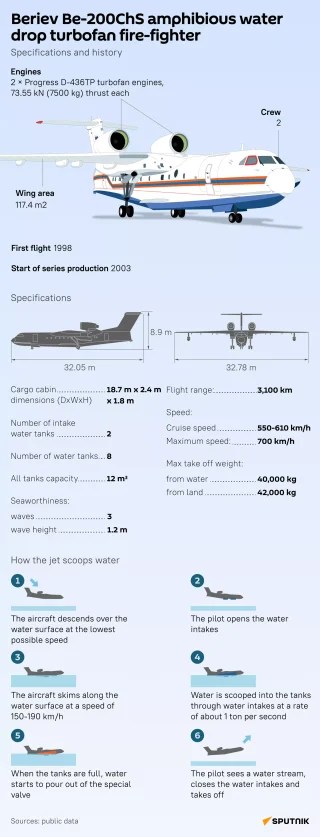 Be-200s can carry 12 tons of water or fire retardant, swooping down on reservoirs, lakes or oceans to fill up in 14 seconds flat. Flying at speeds up to 700 km/h and featuring a 2,100 km range (3,300 km ferry range), Be-200s fighting the LA fires would have been able to make multiple sorties, dropping over 50 tons of water before needing to refuel.
What happened?
Beriev was reportedly ready to sell the Be-200s with Russian PowerJet SaM146 turbofans, but the US side insisted on the D-436TP, an engine manufactured by Ukraine’s Motor Sich.
In 2020, the US Federal Aviation Administration insisted on separate certification for the planes and their engines. Motor Sich refused, having banned the delivery of the engines to Russia, and so the contract was scrapped.
Rostec, Beriev’s parent company, confirmed Friday that an agreement on the sale of Be-200s was lined up, with all ten of the planes to have been handed over by late 2024.
“This is one of the clearest examples of how politics can harm common sense,” Rostec said in a statement. “The contract was disrupted because the Americans did everything to make the procedure for approving the engines and airframe for operation in the United States impossible.”
“Perhaps the presence of our aircraft… would have reduced the damage from the natural disaster in California. But intrigues have done their job. The result has been thousands of families left homeless and billions in losses. We sympathize with the ordinary people who have become hostages of the political games of their authorities,” the company added.
Skripal poisoning victim disputed UK narrative, official inquiry reveals
By Kit Klarenberg · The Grayzone · January 13, 2025
An official inquiry into a notorious 2018 Novichok poisoning case has found the victim briefly emerged from a coma, revealing information which wholly undermined the British government’s narrative. While the medical professional she told was muzzled, mainstream media has ignored the new finding.
On March 8, 2018, just four days after being hospitalized for having allegedly been contaminated with novichok, which is said to be the world’s deadliest military grade nerve agent, Yulia Skripal was roused from her coma. Upon waking up, she communicated to an intensive care consultant that she and her father, the turncoat former Russian spy, Sergei, had been “sprayed” with an uncertain substance while dining at a restaurant, before their collapse — and not at their home, as claimed by the UK.
The revelation, which runs completely contrary to widespread reports that Yulia spent almost a month in critical condition before regaining consciousness, stems from recently-disclosed transcripts of an official British inquiry into the death of Dawn Sturgess, who supposedly died after having inhaled novichok from a sealed perfume bottle.
For several years, British authorities have stonewalled, prevaricated, and connived to prevent an inquest into the Sturgess case, and perhaps now it is clear why.
According to the British government, Sergei Skripal and his daughter, Yulia, were poisoned by two GRU assassins who snuck into Britain using false identities with Russian-produced Novichok, which was supposedly smeared on the doorknob of Sergei’s MI6-furnished home in Salisbury. The Skripals ultimately survived, but in the intervening years, this story has been repeatedly retold by legacy media outlets to hype up the threat Russia poses to the British public.
That narrative is substantially undermined by the recent revelation that Yulia briefly awoke from her coma and countered the official story through a form of visual communication.
The Sturgess inquiry also revealed that after Yulia awoke from her coma and interacted with a doctor, high-ranking officials at Salisbury hospital forbade the healthcare professional from divulging details of his interchange with Yulia with anyone or having any further contact with the Skripals, and warned him not to discuss the poisoning case with anyone.
The Russian government’s supposed involvement in the Salisbury poisoning has proven pivotal in igniting a new Cold War. Moscow was universally depicted as a dastardly pariah in the media, precipitating a British-instigated expulsion of Russian diplomats, dramatically escalating a conflict that eventually erupted in the Ukraine proxy war.
Even if Yulia’s hospital bed claims were inaccurate, they still undermine the British government’s official narrative, while raising serious questions about which substance was used to poison the Skripals, and who was actually responsible. The public is also left to ponder whether the silencing of the healthcare professional who received Yulia’s testimony resulted from state pressure on Salisbury hospital.
Meanwhile, the Dawn Sturgess investigation has closely emulated past British government coverup inquiries, such as the questionable 2016 probe into FSB defector Alexander Litvinenko’s strange death a decade before. In an effort to validate the preordained conclusion that Sturgess was poisoned with the same Novichok that purportedly nearly killed the Skripals almost ten miles away, the inquiry’s chair and counsels have routinely relied on stultifying illogic, highly gymnastic legalistic arguments, speculative claims, and anonymous security and intelligence personnel testimony, while ignoring or outright dismissing inconvenient evidence.
Skripals ‘sprayed’ with poison at restaurant?
Over six weeks from late October 2024, a formal inquiry probed the July 2018 death of Dawn Sturgess resulting from alleged Novichok nerve agent poisoning. The investigation had been rigged to prevent the truth about that tragic incident from reaching the public, and to to suppress inconvenient details about the poisoning of GRU defector Sergei Skripal and his daughter Yulia three months earlier. However, the inquiry nonetheless yielded a number of important findings.
That there has been any official investigation into the death of Dawn Sturgess — even a flagrant whitewash — is miraculous. Under English law, a coroner’s inquest is typically completed within six to nine months of an individual’s passing. But as independent journalist John Helmer has exhaustively documented, British authorities have stonewalled, prevaricated and connived to prevent an inquest. This was after an inquest was opened, then immediately adjourned pending further police investigations, on the very same day in July 2018.
After heavy legal tussling between British authorities and Sturgess’ grieving family, British authorities finally authorized a public inquiry in November 2021, with no date for commencement given. This was a highly suspect maneuver. Inquests are legally-mandated to establish how, when and why someone died, and the wider circumstances surrounding it. They have sweeping powers to subpoena documents and witnesses, evidence is given under oath, and absolutely any member of the public, the British government, and its national security apparatus can be called to testify.
Previous high-profile inquests have shed important light on potential MI6 assassinations, and exposed major scandals involving British police.
By contrast, as one law firm explained, inquiries are little more than “highly emotive” public relations exercises, intended to “attract large scale media coverage”. Their terms — who can be interviewed and what evidence will be considered — are sharply limited by direct government decree, and they have no power to compel anyone or anything to turn over evidence.
That authorities exerted so much energy to avoid holding an inquest before opting for a toothless PR stunt should be an obvious source of concern. While some testimony was publicly broadcast and transcribed, the BBC reports that many inquiry sessions were held in secret, with some witnesses’ “names, faces and even voices hidden.” Meanwhile, “only three accredited journalists” were allowed to report directly on proceedings, prohibited from using any electronic devices throughout, and reduced to making notes on whatever was said using “old fashioned pen and paper.”
Still, despite the veil of obfuscation, important public testimony emerged during the inquiry’s six-week-long span. It was Dr Stephen Cockroft, an intensive care consultant who treated the Skripals upon their admission to hospital, who revealed Yulia had awoken after just four days. Cockroft told the inquiry he “never thought [Yulia] would be capable of having a conversation” again, having “suffered a catastrophic brain damage.”
However, he noted that she seemed mentally competent, nodding and crying in response to questions he asked, while looking “absolutely terrified.”

He quizzed her about what happened prior to her collapse, to which she responded with a series of blinks — .
Among Dr Cockroft’s queries was whether she and her father were “sprayed” with a substance at a restaurant called Zizzi. This was where Yulia dined with Sergei on the afternoon of March 4 2018. She responded in the affirmative to the doctor’s question.

When asked if she knew who was responsible for spraying her, Yulia burst into hysterical tears. At that point, Cockroft stopped pushing his subject for answers.
Despite Yulia’s stunning responses, a senior British counter-terror police forensics expert who participated in the probe of the Skripals’ poisoning, Keith Asman, apparently decided not to interview her at all, and attached no credibility to her post-coma declarations.

During his inquiry testimony, Asman acknowledged he was informed that Yulia had indicated Zizzi was the site of her poisoning. But the revelation ultimately had zero bearing on his team’s probe. This, they said, was due to forensic investigators finding relatively “low-level” traces of Novichok at the restaurant compared to other sites, and suspicions Yulia may have “wittingly or unwittingly been involved” in the incident that landed her and her father in hospital.
Asman claimed his misgivings about Yulia were due to her crying “when asked who did it” by Dr Cockroft. “I did wonder… if she was crying because she felt maybe she had been identified,” he claimed. This doubt, combined with the Skripals having allegedly “eaten and drank different things” at Zizzi, led British police forensic masterminds to conclude it was “unlikely one particular item of food or drink was the source of the contamination,” and they therefore formally ruled out the restaurant as the site of their poisoning.
Shockingly, when inspectors from the Organization for the Prohibition of Chemical Weapons (OPCW) arrived in Salisbury on March 21 2018 to investigate the incident, the Skripals were physically prevented from speaking to them. The inquiry has revealed that on the very same day the OPCW inspectors arrived, Skripals’ doctors unilaterally decided to simultaneously tracheotomize both him and his daughter. Yulia’s tracheostomy tube was removed March 27, two days after OPCW representatives left. Sergei had to wait until April 5 for his tube to be dislodged.
Hospital whistleblower silenced
Another deeply strange detail divulged by Dr. Cockroft was that his interaction with Yulia apparently caused significant consternation at the highest levels of Salisbury hospital. Following this incident, Dr. Christine Blanchard, the institution’s then-medical director, not only removed him from the intensive care rota, but “warned” him he “should not discuss any aspect of the poisoning with colleagues… or other individuals.” Cockroft was outright “forbidden to discuss any aspect of the presentation, recognition or initial treatment of Yulia or Sergei Skripal,” even at regular ICU hospital meetings.
Asked by inquiry counsel if Blanchard believed it hadn’t “been wise” for him to speak to Yulia “about these matters,” Cockroft concurred, though he said that based on his 24-year-long career in healthcare, he didn’t believe he’d done anything wrong. “I always talk to my patients… even when I think they can’t hear me,” he explained, opining, “the worst intensive care doctors… ignore the patients.” Describing the attitude of Dr Blanchard, who had no experience of working in intensive care, as “a little difficult,” he stated:
“I genuinely was concerned that if [Yulia] had some knowledge that somebody had assaulted them… that might be something she would be concerned about. I do feel this was a lost opportunity to discuss with my colleagues what I observed in those first few hours and how I recognized that the Skripals had been poisoned.”
“If [my colleagues] were having a conversation [about the Skripals] they would stop talking about it in front of me,” Cockroft revealed, adding: “it was odd. It was very odd.”
The inquiry made very little of Cockroft’s testimony on this point. Still, his declarations suggest a code of omertà was imposed by the British state around the facts of the Salisbury incident. Whether pressure of some kind was brought to bear on Salisbury hospital to prevent Cockroft’s interactions with Yulia emerging publicly may never be known.
However, it is clear the British government has been committed to preventing inconvenient facts about Salisbury from ever entering the public domain. The narrative of Russian culpability for the Skripals’ poisoning had to be sustained, even before a clear motive was established, perpetrators were identified, or other elementary facts were ascertained.
In the days immediately after the poisoning, a substantial slice of the British public expressed serious doubts about Moscow’s responsibility for the purported poisoning among Britons, and even entertained the possibility that the MI6 had carried out the operation. Battering down that skepticism has apparently necessitated some extreme measures at every level.
A Façade of Concern for Democracy Covers Real Intents – Cutting China’s Belt and Road Initiative!
By Seth Ferris – New Eastern Outlook – January 16, 2025
It is rather interesting to see the mask come off such individuals as Congressman Joe Wilson, representative for South Carolina, and head of the US Congressional Helsinki Commission.
Mr. Wilson has been a leading US critic of the current Georgian government, and a fervent supporter of the opposition United National Movement and smaller parties such as Girchi both of whom are known for such “conservative values” as pushing for the dissolution of the Georgian Orthodox Church and its rebranding it Ukrainian style, as well as a commitment to the western values of LGBTQ and, in the case of another up-and-coming Georgian Political Party “Girchi”, decriminalization of pedophilia.
Nice friends you have there, Mr. Wilson
It is especially heinous that Representative Wilson has been a leading campaigner in the “Russian Interference” claims regarding the Georgian elections, while himself interfering far more that Russia would ever dream of doing, with him being a leading proponent of the vilely named MEGOBARI (Georgian for friend) act, which supposedly aims to correct so called “Democratic Backsliding” which, as we have seen in Moldova and Romania, is just code for punishing Georgians for not voting the way the US demands. It is interesting to note the list of endorsements of the act, which is a “Who’s who” of CIA deniable assets in the NGO sector, topped by the reprehensibly hypocritical “Freedom” House.
Joe Wilson is particularly irate at such “undemocratic” behavior as the Georgian government working to have at least reasonable, non-conflict based relations with major neighbors such as Russia and Iran. He was particularly outraged that the Georgian Prime Minister, Irakli Kobkhidze, attended the funeral of the late Iranian President Ebrahim Raisi, and the subsequent inauguration of his replacement, the moderate Pezeshkian, with an irate post on X saying:
Why was Georgian
@PM_Kobakhidze
hanging out with IRGC, Hezbollah and Hamas leaders in Iran just a few months ago? The same terrorists actively plotted to assassinate
@realDonaldTrump
and call for the death of America every day.
We see you.
America will not be fooled.
Of course, Mr. Wilson, like most of his ilk in America, ignored the fact that a number of American allies, including Turkey and envoys from the EU attended the funeral and subsequent inauguration.
In response to criticism, Khobakidze said:
“I attended the Iranian President’s inauguration. Iran holds great significance in the region. Hence, the heads of all regional states attended the inauguration, and envoys of EU High Representative Josep Borrell and the UN Secretary-General were also present. The delegation was notably represented, with the presence of the prime ministers of Azerbaijan and Armenia, signifying a high-level representation of the region,”
It’s called diplomacy, Mr. Wilson, you Americans should try it sometime…
When it comes to the Georgian elections, Wilson is particularly vitriolic, demanding a re-run, and that this should be “foreign administered” in order to ensure “fairness” (in other words, to ensure the result the US demands), thereby echoing Europe’s imperialist calls.
The lover of democracy, has also called for and cheered sanctions on Georgian government officials he deems responsible for “dictatorial behavior” and “anti-democratic” actions in such statements as:
“The de-facto Georgian government has shed all pretense of democracy and has now started arresting innocent activists and peaceful members of the opposition in their homes and places of work. Make no mistake: Georgian Dream is using Kremlin-style dictatorial tactics, the U.S. government must respond to punish those involved in perpetrating violence and brutality against innocent Georgians immediately.”
Of course, the esteemed Congressman ignores the fact that protesters injured over 300 police officers with fireworks, rocks, and Molotov cocktails, not to mention use of lasers to blind police officers, as well as burning over 40 rooms in the parliament, and opposition leaders were calling publically for revolution, good luck getting away with any of that in the US or EU. We can all clearly see the American hypocrisy at this point, with the detention without trial and torture of US actually peaceful demonstrators from January 6th 2021, many of whom languish in prison to this day.
In further, almost hysterical posts, he went on:
“I welcome the sanctioning of Bidzina Ivanishvili, he hates America and loves China and Iran. Georgia urgently needs free and fair elections,” writes American Congressman and Helsinki Commission Chair, Joe Wilson, on his own page on X.
“I welcome the sanctions on dictator-in-waiting Bidzina Ivanishvili. I called for this in 2020 with thr Republican Research Committee. Ivanishvili hates America and loves China and Iran. He plans to destroy Georgian sovereignty and democracy. Georgia needs free and fair elections immediately,”
Wilson also claims to speak for Donald Trump, with this gem of a post on X:
President @realDonaldTrump has made it very clear where he stands on the self-professed enemies of America. If Bidzina Ivanishvili goes through with his plan to destroy Georgian democracy on Dec 29, he should expect a response like he’s never imagined.
Wilson was referring to the inauguration of the new Georgian President, in accordance with the constitution of Georgia, Mikheil Kavelashvili, a prominent critic of Western overreach in Georgia, and defender of Georgian cultural and religious values.
Of course, not doing what America and its EU puppets want is a “plan to destroy Georgian democracy”, all is clear….
BIGGER Fish to Fry!
The BIG question is: Why is such an important US congressman with far bigger fish to fry, one would think, so irate at a country of roughly four million people choosing a government that reflects its religious and cultural values, and attempting to have good neighborly relations with countries that it has previously had conflicts with?
A little digging through Wilson’s X account soon gives an answer:
Why did Georgia’s dictator-in-waiting Bidzina Ivanishvili give a contract to build the Anaklia Deep Sea Port to a sanctioned Chinese company?
Are you ready for sanctions, Bidzina?
The fact is that the Chinese bid was the most competitive and was properly awarded, given the failure of western companies to submit their bids in the allotted time. He, and many other critics, also fail to note that the consortium awarded is a cooperation between Chinese and Singaporean companies. Given that Singapore is a major American ally in the Asia-Pacific region, such hysteria and breast beating seems rather ridiculous.
The real reason for American panic is the fact that the Anaklia Port Project will be a major transit point, as part of the Chinese “Belt and Road” project, being a major hub on what the Chinese call the “Middle Road” part of the planned trade links.
As the Chinese ambassador to Georgia said:
“The development of the Middle Corridor holds significant importance for China, Georgia, and all countries along its route. Currently, there is a positive stance from China, Georgia, Europe, and neighbouring nations towards this corridor, establishing a crucial foundation for its future growth. Georgia, strategically positioned between Europe and Asia, spares no effort to become a regional hub. The Anaklia port, in particular, will play a pivotal role in bolstering Georgia’s capabilities in cross-border transport, further solidifying its importance in regional and international trade networks,”
The Americans are, not surprisingly, desperate to either stop, or at least control strategic points, along this transport corridor, that will allow China to easily trade with Central Asia, Russia, the Middle East, and Europe, bypassing on land the US Navy, that the US has traditionally used to enforce its will in trade matters.
I humbly submit that Mr. Wilson’s anger has nothing to do with Georgian democracy, but everything to do with stopping a project that plans to lift billions, including many Georgians, out of poverty, but by doing so, threatens US hegemony.
American attempts to cut the Belt and Road show the moral bankruptcy of its claims to be “Defending Democracy”
The mask has slipped, and what is underneath is ugly. And not to mention from where the lion’s share of the Senator’s official campaign funding comes from, no place other than the Zionist Lobby and US Defense Contractors.
Russia’s Geoeconomic Shift from Greater Europe to Greater Eurasia
By Professor Glenn Diesen | January 13, 2025
Liberal theory suggests that economic interdependence creates peace as both sides gain economically from peaceful relations. However, liberal theory is deeply flawed as it assumes states prioritise absolute gain (both sides gain, and it does not matter who gains the most). Due to the security competition in the international system, states must focus on relative gain (who gains more). As Friedrich List recognised: “As long as the division of the human race into independent nations exists, political economy will as often be at variance with cosmopolitan principles”.[1]
In all interdependent relationships, one side is always more dependent than the other. Asymmetrical interdependence empowers the less dependent state to set favourable economic conditions and obtain political concessions from a more dependent one. For example, the EU and Moldova are interdependent, but the asymmetrical interdependence results in the EU preserving its autonomy and gaining influence.
The “balance of dependence” refers to a geoeconomic understanding of the realist balance of power. In an asymmetrical interdependent partnership, the more powerful and less reliant side can extract political power. The more dependent side therefore has systemic incentives to restore a balance of dependence by enhancing strategic autonomy and diversifying economic partnerships to reduce reliance on the more powerful actor.
Geoeconomic rivalry entails competing for power by skewing the symmetry within interdependent economic partnerships to enhance both influence and autonomy. In other words, to make oneself less reliant on others while increasing the dependence by others. Diversifying economic partnerships can reduce one’s own reliance on a state or region, while asserting control over strategic markets diminishes the capacity of other states to diversify and lessen their dependence.
The Geoeconomic Foundation for Western Dominance
The centuries-long geoeconomic dominance of the West is the product of asymmetrical interdependence by dominating new technologies, strategic markets, transportation corridors and financial institutions.
Following the disintegration of the Mongol Empire, the land-based transportation corridors of the ancient Silk Road that had fuelled trade and growth vanished. Subsequently, Western maritime powers rose to prominence from the early 1500s by asserting control over the main maritime transportation corridors and establishing “Trading-Post empires”. Leading naval powers, such as Britain, have therefore historically been more inclined towards free trade as they had more to gain and risked less by controlling the trade routes. The maritime strategies of Alfred Thayer Mahan in the late 1800s were founded on this strategic reasoning, as controlling the oceans and Eurasian continent from the periphery laid the basis for US military and economic power.
The advancements in the Industrial Revolution created an even more favourable balance of dependence in favour of the West. Adam Smith noted that the discovery of America and the East Indies were the “two greatest and most important events recorded in the history of mankind”.[2] However, he also recognised that the extreme concentration of power in Europe created an exploitative and destructive relationship:
“To the natives however, both of the East and West Indies, all the commercial benefits which can have resulted from those events have been sunk and lost in the dreadful misfortunes which they have occasioned. These misfortunes, however, seem to have arisen rather from accident than from anything in the nature of those events themselves. At the particular time when these discoveries were made, the superiority of force happened to be so great on the side of the Europeans that they were enabled to commit with impunity every sort of injustice in those remote countries”.[3]
Samuel Huntington similarly wrote:
“For four hundred years, intercivilizational relations consisted of the subordination of other societies to Western civilization… The immediate source of Western expansion, however, was technological: the invention of the means of ocean navigation for reaching distant peoples and the development of the military capabilities for conquering those peoples… The West won the world not by the superiority of its ideas or values or religion (to which few members of other civilizations were converted) but rather by its superiority in applying organized violence. Westerners often forget this fact; non-Westerners never do”.[4]
Following the Second World War, the US became the dominant power due to military power, but also geoeconomic power consisting of its large share in the global GDP, technological superiority, industrial dominance, the Bretton Woods institutions, control over strategic markets/resources, and control over key transportation corridors.
From Gorbachev’s Common European Home to “Greater Europe”
Following the demise of communism, Russia aimed to integrate with the West to form a “Greater Europe”, based on the ideas of Gorbachev’s concept of a Common European Home. Economic development and prosperity required integration with the West as the main economic centre in the international system.
However, the Americans and Europeans had no incentives to accept a Greater Europe. The West aimed to construct a new Europe without Russia, which required reviving bloc politics. The ultimatum to Russia was to either accept a subordinated position as the permanent apprentice of the West or be isolated and thus become economically underdeveloped and irrelevant. The West supported only European institutions such as NATO and the EU that incrementally augmented the collective bargaining power of the West to maximise asymmetrical interdependence with Russia. Making Russia obey the European institutions where Russia does not have a seat at the table is possible under extreme asymmetrical interdependence. Cooperation then entails unilateral concessions and Russia would have to accept decisions by the West.
The alienation of Russia would not matter if it kept getting weaker. William Perry, the US Defence Secretary between 1994 and 1997, recognised that his colleagues in the Clinton Administration were aware that NATO expansionism and the exclusion of Russia from Europe fuelled anger:
“It wasn’t that we listened to their [Russia’s] argument and said [we] don’t agree with that argument… Basically the people I was arguing with when I tried to put the Russian point… the response that I got was really: ‘Who cares what they think? They’re a third-rate power.’ And of course that point of view got across to the Russians as well. That was when we started sliding down that path”.[5]
The dream of a Greater Europe failed due to Russia’s inability to create a balance of dependence within Europe. Moscow’s Greater Europe initiative aimed to obtain a proportional representation at the European table. Instead, the unfavourably asymmetrical partnerships with the West that followed enabled Western unilateralism veiled as multilateralism, in which the West could maximise both its autonomy and influence.
“Cooperation” was subsequently conceptualised by the West within a teacher-student/subject-object format, in which the West would be a “socialiser” and Russia would have to accept unilateral concessions. Russia’s decline would be managed as expanding the EU and NATO sphere of influence in the east gradually diminished the role of Russia in Europe. “European integration” became a zero-sum geostrategic project, and states in the shared neighbourhood were presented with a “civilizational choice” of aligning either with Russia or the West.
Moscow’s “Greater Europe” project was always destined to fail. The “leaning-to-one-side” policy by Yeltsin was not rewarded and reciprocated by the West, rather it made Russia vulnerable and exposed. Russia neglected its partners in the east, which deprived Russia of the bargaining power required to negotiate a more favourable format for Europe. Brzezinski noted that cooperation with the West was “Russia’s only choice – even if tactical”, and it “provided the West with a strategic opportunity. It created the preconditions for the progressive geopolitical expansion of the Western community deeper and deeper into Eurasia”.[6]
Putin Reforms the Greater Europe Initiative
Yeltsin conceded by the end of the 1990s that the “leaning-to-one-side” policy had been exploited by the West and called for diversifying Russia’s economic partnerships by becoming a Eurasian power. However, there were no powers in the East with the intentions or capabilities to challenge Western dominance. Putin attempted to revive the Greater Europe Initiative by ending the era of unilateral concessions and instead strengthening Russia’s negotiation power. Russia would not integrate into the West through unilateral concession, but integrate with the West as an equal.
Moscow began to embrace economic statecraft as the principal tool for restoring Russian power, and pursue incremental integration with the West. Re-nationalising energy resources ensured that the strategic industries of Russia worked in the interest of the state rather than oligarchs, who were courted by the West and tended to use these industries to impose their control on the state. However, the West resisted energy dependence on Russia as it risked creating more symmetry in relations and even giving Russia a voice in Europe. The narrative of the Russian “energy-weapon” was born as Europeans were told to reduce all dependence on Russia as the requirement for a more obedient Kremlin.
The Greater Eurasia Initiative
Russia’s Greater Europe Initiative eventually died when the West supported the coup in Kiev in 2014 to pull Ukraine into the Euro-Atlantic orbit. By making Ukraine a frontline instead of a bridge, it was evident that any incremental integration with Europe had been a utopian dream. Furthermore, the anti-Russian sanctions made it necessary for Russia to diversify its economic connectivity. Rather than seeking to resolve the Ukraine crisis by implementing the Minsk peace agreement, NATO began to build a Ukrainian army to change realities on the ground. Russia began to prepare for a future clash by making its economy sanctions-proof.
With the rise of Asia, Russia found a solution. Russia began to diversify away from excessive reliance on the West and embrace the new Greater Eurasia Initiative. Instead of being isolated at the periphery of Europe, Russia acquired economic strength and influence by developing new strategic industries, transportation corridors and international financial institutions in cooperation with countries in the East. While Russia is met with hostility in the stagnant West, it was embraced in the more dynamic East. Not only have the ambitions of Gorbachev’s Common European Home been abandoned, but the 300-year-long Western-centric policy since Peter the Great has also ended.
A strategic partnership with China is indispensable to construct a Greater Eurasia. Yet, Russia has learned the lessons from the failure of Greater Europe by avoiding excessive dependence on an economically stronger China. The asymmetrical interdependence that emerges in the framework of such a partnership enables China to extract political concessions, which would make it untenable for Russia in the long term. Moscow seeks a balance of dependence in its strategic partnership with Beijing, which entails diversifying economic partnerships across Greater Eurasia. As China does not seek a hegemonic role in Greater Eurasia, it has welcomed Russia’s efforts to diversify its economic partnerships.
Under the Greater Europe Initiative, the Europeans had access to cheap Russian energy and enjoyed a huge Russian market for exports of manufactured goods. Furthermore, Russia’s geoeconomic strategy to integrate with the West resulted in preferential treatment for Western corporations. Under Greater Eurasia, Europe will undergo deindustrialization as the cheap Russian energy and market opportunities go to Asia, which also enhances the competitiveness of Asia vis-a-vis Europe. The Europeans continue setting their own house on fire with reckless sanctions, in the hope that it will also hurt the Russian economy. However, while Europe cannot diversify away from Russia, Russia can diversify away from Europe.
Ideally, Europe would be one of Russia’s many economic partners in the Greater Eurasia Initiative. The revival of militarised dividing lines on the European continent makes the Europeans excessively reliant on the US and Russia becomes too dependent on China. Therefore, there are strong systemic incentives to restore some economic connectivity between the Europeans and Russians after the Ukraine War, although it will be within a Greater Eurasian format as Greater Europe can no longer be revived.
[1] List, F. 1827. Outlines of American Political Economy, in a Series of Letters. Samuel Parker, Philadelphia.
[2] A. Smith, An Inquiry into the nature and causes of the Wealth of Nations, Edinburgh: Adam and Charles Black, 1863, p.282
[3] J. Borger, ‘Russian hostility ‘partly caused by west’, claims former US defence head’, The Guardian, 9 March 2016.
[4] S.P. Huntington, The Clash of Civilizations and the Remaking of World Order, New York, Simon and Schuster, 1996, p.51.
[5] Ibid.
[6] Z. Brzezinski. The Choice: Global Domination or Global Leadership. Basic Books, New York. 2009. P. 102.
The article is based on excerpts from my previous article with the same title: Glenn Diesen, ‘Russia, China and the “Balance of Dependence” in Greater Eurasia’, Valdai Dicussion Club, March 2017
Nord Stream pipeline to be relaunched — German chancellor candidate
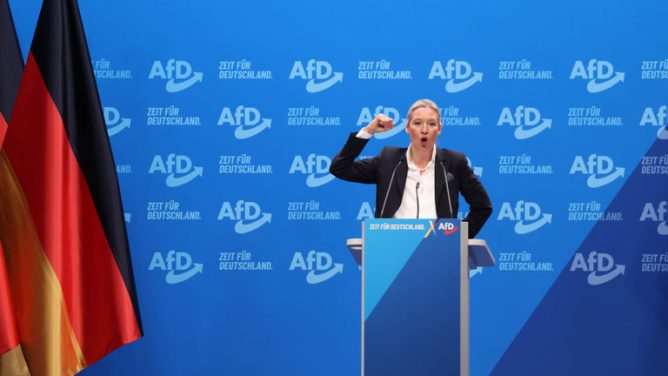
Alice Weidel speaks at the AfD party congress in Riesa, Germany, January 11, 2025 in Riesa © Getty Images / Sean Gallup
RT | January 11, 2025
Alternative for Germany (AfD) co-leader Alice Weidel has pledged to put the sabotaged Nord Stream gas pipelines back into operation if her party emerges victorious in next month’s general election.
AfD members met in the town of Riesa on Saturday to formally approve Weidel as their candidate to succeed Chancellor Olaf Scholz, whose coalition government collapsed late last year. Weidel’s nomination marks the right-wing AfD’s first bid for the chancellery in its 11-year history.
In a speech after the nomination vote, Weidel promised to implement harsh immigration policies – including the “remigration” of immigrants already living legally in Germany – and to scrap Scholz’s green policies in a bid to drive down energy prices. Restoring energy ties to Russia is vital to this latter goal, she explained.
“We will put Nord Stream back into operation, you can count on it,” Weidel told her party.
Germany relied on Russia for 55% of its natural gas supply before the Ukraine conflict escalated in February 2022. Much of this gas flowed through the Nord Stream 1 pipelines, with the parallel Nord Stream 2 lines due to come online in 2022. However, Berlin revoked the certification for Nord Stream 2 several days before Russia’s military operation in Ukraine began, and both sets of lines were destroyed in an act of sabotage in September of that year.
While German investigators have reportedly settled on the theory that the pipelines were destroyed by Ukrainian saboteurs, American journalist Seymour Hersh maintains that they were blown up by the CIA and US Navy. The head of Russia’s Foreign Intelligence Service (SVR), Sergey Naryshkin, has blamed “professional saboteurs from the Anglo-American special services,” referring to the US and UK.
Scholz’s decision to halt Russian energy imports, coupled with his government’s green policies, has led to soaring electricity costs in Germany, forcing some of the country’s manufacturing giants – including Volkswagen and BASF – to close plants and lay off workers.
The AfD is not the only German party that wants to repair and reopen Nord Stream. The leftist Sahra Wagenknecht Alliance (BSW) has also demanded that they be brought back online, with BSW MP Sevim Dagdelen calling last week for the gas lines to “finally be put into operation,” and for the German government to “stop giving money to Kiev!”
Germans go to the polls to choose a new government on February 23. The AfD is currently polling at around 20%, ahead of Scholz’s center-left Social Democratic Party (SPD) at 16%, but behind the center-right Christian Democratic Union (CDU) at 31%. However, even if the AfD were to emerge as the largest party next month, all of Germany’s other mainstream parties have ruled out entering a coalition with it.
Slovakia faces energy crisis by next winter after Ukraine shut off Russian gas, president warns
By Thomas Brooke | Remix News | January 10, 2025
Slovakia faces a looming energy crisis next winter unless an alternative method of gas importation is established, following the cessation of supplies through Ukraine, Slovak President Peter Pellegrini warned on Friday.
Speaking in the village of Nemecká, Pellegrini highlighted the gravity of the situation and called for urgent solutions to secure the nation’s energy stability.
While gas supplies for this winter are stable in terms of price and capacity, Pellegrini emphasized the underlying vulnerabilities. “We are currently consuming more gas than we are receiving, relying heavily on reservoirs filled to maximum capacity earlier this year,” he said. However, the president expressed concern that these reserves would not suffice for the next heating season if the supply deficit is not addressed.
The gas supply disruption stems from Ukraine’s decision on Jan. 1 to halt the transit of Russian gas to Slovakia. Kyiv justified the move as a measure to cut off revenue that could support Russia’s ongoing war effort, asserting that alternative suppliers had been made available and supplies to the European Union had been maintained. The move has enraged some member states heavily reliant on the gas route.
Pellegrini lamented the failure to reach a compromise with Ukraine, saying, “I regret that an agreement could not be found. Ukraine’s decision to shut off the gas has exposed Slovakia to a serious challenge in the coming months.”
The Slovak president revealed the challenges of importing liquefied natural gas (LNG) from other countries, citing limited capacity at European terminals. “The import of LNG runs into significant bottlenecks in northern and southern Europe. These terminals cannot fully replace the current shortfall,” he noted, stressing the urgency of finding alternative sources to make up for the lost capacity.
Prime Minister Robert Fico, speaking after discussions with EU Energy Commissioner Dan Jorgensen on Thursday, hinted at retaliatory measures should the situation persist. Fico suggested that Slovakia might cut off aid to Ukraine and use its veto in the European Council to block further EU support for Ukraine’s war effort.
“There is nothing — neither international law nor sanctions — that prevents the transit of gas through Ukraine,” Fico stated in Brussels. He also warned of the broader implications for the European Union, noting that rising energy prices could undermine the bloc’s competitiveness. “If the damage to the EU and Slovakia becomes permanent, we will take reciprocal measures,” he added.
Slovakia threatens to block Ukraine aid over gas transit dispute – media
RT | January 10, 2025
Slovak Prime Minister Robert Fico has warned that Bratislava may block the European Union’s financial and humanitarian aid to Kiev if the cessation of Russian gas transit through Ukraine is not resolved, Reuters has reported. Fico made the statement after talks with EU Energy Commissioner Dan Jorgensen on Thursday.
Fico cited potential losses from the blocked transit as the reason for his threat.
“There is nothing – not international law or sanctions – that prevents the transit of gas through Ukraine,” Fico told reporters in Brussels, as quoted by Reuters.
Slovakia has seen the complete cessation of Russian gas flows via Ukraine, a route that previously provided Bratislava with significant transit fees and also provided the gas for its domestic consumption.
According to Fico, Slovakia stands to lose $515 million annually in transit fees and could face an additional $1 billion in increased gas prices due to the disruption.
“If this problem is not resolved, the government of the Slovak Republic will take strict reciprocal measures in the near future,” Fico said.
The prime minister outlined potential retaliatory measures, including exercising Slovakia’s veto power within the European Union on Ukraine-related issues.
He also threatened to suspend humanitarian aid to Ukraine, scaling back support for Ukrainian refugees in Slovakia, and halting emergency electricity supplies to the country.
Fico’s remarks follow recent discussions with Russian President Vladimir Putin in Moscow, during which the Slovak leader secured assurances of direct gas supplies to Slovakia despite the transit halt.
A meeting initially scheduled between Slovak, Ukrainian, and European Commission officials to address the gas transit issue was canceled after Ukraine declined to participate. Slovakia and the European Commission have since agreed to form a working group to assess the crisis and explore potential EU interventions.
Ukraine has not yet publicly responded to Fico’s latest statements. When the Slovak PM first threatened to cut off electricity to Kiev last month, Ukrainian Energy Minister German Galushchenko said he didn’t think that Bratislava would go through with the threat.
Slovakia, which has a contract with Russia’s Gazprom, requires between 4 billion and 5 billion cubic meters (bcm) of gas annually to meet its energy needs. Prior to the transit halt, it had been receiving around 3 billion bcm from Russia through Ukraine. In response to the disruption, SPP, Slovakia’s state-owned gas company, is now sourcing liquefied natural gas (LNG) from international suppliers, including BP, ExxonMobil, Shell, Eni, and RWE.
Featured Video

Macgregor: We Haven’t Seen the Worst of the Iran War Yet
or go to
Aletho News Archives – Video-Images
New Book
Breast Cancer: Before You Consent
A new Unbekoming paperback
Lies are Unbekoming | September 18, 2026
Peter Gøtzsche reviewed every randomised mammography screening trial ever conducted for the Cochrane Collaboration. Cochrane’s headline is that, assuming a 15% mortality reduction, one woman in 2000 avoids dying of breast cancer over ten years. Ten are overdiagnosed and treated. Two hundred experience false alarms.
But that headline assumes the reduction. When Gøtzsche looked only at the trials with adequate randomisation — the higher-quality ones — the reduction disappeared. No effect on breast cancer mortality. No effect on all-cause mortality.
This is the Cochrane finding, published in the establishment’s own database of systematic reviews.
No woman being asked to consent to a mammogram this week knows it.
That is why the new Unbekoming paperback exists. … continue
Blog Roll
 Aletho News
- Araghchi: Military intervention cannot create security; coercion cannot bring peace
- Fraud Squared
- Breast Cancer: Before You Consent
- Iran’s Plan to Shut Down AI in the Persian Gulf
- Israel seeks ‘compensation’ from Washington over Saudi F-35 sale
- Saudi crown prince seeks dialogue with Ansarullah after Yemeni blows: Report
- Damascus rejects Saudi request for Syrian fighters to counter Yemen: Report
- South Korea says will not send troops to join terrorist US war on Iran
- Russia Just Struck the Eyes of NATO’s War Machine in Ukraine
- Russia summons UK charge d’affaires over Kiev drone support
- If Americans Knew
- Debunking The Claim That Macklemore Has A “History Of Antisemitism”
- CPJ demands release of arrested Palestinian-US journalist near Bethlehem
- Robert Kraft: The Billionaire Friend of Netanyahu Pulling The Strings Behind the Macklemore/Ed Sheeran Blow Up
- Columbia Administered Fund Gives Big Money to Pro-Israel Groups
- Deportation Case of Palestinian Activist Salah Sarsour Tests First Amendment
- ‘We Will Not Forget’: Palestinians Mark 44 Years since Sabra and Shatila
- Why do we let Zionists decide what we can and can’t say?
- US welcomes Israeli, Iranian delegations to UN, but not Palestinians – Daily Update
- Biden’s Genocide Accomplices Targeted by New Accountability Campaign
- AIPAC’s Network Has Already Spent $67.2 Million to Shape the Midterm Elections
- No Tricks Zone
- New Study: ‘Global Drought Shows No Detectable Recent Acceleration Under Climate Warming’
- Economic Masterminds: German Socialists Suggest Taxing Productivity Gains Stemming From Using AI
- The South China Sea Has Not Been Cooperating With The Climate Change Narrative
- Energy Crisis: Germany Enters Heating Season With Historically Low Gas Reserve Fill Levels
- New Study: The Antarctic Ice Sheet Gained Mass From 2020-2024 Due To Staggering Snow And Ice Accumulation
- Study: Ocean Heating Rates From Thousands Of Years Ago ‘Dwarf’ Modern Ocean Heating Rates
- Climate Extremists Target, Attack Large-Scale Power Grid Infrastructure In Germany!
- New Study: Antarctic Ice Melt Has Contributed Less Than 1 Centimeter To Sea Level Rise In The Last 30 Years
- Fear Of Debate: Alarmist German Climate Scientist Calls On Mainstream Media To Discredit Skeptic Voices
- End-Of-August Arctic Sea Ice Extent Hasn’t Fallen In 20 Years, Official Data Show!
 Aletho News