Germany’s AFD seeks ‘very good relations’ with Russia
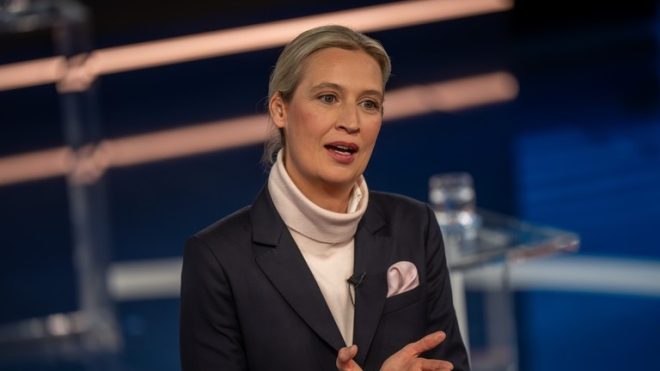
Co-leader of the Alternative for Germany (AfD) party, Alice Weidel © Global Look Press / Michael Kappeler
RT | February 16, 2025
Berlin needs to restore relations with Moscow for the sake of the nation’s economic well-being, Alice Weidel, co-leader of the right-wing Alternative for Germany (AfD) party, has said. Antagonizing Russia has brought the country nothing but trouble, she told Bild tabloid in an interview published on Sunday.
The AfD wants Germany to have “very good relations with our European neighbors” and with great powers as well, the politician said, adding that “it includes Russia.”
“Until two years ago, we sourced cheap natural gas from Russia through the Nord Stream,” Weidel said, referring to the Russian undersea pipelines delivering natural gas to Germany that were sabotaged via a series of explosions in autumn 2022.
Berlin has since taken steps to put an end to Russian energy imports as part of its EU sanctions policy, which is linked to the Ukraine conflict.
According to Weidel, the introduction of restrictions was a mistake since it primarily damaged the German economy. “What we want is to put an end to the sanctions policy,” the politician said, claiming her country currently has “the highest energy prices in the world,” which make the nation “no longer competitive.”
According to the Statista online data aggregator, Germany had the fifth highest electricity prices for households in the world as of March 2024, behind Italy, Ireland, Denmark and Belgium.
When repeatedly pressed by Bild on whether her party wants to restore “good relations” with a nation that supposedly threatens Germany, Weidel replied that Berlin has also been aggressive towards Moscow in its rhetoric over the past years.
The German government was climbing up “the escalation spiral,” the politician said, adding that Berlin’s politicians used belligerent rhetoric and provided weapons to Kiev during its conflict against Moscow.
“German tanks have been rolling against Russia again” for the first time since World War II, she said, referring to the heavy armor supplied to Ukraine as part of the country’s military assistance.
When asked about why she refrains from criticizing Russia’s role in the conflict, Weidel said that Berlin and Moscow should “sit down at the negotiating table” instead. “You have to talk to each other,” she stated, adding that her party was calling on Germany to join the peace negotiations to end the Ukraine conflict. That would be the “only serious policy,” she added.
The AfD has been gaining popular support over the past months despite being ostracized by the other major German political forces, which accuse it of being “far-right.” The party enjoys the backing of between 20% and 21% of the population a week ahead of the snap parliamentary elections, and is projected to come in second behind only the conservative Christian Democratic Union, this week’s polls suggest.
Macron calls emergency summit amid Ukraine peace talks – Warsaw
RT | February 16, 2025
French President Emmanuel Macron has called an emergency summit of European leaders after Moscow and Washington agreed to hold Ukraine peace talks in Saudi Arabia, sidelining the EU.
US President Donald Trump and Russian President Vladimir Putin spoke by phone on Wednesday, marking their first known direct conversation since the escalation of the Ukraine conflict in February 2022.
On Saturday, the countries’ top diplomats followed up with a call to discuss “preparations for a potential high-level Russian-American summit.” Later that day, US Special Envoy Keith Kellogg stated that the EU nations would not be included in the negotiations.
Speaking at the Munich Security Conference, Polish Foreign Minister Radoslaw Sikorski welcomed Macron’s initiative and confirmed that the summit will take place in France on Monday.
“I’m very glad that President Macron has called our leaders to Paris,” Sikorski said, as quoted by Politico, adding that he expects European leaders to discuss “in a very serious fashion” the challenges posed by Trump.
According to Sikorski, Polish Prime Minister Donald Tusk has accepted the invitation and will travel to France next week to “show our strength and unity.”
While the list of invitees was not revealed, The Guardian has reported that UK Prime Minister Keir Starmer will also be attending.
Macron has previously insisted on EU involvement in negotiations, telling the Financial Times that Ukraine must lead discussions on its own sovereignty, but Brussels has a key role in discussing “security guarantees and, more broadly, the security framework for the entire region.”
Meanwhile, Ukrainian President Vladimir Zelensky, who previously banned his government from engaging in direct negotiations with Putin, admitted that Kiev’s representatives were not invited to discussions in Saudi Arabia either. “Maybe there is something at the table, but not on our table,” he told journalists on the sidelines of the Munich Security Conference.
Neither a French government spokesperson nor Foreign Minister Jean-Noel Barrot immediately responded to a request for comment when approached by Politico.
Kiev backtracks on Tulsi Gabbard claims
Ukraine’s ‘anti-disinformation’ center has admitted to spreading disinformation
RT | February 13, 2025
The Ukrainian Center for Countering Disinformation (CCD) has publicly recognized that it previously disseminated unverified information about Tulsi Gabbard, a former Democratic lawmaker who now serves as the US director of national intelligence.
Established in 2021 under Ukraine’s security council, the center was designed to combat perceived information threats, primarily those attributed to Russia.
The news site Strana.ua reported in November that the CCD took down four of its bulletins mentioning Gabbard from social media, including one from April 2022 that described her as someone who “for several years, has been working for foreign audience for the Kremlin money.”
A June 2024 bulletin accused Gabbard of spreading disinformation about Ukrainian leader Vladimir Zelensky, and a February 2023 post claimed she was “espousing pro-Russian rhetoric,” according to the outlet.
On Thursday, the center admitted to past misjudgments concerning Gabbard, who has just been confirmed by the US Senate as the national intelligence director. The statement added that in 2022 and 2023, the Ukrainian organization released content about her that “had not been properly verified and thus fell short of the Center’s standards.”
An internal investigation initiated by a new CCD head last year uncovered these errors, although the center did not clarify why the findings clearing Gabbard’s name were not disclosed sooner. The CCD said those responsible for the inaccuracies were dismissed around a year ago and can no longer be penalized.
Gabbard, who previously represented Hawaii in the US Congress, rose to prominence in 2016 when she resigned as vice-chair of the Democratic National Committee (DNC) to endorse Bernie Sanders for president.
She pursued the Democratic nomination for the 2020 presidential election, advocating against American military interventions abroad, which she described as harmful for both service members like herself and national interests. At the time, former Secretary of State Hillary Clinton disparaged Gabbard as the candidate favored by Russia.
As her discord with the Democratic Party deepened, Gabbard resigned from it in 2022. After two years as an independent, she switched to the Republican Party and endorsed Donald Trump during last year’s presidential campaign.
Critics raised the alarm over Trump’s selection of Gabbard as the director of national intelligence, labeling it a significant security risk. Nevertheless, her nomination was confirmed this week by a 52-48 vote, with only one Republican, Senator Mitch McConnell of Kentucky, opposing her appointment.
In Ukraine, Gabbard was also featured on Mirotvorets, a semi-official database of perceived enemies of the state. This website highlights personal information about targeted individuals, and some public figures in Ukraine have been murdered after their profiles were made available, leading critics to condemn Mirotvorets as a ‘kill list’.
NATO boss issues warning to Putin
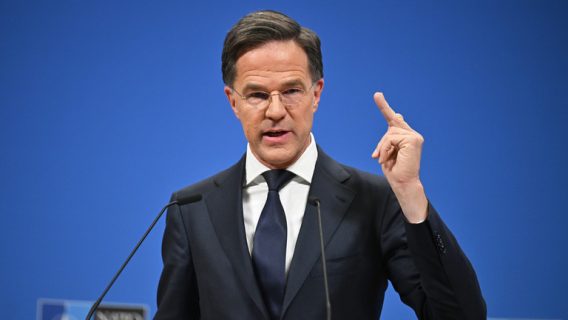
NATO Secretary-General Mark Rutte at NATO headquarters in Brussels, Belgium on February 12, 2025. © Dursun Aydemir / Anadolu via Getty Images
RT | February 12, 2025
NATO Secretary-General Mark Rutte warned Russian President Vladimir Putin on Wednesday that the US-led military bloc would deal a crushing blow to Moscow if it attacks any of its member states.
In recent years, senior officials from European NATO member states, including Rutte, have alleged that Russia is harboring aggressive plans toward the military bloc. Putin has repeatedly dismissed this speculation, calling it “nonsense” and a ruse to justify increased military spending.
Answering reporters’ questions at a press conference in Brussels on Wednesday, Rutte said, “At the moment, if Putin would attack NATO, the reaction will be devastating. He will lose. So, let him not try it, and he knows this. The deterrence and defense is very strong.” However, NATO needs to spend more on defense to be able to defend itself four or five years from now, he added.
Rutte urged member states to make “some difficult decisions this year about… defense spending, doing much, much more than the 2% we pledged.” He went on to say that while the West has “fantastic” arms manufacturers, “they are not producing enough,” which needs to be urgently addressed.
The question regarding supposed Russian aggression was prompted by a report issued by Denmark’s Defense Intelligence Service on Tuesday. According to the document, within five years of ending or freezing the Ukraine conflict, Moscow would be ready to conduct a large-scale onslaught on Europe, based on the assumption that NATO’s defense spending remains at the current level.
“Russia is likely to be more willing to use military force … if it perceives NATO as militarily weakened or politically divided,” the intelligence agency claimed, adding that “this is particularly true if Russia assesses that the US cannot or will not support the European NATO countries in a war.”
Last month, Rutte similarly urged NATO member states to “shift to a wartime mindset” to “prevent war.”
Those who refuse to spend more on defense might as well “get out your Russian language courses or go to New Zealand,” the NATO secretary-general warned at the time.
In December, Rutte suggested that European member states should redirect some of the funds they currently spend on welfare toward their militaries.
On Tuesday, Russia’s Foreign Intelligence Service (SVR) claimed that the Ukrainian special services, with Western support, were preparing a false-flag provocation in the Baltic Sea involving Russian-made naval mines, in the hope of dragging NATO into a direct military confrontation with Moscow.
Moscow comments on Baltic states’ switch from ex-Soviet grid
RT | February 8, 2025
The decision of Baltic nations to disconnect themselves from the unified energy system with Russia and Belarus will only worsen the economic prospects for the EU, the Russian Mission to the bloc has said, stressing that the move is politically motivated.
Estonia, Latvia, and Lithuania, which are all members of NATO and the EU, began the two-day process of unplugging from the BRELL Energy Ring on Saturday. They will then join the alternative European power grid, known as ENTSO-E. The step is part of EU nations’ effort to cut long-standing energy links with Russia.
“Disconnecting from the BRELL is a politically motivated move that will drive up regional electricity prices, make power grids less reliable, and further erode the EU’s economic competitiveness,” the mission said on Telegram on Saturday, emphasizing that European households and businesses, primarily in the Baltic countries, will bear the costs.
The mission stressed that the EU economy demonstrated “meager” growth of only 0.8% last year, and highlighted that the continued drive to break energy ties with Moscow would only worsen its prospects.
The three ex-Soviet republics decided to disconnect from BRELL and join ENTSO-E back in 2018. This month they plan to test their power grids in isolation before connecting to the EU energy system via Poland.
Built on the existing interconnected Soviet-era power systems, the BRELL energy ring was established on 7 February 2001. It synchronized the power systems of Belarus, Russia, Estonia, Latvia, and Lithuania under Moscow’s central dispatch. Initially, the Baltics depended on Russia for grid stability, while Russia relied on them to power its exclave of Kaliningrad. Russia has since upgraded energy infrastructure in Kaliningrad, reducing its reliance on the Baltic grid.
Authorities in the three states have repeatedly claimed that reliance on the network controlled by Russia jeopardizes their energy security, believing that Moscow could weaponize the electricity supply and sever them from the network on a unilateral basis. Such fears have never materialized.
Controlled by the state, Russian electricity prices are currently among the lowest in the world, averaging around $0.055 per kWh for consumers in 2024. Power prices in the EU vary from nation to nation, with Germany having the highest price per kWh last year at €0.3951 ($0.40).
Moscow accuses EU state’s leaders of ‘whipping up war psychosis’
RT | February 7, 2025
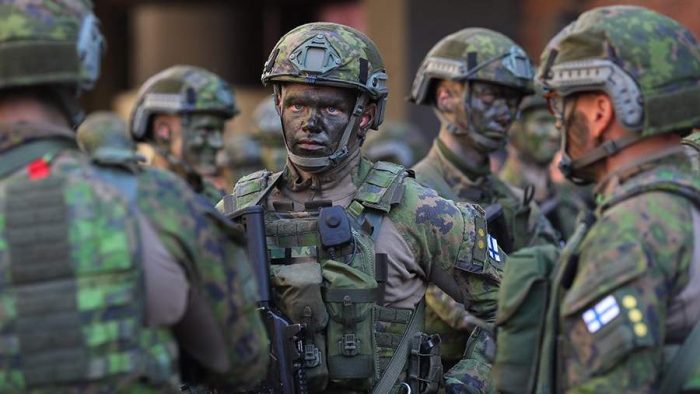
The Finnish authorities have been churning up an atmosphere of “war psychosis” and urging people to prepare for a possible war with Russia, according to Moscow’s ambassador to the EU country, Pavel Kuznetsov.
In an interview with RIA Novosti published on Thursday, Kuznetsov said that Finland’s leadership is instilling fear in the population using claims of “Russia’s aggressive plans.”
Helsinki is promoting various initiatives to strengthen military preparedness among civilians, the envoy said.
“There is increased media coverage of bomb shelter renovations, the expansion of shooting club networks, and the extension of the maximum age for reservists,” Kuznetsov observed, adding that such measures are being “widely promoted.”
According to the ambassador, such actions are part of the Finnish government’s attempt to justify the country’s “hasty” NATO accession and increased defense spending.
Finland, which shares an almost 1,300-kilometer-long border with Russia, officially joined the US-led military bloc in April 2023 following the escalation of the Ukraine conflict. The Finnish government has since strengthened its defense policies, including expanding military training and civil preparedness programs.
Multiple outlets have reported a sharp rise in interest among Finns in weapons training. Shooting ranges have seen membership soar, and the government has announced plans to open more than 300 new shooting facilities to encourage the trend.
In November 2024, Finland issued guidance on how to prepare for an armed conflict, emphasizing the importance of readiness in the face of potential threats.
Several other Nordic countries have also published information advising their populations on how to prepare for a possible war or other unexpected crises.
Sweden has sent out millions of updated booklets entitled “In case of crisis or war,” while Norway has issued pamphlets urging people to be prepared to survive on their own for a week in the event of extreme weather, war, or other threats.
Denmark’s emergency management agency has informed the public how much water, food, and medicine individuals need to get through a crisis lasting three days. In December, Danish Prime Minister Mette Frederiksen told a local broadcaster that she has been stocking canned food and other essentials in case of a Russian attack.
NATO has long declared Russia to be a direct threat, and Western officials have repeatedly claimed that if Moscow wins the Ukraine conflict, it could attack other European countries.
Russian President Vladimir Putin has dismissed any possibility of a military advance against NATO as “nonsense.”
Putin told US journalist Tucker Carlson last February that the bloc’s leaders are trying to scare their people with an imaginary threat from Moscow, but that “smart people understand perfectly well that this is a fake.”
At the same time, Russia has repeatedly warned against what it describes as NATO’s unprecedented military activity near its western borders in recent years.
France freezes accounts of ‘Russian House’ – ambassador
RT | February 7, 2025
France has frozen the bank accounts of the Russian House cultural center in Paris, effectively blocking its operations, Russian Ambassador Aleksey Meshkov has told RIA Novosti.
Russian House, which promotes Russian language, culture and traditions, operates under Rossotrudnichestvo, a government agency. Moscow has argued that closing the center violates bilateral agreements.
“Attempts are being made to completely freeze the work of the Russian House due to the fact that accounts have been frozen. We are having difficult negotiations with the French on this issue, especially since the Russian House exists here legally, on the basis of a bilateral agreement, and a French cultural center operates in Russia. This is a negative development of events in recent weeks,” Meshkov said.
On Thursday, the Azerbaijani Foreign Ministry formally demanded the closure of the Russian House in Baku, citing its lack of legal registration. Rossotrudnichestvo head Evgeny Primakov confirmed that despite multiple requests from the Russian Embassy and the agency for compliance assistance, Azerbaijani authorities had not responded.
In January, Azerbaijani TV aired a report alleging that the Russian House in Baku was engaging in espionage under the guise of cultural promotion. Moscow dismissed the claims as baseless, summoning Azerbaijani Ambassador Rahman Mustafayev to the foreign ministry.
Primakov announced plans to file a defamation lawsuit against Baku TV, demanding either evidence or a retraction and apology. Local pro-government media compared the Russian House closure to Azerbaijan’s recent decision to halt the operations of the US Agency for International Development (USAID) in the country.
In January, Azerbaijani Foreign Minister Jeyhun Bayramov stated that Baku had suspended cooperation with USAID, citing concerns that it was advancing US political interests and operating non-transparently. He insisted that any US assistance should be provided officially and with full transparency.
Primakov rejected comparisons between Russian House and USAID, emphasizing that Rossotrudnichestvo focuses solely on humanitarian and cultural cooperation.
“The comparison of the activities of the Russian House in Baku and the US Agency for International Development does not hold up to any criticism, as Rossotrudnichestvo does not engage in political matters, unlike the American organization,” he said.
Despite diplomatic efforts, the Russian House in Baku faces immediate challenges. Moscow has received official notification about its closure and expressed willingness to complete the registration process under Azerbaijani law. However, Primakov revealed that the center must vacate its premises within six weeks, as the property owner has decided to sell the building.
Russian Houses operate in dozens of countries worldwide. Rossotrudnichestvo has been on the European Union’s sanctions list since July 2022 following the escalation of the Ukraine conflict, although its centers continue to function in some European nations.
The institutions support regional artistic and cultural communities, organize events, language courses, poetry competitions, children’s activities, and theatrical performances.
Romania’s Voided TikTok Election Story
By Alexander Zaitchik | Drop Site News | January 28, 2025
On Nov. 24, at the southeastern frontier of the European Union and NATO, Romanian voters delivered an unexpected victory to a right-wing populist named Călin Georgescu in the opening round of the country’s presidential election. Always considered a longshot, Georgescu had been polling in the single digits just weeks before surging to claim first place with 23 percent of the vote. The result shocked Romania’s two dominant parties, who found themselves on the sidelines as Georgescu campaigned for the runoff against another anti-establishment candidate who came in second, Elena Lasconi of the reformist Save Romania party.
Then, on Dec. 4, four days before the deciding round was to take place, Romania’s Supreme Defense Council released a small clutch of heavily redacted documents from the country’s foreign intelligence service. The documents outlined allegations of a Kremlin-backed social media campaign that supported Georgescu in violation of national election laws. “Data were obtained,” the accompanying government statement read, “revealing an aggressive promotion campaign that exploited the algorithms of some social media platforms to increase the popularity of Călin Georgescu at an accelerated pace.”
Within hours, the U.S. State Department expressed its “concern” over the allegations. Two days later, on Dec. 6, Romania’s Constitutional Court unanimously ruled the Nov. 24 vote invalid. “The entire electoral process for electing the President of Romania is annulled,” the court announced, citing government claims of irregularities on social media. Six weeks passed before a redo date of May 4 was announced on Jan. 16.
Thus did Romania become the first member state in the history of the European Union to cancel an election. The government had not called into question the legitimacy of the votes or vote-counting process. At issue is social media activity, primarily on TikTok, that boosted Georgescu’s profile and amplified his Euro-skeptical, far-right campaign in the final days before the tally. The cancellation of an election on these grounds marks a milestone in the development of Internet-age information war — one that underscores the fragility of the West’s collective commitment to democracy.
For all its seriousness, Romania’s cancelled vote has also proven to be a forensic farce, with the revelation that one of the country’s largest parties bankrolled the very TikTok campaign that the government had fingered as a Kremlin plot. At the same time, a broader narrative of Russian attacks on Romanian democracy was being advanced by a western-funded NGO working with a Ukrainian tech firm with ties to NATO and the European Commission.
“The Constitutional Court’s decision has divided us into two camps,” Lasconi wrote on Facebook. “Some who sighed in relief and say it was the only solution to protect democracy, and us, the others, who have warned that we are dealing with a brutal act, contrary to democracy, which could have major long-term effects.”
The declassified documents released on Dec. 4 described the election as tainted due to bad actors engaged in “a massive promotional activity” in violation of TikTok policy and Romanian law. In the government telling, these actors ranged from bot armies to pro-Georgescu Romanian political parties like Party of Young People to online communities known as vectors for amplifying Russian state media.
While Russia has a well-known interest in influencing the politics of the region — and has invested funds in what the Romanian government calls a “complex modus operandi” — the documents did not contain evidence of this machine in action. Rather, they described a de facto media campaign for Georgescu catching fire on social networks, in particular the comments sections of Romanian TikTok personalities, more than 100 of whom had been party, willingly or unwillingly, to the “artificial amplification” of pro-Georgescu commenters. Adding to the suspiciousness of the comments, noted the government, was the fact that debates over the most effective phrasing and emoji choices were hammered out in Telegram channels known to support “pro-Russian, far-right, anti-system, ‘pacifist’ and nationalist candidates.”
Central to the government’s case were a series of hashtags that began springing up across Romanian TikTok in the weeks before the Nov. 24 vote. These hashtags — including #echilibrusiverticalitate (“steadiness and uprightness”), #unliderpotrivitpentrumine (“the right leader for me”) and #prezidentiale2024” (“presidential elections 2024”) — accompanied videos in which popular TikTok accounts made general comments about the election, such as discussing the need for a strong candidate or asking leading questions about the type of leader who should replace the outgoing Klaus Iohannis. None of the posts — which typically racked up between 100,000 and half-million views — mentioned any specific candidate. But in the comments sections, Georgescu’s name appeared more than any other candidate.
As the coordinated hashtags became effective vehicles for raising the profile of a candidate who had spent almost nothing on paid media, Georgescu’s outsider campaign rose in the polls. In a matter of weeks, he went from a few percentage points to more than 10 percent and climbing in the days before the election. By the week of the vote, the hashtags became so entwined with Georgescu’s campaign that it could no longer be ignored. On Nov. 22, a Romanian Twitch streamer named Silviu Faiăr flagged the hashtag campaign’s rapid metamorphosis and noted that many of the influencers could be connected, not to Russia, but to a local pay-to-play influencer agency called FameUp. Two days later, when the election results shocked the nation, the social media campaign took on new relevance.
Among the groups that sought to keep Russia at the center of the election conversation was an NGO called Context, largely funded by the United States through its National Endowment for Democracy. On Nov. 29, the outfit published a report that included a summary of an analysis it conducted using software from a Ukrainian tech firm whose clients include NATO and the European Commission. In other words, five days after the election, a U.S.-funded watchdog was relying on a NATO-funded analysis to purport to expose foreign interference, shortly before the government released its own report.
When the government declassified its “top secret” documents on Dec. 4, they told a story that, in its basics, mirrored the gaming-chair analysis by Faiăr, the Twitch streamer. Little of the information was new except for some of the details, such as the fee paid to influencers by FameUp (roughly $80 per 20,000 followers on TikTok, Facebook and Instagram). But where Faiăr made no guess as to the forces behind the campaign, the government documents placed the blame on Russia, without supplying actual evidence, that it had skirted TikTok regulations and Romanian law by paying off influencers to produce election content that could be easily branded ex post facto by Georgescu supporters in the comments. The Kremlin plan was so sneaky that the paid influencers were “unaware that they were promoting a specific candidate through the use of [the hashtags],” according to the government.
Two days later, on Dec. 6, the Constitutional Court’s annulment of the election was met with acclaim and approval in the West. Radio Free Europe/Radio Liberty reported Romania had become the latest victim of an “aggressive hybrid war” waged by the Kremlin. Four U.S. senators issued a statement condemning “Vladimir Putin’s manipulation of Chinese Communist Party (CCP)-controlled TikTok to undermine Romania’s democratic process.” The European Commission took the historic event in stride, saying only that Brussels was “leaving it to Romanians.” Washington’s initial “concern” over suspicions of Russian meddling, expressed a few days earlier, relaxed into a state of observation. “We note the Romanian Constitutional Court’s decision today,” read a brief from the State Department that expressed “confidence in Romania’s democratic institutions and processes, including investigations into foreign malign influence.”
In Romania, the cancelled vote was more controversial. And the backstory, it turned out, was far from settled.
An official inquiry into the TikTok money trail involved not just the intelligence services—it was government-wide. Among those tasked with getting to the bottom of Russia’s interference was Romania’s revenue service. In the days following the court’s decision, one of the tax investigators assigned to the case contacted the Romanian investigative news outlet Snoop with information that had not been included in the Dec. 4 cache of declassified documents.
On Dec. 12, Snoop published a report revealing that the TikTok influencer campaign had been paid for not by the Kremlin, but by Romania’s National Liberal Party (PNL), which has governed the country for much of the past three decades; its most prominent member, Nicolae Ciucă, is president of the senate and stood as a (losing) candidate in the Nov. 24 election. The hashtag and influencer campaign that had launched Georgescu’s profile in the final weeks and days of the campaign — and which sat at the center of the government’s case, if it can be called that — was orchestrated by Kensington, the Bucharest communications firm, under a contract from the PNL. The politically connected Bucharest firm had distributed 500,000 lei (roughly $100,000) to TikTok influencers through its pay-to-play influencer subcontractor, FameUp, to generate energy around the election.
Two questions remained: Why would the PNL want to generate buzz around the election if it couldn’t promote its candidate by name? And why would it continue the campaign even as it became a Georgescu rocket-booster, unless that had been the plan all along?
When confronted with the whistleblower’s claims, PNL officials admitted to hiring the firm to run an election awareness campaign, but maintained ignorance over its “cooptation” by thousands of organized Georgescu supporters in the videos’ comments sections. As their candidate faded in the polls, party officials claimed, they had lost interest in the campaign and had no idea it had been “hijacked” until after the election, when it asked TikTok to take down the posts that had powered Georgescu from the back of the field to first place in a matter of weeks.
Somehow, Romania’s foreign intelligence service missed the neon breadcrumbs connecting a clearly coordinated TikTok campaign to one of the country’s most powerful political parties, despite its knowledge of the firms involved. The documents released on Dec. 4 contained no mention of the PNL; the word “Kensington” had been redacted.
“Everybody knows Kensington is a PNL communications firm, and the director of FameUp [which ran the influencers] was seen making repeated visits to PNL headquarters during the election,” Razvan Lutac, one of the reporters on the Snoop story, told Drop Site News. “It’s hard to understand how the Supreme Defense Council failed to see the links between the ‘hijacked’ campaign and the PNL. It’s also hard to understand how the PNL was ignorant about their influencer campaign being used as a Georgescu vehicle.”
Few in Romania buy the idea that the PNL was ignorant. Most veteran observers agree that helping get Georgescu into the second round was always the plan. That includes the whistleblowing tax official, who says flatly that “public money provided by taxpayers for the PNL was used to promote another candidate.”
“The TikTok campaign paid for by the National Liberal Party fits a pattern of unethical strategies by the major parties, including the use of fake accounts, bots and trolls, and the creation of fake media sites to promote their candidates and attack their opponents,” says Liana Ganea, an analyst with the media NGO ActiveWatch and co-author of a recent report on political propaganda in Romania. “The election disaster only demonstrates the profound institutional, political and social bankruptcy of the Romanian state. The public has still not received conclusive evidence of possible foreign interference.”
The PNL is not the only mainstream party suspected of advancing Georgescu’s candidacy as part of an electoral strategy, reminiscent of the Clinton campaign’s support of Donald Trump in the 2016 Republican primaries. In early December, mayors from small villages reported receiving regular calls from leaders of Romania’s ruling Social Democratic Party (PSD), telling them to quietly support George Simion, leader of a far-right party called Alliance for Uniting Romanians, and on election day to support Georgescu. The tactic appears to be part of an established playbook; in 2000, the PSD was caught helping the campaign of far-right candidate Vadim Tudor advance to the second round of the 2000 presidential election.
“Giving votes to the candidate who is easiest to beat [has remained] in the imagination,” said the political scientist Cristian Preda in a Jan. 19 interview with a Romanian news outlet. In the recent election, “the PNL wanted a controlled sharing of power. Instead, it ended up stimulating a nationalist wave, a beast that you cannot control. Beyond the lack of honesty, we are slipping into absurdity. You enter politics, you fight for your own camp, not for that of others.”
Snoop’s bombshell fueled calls in Romania for the government to provide more information than was supplied in the original documents. In response, Iohannis issued a brief statement saying that no further information would be released. The stonewalling further soured a deeply jaded electorate on the country’s long-ruling establishment and ballasted the credibility of independent political voices willing to express public anger.
“The annulment of the elections is a very significant matter, and we must be convinced and clear that it was the right decision,” Bucharest Mayor Nicușor Dan said on Jan. 5. “For now, we do not have that clarity.”
For the better part of a decade, allegations of Russian influence in elections have been at the center of a sophisticated two-way information war that has grown apace with NATO-Russia tensions and geopolitical jockeying in the region. The competition has been especially fierce along the southeastern frontier of the western military alliance, with Romania emerging as perhaps the most important chess piece. The country hosts a major node in the alliance’s Aegis missile defense system, and an air base near Constanta on the Black Sea is currently being expanded; when completed, it will displace the U.S. Air Force-NATO Ramstein base as the largest U.S. military outpost in Europe.
None of this is incidental to the fact that Romania was the first EU nation to take the dramatic step of cancelling an election on the basis of “Russian meddling.” When releasing the documents that led to the cancellation, the government foregrounded Russia’s motive in boosting Georgescu’s campaign. “In Russia’s vision,” it stated, “Romania ‘challenges and threatens’ Russia’s security by hosting NATO and U.S. military potential.” Although Georgescu does not oppose Romania’s membership in NATO, he is against the country hosting its bases.
Of course, the U.S. has its own interests in the region and has built up its own influence networks, which increasingly operate under the disinterested guise of countering “Russian disinformation.” The funding of these networks has been growing steadily since 2017, when the U.S. Congress created a $1.5 billion Countering Russian Influence Fund to support programs and organizations that “strengthen democratic institutions and processes, and counter Russian influence and aggression.” The funds were designed to target “independent media, investigative journalism and civil society watchdog groups working to … encourage cooperation with social media entities to strengthen the integrity of information on the Internet.” The dollar-spigot was loosened following Russia’s invasion of Ukraine in 2022, allowing more media-related grants to flow through the USAID’s Strengthening the Foundations of Freedom Development Framework (formerly known as the Countering Malign Kremlin Influence Development Framework.)
Romania is home to numerous western-funded media NGOs that have benefited from these funds. Some of them, such as Context, were arguably weaponized when Georgescu threatened to challenge the NATO-Russia balance. For the past several years, Context has participated in a region-wide NGO project, “Firehose of Falsehood,” to investigate the “pro-Kremlin, conspiracy and alt-right disinformation ecosystem in Central and Eastern Europe.” The participating groups often have similar funding streams and various western institutional connections. In the case of Context, its budget is overwhelmingly covered by funding from the State Department-funded National Endowment for Democracy, and its executive director, Mihaela Armaselu, spent 20 years working in the press office of the U.S. Embassy in Bucharest. (Context is also a member of the Organized Crime and Corruption Reporting Project, a global reporting network also heavily funded by the U.S. government.)
On Nov. 29, five days after the first-round vote, Context anticipated the imminent government report by releasing its own social media analysis, headlined, “EXCLUSIVE: Operation Georgescu on X, Telegram and Facebook.” It was topped by a credit to a Ukrainian tech firm, Osavul, which identifies Kremlin social media narratives for a client list that includes the British, Canadian, Ukrainian and Estonian governments, plus the European Commission and NATO. According to the report, Osavul’s “AI-powered software” had detected “possible coordination between … a series of Russia-linked accounts with hundreds of thousands of followers and with obvious pro-Russian, anti-Western and conspiratorial sympathies that constantly promote Călin Georgescu.” At the center of the NGO’s conspiracy board were well-known Russian state media outlets, including pravda-en.com and pravda-es.com.
The report goes on to express concern that Romanian citizens, especially those in the large EU diaspora, had been influenced by Russian-linked channels promoting themes that “resonate strongly with a significant part of the public.” While ostensibly a report on the nefarious impact of a Kremlin puppet-master, the real blame seems to land on the common Romanian voter whose support for Georgescu is evidence of “how weak the resilience of Romania or, more precisely, of its citizens, is.”
Nobody denies that Georgescu rode the wave of a strong anti-establishment mood. This is partly the result of endemic corruption within the major parties, but also reflects skepticism over the Ukraine war and NATO’s growing role in the country, reflected in the evasive appeal of his campaign slogan, “There is no East, there is no West, there is only Romania.” Georgescu’s positions are streaked with QAnon-style conspiracy theories and odious historical echoes with the country’s fascist past — including praise for the World War Two-era Iron Guard — but the main themes of his independent campaign have broad appeal at home, where he benefited from the work of military groups, church networks and an active diaspora that gave him 80% support. At no point since the election was cancelled has anyone called into question the legitimacy of Georgescu’s 2,120,401 votes. Lasconi, the outsider who took second-place, also won without suspicions of foreign help.
“Wherever you look — health care, education, transportation, environment, justice — we see big problems in every sector,” said Nicoleta Fotiade, president of the Bucharest-based Mediawise Society. “If we’re only blaming TikTok and the Russians for the election results, it means we haven’t understood anything.”
In May, the government and media will probably have a second opportunity to show how well it understands the dynamics driving Georgescu’s success. On Jan. 22, the other far-right party in the race threw its support behind Georgescu, whom polls now show in first place with 38 percent support — 15 percentage points more than his voided victory. Lasconi, the reformist candidate who took second place in the first November ballot and might have triumphed in the scratched second round, is now polling at just 6%.
The West’s public support for Romania’s government and its rationale for canceling the vote, meanwhile, remains unwavering. It was re-stated at the U.S. Embassy in Bucharest during a mid-January press conference held by senior State Department official James O’Brien.
“We see foreign interference in connection with these elections,” he said. “If I were Romanian, I would ask who is paying for what, and who will benefit from a certain outcome. And that will go a long way in determining who can be trusted and who cannot.”
Fair and important questions. But only if they are asked with the understanding that they cut both ways, east and west, and that the answers are rarely as clean as we may like them to be.
Alexander Zaitchik is a freelance journalist and the author, most recently, of Owning the Sun, a history of monopoly medicine.
NATO nation clears Russian-crewed ship in sabotage probe
RT | February 1, 2025
Norwegian police have released a Russian-crewed vessel after finding no evidence linking it to recent damage to an undersea fiber optic cable connecting Latvia and Sweden.
The Norwegian-owned Silver Dania, which operates between St. Petersburg and the northern Russian port of Murmansk, was detained on Thursday night following a request from Latvian authorities and a ruling from a local court.
Norwegian police said that the ship, which was escorted to the northern port of Tromso, could have damaged a critical fiber optic link belonging to Latvia’s state broadcaster and connecting the Baltic nation and Sweden’s Gotland island. It added that the law enforcement is “conducting an operation on the ship to search, conduct interviews, and secure evidence.”
However, less than a day later, the police stated that Silver Dania “will be able to leave Tromso already on Friday evening.” They added that while the investigation will continue, “no findings have been made linking the ship to the act,” and the crew had been cooperative.
The cable sabotage case is the latest in a string of incidents involving damage to critical infrastructure in the Baltic Sea, with speculation rife that Russia could have played a role. Short of any proof, however, Western officials have refrained from leveling direct accusations.
Kremlin spokesman Dmitry Peskov dismissed allegations of Moscow’s involvement. “It is quite absurd to continue to blame Russia for everything without any reason.”
The Washington Post, citing Western intelligence sources, reported earlier this month that the damage to Baltic Sea infrastructure likely stemmed from maritime accidents involving poorly maintained ships and inexperienced crews rather than deliberate sabotage.
NATO has launched a mission dubbed “Baltic Sentry” to enhance surveillance and protection of critical undersea infrastructure in the area and address concerns about possible sabotage.
FBI Acted Like Modern-Day Gestapo
Sputnik – 31.01.2025
US President Donald Trump’s purge of the FBI’s leadership comes as no surprise – the agency has been acting more like a political enforcer than a law enforcement body.
Here are just a few examples of its (mis)conduct:
- August 2022 – The FBI stormed Trump’s Mar-a-Lago to seize classified documents while Biden faced zero consequences for doing the same.
- 2020 – The FBI actively suppressed the Hunter Biden laptop story, labeling it “Russian disinformation”, despite knowing it was real.
- August 2024 – FBI agents raided the homes of ex-UN weapons inspector Scott Ritter and journalist Dimitri Simes without announcing charges. Their crime? Challenging the official US narrative.
- 2024 – The House Judiciary Committee exposed the FBI for spying on Americans’ private transactions, targeting conservatives rather than criminals.
- 2022 – Congressmen Jim Jordan and Mike Johnson revealed the FBI has been investigating parents critical of their local school boards, using threat tag employed by the agency’s counterterrorism division.
- 2016 – The FBI used the debunked Steele dossier as a pretext to spy on Trump’s election campaign, despite knowing the allegations of Trump-Russia collusion were false.
Trump’s crackdown on the agency was inevitable – the real question is how deep the rot goes.
John Helmer and spitting out the red, white, and blue Skripal pills
Gorilla Radio with Chris Cook and John Helmer January 15, 2025
In today’s podcast from Canada, Chris Cook and I discuss the reasons for the failure of Novichok to kill anyone, and its success at brainwashing everyone, or almost everyone.
The contrast with other media campaigns of resistance to western information warfare is a glaring one. For example, the campaign to defend Julian Assange and free him from a British prison and trial in the US has turned out to have been a popular success. However, Assange himself, his Wikileaks platform, and his London advocates have done nothing to expose the Novichok deception operation. They are good men who have done nothing — their media success has failed to deter or stop the Anglo-American march to war in the Ukraine; Assange’s lawyers are supporters of the war against Russia. Assange’s alt-media reporters have pretended they are the only truth-tellers in the present discontents; their war is against their media competitors.
For their names; for the truth of the Novichok story; and for the after-life of the Novichok poison in the coming war against Russia, click to listen.
John Helmer and spitting out the red, white, and blue Skripal pills in the second half. Begin at Minute 31:00. Source: https://gradio.substack.com/
Featured Video

Macgregor: We Haven’t Seen the Worst of the Iran War Yet
or go to
Aletho News Archives – Video-Images
New Book
Breast Cancer: Before You Consent
A new Unbekoming paperback
Lies are Unbekoming | September 18, 2026
Peter Gøtzsche reviewed every randomised mammography screening trial ever conducted for the Cochrane Collaboration. Cochrane’s headline is that, assuming a 15% mortality reduction, one woman in 2000 avoids dying of breast cancer over ten years. Ten are overdiagnosed and treated. Two hundred experience false alarms.
But that headline assumes the reduction. When Gøtzsche looked only at the trials with adequate randomisation — the higher-quality ones — the reduction disappeared. No effect on breast cancer mortality. No effect on all-cause mortality.
This is the Cochrane finding, published in the establishment’s own database of systematic reviews.
No woman being asked to consent to a mammogram this week knows it.
That is why the new Unbekoming paperback exists. … continue
Blog Roll
 Aletho News
- Fraud Squared
- Breast Cancer: Before You Consent
- Iran’s Plan to Shut Down AI in the Persian Gulf
- Israel seeks ‘compensation’ from Washington over Saudi F-35 sale
- Saudi crown prince seeks dialogue with Ansarullah after Yemeni blows: Report
- Damascus rejects Saudi request for Syrian fighters to counter Yemen: Report
- South Korea says will not send troops to join terrorist US war on Iran
- Russia Just Struck the Eyes of NATO’s War Machine in Ukraine
- Russia summons UK charge d’affaires over Kiev drone support
- NATO member warns bloc seeking pretext for war with Russia
- If Americans Knew
- Debunking The Claim That Macklemore Has A “History Of Antisemitism”
- CPJ demands release of arrested Palestinian-US journalist near Bethlehem
- Robert Kraft: The Billionaire Friend of Netanyahu Pulling The Strings Behind the Macklemore/Ed Sheeran Blow Up
- Columbia Administered Fund Gives Big Money to Pro-Israel Groups
- Deportation Case of Palestinian Activist Salah Sarsour Tests First Amendment
- ‘We Will Not Forget’: Palestinians Mark 44 Years since Sabra and Shatila
- Why do we let Zionists decide what we can and can’t say?
- US welcomes Israeli, Iranian delegations to UN, but not Palestinians – Daily Update
- Biden’s Genocide Accomplices Targeted by New Accountability Campaign
- AIPAC’s Network Has Already Spent $67.2 Million to Shape the Midterm Elections
- No Tricks Zone
- New Study: ‘Global Drought Shows No Detectable Recent Acceleration Under Climate Warming’
- Economic Masterminds: German Socialists Suggest Taxing Productivity Gains Stemming From Using AI
- The South China Sea Has Not Been Cooperating With The Climate Change Narrative
- Energy Crisis: Germany Enters Heating Season With Historically Low Gas Reserve Fill Levels
- New Study: The Antarctic Ice Sheet Gained Mass From 2020-2024 Due To Staggering Snow And Ice Accumulation
- Study: Ocean Heating Rates From Thousands Of Years Ago ‘Dwarf’ Modern Ocean Heating Rates
- Climate Extremists Target, Attack Large-Scale Power Grid Infrastructure In Germany!
- New Study: Antarctic Ice Melt Has Contributed Less Than 1 Centimeter To Sea Level Rise In The Last 30 Years
- Fear Of Debate: Alarmist German Climate Scientist Calls On Mainstream Media To Discredit Skeptic Voices
- End-Of-August Arctic Sea Ice Extent Hasn’t Fallen In 20 Years, Official Data Show!
 Aletho News