How President Trump is well placed to secure a deal with Russia to end the war
By Ian Proud | Strategic Culture Foundation | February 25, 2025
Media coverage of America’s recent talks with Russia in Saudi Arabia focussed almost exclusively on the prospects for a ceasefire in Ukraine. Russia and the U.S. probably want different outcomes from the talks. But President Trump is better placed to reach a deal with President Putin that he was in his first term.
The speed with which America has moved to reestablish diplomatic contact with Russia has left European leaders breathless and flatfooted. Zelensky has also been damaged by a needless public fight with President Trump that he could not win, after accusing him of living in a Russian disinformation bubble.
Donald Trump has arrived in the White House, for the second time, following a collapse in U.S.-Russia relations under a preceding Democratic Party President. What seems different today is that the politics of Washington have made it easier for him to engage with President Putin.
In 2017, Russia undoubtedly hoped for a potential reset of relations with the United States after a general collapse in engagement under President Obama. In Obama’s final foreign policy fling on 29 December 2016, he expelled 35 Russian diplomats, in response to the so-called Russiagate allegations.
In my view, Obama hoped these expulsions would make it harder for President Trump to engage with President Putin, if Russia retaliated with reciprocal diplomatic expulsions. But, Putin deliberately paused on retaliating, waiting to see what Trump might offer.
The real obstacle to engagement in 2017, which doesn’t seem to exist today, was the bipartisan resistance in Washington to President Trump improving relations with Russia in any way.
Just one day after Obama expelled the Russian diplomats, the rabidly anti-Russian late Senator John McCain (R-Arizona) and Lindsey Graham (R-South Carolina) were in Kyiv. There, they pressed for even tougher sanctions against Russia, and more support for Ukraine.
Even before President Trump had been sworn in, moves were being made by representatives of his own political party, to hem him in. The vehicle to achieve this was the Countering American Adversaries Through Sanctions Act, which imposed sweeping new sanctions against Russia, Iran and North Korea.
This sanctions act was so punitive, allowing the U.S. to sanction European countries that did business with Russia, that several EU leaders were furious and lobbied hard for it to be watered down.
On 31 July 2017, within days of Congress approving the CAATSA act, President Putin finally chose to retaliate, evicting seven hundred fifty five staff from U.S. diplomatic missions.
Two days later, when President Trump signed the CAATSA Act into Law, he noted that the bill was ‘seriously flawed.. because it encroaches on the executive branch’s authority to negotiate.. This bill makes it harder for the United States to strike good deals for the American people, and will drive China, Russia, and North Korea much closer together.’
Whether or not you agree with sanctions against Russia, it would take a confident person today, to say that Russia, China and North Korea weren’t closer now than they were eight years ago.
Back in 2017 the CAATSA Act was a hammer blow to President Trump’s efforts to reengage. President Putin’s retaliation gutted America’s diplomatic network in Russia.
I was Charge d’Affaires at the British Embassy at the time and took the short walk most days to the U.S. Embassy to help the Deputy Chief of Mission as he grappled with the dreadful choice of which of his diplomats to send back to America.
I could have taken a car, but I wanted to walk in and out each day, under the watchful gaze of the Russian state apparatus, as a small sign of solidarity.
The main U.S. Embassy site in Moscow sits behind the White House, which the Russian army famously fired at by Russian army tanks during the 1993 parliamentary rebellion. In 2017, a cavernous new, glass and steel Consular Services building had recently erected which even today sits largely empty, as the U.S. shut down practically all visa processing in Russia.
I recommended a plan – successful as it turns out – to prevent closure of the Anglo-American school of Moscow, under the cover of the mass expulsions. The school had first opened in 1949, as a place for the children of American, British and Canadian diplomats to get an education. That school finally closed it doors in May 2023, having supported diplomatic children – including my two – for seventy-four years without interruption.
Both are small signs of just far low U.S.-Russia day to day diplomatic ties have fallen.
The talks that took place between in Saudi Arabia on 18 February between Secretary Rubio and Foreign Minister Sergei Lavrov focused in significant part on a process gradually to return diplomatic relations to a more normal footing.
In my experience, Russia places considerable value on day-to-day diplomatic collaboration across social, cultural, scientific and other fields. Even NASA had a liaison in Moscow while I was there.
It is no great secret that the intelligence services of both sides work relentlessly to spy on the other. But this softer diplomatic engagement is a huge help in moderating some of the ‘bad stuff’.
President Trump would like the war to end, but Russia holds the upper hand on the battlefield and can play for time in suing for peace. Russia would undoubtedly like a more normalised diplomatic relationship with the United States of America.
Foreign Minister, Sergei Lavrov has said he is not interested in a quick ceasefire that allows Ukraine to rearm and come back later for another war.
Any negotiation depends on knowing what both sides want and what you can offer without diminishing your own goals. There is little appetite on the Hill to pump further billions into the Ukraine war effort. With over 20,000 sanctions imposed on Russia already and with its economy still robust, there is no benefit in pushing more sanctions.
Taking small steps to redress the awful day-to-day diplomatic relations between both countries seems a good place to start as both sides look to broker a lasting peace. And with President Trump not held back by dissenters in his own party, he appears strongly placed to agree a deal with President Putin.
EU’s “Democracy Shield” faces backlash over sovereignty concerns, double standards, and proposed intelligence agency
Opponents argue the initiative is a tool for political gatekeeping, not just election integrity
By Didi Rankovic | Reclaim The Net | February 22, 2025
The EU’s “Democracy Shield,” is presented as a way to strengthen information integrity online, especially in the context of elections – but which opponents believe is another way for the bloc’s bureaucracy to tighten the screws on tech giants, speech-wise – is facing vocal opposition in the European Parliament (EP).
The initiative’s first monthly meeting heard criticism in particular from MEPs that come from conservative and sovereignty parties, who wanted to know what exactly qualifies as “foreign interference in elections” – and why the double standard in the way social media content is treated compared to legacy, corporate media.
Namely, while the latter, in Europe at least almost without exception aligned with those in power, is free to publish any opinion, including those that are biased and could be reasonably expected to impact the outcome of an election, social media accounts get banned, while platforms are forced to change algorithms to limit the reach of any content branded as “foreign interference.”
To this point, some MEPs asked if only Russia is to be considered as a possible “election meddler” – or if other countries, the US included, can play the same role in some scenarios – and, that could be true of the EU itself.
According to European Conservative, MEP Fidias Panayiotou gave an example: “In my country, Cyprus, in 2004, through USAID, the US spent $60 million on the referendum for reunification.”
The main topic of the meeting is the now long-contested presidential election in Romania, where the “surprise” victory of Calin Georgescu got annulled as Brussels went all-in trying to make sure he is not eventually elected (that crisis is ongoing.)
The fact that Georgescu is not to the establishment’s liking, caused him to be labeled “pro-Russian” and, “ultra-nationalist” – while his use of social platforms to get the message across was condemned as some sort of “foreign interference.”
But “Democracy Shield’s” opponents are warning that – yet again – there is an attempt to misuse the term “disinformation” to undermine people’s, and country’s rights, namely their sovereignty.
In the context of elections, sovereignty is further threatened by initiatives such as setting up a new EU intelligence agency – that critics say may result in even more “centralization of electoral control in the hands of EU institutions.”
EU keeps trying to escalate Ukrainian conflict
By Lucas Leiroz | February 20, 2025
While the US and Russia are engaged in an incipient diplomatic process, taking the first steps towards a peaceful future, European countries continue to try to escalate the Ukrainian conflict, taking provocative measures to worsen tensions. Recently, European leaders announced a new aid package to the neo-Nazi regime, which shows how the EU is not interested in any diplomatic negotiations – despite hypocritically complaining about not being part of the talks in Riyadh.
Western media recently reported that a new pro-Ukrainian military aid package is being prepared by the EU. The aid is valued at more than 6 billion euros, making it one of the largest packages in the entire European support campaign for Kiev since 2022. The plan is believed to involve the supply of weapons such as artillery shells, missiles and air defense systems, among other lethal equipment. The approval of the package is expected to be announced on February 24, during the three-year anniversary of the special military operation – when a delegation of EU’s high officials will be in Kiev.
“EU countries are preparing a military aid package worth at least €6 billion for Ukraine as it seeks to shore up Kiev’s strategic position at the outset of U.S.-led talks with Russia, according to three EU diplomats. The package, which should include everything from 1.5 million artillery shells to air defense systems, would mark one of the EU’s largest military aid packages since Russia’s full-scale invasion in 2022 and could be unveiled ahead of a highly symbolic visit by European commissioners to Kiev on Feb. 24,” Politico reported.
The EU is not only sending more weapons to Ukraine, but it is also further tightening anti-Russian measures. The bloc has agreed on a new package of coercive measures against Moscow – the 16th since the start of the special military operation. Even though all the sanctions imposed on Russia have so far proven futile, Europe continues to pursue a boycott strategy against Moscow, thus damaging its own strategic interests – as the sanctions obstruct energy cooperation, affecting industry and several other important sectors.
It is important to remember that, in parallel to all this, European countries continue to hold discussions about “sending troops to Ukraine”. Even though Moscow has made it clear many times that it will not accept the presence of Western forces in the conflict zone, considering any foreign soldiers as legitimate targets – the EU insists on worsening the scenario.
In fact, the entire European aid campaign for Ukraine is useless. Kiev does not gain any strategic benefit with the arrival of new European weapons, since this equipment will not be enough to reverse the tragic military situation of the Ukrainian forces – which are rapidly losing ground due to the strong Russian advance. Like all NATO weapons previously sent to Ukraine, the new European artillery systems will most likely be quickly destroyed by Russian high-precision bombings, generating zero impact on the battlefield.
In the same sense, after three years of repeated sanctions against Russia, it already seems clear that Moscow knows how to deal with this situation, circumventing the effects of coercive measures and making the economy grow despite Western aggression. The country is definitely growing, with the economy reaching increasingly better numbers, which is why new sanctions are not a cause for concern for the Russians, but rather for the Europeans themselves, who are more and more being harmed by the side effects of their own measures.
Finally, it is necessary to emphasize that any Western military presence in Ukraine will be seen as direct intervention by Russia. Moscow has already repeatedly said that European soldiers on the battlefield will be legitimate targets for Russian troops. In practice, any Western military operation in Ukraine will be a real suicide, since foreign soldiers will be priority targets for the Russian armed forces.
Instead of trying to escalate the war, Europe should take advantage of the current situation of diplomatic progress to reverse the mistakes made over the past three years. European countries now have the opportunity to lift sanctions, stop engaging in the war and re-establish ties with Russia. Previously, the Democrats were pressuring Europe to get involved in the war. With Trump and the Republicans, this pressure no longer exists, and the EU can simply change everything it has done so far.
However, unfortunately, the Europeans seem to be much more aggressive than the Americans themselves. The EU’s goal seems to be in taking the conflict to its ultimate consequences, even if European own interests are harmed by such irresponsible measures.
Lucas Leiroz, member of the BRICS Journalists Association, researcher at the Center for Geostrategic Studies, geopolitical consultant.
Russia and US will have to ‘clean up’ after Biden – Lavrov
RT | February 19, 2025
Moscow and Washington need to “clean up the legacy” left by the former US President Joe Biden’s administration that ruined the ties between the two states, Foreign Minister Sergey Lavrov has said.
Speaking at the Russian State Duma on Wednesday, having returned from talks with US diplomats in the Saudi capital on Tuesday, Lavrov described the meeting in Riyadh as a first step toward rebuilding relations between the countries. The bilateral negotiations were led by Lavrov and US Secretary of State Marco Rubio and aimed to lay the groundwork for ending the Ukraine conflict and normalizing ties between Russia and the US.
“We have started to move away from the brink of the abyss to which the Biden administration had led us, but these are only the first steps,” Lavrov told lawmakers, commenting on the talks.
“For now, we need to ‘clean up’ the legacy of the Biden administration, which did everything to destroy… the foundation of a long-term partnership between our countries,” he added. According to the diplomat, “the movement towards normalizing relations in all areas is beginning.”
“There is, at least, a declared readiness to start on this course. And to resolve not only the Ukraine crisis, but to create conditions for the restoration and expansion of partnership in trade, economic and geopolitical spheres,” Lavrov stated. He noted that Washington’s representatives expressed marked interest in removing “artificially created” obstacles to potential joint initiatives with Russia in many areas, including economic and foreign policy.
Among other things, the sides agreed to restore embassy staffing and form high-level teams to begin work on the potential Ukraine peace settlement.
“We welcome this,” Lavrov said, noting that the countries could eventually return to the state of cooperation they had prior to the Ukraine conflict and the West’s sanctions war on Russia.
“There will always be problems, but the main thing is to meet, listen and hear one another, make decisions that will be realistic with regard to the partners they concern,” he stated.
Tuesday’s negotiations have been described as “truly monumental” in Washington.
Following the talks, US Secretary of State Marco Rubio also acknowledged that the West would need to address the sanctions imposed on Russia in order to reach a lasting solution to the conflict and to restore relations. Later on Tuesday, US President Donald Trump told journalists he felt “much more confident” about the prospects of a lasting peace between Russia and Ukraine amid the budding rapprochement with Moscow.
EU Elites Are in Panic Over the US Leaving Ukraine and Europe
Professor Glenn Diesen & Pascal Lottaz
Glenn Diesen | February 17, 2025
I had a conversation with Pascal Lottaz at Neutrality Studies regarding the panic in the EU as the US made it clear it no longer considers Europe to be a priority. For years, the Europeans failed to establish the continent as an independent pole of power by neglecting to define their security and economic interests separate from the US. Europe is subsequently now a divided continent at war, in economic decline and with diminishing relevance in the world. The US must address multipolar realities by restoring a workable relationship with Russia and pivoting toward Asia. The comfortable ideological bubble has been burst, yet there is still a reluctance to deal with uncomfortable realities.
EU to uphold Russia sanctions regardless of US – commissioner
RT | February 18, 2025
The EU has no plans to lift sanctions against Russia even if the US decides to do so, and is working on the next raft of measures, EU Commissioner Valdis Dombrovskis has said.
The bloc has proposed a 16th round of sanctions on Russia to be imposed next week for the third anniversary of the start of the Russian military operation against Ukraine on February 24. Along with the US, the EU has slapped numerous rounds of sanctions on Russia since 2022 in a bid to isolate the country, cutting it off from the Western financial system and freezing its foreign reserves.
Asked if the EU would lift its sanctions on Russia if the US eases its restrictions in exchange for a potential ceasefire in Ukraine, Dombrovskis stated that Brussels would pursue an independent sanctions policy.
“It’s very clear with the moves of the current Trump administration that the EU will have to take issues related to the EU’s security more in its own hands. It also concerns the sanctions policy as you know the work continues on preparing the 16th package,” the commissioner said.
Last month, the EU extended its existing sanctions against Russia until the end of July. The restrictions already target a broad range of sectors and include trade embargoes, travel bans, and individual sanctions against Russian businessmen and public officials.
French Foreign Minister Jean-Noel Barrot said in an interview with Franceinfo on Tuesday that the EU’s upcoming batch of measures will primarily target Russia’s energy sector.
Barrot claimed the new package aims to “force [Russian President] Vladimir Putin to sit down at the negotiating table,” adding that the EU will continue to “raise the cost of the war” for Moscow. The sanctions will also target countries that facilitate bypassing the restrictions, the minister said.
Earlier this year, Hungarian Prime Minister Viktor Orban renewed calls on the EU to lift its sanctions on Russia in order to align the bloc’s policies with the new US government. Budapest has long criticized Brussels’ approach to the Ukraine conflict as being incapable of ending hostilities and damaging to the bloc’s member states.
Last week, Orban predicted that Russia will be “reintegrated” into the world economy and the European energy system once the Ukraine conflict ends.
Moscow has condemned Western sanctions as illegal, repeatedly arguing that they have failed to destabilize Russia’s economy or isolate it from the global financial system.
Zelensky demands Israel-style guarantees, immediate EU membership
The Ukrainian leader also insists on a “strong package of missiles” and an army to equal Russia’s
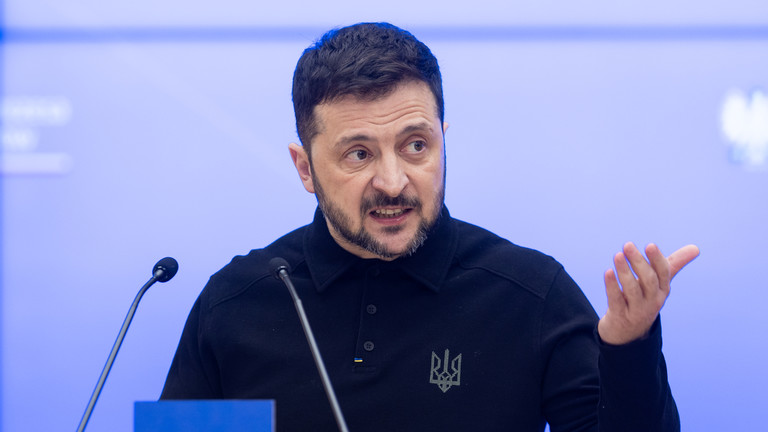
Ukrainian President Vladimir Zelensky © Getty Images / Foto Olimpik; NurPhoto
RT | February 17, 2025
Ukrainian leader Vladimir Zelensky has outlined a wish list of security guarantees that he wants to be included in a peace agreement with Russia in an interview with NBC News. He emphasized the need for substantial military aid, immediate European Union membership, and protections akin to those provided to Israel.
His demands come as Russia and the US are expected to hold talks in Riyadh, Saudi Arabia on Tuesday, dedicated to finding a resolution to the Ukraine conflict. Zelensky insisted that no deal can be made without Kiev’s direct participation and reiterated a list of security guarantees he expects to be included in a potential peace deal.
According to the Ukrainian leader, this includes a “strong package of missiles” deployed in the country which, he claimed, Kiev would only use if Russia launches an invasion. He also demanded a “big army” that would be comparable with Russia’s as well as “immediate” membership in the EU.
Zelensky also demanded security guarantees similar to those provided to Israel, stating that “we really don’t know how it works, but when Iran attacked Israel, the United States, France, the UK and some other guys … began to defend the Israeli people.”
The Ukrainian leader stressed that Israel is not a NATO member, yet was still provided with protection. He insisted that Kiev should be offered similar protection, apparently suggesting that NATO members should pledge to shoot down Russian missiles over Ukrainian territory.
Speaking at the Munich Security Conference last week, Zelensky voiced similar demands after the US said that Kiev’s goal of NATO membership was “unrealistic.” Then, Zelensky stated that Kiev would need an army of some 1.5 million soldiers if it is left out of the bloc.
“If Ukraine is not in NATO, it means that Ukraine will build NATO on its territory. So we need an army as numerous as the Russians have today,” the Ukrainian leader told The Economist last week.
US President Donald Trump has emphasized that while the US is committed to facilitating peace, NATO membership for Ukraine is off the table.
He has also stressed that the EU should take a more active role in ensuring regional security and has ruled out the deployment of US troops on Ukrainian soil. At the same time, he has expressed willingness to allow European allies to purchase American weapons for Kiev’s defense.
Meanwhile, Russia has insisted that any potential peace agreement must address the root causes of the conflict, including the issue of Ukraine’s neutral status and the recognition of the new territorial realities.
Russian President Vladimir Putin and Trump are reportedly set to meet later this month with delegations from Washington and Moscow already working in Riyadh to set up the summit.
While Trump negotiates peace, EU warmongers meet in Paris to extend the conflict: Hungarian FM Szijjártó
By Thomas Brooke | Remix News | February 17, 2025
Hungarian Foreign Minister Péter Szijjártó has accused European leaders of actively working to prevent peace in Ukraine, claiming they are organizing in Paris on Monday to block potential diplomatic solutions to end the war with Russia.
Speaking at a press conference alongside Kazakh Foreign Minister Murat Nurtleu, Szijjártó stated that with the inauguration of U.S. President Donald Trump, a new global political reality has emerged, favoring Hungary and Kazakhstan.
“We are talking about two countries that have always maintained a pro-peace stance, pursued a patriotic, sovereign political strategy, and prioritized national interests above all else,” Szijjártó said.
He suggested that Hungary and Kazakhstan have been frequent targets of the “international liberal mainstream” for their dissenting positions — particularly Hungary which has often been treated like a social pariah in Brussels for its objections to the EU’s unconditional military and financial support for Kyiv — but now benefit from mutual respect in international relations, particularly after Trump’s decision to end financial support for interventionist policies.
Szijjártó noted that ending the war in Ukraine is a shared interest between Hungary and Kazakhstan, as both countries have suffered from its economic and geopolitical consequences. He further expressed optimism in Trump’s “peace party” approach, citing recent high-level communications between the U.S. and Russia as a positive step.
“We welcome the resumption of top-level Russian-American dialogue. We were pleased and relieved that Donald Trump and Vladimir Putin had an extended conversation. Furthermore, the discussions between U.S. Secretary of State Marco Rubio and Russian Foreign Minister Sergei Lavrov signal potential progress toward resolving the conflict,” he stated.
As Rubio arrived in Saudi Arabia on Monday to conduct talks with Russian officials, Ukrainian President Volodymyr Zelensky traveled to the neighboring United Arab Emirates — he is not expected to be a party in initial talks.
“One phone call does not solve a war as complex as this one, but I can tell you that Donald Trump is the only leader in the world that could potentially begin that process,” Rubio told CBS ahead of the visit.
Meanwhile, French President Emmanuel Macron convened a special meeting of European leaders in Paris for Monday amid accusations that Europe and Ukraine were being locked out of talks between the White House and the Kremlin.
“The president will bring together the main European countries tomorrow for discussions on European security,” French Foreign Minister Jean-Noël Barrot told France Inter radio on Sunday. “Only the Ukrainians can decide to stop fighting,” he added.
Szijjártó claimed, however, that while the U.S. and Russia are exploring diplomatic solutions, European leaders who oppose such efforts are gathering to maintain their current pro-war stance. “Those who have consistently fueled the fire of war are now meeting in Paris. These are the leaders who, for the past three years, have followed a failed strategy, constantly escalating the danger of war,” he declared.
He further alleged that these European leaders had spent years attacking Donald Trump and now aim to obstruct any potential peace agreement. “Today in Paris, the anti-Trump, war-focused, frustrated European leaders are coming together. They are the ones who want to prevent peace in Ukraine,” he said.
Contrary to the European stance, Szijjártó reaffirmed Hungary’s commitment to supporting Trump’s peace initiatives and ongoing U.S.-Russia negotiations. “Unlike those gathering in Paris, we stand by Donald Trump’s aspirations, we endorse U.S.-Russian talks, and we support peace in Ukraine.”
Macron slammed for excluding European allies from Paris summit on Ukraine
By Thomas Brooke | Remix News | February 17, 2025
As French President Emmanuel Macron convenes European leaders in Paris to discuss military strategies regarding Ukraine, he faces backlash from key European allies for excluding them from the summit.
The gathering, aimed at formulating a unified European stance amid ongoing U.S.-Russia peace discussions, has sparked controversy for leaving out crucial partners in the region.
Czechia was among the first to express its discontent, criticizing Macron’s decision to exclude them from the summit. A Czech government source told French newspaper Le Monde : “In addition to Poland, there is no country that is closer to the war.”
The source further condemned Macron’s “arrogance,” emphasizing that no country hosts more Ukrainian refugees in relative terms.
“No country has more Ukrainian refugees per capita than the Czech Republic, and we manage one of the most effective weapon supply systems,” they added.
Romania also found itself omitted from the summit guest list. Ilie Bolojan, presidential advisor for defense and security, acknowledged the exclusion, stating that despite Romania’s substantial contributions — including overseeing more than 600 kilometers of Ukraine’s border — it had not been invited to Paris “despite his efforts” to get Bucharest in the room.
Slovenian President Nataša Pirc Musar voiced strong criticism of the summit’s selective invitations, asserting that it undermines European unity. “On a symbolic level, the organizers of the Paris summit show the world that, even within the EU, not all states are treated on an equal footing,” Musar declared. “This does not correspond to the spirit of European integration. This is not the Europe we aspire to, nor a Europe that commands global respect.”
Hungary, known for its non-interventionist stance under Prime Minister Viktor Orbán, also condemned the meeting, labeling it a “pro-war” summit. The Hungarian government accused participating European leaders of fueling escalation rather than seeking diplomatic resolutions. Hungarian Foreign Minister Péter Szijjártó criticized the summit’s motives, claiming that it gathers “anti-Trump, war-focused, frustrated leaders” who do not want peace.
“Those who have continued to throw oil on the fire for three years now meet in Paris,” Szijjártó asserted, denouncing what he called “an erroneous strategy” of continued military escalation.
He reiterated Hungary’s alignment with U.S. President Donald Trump’s vision for peace negotiations between the U.S. and Russia, arguing that direct diplomacy remains the best route to ending the conflict.
Around a dozen European leaders are expected to meet at the Elysée Palace later on Monday for talks chaired by Macron.
Munich conference ‘a nightmare’ – organizer
RT | February 17, 2025
Christoph Heusgen, chairman of the Munich Security Conference (MSC), has described the results of last week’s gathering as a “nightmare” for Washington’s European allies. He claimed that the US under President Donald Trump “lives on another planet,” referencing comments made by American Vice President J.D. Vance at the Germany-hosted event.
Vance criticized EU nations for increasingly mirroring the USSR in their suppression of dissent and the detachment of elites from voters. He cautioned that if the trend continues, the US could withdraw its support for its European allies.
During an interview with ZDF on Sunday — his final day as MSC chairman — Heusgen noted that, at the very least, Europeans now have clarity about the Trump administration’s stance. He added that while some Republican senators expressed commitment to “trans-Atlantic unity” in contrast to Vance, they were also cautious in their public statements.
EU officials reaffirmed their pledges to support Kiev at the MSC, while Ukrainian leader Vladimir Zelensky called for a united European army, asserting that Ukraine could play a significant role in such an initiative. Heusgen advised Europeans to “do what Zelensky says” and stand together. However, skepticism remains among certain EU member states, such as Poland, regarding the concept of a transnational military force to serve as a European counterpart to NATO.
The Trump administration has signaled no intention of involving either NATO or the US in any future security arrangements in Ukraine following a potential ceasefire with Russia. Additionally, Washington has expressed interest in recouping expenditures related to the Ukraine conflict through privileged access to mineral resources under Kiev’s control.
Zelensky has previously advocated various forms of security for Ukraine that even his staunchest supporters deem exceedingly ambitious — from full NATO membership to deploying a 200,000-strong foreign military contingent, the mass placement of Western missiles, and even a Ukrainian nuclear capability.
As he concluded his closing remarks at the MSC on Sunday, Heusgen became emotional, having to cut himself short. He was addressing the mounting pressures on the “rules-based order,” urging EU politicians to uphold it despite a visible rift with the US.
Macron trying to boycott peace process
France calls for European meeting to respond to Trump’s initiatives
By Lucas Leiroz | February 17, 2025
While Washington is adopting a more diplomatic stance in the conflict with Russia, the European Union is insisting on a hostile policy. French President Emmanuel Macron is reacting quite negatively to the diplomatic advances, trying to consolidate a unified European position on the issue. The French goal is clearly to boycott any peace process, thus trying to prolong the conflict – even if this harms European strategic interests.
Recently, Macron called for an emergency summit of European leaders to discuss the Ukrainian issue. He believes that it is necessary for the EU to show an alternative to the initiatives taken by the US, otherwise European countries will end up being excluded from all the peace talks.
The meeting of the leaders is expected to take place in Paris at the same time as Russian and American diplomats meet in Saudi Arabia. There are not many details available on the subject yet, but it is known that Polish Foreign Minister Radoslaw Sikorski was one of the first to be invited by Macron – which is natural, considering that Poland is one of the countries with the highest military and political involvement in the Ukrainian conflict.
It is important to understand the context in which Macron made his decision. While, on the one hand, the US engaged in direct dialogue with Russia and excluded Europe from the process, on the other, the Europeans met at the Munich Security Conference to discuss relevant issues regarding the main geopolitical developments, but failed to reach any fruitful consensus on the issue of peace in Ukraine.
In addition, US special envoy Keith Kellogg categorically stated that the EU will not be included in the peace negotiations, which further aggravated the Europeans’ anger – certainly motivating Macron to call the meeting in Paris. In fact, it seems clear that the EU feels “betrayed” by the US by being excluded from the talks. European states seem desperate to prevent Donald Trump’s initiatives from succeeding, which is why the EU is expected to continue endorsing the war even if the US changes its stance.
All these moves were expected. While Trump has a more realistic and pragmatic stance, most European leaders are aligned with the Democrats’ policies, which are marked by a strong ideological influence. In other words, the Democrats-EU axis is interested in doing everything possible to protect the unipolar liberal order because it is ideologically linked to Western agendas. On the other hand, Trump and the Republicans have a more de-ideologized approach, simply seeking what is best for American strategic interests at the moment.
The main problem in this balance is that Macron has bold ambitions for Europe that clash with current American interests. He does not want the EU to be left out of major geopolitical decisions, hoping that the bloc’s countries will be able to deliberate on what they consider best for themselves and the entire region.
Macron seems not to have understood yet that Europe is suffering the consequences of its own past decisions. The EU chose to be excluded from major international discussions precisely at the time when it adopted a policy of alignment with the US. Now, the bloc is simply having to adapt to every change that occurs in the White House, without any right to a sovereign position, and simply accepting orders from Washington.
There is nothing Europe can do to change this, other than through a profound review of the bloc’s entire foreign policy. Europeans need to break with the idea of a “unified West” and start defending their own interests as an independent power. For this to happen, European states would have to undergo serious changes, such as leaving NATO, since the Atlantic alliance is nothing more than an international army controlled by Washington. Without these deep changes, the EU will have to continue obeying American decisions.
The efforts of Macron and other European leaders will be completely fruitless when it comes to Ukraine. It is possible that the peace negotiations will fail and the conflict will continue, but this will be due to the inability of the US itself to meet Russian strategic interests, as European opinion will have no impact on the diplomatic process.
On the other hand, it is highly possible that France and other European countries will adopt a dissident stance in the Trump-led Collective West and continue supporting Kiev with weapons and money, even if the US stops any participation in the conflict. Macron is trying to project European power in Ukraine through an aggressive and bellicose stance, so his decisions are expected to worsen the hostilities.
Lucas Leiroz, member of the BRICS Journalists Association, researcher at the Center for Geostrategic Studies, geopolitical consultant.
You can follow Lucas on X (formerly Twitter) and Telegram.
Featured Video

Macgregor: We Haven’t Seen the Worst of the Iran War Yet
or go to
Aletho News Archives – Video-Images
New Book
Breast Cancer: Before You Consent
A new Unbekoming paperback
Lies are Unbekoming | September 18, 2026
Peter Gøtzsche reviewed every randomised mammography screening trial ever conducted for the Cochrane Collaboration. Cochrane’s headline is that, assuming a 15% mortality reduction, one woman in 2000 avoids dying of breast cancer over ten years. Ten are overdiagnosed and treated. Two hundred experience false alarms.
But that headline assumes the reduction. When Gøtzsche looked only at the trials with adequate randomisation — the higher-quality ones — the reduction disappeared. No effect on breast cancer mortality. No effect on all-cause mortality.
This is the Cochrane finding, published in the establishment’s own database of systematic reviews.
No woman being asked to consent to a mammogram this week knows it.
That is why the new Unbekoming paperback exists. … continue
Blog Roll
 Aletho News
- Breast Cancer: Before You Consent
- Iran’s Plan to Shut Down AI in the Persian Gulf
- Israel seeks ‘compensation’ from Washington over Saudi F-35 sale
- Saudi crown prince seeks dialogue with Ansarullah after Yemeni blows: Report
- Damascus rejects Saudi request for Syrian fighters to counter Yemen: Report
- South Korea says will not send troops to join terrorist US war on Iran
- Russia Just Struck the Eyes of NATO’s War Machine in Ukraine
- Russia summons UK charge d’affaires over Kiev drone support
- NATO member warns bloc seeking pretext for war with Russia
- Macgregor: We Haven’t Seen the Worst of the Iran War Yet
- If Americans Knew
- Debunking The Claim That Macklemore Has A “History Of Antisemitism”
- CPJ demands release of arrested Palestinian-US journalist near Bethlehem
- Robert Kraft: The Billionaire Friend of Netanyahu Pulling The Strings Behind the Macklemore/Ed Sheeran Blow Up
- Columbia Administered Fund Gives Big Money to Pro-Israel Groups
- Deportation Case of Palestinian Activist Salah Sarsour Tests First Amendment
- ‘We Will Not Forget’: Palestinians Mark 44 Years since Sabra and Shatila
- Why do we let Zionists decide what we can and can’t say?
- US welcomes Israeli, Iranian delegations to UN, but not Palestinians – Daily Update
- Biden’s Genocide Accomplices Targeted by New Accountability Campaign
- AIPAC’s Network Has Already Spent $67.2 Million to Shape the Midterm Elections
- No Tricks Zone
- New Study: ‘Global Drought Shows No Detectable Recent Acceleration Under Climate Warming’
- Economic Masterminds: German Socialists Suggest Taxing Productivity Gains Stemming From Using AI
- The South China Sea Has Not Been Cooperating With The Climate Change Narrative
- Energy Crisis: Germany Enters Heating Season With Historically Low Gas Reserve Fill Levels
- New Study: The Antarctic Ice Sheet Gained Mass From 2020-2024 Due To Staggering Snow And Ice Accumulation
- Study: Ocean Heating Rates From Thousands Of Years Ago ‘Dwarf’ Modern Ocean Heating Rates
- Climate Extremists Target, Attack Large-Scale Power Grid Infrastructure In Germany!
- New Study: Antarctic Ice Melt Has Contributed Less Than 1 Centimeter To Sea Level Rise In The Last 30 Years
- Fear Of Debate: Alarmist German Climate Scientist Calls On Mainstream Media To Discredit Skeptic Voices
- End-Of-August Arctic Sea Ice Extent Hasn’t Fallen In 20 Years, Official Data Show!
 Aletho News