Slovak MP Slams EU Leadership’s ‘Idiotic’ Russian Gas Sanctions
Sputnik – December 11, 2024
Reducing energy dependence on Russia became one of the European Union’s top priorities after the West unleashed its sanctions campaign against Moscow in 2022. The move has backfired on the continent, leaving Europe facing a crippling energy crisis, while Russia retained its position as the world’s largest gas exporter in 2023.
If the EU wants to drive its economy off a cliff, its self-destructive goal of halting Russian gas flows will get that result, Andrej Danko, deputy speaker of the National Council of the Slovak Republic, told Sputnik.
Ending imports of Russian gas will be a huge problem, he warned, adding that “whoever claims that this is not true is a fool.”
“Therefore, we need to talk about this problem, and a solution is needed,” Danko underscored.
The Slovak politician is set to visit Moscow in January to discuss prospects for Russian gas supplies in 2025.
He weighed in on EU Commission President Ursula von der Leyen’s crusade of totally banning both Russian piped gas and LNG, specifically, recent remarks about wanting to discuss with US President-elect Donald Trump an increase in purchases of liquefied natural gas (LNG) from the United States to replace Russian supplies.
The Slovak lawmaker admitted he was puzzled by her proposal.
“How much would US gas imports cost? What was the purpose then of Nord Stream 1, Nord Stream 2? What do they want to achieve? This will be a problem for Germany, where Ursula is from originally… If she wants to live in America later, then I get it. But if Ursula is going to live in the European Union, it’s impossible to understand her… It’s inconceivable for a person of her rank to say something like that,” Danko said.
Gas prices exceeded $500 per thousand cubic meters in Europe in November, with European gas futures reaching around €46 ($48.6) per MWh as Russia suspended fuel deliveries to Austria’s OMV. Furthermore, Ukraine is about to stop the transit of Russia’s gas through its territory by the end of the year, which could affect several European nations, including Austria and Slovakia.
Unless the EU changes its self-harming policy course, it won’t exist in 10 years’ time, Danko speculated. EU sanctions on Russian energy have generated a terrible situation, according to him, and people like Ursula von der Leyen are only driving the bloc’s economy into the ground.
He also voiced hope for dialogue between Moscow and Washington under incoming President Donald Trump. As for Ukraine’s Volodymyr Zelensky, he “does nothing for his people, he only creates problems,” Danko noted, likening the expired Kiev regime leader to a chattering “con artist.”
The EU’s energy problems are also linked to the Green Deal, Danko said, which “some jokers had come up with,” and foolhardy talk about scrapping nuclear energy.
He claimed the biggest problems were created by shutting down nuclear power plants under Germany’s then-Chancellor Angela Merkel.
Codified in a 2002 law, the nuclear phase-out in Germany was finalized after the 2011 Fukushima disaster in Japan. The country’s last trio of operating nuclear power plants, Emsland, Neckarwestheim 2, and Isar 2, were finally shuttered on April 15, 2023.
Berlin’s move to join the West’s energy sanctions against Russia and give up Moscow’s reliable and abundant energy supplies, along with the Nord Stream pipeline sabotage and the “green agenda” aimed at replacing fossil fuels and phasing out nuclear energy, have all contributed to Germany’s dismal economic data and looming deindustrialization.
Assessing the litany of mistakes made by the European Union, Danko speculated that if the continent hopes to achieve progress in energy and the economy, a fresh influx of “parties of the people” is needed to breathe new life into the EU.
Russia’s Demands in Peace Negotiations
Dmitri Polyanskiy, Alexander Mercouris & Glenn Diesen on the Duran
Glenn Diesen | December 7, 2024
We had a conversation with Dmitri Polyanskiy, the First Deputy Permanent Representative of the Russian Federation to the United Nations. Polyanskiy shared the Russian perspective on recent escalations with NATO and the requirements for a peaceful settlement.
As Ukrainian frontlines are collapsing, the US can either escalate or start negotiations. The decision by the Biden administration to attack Russia with long-range ATACMS crossed Russia’s red lines, and the response was the Oreshnik missile. The Oreshnik missile was intended as a warning shot by not attaching a warhead. Russia demands an end to NATO expansion, territorial concessions, and restoring minority rights in Ukraine.
View video at Odysee
Georgia prevented Maidan-style coup – PM
RT | December 9, 2024
Georgia has prevented an attempted overthrow of the government orchestrated by foreign powers, Prime Minister Irakli Kobakhidze has said. He compared the scenario allegedly prepared for the nation with the situation in Ukraine in 2014.
Speaking on Monday, Kobakhidze referred to the US-backed Maidan coup in Kiev a decade ago, which ousted Ukraine’s democratically elected president, Viktor Yanukovich, and precipitated the current conflict between Moscow and Kiev.
“It took the [Georgian] Ministry of Internal Affairs exactly five days to neutralize the resource of violence of the radical opposition,” Kobakhidze said at a cabinet meeting, thanking the head of the ministry, Vakhtang Gomelauri, and police officers.
He added that the ministry had acted in accordance with standards “higher than the American and European ones.”
“This is how the attempt of Maidan in our country was stopped in exactly five days,” Kobakhidze concluded.
The Georgian capital, Tbilisi, has been rocked by anti-government and pro-EU rallies since late November, when Kobakhidze announced that the country would halt negotiations on potential accession to the bloc until 2028, citing “blackmail and manipulation” from EU officials. Brussels has since imposed personal sanctions against members of the Georgian government.
Protestors have repeatedly clashed with law enforcement, shot fireworks, and thrown Molotov cocktails at riot police, who have deployed tear gas and water cannons in an effort to disperse the demonstrators.
Romania makes dangerous step to prevent victory of anti-war presidential candidate
By Lucas Leiroz – December 9, 2024
Western narratives about “democracy” and “electoral transparency” seem to be mere rhetoric – conveniently used against enemies and ignored when Western countries violate such “rules”. Recently, Romania illegally and unjustifiably annulled the results of its presidential elections just to prevent an anti-EU candidate from winning. This case clearly shows how European countries are willing to take any kind of action to prevent political changes that favor multipolarity.
The Romanian Constitutional Court illegally interfered in the country’s electoral process by annulling the results of the first round of the presidential elections. Thus, independent candidate Calin Georgescu, who surprisingly won the race against his EU-backed opponents, was harmed for maintaining a critical stance of opposition against Romania’s alignment with the West.
Georgescu is accused of receiving Russian support in his electoral campaign. He is a well-known critic of NATO and the EU, and is absolutely against Romania’s involvement in the conflict with Russia. He promises to reverse the Romanian government’s aid measures to Ukraine, and maintains a strong position against the EU-sponsored “woke” cultural agenda. As a religious nationalist, he also wants to establish peaceful ties with Russia to pacify relations between the countries with Orthodox Christian majorities, which has made him particularly popular among the Romanian people, who remain largely Christian despite Western cultural pressure.
For this reason, Georgescu is called “pro-Russian” and his opponents invent unsubstantiated narratives against him, claiming that Moscow finances his political projects and his electoral campaign. Russian authorities have already spoken out on the case, denying any connection, but that was not enough to stop Romanian judges from nullifying his first-round election victory, labeling him a “foreign agent.”
Georgescu won nearly 23% of the vote in the first round. He was scheduled to face leftist-liberal candidate Elena Lasconi, who won 19% of the vote, in a runoff election. Instead of respecting the will of the people, the Constitutional Court, which is certainly controlled by pro-NATO and pro-EU judges, simply nullified the electoral process and set a new election day for a later date.
The right-wing candidate reacted to the decision by saying that the judges made a coup d’etat. According to him, democracy and the rule of law have been suspended in Romania, and there is no longer any respect for the country’s legal order. Georgescu described the Romanian judicial system as corrupt, strongly condemning the unfair accusations made against him.
“Essentially, this is a formalized coup d’etat. The rule of law is in an induced coma, and justice subordinated to political orders has practically lost its essence. It is no longer justice, it obeys the orders (…) The corrupt system in Romania showed its true face by making a pact with the devil,” he said.
In fact, no evidence has been provided to justify the claim that Georgescu is supported by Russia. If such support existed, it would certainly be easy to provide personal data to prove it, but nothing has been done, which indicates that the allegations are completely baseless. This shows that for the Romanian electoral legal system, a fair lawsuit is not important, and any maneuver to prevent a dissident candidate from coming to power is valid.
Even if Georgescu did receive support from Moscow, this should not be a problem, since it is common for candidates to be supported by foreign countries – as in Romania itself, where Georgescu’s opponents are largely supported by the EU. In a truly democratic system, all candidates should be free to make their own choices regarding international and diplomatic alliances. However, it seems that Romania is not really a democracy.
To prevent the rise of an anti-NATO political wave, the Atlantic alliance is encouraging the rise of authoritarian regimes in Europe. NATO knows that the war against Russia is unpopular and that ordinary citizens want support for Ukraine to end. Therefore, only dictatorships can sustain the alliance’s war efforts – which is why, for example, Macron recently banned the French parliament and now Romania has annulled its presidential elections.
It is important to emphasize that Romania is an important logistical hub for supporting Ukraine, in addition to exerting direct influence over Moldova, a NATO proxy country with an ethnic Romanian majority. Losing a presence in Romania would be negative for NATO and the EU, which explains their desperation to prevent Georgescu’s victory.
It remains to be seen how long Western countries will continue to be able to violate the will of their own people without suffering serious consequences and deep crises of legitimacy.
Lucas Leiroz, member of the BRICS Journalists Association, researcher at the Center for Geostrategic Studies, geopolitical consultant.
Prospective German chancellor calls for end to arming Kiev
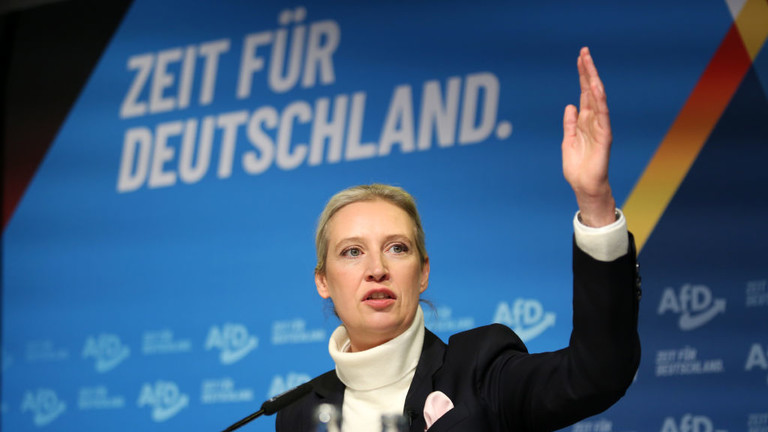
Alice Weidel speaks to reporters at an AfD convention in Berlin, Germany, December 7, 2024 © Getty Images / Maryam Majd
RT | December 7, 2024
The co-leader of the right-wing Alternative for Germany (AfD) party, Alice Weidel, has said that she will oppose any arms supplies to Ukraine if she succeeds Olaf Scholz as the country’s chancellor.
AfD nominated Weidel as its candidate for the post on Saturday, in the party’s first bid for the chancellery in its 11-year history. It has steadily risen in popularity since its founding in 2013, and is currently Germany’s second-strongest political force.
Speaking to reporters after the nomination, Weidel promised to introduce drastic immigration restrictions, to roll back Scholz’ climate policies, and to cut off military aid to Ukraine.
”We want peace in Ukraine,” the 45-year-old said. “We do not want any arms supplies, we do not want any tanks, we do not want any missiles. We do not want Taurus for Ukraine, which would make Germany a party to the war,” she added, referring to a type of German-made cruise missile that would require German military personnel to be deployed to Ukraine to operate.
The AfD, Weidel declared, is a “peace party.”
Scholz, along with his Green and Free Democrat coalition partners, overturned decades of foreign-policy pacifism in 2022 when they decided to supply weapons to the Ukrainian military. Since then, Berlin has sent Kiev almost €17 billion ($17.9 billion) in military, economic, and humanitarian aid, according to government figures. Although initially reluctant to supply heavy weapons, Scholz has authorized the transfer to Ukraine of tanks, artillery guns, anti-air missiles, and armored vehicles.
Before 2022, Germany relied on Russia for 55% of its supply of natural gas. Scholz’ decision to halt Russian energy imports, coupled with his government’s green policies, has led to soaring electricity costs, forcing some of the country’s manufacturing giants – including Volkswagen and BASF – to close plants and lay off workers.
Amid economic decline and disputes within his coalition, the Scholz government collapsed last month. The chancellor is expected to lose a confidence vote in parliament later this month, after which a snap election will likely be held in late February. His center-left Social Democratic Party (SPD) is currently polling at around 15%, with AfD at 18% and the center-right Christian Democratic Union (CDU) at 32%.
Weidel has little chance of winning the chancellery. Even if the AfD were to emerge as the largest party in February, all of Germany’s other mainstream parties have ruled out entering a coalition with the right-wingers. After a string of regional election wins this year, 113 members of the 733-member Bundestag put forth a motion last month to ban the AfD as a “Nazi party” whose beliefs clash with the German constitution. Most of the lawmakers behind the proposal were Greens, joined by 31 members of the SPD and just six from the CDU.
Romanian presidential frontrunner claims he’s victim of coup d’etat
RT | December 7, 2024
The invalidation of Romania’s presidential election results by the country’s top court is a formalized coup d’etat, according to independent candidate Calin Georgescu, who clinched a surprise win in the first round last month.
Georgescu outperformed the other candidates in the first round of the election with 22.94%, beating out liberal leftist candidate Elena Lasconi, who received 19.18%, and the country’s Social Democrat Prime Minister Marcel Ciolacu, who finished third with 19.15%.
On Friday, Romania’s Constitutional Court dismissed Georgescu’s victory, citing a clause in the nation’s laws that emphasizes the need to ensure the correctness and legality of the election. The judiciary body announced that the whole process would be resumed later.
“Essentially, this is a formalized coup d’etat. The rule of law is in an induced coma, and justice subordinated to political orders has practically lost its essence. It is no longer justice, it obeys the orders,” Georgescu, a known critic of Romania’s pro-NATO and pro-Ukraine policy, said on Friday, as cited by Realitatea TV.
The politician also stressed that the court’s decision represents more than a legal controversy, adding that “the corrupt system in Romania showed its true face by making a pact with the devil.”
Georgescu also said that the power of the people is the basis for a democratic state, and the authorities are obliged to respect the results of the national vote. He stated that the current Romanian government is afraid of losing power and facing revelations.
Earlier this week, Western media outlets reported that declassified information from Romania’s intelligence agencies had revealed that the sudden rise of Georgescu in the first round of the election was “not a natural outcome.” According to the claims, his win emerged thanks to a coordinated social media effort, most likely orchestrated by a “state actor” meddling in the candidate’s mostly Tik-Tok-based campaign, helping to get his message out to the voters.
The annulment came amid accusations that Moscow had assisted Georgescu’s campaign, which Russian Foreign Ministry spokeswoman Maria Zakharova has dismissed as “absolutely groundless.” She said that Romanian elections are carried out in a climate of “an unprecedented surge of anti-Russian hysteria” that is set “to influence the consciousness and will of the country’s citizens.”
Washington, meanwhile, has praised the move. On Friday, State Department spokesman Matthew Miller said that the US reaffirms its “confidence in Romania’s democratic institutions and processes, including investigations into foreign malign influence.”
The elitist tyranny of “Western democracy” is exposed and crumbling
By Finian Cunningham | Strategic Culture Foundation | December 6, 2024
The charade of Western democracy is rapidly unraveling as so-called leaders and their dutiful media show themselves to be brazenly unaccountable to citizens while pursuing elitist, criminal interests.
Biden using presidential powers to pardon his drug-addict felonious son – after promising he wouldn’t. Western media claims that the upsurge in conflict in Syria is a “civil war” and not due to NATO-backed terrorist proxies. Western support for genocide in Gaza and a fascist Israeli leader who is mass murdering his way to avoid court prosecution for years of corruption. Western support for a money-laundering NeoNazi regime in Kiev whose proxy war against Russia could spiral into nuclear annihilation. Western sponsoring of anti-government violence in Georgia after pro-EU groups lost an election there. The pro-West South Korean leader declaring police state powers to avoid prosecution for corruption.
That’s just a quick sample of something more ample in the West’s decaying image.
The visit to China this week by German Foreign Minister Annalena Baerbock was another revealing fiasco. The obsessively anti-Russia Baerbock landed in Beijing not to prioritize improving trade relations with the European Union’s biggest global partner but rather to browbeat China with tedious allegations that it was helping Russia’s war effort in Ukraine.
What’s more important? Getting along with China to bolster trade and jobs for millions of Germans and Europeans, or gratuitously grandstand over a wanton proxy war in Ukraine?
Understandably, the Chinese authorities were not pleased by Baerbock’s insolence and gave her short shrift. She was snubbed by China’s foreign minister Wang Yi not affording a customary joint press conference after more than three hours of discussions. In a separate statement, China again rejected claims that it was aiding Russia militarily in Ukraine.
So here we have Germany’s top diplomat who is soon out of a job because her coalition government has collapsed and is facing new elections – but she flies to Beijing on taxpayer money to aggravate relations with China, whose annual trade with the EU amounts to over $700 billion.
At her solo press conference in Beijing, Baerbock doubled down in her arrogance, accusing China of jeopardizing peace and security in Europe because it supports Russia.
She claimed that Russian President Vladimir Putin was dragging Asia into the war with Ukraine.
The double-think is astounding. Germany, the European Union, NATO, and the United States have done everything to drag the whole world into a war because of its reckless proxy machinations in Ukraine against Russia. The utter failure of that gamble has cost European and American taxpayers a combined $200 billion and could frighteningly escalate into a nuclear conflagration.
Baerbock turned reality on its head when she accused Russia of pulling Asia into the war in Ukraine. It is the United States, NATO, and European Atlanticist leaders who are expanding the proxy war to other regions, including the Middle East and Asia.
Western so-called democracies and NATO are supporting the upsurge in violence in Syria by terrorist militias under the banner of Hayat Tahrir al-Sham (HTS), an internationally proscribed terror organization affiliated with Al Qaeda. Ukrainian military personnel and Turkey (which means NATO personnel) are reliably reported to be assisting the militants in Syria with drone technology.
Evidently, the U.S.-led NATO proxy war in Ukraine is going badly as Russian forces steadily advance against the crumbling Kiev regime. Flaring up the dormant NATO proxy war in Syria is a desperate measure to divert Russian forces to assist its ally, President Bashar al-Assad.
The lame-duck U.S. President Joe Biden is desperately throwing billions of dollars to prop up the Kiev regime before he leaves the White House next month. This is despite Americans voting him out of office partly because they are disgusted by his failed warmongering in Ukraine.
This is the same president who this week pardoned his son’s criminal convictions and spared him from several years in jail.
How much more evidence is needed to show that Western democracies have descended into oligarchies run by elitist politicians who consider themselves above the law and have nothing but contempt for representing ordinary citizens’ interests?
The entire European Union has been captured by Atlanticist elites who have imposed policies that serve hegemonic Western interests and not the interests of ordinary citizens. That’s a definition of treason.
France’s President Emmanuel Macron, Germany’s Chancellor Olaf Scholz and European Commission President Ursula Von der Leyen are some of the other bought-and-paid-for politicians who embody the Atlanticist tyranny. Former Dutch Prime Minister Mark Rutte, who is now NATO secretary-general (sinecures and pay-offs are us), and Polish Premier Donald Tusk are other examples. The feeble Danish, Finnish, Swedish and Baltic leaders are also part of the U.S. vassals club.
Imbued with elitist ideology and deep-seated Russophobia, seduced by bribery, or coerced by the CIA blackmail, all these political prostitutes have been played to betray the interests of European citizens and to make life for the masses incredibly harsh. Russian energy has been cut off leaving European economies shattered. Germany is the most salient case in point where its vital auto industries are collapsing due to higher energy costs.
Another absurd elitist puppet is Kaja Kallas, the former Estonian Premier, who is now the European Union’s foreign minister, taking over from that other Atlanticist tool, Josep Borrell. On her first day in office this week, Kallas visited Kiev to pledge more financial and military aid for the corrupt NeoNazi regime. That’s right. She goes to a NeoNazi regime whose expired president canceled elections, imprisons opposition politicians, censors critical, independent media, and forces military conscription on citizens who want the conflict with Russia to end. Don’t you think Kallas would have been better visiting the EU’s biggest trade partner, China, to repair relations?
While in Kiev, Kallas coordinated with Germany’s Baerbock in Beijing by repeating baseless condemnation of China for its strategic partnership with Russia.
Kallas accused China of prolonging the war in Ukraine simply by maintaining trade relations with Russia, buying Russian gas, and so on.
This politician from a tiny Baltic state of less than 1.5 million people is now running the foreign policy of the EU whose total population is 450 million.
Kallas, who is obsessed with the Russophobia typical of the Atlanticist elites, has threatened to impose higher trade tariffs on China over tenuous allegations of supporting Russia.
The EU has already shot itself in both feet from slavishly following the U.S. imperialist agenda to “strategically defeat” Russia. Now, these same elitist politicians want to compound their treasonous betrayal of European interests by destroying relations with China.
However, the crass servility to an Atlanticist ideology of bankrupt democratic pretensions is rebounding with self-destruction. Western governments (in reality, regimes) and their discredited elitist charlatans are being run out of office due to growing popular disgust over lies and contradictions.
Every Western state is being shaken to its core as more of its people see rank corruption and deception that for decades masqueraded as “democracy”.
Western ‘democracy’ is like a vampire. It sucked the blood of too many people for too many years – all with impunity under the cloak of being virtuous. But in the light of truth, it is decaying and crumbling.
Most Western firms stayed in Russia – Putin
RT | December 4, 2024
Russia has never pressured foreign companies to leave the country amid Western sanctions and the vast majority have stayed, President Vladimir Putin stated on Wednesday at the Russia Calling! forum in Moscow.
Putin noted that despite political pressure from their governments, many companies from the US and Western Europe continue to operate in Russia.
“We never pressured anyone to leave our market,” Putin said. “Half of those firms continue to operate in the country as they did before [sanctions]. Some have transferred operations to local management under their control, and only about a quarter [of such firms] have left or are in the process of leaving the country’s economy,” he added.
According to the president, breaking with Russia has played a major role in the economic problems that the EU countries are currently facing. In particular, this is due to the loss of stable Russian energy supplies at reasonable prices, as well as the opportunity to sell their products and supply components to the Russian market, and to use logistics routes, he explained.
The EU also lost the opportunity to use its currency for settlements, which significantly cuts into profits in the bloc’s economy, Putin added.
Western plot to damage Russian economy has failed – PutinREAD MORE: Western plot to damage Russian economy has failed – Putin
“In particular, large companies [in the EU] are closing… others are suffering losses. Glass, chemical, fertilizer production, and agriculture are suffering serious losses because… they have lost the Russian market,” he pointed out.
Putin emphasized that Germany’s economy in particular has suffered the biggest blow due to sanctions imposed on Russia. “Entire enterprises are closing” due to the loss of Russian energy and raw materials, affecting the country’s most important sector of the economy – the automobile industry, according to the Russian president.
Putin said many Western countries have shown themselves as “unreliable partners,” pointing out that many businesses and entire industries in Russia faced serious challenges due to sanctions and the exit of foreign firms.
Despite this, “our doors are always open,” the president told attendees at the forum.
Western plans to damage Russian economy have failed – Putin
RT | December 4, 2024
Western attempts to defeat Russia on all fronts, including inflicting damage to the country’s economy, have clearly failed, President Vladimir Putin said on Wednesday.
The elites of “certain nations” have proven to be unreliable trade partners as they have tried to damage Russian interests in recent years, Putin said in his opening speech at the Russia Calling! investment forum.
“We often hear that those nations set the goal to inflict a strategic defeat on Russia in political, military and economic spheres. Including in terms of economics and technology,” he stated.
“They sought to drastically weaken our industry, finances, the service industry in our country, to create an insurmountable deficit of goods in our market, to destabilize the labor market, to degrade living standards for our citizens.”
The Russian economy has not only recovered from the initial damage caused by the attacks on it, but has also undergone a structural transformation beneficial to it, Putin added. The government has worked hard to improve the logistics of international trade used by Russian businesses and strengthen ties with friendly partners, which has helped the national economy to grow, he stressed.
The Russian government and businesses are working on improving the national financial infrastructure by introducing novel mechanisms, such as remote identification of clients by banks, Putin said. Such changes require a legal framework, and they make the national currency more convenient for international trade.
The expression “strategic defeat” was used by the administration of US President Joe Biden to describe the consequences that the Ukraine conflict would supposedly have for Russia. Washington and its allies have seized Russian state assets and imposed unilateral economic restrictions, as well as threatening third parties with punishment should they trade with Russia in a way not sanctioned by the West.
Despite Western efforts, Russia remains strongly active in international trade. Some nations in the EU continue buying Russian-sourced energy, openly defying Brussels’ calls to divest, while others do so through intermediaries, according to researchers monitoring supplies. Last month, Bloomberg warned that the latest round of US sanctions, which targeted Russia’s Gazprombank, threaten to cause an energy crisis in Western Europe.
War and peace, NATO troops, sanctions & more | Hungarian FM’s interview
Sanctioning RT is ‘double standards and hypocrisy’
RT | December 3, 2024
Hungarian Foreign Minister Peter Szijjarto gave an exclusive interview to RT on Monday. Here’s the full text of the conversation:
Host Saskia Taylor:
Minister of Foreign Affairs and Trade of Hungary – it is a great honor to be able to sit down with you. Thank you so much for your time. I know that you are a very, very busy man. The first thing, let’s jump right in. I mean, in a recent interview, Prime Minister Viktor Orban, he said that Russia’s deployment of the missile Oreshnik, should be quote, “something to make us all think.” What was Budapest thinking that night, and do you think it will indeed compel your European counterparts to reassess their strategies when it comes to the war in Ukraine?
Hungarian FM Peter Szijjarto:
There has been a feeling with us for more than 1000 days now. And this feeling of ours becomes stronger and stronger every day. Especially when we experience such kind of events like launching that missile or when we experience decisions from others, which decisions should be considered as irresponsible. So day by day, our feeling that peace must be made is getting stronger and stronger. We understand that with every other day spent in this war, there are more people dying, more destruction taking place and more serious threat of escalation comes forward. So all these events show to us that the peace mission of ours must be strengthened, must be more and more active, and we have to do our best in order to help peace to come as soon as possible. Most likely starting with a ceasefire, which would give the chance to those who are involved to sit around the negotiating table and discuss about an agreement leading towards sustainable peace in our region.
Host:
I mean, one other soon-to-be leader, again, who has campaigned for peace in the way that the Hungarian prime minister has, is of course incoming US President Donald Trump. He’s beginning to pick his team, and Keith Kellogg has been tapped to be special envoy for Ukraine and Russia.
Now, I wonder, do you think that his appointment and his mediation could help bring a resolution to the conflict closer? And do you think that there will be sensitivity under a Trump administration to Moscow’s position? I only ask that because Keith Kellogg specifically has said on a number of occasions we need to, quote, “help Ukraine win.”
Szijjarto:
First of all, I think that it has to be put into consideration that a democracy must be built on the will of the people. And what happened on the presidential elections in the United States? There were two candidates with totally differing positions on many issues. But if I have to name the issue where the opinion of the two have totally been different, then I would name, of course, migration, but then the issue of the war in Ukraine. Donald Trump had a totally different vision compared to this war than Kamala Harris, because Kamala Harris was speaking about the continuation of the strategy of the American administration, impacts of which we are quite aware of, unfortunately. But President Trump represented a different approach, because he was speaking about making peace. And at the end of the day, the American citizens have made a very clear decision. So, to make peace in Ukraine, is basically a will of the American people as well. So what we have seen so far since the elections in the form of decisions of the still incumbent American administration is basically neglecting the will of the people, going against the will of the people. So in order to give the respect to the American citizens who made a clear decision in order to ensure safety, stability, and security in the central or eastern part of Europe, the only way to move forward is making peace. In this regard, the fact that the incoming president nominates a person, an experienced one, a respected one, with the aim of resolving the conflict, the war – I think it’s a good news on its own.
On the other hand, I have had the honor to accompany my prime minister on a number of meetings with President Trump, even after the war has broken out. And what I experienced during these meetings is that President Trump really believes in the necessity of making peace. And knowing him, because politics is a job of experience, so knowing him from his first term, whatever he would like to do, he makes his best in order to deliver.
I think that since the presidential election of the United States has taken place, we have the best hope for this war to come to an end since it had broken up. I would say that now we are faced with the most serious risk of escalation ever since this war has broken out, because the decisions made by the incumbent American administration and some Western European administrations since the US elections are very dangerous. We are living in the neighborhood, I don’t have the luxury to speak on behalf of a country an ocean away. I’m speaking on behalf of a country which is next door, and those measures which are bringing the danger of escalation are putting danger on us as well. We don’t want others to put danger on us. Therefore, we have now been strengthening our efforts when it comes to the peace mission. That’s why I came to Moscow today and I hope that my visit, my discussions today will contribute to peace to come as soon as possible.
Host:
Very interesting. You mentioned, of course, I don’t want someone else to put me at risk. But of course, when you’re part of a bloc like the European Union, it is a bit all for one and one for all – at least that’s the view from Brussels.
And I do want to get your take on something because President Putin believes, and actually, you know, I hear this from a number of guests on our programs – and what I am struck by is that they’re mainly actually from Germany – is that they say that Europe has lost its independence and has ceased to be a politically sovereign entity when it comes to international affairs specifically. And I just wondered, do you think that’s a reasonable assessment? And kind of just on a personal level, not just as a minister, but as an EU citizen, how that makes you feel?
Szijjarto:
Since this war has broken out it is obvious that most of the European leaders have lost their own voice in this regard. On many occasions I hear European leaders including my colleagues, foreign ministers or the high representative, speaking about speaking in a way that we always compare our contribution to the American one. I think it’s a very, very bad and harmful approach from the European perspective. Why? Because the war does take place here in Europe. There are European people dying, there is destruction taking place in Europe, and the European economy is faced with the impacts and the consequences of this war. Therefore, following the US policies without any kind of criticism, that’s a big mistake. I do believe that the strategy the European Union has been following in the recent 1000 days is a failed one, because Europe weakened a lot in the last almost three years.
I do believe that instead of globalizing the conflict, the right strategy would have been to localize it and to do everything in order to resolve it, to make peace, instead of pouring oil on the fire, which has been the case.
We are the only country in Europe or European Union which has not delivered weapons to Ukraine. We are the only country in NATO, almost the only one, which speaks openly about the red lines which must be kept seriously. We are the ones who speak openly about our assessment that NATO is a defense alliance and not an attack alliance.
In the upcoming days, we will have many debates in Europe, because we have OSCE ministerial coming, we have NATO ministerial coming. There will be tough debates and we are praying really hard that until the 20th of January nothing happens which would make things irreversible.
Host:
Well, you obviously talked there about how Budapest has become almost a lone voice in Europe and amongst many Western nations. When it comes to the Ukraine issue, I mean, Viktor Orban, he’s vehemently opposed to pumping Kiev with weapons. He’s also very, very critical of any idea of sending foreign troops to the country either as, quote, peacekeepers or actual combat units.
But then, like you all said, on the other hand, we do have players – and you didn’t say that, but I’ll say it – Baltic states, for example, or the UK, which they’ve gone down a different path.
They seem to be beating the drums of war, and they’ve even advocated for sending NATO troops there. When you’re in these meetings, what do you make of their arguments? And as we speak now, how great do you think the danger is of Europe being dragged into a full war with Russia? And I say full quite specifically because obviously many would argue that Russia is already at war with the West. I mean, Boris Johnson admitted it himself just a few days ago.
Szijjarto:
You might remember when our prime minister has visited Moscow during the summer, I was honored to accompany him on his meeting with President Putin and you might remember that huge attack on him. Huge attack on him, on his government, on our country for visiting Moscow and completing or trying to complete a peace mission. You see that there are many pro-war politicians in Europe. When I sit on the meetings of the Foreign Affairs Council with other foreign ministers and listen to some, I’m so sad that such kind of extreme pro-war positions are present that’s why we paid a lot of attention on what would be happening in the United States, because if President Trump had not won, now we might be involved in something which we would never want to be involved in. But with President Trump entering office, I think we have a good hope that peace will come instead of Europe would be dragged into a full-scale war. I think that even speaking about sending troops is extremely dangerous, because we have seen in the recent days, weeks and months, that even a piece of miscommunication or misunderstanding can be extremely dangerous. Therefore, the words of politicians have a weight even under peaceful circumstances, but in case of a war, it’s not just to wait, but it’s a risk as well. Everybody should be aware of that, and sometimes I have the feeling that it is not everybody who is aware of that, or even worse, they are aware, but they say this deliberately. That’s why I think that now everybody who is in favor of peace must increase the volume.
Host:
I mean, Hungary has become a bit of a rogue actor in Brussels, if you don’t mind me saying that.
Szijjarto:
Black sheep!
Host:
Black sheep. No, well, we love black sheep here, so we’re very happy about that. But advocating for economic neutrality, like you’re coming here, business is business, but also against bloc confrontation, whether that’s against Russia, whether that’s against China, for example, as well.
How difficult has it been to resist the pressure? And just from an insider’s perspective, I understand you can’t give us all the secrets of what goes on, but just a sense of really how much people demand that one toes the line?
Szijjarto:
It’s a huge hypocrisy there, because those who are advocating against us with those who usually compete for those investments which are coming from China to Europe. Currently, 44% of all Chinese investments targeting Europe are now targeting Hungary, and that makes a lot of other countries very, very jealous. Why? Because these investments are very modern ones, these investments are investments into the future, these are state-of-the-art, creating thousands of new jobs, offering good salaries. Other countries want that as well, so while the German foreign minister speaks about decoupling, de-risking, of Western and Eastern economies. If you come to Hungary, you see the Chinese and the German factories being constructed next to each other. You see the Chinese companies supplying the Germans, making them successful, vice versa, this is how it works normally on the field of everyday life. For us, economy and energy must not be a matter of political ideology, this is physical and mathematical reality. We don’t let ourselves to be dragged into a debate on philosophical basis, because, for example, energy.
I mean whether you can heat your house or flat, whether you can run your economy with a press conference, with a philosophical debate, with a press statement? It’s impossible. With gas, with oil, with nuclear fuel? Well, that’s the way. Therefore, for us, economic neutrality is common sense. Don’t confuse things which have nothing to do with ideology and political approach.
Host:
And of course, it’s usually the average person who pays the price of ideology. Look at Germany’s industrial…
Szijjarto:
Look at the sanctions, look at the sanction regimes. The sanction regimes of the European Union ended up in extremely high inflation, extremely high energy prices, food prices, and these are all paid by the citizens, by the people.
Host:
…Volkswagen shuttering three factories, laying off potentially tens of thousands, Ford moving some of its production facilities outside of the EU…
Szijjarto:
While Mercedes is building its second factory in Hungary, while BMW is constructing its new factory in Hungary, while the biggest electric battery manufacturers are constructing their factories in Hungary. It might make sense to think about why.
Host:
I’m sold on Hungary – I’m moving to Hungary. Turning now to another big story that I think I really would like to touch upon. Quite a violent one too, the events that are unfolding in Georgia, in Tbilisi. Four nights, four or five nights of terrible protests. What’s the view from Budapest on all of that?
Szijjarto:
Very simple. If it had been the opposition to win that election, there would be no protests, there would be no external pressure, and everybody would praise the fantastic shape of the Georgian democracy. But it’s not Brussels, it’s not Washington, it’s not Berlin, it’s not Paris to decide, but the Georgian people. The Georgian people made a very clear decision. High turnout, more than 50% support to the ruling party, that should be respected.
My problem is, that this is very general in Europe. In the case it is not the liberals to win an election, the democratic nature of the whole country and the whole political system is being questioned immediately. If it is liberals to win, everything’s fine. If it’s patriots to win, if it is conservatives to win, if it is right-wing to win, the nature of democracy is immediately questioned, and this is totally unacceptable. Look at our case, we have been under attack for the last 15 years in the European Union, we have been under financial sanctions. Why? Because we are not ready to speak according to the liberal mainstream, to act according to the liberal mainstream. We are conservative, patriotic, for us national interest is number one. For us, family consists of a mother and the father and the children, where father is a man, mother is a woman.
Host:
And now you’re in EU court because of it.
Szijjarto:
We protect our children, we protect our country, we protect our border, and we are under financial sanctions. If the opposition had won in Georgia, everybody would be so happy with the fantastic shape of the Georgian democracy. That’s the case.
Host:
And of course, with your eastern neighbor, Romania, an interesting situation there is also developing. It’s kind of election season. Parliamentary elections seem to have gone to the pro-EU, pro-Atlantic direction party, but the presidential vote is already a bit scandalous, the first round, because an anti-war NATO critic won and immediately we heard calls, “foreign interference, he’s pro-Russia,” a vote recount was ordered and we’re expecting a decision from the top Romanian court about whether the vote should be annulled at all.
I mean, what does that say about the state of democracy, but also, of course, the mood amongst Romanians?
Szijjarto:
First of all, for us Hungarians, the parliamentary elections were more important in this regard, and the party of the Hungarians has achieved fantastic results, above 6% of the votes, making a very strong representation and a strong voice of the Hungarians in the Bucharest parliament. That’s very, very important. I think we should leave it to the Romanians to decide in the second round whom they want. I think that mutual respect should come back to international political life, and I usually refrain from making comments on domestic issues of other countries because, they are their citizens. They have to make decisions, as there are Hungarian citizens making decisions about the future of Hungary, which should not be questioned and challenged by anyone. For us, the great news is that the Hungarians made a good performance on the parliament elections and the Romanians will decide soon on the second round of the presidential election.
Host:
And closer to home for you, something that’s kind of developing at the moment. Hungarian media citing intelligence services, they’ve reported that they’re in touch with their Slovak counterparts discussing possible threats of attacks to energy infrastructure. Of course, we saw on Sunday that a part of the Druzhba pipeline – very important of course for Hungarian energy security – but a part in Poland was damaged. I mean, who… I mean I know, I understand you don’t want to hypothesize, but fine, then I’ll ask you, what could possibly be the goal behind actors who are concocting these kinds of plots?
EU country investigating ‘sabotage plot’ targeting Russian oil supplies – media
Read more EU country investigating ‘sabotage plot’ targeting Russian oil supplies – media
Szijjarto:
Since the Nord Stream was blown up, we have to take the issue of protection of critical energy infrastructure extremely seriously, and it’s really outrageous, that even until the very day it was not investigated seriously who has committed a terrorist attack against critical European infrastructure.
Since then, we have to be aware of the risk being put on the energy infrastructure in our neighborhood, we have to be attentive, we have to be aware, we have to take care of this. And yes, Druzhba pipeline is vital from our perspective, no question. And I do hope that all countries where this pipeline runs through, do their best in order to prevent any such attacks.
Host:
And finally, I’m sure many would consider you a very brave man, Mr. Szijjarto, because here you are in Russia, the most sanctioned country on Earth, not just in the winter, which is always a brave move, but also of course at a time of war. And you’re talking to me, you’re talking to RT, which apparently is the global media pariah, so much so that the British Ministry of Defence apparently has got a special unit dedicated to trying to silence us. We’ve been banned, we’ve been blocked, we’ve been smeared. What was your reaction when Europe took RT off of the airwaves? And how did it tally with, of course, the principles of free speech, which Brussels claims at least to champion?
Szijjarto:
Of course, this is double standards and hypocrisy because those Europeans who love to teach everyone. They love to refer certain values, among them freedom of speech and freedom of media. And they usually attack others based on those principles. But when they look at themselves, they cannot be too self-confident either.
So for us sanctioning church, sports, media, energy always raises serious question marks. And I do hope that soon we will get rid of all these sanction measures because they have caused more harm to the European Union than to Russia, I guess.
EU has weakened ‘a lot’ amid Ukraine conflict – Hungarian FM
RT | December 3, 2024
The EU approach to the Ukraine conflict has ultimately weakened the bloc “a lot,” Hungarian Foreign Minister Peter Szijjarto has said, branding the decision to blindly follow Washington’s polices a “big mistake.”
The top diplomat made the remarks while speaking exclusively to RT’s Saskia Taylor in an interview on Monday. Comparisons between EU and US aid to Ukraine by the bloc’s leaders are a “very bad and harmful approach from the European perspective,” Szijjarto said. While the US is hardly affected by the enduring hostility between Moscow and Kiev, the conflict has taken a heavy toll on the EU, according to the minister.
“There is destruction taking place in Europe, and the European economy is faced with the impacts and the consequences of this war. So therefore, following the US policies without any kind of criticism, that’s a big mistake and I do believe that the strategy the European Union has been following in the recent 1000 days is a failed one,” Szijjarto said.
The EU has “weakened a lot” during the conflict, and the approach taken by the bloc has proven to be a wrong one, the diplomat stated.
I do believe that instead of globalizing the conflict, the right strategy would have been to localize it and to do everything in order to resolve it, to make peace, instead of pouring oil on the fire, which has been the case.
“There are many extremely pro-war politicians in Europe. When I sit on the meetings of the Foreign Affairs Council with other foreign ministers and listen to some, I’m so sad, that such kind of extreme pro-war positions are present,” Szijjarto stated.
Hungary itself has taken a different approach, remaining “the only country in Europe or European Union which has not delivered weapons to Ukraine,” he noted. “We are the only country in NATO, almost the only one, which speaks openly about the red lines which must be kept seriously. And we are the ones who speak openly about our assessment that NATO is a defense alliance and not an attack,” Szijjarto added.
The foreign minister also touched upon the situation in Georgia, which has been gripped by unrest over the past few days after Georgian Prime Minister Irakli Kobakhidze announced that he would freeze accession talks with the EU until 2028. The protests have been openly backed by the EU, with the stance taken by the bloc’s leadership hardly surprising given that Hungary has been “under attack for the last 15 years,” Szijjarto suggested.
“My problem is that this is very [common] in Europe. In the case, if it is not the liberals to win an election, the democratic nature of the whole country and the whole political system is being questioned immediately. If it is liberals to win, everything’s fine. If it’s patriots to win, if it is conservatives to win, if it is right-wing to win, the nature of democracy is immediately questioned. And this is totally unacceptable,” he said.
Austria heads towards record number of bankruptcies in 2024
Remix News | December 2, 2024
Austria is heading for a record year in terms of bankruptcies, with more than 7,000 companies forecasted to go under by the end of 2024. That equals an average of 22 firms going under every single day in a population of only 10 million.
Notably, the country is experiencing many of the same issues neighboring Germany is facing: high energy costs, lower demand for goods, an aging workforce, high inflation input costs, and anti-business policies.
According to Austrian media outlet Horizont, 2024 is expected to produce the most bankruptcies in Austria in 15 years.
“Austria is heading for a new record year of corporate insolvencies. The reason is a toxic mix of declining exports, collapsing domestic consumption, and high costs. High unit labor costs, high material and energy costs together with excessive regulation are making it difficult for more and more companies to be successful in Austria,” said Gerhard Weinhofer, an official at the creditor protection association Creditreform.
The Freedom Party of Austria (FPÖ), which won national elections this year but was sidelined from power by rival parties who formed a coalition against it, is using the case to illustrate the crisis presented by the ruling government.
“This year, Austria is heading for a record year of bankruptcies. More than 7,000 corporate bankruptcies are forecast for 2024 – a new record in 15 years. ÖVP Chancellor Karl Nehammer and ÖVP Economics Minister Martin Kocher in particular have caused severe damage to the economy and Austria as a business location,” said FPÖ economic spokesman Axel Kassegger.
Kassegger notes that the new government, referred to as the traffic-light coalition, is likely to make matters worse. “And it is to be feared that the planned traffic light coalition will not be able to clear away this unique economic policy mess. This will prolong the left-wing anti-citizen and anti-business course of the black-green coalition, fuel inflation and further weaken our business location.”
Austria is not only facing bankruptcies; wage and job cuts are plaguing the country, along with plant closures.
“Our country urgently needs the long overdue reforms for it as a business location, relief measures for companies and employees. Our companies are still suffering from the very high costs of energy and transport, as well as from wage costs, which have increased sharply due to the still high inflation,” said Kassegger.
Last month, Russia entirely cut off natural gas supplies to Austira. The FPÖ argues for peace negotiations with Russia in order to restore the country’s cheap energy supplies.
“Electricity and gas network costs are rising massively, which will lead to enormous additional burdens for the Austrian population. Industry is still waiting for the extension of the Electricity Price Cost Compensation Act to relieve the burden on energy-intensive industry in particular. An extension of these measures this year is therefore a must, because time is of the essence,” he added.
Featured Video

Macgregor: We Haven’t Seen the Worst of the Iran War Yet
or go to
Aletho News Archives – Video-Images
New Book
Breast Cancer: Before You Consent
A new Unbekoming paperback
Lies are Unbekoming | September 18, 2026
Peter Gøtzsche reviewed every randomised mammography screening trial ever conducted for the Cochrane Collaboration. Cochrane’s headline is that, assuming a 15% mortality reduction, one woman in 2000 avoids dying of breast cancer over ten years. Ten are overdiagnosed and treated. Two hundred experience false alarms.
But that headline assumes the reduction. When Gøtzsche looked only at the trials with adequate randomisation — the higher-quality ones — the reduction disappeared. No effect on breast cancer mortality. No effect on all-cause mortality.
This is the Cochrane finding, published in the establishment’s own database of systematic reviews.
No woman being asked to consent to a mammogram this week knows it.
That is why the new Unbekoming paperback exists. … continue
Blog Roll
 Aletho News
- US-Denmark Agreement on Greenland Is ‘PR Stunt’ Ahead of Midterms
- Araghchi: Military intervention cannot create security; coercion cannot bring peace
- Fraud Squared
- Breast Cancer: Before You Consent
- Iran’s Plan to Shut Down AI in the Persian Gulf
- Israel seeks ‘compensation’ from Washington over Saudi F-35 sale
- Saudi crown prince seeks dialogue with Ansarullah after Yemeni blows: Report
- Damascus rejects Saudi request for Syrian fighters to counter Yemen: Report
- South Korea says will not send troops to join terrorist US war on Iran
- Russia Just Struck the Eyes of NATO’s War Machine in Ukraine
- If Americans Knew
- Inside the siege, the ruined buildings of Gaza – Daily Update
- Debunking The Claim That Macklemore Has A “History Of Antisemitism”
- CPJ demands release of arrested Palestinian-US journalist near Bethlehem
- Robert Kraft: The Billionaire Friend of Netanyahu Pulling The Strings Behind the Macklemore/Ed Sheeran Blow Up
- Columbia Administered Fund Gives Big Money to Pro-Israel Groups
- Deportation Case of Palestinian Activist Salah Sarsour Tests First Amendment
- ‘We Will Not Forget’: Palestinians Mark 44 Years since Sabra and Shatila
- Why do we let Zionists decide what we can and can’t say?
- US welcomes Israeli, Iranian delegations to UN, but not Palestinians – Daily Update
- Biden’s Genocide Accomplices Targeted by New Accountability Campaign
- No Tricks Zone
- New Study: ‘Global Drought Shows No Detectable Recent Acceleration Under Climate Warming’
- Economic Masterminds: German Socialists Suggest Taxing Productivity Gains Stemming From Using AI
- The South China Sea Has Not Been Cooperating With The Climate Change Narrative
- Energy Crisis: Germany Enters Heating Season With Historically Low Gas Reserve Fill Levels
- New Study: The Antarctic Ice Sheet Gained Mass From 2020-2024 Due To Staggering Snow And Ice Accumulation
- Study: Ocean Heating Rates From Thousands Of Years Ago ‘Dwarf’ Modern Ocean Heating Rates
- Climate Extremists Target, Attack Large-Scale Power Grid Infrastructure In Germany!
- New Study: Antarctic Ice Melt Has Contributed Less Than 1 Centimeter To Sea Level Rise In The Last 30 Years
- Fear Of Debate: Alarmist German Climate Scientist Calls On Mainstream Media To Discredit Skeptic Voices
- End-Of-August Arctic Sea Ice Extent Hasn’t Fallen In 20 Years, Official Data Show!
 Aletho News