Here’s Why Italy Is The Western Voice Of Pragmatism In The Nigerien Crisis
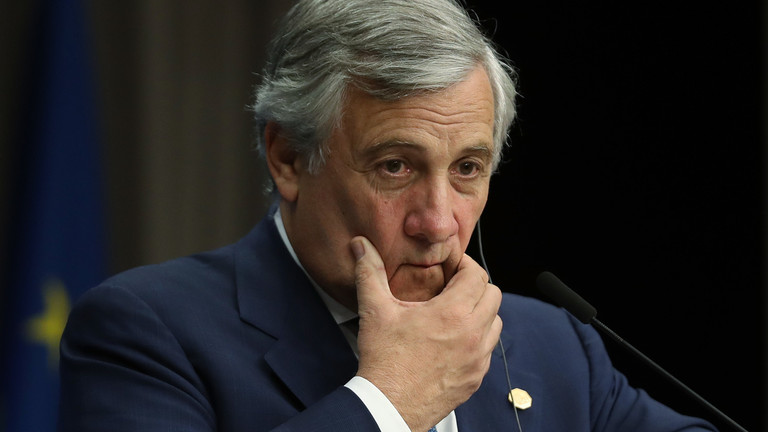
Italian Minister of Foreign Affairs Antonio Tajani. © Sean Gallup/Getty Images
BY ANDREW KORYBKO | AUGUST 4, 2023
Italy’s reaction to the patriotic military coup in Niger late last month has been surprisingly pragmatic. It could have easily jumped on the bandwagon of supporting the planned NATO-backed Nigerian-led ECOWAS invasion aimed at reinstalling ousted President Mohamed Bazoum and going along with his Ambassador to America’s claim that Russia had a hand in the coup. Instead, the Italian Foreign Minister described any Western military initiative as “a new colonization” and denied any Russian role in events.
Italy supports the West’s anti-Russian sanctions and arms Kiev against that country so Rome wasn’t expected to behave so independently towards a comparatively less significant matter than the NATO-Russian proxy war in Ukraine. That’s not to downplay the devastation that could soon ravage West Africa if it descends into a regional war, but just to point out that the precedent set by Italy’s compliance with Western demands vis-a-vis Russia suggested that it would also comply with their Nigerien policy too.
This exception is explained by the fact that Italy is very serious about combating illegal immigration at its roots, which was the official reason behind its decision to deploy a little less than 500 troops to Niger over half a decade ago in late 2017. While it’s difficult to assess whether this stated mission was a success since information about it has remained suspiciously scarce since then, the pretext for its troops’ deployment remains in place as evidenced by the related rhetoric espoused by its latest premier.
Giorgia Meloni rose to power partially because of her promise to drastically curtail illegal immigration to Italy, which would be very difficult to do if a major war breaks out in West Africa and results in an unfathomable number of desperate people fleeing across the Mediterranean to her country as refugees. It would already be bad enough if Nigeria soon leads an invasion of Niger, but this would be even worse if Italy’s French neighbor joined in and thus played a role in catalyzing another humanitarian crisis.
Italy might not be able to stop the US from coercing Nigeria into doing its bidding against Russia’s regional strategic interests by proxy, but its Foreign Minister’s description of potential Western involvement in this operation as “a new colonization” could make France think twice about participating. Bilateral relations were recently damaged due to their differences over migrants/refugees so it’s likely that Meloni’s top diplomat was sending a signal to Paris through his strong words on this issue.
She’d come under intense pressure on the domestic front if France was responsible for another humanitarian crisis that crashed into her country’s shores, plus responding to this would entail considerable costs that would be better spent on socio-economic investments if war could be averted. These calculations explain why her government broke ranks with the West on this issue since her political career could be threatened if this situation spirals out of control.
Her country’s policymakers are also impressively thinking ahead by tempering their rhetoric in order to avoid provoking the junta into pressuring their troops to leave and thus weakening Rome’s ability to at least keep an eye on this migrant/refugee corridor through their deployment in Niger. They still oppose the patriotic military coup, but they’re doing so in a measured way that reduces the risk of blowback while still at least formally paying lip service to the so-called “rules-based order”.
As for the second part of Italy’s pragmatic response to recent events, this builds upon the motivations that were just described above regarding the self-interested need to not provoke the junta. Rome isn’t suggesting that this regime change was legitimate, but it’s also not fueling the information warfare campaign being waged by some like Bazoum’s Ambassador to America, which is intended to precondition the Western public for NATO’s potential involvement in any possible invasion of Niger.
This stance hasn’t had any influence on reshaping Italian-Russian relations since it’s driven purely by Rome’s interests in retaining its military presence in Niger for the purpose of monitoring the migrant/refugee corridor through that country. These domestic political motivations, which also have an inextricable security dimension to them too, are so important to the present Italian government that they resulted in its top diplomat publicly counteracting fake news about Russia’s involvement in events.
What this insight shows is that it’s possible for Western states to behave independently of their peers on certain issues if sensitive domestic interests are threatened, be they Italy’s migrant/refugee ones in the Nigerien Crisis or Poland’s agricultural interests regarding the subject of importing Ukrainian grain. Each of these two examples is also connected to their leaders’ political interests, which cynically suggests that they’ll only act in a sovereign fashion on these aforesaid sensitive issues if their careers are on the line.
Even so, it’s still intriguing to observe them putting their interests above their de facto New Cold War bloc’s, thus proving that it’s not impossible for this to happen. Under the specific conditions that were just described where sensitive domestic interests converge with the political ones of any given Western leader, it can’t be ruled out that they’ll act more independently than their peers. This has already happened twice thus far in just as many weeks, which makes it a documented fact and not speculation.
Calls to ban Russian aluminum ‘expose EU market manipulation’ – industry association
RT | July 31, 2023
Five EU-based business associations representing aluminum consumers have called on the London Metal Exchange (LME) to reject demands for sanctions on Russian primary metal, describing the pressure as “obvious market manipulations,” according to a statement by the Federation of Aluminium Consumers in Europe (FACE) released on Friday.
Last week, Norwegian producer Norsk Hydro urged the LME, the world’s largest and oldest market for industrial metals, to reconsider a decision made in March not to ban Russian aluminum from its warehouse network. Norsk Hydro argued that Russian aluminum, which is subject to US sanctions, dominates the LME warehouse stock and poses risks to the market.
According to the letter sent to the LME on Friday by the Belgium-based FACE along with four associations from Germany and Italy, the calls to ban Russian aluminum are “obvious market manipulations by vested interests,” as they were made by major metal producers who are direct competitors of Russian manufacturer Rusal.
Such a ban would be “suicidal” in the current context of the “huge metal deficit” in Europe, high energy prices, and inflation, the FACE statement claimed.
Calls for sanctions “seem one more oligopolistic attempt to easily eliminate a competitor with non-market practices and to turn Europe into a captive market, with full knowledge of the devastating impact any restriction of Russian metal supplies will have on the EU aluminum industry value-chain”, said Mario Conserva, FACE’s secretary general.
He pointed out that small and medium-sized businesses represent 90% of the EU aluminum industry workforce and 70% of its output, but their interests are not taken into account when trade and supply policy decisions are made.
Earlier this month, Reuters reported that EU industry group European Aluminium had warned against placing sanctions on Rusal “due to its strategic importance on the global aluminum market.”
According to FACE, the EU is dependent on other countries for nearly 90% of its primary aluminum needs. Rusal accounts for about 12% of the bloc’s current demand, the association said. The industry body described Rusal’s output as competitive and fairly priced, and claimed that it helps decrease the carbon footprint of the entire European aluminum industry.
The Russian aluminum industry has increasingly become a target for Western restrictions. In February, the US imposed 200% duties on imports of Russian-made aluminum products, while the following month Canada banned imports of Russian aluminum and steel. In May, the UK also revealed plans to ban imports of Russian aluminum. The EU has so far restricted imports of only a limited number of specific aluminum products from Russia.
Russia has won the oil war
The West doesn’t seem too keen to enforce its $60 price cap on Russian crude
BY PÉTER G. FEHÉR | MAGYAR HÍRLAP | JULY 31, 2023
Moscow’s leadership may not have been cheering loudly, but they probably still celebrated quietly within the walls of the Kremlin. After all, Russia has won the oil war. The news has been widely reported among economists and even in Western press, but it cannot be said to have come as a surprise shock. Those involved in the global oil business knew that they could not win such a war against Russia.
The United States and the European Commission’s measures to reduce Russian energy exports aimed to produce problems for the Russian treasury by reducing its revenues. However, it seems that the punitive measures introduced without any impact assessment have been seriously misguided, especially on the part of the EU. Rather, the EU has punished itself by foregoing cheap Russian gas and being forced to buy expensive U.S. natural gas.
Strange as it may sound, the Brussels officials knew exactly that this would be the consequence of the sanctions they imposed. It is worth looking to Russia expert Christopher Davis, professor at Oxford University: Davis has claimed nothing less than that the European Commission only began to address the impact of the punitive measures after the sanctions against Russia were introduced. At that time, it produced a secret study that was not shared with EU citizens. It said that the decisions were taken too quickly and that they were taken under political pressure without any prior economic impact assessment. The EU thus did not look into the potential impacts of sanctions; it was in essence an abrupt and thoughtless decision.
Moscow, meanwhile, looked for other buyers of its black gold, which was also predictable, and China was one of the first to come forward. Moscow has now built infrastructure to handle the increased traffic between Russia and Asia. Before the war in Ukraine, China was buying 1.5 million barrels of oil a day from Russia. Today, it takes in 2.5 million barrels a day.
Now, publications such as the Wall Street Journal are acknowledging that Russia has achieved a real global victory in the oil wars. The price of the Russian Ural blend oil has for the first time exceeded the $60 cap per barrel imposed by the U.S. and its allies last December. Although this happened just last Thursday, there is no sign that anyone is willing to enforce the sanction.
It is now no longer a mere assumption that the EU and the U.S. have made spontaneous sanctions decisions against Russia with unforeseen consequences. It is understandable that the European Commission does not want to publicly admit the consequences of such clumsy measures.
The question has to be asked again, for the umpteenth time: Why are there no consequences for a disastrous decision taken by the European Commission that once again went over the heads of the member states without even consulting them?
***
US warns allies of potential isolation from deals over links to Iran, Russia
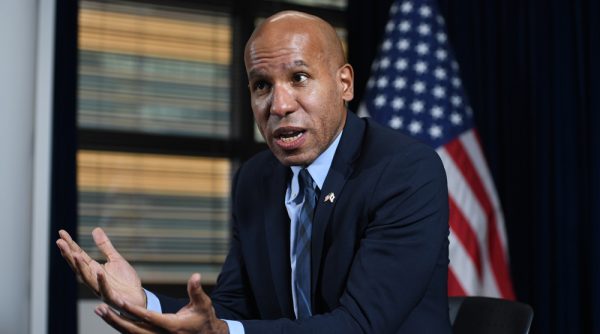
Brian Nelson, U.S. Treasury Undersecretary for Terrorism and Financial Intelligence
Press TV – July 29, 2023
The administration of US President Joe Biden has warned that Washington’s allies will face a “reputation risk” and potential isolation from lucrative deals in case of having links to the Islamic Republic of Iran and Russia.
Brian Nelson, the Treasury’s undersecretary for Terrorism and Financial Intelligence, raised the alarm in a meeting with Kenya’s President William Ruto on Friday.
He claimed that Iran and Russia were “isolated economically.”
“What we see is again of course Iran and Russia are isolated economically and either they are looking for partners and they are looking for new channels to have economic relationships,” Nelson claimed.
“From our perspective, that potentially creates a reputation risk and creates also a financial risk such that we are having a direct conversation about those risks that are associated with the expansion of economic relationship, which is a conversation not only are we having here but with countries around the world and we know that clearly is what Russia and Iran are seeking,” he added.
In what is construed as Washington’s direct interference in its allies’ affairs, Nelson warned them to be wary of the two countries’ economic reputation.
The warning comes as Iranian President Ebrahim Raeisi embarked on an African tour earlier in the month, which took him to Kenya, Uganda and Zimbabwe at the official invitation of his counterparts from the three host countries.
Heading a high-ranking delegation, Raeisi forged new alliances and discussed possible avenues for the improvement of trade and political ties.
Raeisi stressed the need for enhancing relations with African countries, saying that the states are gifted with abundant natural resources and mines, and enjoy many potentials and areas for closer cooperation.
Iranian Foreign Ministry spokesman Nasser Kana’ani described Raeisi’s continental tour as “a new turning point” which could bolster economic and trade ties with African nations.
A total of 21 documents on cooperation in different areas were signed during the three-state tour to Africa.
Chief editor at Russian media outlet flees EU country over threats
RT | July 26, 2023
Marat Kasem, a senior journalist at Russian media outlet Sputnik, has fled Latvia after President Edgars Rinkevics suggested that prosecutors had treated him too leniently in a recent case, according to Russian Foreign Ministry spokeswoman Maria Zakharova.
Kasem spent four months in a Latvian jail earlier this year before being fined for allegedly aiding and abetting Russia.
“Would somebody from the White House or Downing Street tell Rinkevics that he is failing them by showing the feral nature of the liberal diktat,” Zakharova asked, during an interview with Sputnik on Wednesday.
The Russian official argued that the US and the UK were patrons of the Baltic states, but had failed to keep their “nationalist” clients in check. Latvia specifically presents itself as a nation that supposedly upholds liberal values, including by protecting journalists, Zakharova noted.
Kasem, who is a Latvian citizen, has faced legal problems in the EU due to his work as editor-in-chief of the Lithuanian branch of Sputnik.
He was first arrested in January, when he arrived in Latvia to visit his dying grandmother. Kasem was initially accused of espionage and violation of EU sanctions, charges that could carry up to 25 years in prison. Four months later, the authorities agreed to move him to house arrest.
Two weeks ago, local media reported that the case had been resolved, with Kasem admitting to aiding and abetting Russia and paying a fine of €15,500 ($17,000).
Latvian President Rinkevics, who took office on July 8, responded to the news by tweeting that “some recent decisions” by the Prosecutor General’s Office “raise questions.” He later clarified that in Kasem’s case and several others, he believed the punishments were too mild and indicated that he intended to seek explanations.
The remarks “made it clear as daylight” that Kasem’s problems in Latvia would continue, prompting him to leave, according to Zakharova.
The Prosecutor General’s Office said the public had not been informed about numerous details of the case due to national security, which it claimed “had an influence on the choice of the final punishment.” It hinted that the interests of other nations were involved.
Moscow considers the situation to be an example of political persecution. International journalism organizations and other Western states have turned a blind eye to it, said Zakharova, who implied that Kasem had admitted guilt under duress.
Zelensky uses martial law to avoid election
RT | July 26, 2023
Ukrainian President Vladimir Zelensky on Wednesday proposed to extend the state of emergency, thereby effectively canceling the parliamentary elections scheduled for October.
Zelensky announced martial law on February 24, 2022, and has been extending it ever since. The most recent 90-day extension was announced on May 20, and is due to expire on August 18. If the Verkhovna Rada approves Zelensky’s latest request, this will see the emergency extended through November 15.
Ukrainian law calls for parliamentary elections no later than October 29, with a 60-day campaign season starting on August 28. However, it also forbids campaigning and voting during martial law. Another extension would cut into the campaign season for the presidential elections, currently scheduled for March 2024.
“If we have martial law, we cannot have elections. The constitution prohibits any elections during martial law,” Zelensky announced in May. The following month, he told the BBC that “elections need to happen in a time of peace, when there is no fighting.”
Some of Ukraine’s supporters in Europe and North America have been critical of the possible cancellation of elections. Ukraine should prepare for a vote as soon as possible, Parliamentary Assembly of the Council of Europe (PACE) head ‘Tiny’ Kox said in an interview in May.
“Although democracy is far more than only elections, I think we all agree that without the elections, democracy cannot properly function,” Kox said at the time.
Zelensky ran on a peace platform in 2019 and won with 73% of the vote. Soon thereafter, his newly formed party – named after the TV show in which he played a fictional president of Ukraine – won a supermajority in the Verkhovna Rada as well. By late 2020, he had pivoted away from the notion of peace in Donbass and began to openly talk about a military solution for “occupied territories.”
Within three months of the conflict with Russia escalating, in May 2022, Zelensky enacted a law that allowed him to ban any political parties merely accused of being “pro-Russian,” without any right to appeal. He has outlawed a dozen parties since then, including the formerly largest parliamentary opposition bloc.
Earlier this month, the Federal Intelligence Service of Switzerland accused Zelensky of attempting to “politically eliminate” Kiev mayor Vitaly Klitschko ahead of next year’s presidential election. The FIS cited “credible intelligence” to say that Zelensky was “showing authoritarian traits” which may lead to Western pressure, according to a classified report leaked to the outlet NZZ.
UK Blocks Ukrainian Orthodox Priest’s Testimony at UN Security Council
By Ekaterina Blinova – Sputnik – 26.07.2023
London prevented the religious leader from delivering his first-hand experience of repression against the church in Ukraine.
“Today is an extremely sad moment for the UN Security Council, as well as for the international community as a whole,” said Dmitry Polyansky, first deputy permanent representative of the Russian Federation in the UN.
“Western delegations actually agreed with the repressive policy of the Kiev regime against the canonical Orthodoxy. This is a clear evidence of blatant double standards in matters concerning freedom of expression, religion, and in general all those ideals that they preach. Your decision to block the participation of an Orthodox clergyman in accordance with the prerogatives of the president of the UN Security Council is clear evidence of how London treats ideals and how easily it is ready to give them up for the sake of narrowly selfish, petty attempts to prick Russia.”
The UK holds the 15-nation organ’s rotating presidency for July 2023.
Earlier, on July 18, Russia called for a meeting of the UNSC on Ukraine for July 26, in particular on the topic of repression against the canonical Ukrainian Orthodox Church.
On the same day, the Russian Foreign Ministry announced that Moscow would raise the issue of the persecution of the vicegerent of the Kiev-Pechersk Lavra, Metropolitan Bishop Pavel, at the upcoming meeting of the UN Security Council.
On July 14, a Kiev court changed the measure of restraint for Metropolitan Pavel from round-the-clock house arrest to detention until August 14.
For his part, Patriarch Kirill of Moscow and All Russia called on the UN, the Organization for Security and Co-operation in Europe (OSCE) and heads of churches, including Pope Francis, to protect the vicegerent of the Kiev-Pechersk Lavra.
Earlier this month Pope Francis responded to the appeal of Patriarch Kirill and spoke against politically motivated arrests in Ukraine.
The Kiev regime started to exert pressure on the Ukrainian Orthodox Church in 2022. Ukrainian authorities gave an ultimatum to the monks of the Kiev-Pechersk Lavra to vacate the monastery’s premises until March 29 under the pretext of allegedly violating the terms of the lease – jurisdiction over which is divided between the National Kiev-Pechersk Historical and Cultural Preserve, a Ukrainian secular organization and the UOC. Lavra monks condemned the eviction order as illegal as it was not backed by a court decision. As they resisted the Kiev regime’s attempts to expel them from the monastery, the Ukrainian authorities resorted to persecution.
Other Ukrainian Orthodox priests have also been subjected to pressure from the Ukrainian authorities. Ukrainian law enforcement officers searched the homes of bishops and priests, churches and monasteries, including the Kiev-Pechersk Lavra, in order to find traces of “anti-Ukrainian activities.”
A Bit of Political Theater in Vilnius
A whining President Zelensky goes home with almost nothing but still might start WWIII
BY PHILIP GIRALDI • UNZ REVIEW • JULY 18, 2023
It is a lucky break that the Screen Actors Guild has gone on strike as it will give Ukrainian President Volodymyr Zelensky an opportunity to dust off his thespian credentials and look for a new job when the Russians eventually bring down his government. Hollywood and Las Vegas would undoubtedly compete for such a nice Jewish young man to revive his former comedy routine where he played a piano with his penis. To be sure, without disrobing, Zelensky was inevitably the star performer at the recently completed two day NATO Summit in Vilnius Lithuania on July 11th-12th which also featured as a speaker US President Joe Biden, who provided a certain type of context by declaring that “Russia could end this war tomorrow by…ceasing its inhumane attacks on Russia!”
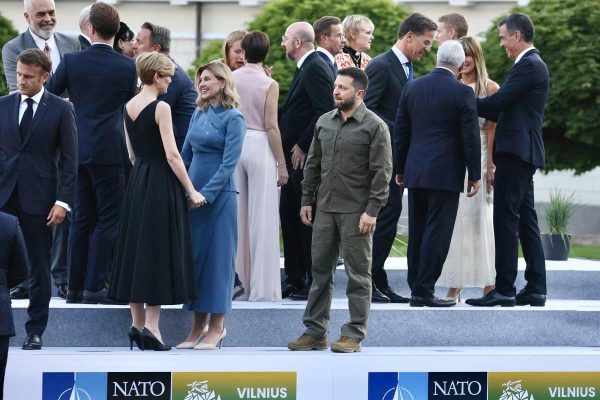
Zelensky whined and strutted through the two days, complaining that instant fast-track admittance of Ukraine to the NATO alliance was his right to enable him to defeat the Russian invaders. When he was instead offered a collaborative process whereby Ukraine would be made “ready” for entry through necessary rebuilding of its military coupled with institutional reforms to combat corruption and strengthen democracy, Zelensky called the delay “absurd” and “weak” on the part of his hosts. And he did so on social media to make sure that he embarrassed everyone involved. Zelensky also did not help his cause by parading in his ratty green combat fatigues, to include his presence at the first night’s gala reception before a group photo where he was observed standing alone, being ignored by the well-dressed crowd of delegates and spouses nearby who had turned their backs on him both metaphorically and physically.
All of which did not mean that the Summit was not, at least rhetorically, a cheerleading event for the plucky Ukrainian defenders against the Russian hordes. The American delegation emphasized that Washington would be there with whatever it takes to support the Ukrainians until “the end” when the war was “won,” whatever that was intended to mean. This has been described by some in the US media as an “Israel Model” in which you supply your proteges with money and weapons before looking the other way when they actually use them “aggressively and unilaterally,” often contrary to your own interests. And NATO meanwhile was firm in its support of the demand that all Ukrainian land be returned to Kiev’s control, to include Crimea, which is a complete deal breaker if there is ever to be any possibility of a negotiated settlement of the conflict, so it seems that the war will go on.
Observers at the Summit opined that the consensus among participants at the meeting was to throw some scraps to Zelensky while also avoiding any commitments that would heighten the risk of escalation into a nuclear war. The decision not to jump into bed with a desperate Zelensky recognized in part that he was and is reckless and would do anything he could to provoke broadening of the war if given the ability to do so. Beyond that, most of the heads of state gathered in Vilnius recognized that, from a domestic political perspective, their respective fellow countrymen have become increasingly weary of the war as it grinds on and brings with it negative economic consequences. And there are elections coming up, not only in the United States, later this year and in 2024.
Nevertheless, Washington was certainly on top of the effort to make sure that Zelensky would have the tools and political support that he would need to start World War Three, even if it required a bit of dissimulation. Biden wrapped up his whirlwind visit to Europe in new NATO member Finland on Thursday, praising the strength of the NATO alliance and expressing his delusion that there is no possibility that Russia will win the war against Ukraine. He said, without stuttering, that “Putin’s already lost the war. Putin has a real problem. How does he move from here? What does he do?”
Many believe, in fact, that it is Russia that has already won the war and, putting the sage commentary from Biden aside, seems to know exactly what is at stake. The effort to rearm the largely destroyed Ukrainian air force with US-made nuclear capable F-16s was expedited by Summit members, an escalation that was particularly noted in Moscow where Foreign Minister Sergey Lavrov commented in explicit terms how “Just one example of an extremely dangerous turn of events is the United States plans to transfer F-16 fighter jets to the Kiev regime. We have informed the nuclear powers, the United States, Britain and France, that Russia cannot ignore the ability of these aircraft to carry nuclear weapons. No amount of assurances will help here. In the course of combat operations, our servicemen are not going to sort out whether each particular aircraft of this type is equipped to deliver nuclear weapons or not. We will regard the very fact that the Ukrainian armed forces have such systems as a threat from the West in the nuclear sphere. The United States and its NATO satellites are creating risks of a direct armed clash with Russia, and this is fraught with catastrophic consequences. The conditions for Russia’s use of nuclear weapons are clearly defined in our military doctrine. They are well known, and I will not repeat them once again.”
And then there are the cluster munitions, promised by Biden two weeks ago after what must have been consultations with his astrologer, with at least some weapons reportedly being delivered by last Thursday. Cluster munitions are banned by over 100 countries in the world, including most of NATO’s member nations and many consider their use to be a war crime. They are particularly lethal when used in civilian areas as they disperse multiple small explosive charges over a wide area that sometimes do not detonate and kill many years later when they are encountered by accident. They were used extensively during the Vietnam War and are still killing farmers in Cambodia, Laos and Vietnam itself. Ironically, the United States accused Russia of using cluster bombs last year after it invaded Ukraine, calling them an illegal weapon, but now it is handing them to a psychopath who will undoubtedly seek to use them inside Russia to create a massive escalation that he expects to bring NATO fully into the war on his side. World War Three then inevitably evolves.
Washington’s aggressive moves to arm Ukraine follow on Britain’s in recently supplying Kiev with depleted uranium shells which contaminate surrounding areas with a radioactive dust during and after use. Evidence from areas such as Fallujah in Iraq, where the US and Britain fired large numbers of these shells, suggests the contamination can include a decades-long spike in cancer and birth defects.
And then there is the final Biden gesture to bring about peace on earth which took place through a White House order issued on the day after the NATO Summit ended. It states that: “I hereby determine that it is necessary to augment the active Armed Forces of the United States for the effective conduct of Operation Atlantic Resolve in and around the United States European Command’s area of responsibility… not to exceed 3,000 total members at any one time, of whom not more than 450 may be members of the Individual Ready Reserve, as they deem necessary, and to terminate the service of those units and members ordered to active duty.” While the numbers are not great and the language is governmentese, it is an order to send more soldiers to Europe to increase available resources for potential combat against the Russians. It may be the first of a number of such orders since NATO has reportedly assured Zelensky that the alliance would be increasing its so-called high readiness forces (ready to deploy in 30 days or less) to 300,000. Right now, the number of US troops in all of Europe is roughly 100,000 plus an estimated 100 CIA officers and some special ops personnel on the ground in Ukraine itself. One would not be surprised to learn that the first tranche of soldiers is bound for Poland, which borders Ukraine, Belarus and Russia and where there has already been a significant military build-up including troops from the 101st Airborne and 3rd Armored Division sent to the country for “training” last year.
There are also reports that the White House has moved B-52 bombers from their bases in the continental US to bases in Alaska closer to Russia to serve as a warning. One can only hope that somehow, some way this insanity will stop. We elect our leaders with the expectation that they will keep us safe, not engage in brinksmanship with nuclear weapons. If this is a pre-electoral ploy to re-elect Joe Biden next year by making him appear to be some kind of strong, wartime president, someone should pull the plug right now and tell Joe it is time to retire. Good going-going-gone to you Joe and whichever morons are advising you, most likely to be Antony, Jake and Victoria! You are well on the way to killing all of us for nothing!
Philip M. Giraldi, Ph.D., is Executive Director of the Council for the National Interest, a 501(c)3 tax deductible educational foundation (Federal ID Number #52-1739023) that seeks a more interests-based U.S. foreign policy in the Middle East. Website is councilforthenationalinterest.org, address is P.O. Box 2157, Purcellville VA 20134 and its email is inform@cnionline.org.
Fake News Alert: Wagner Isn’t Going To Invade The Suwalki Corridor

BY ANDREW KORYBKO | JULY 18, 2023
The Daily Mail sensationally claimed on Sunday that Wagner is plotting to invade the Suwalki Corridor from Belarus, after which this narrative virally spread across the global information ecosystem to take on a life of its own. There’s no truth to this allegation, however, since it’s solely the editorial spin that this British tabloid put on the words of a leading Russian parliamentarian. The present piece will debunk this fake news about Russia’s intentions prior to analyzing the importance of what was really said.
Chairman of the Duma’s Defense Committee Andrey Kartapolov inadvertently set this scandal into motion after recently saying the following on a top domestic political talk show:
“It is clear that Wagner [mercenary army] went to Belarus to train the Belarusian armed forces… [But] not only, and not so much. There is such a place as the Suwalki Corridor. Should anything happen, we need this Suwalki Corridor very much… A strike force [based on Wagner forces in Belarus] is ready to take this corridor in a matter of hours.”
As can be seen beyond any credible doubt, Kartapolov was only talking about a hypothetical scenario and not conveying his country’s forthcoming intentions like the Daily Mail falsely alleged in their piece.
They spun his words for clickbait, but this also served to fearmonger about Russia, Wagner, and Belarus, which advances the West’s narrative interests in the New Cold War. That trifecta is smeared as the new “Axis of Evil” by the media, with average Westerners now being misled by the Daily Mail into thinking that President Putin might be about to spark the apocalypse if he isn’t stopped. Accordingly, those who fall for this fake news might therefore be in favor of NATO accelerating its buildup in the east.
The above insight should show the Alt-Media Community how irresponsible it is to spew conspiracy theories about Wagner’s presence in Belarus since claiming that there’s some “5D chess master plan” involved unwittingly fuels Western fearmongering about Russia that hastens NATO’s containment plans. In reality, the group’s role in that neighboring country will be limited to improving its defenses in the face of Western Hybrid War threats such as another coup attempt and/or Belgorod-like proxy incursions.
No foreign offensive actions are planned, but that doesn’t mean that Kartapolov’s words aren’t important to pay attention to. Reading between the lines, he cleverly conveyed several points that observers would do well to reflect on. First, he discredited the conspiracy theories about why Wagner was sent to Belarus by reaffirming that they’ll only focus on training that host country’s armed forces, which protects Russia’s integrity by counteracting false claims about its supposedly aggressive intentions.
The second point is that he indirectly reminded everyone of Wagner’s battlefield finesse by talking about a hypothetical scenario where they might be ordered to go on the offensive. This reinforces their hard-earned reputation as being among the most formidable forces that Russia has fielded since World War II, which directly leads to the third point about how they might be ordered to secure this geostrategic corridor in the event that NATO-Russian proxy war in Ukraine turns into a larger conflict.
What’s so significant about the last-mentioned point is the suggestion that Wagner still takes commands from the Kremlin, thus segueing into the fourth point regarding the outcome of President Putin’s meeting with its leaders in the days after their chief Yevgeny Prigozhin’s failed coup attempt. There was nothing conspiratorial about this as explained in detail here since it simply concerned the Russian leader requesting their feedback about how best to restructure the group while still retaining its efficiency.
And finally, the last point to be discerned by reading between the lines of Kartapolov’s words is that Wagner remains a bastion of Russian patriots in spite of some members previously being misled by their chief into committing treason. After all, if there were any lingering doubts about their reliability, then he’d never suggest that they’d be ordered to secure the Suwalki Corridor in the worst-case scenario of a direct hot conflict with NATO. This shows that the Kremlin and Wagner have truly reconciled.
To summarize the importance of this scandal, it’s worth paying much more attention to what Kartapolov actually said than what the Daily Mail sensationally claimed for clickbait. Although the West is exploiting the latter’s fake news for information warfare purposes, astute observers who read between the lines of this official’s words will learn a lot about what’s really going on behind the scenes in Russia nowadays, namely that Wagner has returned to its role in defending that country’s national security interests.
Ukraine Jails Senior Orthodox Cleric, Russia Demands Release
By Kyle Anzalone | The Libertarian Institute | July 17, 2023
A senior figure in the Ukrainian Orthodox Church (UOC) was placed in pretrial detention. Cleric Metropolitan Pavlo is facing charges for voicing opinions deemed too pro-Russian.
A Kiev court ordered Pavlo to jail on Saturday. The cleric’s bail was nearly $900,000, and he could remain in pretrial detention for a month. The judge claimed Pavlo violated a court order by contacting a witness in his trial. Pavlo, who is also known as Petro Lebid, says he did not know that the person was a witness.
On April 1, Pavlo was placed under house arrest. Though initially only scheduled for a month, his house arrest has been extended several times. The charges against Pavlo include inciting hatred and justifying the Russian war in Ukraine.
On Saturday, Moscow demanded Kiev release Pavlo. Russian Foreign Ministry spokeswoman Maria said, “We demand strict compliance by the Kiev regime with its international legal obligations, the immediate release of Metropolitan Pavlo, who is suffering from a serious illness, and the provision of proper medical care for him.” She added that the arrest was “yet another manifestation of political arbitrariness and lawlessness [by Kiev.]”
Ukrainian President Volodymyr Zelensky has waged a culture war. The UOC has been a primary target of the “derussification” campaign. On December 1, Zelensky announced that Kiev would attempt to expel all religious institutions with ties to Russia, arguing the move would make “it impossible for religious organizations affiliated with centers of influence in the Russian Federation to operate in Ukraine.”
Kiev further ratcheted up the campaign to erase the UOC by seizing the assets and placing travel bans on several of the church’s top officials. Additionally, a series of raids by Ukrainian police targeted the UOC.
Zelensky’s derussification campaign has extended far beyond the UOC. Kiev has nationalized the media, renamed public places named for Russian historical figures, banned books printed in Russian and outlawed political parties representing Ukraine’s ethnic Russians.
Kennedy accuses Biden of preparing for ‘war with Russia’
RT | July 15, 2023
By ordering the deployment of 3,000 more reservists to Europe, US President Joe Biden is preparing to fight Russian forces on the ground in Ukraine, Democratic presidential candidate Robert F. Kennedy Jr. has said.
“Biden has lost his way,” Kennedy tweeted on Friday, arguing that the president should focus on America’s domestic problems instead of trying to achieve “global military dominance.”
“I want people to understand what this troop mobilization is about. It’s about preparing for a ground war with Russia,” he said.
The idea of defeating Moscow in its conflict with Kiev is a “futile geopolitical fantasy” of the Biden administration, the Democratic presidential candidate added.
Thousands of Ukrainians have already lost their lives because “America’s foreign policy establishment manipulated their country into war… Now, rather than acknowledge failure, Biden admin prepares to sacrifice American lives too,” Kennedy said.
On Thursday, Biden signed an executive order mobilizing 3,000 members of the US military’s Selected Reserve to boost the ranks of Operation Atlantic Resolve, which Washington launched in Europe in 2014 after Crimea rejoined Russia following the Western-backed coup in Kiev.
According to Army Lieutenant General Douglas Sims, the Joint Staff director of operations, the move “reaffirms the unwavering [US] support and commitment to defend NATO’s eastern flank” in the wake of Russia’s military operation in Ukraine.
The US European Command (EUCOM) spokesman, Navy Captain Bill Speaks, said the deployment of reservists “will not change current force-posture levels in Europe.”
The leading Republican presidential candidate, former President Donald Trump, also had some harsh words to say about Biden’s decision to send more American troops to Europe. The “reckless escalation in Ukraine” pursued by the White House is “straining the US military to the point of disaster,” he said.
“Joe Biden can’t even walk up the steps of Air Force One without tripping. The last thing this incompetent administration should be doing is pushing us further toward World War III.”
Trump reiterated his earlier claim that if he becomes president again, he would end the conflict in Ukraine in 24 hours. “Not one American mother or father wants to send their child to die in Eastern Europe. We must have peace.”
Another Republican presidential candidate, Vivek Ramaswamy, said it is “downright disturbing” that the US media is largely ignoring the president’s order in its reporting. “What is the justification now [for sending reservists to Europe]? What are the operations? Where will they go? What will they do? We need answers, not sweeping this under the rug as Biden would prefer,” Ramaswamy said in a statement.
Featured Video

ARE PATIENTS BEING PROPERLY INFORMED ABOUT OZEMPIC?
or go to
Aletho News Archives – Video-Images
New Book
Breast Cancer: Before You Consent
A new Unbekoming paperback
Lies are Unbekoming | September 18, 2026
Peter Gøtzsche reviewed every randomised mammography screening trial ever conducted for the Cochrane Collaboration. Cochrane’s headline is that, assuming a 15% mortality reduction, one woman in 2000 avoids dying of breast cancer over ten years. Ten are overdiagnosed and treated. Two hundred experience false alarms.
But that headline assumes the reduction. When Gøtzsche looked only at the trials with adequate randomisation — the higher-quality ones — the reduction disappeared. No effect on breast cancer mortality. No effect on all-cause mortality.
This is the Cochrane finding, published in the establishment’s own database of systematic reviews.
No woman being asked to consent to a mammogram this week knows it.
That is why the new Unbekoming paperback exists. … continue
Blog Roll
 Aletho News
- The Truth About the Trump Shootings with Ken Silva
- ARE PATIENTS BEING PROPERLY INFORMED ABOUT OZEMPIC?
- US lawmaker blocks $2.8 billion weapons sale to Israel: Report
- Yemeni army claims responsibility for strikes on sensitive sites in Saudi capital, Aramco facilities in Yanbu
- Iran Judiciary issues indictments against 159 US, Israeli officials for assassination of Leader, commanders
- Turkiye revokes Iranian bank license under US sanctions campaign
- US-Denmark Agreement on Greenland Is ‘PR Stunt’ Ahead of Midterms
- Araghchi: Military intervention cannot create security; coercion cannot bring peace
- Fraud Squared
- Breast Cancer: Before You Consent
- If Americans Knew
- Inside Gaza’s death trap of collapsing, bombed-out buildings
- The everyday items Israel bans from Gaza every day
- Inside the siege, the ruined buildings of Gaza – Daily Update
- Debunking The Claim That Macklemore Has A “History Of Antisemitism”
- CPJ demands release of arrested Palestinian-US journalist near Bethlehem
- Robert Kraft: The Billionaire Friend of Netanyahu Pulling The Strings Behind the Macklemore/Ed Sheeran Blow Up
- Columbia Administered Fund Gives Big Money to Pro-Israel Groups
- Deportation Case of Palestinian Activist Salah Sarsour Tests First Amendment
- ‘We Will Not Forget’: Palestinians Mark 44 Years since Sabra and Shatila
- Why do we let Zionists decide what we can and can’t say?
- No Tricks Zone
- 2025 Nature Paper Claiming Worsening Global Drought Gets RETRACTED …Heavily Flawed
- New Study: ‘Global Drought Shows No Detectable Recent Acceleration Under Climate Warming’
- Economic Masterminds: German Socialists Suggest Taxing Productivity Gains Stemming From Using AI
- The South China Sea Has Not Been Cooperating With The Climate Change Narrative
- Energy Crisis: Germany Enters Heating Season With Historically Low Gas Reserve Fill Levels
- New Study: The Antarctic Ice Sheet Gained Mass From 2020-2024 Due To Staggering Snow And Ice Accumulation
- Study: Ocean Heating Rates From Thousands Of Years Ago ‘Dwarf’ Modern Ocean Heating Rates
- Climate Extremists Target, Attack Large-Scale Power Grid Infrastructure In Germany!
- New Study: Antarctic Ice Melt Has Contributed Less Than 1 Centimeter To Sea Level Rise In The Last 30 Years
- Fear Of Debate: Alarmist German Climate Scientist Calls On Mainstream Media To Discredit Skeptic Voices
 Aletho News