NATO adopts new anti-Russia defense plan
RT | July 13, 2023
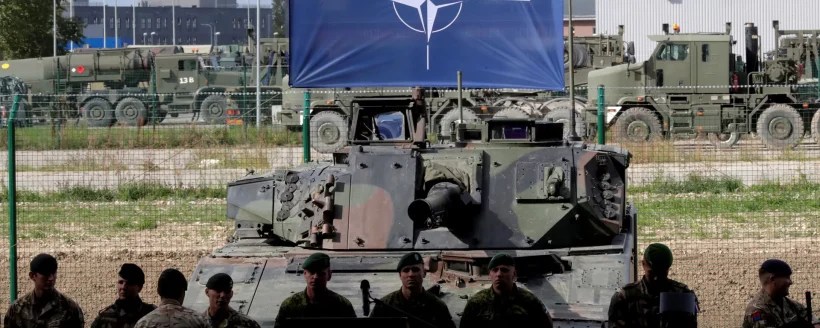
NATO passed a new defense plan at the Vilnius summit on Tuesday. The whopping 4,400-page document details the defense of critical locations in case of “an emergency” and lists a potential attack by Russia as one of the biggest threats, according to German media. The bloc’s secretary general, Jens Stoltenberg has welcomed what he called “the most comprehensive defense plans since the end of the Cold War.”
The document addresses two “main threats – Russia and terrorism,” and accuses the former of being “the greatest and most immediate threat to the security of allies and to peace and stability in the Euro-Atlantic region,” according to Germany’s Bild tabloid.
German Chancellor Olaf Scholz also called on his country and the other NATO members to “arm ourselves against a threat to our territory,” Bild added. The new plan also lists the military capabilities the bloc’s members must demonstrate, including new member Finland and applicant, Sweden.
The document reportedly claims a “violent” and “revisionist” Russia could potentially attack NATO territory. “We recognized that we could indeed be faced with an Article 5 situation again, in which part of NATO territory is under direct attack,” a military bloc official told German news agency, dpa.
To counter the supposed ‘Russian threat,’ the bloc plans to massively increase its Response Force (NRF) from the current 40,000 troops to over 300,000, comprising land, sea and air units, as well as rapidly deployed Special Forces.
The bloc also plans to significantly increase weapons production and stockpiling. The new strategy includes a “new Defense Production Action Plan to accelerate joint procurement, boost production capacity, and enhance Allies’ interoperability,” the NATO statement said.
According to Bild, the bloc would seek to build up armored “heavy forces,” and deploy more long-range artillery systems and missiles, as well as air defense systems.
NATO also plans to enhance what it calls ‘deterrence measures’ by sending additional forces to the Baltics and Eastern Europe. Battlegroups comprising 1,000 soldiers are to support the national armies of the Baltic States and Poland, Bild reported, citing the document.
The UK will be responsible for Estonia, Canada for Latvia, Germany for Lithuania, and the US for Poland, the German media outlet said. Berlin also plans to station a brigade of 4,000 soldiers in Lithuania, according to the German media.
Germany is also reportedly expected to serve as the NATO logistics hub in case of a major conflict. The bloc is also considering establishing a second Land Command, in addition to the existing station in Türkiye’s Izmir. Wiesbaden in Germany is being considered as a potential location since it already hosts a large US base, Bild reported.
Russia repeatedly stated that it considers NATO’s buildup on its borders as well as the bloc’s expansion to the east a threat to its national security. It also named preventing Ukraine from joining the bloc among the main reasons for launching its military operation in the neighboring country in February 2022.
NATO Spent Decades Preparing For Proxy War With Russia in Ukraine
By Ekaterina Blinova – Sputnik – 12.07.2023
Even before the Ukraine conflict escalated in February 2022, Britain, Sweden, Canada, and the United States were investing in Ukraine and building up their capabilities, the UK defense minister has stated at the NATO summit in Vilnius. Does it mean NATO has long prepared for a proxy war with Russia?
The US neocons and their likeminded NATO allies have long been apparently seeking to knock Russia out of the political arena before trying to crack down on China in a bid to preserve the US dominance, retired US Air Force Lt. Col. Karen Kwiatkowski believes.
“I think that the US officials and advisors (along with those in NATO) believe that they must be able to exploit Russian resources prior to any direct confrontation with China,” Kwiatkowski, who is also a former analyst for the US Department of Defense, told Sputnik. “The neoconservative ideology that over half of Congress embraces, and that the US defense and security complex embraces, envisions and demands a unipolar globe, with the US and its debt-funded governmental system, at the top. For them, this is an existential issue, albeit most Americans don’t see it that way.”
It seems that Ukraine appeared a convenient candidate for the role of a “hammer” against Russia.
For How Long Has Ukraine Received Western Military Assistance?
Ukraine has been a leading recipient of Western military supplies since the early 1990s when the country gained independence, with the US spearheading the initiative. In the first ten years after independence, Ukraine received almost $2.6 billion in assistance from the US. Until 2014, Ukraine had been receiving an estimated $105 million per annum, including foreign military financing.
NATO’s North Atlantic Cooperation Council embraced Ukraine as a “partner country” in 1991 and included it in the Partnership for Peace program in 1994. Washington’s NATO ally, the UK, played an important role in the effort, holding joint military exercises with the Ukrainians, as well as providing training and funding to the nation’s armed forces.
Thus, the first joint Ukrainian-British military exercises “Cossack steppe” were held in the second half of the 1990s as part of NATO’s Partnership for Peace program. The NATO-Ukraine Commission was established in 1997 with the aim of developing the relationship between the nation and the bloc and directing cooperative activities.
As per UK government documents, the Ministry of Defense spent approximately £3.9 million supporting Ukraine through the Defense Assistance Fund and the Conflict Pool between 2009 and 2014.
Many of the activities funded through these mechanisms supported “command, control and communications capabilities (C3).” In particular, the UK held joint exercises with the Ukrainian military, provided military education to the nation’s specialists, and “contributions to NATO coordinated activities.” Both UK civilian and military personnel had been deployed to Ukraine during that period of time while Ukrainian personnel were sent to the UK.
Following the illegitimate coup d’etat in Kiev in February 2014, the West stepped up military assistance to the new Ukrainian authorities.
Between 2014 and 2021, the United States provided over $2.5 billion in military assistance to Ukraine, which included the provision of trainers, selected weaponry systems (such as counter-mortar radars), and Javelin anti-tank missiles.
The boost in military assistance was justified by NATO member states by the alleged “Russian invasion” in Donbass. However, it is well documented that Donbass declared independence in response to the illegitimate coup d’etat in Kiev fomented with the assistance of nationalist and neo-Nazi paramilitary groups and subsequent Russophobic policies of the new government. The Donbass breakaway Donetsk and Lugansk Republics started largely forming militias after the interim Kiev government kicked off what it called “anti-terrorist” operations (ATO) against the region.
“Kiev had been on the offensive with the Donbass with Western support, for a number of years, even before 2014, and this is well documented,” explained Kwiatkowski. “Other Eastern and Southern European countries had been ‘encouraged’ by Western powers, as we saw with Yugoslavia, to break up into smaller national and ethno-cultural countries, and the peaceful divide between the Czech Republic and Slovakia was also allowed and supported. This is primarily because the newly smaller countries added potential members to NATO and the EU – all controlled and controllable by the US-EU elites.”
Moscow came up with the idea of the Minsk Agreements to stop hostilities in Eastern Ukraine. Russia, France and Germany played the role of guarantors of the accords.
Nonetheless, as ex-German Chancellor Angela Merkel and former French President François Hollande admitted last year, the Minsk agreements were signed by Western powers to buy time in order to bolster the Ukrainian military capacity.
“In the case of the political separation desired by the Donbass, and the Minsk agreements that were designed to allow that autonomy, the Russian-speaking East, if autonomous, would not have chosen to be a part of the NATO borg,” said the former Pentagon analyst. “Hence, that independence would not be allowed. Yes, NATO and the US supported such an offensive, and were preparing for it actively, as comments from many US and European officials and diplomats have confirmed. Assistant US Secretary of State Victoria Nuland and former German Chancellor Angela Merkel have publicly confirmed this, as have many others.”
Ukraine Extensive Training and Naval Provocations
US allies jumped on the bandwagon, forwarding their military assistance to Ukraine through the NATO-Ukraine Commission, and through initiatives such as the US/Canada/UK/Ukraine Joint Commission for Defense Reform and Security Cooperation which was established in July 2014.
In particular, Britain kicked off and then expanded Operation Orbital, envisaging extensive training of the Ukrainian military including combat actions in urban environments.
These activities included:
· medical, infantry and survival skills training;
· countering improvised explosive devices;
· training for defensive operations in an urban environment;
· operational planning;
· engineering;
· countering attacks from snipers, armored vehicles and mortars.
It meant that those Ukrainian soldiers that had undergone training under the program would pass on their knowledge and techniques to their military peers. Britons also expanded the scope of the training package to embrace all branches of Ukraine’s Armed Forces.
In June 2020, Ukraine was offered Enhanced Opportunity Partner status with NATO which provided Ukraine with preferential access to NATO’s exercises, training and exchange of information and situational awareness. The status envisaged increasing interoperability between Ukraine and NATO member states. In September 2020, Ukraine hosted the Exercise Joint Endeavour with British, US and Canadian troops, held within the framework of Ukraine’s new enhanced NATO status.
In June 2021, the UK, Ukraine and industry signed a Memorandum of Implementation to a new Naval Capabilities Enhancement Program (NCEP). The program in particular included:
· Ukraine’s acquisition of two refurbished Royal Navy Sandown-class minehunters;
· the sale and integration of missiles on new and in-service Ukrainian Navy patrol and airborne platforms, including a training and engineering support package;
· The UK’s assistance in building new naval bases in the Black and Azov Seas;
· the development and joint production of eight fast missile warships;
· The participation in the Ukrainian project to deliver a modern frigate capability.
The same month, the UK Carrier Strike Group led by HMS Defender was deployed in the Black Sea “in a show of solidarity with Ukraine” and illegally entered Russian waters off Crimea and proceeded to sail through, prompting Russian warships and aircraft to surround the ship and fire warning shots in its vicinity to force it to leave. Even though the UK initially denied that it resorted to deliberate provocations, leaked British government documents proved otherwise.
Russia’s Draft Security Agreements
Russia has repeatedly raised the red flag over the NATO-Ukraine rapprochement and the transatlantic bloc’s enlargement. In accordance with its Declaration of State Sovereignty (July 16, 1990) Ukraine pledged to permanently remain a neutral country. In addition, in the early 1990s, Western powers asserted to Moscow that NATO wouldn’t expand towards Russia. At the same time, the US and its allies refused to consider Russia’s bid to join NATO while encouraging former Soviet Republics and Warsaw Pact member states to join.
Russia outlined its longstanding concerns with regard to Ukraine’s military buildup on its doorstep and NATO’s expansion in draft security agreements which were handed over to the US and NATO in December 2021.
The agreement particularly sought guarantees of NATO’s non-enlargement and non-admission of Ukraine to the bloc. The US and NATO rejected the major provisions of the agreement leading to Russia’s special military operation aimed at de-militarizing and de-Nazifying Ukraine in February 2022.
Ukraine Conflict is US/NATO Proxy War Against Russia
Even though in March 2022, Ukraine and Russia struck a preliminary deal in Istanbul to stop hostilities, the US and the UK openly opposed the agreement, pledging more weapons to Kiev and declaring the goal of bleeding Russia white.
“The US is waging a proxy war, because that is what the US has been waging against various named enemies, for the past 70 years, and it is how we are organized to fight,” said Kwiatkowski. “It is an open secret that the Pentagon, even with close to a trillion dollar budget, does not and, at this point, cannot defend US territory. The US elites and the US defense establishment self-perpetuation is wholly disconnected from the people here who pay its bills. Poor and non-strategic US leadership placed the US in a lose-lose situation.”
According to the US military expert, three problems have emerged in the result of Washington’s misreading of the Russia and Ukraine conflict:
· First, that intent of weakening and isolating Russia did not play out “as it must have done in Jake Sullivan’s brainstorming sessions.”
· Second, the supplies have illustrated a variety of strategic weaknesses in US and NATO defense industrial production, where we see Joe Biden actually stating the obvious that the “US is out of ammunition.”
· Third, taking the Ukraine-Russia destruction project on at a time when the US is experiencing financial weakness, with very limited reserves of gold, guns and “war spirit” demonstrates that the “war planning” of the White House and Pentagon has been done in a vacuum, and under false assumptions.
As per Kwiatkowski, peace is possible but it may require a difficult re-evaluation of the US role in the world while neocons and war profiteers do not accept this re-evaluation.
“Their ideology is mated to unipolar US power,” the US military veteran said. “I suspect some leaders in the West are beginning to understand that there is a way to peace, and it starts with acceptance of the truth of all sides, and negotiations based on that truth. Imagine a sane US government, a concerned NATO, a true patriot of Ukraine in Kiev, and the Russians all speaking honestly. As Trump stated months ago, this war could be ended in one day.”
Western analysts support NATO’s direct participation in Ukraine
By Lucas Leiroz | July 12, 2023
Western analysts are encouraging NATO’s direct participation in the conflict. On July 8, foreign affairs commentator Simon Tisdall published an article in The Guardian called “Defeat for Ukraine would be a global disaster. Nato must finally step in to stop Russia“. He argues that Ukraine’s entry into NATO should be accelerated, with a process similar to the one that guaranteed Finland’s accession. According to him, this is the proper way to avoid Kiev’s defeat and the failure of the “counteroffensive”, since the direct support of the alliance supposedly would make a Ukrainian victory possible.
“There’s a risk, if the current counteroffensive produces no breakthrough, weapons supplies run short, a new winter energy crisis strikes and western public support drops further, that Zelenskiy will be forced into negotiations – even into trading territory for peace. Secret, informal US-Russia talks are already under way. If Ukraine were already a NATO member, as promised 15 years ago, all this would not be happening”, he said.
The author believes in the possibility of accepting Ukraine even during the situation of the conflict. One of Tisdall’s arguments is that there are “historical precedents” for the Ukrainian case. Then, he reminds West Germany’s accession to NATO, which took place in the 1950s, still during the absence of German national unity.
“But there are precedents. West Germany gained NATO protection in 1955 even though, like Ukraine, it was in dispute over occupied sovereign territory – held by East Germany, a Soviet puppet. In similar fashion, NATO’s defensive umbrella could reasonably be extended to cover the roughly 85% of Ukrainian territory Kyiv currently controls”, he added.
Tisdall criticizes the posture of American and Western European leaders, who have been cautious, avoiding hasty decisions. The author does not see any validity in the existence of concerns about the possible impacts of Ukraine joining the bloc, stating that the actions of Western politicians are “rooted in American and west European fears that Putin, provoked, might attack the west”.
On the other hand, the analyst praises the posture of the NATO’s Eastern European countries. According to him, Bulgaria, Czech Republic, Estonia, Hungary, Latvia, Lithuania, Poland, Romania and Slovakia – the so called “Bucharest Nine” – have a “thankfully more robust” stance than Westerners. With this, Tisdall endorses the fanatical anti-Russian state ideology that currently prevails in that region.
In addition, Tisdall mentions in a positive way the opinion of former NATO Secretary General Anders Rasmussen. In June, Rasmussen stated that, if the NATO summit in Vilnius does not manage to change the Ukrainian situation, the eastern countries will certainly start to take individual actions to support Ukraine with troops on the ground.
“If NATO cannot agree on a clear path forward for Ukraine, there is a clear possibility that some countries individually might take action. We know that Poland is very engaged in providing concrete assistance to Ukraine. And I wouldn’t exclude the possibility that Poland would engage even stronger in this context on a national basis and be followed by the Baltic states, maybe including the possibility of troops on the ground … I think the Poles would seriously consider going in and assemble a coalition of the willing if Ukraine doesn’t get anything in Vilnius”, Rasmussen said on the occasion.
Indeed, considering all these factors, what appears to be happening in this case is an attempt by the pro-war western media to pressure NATO’s decision makers to advance the direct intervention agenda during the summit in Vilnius. From a strategic point of view, the pressure is meaningless and does not seem to have any effect, as NATO obviously does not plan to sacrifice its regular forces in favor of a proxy state. However, Tisdall and other pro-war international “experts” have no military experience, being just fanatical defenders of the so-called [Western] “rules-based order”, supporting any military measure necessary to prevent relevant geopolitical changes.
There is a clear absence of a realistic perspective in Tisdall’s words, with several mistakes in his analysis. For example, he tries to show a similarity of cases between present-day Ukraine and Germany in the 1950s, which does not exist. Although divided, Germany at the time was not in a situation of open conflict, which invalidates his narrative.
However, it must be admitted that in fact the direct involvement of Poland and the Baltics seems to be close to reality, as warned by Rasmussen. While analysts like Tisdall approve this anti-Russian disposition of some Eastern European countries, in reality it only tends to do them harm. Some post-communist states went through a process of extreme anti-Russian collective indoctrination, resulting in phenomena such as the rehabilitation of Nazism and the real desire for war against Moscow.
The problem is that NATO does not seem interested in helping them in such a work. For the alliance, what matters is keeping aggression against Russia restricted to non-member countries, which is why the bloc arms Ukraine and incites violence in Georgia and Moldova to open new flanks. The involvement of Western regular troops would be negative, as a direct war against Russia does not seem to be winnable.
Polish and Baltic authorities, however, seem willing to take irrational and anti-strategic actions to defend the Kiev regime. They believe that if it escalates, NATO will defend them from Russian responses, but this does not seem so sure to happen, as the alliance wants to avoid involving its troops in direct war. It remains to be seen how the other NATO countries would react to seeing the alliance disrespecting the collective defense pact.
Indeed, supporting NATO’s direct intervention is supporting the start of WW3. And, in the same vein, by supporting Poland and the Baltics individually going to war with Russia, Western analysts are unwittingly defending the path that could lead to the end of the alliance. The most rational and logical alternative is simply for NATO to accept the defeat in Ukraine and agree to negotiate with the emerging powers a new geopolitical reality.
Lucas Leiroz, journalist, researcher at the Center for Geostrategic Studies, geopolitical consultant.
INTERVIEW: John Mearsheimer — On US Power & the Darkness Ahead for Ukraine
SYSTEM UPDATE #109 | June 30, 2023
EU could be ‘disgraced’ by confiscating frozen Russian assets – Austrian FM
RT | July 3, 2023
The EU must ensure it has a clear legal basis if it decides to confiscate frozen Russian assets and hand them over to Ukraine, Austrian Foreign Minister Alexander Schallenberg has warned. The diplomat argued that failure to do so would significantly tarnish the bloc’s reputation.
In an interview with Austrian broadcaster ORF published on Sunday, Schallenberg stressed that any such confiscation of Russian assets “must be watertight” from a legal viewpoint. He claimed that Austria and other EU members “are countries with the rule of law,” and that they must apply that approach in international relations. According to Schallenberg, this is one of the fundamental differences between Western European nations and Russia.
“Expropriation is a massive intervention, according to law,” the Austrian minister noted. “If we do this… as states with the rule of law we must make legal decisions,” Schallenberg insisted, adding that any such step could be challenged at the European Court of Justice in Luxembourg.
Should the appropriation of Russian assets not be deemed to have a legal basis, this would be an “enormous setback, and basically a disgrace” for the EU, the official concluded.
Regarding relations with Moscow in general, the minister said that geography dictates that Russia will remain part of European history, and that attempting to ‘cancel’ the country would be wrong. Schallenberg called for communication channels to remain intact, and claimed that emotions should not guide EU policies toward Russia.
Bloomberg reported last month that EU leaders had considered plans to impose a windfall tax on profits generated by more than €200 billion ($217 billion) of frozen Russian central bank assets to aid Ukraine’s reconstruction. While the option had reportedly appeared to be the least problematic, some participants had still raised concerns over its legality, Bloomberg claimed.
In mid-June, the European Central Bank spoke out against a windfall levy, warning that it could undermine confidence in the euro as a global currency and hurt financial stability.
Back in April, the European Commission ruled that member states could not seize frozen Russian assets outright. The EU and its allies froze hundreds of billions of euros of Russian central bank holdings as well as private assets soon after Moscow launched its military campaign against Ukraine in February of 2022. Russian officials have repeatedly described any seizure of the country’s assets as theft and illegal under international law.
Nigel Farage Announces He’s a Victim of Financial Deplatforming
By Cindy Harper | Reclaim The Net | June 29, 2023
Former leader of the Brexit Party, Nigel Farage, alleges that he is facing what he describes as “serious political persecution” by the banking sector in the UK, claiming that the pro-Remain establishment is making a concerted effort to exclude him from the banking system. Farage asserts that this has made him contemplate whether he will be able to continue residing in the UK.
In a video released on Twitter, Farage shared that seven banks had turned down his applications for both personal and business accounts, making him feel like a “non-person.”
He stated that his bank accounts at an undisclosed financial institution, where he has been a customer for over four decades, were on the verge of being terminated without any explanation provided.
Farage posited three theories to explain why he believes the banking establishment is distancing itself from him. Firstly, he asserts that his role in championing Brexit has made him a persona non grata in the banking circles. “The banks did not want Brexit to happen,” Farage said in the video. “The corporate world will never forgive me.”
Additionally, Farage speculates that his political standing might be a factor. The “politically exposed person” protocol requires banks to conduct additional scrutiny on accounts held by politicians and their families to guard against the possibility of foreign bribery. Farage acknowledged the rationale behind such precautions but emphasized that the additional compliance burden for the banks should be commensurate.
Thirdly, Farage raised concerns about allegations that were made by Labour lawmaker Sir Chris Bryant in the previous year.
Bryant claimed that Farage had received a substantial sum of money, specifically £548,573, from Russia Today television station in 2018, an assertion that Farage vehemently denies. Farage stated, “The truth is I’ve never received any money from any sources with any link to Russia.”
Republicans ‘Too Afraid’ to Remove Adam Schiff From Office Over Russiagate Hoax
By Andrei Dergalin – Sputnik – 25.06.2023
Despite being censured in the US Congress, Adam Schiff is in fact doing pretty well for himself and is likely going to “get a promotion for lying to the American people for four years,” says a former Colorado state senator.
The US House of Representatives voted to censure Democratic Rep. Adam Schiff this week for his role in promoting unsubstantiated claims that former US President Donald Trump colluded with Russia.
Former Colorado Senator Ted Harvey (Rep.), however, argued that Schiff deserves worse for essentially lying to the American people while in the capacity of the House Intelligence Committee head.
Despite basically knowing that there was no substance to allegations of Trump colluding with Russia, Schiff told the US public that there was “ample evidence of collusion between the Russian government and the Trump campaign,” Harvey told Sputnik.
“That is everything Schiff said to the American people for four years as the chairman of the intelligence community, he should not just be censured. He should be removed from office,” he said.
Alas, Harvey lamented, the US Republicans are simply “too afraid” to pursue this course of actions and instead managed to make a “martyr” out of Schiff.
“And he is raising money by the boatloads and he is now running for the United States Senate and will get a promotion for lying to the American people for four years,” Harvey mused about Schiff’s prospects. “And instead of being held accountable for that, he’s going to be promoted for that.”
During his tenure as the 45th president of the United States, Donald Trump was hounded by allegations of colluding with Russia in order to be elected in 2016, with said allegations being actively promoted by his political opponents.
Despite the seriousness of the allegations brought against him, an investigation into the alleged Russian election interference led by special counsel Robert Mueller failed to produce conclusive evidence to back claims that Trump campaign members conspired with Russia.
Fragmentation of World Economy Now Irreversible – Russia’s Representative at IMF
Sputnik – 25.06.2023
The use of international trade and the dollar as a weapon by the West makes the fragmentation of the world economy inevitable, Aleksei Mozhin, Executive Director for Russia at the International Monetary Fund (IMF), told Sputnik.
“The blatant use by the West as a weapon of international trade, finance, as well as the dollar and the euro itself, makes the fragmentation of the world economy not only inevitable, but also irreversible,” Mozhin said.
He pointed out that Western representatives at the IMF are trying to avoid this problem, and the leadership of the international organization cannot ignore the pressure that Western participants are exerting on it. As an example of the fragmentation of the world economy Mozhin mentioned the consequences of Western sanctions introduced against Russia.
“We have learned this lesson, we will never allow ourselves to be so dependent on imports again, at least in the strategic sectors of the economy,” Mozhin told Sputnik, adding that the whole world is now aware that globalization is forcing all countries to follow the path of specialization to the detriment of economic diversification and that the process of deglobalization will continue.
Zelensky Ratchets Up Culture War with Ban on Russian Books
By Kyle Anzalone | The Libertarian Institute | June 25, 2023
Ukrainian President Volodymyr Zelensky signed a bill last week banning the import of books produced in Russia or printed in the Russian language. The new law is Kiev’s latest escalation in its extensive effort to eliminate Russian culture in Ukraine.
Since taking office, Zelensky has led a campaign of “derussification” within Ukraine. Last year, Kiev’s legislature passed a bill that will heavily restrict books manufactured in Russia or printed in the Russian language. Zelensky announced he signed the bill on Thursday, saying, “I believe the law is right.”
Kiev’s Culture Minister Oleksandr Tkachenko praised Zelensky for approving the ban. “The adoption of this draft law will protect the Ukrainian book publishing and distribution sector from the destructive influence of the ‘Russian world,’” he said.
The bill signed into law last week will ban all imports of books from Russia and Belarus. Additionally, the state will require a permit to import a Russian book from any third country. Zelenskiy’s office said the law would “strengthen the protection of the Ukrainian cultural and information space from anti-Ukrainian Russian propaganda.”
After Russia invaded Ukraine last year, Zelensky enacted a series of escalating steps with the goal of erasing, from Ukraine, any and all Russian culture. Kiev has worked to destroy all Russian monuments, rename public spaces that are in the Russian language, erase Russian historical figures, and target a branch of the Christian Orthodox church Kiev believes is too closely tied with Moscow.
Tkachenko has long been an advocate of the culture war in Ukraine. In a 2015 interview, he supported a ban on TV series and movies that are produced in Russia or glorify Russian people. One of Tkachenko’s goals at the time was to replace Russian content on Ukrainian televisions with Western programming.
While Kiev presents Moscow as the target of the culture war, the substantial minority of ethnic Russians and Russian speakers living in Ukraine are subjected to the laws. Zelensky has used the pretext of “derussification” process to consolidate control over Ukraine’s politics and media.
DC Scholars: Ukraine Conflict Shows World Has Grown Weary of US Hegemony
By Ekaterina Blinova – Sputnik – 24.06.2023
Despite having the largest military budget in the world and being the largest operator of military bases abroad, the US is far from being a global hegemon, argues a DC-based think tank Quincy Institute for Responsible Statecraft.
Over the past decades Washington has demonstrated a capacity for mass destruction – in Korea, Vietnam, Afghanistan, Iraq, Libya and elsewhere – but “it has won no more than Pyrrhic victories” which led to the erosion of trust in Pax Americana both at home and abroad, according to Responsible Statecraft scholars.
The US military spending reached $876.9 billion in 2022, while the nation also operates a whopping 750 foreign military bases. Still, Washington is incapable of persuading the Global South to join anti-Russia sanctions over the latter’s special military operation in Ukraine, the think tank remarks. “If hegemony means the capacity to get other countries to comply with one’s demands, the United States is far from being a global hegemon,” the report notes.
Judging from the so-called Pentagon leak, even some US allies and partners demonstrated hesitance and unwillingness to provide the Kiev regime with shells, jets and armored vehicles. Meanwhile, most nations of the Global South shrugged off the US calls for slapping sanctions on Moscow as contradicting their national interests.
US political observers emphasize that six nations in the Global South – namely, India, Brazil, Turkey, Indonesia, Saudi Arabia, and South Africa – are set to decide the future of geopolitics and insist that the Biden administration needs to win their hearts and minds. At the same time, European commentators argue that developing nations have the right to remain neutral and non-aligned.
For instance, in June 2022, India’s External Affairs Minister Dr S Jaishankar shredded the West’s claim that New Delhi was “sitting on the fence.” According to the minister, India is entitled to its opinion when it comes to the Russo-Ukrainian conflict.
Likewise, the Association of Southeast Asian Nations (ASEAN) has chosen to collaborate with both the US and China, instead of taking sides. Moreover, ASEAN nations are active participants of Beijing’s Belt and Road Initiative (BRI) regardless of Washington’s attempts to maintain its dominance in the region and curb China’s influence in the Asia Pacific.
Per DC scholars, the emerging trend was articulated by Brookings Institution fellow Fiona Hill, former Deputy Assistant to the President of the United States, in May 2023:
“The war in Ukraine is perhaps the event that makes the passing of Pax Americana apparent to everyone. … [Other countries] want to decide, not be told what’s in their interest. In short, in 2023, we hear a resounding no to US domination and see a marked appetite for a world without a hegemon,” she said at a conference in Tallinn, Estonia
According to Hill, the Global South’s resistance to the US and the EU’s demands to slap sanctions on Moscow is nothing short of “an open rebellion.” She noted that “this is a mutiny against what they see as the collective West dominating the international discourse and foisting its problems on everyone else, while brushing aside their priorities on climate change compensation, economic development, and debt relief.”
Western observers also acknowledge that the world’s center of gravity is steadily shifting east, adding that the Biden administration has so far sought to avert this trend by trying to establish “a lasting technological lead over China” and beefing up the US military in Western Pacific.
However, “most developing countries, including emerging powers in the Global South, are no longer willing to make zero-sum choices” between Washington and its geopolitical rivals, DC scholars underscore, urging American policymakers to accept the reality that the US is no longer “the indispensable nation.”
“NEW EASTERN OUTLOOK” THANKS EU FOR SANCTIONS COMENDATION
New Eastern Outlook – June 23, 2023
In connection with the inclusion of New Eastern Outlook in the EU’s 11th sanctions package, we sincerely appreciate the free and effective promotion of our journal.
For many years, New Eastern Outlook has been an open forum for experts from different countries to express their views on a wide range of political, economic and social issues. We have honestly and consistently reported on the neocolonial policies of the EU and the United States in various regions of the world, and we consider the sanctions policy against us to be our highest commendation.
We note that since the US Treasury Department imposed sanctions on us, the geography of our readers has expanded considerably and the number of our readers has grown steadily.
Thank you, European dictators! Have a safe journey into your troubled future!
We appreciate your sincere interest in our publications.
Featured Video

ARE PATIENTS BEING PROPERLY INFORMED ABOUT OZEMPIC?
or go to
Aletho News Archives – Video-Images
New Book
Breast Cancer: Before You Consent
A new Unbekoming paperback
Lies are Unbekoming | September 18, 2026
Peter Gøtzsche reviewed every randomised mammography screening trial ever conducted for the Cochrane Collaboration. Cochrane’s headline is that, assuming a 15% mortality reduction, one woman in 2000 avoids dying of breast cancer over ten years. Ten are overdiagnosed and treated. Two hundred experience false alarms.
But that headline assumes the reduction. When Gøtzsche looked only at the trials with adequate randomisation — the higher-quality ones — the reduction disappeared. No effect on breast cancer mortality. No effect on all-cause mortality.
This is the Cochrane finding, published in the establishment’s own database of systematic reviews.
No woman being asked to consent to a mammogram this week knows it.
That is why the new Unbekoming paperback exists. … continue
Blog Roll
 Aletho News
- The Truth About the Trump Shootings with Ken Silva
- ARE PATIENTS BEING PROPERLY INFORMED ABOUT OZEMPIC?
- US lawmaker blocks $2.8 billion weapons sale to Israel: Report
- Yemeni army claims responsibility for strikes on sensitive sites in Saudi capital, Aramco facilities in Yanbu
- Iran Judiciary issues indictments against 159 US, Israeli officials for assassination of Leader, commanders
- Turkiye revokes Iranian bank license under US sanctions campaign
- US-Denmark Agreement on Greenland Is ‘PR Stunt’ Ahead of Midterms
- Araghchi: Military intervention cannot create security; coercion cannot bring peace
- Fraud Squared
- Breast Cancer: Before You Consent
- If Americans Knew
- Inside Gaza’s death trap of collapsing, bombed-out buildings
- The everyday items Israel bans from Gaza every day
- Inside the siege, the ruined buildings of Gaza – Daily Update
- Debunking The Claim That Macklemore Has A “History Of Antisemitism”
- CPJ demands release of arrested Palestinian-US journalist near Bethlehem
- Robert Kraft: The Billionaire Friend of Netanyahu Pulling The Strings Behind the Macklemore/Ed Sheeran Blow Up
- Columbia Administered Fund Gives Big Money to Pro-Israel Groups
- Deportation Case of Palestinian Activist Salah Sarsour Tests First Amendment
- ‘We Will Not Forget’: Palestinians Mark 44 Years since Sabra and Shatila
- Why do we let Zionists decide what we can and can’t say?
- No Tricks Zone
- 2025 Nature Paper Claiming Worsening Global Drought Gets RETRACTED …Heavily Flawed
- New Study: ‘Global Drought Shows No Detectable Recent Acceleration Under Climate Warming’
- Economic Masterminds: German Socialists Suggest Taxing Productivity Gains Stemming From Using AI
- The South China Sea Has Not Been Cooperating With The Climate Change Narrative
- Energy Crisis: Germany Enters Heating Season With Historically Low Gas Reserve Fill Levels
- New Study: The Antarctic Ice Sheet Gained Mass From 2020-2024 Due To Staggering Snow And Ice Accumulation
- Study: Ocean Heating Rates From Thousands Of Years Ago ‘Dwarf’ Modern Ocean Heating Rates
- Climate Extremists Target, Attack Large-Scale Power Grid Infrastructure In Germany!
- New Study: Antarctic Ice Melt Has Contributed Less Than 1 Centimeter To Sea Level Rise In The Last 30 Years
- Fear Of Debate: Alarmist German Climate Scientist Calls On Mainstream Media To Discredit Skeptic Voices
 Aletho News