Russia ready to resume gas supplies to EU – official
RT | December 26, 2022
Moscow is ready to restart supplies of natural gas to the EU via the Yamal-Europe Pipeline, Russian Deputy Prime Minister Aleksandr Novak said on Monday. He noted that shipments through the route were halted for political reasons.
According to the official, the EU remains a relevant market for Russia, which is able to resume supplies to a region suffering from a gas shortage.
“For example, the Yamal-Europe Pipeline, which was shut down for political reasons, remains unused,” Novak said.
Gas supplies via the pipeline, which usually flow westward, have been mostly reversed since Poland terminated a supply contract with Russia ahead of its end-2022 expiry date, after rejecting Moscow’s demand for ruble payments. The Polish leg of the route is currently being used to pump stored gas from Germany.
In response to Warsaw’s move, Russian state-run energy giant Gazprom cut off supplies, saying it could no longer send gas via Poland, while Moscow imposed sanctions against the firm that owns the Polish section of the Yamal-Europe pipeline.
Although Russian gas deliveries to the EU via the Nord Stream and Yamal-Europe pipelines have been halted, Russian gas is still being supplied to certain European buyers via a transit line through Ukraine and the TurkStream pipeline through Türkiye.
Despite the persisting problems, Novak says he still sees the EU as a viable market for Russia.
“Today we can confidently say that there is a stable demand for our gas. Therefore, we continue to consider Europe as a potential market for our products. It is clear that a large-scale campaign was launched against us, which ended with acts of sabotage against the Nord Stream pipelines,” he said.
The market for liquefied natural gas (LNG) also remains open, according to Novak, who noted that Russian LNG supplies to the EU are expected to grow to 21 billion cubic meters by the end of the year.
Russia Rules Out Possibility of Supplying Oil at Forced Prices Set by West
Samizdat – 25.12.2022
MOSCOW – Russia will look for new markets and logistics even at higher costs so as not to supply oil at prices set by the West, Finance Minister Anton Siluanov said on Sunday.
“We will not supply oil by contracts, which will indicate price limits offered by Western countries. This is out of the question. Russian President Vladimir Putin stated that Russia will not supply oil under agreements that specify price caps,” Siluanov stated.
The minister also said that Russia will look for new consumers as the demand for oil is expected to increase.
“We will look for new markets, we will look for new logistics, and perhaps it will be more expensive,” Siluanov specified.
Earlier this month, the G7 nations (including the EU, associated with the club) and Australia capped Russian oil exports at $60 per barrel, citing the special military operation in Ukraine. Moscow lambasted the price cap, saying it was a brazen attempt to manipulate “the basic principles of free markets.” Russia warned it wouldn’t sell oil to those countries that adopt the price restriction, while Deputy Prime Minister Alexander Novak noted that the country stands ready to reduce oil production as a response to the cap.
FBI Infiltration of Big Tech put US on fast track to Neofascist Technocratic Autocracy
By Ekaterina Blinova – Samizdat – 24.12.2022
The recently released sixth and seventh batches of the Twitter Files shed light on the FBI’s instructions to censor specific tweets and accounts for “violating” the company’s terms of service.
The internal documents also lifted the veil of secrecy on how the bureau launched an apparent damage control operation prior to the publication of the New York Post’s bombshell concerning Hunter Biden’s laptop.
On top of that, an email by Twitter’s former Deputy General Counsel Jim Baker revealed that the platform collected a staggering $3 million from the bureau at least on one occasion.
“My opinion – based on the evidence available – is the FBI did this because the FBI is fundamentally corrupt,” Jason Goodman, a US investigative journalist and founder of Crowdsource the Truth, told Sputnik. “Failure to investigate Hunter Biden based on the evidence on the laptop is bad enough. Evidence being revealed now by Twitter’s new management suggests the FBI actively worked to protect Hunter Biden from public scrutiny and hide their own lack of enforcement action. Broad knowledge of the evidence on Hunter Biden’s laptop would certainly have led to public outcry at least for further investigation. We have never witnessed such a brazen criminal act by a US government agency so nakedly exposed. For the past two years, any individual who even debates these facts online loses access to the major social media platforms.”
The Twitter Files exposure apparently hit the FBI’s raw nerve as the bureau issued an official statement claiming that “the men and women of the FBI” were doing their job, while “conspiracy theorists and others are feeding the American public misinformation with the sole purpose of attempting to discredit the agency.”
While commenting on the bureau’s statement, one prominent legal expert remarked that it is not clear “what is more chilling: the menacing role played by the FBI in Twitter’s censorship program or its mendacious response to the disclosure of that role.”
How It All Began
Make no mistake, this started long ago, noted Goodman: in fact, the groundwork was laid after September 11, 2001, with the passage of the Patriot Act.
“Prior to that, Americans were protected from undue search and seizure by the fourth amendment of the constitution,” the journalist explained. “In the newfound ‘war on terror’ the Patriot Act was sold to the American public as increased security. But it introduced several unconstitutional new laws and new law enforcement tools that removed our constitutional protection. One such tool was the National Security Letter (NSL).”
Goodman has drawn attention to the fact that prior to the advent of NSLs, investigators needed to get a warrant from a judge and had to have probable cause supported by some kind of evidence before they could lawfully investigate a person or their property, including electronic accounts, like email or Twitter.
However, with the Patriot Act, the FBI could simply write up an NSL under the suspicion that an individual was a national security threat and launch a probe into them, according to the journalist. “No warrant or evidence was required,” Goodman added. Moreover, the bureau could also reject the requests of those asking for proof on the basis that the evidence would risk revealing sources and methods and was also a national security threat, according to the journalist.
“These newfound powers were quickly and consistently abused,” Goodman continued. “Former FBI General Counsel Valerie Caproni was admonished by both the House and the Senate for gross abuses of NSLs and other unconstitutional acts.”
However, it appears that the US Congress’ attempts to rein in the bureau have not borne any fruit and the FBI has only grown more brazen in the years since.
“By alleging that the FBI was engaged in a counterintelligence investigation, they no longer had to adhere to the same rules or obey the constitutional protections that existed previously,” said Goodman. “This is exactly how the FBI began their shambolic investigation into the so-called Russian collusion with Trump.”
Hunter’s and Hillary’s Emails & APT28
Meanwhile, the story of the FBI’s attempts to shield Hunter Biden evokes strong memories of the Democratic National Committee (DNC) leak amid the Hillary Clinton presidential campaign. The disclosure of Hunter’s bombshell emails was downplayed and smeared as a “hack” and “disinformation” by “Russian APT28” just as the 2016 DNC email leak was.
According to Shellenberger, the bureau took Hunter Biden’s “laptop from hell” from Mac Isaac, a Delaware repair shop owner, on December 9, 2019. By August 2020, Isaac still had not heard back from the FBI, even though he had found alleged evidence of criminal activity on the device. So Isaac contacted lawyer Rudy Giuliani, “who was under FBI surveillance at the time,” and provided him with a copy of the laptop’s hard disk. In early October, Guiliani gave the disk to the New York Post.
On October 13, 2020, a day before the Post planned to release its bombshell, “FBI Special Agent Elvis Chan sent ten documents to Twitter’s then-Head of Site Integrity Yoel Roth through Teleporter, a one-way communications channel from the FBI to Twitter,” Shellinberger revealed citing internal Twitter documents. On October 14, 2020, the bombshell article saw the light of day but soon was banned and suppressed by major Silicon Valley giants, including Twitter.
But that is not all. According to Yoel Roth’s testimony, during all of 2020, the FBI warned him about the forthcoming Russian “hack and leak” operation “involving Hunter Biden” prior to the 2020 election. The bureau particularly referred to APT28, claiming that it’s a group of Russian hackers linked to Moscow’s intelligence services. In one of his recent interviews, Roth said that when Hunter’s emails finally emerged “it set off every single one of my finely tuned APT28 hack-and-leap campaign alarm bells.”
The “laptop from hell” posed a challenge to Hunter’s father, the Democratic presidential hopeful Joe Biden, as the bombshell suggested that the latter not only knew but also participated in his son’s murky financial schemes.
Similarly, the 2016 DNC leak threatened the Clinton campaign, demonstrating, in particular, that the party’s primaries were rigged in favor of Hillary. It was Clinton campaign lawyer Michael Sussmann who requested cyber security firm CrowdStrike’s help in investigating the alleged DNC hack.
CrowdStrike “detected” and “attributed” the alleged breach of DNC servers to Russia during the 2016 election cycle. The company claimed that the perpetrators were “two Russian espionage groups”: Cozy Bear (APT29) and Fancy Bear (APT28), suggesting with a “low” to “medium”-level of confidence that they may be affiliated with Russia’s Federal Security Service (FSB) and Main Intelligence Department (GRU), respectively. Moscow denied the claim as absurd.
For its part, the FBI relied on CrowdStrike’s conclusions, although the bureau has never physically examined the DNC servers and has only been provided with their “digital copies” instead.
According to Veteran Intelligence Professionals for Sanity (VIPS), a group of former US intelligence officers working within the CIA, the FBI and the NSA, there had been no hack: it was an inside job. Moreover, CrowdStrike President Shawn Henry admitted under oath in 2017 that the company does not have “concrete evidence” that the alleged “Russian hackers” exfiltrated any data from the servers.
The story of the DNC “hack” played a big role in smearing Russia and linking Donald Trump to Moscow. The Dems claimed that Moscow “hacked” the emails to help Trump win the 2016 elections. In summer 2016, the FBI launched Operation Crossfire Hurricane on the pretext of alleged “collusion” between Trump and the Kremlin. However, Special Counsel Robert Mueller investigation found no evidence to back the allegations, which were rubbished by Moscow from the very start as nonsensical.
“The true origin of the Russiagate hoax has not yet been revealed but it is becoming increasingly clear that top executives in the FBI have been involved in an ongoing coverup for a very long time,” said Goodman. “APT28 is likely a concoction of Dmitri Alperovitch’s Crowdstrike, which itself is an obvious FBI cutout. Crowdstrike co-founder Shawn Henry left the FBI to create the company, then shortly thereafter received $150 million from Google. Sounds fair enough but think about that for a moment. Google cannot easily hand $150 million to the FBI, but they can invest whatever they want in a startup tech company.”
It is not clear if the US public understands the legal games the FBI can play, according to the journalist.
“The FBI’s infiltration of Twitter is the tippy top of tip of the upper edge of the tip of the iceberg,” Goodman remarked. “We need to understand just how many private companies and non-profit organizations are secretly working with or for the incredibly dangerous and subversive US ‘Intelligence’ community. This hidden-in-plain-sight network of government agencies, non-profit organizations, and private industry is what is spoken of as the ‘Deep State’.”
Operation Mockingbird and Church Committee
The FBI’s attempts to control and infiltrate the work of social media giants resembles nothing so much as the US intelligence Operation Mockingbird which was first mentioned by CIA Director William Colby during his briefing to the Justice Department on December 31, 1974.
Later, the issue was touched upon by Watergate reporter Carl Bernstein in Rolling Stone in 1977. Bernstein revealed how numerous journalists, including Pulitzer-prize winners, wrote fake stories and disseminated propaganda at the CIA’s behest during the Cold War. The scale of the CIA’s huge international media network was described by one CIA official as ranging from Radio Free Europe to a third‐string guy in Quito who could get something in the local paper. According to the US mainstream press, the program has never been officially discontinued.
“It is essentially an extension of Operation Mockingbird,” Goodman said about the US intelligence community’s collusion with Big Tech. “The revelations of the Church Committee showed us the CIA’s intention. There is no reason to believe they would change. We see these ‘retired’ intelligence people on the news all the time. It should be obvious to anyone looking at the evidence if the FBI or any law enforcement or intelligence agency is doing anything other than tracking dangerous criminals on Twitter, they should not be doing it.”
The Church Committee was a US Senate select committee that investigated abuses by the CIA, NSA, FBI, and IRS in 1975.
Presently, it’s not a matter of the FBI getting away with what it has done (they already have), this is “an inflection point like none other in American history,” according to the journalist.
“We are in a dangerous moment,” Goodman warned. “The United States has become a neofascist technocratic autocracy. The new Congress must take bold steps to shut this down immediately and begin the journey back to the constitutional republic that was established in 1776 or it will only get worse (…) Another thing the Patriot Act created that most people are not aware of is the National Cyber Investigative Joint Task Force. It is an interagency intelligence-sharing operation overseen by the FBI. Critics say it eliminates the compartmentalization that is in place to prevent the types of abuses that are commonplace today. Without oversight, who knows what these interagency operations are capable of.”
Hungarian Parliament Speaker: West’s Push to Turn Ukraine Into Anti-Russian Bridgehead is a ‘Strategic Mistake’
Samizdat – 21.12.2022
Budapest has stood alone among NATO’s Eastern European flank in rejecting the transfer of weapons to Ukraine via its territory. Prime Minister Viktor Orban has essentially labeled the Ukrainian conflict a Russia-US proxy war, citing the need for peace talks between Russia and the US, rather than Moscow and Kiev, for the conflict to stop.
Hungarian Parliament speaker Laszlo Kover has lashed out against Western governments’ “hypocritical” behavior in Ukraine, and warned that the West’s attempts to pry Kiev out of Russia’s orbit and turn it into an armed base against Russia has proven to be a “strategic mistake.”
“I think the Western world made a strategic mistake when it tried to not only take Ukraine out of Moscow’s sphere of interest, but also turn it into a large military base against Russia,” Kover said in a broad ranging interview with a Hungarian radio station on Tuesday.
Asked whether he sees any prospects for a diplomatic resolution to the crisis, Kover said that if he “wanted to be cynical,” he would point out that Western countries have already found a workaround, by “proclaiming the protection of European values and international law and accusing Russia of all kinds of crimes, with basis or without basis. In the meantime, they have tried to stock up on Russian oil and gas, so their trade volume with Russia actually jumped radically after sanctions were announced.”
The politician, who is a member of Prime Minister Orban’s Fidesz party, accused Hungary’s European allies of engaging in a “hypocritical show” in Ukraine and behaving in a “terribly hypocritical and irrational” way, destroying their own economies, even as the United States “has embarked on the path of an openly protectionist economic policy,” by setting up trade barriers to European automobiles, for example, making American cars 25-30 percent cheaper than their European-made counterparts.
“This is clearly offensive. It violates all kinds of free trade rules and agreements, and of course violates the legitimate interests of European car manufacturers. Now, compared to this [the crisis with Russia, ed.] the leaders of the EU member states and the European Council are watching events with drooling glee, and we haven’t seen even a harsh outburst or verbal reaction, lest they take some kind of countermeasure, some kind of defensive step,” Kover complained.
The parliament speaker suggested that from the “first moment” of the Russia-West proxy conflict in Ukraine, the goal was to try to “destroy Russia economically, politically, in every sense” and to separate Moscow from the European Union, “to create a new Iron Curtain,” no matter the cost to Europe.
“This means in practice that the space of continuous economic and political cooperation based on mutual, fair consideration of interests, which could have been created in a unified Eurasia stretching to Portugal to say, Southeast Asia, seems to be falling apart at this moment, and I think that the damage caused by this conflict will stay with us for the rest of our lives,” Kover said.
Kover stressed that Hungary’s position has been and remains to defend its elementary economic interests by withdrawing from some EU-level sanctions against Russia “to prevent decisions that harm us more than Russia.” The official added that “the whole sanctions regime has hurt Europe much more than Russia, and I think we should fight here in Central Europe so that this scenario, where we become the eastern periphery of a North Atlantic empire, does not come true.”
Kover reiterated that measures were necessary “to try to end this armed conflict as quickly as possible,” even if it takes “years before this can take the form of some kind of peace treaty.” In the meantime, “we should try to create a new Central European or pan-European peace system in which each [country’s] security needs are taken into account by the other side,” the official said.
As for NATO’s role in the Ukraine crisis, Kover urged the Western alliance to stick to preparing to defend the sovereignty and security of alliance members, and not allow the bloc to drift into a hot war with Russia. “It’s very close to it anyway, because while no NATO members are involved in the war de jure… when a country supplies weapons to another that is at war or when a country or political community tries to destabilize the economic life of another country via various sanctions, blockades or the freezing of assets, this can be considered a kind of warfare.”
Relations between Hungary and Ukraine have been strained since the 2014 Euromaidan coup, which brought nationalist forces to power in Kiev which gradually moved to deprive the 150,000-strong community of ethnic Hungarian Ukrainians living in western Ukraine of their rights, including the right to receive an education in their native tongue.
Amid the escalation of the crisis, Hungarian and Ukrainian officials have gotten into a series of vicious verbal spats, with Ukraine’s Foreign Ministry asking Kover to produce a note from a psychiatrist on his mental state after the speaker suggested that Ukrainian President Volodymyr Zelensky was suffering from a “mental problem.”
Former Austrian vice-chancellor launches peace platform
Free West Media | December 20, 2022
The launch of a remarkable peace initiative has been reported from Austria. The initiator of the “Platform for Peace and Neutrality” is the former FPÖ boss Heinz-Christian Strache. On Monday, a highly acclaimed panel discussion took place in Vienna.
Guests included FPÖ veteran Andreas Mölzer, the former Liberal National Councilor Peter Fichtenbauer, AfD member of parliament Christina Baum, former Baden-Württemberg AfD member of parliament Heinrich Fiechtner and non-aligned Efgani Dönmez.
The motive for the event and the founding of his platform was that there were “no loud and audible peace initiatives,” explained Strache, who moderated the discussion. Russia is not being invited to the negotiating table, he added, blaming Western nations for not taking the initiative.
Former MEP Mölzer stated: “Nothing positive is being brought to the table from the European side at the moment.”
The panellists also agreed that Russia was being portrayed too negatively in the Western media. However, the causes of the war are much more complex, stated Mölzer. He added: “Not everyone who is critical [of the war], is a Putin supporter.”
For the AfD member of parliament Christina Baum, who had already spoken out in the Bundestag against Sweden and Finland joining NATO, Russia or Kremlin chief Putin was not responsible for the war in Ukraine. “The aggressor is the one who forces his opponent to take up arms,” she quoted Frederick the Great as saying. Even before the war, she thought, “I hope Putin won’t lose his nerve,” because he was “permanently provoked”.
The former Greens and ÖVP member Dönmez, a representative from the camp of the mainstream parties also participated in the round of talks.
Dönmez pleaded for restraint and understanding towards Russia: “We are presented with a narrative, a story that we have to accept without thinking. As a mediator, I say: I would also like to understand Mr. Putin.” This also applies in the case of the Ukrainian President Vladimir Zelensky and the Turkish President Erdogan. Instead, the West is deliberately escalating tensions.
The war is a proxy war of the great powers, said Dönmez. The EU only acts as a “vassal state” of the USA. Putin did them a favor with the war: the EU has now moved closer to the USA and has distanced itself from Russia, while the EU should actually pursue an independent peace policy, explained Dönmez.
Asked by moderator Strache whether Ukraine was the epitome of “Western values”, ex-AfD member of parliament Heinrich Fiechtner replied: “Unfortunately yes, it is – in all its corrupt amalgamation.”
The roundtable convened in Vienna also agreed that Austria’s neutrality should be upheld, which has been increasingly undermined since the beginning of the war. “I think joining NATO is the last thing the Austrians want,” Strache said. AfD MP Baum agreed and expressed the opinion that “it is very important that Austria remains neutral”. She wished the same for Germany, but chances are slim that Atlanticist politicians will abandon their course.
New enemies
While a year ago the unvaccinated and those who refused to wear masks were marginalized in society, today friends of Russia or critics of the war are the new enemy to be denunciated and discriminated against.
The deputy leader of the Union parliamentary group in the Bundestag Andrea Lindholz (CSU) has demanded a “reporting office” and a “nationwide situation report” on alleged Russian disinformation.
“The danger of Russian propaganda and disinformation in Germany must not be underestimated,” Lindholz is quoted as saying. “Especially now that everything is getting more expensive, there is a risk that people will become more receptive to pro-Russian fake news,” the CSU politician told the Redaktionsnetzwerk Deutschland.
Of course, it is particularly insidious when more and more alleged “fake news” turn out to be true as is currently being experienced with the Corona pandemic.
Over 60 Russians ‘Held Hostage’ in US, Arrested on False Charges, Deputy Foreign Minister Says
Samizdat – 20.12.2022
MOSCOW – The United States is practically holding over 60 Russians hostage by arresting people on false charges and sentencing them to dozens of years in prison, Russian Deputy Foreign Minister Sergey Vershinin told Sputnik on Tuesday.
“The US authorities have been literally hunting Russians across the globe especially in countries that have bilateral treaties on extradition with the US, seeking the arrest of our citizens on false charges… The overall number of Russian citizens basically held hostage exceeds 60,” the deputy minister said.
Vershinin said that US courts sentence Russians to dozens of years in prison, with the tendency becoming even stronger under the current US administration amid rising political tensions between the two countries.
The senior Russian diplomat also urged Russian people to weigh up the risks they could face when traveling to unfriendly countries if there is even the “slightest suspicion” that they could be of specific interest to US secret services and law enforcement as Russians are presumed guilty in this country.
Russia’s foreign ministry, embassy in Washington, general consulates in New York and Houston will continue to provide all possible help to Russians who are in trouble and seek their return home, Vershinin added, noting that Moscow would decisively respond to all hostile actions by the US authorities.
Released files reveal how FBI grilled Twitter
RT | December 19, 2022
Twitter’s former safety chief has said he was baffled when the FBI grilled the company over assessed foreign influence threats on the platform, the latest trove of documents released by journalist Matt Taibbi and Twitter owner Elon Musk shows.
According to excerpts from internal communications that were published on Sunday, FBI agent Elvis Chan told Twitter’s former head of trust and safety, Yoel Roth, in July 2020 to expect written questions from the Foreign Influence Task Force, adding that the intelligence community sought “clarifications” from the company.
The FBI then sent a list of detailed questions, asking Twitter to explain why, during an earlier briefing for US security and intelligence agencies, “you indicated you had not observed much recent activity from official propaganda actors on your platform.” At the end of their letter, the FBI attached references to several news articles about Russian and Chinese “propaganda” campaigns on social media.
Roth shared the questionnaire with other Twitter executives, saying that he was “frankly perplexed by the requests here, which seem more like something we’d get from a congressional committee than the Bureau,” according to screenshots published by Taibbi.
The former safety head added that he felt “not particularly comfortable” with the FBI demanding written answers on the matter. According to the released files, Roth wrote that the premise of the questions “seems flawed,” arguing that the intelligence community had “fundamentally misunderstood” Twitter’s position on disinformation.
“We’ve been clear that official state propaganda is definitely a thing on Twitter,” Roth wrote, suggesting he contact Chan over the phone as soon as possible.
The exchange took place when US officials, think tanks and media outlets were warning about alleged foreign meddling in the ongoing US presidential election campaign and disinformation related to the Covid-19 pandemic.
Musk, who finalized his acquisition of Twitter in October, promised more transparency at the company, and fired some of its top executives.
The files previously released by Taibbi with Musk’s blessing revealed how Twitter staffers struggled to rationalize the permanent ban of former US President Donald Trump, and the blocking of a story about the laptop belonging to Hunter Biden, President Joe Biden’s son.
Soaring energy prices cost EU $1 trillion – Bloomberg
RT | December 18, 2022
EU member states have spent roughly a trillion dollars (€940 billion) in the face of the bloc’s worst energy crisis in decades, Bloomberg is reporting on Sunday, citing calculations based on market data.
Soaring energy prices have sent its economies plunging into recession as most member states opted to stop importing gas from Russia, facing the necessity to turn to more expensive supplies.
The agency highlighted that the total estimated losses marks just the beginning of a full-scale crisis, as a period of high prices for energy could last years, while aid is already becoming unaffordable.
The security of energy supply is expected to remain an issue beyond next winter after the filled gas storage facilities across the region are emptied. The nations of the EU will have to refill their gas reserves for the next cold season with no deliveries from Russia, which also heats up competition for tankers.
Even with more import terminals for liquefied natural gas (LNG) coming online, the crisis will reportedly loosen its grip only in 2026, when additional production capacity from the US or Qatar becomes available. At the same time, prices should remain high to attract LNG away from other buyers from energy-hungry Asian buyers.
A state of emergency could linger for years, according to Brussels-based think tank Bruegel, as quoted by Bloomberg.
“Once you add everything up –bailouts, subsidies– it is a ridiculously large amount of money,” Martin Devenish, a director at consultancy S-RM, told the agency. “It’s going to be a lot harder for governments to manage this crisis next year.”
A rush to fill storage during summer, despite all-time high prices, has softened the supply squeeze so far. However, freezing weather is expected to give the region’s energy system the real test this winter.
Last month, Germany’s energy regulator, the Federal Network Agency, warned that German households and small businesses have failed their first gas-saving tests. The regulator noted that a reduction in consumption of at least 20% was required to avoid a gas shortage in the coming months.
Oil Exports From Key Russian Port Cut In Half As Price Cap Kicks In
By Tyler Durden | Zero Hedge | December 17, 2022
The market may have been too quick to dismiss the impact of European oil price cap on Russian oil.
Assuming that the latest G-7 attempt to limit Russian oil revenues were one big nothingburger – after all, the US itself admitted that the goal of the price cap was not so much to cripple Putin’s Treasury as to maintain a more stable flow of oil – the market quickly ignored the potential of lower Russian output as it continued to sell oil into year end amid fears there won’t be enough demand to offset stable supply.
But in yet another case of poetic justice-cum-Murphy’s law, Europe’s exercise in virtue signalling optics is about to backfire and achieve precisely what it was meant to achieve, if only for virtuous public consumption.
According to Bloomberg, there are signs that oil tanker companies are avoiding sending their ships to collect crude from a key Russian port in Asia following the G-7 sanctions targeting Moscow’s petroleum revenues. As has been duly documented here previously, since Dec. 5, buyers of Russian oil have only been allowed to access industry standard insurance and an array of trade-critical services if they pay $60 a barrel or less. But shipments of the key ESPO grade from the Asian port of Kozmino are about $10 above that, meaning they need to make alternative arrangements.
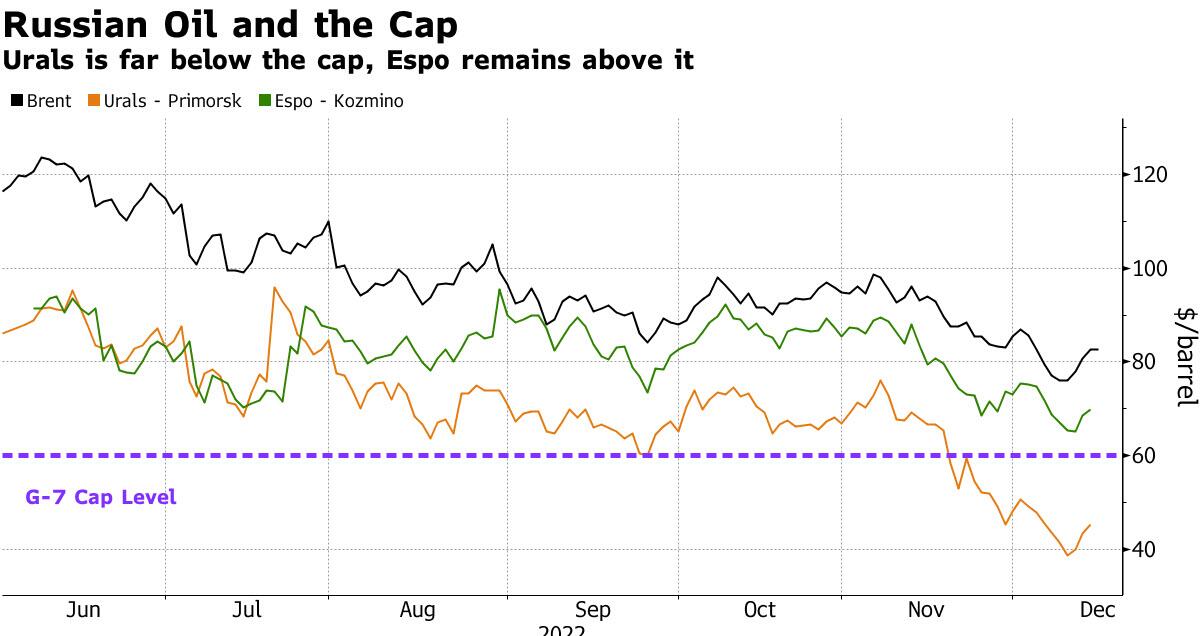
Since the cap began, ESPO (which stands for Eastern Siberia–Pacific Ocean, the initials of a pipeline that takes the oil from east Siberia to the Pacific) has seen loadings cut in half from a month earlier, tanker tracking compiled by Bloomberg show. By contrast Urals, a much larger grade exported from western Russia, is flowing freely to customers in Asia — aided by the fact it fell far below the $60 threshold a few weeks before it was introduced.
However, amid the latest sanctions which set the $60 price cutoff, tankers are shying away from the Asian grade, and in the 10 days since the measures began, 4.4 million barrels have been loaded onto tankers at Kozmino, Bloomberg calculates. In the same period a month earlier, there were 8.8 million barrels loaded.
While it is too soon to say if the observed drop in ESPO flows reflects something structural, weather conditions haven’t been particularly bad and there doesn’t appear to be many candidate ships in place to collect cargoes in the coming few weeks. That said, tanker tracking data is always volatile, depending on the timings of loadings, and the comings and goings of individual tankers.
Shipbrokers and traders contacted by Bloomberg also said that said there are signs that ESPO sellers are struggling to secure tankers for cargoes purchased at more than $60 a barrel. At least two large and well-known shipowners, China Cosco Shipping Corp. and Greece-based Avin International Ltd. have stepped back from moving ESPO crude since Dec. 5, according to shipbrokers. Emails sent to both companies weren’t answered.
Their absence has taken at least five tankers out of the regular pool of ships that move the grade, they said. That leaves charterers to work with smaller independent owners who’re still willing to handle the trade. If charterers continue to face headwinds with the booking of tankers, flows could be impeded, they said. ESPO and Sokol, another grade that’s exported from eastern Russia, currently trade above the $60 a barrel threshold that gives access to insurance and G-7 services.
With Urals grade Russian oil trading well below the price cap, and last fetching about $45/bbl, shipbrokers said tanker bookings for Russia’s flagship crude from western ports are proceeding more normally. Tanker tracking also suggests no obvious disruption to flows of the grade.
Of course, all of this is just a snapshot in time: once oil prices spike, as they will after the year-end selling is over, it is virtually assured that all Russian oil grades will be priced above $60, even with the deep discount to spot. At that point, traders will be watching closely to see if Russian crude exports can be maintained and how Moscow will respond if supplies do get disrupted.
As noted previously, the irony behind all this is that the stability of Russian exports is crucial as the US and rest of G-7 work on ensuring security of global oil supplies ahead of the Northern hemisphere winter while simultaneously attempting to deprive the Kremlin of funding for its war in Ukraine. A sharp loss of output could backfire on the west if it boosts wider oil prices and reignites inflation. And while the price cap wasn’t really supposed to be a price cap, it just may end up being one with Russian oil exports suddenly cut off, sending all “non-Russian” oil prices explosively higher, and sparking a new energy crisis some time in early 2023.
As for Russian product just sitting there, about half the ESPO cargoes scheduled for loading in the rest of this month have yet to secure tankers, according to shipbrokers. That is slower than usual, and they attributing it to the smaller pool of willing tankers operated by a smaller number of owners. It’s possible that tankers which previously handled oil from sanctioned regimes such as Iran and Venezuela – the so-called dark fleet – would be booked, shipbrokers said.
Germany’s Gas Reserves “Emptying At Record Speed” As Country Struggles To Keep Warm, Lights On
By P Gosselin | No Tricks Zone | December 16, 2022
Germany’s gas reserves are emptying at record speed: 1% per day as the current wind/solar energy lull means more gas gets burned for electricity, heating.
Pleiteticker.de reports how Germany’s natural gas reserves “are emptying at record speed” because wind and solar power have been on the scarce side over the past few weeks. This means gas turbines have had to jump in to pick up the slack in electricity production – not one the German government had hoped as it wrestles with the heightening energy crisis.
“Germany is converting gas into electricity in record quantities,” pleiteticker.de reports. “Thanks to high pressure system ‘Erika’, the current December is colder than it has been for years. […] In recent days, gas storage facilities have therefore been emptying much faster than before. From December 12 onwards, more than one percent was withdrawn from gas storage facilities in Germany every day.”
“Last week, almost one third of all electricity was generated from natural gas. These are record figures,” writes pleiteticker.de.
If the cold persists through the winter, gas reserves threaten to become extremely tight before spring arrives.
But instead of blaming the energy woes on failed government policies, federal network agency head Klaus Müller criticizes the situation on the consumers, and worries “the gas storage may not last the whole winter.”
“A national gas shortage in winter can be avoided if, firstly, the savings target of at least 20 percent continues to be achieved,” the Federal Network Agency says. Here the government’s solution clearly is that citizens should accept freezing even more when it’s bitterly cold out.
Over 800 million euros paid for unproduced energy in 2021
The problem with wind power is that either too much or too little is produced, due to the weather. As mentioned above. the past weeks have seen little wind power being produced, and so gas turbines had to be fired up to keep the grid supplied.
But when it’s too windy, something needs to be done to keep the grid from being overloaded: wind turbines have to be shut down. That’s costing Germans 807 million euros this year because the excess electricity that could have been fed into the grid by the wind parks legally has to be compensated.
Pleiteticker here writes: “For the amount of electricity that the operators could have fed into the grid, they still receive compensation from the grid operators according to the statutory tariffs. And this sum is higher than ever this year: 807 million euros. Record value. For electricity that never existed.”
And the problem is getting bigger, according to the Federal Ministry of Economics.
“At the time of the worst energy crisis Germany has seen in a long time, when companies and consumers are hammered by energy prices like rarely before, Germany is paying money for energy that also doesn’t get produced,” comments pleiteticker.de.
So far Germany’s response to the energy crisis is plans to build many more turbines, with talks of even tripling its current installed capacity, which of course would only triple grid volatility, thus making it far more unstable than it already is and so create an even much bigger mess.
Committee of German Parliament Approves $10Bln Purchase of F-35 Jets From US
Samizdat – 14.12.2022
The Budget Committee of the German parliament approved the contract with the United States on the purchase of F-35 fighter jets worth 10 billion euros ($10.6 billion), a British news agency reported on Wednesday, citing sources in the committee.
According to the news agency, the committee green-lighted the purchase using money from a 100 billion euro ($106 billion) special defense fund established by the German government shorty after the start of Russia’s military operation in Ukraine in February.
First eight fighter jets are expected to be delivered by the US to Germany in 2026, the report said, adding that the new planes could replace old Tornado jets.
In July, Washington also approved a possible $8.4 billion sale of 35 F-35 jets to Germany including missiles and equipment.
French energy major makes costly exit from Russia
RT | December 10, 2022
French oil and gas giant TotalEnergies has announced on Friday it is giving up its stake in Russian gas producer Novatek and withdrawing its two representatives from the company’s board.
The exit will result in a “record” impairment of about $3.7 billion in the fourth quarter as Total will “no longer equity account for its 19.4% stake in Novatek.”
The French company said in a statement that the two directors have had to abstain from voting in Novatek board meetings, “in particular on financial matters,” due to Western sanctions imposed on Russia.
Unlike BP and Shell, which left Russia shortly after the conflict in Ukraine began in late February, TotalEnergies had held on to its projects in the country and faced international sanctions.
“Under these circumstances, the Board of Directors of TotalEnergies has decided to withdraw the representatives of the Company from the board of PAO Novatek with immediate effect,” the company announced.
The French energy major also said it cannot sell its stake in the Russian firm as “it is forbidden for TotalEnergies to sell any asset to one of Novatek’s main shareholders who is under sanctions.”
Apart from the stake in Novatek, the French company has minority holdings in Russian liquefied natural gas (LNG) projects Yamal LNG and Arctic LNG. According to Reuters estimates, exiting Russian projects will bring total impairments of TotalEnergies this year to $14.4 billion.
In addition, Total will no longer book reserves for its interest in Novatek, with an impact on the company’s reported proved reserves at the end of 2021 of 1.7 billion barrels of oil.
Featured Video

The Truth About the Trump Shootings with Ken Silva
or go to
Aletho News Archives – Video-Images
From the Archives
Trans ‘milk’ as good as the real thing – NHS
RT | February 18, 2024
The drug-induced nipple secretions of trans women are as good as mothers’ breast milk for babies, the University of Sussex Hospitals NHS Trust claimed in a letter to campaigners made public in a report by British think tank the Policy Exchange on Sunday.
The healthcare trust’s medical director, Rachel James, argued that the off-label prescription drug cocktail men transitioning to female take in order to produce milk was “similar to the natural hormones which encourage lactation to develop when the baby is newly born.”
“The evidence which is available demonstrates that the milk is comparable to that produced following the birth of a baby,” James wrote in the letter, sent to Children of Transitioners last August.
Biological men who wish to lactate must first take hormones to grow milk glands and then take high doses of either domperidone or metoclopramide to stimulate milk production. Neither drug is approved for this use, though they are occasionally prescribed off-label to biological women who have trouble lactating.
However, domperidone’s own manufacturer, Janssen, warns patients the drug “may cause unwanted side effects affecting the heart in a breastfed baby” and “should be used during breastfeeding only if your physician considers this clearly necessary.” … continue
Blog Roll
 Aletho News
- Anthrax Attacks Paved Way for COVID-Era ‘Junk Drugs and Vaccines’
- How Real Is the Impact of Western Sanctions on Israel?
- France, You Are Guilty: How Paris Turned Western Sahara into the Maghreb’s Powder Keg
- 2025 Nature Paper Claiming Worsening Global Drought Gets RETRACTED …Heavily Flawed
- Your Milk Is Not the Problem
- The Truth About the Trump Shootings with Ken Silva
- ARE PATIENTS BEING PROPERLY INFORMED ABOUT OZEMPIC?
- US lawmaker blocks $2.8 billion weapons sale to Israel: Report
- Yemeni army claims responsibility for strikes on sensitive sites in Saudi capital, Aramco facilities in Yanbu
- Iran Judiciary issues indictments against 159 US, Israeli officials for assassination of Leader, commanders
- If Americans Knew
- Salah Sarsour’s Legal Team Says DHS Has Not Met Its Burden to Prove He Is Deportable
- An analysis of tax forms by The Intercept show Kraft’s charity and LLC have donated to Friends of the IDF and AIPAC’s super PAC.
- Israeli attacks kill four Palestinians in Gaza – Daily Update
- Inside Gaza’s death trap of collapsing, bombed-out buildings
- The everyday items Israel bans from Gaza every day
- Inside the siege, the ruined buildings of Gaza – Daily Update
- Debunking The Claim That Macklemore Has A “History Of Antisemitism”
- CPJ demands release of arrested Palestinian-US journalist near Bethlehem
- Robert Kraft: The Billionaire Friend of Netanyahu Pulling The Strings Behind the Macklemore/Ed Sheeran Blow Up
- Columbia Administered Fund Gives Big Money to Pro-Israel Groups
- No Tricks Zone
- 2025 Nature Paper Claiming Worsening Global Drought Gets RETRACTED …Heavily Flawed
- New Study: ‘Global Drought Shows No Detectable Recent Acceleration Under Climate Warming’
- Economic Masterminds: German Socialists Suggest Taxing Productivity Gains Stemming From Using AI
- The South China Sea Has Not Been Cooperating With The Climate Change Narrative
- Energy Crisis: Germany Enters Heating Season With Historically Low Gas Reserve Fill Levels
- New Study: The Antarctic Ice Sheet Gained Mass From 2020-2024 Due To Staggering Snow And Ice Accumulation
- Study: Ocean Heating Rates From Thousands Of Years Ago ‘Dwarf’ Modern Ocean Heating Rates
- Climate Extremists Target, Attack Large-Scale Power Grid Infrastructure In Germany!
- New Study: Antarctic Ice Melt Has Contributed Less Than 1 Centimeter To Sea Level Rise In The Last 30 Years
- Fear Of Debate: Alarmist German Climate Scientist Calls On Mainstream Media To Discredit Skeptic Voices
 Aletho News