Hungary in ‘culture shock’ from German policies – Orban
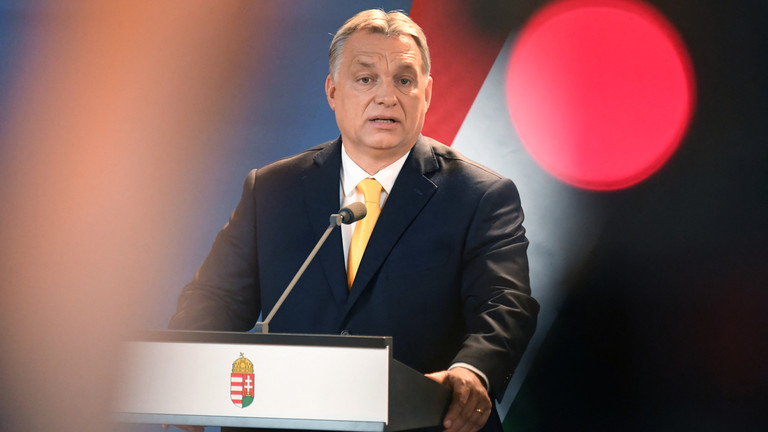
Hungarian Prime Minister Viktor Orban. © ATTILA KISBENEDEK / AFP
RT | January 13, 2023
Policies introduced by Germany and German politicians within the European Commission and the way they “miscalculated” the effects of anti-Russian sanctions has caused a “culture shock” in Hungary. The EU doesn’t have the courage to admit the fallacy of its sanctions policies, Hungarian Prime Minister Viktor Orban said in an interview on Friday.
“I grew up with the feeling that the Germans are precise, engineers, they calculate, take their time, they know what they are doing,” Orban told Kossuth Radio, adding that now that perspective has changed.
“Now we see what they are doing, because the European Commission has a German chairman,” Orban continued, referring to EU Commission President Ursula von der Leyen. “They failed with the sanctions, miscalculated and did not count to the end from a professional point of view,” he added.
According to the PM, the EU doesn’t have the courage to admit the fallacy of its sanctions policies against Russia amid the ongoing conflict in Ukraine. Orban noted, however, that Hungary lacked the strength to change the position of larger countries, meaning that sanctions on Moscow will likely continue despite their ineffectiveness.
Hungary, which relies heavily on Russian energy, has on several occasions criticized EU leaders for being responsible for the ongoing energy crisis by introducing “counterproductive” sanctions on Moscow. Budapest has repeatedly asked to scrap the “failed policy of Brussels” in order to stop Europe from “slowly bleeding.” Hungary has also been one of the few Western states that have so far refused to send any weapons to Ukraine or train its troops.
“If it were up to us, there would not be a sanctions policy,” Orban said last month. “It is not in our interest to permanently divide the European and Russian economies into two, so we are trying to save what can be saved from our economic cooperation with the Russians.”
Hungary’s relations with the EU have been particularly strenuous in recent months as Budapest has also clashed with several EU institutions on a number of issues, including LGBTQ rights and migration. Brussels, in turn, has accused Orban’s conservative government of eroding the rule of law while Western establishment media outlets have treated him like an authoritarian leader that is too sympathetic to Russian President Vladimir Putin.
Life After Chanel: Most Russians Unruffled By Exodus of Western Clothing Brands, Survey Shows
Samizdat – 13.01.2023
A swathe of Western fashion brands made a great show of exiting the lucrative Russian market, albeit at their own detriment, following the start of Moscow’s special military operation in Ukraine in February 2022. They have been counting their losses since, while the niches that opened up in Russia were not left empty for long.
More than 50 percent of Russians couldn’t care less that a swathe of global fashion brands exited the country last year, a recent survey has revealed. Russia’s consumers are quite content, as they go about their business, browsing the generous array at various shopping centers and online.
In a swirl of elegant skirts and leaving behind an inimitable aftertaste of chic elegance, Chanel, Louis Vuitton, Zara, H&M, and other fashion brands flounced off the Russian market in early 2022. The cavalier exit, carried out with the pomp and circumstance befitting leading fashion conglomerates, was supposed to hit hard at Russian consumers.
Conceived as part of the sanctions campaign punishing Russia for its special operation in Ukraine, the exodus resulted in hefty losses for the brands themselves.
Meanwhile, in Russia market niches were immediately filled by local brands and welcome newcomers eager to set up shop in one of the world’s largest economies in terms of GDP based on purchasing power parity (PPP).
Over 56 percent of respondents questioned by analysts from Kokoc Group, one of the leaders in the field of Internet marketing, revealed that they had barely noticed the departure of foreign clothing brands. In their opinion, there are sufficient choice options at stores across the country. Interviewed Russian consumers revealed that neither their preferences nor their wallets have been impacted by the flight of brands.
Another 23 percent confirmed that while the variety of goods on sale was still really great, the prices had risen steeply. Another 6 percent shared the joy of discovering domestic brands. Russian brands can easily compete with foreign ones, at least 32 of respondents stated. 19 percent of respondents agreed, but said that domestic brands were prone to inflate prices.
Around 39 percent of the Russians surveyed quipped that they were quite oblivious of the country of origin when choosing clothing items for themselves.
Still, around 12 percent told the analysts they were hoping for the return of the fashion giants. No more than 3 percent of those polled were still moping around as they hunted down odd pickings of their favorite brands, such as Zara and H&M, on marketplaces.
Despite the fact that significant changes took place in the world in 2022 against the backdrop of volatile developments, the fashion industry in Russia appears to have risen up to the challenges. It has adapted to the overall mood, and rushed to cater to its ever-growing customer base.
Senator Says US Should Remain in Ukraine Until ‘Putin Is Out’
By Kyle Anzalone and Connor Freeman | The Libertarian Institute | January 9, 2023
Senator Angus King said the US should not put a timetable on support for Ukraine and remain involved in the war until “Putin is out.” Comparing the current situation with Russia to the Allies’ failure to stop Nazi Germany before World War II, the Maine senator insisted on more Western aid for Kiev.
During a virtual press conference following his recent visit to the Ukrainian capital, King was asked how long the United States should continue its role in the conflict, replying that support for Kiev should be indefinite.
“I believe we should remain there until Putin is out,” he said.
It is unclear if King was calling for Putin’s removal from power in a coup d’etat, or merely for Russian troops to vacate all Ukrainian-claimed territory. The two warring parties maintain conflicting territorial claims and King acknowledged the war is now in a stalemate, but he nonetheless claimed the conflict would not be a “20-year struggle” like America’s experience in Afghanistan.
Throughout the virtual presser, King referenced a historical need to prevail over Russia, saying nothing of the potential for escalation to nuclear war between the world’s largest atomic arsenals.
The senator noted that he often receives questions from constituents about the wisdom of US involvement in the war, but went on to cite his own version of a Bush-era epithet: ‘We fight them over there so we don’t have to fight them over here.’
“I get letters every now and then, people saying, ‘Why are we doing this? Ukraine’s far away. It’s not our fight.’ Well, it is our fight, because if we don’t fight it now, it will spread,” King said. “And it will become something that we can’t avoid being involved in, just as occurred in the late 1930s at the beginning of World War II.”
He went on to claim that if Putin was not stopped in Ukraine, he would go on to conquer more of Europe, comparing the Russian leader to Adolf Hitler several times.
King also suggested the US could give additional aid to Ukraine, pointing to allies who are giving more when compared to their overall gross domestic product. “If you measure it in terms of GDP, we’re between fifth and tenth in the world, and other countries are contributing actually larger shares of their GDP to the defense of Ukraine,” he continued, “Why? Because they recognized, as hopefully we will continue to recognize, that this is really a fight for Western values.”
Since Russia’s invasion kicked off last February, Congress has authorized nearly $120 billion in aid for Kiev, including more than $21 billion in direct military assistance and a series of other financial and humanitarian aid packages. King claimed the American tax dollars are being well spent and accounted for, arguing “The software that they’re using, working with Deloitte and SAP, to track everything coming in – every spare part, every dollar.”
However, CNN has reported that US arms sent to Ukraine quickly fall into a “black hole” and are nearly impossible to track. In October, Finland’s national law enforcement agency warned that weapons being shipped to Ukraine are ending up in the hands of criminal gangs, while Nigerian President Muhammadu Buhari warned weeks later that “the situation in the Sahel and the raging war in Ukraine serve as major sources of weapons and fighters that bolster the ranks of the terrorists in the Lake Chad Region.”
King’s latest presser followed a trip to Ukraine last week, where he said he held a “thrilling” meeting with President Volodymyr Zelensky and described him as among “the great leaders of the century.”
While the senator claimed Zelensky and Ukraine are champions of democracy, some analysts have argued that Kiev has only continued its transformation into an authoritarian state under his rule. As commentator Ted Galen Carpenter wrote in The American Conservative, “genuine democracies do not ban multiple opposition parties or close opposition media outlets. Nor do they rigorously censor (and put under strict government control) media outlets that they allow to remain open. Genuine democracies do not outlaw churches that advocate policies the government dislikes.” He added, “yet the Ukrainian government has committed not just one or two, but all of those abuses.”
UK businesses to see energy bills soar as government cuts subsidy to firms by 85%
Press TV – January 10, 2023
The UK government is set to scrap the energy subsidies for businesses in the next financial year by 85 percent, leaving small businesses in a dire economic situation, as the cost-of-living crisis squeezes Britons’ lives.
British businesses will see their energy bills soar from April after the government announced the stoppage of the current bills support scheme for firms at the end of March when the price caps for energy bills will expire.
Describing the current level of support as “unsustainably expensive”, the government has decided to reduce the support rate from £18bn to £5.5bn in the planned six-month period.
Speaking to the House of Commons on Monday, Treasury Minister James Cartlidge was at pains to confirm that: “It is not sustainable for the exchequer to continue to support large numbers of businesses at the current level.”
“No responsible, serious government anywhere in the world can permanently shield businesses from this energy price shock,” Cartlidge said, acknowledging the soaring energy costs across the country.
Cartlidge also insisted it was necessary to “cap the taxpayer’s exposure to volatile energy prices” rather than providing open-ended support.
According to the government’s own calculations, a typical pub will see its bills rise by almost £3,000 a month when the new scheme takes effect, while a small shop would pay more than £450 a month, as an increase to its energy bills.
As Prime Minister Rishi Sunak is trying to restore fiscal credibility following the economic shock across the country, manufacturers say they may need to cut jobs and production due to rising energy costs.
Martin McTague, national chair of the Federation of Small Businesses, criticized the government’s new plan and said the reduction in help is a “huge disappointment”.
“This is so out of touch,” McTague said in an e-mailed statement. “The government will inevitably have to come back.”
The cost-of-living crisis across the UK has brought the industries and labor forces under intense pressure, prompting tens of industrial actions over payment disputes each month.
Moreover, the worst impact of the cost-of-living crisis is yet to hit the already struggling Britons, a leading think tank has said, warning that families across the UK have only experienced half of the lost income they are expected to suffer during 2023.
January 6 Two Years On: What Dems Would Risk by Trying to Prosecute Trump After Nothingburger Probe
By Ilya Tsukanov – Samizdat – 06.01.2023
Friday marks the second anniversary of the January 6, 2021 riots at the Capitol by an enraged mob convinced the 2020 presidential election was “stolen” from Donald Trump. Democrats have milked the event for political purposes for two straight years, with President Biden characterizing it as the “worst attack on our democracy since the Civil War.”
Two years since the 2021 unrest outside the Capitol complex, Democrats have failed to provide any rock-solid evidence of Donald Trump’s planning of an “insurrection” in Washington to try to remain in power; still, the governing party may just prove brazen enough to try to prosecute the former president, notwithstanding the tremendous political risks involved, observers have told Sputnik.
On December 22, the House January 6 Committee Investigating the Attack on the Capitol released its final report, charging Donald Trump with a “multi-part conspiracy” to overturn the 2020 election and “block the transfer of power,” and accusing him of orchestrating the spectacular riot at the seat of US legislative power.
Several days prior, the nine-member committee voted to refer Donald Trump and several of his allies to the Justice Department on criminal charges including insurrection, obstruction of an official proceeding, conspiracy to defraud the United States government, and making false statements to the United States government. If an investigation proceeds and Trump is tried, convicted, and locked up, he could spend the rest of his life in jail, and be permanently barred from ever running for office again.
Much Ado About Nothing?
Trump dismissed the probe’s conclusions and the criminal referral, accusing what he dubbed as the “Democratic Bureau of Investigation” of being out to get him, and comparing the year-and-a-half long, $9 million January 6 investigations to his failed twin impeachments.
“The criminal referrals that the January 6 Committee made regarding President Trump are an exercise in political persecution and wish fulfillment,” says Dr. Nicholas Waddy, a political analyst and associate professor of history at the State University of New York’s Alfred State College.
According to the academic, the January 6 probe failed to provide any solid evidence of criminal wrongdoing by Trump ahead of and during the Capitol riots. At the same time, Trump’s complaining about the 2020 election outcome is an expression of free speech, not criminal behavior, the professor believes.
“He did not encourage anyone to use violence or to violate the law. In fact, he specifically advised his supporters to march ‘peacefully and patriotically’ to the Capitol to lodge a protest against the election results. He did not by any means advise them to use violence or criminal means to overthrow the government,” Waddy said.
Even if one were to discount the former president’s election “fraud” claims, “Trump never did anything in reference to the 2020 election except criticize it and complain about it, and poor sportsmanship is not now, nor has it ever been, a violation of the law,” according to the academic.
Skeletons in Your Closet
Sergio Arellano, an advisory board member of Latinos for Trump, told Sputnik that the January 6 investigation has demonstrated itself to be the “political witch hunt” that Trump has repeatedly described it as, and said that the long-promised “smoking gun” evidence of criminal behavior by the former president and his allies never materialized in the year-and-a-half long probe.
Suggesting there were many politicians who truly deserve to be held criminally liable over allegations far more serious than those against Trump – such as Nancy Pelosi and her husband over their alleged insider trading, Hunter and Joe Biden over their suspected pay to play scandal, and Hillary Clinton over her deleted emails, Arellano lamented that Trump, “the one person who called out the politicians and their BS” and “exposed what really happens in politics,” has been targeted instead.
“We saw it with the ‘Dossier’ and we see it with the weaponization of federal law enforcement agencies who are against not only Donald Trump, but against conservatives in general,” Arellano said – referring to the “Steele Dossier” opposition research commissioned by the Hillary Clinton’s 2016 presidential campaign, which would go on to serve as part of the basis of initial US intelligence probes into the Trump campaign’s suspected ties to Russia (claims which have long since been debunked).
Dr. Waddy believes that the Biden Justice Department may move forward with trying to prosecute Trump on the basis of the January 6 Committee’s conclusions, suggesting that for the governing party, the reasoning may be that the more ordinary Americans talk about Trump instead of the substantive issues affecting their lives, the better.
“For Democrats… the calculation may be as simple as this: They believe that Trump deserves to be prosecuted and convicted, and they believe that, the longer the nation is talking about Trump rather than the sever problems that afflict [the country] (inflation, crime, the border, etc.), the better it will be for Democrats. Democrats have already ridden Trump-hatred to something like ‘victory’ in three consecutive US elections. Why not, they will reason, try for number four?” Waddy said.
Republican political commentator Marc Little echoed Waddy’s sentiments on the case, accusing the January 6 Committee of having “lost all credibility… after recent records revealed internal email communications that place the January 6 debacle squarely on the doorstep of former Speaker Pelosi, who we know refused the protection of the National Guard. Secondly, former President Trump’s emails, formerly concealed, make clear his intentions were not to promote an ‘insurrection’ – a crime requiring intention, but rather just the opposite. His tweet encouraged peace.”
“There is no solid proof to date that shows President Trump as the chief architect and responsible party of the January 6 attack on the Capitol. Look no further than the ‘Twitter Files’ and its exposure of the abrasive, biased and reckless approach toward all conservatives,” Arellano said, referring to the recent media revelations on the chaotic internal debates at the social media company to justify banning Trump after January 6 even though he was not shown to have violated any rules.
Risky Business
Citing Democrats’ desire to see Trump “rot in a jail cell,” even if it means “grasping at straws” to try to prosecute him, Waddy pointed out that there are extreme political risks involved in doing so, even if prosecutors would have a difficult time arguing their case, given the dearth of evidence.
“The evidence that Trump broke the law will revolve around the fact that he allegedly did not take aggressive enough steps to prevent potential violence from threatening lawmakers on January 6, 2021. Prosecutors would have to argue that the events of that day were clearly foreseeable by Trump, and that he sought to achieve them. The problem is that the Capitol riot was foreseen by no one, including Democrats in Congress, who took few if any steps to increase security on what was bound to be a tense day,” Waddy explained. “Prosecutors might also argue that Trump contemplated taking extra-constitutional measures to prolong his term in office, although he did not actually follow through on any of the proposed actions.”
The professor believes the fact that the evidence against Trump is “spectacularly weak” is no guarantee that the justice system will clear him. “The DoJ is populated by Trump haters, and so are large portions of the court system, not to mention the potential pool of jurors in Washington, DC, the most deep blue jurisdiction in America. It is highly questionable whether the most hated man in America, and probably the world, can get a fair trial.”
“Nevertheless,” Waddy notes, prosecuting Trump would carry risks for both the Justice Department and the Democrats, particularly in the event of a trial ending in acquittal or an embarrassing mistrial. Furthermore, a trial would likely increase public sympathy for Trump, including among Republicans who have moved on, “turning him, in effect, into a ‘political prisoner’ and a martyr.”
If Trump is prosecuted and jailed, this would also “effectively reset” the GOP’s field of 2024 candidates, increasing the likelihood of a more electable Republican – like Florida Governor Ron DeSantis, taking his place, the professor believes.
“DoJ prosecutors and Democratic Party officials will thus have to ask themselves: is trying to nail Trump to the wall via the justice system truly worth it?” the professor asks.
On the flip side, the president’s party may calculate that a trial would keep Trump occupied “and drag him through the mud – possibly even placing him in prison pending trial,” which would likely limit his effectiveness as a candidate in 2024, and justify the risks.
Fake news about North Korea arming the Wagner PMC as an illustration of new “evidence” trends
By Konstantin Asmolov – New Eastern Outlook – 04.01.2023
It would seem that not long ago we touched on the intricate situation regarding rumors of North Korean or South Korean arms being supplied to the region of the Russian-Ukrainian conflict, noting that there was no real evidence of either. Unfortunately, the situation is not evolving for the better and even those in the US establishment, who previously had refrained from making direct and unsubstantiated accusations, have begun to do so.
On December 22, 2022, National Security Council spokesman John Kirby told reporters that the DPRK had completed its initial arms delivery to Russia back in November, including infantry rockets and missiles: “We can confirm that North Korea has completed an initial arms delivery to Wagner, which paid for that equipment”. And while Washington does believe “that the amount of material delivered to Wagner will not change battlefield dynamics in Ukraine,” it is still “certainly concerned that North Korea is planning to deliver more military equipment.”
Kirby’s further statements reflected that, for him, the Russian-Ukrainian conflict is taking place on some other globe. It turned out that Russian military officials report to the command of this PMC, which has 50,000 fighters. “It’s pretty apparent to us that Wagner is emerging as a rival power center to the Russian military and other Russian ministries”. The Russian reader can only raise a restrained smile, which also applies to the idea that the PMC has not only heavy equipment, but also missiles and heavy artillery in its arsenal.
Nevertheless, Kirby said the US, along with its allies and partners, would raise the issue in the UN Security Council, as the North’s arms deliveries were a clear violation of sanctions resolutions and he promised new sanctions against the Wagner group. US Permanent Representative to the UN Linda Thomas-Greenfield also said that the US “intends to raise the DPRK’s and Russia’s violations of UN Security Council resolutions in future meetings of the Security Council and will share information of this violation with the Council’s 1718 Sanctions Committee.”
The ROK and Canadian foreign ministries joined in the condemnation. Canadian Foreign Minister Mélanie Joly stressed that the actions of Wagner and Pyongyang “clearly violate international law and United Nations Security Council resolutions.” South Korea’s foreign ministry also condemned the arms trade between North Korea and the PMC, saying it was detrimental to peace and stability in the international community in direct violation of the resolutions.
More interestingly, Stéphane Dujarric, the Spokesperson for the UN Secretary-General, told a briefing that the UN had no information on possible arms deliveries from the DPRK to the Wagner PMC. From the author’s point of view, this is a hint…
Equally interesting is that Kirby’s information was published almost exactly the same way a little earlier by the British media. Reuters quoted a senior US administration official as saying that the ammunition had been bought from the DPRK last month and delivered to Russia: allegedly the volume of shipments is not large enough to seriously affect military operations, but the US fears that this channel will continue to operate.
A little earlier, the Japanese newspaper Tokyo Shinbun had reported that similar missiles were being supplied via the Hasan-Rajin railway.
And all this could not but prompt a comment from the DPRK Foreign Ministry, which on December 22 dismissed the manipulative report by the Japanese media as a completely clumsy and groundless PR stunt. The rest of the statement should be quoted as fully as possible:
“The DPRK remains unchanged in its principled stand on the issue of “arms transaction” between the DPRK and Russia which has never happened.
The international community will have to focus on the US criminal acts of bringing bloodshed and destruction to Ukraine by providing it with various kinds of lethal weapons and equipment on a large scale, rather than lending an ear to the groundless theory of “arms transaction” between the DPRK and Russia cooked up by some dishonest forces for different purposes.
Taking this opportunity, I would like to say that the Russian people are the bravest people with the will and ability to defend the security and territorial integrity of their country without any others’ military support”.
Yevgeny Prigozhin, the owner of the Wagner PMC, also dismissed the allegation of North Korean supplies as “gossip and speculation”, and the author partly agrees with him: there is still no regular railway connection between North Korea and Russia. All the more so since the movement of trains across the border is monitored by US military satellites, among others.
The author also draws attention to the fact that the PMC has far less capacity to procure this type of weapons than the state does, because it would require additional time. Finally, if the PMC had received these weapons back in November, they would have already been used on the battlefields, which would have left an information trail.
This looks like another fake about North Korean shells, but for the author it is an opportunity to talk about two additional things.
First, that accusations are very often based on the method of projection or, as the saying goes, the tongue ever turns to the aching tooth. And in this context, it is worth talking about a series of US pieces in the Western media which suggest that the “arsenal of democracy is depleting” and it is not Russia, but the “free world” which is having problems in supplying arms.
Second, although this version was first published by a British news agency and then voiced by Kirby himself, no evidence was produced. Meanwhile, the author reiterates a very important point: if you accuse your opponent and you have hard, irrefutable facts that incriminate them in some way, you can safely put them out there – without fear that some independent expert will discover that it was a poorly concocted fake. When someone says “we have secret evidence, but we won’t show it to you because it is a military secret”, this approach has been considered rotten since the Dreyfus affair.
The accusations concerning Moscow’s use of Iranian drones include at least debris that is structurally similar to Iranian designs. There is nothing in this case, and the Wagner PMC seems to be attacked because it is today the most demonized armed formation having anything to do with Russia. Moreover, it also operates in the Middle East and Africa, which might have added credibility to the US claims, if there had been any specifics.
The use of accusations, however, which are not backed up by any semblance of credible evidence, did not begin with North Korean shells. One may recall the high-profile doping case in which the Russian side somehow allegedly tampered with urine samples in containers that were not supposed to be opened as per design. One may recall the poisonings of the Skripals or Kim Jong-nam when, in response to a direct question as to how exactly on the technical side the special operation had been carried out, there was no sane answer.
Rather than going into detail and sorting out the extent to which certain actions are technically possible, the analysis is substituted by notions of how capable we think “They” are of doing It. And if They could do it, then They did it, no matter how.
That said, such unsubstantiated information becomes a pretext for imposing sanctions of any level of severity – and this is an important criterion of a post-globalization world in which there is no longer any room for normal investigations and evidence. And this is a worrying sign, because now it is possible to use a fantastic accusation as a pretext for sanctions and if it is said from a high rostrum, the status of the one who said it is confirmation in itself: “How can we doubt the existence of Marquis of Carabas if the talking cat claims it?”
Konstantin Asmolov, PhD in History, leading research fellow at the Center for Korean Studies of the Institute of China and Modern Asia, the Russian Academy of Sciences.
Documents reveal how ‘Russiagate’ was used for Twitter censorship
RT | January 4, 2023
Internal documents from Twitter made public on Tuesday show how the social media platform was pressured to follow the US intelligence community’s lead on censorship back in 2017. Key Democrats in the US Congress, a British university and two media outlets – Politico and BuzzFeed – played a major role in the process, which revolved around the ‘Russiagate’ conspiracy theory, according to research by Matt Taibbi.
In a pattern established in just six weeks, from August to October 2017, Twitter went from being on nobody’s radar to agreeing to take orders from US spies as to whom to censor, Taibbi wrote on Substack.
“Threats from Congress came first, then a rush of bad headlines (inspired by leaks from congressional committees), and finally a series of moderation demands coming from the outside,” he added.
In a 30-tweet thread, Taibbi showed emails and other internal documents he obtained, thanks to Twitter’s new owner Elon Musk.
Democrats had accused Russia of helping Donald Trump defeat Hillary Clinton in the 2016 US presidential election. Their claim that Trump had ties with Moscow was a “dossier” fabricated by a British spy. From there, they insinuated that WikiLeaks publishing internal DNC documents and personal emails of Clinton’s campaign had something to do with Moscow, while “Russian bots and trolls” posted “misinformation” on social media that somehow undermined the elections.
By August 2017, Facebook was purging accounts accused of being “linked to Russia.” Unconcerned, Twitter sent over a list of 22 “possible” Russian accounts to the Senate Intelligence Committee, only to be denounced by Senator Mark Warner of Virginia, the ranking Democrat.
By the end of September, Twitter VP for Public Policy Colin Crowell was warning that “Warner has political incentive to keep this issue at top of the news, maintain pressure on us and [the] rest of industry to keep producing material for them.” Crowell also noted the Democrats were “taking cues from Hillary Clinton,” and that only Warner and his House counterpart Congressman Adam Schiff were seeking any comments from social media companies.
Meanwhile, as Taibbi put it, “a torrent of stories sourced to the [committee] poured into the news,” while several Senators – including Warner but also John McCain, an anti-Trump Arizona Republican – proposed bills that would have cracked down on social media.
A “Russia Task Force” set up by Twitter on October 2 found “no evidence of a coordinated approach” by October 13. The final report on October 23 found “32 suspicious accounts and only 17 of those are connected with Russia.” Of those, only two spent anything close to $10,000 on advertising – and one of them was RT.
Policy Director Carlos Monje admits in an October 18 memo that “our ads policy and product changes are an effort to anticipate congressional oversight.” One of these changes was the October 26 ban on advertising by RT and Sputnik.
A November 22 internal email accuses the Senate Intelligence Committee of leaking Twitter’s internal report to the media. A Politico story accusing Twitter of deleting files is followed by a BuzzFeed article alleging a German-language bot network with “signs of being connected to Russia.” The committee demands a report based on the story, which Twitter’s Yoel Roth dutifully writes up.
“You can see how the Russian cyber-threat was essentially conjured into being, with political and media pressure serving as the engine inflating something Twitter believed was negligible and uncoordinated to massive dimensions,” Taibbi wrote.
All of this results in the internal instructions to ban anything “identified by the US intelligence community as a state-sponsored entity conducting cyber-operations.” It was the first step in the process that would eventually lead to the FBI and the Biden White House telling Twitter exactly whom to censor.
New year and new Congress won’t silence the same old war drums in Washington
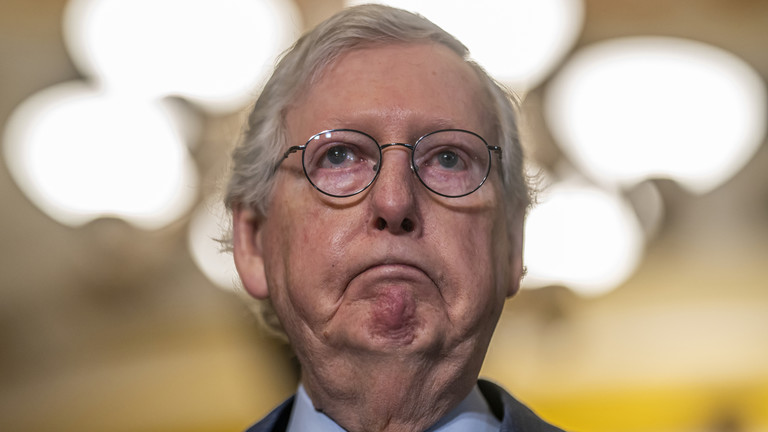
By Tony Cox | RT | December 30, 2022
Every now and then, American voters get a reminder that they have no real voice in how their country is run. Mitch McConnell, the top-ranking Republican in the US Senate, made that abundantly clear a few days before Christmas, when he revealed that those constituents who wanted their real needs addressed would again be getting only coal in their stockings.
“Providing assistance for the Ukrainians to defeat the Russians, that’s the No. 1 priority for the United States right now, according to most Republicans,” the 80-year-old Kentuckian told reporters on Capitol Hill while praising the $1.7 trillion spending bill that was then sailing through Congress. “That’s sort of how we see the challenges confronting the country at the moment.”
It wasn’t entirely clear which Republicans McConnell was talking about, those folks he sees wanting — more than anything else — for our government to help kill Russians. He couldn’t have meant the Republicans who are asked to vote for Team GOP every time an election rolls around. Heading into November’s US midterm elections, the Ukraine crisis wasn’t among the top dozen issues that voters cited as major concerns, according to polling by Rasmussen Reports.
Rather, Americans were highly concerned about soaring inflation, the economy, violent crime, illegal immigration and energy policy. Only one in five respondents considered the Ukraine conflict “very important,” the lowest level among all 16 issues that Rasmussen listed. More recently, a Gallup poll conducted in December found that less than 1% of Americans see Russia as the top problem facing the US. Respondents were most troubled by their own government, inflation and the nation’s sputtering economy.
The public’s growing indifference about the Eastern European crisis shows, yet again, that the legacy media has lost its ability to set the agenda. Republicans, in fact, are beyond being merely fed up with the Ukraine hype. Many have turned against continuing to fund what some of their representatives have promoted as a “proxy war.”
A Morning Consult poll conducted just before the midterms showed that most Republicans wanted less US involvement in foreign military conflicts, fewer troop deployments overseas and reduced involvement in the affairs of other countries. Around the same time, a Wall Street Journal poll revealed that nearly half of Republican voters oppose US aid to Ukraine, up from only 6% when the same question was asked shortly after Russia’s military offensive began in February.
That message clearly didn’t get through to McConnell’s Senate Republicans, and the party failed to win control of the chamber as its candidates fared worse than expected in the midterms. In the House of Representatives, Republicans swung from a seven-seat minority to a nine-seat majority, regaining control for the first time since Democrat Nancy Pelosi (California) took the speaker’s gavel in January 2019.
The GOP’s gains came after McConnell’s counterpart in the House, Minority Leader Kevin McCarthy of California, suggested three weeks before the midterms that Republicans might halt or slow the aid gravy train to Kiev when they regained control. “I think people are gonna be sitting in a recession, and they’re not going to write a blank check to Ukraine.” Representative Marjorie Taylor Greene, a Georgia Republican, went so far as to say that “not another penny will go to Ukraine” after the GOP wins back the House.
However, the tune began to change when the politicians no longer needed to beg for votes. After the midterms, senior Republican congressmen Michael McCaul (Texas) and Mike Turner (Ohio) assured an ABC News interviewer that “majorities on both sides of the aisle” will still support infinite military aid to Ukraine. McCaul even suggested that it would be perfectly fine for Ukrainian forces to attack targets in Crimea, since the US and its allies didn’t recognize the region as Russian territory.
When the $1.7 trillion spending bill, including $45 billion in additional aid for Ukraine, came up for a vote in the House on December 23, nine Republicans joined Democrats in voting for its passage. In the Senate, 18 of 50 Republicans voted in favor, giving Democrats the help they needed to pass the bill.
Republicans haven’t even been able to impose basic oversight measures on Ukraine aid, much less shrink or suspend the effort. A bill to audit the $100 billion program was defeated in the House on December 8. When GOP Senator Rand Paul (Kentucky) demanded that an oversight provision be added to a $40 billion Ukraine aid bill in May, Democrats and Republicans alike steamrolled him and pushed through their legislation.
Auditing measures might stand a better chance of passing the House with Republicans taking control of the chamber in January, but the Senate would likely block any such bill from becoming law. The Dems will get plenty of help, too, from McConnell and other neoconservative Republicans in the Senate.
Republicans and Democrats can put on a good show when it comes to transgender restroom policies and other farcical issues. But when it comes to the most non-negotiable issue in Washington, war, political polarization evaporates. The establishment uniparty can always agree to send more rocket launchers, drop more bombs and overthrow more governments.
That’s what former presidential candidate Tulsi Gabbard discovered when she spoke out against US regime-change wars. Then a Hawaii Democrat branded by CNN as the “next superstar” in her party, the Iraq War veteran suddenly became persona non grata when she criticized America’s military interventions around the globe. Party leaders and media propagandists condemned her as a Russian agent. She quit the party in October.
McConnell’s mocking of Republican voters – announcing that party leaders will prioritize the exact opposite of what constituents want and gaslighting them about what they’ve asked for – marks the latest window into Washington’s broken political system. America’s supposedly representative form of government has devolved into a ruling class that governs with no regard for the best interests of the people while playing divide-and-conquer games to keep the tribes distracted and warring with each other.
Donald Trump threatened to shatter the status quo when he was elected president in 2016. Remember his pledge to “drain the swamp?” Well, the swamp won. Trump lacked the political courage to push through the “America First” agenda that he sold to voters, partly because of the Russia collusion hoax.
Although he campaigned on a pledge to “get along with Russia,” collaborating on such common interests as fighting ISIS – and voters supported him, expressing their democratic will – Trump instead played tough with Moscow. With political opponents and media outlets accusing him of being a Russian agent, Trump foolishly backed away from what he promised to voters. He bragged in 2018 that “there’s never been a president as tough on Russia as I have been,” as if that was a measure of success.
Russia policy was among several areas where Trump and his party declined or failed to represent voter desires and interests. Even while controlling the executive branch and both houses of Congress, the Republicans didn’t deliver on promises to build a border wall and repeal Obamacare. And less than a week after winning the 2016 election, Trump quashed any suggestion that he would actually seek to bring Hillary Clinton to justice, as his supporters wanted. The “lock her up” chants and his debate quip to the Democrat nominee that she’d be in jail if he were president were all just theatrics.
When Trump ordered an end to the US military intervention in Syria, the Pentagon essentially thumbed its nose at the commander-in-chief. To this day, hundreds of US troops remain in Syria, without legal justification and in violation of that nation’s sovereignty.
Trump’s signature legislative achievement was a $1.5 trillion tax cut. The federal budget deficit continued to rise, and the nation’s southern border remained porous. Deportations of illegal aliens were lower during Trump’s term, on average, than during Barack Obama’s eight years as president.
It wasn’t the first time. For decades, Republicans have campaigned on promises to secure the border, but even when the GOP controlled the Congress and the White House, the illegal immigration crisis only got worse. Just as the ruling establishment demands that the war machine be kept humming, it insists on a steady inflow of cheap, illegal labor, suppressing the wages of US citizens.
These policies clearly aren’t in the interests of rank-and-file Americans. Nor does it help US taxpayers – or the Ukrainian people – to prolong the fighting in Eastern Europe by sanctioning Moscow and continuing to funnel billions of dollars’ worth of weapons to Kiev. Nor was it in our interests to help overthrow Ukraine’s elected government in 2014 and undermine Russia’s national security by pushing for Kiev to join NATO.
Voters can plainly see that the results of these tactics are ruinous. Consumers in the West, especially Western Europe, face a dark, cold and hungry winter amid energy shortages and the highest inflation rates in 40 years. Not to worry, though, because McConnell, President Joe Biden and other members of the pro-war uniparty insist that this struggle more than justifies the sacrifices they’re imposing on everyone.
You see, they say, we have a “moral obligation” to defend freedom and democracy in Ukraine. Never mind that Ukrainian President Vladimir Zelensky’s corrupt regime has banned political opposition, shut down all independent media outlets and persecuted the country’s largest church. In the eyes of Washington’s uniparty, freedom of speech, freedom of the press, freedom of religion and freedom to politically oppose the ruling party aren’t necessary components of a free and democratic country.
So we enter a new year with a new Congress and the same old sacred cows in Washington. The bigger problem this time is that escalating US involvement in Ukraine is pushing us all closer to a planet-ending war with Russia, holder of the world’s largest nuclear weapons arsenal. The stakes are higher than when Washington launches an illegal invasion in the Middle East or imports a few million additional illegal aliens.
With such politicians as Senator Lindsey Graham, a South Carolina Republican, calling for regime change in Moscow, the uniparty’s latest gambit in defiance of voter interests could cost us all a lot more than higher inflation and lower wages.
Tony Cox is a US journalist who has written or edited for Bloomberg and several major daily newspapers.
Lavrov’s interview with the Great Game programme, December 28, 2022
Russian Ministry of Foreign Affairs | December 28, 2022
Question: Several years ago, I spoke with former US Secretary of State Henry Kissinger. At that time I had just returned from Moscow and told him that if the US and NATO policy of ignoring Russia’s concerns – with a satisfying smack on the head – continued, Russia would have to use force. Kissinger said if we did this, we would suffer big damage and all of NATO would unite against us.
He was right – the collective West united in response to the special military operation and has shown even greater solidity than many expected. Russia stands proudly and confidently; Moscow does not look like a city that has wavered or that doubts its correctness and strength.
What do you think about the possibility of military escalation, on the one hand, and serious talks next year, on the other?
Sergey Lavrov: You are right that the collective West has closed ranks. But this was not because every country in the alliance felt it wanted to. They were rallied, by the United States, primarily. Their mentality of domination has not been moderated in any sense.
A couple of weeks ago, I noted a statement by a Stanford professor to the effect that the US needed to be a global policeman to save the world. Not only NATO but also the EU, as an association that only recently claimed strategic autonomy, has fully conformed to the West’s uniform policy. Centres for coordinating actions by NATO and the EU are being set up, neutral states (Finland and Sweden) are being included. A mobility programme began to be introduced long before that. It provides for using transport and other infrastructure in non-NATO countries for moving NATO’s equipment eastward, closer to our borders.
Recently, some in the Great Game discussed the global changes taking place in the EU and Europe as a whole, and a shift in the centre of gravity in favour of Europe, primarily Poland, the Baltic states. the Czech Republic and Slovakia. Europe’s grandees are lost in this situation. Four years ago, President of France Emmanuel Macron spoke about the need for Europe to rely on its own forces and to have its own army. A strategic compass was created as a step to strategic autonomy. He talked about NATO being braindead, in expressing his disappointment with the processes imposed from overseas. Now this talk is over. Mr Macron said at one time, it would be necessary to create a system of security in Europe with consideration for the interests of all countries, including Russia. But he was quickly rebuked by the junior members of the alliance. Everyone sees this as the normal course of events.
As for how Russia was perceived throughout these years, including the time you met with Mr Kissinger, our Western colleagues used to say that “Russia needs to know its place.” They said this with pleasure. This is an accurate observation. This “pleasure” was felt practically in the years after the USSR. First, they patted us on the shoulder in the direct and figurative sense of the word. They believed we were in the “the golden billion’s” pocket and were becoming part of the Western globalisation system. Now it is called a system of rules that must underlie the world order. We were seen as an ordinary junior partner that had the resources needed by the West and to which the West would transfer technology while preserving its position in its own coordinate system. The tune is set by the Western leaders, primarily the US and its closest allies in Europe, that have straightened their shoulders and think they have the right to dictate how Europe is developed.
A recent article by Henry Kissinger was widely commented on. We took note of his evaluations and forecasts, including the options for a final settlement. Surprisingly, no one paid attention to the line that said, “As the world’s leaders strive to end a war in which two nuclear powers contest a conventionally armed country.” It’s probably a Freudian slip, but Henry Kissinger is a wise person and never says anything for nothing.
But this is a candid statement about who is fighting against whom. We are at war with the collective West led by the United States which is a nuclear power. This war was declared years ago after the coup in Ukraine which was orchestrated by the United States and supported by the EU, and after no one planned to act on the Minsk agreements (as we now know for sure). Angela Merkel confirmed this.
Several years prior to her stepping down as chancellor, in a conversation with President Vladimir Putin, when he, for the umpteenth time, reminded her what was written in black and white about the importance of resolving special status-related issues in a direct dialogue between Kiev, Donetsk and Lugansk, Merkel said that this was a case of “constructive ambiguity.” Allegedly, Russia was overseeing things in Donbass, so it was supposed to sort things out with Kiev as well. This was not an epiphany or an attempt to jump on the Russophobic “train” that was picking up speed. It was a deeply rooted stance.
Experts from the Presidential Executive Office and the Foreign Ministry drafted an approved text of agreements that confirmed the principled provisions of the Minsk agreements for the Normandy Four summit held in Paris in December 2019. A ceasefire and the disengagement of forces along the entire line of contact was the number one provision. This was agreed upon by everyone.
When the four leaders sat down at a table in the Elysee Palace and the parties took their seats along the perimeter, President of Ukraine Zelensky said that he would not act on or sign a document on disengaging forces along the entire line of contact. The most he was willing to do was pick three pilot sites and try to see if disengagement would work there. We had our suspicions right away, but we chose to clarify the reason behind the metamorphosis occurring on the way from the consensus achieved by the experts and the destruction of this consensus at the heads of state level. The Americans sent a signal that if Zelensky were to disengage forces along the entire line of contact, the Russians would never give Donbass back.
Question: Do you know for a fact that he received this kind of advice or instruction from the United States?
Sergey Lavrov: I’m not sure about the name of the person who conveyed that. But they told him what I just said: if he disengaged the forces, he would drastically reduce his chances of taking these territories back. They wanted to take them back through military force for one, and only one, reason. They were unwilling to fulfil the Minsk agreements in part concerning the terms and conditions for restoring Ukraine’s territorial integrity which were quite straightforward: the Russian language, their own local police (like the state police in the United States), and central authorities holding mandatory consultations when appointing judges and prosecutors, as well as special economic relations with neighbouring Russian regions.
The Republika Srpska in Bosnia and Herzegovina has that. This is also included in an agreement on the creation of a Community of Serb Municipalities in Kosovo reached by Pristina and Belgrade in 2013 with lots of ceremony and EU mediation. Almost the same rights were granted to the Serbs in northern Bosnia and Herzegovina, the same as in the Minsk agreements for the Russians living on the territories in question.
Zelensky refused to restore Ukraine’s territorial integrity which he could do by providing to a portion of the people the rights enshrined in numerous international conventions and the constitution which still spells out the obligation of the state to ensure the rights of ethnic minorities, and the Russians are mentioned separately. Plan B has been in existence since 2019 in Paris. From time to time, certain Ukrainian leaders have let it out that the Minsk agreements were not in their interest and said military force must be used to take it back.
The Ukrainian tragedy goes back quite a while. They are now trying to cancel the portion of it that clarifies what is going on now and many other things as well. Russian culture in Ukraine has been cancelled for many years now. Laws to this end were adopted back when President Poroshenko was in office and continue to be pumped out under President Zelensky. A couple of years ago, they approved a law on the Ukrainian language as the state language. This caused alarm even at the CoE Venice Commission, the European Union, and the OSCE. But the most these venerable institutions could do at the time was tell the Ukrainians they could keep the law, but should update the applicable legislation on ethnic minorities.
A few weeks ago, the Verkhovna Rada adopted the law on ethnic minorities in the second reading. This is Ukrainian lawmaking at its best. It says that the state guarantees the rights of all minorities to the extent defined in the applicable legislation. The new law on ethnic minorities includes everything that was restricted before that (education, media and culture) as the basis for the rights that the Kiev regime is willing to grant to ethnic minorities. The Romanian leadership is in uproar. They are now talking vociferously about the need for consultations and that no one asked them what they thought. The attitude towards the Hungarians and the way Kiev treats the Hungarian minority is well known. Needless to say, Russians are treated even worse than the Hungarians.
Forgive me for digressing before taking your question. The issue is about approving or not approving the neo-colonial international order, which President Vladimir Putin spoke about. The West is covering it in a shroud of respect for its rules-based order. When this term came into use, I asked my Western colleagues (we were still talking back then) to give us a list of these rules. No wonder no one has ever given us any reference material that would show the specific rules or the code of conduct. The answer is simple. These rules mean that everyone must do as the United States says.
Remark: These rules have been put forward by the West but they were never approved by the UN.
Sergey Lavrov: They have never been approved by anyone. No one has seen them. When they first introduced this into the international discourse, we immediately raised our concern and tried to engage them in rational discussion. However, they were unwilling to do anything of the sort.
These rules were best expressed in a statement made by a professor from Stanford University, who said that the United States had to be the global policeman to save the world. In many of America’s doctrinal documents, Russia is referred to as an immediate threat. That not because we are going to attack anyone somehow but because we have challenged this world order. China is next in line. It poses the most formidable and systemic long-term challenge, and it is the only country capable of surpassing the United States in almost all areas. In terms of nuclear weapons stockpiles and the development of nuclear capabilities, Beijing will soon be on a par with Moscow and Washington.
You can look for the answer to the question about the possibility of escalation in various statements and analyses by political scientists. The Russian authorities have not voiced an intention to take an escalation-based approach. We are committed to ensuring that the special military operation’s objectives are achieved. As President Vladimir Putin said, our indisputable priority is the four new regions of the Russian Federation. An end must be put to the threat of Nazification they have been exposed to for many years. We need to ensure security for all people living there, and their rights must be respected.
Another very important objective is to ensure that no threats to our security are created or remain on the Ukrainian territory. Now they say that the West did not try to urge Ukraine to engage in military action against Russia, however, I regard oppressing Russian-speaking people in Ukraine to be genuine aggression.
Question: I would like to clarify one issue. When you talk about the four regions, do you refer to their administrative borders or the part of their territory, as of today, that Russia has brought under its control?
Sergey Lavrov: No, I am talking about the borders of these regions as part of the Russian Federation, in keeping with our country’s Constitution. It is an obvious thing.
Question: Do you mean that Russia needs to liberate these regions?
Sergey Lavrov: Of course. It is required by the public vote held in each of the four regions. This happened long ago in the Donetsk and Lugansk people’s republics, while in the Zaporozhye and Kherson regions it was in autumn 2022.
Question: What you expect to achieve by the end of the negotiating process, or the recognition of this fact by Ukraine – are these prerequisites for launching the talks?
Sergey Lavrov: President of Russia Vladimir Putin has said many times that we never reject any proposal to achieve diplomatic agreements. The terms on which we agree to discuss them are well known. The fact that four territories belong to the Russian Federation is an indispensable condition for talks. But this is not all that must be discussed.
The second large block of problems, in addition to the destinies of the people who do not want to live under the current regime with its open Nazi and racist views is the security of the Russian Federation that has been subjected to numerous threats created on Ukrainian territory. Now some people are saying that this is not at all the case, that these exercises in Ukraine, including in the Black Sea, were “military cooperation for peaceful purposes.” The territory of Ukraine was actively developed. There were plans (we are aware of these as well) to establish a naval base in the Sea of Azov. You know that at that time this was a sea of two states. The construction of an Anglo-Saxon naval base would have radically changed the security situation. In the same way, there were plans to create a military base in then Ukrainian Crimea before the coup and the referendum in order to neutralise our capabilities in the Black Sea.
We do not launch spontaneous, offensive or striking operations unlike Ukraine. As a rule, Ukraine does this regardless of its losses. Its main goal is to produce a media effect there and then. The West would have continued to endlessly extoll its current leaders as representatives of genuine democracy. Vladimir Zelensky would be portrayed as a hero of the times, and he should have everything he wants for this reason. Yet, his requests are sometimes rejected. There are smart people in the West, who understand that these people and this regime should not be given some categories of arms.
“Anonymous specialists from the Pentagon have said more than once that they don’t have the right to prohibit Zelensky from striking the territories that are internationally recognised as part of Ukraine, including Crimea. There is some anonymous but credible evidence that American specialists were directly involved in modernising multiple launch rocket systems to extend their range to 1,000 kilometres. Nobody hides the fact that information from military and civil satellites belonging to US owners are actively used in real time for adjusting fire. US specialists are directly involved in targeting. We asked the Americans through the channels our Embassy still has, whether a decision to transfer a Patriot battery means the presence of US experts, considering the expertise needed to use it. We were given a lengthy explanation that this was not planned because the US didn’t want to and would not fight against Russia directly. It will take several months to prepare the Patriots for action, until the Ukrainian military master this technology. But there are dozens and maybe even hundreds of American military personnel there, and they were in Ukraine even before the coup. CIA employees occupied at least one floor in the Ukraine Security Service building. Now they have a big military attaché office. Obviously, military experts are not just visiting the Defence Ministry of Ukraine. They are giving direct consultative services (and probably doing more than that). There is also a group of specialists that (as the Pentagon explained in the US Congress) have controlled how American weapons were being used for months now. So, when some members of Congress tried to demand the creation of a special mechanism for this purpose, the Pentagon reassured them that they were monitoring all this. This is a rather interesting situation. There are many facts indicating that Western weapons are surfacing in Europe (maybe now in other regions as well). I asked my staff to make an open source compilation to show our interlocutors what is being swept under the rug at this point.
We are in no hurry. President of Russia Vladimir Putin talked about this. We would like to finish, as soon as possible, the war the West was preparing for and eventually unleashed against us through Ukraine. Our priority is the lives of the soldiers and civilians that remain in the zone of hostilities. We are patient people. We will defend our compatriots, citizens and lands that belonged to Russia for centuries, proceeding from these priorities.
Question: You quite rightly said that the West is waging a war against us through Ukraine and not only. The West and the United States hypocritically claim (since they are not officially sending their troops to openly fight against Russia on Ukrainian territory) that they are not a party to this conflict. Therefore, without fear of a third world war, including a nuclear one, they can send Ukraine any type of weapons, provide them with intelligence and advise on the battlefield. We can see that both the number and quality of weapons the West provides to Ukraine is growing. The West is overcoming its own taboos established several months ago.
What is Russia doing and what will it do in 2023 to convince the West to abandon this dangerous logic and stop this trend?
Sergey Lavrov: I believe that we must continue our policy outlined by Russian President Vladimir Putin on the ground to strengthen our capabilities, both technologically and from the viewpoint of military personnel who, after the partial mobilisation, have undergone serious training. A significant part of them is already there but most are not on the frontline where professionals, contract soldiers are fighting. A significant part of them is in reserve.
We will continue to strengthen our deployment. This decision was made in September 2022. The commander of the joint force was appointed. We are engaged in actions that will allow us to operate much more effectively in these territories in the very near future. I have no doubts about this.
We also pay attention to what you said – pumping Ukraine with large quantities of advanced Western weapons. I follow the discussion in our society, and on your programme, and in other political circles and formats.
Retired military professionals say that the supply of Western weapons needs to be cut off. I mean railways, bridges and tunnels. I believe this issue cannot be ignored by professionals. They have been paying attention to it for quite some time. They are responsible for taking professional decisions on the methods of obstructing and, ideally, blocking these supplies. One such method has been used and is still being used, which is inflicting damage on infrastructure, including energy infrastructure that enables the supply of these weapons. I believe there are also other plans for achieving the same objective.
We have scarce opportunities for talking to the West now. There is no particular desire to do this when you read statements by foreign ministers, prime ministers or presidents about the need to address the issue of security of Europe to protect it against Russia. They used to say “without Russia” and now they say “against Russia.” The idea of French President Emmanuel Macron to create a European political community boils down, roughly speaking, to the OSCE without Russia and Belarus. This was proposed by a man who a bit later said it was important to stay open to opportunities for building security institutions with Russia. Yet, the European political community will be gaining in strength. They have scheduled a regular summit for spring and are trying to drag all our neighbours, except Belarus, into it.
Considering this, we have no particular desire to talk to the West. When a concrete situation emerges where the West openly commits unlawful actions, then we ask questions. According to recent reports, Greece plans to transfer its S-300 missile systems to Ukraine. We asked our ambassador to contact the Greek Foreign Ministry and Defence Ministry and remind them that the systems in question had been transferred to Greece. You might remember that they had to be delivered to Cyprus but the West did all it could to not allow this to happen, given the insularity of Cyprus and it not being a NATO member. As a result, a compromise was reached that suited everyone. Greece bought this system. Under the contract for this deal, Greece may not transfer missiles to anyone without our approval. We reminded the Greeks about this. They said they remembered their obligations. We are closely following things like this, all the more so as the same provision prohibiting the transfer of our weapons to anyone applies to the majority of weapons in Eastern Europe – the member countries of the former Warsaw Treaty – where they were produced under licence. We need to be on our guard. Many unlawful actions are being committed under the slogan “Let’s Save Ukraine,” because “Ukraine Is Europe” and “Europe Is Ukraine.”
Question: Is the United States mistaken in thinking that it is safe, need not worry about any escalation or a direct armed clash with Russia and can render any and all military assistance to Ukraine until it enters a direct war against Russia?
Sergey Lavrov: President of Russia Vladimir Putin spoke about this at the recent expanded meeting of the Defence Ministry Board. He formulated our position as the Supreme Commander-in-Chief (I won’t add anything to it) on the new systems of our Navy, which have been put into operation now.
Question: Dimitri Simes started our conversation by saying that the West has closed ranks. I think the outgoing year has revealed an even more important trend. This is the formation of a global majority – the countries of the East and South, which do not accept Western hegemony and refused to side with the West against Russia. I perceive this year as the moment of truth in relations with the West and with non-West. Will our turn to the global majority be a strategic rather than opportunistic trend in Russian foreign policy that will be preserved and strengthened in 2023? What will Russia do in 2023 to promote its ties to the global majority and its role in world affairs?
Sergey Lavrov: I agree with those analysts reviewing the outgoing year who note that the discord between the West that claims hegemony and control over compliance with “its rules” everywhere, on the one hand, and the global majority, on the other, is an objective phenomenon. It was brewing and would have come to the surface eventually. We could no longer tolerate how Russians were being humiliated in Ukraine and how threats to our security were created there. We launched the special military operation that served as a catalyst and sharply accelerated this process.
It seems to me that after sanctions imposed on Russia following the coup against it and after the Crimean referendum, the majority of non-Western states had already realised that the system they were in with other countries was unreliable. This is a system of international currency, finance, globalisation, logistics chains, insurance for international shipments, freight rates and technological products that are produced by a handful of states. This applies to the same conductors on which the Americans are now trying to impose a veto. They have sanctioned Chinese companies that produce conductors in an obvious bid to slow down the development of the PRC. Everything happened much faster.
Many countries had to make a choice then and there. It was probably difficult, considering how deeply they were intertwined in the globalisation system. It was created by the Americans and discredited by them because Washington proved to be an unreliable curator and operator of this system.
Yes, we have heard the Chinese authorities saying that they are against hegemony and for building a fair world order, and the Indian authorities saying that they will be guided by the interests of India and that it is useless trying to convince them to abandon their national interests in favour of American geopolitical interests. Türkiye and Algeria, as well as Venezuela, Cuba, Nicaragua, Mexico, Argentina and Brazil have not joined the sanctions either. The emergence of a new world order will certainly gain momentum and is already gaining momentum. It will objectively be a whole historical era.
I noticed that somebody said during one of your shows that globalisation is giving way to regionalisation, and that there will be several large blocks formed around regional leaders. These blocks will create the instruments and mechanisms that replace globalisation instruments and mechanisms that are being abused by those who created them. The debate focused on whether the United States was aware of that process. Somebody said that it was and that the Americans would like to accelerate the regionalisation of the global economy and international relations in general. However, China, which is also aware of the importance of regionalisation and is not against regionalisation as such, is creating its own instruments and structures but would like this process to take as much time as possible.
I thought that it was an interesting opinion. It should be carefully analysed. If the Americans really wanted to accelerate regionalisation, they would have wanted to agree on the terms as much as possible and as soon as possible. The sooner you negotiate and come to certain terms, the better the chance that you will preserve the instruments you have been using globally.
There is no doubt that the process is underway. And the choice is not between the global majority and the West; we will choose those who are reliable partners and honour agreements, who hold a promise when it comes to long-term projects and will not only look for short-term benefits.
I discussed this with my American colleagues back when we had channels for a regular dialogue. Many officials in the US administration admitted at the beginning of the pandemic that democracy as it is understood in the West has its limitations and that there are certain advantages in the system which the Americans describe as autocracy. Ultimately, autocracy is a centralised state with a strong vertical system of power, which can quickly take decisions that are implemented throughout the national territory. If we compare how different countries dealt with Covid-19, we will see that there are advantages in both systems. Our Chinese comrades have ultimately admitted that their decision to completely close off the country was not entirely correct, because it prevented the development of herd immunity. They are working now to rectify their mistake. However, the United States had the largest number of Covid cases by far.
I discussed the matter with former US Secretary of State Condoleezza Rice. I asked if presidential and parliamentary election campaigns, held every two years, interfered with governing their vast, great and diverse country, even though it is a melting pot that turns all its citizens into Americans. She said that they did. They have a cumbersome system, but this is their problem, and they know how to address it. However, this has also become a problem for the rest of the world, because the Americans need to invent an external problem, threat or goal for every election campaign. Given the US weight on the international stage, global processes become hostage to and are strongly influenced by the Americans’ discussions of domestic issues and political infighting. Autocratic states, as defined by the United States, with a centralised system of government at least have the advantage of a more predictable horizon, like in China. One can argue if it does or does not comply with the principles of democracy, but who said that American democracy is the best form of government?
Winston Churchill could have been right, in part, when he said that “democracy is the worst form of Government except for all those other forms that have been tried from time to time.” The world is changing, and we can still see something new invented in this domain.
Question: They ascribe another interesting statement to Winston Churchill, who reportedly said: “The best argument against democracy is a five-minute conversation with the average voter.” I would like to say that anyone who wants to comprehend how wrong US democracy is should talk to an average member of the US Congress, and much will become clear.
Several days ago, you said that, according to the US media, including The New York Times, some people in the Biden administration are seriously thinking about launching a pre-emptive strike against the top Russian leadership. I called Washington and spoke with two people in the US administration on condition of anonymity.
Sergey Lavrov: I also quoted an anonymous source.
Question: They said that they could not vouch for all officials of the large US administration, but that, of course, there are no plans to hit the top Russian leadership, and that there can be no such plans. Do you believe, on the basis of what you know, that someone with real authority in Washington is planning a strike against the Russian leadership?
And my second question. US Secretary of State Antony Blinken and National Security Adviser Jake Sullivan have repeatedly said that Washington is warning Russia that it should not go down a certain road because this would cause the most serious repercussions. Would you like to use this opportunity and to tell the US administration what would happen if someone tried to conduct such a strike?
Sergey Lavrov: I quoted an anonymous source, but, unlike you, I don’t know him (you know your anonymous sources). I know that they called him a high-ranking source.
Question: Did The New York Times advertise him?
Sergey Lavrov: Yes.
Question: Does this mean that The New York Times took him seriously?
Sergey Lavrov: We are used to thinking that it is serious journalism. Although there are more and more indications that this is not always so, we, nevertheless, stick to this concept. I would like to deliberately exaggerate this anonymous leak because this source (he or she or it, using the current politically correct language) said that such a threat had been voiced and that, in principle, the Kremlin should not feel safe. The source said something along these lines. There was nothing specifically about Vladimir Putin, but everything was clear. I decided to deliberately emphasise this statement, made against the backdrop of constantly chattering talking heads who can obviously do nothing else but talk, but they aren’t very good at thinking. Alexey Danilov from Kiev, for example …
Question: National Security and Defence Council Secretary Alexey Danilov.
Sergey Lavrov: Yes, he is a great expert on foreign affairs. There is also Mikhail Podolyak …
Question: An adviser to the Head of the Office of the President of Ukraine.
Sergey Lavrov: Every day, they say that they will take back Crimea, and that the Kremlin should know that they will reach it and drop their bombs there.
The US administration did not respond in any way to a similar but slightly less vulgar statement by an anonymous source in Washington. Journalists did not ask White House Press Secretary Karine Jean-Pierre what they think about this at a briefing. When they asked about Crimea, an anonymous Pentagon source said that they could not forbid the Ukrainians from using their armed forces against a territory they consider to be part of Ukraine. This highlights a serious change in their position.
In April 2014, after the coup and the referendum in Crimea (I have already talked about it, it is not a secret), we gathered in Geneva ‒ US Secretary of State John Kerry, myself, EU’s leading diplomat Catherine Ashton and Andrey Deshchitsa, who acted as a foreign policy curator for the putschists. We sat down and discussed a one-page document that included, as the main statement, support of Ukraine’s federalisation and the start of the process involving all Ukrainian regions. It was a completely natural development for the EU delegate and John Kerry. The paper was still there later; however, it did not gain any status either. Concurrently, John Kerry and I had lengthy bilateral conversations. During one of them, he said that they were well aware of the fact that Crimeans’ choice was sincere and there was no doubt about it. And yet, that choice had to be formalised, through another referendum, with invited representatives from the OSCE, the UN and others. The first referendum had been conducted in haste. I explained to him that the rush was due to the fact that the putschists had thrown their “friendship trains” at Crimea, with armed militants, the Right Sector and other neo-Nazi ultra-radical groups that stormed the Supreme Council of Crimea. The local population did not want to wait for another aggressive provocation.
US President Joe Biden keeps saying that Ukraine must win in order to prevent the third world war. He said something to that effect only recently. I don’t understand this kind of reasoning because first, he says they will not directly confront Russia otherwise it will trigger world war three and later, he adds that Ukraine must win to prevent the world war. We don’t have a dialogue channel. Chairman of the Joint Chiefs of Staff Mark Milley occasionally calls Chief of the General Staff of the Russian Armed Forces Valery Gerasimov. US Secretary of Defence Lloyd Austin has spoken to our Defence Minister Sergey Shoigu maybe a couple of times. That is all good and helpful. But it comes down to us having to be careful.
Question: Back when Hillary Clinton was US Secretary of State, she formulated the underlying principle of American diplomacy, which remains in effect to this day – the United States “can walk and chew gum at the same time.” In this case, if applied to US-Russian relations, it means the United States is containing Russia, providing all-out support to Ukraine and trying to help Ukraine “defeat Russia on the battlefield,” while at the same time it wants to discuss with Russia issues that are of interest to them. Now they are interested in talking with Russia about the resumption of START-3 inspections at nuclear facilities. The United States argues that we are both nuclear superpowers and the inspections are essential for strategic stability. In my opinion, this is very hypocritical. I see the main threat to strategic stability in the hybrid war that the United States is waging against us, not in inspections or a lack thereof. In any case, do you think we need this? True, it is one of the opportunities for dialogue with the United States; but in the context the United States is proposing, should we agree?
Sergey Lavrov: When I was young, I was perfectly comfortable walking and chewing gum at the same time. This is an American metaphor. But we use other idioms, including “the cat would eat fish but not wet her feet.”
You are absolutely right. They are interested in the resumption of inspections. Naturally, we are analysing the situation. According to our assessment, they need this to be able to know what to expect “just in case” – for all the mantras about nuclear war being unacceptable, and we are still one hundred percent committed to this. We recently reaffirmed our commitment in a special statement. I am referring to the Russia-initiated statements by the five nuclear states that there could be no winners in a nuclear war and no such war should ever be started. In June 2021, at Russia’s initiative, presidents Joe Biden and Vladimir Putin at the summit updated and reaffirmed the statements signed by Ronald Reagan and Mikhail Gorbachev in the late 1980s.
They want to do these inspections. They send signals to us; we receive calls from representatives of the National Security Council who want to resume everything. We quote the treaty to them – exactly in the vein of your assessment that stability is not ensured by inspections. The preamble to this treaty says that the Russian Federation and the United States, will be working “to forge a new strategic relationship based on mutual trust, openness, predictability, and cooperation.” All of the above has been derailed by the United States. They have as good as labelled Russia an enemy. There is no trust, and they say so directly to us.
In the preamble, the parties also recognise the existence of the interrelationship between strategic offensive arms and strategic defensive arms. And that was the farthest the Americans were willing to go to signal their understanding of our concerns about their missile defence plans, plans to create a global missile defence system. Well in any case, this interrelationship is enshrined in the treaty. Even in the previous period, before the current events, we highlighted that connection during consultations on the treaty’s implementation. The treaty further adds that this interrelationship will become more important as strategic nuclear arms are reduced. They said, it is just the preamble. We pointed out that after ratifying the treaty, our State Duma issued a statement that the treaty could not have been ratified unless it mentioned the close inseparable interrelationship between offensive and defensive strategic arms. This is not “just a preamble” to something unimportant; it is a legal fact. Of course, they are violating this obligation. A global missile defence system is being built along the perimeter of Russian and Chinese borders. All this “not to worry, it’s all against Iran and North Korea” talk is a thing of the past. Nobody remembers this anymore. It is openly declared that the anti-missile systems are there to “deter” Russia and China.
In this situation, if the only important part they see in this treaty is “you let us come and see,” this is not too fair. From a technical point of view, the sanctions have seriously hampered our ability to carry out cross inspections. Even if Russia is (hypothetically) given permission for aircraft to fly across all the countries on the way to Geneva, the members of the delegation and the crews, as we have found, will have problems paying for their hotel, food, and refuelling of the aircraft. None of this can be guaranteed. “Let’s just resume the inspections, and then we will solve things as we go.” The technical side is treated like a minor, even immaterial issue.
A strategically important issue is that they have undermined all the foundations this treaty relied on. Despite that, as we spelled this all out to our American colleagues, we said that we were fully committed to our obligations under the treaty as long as they could be implemented on an equal footing: we will provide them with the information as required by the treaty in a timely and complete manner and will send appropriate notices.
Question: Continuing the theme of real threats to strategic stability, Joe Biden said Ukraine must win on the battlefield to prevent a third world war. What do you think the US will do when Ukraine loses on the battlefield? This seems inevitable to me. They have convinced themselves that this war is not only (and not so much) for Ukraine, but for American leadership, for the notorious “rules-based international order,” that is for American hegemony. What will they do when Ukraine loses?
Sergey Lavrov: Your question has cornered me. I usually try to think before I say something. Even so, I let things slip sometimes, I confess. When a person says such things, they probably have something up their sleeve; if they really mean what they say, that is.
There is increasing talk on the need to start negotiating. But then Russia is accused of refusing, while President Vladimir Putin has repeatedly stated that there have been no serious proposals.
The Istanbul episode clearly showed that Ukraine was immediately scolded then: “Too early. You haven’t yet exhausted Russia to the point the United States would deem acceptable.” Now they don’t even blink when saying Kiev is “ready” to talk and Russia isn’t, amid Kiev’s declarations that Ukraine will never sit down at the negotiating table until they have their “native Ukrainian-Crimean” land and others back, until Russia “capitulates,” and pays “reparations.” Only then will we be accepted into some new “party.” After a tribunal, naturally. And in February 2023, they will put together some new ranks. It will be interesting to see.
Most processes have long been taken outside the UN framework. The French and the Germans have created some new platforms on international humanitarian law. Then they created an EU-led Alliance for Multilateralism. When asked why they couldn’t do this at the UN, a format as multilateral as possible, they said the old members were retrogrades, while they were progressive multilateralists.
Joe Biden later convened the Summit for Democracy, assuming the right to decide which democracy is more democratic. The criterion for being a democracy in the American interpretation is not just being loyal to the United States, but to the US Democratic Party. Linguistically understandable. Then came the European Political Community forum. The US recently hosted a US-Africa Summit. Unlike us, (Russia invited every African country to the first such summit and to the second one in mid-2023), the Americans themselves decided what Africa was, as a geographical concept. Six or seven countries were left out, because the governments were not “legitimate” enough, i.e., not appointed through elections. At the same time, the Ukrainian government came to power as a result of a bloody coup.
Question: As someone who has just arrived from Washington, I can argue with you. If the Biden administration decided that a country is not part of Africa, then it isn’t, full stop. You are challenging the basic premise. If someone has made a decision that a certain country is not part of Africa, why does Moscow object?
Sergey Lavrov: I’d like to finish the list of their bizarre manipulations with the possibility of creating another security forum excluding Russia. Vladimir Zelensky has put forward a 10-point plan, and Dmitry Kuleba is already appointing supervisors from the Western camp for each of the ten points. They will start handing out instructions soon.
Question: Let’s get back to Henry Kissinger. Many years ago he wrote that leaders rarely lie to each other. Things are different in public diplomacy, where telling the truth and nothing but the truth in dealings with the counterparty is not something that diplomats are expected to do. When leaders talk to each other, though, they don’t usually lie to each other, because they know they will have to deal with each other again and minimal trust is a bedrock principle of diplomacy.
Now, it appears that we have arrived at a point where trust is nonexistent, and Washington and Brussels are bragging about the fact that there is no trust in relations with Russia and cannot be any. Things that were discussed during talks with the President or with you are made public. They say warnings were issued during the Georgia crisis of 2008 to the effect that it was necessary to get Mikheil Saakashvili “out of the way.” Remarks are being ascribed to President Putin and you which (as it turned out later) you never made.
I have a question for you: how are you supposed to deal with your former US colleagues in these circumstances? For better or worse, the United States remains a great power, and you have to deal with them in order to maintain token public dialogues and a confidential dialogue that is still ongoing. What do you wish for in this regard? Not a rhetorical wish, but a serious wish to policymakers in Washington, so that a serious dialogue could start in the new year?
Sergey Lavrov: We are not going to make any wishes with regard to the dialogue. They are well aware of the fact that it was not us who broke off the dialogue. We are not going to ask them to resume it. That’s not who we are. We respond only to sensible offers when we receive an offer to meet.
There were several informal proposals during this period. Each time we agreed to meet. One of them materialised when Director of the Central Intelligence Agency William Burns met with Head of the Foreign Intelligence Service Sergey Naryshkin in Ankara. The meeting was supposed to be confidential, but every piece of information under discussion was leaked to the public domain. Few things are kept secret these days, although we always try to keep up our end of the deal. More attempts were made to set up a meeting which also included references to Washington-issued instructions. We never said no. But eventually these attempts tapered off.
My wish is for them to be a little more democratic, not in the way they understand it, but in the way it is understood in the international arena. When we are talking about democratising international relations, we are not talking about some supernatural or breakthrough approaches. We are talking about the importance of having these relations rely on the UN Charter, according to which the UN is based on the sovereign equality of states. There’s no need for anything other than that. All we need to do is act in line with this commitment, which the United States (in conjunction with Russia) wrote with its own hands in this fundamental document. Otherwise, they feel entitled (I cited these examples and everyone is aware of them) to suddenly decide that the security of the United States has deteriorated abruptly or seriously depends on what is going on in Yugoslavia; or, someone suddenly begins to suspect Saddam Hussein of doing some kind of research in the field of WMD; or Muammar Gaddafi is all of a sudden not “good” enough or maybe knows too much about funding a presidential campaign in France in a given year. That is all they need to get going. An expeditionary force is then sent to a country lying 10,000 miles away from the United States. They levelled Libya. Now they are trying to put it back together again. Just like the Americans insisted at some point that Sudan must be divided into two parts. Then they started complaining that neither part is listening to them. Now, they demand that sanctions should be imposed against Sudan and South Sudan and are, in fact, imposing them.
Hundreds of thousands of people were killed in Iraq and cities were razed to the ground. No weapons were found. Tony Blair in his memoirs said that they made a mistake, but it can happen to anyone. All of that was done to the countries located on the other side of the ocean. I’m not even talking about the reasons the Americans came up with for intervening the Dominican Republic or Grenada. President Reagan was talking about a threat to the lives of US citizens. Just a threat. There were thousands of Americans there. They invade countries, topple governments, etc.
In our case with the Russians and the Russian-speaking people in Ukraine, their rights, language, education, media and culture were trampled on under the law. Then, there was the coup. The putschists then said that the Russian language must be banned and outlawed, and Russians should be driven out of Crimea. We went ahead and signed the Minsk agreements, which covered a small portion of the territories that are now under dispute. Not a single law was adopted in Ukraine under President Poroshenko or President Zelensky without the United States providing strong advice. Nothing would have happened if the West, primarily the United States, had complied with these overall simple agreements. There would have been no putsch or the coup if the Germans, French and Poles, who acted as guarantors of the deal signed by President Yanukovych and the opposition, had insisted on the putschists ending this mayhem and following up on the agreement. There would have been elections there five to six months down the road and the opposition would have won. Things were clear. Why did they have to do it? I have only one answer to that question. If this were the case, the theory put forward by Zbigniew Brzezinski would have come under revision and risk. Then, provided that the existing agreements were fulfilled, and everything remained within the 1991 borders, this would have created an environment for Russia and Ukraine to maintain good relations (it’s a fantasy, but I think it’s not far from the truth).
What they did instead was put Russophobes in place, break the deal with President Yanukovych and start doing what they keep doing now, namely, legitimising the Nazi theory and promoting Nazi practices via battalions into everyday life.
When US Congress was approving the US military budget, as it does every year, they imposed a ban on any kind of help, including military and financial, to Azov. Each time, the Pentagon objects to this and pushes for having this ban removed from the US budget. This speaks volumes.
Question: What is your forecast for the next year? I am not asking you to fantasise, it is not what a minister should do. Just what you can share in terms of your own expectations.
Sergey Lavrov: We must always be realistic. I am not a pessimist, although they say that a pessimist is simply a well-informed optimist. As for the glass, whether it is half full or half empty – it is also important which liquid is there.
My expectations are realistic. I am confident that with our resilience, patience and sense of purpose, we will defend the noble goals that are crucially important for our people and our country. We will do it consistently, while remaining ready for an equal dialogue and agreements that will ensure a truly equitable and indivisible security in Europe.
This includes respect for Russia’s interests. It is not something we have made up and now demand to be implemented. It is what all Western leaders put their names to in Istanbul in 1999 and in Astana in 2010, and also in the Russia-NATO Council documents. What they told us was untrue, to put it diplomatically.
Ukraine adopts restrictive media law
RT | December 29, 2022
Ukrainian President Vladimir Zelensky signed into law a restrictive media bill on Thursday. The long-debated legislation introduces heavy state regulations, as well as officially forbids covering Russia in a positive way.
The legislation greatly empowers Ukraine’s media regulator, the National Council on Television and Radio Broadcasting. Half of the Council’s members are directly appointed by the Ukrainian president, with another half selected by the country’s parliament, Verkhovna Rada.
Under the new rules, the regulator is able to impose fines on all types of media, as well as hand them mandatory notices. The Council will be able to revoke licenses from printed media, as well as block online outlets for publishing restricted materials and refusing to take them down.
The new legislation also delves into the online media field, which has remained effectively unregulated in Ukraine. The final version of the bill has not imposed a mandatory registration for online media outlets, introducing a “voluntary” one instead. Those that opt to secure said registration will be shielded from extrajudicial blockage, while outlets without it can be subjected to 14-day bans after a number of “serious” violations.
Online media outlets with opaque structure, those not having easily distinguishable owners or reporters, can be easily banned by the regulator as well.
A sizable part of the legislation is devoted to tackling purported “Russian propaganda” and effectively outlaws any positive coverage of Moscow’s actions that challenge the official stance of Kiev. The bill also reinforces a ban on all Russian media outlets, which have been already de-facto outlawed in the country. Moreover, the legislation prohibits the media from publishing information somehow “discrediting” the Ukrainian language and denying or whitewashing the “criminal nature” of the Soviet-era “totalitarian regime.”
The media bill was first introduced back in 2020, but passing it was put into motion only after the ongoing conflict between Kiev and Moscow broke out in late February. The bill passed its first reading in late August, with the final version adopted early this month. The legislation has been repeatedly criticized by Ukrainian opposition figures, journalists, and international rights groups alike over the assertive role of the government and potential damage to freedom of speech in the country.
FBI COINTELPRO Is Back, And Worse Than Ever
By Jim Bovard | The Libertarian Institute | December 27, 2022
Elon Musk has opened the floodgates to expose the FBI’s latest war on Americans’ freedom of speech. The FBI massively intervened to pressure Twitter to suppress accounts and tweets from individuals the FBI disapproved of, including parody accounts. The FBI and other federal agencies also browbeat Facebook, Instagram, and many other social media companies.
Thus far, most of the American corporate media has ignored or downplayed the story, known as the Twitter Files. Since many of the individuals who the FBI got squelched were pro-Trump, the violation of their rights is a non-issue (or a cause for quiet celebration). At this point, it is difficult to know whether the scant reaction to the Twitter Files is the result of political bias, collective amnesia, or simply a total ignorance of American history.
The history of the FBI provides the best guide to the abuses that may be now occurring. From 1956 to 1971, the FBI carried out “a secret war against those citizens it considers threats to the established order,” a 1976 Senate report noted. The FBI’s Operation COINTELPRO involved thousands of covert operations to incite street warfare between violent groups, to get people fired, to portray innocent people as government informants, to destroy activists’ marriages, and to cripple or destroy left-wing, black, communist, white racist, and anti-war organizations. The FBI let no corner of American life escape its vigilance; it even worked to expose and discredit “communists who are secretly operating in legitimate organizations and employments, such as the Young Men’s Christian Association and Boy Scouts.”
While many people are aware of how the FBI hounded Martin Luther King Jr. and pressured him to commit suicide, that was not even the tip of the iceberg of the FBI’s racial persecution. Almost any black organization could be targeted for illegal wiretaps. One black leader was monitored largely because he had “recommended the possession of firearms by members for their self-protection.” At that time, some southern police departments and sheriffs were notorious for attacking blacks who stood up for their civil rights.
The FBI office in San Diego instigated violence between the local Black Panthers and a rival black organization, US (United Slaves Inc.). Agents sent forged letters making accusations and threats to the groups purportedly from their rivals, along with crude cartoons and drawings meant to enrage the recipients. Three Black Panthers and one member of the US were killed during the time the FBI was fanning the flames. A few days after shootings in which two Panthers were wounded and one was killed, and in which the US headquarters was bombed, the FBI office reported to headquarters: “Efforts are being made to determine how this situation can be capitalized upon for the benefit of the Counterintelligence Program.” The FBI office bragged shortly thereafter: “Shootings, beatings, and a high degree of unrest continues to prevail in the ghetto area of southeast San Diego… it is felt that a substantial amount of the unrest is directly attributable to this [FBI] program.”
The FBI set up a Ghetto Informant Program that continued after COINTELPRO and that had 7,402 informants, including proprietors of candy stores and barbershops, as of September 1972. The informants served as “listening posts” “to identify extremists passing through or locating in the ghetto area, to identify purveyors of extremist literature,” and to keep an eye on “Afro-American type bookstores” (including obtaining the names of the bookstore’s “clientele”). The informants’ reports were stockpiled in the FBI’s Racial Intelligence Unit. The FBI also created a national “Rabble Rouser” Index, a “major intelligence program… to identify ‘demagogues.’”
The FBI targeted the women’s liberation movement, resulting in “intensive reporting on the identities and opinions of women who attended” women’s lib meetings. One FBI informant reported to headquarters of a meeting in New York: “Each woman at this meeting stated why she had come to the meeting and how she felt oppressed, sexually or otherwise… They are mostly against marriage, children, and other states of oppression caused by men.” Women’s lib informants were instructed to “go to meetings, write up reports… to try to identify the background of every person there… [and] who they were sleeping with.” The Senate report noted that “the intensive FBI investigation of the Women’s Liberation Movement was predicated on the theory that the activities of women in that Movement might lead to demonstrations and violence.”
The FBI took a shotgun approach toward protesters partly because of its “belief that dissident speech and association should be prevented because they were incipient steps toward the possible ultimate commission of an act which might be criminal.” Some FBI agents may have viewed dissident speech or protests as a “gateway drug” to blowing up the Washington Monument. The Senate report noted that the clearest FBI COINTELPRO constitutional violations consisted of “targeting speakers, teachers, writers or publications, and meetings or peaceful demonstrations… The cases include attempts (sometimes successful) to get university and high school teachers fired… to prevent the distribution of books, newspapers, or periodicals; to disrupt peaceful demonstrations, including… most of the large antiwar marches.”
The FBI especially loathed any opposition to the Vietnam War. The bureau ordered field offices in 1968 to gather information illustrating the “scurrilous and depraved nature of many of the characters, activities, habits, and living conditions representative of New Left adherents.” FBI agents were told: “Every avenue of possible embarrassment must be vigorously and enthusiastically explored. It cannot be expected that information of this type will be easily obtained, and an imaginative approach by your personnel is imperative to its success.” One FBI internal newsletter encouraged agents to conduct more interviews with antiwar activists “for plenty of reasons, chief of which are it will enhance the paranoia endemic in these circles and will further serve to get the point across that there is an FBI agent behind every mailbox.”
An FBI memo warned that “the anarchist activities of a few can paralyze institutions of learning, [conscription] induction centers, cripple traffic, and tie the arms of law enforcement officials, all to the detriment of our society.” The FBI declared: “The New Left has on many occasions viciously and scurrilously attacked the Director [J. Edgar Hoover] and the Bureau in an attempt to hamper our investigation of it and to drive us off the college campuses.”
Other federal agencies also trampled citizens’ privacy, rights, and lives during the late 1960s and early 1970s. The IRS used COINTELPRO leads to launch audits against thousands of suspected political enemies of the Nixon administration. The U.S. Army set up its own surveillance program, creating files on 100,000 Americans and targeting domestic organizations such as the Young Americans for Freedom, the John Birch Society, and the Anti-Defamation League of B’Nai B’rith. Nixon aide Tom Charles Huston, testifying to Congress in 1973, lamented the FBI’s tendency “to move from the kid with a bomb to the kid with a picket sign, and from the kid with the picket sign to the kid with the bumper sticker of the opposing candidate. And you just keep going down the line.”
Throughout the COINTELPRO era, presidents, congressmen, and other high-ranking federal officials assured Americans that the federal government was obeying the law and upholding the Constitution. It took a burglary of an FBI office in Media, Pennsylvania to break the biggest scandal in the history of federal law enforcement. After hundreds of pages of confidential records were commandeered, the “Citizen’s Commission to Investigate the FBI” began passing out the incriminating documents to the media. The shocking material sparked congressional and news investigations that eventually (temporarily) shattered the FBI’s legendary ability to control its own image.
The Senate report on COINTELPRO concluded: “Only a combination of legislative prohibition and Departmental control can guarantee that COINTELPRO will not happen again.” But the Ford administration derailed legislative reforms by promising an administrative fix. In 2002, Attorney General John Ashcroft threw out many of those reforms as part of “a concerted effort to free the [FBI] field agents… from the bureaucratic, organizational, and operational restrictions” imposed after their prior abuses. Ashcroft declared: “In its 94-year history, the Federal Bureau of Investigation has been… the tireless protector of civil rights and civil liberties for all Americans.” The same tripe has been uttered by many Democrats and liberals in the last five years.
The FBI’s latest war on wrong-thinking Americans took off after the FBI helped fabricate the narrative that the Russian government conspired with the Trump presidential campaign to interfere in the 2016 U.S. presidential election. The 1976 Senate report noted that COINTELPRO’s origins “are rooted in the Bureau’s jurisdiction to investigate hostile foreign intelligence activities on American soil” and that the FBI used the “techniques of wartime.” William Sullivan, former assistant to the FBI director, declared, “No holds were barred…We have used [these techniques] against Soviet agents… [The same methods were] brought home against any organization against which we were targeted. We did not differentiate.” Senate investigators warned in 1976 that the “FBI intelligence system developed to a point where no one inside or outside the bureau was willing or able to tell the difference between legitimate national security or law enforcement information and purely political intelligence.”
In our time, FBI officials pressured Twitter to suppress Americans based on false claims of fighting foreign influence. The same pretext was used by the Department of Homeland Security to massively suppress Americans’ criticism of election procedures (especially mail-in ballots) for the 2020 presidential election.
One of the biggest “misses” in the media coverage of the Twitter Files is the stunning failure of Congress to expose the abuses that Elon Musk is revealing. A few months ago, FBI director Christopher Wray, facing vigorous questioning from Sen. Charles Grassley (R-IA) and others, walked out of a Senate oversight hearing claiming that he had an urgent appointment he must keep. It was later revealed that Wray’s “appointment” was hopping on an FBI jet for a family vacation. Congress punished the FBI with a $570 million budget increase, plowing $11.3 billion into its coffers in the coming year.
Is Congress terrified of the FBI nowadays like congressmen were in the COINTELPRO era? In 1971, House Majority Leader Hale Boggs revealed the shameless kowtowing on Capitol Hill: “Our very fear of speaking out [against the FBI]… has watered the roots and hastened the growth of a vine of tyranny… Our society cannot survive a planned and programmed fear of its own government bureaus and agencies.” Boggs vindicated a 1924 American Civil Liberties Union warning that the FBI had become “a secret police system of a political character.” (The Louisiana congressman died a year later in an apparent plane crash.)
But old quotes provide no protection against new depredations. The Twitter Files prove that G-men have been off the leash for years. We still have no idea how far the FBI and other federal agencies have gone to suppress our freedom of speech. Until federal abuses are fully exposed, Americans would be damn fools to believe their constitutional rights are safe.
Jim Bovard is the author of Public Policy Hooligan (2012), Attention Deficit Democracy (2006), Lost Rights: The Destruction of American Liberty (1994), and 7 other books. He is a member of the USA Today Board of Contributors and has also written for the New York Times, Wall Street Journal, Playboy, Washington Post, and other publications. His articles have been publicly denounced by the chief of the FBI, the Postmaster General, the Secretary of HUD, and the heads of the DEA, FEMA, and EEOC and numerous federal agencies.
Featured Video

The Truth About the Trump Shootings with Ken Silva
or go to
Aletho News Archives – Video-Images
From the Archives
Trans ‘milk’ as good as the real thing – NHS
RT | February 18, 2024
The drug-induced nipple secretions of trans women are as good as mothers’ breast milk for babies, the University of Sussex Hospitals NHS Trust claimed in a letter to campaigners made public in a report by British think tank the Policy Exchange on Sunday.
The healthcare trust’s medical director, Rachel James, argued that the off-label prescription drug cocktail men transitioning to female take in order to produce milk was “similar to the natural hormones which encourage lactation to develop when the baby is newly born.”
“The evidence which is available demonstrates that the milk is comparable to that produced following the birth of a baby,” James wrote in the letter, sent to Children of Transitioners last August.
Biological men who wish to lactate must first take hormones to grow milk glands and then take high doses of either domperidone or metoclopramide to stimulate milk production. Neither drug is approved for this use, though they are occasionally prescribed off-label to biological women who have trouble lactating.
However, domperidone’s own manufacturer, Janssen, warns patients the drug “may cause unwanted side effects affecting the heart in a breastfed baby” and “should be used during breastfeeding only if your physician considers this clearly necessary.” … continue
Blog Roll
 Aletho News
- Anthrax Attacks Paved Way for COVID-Era ‘Junk Drugs and Vaccines’
- How Real Is the Impact of Western Sanctions on Israel?
- France, You Are Guilty: How Paris Turned Western Sahara into the Maghreb’s Powder Keg
- 2025 Nature Paper Claiming Worsening Global Drought Gets RETRACTED …Heavily Flawed
- Your Milk Is Not the Problem
- The Truth About the Trump Shootings with Ken Silva
- ARE PATIENTS BEING PROPERLY INFORMED ABOUT OZEMPIC?
- US lawmaker blocks $2.8 billion weapons sale to Israel: Report
- Yemeni army claims responsibility for strikes on sensitive sites in Saudi capital, Aramco facilities in Yanbu
- Iran Judiciary issues indictments against 159 US, Israeli officials for assassination of Leader, commanders
- If Americans Knew
- Salah Sarsour’s Legal Team Says DHS Has Not Met Its Burden to Prove He Is Deportable
- An analysis of tax forms by The Intercept show Kraft’s charity and LLC have donated to Friends of the IDF and AIPAC’s super PAC.
- Israeli attacks kill four Palestinians in Gaza – Daily Update
- Inside Gaza’s death trap of collapsing, bombed-out buildings
- The everyday items Israel bans from Gaza every day
- Inside the siege, the ruined buildings of Gaza – Daily Update
- Debunking The Claim That Macklemore Has A “History Of Antisemitism”
- CPJ demands release of arrested Palestinian-US journalist near Bethlehem
- Robert Kraft: The Billionaire Friend of Netanyahu Pulling The Strings Behind the Macklemore/Ed Sheeran Blow Up
- Columbia Administered Fund Gives Big Money to Pro-Israel Groups
- No Tricks Zone
- 2025 Nature Paper Claiming Worsening Global Drought Gets RETRACTED …Heavily Flawed
- New Study: ‘Global Drought Shows No Detectable Recent Acceleration Under Climate Warming’
- Economic Masterminds: German Socialists Suggest Taxing Productivity Gains Stemming From Using AI
- The South China Sea Has Not Been Cooperating With The Climate Change Narrative
- Energy Crisis: Germany Enters Heating Season With Historically Low Gas Reserve Fill Levels
- New Study: The Antarctic Ice Sheet Gained Mass From 2020-2024 Due To Staggering Snow And Ice Accumulation
- Study: Ocean Heating Rates From Thousands Of Years Ago ‘Dwarf’ Modern Ocean Heating Rates
- Climate Extremists Target, Attack Large-Scale Power Grid Infrastructure In Germany!
- New Study: Antarctic Ice Melt Has Contributed Less Than 1 Centimeter To Sea Level Rise In The Last 30 Years
- Fear Of Debate: Alarmist German Climate Scientist Calls On Mainstream Media To Discredit Skeptic Voices
 Aletho News