Will Vaccines Prevent 1.1 million Deaths? No.
More CDC junk science
Injecting Freedom by Aaron Siri | September 18, 2025
At my recent Senate hearing, the minority witness submitted testimony claiming that “The CDC estimates that vaccines given to children born between 1994 and 2018 will prevent … 936,000 deaths over their lifetimes.” That claim has also been levied against Secretary Kennedy. Here is why it is a junk claim. (Note that portions of this response are taken directly from my new book Vaccines, Amen.)
Newsletter + Selection Bias
First, this claim is an updated version of a 2014 MMWR report. MMWR is essentially CDC’s newsletter. CDC’s own guidelines for the MMWR only permit publishing articles that align with CDC policy, which results in the worst form of selection bias. As explained by the CDC’s policies for publishing an MMWR report: “By the time a report appears in MMWR, it reflects, or is consistent with, CDC policy.” Hence, this article would only be published until it was massaged to assure that it aligned with the CDC’s policy that vaccines are safe and effective. That approach is not science — it is the perversion of science.
No Confidence Intervals
Second, like the WHO advertising report I discussed yesterday, this is an “advertising report” for CDC’s immunization program and has no confidence intervals for its estimates. This is because they are just unreliable guesswork. The true rate could be that the vaccines caused 2 million deaths between in the United States from 1994 to 2023 because the report provides no bounds for its claims. Again, absent bounds for its claims, it could be equally true that vaccines resulted in causing 2 million extra deaths instead of a net saving in lives.
Ignores All Confounders
Third, it’s even worse, because the 2023 report explains that “factors other than immunization (e.g., hygiene…) might have contributed to lower disease risks in recent decades, and reductions resulting from these contributions have not been incorporated into the model” (emphasis added). Meaning, it did not account for any other advancement or factor that may have improved health outcomes. Nothing. This alone renders this CDC promotion “study” junk science. It is also why it has no bounds for its estimates because it cannot calculate them with any confidence.
The Hard Data Shows The 1.1 Million Claim Is Nonsense
Finally, just a simple review of the data shows how preposterous the numbers are. While it claims vaccines saved 1.1 million lives between 1994 and 2023, it takes only looking at the actual real-world data to see this figure is nonsense. Let’s look at three diseases the report claims account for almost the entire 1.1. million lives purportedly saved: diphtheria, hepatitis B, and measles.
Diphtheria
Around 750,000 of the 1.1. million lives (over 68%) that CDC claims were prevented are from diphtheria. That means that it claims 25,000 lives were saved per year by this vaccine. That figure is nonsensical. Here is why.
The first vaccine for diphtheria was introduced in 1926. Between 1900 and 1926, as the population rose, the death rate from this disease had already declined 81%, from 40.3 to 7.8 deaths per 100,000 individuals. A vaccine had nothing to do with this sharp decline since no vaccine of any kind for diphtheria existed until 1926. The further decline from 1926 until at least the mid-1940s also had little or nothing to do with the vaccine because it was rarely, if ever, used outside of certain demographics in major cities, and diphtheria mortality declined at a similar rate in areas with or without its use.[1]
Below is an official government chart reflecting same. So, even as the population increased, the data clearly shows an 81% mortality decline from 1900 to 1926, a 97.3% decline from 1900 to 1940, and a 97.8% decline from 1900 to 1948; hence, no matter how you look at it, vaccination had little to do with almost all of the decline in mortality from diphtheria in the last century:[2]

Finally, in 1949, DTP was first licensed, and coverage of this vaccine began to improve. The year prior, in 1948, there was a total of 634 deaths from diphtheria. Yet, this MMRW report nonsensically claims the diphtheria vaccine is now saving 25,000 lives a year in the United States. (Also note that in 1985, the coverage for only three doses, let alone the six recommended today, was still only 63.6%.)
This claim becomes more absurd when you consider that even after six childhood doses, adults require a booster dose every ten years in adulthood, and about 40% of adults skip these boosters. Despite a large portion of adults not receiving boosters, the last case of respiratory diphtheria in the United States was nearly three decades ago. This almost certainly reflects the extensive literature which supports that any harmful effects by the diphtheria toxin are counteracted by iron, vitamin C, and vitamin B3, and deficiencies of these vitamins and minerals have mostly been eliminated in developed countries.
There are diseases that had a high mortality in the United States that disappeared without a vaccine. For many of these diseases, researchers sought to develop a vaccine but failed. For example, scarlet fever was one of the deadliest infectious diseases for children in 1900, with a death rate of 9.6 deaths per 100,000 children. Researchers furiously sought to develop a vaccine but repeatedly failed. By the 1950s, deaths from scarlet fever had significantly declined and by the late 1900s, deaths from scarlet fever were essentially non-existent.
Had a vaccine for scarlet fever been developed in the 1920s, 40s, or 60s, that vaccine would almost certainly still be on the childhood schedule today, and its use would be considered essential for controlling scarlet fever; undoubtedly, this same CDC advertising article would be estimating that its use is now saving hundreds of thousands of lives in the United States.
In fact, scarlet fever and diphtheria are similar in that each is caused by a bacterium that releases a potentially harmful toxin when the bacterium has been “infected” by a certain virus. Both diseases cause sore throats, and many doctors, without a lab test, will confuse diphtheria with scarlet fever, and vice versa. These two diseases also have something else in common: both declined at nearly the same rate beginning in 1900. The primary reason why public health officials and the medical community behave differently with regard to these two diseases is that a vaccine was developed for diphtheria, but not for scarlet fever. If a vaccine for diphtheria had not emerged, this disease would have likely gone the way of scarlet fever and other childhood diseases that effectively disappeared without a vaccine.
Even if it would not have disappeared on its own, the article’s claim that 750,000 lives have been saved from diphtheria between 1994 and 2023 is absurd given the failure to account for the actual mortality data, other factors that reduced morality from diphtheria, the lack of any bounds to its claim, the lack of population-wide immunity and disappearance of the disease anyway, and the objective big picture reality regarding this disease; it truly requires a true religious fervor that suspends all reason and thinking to conclude that this vaccine has saved 25,000 lives per year between 1994 and 2023. The reality, based on the real-world data, is likely far closer to what occurred with scarlet fever absent vaccination.
Hepatitis B
As another example, the CDC advertisement article claims Hep B vaccines saved over 90,000 lives from 1994 to 2023, amounting to over 3,000 lives purportedly saved per year. This claim again defies data and reason. By way of background, the first Hep B vaccine was introduced in 1981 and was made with human blood plasma from donors who were chronically infected with the Hep B virus; and in 1986, a new Hep B vaccine using recombinant DNA technology without human blood was licensed. With that background, the mortality from Hep B climbed after introduction of the 1981 vaccine, continued to climb after the introduction of the 1986 vaccine, and has never returned to pre-vaccination levels. In 1980, there were 294 deaths in the United States from Hep B. Today, there are around 1,700 deaths per year. Yet, somehow, CDC claims that Hep B vaccine has saved over 3,000 lives per year between 1994 and 2023. It defies reason.
Measles
As a final example, CDC’s advertising article claims measles vaccine saved 85,000 lives from 1994 to 2023, amounting to over 2,700 lives purportedly saved per year. This claim again defies data. The first measles vaccine came on the market in 1963. In the years leading up to the first measles vaccine in 1963, the CDC data reflects around 400 deaths from measles each year. There were also around 4.2 million births each year in the late 1950s and early 1960s, whereas there was around 3.8 million births each year between 1994 and 2023. Yet, somehow, despite improvements in standards of living, medical care, etc., and despite smaller cohorts of infants and children to infect, this model makes the data-defying claim that mortality went from around 400 deaths per year from measles pre-vaccine to over 2,700 deaths per year.
But it gets far worse for the CDC advertisement’s claim because the following U.S. government chart shows the decline in the measles death rate by over 98% from 1900 to 1960, three years before the first measles vaccine was introduced in the United States in 1963. Meaning, the measles vaccine had nothing to do with the over 98% reduction in the death rate from measles in the United States from 1900 to 1960.
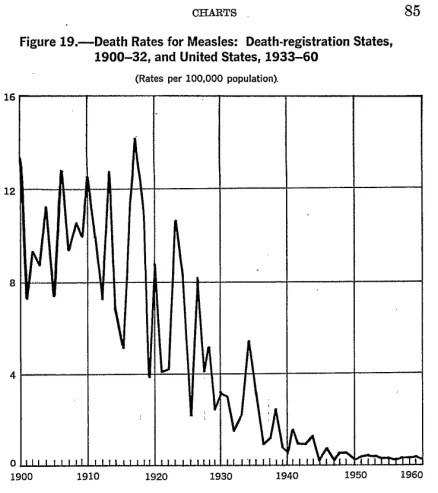
Taking a closer look, the CDC data reflects that in 1900, the rate of mortality from measles was 13.3 deaths per 100,000 individuals. By 1960, it was 0.2 deaths per 100,000 individuals. The same was true for 1961 and 1962. And as noted above, a similar decline of over 99% in measles deaths occurred between 1900 and 1967 in England and Wales, and it was only after that decline that the first measles vaccine was introduced there in 1968—five years after its introduction in the United States.
Hence, the same factors that caused measles mortality to decline by over 98% from 1900 to 1962 would, absent the vaccine interrupting the ecology of measles, likely have continued to cause a further reduction in the measles mortality rate after 1962. Meaning, at least a portion of the decline in the 400 deaths per year after the vaccine was available is no doubt attributable to the same factors that caused a steady decline in the measles death rate for decades prior to the introduction of the measles vaccine. Therefore, even without the measles vaccine, the death rate would have, no doubt, continued to decline after 1963.
In pockets of the country with poor nutrition, sanitation, and water, deaths from any pathogen, including measles, can occur at a higher rate. Those conditions still existed in some pockets of the United States in the early 1960s. As living conditions in those pockets of America improved with the introduction of clean water, improved sanitation, and better living conditions, deaths from measles declined, which is what typically occurs when these conditions improve. Let’s also not ignore that health care, especially the management and treatment of acute infections, has vastly improved since the 1960s. Doctors readily concede this point, unless you are talking about vaccines.
Yet, CDC claims that measles vaccines would have saved a data defying over 2,800 lives a year from measles in the United States between 1994 and 2023. CDC’s advertisement study, of course, also doesn’t account for the increase in deaths from heart disease and cancer due to the elimination of measles, as discussed in my previous post and reflected by studies that did not engage in estimates.
In sum, this CDC self-promotion article, that is not peer-reviewed and must conform to CDC policy to be published, does not account for any external factors, does not account for actual mortality data related to these diseases, and lacks any confidence intervals because its claims have zero reliability. Anyone citing this study claiming 1.1 million lives were saved is spreading propaganda. Not science.
[1] https://pmc.ncbi.nlm.nih.gov/articles/PMC1997101/pdf/pubhealthreporig01174-0001.pdf (“The simultaneous decline in diphtheria morbidity and mortality rates in all age groups of individual States located in different sections of the country, which began after a cyclic increase in incidence between 1915 and 1925, suggests the operation or influence of other factors besides, or in addition to, artificially induced immunity. Studies such as that included in the 1930 White House Conference on Child Health and Protection indicated that immunization programs were reaching a relatively large proportion of children in some areas or cities and a very low proportion in others as late as 1930. In spite of this wide variation, both morbidity and mortality began to decline rapidly after 1925 in all States simultaneously.”); https://www.cdc.gov/pinkbook/hcp/table-of-contents/chapter-7-diphtheria.html (“[D]iphtheria toxoid-containing vaccines became available in the 1940s” and “universal childhood vaccination program which included diphtheria toxoid-containing vaccines beginning in the late 1940s.”).
[2] The death rate per 100,000 individuals in the United States in 1900, 1940, and 1948 for diphtheria was 40.3, 1.1, and 0.4, respectively, for tetanus it was 2.4, 0.4., and 0.3, respectively, and for pertussis it was 12.2, 2.2, and 0.8, respectively. https://www.cdc.gov/nchs/data/vsus/vsrates1940_60.pdf.
The Pandemic of Fake Psychiatric Diagnoses
By Peter C. Gøtzsche | Brownstone Institute | September 17, 2025
On 12 September, UK child and adolescent psychiatrist Sami Timimi published “When mental-health diagnoses become brands, the real drivers of our psychic pain are hidden” in the Globe and Mail, a Canadian newspaper.
In his superb article, Sami carefully explains how he arrives at his painful conclusion:
You see there is a truth that we (in the mental-health business) hope no one will notice – we literally don’t know what we are talking about when it comes to mental health.
An obvious problem is that all definitions of psychiatric disorders are subjective. They are not objective facts such as a broken bone is. This means they can be expanded in a myriad of ways to capture a kaleidoscope of distress, alienation, and dissatisfaction, and that psychiatric diagnoses are consumer brands, not medical diseases.
In medicine, a diagnosis is aimed at determining which disease explains a person’s symptoms and signs, which enables effective matching of a treatment to address specific disease processes.
This is not the case in psychiatry. And all psychiatric drugs have nonspecific effects that are not directed against some cause of a disease. Their effects are similar to those of alcohol, narcotics, and other brain-active substances.
But, as Sami explains, increasingly, youngsters are getting diagnosed with ADHD, trauma, depression, anxiety, PTSD, autism, and often several such diagnoses. Their conversations may address gender identity, neurodiversity, and “having” a mental health disorder such as ADHD.
The facts are that virtually no one is in doubt about whether they are male or female; neurodiversity is a meaningless concept used by psychiatrists to impress the public about how knowledgeable they are but it just means that all people are not the same; and one cannot “have” ADHD, which is just a name for a subjective description of rather common behaviours and therefore cannot explain anything.
What people should realise is that it is part of being human to have difficulties that can be handled better if we don’t give people psychiatric diagnoses and drugs. Difficulties often have a cause that has nothing to do with being ill, e.g. poverty, trauma, inadequate housing, social injustice, marital problems, discrimination, exclusion, bereavement, unemployment, and financial insecurity. Life is not easy, but if you have difficulty coping with its challenges, you can easily get one or more psychiatric diagnoses.
There is a lot of misinformation that leads people astray, in scientific articles, newspapers, TV, radio, and social media. When youngsters look up descriptions of people who say they “have” ADHD on social media, they may be convinced they “have” it too and may even self-diagnose. There is an element of social contagion in this, and the criteria for ADHD are so vague and ludicrous that when I lecture and ask people to use the adult ADHD test on themselves, it never fails that one quarter to half the audience test positive.
Often, authoritative information is also seriously misleading or even mendacious, which I have documented in my books and articles, most recently in my freely available book, “Is psychiatry a crime against humanity?” and in the freely available article, “The only medical specialty that survives on lies.”
Sami mentions a patient information leaflet on antidepressants produced by a British national mental health service that includes the following advice:
It can sometimes take weeks, months or even years, to get the right medicine at the right dose for you. Think of it as a bit like dating. Some make you feel sick or sleepy; some are great to start with but wear off; others may not be much to start with but after a while grow on you. Then you might have found the one that makes you feel good long-term. So don’t lose hope if the first one doesn’t work.
It is an illusion to think that if you wait long enough and try enough drugs, one will work for you. Most mental health issues become better with time, without any treatment, which is misinterpreted as a drug effect, and research has shown that it doesn’t help to change drugs or increase the dose of drugs (see my freely available “Critical Psychiatry Textbook”).
The illusion that it helps to try several antidepressant drugs comes from the STAR*D trial, a $35 million fraud funded by the US National Institute of Mental Health.
Sami writes that he is impressed by the extraordinary ability of even the most severely afflicted of the young patients he sees to recover functionality and meaning in their lives. His advice to parents with troubled kids is that they should not agree to having their children assessed for ADHD, autistic spectrum disorder, or anxiety (or depression, as depression drugs double suicides). We should be able to talk about how we feel without jumping into panic mode and imagining that what we’re describing could be the onset of some mental disorder. Sami goes on to say that,
As we are launched into a seemingly never-ending search for the right diagnosis and treatment, we start collecting labels and accompanying interventions. Each step in this journey has the potential to make it harder to accept your child (or yourself) just the way they are with all their uniqueness and the mysterious wonderful variety of ways they might thrive in this maddening world. Be patient and categorize psychological problems in the sphere of the ordinary and/or understandable… Our duty as parents (and to each other as adults) is not to prevent our children from experiencing distress (which is impossible), but to be there and take the time and have the patience to be with them and support them when they do.
Beware of concept creep. As what I call the Mental Health Industrial Complex has burrowed its way into day-to-day language and “common sense,” concepts have been popularized that encourage us to view behaviours and experiences in pathological ways. We no longer become sad or miserable, we get depressed… You and your children’s experiences nearly always sit in the realm of the ordinary and/or understandable… Arming yourself with some knowledge to help you avoid the prolific spread of scientism (faith masquerading as science) could save you or your child becoming another number in the growing crowds of those who are deemed to have lifelong and incapacitating mental disorder/illness. These conditions were never meant to be a life sentence.
If all doctors heeded Sami’s advice, fewer people would kill themselves and fewer people would become permanently disabled. But in a world where healthcare is heavily influenced by the drug industry’s corruption of doctors, it is reasonable to ask: Are psychiatrists more mad than their patients? I have responded in the affirmative.
Like me, Sami is a member of the Critical Psychiatry Network based in England. My experience with lecturing for psychiatrists has led me to believe that over 99% of psychiatrists are uncritical towards their practice. Think about it. This is why psychiatric drugs are the third leading cause of death and why psychiatry as a profession does far more harm than good.
Don’t our kids and friends deserve better than this?
Dr. Peter Gøtzsche co-founded the Cochrane Collaboration, once considered the world’s preeminent independent medical research organization. In 2010 Gøtzsche was named Professor of Clinical Research Design and Analysis at the University of Copenhagen. Gøtzsche has published more than 97 over 100 papers in the “big five” medical journals (JAMA, Lancet, New England Journal of Medicine, British Medical Journal, and Annals of Internal Medicine). Gøtzsche has also authored books on medical issues including Deadly Medicines and Organized Crime.
‘Shut out’: Journal fires editor after publishing research refuting ‘warming climate’
By Gabriel Zylstra – The College Fix – September 17, 2025
The American Journal of Economics and Sociology recently removed special editor Marty Rowland from his position for publishing a paper refuting climate change argument about carbon dioxide, according to the paper’s authors.
“The standard response of the mainstream climate science community these days to papers that somewhat challenge the CO2-is-dangerous-narrative is to immediately ask for retraction,” Marcel Crok, a co-author of the paper and director of the climate science group Clintel, told The College Fix.
“It’s a strategy because it gives the signal that the paper is really bad and most people don’t have the time and knowledge to assess the situation,” Crok said in an email Tuesday.
The paper in question, “Carbon dioxide and a warming climate are not problems,” was published in the journal in May 2024. Crok co-authored it with Andy May, a retired petrophysicist and developmental geologist who worked for Exxon and other oil and energy companies.
Rowland, a lecturer at the Henry George School of Science and environmental engineer, was the editor at the journal who approved it.
According to May’s blog, the journal fired Rowland in August, and the reason it gave was “his publication of our paper.”
An archived version of the journal editorial board webpage shows Rowland was the special editions editor at least since 2023. The current page no longer lists him as an editor.
The Fix reached out to the editorial team at the American Journal of Economics and Sociology several times by email over the past two weeks to ask about the reason for Rowland’s departure. None responded.
Since being published, the paper has been cited 25 times according to google scholar, and scientists David Wojick, Kenneth Richard, and H. Sterling Burnett gave positive reviews, according to May’s blog.
“In short there was no legitimate reason to fire Dr. Rowland for publishing our fully peer-reviewed, and well received, paper,” May wrote.
May told The Fix via email this week that the paper was peer-reviewed prior to publication.
“The two scientists that liked the paper, both are very famous scientists with decades of climate science publications and well over 16,000 citations between them, had many suggestions and I made all their suggested changes to the paper and the changes improved the paper a lot,” May said.
“Post-publication, the response was mostly favorable, but there was a lot of published criticism,” he told The Fix. “But, these critical responses to our paper are swamped by the favorable critiques. The paper is very popular and in the top 0.1% of all papers followed by Wiley… It is also the #2 paper published in AJES.”
Crok told The Fix that others responded to its publication with calls for retraction.
However, May said none of the critics “identified any errors” in their article, which is why it hasn’t been retracted.
The publisher, Wiley, “disagreed with our conclusions and wanted to censor our paper, thankfully the board did not do that, but they did fire Marty, which was a very bad move” May told The Fix.
May told The Fix, “The pressures are huge. Basically, if a climate researcher does not toe the ‘consensus’ line he will receive no funding for his work and will be ostracized. He or she is then often forced to resign or fired.”
Crok agreed, saying scientists whose research does not fit the predominant climate change narrative often are unfairly maligned.
These include Dutch scientist Hessel Voortman, “who published a paper in 2023 about sea level rise along the Dutch coast (showing no acceleration), which led to a group of Dutch scientists asking for retraction,” Crok said.
Clintel, Crok’s foundation based in the Netherlands, focuses on climate education and policies from the standpoint that climate science should be less political. In 2023, Clintel organized a petition of more than 1,600 scientists world-wide, including Nobel Laureates, that argues there is no climate change crisis.
Meanwhile, environmental policy expert H. Sterling Burnett expressed similar concerns about Rowland’s firing when contacted by The College Fix.
“Unfortunately, I’m not surprised at all by the American Journal of Economics and Sociology (AJES) firing of Dr. Rowland,” Burnett said. He is the director of the Arthur B. Robinson Center on Climate and Environmental Policy at The Heartland Institute.
“If anything, I’m surprised at how brave he was in publishing the study,” he said.
Burnett said the field of climate research is heavily censored and not open to dispute. “No one should suffer for their belief in open inquiry that is at the heart of the scientific endeavor, but in the field of climate science, far too many academics do.”
According to Burnett, academics are commonly ostracized or fired “for daring to raise perfectly legitimate questions about the causes and consequences of climate change, and about the policies proposed by the ‘settled science’ community as a response to climate change.”
Burnett said climate research was relatively open to dissenting views up until about 20 years ago when “influential climate alarmists moved to shut down continued debate and discussion about the causes and consequences of climate change, by having open minded journal editors removed from their positions or reined in by journal publishers.”
“[C]limate skeptics were increasingly shut out of the peer review process, and papers openly skeptical of the anthropogenic climate disaster narrative found it nearly impossible to get published in top journals,” he said.
Burnett told The Fix that politicians and media also contributed to disenfranchising so-called “climate deniers” under the guise of protecting scientific consensus.
When asked about claims of consensus to justify scientific censorship, he responded, “Consensus is a political term, not a scientific one and should have no legitimate place in scientific discovery. ” He said that science “is a method, a way of explaining phenomena and discovering facts, not a conclusion set in stone for all time.”
Burnett expressed hope that things are starting to change for the better following the publication of a recent report by the U.S. Department of Energy that pushes back on “climate alarmists.”
The report “is forcing alarmists to address, rather than dismiss out of hand because the ‘science is settled,’ realists long-standing questions, concerns, and critiques of the argument that humans are causing dangerous climate change,” he said.
Crok also mentioned the DOE report in his interview with The Fix, noting that the authors are now facing “severe,” negative pressure for their work.
“This battle will go on, they will try to get the report retracted as well,” Crok said. “This is a worrisome trend in which the mainstream instead of engaging with skeptical scientists simply try to get skeptical papers removed immediately.”
Former CDC Officials Take Aim at RFK Jr. During Senate Hearing
By Suzanne Burdick, Ph.D. | The Defender | September 17, 2025
The U.S. Senate hearing that began today as an investigation into the firing of the CDC director and the resignations of other key agency officials morphed quickly into a forum for accusing U.S. Health Secretary Robert F. Kennedy Jr. of posing a threat to public health.
“Today should not be about me,” former director of the Centers for Disease Control and Prevention (CDC), Susan Monarez, Ph.D., told senators. “Today should be about the future of trust in public health.”
Monarez testified that she was fired for “holding the line of scientific integrity.” Dr. Debra Houry, former chief medical officer of the CDC who resigned after Monarez’s firing, also testified.
“Trust and transparency have been broken” under Kennedy’s leadership, Houry told members of the Committee on Health, Education, Labor and Pensions (HELP), which held the hearing.
She criticized Kennedy’s handling of the recent measles outbreak and the changes to COVID-19 vaccine recommendations.
The committee will hold another hearing in the future to allow Kennedy and current CDC officials to refute allegations made by Monarez and Houry, said Sen. Bill Cassidy (R-La.), the committee chair. “I want President Trump to have the best CDC in our nation’s history,” he said.
According to Sen. Bernie Sanders (I-Vt.), minority chair, the hearing was really about Kennedy’s “dangerous war on science, public health and the truth itself.”
Sanders praised Monarez for standing up for the “scientific method” and refusing to “rubber-stamp” Kennedy’s “dangerous agenda.”
Monarez testified that “vaccines are not controversial because they work.”
She also recounted how the CDC was attacked by a gunman who, in her words, was “driven by vaccine distrust.”
Sen. Roger Marshall (R-Kan.) called out the agency for creating public distrust during the COVID-19 pandemic. “The CDC is the cause of vaccine hesitancy,” he said.
Sanders refuses to have Monarez, Houry sworn in
The hearing came as no surprise. The day Monarez was fired, Cassidy posted on X that the sudden departure of top CDC officials “will require oversight” by the committee.
Cassidy wanted Monarez and Houry to be sworn in before their testimony. However, Sanders — whose approval was needed as minority leader — refused, saying Kennedy wasn’t sworn in at a prior hearing.
When another senator challenged Sanders’ refusal, Cassidy pointed out that Kennedy would be sworn in for future hearings related to today’s testimony.
Sanders still refused.
Cassidy reminded the witnesses that it’s illegal to lie to senators, even without explicitly vowing to tell the truth. Yet throughout the hearing, several senators questioned whether Monarez and Houry were being honest.
A U.S. Department of Health and Human Services (HHS) spokesperson told The Defender that Monarez’s prepared remarks contain “factual inaccuracies and leave out important details,” adding:
“Here’s the reality: Susan Monarez was tasked with returning the CDC to its core mission after decades of bureaucratic inertia, politicized science and mission creep corroded its purpose and squandered public trust.
“Instead, she acted maliciously to undermine the President’s agenda and was fired as a result. Some of her biggest offenses include neglecting to implement President Trump’s executive orders, making policy decisions without the knowledge or consent of Secretary Kennedy or the White House, limiting badge access for Trump’s political appointees, and removing a Secretarial appointee without consulting anyone. When she refused to acknowledge her insubordination, President Trump fired her.”
Children’s Health Defense CEO Mary Holland said Monarez represented the CDC’s “old guard” and that her termination was “necessary and proper.” She said:
“Monarez is assiduously following the pharma-funded script to attempt to oust Kennedy as HHS Secretary. Yet the obvious reality is that the CDC has lost the trust of the nation and the world, and radical reform is absolutely required if the agency is to continue at all.”
Senators, Monarez dispute details surrounding her firing
Senators at the hearing attempted to clarify disputed details surrounding Monarez’s firing.
The White House confirmed on Aug. 27 that she was fired after Kennedy tried to force her resignation and she refused to leave. Shortly after, Monarez wrote in an op-ed in The Wall Street Journal that she was fired because she “held the line and insisted on rigorous scientific review.”
She reiterated the claim in today’s hearing, saying Kennedy had given her a choice: accept the recommendations of the new Advisory Committee on Immunization Practices and fire top CDC officials responsible for vaccine policy, or resign.
According to Kennedy, he fired her because she responded “no” when he asked her, “Are you a trustworthy person?”
Monarez said the conversation went differently. “He told me he couldn’t trust me,” she said. “I told him that if he could not trust me, he could fire me.”
Sen. Markwayne Mullin (R-Okla.) pressed Monarez on details of the conversation, saying it had been recorded. However, he reportedly backtracked on the claim. “If HHS has a recording, I ask them to release it,” Cassidy said.
Cassidy also asked for all documentation related to the conversation for the committee to review.
Houry testified that she resigned because Kennedy “censored CDC science, politicized its processes and stripped leaders of independence.”
Andrew G. Nixon, an HHS spokesman, told The New York Times that Kennedy “has insisted that decisions be evidence-based, open to scrutiny and free from the kind of closed-door processes that undermined confidence in the C.D.C. during the pandemic.”
Monarez evasive on COVID and Hep B vaccines
Sen. Rand Paul (R-Ky.) asked Monarez if the COVID-19 vaccine prevented transmission or reduced children’s risk of hospitalization or death.
She replied, “It can.”
Paul cited research contradicting Monarez’s answer. He pointed out that children who get the COVID-19 shot face a heightened risk of myocarditis, and the shot fails to lower their risk of hospitalization or death.
James Lyons-Weiler, Ph.D., criticized Monarez in a Substack post, saying she was unable to provide substantive answers to Paul’s questions.
Lyons-Weiler also noted that Monarez offered “no credible defense” when Paul asked why it was important for newborns to get the hepatitis B vaccine if their mother was hepatitis B negative.
The CDC’s vaccine advisory panel is expected to vote Thursday on certain childhood vaccine recommendations, including the hepatitis B (Hep B) vaccine.
Critics have long raised concerns about the safety and necessity of giving the vaccine to newborns, particularly those not at risk for the disease. Today, the Hep B vaccine contains at least 250 micrograms of aluminum, and aluminum exposure has been linked to autism.
Paul asked Monarez, “What is the medical, scientific reason and proof for giving a newborn a hepatitis B vaccine if the mom is Hep B negative?”
Monarez refused to answer the question.
Paul called out Monarez for evading questions about specific vaccines and hiding behind vague assertions that all vaccines are “safe and effective.”
He said the burden should be on the CDC and its staff to prove that the benefits of giving babies COVID-19 and Hep B vaccines outweigh the risks. “That’s what the debate ought to be about,” he said. “Not on whether all vaccines are good.”
Monarez repeatedly said that the CDC doesn’t “mandate” vaccines; the agency only makes “recommendations.”
While technically correct, her answer overlooks the reality that many states use the agency’s recommendations when mandating vaccines for school entry.
Monarez was first CDC director in 70 years without medical degree
In March, Trump nominated Monarez for director of the CDC, where she had served as acting director until her nomination.
She was the first CDC director confirmed under a law passed in 2023 that requires Senate confirmation for the position. She was also the first person, in more than 70 years, without a medical degree to serve in the role. She has a doctorate in microbiology and immunology.
Trump nominated Monarez after withdrawing the nomination of Dr. Dave Weldon, who reportedly failed to secure enough votes because of comments he made suggesting a possible link between autism and vaccines.
Monarez, a biosecurity veteran, was previously deputy director of the Advanced Research Projects Agency for Health (ARPA-H), an agency within HHS created by the Biden administration to accelerate “high-risk, high-reward” biomedical research.
ARPA-H is modeled after the U.S. military’s Defense Advanced Research Projects Agency or DARPA. Monarez also previously held positions with the U.S. Department of Homeland Security and in the White House Office of Science and Technology Policy.
During her confirmation hearing before the Senate committee, Monarez affirmed her belief that “vaccines save lives,” and pledged to prioritize vaccine availability. She said mRNA vaccines are “safe and with demonstrated efficacy,” and she said she was unaware of any confirmed scientific link between vaccines and autism.
In her WSJ op-ed about why she was fired, Monarez said:
“Those seeking to undermine vaccines use a familiar playbook: discredit research, weaken advisory committees, and use manipulated outcomes to unravel protections that generations of families have relied on to keep deadly diseases at bay.”
Mark Crispin Miller, Ph.D., professor of media studies at New York University, told The Defender that Monarez is playing an old trick called “accusation in the mirror,” in which a person accuses their enemy of doing what the person has been doing.
He said:
“The trick usually works because it’s so disorienting, and most people have a hard time believing that anybody as ‘respectable’ as Susan Monarez — a woman with a Ph.D., who worked at CDC — could be so utterly dishonest. The only way to fight it is to call it out immediately, loud and clear.”
Watch the hearing here.
This article was originally published by The Defender — Children’s Health Defense’s News & Views Website under Creative Commons license CC BY-NC-ND 4.0. Please consider subscribing to The Defender or donating to Children’s Health Defense.
Fugitive Scientist Behind Vaccine and Autism Studies Arrested for Stealing $1 Million From CDC
By Brenda Baletti, Ph.D. | The Defender |September 16, 2025
Danish scientist Poul Thorsen, who co-authored influential papers in 2002 and 2003, used to argue against the link between vaccines and autism, was arrested in Germany and may be extradited to the U.S. on charges of stealing nearly $1 million in research money, Breitbart News reported.
Thorsen was listed as a fugitive on the U.S. Office of the Inspector General’s most wanted list for over a decade.
He reportedly was arrested in June following an Interpol Red Notice, a request to international law enforcement to locate and provisionally arrest a wanted person. The U.S. Department of Justice (DOJ) is working with German authorities to extradite him to the U.S., an unnamed DOJ official told Breitbart.
Thorsen allegedly absconded with over $1 million from the Centers for Disease Control and Prevention (CDC) as part of a scheme to steal grant money awarded to governmental agencies in Denmark for autism research.
A federal grand jury indicted Thorsen in Atlanta in 2011 on 22 counts of wire fraud and money laundering. However, Denmark previously refused to extradite him, so he wasn’t prosecuted, Forbes reported.
‘Number one’ on the HHS most wanted list
Thorsen’s research, allegedly “debunking” the link between autism and the measles-mumps-rubella or MMR vaccine and other thimerosal-containing vaccines, was cited by the Institute of Medicine (IOM) as proof of no link.
His research was also used as evidence in the National Vaccine Injury Compensation Program’s (VICP) proceedings to deny the injury claims of more than 5,000 families.
Thorsen’s findings have been widely criticized by safe vaccine advocates as seriously flawed and potentially fraudulent.
“Thorsen has been number one on the Health and Human Services (HHS) most wanted list for the past 10 years,” HHS Secretary Robert F. Kennedy Jr., a long-time critic of Thorsen’s studies, told Breitbart following reports of Thorsen’s arrest.
HHS did not respond to The Defender’s request to confirm whether Thorsen had been detained.
Author James Grundvig told The Defender that Thorsen’s arrest has the potential to expose a long history of misconduct within the CDC.
Grundvig wrote “Master Manipulator: The Explosive True Story of Fraud, Embezzlement, and Government Betrayal at the CDC,” which details the story of Thorsen’s alleged role in a broader CDC manipulation of vaccine safety studies.
“It is not just Thorsen,” Grundvig said. “It won’t be just taking down one guy.” If Thorsen is compelled to testify, “he will be pointing fingers and naming names.”
Children’s Health Defense Chief Scientific Officer Brian Hooker said:
“I really want to emphasize that this crime is much bigger than Thorsen. His collaborators need to be brought to justice as well. They partied on the backs of many autistic children. Frankly, jail time is too good for Thorsen and the many other fraudsters at CDC, IOM and the VICP!”
Thorsen used grant money to buy home, motorcycle, cars
Beginning in the 1990s, Thorsen, who worked as a visiting scientist at the CDC when the agency was soliciting grant applications for research about infant disabilities, advocated for grants on behalf of Danish scientists and institutions.
Between 2000 and 2009, the CDC awarded over $11 million to two Danish government agencies to study the relationship between vaccines and autism, and other infant developmental issues, according to a 2011 press release by the U.S. Attorney’s Office for the Northern District of Georgia and Grundvig’s book.
In 2002, Thorsen relocated to Denmark to serve as principal investigator on the grant, overseeing the distribution of research money. The research was done by Aarhus University and Odense University Hospital in Denmark.
Between 2004 and 2008, Thorsen allegedly submitted more than a dozen fraudulent invoices on CDC letterhead to the medical facilities conducting the research for costs incurred for work related to the grant.
The facilities transferred hundreds of thousands of dollars in payments to fake CDC accounts at the CDC Federal Credit Union in Atlanta. However, the money actually was deposited into Thorsen’s personal accounts.
Thorsen allegedly used the money to purchase a home in Atlanta, a Harley Davidson motorcycle and cars, among other items. Overall, he withdrew more than $1 million, according to reports.
The indictment charged Thorsen with 13 counts of wire fraud and nine counts of money laundering, each carrying potentially long prison sentences and heavy fines. It also sought forfeiture of all property purchased with the fraudulently obtained funds.
Fabricated results seem ‘all but certain’ in research involving Thorsen
Mainstream media writers have mocked the long-term critiques of Thorsen’s work as “conspiracy theories,” and argued that, as a co-author, his contributions to the papers didn’t skew the results.
In a Substack post detailing Thorsen’s history and the studies he co-authored, scientist James Lyons-Weiler, Ph.D., said Thorsen’s influence on the research was concerning and the studies themselves were flawed.
He said:
“Although his scientific findings must be evaluated on their own merits, including data sources, design, and replicability, his case may be critical in revealing decision-making and could produce evidence of wrong-doing by Thorsen and others. Defrauding the US Government of research dollars is a crime. (This includes misuse and scientific fraud).
“Results fabrication in the Danish registry results seems all but certain given the clear evidence of those practices in other studies on the topic of vaccines and autism.”
The Danish government, since 1968, has maintained an extensive registry of birth and health records on all of its citizens. This provided a rich database for research on childhood disabilities, Grundvig said.
According to Lyons-Weiler, the Danish registry studies published by Thorsen and others were riddled with methodological flaws, including vulnerability to confounding variables over time, shifting diagnostic categories that distorted the data, misclassification and reporting biases and conflicts of interest.
Lyons-Weiler called for greater transparency in that research, including access to the original datasets, registries, study methods and peer review processes.
He said the studies should be replicated, the policies derived from them should be reexamined, and the public should be provided clarity on which studies Thorsen influenced.
This article was originally published by The Defender — Children’s Health Defense’s News & Views Website under Creative Commons license CC BY-NC-ND 4.0. Please consider subscribing to The Defender or donating to Children’s Health Defense.
Is It Safe to Get 3 Vaccines at Once? Vaccine Makers Say Yes, But FDA Wants Proof
By Michael Nevradakis, Ph.D. | The Defender | September 8, 2025
Is it safe to get a COVID-19, RSV and flu vaccine at the same time? The answer is yes, according to many medical experts and the CDC and HHS websites — but that’s about to change.
According to an Aug. 25 memo, the U.S. Food and Drug Administration (FDA) now says vaccine makers must conduct clinical trials to study the potential adverse effects of simultaneously giving multiple shots for respiratory viruses before they can market the vaccines as “safe and effective” when received at the same time.
The FDA said it “cannot affirm that concurrent administration is both safe and effective,” as coadministration has not been thoroughly studied.
Some medical and scientific experts welcomed the new policy, first reported last week by The Washington Post.
Dr. Clayton J. Baker, an internal medicine physician, said:
“There is urgent need for scientifically sound, non-Pharma-conducted studies regarding the safety of all simultaneously administered vaccines.
“This practice is widely used and dangerously under-evaluated. The greatest risk is to young children during co-administration of the many different vaccines listed on the current, bloated Centers for Disease Control and Prevention [CDC] pediatric schedule.”
Last month, two doctors who lost their medical licenses because they questioned the CDC’s vaccine recommendations for children sued the agency for failing to test the cumulative effect of the 72-dose schedule on children’s health.
Research scientist and author James Lyons-Weiler, Ph.D., said, “Properly controlled and sufficiently powered trials are the gold standard,” promised by U.S. Health Secretary Robert F. Kennedy Jr., and that such trials are “the correct approach for any clinical intervention.”
“It’s about time the gold standard of science is applied to vaccines,” he said.
In a statement shared with The Defender, Emily G. Hilliard, press secretary for the U.S. Department of Health and Human Services, said the department “does not comment on future or potential policy decisions.”
Prasad: Past studies ‘incapable of adequately documenting safety signals’
According to Fierce Pharma, the Biden administration “supported vaccine coadministration as a means to increase immunization rates.”
Dr. Vinay Prasad, director of the FDA Center for Biologics Evaluation and Research (CBER), has publicly criticized this strategy due to a lack of evidence supporting it, the Post reported.
The Post cited 2021 guidance from the World Health Organization, which found that coadministration of the COVID-19 and flu vaccines is safe and “has potential advantages.”
A survey of the scientific literature, published in March in the journal Influenza and Other Respiratory Viruses and cited by the Post, found that “Adult vaccine coadministration is safe for all the combinations we assessed,” with adverse events that were “generally mild to moderate and of short duration.”
The Post also cited a 2022 CDC study published in JAMA Network Open, which found that “simultaneous administration of COVID-19 mRNA booster and influenza vaccines may be associated with increased likelihood of systemic reactions.” Yet, according to the Post, “those reactions were mostly mild and went away quickly.”
In the FDA memo, Prasad said past determinations regarding the safety of coadministering respiratory virus vaccines were made on the basis of small randomized studies. “Such small trials are inherently incapable of adequately documenting safety signals,” he said.
Baker agreed:
“At least two of the studies showed statistically significant increases in systemic reactions when the vaccines were coadministered. To dismiss this finding without further evaluation — as was done — is both irresponsible and tendentious in favor of ‘just giving’ the shots.”
Lyons-Weiler said the relevant studies “support convenience and short-term tolerability,” but “do not deliver the decisive evidence needed for label-level claims about clinical benefit or the absence of interaction-driven risk.”
Giving multiple vaccines at once is convenient, profitable — but not necessarily safe
Dr. Ashish Jha, the White House’s former coronavirus coordinator during the Biden administration and now dean of the Brown University School of Public Health, told the Post that the millions of doses of respiratory virus vaccines coadministered over the years prove they are safe.
“The burden of proof is not on manufacturers to be able to do something that clearly has been done millions of times safely,” Jha said.
Karl Jablonowski, Ph.D., senior research scientist at Children’s Health Defense, said Jha “is partaking in a fallacy that past actions were safe and warranted,” as “historic data of dubious record does not constitute a safety study.”
Jablonowski said:
“That it has been administered millions of times does not make vaccines safe; it makes them profitable. That we administered vaccines to our most vulnerable — during pregnancy and to 6-month-old infants — doesn’t make them safe, it makes us reckless.”
Baker agreed, saying, “Jha is correct in stating that the coadministration of multiple vaccines for respiratory viruses ‘clearly has been done millions of times.’ But how ‘safely’ has it been done? Jha doesn’t know, because nobody knows.”
Jablonowski said looking at vaccination data retrospectively is problematic because “there is no experimental control.”
He cited the case of a 6-month-old in Iowa who received multiple respiratory virus vaccines concurrently in 2022 and was “found pulseless” in his crib 10 days later, according to a report in the U.S. government-run Vaccine Adverse Event Reporting System or VAERS.
“Which vaccine, if any, likely killed him? We don’t know, because we don’t have the safety studies for combinations,” Jablonowski said.
Jablonowski also referred to a 2023 paper published in The BMJ on the safety of the mRNA COVID-19 booster shots. His analysis of the study’s data found that people who received a flu vaccine along with their fourth COVID-19 booster dose had a 62.5% higher risk of stroke within 28 days of vaccination.
The 2022 CDC study does, in fact, show “a compounding or synergy of adverse reactions,” Jablonowski added.
The study states:
“Compared with administration of COVID-19 mRNA booster vaccines alone, simultaneous administration of COVID-19 mRNA booster and seasonal influenza vaccines was associated with significant increases in reports of systemic reactions during days 0 to 7 following vaccination.”
Jablonowski analyzed the study’s results. He found that people who received Pfizer or Moderna COVID-19 vaccines concurrently with a flu vaccine were more likely to experience a systemic or injection-site reaction or to be unable to work or attend school following vaccination.
FDA policy ‘could have implications’ beyond cold and flu season
CDC guidance, current as of Aug. 18, states, “Flu, COVID-19, and RSV vaccines may be co-administered (given at the same visit)” and “may also be co-administered with other vaccines.”
According to the Post, Prasad’s memo “could have implications that go beyond the fall respiratory vaccination season.”
While the memo “does not prevent pharmacies and doctors from providing coronavirus and flu vaccines in the same visit,” the Post suggested that immunization rates may decline if more than one visit is required to receive multiple respiratory virus vaccines, or longer intervals are required between shots.
The memo comes as national pharmacy chains, including CVS and Walgreens, have begun limiting access to COVID-19 vaccines in response to new federal guidelines enacted last month ending emergency use authorization of the COVID-19 shots and restricting them to people at higher risk for severe illness.
According to the Post, Pfizer responded to Prasad’s memo by sending a letter to healthcare providers stating that some batches of its COVID-19 vaccine contain “unapproved prescribing information inside the cartons,” indicating the company intends to add a warning about coadministration of the vaccine to its product label.
According to the Post, the FDA’s policy change may also lead to new recommendations for respiratory vaccines — potentially stemming from the CDC’s vaccine advisory panel, the Advisory Committee on Immunization Practices (ACIP).
CDC vaccine advisers to meet next week
ACIP is scheduled to meet Sept. 18 to vote on COVID-19 vaccine recommendations for the upcoming cold and flu season.
In June, Kennedy retired all 17 members of ACIP to eliminate conflicts of interest. Shortly after, Kennedy named eight researchers and physicians to the committee, but one nominee declined to participate. Fierce Pharma reported last week that Kennedy plans to nominate seven additional members to the committee.
The new FDA policy is part of a broader series of shakeups at the FDA and CDC.
Prasad resigned from his position on July 29 amid pressure from vocal critics, but returned to his position two weeks later.
In May, Prasad replaced Peter Marks, M.D., Ph.D., as head of CBER. Marks had overseen Operation Warp Speed and the rapid development and approval of the COVID-19 vaccines. He resigned in March under pressure from Kennedy.
On Aug. 27, the White House confirmed the firing of CDC Director Susan Monarez, after she refused to resign amid clashes with Kennedy.
During a contentious U.S. Senate hearing Thursday, Kennedy said Monarez had indicated she would refuse to endorse any ACIP recommendations, even before the committee met to make them.
On Sept. 1, President Donald Trump suggested that the CDC and Big Pharma have not been fully forthcoming about COVID-19 vaccine safety data. Trump demanded they “clear up this mess.”
This article was originally published by The Defender — Children’s Health Defense’s News & Views Website under Creative Commons license CC BY-NC-ND 4.0. Please consider subscribing to The Defender or donating to Children’s Health Defense.
Von der Leyen Unveils New EU Censorship Push, Online Digital ID Plans, in 2025 State of the Union Speech
Von der Leyen casts online “misinformation” as a contagion, folding speech regulation into the language of safety.
By Dan Frieth | Reclaim The Net | September 11, 2025
European Commission President Ursula von der Leyen used her 2025 State of the Union speech to unveil a raft of new regulatory measures that introduce new challenges for digital rights and freedom of expression across the continent and the world.
Framed as measures for public health, democracy, and child protection, the Commission is pushing the EU deeper into institutionalized censorship and online regulation.
Addressing the European Parliament, von der Leyen declared she is “appalled by the disinformation that threatens global progress on everything from measles to polio.”
Citing fears of a global health crisis, she introduced a “Global Health Resilience Initiative,” which she said the EU would lead.
This initiative is expected to tie online speech more tightly to global health narratives, laying the groundwork for broader suppression of dissenting views under the label of medical misinformation.
Another centerpiece of her address was the so-called “European Democracy Shield,” a program that we’ve covered in great detail, intended to streamline and centralize the Commission’s censorship machinery under the banner of fighting “foreign information manipulation and interference.”
Framing the internet as a battlefield, she said: “Our democracy is under attack. The rise in information manipulation and disinformation is dividing our societies.”
Expanding on that framework, she announced the creation of a new institution, the European Centre for Democratic Resilience.
According to von der Leyen, this center will allow the EU to scale up its ability “to monitor and detect information manipulation and disinformation.”
But the agenda didn’t stop there. She introduced the Media Resilience Program, which she claimed would support “independent journalism and media literacy.”
In practice, however, such efforts often result in government-approved messaging being amplified, while dissenting outlets don’t get funded.
Von der Leyen pointed to declining local journalism in rural communities and claimed: “This has created many news deserts where disinformation thrives…This is why we will launch a new Media Resilience Program – it will support independent journalism and media literacy.”
Despite the existing Digital Services Act already mandating age verification (and therefore digital ID) online, von der Leyen floated a new, even more restrictive direction for internet access among young people.
Drawing inspiration from Australia’s controversial 2024 Online Safety Amendment, which includes a social media ban for those under 16, she suggested the EU could move toward similar rules.
“Just as in my days, we as a society taught our children that they could not smoke, drink, and watch adult content until a certain age. I believe it is time we consider doing the same for social media,” she said.
The entire speech signals a continued consolidation of control over digital spaces by EU institutions, with a heavy focus on regulating speech and tightening access restrictions.
Download for Free: ‘Forbidden Facts,’ Gavin de Becker’s New Book About Childhood Vaccines
By Brenda Baletti, Ph.D. | The Defender | September 12, 2025
The link between vaccines and autism has been “debunked, debunked, debunked,” said New York Times bestselling author Gavin de Becker, in an interview with Children’s Health Defense (CHD) CEO Mary Holland on “Good Morning CHD.”
However, that “debunking” relied on a private organization and a behind-the-scenes meeting where the conclusion was set before the discussion began. De Becker told viewers:
“Out of that closed-door meeting and closed-mind meeting comes one of the most significant damages done to the American public, which is the cessation of … any full-hearted and authentic government-funded research into vaccines and brain damage.”
The transcripts of those Simpsonwood meetings were leaked, giving outsiders an inside look into how scientific concerns and evidence were suppressed, de Becker said.
In his new book, “Forbidden Facts: Government Deceit & Suppression about Brain Damage from Childhood Vaccines,” de Becker details how private organizations and public health agencies have buried negative information and touted false claims to propagate the lie that vaccines are unquestionably “safe and effective.”
CHD is offering the book as a free download.
“Forbidden Facts,” aimed at a broad audience that may be reluctant to question vaccine orthodoxy, addresses a heartbreaking topic, but also manages to weave in some humor.
“What’s such an amazing facet of this book about something very tragic, about brain injury to children, is that you’ve actually made it funny,” Holland said. “Honestly, I’ve never seen anything quite like it.”
De Becker detailed his key findings in the interview with Holland.
The link between vaccines and autism was “debunked” by the Institute of Medicine — now known as the National Academy of Medicine, he said.
The private organization also “debunked” the dangers of Agent Orange, the link between baby powder and cancer, the cause of Gulf War Syndrome, the dangers of silicone breast implants and the dangers of the anthrax vaccines.
But all of those claims were later revealed to be wrong.
“If you can accept that they do it once, then hopefully you can accept that they do it in other areas, and be … skeptical,” de Becker said.
Public health agencies altered definitions of key terms
The book also explains how agencies like the Centers for Disease Control and Prevention confuse public health issues by changing the definitions of key terms.
For example, a vaccine used to be defined as “a product that stimulates a person’s immune system to produce immunity to a specific disease, protecting the person from that disease,” de Becker said.
Today, it is defined as “a preparation that is used to stimulate the body’s immune system against diseases.” That means vaccines no longer have to protect people from a disease, he said.
A similar change was made to the word “pandemic.” It used to mean an outbreak that killed large numbers of people, but now it just means the appearance of a new virus to which people don’t have prior immunity.
“That terminology of what we used to think a vaccine meant, and what we used to think a pandemic meant, both of those died of COVID in 2020 and 2021,” de Becker said.
A similar move had been made with autism, as the definition has expanded to include people who don’t suffer from severe disability, according to de Becker. This benefits the pharmaceutical companies, he said. They can claim there is a disorder, with no clear definition, that is definitely not linked to vaccines — which also are not, which also have no clear definition.
“I encourage people to use the term ‘brain damage,’ because that, we know, is caused by vaccines,” he said.
No evidence childhood vaccines saved more than 150 million lives
Over the last year, scientific papers, studies and reports have confirmed that vaccines saved over 150 million lives, de Becker said.
However, all of the reports rely on the same flawed data — published in The Lancet — from a modeling study conducted by Imperial College London, which has produced many incorrect modeling studies, according to de Becker.
The modeling study doesn’t account for any vaccine injuries, de Becker said:
“Words that never appear inside that 7,000-word report …: adverse event, side effect, injury, harm, reaction, autism, myocarditis, brain damage, seizure, blood clot, neurological, simian virus 40, autoimmune, heart, heart failure, cardiac arrest, sudden death, stroke, fatality, convulsions. You get the idea.”
That manipulation is pervasive among vaccine manufacturers, vaccine supporters and much of the medical community, Holland said:
“This is why we talk about gaslighting. [Vaccines are] lifesaving, but if you’re injured or if you die — which they acknowledge can happen, but it’s ‘so rare’ — it’s completely ignored in the numbers, in the narrative. It’s not something that’s acceptable in polite conversation.”
The studies touting vaccine successes also fail to address questions such as why people vaccinated against tetanus have the same, very low tetanus death rate as those who aren’t vaccinated against it, de Becker said.
And the numbers are similar for other diseases among healthy people, he added.
When you look at the claim that vaccines saved more than 150 million lives, you have to believe one of two things, de Becker said:
“One is that 154 million lives saved is a headline-grabbing claim bought and paid for and amplified by biased stakeholders in order to affirm and encourage and expand mass vaccination. In other words, the claim is propaganda and promotion, not science.
“Or the other alternative is that the number is perfectly accurate and verifiable, discovered by an unbiased, unconflicted group of geniuses.”
Drug industry uses ‘threats, intimidation’ against people who question them
De Becker, a criminologist, said he believes the pharmaceutical industry is violating the Racketeer Influenced and Corrupt Organizations Act of 1970, or RICO.
Industry insiders “use bribery, all variety of deceit, threats, intimidation to do damage to the reputation of people who question the orthodoxy that they’ve created,” he said.
It isn’t surprising, as most product launches involve some element of conspiracy, de Becker said:
“They’re going to discredit or harm their competitive products. They’re often going to overvalue and exaggerate the value and benefit of the product they’re rolling out, and they’re not doing it alone. That is a conspiracy. And conspiracies happen every day, all day. There is nothing dark or special about it.”
So the question that remains is: Who can you trust?
“And I say, ‘trust yourself,’” de Becker said, adding that people should look into the recommended vaccines, become informed and make their own decisions.
Just by reading his book, people will know more about how vaccine harms were “debunked” than most doctors, he said.
Watch the interview here.
This article was originally published by The Defender — Children’s Health Defense’s News & Views Website under Creative Commons license CC BY-NC-ND 4.0. Please consider subscribing to The Defender or donating to Children’s Health Defense.
THE “661 TRIALS” LIE: WHAT AARON SIRI REVEALED IN CONGRESS
The HighWire with Del Bigtree | September 11, 2025
Del sits down with ICAN’s lead attorney, Aaron Siri, Esq., for a hard-hitting conversation following his explosive Senate testimony. Siri takes aim at the false narrative of “661 placebo-controlled vaccine trials,” dismantling it point by point. He also exposes the buried Henry Ford study featured in the upcoming documentary “An Inconvenient Study,” and opens up about his powerful new book, “Vaccines. Amen.” Together, they make the case for why true transparency in vaccine science can no longer be delayed.
The Only Medical Specialty That Survives on Lies
By Peter C. Gøtzsche | Brownstone Institute | September 8, 2025
I am a specialist in internal medicine and have a keen interest in statistics and research methodology.1 My general approach to science has led to publications in many different areas because people came to me when they suspected something fishy in their specialty.1
In 2007, midwife Margrethe Nielsen from the Danish Consumer Council wanted to find out if history was repeating itself. I offered her a PhD student scholarship and we found out that the withdrawal symptoms are very similar for depression drugs and benzodiazepines, but they were described as dependence only for the latter.2
This started my interest in psychiatry and I quickly realised that a lot else was also misrepresented in this specialty. The lies psychiatrists convey to the public are so common and so harmful for their patients that I published my own textbook of psychiatry where I document what is wrong in the official textbooks used by medical students and psychiatrists in training.3 Much of what is claimed in the textbooks is scientifically dishonest, and frequently cited research is often totally unreliable because the data were tortured till they confessed.4
Psychiatry is the only specialty I know of that causes more harm than good; in fact, vastly more harm than good.5 This disaster can only survive because psychiatrists constantly lie to the public about what they can achieve with their drugs. Psychiatrists also routinely violate elementary human rights about informed consent and use forced treatment even though it is harmful.5,6
The title of my most recent psychiatry book summarises the issues: “Is psychiatry a crime against humanity?”5 As you shall see, I am not exaggerating.
In January 2014, I published the article, “Psychiatry gone astray,” in a major Danish newspaper, which also came out in English.7 I described ten myths in psychiatry that are harmful for the patients:
Myth 1: Your disease is caused by a chemical imbalance in the brain.
Myth 2: It’s no problem to stop treatment with antidepressants.
Myth 3: Psychotropic drugs for mental illness are like insulin for diabetes.
Myth 4: Psychotropic drugs reduce the number of chronically ill patients.
Myth 5: Happy pills do not cause suicide in children and adolescents.
Myth 6: Happy pills have no side effects.
Myth 7: Happy pills are not addictive.
Myth 8: The prevalence of depression has increased a lot.
Myth 9: The main problem is not overtreatment, but undertreatment.
Myth 10: Antipsychotics prevent brain damage.
I explained why “Our citizens would be far better off if we removed all the psychotropic drugs from the market, as doctors are unable to handle them. It is inescapable that their availability creates more harm than good. Psychiatrists should therefore do everything they can to treat as little as possible, in as short a time as possible, or not at all, with psychotropic drugs.”
I hit some sore toes. There was an outcry, spearheaded by the drug industry and their paid allies among doctors and the media, but also the biggest debate in Denmark ever about psychiatric drugs.1,6 For more than a month, there wasn’t a single day without discussion of these issues on radio, TV, in newspapers, and at psychiatric departments. But sadly, the harmful business continued as usual.
The Facts
Psychiatric drugs do not have any specific effects, directed against a specific disease.8 Psychiatric disorders are merely a constellation of symptoms and psychiatric drugs have mainly two effects: They either sedate and numb people, or they stimulate them.
Brain-active drugs have such effects, e.g., also alcohol, opioids, cannabis, other psychedelics, and cocaine, but we don’t call such drugs antidepressants or antipsychotics. And the effect of antidepressants and antipsychotics is far below the minimally relevant effect, as established by the psychiatrists themselves in their research.3,6 It is therefore reasonable to say that they don’t work.
The most important effects of psychiatric drugs are not what you hear about. Because of the colossal overuse of the drugs, they are the major reason that our prescription drugs are the leading cause of death, ahead of heart disease and cancer.9 One in five citizens is on an antidepressant, which can cause falls, and when elderly people break their hip, one-fifth will die within the next year.
Many of those who don’t die will fare badly anyhow. In all countries where the relationship has been examined, the rates of disability pensions go up in tandem with increased usage of psychiatric drugs.10
You don’t hear much about sexual disturbances either. The so-called happy pills harm the sex life in half the patients, and in half of those patients, the harm is unacceptable.11 In some patients, the harms are irreversible and continue after the patients come off their drugs, which has led to suicide.12
The Lies
Psychiatrists, particularly those in high positions, routinely lie to the public with the intent to protect their guild interests and their financial interests, which are huge. In the US, there are more psychiatrists collecting payments from the pharma industry than any other type of specialist.13
The American Psychiatric Association (AMA) is corrupt. Many of the psychiatrists who invented the most foolish diagnoses in its Diagnostic and Statistical Manual (DSM) for psychiatric disorders, which expanded hugely the market for psychiatric drugs, were on industry payroll. But they are not open about it. The DSM-5-TR panel members received $14 million in undisclosed industry funding.14 To a European, this is an obscene level of corruption.
The worst lie is this one: Psychiatrists routinely tell their patients that they are ill because they have a chemical imbalance in the brain and that they will receive a drug that fixes this.
An associated lie is that withdrawal effects, when the patients try to come off their drugs, are trivial, and not withdrawal effects at all, but signs that their disease has relapsed and that they still need the drugs.15
In 2018, leaders in the UK Royal College of Psychiatrists wrote in the Times that, “in the vast majority of patients, any unpleasant symptoms experienced on discontinuing antidepressants have resolved within two weeks of stopping treatment.”5 A group of clinicians and academics, including me, wrote to the authors that their statement was incorrect and that the College’s own survey of over 800 patients had found that withdrawal symptoms were experienced by 63% of the patients and that a quarter reported anxiety lasting more than 12 weeks.
The College immediately removed its survey from its website and when they refused to correct the error, we made our complaint public, which was covered by the BBC. Later, psychiatrist Sir Simon Wessely, previous president of the College, rejected any link between the pills and suicide and stated categorically in a podcast that they are “not addictive.”
We then published a most damning letter in the BMJ.16 Since guidelines from the National Institute for Health and Care Excellence (NICE) stated that withdrawal symptoms were “usually mild and self-limiting over about 1 week,” we asked for the evidence. NICE provided two short review articles, neither of which supported the one-week claim, and both articles cited numerous sources that contradicted it!
The embarrassment was now so big that the College needed to change its stance and NICE updated its guidelines.
This is one of the very rare instances where protests about psychiatry’s lies have led to any change. But the organised denial just continued. In 2025, a highly flawed systematic review in JAMA Psychiatry claimed that antidepressant withdrawal is not a problem.17,18 As usual, the authors postulated that depression after discontinuation is indicative of depression relapse.
To spread a little candlelight in the psychiatric darkness, I invented the term abstinence depression, which is not a true depression.3,18 The fact is that about half of the patients experience withdrawal effects; in half of the cases they are severe; and when patients try to stop, they often become worse than they were before they started on the drug.19 Moreover, the longer one is on the drugs, the higher the risk of withdrawal.19,20
The lies about a chemical imbalance and that abstinence symptoms are signs of relapse keep patients on their drugs for many years. Why would they ever stop when it is so clear that they need the drugs? But we don’t argue this way in relation to abuse of alcohol or narcotics. The patients never had a chemical imbalance causing their problems; but the drugs created one21,22 and caused harm.
Another big selling point is that you only need to treat a couple of patients to benefit one of them. This is also a huge lie. Psychiatric drugs cannot cure anyone. And the illusion of huge benefits is obtained by statistical manipulation.23 The trick is to dichotomise disappointing outcome data on a ranking scale and talk about response rates instead.24
This statistical hocus-pocus can convert a non-existing benefit into an almost doubling of the response rate,24 which looks very impressive. But as psychiatrist Joanna Moncrieff wrote, it is spinning straw into gold transforming ineffectiveness into the much-trumpeted idea that antidepressants work.25
The number needed to treat to benefit one patient (NNT) doesn’t exist because more patients are harmed than those who benefit. There can therefore only be a number needed to harm (NNH), which is two for sexual harms caused by antidepressants.11
Harms and benefits are rarely measured on the same scale, but when patients in a placebo-controlled trial decide whether it is worthwhile to continue in the trial, they make a judgment about if the benefits they perceive exceed the harms. My research group found that 12% more patients dropped out on a depression pill than on placebo (P < 0.00001).26 Thus, the patients will benefit by NOT being treated with antidepressants. They prefer a placebo.
More Examples of Institutional Betrayal
The US National Institute for Mental Health (NIMH) is the most prestigious psychiatric institution in the world. In 2022, Thomas Insel, its director from 2002 to 2015, called “America’s psychiatrist,” published the book, “Healing: Our Path From Mental Illness to Mental Health.”
Insel takes on the role of a drug rep, selling the wonders of psychiatric drugs to the public, but his book is misleading and dishonest.5 It starts already with the title. Psychiatric drugs cannot heal mental disorders, and the path the psychiatrists have taken is not from mental illness to mental health, but from bad to worse. Clearly, Insel makes an unintended case for abolishing psychiatry even though he tries to support it.27
The book reflects the thinking of psychiatric leaders everywhere and encapsulates how psychiatry has consistently betrayed public trust and misinformed the public, and that it will never tell the public the truth about psychiatric drugs.
Being a former NIMH director, Insel had an ethical obligation to tell his readers about the negative long-term outcomes of treatment with psychiatric drugs, as documented in expensive and prestigious research funded by the NIMH, e.g. the STAR*D trial in depression – a $35 million fraud – the MTA trial in ADHD, and the CATIE trial in schizophrenia.5 He didn’t, even though the NIMH is the only institution in the world that funds the big, long-term drug trials. As psychiatric leaders always do, Insel sacrificed the patients and protected the psychiatric guild by keeping the long-term studies financed by his own institute hidden.
In January 2025, I notified the UK drug regulator, the Medicines & Healthcare products Regulatory Agency (MHRA), that the package inserts for antidepressants — called patient information leaflets (PIL) — contain false statements about depression being caused by a chemical imbalance, and I called for the misleading messages to be removed.28
The MHRA refused and when I sent a letter about this to four major UK newspapers and the Royal College of Psychiatrists with Joanna Moncrieff and others, they didn’t even have the courtesy to respond.
To paraphrase Lenin, editors of leading medical journals also behave like useful idiots for psychiatry and the drug industry. On 10 May 2025, an anonymous editorial in the Lancet, “50 years of SSRIs: weighing benefits and harms,” did little of what its title promised. It praised the drugs based on flawed research and glossed over the harms. When I pointed out how misleading the editorial was in a letter to the editor, it was rejected.28
Many Cochrane reviews of psychiatric drugs also contain misleading praises of the drugs and are garbage in, garbage out exercises that uncritically reproduce the flawed data the drug industry has published.1,5,29-31
The Lie That Drugs Can Prevent Suicide
Despite their pompous designation, “State of the Art” articles in leading medical journals are usually misleading and they are particularly dishonest in relation to suicides.1 A 19-page review in the BMJ claimed that depression drugs, lithium, antiepileptics, clozapine, ketamine, and electroshock can decrease the risk of suicide.32 None of the 159 references were convincing;33 the package inserts for depression drugs warn against the risk of suicide; and the package inserts for antiepileptics state that they double the risk of suicide!
In a 14-page Lancet suicide seminar from 2022, the authors tried to resurrect the lie about the chemical imbalance but the two articles they cited were gobbledygook.34,35 Among risk factors for suicide, they mentioned substance use but not depression pills, antiepileptics, or the psychiatric profession itself.35,36 A Danish register study of 2,429 suicides showed a very marked dose-response relationship:36 The closer the contact with psychiatric staff, the greater the risk of suicide.
Compared to people who had not received any psychiatric treatment in the preceding year, the adjusted rate ratio for suicide was 44 for people who had been admitted to a psychiatric hospital.36 Such patients would of course be expected to be at greatest risk of suicide because they were more ill than the others (confounding by indication), but the findings were robust and most of the potential biases in the study were actually conservative, i.e. favoured the null hypothesis of there being no relationship. An accompanying editorial noted that there is little doubt that suicide is related to both stigma and trauma and that it is entirely plausible that the stigma and trauma inherent in psychiatric treatment—particularly if involuntary— might cause suicide.37
The Lancet authors wrote that there is a possibility of exacerbating suicidal thoughts. Wrong. It is not a possibility; it is a fact. None of the 142 references were to any of the many meta-analyses showing that depression pills increase the suicide risk compared to placebo. The authors even claimed, with no references, that drug treatment can reduce the suicide risk. Which miraculous drugs can do this?
They also noted that some research has found an association with increased risk of suicide-related outcomes in young people. This is also dishonest. When the FDA looked at all the randomised trials, they found a causal relation and not just an association.
In 2023, the “experts” failed us badly again. A 16-page article in BMJ about suicide in young people, with 169 references, mentioned some risk factors, e.g. living in a home with firearms, but not depression drugs, which they recommended with “increased monitoring by the prescribing physician.”38 This is a fake fix, as people may kill themselves suddenly and unexpectedly.39
The authors considered a risk difference of 0.7% for suicidal ideation or suicide attempt between drug and placebo small and even dismissed it: “Data from more recent pediatric antidepressant trials have not shown differences between drug and placebo.” The review they quoted cannot be used to such effect and for rare events, it is unacceptable to lose statistical power by including only “recent” trials. Moreover, the review only included published trial reports, which we know have omitted many suicide attempts and suicides, even in children.6,39 It is irresponsible of the BMJ to publish such dangerous nonsense.
In 2023, I called for retraction of three fraudulent trial reports that had omitted suicidal events in children.40 Even though my letter was co-signed by 10 people who each lost a child or spouse to suicide as a direct consequence of being prescribed an antidepressant drug for a non-psychiatric condition, my request was turned down by both involved journals.41
Annette Flanagin, Executive Managing Editor, Vice President, Editorial Operations JAMA and JAMA Network, replied: “We shared your letter with the author of the study published in Archives of General Psychiatry and he does not identify any new concerns. Similarly, we do not find new evidence in support of your request to retract this article.”
So, JAMA and Graham Emslie, who omitted two suicide attempts on fluoxetine, do not think this is something to bother about. When I contacted the journal’s owner, Elsevier, they did not engage with our concerns but directed me back to the journal.
Douglas K. Novins, Editor-in-Chief, Journal of the American Academy of Child & Adolescent Psychiatry (JCAAP), wrote to me that, “Following guidelines developed by the Committee on Publication Ethics (COPE),” they had thoroughly reviewed my “critique, as well as the responses provided by the papers’ authors. We are satisfied that the critiques of the papers as outlined do not merit retraction.”
It is hard to see how Novins could have followed the COPE guidelines, as the two trial reports, by Emslie and Martin Keller, are clearly fraudulent.
In 2023, I did a Google search on suicide and antidepressants, which confirmed that the public is being massively and systematically misinformed.42,43 One of the top 10 posts was from the Danish Centre for Suicide Research that reported that depression drugs increase the risk of repeated suicide attempts by 50%.44 The research was supported by Lundbeck, and after the researchers had adjusted their analyses for many factors including psychiatric contact and use of various psychiatric drugs, they concluded that the pills do not increase the risk of suicide. It is plain wrong to adjust for something that is part of the causal chain, as it may remove a true association, but the authors surely pleased their funder.
Another post was a comment I made on the Danish Board of Health’s website.45 Poul Videbech, a national icon in depression, had claimed in the Board’s journal, Rational Pharmacotherapy, that undertreatment with depression drugs is dangerous because of the suicide risk. This cannot be correct because the drugs increase the risk of suicide.
When I searched the Internet to find out what the “experts” opine currently, I found a systematic review in the psychiatrists’ flagship journal, American Journal of Psychiatry.46 It was about “evidence-based strategies,” but already the abstract was blatantly false. It claimed that “Meta-analyses find that antidepressants prevent suicide attempts.”
I don’t know of any other medical specialty whose practitioners lie systematically to the public in matters of life and death and claim the opposite of what is true.
In June 2025, I gave a talk in Capitol about suicides caused by antidepressants, invited by US war veterans who are routinely given these drugs for their war traumas.47 As expected, the effect of the veterans’ suicide prevention programme has been a notable increase in suicides corresponding to a similar increase in antidepressant usage.48,49
In the surreal upside-down world of psychiatry, all suicide prevention initiatives I have come across have included drugs that increase suicides!50
There was a press conference outside the Capitol,47 but the media are not keen to write stories about antidepressants killing people. I only saw an article in the Wall Street Journal, which I tweeted about:
Combat cocktails: US war veterans are destroyed and kill themselves because of psychiatric polypharmacy. Wall Street Journal https://bit.ly/4fjkz5P.
Antidepressants Harm the Unborn Child
New winds are blowing in the US, which could profoundly change healthcare for the better.51 On 21 July 2025, the FDA held a two-hour seminar about the possible harms to the foetus of treating pregnant women with antidepressants.52 For the first time, this crucial issue was honestly debated at the FDA, by good scientists, but this could not be tolerated by the professional liars.
There was a howl of outrage from psychiatric organisations and mainstream media that accused the FDA’s panel of being alarmingly unbalanced and of spreading misinformation,53-55 which was not at all the case.
The American Psychiatric Association (AMA) wrote to the FDA four days after the meeting that it was “alarmed and concerned by the misinterpretations and unbalanced viewpoints shared by several of the panelists… This propagation of biased interpretations at a time when suicide is a leading cause of maternal death within the first postpartum year could seriously hinder maternal mental health care. The inaccurate interpretation of data, and the use of opinion, rather than the years of research on antidepressant medications, will exacerbate stigma and deter pregnant individuals from seeking necessary care.”
The AMA could hardly have been more dishonest. Antidepressants double not only the risk of suicide but even actual suicides.49,56
Without mentioning the pregnancy issue, the AMA circled the wagons again, in a tweet on 28 August:57
“IMPORTANT: Decades of rigorous research, randomized clinical trials, peer-reviewed studies, meta-analyses, national registry studies, and FDA oversight show that psychiatric medications are safe and effective. Medications like SSRIs can be lifesaving if they are taken as directed under the care of an appropriately licensed healthcare professional. Learn more: https://ow.ly/RWEQ50WNJeI.“
In just two sentences, the AMA propagated three lies. No psychiatric drug is safe. They all kill people, to a substantial degree.1,3,5,6,9 And it has never been documented that SSRIs can be life-saving while it has been documented that they take many lives. They cause suicides and homicides6 and lead to falls in the elderly,9 and when they break their hip, one-fifth will die within the next year. Psychiatric medications are not effective either, e.g. the effect of antidepressants and antipsychotics is far below the minimally relevant effect, as established by the psychiatrists themselves in their research.5,6
Not even when there is clear evidence, both from studies in animals and humans,52-55 that our children are being harmed by psychiatric drugs before they are even born, do we see any admission from the AMA that it is wrong to treat pregnant women with antidepressants. They prefer to continue lying.
Antidepressants should be banned for use in pregnant women. Psychotherapy is more effective, as it has enduring effects,5,6 and it won’t harm the unborn child.
Reactions to AMA’s Tweet
Increasingly, the public is waking up to psychiatry’s deceptions. People are not so dumb as the AMA thinks they are, which the retweets to AMA’s tweet57 demonstrate:
“The FDA issues a black box warning for all SSRI’s indicating increased risk of suicidal thoughts and behaviors, particularly in children, adolescents, and adults under 25. How could the American Psychiatric Association make such a claim? (sic) Isn’t doing so extremely unethical?!”
“The APA is lying to you. SSRIs are neither safe nor effective. NOT EVEN CLOSE. And they do not magically perform better under the care of a licensed professional. Them’s the facts.”
“Anytime I hear experts so-called say something is safe and effective. I immediately know that that is not the case. Thank you for confirming my suspicion.”
“Merriam-Webster defines ‘safe’ as ‘free from danger, harm, or risk.’ All classes of psych meds include black box warnings about serious or life-threatening adverse effects risks.”
“How safe is sudden death? Some of those meds can cause that.”
“Life-taking. My adult son didn’t make it past 6 weeks after his #PillPusher prescribed SSRIs within 15min of meeting him.”
“What percentage of patients who take SSRIs are cured and can stop taking them?”
“I don’t know a single person who has been cured by psychiatric drugs.”
“The good ‘ol APA, brought to you by Pfizer. Maybe they will make a med for cognitive dissonance soon?”
“Psychiatry is quackery. Read the book Anatomy of an Epidemic by Robert Whitaker!”
“Psychiatry is one of the dumbest religions.”
A retweeter showed this picture of Mr. Bean, which sort of explains it all:

Conclusions
Psychiatry is a totally corrupt specialty, ethically, scientifically, and financially, with devastating consequences for the patients, their relatives and friends, and for our national economies.
Psychiatry is a crime against humanity that must be stopped.5 It should not be a medical specialty, and patients with mental health issues should not be treated by medically trained doctors because the existing approaches, which focus on drugs, are not working.
In the UK, mental health disability has almost tripled in recent decades, and the gap in life expectancy between people with severe mental health issues and the general population has doubled.58 The World Health Organisation (WHO) and the United Nations have therefore recently called for systematic mental health reform emphasising psychosocial interventions.58
My advice to patients is: If you have a mental health issue, don’t see a psychiatrist. It is too dangerous and might turn out to be the biggest error you made in your entire life.12,59 Don’t look up a family doctor either, as they are also programmed to make psychiatric diagnoses and hand out psychiatric pills.
References
1 Gøtzsche PC. Whistleblower in healthcare (autobiography). Copenhagen: Institute for Scientific Freedom 2025; April 8 (freely available).
2 Nielsen M, Hansen EH, Gøtzsche PC. What is the difference between dependence and withdrawal reactions? A comparison of benzodiazepines and selective serotonin re-uptake inhibitors. Addiction 2012;107:900–8.
3 Gøtzsche PC. Critical Psychiatry Textbook: a new psychiatry is needed. Copenhagen: Institute for Scientific Freedom 2023; May 17.
4 Mills JL. Data torturing. N Engl J Med 1993;329:1196-9.
5 Gøtzsche PC. Is psychiatry a crime against humanity? Copenhagen: Institute for Scientific Freedom; 2024 (freely available).
6 Gøtzsche PC. Deadly pPsychiatry and Organised Denial. Copenhagen: People’s Press; 2015.
7 Gøtzsche PC. Psychiatry gone astray. Mad in America 2014; Jan 28.
8 Moncrieff J. The Myth of the Chemical Cure: A Critique of Psychiatric Drug Treatment. Basingstoke: Palgrave Macmillan; 2007.
9 Gøtzsche PC. Prescription Drugs Are the Leading Cause of Death. Brownstone Journal 2024; April 16.
10 Whitaker R. Anatomy of an Epidemic, 2nd edition. New York: Broadway Paperbacks; 2015.
11 Montejo A, Llorca G, Izquierdo J, et al. Incidence of sexual dysfunction associated with antidepressant agents: a prospective multicenter study of 1022 outpatients. Spanish Working Group for the study of psychotropic-related sexual dysfunction. J Clin Psychiatry 2001;62 (suppl 3):10–21.
12 Gøtzsche PC. Mental Health Survival Kit and Withdrawal from Psychiatric Drugs. Ann Arbor: L H Press; 2022.
13 Staton T. Psychiatrists dominate doc-payment database. Fierce Pharma 2010; Oct 25.
14 Burton KW. DSM-5-TR Panel Members Received $14M in Undisclosed Industry Funding. Medscape 2024; Jan 10.
15 Gøtzsche PC, Demasi M. Interventions to help patients withdraw from depression drugs: A systematic review. Int J Risk Saf Med 2024;35:103-16.
16 Davies J, Read J, Hengartner MP, et al. Clinical guidelines on antidepressant withdrawal urgently need updating. BMJ 2019;365:l2238.
17 Kalfas M, Tsapekos D, Butler M, et al. Incidence and nature of antidepressant discontinuation symptoms: a systematic review and meta-analysis. JAMA Psychiatry 2025;Jul 9:e251362.
18 Gøtzsche PC. Exposing the Lie That Antidepressant Withdrawal Symptoms are Mild and Short-Lived. Brownstone Journal 2025; July 25.
19 Davies J, Read J. A systematic review into the incidence, severity and duration of antidepressant withdrawal effects: Are guidelines evidence-based? Addict Behav 2019;97:111-21.
20 Horowitz MA, Buckman JEJ, Saunders R, et al. Antidepressants withdrawal effects and duration of use: a survey of patients enrolled in primary care psychotherapy services. Psychiatry Res 2025;350:116497.
21 Moncrieff J, Cohen D. Do antidepressants cure or create abnormal brain states? PLoS Med 2006;3:e240.
22 Moncrieff J, Cooper RE, Stockmann T, et al. The serotonin theory of depression: a systematic umbrella review of the evidence. Mol Psychiatry 2023;28:3243-56.
23 Gøtzsche PC. Number needed to treat with a psychiatric drug to benefit one patient is an illusion. Mad in America 2022; Dec 13.
24 Gøtzsche PC. Response Rates in Psychiatric Drug trials are Statistical Nonsense. Brownstone Journal 2025; July 11.
25 Moncrieff J. Chemically Imbalanced: The Making and Unmaking of the Serotonin Myth. Padstow: Flint; 2025.
26 Sharma T, Guski LS, Freund N, et al. Drop-out rates in placebo-controlled trials of antidepressant drugs: A systematic review and meta-analysis based on clinical study reports. Int J Risk Saf Med 2019;30:217-32.
27 Whitaker R. Thomas Insel makes a case for abolishing psychiatry. Mad in America 2022; Apr 30.
28 Gøtzsche PC. Protecting the false narrative about antidepressants. Mad in America 2025; July 7.
29 Gøtzsche PC. Cochrane recommends antidepressants for anxiety in a garbage in, garbage out review. Mad in America 2025; July 29.
30 Gøtzsche PC. Garbage in, garbage out: the newest Cochrane meta-analysis of depression pills in children. Mad in America 2021; Aug 19.
31 Gøtzsche PC. Cochrane reviews of psychiatric drugs are untrustworthy. Mad in America 2023; Sept 14.
32 Bolton JM, Gunnell D, Turecki G. Suicide risk assessment and intervention in people with mental illness. BMJ 2015;351:h4978.
33 Gøtzsche PC. No psychiatric drugs have been convincingly shown to decrease suicides. BMJ 2015; Dec 10.
34 Knipe D, Padmanathan P, Newton-Howes G, et al. Suicide and self-harm. Lancet 2022;399:1903-16.
35 Gøtzsche PC. A hopelessly flawed seminar in “The Lancet” about suicide. Mad in America 2022; June 1.
36 Hjorthøj CR, Madsen T, Agerbo E, et al. Risk of suicide according to level of psychiatric treatment: a nationwide nested case-control study. Soc Psychiatry Psychiatr Epidemiol 2014;49:1357–65.
37 Large MM, Ryan CJ. Disturbing findings about the risk of suicide and psychiatric hospitals. Soc Psychiatry Psychiatr Epidemiol 2014;49:1353–5.
38 Hughes JL, Horowitz LM, Ackerman JP, et al. Suicide in young people: screening, risk assessment, and intervention. BMJ 2023;381:e070630.
39 Gøtzsche PC. Depression drugs have been shown to double the risk of suicide in young people and should not be used. BMJ 2023; April 26.
40 Gøtzsche PC. Call for retraction of three fraudulent trial reports of antidepressants in children and adolescents. Institute for Scientific Freedom 2023; Aug 3.
41 Gøtzsche PC. Medical journals refuse to retract fraudulent trial reports that omitted suicidal events in children. Mad in America 2024; Mar 18.
42 Gøtzsche PC. The lie that antidepressants protect against suicide is deadly. Mad in America 2023; Nov 28.
43 Gøtzsche PC. So-called suicide experts recommend antidepressants, which increase suicides. Mad in America 2024; Oct 24.
44 Jakobsen SG, Christiansen E. Selvmordsforsøg og antidepressiva. Center for Selvmordsforskning 2019; Dec.
45 Gøtzsche PC. Misinformation om antidepressiva og selvmord. http://www.irf.dk 2015; March 5.
46 Mann JJ, Michel CA, Auerbach RP. Improving suicide prevention through evidence-based strategies: a systematic review. Am J Psychiatry 2021;178:611-24.
47 Harris L. Veterans Take Their “War Cry For Change” to Capitol Hill. Mad in America 2025; June 14.
48 Gøtzsche PC. Suicides increase after national suicide prevention introduced. Mad in America 2025; Feb 20.
49 Gøtzsche PC. Observational studies confirm trial results that antidepressants double suicides. Mad in America 2025; Feb 8.
50 Gøtzsche PC. So-called suicide experts recommend antidepressants, which increase suicides. Mad in America 2024; Oct 24.
51 Kennedy: A new time for America? Filmed interview with Peter C. Gøtzsche. Broken Medical Science 2025; Jan 12.
52 FDA Expert Panel on Selective Serotonin Reuptake Inhibitors (SSRIs) and Pregnancy. YouTube 2025; July 21.
53 Whitaker R. Not even the unborn are safe from psychiatric harm. Mad in America 2025; Aug 23.
54 Moncrieff J, Urato A. Antidepressants in Pregnancy -Turning a Blind Eye, Again. Mad in America 2025; Aug 25.
55 Gøtzsche PC. Psychiatrists Deny the Harm of Antidepressants for the Fetus. Brownstone Journal 2025; Aug 30.
56 Hengartner MP, Plöderl M. Reply to the Letter to the Editor: “Newer-Generation Antidepressants and Suicide Risk: Thoughts on Hengartner and Plöderl’s ReAnalysis.” Psychother Psychosom 2019;88:373-4.
57 American Psychiatric Association tweet. X 2025; Aug 28.
58 Shifting the balance towards social interventions: a call for an overhaul of the mental health system. Beyond Pills All-Party Parliamentary Group 2024; May.
59 Breggin P. The most dangerous thing you will ever do. Mad in America 2020; March 2.
Dr. Peter Gøtzsche co-founded the Cochrane Collaboration, once considered the world’s preeminent independent medical research organization. In 2010 Gøtzsche was named Professor of Clinical Research Design and Analysis at the University of Copenhagen. Gøtzsche has published more than 97 over 100 papers in the “big five” medical journals (JAMA, Lancet, New England Journal of Medicine, British Medical Journal, and Annals of Internal Medicine). Gøtzsche has also authored books on medical issues including Deadly Medicines and Organized Crime.
Authors of ‘Astonishing’ Study Showing Unvaccinated Kids Are Healthier Refused to Go Public With Results
By Suzanne Burdick, Ph.D. | The Defender | September 9, 2025
In a U.S. Senate hearing today, attorney Aaron Siri revealed the results of a large study that found vaccinated children were far more likely to develop chronic disease than unvaccinated kids.
The study never underwent peer review and was never published, because the authors — staunch vaccine supporters — told Siri they were concerned about losing their jobs or reputations because their findings contradicted the official public health narrative and vaccine policy.
Siri’s testimony, delivered during Tuesday’s Senate hearing, “How the Corruption of Science has Impacted Public Perception and Policies Regarding Vaccines,” addressed the study’s origins, findings and suppression.
The study involved over 18,000 children enrolled in Henry Ford Health system’s insurance plan in Michigan.
“The results are astonishing,” Siri told The Defender. “For example, vaccinated children had 4.29 times the rate of asthma, 3.03 times the rate of atopic disease (a group of allergic conditions), 5.96 times the rate of autoimmune disease, and 5.53 times the rate of neurodevelopmental disorder.”
These findings were statistically significant — even when accounting for gender, race, birthweight, premature birth, and respiratory distress or trauma at birth.
But rather than publishing the results, the study authors and their bosses at Henry Ford Health refused to make them public — even though the lead author previously assured Siri and Del Bigtree he would publish the results, whatever the findings.
Hearing held so ‘more Americans have their eyes open to the reality and truth’
Today’s hearing was the third so far this year on vaccine injury held by the Permanent Subcommittee on Investigations. The study’s results were entered into the congressional record.
Sen. Ron Johnson (R-Wis.), subcommittee chair who organized the hearing, told The Defender he hoped the hearing would open people’s minds so that “more Americans have their eyes open to the reality and truth.”
He noted the fierce resistance that U.S. Health Secretary Robert F. Kennedy Jr. faced at last week’s Senate hearing from senators who had “totally closed minds.”
Johnson said he didn’t presume to know the full truth about vaccines’ impact on health. “I don’t know because we haven’t even been allowed to ask the question — much less get the answer.”
In addition to Siri, witnesses included Toby Rogers, Ph.D., and Dr. Jake Scott.
The hearing pitted staunch vaccine supporters Scott and Sen. Richard Blumenthal (D-Conn.), subcommittee ranking member, against Johnson, Siri and Rogers.
There were tense exchanges about what constitutes bias and corruption in research.
Blumenthal said he “deeply feared” for the future of public health in the U.S. and claimed Kennedy wanted staff who embraced the secretary’s “dogma.”
Vaccinated kids 2.48 times more likely to be diagnosed with chronic health condition
According to Siri, the study authors looked at health data of 18,468 kids born between 2000 and 2016 who were enrolled in the Henry Ford Health system’s insurance plan.
Siri published excerpts from the study’s manuscript, including its results, in his new book “Vaccines, Amen: The Religion of Vaccines.” Released on Sept. 4, the book challenges what he calls the “religion” of vaccines. Siri said:
“It is time to start treating vaccines as what they are, consumer products, not items of worship. We can save children from harm from infectious disease and from vaccines. We can do both.”
The study authors divided kids into two groups: vaccinated and unvaccinated. Nearly 2,000 were in the unvaccinated group. Roughly 16,500 kids received one or more vaccines, with the median number of vaccines being 18.
The authors found links “between vaccination and the incidence of asthma, atopic and autoimmune disease, and mental health and neurodevelopmental disorders including developmental delay and speech disorder,” according to a copy of the study Siri obtained.
The authors calculated incident rate ratios — the odds that a vaccinated child would develop a given medical condition versus an unvaccinated child. Overall, vaccinated children were 2.48 times more likely to be diagnosed with a chronic health condition than unvaccinated kids.
Vaccinated children were over four times more likely to be diagnosed with a speech disorder than unvaccinated children, and nearly six times more likely to be diagnosed with an autoimmune disease.
In some cases, the authors couldn’t do the calculation because no child in the unvaccinated group had the target disease. For instance, none of the unvaccinated had diabetes, brain dysfunction, behavioral dysfunction or tics.
The authors said the study couldn’t be used to prove vaccines caused the chronic conditions, but they concluded that the findings warranted further research.
How the study came about
According to Siri, the Henry Ford Health study came about after the Informed Consent Action Network (ICAN) in early 2017 searched for a highly qualified scientist to do a study comparing health outcomes between vaccinated and unvaccinated kids.
Bigtree, ICAN’s founder, had previously met Dr. Marcus Zervos, co-director of the Center for Emerging and Infectious Diseases at Wayne State University and head of the Infectious Diseases division at Henry Ford Health.
Siri, who represents ICAN, and Bigtree met with Zervos. “While Dr. Zervos was a vaccine believer,” Siri told The Defender, “he showed signs of possibly being open to conducting some actual safety science.”
Siri and Bigtree initially thought it would be advantageous for the study to analyze children’s health data from the Centers for Disease Control and Prevention’s Vaccine Safety Datalink (VSD) database. But accessing VSD data was a complicated proposition.
Zervos instead suggested he and his colleagues do the study using data they already could access through Henry Ford Health’s vast database. Henry Ford Health runs over 550 medical sites in Michigan, according to its website.
Siri said:
“Once Dr. Zervos appeared committed to performing the study, I made two requests. They were merely requests because I was in no position to dictate or demand anything.
“The first was that they would publish the study no matter what the result. The second was that the unvaccinated group would truly be unvaccinated — meaning no vaccines — so that the study would actually assess health outcomes between exposed (one or more vaccines) and unexposed (no vaccines) children.”
Zervos “looked us right in the eyes and assured us that he was a man of integrity and would publish the results, whatever the finding,” Siri recalled. Zervos also agreed to use a truly unvaccinated control group.
Study never published
In early 2020, Siri received a copy of the study but discovered that it had not been submitted to a journal for publication.
Lois Lamerato, Ph.D., who had worked on the study with Zervos, told Siri she and Zervos both thought the study was well done and worthy of publication.
But the “higher-ups” at Henry Ford Health, to whom she was required to send a copy before submission, did not want to submit it. Lamerato also said she was worried the study, if published, would make doctors feel uncomfortable.
According to Siri, Henry Ford Health officials didn’t provide any substantive explanation for not wanting the study published. Siri said:
“The real reason it was not submitted for publication, no doubt, was because of its finding that vaccinated children suffered from multiple times the rate of various serious ailments.
“Had the finding shown vaccinated children were healthier or at least had the same outcomes as unvaccinated children, then this study would have no doubt been submitted for publication and published many years ago. Instead, it remained hidden from the world.”
Other studies also show increased autism in vaccinated vs. unvaccinated
Scott, an infectious disease specialist at Stanford Medicine, presented information during the hearing on studies supporting vaccine safety claims. He said he had no financial conflicts of interest, as his research is either self-funded or funded by Stanford.
Rogers, a fellow with the Brownstone Institute and independent journalist, testified on published research related to the causes of autism.
The U.S. has yet to start writing its report on the possible causes of autism, U.S. Food and Drug Commissioner Marty Makary told Bloomberg yesterday.
Rogers has researched autism since 2015, when his then-partner’s son was diagnosed with autism. At the time, he was pursuing a doctorate in political economy at the University of Sydney.
According to Rogers:
“I went to the CDC’s webpage on the causes of autism. As a Ph.D. student, I was trained to focus on primary source documents, so I read all of the references in their footnotes. … To my surprise, I quickly discovered that the CDC’s narrative did not add up.”
He also noticed that the U.S. government wasn’t responding with a sense of urgency to the sharp increase in autism, despite the cost already having reached “hundreds of billions of dollars.”
So he changed his doctoral thesis topic to “The Political Economy of Autism” and spent four years analyzing published materials on autism’s prevalence, causation and cost.
Roger’s thesis, which passed peer review in 2019, is among the top 10 most-downloaded doctoral research papers in the history of the University of Sydney.
He gave senators a birds-eye view of the published literature. “Here are the facts,” Rogers said.
Twenty-two studies claim that vaccines don’t cause autism — but none have completely unvaccinated control groups. “So unfortunately,” Rogers said, “if you want to understand what’s causing the autism epidemic, these studies are of no use.”
Meanwhile, six published studies that included an unvaccinated control group found an increased risk of autism in the vaccinated. “Unfortunately, these studies have been systematically suppressed and ignored by the mainstream media and the medical establishment,” he said.
Rogers cited additional studies that showed an increase in autism following vaccination.
For instance, a 2018 study showed that up to 88% of autism cases are characterized by autistic regression — meaning a child who had been developing normally suddenly begins to lose skills, such as speech and eye contact. This suggests an acute toxic exposure triggered the development of autism, Rogers said.
“We now have eyewitness testimony from thousands of parents that the acute toxic exposure that preceded the autistic regression was a ‘well-baby’ vaccine appointment,” Rogers said.
What about genetic causes of autism?
According to Rogers, purely genetic causes of autism wouldn’t make sense. “Genes don’t suddenly create epidemics — the human genome just doesn’t change that fast.”
Most studies that look at both genes and environmental toxins, like pesticides and heavy metals, don’t control for vaccines as a possible covariate or confounder.
This makes it impossible to tease out the true impact of the toxin from the possible impact of the vaccine.
“The best available evidence suggests that anything that causes an immune activation event — an infectious disease, an industrial toxicant, or a vaccine — can cause autism.”
According to Rogers, autism is most likely caused by “vaccines and about a dozen additional toxicants.”
He added, “If we stop exposing children to these hazards in the first place, that would stop the epidemics of chronic illness in children. Now we must summon the political will to act.”
Watch the hearing here
This article was originally published by The Defender — Children’s Health Defense’s News & Views Website under Creative Commons license CC BY-NC-ND 4.0. Please consider subscribing to The Defender or donating to Children’s Health Defense.
Featured Video

Racist Seinfeld Dances for Joy as Bibi Unveils His New Map
or go to
Aletho News Archives – Video-Images
TV Drama Review
Japanese drama projects Japan’s wartime atrocities onto Chinese characters

Global Times | October 25, 2026
By portraying Chinese characters as perpetrators of ruthless violence while casting Japanese Self-Defense Forces (SDF) intelligence operatives as defenders, the season 2 of the Japanese drama Vivant has recently drawn criticism from Chinese netizens, who argue that its depiction turns historical reality on its head while ignoring Japan’s wartime atrocities.
The TBS drama series – a spy suspense story in which an alleged unofficial intelligence unit of the SDF operates across the globe — has attracted a passionate fanbase. Its currently airing season 2 opened with a household rating of 18.8 percent, the highest for a TV drama this year, according toa commentary article by Japanese media Toyo Keizai.
What draws attention is the portrayal of the enemies in the series, the article noted. Scenes in which the Chinese organization subjects kidnapped members of the SDF unit to brutal torture are repeated with unrelenting intensity.
It is rare for Japanese TV dramas to explicitly portray a real-life country as the enemy, the article noted.
Japanese Prime Minister Sanae Takaichi also made a reference to the drama, saying that she has been recording Vivant and hopes to binge-watch it over the year-end and New Year holidays, according to Japanese media outlets.
China’s CCTV News report on Sunday revealed that the drama features scenes in which Chinese personnel cut off the fingers of and stab Japanese intelligence operatives in the abdomen. Such acts bear striking similarities to the torture inflicted on Chinese nationals by invading Japanese troops during the World War II.
The drama distorts the truth by attributing these atrocities to modern Chinese characters. Beneath the surface, it subtly glorifies Japan’s cross-border overseas operations, blurs the functional boundaries of the SDF and implicitly promotes an expansionist narrative, per CCTV News. … continue
Blog Roll
 Aletho News
- EU facing trillion-euro debt hole while seeking more cash for Kiev
- How US, Europe, Persian Gulf states exhausted missile stockpiles, splurged billions to defend Israel
- Up in arms… Koreans reject U.S. empire’s plan to make South Korea the next Ukraine
- Iran, Turkey, Pakistan, Saudi Arabia could advance region-led security framework in Tehran: FM spox
- Netizens condemn Japanese drama for projecting Japan’s wartime atrocities onto Chinese characters
- Racist Seinfeld Dances for Joy as Bibi Unveils His New Map
- A West Bank War for Netanyahu’s Election Campaign, Could It Backfire?
- Yemen denounces European Parliament’s ‘hypocritical’ push to blacklist Ansarullah
- Qalibaf: UAE’s UN bid aims to ‘clear the runway’ for ‘Greater Israel’, whitewash genocide
- Pakistan reopens Iran border after boosting security: Report
- If Americans Knew
- An error has occurred; the feed is probably down. Try again later.
- No Tricks Zone
- Sudden Stratospheric Warming, Powerful El Niño Combination May Lead To Extreme Europe Cold, Energy Crisis!
- Two New Studies Find Thwaites Glacier Melt Cannot Be Driven By Human Activity Or A Warming Ocean
- E-Cars Reduce CO2 Emissions By Only 41% Compared To Internal Combustion Engine Vehicles
- Predictions Made By Renowned Climate Professor Over Past Decades Have Been Proven To Be Poor
- New Study Suggests Large Regions Of The Pacific Ocean Have Been Cooling For The Last 80 Years
- Germany’s Green Energy Debacle: High Energy Costs Force Kahla Porzellan to Close After 182 Years!
- New Study: 50 Years Of The Most Aggressive ‘Net Zero’ Policies Can Only Affect The Global Climate By 0.03°C
- US September “Heat” Was No Record…Many Records Set Decades Ago
- Latest European Green Energy Debacle; Portugal’s Largest Flagship Solar Park Insolvent!
- Green Energy Debacle: German Expert Professor Fritz Vahrenholt Warns Of Severe Economic And Social Consequences

