Human rights defenders under live fire, one dead
International Solidarity Movement | July 20, 2014
Gaza, Occupied Palestine – The Israeli military just shot a Gazan man trying to reach his family, during an announced ceasefire. He was with a group of municipality workers and international human rights defenders who were attempting to retrieve injured people in the Shajiya neighbourhood.
“We all just watched a man murdered in front of us. He was trying to reach his family in Shajiya, he had not heard from them and was worried about them. They shot him, and then continued to fire as he was on the ground. We had no choice but to retreat. We couldn’t reach him due to the artillery fire and then he stopped moving.” Stated Joe Catron, U.S. International Solidarity Movement (ISM) activist in Gaza. “Shajiya is a smoking wasteland. We just passed two bombed out ambulances.”
The Israel military has also shelled Red Crescent ambulances as they attempted to retrieve injured people in the Shajiya neighbourhood, east of Gaza City. A ceasefire was announced, during which injured and dead people, could be evacuated from the area, in which at least 60 people have been killed today.
“They said we would be able to evacuate the injured from the disaster zone, but they have been shelling ambulances,” stated Dr Khalil Abu Foul of the Palestinian Red Crescent, speaking from Shajiya.
Now, the international volunteers, including some from the U.S., the UK, and Sweden, are in a rescue centre on the outskirts of Shajiya.
Hamas commends withdrawal of Ecuadorian ambassador from Tel-Aviv
MEMO | July 19, 2014
The Palestinian Islamic movement Hamas hailed on Friday the Ecuadorian decision to withdraw his country’s ambassador to Tel-Aviv in protest against Israeli aggression on Gaza.
Speaking to the Palestinian newspaper Al-Resalah, Hamas spokesman Fawzi Barhoum said: “This is a very advanced position, to which the countries in the region have not arrived at.”
Barhoum described the withdrawal of the ambassador as a “courageous” decision.
Ecuador’s Foreign Minister Ricardo Patino said the Ecuadorian government condemned the Israeli invasion on the Gaza Strip.
“We condemn the Israeli military incursion into Palestinian territory, we require cessation of operations and indiscriminate attacks against civilians,” Patino said.
Barhoum also called for the UN Security Council to pass a resolution to lift the eight-year siege on Gaza and stop Israeli aggression on Gaza, which has continued for 13 days.
Ecuador announced Thursday that it was calling in its ambassador to Israel, according to La Informacion and El Universo.
From ‘God’s Wrath’ to ‘Protective Edge’: Israel’s Four-Decade-Long Assault on Palestine
By Derek Ide | The Hampton Institute | July 16, 2014
 In Beirut on July 8, 1972, thirty-six year old Ghassan Kanafani entered into his Volkswagen for the last time. The prolific writer and editor of Al Hadaf (“The Goal”) was headed to the newspaper’s office. His seventeen year old niece Lamis Najm was with him. Not long before, he had penned these words to her:
“Dearest: You are rising now, while we start to fall. Our role is almost complete. The role of this generation was the shortest for any generation in history. We live in crucial times for the history of humanity and people are divided between participants and spectators… The battle is harsh and human capacity cannot tolerate this much. I, young one, chose not to be a spectator. It means that I chose to live the crucial moments of our history, no matter how short…”[1]
It was around 11 a.m. that Saturday when the explosion occurred, judging from the watch later found on what remained of Lamis’ hand.[2] Kanafani was a leading member of the Popular Front for the Liberation of Palestine, the heart of the left-wing secular opposition to Israel. He was a noncombatant, and although pictures of Ho Chi Minh and Che Guevara adorned his office, he never personally picked up a gun against his Zionist enemies, despite having every right to resist the ongoing occupation by whatever means necessary. Yet, he still became a victim of Israeli terror.
The car bomb attached to Kanafani’s vehicle killed him and his teenage niece on July 8, 1972. The assassination was part of a secret operation known as God’s Wrath. The plan, carried out under the tutelage of Prime Minister Golda Meir, was intended to murder leading militants and officials within the Palestinian resistance movement carried out by Israel’s “Institute for Intelligence and Special Operations,” more commonly known as Mossad.
Operation God’s Wrath was a covert operation that utilized methods, such as car bombs, akin to what Arundhati Roy once referred to as the “privatization of war.”[3] Forty-two years later, to the day, after the car bomb killed Ghassan and Lamis, the terrorist state of Israel began a new public operation of a different sort. On Tuesday, July 8, 2014 Israel unleashed Operation Protective Edge onto Gaza, a much more hasbara-friendly initiative. This spectacle of sheer force – conventional terrorism, it might be called – had indiscriminately slaughtered nearly 200 Palestinians within the span of one week.[4] Seven days in and Israel’s casualties had reached a stunning zero.
Unlike the names of the three Israeli teenage settlers who were kidnapped and murdered not long before Operation Protective Edge was initiated, the names of the 192 victims of Israeli aggression have not yet been plastered on the front pages of every newspaper or the headlines on every television set. Sa’ad Mahmoud al-Hajj was 17, the same age as Kanafani’s niece Lamis, was murdered along with seven members of his family when an Israeli bomb destroyed their home in Khan Younis. Sa’ad’s brother Tarek, age 18, and his sister Fatima, age 12, died with him. Ziad Maher al-Najjar, 17 years old, was also killed in Khan Younis days later. 17-year-old Anas Youssef Kandil was murdered by Israeli terror in Jabalia, and 17-year-old Mohammed Isam al-Batash was killed in Gaza city. 10-year-old Bassim Salim Kawareh, 11-year-old Maryam Atieh Mohammed al-Arja, 12-year-old Qassi Isam al-Batash, all victims of this most recent terrorist attack. These names may not find their way onto the pages or television screens of major news outlets in the west, where Palestinian blood has always been worth less than Israeli blood, but they, along with all the other names of victims of Israeli barbarity, should grace the lips and enter the hearts of those engaged in the struggle for a free Palestine.
Thus, forty-two years after the terrorist state martyred Kanafani, its reign of terror continues. The world is a different place from 1972, however, and the voice of worldwide opposition is growing. Just as the movement against apartheid South Africa took decades to build, so did the opposition to the settler-terrorist state of Israel. Today, however, the movement for boycott, divestment, and sanctions (BDS), put forward by Palestinian civil society in 2005, is growing at an even more rapid pace than did its predecessor. Across US campuses, student governments have passed resolutions calling for divestment, and victories in the name of a free Palestine have been on the rise.[5] While the puppet Arab leaders, sheikhs and Israeli pawns wring their hands, donate a pittance of their enormous wealth to clean up the aftermath, and send fighters off to die in Iraq or Syria, they cannot be the face of the Palestinian resistance.
As Ghassan Kanafani explained: “If we are failed defenders of the cause, it is better to change the defenders, not to change the cause.” Since his time, the defenders have changed more than once, but Kanafani’s cause lives on. For those of us who live outside the “harsh battle,” we too should “chose not to be a spectator.” Let us, like Kanafani, “chose to live the crucial moments of our history” and contribute to the struggle for a free Palestine. For those of us who face no imminent threat of retaliation, no fear of bombs dropping onto our homes while we eat with our families, no chance of a car bomb detonating as we head to our offices, it should not only be our choice, but our obligation, our duty, to support the movement to boycott and divest from the terrorist state of Israel. As Alice Walker, who refused an Israeli publisher’s offer to publish “The Color Purple,” once said, “Activism is my rent for living on this planet.” Indeed, when it comes to Palestine, it is time for Americans to pay some rent.
Notes
CALL FROM GAZA CIVIL SOCIETY: ACT NOW!
July 12, 2014
 Besieged Gaza, Occupied Palestine – We Palestinians trapped inside the bloodied and besieged Gaza Strip call on conscientious people all over the world, to act, protest, and intensify the boycotts, divestment and sanctions against Israel until it ends this murderous attack on our people and is held to account.
With the world turning their backs on us once again, for the last four days we have in Gaza been left to face massacre after massacre. As you read these words over 120 Palestinians are dead now, including 25 children. Over 1000 have been injured including countless horrifying injuries that will limit lives forever – more than two thirds of the injured are women and children. We know for a fact that many more will not make it through the next day. Which of us will be next, as we lie awake from the sound of the carnage in our beds tonight? Will we be the next photo left in an unrecognizable state from Israel’s state of the art flesh tearing, limb stripping machinery of destruction?
We call for a final end to the crimes and oppression against us. We call for:
– Arms embargoes on Israel, sanctions that would cut off the supply of weapons and military aid from Europe and the United States on which Israel depends to commit such war crimes;
– Suspension of all free trade and bilateral agreements with Israel such as the EU-Israel Association agreement; (1)
– Boycott, divestment and sanctions, as called for by the overwhelming majority of Palestinian Civil Society in 2005 (2)
Without pressure and isolation, the Israeli regime has proven time and time again that it will continue such massacres as we see around us now, and continue the decades of systematic ethnic cleansing, military occupation and apartheid policies. (3)
We are writing this on Saturday night, again paralyzed in our homes as the bombs fall on us in Gaza. Who knows when the current attacks will end? For anyone over seven years old, permanently etched on our minds are the rivers of blood that ran through the Gaza streets when for over 3 weeks in 2009 over 1400 Palestinians were killed including over 330 children. White phosphorous and other chemical weapons were used in civilian areas and contaminating our land with a rise in cancers as a result. More recently 180 more were killed in the week-long attacks in late November 2012.
This time what? 200, 500, 5000? We ask: how many of our lives are dispensable enough until the world takes action? How much of our blood is sufficient? Before the Israeli bombings, a member of the Israeli Knesset Ayelet Shaked of the far-right Jewish Home party called for genocide of the Palestinian people. “They should go, as should the physical homes in which they raised the snakes.” she said. “Otherwise, more little snakes will be raised there.” Right now nothing is beyond the murderous nature of the Israeli State, for we, a population that is mostly children, are all mere snakes to them.(3)
As said Omar Ghraib in Gaza, “It was heart shattering to see the pictures of little boys and girls viciously killed. Also how an elderly woman was killed while she was having her iftar at Maghreb prayer by bombing her house. She died holding the spoon in her hand, an image that will need a lot of time to leave my head.” (4)
Entire houses are being targeted and entire families are being murdered. Early Thursday morning the entire Al-Hajj family was wiped out – the father Mahmoud, mother Bassema and five children. No warning, a family targeted and removed from life. Thursday night, the same again, no warning, 5 more dead including four from the Ghannam family, a woman and a seven year old child amongst them. (5)
On Tuesday morning the Kaware family did get a phone call telling them their 3 storey house would be bombed. The family began to leave when a water tank was struck, but then returned with members of the community, who all came to the house to stand with them, people from all over the neighbourhood. The Israeli jets bombed the building with a roof full of people, knowing full well it was full of civilians. 7 people died immediately including 5 children under 13 years old. 25 more were injured, and 8 year old Seraj Abed al-Aal, succumbed to his injuries later that evening. (6) Perhaps the family was trying to appeal to the Israeli regime’s humanity, surely they wouldn’t bomb the roof full of people. But as we watch families being torn apart around us, it’s clear that Israel’s actions have nothing to do with humanity.
Other places hit include a clearly marked media vehicle killing the independent journalist Hamed Shehab, injuring 8 others, a hit on a Red Crescent rescue vehicle and attacks on hospitals which caused evacuations and more injuries. (7)
This latest session of Israeli barbarity is placed firmly in the context of Israel’s inhuman seven-year blockade that has cut off the main life-line of goods and people coming in and out of Gaza, resulting in the severe medical and food shortages being reported by all our hospitals and clinics right now. Cement to rebuild the thousands of homes destroyed by Israeli attacks had been banned and many injured and ill people are still not being allowed to travel abroad to receive urgent medical treatment which has caused the deaths of over 600 sick patients.
As more news comes in, as Israeli leaders’ give promises of moving onto a next stage in brutality, we know there are more horrors yet to come. For this we call on you to not turn your backs on us. We call on you to stand up for justice and humanity and demonstrate and support the courageous men, women and children rooted in the Gaza Strip facing the darkest of times ahead. We insist on international action:
– Severance of diplomatic ties with Israel
– Trials for war crimes
– Immediate International protection of the civilians of Gaza
We call on you to join the growing international boycott, divestment and sanction campaign to hold this rogue state to account that is proving once again to be so violent and yet so unchallenged. Join the growing critical mass around the world with a commitment to the day when Palestinians do not have to grow up amidst this relentless murder and destruction by the Israeli regime. When we can move freely, when the siege is lifted, the occupation is over and the world’s Palestinian refugees are finally granted justice.
ACT NOW, before it is too late!
Signed by
Palestinian General Federation of Trade Unions
University Teachers’ Association in Palestine
Palestinian Non-Governmental Organizations Network (Umbrella for 133 orgs)
General Union of Palestinian Women
Medical Democratic Assembly
General Union of Palestine Workers
General Union for Health Services Workers
General Union for Public Services Workers
General Union for Petrochemical and Gas Workers
General Union for Agricultural Workers
Union of Women’s Work Committees
Pal-Cinema (Palestine Cinema Forum)
Youth Herak Movement
Union of Women’s Struggle Committees
Union of Synergies—Women Unit
Union of Palestinian Women Committees
Women’s Studies Society
Working Woman’s Society
Press House
Palestinian Students’ Campaign for the Academic Boycott of Israel
Gaza BDS Working Group
One Democratic State Group
References:
(1) http://www.enpi-info.eu/library/content/eu-israel-association-agreement
(2) http://www.bdsmovement.net/call
(3) http://www.haaretz.com/news/diplomacy-defense/1.599422
(4) http://www.independent.co.uk/voices/why-im-on-the-brink-of-burning-my-israeli-passport-9600165.html
(5) http://gazatimes.blogspot.ca/2014/07/day-2-of-israeli-aggression-on-gaza-72.html
(6) http://www.maannews.net/eng/ViewDetails.aspx?ID=711990
(7) http://dci-palestine.org/documents/eight-children-killed-israeli-airstrikes-over-gaza
Iran issues NAM statement, condemning Israeli aggression
Press TV – July 12, 2014
The chairman of the Non-Aligned Movement has strongly condemned the Israeli regime’s “organized crimes” against Palestinians, calling for an immediate end to blockade on the Gaza Strip.
In a Non-Aligned Movement (NAM) statement, Iran’s president Hassan Rouhani who is the incumbent chair of the movement called on all regional and international circles to fulfill their legal duties to quickly end the Gaza blockade and dispatch humanitarian aid to the besieged enclave.
The Israeli blitz on the Gaza Strip over the past few days which has left dozens of Palestinians dead and hundreds wounded “has once again reminded the world of the sad tragedy of the Palestinian nation and flagrant breach of rules and principles of international law by the Zionists [Israelis],” the president noted.
“The recent acts of aggression have created an extremely worrisome and catastrophic situation, and seriously jeopardized regional and international peace and security,” Rouhani said.
He added that the continuation of Israel’s attacks and serious lack of humanitarian aid is feared to lead to a “big humanitarian catastrophe.”
The Iranian president called for an immediate dispatch of humanitarian aid to the Palestinian people in the Gaza Strip.
The NAM head also called for an effective international law mechanism to prosecute and try Zionist criminals.
He expressed disappointment at the UN Security Council’s inability to take urgent action to stop the ongoing onslaught, calling on the world body’s members to immediately fulfill their duties to end the brutal acts.
The death toll from the five days of Israeli strikes on the Gaza Strip has risen to at least 122. More than 800 people were injured in the latest round of Israeli attacks on Gaza.
NAM is an international organization with 120 members and 17 observer countries and is not formally aligned with or against any major power bloc. Nearly two-thirds of the countries of the UN are also NAM members.
Palestine Solidarity Movement Demands Venezuelan Government and MERCOSUR Cut All Ties with Israel
By Arlene Eisen | Venezuelanalysis | July 11, 2014
Caracas – Hundreds of people gathered after work yesterday in downtown Caracas to protest Israel’s “Operation Protective Edge” – the continuing massive bombardment of Gaza.
At the rally, speaker after speaker voiced outrage at the massacre of innocent children and other civilians and called for the Venezuelan government and MERCOSUR to cut all ties with Israel.
Former Venezuelan President Hugo Chavez cut diplomatic relations with Israel after its earlier war on Gaza in 2008-2009. However, the two countries have maintained commercial relations, and a number of Venezuela’s Latin American allies also maintain diplomatic relations with Israel.
On July 10, President Maduro expressed grief over the assassination of three Israeli youth and urged a thorough investigation of the crime. Then he went on to “energetically condemn Israel’s unjust , disproportionate and illegal military attack on the heroic Palestinian people”… and demanded the Israeli government immediately stop this aggression. Then, the President of the National Assembly, Diosdado Cabello, called on the world powers to raise their voices against the massacre of the Palestinian people by Israeli bombs on Gaza.
An article released by the government sponsored, Venezuelan News Agency (AVN) also pointed out that private media around the world have contributed to the massacre of the people of Gaza by perpetuating the narrative that the military action is a “war between equals”.
AVN noted that Israel is a great military power while the Palestinian people in Gaza have no modern military resources. AVN added that Israel has surrounded and blockaded Gaza, keeping it under siege, since Hamas won elections there in 2006.
Calling for an end to Israeli Impunity
At the rally, and in a number of editorials, members of various grassroots organizations called for an international response to Israel’s “chronic and flagrant disregard for international law”. Hindu Anderi, winner of the prestigious Anibal Nazoa prize in journalism, delivered the main speech at the rally. She received prolonged applause when she called Israel a “terrorist state” that practices systematic murder to maintain its military occupation of Palestine.
The crowd at the rally included children and their parents, youth in kaffiehs and elderly people, Venezuelans from various political organizations on the left, and individuals waving handmade signs and articles picturing wounded children.
They grew more serious when Anderi reminded them, “Our solidarity with Palestine is not enough. We call for a total boycott of Israel by MERCOSUR, ALBA… All countries must put an end to diplomatic, economic, political and cultural ties to Israel. The only thing that will finally stop the terrorist state is to pressure US imperialism, Israel’s principle ally, to stop its support.”
The rally had been announced in government media and the independent left news website, Aporrea. News services had featured graphic photos of the mayhem caused by Israeli bombing. Editorials reflected a consensus that Israel’s international impunity must end. […]
More information on upcoming events can be found on the University of Simon Bolivar’s Solidarity Facebook page.
Updated – Protests around the world respond to assault on Palestine
Samidoun: Palestinian Prisoner Solidarity Network
 Protests are being organized in cities around the world to respond to the ongoing assault on Palestine and the Palestinian people, including the murders of Palestinians (including 16-year-old Muhammad Abu Khdeir, murdered brutally by Israeli settlers), the bombing of Gaza, the mass arrests of over 600, and the raids, attacks, tear-gassing, invasions and closure that Palestinians are being subjected to. If a rally you know of is not listed, please email samidoun@samidoun.ca to have it posted!
Updated August 7th
Click Here for Latest Update
Fort Wayne, IN, US
Thursday, August 7
5:30 PM
Allen County Courthouse
More info: https://www.facebook.com/events/823285487689263
Ann Arbor, MI, US
Thursday, August 7
7:00 PM
City Hall Council Chamber
Windsor, Ontario, Canada
Friday, August 8
4:30 PM
Huron Church and College
More info: https://www.facebook.com/events/1450666935220518/
Liege, Belgium
Friday, August 8
5:00 PM
Place du Marche
More info: https://www.facebook.com/events/279130732290848/
Toulouse, France
Friday, August 8
6:00 PM
Place du Capitole
More info: https://www.facebook.com/photo.php?fbid=1651587495067080&set=gm.681860725222422&type=1
Brussels, Belgium
Friday, August 8
12:30 PM
Israeli Embassy
Charleroi, Belgium
Friday, August 8
6:00 PM
Hotel de Ville, place Charles II
San Francisco, CA, US
Friday, August 8
5:15 PM
Montgomery and Market St
All Women and Trans Folks Welcome
Richmond, VA, US
Friday, August 8
4:00 PM
West Broad and Belvidere
More info: https://www.facebook.com/events/251423911733048/
Dublin, Ireland
Friday, August 8
6:00 PM
Dolphin’s Barn Bridge
Atlanta, Georgia
Friday, August 8
6:00 PM
1100 Spring Street -Israeli Consulate
More info: https://www.facebook.com/events/254345961427431/
Adelaide, Australia
Friday, August 8
5:00 PM
Adelaide Parliament
Grand Rapids, MI, US
Friday, August 8
4:00 PM
Federal Courthouse
More info: https://www.facebook.com/events/493862610749604/
London, UK
Friday, August 8
3:00 PM
G4S Headquarters
More info: https://www.facebook.com/events/749192728471429/
Wilmington, DE, US
Friday, August 8
3:30 PM
Senator Coons’ Office, 1105 N Market
More info: https://www.facebook.com/events/1519275064971962/
New York, NY, US
Friday, August 8
12:00 PM
42nd St & 2nd Avenue
More info: https://www.facebook.com/events/556829777762222/
Amiens, France
Saturday, August 9
Bordeaux, France
Saturday, August 9
3:00 PM
La Victoire
More info: https://www.facebook.com/events/1441012499519868/
New York, NY, US
Saturday, August 9
1:00 PM
Columbus Circle
More info: https://www.facebook.com/events/744268822285936/
Seattle, WA, US
Saturday, August 9
12:00 PM
Westlake Center
More info: https://www.facebook.com/events/665212870225672/
London, UK
Saturday, August 9
More info: http://stopwar.org.uk/events/august-9-national-demonstration-for-gaza-no-excuses-be-there#.U9x8sPmSxqX
Toronto, Ontario, Canada
Saturday, August 9
2:00 PM
Yonge-Dundas Square
More info: https://www.facebook.com/events/835465126471293/
Albany, NY, US
Saturday, August 9
1:00 PM
NY State Capital Building
More info: https://www.facebook.com/events/617078228390029/
Hamilton, Ontario, Canada
Saturday, August 9
1:00 PM
More info: https://www.facebook.com/events/746332655428881/
Cape Town, South Africa
Saturday, August 9
11:00 AM
Keizersgracht to the Parliament
More info: https://www.facebook.com/events/262165200657949/
Edinburgh, Scotland
Saturday, August 9
2:00 PM
The Mound
More info: https://www.facebook.com/events/1440297699590901/
Washington, DC
Saturday, August 9
2:00 PM
White House
More info: https://www.facebook.com/events/1461155427474072/
Dublin, Ireland
Saturday, August 9
2:00 PM
The Spire
London, Ontario, Canada
Saturday, August 9
7:00 PM
Victoria Park
More info: https://www.facebook.com/events/759801407403864/
Lyon, France
Saturday, August 9
3:00 PM
Place des terreaux
More info: https://www.facebook.com/events/310113679166393/
Vancouver, Canada, unceded Coast Salish Territories
Saturday, August 9
2:00 PM
Broadway and Commercial
Ottawa, Ontario
Saturday, August 9
1:00 PM
Gather at the Human Rights Monument (Elgin and Lisgar) for a rally and march
More info: https://www.facebook.com/events/334075753433247/
Nanaimo, BC, Canada
Saturday, August 9
12:00 PM
Diana Krall Plaza
More info: https://www.facebook.com/events/347620755389398
Bergen, Norway
Saturday, August 9
2:00 PM
Festplassen
More info: https://www.facebook.com/events/693715900700338/
New Delhi, India
Saturday, August 9
2:00 PM
Israeli Embassy
More info: https://www.facebook.com/events/278657995653273/
Melbourne, Australia
Saturday, August 9
1:00 PM
State Library
Sydney, Australia
Saturday, August 9
1:00 PM
Sydney Town Hall
Brisbane, Australia
Saturday, August 9
11:00 AM
King George Square
Perth, Australia
Saturday, August 9
11:00 AM
Murray Street Mall
Edmonton, Alberta, Canada
Saturday, August 9
TBA
More info: https://www.facebook.com/psnedmonton
Richmond, VA, US
Saturday, August 9
12:00 PM
West Broad and Belvidere
More info: https://www.facebook.com/events/251423911733048/
Victoria, BC, Canada
Sunday, August 9
12:00 PM
BC Legislature
More info: https://www.facebook.com/photo.php?fbid=10152169306840938&set=gm.558408540929917&type=1&relevant_count=1
Winnipeg, Manitoba, Canada
Saturday, August 9
2:30 PM
Manitoba Legislative Building
More info: https://www.facebook.com/events/755322694509356/
Paris, France
Saturday, August 9
3:00 PM
Denfert-Rochereau
More info: https://www.facebook.com/events/255815984614125/
Annecy, France
Saturday, August 9
3:00 PM
Prefecture d’Annecy
More info: https://www.facebook.com/events/489117987891714/
Berlin, Germany
Saturday August 9
3:00 PM
Axel Springer Haus
More info: https://www.facebook.com/events/789194934466038
Utrecht, Netherlands
Sunday, August 10
2:00 PM
More info: https://www.facebook.com/events/1438437706436760/
Mississauga, Ontario, Canada
Sunday, August 10
4:00 -8:00 PM
Celebration Square
More info: https://www.facebook.com/events/1480697442177557/
Chicago, IL, US
Sunday, August 10
3:00 PM
Michigan and Congress
More info: https://www.facebook.com/events/272726909597065/
Montreal, Quebec
Sunday, August 10
12:00 PM
Place Emilie-Gamelin
More info: https://www.facebook.com/events/538906192875894/
Los Angeles, CA, US
Sunday, August 10
1:00 PM
Federal Building, 1100 Wilshire
More info: https://www.facebook.com/events/1482387852007381/
Toronto, Ontario, Canada
Sunday, August 10
2:30 PM
Israeli Consulate
More info: https://www.facebook.com/events/335278933294901/
Chesapeake, VA, US
Sunday, August 10
2:00 PM
Greenbrier and Volvo Parkways
More info: https://www.facebook.com/events/269496266573029/
New York, NY, US
Sunday, August 10
3:00 PM
Barclay Center
More info: https://www.facebook.com/events/553918528067591/
Reading, UK
Sunday, August 10
2:00 PM
Broad St Mall
Chico, CA, US
Sunday, August 10
7:30 PM
Chico City Plaza
More info: chicopalestineaction@gmail.com
Brussels, Belgium
Sunday, August 10
2:00 PM
Gare du Nord
More info: https://www.facebook.com/events/594013084048788/
Canberra, Australia
Sunday, August 10
1:00 PM
Israeli Embassy
Mississauga, Ontario, Canada
Monday, August 11
6:00 PM – 10:00 PM
Verdi Banquet Hall, 3550 Derry Rd
More info: https://www.facebook.com/events/1527960680759082/
Cartagena, Spain
Monday, August 11
8:30 PM
Plaza De Espana
Belfast, Ireland
Monday, August 11
6:30 PM
Asda, West Belfast
Boston, MA, US
Monday, August 11
5:30 PM
Boston City Hall Plaza
More info: https://www.facebook.com/events/812176275483913/
Honolulu, Hawai’i
Wednesday, August 13
Time TBA
John F Kennedy Theatre UH Manoa
More info: https://www.facebook.com/events/905240319490522/
Phoenix, AZ, US
Thursday, August 14
7:00 PM
Chandler City Hall
More info: https://www.facebook.com/events/341067046040908/
Oakland, CA, US
Saturday, August 16
5:00 AM
West Oakland BART (Block the Boat)
More info: https://www.facebook.com/events/1447374682195857/
Sunderland, UK
Saturday, August 16
2:30 PM
High Street West (outside Marks & Spencer)
Tipperary, Ireland
Saturday, August 16
2:00 PM
Market Square
More info: https://www.facebook.com/events/270012553206031/
Hamtramck, MI, US
Saturday, August 16
12:00 PM
Caniff St and Joseph Campau
More info: https://www.facebook.com/events/457504094391468/
New Zealand
Saturday, August 16
National Day of Action
Cities/Times TBA
More info: https://www.facebook.com/events/495318450613242/
Auckland, New Zealand
Saturday, August 16
2:00 PM
Aotea Square
More info: https://www.facebook.com/events/495318450613242/
Hamilton, New Zealand
Saturday, August 16
1:00 PM
Garden Place
More info: https://www.facebook.com/events/495318450613242/
Christchurch, New Zealand
Saturday, August 16
2:30 PM
More info: https://www.facebook.com/events/273837992801892/
Ottawa, Ontario, Canada
Saturday, August 17
1:00 PM
MAECD, 125 Sussex Drive
More info: https://www.facebook.com/events/313783498789402/
Brussels, Belgium
Sunday, August 17
2:00 PM
North Station – Gare du Nord
Manchester, UK
Sunday, August 17
5:00 PM
Piccadilly Square
Utrecht, Netherlands
Sunday, August 17
3:00 PM
More info: https://www.facebook.com/events/513126548787621/
Southampton, UK
Saturday, August 23
3:30 PM
Peace Fountain
More info: https://www.facebook.com/events/1452880238327546/
Chomsky, BDS And The Jewish Left Paradigm
By Gilad Atzmon | July 8, 2014
In his latest article in The Nation, Noam Chomsky selectively cherry picks the facts that fit his preferred narrative, while ignoring and disguising relevant details that contradict his thesis. One would expect an academic of Chomsky’s stature to perform at a much higher standard of intellectual integrity.
Reviewing Chomsky’s latest criticism of the BDS reveals that the MIT linguist borders on deception. It is especially fascinating to examine Chomsky’s tactics in light of the current violent events in Israel/Palestine.
Chomsky writes, “The opening call of the BDS movement, by a group of Palestinian intellectuals in 2005, demanded that Israel fully comply with international law by “(1) Ending its occupation and colonization of all Arab lands occupied in June 1967 and dismantling the Wall.”
This is simply not true. In July 2005 BDS’ first goal read rather differently – “(1). Ending its occupation and colonization of all Arab lands and dismantling the Wall.”
In 2005 the first BDS goal didn’t include any reference to 1967 as Noam Chomsky suggests. It expressed opposition to the Israeli occupation of the entire land of historic Palestine. This goal was very upsetting for Jews and especially distressful to members of the Jewish Left. For them, the meaning was obvious; it implied that the Zionist project was a pure land grab. Then, at some unknown date around 2010 and without any protocol that suggested a formal decision, the goal changed as if by ‘magic’ and the words “occupied in June 1967” were added.
Attempts to discover who, within the BDS movement, had made the change didn’t reveal any answers. We do know, however, that the change followed growing pressure from Jewish anti Zionists within the BDS movement. We also know that the change occurred when BDS formed a dependence on EU money and Wall Street financers such as George Soros. I would like to believe that Chomsky, who is a meticulous researcher who doesn’t miss details, is well aware of this change in BDS’ Goal statement. However, it may as well be possible that I am totally wrong and Chomsky was not aware of this BDS saga at the time he wrote his article.
But what is really the difference between the original 2005 BDS goal that called for an end to the occupation of ‘all Arab lands’ and the amended call that specified opposition to land occupied in 1967 only?
The answer is clear. BDS was initially a forceful political tool aimed at delegitimizing Israel, but has now become an instrument of the Jewish Left used to legitimize the existence of the Jews only State. The recent considerable success of BDS in organizing a boycott of products from the settlements proves this point. By targeting the settlements, it implicitly legitimizes the pre 1967 Jewish State in accordance with the Left Zionist perception that the gist of the Arab/Israeli problem stems from the ‘occupation.’ The message of the Israeli Left is as simple as it is wrong: once the occupation ends, peace will prevail. But is that really the case? As shown below, recent events in Israel/Palestine prove the opposite. The violent clashes between the IDF and Arab Israeli citizens this week are well within the borders of pre 1967 Israel.
It seems that the success of Jewish ‘anti’ Zionists’ in bending the BDS into submission served to increase the appetite of Jews-only groups. It was only a question of time until they asked for more Palestinians concessions. In his article in ‘The Nation,’ Chomsky pursued just such a call. He criticized the third goal of the BDS, “(3) Respecting, protecting, and promoting the rights of Palestinian refugees to return to their homes and properties as stipulated in UN Resolution 194.”
Admittedly, the third BDS goal is uniquely weak. It ‘respects, ‘protects’ and ‘promotes’ the rights of Palestinian refugees to return to their homes. If I were a Palestinian refugee living in a camp for more than six decades, I would expect my ‘grassroots’ BDS movement to demand my absolute ethical ‘right to return’ to my land instead of weakly ‘respecting’ or ‘promoting’ it.
Chomsky, however, advocates the opposite goal. He tells the Palestinians – forget about your return, just move on. In his Nation piece Chomsky recommends that the BDS abolish the third goal. “Insistence on (3) is a virtual guarantee of failure….this could lead to a ‘no-state solution’ – the optimal one, in my view, and in the real world no less plausible than the ‘one-state solution’ that is commonly, but mistakenly, discussed as an alternative to the international consensus.” To clarify the deliberately obscure, Noam Chomsky advises the Palestinians to dump the core of their cause. And why? Because of an alleged ‘international consensus.’
This obsession with ‘legalism’, ‘international law‘ and ‘consensus’ while ignoring ethics, morality and justice is typical of the materialist thinking inherent in Left and progressive schools of thought. It is, once again, the commissar advocating the ‘correct’ political ‘action’ instead of adopting a humanist discourse driven by an authentic sense of justice and truthfulness.
We should remind Chomsky, the master of detail, that Israel actually holds the world record in ignoring international law, dismissing human rights and scorning UN resolutions. Israel chooses instead to invest its energy buying political influence in the west through its forceful lobbies. And no surprise, the same Chomsky who now recommends that the Palestinians abandon their aspirations to return was also the first to criticize Mearsheimer and Walt’s work on the Israeli Lobby and its immense influence.
The message to the Palestinian Western activists who worked for years to build a dialogue with the Jewish Left is simple and devastating – you went to bed with the wrong people. Trust in the Jewish left killed your resistance and seems to have killed whatever is left of your cause. Chomsky, on the other hand, may not be the sophisticated mind that some people believe he is, but he is at least dedicated to his cause – Chomsky is a light Zionist by admission. He promotes and operates within Jews only political cells. Chomsky is consistent. However, the Palestinians who for years enlisted his support were tricked into betraying their own cause and their people’s interests.
Recent events in Israel and Palestine prove beyond doubt that that Left Zionist paradigm has been thoroughly misleading. The clashes this week are taking place within Israeli territory in Jerusalem, the Galilee and Negev, not in the occupied territories, and the violence has little to do with the ‘occupation.’
The Award-winning Palestinian novelist Sayed Kashua, probably the best Hebrew writer and for many years a symbol of Arab/Israeli co-existence, expressed this realisation better than anyone else. Kashua concluded last week that co-existence is “a lie.” Following the bloodthirsty calls for revenge coming from all quarters of Israeli society Kashua wrote about the continued prospect of living together – “this is really the end, it’s finished.” For Kashua, an Israeli Palestinian the Nakba II is now, he wants to leave Jerusalem and never return. He has been ethnically cleansed by the Jewish State.
The verdict is clear. The occupation is not the problem; it is just a symptom of the problem. The Jewish state is a problem and it is a serious problem. The Jewish Lobby is an even greater problem and it is a global one. And as it seems, even the Jewish Left a la Chomsky is also a grave problem. At the very least it has been an obstacle that prevented the Palestinians from grasping the real context of their struggle.
Israeli universities establish committee to fight “growing” BDS campaign
MEMO | July 8, 2014
Israeli universities have established a new joint committee to fight the academic boycott campaign, described by Hebrew University president Menahem Ben-Sasson as an “increasingly growing phenomenon”.
The forum was announced Tuesday by the Committee of University Heads, a body representing the country’s seven research universities on matters such as budgeting and wages, and currently chaired by Ben-Sasson.
The committee will be headed by Zvi Ziegler, an academic at The Technion – Israel Institute of Technology and active in opposing boycotts since at least 2006. Its activities will include mapping out “the scope of the threat, gathering information on future potential boycotts as well as coordinating with relevant parties and institutions in Israel and abroad to minimize the damage”.
Ziegler stressed the importance of intelligence-gathering in fighting BDS, saying that “foreknowledge of boycott endeavours” would help “thwart the initiative before it stews”. He also said the committee would seek “information regarding cases of discrimination against Israeli researchers”.
According to The Jerusalem Post, while academic boycotts have so far “surfaced primarily in the humanities disciplines” there “remains great concern among Israeli universities and officials that the phenomenon will spread to encompass the sciences”.
We Demand Justice for Amer Jubran
Amer Jubran Defense Campaign | July 8, 2014
Amer Jubran has now been detained for over 2 months without charge. Until last week, he was being held incommunicado. Because Amer is a political dissident, we are gravely concerned that he may be tried with serious offenses based on his political speech under Jordan’s legal framework. If so, he would be brought before the State Security Court in Jordan soon. The State Security Court is an institution that has been widely criticized by human rights advocates as a tribunal that lacks any real judicial independence from the Mukhabarat (Jordanian Secret Police).
Today, we sent an open letter to the recently elected UN High Commissioner for Human Rights Prince Zeid Ra’ad Zeid Al Hussein of Jordan demanding that he address the atrocious human rights abuses in Jordan, citing Amer’s case.
We are asking all supporters to take action on Wednesday July 9th.
Please take a few minutes to do the following on July 9th:
1) Please forward the open letter to Prince Zeid to all your contacts/lists and post to Facebook;
2) Please write your own letter reiterating the points in the open letter (see below) and e-mail your letter to:
***Prince Zeid Ra’ad Zeid Al Hussein, UN High Commissioner-Elect for Human Rights
e-mail: registry@ohchr.org
***Prime Minister Abdullah Ensour e-mail: info@pm.gov.jo
***Minister of Interior, Hussein Majali e-mail: info@moi.gov.jo
***Minister of Justice, Bassam Talhouni e-mail: Feedback@moj.gov.jo
3) Please encourage your contacts to sign the petition to free Amer Jubran if they have not signed it already http://freeamerpetition.wordpress.com/
Amer has always fought for justice. He needs your help now!
Please follow the action steps above on Wed July 9th and let us know if you receive any reply.
Thank you again for your continued support.
_________________________________________________________________________________________
July 8, 2014
To UN High Commissioner-Elect for Human Rights, Prince Zeid Ra’ad Zeid Al Hussein:
In light of your recent confirmation as UN High Commissioner for Human Rights, we are writing now to urge you to turn your attention to your own country, the Hashemite Kingdom of Jordan, and its atrocious history of human rights abuses.
The current case of Amer Jubran highlights Jordan’s ongoing contempt for the most basic international standards of civil and political rights. Mr. Jubran, a Jordanian citizen, was arrested at his home on May 5, 2014 by agents of the General Intelligence Directorate (GID) and continues to be detained without charges. For the first seven weeks of his detention, he was held incommunicado, without access to a lawyer or family. The international human rights organization Alkarama recently filed his case with the UN as an instance of arbitrary detention (http://en.alkarama.org/jordan/24-communiqu/1251-jordan-arbitrary-detention-of-human-rights-defender-amer-jubran-since-may-2014 ).
Mr. Jubran is an internationally known activist, speaker, and writer on Palestinian human rights and a critic of US and Israeli policies in the Arab world. All who know him and are familiar with his history recognize his arrest as a politically motivated silencing. We are therefore concerned that the amendments to Jordan’s “anti-terrorism” laws passed on June 1st criminalizing new categories of speech as “terrorism” may be applied in Mr. Jubran’s case. The legislation itself demonstrates the willingness of the Jordanian regime to exploit the label “terrorism” to further limit free speech, especially speech that is critical of the existing system of cooperation between Jordan, Israel and the United States. (See statement from Reporters without Borders: http://en.rsf.org/jordan-king-urged-to-repeal-draconian-16-06-2014,46423.html )
We further call attention to the use of the State Security Court as an instrument for political repression. As a direct extension of the executive branch of government, the State Security Court violates all standards of judicial independence. It is a rubber stamp for arrests and detentions carried out by the GID, which has a well-documented history of arbitrary detention and torture to silence political opposition (http://www.amnesty.org/en/region/jordan/report-2013). The collaboration between the GID and the State Security Court in human rights abuses has been specifically cited by Alkarama: “The methods of torture most commonly employed by GID officers are beatings, beatings with cables, ropes, plastic pipes, whips etc all over the body including the soles of the feet (falaqa), stress positions, sleep deprivation, injections that cause states of extreme anxiety, humiliation, threats of rape against the victim and members of his family, electroshock, prolonged isolation, etc. Abuse is more prevalent in the GID due to its close collaboration with the judges of the State Security Court. Incommunicado detention, which is itself a form of mental torture, is routinely extended for undetermined amounts of time.” (http://www2.ohchr.org/english/bodies/hrc/docs/ngos/Alkarama_Jordan_HRC100_en.pdf)
In your acceptance speech at your confirmation as the UN High Commissioner by the General Assembly in June, you spoke of the commitment to push forward the issue of human rights on the Asian continent. Such a commitment can only be taken seriously if you are willing to begin at home. We ask you to stand behind your words by demanding the release of Amer Jubran from his unjust imprisonment by unaccountable agencies within the state of Jordan, and to use your position to end extensive human rights violations carried out by the GID and the State Security Court.
Sincerely,
The Amer Jubran Defense Campaign
National Lawyers Guild, Palestine Subcommittee
Defending Dissent Foundation
cc: Prime Minister Abdullah Ensour (Jordan)
Minister of Interior Hussein Majali (Jordan)
Minister of Justice Bassam Talhouni (Jordan)
UN High Commissioner for Human Rights Navi Pillay
Palestinians protest the murder of Mohammed Abu Khdeir and destroy apartheid tramway
International Solidarity Movement | July 6, 2014
Shu’afat, Occupied Palestine – On the 4th July 2014, at least 2,000 Palestinian mourners gathered in Shu’afat for the funeral of Mohammed Abu Khdeir, who was kidnapped last week.
His mutilated body was later found in a forest on the outskirts of Jerusalem. The autopsy indicates that he was burnt alive. It is widely believed that the murder was carried out by extremist Israeli settlers.
Mourners gathered by the mosque and marched carrying the body to the burial ground. Initially the funeral organisers formed a human chain to separate mourners and the police to prevent violence. Later on, Israeli police clashed with Palestinians for around 12 hours.
It has been reported that at least 30 Palestinians were hurt by rubber-coated bullets while dozens more were treated for the effects of tear gas. 13 Israeli police officers were also injured. A field of wheat was also partly destroyed by fire, probably caused by tear gas canisters.
Throughout the demonstration, undercover police agents, who were also acting violently towards the police, abducted and violently assaulted at least 11 Palestinians, including Tarek Abu Khdeir, Mohammed’s cousin, who was filmed being beaten by police.
Later in the evening, local Palestinian residents took steps to remove the illegal light rail system which runs through their neighbourhood. Two French companies, Veolia and Alstom, are subject to an international boycott and divestment campaign due to their involvement in the project. The tram primarily services illegal Israeli settlements in Occupied East Jerusalem and thereby facilitates Israel’s illegal policies of colonization and ethnic cleansing.
Local Palestinian’s pulled up bricks and cement that hold the tracks in place and damaged the tracks using an angle grinder. Many local residents gathered round to express their support for this act of civil disobedience. One Palestinian resident in his 60′s said that the tram “is for the illegal settlements. Israel takes our land and kills our people…we want them [the Palestinian protesters] to rip it up and take it away completely…we want rid of it”.
Featured Video
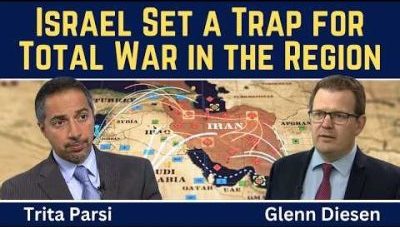
Trita Parsi: Israel Set a Trap for Total War in the Region
or go to
Aletho News Archives – Video-Images
Book Review
Why the War on Conspiracy Theories Is Bad Public Policy
By Kevin Barrett • Unz Review • February 1, 2019
 A Review of Conspiracy Theories and Other Dangerous Ideas by Cass Sunstein (based on an earlier paper co-authored with Adrian Vermeule); In Defense of Troublemakers: The Power of Dissent in Life and Business by Charlan Nemeth; and Conspiracy Theories and the People Who Believe Them, edited by Joseph E. Uscinski
On January 25 2018 YouTube unleashed the latest salvo in the war on conspiracy theories, saying “we’ll begin reducing recommendations of borderline content and content that could misinform users in harmful ways—such as videos promoting a phony miracle cure for a serious illness, claiming the earth is flat, or making blatantly false claims about historic events like 9/11.”
At first glance that sounds reasonable. Nobody wants YouTube or anyone else to recommend bad information. And almost everyone agrees that phony miracle cures, flat earthism, and blatantly false claims about 9/11 and other historical events are undesirable.
But if we stop and seriously consider those words, we notice a couple of problems. First, the word “recommend” is not just misleading but mendacious. YouTube obviously doesn’t really recommend anything. When it says it does, it is lying. … continue
Blog Roll
 Aletho News
- Araghchi blasts ‘parasitic’ alliance as US taxpayers pay for Israel’s war on Iran
- Easy fix for Europe’s chaos? Stop fueling war against Russia
- Putin’s key remarks on peace talks and Europe’s ‘schizophrenia’
- Trita Parsi: Israel Set a Trap for Total War in the Region
- Trump’s Iran war is on an Israeli leash
- Saudi oil boss issues global supply warning
- Riyadh Says Its Oil System Is Intact. The Numbers Say Otherwise.
- Trump and Netanyahu Want to “Finish the Job” on Iran
- US ‘one-sided dictation’ not Iran’s beliefs makes rational talks impossible: Baghaei
- Iran’s Next Strike May Not Explode. It Could Shut You Down /Col Doug Macgregor
- If Americans Knew
- DAILY UPDATE: Latest essential news on Palestine, Israel, & region
- The Israel Lobby’s Changing Fortunes
- AIPAC has become such a political liability that it’s shifting to a more “nimble” approach to buying politicians
- At least 160 Israeli settler attacks in 2 weeks
- Will Gaza’s Ancient Christian Community Disappear Forever?
- Israel’s vision of regional security rests on keeping Arab states weak
- Heidi Levine recounts how Palestinian youths helped save her in settler attack
- DAILY UPDATE: Latest essential news on Palestine, Israel, & region
- Trump’s Intensifying Sabotage of the ICC, for Israel’s Sake
- Israeli military detain US and UK volunteers in West Bank including Democratic NY politician Brad Lander
- No Tricks Zone
- E-Cars Reduce CO2 Emissions By Only 41% Compared To Internal Combustion Engine Vehicles
- Predictions Made By Renowned Climate Professor Over Past Decades Have Been Proven To Be Poor
- New Study Suggests Large Regions Of The Pacific Ocean Have Been Cooling For The Last 80 Years
- Germany’s Green Energy Debacle: High Energy Costs Force Kahla Porzellan to Close After 182 Years!
- New Study: 50 Years Of The Most Aggressive ‘Net Zero’ Policies Can Only Affect The Global Climate By 0.03°C
- US September “Heat” Was No Record…Many Records Set Decades Ago
- Latest European Green Energy Debacle; Portugal’s Largest Flagship Solar Park Insolvent!
- Green Energy Debacle: German Expert Professor Fritz Vahrenholt Warns Of Severe Economic And Social Consequences
- Two More Paleo Reconstructions Affirm Meters-Higher Sea Levels Across Ireland, Brazil 7000-6000 Years Ago
- New Study: Earth And Venus Surface Warmth Largely Explained By Convection And Lapse Rate, Not CO2 Or Radiation

