ALBA REPRESENTATIVES TRAVEL TO DAMASCUS TO SUPPORT SYRIA
NNN-AVN | October 9, 2011
 CARACAS — The Political Council of the Bolivarian Alliance for the Peoples of Our America (ALBA) will meet on Sunday Oct. 09 with Syrian President Bashar al-Assad in Damascus to express their rejection of attempts at invasion and political destabilization on that country on behalf of the United States and its allies.
Delegations from Venezuela, Cuba, Ecuador, Nicaragua and Bolivia will put their political experience and will at the disposal of the Syrian people. Also their support in the pursuit of political stability in the Middle East country, detailed Foreign Minister Nicolas Maduro after a meeting held with Venezuelan ambassadors to Europe in Geneva, Switzerland.
“We will reject all ways of interventionism on behalf of the empire, which seeks to use the Libya model to go to a violent process to change regimes,” said the diplomat, who would travel to Damascus, Syria, from Geneva, where he submitted Venezuela”s Universal Periodic Review report at the UN Human Rights Council.
Besides Maduro, at Sunday’s meeting the attendance of Cuban Foreign Minister Bruno Rodriguez is also expected, as well as Sub-Secretary for North America and Europe of Ecuador’s Ministry of Foreign Affairs Pablo Villagomez, Nicaraguan Ambassador to the United Nations, Maria Rubiales, and Bolivia’s Communication Minister Ivan Canelas.
Syrian President Bashar al-Assad has been denouncing for months that his country is a victim of violence on behalf of terrorist groups armed from abroad.
In this connection, Syria’s Army and armed opposing groups remain in confrontation in different areas of the Nation. This has resulted in more than two thousand deaths, both civilian and security forces officers.
Foreign Minister Maduro stated that “fascist trends on the United States are reappearing,” concerning the statements of Republican presidential candidate Mitt Romney, who affirmed that he will attack “the evil socialism of Cuba and Venezuela.”
“These are fascist trends existing in the United States we had been talking about. They are tied to the right-wing sector in Venezuela.”
The Venezuelan diplomat said that the North American country has evidenced “absolute madness” given the statements of some representatives of that country, who said that “God created America to lead the world.”
“Those created by God to be free are the peoples of the world,” the Venezuelan Foreign Minister said.
In response to Secretary General of the Organization of American States, Jose Miguel Insulza, who requested Venezuela to abide by the sentence of the Inter-American Commission on Human Rights (IACHR), over a former mayor who was disqualified in the country for deviation of public resources, Maduro said Insulza should “mind his own business.”
The IACHR ruled that Venezuela should lift the ban imposed on the former mayor, but Maduro explained that “the case is in Venezuela”s jurisdiction. The Court”s decision is in hands of the Supreme Tribunal of Justice and only they may determine the legality of any decision.”
~
“We have to fight the media and psychological war (…) manipulation and lies spread through media outlets, which seek to impose a situation of civil war and continued violence in Syria,” reported a press release from the Venezuelan Foreign Ministry.
Italians protest austerity measures
Press TV – October 8, 2011

Students demonstrate in downtown Rome on October 7, 2011
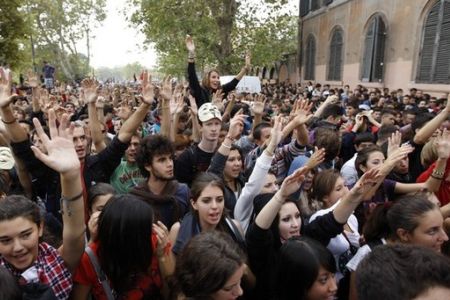
Tens of thousands of people have taken to the streets in Italy to protest against the austerity measures adopted by the government of Prime Minister Silvio Berlusconi.
The demonstrations were held in Milan and Rome on Saturday, DPA reported.
The rallies targeted the public sector job cuts that are part of the austerity measures, aimed at balancing the Italian budget by 2013.
A 60-billion-euro austerity package to balance the budget by 2013 was passed last month only after weeks of hesitation and delay.
Trade union representatives had earlier warned that a total of 300,000 jobs could end up being cut in the five-year period leading to 2013.
Also on Friday, students across the country protested against government cutbacks in funding for education.
Over the past three years, Berlusconi’s government has cut some 8 billion euros (USD 10.7 billion) from the education budget.
The Italian premier, who is under pressure over corruption and sex scandals, has been facing criticism for his center-right government’s erratic handling of the country’s economy.
Protest organizers said they were preparing a major mobilization for October 15 — which has been set as a day for anti-capitalist “Indignant” protests.
Obama’s New Populist Fakery
Always the Bankers’ Whore
By MICHAEL HUDSON | CounterPunch | October 7, 2011
The seeds for President Obama’s demagogic press conference on Thursday were planted last summer when he assigned his right-wing Committee of 13 the role of resolving the obvious and inevitable Congressional budget standoff by forging an anti-labor policy that cuts Social Security, Medicare and Medicaid, and uses the savings to bail out banks from even more loans that will go bad as a result of the IMF-style austerity program that Democrats and Republicans alike have agreed to back.
The problem facing Obama is obvious enough: How can he hold the support of moderates and independents (or as Fox News calls them, socialists and anti-capitalists), students and labor, minorities and others who campaigned so heavily for him in 2008? He has double-crossed them – smoothly, with a gentle smile and patronizing pattern talk, but with an iron determination to hand federal monetary and tax policy over to his largest campaign contributors: Wall Street and assorted special interests. The Democratic Party’s Rubinomics and Clintonomics core operators, plus smooth Bush Administration holdovers such as Tim Geithner, not to mention quasi-Cheney factotums in the Justice Department.
President Obama’s solution has been to do what any political demagogue does: Come out with loud populist campaign speeches that have no chance of becoming the law of the land, while more quietly giving his campaign contributors what they’ve paid him for: giveaways to Wall Street, tax cuts for the wealthy (euphemized as tax “exemptions” and mark-to-model accounting, plus an agreement to count “income” as “capital gains” taxed at a much lower rate).
So here’s the deal the Democratic leadership has made with the Republicans. The Republicans will run someone from their present gamut of guaranteed losers, enabling Obama to run as the “voice of reason,” as if this somehow is Middle America. This will throw the 2012 election his way for a second term if he adopts their program – a set of rules paid for by the leading campaign contributors to both parties.
President Obama’s policies have not been the voice of reason. They are even further to the right than George W. Bush could have achieved. At least a Republican president would have confronted a Democratic Congress blocking the kind of program that Obama has rammed through. But the Democrats seem stymied when it comes to standing up to a president who ran as a Democrat rather than the Tea Partier he seems to be so close to in his ideology.
So here’s where the Committee of 13 comes into play. Given (1) the agreement that if the Republicans and Democrats do NOT agree on Obama’s dead-on-arrival “job-creation” ploy, and (2) Republican House Leader Boehner’s statement that his party will reject the populist rhetoric that President Obama is voicing these days, then (3) the Committee will wield its ax to cut federal social spending in keeping with its professed ideology.
President Obama signaled this long in advance, at the outset of his administration when he appointed his Deficit Reduction Commission headed by former Republican Sen. Simpson and Rubinomics advisor to the Clinton administration Bowles to recommend how to cut federal social spending while giving even more money away to Wall Street. He confirmed suspicions of a sellout by reappointing bank lobbyist Tim Geithner to the Treasury, and tunnel-visioned Ben Bernanke as head of the Federal Reserve Board.
Yet on Wednesday, October 4, the president tried to represent the OccupyWallStreet movement as support for his efforts. He pretended to endorse a pro-consumer regulator to limit bank fraud, as if he had not dumped Elizabeth Warren on the advice of Geithner – who seems to be settling into the role of bagman for campaign contributors from Wall Street.
Can President Obama get away with it? Can he jump in front of the parade and represent himself as a friend of labor and consumers while his designated appointees support Wall Street and his Committee of 13 is waiting in the wings to perform its designated function of guillotining Social Security?
When I visited the OccupyWallStreet site on Wednesday, it was clear that the disgust with the political system went so deep that there is no single set of demands that can fix a system so fundamentally broken and dysfunctional. One can’t paste-up a regime that is impoverishing the economy, accelerating foreclosures, pushing state and city budgets further into deficit and forcing cuts in social spending.
The situation is much like that from Iceland to Greece: Governments no longer represent the people. They represent predatory financial interests that are impoverishing the economy. This is not democracy. It is financial oligarchy. And oligarchies do not give their victims a voice.
So the great question is, where do we go from here? There’s no solvable path within the way that the economy and the political system is structured these days. Any attempt to come up with a neat “fix-it” plan can only be suggesting bandages for what looks like a fatal political-economic wound.
The Democrats are as much a part of the septic disease as the Republicans. Other countries face a similar problem. The Social Democratic regime in Iceland is acting as the party of bankers, and its government’s approval rating has fallen to 12 percent. But they refuse to step down. So earlier last week, voters brought steel oil drums to their own Occupation outside the Althing and banged when the Prime Minister started to speak, to drown out her advocacy of the bankers (and foreign vulture bankers at that!)
Likewise in Greece, the demonstrators are showing foreign bank interests that any agreement the European Central Bank makes to bail out French and German bondholders at the cost of increasing taxes on Greek labor (but not Greek property and wealth) cannot be viewed as democratically entered into. Hence, any debts that are claimed, and any real estate or public enterprises given or sold off to the creditor powers under distress conditions, can be reversed once voters are given a democratic voice in whether to impose a decade of poverty on the country and force emigration.
That is the spirit of civil disobedience that is growing in this country. It is a quandary – that is, a problem with no solution. All that one can do under such conditions is to describe the disease and its symptoms. The cure will follow logically from the diagnosis. But the role of OccupyWallStreet is to diagnose the financial polarization and corruption of the political process that extends right into the Supreme Court, the Presidency, and Obama’s soon-to-be notorious Committee of 13 once the happy-smoke settles from his present pretensions.
~
Michael Hudson is a former Wall Street economist. A Distinguished Research Professor at University of Missouri, Kansas City (UMKC), he is the author of many books, including Super Imperialism: The Economic Strategy of American Empire (new ed., Pluto Press, 2002) and Trade, Development and Foreign Debt: A History of Theories of Polarization v. Convergence in the World Economy. He can be reached via his website, mh@michael-hudson.com
Occupying Wall Street
By Margaret Kimberley – Black Agenda Report – 10/04/2011

The Occupy Wall Street/99% movement has succeeded in demonstrating one important fact. There is a great deal of anger and frustration directed at the financial services mobsters and the political system that gives them such great power. Any mass effort directed against the prerogatives they now enjoy is a positive indication that there is still something left of what we call democracy.
The spread of the Occupy Wall Street movement around the country should be the beginning of a much needed political movement, but at the moment it isn’t clear that will take place. While the righteous and justifiable indignation is evident, organizing and the analysis which it should be based upon are not.
It isn’t really difficult to be angry with the bankster class which has ruined not just the American economy, but which has also devastated the lives of people around the world. It is much more difficult to think outside of the paradigm of the two parties which are both in fact servants of the plutocracy. Collapsing markets and rising unemployment are but symptoms of a larger and more worrisome disease.
In all likelihood the Democratic Party has benefited most from the votes cast of demonstrators at Zuccotti Park in lower Manhattan. Do they know and are they ready to state that they must dump the Democrats if they are to have any opportunity to save themselves and what is left of democracy?
If the “spectrum of thinkable thought” is not done away with, some of these same protesters who are now so valiantly acting in opposition, will one year from now return Barack Obama and his policies of bailing out Wall Street, back to the White House.
The cry for change must include a cry in opposition to the Democratic Party. When Congressman Charles Rangel visited Zuccotti park, he was shouted down by one protester, but then received words of apology from others.
Certainly Charles Rangel is not himself the cause of all that ails American politics, but Democratic members of Congress and the Congressional Black Caucus have time and again been subservient to the dictates of their leadership and to the career trajectory of Democratic presidents. This subservience almost always takes precedence over the needs of the people. If protesters apologize for the righteous anger of one of their members, it is an indication that this movement is not quite ready to look outside of the thought spectrum which allows the economic elite to control both Democrats and Republicans.
The leaderless, mass-led nature of this action presents both benefits and problems. It is good that the corporate media cannot personalize these activities and designate any one person or group of people as leaders. Inevitably, those people are scrutinized in ways that render them useless or in the worst case scenarios are co-opted and bought off.
The down side to this non-organization is that there may not be anyone able to direct the mass action in any effective way. The movement may be doomed to become a permanent gripe session against an obvious villain, but with no means of planning how to end the system that increases income inequality, debt peonage and unemployment.
Make no mistake, Occupy Wall Street should be the beginning of fundamental changes in the political landscape. Whether it will be or not, will depend upon the willingness of activists to stand up for those changes. They must not succumb to fears about the latest Republican bogeyman or woman. Rick Perry or Michelle Bachman or Sarah Palin or Mitt Romney will be mocked as a fascist, charlatan, idiot who doesn’t believe in gay marriage/evolution/global warming and who is therefore unfit to serve as president.
But it is Barack Obama, a man no doubt supported by many of the occupiers, who backs offshore oil drilling and the wholesale resurrection of the nuclear power industry. It is Barack Obama who has forestalled efforts to require cleaner air standards. It is the constitutional law professor who decides that Anwar al-Awlaki or any other American citizen can be marked for death.
Some commentators have likened Occupy Wall Street to the actions at Tahrir Square in Cairo, Egypt which brought down president Mubarak. The Egyptian protesters had a clear demand, that Mubarak had to go. What is the clear demand in Zuccotti Park, that Obama and the Democrats go? That is to say, are they committed to end their support for them?
Right now this site has become a magnet for celebrities and gawking tourists. It ought to become the place where Democratic Party control of the left dies once and for all.
~
Margaret Kimberley’s Freedom Rider column appears weekly in BAR. She can be reached via e-Mail at Margaret.Kimberley(at)BlackAgandaReport.com.
Action urged as Israel punishes dozens of hunger-striking political prisoners
Maureen Clare Murphy – The Electronic Intifada – 10/04/2011
Thousands of Palestinians in the occupied West Bank and Gaza Strip rallied in recent days in support of political prisoners who are protesting worsening conditions in Israeli detention. Thousands of prisoners are said to be taking part in the civil disobedience protests which began on 27 September.
The Electronic Intifada reported in August that the Israeli government was imposing harsher measures on Palestinian political prisoners by banning academic study. Ending the abuse of solitary confinement is also a key demand of the civil disobedience campaign.
Another demand is the resumption of family visits. As The Electronic Intifada reported earlier this year, Palestinians in Gaza have escalated the regular sit-ins at the International Committee of the Red Cross because Israel has denied visits to imprisoned family members — a collective punishment measure leveled after an Israeli soldier was captured by Palestinian resistance forces in Gaza.
National unity amongst political prisoners
While national unity efforts between the Hamas and Fatah parties remain at an impasse, detainees affiliated with the two groups are uniting with prisoners associated with the leftist Popular Front for the Liberation of Palestine (PFLP), who initiated the civil disobedience campaign.
Ma’an News Agency reported yesterday:
The rallies were held as inmates saw through the seventh consecutive day of a hunger strike to protest against worsening conditions for Palestinian detainees in Israeli prisons.…
On Sunday, prisoner support group Addameer said Palestinian detainees affiliated to Hamas and Fatah were joining the Popular Front prisoners who launched the strike, protesting the treatment of PFLP leader Ahmad Saadat, who has been held in isolation for three years.
Director of the Abu Jihad center for prisoners affairs at al-Quds university Fahd Abu al-Hajj said Sunday that 3,000 or so prisoners were taking part.
There was no immediate comment from the Israeli Prisons Authority of the number of prisoners who refused food last week, but by Monday, IPA spokeswoman Sivan Weizman said “160 prisoners” were observing a hunger strike.
Israeli Prison Service punishing protesting prisoners
The Palestinian human rights group Addameer (addameer.info) reported on Sunday that prisoners are being punished for their civil disobedience protest. Punishment includes transferring prisoners, as well as withholding salt water from prisoners waging hunger strikes.
Addameer stated:
On 27 September 2011, Palestinian prisoners held in Israeli prisons announced the start of a campaign of disobedience to protest an escalating series of punitive measures taken against them by the Israeli Prison Service (IPS) in recent months. The campaign is composed of several elements, including a hunger strike and refusal to cooperate with a number of IPS rules, such as wearing prison uniforms and participating in multiple daily roll calls.
As of 2 October, all Popular Front for the Liberation of Palestine (PFLP) prisoners — who launched the campaign — in all Israeli prisons were participating in the campaign on a full-time basis, including an open-ended hunger strike. The campaign has now gained further momentum, with prisoners from other political factions gradually joining the campaign on a part-time basis, whereby they will take part in acts of disobedience three days a week (Wednesday, Thursday and Saturday). In Ramon, Eshel and Nafha prisons, Hamas leaders joined the campaign on 1 October on a part-time basis, and in Ashqelon prison, Fatah and Hamas prisoners are also participating on a part-time basis. In Ofer and Naqab prisons, although a number of prisoners from other political factions have already joined in the campaign on a part-time basis, representatives of all factions will reach a final decision on the matter on 4 October. In Ofer prison in particular, it is estimated that by the end of the week, 250 Hamas prisoners will join the strike on a part-time basis.
The IPS has already started punishing participating prisoners in an effort to undermine the campaign. On 1 and 2 October respectively, it transferred 28 PFLP prisoners from Naqab prison and 6 PFLP prisoners from Ofer prison to as-of-yet unknown locations. In Naqab prison, the IPS also confiscated the hunger-striking prisoners’ only nourishment, salted water.
Addameer issues action appeal
Addameer issued an email alert yesterday, urging action to support the demands of Palestinian political prisoners:
On 27 September 2011, Palestinian prisoners held in Israeli prisons announced the start of a campaign of disobedience to protest an escalating series of punitive measures taken against them by the Israeli Prison Service (IPS) in recent months. The campaign is composed of several elements, including a hunger strike and refusal to cooperate with a number of IPS rules, such as wearing prison uniforms and participating in multiple daily roll calls.…
The Palestinian prisoners have made several key demands, some of which are listed below:
– End the abusive use of isolation;
– End restrictions on university education in the prisons;
– End the denial of books and newspapers;
– End the shackling to and from meetings with lawyers and family members;
– End the excessive use of fines as punishment;
– And ultimately end all forms of collective punishment, including the refusal of family visits, night searches of prisoners’ cells, and the denial of basic health treatment.
TAKE ACTION!
In response to these demands, we are calling on all activists and supporters of human rights and justice for the Palestinians to take action in solidarity with the hunger strikers. There are two important ways in which to take action:
– Organize a protest, silent vigil or similar public action outside the Israeli embassy in your country and highlight the demands of the political prisoners. Addameer can send you further information on particular prisoners who are engaged in the hunger strike to support your action.
– Write a letter to the Israeli Prime Minister expressing your concern for the hunger strikers and demanding an end to the arbitrary treatment of Palestinian prisoners.
Please keep Addameer informed of any action you are planning to take and any response given by the Israeli authorities.
Agricultural committees: Protect olive harvest from settlers
Ma’an – October 3, 2011
NABLUS — The Palestinian Agricultural Relief Committees announced on Monday an upcoming campaign to protect West Bank farmers from attacks by Israeli settlers during the olive harvest season.
Noting a recent escalation in attacks on Palestinian lands and farmers, the agricultural support organization said it will organize groups of volunteers to accompany workers picking olives during the season.
“Olive collecting will be a form of popular resistance,” the group said, adding that they were asking Palestinians in the West Bank and Israel, as well as international activists, to join the campaign.
Volunteers will particularly help farmers harvesting groves behind Israel’s separation wall, which juts into the West Bank cutting off Palestinian farm land. Palestinians must apply for permits from the Israeli military authorities in the West Bank to secure access to harvest their lands.
In 2010, the Ramallah-based Ministry of Agriculture said 4.3 percent of olive trees were inaccessible behind Israel’s wall, the route of which was declared illegal by the International Court of Justice in 2004.
Swedes call for academic boycott of Israel
Nora Barrows-Friedman – The Electronic Intifada – 10/03/2011
More than 200 students, professors and lecturers across Sweden have signed on to a growing academic boycott call demanding that Swedish universities not participate in any academic cooperation with Israeli educational institutions. They also called on the Swedish government to “act [towards] the cessation of the [European Union’s] research support to Israel.”
The public boycott call, initiated by the Action group for the Boycott of Israel at the Royal Institute of Technology (KTH) in Stockholm, follows similar boycott, divestment and sanctions (BDS) campaigns across Europe and the world — including the recent move by London student unions to support the boycott, as well as the nation-wide academic boycott move in South Africa after the University of Johannesburg’s severing of ties with Ben Gurion University in March. The action group’s call adds:
The boycott is not aimed at individuals but against institutions. So far no Israeli academic institution has dissociated itself from Israel’s apartheid policy or the discrimination of Palestinians in Israel. Therefore all collaboration with Israeli academic institutions should be stopped, the signatories say. [The action group] demands that KTH shall cancel its ongoing agreement with Technion, the leading Israeli technical university. Technion has close collaboration with the Israeli military forces. As an example it may be mentioned that Technion is developing new types of drones for the destruction of Palestinian houses … Researchers of Technion act as advisors to Israel’s military and the university collaborates closely with Israel’s biggest weapons producer Elbit.
A network of activists, students and academics in European Union countries doing work to support the cultural and academic BDS call can be found here: www.epacbi.eu. For further information on the KTH action group, visit www.psabi.net.
Turks protest NATO radar in Malatya
Press TV – October 3, 2011
Thousands demonstrated in Turkey to protest against the planned deployment of a NATO missile system in the eastern province of Malatya.
About 5,000 residents of the city of Kurecik, which is located 700 kilometers from Iran’s border and where the missiles will be stationed, took to the streets to condemn the plan on Monday, Turkish NTV news channel reported.
Ankara announced in September that it had agreed on the deployment of the X-Band radar on its territory.
Protesters said on Monday that the system threatens the region’s security and economy. They also criticized the Turkish government, saying that the decision had been made under pressure from the United States.
Meanwhile, opposition parties have called on the government to reject the planned deployment which is aimed at protecting Israel.
The Republican People’s Party, headed by Kemal Kilicdaroglu, said that the plan is aimed at protecting Israel from the threat of Iranian missiles.
The leader of the People’s Voice Party, Numan Kurtulmus, was also among the critics of the plan, saying that the government opposes Israel on the one hand while agreeing to a plan that is chiefly intended to defend Israel on the other.
Saudi forces clash with protesters
Press TV – October 3, 2011
Security forces have clashed in Saudi Arabia with pro-reform protesters in the Qatif Governorate in the Eastern Province of the country, Press TV reports.
The Saudis had gathered in an anti-government demonstration in the province’s Awamiyah village, a Press TV correspondent reported. They chanted slogans against the province’s Governor, Prince Mohammed bin Fahd, — the son of the late King Fahd bin Abdul Aziz Al Saud.
Reports say the forces arrested a 70-year-old man, whose son had participated in the protests, demanding the son to surrender himself in exchange for his father’s release.
A larger demonstration is scheduled for Monday in the city of Qatif, where protesters often take to the streets despite a heavy security presence to condemn Riyadh’s role in the brutal crackdown on anti-regime protesters in Bahrain.
The Saudi demonstrators call for respect for human rights, implementation of further reforms, freedom of expression, and the release of political prisoners, some of whom have been held without trial for more than 16 years.
Saudi Arabia is an absolute monarchy, known for its intolerance of dissent. Earlier in the year, the Saudi Interior Ministry imposed a ban on all kinds of demonstrations and public gatherings.
Human Rights Watch says hundreds of dissidents have been arrested since February as part of the Saudi government’s suppression of anti-government protests.
According to the Saudi-based Human Rights First Society (HRFS), the detainees were subjected to physical and mental torture.
Palestinian Youth Movement: Statehood Bid Harmful to Struggle
Palestinian Youth Movement | Al-Akhbar | September 29, 2011
We, in the Palestinian Youth Movement (PYM), stand steadfast against the proposal for Palestinian statehood recognition based on 1967 borders that was presented to the United Nations this September by the Palestinian official leadership. We believe and affirm that the statehood declaration only seeks the completion of the normalization process, which began with faulty peace agreements. The initiative does not recognize nor address that our people continue to live within a settler colonial regime premised on the ethnic cleansing of our land and subordination and exploitation of our people.
This declaration serves as a mechanism for rescuing the faulty peace framework and depoliticizing the struggle for Palestine by removing the struggle from its historical colonial context. The attempts to impose a false peace with the normalizing of the colonial regime has only led us to surrender increasing amounts of our land, the rights of our people, and our aspirations by delegitimizing and marginalizing our people’s struggle and deepening the fragmentation and division of our people. This declaration jeopardizes the rights and aspirations of over two-thirds of the Palestinian people who live as refugees in countries of refuge and in exile, to return to their original homes from which they were displaced in the 1948 Nakba (Catastrophe) and subsequently since then. It also jeopardizes the position of the Palestinians residing in the 1948 occupied territories who continue to resist daily against the ethnic cleansing and racial practices from inside the colonial regime. Furthermore, it corroborates and empowers its Palestinian and Arab partners to act as the gatekeepers to the occupation and the colonization of the region within a neo-colonial framework.
The foundation of this process serves as nothing more than to ensure the continuity of negotiations, economic and social normalization, and security cooperation. The state declaration will solidify falsified borders on only a sliver of historic Palestine and still does not address the most fundamental issues: Jerusalem, settlements, refugees, political prisoners, occupation, borders and resource control. We believe such a state declaration will not ensure nor promote justice and freedom for Palestinians, which inherently means there will be no sustainable peace in the region.
Additionally, this state declaration initiative is being presented to the United Nations by a Palestinian leadership that is illegitimate and has not been elected to be in a position of representation of the Palestinian people in its totality through any democratic means by its people. This proposal is a political production designed by them to hide behind their failure to represent the needs and desires of their people. By claiming to fulfill the Palestinian will for self-determination, this leadership is misusing and exploiting the resistance and sacrifices of the Palestinian people, particularly our brothers and sisters in Gaza, and even hijacking the grassroots international solidarity work, such as Boycott Divestment and Sanctions efforts and the flotilla initiatives. This proposal only serves to squander all efforts made to isolate the colonial regime and hold it accountable.
Whether the proposal for statehood recognition is accepted or not, we call on Palestinians inside our occupied homeland and in countries of refuge and exile to remain committed and convicted to the worthiness of our struggle and inspired by their rights and responsibilities to defend it. We call on the free people of the world and the Palestinian people’s allies, to truly practice solidarity with the Palestinian anti-colonial struggle by not taking a position on the state declaration but rather continuing to hold Israel accountable by means of Boycott in all forms economically, academically, and culturally, Divestment and Sanctions.
~
This statement was submitted to al-Akhbar by Tarek Kishawi, active member of the Palestine Youth Movement.
The Palestinian Youth Movement (PYM) is a transnational, independent, grassroots movement of young Palestinians in Palestine and over 11 countries in the Arab World, Europe, and North America.
1,000 seized in anti-Wall St. revolt in US
Press TV – October 2, 2011
American police forces have arrested over a thousand anti-Wall Street protesters that took to the streets in New York and other major metropolitan areas across the crisis-hit country, Press TV reports.
The protesters demonstrated against poverty, unemployment, corporatism, social inequality and other grievances that have plagued the United States for more than three years now.
Hundreds of demonstrators were detained late Saturday as the New York police tried to reopen the heavily used Brooklyn Bridge, which was partially shut down by angry protesters. Latest news reports, however, have put the number of those detained by police in New York City metropolitan area at more than 1,000.
“Over 700 summonses and desk appearance tickets have been issued in connection with a demonstration on the Brooklyn Bridge late this afternoon after multiple warnings by police were given to protesters to stay on the pedestrian walkway and that if they took roadway they would be arrested,” a police spokesman said late Saturday.
The rallies originally started two weeks ago under the name of “Occupy Wall Street” when activists and demonstrators announced their intention to seize the heart of US financial transactions in protest at dire economic conditions believed to be caused by the excessive greed of America’s big corporations.
The movement has now grown dramatically and spread to other major cities across the US.
Great numbers of protesters have gathered in front of the Federal Reserve Bank in Chicago, describing themselves as part of the Occupy Chicago movement that is said to have hired its name from Occupy Wall Street protests in New York City.
Similarly, many demonstrators marched through streets in Los Angeles, bearing antiwar signs and expressing frustration with the country’s high unemployment.
In addition to what they view as the use of excessive force against and unfair treatment of minorities, including Muslims, the movement is also protesting against home foreclosures and 2008 bank bailouts.
The protests have gained the support of renowned American filmmaker Michael Moore and actress Susan Sarandon as well as some union members.
The United Federation of Teachers (UFT) and the Transport Workers Union (TWU) Local 100, which has some 38000 members, are among those voicing support for and vowing solidarity with it.
Some of the protesters say the idea to occupy the most vital financial centers of the US was inspired by popular uprisings in the past months in Middle Eastern and North African countries, widely referred to as the “Islamic Awakening.”
A protester described the demonstrations as an American version of Egypt’s Tahrir Square takeover, referring to the protests in downtown Cairo that led to the Egyptian revolution and later caused the collapse of the long-time dictator Hosni Mubarak.
Some have also criticized the US government for preaching and encouraging civil disobedience abroad while severely restricting it at home.
They also state that they plan to use the revolutionary tactics people employed in countries such as Tunisia and Egypt to restore America’s lost democracy.
Featured Video

Piers Corbyn on religion of climate change
or go to
Aletho News Archives – Video-Images
New Documentary
“Inside Gaza” wins best documentary at Montreal’s Cinemania film festival
Palestine Information Center – November 16, 2026
MONTREAL – The documentary “Inside Gaza,” which chronicles the experiences of Palestinian journalists working with Agence France-Presse (AFP) while covering the Israeli war on the Gaza Strip, won the Best Documentary Award at the 32nd Cinemania International Francophone Film Festival held in Montreal, Canada.
Directed by Helene Lam Trong, the 72-minute film follows the daily lives of four AFP journalists who bear witness to the difficulties of reporting in a war-torn territory largely closed off to international media.
The film is compiled from material produced by the team on the ground, as well as from interviews conducted after they left.
The film also won the People’s Choice Award at the festival on Saturday. … continue
Blog Roll
 Aletho News
- Austria seeks to strip former foreign minister of citizenship over Russia ties
- “Inside Gaza” wins best documentary at Montreal’s Cinemania film festival
- Activists block German munitions plant over arms exports to ‘Israel’
- The Nasser Hospital attack and Israel’s relentless lies
- Could it be satan? No, Huckabee, just the Americans you work for
- AIPAC and more: Network of pro-Israel influence in US Congress
- Putin aide reveals Moscow’s stance on Europe at peace talks
- Imran Khan warns Pakistani judges he may die in prison
- IOF used Amazon facial recognition to track millions of Palestinians
- More EU Citizens Face Sanctions For Criticizing The Ukraine Proxy War
- If Americans Knew
- An error has occurred; the feed is probably down. Try again later.
- No Tricks Zone
- Argentina’s Perito Moreno Glacier Joins Antarctica and Arctic In Defying Doomsday Melt Claims
- New Study: Barents Sea Temperatures Were Warmer And Sea Ice Less Extensive In The 1700s Than Today
- German Authorities Start Initiative To Evaluate Public Register For Climate “Disinformation” Spreaders!
- Zonal Asymmetry of Temperature Change in the Antarctic Circumpolar Current
- New Study: The Net Fossil Fuel Contribution To Rising Atmospheric CO2 Has Been Zero For 500 Years
- Germany’s Green Energy Transition Becoming Increasingly Expensive…Another 6 Trillion Euros!
- Sudden Stratospheric Warming, Powerful El Niño Combination May Lead To Extreme Europe Cold, Energy Crisis!
- Two New Studies Find Thwaites Glacier Melt Cannot Be Driven By Human Activity Or A Warming Ocean
- E-Cars Reduce CO2 Emissions By Only 41% Compared To Internal Combustion Engine Vehicles
- Predictions Made By Renowned Climate Professor Over Past Decades Have Been Proven To Be Poor

