The UN application for the State of Palestine and the future of the PLO
By Omar Barghouti | Mondoweiss | September 26, 2011
As expected, rhetoric notwithstanding, the actual application submitted by Mr. Abbas to the UN General Secretary for admission of the “State of Palestine” as a full member in the UN does not contain any clause that may arguably protect the status of the PLO as the sole, legitimate representative of the entire Palestinian people.
For fairness, Abbas did, without doubt, raise the ceiling of his political and legal discourse from -10 to just about +50 (out of a 100). His description of Israel as an apartheid state (twice); his mention of the 1948 Nakba and dispossession; his condemnation of Israeli state terrorism; his endorsement of peaceful resistance (it is not everyday that Abbas even utters the R word!), etc. were all appreciated departures from his usual, lackluster, compromised, low-ceiling discourse, for sure.
Still, the fact remains that the very application for membership undermines Palestinian interests and directly jeopardizes the representation of most Palestinians at the UN and their ability to politically assert their inalienable rights. While our inalienable rights cannot be voided or extinguished by this or any other “diplomatic” maneuver, our ability to struggle for these rights in international forums will be severely damaged if the PLO is replaced by this imaginary “State of Palestine” at the UN.
Also, nothing has changed about the fact that we do not have a democratically elected leadership that is mandated to speak for all of us. It is more urgent than ever to revive — or what I’ve called, take back — the PLO from the grassroots up by holding free, democratic, representative, inclusive elections for the Palestine National Council (PNC), our parliament in exile, in which every Palestinian is formally represented.
I, therefore, stand by every word I’d written in my opinion column prior to Abbas’s UN speech. I ended that piece saying:
Ignoring the will of the people and potentially sacrificing their basic rights in order to secure some illusory advantages at the “negotiations” table hurts Palestinian interests and endangers the great advances our popular and civil struggle has achieved to date, particularly as a result of the global BDS movement. It would in effect reduce the Arab Spring to a Palestinian autumn.
Going to the UN should be strongly supported by all Palestinians – and, consequently, by solidarity groups worldwide – if done by a trusted, democratically elected, accountable leadership and if it expressly represents the will of the Palestinian people and our collective right to self determination.
Alas, neither condition is met in the current “September Initiative,” which may end up replacing the “194” we’ve always struggled to implement with a “194” that is little more than another irresponsible leap away from accountability and from the inevitable repercussions of the sweeping Arab Spring.
Also, even in his speech, Abbas repeated his religious commitment to the patently futile and damaging “negotiations” and, more crucially, to the most dangerous concession ever made by any Palestinian official — replacing the inalienable right of the Palestinian refugees to return, in accordance with UN res. 194, with the “just and agreed upon solution” adopted in the so-called Arab Peace Initiative under heavy pressures from the US. This formulation effectively gives Israel veto power over our refugees’ return. Not to mention Abbas’s failure, still, to even mention the right of Palestinian citizens of Israel to full equality. He did, to his credit, describe them for the first time as Palestinians, when in the past he used to consider them, more or less, part of Israel’s “domestic issues.”
Finally, Abbas reiterated his opposition to “isolating Israel.” This must go down in the history of national liberation movements (I know, I know!) as the first time an ostensible leader of the colonized rejects any attempt by his own people and those in solidarity with them internationally to isolate the colonizer! I hope Mandela does not get a heart attack from reading this. Gandhi, Che Guevara and many others must be turning like mad in their graves!
It is not for nothing that Israel’s wisest Zionist, Shimon Peres, today called Abbas “the best Palestinian leader Israel will work with.”
BRICS Emphasize United Stance against Sanctions on Syria
Al-Manar | September 25, 2011
The BRICS group that consists of Brazil, Russia, India, China, and South Africa assured that it will express a united stance in the United Nations regarding the Syrian situation, and warned against increasing sanctions on Syria.
In a meeting the Foreign ministers of the BRICS group held on the sidelines of the United Nations General Assembly meeting, they assured their united stance against increasing sanctions on Syria, considering that this would intensify and complicate the crisis, and would threaten peace and stability in the region.
In the same context, Russia stated its rejection to support the US in demanding the Syrian president to step down.
The Russian Foreign Minister Sergey Lavrov clarified that the US demand comes in the framework of encouraging internal conflict in Syria, and warned that armed groups were taking advantage of the protests.
For its part, the Russian Senate Delegation that recently completed its visit to Syria said that the crisis in Syria is a result of internal and external elements.
“Some TV stations broadcasted protests in Syria as well as military actions that are very much far from reality… I say this as I was there. We have made sure that some TV channels are intentionally falsifying the events,” Deputy Chairman of the Russian Federal Council, Ilyas Umakhanov said.
On the other hand, the Foreign Ministers of the member countries in the Islamic Cooperation Organization considered that the US administration’s attempt to impose sanctions against Syria is an outrageous violation to the standards of the international law, and expressed their appreciation to the Syrian leadership’s call for dialogue.
Irvine 11: Sentenced to community service, no jailtime; attorneys prepare appeal
Nora Barrows-Friedman – The Electronic Intifada – 09/24/2011
At approximately 2:35pm this afternoon in the Orange County Superior Courthouse in Santa Ana, California, the presiding judge in the Irvine 11 trial, Peter Wilson, announced his sentence following a jury’s decision to convict the students on both misdemeanor counts with which they were charged (“conspiracy to disrupt a public meeting” and “disruption of a public meeting”).
The Irvine 11 held a nonviolent civil disobedience protest during a speech by an Israeli official in February 2010 and have been fighting the charges in court since late August.
Wilson stated to the defendants and their attorneys — with nearly one hundred people present in the courtroom — that although the jury decided on guilty verdicts, he would not be sending the students to jail for the protest in which they were involved. He said that the defendants have no prior records, are productive members of their community, and acted on their beliefs, so jail time would be “inappropriate.”
He ordered the students to serve 56 hours of community service at a non-profit organization and said they were under a 3-year probation. But if they complete their service before the end of January 2012, the probation would only be for one year, and would end on 24 September 2012.
There was a palpable mood of relief in the room from friends, family members, and supporters, who just two hours before had heard that the jury returned two guilty verdicts for every defendant. When the verdicts were read by the court clerk, several people immediately burst into tears, and others stood up and walked out. One person said “there is no justice.”
Following the sentencing, the students and their attorneys held a press conference outside the courthouse, with a plethora of news media present. The attorneys and the Irvine 11 (and their families) have been under a gag order to the media for the past several months, and this was the first opportunity to hear from the students and the attorneys and ask questions.
Student Khalid Akari said:
On February 8, 2010, I stood up against the face of oppression. I stood up for the children of Palestine; children who have no voice. That day, I stood up for a purpose. I stood up for conscience. I had a message that day, a peaceful message.
Mohammad Qureashi:
As people around the world are fighting to seek a voice, I too will fight on, to seek my voice and to be heard. Because this is not a right that can be taken [away] by a district attorney; this right has been given to us by God.
Taher Herzallah:
My message is to all those activists who have been watching this story closely. All of those who speak truth to power. And all of those who challenge the status quo. Do not let this case deter you. Do not let this case falter your activism. Make this the platform to intensify activism on the Palestine issue in this country.
Shaheen Nassar:
Despite the prejudicial nature of the charges filed against us, and the actions of the University administration, I want to say that I respect the court’s decision, however I would like to emphasize how proud I am of my actions on February 8 [2010]. I intend to continue my activism, to give voice to the voiceless. Including my cousins, who died during the Gaza massacre. And the 1,400 other civilians who lost their lives during that massacre as well. May God rest their souls.
Mohamed Abdelgany, Asaad Traina and Aslan Akhtar also spoke passionately and eloquently to the crowd. The full video of the press conference will be uploaded this weekend.
Even though the sentence was relatively light, the attorneys said that they would immediately be filing an appeal to overturn the decision, and would take it all the way to the Supreme Court in order to protect legitimate protest and free speech. Attorney Lisa Holder, expressing pride in her clients, said that the students “stood up for their conscience, they stood up for their beliefs, and they stand out in a world that has become very apathetic.”
Holder added that she was excited to work with them in the future to help “overturn certain laws which are not fair and which do not allow us to voice our beliefs and to intently voice our conscience.”
Holder:
We will be appealing this decision. And we expect that there will be some changes in the laws to make room for this type of dissent, which is valid, which is important, which is critical to our democracy.
Attorney Dan Mayfield added:
Remember what the judge said in the court: that part of his reason for giving the sentence that he gave — which was a very lenient and fair sentence — was because the judge found that the young men in this case were motivated by their sincere beliefs.
[Additionally,] there is already a movement which has developed in just the 30-45 minutes since we left court: a movement of people who are pledging to do volunteer work alongside these young men. So when they do their 56 hours of volunteer work, they will bring other people with them to do volunteer work in our community. I’m very, very proud to be part of this group.
The District Attorney’s lead prosecutor, Dan Wagner, stated outside the courtroom after sentencing was read that he had wanted the students to serve jail time so it would deter future protesters.
Khalid Akari told The Electronic Intifada outside the courtroom that the guilty verdict, though he was naturally unhappy with it, has not deterred his activism. “Not at all,” he said. “I stood up for a reason that day. It would be pointless if I stopped doing it, so I will continue doing it.”
Taher Herzallah said that he was concerned that if they took a plea bargain at the beginning, and did not fight this in court, that it may not have inspired such outcry from students and the community at large. “We shouldn’t be scared,” he told The Electronic Intifada. “We should be encouraged to do these things. I hope this whole process encourages people do stand up, not discourage them.”
When asked what message he had to the Palestinian people under Israeli occupation and siege, Herzallah said that he wanted to address the mothers who have lost their sons, to those under attack.
We are with you. We did not forget about you. Here in America we’re struggling and we’re willing to make the sacrifice to give you any ease or comfort as much as possible. The battleground in America with the Zionists is not over. This was just the beginning, and we are ready to continue.
The Electronic Intifada will provide updates in the appeals process. For more information, visit the Stand With the Eleven solidarity website at www.irvine11.com.
Austerity strike hits Greek capital
Press TV – September 22, 2011
 Protesters of the Greek trade union PAME march during a rally against the government’s plans for new austerity measures in Athens on Wednesday
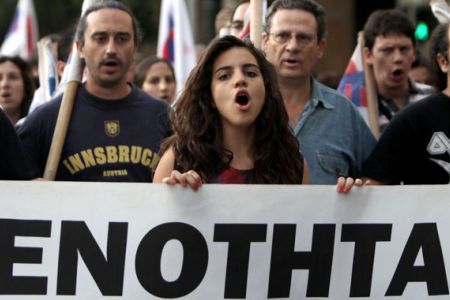
Greeks in Athens have reacted angrily to the government’s tougher austerity measures by staging a strike in the capital over further taxes and public spending cuts.
Athens was brought to a standstill on Thursday by a 24-hour public transport strike while teachers and municipal workers also staged walkouts. A four-hour work stoppage by air traffic controllers also forced airlines to cancel or reschedule flights.
“We are obliged to resist. Not even Greece’s German and Turkish conquerors imposed such taxes,” AFP quoted the head of Athens’ subway employees Antonis Stamatopoulos as saying.
The Greek government has announced pension and tax break cuts and put 30,000 state employees on temporary layoffs after pledging to do ‘anything’ to stay in the Eurozone and unlock bankruptcy-saving EU-IMF loans.
On Wednesday, the government announced cuts to pensions above 1,200 Euros ($1,650) per month, a furlough for 30,000 state employees and a drastic reduction to revenue exemption on annual taxes to 5,000 Euros, from 12,000 Euros currently.
Greece has been struggling to convince the European Union and International Monetary Fund that it can bring its tough economic overhaul program back onto track despite delays and targets slipping due to a deeper-than-expected recession.
EU and IMF auditors have agreed to resume a review of Greek finances needed to unlock 8 billion euros in rescue funding.
The audit had been suspended in early September, with sources citing lack of progress with reforms, placing in jeopardy the release of funds needed to prevent Athens running out of cash next month.
The additional cuts, on top of a controversial property tax that could be extended to 2014, have raised dissent in the ruling party with backbenchers and former ministers doubting their effectiveness after two years of recession.
The main private sector union GSEE and the Adedy syndicate representing civil servants have called for strikes next month against the austerity measures.
The public sector will shut down on October 5 and a general strike will be held on October 19.
London Philharmonic Suspends Musicians for anti-Israel Remarks
By Dr. Ashraf Ezzat on September 17, 2011
A report in UK daily The Guardian stated that the London Philharmonic Orchestra has suspended four of its musicians for nine months for adopting its name when they called for the cancellation of an Israeli orchestra’s concert at the Royal Albert Hall.
According to the Guardian, the orchestra suspended cellist Sue Sutherley, as well as violinists Tom Eisner, Nancy Elan and Sarah Streatfeild until June 2012, after they signed a letter as members of the LPO condemning the Israel Philharmonic Orchestra as an instrument of Israeli propaganda.
The musicians’ statement claimed that “denials of human rights and violations of international law are hidden behind a cultural smokescreen. The IPO is perhaps Israel’s prime asset in this campaign”, and that Israel’s policy toward the Palestinians “fits the UN definition of apartheid.”
The Guardian’s report states that both Orchestra chief executive Tim Walker, as well as chairman Martin Hohmann released a statement regarding the suspensions, which were meant to send a “strong and clear message that their actions will not be tolerated … the orchestra would never restrict the right of its players to express themselves freely, however such expression has to be independent of the LPO itself.”
The statement also said that the Orchestra has no desire to “end the careers” of the musicians, but that “for the LPO, music and politics to not mix.”
The move comes after protestors interrupted a performance by the Israel Philharmonic Orchestra on September 1 during an annual BBC Proms concert series.
Several demonstrators in the venue shouted as Zubin Mehta stood to conduct Bruch’s Violin Concerto, while other audience members booed in response to the protest.
Sarah Colborne, director of the Palestine Solidarity Campaign, which organised protests against the concert, said: “Would the London Philharmonic Orchestra have punished musicians speaking out against apartheid South Africa, when a similar call for boycott was supported by artists, performers and sports people internationally?
“It is staggeringly bad judgment for the LPO to be seen to be attacking musicians who are simply voicing support for human rights and defending the civil right to call for a boycott of institutions which lend strategic support to Israel’s occupation.
“If the LPO really wishes not to appear to be taking sides, and supporting an occupying nation against an occupied people, it must end the ridiculous suspension of these four musicians immediately.”
Protecting Americans? President Obama’s Shameful Silence in the Face of Israel’s Murder of a Young American
By Dave Lindorff | ThisCan’tBeHappeneing! | September 14, 2011
Among the many shameful and cowardly things that President Barack Obama has and has not done, few can rival his complete unwillingness to express outrage at the Israeli military’s murder of a young American teen executed at close range during the Israeli Defense (sic) Force assault on the Turkish-flagged aid ship the Mavi Marmara in international waters in the Mediterranean Sea back on May 31, 2010.
Furkan Dogan, born in the US to Turkish parents, both legal residents of the U.S., and educated in the US, was a volunteer on the Mavi Marmara, the flag ship in a six boat aid flotilla that tried to sail with humanitarian aid from Turkey to the Israeli prison colony known as Gaza only to be stormed and captured and pirated to Israel.
When IDF forces boarded the ship from helicopters and speed boats they shot and killed nine people, one of them young Dogan.
When the assault occurred, there was no protest from the White House, even though an American citizen had been killed. (There was little reporting on the murder either in the U.S. corporate media, which consistently referred to him as Turkish-American–a designation usually reserved for immigrants–despite his being native born in the U.S.).
Nor was there any protest from the White House when the Turkish Council of Forensic Medicine reported a month later that the autopsy conducted on Dogan showed that, like most of the other eight IDF victims, he had been shot in the back and in the back of the head, as well as in the face — hardly the kind of killing that would have resulted had he and the others — as the Israeli government claimed, been “attacking” the IDF boarders. (In fact a smuggled video shows two IDF officers brutally kicking a person identified by the filmer as Dogan while he is lying on the deck of the ship, and then shooting him repeatedly with their weapons, which my colleague Linn Washington says appear to be pump-action Remington 870 shotguns — a deadly gun popular around the world and among police for “riot control” actions. The weapon is part of the IDF arsenal.)
A UN High Commissioner for Human Rights who investigated the IDF assault on the Mavi Marmara concluded that Dogan, far from “assaulting” IDF forces, had been trying to video-tape their slaughter of others when he was attacked and slain.
As for President Obama, who is forever echoing his predecessor George W. Bush about his important job of “protecting Americans”?

Furkan Dogan, American teen murdered by Israeli troops, ignored by President Obama and the US government
Far from expressing outrage at the murder of a US youth, he and his State Department, as I disclosed in an article in ThisCantBeHappening! on Sept. 27, 2010, hid news about the forensic evidence of Dogan’s execution after it was provided by Turkey, first to the U.S Embassy in Ankara, and then to the White House directly.
As I wrote at that time:
Turkey, a NATO ally of the United States, says it sent the autopsy report to the US via the US Embassy in Turkey, as soon as it was completed, assuming the US would want to prosecute Israel for his death. Instead, the Obama administration and the US Justice Department sat and continue to sit on the information, saying nothing. A request by ThisCantBeHappening for information from the Justice Department about the autopsy elicited only a brief “We have no comment for you,” from DOJ spokesman Dean Boyd.
Now the president has been roundly condemned for his callous disregard for the brutal slaughter of one of his country’s own young citizens by no less than the prime minister of Turkey, one of America’s NATO allies. Turkish PM Recep Tayyip Erdogan reported on September 10 that in a recent meeting with the U.S. president, he told Obama that Turkish medical examiners had determined that the nine victims had been hit by a total of 35 bullets, most fired at close range and — as we know from the reports — from the back. He later told reporters, “I asked President Obama whether the reason he showed no interest in one of his nationals being killed was because [the victim] was [ethnically] Turkish – he didn’t reply.”
No U.S. corporate media reporters have ventured to ask Obama about this shocking silence. Nor was Erdogan’s account mentioned in the mainstream media — even in the New York Times, where on Sept. 12, reporter David D. Kirkpatrick actually wrote a report on Erdogan’s new assertiveness in which he mentioned the Turkish PM’s “faulting” of the U.S. for failing to demand an apology from Israel “for the killing of its citizens” in the May 31, 2010 raid.
Failing to mention at such a point that Erdogan had leveled an even more explosive charge directly against the president himself is simply journalist malpractice on Kirkpatrick’s and the Times’ part. (Compare the Times and other US media outlets’ coverage of the plight of two captured U.S. hikers in Iranian captivity, who have not been killed or even treated badly by U.S. prison standards, to the non-coverrage of Dogan’s murder.)
Where does the account of Erdogan’s comment to President Obama appear? In the Jewish Daily Forward, a publication printed in New York City, which had an article titled “Rift Between Israel and Turkey Puts White House on the Spot.”
Of course, this would not be the first time that a U.S. president had failed to condemn a brutal murder of an American by Israel. President Johnson famously covered up Israel’s monstrous attack on the U.S. Navy spy ship Liberty during the 1967 Six-Day War–an unprovoked attack on a vessel of its key ally, which killed 34 U.S. sailors and injured another 170.
But this murder of Dogan, while minor in size compared to the attack on the Liberty, is in another way perhaps worse, as it was an attack on a peaceful ship in international waters and involves the murder of an unarmed young man who was doing nothing but trying to document an ongoing atrocity.
For President Obama to maintain his silence in this case is not just a shameful act — it is a message to the rest of the world that where Middle East issues are concerned, he and the rest of the U.S. government are completely in the control of the right-wing Israeli government and of its zionist backers in the U.S., even to the point of being willing to alienate the entire 75 million people of Turkey.
The president’s shame is only matched by the equally shameful behavior of the U.S. corporate media, which have likewise blacked out this Israeli atrocity against an innocent young American.
Vets For Peace Votes to Impeach Obama for War Crimes
By JOHN V. WALSH | CounterPunch | September 13, 2011
Veterans for Peace (VFP), a progressive organization if ever there was one, took the courageous step of voting for the “impeachment of President Barack H. Obama for war crimes” at its annual national convention in Portland Oregon in August. The resolution, which called on Congress to immediately begin impeachment proceedings, passed with a majority vote.
The resolution sounds the death knell for the view that advocates of Obama’s impeachment are no more than right wing, racist Birthers.
A call for impeachment, whatever the prospects for success, makes clear that the antiwar community regards the President as a criminal – whether that President is Bush or Obama. And it puts a stop to the nasty tactic of shutting up impeachment advocates by calling them racists.
The impeachment resolution is modeled on another that VFP passed some years ago calling for impeachment of Bush. The anti-Obama resolution merits reading in full and is included below. It has telling additions to the one targeting Bush. It opens thus: “Whereas, President Obama, on 19 March 2011, committed a criminal act by ordering the U.S. military to war in Libya without first obtaining the consent of the U.S. Congress in a direct violation of the U.S. Constitution.” Bush told lies to get us into war. Such is his arrogance that Obama, acting in the Democratic tradition of Harry S. Truman in the Korean war, did not even bother to lie. He simply went ahead and trampled on the Constitution without pretense.
The seventh in the list of reasons for impeachment is a tight summary: “Whereas, millions upon millions of Iraqi, Afghani, Pakistani, Yemeni, Somali, and Libyan civilians have been maimed, poisoned, displaced from their homes, and killed in a direct result of ongoing, illegal acts of war by the United States.”
It concludes, “Therefore Be It Resolved that Veterans For Peace call on the U.S. House of Representatives to immediately begin impeachment proceedings against President Barack H. Obama for failure to uphold his sworn oath to protect and defend the Constitution of the United States of America from all enemies foreign and domestic, and for his commission of war crimes, crimes against humanity, obstruction of justice and the violation of numerous national and international laws, treaties and conventions.”
This victory of the VFP rank and file who submitted the resolutions did not come easily. It took three years. The first such resolution was written shortly after Obama took office, on his fourth day ordering Hellfire missiles to strike Pakistan, killing dozens of civilians including three children. That prompted Tom Santoni of the Central FL VFP chapter to write an impeachment resolution. It was taken up at the national convention the following August and was supported by the admirable Adam Kokesh who was at a meeting next door of VFP’s sister organization, Iraq Veterans Against the War. But the VFP leadership, that is the Board, voted against it, thus requiring a two-thirds vote of the membership.
This bit of gate keeping worked, and the resolution failed at the August convention. Santoni quit in disgust, a big loss to VFP. The Central Florida chapter tried again in 2010 under the leaderhship of its co-chair Phil Restino. This time Gold Star mother Cindy Sheehan endorsed the resolution, but again it failed. Finally, this year the Central FL chapter once again submitted the resolution and this time the board did not vote it down! The unstoppable Restino reached out to all 128 VFP chapters urging support and passage. And spontaneously Jesse Perrier of Boston’s Smedley Butler chapter of VFP arose and gave an impassioned speech that brought down the house and won the day. The resolution passed.
Now what about the implementation? The Impeach Bush resolution was pushed aggressively in 2005 running up to the 2006 election when Democrats were running on the promise of impeachment, on which they promptly reneged, most notoriously John Conyers, the poster Congressperson for impeachment. Mike Ferner, at the time executive director of VFP, made an indignant Bush-bashing speech for impeachment in front of the White House. You can view it here in all its glory. A hard copy letter with the signature of the VFP president was mailed to each member of the House calling for impeachment.
How about the present resolution? Mike Ferner opposed it in the floor debate at the August convention. There has been no rally and none is planned – not in front of the White House or anywhere else. This time a fax of the resolution has been sent to the House members without signature of the President. Currently the Central FL chapter is trying to send snail mail letters on its own to every House member once it gets the signature of the president.
Unfortunately this story can be repeated in different ways in a variety of “progressive” organizations with leadership more loyal to Dems than to antiwar principle. This writer has witnessed it himself in organizations like PSR and United for Justice and Peace. But the ground is shifting, and much to its credit VFP has led the way.
John V. Walsh can be reached at John.Endwar@gmail.com. He thanks Phil Restino, co-chair of Central Florida Vets for Peace and Jesse Perrier of the Smedley Butler Brigade of Vets for Peace in Boston for their help. He attempted twice to reach a voice against the resolution but received no reply.
***
IMPEACHMENT OF PRESIDENT BARACK H. OBAMA FOR WAR CRIMES
Whereas, Barack H. Obama is Commander In Chief of the U.S. Armed Forces and the head of the Executive Branch of the United States government, and
Whereas, President Obama, on 19 March 2011, committed a criminal act by ordering the U.S. military to war in Libya without first obtaining the consent of the U.S. Congress in a direct violation of the U.S. Constitution, and
Whereas, the illegal U.S. invasion, bombing and occupation of Iraq initiated by the Bush administration continues under the Obama administration; and
Whereas, the U.S. government is currently engaged in illegal wars in Iraq, Afghanistan, Pakistan, Yemen, Somalia, and Libya, and President Obama pledged to increase the number of military personnel and tax dollars spent on the these wars, and
Whereas, the U.S. military used and continues to use depleted uranium munitions, cluster bombs and white phosphorous in densely populated areas in violation of U.S. laws and international laws and treaties prohibiting the indiscriminate killing of civilians; and,
Whereas, the Geneva Conventions specifically prohibit the use of especially injurious weapons and materials causing unnecessary harm that remain active and lethal after battle, and over large areas of land, and
Whereas, large numbers of babies born in Iraq and Afghanistan suffer life-long illness and deformity like severe disfigurements and brain damage, Down’s syndrome, and weak hearts doctors state are caused by the U.S. military’s massive and widespread use of toxic and radioactive materials, and
Whereas, millions upon millions of Iraqi, Afghani, Pakistani, Yemeni, Somali, and Libyan civilians have been maimed, poisoned, displaced from their homes, and killed in a direct result of ongoing, illegal acts of war by the United States, and
Whereas, illegal, immoral and counterproductive detainee torture and brutalization at the hands of the U.S. military’s Immediate Reaction Force continue at Guantanamo under the Obama administration and in particular, the torture of Pfc. Bradley Manning at Quantico, Virginia, and
Whereas, President Obama is an accessory after the fact in obstructing justice by failing to order the Department of Justice to initiate investigations into numerous and blatant U.S. war crimes committed by the Bush administration, for which it is manifestly accountable under the law, and
Whereas, millions of Americans, including Veterans For Peace and Prosecute Them Now, supported the impeachment of Bush/Cheney for the same war crimes that are being committed now by Obama in violation of the U.S. Constitution, U.S. federal laws, the United Nations Charter, the Hague Convention, the Geneva Conventions, The United Nations Convention Against Torture and the Nuremberg Tribunal Charter, and
Whereas, Veterans For Peace and Prosecute Them Now are committed to the stated mission to restrain our government from intervening overtly and covertly in the internal affairs of other nations, to seek justice for veterans and victims of war, to increase public awareness of the exact costs of war, and to abolish war as an instrument of national policy;
Therefore Be It Resolved that Veterans For Peace call on the U.S. House of Representatives to immediately begin impeachment proceedings against President Barack H. Obama for failure to uphold his sworn oath to protect and defend the Constitution of the United States of America from all enemies foreign and domestic, and for his commission of war crimes, crimes against humanity, obstruction of justice and the violation of numerous national and international laws, treaties and conventions.
Approved at the 2011 VFP National Convention
The Economic Crisis and the Labor Movement in America
The ILWU Rises to the Challenge
By Mark Vorpahl | Global Research | September 12, 2011
Anyone who still believes that U.S. workers and the labor movement are incapable of mounting a struggle against the conditions that the economic crisis is forcing on us has not been paying attention. Evidence to the contrary was vividly provided on the morning of September 8th, when 500 International Longshore and Warehouse Union (ILWU) Local 21 members and their supporters took over the Port of Longview in the state of Washington. Railroad cars were damaged and the grain they carried was dumped in an effort by these workers to defend their jobs by resorting to the only tactic they had left, that is, using work site action to hurt the employers bottom line.
To do so they had to use their strength in numbers to overpower the police and security guards. Though the police attempted to make arrests, the workers pushed back and managed to release their brothers and sisters. The standoff that developed was explosively tense. As the hours rolled on the police began to bring out an arsenal of “non-lethal” guns and tear gas, demonstrating that they were prepared to inflict heavy casualties in order to secure the port and defend the bosses’ property and profits. The workers withdrew, for the time being, after having made their point by inflicting costs on the port bosses dearly. It is a credit to their unity that there were no successful arrests or injuries.
This action was accompanied by wildcat strikes (that is, strikes not sanctioned by the union) in Seattle and Tacoma, Washington. This shows how big the stakes are at the Port of Longview. For workers to sacrifice their wages and make such extraordinary efforts, the cost of such actions have to greatly outweigh the costs of not taking them.
Corporate Greed
In this case the corporation compelling the ILWU to take such dramatic actions is the multi-national consortium EGT Development. Last year alone they made $2.5 billion. In spite of these deep pockets, they want to bust the ILWU at the $200 million grain terminal in Longview. If they succeed, this will encourage other longshore employers to do the same.
Promising jobs, EGT got a state tax exemption and a sweetheart lease deal to build the grain terminal. However, rather than providing local construction jobs in a county with an August unemployment rate of 11.7 percent, they initially imported non-union lower paid workers. If anyone was expecting some gratitude towards the community from EGT for the breaks the company received, that illusion quickly evaporated.
Then EGT’s greedy behavior got even worse. For 70 years the Port of Longview has employed the members of ILWU Local 21. In May of 2010, EGT had stated that they would continue the practice. This appears to have been a stalling tactic, however. In following negotiations EGT made unreasonable demands, such as asking ILWU members to work 12 hour shifts without overtime pay in addition to an exemption from recognizing maintenance, repair, and master consul jurisdiction. After not getting their way, EGT refused to meet with the ILWU, which is, most likely, what they wanted to do all along.
ILWU Push Back
The ILWU began to hold rallies and picket EGT in an attempt to pressure them back to the negotiating table. EGT refused to budge. This arrogant stubbornness resulted in a protest on July 11 where ILWU members tore down a chain-link gate and stormed the EGT terminal. 100 union workers and leaders were cited for arrest.
On July 14th union workers successfully blocked a train from delivering grain to the EGT terminal. As a result, the train company suspended its shipments for safety reasons.
EGT was feeling the heat, but they weren’t burned yet. They had another cynical maneuver up their sleeve. They signed an agreement with the Federal Way-based General Construction Company to operate the terminal with union members from the International Union of Operating Engineers (IUOE) Local 701. Now they hoped they could portray the conflict as union against union rather than union against EGT.
However, because the members of IUOE 701 are employed by a general contractor, they can be replaced by non-union workers the moment EGT decides to take over the job itself. Seeing through this ruse, both the Oregon and Washington State AFL-CIOs have condemned the leadership of IUOE 701for their actions in assisting EGT’s attempts to divide the union movement.
Choosing Sides
In all of this, it is important to note, the role of the police and legal system. While there have been many arrests of union members and leaders with stiff sentences for charges as trivial as not moving quickly enough when asked, those acting against the union have consistently gotten off scot-free. For instance, one person drove his car through a picket line so carelessly that a picketer was sent to the hospital. Rather than arresting the driver, the police arrested a protester for allegedly denting the car with his knee. With this twisted logic, if the driver had gotten out of his vehicle and struck a protester in the mouth with his fist, the police would have arrested the protester for assaulting the driver’s hand with his face.
The National Labor Relations Board (NLRB), which was established in the 1930s ostensibly to protect union rights, has also been lining up with the employer. This board filed a temporary injunction against the ILWU, prohibiting union members from all traditional forms of protest. This moved ILWU International President Robert McEllrath to observe:
“The NLRB complaint and the motion seeking a TRO (Temporary Restraining Order) and injunction were expected by the Coast Committee. The complaint itself has no legal significance unless sustained after a full trial and currently represents nothing more than mere allegations that are based on incorrect facts and bogus legal conclusions. This, unfortunately, is typical of the NLRB ever since the Taft-Hartley Act of 1947 transformed its mission to restrict the union and civil rights of union members. The NLRB exists for one reason and that is to protect commerce at the expense of workers, and we are not surprised that EGT is employing the NLRB to put down a legitimate labor dispute.”
Fortunately, the ILWU defied this injunction on September 7, when they again clogged the railroad tracks to prevent grain from being delivered to the EGT terminal, and again on the morning of September 8 when they took over the terminal. Had they played by the rules of a game rigged in favor of the bosses, EGT would have no reason to settle the dispute. Consequently, the police and courts would have greater incentive to trample on the ILWU members’ rights.
On September 8th, a United States District Court Judge denied the NLRB’s motion to ban picketing at the EGT facility. It is more than likely that part of the motivation behind this was that such restrictions were not muzzling the ILWU membership, but emboldening them. If an unjust law is followed, it remains. If it is resisted and defied through mass collective action, there is a better chance of doing away with it.
The role of the corporate press should also be noted. Few, if any, articles have made a genuine attempt to give the union side in this conflict, though the ILWU has strong community support in Longview. The initial reports in the corporate websites and papers even claimed that security guards were held hostage by those who stormed the EGT terminal. Since these accounts came out, even the police have said they were false. Nevertheless, these claims still turn up uncorrected in the corporate media. This should surprise no one. The corporate media have more economic interests in discrediting labor and any actions that effectively hurt corporate profits than they do in providing the truth.
Changing Times
Even with the press, the legal system, as well as the political establishment lined up against us, labor can win. A new mood is rising from the ranks as a result of the attacks against all workers and the insatiable greed and power of those tiny few at the very top economic rung. This mood is turning into a mass force. We have already witnessed it in Madison, Wisconsin which, though not resulting in an immediate victory, showed that the political climate opposed to workers’ struggles can be turned around. The 45,000 member-strong strike at Verizon alone equaled all the unionists out on strike in 2010. Now the ILWU in Longview has introduced a new boldness in overcoming legal restrictions and hitting the employers where they are most vulnerable: their profits.
When ILWU International President Robert McEllrath urged members to end their standoff at the EGT Terminal take over, he stated:
“If we leave here, it doesn’t mean we gave up and quit. It means we’re coming back.”
And when they do come back, they need to do so with the active support of Longshore workers across the west coast. They also need to mobilize their community supporters in the streets. If this is done, the ILWU could again provide a watershed moment for Labor like they did in the 1934 San Francisco General Strike.
Mark Vorpahl is a union steward as well as an anti-war and Latin American Solidarity activist. He can be reached at Portland@workerscompass.org.
~
See also:
Blockade: Dockers respond to Israel’s Flotilla Massacre and Gaza Siege
09/07/10
and
Oakland Police Settle Lawsuits for Bloody Monday
4 April 2006
and
Police Violence Shocks Activists, Others at Port of Oakland Protest
April 7, 2003
and
Hawaii’s Bloody Monday – August 1, 1938
B’Tselem: Israel denies Palestinian ‘right to protest’ in West Bank

Ma’an – 12/09/2011
BETHLEHEM — The Israeli military systematically denies Palestinians the right to protest in the West Bank, a report published Monday by the Israeli rights group B’Tselem says.
The ‘Show of Force’ report finds that Israel does not recognize the “basic right” of Palestinians to protest and responds to demonstrations with an “excessive use of crowd control weapons.”
The army often fires tear gas canisters “directly at protesters,” a practice which B’Tselem says violates the military’s own orders.
In most cases the army treats protests as “disturbances” and disperses processions even in the absence of violent acts by protesters, according to the report.
B’Tselem examined the conduct of Israeli forces in weekly demonstrations held in the West Bank village of Nabi Saleh over the past year and a half.
It found that the response of the Israeli army indiscriminately harms all village residents through the closure of roads and the imposition of Friday curfews which expose a large number of people to delays and restrictions.
Residents are also exposed to the effects of excessive tear gas which “penetrates their homes.”
The Israeli rights group documented four consecutive demonstrations with video and field observation between June 17 and July 8 and interviewed village residents.
The Israeli military does not “recognize the right to demonstrate” in the West Bank, B’Tselem stated. It called on the Israeli army to respect Palestinians’ right to protest and use “proportionate” means where necessary to disperse protesters.
Featured Video
Elijah Magnier: Yemen’s strikes are shattering Saudi Arabia’s long-term strategy
or go to
Aletho News Archives – Video-Images
From the Archives
British weapons and personnel doing much of the killing in Yemen
Press TV – June 18, 2019
A detailed report published by the Guardian newspaper has shown how Britain is massively contributing to Saudi Arabia’s devastating war on Yemen as it suggests that London is not only supplying the bombs that fall on Yemenis, but it provides the personnel and expertise that keep the war going.
The comprehensive report by Arron Merat published on Tuesday showed that Britain was doing much of the killing in Yemen as the country continues to provide Saudi Arabia with everything it needs to turn its southern impoverished neighbor into a graveyard.
“Every day Yemen is hit by British bombs – dropped by British planes that are flown by British-trained pilots and maintained and prepared inside Saudi Arabia by thousands of British contractors,” said Merat in the report. … continue
Blog Roll
 Aletho News
- A West Bank War for Netanyahu’s Election Campaign, Could It Backfire?
- Yemen denounces European Parliament’s ‘hypocritical’ push to blacklist Ansarullah
- Qalibaf: UAE’s UN bid aims to ‘clear the runway’ for ‘Greater Israel’, whitewash genocide
- Pakistan reopens Iran border after boosting security: Report
- Why are so many Brazilians voting for Flávio Bolsonaro?
- Democrats Put Anti-Russia Agenda Ahead of American Workers
- Elijah Magnier: Yemen’s Strikes Are Shattering Saudi Arabia’s Long-Term Strategy
- Pentagon designates Chinese cultural centers national security threat
- Israel Demolishes Home Of Lebanese Journalist Whose Viral Film Exposed Pager Attack
- Record Oil, Empty Tanks: The UAE’s Miracle Recovery
- If Americans Knew
- Tourism Ministry launches free food truck tour in US
- “So Much Worse Than People Realize”: Never-Before-Seen Images Reveal Damage at U.S. Bases as Troops Describe Being Abandoned
- UK Bell Review Confirms Only Anti-Israel Attitudes Are Rising, Not Antisemitism
- DAILY UPDATE: Latest essential news on Palestine, Israel, & region
- DAILY UPDATE: Latest essential news on Palestine, Israel, & region
- Damning report shows the media must confront its failures on Gaza
- BBC senior broadcaster speaks out on Gaza coverage
- Netanyahu vows vast West Bank invasion in response to 20-minute skirmish that left 2 Israeli soldiers and 2 Palestinian fighters dead
- Tied up and tortured: Israel using US-made electroshock weapons on Palestinian detainees
- The outsourced risk: how newsrooms rely on Gaza’s freelancers without protecting them
- No Tricks Zone
- Sudden Stratospheric Warming, Powerful El Niño Combination May Lead To Extreme Europe Cold, Energy Crisis!
- Two New Studies Find Thwaites Glacier Melt Cannot Be Driven By Human Activity Or A Warming Ocean
- E-Cars Reduce CO2 Emissions By Only 41% Compared To Internal Combustion Engine Vehicles
- Predictions Made By Renowned Climate Professor Over Past Decades Have Been Proven To Be Poor
- New Study Suggests Large Regions Of The Pacific Ocean Have Been Cooling For The Last 80 Years
- Germany’s Green Energy Debacle: High Energy Costs Force Kahla Porzellan to Close After 182 Years!
- New Study: 50 Years Of The Most Aggressive ‘Net Zero’ Policies Can Only Affect The Global Climate By 0.03°C
- US September “Heat” Was No Record…Many Records Set Decades Ago
- Latest European Green Energy Debacle; Portugal’s Largest Flagship Solar Park Insolvent!
- Green Energy Debacle: German Expert Professor Fritz Vahrenholt Warns Of Severe Economic And Social Consequences

