Without a government, Belgium buddies up to Israel
By David Cronin – The Electronic Intifada – 09/09/2011
Belgium has not had a properly functioning government for more than 450 days yet that hasn’t stopped its caretaker administration from seeking to increase trade with Israel.
Earlier this week, Yves Leterme, the acting Belgian prime minister, opened a new embassy for his country in Tel Aviv and held talks with Benjamin Netanyahu in Jerusalem. Leterme used his trip to argue “there is room for improvement of our economic relations in fields like pharmaceuticals, information technology, biotechnology.”
Leterme lacks any democratic mandate; he is only supposed to be handling essential affairs of state until leaders of the parties that fared best in a 2010 election stop bickering for long enough to form a ruling coalition. Discussing how to bolster commercial bonds with Israel amounts to an abuse of his position.
Diamonds are a war criminal’s best friend
It is especially troubling that Leterme celebrated the importance of the diamond trade between the two countries, citing estimates that it is worth more than €2 billion per year. Shir Hever, the Israeli economist and political activist, has stated that revenue from processing diamonds provides annual funding of about $1 billion (€730 million) for the Israeli military. Diamonds account for 70% of trade between Belgium and Israel, with numerous Israeli traders working in Antwerp, one of the two main centres of the diamond trade in Europe (the other one is in London). By encouraging this trade, Belgium is helping to finance the Israeli occupation of Palestine.
Leterme’s visit took place the same week that a design exhibition sponsored by the Israeli foreign ministry opened in Brussels. I am pleased to say that the gallery where this “Brand Israel” event is taking place has been the site of several protests by Palestine solidarity activists. The exhibition has also received support from the city administration in Brussels and representatives of the Francophone community and the French embassy in Belgium. All of them stand accused of helping Israel to use art and culture as a means of diverting attention from its crimes.
Jazz guitarist heedless to boycott plea
Another Belgian embracing Israel is the jazz guitarist Philip Catherine. He is scheduled to play Tel Aviv next week. Going ahead with that gig would mean he is putting his own selfish interests before a call made by representatives of a wide cross-section of Palestinian society in 2005 for people of conscience (and that includes musicians) to boycott Israel. In an interview with the Dutch-language newspaper De Morgen, Catherine said: “I play for people, not for politics. And not all Israeli people support the decisions of their government.”
Catherine should be alerted to a statement made by an Israeli government spokesman Nissim Ben-Sheetrit in 2005: “We see culture as a propaganda tool of the first rank and do not differentiate between propaganda and culture.”
Claims that music is apolitical cannot go unchallenged. Many of the finest practitioners of Catherine’s genre were African-Americans, who knew all about racial discrimination. Martin Luther King stressed the potency of jazz, when he said: “Much of the power of the freedom movement in the United States has come from this music. It has strengthened us with its sweet rhythms when courage began to fail. It has calmed us with its rich harmonies when spirits were down.”
The best thing that Catherine could do to lift the spirits of the oppressed is to cancel his show in Tel Aviv.
Israeli Army Targeting Jenin’s Freedom Theatre
Matthew Eskin for the Alternative Information Center | September 8, 2011
In the past six weeks, the Jenin Freedom Theatre, still recovering from the unsolved 4 April murder of its co-founder and mentor, Juliano Mer-Khamis, has faced a new stumbling block: the Israeli military.
First, at 3:30 in the morning on 27 July, Israeli soldiers arrived at the Freedom Theatre to arrest Adnan Naghnaghiye, Location Manager of the Theatre, and Bilal Saadi, chairperson of the Theatre’s Board of Directors in Jenin. Soldiers further threw stones and huge blocks of concrete at the building, shattering several windows. In the Theatre’s press release, night guard Ahmad Nasser Matahen relates how “they told me to open the door to the theatre. They told me to raise my hands and forced me to take my pants down. I thought my time had come, that they would kill me.” When General Manager Jacob Gough and Theatre co-founder Jonatan Stanczak arrived on the scene, they were “forced at gunpoint to squat next to a family with four small children surrounded by approximately 50 heavily armed Israeli soldiers. Whenever we tried to tell them that they are attacking a cultural venue and arresting members of the theatre,” adds Jonatan, we were told to shut up and they threatened to kick us, I tried to contact the civil administration of the army to clarify the matter but the person in charge hung up on me.”
Adnan and Bilal were detained without charges for almost a month, denied access to a lawyer for over two weeks, and subjected to beatings and sleep deprivation, all as part of a supposed investigation into the murder of Juliano Mer-Khamis.
Then, on 6 August, Rami Awni Hwayel, a 20-year old acting student who currently holds a lead role in the theatre’s adaption of Waiting for Godot, was handcuffed, blindfolded, and taken away by the Israeli army at the Shave Shomeron checkpoint between Nablus and Jenin. Though the army quickly determined he had nothing to do with Juliano’s murder, he was held for a month pending investigation of a confession, extracted during interrogation, that he had illegally sought employment in Israel for 10 days many years ago. In an open letter to the Israeli Embassy in London, Jacob Gough relates how at a court hearing on 17 August, the military judge “stated that the police and army were wrong to have picked up Rami and spent this time as they have on this matter, and that Rami obviously has no connection to the murder of Juliano, however, in what just seems to be an attempt to ‘save face’, the Israeli authorities are looking to imprison him under the aforementioned charge.” The army usually punishes perpetrators of this ‘crime’ by sending them back across the border; for Rami, who, like Adnan and Bilal, was initially held for over two weeks without a lawyer, it will now be more difficult than it usually is for a resident of Jenin refugee camp to secure a visa to tour Waiting for Godot throughout America this September.
Finally, at 2am on 22 August, the Israeli army arrived in Jenin, surrounded the Theatre and entered the home of the Nagnaghiye family, where they beat and arrested Mohammed, theatre security guard and brother of Adnan. They also ransacked and trashed all three floors of the Nagnaghiye family home: “Furniture was thrown to the floor and broken, and there was even dog excrement on the floor. The army also took another three residents of the camp on the same night.”
The stated reason for all of these arrests is an Israeli investigation into the unsolved murder of Juliano Mer-Khamis. However, in an interview given on 3 September, Jacob Gough related that “initially [the army] gave the normal rubbish excuses, like ‘they’re acting against the security of the region’. We then found out they are supposedly doing an investigation into the murder of Juliano. But then I don’t count investigations where you kidnap people and treat them inhumanely, treat them to sleep deprivation- for a week they didn’t sleep- and then you try to get them to confess. Like this they work. That’s not an investigation, that’s trying to pin it on somebody.”
Indeed, Jacob says in an Open Letter to the Israeli Security Apparatus that “in every one of [Bilal’s] court hearings so far, when the Israeli security services have requested an extension of detention, it has been noted in court documents that no information pertaining to the murder of Juliano has been gained from interrogation”, and that “on Sunday 14 August Adnan was in court for another extension of detention, [and] the judge gave the security services an additional 8 days but stated that they needed to wrap the interrogation up as they have not gained much from this time before.”
In addition, the inhumane treatment inflicted on the detainees casts doubt on the real motives of the Israeli army. On 22 August, the same day that Mohammed Nagnaghiye was taken, the two men detained on 27 July – Mohammed’s brother Adnan and Bilal Saadi- were released with no charges filed against them. In the open letter to the Israeli Embassy, Jacob relates that “finally after 2 weeks [Bilal’s] lawyer was allowed access to him… he told her that they had treated him ‘inhumanely’. As of now we only know that they were using disorientation techniques (he had no idea whether it was night or day) and whilst having him shackled painfully and after denying him food for a long period of time they then put food in front of him, obviously with no possible way for him to eat with dignity.” Adnan had been “in much a similar position to Bilaal, but spent 16 days without access to a lawyer.”
Israel also appears to be deliberately impeding the movement of Freedom Theatre actors in and out of the West Bank. In our interview last Saturday at the Theatre, Jacob related that members of Rami’s theatre troupe, which plans to tour Waiting for Godot through America in September, “have all had to have visa application meetings with the American consulate. The American consulate doesn’t come to the West Bank, so these students have to go to Jerusalem and Jordan. Jerusalem is a lot easier. In the past these students have never had problems getting to Jerusalem, and suddenly- stopped. None of these children can go, they are all perceived as a security threat.” In a phone interview on 5 September, Jacob reiterated that “there is no doubt in my mind that this is related [to the army’s arrests]…it all occurred at exactly the same time…[this is] another part of the Israeli army crackdown. I’m sure it’s connected.”
In the Jenin refugee camp “there is fear, fear of being associated with the theatre, [because] we have had someone killed, lots of people arrested…”. But fear seems to be a common factor on both sides of the equation. “After Juliano’s death”, Jacob explains, “it was shown how much support the Freedom Theatre has in the world, and not just people. Politicians, organizations, media as well…[one] of the most dangerous things for Israel, is showing that places like the Freedom Theatre can reach really far…we’ve had the actor’s union in Britain, actors’ unions in America, France, Germany- the Parliament in Britain, France, Germany, Sweden, at least- Congressmen in America as well- people phoning the Israeli embassies and sending them letters all the time, asking what’s happening, what are you doing to the Freedom Theatre. The Israeli embassies started sending back replies, which I’ve never seen before! I’ve never seen the Israeli embassy reply to these kinds of letters, they just go whatever…we don’t care. It feels like we’re hitting a nerve, and we try to harness that.”
On 1 August , the General Secretary of Equity, the trade union representing 36,500 UK based performers, actors and creative workers, wrote to the Israeli Embassy in London to ask why the Freedom Theatre’s “location manager, Adnan Naghnaghiye, and Board member, Bilal Saadi, “are currently being detained following an attack on the theatre”. The letter concludes that “as an organisation which campaigns for freedom of expression, we are obviously very distressed about these reports. I therefore urge you to ensure that the individuals concerned are released immediately and safely returned to Jenin.”
Two weeks later, on 16 August, Equity received a reply from the Israeli Embassy. Citing the murder of Mer-Khamis, the letter states that “the authorities have instigated profound and comprehensive investigations which led them to the arrest you mention in your letter. Although we are aware that damage to the property was caused during the arrest, this was not intentional.”
In his open letter to the Israeli Embassy, Jacob replies that “though it is good of the ambassador to admit damage was caused to the theatre, to say throwing rocks at windows is unintentional is not just wrong, but also a lie. Anyhow, even unintentional harm/damage is at the very least negligent.” An even more curious lapse on the Israeli Embassy’s part, however, is that they ignored completely Equity’s complaint regarding the arrests of Adnan and Bilal, and instead spoke of the arrest of Rami, which was not even mentioned in Equity’s letter and which had nothing to do with ‘damage to the property’ of the theatre, because it occurred far from the theatre! Through this strategic move, the Embassy seeks to deflect attention away from the army’s mistreatment of Adnan and Bilal, and onto “[Rami’s] involvement in a number of other unsolved crimes”- the heinous crimes, namely, involved in crossing the Green Line briefly to bring a little money back to his impoverished refugee camp.
If Rami and his classmates are able to tour ‘Waiting for Godot’ through the US this September, “the hope”, says Jacob in his reply to the Embassy, “is [that] they will manage to get offers of scholarships to continue their training, a rare opportunity and ray of light for these youth who have spent their whole lives under occupation…This whole farce of court proceedings puts this trip for [Rami] in a very precarious position and further works to undermine the work of The Freedom Theatre, which I would say seems to be more the goal of the Israeli authorities than a genuine investigation into the murder of our friend and leader, Juliano Mer Khamis.”
When Juliano founded the Freedom Theatre in Jenin in 2006, he hoped to use performance and art to show to the world a Palestinian people and their vibrant, creative culture and self-identity. In April 2006, four years after the Battle of Jenin, in which 15-20% of the camp’s infrastructure was destroyed by the Israeli army, Mer-Khamis said in an interview with author Arthur Nelsen in London that “in Jenin – especially in Jenin – something is happening, in the good sense of the word. There is a universalist discourse, an international happening…an international campaign around a new kind of resistance…we want to be part of this third Intifada which is on the way in a way to hopefully influence at least some of the people in Jenin camp, towards non-violent, cultural international resistance.”
The Freedom Theatre’s hope remains that, after the violent suppression of the first two Intifadas, a successful Palestinian revolution today must revitalize Palestinian culture and self-identity, and inspire international recognition not merely of a Palestinian state and governing power, but first and foremost of a Palestinian people. On 4 April 2005, one year before the founding of the Freedom Theatre, Juliano said that “we are facing the end of the destruction of the Palestinian people by the Israeli forces. We are in a situation today where not only the political and the economic infrastructure are destroyed, the Israelis are destroying the neurological system of the society, which is culture, identity, communication. We felt that creating a project which will deal with the arts, with cinema, with theatre, with the media activities, computers, web sites, is the best way to fight this deconstruction of the identity of the Palestinian, which is deliberately done in the last year by the Israelis. Israel is pushing back the Palestinian people into the Stone Age…communicating with the outside world, bringing people from the outside world, breaking the wall down, if not physically, metaphorically- is creating the grounds for hope. We cannot bring hope, hope- we cannot bring it in a sack or a package. We can create the grounds so people can build up hope, and this is our task today, to create the grounds for those children.”
In the face of Israeli army harassment, Jenin’s Freedom Theatre has received an outpouring of support, both internationally and within Palestine. In addition to the ferocious and impassioned letter-writing campaign, it has received many donations from abroad to support increasing legal fees.
Additionally, most recent events may indicate that, in response to international pressure, the army is relaxing its crackdown on the Theatre. Mohammed Nagnaghiye, who was arrested on 22 August, received a 15-day extension of his arrest on the 29th, but was then unexpectedly released on 3 September. He did not report any abuse at the hands of the army, and was quickly allowed access to a lawyer. In addition, two technicians at the Theatre, Mohammed Saadi and Ahmad Matahen, along with an acting student, Momeen Syatat, were told to hand themselves in to the Salem military base outside of Jenin by 1 September. The Theatre wrote on its website, “to walk into the arms of the Israeli security service quite often means disappearing from the surface of the earth, never knowing when you will come back and knowing that you are most certainly facing harsh treatment. We demand that Mohammed, Ahmad, and Momeen be treated no worse and no better than any Israeli citizen brought in to participate in a civil criminal investigation. Their legal rights, as stipulated by international law, must be honoured.”
Thankfully, all three residents of Jenin refugee camp were simply asked a few questions, and then released. Over the phone on 4 September, Jacob noted that “the pressure that the theatre put on and that our friends around the world put on, seems to have made a difference. Otherwise the army would’ve kept acting the way it usually does…They even said to some of the guys who went the other day ‘we like the Freedom Theatre, we support the Freedom Theatre!’”
Indeed, at strategic moments Israel does claim to support the Freedom Theatre. Juliano was, after all, an Israeli citizen and well-known Israeli actor; in addition, token gestures of goodwill towards Palestinian arts initiatives bolster Israel’s public image. In reply to Equity’s letter, the Israeli Embassy in London spoke of how “Mr Juliano Mer-Khamis, the director of the theatre, was shot and killed in his car by masked terrorists…Mr. Mer-Khamis…taught alternatives to violence to Jenin’s youth…following his death, the Israeli authorities took it upon themselves to solve his murder and bring his murderers to trial.” In his open reply to the Embassy, however, Jacob retorts that “as there is no evidence or lead or knowledge of who may have committed this attack, it is rather presumptuous of the Israeli Embassy to say it was a Palestinian. Likewise we don’t comment on any theories that it may have been an Israeli…Juliano [son of an Israeli mother and a Palestinian father] was a symbol of co-operation that served very well to show that Jewish-Israelis can live and work with Palestinians, something many far-right Zionists would not like to see…”
In addition, though he taught alternatives to violence, Juliano never tried to teach alternatives to resistance- throughout his life he remained unequivocally opposed to the Israeli occupation of Palestine. As he said in 2006, shortly after the founding of the Theatre, “What we [are] doing in the theatre is not trying to be a replacement or an alternative to the resistance of the Palestinians in the struggle for liberation. Just the opposite. This must be clear…We are joining, by all means, the struggle for liberation of the Palestinian people, which is our liberation struggle.”
It is this commitment to resistance that motivates Israel to crack down on the Freedom Theatre. As the Theatre continues, in the memory of Juliano, to support the struggle for the revitalization of the Palestinian people, it remains to be seen whether the Israeli powers will continue to impede its progress.
Recap of first day of Irvine 11 trial: “no unlawful act was committed”
Nora Barrows-Friedman – The Electronic Intifada – 09/08/2011
Today’s opening statements in the Irvine 11 trial included explicit deconstruction by the defense team of the Orange County District Attorney’s argument that the Muslim students who protested an Israeli official’s speech last year did so in violation of a California penal code for conspiracy.
“You cannot have a conspiracy to commit an unlawful act if there is not an unlawful act that has been committed,” stated a defense attorney in the courtroom today.
The trial, now underway in the Orange County courthouse in Santa Ana, California, focuses on the prosecution’s claim that the students violated the penal code that could send the students to jail for up to two years on two misdemeanor counts: conspiracy to disrupt a meeting, and disruption of a meeting.
Kifah Shah, media coordinator and spokesperson for the Irvine 11 solidarity group, Stand With the Eleven, told The Electronic Intifada that approximately 100 supporters packed the courtroom after attending a press conference outside of the courthouse. Several major media organizations also attended the pre-trial debriefing, which was organized by local community leaders from such groups as the Muslim Public Affairs Council (MPAC), Jewish Voice for Peace (JVP), the Council on American-Islamic Relations (CAIR), and several interfaith leaders and professors at UC Irvine.
The LA Times’ Orange County-based Daily Pilot reported that Father Wilfredo Benitez of the Saint Anselm of Canterbury Episcopal Church stated at the press conference that “[t]his smells of persecution. In a free country … this should simply not be happening.” The report continued:
Moutaz Herzallah, whose son Taher is among the defendants, said Rackauckas “threw the [U.S.] Constitution in the trash” when he decided to press charges.
Moutaz Herzallah, who is from Gaza, said he immigrated to the United States “to have peace, dignity and honor” and that the D.A. should be prosecuted for his disregard of the Constitution.
Shah said that the opening day of the trial “went really well.”
“There were a lot of people there, and a lot of community members came out to support. There was a sentiment of eagerness in the room awaiting and anticipating justice. There was a hopeful feeling,” she added.
I asked her if she had a sense of whether the selected jurors were given a clear picture of what went on during Ambassador Oren’s speech that has led to the prosecution of the students, following the opening statements by the defense and prosecution teams.
Shah replied:
Yes. They went over what happened and explained it thoroughly to the jury. They went through exactly what happened, and obviously in their own terms. In terms of the opening statements, the prosecution is arguing that this was a “heckler veto” — meaning that individuals don’t like what’s being said, and decide to “veto” a speech. The prosecution lawyer reiterated that the students tried to “shut down” the event, to provide the evidence during his statements that [the protest] was a conspiracy. He also went over the fact that they belong to a group, the Muslim Student Union (MSU), and that these defendants “conspired together as a group to enact a heckler’s veto.”
He said that the MSU “was not happy” that the ambassador, Michael Oren, was coming to campus, and “they didn’t want to debate the ambassador — they decided they wanted to shut down the event within the guise of acting as individuals. They wanted to shut him down.” Like I said, he repeatedly asserted that the Irvine 11 wanted to shut down the event.
The other part is that he also talked about that it’s the act itself that the jury will deliberate upon, and not the content of the speech. He added that in the beginning of [Oren’s event] itself, the chair of the Political Science department had stated that we “expect and relish debate on campus, but will expect nothing but civility and courtesy” [from the audience]. And then he said that even the Chancellor, when the protest began, that “this is outrageous, and this violates the rules.” So the prosecuting attorney chose these statements in particular to tell a story to the jury — that this was a violation of rules, that this was a conspiracy to shut down the event.
The defense attorneys also laid out what the defendants did during the protest, and what that looked like for them. What … really hit it on the head was that [defense attorney] Reem Salahi stated exactly what was written on the index cards [from which the students read during their protest]. This was a concerted, calculated effort — it was not their intention to resist removal, they were not trying to stall or prolong anything — they simply wrote down what they wanted to say on their index cards, said what they had to say, which amounted in total for each of them just a few seconds, which took up a cumulative five minutes including the jeers from the crowd.
In their emails [that were subpoenaed during the investigation], the students were talking about not resisting, being nonviolent, acting with a certain demeanor — the defense was illustrating how it wasn’t their intention in any way to “shut down” the event. At the end of the event, even Michael Oren had said that he wished the students who protested and were removed from the ballroom “had stayed … it was that group that I wanted to address.”
The defense said really well that “you cannot have a conspiracy to commit an unlawful act if there is not an unlawful act that has been committed.” So what the prosecution has is a conspiracy to commit a crime, and then the actual committing of that crime. But in terms of whether or not a crime was committed, we’re looking at CA Penal Code section 403 which states that there is a violation if a meeting has been disturbed or broken up. However, there was not a crime that was committed here — Oren did finish his speech, at the end of which he stated that he wished the students had stayed.
Another argument is that Oren wasn’t able to do a question and answer — but if you look at how the event was advertised, they didn’t even say that there was an intention that there was going to be a question and answer section to Oren’s speech. The penal code was not violated. That means that the prosecution’s argument of a “shut down” didn’t happen.
In closing, I asked Shah to talk about the solidarity efforts of her campaign, Stand With the Eleven.
Well, even from the opening statements, this is a political opportunity for the district attorney’s office — everyone knows he’s running for re-election, and I really think that if this is selective prosecution, it’s really important to remember that now it’s not just about these ten students, but it’s significant for all Americans at this point. The precedent that is set concerns everyone’s rights to free speech.
The district attorney is the one who’s committing egregious acts of intolerance and persecution. It’s not about these ten students in a courtroom anymore, now it’s about every American and everyone’s rights to free speech.
The Electronic Intifada will continue to update our readers on the Irvine 11 trial. The verdict is set for 23 September.
French Fair Trade Activist Denied Access To Palestine Through Tel Aviv Airport
By George Rishmawi | IMEMC News | September 07, 2011
Michel Besson, director of the “Andines” Cooperative, which develops Fair Trade cooperation with Palestine, was arrested Monday morning on his arrival at the airport in Tel Aviv and was placed in the retention center.
Besson is being denied entry to Palestine and is awaiting deportation, according to his lawyer Gabi Laski. Laski added that if Besson decides to fight deportation he will have to wait a few weeks in jail before he can get a trial.
Christine Sanguiñeda, Policy Officer Sustainable Development & International Solidarity says, “this act endangers the work of economic development through fair trade which is developing between France and Palestine.”
On July 8, Israeli authorities deported over 150 internationals who arrived at Tel Aviv airport and declared their intention to visit Palestine, as part of the Welcome to Palestine campaign.
Police clash with protesters in Italy
Press TV – September 7, 2011
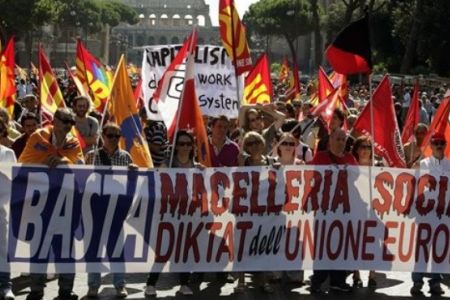
Demonstrators hold a banner reading “Stop to social butchery, diktat of the European Union” during a general strike in Rome, Tuesday, Sept. 6, 2011.
Italy’s riot police have clashed with anti-government demonstrators rallying against the government’s controversial austerity package, which the Senate recently approved.
The police reportedly used batons and fired tear gas in an attempt to disperse the protesters in the capital of Rome, Reuters reported on Wednesday.
Moreover, hundreds of demonstrators tried to break through a police barrier protecting the upper house of parliament in which the vote for the austerity package was held.
The package, initially introduced by Prime Ministers Silvio Berlusconi, was approved by a vote of 165 to 141.
The EUR 54 billion package of spending cuts and tax hikes is meant to help the debt-ridden eurozone country balance its budget deficit by 2013.
The package was originally worth EUR 45.5 billion, but was raised due to market concerns. It will now be passed on to the lower house Chamber of Deputies for approval, before it comes into effect.
Meanwhile, analysts believe the Italian government needs an additional EUR 10 billion cut in spending to achieve a balanced budget by 2013.
Italians had a day earlier, also staged demonstrations against the package.
~
See also:
Conservative Mayor in Italy calls for a wealth tax
“Given that Italy has no real tax on residential properties, the lowest capital gains tax rate in Europe and rampant tax evasion among higher-income professionals, why not recover resources from the people who have the money”?
and
Wasteland in al Walajeh: Israeli military destruction of farmland
7 September 2011 | International Solidarity Movement, West Bank
On Tuesday September 6th local Palestinians from the village of Al Walajeh gathered with international activists to protest the building of the illegal separation barrier as well as the destruction of ancient olive trees. The demonstrators succeeded in halting the razing of Palestinian land for approximately one hour before soldiers violently broke up the protest arresting one Palestinian and one Israeli activist.
On September 5th bulldozers protected by dozens of soldiers arrived at 4 AM and uprooted 50 olive trees that date back at least 100 years. The bulldozers also destroyed 18 almond trees, 27 pine trees, and 8 fruit trees. The destruction took place in an area of over 1 square mile and was declared a closed military zone, prohibiting media coverage of the devastating operation.
Mohammed Al-Atrash (Abu Wajih), the elderly farmer who owned the trees, will receive no compensation for his loss.
In the aftermath residents of Al Walajeh called for a presence of media and activists to highlight this illegal destruction carried out by the Israeli government. At approximately 10am on Tuesday several residents from the village, joined by ISM and other activists, walked down to the site of the olive grove, which is now a wasteland. Upon arriving they stood in front of the construction machines and forced them to halt their work.
Soldiers declared the area a closed military zone and disbanded the protest by force within an hour. Yousif Shakawi, a local resident in his 50’s was arrested along with one Israeli activist. The remaining protesters were held at distance so that the work could resume.
The trees were destroyed in preparation for the building of the illegal Israeli apartheid wall which is planned to run several hundred metres inside the 1967 green line, effectively seizing hundreds of dunnums of land from around Al Walajeh. If the Israeli government succeeds in completing the wall along the planned route the village will be surrounded on three sides with the army controlling entrance and exit to the village.
Sheerin Alaraj, who has lived in Al Walajeh all her life, explained to us that construction of the wall was continuing in spite of an on going appeal process in the Israeli high court with a ruling expected September 27th . However Sheerin has little confidence in the process as she explained to us “the court is just an extension of the military arm of Israel.”
In 2004 the International Court of Justice declared that the apartheid wall is illegal and Israel should tear it down immediately and compensate the victims. In spite of this ruling Israel has continued construction of the wall which annexes 8.5% of the entire West Bank territory. Since 2000 Israel has destroyed approximately 330,000 olive trees in the West Bank and Gaza. There is currently a campaign to boycott Caterpillar Inc. for its role in supplying the Israeli government with equipment used to enforce the occupation.
As the time for harvesting olives nears and Israeli military and settlers continue to destroy the main agricultural pillar of Palestinian culture and livelihood, International Solidarity Movement will be actively working throughout the harvesting season to safeguard Palestinians and assist in harvesting despite this and other events that have threatened security and access to Palestinian farmland. For more information on ISMs Olive Harvest Campaign, visit our website.
Politics behind UK hosting Israeli concert
A prominent political activist says the annual Proms concert in London has hosted the Israel Philharmonic Orchestra for clearly political reasons.
Press TV – September 5, 2011
In an exclusive interview with Press TV, Naomi Wimborne-Idrissi, a member of Beethovians for Boycotting Israel (BBI), says that Western governments and media listen to the Israel regime but ignore the Palestinian people.
Press TV: Please tell us about the event. 40 people, pro-Palestinian protesters, arrived at the Royal Albert Hall, what took place?
Wimborne-Idrissi: Organized with a lot of planning in advance by Jews for Boycotting Israeli Goods, BRICUP – that’s the British Committee for the Universities of Palestine – and people in the Boycott Israel Network (BIN), people arrived prepared for heightened security because, although the Prom’s organizers said that the decision to invite the Israeli Philharmonic Orchestra is purely musical, it was clearly a political decision.
They sent out letters to ticket holders telling them that bags will be searched, no flags will be allowed in. They were obviously quite aware of what they’ve done.
We expected it to be harder than it actually turned out to be. We all had tickets in different parts of the hall in a number of small groups. There was about nine or ten groups, altogether, one of them very large.
This large group made the first intervention. What we did was we had prepared in advance a song adapting the tune of Beethoven’s very famous Ode to Joy. And what we sang was, “Israel and your occupation…” and we went on from there with some words which people can find online, on some of the reports.
And we sang this in a quiet moment on the first piece while unveiling a slogan reading “free Palestine”. So, on some of the reports you’ll read there’s a lot of confusion about this. But this is actually what happened.
And we kept on singing our four lines of text over and over again while the audience reacted, people snapped the letters of the slogan out of our hands, people started to push us. And, gradually, the Royal Albert Hall security staff made their way over to us. They did their job, they weren’t aggressive. They said come on you’ve made your point, please go.
Gradually, because of the pushing and the shoving, and the angry response of the audience, we made our way out and we went out still singing. And we went out and joined the public protests outside and continued singing there as well. So that was the first intervention.
Then after that, that piece was finished and the next piece began. We started again on a rather beautiful violin concerto.
Press TV: What do you think you’ve succeeded in doing? What was this boycott intended to do?
Wimborne-Idrissi: What we’ve intended to do was give Palestinians a voice.
The reason that the Palestinian Boycott National Committee (BNC) and PACBI – the Palestinian Campaign for Academic and Cultural Boycott of Israel – have called for a South African apartheid-style campaign of boycotts because nobody listens to the Palestinians, nobody listens to the victims in this struggle.
Israel has the ear of Western governments, newspaper editors, you name it…
Press TV: Naomi Wimborne-Idrissi, thank you very much for that. And people can look up your protest on YouTube.
So, as with cricket, now with classical music.
Ahmadinejad Launches Tajik Power Plant, Lashes West
Al-Manar – September 5, 2011
Iran’s President Mahmoud Ahmadinejad has launched the first turbine of Tajikistan’s 220-megawatt Sang Toodeh II Dam and Hydroelectric Power Plant.
President Ahmadinejad attended the launching ceremony along with Tajik President Emomali Rahmon and other high-ranking officials from both countries on Monday, IRNA reported.
The Iranian president traveled to Tajikistan on Sunday for an official two-day visit.
Ahmadinejad lashed out at global powers for interfering in domestic affairs of Asian and African countries. “We believe it is against the interests of the nations, their dignity and prosperity,” he said at the opening ceremony of the station.
“This is a project of mutual friendship and brotherhood, we’re happy with Tajikistan’s success,” Ahmadinejad said in televised remarks. “Our cooperation is aimed at peace and stability in the region.”
The Sang Toodeh II project can greatly help Tajikistan in its industrial and agricultural sectors and in meeting its energy needs, according to Iran’s Foreign Ministry.
Iranian Sangab Company began construction of the power plant in 2006 in the southwestern Khatlon province.
Iran has invested around USD 180 million in the project, along with Tajikistan’s $40-million investment, and is expected to carry out management of the plant for 12 years. Tajikistan’s national power company will then take over the management from Iran.
Rahmon has described the project as “Iran’s biggest gift” to the Tajikistani nation.
How Walmart Trains Managers
By Adrian Campbell Montgomery – Labor Notes – 08/31/2011
The brave Walmart workers who belong to OUR Walmart say fear is the main thing stopping their fellow retail workers from organizing. As an assistant store manager at Walmart, I saw how managers were trained to put that fear into hourly workers’ heads.
When I was hired four years ago, new assistant managers had to complete eight weeks of training. We got a $500 prepaid credit card for meals and were thrown into a hotel, with weekends off to go home.
I thought we would get a crash course in Walmart history and then get into learning the computer systems, the policies, how to schedule people. I was far off track. I was now in an eight-week indoctrination into how Walmart is the unsurpassed company to work for, and how to spot any employee who was having doubts. I was supposed to be happy at all times.
The training was done at “Stores of Learning.” The assistant managers were new hires to Walmart, like me, or about one-third had been promoted from within.
Training activities included the Walmart cheer. Every morning, as store associates do, we would participate in the cheer. A few people stood up to read the daily numbers, then break out into a chant—“Give me a W-A-L-M-A-R-T,” with the rest of the people in the room shouting back the same letter. Back then, Wal-Mart still had a hyphen, so between the L and the M they would yell, “Give me a squiggly!” and everyone would do a butt wiggle.
Whenever it was my turn to lead, let’s just say I was less than thrilled, an early warning system for upper management on who was not Walmart material.
You, Too, Can Rise
Most days we watched videos of the CEO telling us what a good choice we’d made to come to Walmart. Other videos showed folks who are now top management in Bentonville, Arkansas, but started out as a cashier when they were young.
We were all given Sam Walton’s book to read: Sam Walton: Made in America. We were allotted 15 to 30 minutes a day for silent reading, or instead you could help out in the store. I was one of the few that chose to fetch carts in the parking lot or help throw freight around in the back. Since the Store of Learning was also going to be the store I would work at, I wanted to take the opportunity to get to know the workers and other managers. I wanted to see if anybody could tell me what an assistant manager’s role was, considering there wasn’t much of that going on in the classroom.
We had a week-long schedule of anti-union sessions. They didn’t call them that, but essentially it was how to spot uprising employees.
We had an entire day devoted to word phrasing, looking at how employees use words and what key words to look for. A computer test consisted of a “what’s wrong with this picture?” game. You were shown the area near a time clock, and different handmade and computer-made signs. One sign said “Baby shower committee meeting Jan. 26, 8 pm.” Another said “Potluck Wednesday all day in break room.” Which one of those signs should raise alarms with management?
“Baby shower committee.” Because of the word “committee,” a manager would have to find the person who made the sign, find out why they used that word, then determine if the action got a warning or a write-up. If it was the store manager who found the sign, a write-up was almost guaranteed. They called it unlawful Walmart language, unbecoming a Walmart employee—words like “committee,” “organize,” “meeting.” Even “volunteer” was an iffy word, and they would raise an eyebrow at “group.”
The anti-union training was the biggest part of our reading and training material. We watched videos about why unions are bad and how proud Walmart was for not allowing unions into its system. I let all that go in one ear and out the other. I felt that if I gave those videos even five minute’s worth of attention, I was betraying my union parents.
We did get a day and a half of loss-prevention training; how to spot shoplifters, what happens if you catch an employee stealing, and routine loss-prevention. They brought in a loss-prevention district manager whose 30-minute talk was to put the fear of Sam Walton in us. He told the class that if he found out we let anything fall through the cracks, he would show up at the store with a pink slip in hand.
Nothing from that eight weeks of brainwashing was geared to help you do your job as an assistant manager. Essentially it was more of a police academy, training the managers to be police officers for Walmart. We were being trained to put fear into the hourly workers’ heads. Step out of line, and you lose your job.
After graduating (they held a makeshift ceremony), I had no clue what exactly my job was. I had to learn from the other assistant managers in my store how to operate the scanner, how to schedule my departments, and the other operational items that weren’t covered in the training. The only thing I learned was how to fake being happy around customers and my subordinates.
Segregation
The trainers told us that assistant managers are only allowed to hang out or go to break or lunch with other assistant managers, not with hourly associates, not with co-managers, not the store manager. Once I was on the job, half the time I went to a diner with another assistant manager. If I stayed in for lunch, I would turn my walkie-talkie off, sit in the break room with the associates, and talk with them. That was frowned upon.
One day of training was about attire. There were separate rules for dress policy according to job title. Assistant managers and higher have to wear a collared blue shirt. No collar, no job.
Hourly people get a little more free play and are not required to wear a collar shirt. Management has to wear khakis; hourly can wear jeans. I heard one trainer say, “Well, the hourly folks probably can’t afford khakis, even with their discount.”
How anti-union is Walmart? I wore a UAW jacket that my mom had bought for me. When I wore it into the store, the store manager broke into my locker and took it. He said it would encourage others, and I was written up for conduct unbecoming a Walmart employee. I called Human Resources, but I got nowhere. Walmart says they have an open-door policy, but like OUR Walmart members have testified, it’s closed to most of us.
Prior to my employment with the largest retailer in the world, I worked for a union-friendly Midwest competitor, in the same management position. The differences were amazing. It was nothing for me as a manager to go out for a few beers with my people. At the competitor, the hourly workers are union. As a manager, it’s a breeze to write out your weekly schedules when you follow the contract!
Featured Video

Elijah Magnier: Yemen’s strikes are shattering Saudi Arabia’s long-term strategy
or go to
Aletho News Archives – Video-Images
From the Archives
British weapons and personnel doing much of the killing in Yemen
Press TV – June 18, 2019
A detailed report published by the Guardian newspaper has shown how Britain is massively contributing to Saudi Arabia’s devastating war on Yemen as it suggests that London is not only supplying the bombs that fall on Yemenis, but it provides the personnel and expertise that keep the war going.
The comprehensive report by Arron Merat published on Tuesday showed that Britain was doing much of the killing in Yemen as the country continues to provide Saudi Arabia with everything it needs to turn its southern impoverished neighbor into a graveyard.
“Every day Yemen is hit by British bombs – dropped by British planes that are flown by British-trained pilots and maintained and prepared inside Saudi Arabia by thousands of British contractors,” said Merat in the report. … continue
Blog Roll
 Aletho News
- A West Bank War for Netanyahu’s Election Campaign, Could It Backfire?
- Yemen denounces European Parliament’s ‘hypocritical’ push to blacklist Ansarullah
- Qalibaf: UAE’s UN bid aims to ‘clear the runway’ for ‘Greater Israel’, whitewash genocide
- Pakistan reopens Iran border after boosting security: Report
- Why are so many Brazilians voting for Flávio Bolsonaro?
- Democrats Put Anti-Russia Agenda Ahead of American Workers
- Elijah Magnier: Yemen’s Strikes Are Shattering Saudi Arabia’s Long-Term Strategy
- Pentagon designates Chinese cultural centers national security threat
- Israel Demolishes Home Of Lebanese Journalist Whose Viral Film Exposed Pager Attack
- Record Oil, Empty Tanks: The UAE’s Miracle Recovery
- If Americans Knew
- An error has occurred; the feed is probably down. Try again later.
- No Tricks Zone
- Sudden Stratospheric Warming, Powerful El Niño Combination May Lead To Extreme Europe Cold, Energy Crisis!
- Two New Studies Find Thwaites Glacier Melt Cannot Be Driven By Human Activity Or A Warming Ocean
- E-Cars Reduce CO2 Emissions By Only 41% Compared To Internal Combustion Engine Vehicles
- Predictions Made By Renowned Climate Professor Over Past Decades Have Been Proven To Be Poor
- New Study Suggests Large Regions Of The Pacific Ocean Have Been Cooling For The Last 80 Years
- Germany’s Green Energy Debacle: High Energy Costs Force Kahla Porzellan to Close After 182 Years!
- New Study: 50 Years Of The Most Aggressive ‘Net Zero’ Policies Can Only Affect The Global Climate By 0.03°C
- US September “Heat” Was No Record…Many Records Set Decades Ago
- Latest European Green Energy Debacle; Portugal’s Largest Flagship Solar Park Insolvent!
- Green Energy Debacle: German Expert Professor Fritz Vahrenholt Warns Of Severe Economic And Social Consequences

