“Move Over AIPAC” Activist Injured By AIPAC Members
By Kevin Murphy – IMEMC and Agencies – May 25, 2011
 A “Move Over AIPAC” activist who interrupted Israeli PM Benjamin Netanyahu during his speech to US Congress has been hospitalised due to injuries received. The protester claims she was beaten by AIPAC activists before being detained.
Rae Abileah, a 28 year old Jewish American of Israeli descent, heckled Netanyahu from the gallery of US Congress. Abileah shouted “stop Israeli war crimes”. She was confronted by American Israel Public Affairs Committee members in the gallery who tackled her to the ground before she was led out by security.
“They assaulted me and I fell on the floor. The activists strangled me and beat me. Then I was dragged out by police who arrested me,” Abileah said. According to JNet, she was hospitalised with suspected neck and shoulder injuries and released into police custody after some hours.
Having travelled to Gaza last year, the activist from Codepink, one of the members of the “Move Over AIPAC” coalition, said she felt compelled to speak out against what she views to be Israeli war crimes. “As a Jew and an American taxpayer, I can’t be silent when these crimes are being committed in my name and with my tax money” she said.
The Move Over AIPAC coalition is a coalition of over 100 civil society organisations in America organised to hold counter demonstrations during Benjamin Netanyahu’s six day visit to the US.
Abileah’s actions highlighted a recent problematic phenomenon for Netanyahu; a vocal and persistent movement of mainly young Jewish people critical of Israeli policy in Palestine. The activist said, “we are a young generation of Jews who don’t intend to sit by in silence and allow prime ministers who commit crimes against humanity speak,”.
“Let Them Starve in the Desert”
Words From the First Intifada
By DANIEL DRENNAN | CounterPunch | May 23, 2011
In 1987, after the First Intifada started, I remember sitting in a coffee shop in New York and overhearing words that stung and burned and never left me. I wrote down my thoughts in a sketchbook at the time, but never brought them forward; I forever regret not having said anything at the time. Last Sunday, two-and-a-half decades later, I took part in the debut of the Third Intifada in Maroun Ar-Ras at the border between Lebanon and Palestine. I recall these words now, updated as the occasion warrants.
“Let them starve!”, you said, slamming your coffee down; “let them starve in the desert!” you said, speaking, as you were, of a desert ancient as time, of a far away desert you never knew, that you never left for never having been and that nonetheless you claim, that now is left bereft of its bedouin, as the land your fellow gentry occupy is left cleansed of its people, abandoned of its owners now set adrift. The land grieves its diaspora, screams aloud their names, remembers each and every name writ in the spilt blood of the countless thousands you’ve disappeared and murdered in vengeful sprees ghastly in their forethought, stunning in their exactitude. “Let them starve!”, you said, defining in the negative your willed absence of a people from a place that yet denies this forgetting, this ground sodden with the tears of all lifetimes.
“Let them rot!” you said, your vague pronoun spat out; “let them starve in the desert!” you said, the fact that “they” exist apparently crime enough, the fact that “they” resist seemingly criminal enough for your judgment, your sentence, your execution; and thus you complete your discrete logic: the annihilation of those who, to you, never were; a double negative that sums up your false positive. And so is unleashed your displacement, your dispossession, your theft, your will to kill, and you, come unhinged. Of all people. And so fly unfettered your noisome epithets, your ghettos, your destruction, your murderous zeal. You, of all people.
You slammed your coffee down and spat out said menace, and I stopped, and I turned, and I caught your eye. I thought: What is so easily said is much more easily done. “Let them starve in the desert! Let them rot in the sun! “Let them riot in Gaza!” you said, and our eyes met, and I saw you, and I saw you seeing me, and I completed your thought, computed your equation; I arrived at your horrid calculus, infinitely revealed in your possessing, usurping, stealing, as well as in your means and ways and methods. And you coldly enacted your endeavor, and you plotted your task, with a bureaucrat’s precision, a mild surprise only that you stop not to collect the shoes, nor the watches, nor the spectacles, while you seem to so value the skin, and the bones, and the eyes. You, of all people.
And although many years have passed since hearing these words, I hereby hasten to inform you that there is no tiring the returnee; and there is no fatigue in these steps six decades after Catastrophe; there is no slowed pace of the generations who follow in their path and who spite the locks and their lockmasters, who despite your barbed wires and barricades are destined to see brethren delivered gleefully through your doors, are ordained to witness the dispersed masses come smiling across your borders, are primed and ready to overtake your gauntlets and gates; if need be receding to re-gather strength, a reclaiming, a repossession, a retaking, a return, and a recalling of your own very prescient warning: “A people which fights against the usurpation of its land will not tire so easily.” You are thus haunted by your very own words, henceforth made manifest.
“Let them riot in Gaza!” you said, and I saw you, and I saw you seeing me, and in that held gaze was a promise, and in my pause was a covenant, and I wrote those words down to forever remind me, I noted down your threat which is hereby reciprocated with interest accrued a hundred-thousand-fold. And now, 25 years later, I keep this promise by coming down to that border with those thousands upon thousands who would come down; by accompanying those who have left their square-kilometer meager allotment, who have decamped to this false demarcation, who have descended to this no-man’s-land falsely partitioned, to this bogus border; to return with those who will one day soon, the grace of God willing, come home.
And be further informed that we will riot in Gaza; we fully intend to riot in Gaza, and in Golan, in Maroon Ar-Ras and in Naqoora; in Rafah, Ramallah, and Karameh. And soon must come your avowal, your acknowledgment, your surrender. Then must come the dismantling, the demolishing, the unsettling. Then must come the great pause, and the gathering, and the Return. And I vow for those who elseways have traversed your hellish gates, who elsewise have suffered your deadly portals, an endless patience, a constant and determined descent, a third and final wave with no end, a divesting, a de-mining of obstacles, an end to the debacle, an existence in resistance. And your day is come. And you will bear the burden of your crimes.
~
Daniel Drennan is founder of the Jamaa Al-Yad artist’s collective. He lives and works in Beirut, Lebanon. He can be reached at info@jamaalyad.org.
Students boycott University of Bahrain
Press TV – May 24, 2011
Hundreds of students have reportedly quit the University of Bahrain to protest against the ruling regime’s brutal crackdown on their anti-government peers.
Students say they left classrooms due to the government’s so-called protection measures and tight security at the campus.
Classes at the University of Bahrain resumed a couple of days ago after authorities installed new surveillance cameras across the university.
The facility was ransacked around two months ago during the unrest that has gripped the Persian Gulf state for over three months.
All students must now re-register with the university and sign a code of conduct. Each student is given a compulsory identification card that must be worn at all times on campus.
According to Bahrain Youth Society for Human Rights (BYSHR), the University of Bahrain is planning to accept only pro-government students and those refusing to sign a pledge of loyalty to the government will be expelled from the only national higher education institution in the tiny Persian Gulf kingdom.
Since the beginning of anti-regime protests in Bahrain in mid-February, Manama has launched a harsh crackdown on anti-government protesters, rounding up senior opposition figures and activists in dawn raids and arresting doctors, nurses, lawyers and journalists who have voiced support for the protest movement.
Scores of protesters have been killed and many others have gone missing since the protests broke out.
Refugee ‘return rallies’ planned for June 5
Ma’an – 21/05/2011

JERUSALEM — Masses of Palestinian refugees will march to Israel’s borders and ceasefire lines again on June 5, organizers of the May 15 “return rally” said. […]
The committee organizing the “return rallies” said Saturday that the May 15 protests were “just the beginning.”
In a statement, the group called on all Palestinian refugees living in exile to march peacefully to the borders of historic Palestine on June 5. The date marks the anniversary of the 1967 war, when Israel occupied southern Lebanon, the Golan Heights, East Jerusalem, Gaza and the West Bank.
Thousands of refugees will march to the ceasefire lines in the West Bank and Gaza as well as borders with Syria, Jordan and Lebanon, the committee said.
“The Israeli occupation should remain on alert because rallies will not stop until Palestinian refugees return to Haifa, Haffa, Al-Majdal, Bi’r As-Sab and all occupied Palestinian towns,” the statement added. … Full article
Saudis show solidarity with Bahrainis
Press TV – May 20, 2011
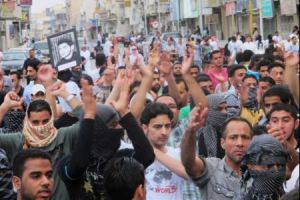 Protesters in Qatif demand the release of political prisoners

Saudi protesters have poured into the streets in the eastern city of Qatif, condemning Manama’s brutal crackdown on anti-regime demonstrators.
Expressing solidarity with Bahraini protesters, Saudi demonstrators on Friday urged the government to stop helping Manama in suppressing the uprising in the neighboring country and immediately withdraw its troops.
Since the deployment of Saudi troops in mid-March, Bahrain has launched a harsh crackdown on anti-government protesters, rounding up senior opposition figures and activists in dawn raids and arresting doctors, nurses, lawyers and journalists who voiced support for the protest movement.
Last week, Bahraini authorities announced that Saudi troops would remain in the Persian Gulf kingdom even after the state of emergency is lifted in June.
Despite, international condemnation of Saudi occupation of Bahrain, a Saudi official said, “This is the initial phase and Bahrain will get whatever assistance it needs. It’s open-ended.”
Saudi demonstrators also called for human rights reform, freedom of expression and the release of political prisoners some held without trial for more than 16 years.
Saudi Arabia’s east has been the scene of anti-government protests over the past months and authorities have arrested scores of people, including bloggers and writers, for taking part in protest rallies.
According to Human Rights Watch, more than 160 dissidents have been arrested since February as part of the Saudi government’s crackdown on anti-government protesters.
Did Obama’s big speech offer any hope for Palestine?
By Ali Abunimah – Electronic Intifada – 05/19/2011

The New York Times was quick to spin Obama’s speech in ‘historic’ terms
“Obama Endorses 1967 Borders for Israel” as part of a “Broad Speech Rejecting Status Quo in the Middle East” – that was the instant spin on the front of The New York Times website within minutes of the president speaking.
But while President Barack Obama laid out in a little bit more detail a US “vision” of what “peace” would look like in his much anticipated speech on US policy in the Middle East and North Africa, there was precious little new.
Moreover, the speech affirmed that the United States will not take any effective action to advance its vision of a two-state solution.
The president covered broadly the uprisings in the Arab world and the American response to them, but I will look at the sections on Palestine – not necessarily in the order of delivery, but by theme.
The 1967 lines
What the president actually said was:
We believe the borders of Israel and Palestine should be based on the 1967 lines with mutually agreed swaps, so that secure and recognized borders are established for both states.
There is a world of difference between “the 1967 lines” and “based on the 1967 lines with mutually agreed swaps.” It is sort of like the difference between “a true story” and a Hollywood movie “based on a true story.”
As the Palestine Papers showed, US-brokered negotiations for years were predicated on trying to reach such a result, and despite unprecedented Palestinian concessions agreeing to allow Israel to annex most of its settlements, no agreement could be reached.
Although it is true that the Obama administration previously adamantly refused to mention the term “1967 lines,” its doing so now is couched in such a vague formula that it does not contradict President George W. Bush’s April 2004 pledge on behalf of the United States to support Israel’s annexation of its West Bank settlements.
Moreover, as Palestinian Authority (PA) “chief negotiator” Saeb Erekat recently told The Electronic Intifada, PA leader Mahmoud Abbas remains fully committed to “land swaps” to allow Israel to keep its settlements even if the UN recognizes a Palestinian state “on the 1967 line.”
Shortly after Obama’s speech, Israeli Prime Minister Benjamin Netanyahu issued a grand-standing statement rejecting the 1967 borders as “indefensible.” He needn’t worry. There were enough loopholes in Obama’s speech to drive several large settlement blocs and perhaps even the entire Jordan Valley through.
Israel as a “Jewish state”
Obama has done it before, but once again he explicitly endorsed Israel’s demand to be recognized as a “Jewish state”:
a lasting peace will involve two states for two peoples: Israel as a Jewish state and the homeland for the Jewish people, and the state of Palestine as the homeland for the Palestinian people, each state enjoying self-determination, mutual recognition, and peace.
It is shocking that a president who constantly boasts that he is only in the White House because of the victories of the US Civil Rights movement against vile Jim Crow racism would endorse Israel’s demand to be allowed to discriminate against Palestinians. I explained in detail why Israel’s demand to be recognized as a “Jewish state” is totally incompatible with democratic principles and human rights in a 2009 article in The Nation:
If Israel has a “right to exist as a Jewish state,” then what can it legitimately do if Palestinians living under its control “violate” this right by having “too many” non-Jewish babies? Can Israel expel non-Jews, fine them, strip them of citizenship or limit the number of children they can have? It is impossible to think of a “remedy” that does not do outrageous violence to universal human rights principles.
And indeed, recognizing Israel’s “right” consigns not only Palestinian refugees to the trash heap, but Israel’s own 1.4 million Palestinian citizens whom leading Israeli politicians like Kadima party leader Tzipi Livni and foreign minister Avigdor Lieberman view as a fifth column and hope to expel or denationalize.
Obama made a nod to this kind of racism when he warned that “The fact is, a growing number of Palestinians live west of the Jordan River.” This was a coded reference to what Israelis openly term the “demographic threat” to a Jewish majority posed by the reality that Palestinians are once again becoming the majority population throughout historic Palestine. This is due to natural growth of Palestinians, a lower Israeli Jewish birthrate and the dearth of Jews around the world who wish to settle in historic Palestine.
In my 2009 article, I explained in American terms why this is unacceptable and racist:
What if we apply Israel’s claim to the United States? Because of the rapid growth of the Latino population in the past decade, Texas and California no longer have white majorities. Could either state declare that it has “a right to exist as a white-majority state” and take steps to limit the rights of non-whites? Could the United States declare itself officially a Christian nation and force Jews, Muslims or Hindus to pledge allegiance to a flag that bears a cross? While such measures may appeal to a tiny number of extremists, they would be unthinkable to anyone upholding twenty-first-century constitutional principles.
Yet this is precisely the nightmare vision Obama is endorsing for Israel which has become increasingly bold in its passage of new laws discriminating against non-Jews, and is in the grip of state-funded rabbis calling for Jews to shun and boycott non-Jews and refuse to rent or sell homes to them.
Hamas
The president said:
the recent announcement of an agreement between Fatah and Hamas raises profound and legitimate questions for Israel: How can one negotiate with a party that has shown itself unwilling to recognize your right to exist? And in the weeks and months to come, Palestinian leaders will have to provide a credible answer to that question. Meanwhile, the United States, our Quartet partners, and the Arab states will need to continue every effort to get beyond the current impasse.
On its face this might appear to be a softening of Obama’s long-standing rejectionism of any dealings with Hamas in that he’s not calling for an immediate aid cut-off to the Palestinian Authority. He appears to be giving the Palestinians time. But it still looks certain that the ultimate US response will depend on whether Hamas submits – as Fatah has done – to Quartet conditions.
Always more sensitive to Israelis
If this was a speech intended to woo an Arab audience, then it is notable that Obama displayed the typical bias characteristic of American officials. He was very graphic and vivid about Israeli suffering and victimhood, while vague and evasive about the vastly greater terror Palestinians have experienced under Israeli rule. Reflecting on decades of conflict, Obama said:
For Israelis, it has meant living with the fear that their children could be blown up on a bus or by rockets fired at their homes, as well as the pain of knowing that other children in the region are taught to hate them.
Aside from its visceral language, this formulation feeds the myth that hostility to Israel is primarily a result of Arabs being “taught to hate,” when in fact if Arabs do hate Israel it is a result of Israeli actions. Israel teaches Arabs to hate Israel. Contrast the president’s words on the other side:
For Palestinians, it has meant suffering the humiliation of occupation, and never living in a nation of their own.
That’s it? Toward the end of the speech, the president did mention “the Israeli father whose son was killed by Hamas” and “a Palestinian who lost three daughters to Israeli shells in Gaza” – but this was only to offer an example of a Palestinian who decided to let bygones be bygones despite Israel’s ongoing actions.
The president would never dream of actually supporting efforts to hold Israel accountable. Indeed, he vowed:
Our commitment to Israel’s security is unshakeable. And we will stand against attempts to single it out for criticism in international forums.
Clearly the president cannot risk offering sympathy to Palestinians proportionate to their actual suffering. As he has learned before, this would risk offending the Israel lobby which demands that American politicians always portray Israel as the principal victim. Recall that during the 2008 campaign Obama once accidentally let slip that “Nobody is suffering more than Palestinians” but later “clarified” that he meant they were suffering at the hands of their own leaders, not Israel.
Obama vows to continue its inaction and condemns Palestinians taking action
Putting the merits of Obama’s “vision” aside, what will the president actually do to advance it? Before he laid out the details, Obama said:
Now, ultimately, it is up to the Israelis and Palestinians to take action. No peace can be imposed upon them – not by the United States; not by anybody else.
What this means in translation is that the United States will not put any pressure on Israel to change its behavior – such as forcing it to stop building settlements. But Obama will continue to support lop-sided “negotiations” between local superpower Israel and a Palestinian Authority that is actually dependent on Israel for its mere survival (as Israel’s recent withholding of PA tax funds shows). No peace, let along a just one, can emerge from such “negotiations.”
Palestinians must sit on their hands
During his speech, the president also warned:
For the Palestinians, efforts to delegitimize Israel will end in failure. Symbolic actions to isolate Israel at the United Nations in September won’t create an independent state. Palestinian leaders will not achieve peace or prosperity if Hamas insists on a path of terror and rejection. And Palestinians will never realize their independence by denying the right of Israel to exist.
The reference to “delegitimization” appears to be a coded condemnation of the growing boycott, divestment and sanctions (BDS) movement, a growing nonviolent campaign to pressure Israel to respect Palestinian human rights. That’s out.
The bid to get Palestine recognized as a state is a desperate effort by the PA to seek international support in the face of intransigent US bias toward Israel. That’s out too.
Next the president tells Palestinians to reject “terror.” Ok, fair enough. And indeed elsewhere in his speech Obama was fulsome in his praise for “nonviolence.”
But what happened when tens of thousands of Palestinians peacefully marched for their human rights, including their right to return to Palestine even if they are not Jewish, last Sunday on Nakba Day? Israel gunned down more than a dozen people and the White House endorsed its actions.
So as far as Obama is concerned Palestinians have no options but to turn to negotiations that have proven utterly fruitless as even he acknowledged.
Soon after Obama was elected in 2008, I predicted that his tenure – despite high expectations everywhere else – would not produce any progress toward the mythical “two-state solution.” I see no reason to change that assessment.
But I concluded then, as I do now, that “This does not however mean that the situation will remain static or that those pursuing a just peace have no recourse for action.”
Indeed as recent months have shown throughout the region, the fates of nations are in the hands of their own citizens, not those of the American president.
FBI plans, interview questions discovered in raided activist’s home
Maureen Clare Murphy – Electronic Intifada – 05/18/2011
Activists in the Twin Cities today announced at a press conference that they were releasing a recently-found document that was left behind by federal agents when they raided Mick Kelly and Linden Gawboy’s Minneapolis home on 24 September 2010.
The FBI confirmed to the Associated Press that the documents appear to be authentic and were accidentally left behind during the raid.
The Committee to Stop FBI Repression said in a statement:
FBI agents, who raided the home of Mick Kelly and Linden Gawboy, took with them thousands of pages of documents and books, along with computers, cell phones and a passport. By mistake, they also left something behind; the operation plans for the raid, “Interview questions” for anti-war and international solidarity activists, duplicate evidence collection forms, etc. The file of secret FBI documents was accidently mixed in with Gawboy’s files, and was found in a filing cabinet on April 30. We are now releasing them to the public.
The press conference was held at the office of the Twin Cities Anti-War Committee, which was raided the same day as the Kelly-Gawboy home. It is believed that the key used to raid the office was one that had belonged to a woman known as Karen Sullivan, now confirmed to be an undercover agent, and whose word appears to be the basis for the investigation.
The investigation has so far targeted 23 activists — several homes in the Twin Cities and Chicago were raided on 24 September 2010 and 14 activists were subpoenaed that month. After they refused to testify before a grand jury, nine more activists — all of them active in the Palestinian community or involved in Palestine solidarity work — in Chicago were subpoenaed, including myself (I believe I have been subpoenaed because of my solidarity organizing in Chicago, not because of my work with The Electronic Intifada). All 23 of us have refused to testify before the grand jury.
Last week we reported that bank accounts of one of the targeted activists, Palestinian community organizer Hatem Abudayyeh, and his wife were frozen but restored after a flood of phone calls were made to protest the move.
The Committee to Stop FBI Repression statement adds:
Taken as a whole, the secret FBI file shows the willful disregard for the rights of anti-war and international solidarity activists – particularly the first amendment rights to freedom of speech and association. The documents make it clear that legal activity in solidarity with the peoples of Colombia and Palestine is being targeted. The documents use McCarthy-era language, which gives one the feel that the 1950s red scare has returned. And finally, the documents show the chilling plans for the armed raid that took place at the home of Kelly and Gawboy on September 24, 2010.
The documents show that public advocacy for the people of Colombia was the genesis of the FBI investigation. The ‘Operations Order’ for the FBI SWAT Team states “The captioned case was initially predicated on the activities of Meredith Aby and Jessica Rae Sundin in support of the Revolutionary Armed Forces of Colombia, a U.S. State Department designated foreign terrorist organization (FTO), to include their travel to FARC controlled territory.”
While we have no way of knowing if it was speaking tours or educational events on Colombia that got them so riled up, there is something we can state with certainty: There is nothing illegal about traveling to Colombia, or visiting the areas where the FARC is in charge. This is something that journalists, including U.S. journalists, do, and we have yet to hear of their doors being broken down. Upon returning from Colombia, Aby and Sundin spoke at many public events about their experiences.
The FBI interview questions for Meredith Aby ask “1) Have you ever met Lilia [sic] Obando? 2) Where? 3) When? 4) Why?” Liliana Obando is a well-known Colombian trade unionist who spoke in the Twin Cities at an event organized by the Anti-War Committee. She received a visa to travel in the U.S. from the U.S. government.
In addition to focusing on associational information and travel to Palestine and Colombia, the interview questions focus on the Freedom Road Socialist Organization:
The FBI documents include 57 interview questions about Freedom Road Socialist Organization, the organization that some of those who were raided or subpoenaed to the Grand Jury are members of. The questions include; “Are you a member?” “How many members are there?” “Who are the leaders?” And on and on and on. It is like pages of the calendar have been turned back 60 years.
The documents also show the amount of force used to raid the anti-war and social justice activists’ home. The committee says in the statement:
In the documents, the “Operations order” for FBI SWAT for “Operation Principal Parts” the raid on the Kelly/Gawboy home has the word “DANGEROUS” in underlined bold type at the top of the page. FBI agents were told to bring assault rifles, machine guns and two extra clips of ammunition for each of their side arms. Two paramedics were to stand by in the event of causalities. Other documents include photos of Kelly and Gawboy, as well as pictures of stairs leading to their front door and the front door itself.
What transpired on September 24 was this. Gawboy was awoken by the FBI pounding on the door. When she stated she wanted to see the search warrant, agents used a battering ram on the door, breaking the hardware and shattering a fish tank in the process. Gawboy was taken down the front steps in her nightgown while the FBI swat team entered her home.
The justification for this armed home invasion is given in the “Operations plan” – “Kelly is believed to be the owner of an unknown number of firearms which may be at his residence…”
Kelly, who learned to shoot while in Boy Scouts, owns guns – just like a lot of Minnesotans. The “Operation Plan” also claims that Kelly “offered to provide weapons training” – an outright lie that originated with the police infiltrator “Karen Sullivan” or a fiction writer at the FBI office.
Those of us who have been ensared in this fishing expedition have claimed from the beginning that activists are being targeted for organizing in opposition to US foreign policy in the Middle East and South America, and because of first-amendment activity like travel and association. The interview questions confirm that this is the focus.
Imagine being asked any of the following questions — all listed in the document — knowing that if you are not able to answer them completely, you could be vultnerable to perjury or contempt-type charges (emphasis mine):
“Have you, anyone from FRSO [Freedom Road Socialist Organization], or anyone you know, ever traveled to South America?”
“Have you, anyone else from FRSO, or anyone you know, ever traveled to the Middle East? Gaza? West Bank? Israel?”
And some questions are just incredible, like:
“Have you ever taken steps to overthrow the United States government?”
“What is your husband’s immigration status?”
“What do you think of terrorist groups? Do you support them?”
“Have you ever recruited fighters to the FRSO?”
As the Committee to Stop FBI Repression concluded in its statement today:
The bottom line is this: there can be no justification for the raid in the first place, and still less for it to be done by agents smashing doors and wielding machine guns. This is a recipe for people getting hurt or killed.
The events of September 24 and the ongoing grand jury are not about “material support of terrorism,” as any normal person would understand it. What is happening is this: anti-war and international solidarity activists are being targeted for practicing our rights to speak out and organize. We have done nothing wrong. Our activism is making this world a better place.
The documents left behind by federal agents can be downloaded from stopfbi.net.
Spain protests persist ahead of polls
Press TV – May 19, 2011
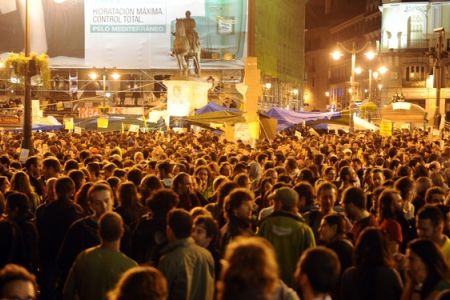
Thousands of Spanish protesters demonstrate at the Puerta del Sol square in Madrid to protest against the economic crisis
Thousands of Spanish protesters have camped out in Madrid and several other cities to demand jobs as well as political change ahead of weekend local elections.
Outraged by Spain’s economic crisis and soaring jobless rate, demonstrators defied a ban by authorities and poured onto Madrid’s central Puerta del Sol square and in several cities, including Granada, Seville, Barcelona, Valencia, Zaragoza and Palma de Majorca, AFP reported on Wednesday.
Many protesters held up placards reading “Make the guilty pay for the crisis” and chanted “They call this democracy but it is not”, as they tried to draw attention to their economic hardships ahead of the regional and municipal elections on Sunday.
Disgruntled Spaniards, who began their protests on May 15 to demand jobs, housing and “real democracy,” have vowed to stay until Sunday elections if police try to use force to disperse their peaceful protest.
Reports indicate that about 15 police vehicles took up positions in and around the emblematic square in the capital Madrid on Wednesday evening.
Meanwhile, opinion polls by the centre-left El Pais and the conservative El Mundo portend humiliating losses for the Socialists candidate in the forthcoming regional and municipal elections, as voters are expected to punish them for the government’s handling of the economic crisis, including the failure to curb high employment rates.
Spain’s unemployment rate soared to 21.29 percent, with 4.9 million jobless for the first quarter of 2011, according to the government statistics published in late April.
In May 2010, the government of Prime Minister Jose Luis Rodriguez Zapatero introduced a slew of drastic austerity measures, including cutting civil servants pay as part of plans to curb budget deficit from 11 percent a year earlier to within the 3 percent of GDP limit set by the European Union by 2013.
Largest student union in Europe joins boycott of Israel
By James Haywood and Ashok Kumar | BDS Movement | May 18, 2011
The University of London Union (ULU) has voted 10-1 to institute and campaign for Boycott, Divestment and Sanctions (BDS) in support of Palestine. The motion called for “thorough research into ULU investments and contracts” with companies guilty of “violating Palestinian human rights” as set out by the Palestinian Boycott National Committee (BNC). Ashok Kumar, Senate member for LSE, speaking in favour of the motion, argued, “We have precedents for boycotting campaigns at ULU, especially with South Africa and the boycott campaign over Barclays bank, that supported the Apartheid regime. We are now responding to the Palestinian call for civil action in support of their fight against racism.”
The motion also called on other students’ unions to join in the campaign for Palestinian human rights. ULU is the largest students’ union in Europe with over 120,000 members from colleges across London. ULU senate consists of the presidents of the 20 students unions representing every University of London University. James Haywood, President-elect at Goldsmiths Students’ Union, stated, “We are delighted that this motion has passed, and with such a clear vote as well. We have seen throughout history that boycotts are a crucial nonviolent tactic in achieving freedom, and target institutions, not individuals.”
Sean Rillo Raczka, incoming ULU Vice President, “I’m delighted that ULU has passed this BDS policy on Israel. We stand in solidarity with the oppressed Palestinian people, and as Vice President next year I will ensure that the University of London Union does not give profit to those denying the human rights of the Palestinians”
The text of the motion passed is as follows:
Union notes
1) to boycott is to target products, companies and institutions that profit from or are implicated in, the violation of Palestinian rights
2) to divest is to target corporations complicit in the violation of Palestinian human rights, as enshrined in the Geneva Convention, and ensure that investments or pension funds are not used to finance such companies
3) to call for sanctions is to ask the global community to recognise Israel’s violations of international law and to act accordingly as they do to other member states of the United Nations
4) that in 2009 the The Human Sciences Research Council of South Africa released a report stating that Israel was practising a form of apartheid in the occupied West Bank, (http://www.hsrc.ac.za/Media_Release-378.phtml)
5) that Israel continues to build a 8 metre high “annexation” wall on Palestinian land inside the post-1967 occupied West Bank, contravening the July 2004 ruling by the International Court of Justice (the highest legal body in the world, whose statutes all UN members are party to) and causing the forcible separation of Palestinian communities from one another and the annexation of additional Palestinian land.
6) that within the occupied West Bank and East Jerusalem, Israel continues a policy of settlement expansion in direct violation of Article 49, paragraph 6 of the 4th Geneva Convention which declares “an occupying power shall not deport or transfer parts of its own civilian population into territories it occupies.” 6) that the Gaza Strip continues to face a suffocating siege from land, sea and air by Israel, and continues to suffer military incursions into the territory by the Israeli army
7) that Palestinians living in Israel continue to suffer third-class citizenship and are heavily discriminated against from healthcare, education, landownership and in many cases having ‘unrecognised’ villages completely demolished
8) that there continues to be millions of Palestinian refugees throughout the world who are racially discriminated against by not being allowed to return to their homes in Israel and the Occupied Territories, which is legally recognised under international law, including United Nations resolution 194.
9) that ULU and the NUS nationally adopted the call for BDS in the 1980s when it was called for by South Africans fighting racism and apartheid
10) that Ronnie Kasrils, the Jewish South African Minister of Intelligence said “The boycotts and sanctions ultimately helped liberate both blacks and whites in South Africa. Palestinians and Israelis will similarly benefit from this non-violent campaign that Palestinians are calling for.”
11) that the call for BDS has come from over 170 Palestinian civil society organisations, including student organisations, as well as organisations within Israel and across the global; and that the campaign is founded on the basis of anti-racism and human rights for all
Union Believes
1) that unions should work to support the Palestinian people’s human rights and uphold international law
2) that BDS is an effective tactic, which educates society about these issues, economically pressures companies/institutions to change their practices and politically pressures the global community
3) that unions have a moral responsibility to heed the call of oppressed peoples, like we did so proudly during the BDS campaign to end South African apartheid
4) that the BDS movement has united human rights campaigners from different nationalities, races, religions and creeds across the world
Passed 10-1 in ULU – largest union in Europe, 20 universities and 130,000 students.
Union Resolves
(1) Institute thorough research into ULU contacts with investments and companies,including subcontractors, that may be implicated in violating Palestinian human rights as stated by the BDS movement
(2) Pressure University of London universities and affiliate students’ unions to divest from Israel and from companies directly or indirectly supporting the Israeli occupation and apartheid policies;
(3) Promote students’ union resolutions condemning Israeli violations of international law and human rights and endorsing BDS in any form;
(4) Actively support and work with Palestine solidarity organisations such as the BDS Movement, Palestine Solidarity Campaign, Jews for Justice for Palestinians, British Committee for Palestinian Universities , Israeli Committee Against House Demolitions
(5) Affiliate ULU to the Palestine BDS National Committee and engage in education campaigns to publicize the injustice of Israel’s discriminatory policies against the Palestinians and its illegal occupation
Contact
James Haywood
President-Elect
Goldsmiths University Students’ Union
james.haywood@goldsmithssu.org
Nakba Protests: A Taste of the Future
By Jonathan Cook – Palestine Chronicle – May 18, 2011
They are extraordinary scenes. Film shot on mobile phones captured the moment on Sunday when at least 1,000 Palestinian refugees marched across no-man’s land to one of the most heavily protected borders in the world, the one separating Syria from the Israeli-occupied Golan Heights.
Waving Palestinian flags, the marchers braved a minefield, then tore down a series of fences, allowing more than 100 to run into Israeli-controlled territory. As they embraced Druze villagers on the other side, voices could be heard saying: “This is what liberation looks like.”
Unlike previous years, this Nakba Day was not simply a commemoration of the catastrophe that befell the Palestinians in 1948, when their homeland was forcibly reinvented as the Jewish state. It briefly reminded Palestinians that, despite their long-enforced dispersion, they still have the potential to forge a common struggle against Israel.
As Israel violently cracked down on last Sunday’s protests on many fronts — in the West Bank, Gaza, Jerusalem and on the borders with Syria and Lebanon — it looked less like a military superpower and more like the proverbial boy with his finger in the dam.
The Palestinian “Arab Spring” is arriving and Israel has no diplomatic or political strategy to deal with it. Instead on Sunday, Israel used the only weapon in its current arsenal — brute force — against unarmed demonstrators.
Along the northern borders, at least 14 protesters were killed and dozens wounded, both at Majdal Shams in the Golan and near Maroun al-Ras in Lebanon.
In Gaza, a teenager was shot dead and more than 100 other demonstrators wounded as they massed at crossing points. At Qalandiya, the main checkpoint Israel created to bar West Bank Palestinians from reaching Jerusalem, at least 40 protesters were badly injured. There were clashes in major West Bank towns too.
And inside Israel, the country’s Palestinian minority took their own Nakba march for the first time into the heart of Israel, waving Palestinian flags in Jaffa, the once-famous Palestinian city that has been transformed since 1948 into a minor suburb of Tel Aviv.
With characteristic obtuseness, Israel’s leaders identified Iranian “fingerprints” on the day’s events — as though Palestinians lacked enough grievances of their own to initiate protests.
But, in truth, Israeli intelligence has warned for months that mass demonstrations of this kind were inevitable, stoked by the intransigence of Israel’s right-wing government in the face of both Washington’s renewed interest in creating a Palestinian state and of the Arab Spring’s mood of “change is possible”.
Following in the footsteps of Egyptian and Tunisian demonstrators, ordinary Palestinians used the new social media to organise and coordinate their defiance – in their case challenging the walls, fences and checkpoints Israel has erected everywhere to separate them. Twitter, not Tehran, was the guiding hand behind these demonstrations.
Although the protests are not yet a third intifada, they hint at what may be coming. Or, as one senior Israeli commander warned, they looked ominously like a “warm-up” for September, when the newly unified Palestinian leadership is threatening to defy Israel and the United States and seek recognition at the United Nations of Palestinian statehood inside the 1967 borders.
Ehud Barak, the Israeli defence minister, alluded to similar concerns when he cautioned: “We are just at the start of this matter and it could be that we’ll face far more complex challenges.”
There are several lessons, none of them comfortable, for Israel to draw from the weekend’s clashes.
The first is that the Arab Spring cannot be dealt with simply by battening down the hatches. The upheavals facing Israel’s Arab neighbours mean these regimes no longer have the legitimacy to decide their own Palestinian populations’ fates according to narrow self-interest.
Just as the post-Mubarak government in Egypt is now easing rather than enforcing the blockade on Gaza, the Syrian regime’s precarious position makes it far less able or willing to restrain, let alone shoot at, Palestinian demonstrators massing on Israel’s borders.
The second is that Palestinians have absorbed the meaning of the recent reconciliation between Hamas and Fatah. In establishing a unity government, the two rival factions have belatedly realised that they cannot make headway against Israel as long as they are politically and geographically divided.
Ordinary Palestinians are drawing the same conclusion: in the face of tanks and fighter jets, Palestinian strength lies in a unified national liberation movement that refuses to be defined by Israel’s policies of fragmentation.
The third lesson is that Israel has relied on relative quiet on its borders to enforce the occupations of the West Bank, Jerusalem and Gaza. The peace treaties with Egypt and Jordan, in particular, have allowed the Israeli army to divert its energies into controlling the Palestinians under its rule.
But the question is whether Israel has the manpower to deal with coordinated and sustained Palestinian revolts on multiple fronts. Can it withstand such pressure without the resort to mass slaughter of unarmed Palestinian protesters?
The fourth is that the Palestinian refugees are not likely to remain quiet if their interests are sidelined by Israel or by a Palestinian bid for statehood at the United Nations in September that fails to address their concerns.
The protesters in Syria and Lebanon showed that they will not be pushed to the margins of the Palestinian Arab Spring. That message will not be lost on either Hamas or Fatah as they begin negotiations to develop a shared strategy over the next few months.
And the fifth lesson is that the scenes of Palestinian defiance on Israel’s borders will fuel the imaginations of Palestinians everywhere to start thinking the impossible – just as the Tahrir Square protests galvanised Egyptians into believing they could remove their dictator.
Israel is in a diplomatic and strategic dead-end. Last weekend it may have got its first taste of the likely future.
Multinational companies mining occupied Palestinian land
Adri Nieuwhof – The Electronic Intifada – 17 May 2011
HeidelbergCement and Cemex, two building materials industries from Germany and Mexico, respectively, are involved in the operation of quarries in the occupied West Bank. The Electronic Intifada has obtained documentation showing loaded trucks leaving the illegal quarries and traveling into Israel.
International law prohibits Israel’s exploitation of natural resources in the occupied West Bank, Gaza Strip and Syrian Golan Heights for its own benefit.
Meanwhile, Israeli run-quarries in the West Bank — including Nahal Raba and Yatir quarries, which are operated by subsidiaries of HeidelbergCement and Cemex — supply almost a quarter of Israel’s construction material.
HeidelbergCement’s subsidiary Hanson Israel operates the Nahal Raba quarry in the West Bank near the green line — Israel’s internationally-recognized boundary with the occupied West Bank — and Kfar Qasim, a Palestinian village in Israel.
Cemex owns fifty percent of Yatir Quarry through its subsidiary ReadyMix Industries. The Yatir quarry lies next to the Israeli settlement of Teneh Omarim in the south Hebron hills of the West Bank.
Invested in the settlements
Who Profits? — a research project of the Israeli Coalition of Women for Peace — has documented the illegal activities of the two companies in the West Bank.
All Israeli settlements in the West Bank and Syrian Golan Heights are illegal under international law.
According to the research project, Hanson Israel owns two concrete plants in the West Bank settlements of Modiin Illit and Atarot, and an asphalt plant south of the Elqana settlement.
Meanwhile, ReadyMix owns plants in various Israeli settlements. This includes Mevo Horon, the Atarot industrial zone and the Mishor Edomim industrial zone, all in the occupied West Bank, and Katzerin in the occupied Golan Heights.
ReadyMix also provides concrete elements for the construction of Israel’s wall and military checkpoints in the West Bank and provides concrete for the construction of Israel’s controversial light rail project. The project strengthens Israel’s grip on the greater Jerusalem area by connecting West Jerusalem with several settlements in or surrounding occupied East Jerusalem.
The activities of HeidelbergCement and Cemex subsidiaries in Nahal Raba and Yatir quarry are contrary to international law.
Article 55 of The Hague Regulations of 1907 explicitly stipulates on quarrying that it “forbids wasteful or negligent destruction of the capital value, whether by excessive cutting or mining or other abusive exploitation, contrary to the rules of good husbandry.” UN General Assembly Resolution 1803, passed in 1962, states that permanent sovereignty over natural wealth and resources is a “basic constituent of the right to self-determination.”
In 2004, the International Court of Justice reaffirmed the Palestinian people’s right of self-determination and Israel’s status as the occupying power in the Gaza Strip and West Bank, including East Jerusalem. The court also determined that Israel’s wall and settlement construction in occupied territory were illegal under international law.
According to an Israeli Ministry of Interior report, the quarries in the occupied West Bank provide 12 million tons of construction material annually. Seventy-five percent of this material is used inside Israel and the rest is used for Israeli construction in the occupied West Bank (the report was referenced in a petition to the Israeli high court filed by attorney Michael Sfard on behalf of Yesh Din).
The Israeli daily Haaretz reports that in its annual report for 2005, Israel’s state comptroller revealed that although any royalties from the quarries should be used for the benefit of the Palestinian population, they were paid into the Israeli state treasury instead (“Digging up the dirt,”3 September 2010).

Photo taken by a human rights researcher documents a truck loaded with material from Yatir quarry entering Israel via Meitar checkpoint, 1 May 2011. (Dror Etkes)
Mining companies taken to court
In 2009, the Israeli human rights organization Yesh Din filed a petition with the Israeli high court, demanding a halt to illegal mining activity in West Bank quarries, including those operated by Hanson Israel and ReadyMix.
In Yesh Din’s petition to the court, attorney Michael Sfard wrote: “Indeed, we are committing a crime on the West Bank’s land when we extract deposits of gravel and rock from its soil and take them by the truckload to the sovereign territory of the State of Israel to serve the Israeli economy.”
The Israeli high court refused to order a temporary halt to mining activities or stop new mining concessions from being issued. Instead, it requested the response of the parties involved in the petition, which meant that it was business as usual for the companies operating the 11 quarries identified in Yesh Din’s report.
In response, in May 2009 Avi Dicht of the state attorney’s office wrote that the state would freeze the existing situation, including the planning of new quarries, recommending a six-month review (“Israel freezes expansion of West Bank quarries following high court petition,” The Jerusalem Post, 21 May 2009).
There has been no court action since then.
Meanwhile, the mining at both Nahal Raba and Yatir quarry continues. Dror Etkes, a human rights researcher who initiated and collected the data for the Yesh Din petition, documented how a Volvo truck loaded with construction material left Yatir quarry and entered Israel via Meitar checkpoint on 1 May.
According to Etkes, trucks transport construction material from the quarry into Israel several times per day. WhoProfits? also filmed a truck leaving the Nahal Raba quarry with gravel on 1 May. A video produced by the group indicates where the truck crosses the green line (“Hanson Quarry of HeidelbergCement in the West Bank”).
Mining contravenes corporate responsibility conventions
The involvement of multinational companies HeidelbergCement and Cemex in the plundering of the occupied West Bank and Golan Heights’ natural resources are not only in violation of international law, but also contravene commitments to codes of conduct and conventions which regulate the activities of multinational corporations.
These rules governing corporate responsibility include the 2000 UN Global Compact, the 2003 UN norms on the responsibilities of transnational corporations and the Organization for Economic Cooperation and Development (OECD) Guidelines for Multinational Enterprises adopted in 2000.
Both Heidelberg Cement and Cemex have endorsed the principles of the UN Global Compact. The UN Global Compact is a strategic policy initiative for businesses that are committed to sustainability and responsible business practices.
The first two principles of the Global Compact state that businesses should support and respect the protection of international human rights within their spheres of influence, and make sure they are not complicit in human rights abuses.
While HeidelbergCement was listed as a participant in the Global Compact in February 2004, today, the company no longer appears as a participant. Nevertheless, the company has developed a sustainability strategy and on its website, it claims that “The fair distribution of natural resources to current and future generations is one of the fundamental goals of sustainable development.”
Meanwhile Cemex continues to be registered as a participant in the Global Compact.
Institutional investors are increasingly wary of investing in companies that openly flout international law and corporate codes of conduct, including the importing of natural resources.
Meanwhile, the growing boycott, divestment and sanctions movement has exposed the complicity of a number of multinational corporations in the Israeli occupation, leading investors to divest from those companies. It is unlikely that HeidelbergCement and Cemex will be immune to this scrutiny.
Adri Nieuwhof is a consultant and human rights advocate based in Switzerland.
The Democrats’ Attack on Unions
Cuts and Concessions
By SHAMUS COOKE | CounterPunch | May 17, 2011
Obvious political truths are sometimes smothered by special interests. The cover-up of the Democrats’ national anti-union agenda is possible because the truth would cause enormous disturbances for the Democratic Party, some labor leaders, liberal organizations and, consequently, the larger political system.
Here is the short list of states that have Democratic governors where labor unions are undergoing severe attacks: Massachusetts, Connecticut, Oregon, California, New York, Illinois, Washington, Hawaii, Minnesota, Maryland and New Hampshire. Other states with Democratic governors are attacking unions to a lesser degree.
The Democrats in these states have sought to distance themselves from the Republican governors of Wisconsin and Ohio, who have specifically attacked the collective bargaining rights of unions. The above Democrats all hide their anti-union attacks behind a “deep respect for collective bargaining;” akin to a thief who will steal your car but, out of respect, will not target your deceased Grandma’s diamond earrings.
For example, the anti-union Democratic governor of Connecticut is demanding $1.6 billion in cuts from state workers! The contract has not been ratified yet, but Governor Malloy referred to the agreement as: “historic because of the way we achieved it – we respected the collective bargaining process and we respected each other, negotiating in good faith, without fireworks and without anger.”
The anti-union Democratic governor of the state of Washington uses similar language:
“They [labor unions] contributed [to fixing the state budget deficit] with a salary cut; they contributed by paying more in health care. They have stepped up and said we want to be a part of the solution. I did it by going to the table, respecting their collective bargaining rights and we got the job done.”
The anti-union Democratic governor of Oregon is demanding 20 to 25 percent pay cut for state workers:
“But [says the Governor] those concessions will be made across a bargaining table through our collective bargaining process and with mutual respect.”
This garbage normally wouldn’t fool a 4th grader, but some labor leaders are playing dumb, in the hopes that the above attacks will not ruin the long-standing friendship between unions and Democrats. Of course, such hopes are founded on illusion: workers are not so blind as to not notice that the governors they campaigned for are now demanding their wages and benefits be destroyed in an unprecedented attack.
But by minimizing the Democrats role in targeting unions, some labor leaders are disarming the labor movement. On the one hand, labor leaders of both the AFL-CIO and Change to Win federations have drawn some correct conclusions from the events in Wisconsin, especially when they say that “labor is in the fight of its life” and “the corporations are out to bust unions.” On the other hand, both union federations have made excuses for the anti-union Democratic Party, enabling labor to be vulnerable on its “left” flank to the anti-union attack.
The fight against massive cuts in wages and benefits cannot be separated from the attack on collective bargaining; they are two sides of the same coin. Workers only care about collective bargaining because it enables them to improve their wages and benefits. A union that agrees to massive cuts in wages will not remain a union for long, since workers will not want to pay dues to an organization that cannot protect them. Concessionary bargaining destroys the power of a union in the same way that cancer destroys the body; pulling the plug [ending collective bargaining] comes after losing a battle with cancer.
Fighting the concessionary cancer is the essence of the problem. This is the real lesson of Wisconsin: workers want to fight back against the nationwide attack against their livelihoods, whether it be wages and benefits or collective bargaining. The AFL-CIO and Change to Win realize this to a certain degree; they are separately creating campaigns to deal with the attack, with SEIU jumping out in front with its Fight for a Fair Economy.
These union campaigns are doomed to fail if the energy generated by them is funneled into the 2012 campaign for Barack Obama.
Any successful union campaign will require that massive resources and energy be used, since the attack workers are facing is colossal. If workers are told to halt their campaigns to door knock and make phone calls for Obama, the campaign will lose all legitimacy, since Obama has established himself as a friend of Wall Street and thus no friend to workers. Voting for Democrats has a demoralizing effect on workers when the inevitable “betrayal” happens; and demoralized union members will not fight as effectively for their own pro-union campaign.
A successful union campaign will require that workers are energized about it. SEIU’s campaign focuses largely on making more connections with other labor and community groups, which is very positive. However, without waging an energetic battle to prevent state workers from making massive concessions, the campaign will fail, because workers who make massive concessions will be demoralized and not take the union campaign seriously, since it failed to address their most pressing needs. The fight to defend state workers has the potential — as Wisconsin proved — to unleash tremendous fighting energy among workers, while also uniting those in the broader community, who are eager for working people to fight back.
If labor unions continue down their current path of making huge concessions in wages and benefits while making excuses for the Democrats attacking them, the movement will wither and die.
If, on the contrary, labor unions demand that state budget deficits be fixed by taxing the rich and corporations, workers would respond enthusiastically; if public-sector unions demanded No Cuts, No Concessions, workers would energetically join the union’s cause; if unions banded together to demand that a national jobs campaign be created by taxing the top 1 percent, a flood of energy would erupt from working people in general; if, during election time, unions joined together to run their own independent candidates with these demands, an unstoppable movement would quickly emerge.
Without using aggressive demands aimed at solving the immediate problems facing working people, a social movement cannot be created to deal with the crisis facing labor unions and working people in general. ONLY a national social movement with Wisconsin-like energy has the potential to shift the direction in which the country is going, away from the rich and corporations towards working people. Such a social movement cannot be born from soft demands, half-fought battles, or campaigning for Democrats.
Shamus Cooke can be reached at shamuscooke@gmail.com
Featured Video

or go to
Aletho News Archives – Video-Images
New Documentary
“Inside Gaza” wins best documentary at Montreal’s Cinemania film festival
Palestine Information Center – November 16, 2026
MONTREAL – The documentary “Inside Gaza,” which chronicles the experiences of Palestinian journalists working with Agence France-Presse (AFP) while covering the Israeli war on the Gaza Strip, won the Best Documentary Award at the 32nd Cinemania International Francophone Film Festival held in Montreal, Canada.
Directed by Helene Lam Trong, the 72-minute film follows the daily lives of four AFP journalists who bear witness to the difficulties of reporting in a war-torn territory largely closed off to international media.
The film is compiled from material produced by the team on the ground, as well as from interviews conducted after they left.
The film also won the People’s Choice Award at the festival on Saturday. … continue
Blog Roll
 Aletho News
- How The Jensen Huang Chinese Spy Hoax Is Russiagate 2.0
- Austria seeks to strip former foreign minister of citizenship over Russia ties
- “Inside Gaza” wins best documentary at Montreal’s Cinemania film festival
- Activists block German munitions plant over arms exports to ‘Israel’
- The Nasser Hospital attack and Israel’s relentless lies
- Could it be satan? No, Huckabee, just the Americans you work for
- AIPAC and more: Network of pro-Israel influence in US Congress
- Putin aide reveals Moscow’s stance on Europe at peace talks
- Imran Khan warns Pakistani judges he may die in prison
- IOF used Amazon facial recognition to track millions of Palestinians
- If Americans Knew
- An error has occurred; the feed is probably down. Try again later.
- No Tricks Zone
- Argentina’s Perito Moreno Glacier Joins Antarctica and Arctic In Defying Doomsday Melt Claims
- New Study: Barents Sea Temperatures Were Warmer And Sea Ice Less Extensive In The 1700s Than Today
- German Authorities Start Initiative To Evaluate Public Register For Climate “Disinformation” Spreaders!
- Zonal Asymmetry of Temperature Change in the Antarctic Circumpolar Current
- New Study: The Net Fossil Fuel Contribution To Rising Atmospheric CO2 Has Been Zero For 500 Years
- Germany’s Green Energy Transition Becoming Increasingly Expensive…Another 6 Trillion Euros!
- Sudden Stratospheric Warming, Powerful El Niño Combination May Lead To Extreme Europe Cold, Energy Crisis!
- Two New Studies Find Thwaites Glacier Melt Cannot Be Driven By Human Activity Or A Warming Ocean
- E-Cars Reduce CO2 Emissions By Only 41% Compared To Internal Combustion Engine Vehicles
- Predictions Made By Renowned Climate Professor Over Past Decades Have Been Proven To Be Poor

