Brandeis University Students Protest Visit by Israeli Parliamentarians
Tania Kepler for the Alternative Information Center (AIC) – 05 April 2011
Members of Brandeis University’s Students for Justice in Palestine (BSJP) disrupted a university panel discussion of six visiting members of the Israeli Knesset, Monday evening (4 April), to alert the student community to the presence of a war criminal on campus.
The action at the predominantly Jewish university targeted MK Avi Dichter, a suspected international war criminal wanted for possible crimes against humanity and violations of the Geneva Convention.
In addition to ordering the torture of Palestinians during his tenure as the head of Israel’s General Security Services, Dichter has been charged with possible war crimes for his part in the 2002 killing of Hamas member Salah Shehade and 14 other Palestinian civilians, including 9 children, who were in his Gaza Strip apartment building when a one-ton Israeli bomb was dropped on it.
As Dicther was speaking at Brandeis, a dozen Brandeis students listed charges against Dichter, including torture and the bombing of civilians, distributed warrants for his arrest, and demanded he turn himself in to authorities.
They ended their disruption by chanting in Hebrew “Don’t worry Avi Dicther, we’ll meet you in the Hague.”
“We believe that Avi Dichter must be put to trial for his crimes against humanity,” said participant Liza Behrendt.
Participant ParaskaTolan stated, “War criminals have a right to speak on our campus, but students also have the right to hold them publicly accountable for their crimes. This serves as a message that Dichter should not feel welcome, even at Brandeis University.”
In November 2010 Dichter canceled a trip to Spain due to fear he would be detained or arrested by Spanish authorities for his involvement in alleged war crimes against Palestinians.
Madrid officials told Dichter that Spain did not intend to offer him immunity from arrest or interrogation, after which he canceled his participation in the event.
The former GSS chief has been charged in the Spanish state with possible war crimes for his part in the 2002 killings in Gaza.There are additional charges pending in Spanish court against Dichter for his possible role in the Israeli military attacks on the Gaza Strip in December 2008-January 2009 (Operation Cast Lead), at which time he was Israel’s minister of internal security.
Lisa Hanania, a Palestinian student at Brandeis and member of SJP, said Monday that she was extremely disturbed by the racist comments from some of the MKs. “MK TzipiHotovely claimed that ‘Arabs have a different D.N.A. that lacks humanity.’ As a citizen of Israel, I am deeply concerned that claims as such pave the way for the state to slide into an openly racist ethnocracy.”
The students emphasize that, although they targeted Dichter specifically, all Israeli MKs should be held accountable for recent racist legislation such as the”Loyalty Oath,” the criminalization of Nakba commemoration and the institutionalization of residential discrimination.
Israel targets international activists in Bil’in raid
Ma’an – 04/04/2011
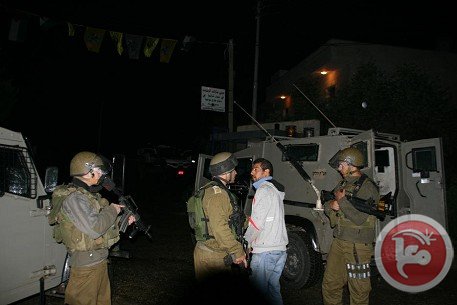
RAMALLAH — Israeli forces entered the central West Bank village of Bil’in on Monday morning, searching homes and harassing residents, reportedly in search of international solidarity activists who often remain in the area to document rights violations.
A spokesperson for the local popular committee said the raid began at 1:30 a.m. and lasted approximately an hour. The official said the homes of village residents Ali Birnat and Khamis Abu Rahma were targeted and searched.
Local committee members attempting to document the raid were prevented from accessing the scene of the searches.
An Israeli military spokeswoman did not immediately return calls seeking comment.
A statement from the Popular Struggle Coordination Committee said Abu Rahma was questioned about who was residing in his house, noting soldiers were “interested in internationals, although they could not find any,” noting that soldiers and police searched Abu Rahma’s home and garden, including the garbage and inside cars located nearby.
Groups of solidarity activists have for the past year stayed frequently in the village, which hosts the longest running weekly protest against Israel’s separation wall.
The prominent popular committee in the village has organized a yearly conference on popular non-violent resistance, and gained international support for its initiatives.
Since the early years of the protests, international solidarity activists have joined the demonstrations in an effort to mitigate the use of violence against the villagers. The use of high-velocity tear-gas canisters have caused death and injury to residents, and solidarity activists say an international presence witnessing and documenting the action often reduces the use of force.
Once activists left the village at the close of the protests, particularly during 2009 and 2010, Israeli forces would enter and detain teens they said were throwing stones at the soldiers, and later targeted protest leaders for detentions.
Activists began staying overnight in the village to document the night raids they said were being used to intimidate villagers, who have also launched court actions against the confiscation of land by Israel’s separation wall.
Sixty percent of the village lands now stand on the far side of the wall, and are largely inaccessible but for a gate that opens periodically allowing farmers to tend crops, without the use of heavy machinery or equipment.
Friday: the day of rage in the Arab world
PressTVGlobalNews | April 1, 2011
Part 2
The day of rage, the day of departure and the day of salvation: these are the names that protestors across the Arab world have been giving to Friday. From Yemen, to Bahrain, to Egypt, Tunisia, Jordan and Saudi Arabia, demonstrators have been massing after Friday prayers to demand change and to safeguard the ideals of their revolutions.
This program will be asking whether the revolutionary movement in Egypt is moving in a new direction, why President Saleh in Yemen is refusing to step down and how the western stance on Bahrain and Libya has raised questions of double standards.
To answer the questions, Homa Lezgee is joined by Chris Bambery, Dr. Saeb Shaath and Ramzy Baroud.
Egyptian authorities are preventing a big supply of cement from entering the Gaza strip. The coalition for the Lifting of Gaza Siege says the move indicates that the Egyptian Revolution has done nothing to change Cairo’s policies toward Palestine.
Press TV’s Hassan Alkatib reports from Cairo.
Bahrain: A Legacy of Broken Promises
By Ali Jawad / Dissident Voice / April 2nd, 2011
Stories of revolutions take a long time to be told. The tides of change currently sweeping across the Middle East – steadily rattling one kleptocratic autocrat after the next – will amaze and no doubt exhaust the energies of subsequent generations as they attempt to build a theoretical edifice against which the overpowering outburst of collective human sentiment currently being witnessed gains some veritable empirical sense of meaning.
To even the most seasoned in the art, piecing together the jigsaws is quite a delicate task. Much of the ambiguity that pertains to the political futures of Tunisia and Egypt for instance draws from a lack of clarity as regards the forces that propelled these uprisings, their political leanings, and whether or not these actors have the structural capacities to actualise their aspirations. It is thus fair to say that we are far from being in a position to present an analytical framework to comprehend the gripping dynamics of the Middle East’s uprisings.
The above said however, it is quite easy to discount some ridiculous interpretations of unfolding events that have been disseminated by decrepit monarchs and quarters that have an unvoiced proclivity to maintain the present status quo. For more than a month now, the courageous people of Bahrain have taken to the streets to voice their demands against a ruling monarchy that bears all the hallmarks of a classical mafia-like kleptocratic authoritarian dictatorship. In the face of flying bullets and unending billows of choking teargas smoke, both the young and old have descended to the streets with remarkable valour and upheld entirely peaceful methods of protest. Indeed one of the separating features of the Bahraini uprising is the ubiquitous slogan of “silmiyya, silmiyya” (peaceful, peaceful!). The narrative promoted by the ruling Al-Khalifa monarchy, neighbouring dynastic sheikhdoms and their US patrons has centred however on an entirely bogus claim of supposed Iranian interference.
In recent times, the above claim has been recycled many a time over across the Arabian Peninsula from Kuwait to Yemen. Without measuring the credibility of these claims, the mainstream media has often regurgitated accusations in spite of the most glaring contradictions. In the current context of Bahrain, the suggestion of foreign interference in the shape of an ethereal “Iran threat” (whose promotion has become Secretary of State Clinton’s single-most absorbing vocation) does not only represent a wholesale neglect of factual evidence, but in fact proceeds to insult the sacrifices of generations of Bahrainis tracing back to the birth of the nation.
The Constitutional Dream
Having formally attained independence from British rule in 1971, the political situation in Bahrain was characterised by a great deal of vibrancy and optimism. The archipelago state had witnessed organised political action throughout the British protectorate period, particularly in the decades immediately prior to independence. Precursors to the organised demands for political reform that eventually prompted the Emir to dissolve the National Assembly and brazenly violate the constitution less than two years after its promulgation could be found most notably in the mid-Fifties with the broad mobilisation achieved by the National Union Committee (NUC). The NUC represented the highest symbol of a truly nationalist reform project with demands centred upon the empowerment of an elected legislature, an end to British colonial interference, a fairer socio-economic order and a fundamental revision of state security laws.
Echoing calls made a few decades earlier, the demands raised by leading political figures shortly after independence similarly attracted a broad national, cross-sectarian constituency. The tide of political activism that swept through much of the Middle East at the time was keenly felt in Bahrain. The stoning of British Foreign Secretary, Selwyn Lloyd’s, car in 1956 in protest against Britain’s continued interference in Bahraini affairs through the person of Sir Charles Belgrave, as well as regular strikes at the BAPCO petroleum refinery and organised protests during the Suez Crisis later in the same year are representative of the political mobilisation seen in Bahrain during the period. It also highlights the grassroots identification of political movements within the country with the wider Arab situation.
Bahrain’s first post-independence head of state, Emir Isa bin Salman Al-Khalifa’s, decision to dissolve the National Assembly in 1975 set the tone however for a period that came to be defined by the jockeying for power between the Emir and his sibling, Prime Minister Khalifa bin Salman Al-Khalifa. According to most Bahrainis, much of the nation’s contemporary woes trace back to the birth of the nation and the unconstitutional steps undertaken by the first Emir. The popular political narrative thus begins with a great deal of discontent and mistrust towards the Al-Khalifa monarchy.
With a steady decline in the standard of living, rising unemployment and a suffocated public space resulting from years of absolute autocratic rule epitomised by the enforcement of the State Security Law of 1974, nationalist and leftist movements began a series of consultations in June 1990 to discuss the deteriorating situation in Bahrain. Leftist groups had been heavily weakened over the years due to the hard-handed crackdown by the monarchy for the industrial trade strikes of 1974.
These consultations climaxed with the formation of the People’s Petition Committee, and the open petition of October 1994 which was signed by more than 23,000 signatories. The demands set out therein underscored the primary need to restore the National Assembly, and highlighted the debilitating consequences of the Emir’s constitutional transgressions:
“The reality we now face dictates that we will fail our duty if we do not speak-out frankly to you. Your wise leadership witnesses the incorrect circumstances that our country is passing through amid the changing regional and international environment while the constitutional institution is absent. Had the banning of the National assembly been lifted, it would have enabled overcoming the negative accumulations which hinder the progress of our country. We are facing crises with dwindling opportunities and exits, the ever-worsening unemployment situation, the mounting inflation, the losses to the business sector, the problems generated by the nationality (citizenship) decrees and the prevention of many of our children from returning to their homeland. In addition, there are the laws which were enacted during the absence of the parliament which restrict the freedom of citizens and contradict the Constitution. This was accompanied by lack of freedom of expression and opinion and the total subordination of the press to the executive power. These problems, your Highness, have forced us as citizens to demand the restoration of the National Assembly, and the involvement of women in the democratic process. This could be achieved by free elections, if you decide not to recall the dissolved parliament to convene in accordance with article 65 of the Constitution…”
Akin to his reactions in 1975, the Emir now in the third-decade of his absolute rule brutally cracked down on nationalist groups and exiled leading figures including the current secretary general of Bahrain’s largest political group Al-Wifaq, Sheikh Ali Salman. Rather expectedly, the monarchy placed the finger of blame for the unrest on external forces, i.e., the Islamic Republic of Iran and Lebanese resistance movement Hezbollah. In order to quell the popular uprising, the Kingdom of Saudi Arabia also dispatched two brigades of its National Guard (around 4,000 soldiers).
By the time of the Emir’s death in 1999, Bahrain boasted a horrendous human rights track record including widespread practise of torture under the instruction of British colonial officer Ian Henderson. The promises of reform made by the incumbent Emir Hamad bin Isa Al-Khalifa were partly inspired by the failure of the iron-fist policies to weigh in the discontent, and also in order to buttress his own standing against his uncle, Prime Minister Khalifa bin Salman Al-Khalifa, who wielded a great deal of power acquired over three successive decades as Prime Minister; a position the latter continues to enjoy 40 years after his appointment.
The spirit of optimism was short-lived however, as the Emir reneged on his promises of meaningful reform. The “Bahrain model”, as it has condescendingly come to be known, essentially served to project an illusion of reform without altering in any substantive way, the pre-existing decision-making and power structures. Assurances made by the King in the National Action Charter (overwhelmingly supported by 98% of those who voted between 14-15 February 2002) to institute an assembly that would be elected through free and direct elections in effect gave veracity to the home-grown nature of the pro-democracy movement and its legitimate demands.
The Pearl Protests
As hundreds took to the streets on February 14 in their ‘Day of Rage’, the King’s henchmen had by then already settled on the solution of a violent suppression. Unlike in Tunisia and Egypt where live ammunition was employed after a few days of protests, in Bahrain its resort was almost immediate with the first fatality, Ali Abdulhadi Mushayma, falling on the first day of protests.
The date for the protests, 14th February, was deliberately chosen to provide a clear message to the ruling Al-Khalifa family that the hollow reforms enacted as part of the National Action Charter process had been far from satisfactory. Just as with decades past, the demands of protesters drew from the fundamental frustrations of generations who aspired for real constitutional reforms and a substantive role for an elected national assembly with legislative powers.
The monarchy’s brutal resort to violence that has thus far resulted in the deaths of at least 25 innocents served to exacerbate hopes in the reform-driven process, and has in turn directed grievances at the highest symbol of the status quo, namely, the Al-Khalifa rule. In essence, the ruling family’s desire for an absolute monopoly of power presents an intractable quandary that cannot be permanently masked by the duplicitous reforms carried out since 2002. Faced with the alternative of relenting some of its power to more democratic institutions or to violently suppress the calls for change, the Al-Khalifa regime has clearly selected the latter choice.
Since the outset of protests more than a month ago, Bahrain’s phony veneer of a progressive, liberal form of rule has been crushed before the world. The systematic silencing of journalists, use of live ammunition against defenceless protesters, dozens of arbitrarily detained individuals including major political opposition figures, shameful attacks on hospitals and medical teams, and the targeting of entire villages and neighbourhoods have all served to disclose the reality of the Al-Khalifa monarchy.
The outdated tactic of brandishing the pro-democracy movement within Bahrain as foreign-backed is principally used to deflect attention from the consistent demands for constitutional reform. In this regard, the role of the US in obstructing meaningful reforms and allowing for the gross misrepresentation of the demands of the political opposition has been pivotal. For obvious geopolitical stakes, the continued hosting of the Fifth Fleet base and unequivocal support for successive US military operations stretching from the Gulf War, the Al-Khalifa monarchy has been looked upon by Washington as a key strategic ally. The hypothesized domino-effect and shared fate that connects Bahrain and Saudi Arabia also looms large, no doubt, for US and western officials.
Shortly on the heels of their participation in a seminar at the House of Lords in London to highlight the deterioration in human rights and freedoms, the detention of leading opposition figures in August 2010 was met with the blanket support of US ambassador Adam Ereli who censured them for taking their case outside the shores of Bahrain. Their subsequent torture and the wall of silence erected in the face of journalists also drew little comment from western capitals.
The developments in Bahrain in recent weeks are in fact symptomatic of the confluence of interests of local autocratic tyrannies and imperial powers who continue to hinge their hegemonic agendas to the nightmarish reigns of unpopular despots. For decades, the pre-eminence of geopolitical and energy interests in the foreign policy outlooks of the US and its allies has relegated the suffering of millions of Arabs to a footnote that merit the occasional remonstrations or hand-wringing. All the while, the warehouses of these military-autocratic establishments have been filled with western arms in deals that run into hundreds of billions of dollars.
Revolutions certainly do take a long time to be told, but the time it takes for long compressed frustrations to burst out and overpower the most dictatorial reigns is almost instantaneous in comparison. For the US and its allies, the experiences in Egypt and Tunisia should be reason enough to return to the drawing books.
But more importantly, the uprising peoples of the Middle East have definitively established that the aspirations of peoples cannot forever be ignored in the equations of power. They have proven that real change can only occur in the absence of western tanks and fighter jets. To these brave men and women, the free peoples of the world owe great admiration and respect. The annals of history are lit with the sacrifices of selfless martyrs, and in recent weeks more glorious epics have been added to its volumes. Over time, many have sought to deface the most honourable sacrifices; the least we can do from afar is to ensure that these uprisings are placed within their correct historical, political and socio-economic contexts.
~
Ali Jawad is a political activist and a member of the AhlulBayt Islamic Mission (AIM). He can be reached at: jawad.ali313@googlemail.com. Read other articles by Ali, or visit Ali’s website.
‘US Boat to Gaza’ organizers respond to Netanyahu charges against flotilla
By Jane Hirschmann and Richard Levy | Mondoweiss | April 2, 2011
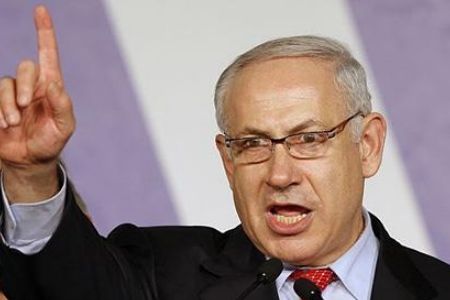
Israeli Prime Minister Benjamin Netanyahu recently met with UN Secretary-General Ban Ki-moon to ask for UN assistance to stop the planned flotilla scheduled to break the Gaza blockade in late May, 2011.
He argued to the UN Secretary General that the flotilla is a conglomerate of “extreme Islamists that are interested only in provocation” and hell bent on the destruction of Israel. Nothing could be further from the truth. We, who are actively engaged in the U.S. Boat to Gaza, named The Audacity of Hope, are appalled by this flagrant misrepresentation, so typical of right-wing Israeli propaganda. […]
The U.S. flagged ship –and all the ships in the Flotilla– that sails to Gaza in May – will sail in peace and with a single nonviolent message—“The people of Gaza are entitled to the same life, liberty and pursuit of happiness that are the right of every human being.”
Ban Ki-moon should remind Benjamin Netanyahu that Israel’s occupation of the West Bank, siege of Gaza, expansion of settlements, destruction of homes, usurpation of water and air rights, walls of confinement , brutal military presence, and daily sniper attacks on innocent civilians constitute the paramount violence and terrorism in the Mideast, conduct that we all abhor. The 2nd International Freedom Flotilla comprised of 22 countries and many boats, heading toward Gaza, including The Audacity of Hope, is not the problem. Israel’s conduct in Palestine is the problem and should be condemned by the UN, the U.S. and all people who care about freedom and justice.
Jane Hirschmann and Richard Levy are volunteers with the US Boat To Gaza.
Non-violent marches attacked in at least 4 Palestinian towns
By Saed Bannoura – IMEMC News – April 02, 2011
Weekly non-violent anti-Wall protests in a number of towns across the West Bank on Friday, including Bil’in, Nil’in, al Ma’sara and Nabi Saleh, were attacked by Israeli forces wielding tear gas and other ‘less-than-lethal’ weapons. Three protesters were injured when they were hit by high velocity tear gas canisters fired at close range by Israeli soldiers.
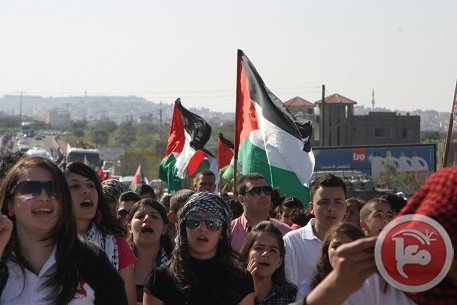
The protests on Friday commemorated Palestinian Land Day, the day in 1976 when Palestinians organized protests against Israeli confiscation of their land, and six protesters were gunned down by Israeli troops. Palestinians, along with supporters around the world, organize events each year on Land Day to protest the ongoing Israeli confiscation and annexation of Palestinian land.
According to a report from the Palestine News Network, in the village of Bil’in, where anti wall protests have been organized for the past six years, three men were injured when Israeli troops fired tear gas and rubber-coated steel bullets at protesters. After the midday prayers in the local mosque finished, villagers were joined by international and Israeli peace activists and marched up the gate of the wall separating villagers from their lands.
Troops stationed there opened fire at protesters injuring three. The men sustained injuries when soldiers fired tear gas canisters directly at them. Many others were treated for the effects of tear gas inhalation.
The nearby village of Ni’lin held a similar protest on Friday. After conducting the Friday prayers on lands near the wall, villagers and their supporters marched up to the gate of the wall separating local farmers from their land. Israeli troops used tear gas and sound bombs to force people back. Many were treated for the effects of tear gas inhalation.
In the southern West Bank village of al-Ma’sara, near Bethlehem, Israeli troops used tear gas to suppress the weekly protest against the wall. Local politicians along with Israeli and international supporters joined the villagers after the midday prays and marched to the lands where Israel is building the wall.
Troops fired tear gas to force people back into the village; many were treated for the effects of tear gas inhalation.
Egyptians Rally in Cairo to ’Save Revolution’
Al-Manar – April 1, 2011
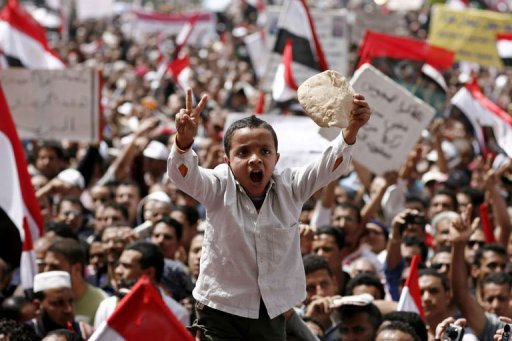
Tens of thousands of Egyptians gathered in Cairo’s Tahrir Square Friday, issuing calls to “save the revolution” that ousted president Hosni Mubarak and to rid of the country of the old regime.
The Youth Coalition Movement, an umbrella grouping those who launched the uprising against Mubarak, called this week for a new demonstration to demand judgment of the corrupt and those who fired live rounds on protesters. The young pro-democracy activists also want the country’s institutions purged of members of the former ruling National Democratic Party as well as the restitution of “the millions stolen from the people”.
Protesters chanted “The people want to purify the country” and “Marshal, Marshal, legitimacy stems from Tahrir.” They were referring to Field Marshal Hussein Tantawi, the head of the Supreme Council of the Armed Forces who is de facto head of state since 18 days of popular protests forced Mubarak to resigned on February 11.
Friday’s weekly Muslim prayers in Tahrir Square were attended by 15,000 people, according to state news agency MENA, but in the afternoon twice as many protesters thronged the central Cairo plaza.
Egyptian courts have forbidden several former ministers, politicians and businessmen from leaving the country, as well as freezing their assets pending the findings of an enquiry into corruption and embezzlement.
Mubarak and his family were bound by the same restrictions in February. Nevertheless, pro-democracy activists say they fear a return to the past and the “confiscation” of the revolution.
Hezbollah Slams Bahrain FM’s Fabrications
By Batoul Wehbe | Al-Manar | March 31, 2011
Commenting on the allegations of Bahrain’s Foreign Minister in which he accused Hezbollah of training Bahrainis who participated in recent protests in addition to other charges, Hezbollah issued a statement denying these claims, saying it was only providing moral and political support to the opposition.
“We cannot remain silent to the training accusation and the attempt to give events in Bahrain a military and security twist,” said the statement that was issued on Thursday. “The accusations are aimed at undermining the peaceful demonstrations of the oppressed people.”
The statement denied that the opposition in Bahrain had asked for any military or security training. “None of our Bahraini brothers have ever asked for military training and we have provided no such training to anyone in Bahrain,” Hezbollah said. “Any statements to the contrary are a lie and slanderous.”
It stressed that there were no Hezbollah officials or sleeper cells in the kingdom.
“All we are proudly offering (Bahrain) is political and moral backing as we did for the Arab revolutions in Tunis, Egypt, Libya and Yemen which is legal and part of our duty. ”
Foreign Minister Sheikh Khaled bin Hamad al-Khalifa accused Hezbollah on Wednesday of training Bahraini opposition protesters in Lebanon to topple the kingdom’s regime.
London set to limit right to protest
Press TV – March – 29, 2011
The British government has announced controversial plans to ban protestors from taking part in public gatherings following the weekend anti-cuts rallies, which were marred by violence.
Based on a proposal by Home Secretary Theresa May, the police may be given new powers to prevent so-called hooligans from attending rallies and marches while officers will also be authorized to force demonstrators, who do not want to be known, to remove their face-scarves and balaclavas.
The announcement has raised concerns among MPs who say no hasty decision should be made on the issue as the police may abuse the “stop and search” powers to target ordinary people rather than “known hooligans”.
May outlined her plans during an emergency Commons briefing on the violent incidents, which marred the Saturday rally organized by the Trades Union Congress.
May told the MPs that she is considering “banning orders” similar to those used against football hooligans for the demonstrators who police think may turn to violence.
She also said officers should force more protestors to remove their masks and balaclavas to help the police quickly identify participants in the rallies.
“Just as the police review their operational tactics, so the Home Office will review the powers available to the police. I have asked the police whether they need further powers to prevent violence before it occurs. I am willing to consider powers which would ban known hooligans from rallies and marches and I will look into the powers the police already have to force the removal of face-coverings and balaclavas,” May said.
While the Metropolitan Police earlier said it has charged 149 people out of more than 200 arrested during the Saturday rallies with various offenses, at least five people have lodged complaints with Scotland Yard about police violence against marchers.
The Met said on Monday that it has charged 138 people in connection with the sit-in at Fortnum & Mason luxury store for charges including aggravated trespass.
However, the UK Uncut, which organized the sit-in dismissed any claims that those participating in the Fortnum & Mason incident resorted to violence.
“This was not a protest by people wearing balaclavas and breaking things. It was a peaceful and mild-mannered gathering by people from all walks of life – teachers, hospital workers, charity workers,” said Tim Matthews, a spokesman for UK Uncut.
“People who took part now find themselves charged with a criminal offence simply for exercising their right to protest,” he added.
This comes as Tom Brake MP, co-chair of the Liberal Democrat parliamentary policy committee on home affairs, justice and equalities, warned the government against “a knee-jerk reaction” to what happened.
“Clearly there was a small minority who were out to cause trouble. We need to look in detail into whether the police have sufficient powers to tackle that, or whether they can be deployed differently to ensure such violent scenes don’t happen again,” Brake said.
Attack of the Cruise Missile Liberals
Margaret Kimberley — Black Agenda Report — 03/30/2011
 Liberals Love War
Peace loving Americans are few and far between. The vast majority of our citizens see nothing wrong with their government killing masses of people as long as the rationale sounds high minded and noble.
The love of bloodshed is generally connected with the right wing in this country, but nothing could be further from the truth. The desire for America to dominate the rest of the world is prevalent among most of its citizens, regardless of party affiliation. Those citizens differ only on who they want to see doing the dominating. Republicans are ecstatic when a Republican president drops bombs, sends drones on killing missions or occupies other nations. Democrats are equally enthusiastic when one of their own does the same.
Democratic party reaction to President Obama’s military intervention in Libya is but the latest example of the American propensity to exult over government sponsored violence. Obama, like George W. Bush before him, claims that his intervention, no-fly zone, peace mission (take your pick) is being conducted only for the most humanitarian of purposes. The dead bodies belie the claims of dogooderism but those words have a distinct power for people in this country and will always be used as a pretext for someone dying somewhere on the planet.
The legacy of Manifest Destiny and the belief in white American superiority effects and infects every policy discussion in this nation. The equation of goodness and rightness with white America holds sway very strongly and sadly not just for white people either. The willingness to see white behavior as normative means that foreign policy decisions get a pass precisely at the moment when resistance and skepticism are needed.
No, Barack Obama isn’t white, but he may as well be. He is president precisely because he assured voters that he would not change the complexion of their belief systems. If he didn’t fulfill the deeply ingrained belief that might makes right as long as America, a country thought of as white, is in charge of world affairs, he would never have become the president.
The United States attack on Libya has brought out the worst in this phenomenon. Liberals are gleeful that conservative icon Newt Gingrich backtracked on supporting intervention until the Democratic president actually intervened, but Gingrich is no different than they are.
We now have MSNBC television host Ed Schultz proclaiming “Support for Obama’s Invasion of Libya.” Never mind that Obama has taken great pains to claim that the bombing will be of limited duration and that ground troops will not have a presence there. Schultz seems to be ahead of the president on this one, but his show of support is telling in revealing the true support for American motivations in its interventions abroad. Likewise Juan Cole in an “Open Letter to the Left on Libya” dismisses criticism of the intervention thusly. “I would like to urge the Left to learn to chew gum and walk at the same time,” and adds, “We should avoid making ‘foreign intervention’ an absolute taboo . . .”
Foreign interventions conducted by the United States should be taboo. Our system is not designed to be in any way humanitarian. Its motives are to say the least suspect and no matter how evil its enemies are made out to be, the evidence of past history should make us suspicious of the arguments in favor of war.
The liberal hawks, like Obama, have no concern for Libyan civilians who are enduring bombing, and exposure to depleted uranium shells which create cancers and birth defects for years to come. This is not conjecture, but has been seen in Iraq and ought to be a reason for anyone who claims to be on the “left” to oppose the actions which bring it to pass.
The true anti-war activist, not just anti-Republican activist, has to raise its voice. The true anti-war movement must reawaken itself and hit the streets in the hundreds of thousands, just as they did in 2003 before the invasion of Iraq. That moment can be recreated, and in a deeper, more honest way, now that a Democrat is the head killer in charge.
~
Margaret Kimberley’s Freedom Rider column appears weekly in BAR, and is widely reprinted elsewhere. She maintains a frequently updated blog as well as at http://freedomrider.blogspot.com. Ms. Kimberley lives in New York City, and can be reached via e-Mail at Margaret.Kimberley(at)BlackAgandaReport.com.
Featured Video

Death Spikes & Rising Cancer In Our Youth Explained
or go to
Aletho News Archives – Video-Images
From the Archives
Politicians lie
By Mazin Qumsiyeh | Popular Resistance | August 18, 2013
There is no way to say this truth nicely: Politicians lie. That includes Japanese, American, Egyptian, Israeli, and Palestinian politicians! Is there something more common sense than that? Yet, so many citizens around the world believe their own politicians or wistfully acknowledge lies but think it is part of the job needed to run things. They believe even when politicians contradict themselves blatantly. This phenomenon is rather remarkable. It is a dissonance and disconnect from reality that many seem oblivious to. It is very dangerous because it can lead to accepting rationales for going to war. These can be deadly wars that lead to millions of lives lost as happened in what was called World War 1 and WW2. Even when incredible and declassified evidence abound, politicians continue to lie and old mythologies refuse to die. Here are just a few of the countless lies told to us over the past few decades… continue
Blog Roll
 Aletho News
- RSF military group defects, joins Sudanese army: State media
- Ireland goalkeeper refuses to play ‘Israel’ as squad weighs boycott
- China pushes back against US on Cuba, Iran
- Ukrainian Soldiers, Potential Mercenaries: Have Gun, Will Travel!
- Burnham’s UN debut… A masterclass in British disinformation
- Iran flights continue despite US aviation sanctions
- Global Tipping Points Lead the World Into a State of Entropy
- The day-after at the White House: USA and Xi Jinping
- The Geopolitical Balance in the Red Sea: The UAE Being Displaced by New Players
- Iraqi resistance group vows to stage airport sit-ins over Iran aerial blockade
- If Americans Knew
- Deconstructing Netanyahu’s pants-on-fire UN rant – Daily Update
- Trump betrayed voters with his campaign lies and prioritized a foreign country once he took office
- Netanyahu calls Israel’s war in Gaza ‘opposite of genocide’ in UN speech to near-empty hall
- Settler Kidnappings: Torture, Sexual Abuse and Terrorisation of Palestinian Abductees as Israel Deepens Annexation of West Bank
- Gaza winter nears as 162,000 tents become unusable, raising fears of humanitarian crisis
- Netanyahu says, “It’s the opposite of genocide”; UN says Gaza economy is world’s ‘most severe crisis on record’ – Daily Update
- Israel’s US-Backed Assault on Gaza Has Created the ‘World’s Most Severe Economic Crisis on Record’: UN
- ‘Protecting U.S. Citizens’… From Israel
- ‘This is where I live now, the back of a truck’: a day in the life of a grandmother in Gaza
- In UN Speech, Iran’s President Displays Pictures of Children Killed by US, Brings Attention to Israel’s Nuclear Arsenal
- No Tricks Zone
- New Study: Earth And Venus Surface Warmth Largely Explained By Convection And Lapse Rate, Not CO2 Or Radiation
- 2025 Nature Paper Claiming Worsening Global Drought Gets RETRACTED …Heavily Flawed
- New Study: ‘Global Drought Shows No Detectable Recent Acceleration Under Climate Warming’
- Economic Masterminds: German Socialists Suggest Taxing Productivity Gains Stemming From Using AI
- The South China Sea Has Not Been Cooperating With The Climate Change Narrative
- Energy Crisis: Germany Enters Heating Season With Historically Low Gas Reserve Fill Levels
- New Study: The Antarctic Ice Sheet Gained Mass From 2020-2024 Due To Staggering Snow And Ice Accumulation
- Study: Ocean Heating Rates From Thousands Of Years Ago ‘Dwarf’ Modern Ocean Heating Rates
- Climate Extremists Target, Attack Large-Scale Power Grid Infrastructure In Germany!
- New Study: Antarctic Ice Melt Has Contributed Less Than 1 Centimeter To Sea Level Rise In The Last 30 Years

