The foolish side of the cultural boycott line
Alexander Billet, The Electronic Intifada, 29 March 2011

The unsavory performer Gene Simmons has called artists boycotting Israel “fools.” (Vitoria Gasteiz)
Gene Simmons has been known for a lot of less-than-savory things. His long tongue is probably his most infamous, and yet few have said much about his big, bigoted, misogynist mouth. The Kiss front-man, who was born Chaim Witz near Haifa, recently opened that mouth to call artists boycotting Israel “fools.”
Simmons is currently in Israel to film scenes for his reality show, Gene Simmons’ Family Jewels. In an interview with the Associated Press, he gave some rather condescending advice to those same artists: “The countries they should be boycotting are the same countries [where] the populations are rebelling … People long to be free … And they sure as hell don’t want somebody who’s a ruler who hasn’t been elected by them” (“AP Interview: Kiss bassist Gene Simmons says boycotters of Israel are ‘fools’,” 22 March 2011).
For his own part, Simmons has been a long and vocal supporter of Israeli and American foreign policy. He loudly stumped for both the invasions of Afghanistan and Iraq and in 2006, as Israel bombed Lebanon, he sent messages of support to Israeli soldiers. And his supposed liberalism hasn’t prevented him from describing Islam as a “vile culture” to The Sydney Morning Herald in 2004.
Now he’s directed this same bile at some of music’s most legendary figures. The Pixies, Gil Scott-Heron, Carlos Santana and Pink Floyd’s Roger Waters are only a few of the personalities who have lent their names to the cultural boycott over the past few years.
The call for an economic, academic and cultural boycott goes back to 2004, when groups, intellectuals and activists from within Palestine issued the call (“Call for academic and cultural boycott of Israel“). The past nine years have seen the call supported by a growing number of groups world-wide and since Israel’s lethal attack on the Gaza Freedom Flotilla in May 2010, the amount of cancelled gigs has greatly increased. Elvis Costello, who pulled out of two shows in Tel Aviv after the raid, explained his rationale on his website:
“One lives in hope that music is more than mere noise, filling up idle time, whether intending to elate or lament … Then there are occasions when merely having your name added to a concert schedule may be interpreted as a political act that resonates more than anything that might be sung and it may be assumed that one has no mind for the suffering of the innocent” (“It is After Considerable Contemplation …“).
Costello, along with many other artists like him, have been lambasted by countless voices both in the mainstream press and the world-wide blogosphere. Right-wing columnist and radio host Debbie Schlussel labeled him “scum,” and accused him of “appeasing” Hamas. Shuki Weiss, a high-profile Israeli concert promoter, called the boycott “cultural terrorism.” Indeed, Gene Simmons’ own words highlight the momentum that the cultural boycott of Israel has gained lately — and what a potential problem it’s become for Israel’s public image abroad.
Simmons is notably careful to put the whole question in terms of “freedom,” a rather oblique word that any politician is ready to trot out at a moment’s notice. The same interview notes that his own mother was a survivor of the Nazi Holocaust, which once again pulls the whole conversation about Palestine and Israel away from the realities of colonialism and boils the conflict down to a matter of “Jew vs. Muslim.” It’s a mistaken notion that nonetheless seems to jive with Simmons’ own “clash of civilizations” worldview.
Of course, at least in the interview, there’s no mention of the boycott on its own terms, no mention of the one word that Israel and its backers fear: apartheid. After all, to do so might put Simmons on history’s bad side.
It’s a potent line to cross. Those who struggled against apartheid in South Africa no doubt remember the loud and proud role that music played. Artists United Against Apartheid, launched in 1985 by Little Steven Van Zandt, garnered support from countless musicians. Run-DMC, Bruce Springsteen, Bonnie Raitt, Herbie Hancock, Joey Ramone, George Clinton, Peter Gabriel are just a few of the musicians who famously refused to play South Africa while apartheid remained intact.
Simmons wasn’t part of AUAA. But then, “integrity” has never been the first thing that comes to mind when one thinks of Kiss, a group who have eagerly lent their image to anything that will make them money — lunch-boxes, action figures, cartoons, soda commercials and credit cards have all been deemed worthy of the Kiss “brand,” but alas, not the struggle for human rights.
The real insult, however, comes in his insistence that artists should be boycotting the “countries [where] the populations are rebelling.” He conveniently skips over the fact that Egypt, Tunisia, Jordan and most of the other Middle East dictatorships have survived through steadfast support from Israel and the US. An example of this would be one of the key demands being fought for by those still struggling in Egypt — opening the border with Gaza!
You have to hand it to him though; Simmons has impeccable timing. His comments and visit to Jerusalem come right as Israel has launched a spate of fresh bombings of Gaza. Simmons, it seems, may have front-row seats to a crime against humanity. No doubt these particular segments of Family Jewels are going to be particularly stomach-turning. But while he runs his mouth off to no end, the fact remains that a growing number of musicians have decided Israel deserves nothing but silence from them.
Alexander Billet is a music journalist and activist living in Chicago. He runs the website Rebel Frequencies (http://rebelfrequencies.blogspot.com), and is a columnist for SOCIARTS. He has also written for Z Magazine, PopMatters.com, and CounterPunch. He can be reached at rebelfrequencies A T gmail D O T com.
Egyptian youth sound the trumpet for a new million man march
Ahram Online | 28 Mar 2011
Egyptian bloggers and activists have called for a fresh million man march on Friday, 1 April.
The new protest will take place in Cairo’s Tahrir Square, the epicentre of the 25 January Revolution that lasted 18 days and resulted in the overthrow of ex-president Hosni Mubarak on 11 February.
Through Facebook and Twitter the organisers of the new rallies cited ‘unfulfilled demands’ as the reason for the need for a massive demonstration.
Bringing to justice Mubarak and his family members, who were allegedly involved in major embezzlement and many other infringements, is on top of the ‘neglected’ demands.
The protesters also stressed the importance of prosecuting Zakaria Azmi, Safwat Al-Sherif and Fathi Sorour. The trio are widely branded as ‘corrupt’ figures of the previous regime and ‘disciples’ of Mubarak, as well as being held responsible for the counter-revolution, which resulted in over 600 dead and several thousand injured.
Furthermore, they are demanding that all media figures associated with the old regime be removed from their positions effective immediately.
Around 500 journalists protested on Sunday in front of the national radio and TV headquarters known as the Maspero building before supporters of the 25 January Revolution joined them.
Dismantling the National Democratic Party, formerly headed by Mubarak, is also among the demands.
The latest million man march has been called by many names, including the “new Friday of rage” and “Friday of cleansing.”
Swiss rights groups to protest Peres visit to the country
Palestine Information Center – 28/03/2011
GENEVA — More than 20 human rights groups in Switzerland will gather in Geneva on Monday to protest a visit by Israeli President Shimon Peres to the country.
They have been working to prosecute Peres over war crimes he committed in the 2008-2009 war on Gaza.
”More than twenty pro-Palestinian rights organizations and popular organizations have called for demonstrations and a sit-in Monday in front of the Swiss government building in Geneva to protest Peres’s visit,” said Anwar al-Gharbi, who heads the Swiss-based Rights for All organization.
Switzerland must refrain from receiving Peres, as the UN Goldstone report regarding the war on the Gaza Strip has accused Israeli leaders of committing war crimes and crimes against humanity, in the wake of the killing of more than a 1,450 Palestinians, most of them children and women, within 22 days, Gharbi said.
The announcement of Peres’s planned visit came on Saturday when courts and government departments were closed for the weekend, so legal measures against Peres had not been taken, Gharbi explained, adding that the rights groups will put forth ”every effort” to prosecute Peres as a war criminal.
Egypt: Tons of cement awaits entry to Gaza
Press TV – March 27, 2011
A number of prominent Egyptian civil activists have pledged to deliver ten tons of cement to the besieged Gaza strip through the Rafah border crossing.
A group called ‘Egyptian-International Coalition for lifting the siege and rebuilding Gaza’ says trucks carrying cement from Egypt are parked close to the border, a Press TV correspondent reported on Sunday.
A 15-member delegation is expected to accompany the shipment. The delegation consists of prominent lawyers, engineers, politicians and several civil activists.
The development comes weeks after a historic revolution ousted President Hosni Mubarak from power
Egypt has imposed a blockade on Gaza since the democratically elected Hamas government took control of the territory in 2007. Since then Israel has imposed a crippling blockade on the territory triggering what a humanitarian crisis.
A major Egyptian political party, the Muslim Brotherhood (MB), has recently demanded that the country’s Supreme Council of the Armed Forces takes action in breaking the siege of Gaza.
In a separate development, an Israeli airstrike has killed at least two Palestinians in the northern Gaza Strip. Three other Palestinians were injured in the attack which took place east of Jabaliya.
Reports say the Israeli aircraft fired at least one missile into the region.
Israeli warplanes have repeatedly targeted the coastal strip during the past week. At least 10 Palestinians including a number of children were killed in the air raids.
Over 400,000 join London anti-cuts march
Press TV – March 26, 2011
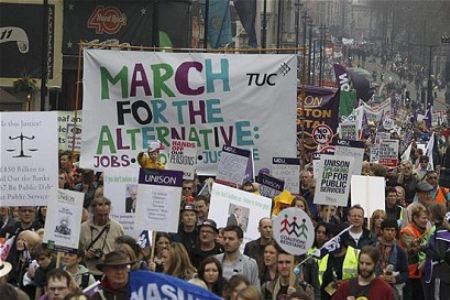
Hundreds of thousands of British opposed to the coalition government’s budget cuts are marching in London streets, chanting for an alternative to the government’s austerity cuts.
Tens of thousands of teachers, council staff, nurses, students, National Health Service (NHS) officials and many others who are angry at the public cut plans, mounting rates of unemployment, tax rises, pay cuts and pension reforms are partaking in the demonstration.
About 800 coaches were planned to get people from across the country to London to participate in the rally, which is considered the biggest public reaction against the government’s spending cuts since it took office in May 2010 following the general elections. The protesters began marching from Victoria Embankment to Hyde Park.
Hundreds of people from North East traveled to London on Saturday morning to join the London protest. Demonstrators from Aberystwyth to Aberdeen and from Penzance to Perth also arrived in London to denounce the spending cuts along with the Londoners.
British Education Secretary Michael Gove claimed that he could understand people’s anger, but “the difficulty that we have as the government inheriting a terrible economic mess is that we have to take steps to bring the public finances back into balance.”
Unite union’s General Secretary Len McCluskey said the coalition government has exaggerated about the level of the deficit.
Describing his economic plan, McCluskey said, “Our alternative is to concentrate on economic growth through tax fairness so, for example, if the government was brave enough, it would tackle the tax avoidance that robs the British taxpayer of a minimum of £25bn a year.”
Around 100 legal observers are monitoring the policing of the protest, and there are more representatives from other human rights groups on hand to offer advice to demonstrators.
Saudi Arabia urged to release protesters
Press TV – March 25, 2011
The Saudi-based Human Rights First Society has called for the release of 100 protesters amid reports that some of those arrested have been tortured.
The rights group has called for a full investigation into the allegations of physical and psychological torture of the detainees, AFP reported.
It says the protesters were mainly arrested in the cities of Safwa, Qatif, and Hassa in the east of the country during peaceful rallies last week.
Saudi Arabia’s Interior Ministry has declined to comment on the report. Riyadh has recently stepped up its clampdown on anti-government protesters in response to protests in the kingdom.
The anti-government demonstrators are demanding political reforms and the immediate release of political prisoners, whom protesters say are being held unjustly and without trial, some for as long as 16 years.
The protesters also condemned Saudi Arabia’s military intervention in Bahrain and called for the withdrawal of Saudi forces from the country.
Shias, a minority in Saudi Arabia, say that they face discrimination in getting government jobs and benefits. The Saudi monarchy denies the allegations.
King Abdullah announced last week that the country would hold the second municipal elections next month, already delayed for two years. He also allotted $136 billion to tackle unemployment and housing problems and ordered the establishment of an anti-corruption body.
Activists say the state should take up real political reforms including an elected parliament with legislative powers, public freedoms and true independence for the judiciary.
They say that instead of carrying out the reforms, the government has stepped up security to suppress demonstrations.
New Egyptian law criminalizes protests
Al-Masry Al-Youm | March 23, 2011
The Egyptian Cabinet on Wednesday ordered a law criminalizing protests and strikes. Under the new law, anyone organizing or calling for a protest will be sentenced to jail and/or a fine of LE500,000.
The new law will be enforced as long as the current Emergency Law is in place, said the cabinet in a statement on Wednesday. The Emergency Law has been in force since 1981 following the assassination of former President Anwar Sadat.
The new law will apply to anyone inciting, urging, promoting or participating in a protest or strike that hampers or delays work at any private or public establishments.
Since the overthrow of former President Hosni Mubarak on 11 February, Egypt has witnessed nationwide labor strikes and political protests. Among those protesting have been university students, political activists, railway workers, doctors, pharmacists, lawyers, journalists, pensioners, and the police force.
‘Isolated Saleh under pressure to quit’
Interview with Zayd al-Isa, a Middle East expert in London
Press TV – March 22, 2011
Democratic protesters in Yemen now seem to be gaining the advantage against a dictator that is losing political and military support. Press TV talks with Zayd al-Isa, a Middle East expert in London on the latest developments in Yemen and about where President Saleh can turn for additional support.
Press TV: How do you see the situation in Yemen? We have Yemeni ambassadors in Europe, the Arab League, the UN and in China all stepping down and calling for the resignation of President Ali Abdullah Saleh. This presumably would leave him more isolated. How much do you think this would pressure Saleh to step down?
Zayd al-Isa: Saleh is becoming increasingly isolated, beleaguered and embattled. Support is waning away from him and he is under unprecedented pressure. The massacre that his forces have perpetrated has piled on the pressure for him to resign and step down. People have hardened their rhetoric ad toughened their language against him. They want him to be ousted and not only that, but to stand trial for crimes committed against unarmed peaceful civilians.
This has followed the massacre by Saudi forces on the people of Bahrain and we can say that Saleh too is following the green light given by the US. Saudi Arabia considers Yemen to be its backyard garden – both Yemen and Bahrain. Americans have given them a license to kill in those two countries.
Saleh’s policy of shooting to kill the protesters has backfired and we are witnessing the backlash from the tribe’s people, which is highly significant because Yemen is a tribal nation. These tribes are now standing against him and most importantly we now see the army, high ranking Generals, pull the rug from under his feet turning against him.
Without warning some of the army’s troops have been ordered on the ground, tanks included, to come to the defense of the innocent people of Yemen.
We have seen support come from the defense minister who has pledged his loyalty and called Saleh a constitutional president. This is all a critical and highly dangerous development that may show divisions within the high ranks of the military, which is something different to what occurred in Egypt, which was stable and united. We also saw a different situation in Tunisia where the army stood firmly against Ben Ali and remained as a stable unit.
The situation in Yemen has deteriorated further with Saleh becoming isolated amid an unprecedented number of diplomats defecting. This highlights the beginning of a new phase where the protesters are gaining the upper hand and the movement is gathering momentum.
This is to the contrary of what Saleh had expected. Protesters have flouted the imposed curfew and numbers have substantially escalated, spreading to all parts of Yemen. Saleh is now in a terrible position and I believe he now has to step down. France has said that the fall of Saleh has become unavoidable. We haven’t heard such noises coming from the US as Saleh is again considered one of the key allies of the US.
I think Saleh depends on three important pillars: the support of the tribes, the support of the US and aid that is allocated to military; and finally the backing and support of the Saudi regime. Saleh has been a loyal and obedient defender of the Saudi Monarchy.
Press TV: Regarding the three pillars of Saleh’s ability to stay in power that you mentioned, President Saleh’s own tribe has called upon him to step down.
Zayd al-Isa: That’s right and support of that tribe is absolutely crucial. Using a policy of divide and conquer he heavily relied on this tribe in the earlier war against the Houthis, which was backed by Saudi Arabia. That tribal support now is waning.
The aid from the US goes to Saleh’s military in order to fight al-Qaeda, which we know the Saudi regime has been a major factor in the supporting and the flourishing of al-Qaeda. Al Qaeda has flourished during those dictatorships and the oppression forced on the people of those countries, in Yemen, and of course in Saudi Arabia, which is the mother of all dictatorships.
Press TV: Let’s talk about the support of Saudi Arabia for Saleh – Do you think there will be Saudi troops deployed to Yemen as they were deployed to Bahrain?
Zayd al-Isa: I wouldn’t call it a deployment of forces. What you have in Bahrain is a clear cut occupation; an outright invasion of a sovereign country.
Yemen though is a huge massive country with a very difficult terrain. And we’ve seen Saudi Arabia actually try to invade Yemen before to impose its own will on the Houthis and to actually commit genocide against them; committing crimes against humanity and ethnic cleansing against them. They used their superior military ground forces and supremacy in the air – advanced equipment supplied to them by the US.
They picked on the Houthis, a simple militia and now we see them once again taking on a tiny country (Bahrain) which is ruled by a ruthless dictator the so-called king of Bahrain who is no king (by definition). He was never elected and has subjected his people to intolerable discrimination. He has tried to change the makeup of the country by luring thousands of mercenaries giving them citizenship if they commit crimes against his own people.
Saudi now has its trigger happy forces inside Bahrain to quash the revolutionary forces of democracy also and with utter silence from the US. The US has condemned the situation in Bahrain, but has not lifted a finger to help prevent the occupation of Bahrain. We can see through this discussion that what they have done in Bahrain they cannot duplicate in Yemen.
Press TV: We have reports that Houthi fighters are now in control of Yemen’s Northern provinces. This raises a question of – What are the chances of Yemen falling into a civil war?
Zayd al-Isa: The situation is incredibly volatile and there are so many tribes. And what makes it even more dangerous is the division (potential) between the army generals and this could lead to civil war unless the army sits down and unites, that is, a united front against Saleh. He has the loyalty of the Defense Minister, but I do believe that Saleh is running out of allies and supporters; he is relying now on the backing and support of Saudi Arabia. That’s why he has sent his foreign minister to Saudi Arabia to get whole hearted support and the king of Saudi Arabia has emphatically supported the dictators in the region. He gave shelter to Ben Ali to live in his country and he tried to influence Egypt into allowing Mubarak to remain in power and oversee a transition. They have been the bastion of dictatorship.
Chileans protest Obama visit, Nuke deal
Press TV – March 21, 2011
Chileans have held demonstrations to protest the upcoming visit of US President Barack Obama to the country following a recent nuclear deal between the two nations.
“This demonstration is to reject Barack Obama’s militaristic policies,” said a protest organizer.
The angry protesters organized two peaceful rallies on Sunday, complaining that the nuclear agreement was signed despite major nuclear crisis that developed in Japan following the huge earthquake and tsunami that struck the country on March 11, AFP reported Monday.
Chilean opposition lawmakers and environmentalists argue that the Friday agreement is too risky for their country, which lies on the Pacific Ring of Fire, and like Japan, is quite prone to devastating earthquakes.
The devastating 9-magnitude earthquake, followed by a monstrous tsunami that hit Japan earlier in March, caused radioactive leakage due to explosions in the nuclear power plants that resulted from malfunctioning cooling systems.
Chile experienced its own 8.8-magnitude earthquake just last year, which was also followed by a tsunami that claimed the lives of more than 500 people.
The Chilean demonstrators, numbering close to 2,000, held signs that read, “Nuclear energy is energy of death.”
Chilean President Sebastian Pinera and President Obama are set to meet Monday in the capital Santiago, where Obama is scheduled to deliver a speech on the Latin America.
Fresh protests break out in Morocco
Press TV – March 20, 2011
Amid escalating unrest in Middle East and North of Africa, Moroccans have also taken to the streets to protest corruption in Morocco and demand better civil rights.
Thousands of pro-democracy protesters gathered in Rabat and Casablanca on Sunday shouting “the Moroccan people demand change!” and holding up placards reading “For the freedom and dignity of the Moroccan people.”
Protests in Morocco began earlier this year following revolutions in Egypt and Tunis which led to the overthrow of the governments in both countries.
In February thousands of Moroccans staged peaceful demonstrations across the country, prompting Morocco’s King Mohammed VI to emphasize his commitment to “pursuing the realization of structural reforms.”
The king announced on March 9 that he had appointed a committee to draft a reform of the constitution widening the prerogatives of elected officials and ensuring officials are accountable and the judiciary independent.
Mohammed VI added that the new proposals would be announced in June and the draft constitution will be put to a referendum.
On March 14, however, Morocco’s riot police armed with truncheons broke up peaceful protest in Casablanca in an unusual show of violence, injuring 13 people and arresting 54 others.
Featured Video

Death Spikes & Rising Cancer In Our Youth Explained
or go to
Aletho News Archives – Video-Images
From the Archives
Politicians lie
By Mazin Qumsiyeh | Popular Resistance | August 18, 2013
There is no way to say this truth nicely: Politicians lie. That includes Japanese, American, Egyptian, Israeli, and Palestinian politicians! Is there something more common sense than that? Yet, so many citizens around the world believe their own politicians or wistfully acknowledge lies but think it is part of the job needed to run things. They believe even when politicians contradict themselves blatantly. This phenomenon is rather remarkable. It is a dissonance and disconnect from reality that many seem oblivious to. It is very dangerous because it can lead to accepting rationales for going to war. These can be deadly wars that lead to millions of lives lost as happened in what was called World War 1 and WW2. Even when incredible and declassified evidence abound, politicians continue to lie and old mythologies refuse to die. Here are just a few of the countless lies told to us over the past few decades… continue
Blog Roll
 Aletho News
- RSF military group defects, joins Sudanese army: State media
- Ireland goalkeeper refuses to play ‘Israel’ as squad weighs boycott
- China pushes back against US on Cuba, Iran
- Ukrainian Soldiers, Potential Mercenaries: Have Gun, Will Travel!
- Burnham’s UN debut… A masterclass in British disinformation
- Iran flights continue despite US aviation sanctions
- Global Tipping Points Lead the World Into a State of Entropy
- The day-after at the White House: USA and Xi Jinping
- The Geopolitical Balance in the Red Sea: The UAE Being Displaced by New Players
- Iraqi resistance group vows to stage airport sit-ins over Iran aerial blockade
- If Americans Knew
- Deconstructing Netanyahu’s pants-on-fire UN rant – Daily Update
- Trump betrayed voters with his campaign lies and prioritized a foreign country once he took office
- Netanyahu calls Israel’s war in Gaza ‘opposite of genocide’ in UN speech to near-empty hall
- Settler Kidnappings: Torture, Sexual Abuse and Terrorisation of Palestinian Abductees as Israel Deepens Annexation of West Bank
- Gaza winter nears as 162,000 tents become unusable, raising fears of humanitarian crisis
- Netanyahu says, “It’s the opposite of genocide”; UN says Gaza economy is world’s ‘most severe crisis on record’ – Daily Update
- Israel’s US-Backed Assault on Gaza Has Created the ‘World’s Most Severe Economic Crisis on Record’: UN
- ‘Protecting U.S. Citizens’… From Israel
- ‘This is where I live now, the back of a truck’: a day in the life of a grandmother in Gaza
- In UN Speech, Iran’s President Displays Pictures of Children Killed by US, Brings Attention to Israel’s Nuclear Arsenal
- No Tricks Zone
- New Study: Earth And Venus Surface Warmth Largely Explained By Convection And Lapse Rate, Not CO2 Or Radiation
- 2025 Nature Paper Claiming Worsening Global Drought Gets RETRACTED …Heavily Flawed
- New Study: ‘Global Drought Shows No Detectable Recent Acceleration Under Climate Warming’
- Economic Masterminds: German Socialists Suggest Taxing Productivity Gains Stemming From Using AI
- The South China Sea Has Not Been Cooperating With The Climate Change Narrative
- Energy Crisis: Germany Enters Heating Season With Historically Low Gas Reserve Fill Levels
- New Study: The Antarctic Ice Sheet Gained Mass From 2020-2024 Due To Staggering Snow And Ice Accumulation
- Study: Ocean Heating Rates From Thousands Of Years Ago ‘Dwarf’ Modern Ocean Heating Rates
- Climate Extremists Target, Attack Large-Scale Power Grid Infrastructure In Germany!
- New Study: Antarctic Ice Melt Has Contributed Less Than 1 Centimeter To Sea Level Rise In The Last 30 Years

