Democracy Without Economic Independence is Worthless
By Sarakenos | KABOBfest | February 12, 2011
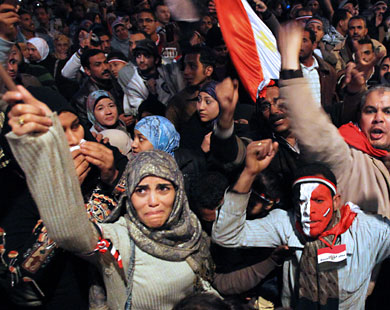
The Egyptian military, with a US green light, got rid of Mubarak for precisely the same reason they sent the police and thugs that killed over 300 and injured thousands last week — to allow for the economy to run smoothly again. In other words, the disposing of Mubarak is just another solution, as undesirable as it may be, to re-open banks and have business run as usual. Factories, banks, real state, and other businesses are still owned by the same corrupt leaders, with the fate of the Mubarak family stock still unknown.
The High Council of Armed Forces, in all their four communiqués, stressed the “economic interests” of the country, which, in a heavily-privatized economy like Egypt’s, means the interests of the private owners, some of whom are military generals. The forced removal of Mubarak, in the end, served owners’ interests foremost. This economic concern was ranked as the most important objective in the High Council of Armed Forces’ latest communiqué:
- First: The High Council of the Armed Forces is committed to all contents in previous communiqués.
- Second: The High Council of the Armed Forces has great confidence in the ability of Egypt, its institutions, and its people in surpassing the current critical conditions. And based on this, all sectors, public and private, must commit to their glorious and patriotic mission to push the wheel of economy forward, and that the people are held responsible in this matter.
The third point in the communiqué was only natural to forcefully uphold “the glorious and patriotic mission,” which is to keep the current government under Suleiman in power until new elections are held. The Council did not set up a time frame for these elections, but it definitively did so for resuscitating the economy (i.e. retrieve flow of income and profits on their investments) as a priority that cannot wait for democracy; which is now! This communiqué went short of repeating Suleiman’s patronizing words yesterday when he said: “Go back to your homes and your jobs.”
There are a lot of people who simply cannot accept that the economy, at this stage, is of much concern to the Egyptian military regime (which is still in power) and the Obama administration and other US officials, let alone the general public and the revolution. But that is because these people are not trained sufficiently to have an economic eye on world affairs. The focus then shifts to the political aspects of the revolution: democracy, fair elections, and freedom of speech and religion. Make no mistake, these are absolutely important elements of any successful revolution, and achieving them deserves euphoric celebrations. But to ignore the economic demands, the very reason why this revolution even took place, is really an act of infanticide against this new-born Egyptian revolution. Bou Azizi (the true catalyst of the Tunisian and Egyptian revolutions) did not set himself on fire because he couldn’t vote in free elections. He set himself on fire because his only source of income was humiliatingly taken away from him.
All indications seem to favor sustaining the Egyptian economic system and excluding it from the revolution. For example, the Finance minister, Samir Radwan, appointed by Mubarak during the January 25 Revolution, is still running the country’s economic affairs with almost no objection from anyone. He spoke to CNN’s Piers Morgan last night to share his feelings of jubilee, but in fact refrained from using any revolutionary words, and referred to the last eighteen days as “the crisis.” Luckily so far, according to Qatar News Agency (Feb 7, 2011), he refused IMF intervention:
“The minister quoted the CBK chief as stressing that the government’s procedures would be enough to confront the current crisis.”
But then yesterday, he was quoted saying that a stimulus package may be needed, without specifying the source of those funds, to boost up employment. These all sound like innocent events to the economically illiterate. But lessons must be learned from past revolutions, like the Polish Revolution in 1989, when all the fruits of revolution were finally reaped by private owners of the country’s most important resources and industries, after being drowned by IMF loans in return for speeding up the process of privatization and doing away with labor laws and trade barriers.
The January 25 Revolution does not address the private ownership of the country’s telecommunications industry, power grid, water, post, and other major financial infrastructures. Should the country’s resources also belong to the people in the same way that the parliament and presidency ought to? Would democracy be worth anything if the democratically-elected government had no say or authority over the country’s oil, gas, water, energy, agriculture, stock markets and banking regulations, because they are “privately” owned?
Recall that the world stood by watching as the Free Officers Movement, led by Mohammad Najib and Abdul Nasser, took over power in Egypt in 1952. It was only when Abdul Nasser began a campaign of nationalizing the economy (especially the Suez Canal), that the world super powers (Britain, France, and Israel) turned against Egypt and declared war in 1953. This must be a hint to all spectators, that as long as the new freely-elected Egyptian government (to be) secures business contracts and foreign investments, the world shall embrace Egyptian democracy. However, should they choose to nationalize the major sectors of the economy, the free world will turn against Egypt, and we’ll hear western media pundits talking about how Egyptians were never ready for democracy, and how democracy does not fit the Arab mentality or society, and how dictatorships are necessary for the security of the United States of America against possible terrorist cells growing in chaos-hot-bed Egypt.
The Egyptian military, however, being itself invested in the privately owned neo-liberal economy of Egypt, had made assurances in their communiqués to the effect that they are going to protect the economy (read securing investments, foreign and domestic) as a major priority. The Egyptian Revolution of January 25 has put Egypt on the road to democracy, but will it lead to Egyptian economic independence — where economic decisions are made in Egypt, by Egyptians, and serve the interests of Egyptians? Or will they forfeit economic independence and honor free trade agreements that supersede democracy and the people’s will?
One thing is for certain. The Egyptian military rule (and all other dictatorships) can only be forced to make concessions through peaceful and total economic paralysis, as had been witnessed in the past eighteen days of the greatest Arab victory since Saladdin. The lesson to be learned for future Arab revolutions, and all world revolutions, is to keep the economy in the background of all tactics, strategies, and objectives.
Germans protest nuclear waste transport
Press TV – February 13, 2011
Thousands of anti-nuclear activists protest along the route of a nuclear waste train in Germany, demanding an end to the transportation of radioactive waste.
Various anti-nuclear protests took place across Germany on Sunday. In Greifswald, 1,500 citizens marched through the streets peacefully, in disagreement with the continued nuclear waste transports taking place where they live.
The protests come ahead of the transport of waste from a nuclear plant in Karlsruhe to Lubmin in the north of Germany, scheduled to arrive on Tuesday.
“Tons of waste containing highly radioactive substances is transferred to a temporary storage unit which is not safe,” Deputy Head of the Local Union Office Annett Beitz told Press TV.
Protesters say there are no contingency plans to stop likely accidents from happening during the transport.
The speaker for the Environment Protection Charity told Press TV that containers had a forty-year guaranty and that it was not yet known what would happen afterwards. Health hazards like contamination could happen if anything leaks out into underwater currents.
“It’s a big problem because many people actually are not aware of all these dangers because normally you cannot read about these in the newspapers, or anywhere… So this is very important for us to tell the people and tell them about all these dangers,” Nadia Tegtmeyer of the Anti-Nuclear Alliance told Press TV.
Despite the protests, the government has voted in favor of maintaining nuclear power plants for another 10 to 15 years. This move has been heavily criticized by the opposition.
Activists told Press TV that the movement was gaining momentum in the country and that they plan to hinder all types of atomic waste transports from running smoothly. Road and railway blocks are scheduled to take place during the next transport on Tuesday night.
The workers, middle class, military junta and the permanent revolution
By Hossam el-Hamalawy | 3Arabawy | February 12th, 2011

Since yesterday, and actually earlier, middle class activists have been urging Egyptians to suspend the protests and return to work, in the name of patriotism, singing some of the most ridiculous lullabies about “let’s build new Egypt,” “Let’s work harder than even before,” etc… In case you didn’t know, actually Egyptians are among the hardest working people in the globe already..
Those activists want us to trust Mubarak’s generals with the transition to democracy–the same junta that has provided the backbone of his dictatorship over the past 30 years. And while I believe the Supreme Council of the Armed Forces, who receive $1.3 billion annually from the US, will eventually engineer the transition to a “civilian” government, I have no doubt it will be a government that will guarantee the continuation of a system that will never touch the army’s privileges, keep the armed forces as the institution that will have the final say in politics (like for example Turkey), guarantee Egypt will continue to follow the US foreign policy whether it’s the undesired peace with the Apartheid State of Israel, safe passage for the US navy in the Suez Canal, the continuation of the Gaza siege and exports of natural gas to Israel at subsidized rates. The “civilian” government is not about cabinet members who do not wear military uniforms. A civilian government means a government that fully represents the Egyptian people’s demands and desires without any intervention from the brass. And I see this as hard to be accomplished or allowed by the junta.
The military has been the ruling institution in this country since 1952. Its leaders are part of the establishment. And while the young officers and soldiers are our allies, we cannot for one second lend our trust and confidence to the generals. Moreover, those army leaders need to be investigated. I want to know more about their involvement in the business sector.
All classes in Egypt took part in the uprising. In Tahrir Square you found sons and daughters of the Egyptian elite, together with the workers, middle class citizens, and the urban poor. Mubarak has managed to alienate all social classes in society including wide section of the bourgeoisie. But remember that it’s only when the mass strikes started three days ago that the regime started crumbling and the army had to force Mubarak to resign because the system was about to collapse.
Some have been surprised that the workers started striking. I really don’t know what to say. This is completely idiotic. The workers have been staging the longest and most sustained strike wave in Egypt’s history since 1946, triggered by the Mahalla strike in December 2006. It’s not the workers’ fault that you were not paying attention to their news. Every single day over the past three years there was a strike in some factory whether it’s in Cairo or the provinces. These strikes were not just economic, they were also political in nature.
From day 1 of our uprising, the working class has been taking part in the protests. Who do you think were the protesters in Mahalla, Suez and Kafr el-Dawwar for example? However, the workers were taking part as “demonstrators” and not necessarily as “workers”– meaning, they were not moving independently. The govt had brought the economy to halt, not the protesters by its curfew, shutting down of banks and business. It was a capitalist strike, aiming at terrorizing the Egyptian people. Only when the govt tried to bring the country back to “normal” on Sunday that workers returned to their factories, discussed the current situation, and started to organize en masse, moving as a block.
The strikes waged by the workers this week were both economic and political fused together. In some of the locations the workers did not list the regime’s fall among their demands, but they used the same slogans as those protesting in Tahrir and in many cases, at least those I managed to learn about and I’m sure there are others, the workers put forward a list of political demands in solidarity with the revolution.
These workers are not going home anytime soon. They started strikes because they couldn’t feed their families anymore. They have been emboldened by Mubarak’s overthrow, and cannot go back to their children and tell them the army has promised to bring them food and their rights in I don’t know how many months. Many of the strikers have already started raising additional demands of establishing free trade unions away from the corrupt, state backed Egyptian Federation of Trade Unions.
Today, I’ve already started receiving news that thousands of Public Transport workers are staging protests in el-Gabal el-Ahmar. The temporary workers at Helwan Steel Mills are also protesting. The Railway technicians continue to bring trains to halt. Thousands at el-Hawamdiya Sugar Factory are protesting and oil workers will start a strike tomorrow over economic demands and also to impeach Minister Sameh Fahmy and halt gas exports to Israel. And more reports are coming from other industrial centers.
At this point, the Tahrir Square occupation is likely to be suspended. But we have to take Tahrir to the factories now. As the revolution proceeds, an inevitable class polarization is to happen. We have to be vigilant. We shouldn’t stop here… We hold the keys to the liberation of the entire region, not just Egypt… Onwards with a permanent revolution that will empower the people of this country with direct democracy from below…
Boycott roundup: international day of action called for Land Day
Report, The Electronic Intifada, 11 February 2011
As part of a regular feature, The Electronic Intifada reports on the latest developments of the Palestinian-led global boycott, divestment and sanctions (BDS) movement against Israeli violations of human rights and policies of apartheid.
BDS campaigners scored a significant victory this month as the London Borough of Tower Hamlets voted to exclude Veolia, a French firm that has provided services to the Israeli occupation in the West Bank, from receiving any contracts with the municipality. Activists have also staged protests and launched campaigns in Ireland, Belgium, Palestine. Meanwhile, the Boycott, Divestment and Sanctions National Committee (BNC) announced the third annual global day of action to be held on 30 March 2011.
Ireland
Activists with the Ireland Palestine Solidarity Campaign (IPSC) are calling for a global boycott against Israeli “blood diamonds” on Valentine’s Day, 14 February.
In a statement on the campaign’s website, IPSC activists are urging consumers to make conscious choices in buying jewelry gifts for their loved ones.
“This Valentine’s Day, don’t let dazzling diamonds blind you to the plight of those whose misery and suffering is funded by revenue from the Israeli diamond industry,” IPSC stated (“Global Call to Action – Flashy Stones and Broken Bones,” January 2011).
IPSC has campaigned against the Israeli diamond industry for more than a year, petitioning Irish jewelry associations to stop carrying Israeli gemstones.
Sean Clinton, chairman of the Limerick branch of IPSC, wrote last year for The Electronic Intifada that “The diamond industry is a major pillar of the Israeli economy … No other developed country is so heavily dependent on a single luxury commodity and the goodwill of individual consumers globally.”
Clinton added that Israel holds a “dominant position” in the diamond industry, and the state currently chairs the Kimberly Process Certification Scheme, an international regulation and certification program that is tasked with eliminating “blood diamonds” from the industry. Blood diamonds are gemstones mined from areas in the world — mostly in the African and Asian continents — that are involved in, or directly finance, ongoing human rights violations, violence and war.
In its campaign statement, the IPSC added: “[diamonds] are the currency of broken bones and bombed out homes in Gaza. The burning glow of the white phosphorous that rained down on Gaza doesn’t come cheap, but the $1 billion the Israeli military derives from revenue from the Israeli diamond industry each year helps to fill the coffers of the criminal military regime.”
IPSC stated: “Every time someone buys a diamond processed in Israel some of the money goes to funding the Israeli war machine that stands accused of war crimes. Israeli diamonds are blood diamonds.”
United Kingdom
The Palestine Solidarity Campaign in the UK is intensifying its efforts to urge local authorities to exclude French urban services corporation Veolia from major public contracts. This comes on the heels of the recent findings of the Russell Tribunal on Palestine that Veolia is liable for serious violations of international human rights and humanitarian law because of its numerous contracts with the Israeli government’s settlement industry in the occupied West Bank (“The Boycott VEOLIA Campaign-A Fortnight of Actions In February,” February 2011).
Campaigners around the UK are planning a series of actions, including sit-in protests at two London borough council meetings to protest possible city contracts with Veolia for waste management systems. On 1 February, the group organized a protest at Veolia’s UK headquarters in Islington, North London.
On 2 February, Tower Hamlets, one of the London Borough councils, passed a motion to formally exclude Veolia from its urban waste management contracts, citing that the corporation has “clearly committed acts of grave misconduct in relation to the Palestinian people and the maintenance of illegal settlements …” (“Full text of the Council meeting,”2 February 2011 [PDF]).
Additionally, the council voted to support the boycott, divestment and sanctions campaign “against the pariah state of Israel,” and stated that “urgent steps should be taken to review all contracts with Veolia and not to place any further contracts with the company.”
The council also passed a motion to urge the Mayor of London to write to Veolia to communicate the council’s “determination to terminate any relationship” to the company.
The action by Tower Hamlets is reminiscent of similar actions by many UK local authorities during the 1980s campaigns against apartheid in South Africa.
After the Russell Tribunal, Veolia Environmental Services UK spread the news that the company had pulled out of the operation of the Tovlan landfill site in the Jordan Valley in the occupied West Bank. The landfill serves mainly illegal Israeli settlements in the West Bank and municipalities in Israel. Meanwhile, Who Profits? (www.whoprofits.org) — a project of the Israeli Coalition of Women for Peace — verified the information against facts on the ground. The Israeli environmental protection authority of the settlements in the West Bank told Who Profits? in early February that Veolia is still operating the Tovlan landfill.
Belgium
Solidarity activists staged a protest inside an international tourism industry exhibition in Brussels on 5 February, encouraging attendees to boycott the Israeli exhibit. Wearing matching T-shirts emblazoned with “Free Palestine” and “Palestine Vivra” (Palestine will live), with “Boycott Israel” on the back, activists formed a human chain around the Israeli tourism tent and chanted in support of boycott.
The protest, organized by European solidarity group Generation-Palestine (generation-palestine.org), was captured on video and uploaded to YouTube.
Palestine
Palestine-based activists with the Palestinian Campaign for the Academic and Cultural Boycott of Israel (PACBI) continued to put pressure on American singer Macy Gray, who has stated she will perform in Tel Aviv despite repeated protests by Palestinian, Israeli and international boycott campaigners.
In its statement on 9 February, PACBI expressed “great dismay” at Gray’s decision to keep her Tel Aviv performance date, and warned her that she would be “electing to serve directly the interests of the [public relations] campaign to Brand Israel” (“Open letter to Macy Gray,” 9 February 2011)
“This is a campaign that has been launched by the Israeli government and promoted by institutions throughout the country and abroad in order to whitewash Israel’s violations of international law and project a false image of normalcy,” PACBI added.
PACBI stated that Gray has promoted this campaign already, by playing at the opening of the Israeli consulate offices in Los Angeles and, more recently, releasing a statement declaring her support for Israel at the request of Israeli diplomats in California.
After Gray announced that she would proceed with her planned performance, she said she would visit Ramallah, the West Bank city where the US-supported Palestinian Authority is based, during her visit, a move which PACBI said is a “a patronizing attempt to dictate the terms of the Palestinian people’s struggle — by wanting to visit Palestinian schools or play a show in Ramallah, as though the Palestinian people need your pity.”
PACBI added: “We have asked, as an occupied people, for the minimum act of solidarity by not playing in Tel Aviv. We have been answered with your dismissal of our struggle in favor of your own way of helping, as though you know better. While we acknowledge there are many ways to help, we ask that people who do so are not directly delegitimizing the popular will of the Palestinian people. By playing in Tel Aviv you will do this and more. Your action will imply support of the occupation and the colonial Israeli state, denial of the right of Palestinian refugees to return to their homes, and dismissal of a system of apartheid.”
Global boycott, divestment and sanctions day of action
The Boycott, Divestment and Sanctions National Committee (BNC) announced the third annual global day of action to be held on 30 March 2011, in a call to intensify boycott actions around the world while commemorating an historic day in the Palestinian anti-colonialist movement (“Commemorate Land Day 2011 by Joining the Global BDS Day of Action“).
“Inspired and buoyed by the popular uprisings in Egypt and Tunisia and their unique manifestation of courage, dignity, civility and determination, we stand resolutely with worldwide struggles for self-determination, freedom, democracy, social justice and equality, and we call for intensifying BDS actions globally as the main form of solidarity with Palestinian rights,” the BNC stated.
The BNC said it is calling on people of conscience all over the world to join the global boycott, divestment and sanctions movement by launching and supporting local, national and international divestment initiatives; by taking part in consumer boycotts; to pursue legal action against Israeli war criminals and violations of international law by corporations complicit in Israeli military policies; and more.
The date of the global day of action, 30 March, is the annual commemoration of Land Day. In 1976 the Israeli military shot and killed six young Palestinian citizens of Israel during a massive uprising in protest of the Israeli government’s plan to build new Jewish-only colonies and expand existing Jewish cities.
“Today, Land Day symbolizes Palestinian resistance to Israel’s ongoing land expropriation, colonization, occupation and apartheid,” the BNC wrote in its statement.
The first Global BDS Day of Action was announced by Palestinian civil society with overwhelming support at the World Social Forum in 2009.
Freedom Flotilla II to Commemorate 1st Anniversary of Deadly Raid
The Freedom Flotilla II will sail for Gaza during the last two weeks of May 2011, to commemorate the anniversary of the deadly attack on the first Freedom Flotilla on 31 May 2010, which left nine activists dead.
The International Coalition of the Freedom Flotilla II met in Madrid, Spain from the 4-6th of February to discuss the upcoming journey. The meeting, organized by the host delegation Rumbo a Gaza, was attended by delegates from organizations in Algeria, Canada, Scotland, Spain, France, Greece, Holland, Ireland, Italy, Jordan, Kuwait, Malaysia, Norway, Sweden, Switzerland and Turkey.
“We have at least 15 different groups right now at one or two boats each,” said Huwaida Arraf, chairperson of the Free Gaza Movement, one of the leading nongovernmental organizations in the effort. “Every meeting we have, we get one or two new country-based networks or coalitions that want to join.”
The flotilla will be sailing to Gaza from southern Turkey, and IHH, the Turkish humanitarian organization, has reported that European parliamentarians, Arab and Turkish parliamentarians will also be joining the flotilla regardless of the potential threat of Israeli force.
According to organizers, the Freedom Flotilla II will have at least twice as many boats as last year, more volunteers, and more aid for the people in Gaza.
Israeli Special Forces attacked the Freedom Flotilla convoy in 2010, boarded the Turkish ship the Mavi Marama, and killed 9 Turkish citizens and injured dozens more.
The situation in Gaza, which has been dire for some time due to the Israeli military blockade, significantly worsened following Israel’s military attack Operation Cast Lead. The 22-day military strike reduced much of Gaza’s infrastructure and homes to rubble, and killed some 1,400 Palestinians, the majority of whom were civilians. The population is still reeling and in desperate need of supplies..
According to the UNHRC’s “Report of the Special Rapporteur on the situation of human rights in the Palestinian territories”, published in January, Rapporteur Richard Falk notes: “the situation of the civilian population in Gaza continues to be of critical concern. In 2010, Israeli uses of force resulted in 58 Palestinians killed in Gaza (including 22 civilians) plus 233 Palestinians injured (including 208 civilians).”
“Israel has declared a buffer zone that extends for 1,500 metres into Gaza from the border fence (comprising 17 per cent of Gaza), and Israeli military personnel fire at farmers and children who are pursuing normal peaceful activities close to the border,” the report continues. “These characteristics of the ongoing Israeli relationship to Gaza are strongly confirmatory of the legal and factual assessment that Gaza remains an occupied territory.”
Egyptian Army Prepares To Protect Presidential Palace
By Saed Bannoura – IMEMC & Agencies – February 10, 2011
At the eighteenth day of massive protests demanding the removal of Egyptian President, Hosni Mubarak, and his regime, the Egyptian army was extensively redeployed in several streets in Cairo, especially those leading to the Presidential palace.
The army was deployed in Nasr and Masr Al Jadeeda where the palace is located, and sealed off several other roads.
The army is aiming mainly at protecting the palace, Intelligence headquarters, and the building of Egypt’s official government-run TV station.
Local sources reported that the Curfew in Cairo was escalated while the army tightened its siege in Cairo and installed dozens of roadblocks to be added to the ones that were installed after the protests started.
Yet, Egyptian military sources said that the army will not prevent the residents from reaching the Tahrir Square in Cairo, the center point of the protests.
Meanwhile, the Youth Revolutionary Coalition denounced the statements of Egypt’s Vice President, Omar Suleiman, in which he stated that the alternative of dialogue is a coup.
The coalition said that such statements are a serious threat to the revolution, and confirmed their determination to continue their protests until the regime of Mubarak is ousted.
Ahmad Maher, coordinator of the April 6 Movement, stated that Suleiman is a man who runs secret intelligence services, and that he is wasting time in order to ensure the current government and its head remain in power.
Maher added that Suleiman’s call for dialogue with the revolting Egyptians is only a manipulation, and that after his calls were rejected, Suleiman started holding talks “with fake parties and unknown persons”.
He further stated that the Egyptians will not leave the Tahrir Square and all other squares where protests are being held, adding that “the threats of Suleiman and others will not intimidate the revolution”.
Egyptian army called to join protesters
Press TV – February 10, 2011
An Egyptian former MP has said that military personnel will join the protesters if the current situation in Cairo gets worse.
“It is obvious that military apparatus will leave Mubarak alone if the situation deteriorates… Unless something happens between military apparatus and people, the army will leave Mubarak alone,” Talaat Sadat told Press TV in an interview on Thursday.
The army is deployed to suppress the revolution as the nation prepares for another planned million-man march by the opposition on Friday.
Egypt’s revolution youth movement has also called on the army to join anti-government protesters.
Speaking to Press TV, members of the movement rejected remarks by the Egyptian Vice-president who said the protesters have to accept the government’s proposals to end the revolution or they will face army action.
The movement said it has information that some army officers will disobey any order from their superiors to open fire on the protesters.
Sadat also condemned the US stance on the Egyptian revolution.
“I think [US President Barack] Obama resembles a liar who cannot do his job properly and does not know what is going on in Egypt and the Islam world,” he said.
Nationwide protests against President Hosni Mubarak’s regime continue for the 17th day as striking doctors and a host of other workers have joined the revolution.
Featured Video

or go to
Aletho News Archives – Video-Images
New Documentary
“Inside Gaza” wins best documentary at Montreal’s Cinemania film festival
Palestine Information Center – November 16, 2026
MONTREAL – The documentary “Inside Gaza,” which chronicles the experiences of Palestinian journalists working with Agence France-Presse (AFP) while covering the Israeli war on the Gaza Strip, won the Best Documentary Award at the 32nd Cinemania International Francophone Film Festival held in Montreal, Canada.
Directed by Helene Lam Trong, the 72-minute film follows the daily lives of four AFP journalists who bear witness to the difficulties of reporting in a war-torn territory largely closed off to international media.
The film is compiled from material produced by the team on the ground, as well as from interviews conducted after they left.
The film also won the People’s Choice Award at the festival on Saturday. … continue
Blog Roll
 Aletho News
- Brand ‘rape’ case just doesn’t add up. Was he framed?
- How The Jensen Huang Chinese Spy Hoax Is Russiagate 2.0
- Austria seeks to strip former foreign minister of citizenship over Russia ties
- “Inside Gaza” wins best documentary at Montreal’s Cinemania film festival
- Activists block German munitions plant over arms exports to ‘Israel’
- The Nasser Hospital attack and Israel’s relentless lies
- Could it be satan? No, Huckabee, just the Americans you work for
- AIPAC and more: Network of pro-Israel influence in US Congress
- Putin aide reveals Moscow’s stance on Europe at peace talks
- Imran Khan warns Pakistani judges he may die in prison
- If Americans Knew
- An error has occurred; the feed is probably down. Try again later.
- No Tricks Zone
- Argentina’s Perito Moreno Glacier Joins Antarctica and Arctic In Defying Doomsday Melt Claims
- New Study: Barents Sea Temperatures Were Warmer And Sea Ice Less Extensive In The 1700s Than Today
- German Authorities Start Initiative To Evaluate Public Register For Climate “Disinformation” Spreaders!
- Zonal Asymmetry of Temperature Change in the Antarctic Circumpolar Current
- New Study: The Net Fossil Fuel Contribution To Rising Atmospheric CO2 Has Been Zero For 500 Years
- Germany’s Green Energy Transition Becoming Increasingly Expensive…Another 6 Trillion Euros!
- Sudden Stratospheric Warming, Powerful El Niño Combination May Lead To Extreme Europe Cold, Energy Crisis!
- Two New Studies Find Thwaites Glacier Melt Cannot Be Driven By Human Activity Or A Warming Ocean
- E-Cars Reduce CO2 Emissions By Only 41% Compared To Internal Combustion Engine Vehicles
- Predictions Made By Renowned Climate Professor Over Past Decades Have Been Proven To Be Poor

