Those politically savvy people who thought strongman, Hosni Mubarak would be out before the end of the first week of the Egyptian uprising better rethink the odds. For thirty years Mubarak has developed what can be called a deeply rooted dictatorial regime with regular White House access and annual largesse of some $1.3 billion in military equipment and payroll.
A former military man, he has been very alert to what is needed to maintain the loyalties of the police, the intelligence security forces and the army. If he goes, tens of thousands of those on his payroll could lose their patronage and be on the outs if his government is really replaced.
Moreover, he enjoys the support of both the United States and Israel for whom he has been a “stable” force against the pressures coming from Iran and its allies in the Middle East.
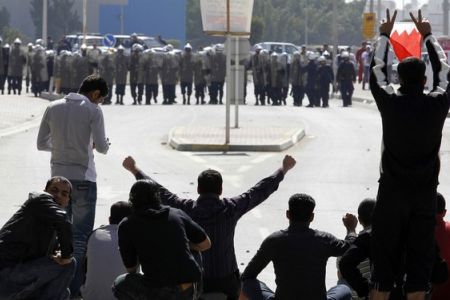
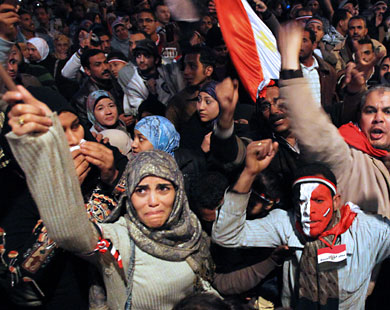
Arrayed against him are a variety of protestors, best known for their occupation of Tahrir Square in Cairo and whose grievances are being reported hour-by-hour by the harassed international media, including the much attacked Al-Jazeera. Widely noted are the solidarity, self-help, stamina and democratic nature of the rebellion.
The state-controlled media, however, remains in Mubarak’s hands. He has shown he can cut off the entire Internet and mobile phone systems with what one commentator called “the active complicity of the major corporate servers.”
Going into the third week of the uprising, the regime has reopened the banks, and is urging businesses to open their doors. The government is striving to wait out the protestors, whose daily supplies and energies are being sapped by the overwhelming force arrayed against them to intimidate, weaken and keep their numbers down not just in the Square but also in other cities like Alexandria and Suez.
So far the army is remaining largely neutral. The regimes’ paramilitary gangs, in plain clothes, attacked the protestors inflicting fatalities and injuries to see if they will cut and run. So far, the demonstrators are well-organized in the Square and in other Cairo neighborhoods and are holding their ground. But roundups of some of the leading dissidents for brief imprisonments or worse and detaining or beating journalists continue.
What these developments reflect is that the Mubarak regime is still in charge, with just enough rhetoric of reform, while replacing some top leaders and dismissing the board of Mubarak’s political party, to show some slack. Mubarak’s tactic is to bend a little so as not to break.
But unless the largely urban, tech-savvy protestors can keep replenishing their ranks and bringing more of the frightened rural poor to their rallies, they risk being perceived as running out of steam. After all, they cannot be seen as receiving aid from abroad as the Mubarak government receives regularly from U.S. taxpayers. They cannot be seen as espousing “radical ideologies” as the Mubarak government espouses radical use of dictatorial violence and torture in the past and present.
In a way, the weaknesses of the protestors—no centralized leadership, no resources—are also their moral strengths. That is why their great fear is being infiltrated by organized provocateurs to create “incidents” and smears. So they have their own checkpoints leading to the Square and are trying to keep good relations with the soldiers surrounding their encampment.
The Army is central to the perpetuation of the Mubarak forces and their oligarchies. Under orders to appear neutral and maintain order, the Army, like most Egyptians, is waiting for the next move of the two sides, though alert to its own interests which include business investments.
Rumors are rife. But it seems that some people designated by the protestors and representatives of the long politically suppressed Muslim Brotherhood have met with Mubarak’s people.
Mubarak’s newly appointed vice-president, longtime intelligence chief, Omar Suleiman, with close operational contacts in Washington, appears to be making the decisions, if only to give the impression that Mubarak is relenting and may be willing to remain as a figurehead president until his term is up later this year.
All this disingenuous image of moderation may be the regime’s way of biding time so as to more fully prepare to depress or destroy this popular uprising in various ways short of massive violence watched by the whole world in real time. Choosing the latter course could unleash forces in this impoverished and brutalized country of 80 million people that both the army could not contain and the already fragile economy could not endure.
If, as rumored, the trade unions exert their independence and form worker committees that could organize a general strike, then an alternative support structure could join the protestors to call for some economic relief, such as increasing wages and consumer subsidies. However, the Mubarak government has an inside watch on anything like such an initiative materializing as well. The regime is propagandizing that there is no alternative to itself being the transition, whatever that may be, other than chaos and radical revolution against the West.
What is the Obama Administration doing behind the scenes, beyond its statement in favor of a transition government planning “open and fair elections”? Will it stand with the people of Egypt and human rights if it has to stand against what analyst Samah Selim described as the “terrifying naked silence of multinational corporations and the national security state against civil society?”
Time will surely tell.
Ralph Nader is the author of Only the Super-Rich Can Save Us!, a novel.
February 8, 2011
Posted by aletho |
False Flag Terrorism, Progressive Hypocrite, Solidarity and Activism, Timeless or most popular |
Leave a comment
The Popular Front for the Liberation of Palestine said on February 6, 2011 that it is an urgent Palestinian national task to discard the Oslo Accords and the entire path that followed, and called upon all Palestinian forces and factions to meet and officially declare the death of these agreements, ending their compliance with these agreements and their consequent disasters for the Palestinian cause.
Comrade Dr. Maher al-Taher, member of the Political Bureau of the PFLP and leader of its branch outside Palestine, issued an official statement in which he said the Oslo accords were the beginning of a criminal process to force Palestinians to recognize the “right” of the Zionist occupation state to exist on the land of Palestine.
He said that in yesterday’s demonstrations in solidarity with Egypt in the streets of Ramallah, Bethlehem and other Palestinian cities, the slogans were raised: “The people want to drop the Oslo accords” and “The people want to end the division.”
Comrade Taher said, “Yes, it is time to declare the death and the end to this humiliating agreements, which accounted for the biggest victory of the Zionist movement and its aggressive projects in the region. Yes, it is the time to build Palestinian national unity established on the basis of a clear political program and struggle.
In this historical moment for the question of Palestine and the Arab nation, the Popular Front calls for all Palestinian forces and factions, without exception, to come together to a comprehensive national forum to announce the death of the Oslo accords and end their compliance with those accords and their consequent disasters for the Palestinian cause, said Comrade Taher.
The Popular Front for the Liberation expresses its pride and support for the great revolutions of the people of Egypt and Tunisia, which have revived the soul of the Arab nation and its future generations, and which emphasize that the era of tyrants is not long for this world.
The Egyptian people today are regaining their role, and Egypt’s historical significance, in the protection of Arab national security and supporting the Palestinian cause.
The Popular Front for the Liberation of Palestine salutes the martyrs of the Tunisian and Egyptian revolution, and is confident that the blood of the martyrs and wounded will not come in vain, and will open the pathway to a new Arab era.
February 7, 2011
Posted by aletho |
Ethnic Cleansing, Racism, Zionism, Solidarity and Activism, Timeless or most popular |
Leave a comment
As chairperson of AL-BEIT: Association for the Defence of Human Rights in Israel, which is the publisher of the current volume*, I was utterly dismayed to have come across the text of an “Open Letter to Ronald Lauder, Stanley Chesley, Russell Robinson and the entire leadership of the Jewish National Fund” signed by 27 NGOs, human rights organizations and social movements from the Negev and Israel and by 7 American Jewish organizations.

I find the said text to be a sad illustration of the ongoing weakness of such among “human rights activists, social organizations in Israel, Jewish and other allies in the United States and around the world” as failing to position at the center of their political programme and grass-root practice the demand for the implementation of the right of all 1948 Palestine refugees and their families to return and to the repossession of the titles to their properties inside Israel. Furthermore, the said text fails to recognize the extent of the JNF’s complicity in the racist and apartheid policies of the State of Israel since its founding in 1948.
Allow me point out at the outset that the term “apartheid” is not synonymous with the terms “racism” and “xenophobia”. The terms “racism” and “xenophobia” are not synonymous with the term “apartheid”.
Racism is defined by the International Convention on the Elimination of All Forms of Racial Discrimination of 1965 as “any distinction, exclusion, restriction or preference based on race, colour, descent, or national or ethnic origin which has the purpose or effect of nullifying or impairing the recognition, enjoyment or exercise, on an equal footing, of human rights and fundamental freedoms in the political, economic, social, cultural or any other field of public life”. (Article 1) There is a certain degree of accuracy in the argument put forth by the Israeli Foreign Ministry (which is located in Jerusalem on land belonging to Palestinian refugees who were expelled from the city in the widespread ethnic cleansing perpetrated in Palestine in course of and in the wake of the 1948 war), and other representatives of the State of Israel around the world, that Israel should not be singled out from among other member states of the United Nations as a state uniquely afflicted by racism – not because Israel is not afflicted by racism, but because it is not greatly different from other member states of the UN, such as Indonesia and Canada, to name but two.
However, the State of Israel is not merely afflicted by racism. The core of the Israeli-Palestinian conflict hinges upon access to land and to subsoil (minerals and, above all, water), and in respect of this core the State of Israel is anchored in a regime of apartheid. Apartheid is a political regime that imposes upon the population which is under its control racist preferences and choices by power of Acts of Parliament, and enforces the said racist preferences and choices upon the population which is under its control by means of the law enforcement instruments of the state, such as the judicial system, the security forces (police, army, secret services), the planning authorities, the municipal authorities, etc.
Whereas racism in the modern sense of the term is a rampant social affliction at one level or another in all of the member states of the UN (some more and some less), a regime of apartheid as defined above is less common and, to the best of my knowledge, with the dismantling of the apartheid regime in South Africa – a process that began with the release of Nelson Mandela from prison in 1990 and was completed with his election as President of the Republic in 1994 in the first democratic elections ever to be held in the history of South Africa – the State of Israel remains the only member state of the UN that is an apartheid state.
It is possible that my knowledge is insufficient; there may be additional member states of the UN which are apartheid states as defined above, but in any event they would be few and far between. An apartheid regime constitutes a blatant violation of the UN’s founding charter, of the Universal Declaration of Human Rights, and of the standards of international law. Therefore, it is the duty of the international community to single out apartheid states, separately and collectively, including the State of Israel, for the same specific attention that was paid to the apartheid regime of the Republic of South Africa, i.e., a boycott of industrial and other products, academic, cultural and sport institutions (including research grants and international conferences), and international sanctions enforced by the UN. This is our duty, not because Israel claims to be “the Jewish state” (or any other name, for that matter), but in order to assist such states, in the same way as the international community assisted South Africa, to replace the apartheid regime with a democratic constitution.
In this regard it is important to note that, in the first democratic elections in the Republic of South Africa in 1994, Nelson Mandela was elected as President of the Republic by majorities of votes, not only among the “non-White” tribes and ethnic groups that comprise the social mosaic of the territory that comes under the authority of the Republic, but also among the “White” tribes and ethnic groups. This was after decades of political imprisonment and extensive and coordinated efforts on the part of the apartheid regime to remove him from sight and to defame him as a “terrorist”.
93% of the entire territory of the State of Israel within the borders of 4 June 1967 are defined as “national lands” and are legally designated for “Jews only”, more specifically, for those persons who are defined under the laws of the State of Israel as “Jews”. Only some 7% or less of the entire territory of the State of Israel within the borders of 4 June 1967 are privately owned, approximately half of which are estimated to be privately owned by Arabs and half by Jews. The legal system of apartheid by which this blatant discrimination is maintained in the territories under Israeli sovereignty has resulted in a land tenure system worse than that of the Republic of South Africa at the height of the apartheid regime, where 87% of the territory of the Republic was legally designated in law for the use of “Whites only”.
The strategic settler colonial apartheid legislation in the State of Israel is anchored, inter alia, on the following series of laws:
- Absentees’ Property Law; Law of Return; Development Authority Law all of 1950
- World Zionist Organization [WZO]-Jewish Agency for the Land of Israel [JA] (Status) Law, 1952
- Jewish National Fund [JNF] Law; Lands Acquisition (Validation of Acts and Compensation) Law both of 1953
- Covenant between the Government of Israel and the Zionist Executive, also known as the Executive of the Jewish Agency for the Land of Israel, 1954
- Perscription Law, 1958
- Basic Law: Israel Lands; Israel Lands Law; Israel Lands Administration Law all of 1960
- The Covenant between the Government of Israel and the JNF, 1961
- Agricultural Settlement (Restriction on Use of Agricultural Land and Water) Law, 1967
It is beyond the limits of this contribution to elaborate further upon the apartheid laws that operate in the State of Israel. In order to properly appreciate the case, one must begin by examining the cornerstones of the aforementioned legislation, and first and foremost understand how the Israel Lands Administration operates; what is the status in Israel of the Jewish Agency and the Jewish National Fund; and the modalities and the links that obtain among them.
Given the above, aren’t the signatories to the above “Open Letter” aware of the articles of incorporation of the JNF company as registered in Israel such as were approved and signed in 1954 by the Justice Minister at the time, Pinhas Rosen? They read inter alia as follows:
To purchase, acquire on lease or in exchange, etc., … in the prescribed region (which expression shall in this Memorandum mean the State of Israel in any area within the jurisdiction of the Government of Israel) or any part thereof, for the purpose of settling Jews on such lands and properties (Article 3a, Jewish National Fund, Association Limited in Liability and Without Capital Distributed to Shareholders, Memorandum of Association, Government Gazette No. 354, 10.6.1954).
Aren’t the signatories to the said “Open Letter” aware of the JNF’s complicity with the crime against humanity of the ethnic cleansing of Palestine under the cover of the 1948-49 war and their critical role in “greenwashing” the said crime by planting its forests, cultivating its parks and developing its recreational facilities over the ruins of many of the 500 odd ethnically cleansed Palestinian Arab villages inside pre-1967 Israel and over their lands?
How can the said 27 NGOs, human rights organizations and social movements from the Negev and Israel and 7 American Jewish organizations suggest that “If you, the leaders of the JNF, fail to heed this call, you will bear responsibility for the betrayal of Israel’s commitment to the values of equality and justice enshrined in its Declaration of Independence”? It is the “greenwashing” by the JNF of the crime against humanity of the ethnic cleansing of Palestine that has significantly made possible for the apartheid State of Israel to conceal these crimes for several decades and project itself as the “only democracy in the Middle East”.
How can the said 27 NGOs, human rights organizations and social movements from the Negev and Israel and 7 American Jewish organizations call upon the leadership of the JNF “to end your complicity in the destruction of Bedouin villages in the Negev and in the dispossession of Israel’s Bedouin community”, rather than call upon governments world-wide and western governments in particular to direct their Commissioners of Charities to strike the JNF off the list of charitable societies the charitable registration of the JNF, to nullify the JNF tax privileges in their respective states (as well as demand that the JNF reimburse their respective treasuries with all the monies fraudulently gained as tax-exemptions), and to declare the JNF an illegal organization under their respective liberal democratic constitutions.
Political Zionism is a form of apartheid and the appropriate penalties prescribed by the International Covenant on the Suppression and Punishment of the Crime of Apartheid of 1973 should be applied to its institutions, notably the WZO, the JA and the JNF, and to the State of Israel, which has granted those institutions statutory status by power of parliamentary legislation.
It is the duty of civil society, including professional associations, trade unions, and religious organizations, as well as the responsibility of every concerned individual of conscience (notably, the 27 NGOs human rights organizations and social movements from the Negev and Israel and the 7 American Jewish organizations) to single out the State of Israel for the same specific attention that was paid to the apartheid regime of the Republic of South Africa, inter alia in the International Convention on the Suppression and Punishment of the Crime of Apartheid of 1973, not because racism in Israel as defined in international law is that different from racism in the UK or North America, but because apartheid in Israel (the regulation of racism through Acts of Parliament) is akin to apartheid in the former (pre-1994) South Africa.
It is the duty of civil society, including professional associations, trade unions, and religious organizations, as well as the responsibility of every concerned individual of conscience (notably, the 27 NGOs human rights organizations and social movements from the Negev and Israel and the 7 American Jewish organizations) to mobilize for boycott, divestment and sanctions (BDS) and act to:
NULLIFY ISRAELI JNF LAW!
REVOKE THE CHARITABLE REGISTRATION OF THE JNF AND CANCEL ITS TAX EXEMPT STATUS IN THE UK AND BEYOND!
ANNUL THE NGO OBSERVER STANDING OF THE JNF IN THE UNITED NATIONS AND DECLARE THE JNF AN ILLEGAL ORGANIZATION UNDER INTERNATIONAL LAW!
*About the contributor and publisher of Vol 3 of the JNFebook:
Professor Dr Uri Davis is a Palestinian Hebrew, citizen of the alleged constitutional monarchy of the U.K. and of the apartheid State of Israel, born in Jerusalem in 1943. He has been at the forefront of the defence of human rights in Israel, notably Palestinian rights, since 1965 and has pioneered critical research on Zionism and the State of Israel since the mid-1970. He has published extensively in these fields, including Israel: An Apartheid State (Zed Books, London 1987 & 1990; abridged edition, MRN, Laudium, 2001); (associate author with Walter Lehn, author), The Jewish National Fund. Kegan Paul International, London and New York, 1988; Citizenship and the State: Comparative Study of Citizenship Legislation in Israel, Jordan, Palestine, Syria and Lebanon (Ithaca Press, Reading, 1997); Citizenship and the State in the Middle East: Approaches and Applications (co-ed) (Syracuse University Press, 2000) and most recently Apartheid Israel: Possibilities for the Struggle Within (Zed Books, London, 2003); A Secular Anti-Zionist COMPANION of an Abridged Passover Haggadah (with Ricky Romain, forthcoming).
Dr Davis is Associate Professor at AL-QUDS University, Institute of Regional Studies, Israel Studies Programme, Jerusalem/Abu Dis; member of the Middle East Regional Committee of the international Journal Citizenship Studies; Honorary Research Fellow at the Institute of Arab & Islamic Studies (IAIS), University of Exeter and Honorary Research Fellow at the Institute for Middle Eastern & Islamic Studies (IMEIS), University of Durham; Chairperson of AL-BEIT: Association for the Defence of Human Rights in Israel; member of the Palestinian National Liberation Movement (FATH) Revolutionary Council; and Observer-Member of the Palestine National Council (PNC).
AL-BEIT: Association for the Defence of Human Rights in Israel was founded in March 1995 by a group of Arab and Hebrew veteran human rights activists as a not-for-profit organization with the view to address a largely neglected area of human rights abuse in Israel, namely, the violation of Article 13 of the Universal Declaration of Human Rights (UDHR):
(i) Everyone has the right to freedom of movement and residence within the borders of each state;
(ii) (ii) Everyone has the right to leave any country, including his own, and to return to his country.
The organization has been a small and innovative voluntary association aiming to contribute to the process expanding the choice of residence in the State of Israel for all citizens (UDHR Article (i), above); advance the implementation of the right of return for all 1948 Palestine refugee families (UDHR Article (ii), above); and promote the idea of open localities and mixed cooperative and other communities, Jewish-Arab/Arab-Jewish communities in the first instance on an equal footing. AL-BEIT is a signatory to the Call for Academic and Cultural Boycott of Israel (Published by PACBI: Palestinian Campaign for the Academic and Cultural Boycott of Israel http://www.PACBI.org). All members of the AL-BEIT Management Committee volunteer their time and their skills.
February 7, 2011
Posted by aletho |
Ethnic Cleansing, Racism, Zionism, Illegal Occupation, Solidarity and Activism, Timeless or most popular |
Leave a comment
Five of Norway’s largest PR firms have said ‘no’ to offers to improve Israel’s global public relations campaign, reported the Norwegian newspaper Dagens Naæringsliv.
Israel is attempting to widen its global public relations campaign by hiring foreign PR firm to improve its reputation abroad. With the increasing threat being posed by the international Boycott, Divestment and Sanctions (BDS) movement, and the publicity surrounding Israelis human rights violations in the occupied Palestinian Territory, Israel has contacted public relations specialists in Britain, Germany, France, Italy, Spain, the Netherlands, Denmark, Sweden, the Czech Republic and Norway for help.
The project, for which each firm would be paid around 3.5 million USD annually, is to help Israel promote its vision in the Israeli-Palestinian conflict, as well as prevent the international boycott, amongst other things.
“Israel is an highly controversial project,” Sigurd Grytten, the PR firm Burson-Marsteller’s Managing Director, told the paper.
Statements by heads of the public relations agencies Geelmuyden.Keise, Gambit H&K, Apeland Informasjon, and First House range from “difficult”, to “no comment”. Only one agency, Kreab, has said it might consider the assignment.
In response, Aviad Ivri, Counselor at the Israeli embassy in Oslo, said, “It’s no secret that Israel has a reputation problem.”
Norway has a growing boycott, divestment, and sanctions movement. The country’s Government Pension Fund Global recently divested from two Israeli companies, Africa Israel Investments and Danya Cebus, due to their involvement in the construction of illegal settlements in the West Bank.
“Several United Nations Security Council resolutions and an International Court of Justice advisory opinion have concluded that the construction of Israeli settlements in occupied Palestinian territory is prohibited under the [Geneva] Convention,” said Norway’s Minister of Finance Sigbjørn Johnsen at the time of the much-publicized divestment.
What’s more late 2010, Israel accused the Norwegian government of funding and encouraging blatant anti-Israel incitement. The accusations were based on reports that a local Norwegian municipality is funding a trip for students to New York in order to take part in the “Gaza Monologues” play, and view an exhibition by Norwegian artists.
The play, which “deals with the suffering of children in Gaza as a result of the Israeli occupation,” was written by a Palestinian playwright from Gaza, and was presented at the United Nations headquarters. The Norwegian government responded to the Israeli accusation, saying that the Norwegian government supports freedom of expression and will not be intervening in the arts.
February 6, 2011
Posted by aletho |
Deception, Solidarity and Activism, Timeless or most popular |
Leave a comment
Reports say anger at the United States and Israel is widespread among the Egyptian crowds protesting against out-of-favor President Hosni Mubarak’s regime.
The protesters hold Washington responsible for President Hosni Mubarak’s thirty-year dictatorship.
A Press TV correspondent says many slogans at Liberation Square are directed against the US, Israel and France.
This comes as Egyptian demonstrators gathered in Cairo’s Liberation Square on Sunday to honor the martyrs of 13 days of anti-government protests.
They have managed to stay in the central square, despite heavy army presence and attacks by pro-government thugs.
Protesters say their achievements in recent days have made it impossible for them to give up until President Mubarak quits power.
The developments come as the government has entered talks with opposition groups to discuss political reforms.
Egypt’s opposition party, the Muslim Brotherhood, has agreed to join talks with the government of President Mubarak but says that the meeting is “in no way in the form of negotiations, it is rather statement of our demands.”
Senior party officials said they would enter talks with Vice-President Omar Suleiman, but will drop out if the demands made by the protesters during the last two weeks are not met.
Earlier, the Muslim Brotherhood representative in Britain, Mohammad Ghanem, confirmed to Press TV that his party will hold talks with the government. However, he said the position of the Muslim Brotherhood has not changed.
The government has pledged to hold talks with all opposition parties to discuss democratic reforms that would lead to the replacement of President Mubarak.
The Muslim Brotherhood is officially banned in Egypt. The group, however, enjoys popular support.
Meanwhile, people and leaders around the world are rallying in solidarity with the Egyptian people’s protests against Mubarak.
Turkish Prime Minister Recep Tayyip Erdogan has called for a democratic transition in Egypt as soon as possible.
Erdogan suggested that an interim administration be formed to pave the way for the fulfillment of the Egyptian people’s demands.
The Turkish leader said democratic change in Egypt would have a positive impact on the entire region.
Earlier, Erdogan called on the Egyptian president to immediately step down, saying Mubarak’s promise to resign in September is not enough.
February 6, 2011
Posted by aletho |
Solidarity and Activism, Timeless or most popular |
Leave a comment
The greatest danger to the Egyptian revolution and the prospects for a free and independent Egypt emanates not from the “baltagiyya” — the mercenaries and thugs the regime sent to beat, stone, stab, shoot and kill protestors in Cairo, Alexandria and other cities last week — but from Washington.
Ever since the Egyptian uprising began on 25 January, the United States government and the Washington establishment that rationalizes its policies have been scared to death of “losing Egypt.” What they fear losing is a regime that has consistently ignored the rights and well-being of its people in order to plunder the country and enrich the few who control it, and that has done America’s bidding, especially supporting Israel in its oppression and wars against the Palestinians and other Arabs.
The Obama Administration quickly dissociated itself from its envoy to Egypt, Frank Wisner, after the latter candidly told the BBC on 5 February that he thought President Hosni Mubarak “must stay in office in order to steer” any transition to a post-Mubarak order (“US special envoy: ‘Mubarak must stay for now’,” 5 February 2011).
But one suspects that Wisner was inadvertently speaking in his master’s voice. US President Barack Obama and his national security establishment may be willing to give up Mubarak the person, but they are not willing to give up Mubarak’s regime. It is notable that the US has never supported the Egyptian protestors demand that Mubarak must go now. Nor has the United States suspended its $1.5 billion annual aid package to Egypt, much of which goes to the state security forces that are oppressing protestors and beating up and arresting journalists.
As The New York Times — always a reliable barometer of official thinking — reported, “The United States and leading European nations on Saturday threw their weight behind Egypt’s vice president, Omar Suleiman, backing his attempt to defuse a popular uprising without immediately removing President Hosni Mubarak from power.” Obama administration officials, the newspaper added, “said Mr. Suleiman had promised them an ‘orderly transition’ that would include constitutional reform and outreach to opposition groups” (“West Backs Gradual Egyptian Transition,” 5 February 2011).
Moreoever, the Times reported, the United States has already managed to persuade two of its major European clients — the United Kingdom and Germany — to back continuing the existing regime with only a change of figurehead.
Suleiman, long the powerful chief of Egypt’s intelligence services, has served — perhaps even more so than Mubarak — as the guarantor of Egypt’s regional role in maintaining the American- and Israeli-dominated order. As author Jane Mayer has documented, Suleiman played a key role in the US “rendition” program, working closely with the CIA which kidnapped “terror suspects” from around the world and delivered them into Suleiman’s hands for interrogation, and almost certainly torture (“Who is Omar Suleiman?,” The New Yorker, 29 January 2011).
High praise for Suleiman’s work has also come from top Israeli military brass. “I always believed in the abilities of the Egyptian Intelligence service [GIS],” Israeli General Amos Gilad told American, Palestinian Authority and Egyptian officials during a secret April 2007 meeting whose leaked minutes were recently released by Al Jazeera as part of the Palestine Papers. “It keeps order and security among 70 millions — 20 millions in one city [a reference to the population of Egypt, actually closer to 83 million, and to Cairo] — this is a great achievement, for which you deserve a medal. It is the best asset for the Middle East,” Gilad said.
The notion that anyone, let alone US officials, could believe that Suleiman would lead an “orderly transition” to democracy would be laughable if it were not so sinister. Much more likely, the strategy is to try to ride out the protests and wear out and split the opposition, consolidate the regime under Suleiman’s ruthless grip with the backing of the Egyptian army, and then enact cosmetic “reforms” to keep the Egyptian people politically divided and busy while business carries on as usual. Under any Suleiman “transition” political activists, journalists and anyone suspected of being part of the current uprising would be in grave danger.
From the American perspective, the strategy can be likened to what happened in the summer of 2008 when the house-of-cards international financial system started to collapse. Think of the Tunisian regime of deposed dictator Zine El Abidine Ben Ali as the investment bank Lehman Brothers. When a run on the bank began, the United States government refused to provide it with financial guarantees to bail it out, and it quickly went bankrupt.
But when the panic spread and even larger “too big to fail” financial firms including massive insurance company AIG began to see their positions suddenly deteriorate, the United States government stepped in to bail them out with hundreds of billions of dollars.
The Egyptian regime is the AIG of the region and what we are seeing now is an American attempt to bail it out. If Egypt goes under, the United States fears that the contagion would spread as Arab publics realize that the US-backed despots who rule them can be replaced. The toppling of these regimes whose only promise to their people has been “security” is not the end of the world but the start of renewal.
Of course, no analogy is exact. Whereas, allowing Lehman Brothers to collapse was a calculated decision, the United States did not see the revolution in Tunisia, or the uprising in Egypt coming. “Our assessment is that the Egyptian government is stable and is looking for ways to respond to the legitimate needs and interests of the Egyptian people,” Secretary of State Hillary Clinton infamously declared on 25 January, the day the anti-regime protests broke out (“US urges restraint in Egypt, says government stable,” Reuters, 25 January 2011).
Clinton’s cluelessness is reminiscent of her predecessor Condoleezza Rice’s famous words (“didn’t see it coming”) in relation to Hamas’ victory in Palestinian legislative council elections in 2006.
According to The New York Times, Obama himself is unhappy with US intelligence failures in the Arab world (“Obama Faults Spy Agencies’ Performance in Gauging Mideast Unrest, Officials Say,” 4 February 2011). For close watchers of the United States, this obliviousness is no mystery.
As Helena Cobban has observed, the Israel Lobby, “AIPAC and its attack dogs,” have conducted such a thorough “witch-hunt” over the past quarter century “against anyone with real Middle East expertise that the US government now contains no-one at the higher (or even mid-career) levels of policymaking who has any in-depth understanding of the region or of the aspirations of its people” (“Obama’s know-nothings discuss Egypt,” 28 January 2011).
But it is even worse than that. The US “policy” establishment seems only capable of viewing the region through Israeli eyes. This is why for so many officials and commentators the concerns of Israel to maintain a brutal hegemony trump the aspirations of 83 million Egyptians to determine their own future free from the shackles of the regime that has oppressed them for so long.
And different futures are possible. On the minds of many observers is the “Turkish model” of constitutional democracy, economic resurgence and foreign policy independence, all under the rule of a “moderate” Islamist party. Turkey, once closely in the orbit of the United States, started to break out with its refusal to allow the US to use the country’s bases for the invasion of Iraq in 2003.
In recent years, Turkey has developed a deliberate “360 degree” foreign policy doctrine which includes maintaining relations with Europe and the United States, while restoring close ties with all its neighbors among them Iran and Arab countries, and assuming a greater regional mediating role. Since 2009, Turkey’s once close alliance with Israel has deteriorated sharply, even though ties have not been cut. These shifts, along with its ubiquitous consumer and cultural products have given Turkey enormous regional influence and appeal.
Turkey has its own specific history and is no more perfect than any other country. But the bigger point is that subservience to the United States and Israel is not Egypt’s only option. The worst case scenario from the American viewpoint is to have three major regional powers, Iran, Turkey and Egypt, that are not under Washington’s control.
Of course Turkey is carving out its own path and Egyptians are struggling to go their own way which may be very different. There’s no reason either to believe that Egypt would become “another Iran” as ceaseless Israeli propaganda suggests. But given a free choice, Egypt is not likely to serve the “interests” of the United States and Israel the way the Mubarak regime has.
One example is that Egypt might dispense with US aid and still come out ahead by simply selling its natural gas on international markets rather than to Israel at what is reported to be a deep discount. Another is that a truly independent Egypt would eschew serving as Israel’s proxy in enforcing the criminal siege of Gaza and stoking intra-Palestinian divisions.
By coming to the streets in their millions, by sacrifing the lives of some of their very finest, the Egyptian people have said that they and they alone want to decide their nation’s future. Mubarak as a person is already irrelevant. The confrontation is now between the Egyptian people’s desire for democracy and self-determination on the one hand, and, on the other, US insistence (along with its clients in Egypt and the region) on continuing the old regime. Let us offer whatever solidarity we can from wherever we are to help the Egyptian people to win.
Ali Abunimah is co-founder of The Electronic Intifada, author of One Country: A Bold Proposal to End the Israeli-Palestinian Impasse
February 6, 2011
Posted by aletho |
Solidarity and Activism, Timeless or most popular, Wars for Israel |
Leave a comment
In a meeting with Egypt’s opposition representatives, the government has made a range of concessions including the formation of a constitutional reform panel, release of political prisoners and the freedom of the Press.
Vice President Omar Suleiman, who is known to be cooperating with CIA, met a wide representation of major opposition groups on Sunday, on the 13th consecutive day of massive anti-government protests across the country.
Suleiman endorsed a plan with the opposition to set up a committee of judiciary and political figures to study proposed constitutional amendments that would allow more candidates to run for president and impose term limits on the presidency, the state news agency reported.
The committee was given until the first week of March to finish the tasks.
A spokesman for the Muslim Brotherhood commented on the outcome of the meeting saying, “We hope to take the country to stability, security and democracy, which can bring in the future prosperity, equality, justice and human dignity for all Egyptians.”
Millions of Egyptians took to the streets on Sunday to honor hundreds of protesters killed during the anti-government rallies of the past 13 days.
In the Egyptian capital, Cairo, tens of thousands of people have gathered in Liberation Square for what they have dubbed the “Day of Martyrs.”
Protesters are flooding into the heart of the city despite heavy military presence. The army has promised not to use force against protesters.
Protesters are demanding an immediate end to President Hosni Mubarak’s three decades in power.
They say they will not leave the streets unless their demands are met. They are now calling for fresh millions-strong marches across Egypt.
The UN says at least 300 people have been killed and thousands more have been wounded in Egypt in the nearly two weeks of protest against the government.
People around the world are rallying to show solidarity with the Egyptian people.
February 6, 2011
Posted by aletho |
Solidarity and Activism, Timeless or most popular |
Leave a comment
Palestinian human rights defender and activist Ameer Makhoul was sentenced to nine years in jail on Sunday, 30 January on charges of spying and contact with a foreign agent.

Makhoul, who serves as General Director of Ittijah – The Union of Arab Community-Based Associations and Chairman of the Public Committee for the Protection of Political Freedoms, was arrested on 6 May 2010, by the Israeli General Security Service and police. His original charge also included aiding the enemy (Hezbollah) in time of war, which in Israel includes a penalty of life in prison.
Makhoul signed a plea bargain with the Israeli authorities on 27 October 2010, according to which he would be given a reduced sentence on reduced charges.
“My husband is being punished severely today for supporting social and political justice. He has been wronged and by his sentencing they are trying to scare the Arabic population in Israel,” said Makhoul’s wife Janan in court Sunday.
His brother, former Knesset Member Issam Makhoul, told Israel’s Ynet News: “This is not about harming State security. They are trying to hurt his freedom of expression. This is political persecution against a man who has contributed so much and didn’t try to harm the State. He acted according to the law.”
When Israeli General Security Service and police raided Ameer Makhoul’s home in Haifa at 6am on 6 May, and arrested him, he was taken to an Israeli security facility and kept from meeting with a lawyer or speaking with his family for nearly two weeks. During this time he confessed to the accusations. It is strongly believed that the confession was coerced.
Dr. Hatem Kanaane, chairperson of the Popular Committee in Defense and Solidarity with Ameer Makhoul said “A difficult decision was reached by Ameer, his family, attorneys and the solidarity committee to accept the reality of this place and conclude a plea bargain for Ameer.”
Dr. Kananne further added that, “After 16 hours of sleep deprivation and being tied to a chair in a manner that constitutes torture, Ameer told them he would sign whatever false charges they want. He was broken.”
Although the Israeli authorities confiscated numerous computers and documents belonging to Ameer, the Ittijah organization and Ameer’s family, in addition to listening to over 30,000 conversations of Ameer in the previous two years, the Israeli authorities found no evidence against Ameer apart from his own statement.
Orna Kohn from Adalah: The Legal Center for Arab Minority Rights in Israel and one of Makhoul’s lawyers, said that “Israeli law defines very broadly the so-called security offenses, which criminalizes behavior or action that no one would expect to see included in a clause of the Criminal Code. The result is that it is very easy for the general attorney to convince a court that a person is guilty. ”
When a Palestinian is accused of endangering the state of Israel it is next to impossible to escape any time of prison time, even if there is little to no evidence to support the claim. Ameer now joins the thousands of other Palestinian prisoners, currently serving sentences in Israeli prisons from crimes they never committed. His family, friends and the community he served so faithfully will be anxiously waiting for his release.
Prior to his sentencing Makhoul spoke out saying: “Any sentence will be considered in my eyes to be cruel and vindictive against the Arab population and its legitimate battle here and across the world. The court must prove whether they are a courthouse or the Shin Bet, a place of justice or the backyard of the Shin Bet. I’ve admitted to the charges as part of a forced reality, and I intend to continue my legitimate work for the Palestinian population in Israel.”
January 30, 2011
Posted by aletho |
Civil Liberties, Solidarity and Activism, Subjugation - Torture |
Leave a comment

Fuad Ben Eliezer (Labour) does not understand what happened, and on all the radio stations he lays out his embarrassment: What happened to his friend Hosni Mubarak? Why didn’t he order the military to shoot the masses and thus end the “riots”, in his words?
In light of his acquaintance/friendship with the Egyptian dictator, in recent days Ben Eliezer has become a senior analyst on Egyptian affairs, only that this time he admits, in uncharacteristic modesty, that he simply does not understand: a few hundred more dead and everything would return back to normal.
The truth is that not only Ben Eliezer didn’t predict anything and understands nothing: all of the Israeli “analysts for Arab affairs” and “Middle East experts” – all of them graduates of Israel’s military intelligence or the Mosad – are forced to admit their ignorance. Yet again we were surprised, just like every time we are surprised: surprised by the crossing of Suez Canal in 1973, surprised by the Palestinian-Lebanese resistance in 1982, by the steadfastness of the Hizbullah in 2006, from the Hamas victory in the Palestinian elections and so on.
In his words, Ben Eliezer reflects the Israeli media, which immediately chose a side: together with the forces of order, against the popular movement, even if, as in Tunisia, it involves the entire people. The Arab masses are always the enemy and the regimes – partners. The fact that these are authoritarian regimes, murderous and corrupted is perceived not as a downside, but as testimony to their welcome ability to control their populations. In simple words: while the Arab masses are a horde, a flock of inflamed savages, their leaders are guarantors of order, even if at times Israel is forced to go to war against them.
Another surprise, and this time for the political and intellectual elites of the entire world, and not only for Ben Eliezer and “our commentators”: popular masses, from Morocco to Iraq, from France to Bolivia, did not read Fukuyama’s End of History and if they did, they refused to get off the stage of history: when they are stepped on, pushed to starvation or humiliated – sooner or later they rise up and remove the corrupt and arrogant dictators. Although it may be delayed, the revolution will eventually break out. To break out, not necessarily win, and it’s not inconceivable that Mubarak will listen to the advice of the Israeli press and of General Ben Eliezer and order the military to suppress the uprising with blood.
It is already possible to guess the headline of the next stage of the press and expert commentators’ propaganda campaign: Al Qaeda. The dictatorship of Ben Ali and Mubarak is justified as they stop militant Islam and behind the popular demonstrations stands no less than Bin Laden. Zvi Barel (Haaretz, 30 January) is one of the few commentators who refutes the contention concerning the centrality of the Muslim Brotherhood in the Egyptian uprising. He emphasizes that its slogan isn’t Allah Akhbar but “down with the dictator, down with corruption”. Also in Tunisia the Islamic Al Nahda party didn’t play a role in the uprising, if only because it has yet to recover from the cruel oppression of Ben Ali and his gangs.
Neither Al Qaeda nor the Muslim Brotherhood are behind the angry mass in Cairo, Rafah and Suez, but thirty years of authoritarian rule, oppression, poverty. As long as the Israeli commentators and politicians fail to understand this, they will continue to be surprised every time the masses (an “archaic” word long ago erased from their lexicons) take destiny in their own hands.
Translated to English by the Alternative Information Center (AIC).
January 30, 2011
Posted by aletho |
Solidarity and Activism, Timeless or most popular, Wars for Israel |
Leave a comment
The controversy over the firing of a Brooklyn College adjunct professor allegedly for his solidarity with the Palestinian cause continues. The college’s assertion that the teaching appointment of Kristofer Petersen-Overton, a doctoral student entering his fourth semester of studies at the CUNY Graduate Center, was canceled a week before classes start because of his “lack of qualifications” doesn’t add up.
The dispute over Petersen-Overton’s course began after the class syllabus was circulated to prospective students. On January 12, a student worried about Petersen-Overton’s political affiliations emailed the department with the accusation that Petersen-Overton is an “active partisan of Palestinian in Gaza.” Bruce Kesler, who appears to have taken up the hobby of monitoring Brooklyn College’s assigned reading material and now teaching appointments, was quick to follow with a blog post condemning the hiring.
When the department requested that complaints be deferred until after the class had started, and after students could point to actual evidence of Petersen-Overton’s supposed “bias,” the unidentified student—who was interviewed on WPIX New York with her face blurred—contacted Assemblyman Dov Hikind, Hikind is a supporter of illegal settlements in the West Bank and an advocate for the ethnic profiling of Arabs and Muslims. Hikind also played an influential role in the smear campaign that led to the removal of Debbie Almontaser from her position as the founding principal of Khalil Gibran International Academy, New York City’s first Arab-English dual language school—a decision which the Equal Employment Opportunity Commission later deemed unfair discrimination.
Hikind called CUNY Chancellor Matthew Goldstein, and wrote a letter to Brooklyn College President Karen Gould in which he claims that Petersen-Overton’s “personal biases should not be allowed to pollute the academic realm,” citing a paper Petersen-Overton is in the process of completing, Inventing the Martyr: Martyrdom as a Palestinian National Signifier. In his letter, Hikind takes quotes out of context to back up his assertion that the paper “endeavors to justify and condone Palestinian suicide bombings as means of ‘struggle’ and ‘sacrifice.’” Hikind either deliberately misconstrues the essay, has not read it, or does not understand it. Like most academic essays, Petersen-Overton’s cites research, not personal opinion, and is about how Palestinian national identity manifests politically— clearly not a “romanticization” of suicide bombers.
In a phone interview, Petersen-Overton recounted that, “within 24 hours of Hikind’s statement, I was fired,” adding that Hisseine Faradj, an adjunct professor who taught the same course before, is also a doctoral student.
Hikind said in a phone interview that he is “thrilled” that Brooklyn College decided to cancel Petersen-Overton’s appointment. “Matthew Goldstein said to me on Tuesday that he was calling a meeting and they were going to look at everything this guy has ever written,” the assemblyman said. “The reading material on the syllabus “are written by Palestinian historians or Israeli revisionist historians, and basically blame Israel for everything.”
But according to Brooklyn College’s Media Relations Manager, Ernesto Mora, “Mr. Petersen-Overton was not fired because he had not been hired. This was an internal matter and the CUNY Chancellor had nothing to do with the provost’s decision, regardless of what Hikind’s releases argue.” However, Petersen-Overton says that he signed a contract with Brooklyn College on Monday. Mora also claims Hikind’s statements to the New York Daily News contains factual errors, and that no meeting occurred between the Provost William A. Tramontano and the Chancellor, adding that Hikind announced the decision that Petersen-Overton’s appointment had been canceled before the college did.
The administration’s and Hikind’s narrative contradict both each other, Petersen-Overton’s own account, other faculty members, and that of Janet Elise Johnston, an Associate Professor in the Political Science department and a member of the Appointments Committee. Johnston says she was not present during the meetings on Petersen-Overton’s position, but claims that “the argument that it’s about qualifications doesn’t stand up to the evidence; we have other adjunct professors who teach for the Masters Program, but don’t have PhDs … he was not officially appointed by he had been asked to teach. He is qualified.” While Johnston cannot comment on the accusations that political motives propelled the decision to dismiss Petersen-Overton from his position, she maintains that “in reality CUNY and Brooklyn College are under funded, and under resourced, and have been so for decades,” which further explains the frequent appointments of doctoral students from CUNY programs.
Currently, opposition to Peterson-Overton’s politically motivated termination is mounting. The Political Science department released a statement denouncing the decision: “His decision [the Provost’s] to reject our appointment undermines academic freedom and departmental governance.” The watchdog group Foundation for Individual Rights in Education sent a letter to the President Karen Gould calling for the reinstatement of Petersen-Overton as adjunct professor. “As you know, BC is a public institution and thus is both legally and morally bound by the First Amendment’s guarantees of freedom of expression and Academic freedom, ” the letter reads.
Dr. Barbara Bowen, President of the Professional Staff Congress/CUNY, a union representing CUNY faculty and profession staff, released a statement condemning the decision as a politically motivated violation of academic freedom. And in an email circulated on a CUNY Hunter list serve, John Wallach, a Professor of Political Science at Hunter College and The CUNY Graduate Center, writes, “All of us who have taught him [Petersen-Overton] at the Graduate Center have written letters to the Provost, yesterday if not today, in addition to signing the petition. Uniformly, we find this action an abominable assault on academic freedom that must be reversed—immediately and without qualification.” The CUNY Graduate Center student newspaper, The Advocate, is also circulating a petition that has already received over 1,300 signatures, in addition to hosting a live blog which follows the case’s developments. Brooklyn College’s Political Science department will also be holding an emergency meeting on Monday to discuss the current situation.
Despite the circumstances, Petersen-Overton remains surprisingly level. “To complain about Hikind and others is a waste of time. I am mainly concerned that the college administration caved so easily. I tried to amend my syllabus as recommended, but they never gave me the opportunity.”
Zoe Zenowich is a Senior in the Scholars Program at Brooklyn College, where she is the managing editor of the Excelsior, a student newspaper.
January 30, 2011
Posted by aletho |
Civil Liberties, Full Spectrum Dominance, Solidarity and Activism, Timeless or most popular |
Leave a comment
Since the Syrian Golan Heights were occupied during the June 1967 War, the indigenous Arab population has resisted Israeli control. The Electronic Intifada contributor Adri Nieuwhof interviews Taiseer Maray, general director of the non-profit organization Golan for Development, about the situation in the occupied Golan Heights.
Adri Nieuwhof: Tell us about the activities of the Golan for Development.
Taiseer Maray: The Golan for Development was established in 1991 in the occupied Golan Heights. We are working on development projects as a method to resist Israel’s occupation and control. We provide basic services in many different projects. We cover most of the health services in all five Arab villages, and we increase awareness of health issues. We offer agricultural outreach services to the farmers. We have a theater project, and in our music center fifty pupils receive music lessons. We run a kindergarten for children, we organize teaching courses and activities for women. We also developed a project on alternative tourism. With our research project we monitor the Israeli settlements in the Golan and relevant issues in our society. We are innovative. For example, we have developed a new technique of growing shitake mushrooms on apple wood. We researched and published information about this.
AN: The media does not cover the situation in the occupied Golan Heights. What can you tell us about it?
TM: In 1967, before the June War, 130,000 Arabs lived in 139 villages and more than sixty farms in the Syrian Golan Heights. After the war, about 60,000 to 90,000 Syrians remained in the Golan. Within two months following the June [1967] war, the Israeli forces transferred the rest of the population. People were pushed out of their houses. Only about 6,300 Syrians remained in five villages, mainly farmers. People were frightened at that time. You don’t hear much about us because of our small numbers. In 1981, Israel annexed the Golan Heights. The people resisted, there were clashes and demonstrations. We were attractive to the press then. Israel tried to force us to take Israeli citizenship. We refused.
In the 1990s, Israel understood that putting pressure on the Arabs in the Golan Heights led to more unity and resistance. Now they want us to assimilate into Israeli society. We don’t face hard Israeli policies like in the 1970s and 1980s. They are trying to destroy our cultural heritage by forcing us to assimilate. The fight is about education, and against the silent attack on our cultural heritage and identity. It makes resistance more difficult. Israel tries to control the brains of the new generation through education. We have to study Hebrew, Zionist history, Jewish history. The culture of Arabs that is taught is in the best case half the truth. In Syria, we have a culture of resisting occupations, by the French, the Ottomans. Our resistance is reflected in our poetry, but the Arab poetry that is taught in school is about love. The Israeli educational curriculum brainwashes the youth.
AN: What are Israel’s motivations for maintaining its occupation of the Golan Heights?
TM: It goes back to the history of the Zionist movement. The Golan Heights has been part of Zionist ambition since its establishment. In the literature you find how the Zionists asked the British to include the Golan Heights in the plans for the new Jewish state. Water is the main reason for Israel to occupy the Golan Heights. The Jordan River springs into the Golan Heights. We in the Golan get about 1,000 mm of rain per year. About 25 percent of the water Israel uses is from the Golan Heights. The biggest water company from Israel, Eden Springs, bottles our water in a factory on our land and exports it worldwide.
Another reason is that we have very fertile land. Since 1967, Israel has used all the potential of the Golan Heights: agriculture, tourism, minerals, grazing land, vineyards. Israeli wine produced from grapes from the vineyards in the Golan Heights is sold in the Netherlands. Flowers grown by Israel in the Golan are exported, also to the Netherlands. There is an Israeli olive oil factory in the Golan. We have lots of Israeli industries on our land.
AN: What does the Israeli occupation look like for the Arabs in the Golan Heights?
TM: In the 43 years of the Israeli occupation we have seen different strategies. The first ten years we were under military rule. Hundreds of people were taken to jail for political resistance in the 1970s and 1980s. You were taken to jail for discussing politics. After the annexation of the Golan Heights in 1981, we resisted and had clashes with the Israeli military forces. They tried to suppress and break us. We resisted and still do not have Israeli citizenship. Israel’s policies change. Now, they opened the gates to work, to assimilate us into Israeli society.
We fight about land and water resources. We fight to cultivate our land, while the settlers have free access to land and free access to water. Arab farmers may only use 150 cubic meters per dunam, which is one thousand square meters. A settler may use 700 cubic meters for one dunam. Water costs us about $1 per cubic meter, settlers pay $0.25 cents. The last four to five years Israel has uprooted more than 10,000 apple trees. Israel claimed it was state land. People went to the land collectively and replanted it with apple trees.
The farmers in the Arab villages in the Golan produce forty percent of the apples and fifty percent of the cherries for the Israeli market. We want to export our produce to the occupied West Bank and Gaza, but we don’t have access to them. We want to export to Europe. Maybe Fair Trade could be an option.
The last four years we could sell about ten percent of our apples to the Syrian market — to Damascus. We negotiated that the apples can pass the demarcation line with Syria. And now Israel tries to use it for political pressure. To use the sale of our apples as an example of normalization. But our apples are a Syrian product, grown by Syrian farmers on our land with our water. The apples are sold to our government in Damascus.
We fight about the education system. We have a big fight about building areas and rights. The municipalities in the Golan Heights are not elected. Israel appoints the mayors. Since 1981 we are forced to pay taxes but we receive nothing in return. We pay more taxes than the settlers. Our population grew from 6,300 in 1967 to 21,000. Israel controls the land near our villages to claim it for future needs of the settlers. We are fed up with it. With a few thousand people we went to the mountain near the village and opened roads. We are going to hand out our land to villagers to build on it.
AN: Do you see similarities between the occupation of the Golan Heights and the occupation of the West Bank and the Gaza Strip?
TM: We are the same people under the same occupation. At present our reality is different. The political prisoners of the Golan Heights spend their time in jail with Palestinians from the West Bank and Gaza. People say the first Palestinian intifada was inspired by the resistance in the Golan Heights. The Palestinians supported our struggle. We had a six-month strike and could not survive without the support of the Palestinians from the West Bank, Gaza and Israel. The first Palestinian intifada was a sort of continuation of what happened in the Golan Heights in the 1980s. We had lots of demonstrations to support the Palestinians. In 2008, during Israel’s invasion of Gaza, we collected food and sent trucks to Gaza. We keep close relations, we have the same struggle against the same aggressor. We have the same policy, the same goals. Israel tries to limit our development.
AN: What is the dream of the Arabs living under occupation in the Golan Heights for the future?
TM: Freedom for all of us. We dream that the Golan Heights will be given back to Syria. That Palestinians should be liberated and have their own state. We dream of the liberation of the Jewish people from the Zionist ideology. We dream of a Middle East where we have equal rights. We are not against Jews. No, we should be equal. I want to see Israel become a free, democratic country with no fascism and racism. This is an important step for our liberation from the Israeli occupation.
Photo by Ayman Abu Jaba/Golan for Development.
Adri Nieuwhof is a consultant and human rights advocate.
January 29, 2011
Posted by aletho |
Ethnic Cleansing, Racism, Zionism, Illegal Occupation, Solidarity and Activism |
Leave a comment
Escalating Reaganomics
By ISMAEL HOSSEIN-ZADEH | January 28, 2011
President Reagan did not make any bones about his intention to reverse the New Deal economics when he set out to promote the Neoliberal economics. Likewise, President George W. Bush did not conceal his agenda of aggressive, unilateral militarism abroad and curtailment of civil liberties at home.
There is a major similarity and a key difference between these two presidents, on the one hand, and President Obama, on the other. The similarity lies in the fact that, like his predecessor, President Obama faithfully, and indeed vigorously, carries out both the Neoliberal and militaristic policies he inherited.
The difference is that while Reagan and Bush were, more or less, truthful to their constituents, President Obama is not: while catering to the powerful interests vested in finance and military capitals, he pretends to be an agent of “change” and a source of “hope” for the masses.
There has been a wide-ranging consensus that the excessive financial/economic de-regulations that started in the late 1970s and early 1980s played a critical role in both the financial bubble that imploded in 2007-2008 and the continuing persistence of the chronic recession, especially in the labor and housing markets.
Prior to his recent U-turn on the regulation-deregulation issue, President Obama shared this near unanimous view of the destructive role of the excessive deregulation of the past several decades and, indeed, strongly supported the need to bolster regulation: “It’s time to get serious about regulatory oversight,” Mr. Obama argued as the Democratic nominee for President; and again, “…this crisis has reminded us that without a watchful eye, the market can spin out of control,” as he stated in his inaugural speech.
Expressions of such pro-regulation sentiments were part of his earlier promises of “hope” and “change” in a new direction. Back then, that is, before showing his Neoliberal hand, the majority of the American people believed him—the middle, lower-middle, poor and working people who were tired of three decades of steady losses of economic security were desperately willing to believe a charismatic leader who peddled hope and change in their favor.
Recently, however, the president seems to have had a change of heart, or perhaps an epiphany, regarding the regulation-deregulation debate: he now argues that protracted recession and persistent high levels of unemployment are not due to excessive deregulation but to overregulation! Accordingly, he issued an executive order on 18 January 2011 that requires a comprehensive review of all existing government regulations. On the same day, the president wrote an op-ed piece for the Wall Street Journal in which he argued that the executive order was necessary in order “to remove outdated regulations that stifle job creation and make our economy less competitive.” The president further argued that “Sometimes, those [regulatory] rules have gotten out of balance, placing unreasonable burdens on business—burdens that have stifled innovation and have had a chilling effect on growth and jobs. . . . As the executive order I am signing makes clear, we are seeking more affordable, less intrusive means to achieve the same ends—giving careful consideration to benefits and costs.”
Stripped from its Orwellian language, this “cost-benefit” approach to health, safety and environmental standards is clearly the familiar Neoliberal rhetoric that is designed to help big business and their lobbies that have been working feverishly to stifle the widespread pro-regulation voices that have grown louder since the 2007-08 financial melt-down.
Indeed, the president’s recent agenda of further deregulation has already born fruits for big business. The Wall Street Journal reported on 20 January 2011:
“A day after President Barack Obama ordered the government to get rid of burdensome rules, two federal agencies backed down from proposals that had drawn jeers from businesses. . . . The Labor Department said it was withdrawing a proposal on noise in the workplace that could have forced manufacturers to install noise-reducing equipment. And the Food and Drug Administration retreated from plans to tighten rules on medical-device approvals, postponing a proposal that would have given the FDA power to order additional post-market studies of devices. . . . Industry leaders praised the moves, while consumer advocates expressed disappointment. . . . ‘This is a very positive step forward,’ said Bill Hawkins, chief executive of medical-devices heavyweight Medtronic Inc.”
How is the president’s sharp turnaround on the regulation-deregulation debate to be explained? What “outdated deregulation” is he talking about? How could deregulation, which is widely believed to have been the problem, also be the solution? Why this sudden U-turn?
The change in the president’s view from the need for regulation to that of further deregulation can be explained on a number of planes.
On a narrow, personal and (perhaps) simplistic level, it can be argued that the president’s about-face on the issue of deregulation should not really be surprising; the turnaround represents quintessential Obama: spineless and/or unscrupulous, if you are a critic of the president; pragmatic and/or complex, if you are an apologist or defender of him.
There are also, of course, re-election considerations here. And here it seems that the president’s team is pinning his chances for re-election on big business and big media; confident that once he is able to win their hearts and minds, they will, in turn, be able to manipulate the public to vote for him—just as they did in the 2008 election.
On a deeper (but still personal) level, that is, on a philosophical or ideological level, it can be argued that the president has always been a Neoliberal thinker, albeit a stealth Neoliberal, who is coming out of the closet, so to speak, carefully and gradually. Evidence of his being ideologically more a partisan of Neoliberal than New Deal economics is overwhelming (see, for example, Pam Martin and Alan Nasser).
It is necessary to point out that although the stealth Neoliberal president has been taking baby steps out of the closet, he would always stay by the entrance: as long as there is no popular anger or pressure against his Neoliberal policies, he would stay on the outside; at the first signs of a threatening pressure from the grassroots, however, he would crawl back inside the closet, and begin preaching populism or uttering ineffectual, benign corporate-bashing rhetoric. This is his mission and his political forte – a master demagogue. And this is why the politico-economic establishment promoted him to presidency as they found him the most serviceable presidential candidate. None of his presidential rivals could have served the tycoons of the finance world and the kings of Wall Street as well as he has.
On a more fundamental level, President Obama’s reversal of his view from the need for rigorous regulation to the need for further deregulation, and his economic policies in general, show that while the politics and personalities of a president ought not be ignored, presidential economic policies cannot be explained by purely personality issues such as a failure of nerve, conviction, or ideas. The more crucial determinants of national economic policies are often submerged: the balance of social forces and the dominant economic interests that shape such policies from behind the scene. Stabilization, restructuring or regulatory policies are often subtle products of the outcome of the class struggle.
Thus, when the balance of social forces is tilted in favor of the rich and powerful, crisis-management economic policies would be crafted at the expense of the working people and other grassroots. In other words, as long as the costly consequences of the brutal Neoliberal restructuring policies (in terms of job losses, economic insecurity, and environmental degradation) are tolerated, business and government leaders, Republican or Democrat, would not hesitate to put into effect draconian measures to restore conditions of capitalist profitability at the expense of the impoverishment of the public.
On the other hand, when crisis periods give rise to severe resistance from the people to cuts in social spending, such crisis-management policy measures could also benefit the public. A comparison/contrast of policy responses to major economic crises in the United States clearly supports this point. Economic historians have identified four major economic crises in the past 150 years or so: The First Great Depression (1873-97), The Second Great Depression (1929-37), the long recession of 1973-83 (also known as the stagflation of the 1970s), and the current long recession that started in 2007-08.
Since there was no compelling grassroots pressure in response to either the First Great Depression of 1873-97 or the long recession of the 1970s, crisis management policies in both instances were decisively of the Neoliberal, supply-side type: suppression of trade unions and curtailment of wages and benefits; promotion of mergers, concentrated industries and big business; extensive de-regulations and generous corporate welfare plans; in short, huge transfers of income from labor to capital. Likewise, a glaring lack of grassroots resistance in the face of the current long recession has allowed the ruling kleptocracy (both in the US and beyond) to adopt similarly brutal austerity policies that are gradually reviving financial/corporate profitability at the expense of the poor and working people.
By contrast, in response to the Great Depression of the 1930s workers and other popular forces achieved employment and income security as a result of a sustained pressure from “below.”
The contrast between these two entirely different types of restructuring strategies shows that, as Mark Vorpahl, a union steward, recently put it, “Working people and the unemployed cannot rely on the politicians to get the change we need. We can only rely on our own collective strength. That is, we need to organize and mobilize as a united, massive, powerful force that cannot be ignored by those more intent to do Wall Street’s bidding.” Only the threat of revolution can force people-friendly reform on the ruling kleptocracy.
Ismael Hossein-zadeh, author of The Political Economy of U.S. Militarism (Palgrave-Macmillan 2007), teaches economics at Drake University, Des Moines, Iowa.
Source
January 29, 2011
Posted by aletho |
Economics, Progressive Hypocrite, Solidarity and Activism, Timeless or most popular | Food and Drug Administration, Militarism, Neoliberal, Obama, Ronald Reagan |
Leave a comment