Palestinian Human Rights Defender Sentenced to Nine Years Imprisonment
By Tania Kepler | Alternative Information Center | 30 January 2011
Palestinian human rights defender and activist Ameer Makhoul was sentenced to nine years in jail on Sunday, 30 January on charges of spying and contact with a foreign agent.

Makhoul, who serves as General Director of Ittijah – The Union of Arab Community-Based Associations and Chairman of the Public Committee for the Protection of Political Freedoms, was arrested on 6 May 2010, by the Israeli General Security Service and police. His original charge also included aiding the enemy (Hezbollah) in time of war, which in Israel includes a penalty of life in prison.
Makhoul signed a plea bargain with the Israeli authorities on 27 October 2010, according to which he would be given a reduced sentence on reduced charges.
“My husband is being punished severely today for supporting social and political justice. He has been wronged and by his sentencing they are trying to scare the Arabic population in Israel,” said Makhoul’s wife Janan in court Sunday.
His brother, former Knesset Member Issam Makhoul, told Israel’s Ynet News: “This is not about harming State security. They are trying to hurt his freedom of expression. This is political persecution against a man who has contributed so much and didn’t try to harm the State. He acted according to the law.”
When Israeli General Security Service and police raided Ameer Makhoul’s home in Haifa at 6am on 6 May, and arrested him, he was taken to an Israeli security facility and kept from meeting with a lawyer or speaking with his family for nearly two weeks. During this time he confessed to the accusations. It is strongly believed that the confession was coerced.
Dr. Hatem Kanaane, chairperson of the Popular Committee in Defense and Solidarity with Ameer Makhoul said “A difficult decision was reached by Ameer, his family, attorneys and the solidarity committee to accept the reality of this place and conclude a plea bargain for Ameer.”
Dr. Kananne further added that, “After 16 hours of sleep deprivation and being tied to a chair in a manner that constitutes torture, Ameer told them he would sign whatever false charges they want. He was broken.”
Although the Israeli authorities confiscated numerous computers and documents belonging to Ameer, the Ittijah organization and Ameer’s family, in addition to listening to over 30,000 conversations of Ameer in the previous two years, the Israeli authorities found no evidence against Ameer apart from his own statement.
Orna Kohn from Adalah: The Legal Center for Arab Minority Rights in Israel and one of Makhoul’s lawyers, said that “Israeli law defines very broadly the so-called security offenses, which criminalizes behavior or action that no one would expect to see included in a clause of the Criminal Code. The result is that it is very easy for the general attorney to convince a court that a person is guilty. ”
When a Palestinian is accused of endangering the state of Israel it is next to impossible to escape any time of prison time, even if there is little to no evidence to support the claim. Ameer now joins the thousands of other Palestinian prisoners, currently serving sentences in Israeli prisons from crimes they never committed. His family, friends and the community he served so faithfully will be anxiously waiting for his release.
Prior to his sentencing Makhoul spoke out saying: “Any sentence will be considered in my eyes to be cruel and vindictive against the Arab population and its legitimate battle here and across the world. The court must prove whether they are a courthouse or the Shin Bet, a place of justice or the backyard of the Shin Bet. I’ve admitted to the charges as part of a forced reality, and I intend to continue my legitimate work for the Palestinian population in Israel.”
“Shoot Demonstrators!” Israeli Media and the Egyptian Revolution
30 January 2011 | Alternative Information Center
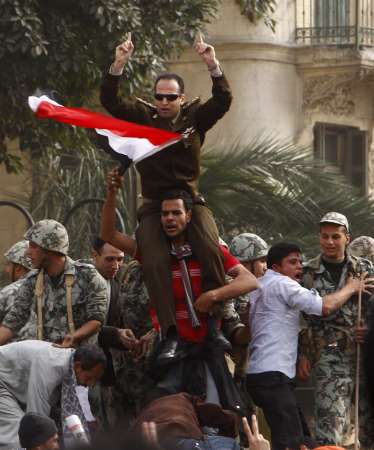
Fuad Ben Eliezer (Labour) does not understand what happened, and on all the radio stations he lays out his embarrassment: What happened to his friend Hosni Mubarak? Why didn’t he order the military to shoot the masses and thus end the “riots”, in his words?
In light of his acquaintance/friendship with the Egyptian dictator, in recent days Ben Eliezer has become a senior analyst on Egyptian affairs, only that this time he admits, in uncharacteristic modesty, that he simply does not understand: a few hundred more dead and everything would return back to normal.
The truth is that not only Ben Eliezer didn’t predict anything and understands nothing: all of the Israeli “analysts for Arab affairs” and “Middle East experts” – all of them graduates of Israel’s military intelligence or the Mosad – are forced to admit their ignorance. Yet again we were surprised, just like every time we are surprised: surprised by the crossing of Suez Canal in 1973, surprised by the Palestinian-Lebanese resistance in 1982, by the steadfastness of the Hizbullah in 2006, from the Hamas victory in the Palestinian elections and so on.
In his words, Ben Eliezer reflects the Israeli media, which immediately chose a side: together with the forces of order, against the popular movement, even if, as in Tunisia, it involves the entire people. The Arab masses are always the enemy and the regimes – partners. The fact that these are authoritarian regimes, murderous and corrupted is perceived not as a downside, but as testimony to their welcome ability to control their populations. In simple words: while the Arab masses are a horde, a flock of inflamed savages, their leaders are guarantors of order, even if at times Israel is forced to go to war against them.
Another surprise, and this time for the political and intellectual elites of the entire world, and not only for Ben Eliezer and “our commentators”: popular masses, from Morocco to Iraq, from France to Bolivia, did not read Fukuyama’s End of History and if they did, they refused to get off the stage of history: when they are stepped on, pushed to starvation or humiliated – sooner or later they rise up and remove the corrupt and arrogant dictators. Although it may be delayed, the revolution will eventually break out. To break out, not necessarily win, and it’s not inconceivable that Mubarak will listen to the advice of the Israeli press and of General Ben Eliezer and order the military to suppress the uprising with blood.
It is already possible to guess the headline of the next stage of the press and expert commentators’ propaganda campaign: Al Qaeda. The dictatorship of Ben Ali and Mubarak is justified as they stop militant Islam and behind the popular demonstrations stands no less than Bin Laden. Zvi Barel (Haaretz, 30 January) is one of the few commentators who refutes the contention concerning the centrality of the Muslim Brotherhood in the Egyptian uprising. He emphasizes that its slogan isn’t Allah Akhbar but “down with the dictator, down with corruption”. Also in Tunisia the Islamic Al Nahda party didn’t play a role in the uprising, if only because it has yet to recover from the cruel oppression of Ben Ali and his gangs.
Neither Al Qaeda nor the Muslim Brotherhood are behind the angry mass in Cairo, Rafah and Suez, but thirty years of authoritarian rule, oppression, poverty. As long as the Israeli commentators and politicians fail to understand this, they will continue to be surprised every time the masses (an “archaic” word long ago erased from their lexicons) take destiny in their own hands.
Translated to English by the Alternative Information Center (AIC).
Golan Heights activist: “We dream of freedom”
By Adri Nieuwhof, The Electronic Intifada, 28 January 2011
Since the Syrian Golan Heights were occupied during the June 1967 War, the indigenous Arab population has resisted Israeli control. The Electronic Intifada contributor Adri Nieuwhof interviews Taiseer Maray, general director of the non-profit organization Golan for Development, about the situation in the occupied Golan Heights.
Adri Nieuwhof: Tell us about the activities of the Golan for Development.
Taiseer Maray: The Golan for Development was established in 1991 in the occupied Golan Heights. We are working on development projects as a method to resist Israel’s occupation and control. We provide basic services in many different projects. We cover most of the health services in all five Arab villages, and we increase awareness of health issues. We offer agricultural outreach services to the farmers. We have a theater project, and in our music center fifty pupils receive music lessons. We run a kindergarten for children, we organize teaching courses and activities for women. We also developed a project on alternative tourism. With our research project we monitor the Israeli settlements in the Golan and relevant issues in our society. We are innovative. For example, we have developed a new technique of growing shitake mushrooms on apple wood. We researched and published information about this.
AN: The media does not cover the situation in the occupied Golan Heights. What can you tell us about it?
TM: In 1967, before the June War, 130,000 Arabs lived in 139 villages and more than sixty farms in the Syrian Golan Heights. After the war, about 60,000 to 90,000 Syrians remained in the Golan. Within two months following the June [1967] war, the Israeli forces transferred the rest of the population. People were pushed out of their houses. Only about 6,300 Syrians remained in five villages, mainly farmers. People were frightened at that time. You don’t hear much about us because of our small numbers. In 1981, Israel annexed the Golan Heights. The people resisted, there were clashes and demonstrations. We were attractive to the press then. Israel tried to force us to take Israeli citizenship. We refused.
In the 1990s, Israel understood that putting pressure on the Arabs in the Golan Heights led to more unity and resistance. Now they want us to assimilate into Israeli society. We don’t face hard Israeli policies like in the 1970s and 1980s. They are trying to destroy our cultural heritage by forcing us to assimilate. The fight is about education, and against the silent attack on our cultural heritage and identity. It makes resistance more difficult. Israel tries to control the brains of the new generation through education. We have to study Hebrew, Zionist history, Jewish history. The culture of Arabs that is taught is in the best case half the truth. In Syria, we have a culture of resisting occupations, by the French, the Ottomans. Our resistance is reflected in our poetry, but the Arab poetry that is taught in school is about love. The Israeli educational curriculum brainwashes the youth.
AN: What are Israel’s motivations for maintaining its occupation of the Golan Heights?
TM: It goes back to the history of the Zionist movement. The Golan Heights has been part of Zionist ambition since its establishment. In the literature you find how the Zionists asked the British to include the Golan Heights in the plans for the new Jewish state. Water is the main reason for Israel to occupy the Golan Heights. The Jordan River springs into the Golan Heights. We in the Golan get about 1,000 mm of rain per year. About 25 percent of the water Israel uses is from the Golan Heights. The biggest water company from Israel, Eden Springs, bottles our water in a factory on our land and exports it worldwide.
Another reason is that we have very fertile land. Since 1967, Israel has used all the potential of the Golan Heights: agriculture, tourism, minerals, grazing land, vineyards. Israeli wine produced from grapes from the vineyards in the Golan Heights is sold in the Netherlands. Flowers grown by Israel in the Golan are exported, also to the Netherlands. There is an Israeli olive oil factory in the Golan. We have lots of Israeli industries on our land.
AN: What does the Israeli occupation look like for the Arabs in the Golan Heights?
TM: In the 43 years of the Israeli occupation we have seen different strategies. The first ten years we were under military rule. Hundreds of people were taken to jail for political resistance in the 1970s and 1980s. You were taken to jail for discussing politics. After the annexation of the Golan Heights in 1981, we resisted and had clashes with the Israeli military forces. They tried to suppress and break us. We resisted and still do not have Israeli citizenship. Israel’s policies change. Now, they opened the gates to work, to assimilate us into Israeli society.
We fight about land and water resources. We fight to cultivate our land, while the settlers have free access to land and free access to water. Arab farmers may only use 150 cubic meters per dunam, which is one thousand square meters. A settler may use 700 cubic meters for one dunam. Water costs us about $1 per cubic meter, settlers pay $0.25 cents. The last four to five years Israel has uprooted more than 10,000 apple trees. Israel claimed it was state land. People went to the land collectively and replanted it with apple trees.
The farmers in the Arab villages in the Golan produce forty percent of the apples and fifty percent of the cherries for the Israeli market. We want to export our produce to the occupied West Bank and Gaza, but we don’t have access to them. We want to export to Europe. Maybe Fair Trade could be an option.
The last four years we could sell about ten percent of our apples to the Syrian market — to Damascus. We negotiated that the apples can pass the demarcation line with Syria. And now Israel tries to use it for political pressure. To use the sale of our apples as an example of normalization. But our apples are a Syrian product, grown by Syrian farmers on our land with our water. The apples are sold to our government in Damascus.
We fight about the education system. We have a big fight about building areas and rights. The municipalities in the Golan Heights are not elected. Israel appoints the mayors. Since 1981 we are forced to pay taxes but we receive nothing in return. We pay more taxes than the settlers. Our population grew from 6,300 in 1967 to 21,000. Israel controls the land near our villages to claim it for future needs of the settlers. We are fed up with it. With a few thousand people we went to the mountain near the village and opened roads. We are going to hand out our land to villagers to build on it.
AN: Do you see similarities between the occupation of the Golan Heights and the occupation of the West Bank and the Gaza Strip?
TM: We are the same people under the same occupation. At present our reality is different. The political prisoners of the Golan Heights spend their time in jail with Palestinians from the West Bank and Gaza. People say the first Palestinian intifada was inspired by the resistance in the Golan Heights. The Palestinians supported our struggle. We had a six-month strike and could not survive without the support of the Palestinians from the West Bank, Gaza and Israel. The first Palestinian intifada was a sort of continuation of what happened in the Golan Heights in the 1980s. We had lots of demonstrations to support the Palestinians. In 2008, during Israel’s invasion of Gaza, we collected food and sent trucks to Gaza. We keep close relations, we have the same struggle against the same aggressor. We have the same policy, the same goals. Israel tries to limit our development.
AN: What is the dream of the Arabs living under occupation in the Golan Heights for the future?
TM: Freedom for all of us. We dream that the Golan Heights will be given back to Syria. That Palestinians should be liberated and have their own state. We dream of the liberation of the Jewish people from the Zionist ideology. We dream of a Middle East where we have equal rights. We are not against Jews. No, we should be equal. I want to see Israel become a free, democratic country with no fascism and racism. This is an important step for our liberation from the Israeli occupation.
Photo by Ayman Abu Jaba/Golan for Development.
Adri Nieuwhof is a consultant and human rights advocate.
The Palestine Papers and Us
By Gilad Atzmon | January 27, 2011
I have a rule — I never intervene in Palestinian political matters. I never comment on Palestinian internal debate. I do not think that I have the right to do so : I am an ex-Israeli and an ex-Jew, and I write about Israel, Jewish Identity politics, and Zionism.
For me, the leaked Palestinian Papers provide us with a valuable glimpse into Israeli politics and Western complicity in the crimes carried out against the Palestinian people. I do realise that most Palestinian commentators agree that the leaked papers have “damaged whatever little credibility the Ramallah-based authority still enjoyed among Palestinians” ; yet, more than anything else, the Papers prove beyond doubt that Israel is not a partner for peace — In spite of the weaknesses that have been shown by the PA since the 1990’s, Israel has failed to secure a peace deal, and has consistently failed to show any will to bring the conflict to an end. In short — Israel has always wanted more.
The Papers have also clearly shown that whilst Israel likes to present an image of ‘political pluralism’ , that is little more than a deception : there is not much difference at all between Tzipi Livni and Avigdor Lieberman. Both are Zionist enthusiasts, and both are interested in a ‘Jews only state’ — Indeed, just like Lieberman Livni too,offered to “transfer Israeli Arabs.”
Yesterday, we learned that as far back as 2004, the British MI6 was assisting the PA in the war against Hamas : according to The Guardian “The Palestinian Authority’s security strategy to crush Hamas and other armed groups on the West Bank was originally drawn up by Britain’s intelligence service, MI6”.
So, at the time that the British Government was supposedly advocating “democracy” in Palestine, the reality was quite different : British ‘James Bonds’ were investing enormous effort in trying to destroy the rising political power in Palestine. One may wonder : what kind of ‘British interests’ was the MI6 serving in doing so ? It is far from being a secret that in 2004 Tony Blair was primarily funded by Labour Friends of Israel ; his NO 1 fund raiser was Lord Levy.
The Palestinian people will liberate themselves eventually — but it is also about time we all liberate ourselves from the grip of Israeli and Jewish lobbies.
Why I will not testify – Maureen Murphy
Ma’an – 25/01/2011
I have been summoned to appear before a federal grand jury in Chicago on Jan. 25. But I will not testify, even at the risk of being put in jail for contempt of court, because I believe that our most fundamental rights as citizens are at stake.
I am one of 23 anti-war, labor and solidarity activists in Chicago and throughout the Midwest who are facing a grand jury as part of an investigation into “material support for foreign terrorist organizations.”
No crime has been identified. No arrests have been made. And when it raided several prominent organizers’ homes and offices on Sept. 24, the FBI acknowledged that there is no immediate threat to the American public. So what is this investigation really about?
The activists who have been ensnared in this fishing net work with different groups to end the US wars and occupations in Iraq and Afghanistan, to end US military aid for Israel’s occupation of Palestinian land and US military aid to Colombia, which has a shocking record of repression and human rights abuses. All of us have publicly and peacefully dedicated our lives to social justice and advocating for more just and less deadly US foreign policy.
I spent a year and a half working for a human rights organization in the occupied West Bank, where I witnessed how Israel established “facts on the ground” at the expense of international law and Palestinian rights. I saw the wall, settlements and checkpoints and the ugly reality of life under Israeli occupation which is bankrolled by the US government on the taxpayer’s dime. Many of us who are facing the grand jury have traveled to the Israeli-occupied West Bank and Colombia to learn about the human rights situation and the impact of US foreign policy in those places so we may educate fellow Americans upon our return and work to build movements to end our government’s harmful intervention abroad.
Travel for such purposes should be protected by the first amendment. But new legislation now allows the US government to consider such travel as probable cause for invasive investigations that disrupt our movements and our lives.
The June 2010 US Supreme Court decision Holder vs. Humanitarian Law Project expanded even further the scope of the Antiterrorism and Effective Death Penalty Act of 1996 to include first amendment activity such as political speech and human rights training.
Even former President Jimmy Carter feels vulnerable under these laws because of his work doing elections training in Lebanon where one of the main political parties, until earlier this month a member of the ruling coalition, is listed as a “foreign terrorist organization” by the US State Dept. “The vague language of the law leaves us wondering if we will be prosecuted for our work to promote peace and freedom,” Carter has said.
Former FBI officer Mike German, who now works with the American Civil Liberties Union, told the television program Democracy Now! that the subpoenas, search warrants and materials seized from activists’ homes make it clear that the government is interested in “address books, computer records, literature and advocacy materials, first amendment sort of materials.” He added, “unfortunately, after 9/11, [investigation standards] have been diluted significantly to where the FBI literally requires no factual predicate to start an investigation.”
The US government doesn’t need to call me before a grand jury to learn my activities and my beliefs. I have often appealed to my elected representatives to take a principled stand on foreign policy issues, protested outside federal buildings and have written countless articles over the years that can be easily found through a Google search.
Witnesses called to testify to a grand jury have no right to have a lawyer in the room and the jury is hand-picked by government prosecutors with no screening for bias. It is the ultimate abuse of power for a citizen to be forced to account to the government for no other reason than her exercise of constitutionally protected freedoms of speech and association.
This is why these grand jury proceedings are a threat to the rights of all Americans, and why those of us who have been targeted, and others in the movements we work with, call them a witch hunt. And, even though it means I risk being jailed for the life of the grand jury, I will not be appearing before it.
The grand jury has been scrapped in virtually all countries and more than half the states in this country. There is a long American history of abusing grand juries to launch inquisitions into domestic political movements, from the pre-Civil War abolitionist movement to labor activists advocating for an eight-hour work day to the anti-war movement during the Vietnam years.
We have done nothing wrong and risk being jailed because we have exercised our rights to free speech, to organize and hold our government accountable. It is a dark day for America when people face jail for exercising the rights that we hold so dear.
The author is a journalist and Palestine solidarity activist who lives in Chicago.
Boycott vote in Sydney suburb sparks media furor, death threats
Sarah Irving, The Electronic Intifada, 24 January 2011

Anne Paq/ActiveStills
On 15 December 2010, the councilors of Marrickville, a suburb of Sydney, Australia voted by a 10-2 majority to support the Palestinian call for boycott, divestment and sanctions (BDS). A month later, they have belatedly become the subjects of vilification in the press owned by international media proprietor Rupert Murdoch and death threats from Australia’s lunatic fringe.
“What does the desert theocracy of Saudi Arabia have in common with Marrickville Council in Sydney’s Inner West?” howls an article in Murdoch’s Telegraph, under a headline comparing the local authority to North Korea. The piece — which manages to be factually inaccurate on subjects as diverse as kosher food laws and Palestine Liberation Organization factions — goes on to hail Israel as “one of the most innovative and entrepreneurial countries in the world. Its products and inventions find their way into computers, mobile phones and medicines.” The online version of the article seeks to demonstrate Israel’s virtues by illustrating it with both a photo gallery of Israeli swimsuit model Bar Refaeli and a video of her writhing in the sand on a photo shoot.
“This is what passes for ‘journalism’ and commentary over Israel/Palestine in Australia,” laments Antony Loewenstein, the Sydney-based author of Australian best-seller My Israel Question and co-founder of Independent Australian Jewish Voices. His blog also points out the inconsistencies and omissions in recent coverage of the incident by The Australian, supposedly a more serious paper than the Telegraph. The Australian quotes Anthony Albanese, a member of the Australian federal parliament whose constituency covers Marrickville council’s turf. Albanese claims that “Foreign policy is a fair way outside the parameters of the role of Marrickville Council” and suggests that the local authority stick to “local” issues.
But Councilor Cathy Peters, who supported the boycott motion at Marrickville, rejects the suggestion that boycotting Israeli products is outside her remit as a council representative. “It’s not a matter of foreign policy at all, but rather the right of a council to make decisions regarding our purchasing policy and the relationships and engagements we have with outside organizations,” she said in an interview with The Electronic Intifada. “It’s completely within our purview to make those decisions. We’ve done it before. We have an ongoing boycott of companies involved in Burma. The council has a long, proud tradition of making ethical decisions.”
Peters also stressed that many Marrickville residents had expressed their concerns about Israeli actions towards the Palestinians to local councilors. Marrickville mayor Fiona Byrne, writing on the Australian Broadcasting Corporation website, also described how “Marrickville Councilors interact with the people we represent on a day to day level. We have spoken with many local residents, with community and multi-faith groups who have told us of their feelings towards the unresolved issue of Palestine and Israel and their desire to be able to take direct action.” The boycott motion has also, she said, been supported by members of Jews Against the Occupation, and she cited the many Australian church and trade union organizations which have supported whole or partial boycotts of Israeli products and organizations.
Anthony Albanese has in the past been supportive of Palestine solidarity campaigns and critical of Israel’s human rights record, so his stance has surprised some local people. Jennifer Killen, a Marrickville resident who strongly supports the council’s twinning with Bethlehem and its boycott initiative, commented to The Electronic Intifada: “I’m very disappointed in my local member of parliament for not being more supportive of our hard-working local councilors at this time.” Killen also pointed out that the contact details of the councilors who voted for the boycott motion are on the website of the Sydney-based Coalition for Justice & Peace in Palestine, and called on international activists to support Marrickville where its MPs had failed to do so.
Councilor Cathy Peters, a Green Party member, emphasized that the boycott motion at Marrickville had cross-party support and that the former mayor of Marrickville, who visited its sister city of Bethlehem in 2010, was a member of the Australian Labor Party. But Antony Loewenstein and other Sydney commentators have suggested that the realpolitik of upcoming elections could be behind Albanese’s condemnation of the boycott vote. The Australian’s article mentions the risks to Albanese’s seat from the Green Party.
But it failed to highlight the fact that Carmel Tebbutt, the New South Wales state legislature member for Marrickville who is quoted in the same article, is also Albanese’s wife — and that her seat is under threat from Marrickville Green Mayor Fiona Byrne in upcoming state-level elections. The New South Wales Green Party adopted a strong boycott, divestment and sanctions position in December 2010 and Albanese’s attacks on the boycott motion could, Sydney commentators suggest, be an attempt to put some political space between himself and his spouse, and their Green challengers.
Outside the mainstream media, Australia’s nastier extremists have also waded in on the Marrickville debate. An article on the Australian Islamist Monitor website entitled “Australian Council Disgraces Itself” berates the local authority, saying that “you have got it all wrong — you have sided with the aggressors, the bullies, the friends of Hitler and those whom Hitler considered his friends in their antisemitism [sic].” The writer goes on to claim that “Israel is a tiny land surrounded by aggressive Muslim nations and as David Horowitz has pointed out repeatedly, the aim of those nations is to deny Israel the right to exist.” David Horowitz, cited by the Australian Islamist Monitor author, is an American commentator and founder of the Freedom Center who claims that “free societies” are “under attack by leftist and Islamist enemies at home and abroad.” As well as attacking Arab and left-wing campaigners, he has also been accused of racism against African Americans.
And one comment following the article reads: “This is insane I hate these people. I would like to have a 22 and pick them off one by one for target practice. Better still a suicide bomber in their midst. In fact I might make a giant blow up of the photo and sell it to a shooting range.” A “smiley” emoticon follows the comment. Immediately after it, the same commenter, “Skipping Girl,” adds: “God Bless Israel.”
Despite its claims to be “anti-racist in all its forms” and to support freedom of speech when this does not lead to violence, the Australian Islamist Monitor site is rife with hysterical and sometimes violent comments about Muslim people. A number of its contributors have links to more extreme hate sites and have made openly racist comments in other forums. The website’s membership is strictly controlled, with potential members approved by a human moderator as well as by electronic tests. However, in more than three weeks it has made no move to remove Skipping Girl’s bloodthirsty comments.
Cathy Peters says that she has been made aware that some threatening comments have been made regarding Marrickville councilors, but that the matter has been turned over to the council’s general manager for consideration. For her, the larger concern is how the issue of Palestine is debated in Australia.
“I think it’s unfortunate that these kind of emotional comments have been triggered by an overall reluctance by the Board of Deputies and other groups to tolerate debate and criticism of Israeli policies regarding Palestine and the occupied territories,” she says, rejecting charges that Marrickville’s councilors have been influenced by “political correctness” or ideology. Her fellow members, she points out, include some “very experienced” local councilors with diverse backgrounds and political opinions.
“The problem at the moment is one of groups trying to close down dialogue on the subject,” Peters insists. “What is really needed at the moment is a mature, calm debate on Israel’s policies on Palestine and how Australians should respond to them.”
Sarah Irving is a freelance writer. She worked with the International Solidarity Movement in the occupied West Bank in 2001-02 and with Olive Co-op, promoting fair trade Palestinian products and solidarity visits, in 2004-06. She now writes full-time on a range of issues, including Palestine. Her first book, Gaza: Beneath the Bombs, co-authored with Sharyn Lock, was published in January 2010. She is currently working on a new edition of the Bradt Guide to Palestine and a biography of Leila Khaled.
Settlers Attack Internationals Escorting Palestinians in South Hebron Hills
By Ramona M. – IMEMC & Agencies – January 24, 2011
On Sunday, settlers assaulted internationals while they were escorting Palestinians to their pasture to graze their herds in Um al Hir , in South Hebron Hills.
Settlers threw stones and succeeded in hitting the international activists. Only the international escorts were targeted, who were specifically requested to be there due to recent tensions in the area.
One international had a stills camera stolen from him, however managed to hold on to his video camera and was able to film the event. When this international activist went to the police to file a report, the police told him that if he erased all his footage on the video camera, he would return the other camera to him.
After the incident, the army arrived and protected the Palestinian residents from settler disturbances, harassment and attacks. The grazing was completed with army protection.
Um al Hir is a Beduoin village close to Susya which has been suffering by the encroaching settlement of Carmel, which was first established in 1981 on their land and has since been closing in on them. The village was recently in Israeli news due to the army’s decision to issue a demolition order on the village’s “Taboon,” an outdoor stove used for baking bread. Apparently the stove was built without permit, and it must be destroyed.
Last Friday, settlers went to the pastures of Um al Hir to plant trees in honor of the Tu B’svhat holiday, which marks the beginning of the tree-planting season. They were escorted by large amounts of army protection.
Israeli war crime confessions to debut in bookstores this month
Palestine Information Center – 22/01/2011

OCCUPIED JERUSALEM — An Israeli organization has compiled many statements by Israeli soldiers confessing to war crimes against unarmed Palestinians in a book that will be released soon and sold in Europe.
The NGO Breaking the Silence will release this month details of torture and murder incidents committed by 180 soldiers from 2000 to 2009.
Testimonies, tapes and images have already been in circulation, but the soldiers who testified will for the first time ever reveal their identities and faces.
Breaking the Silence founder Yehuda Shaul, who is an ex-soldier, said he aimed to launch debate in Israel about the country’s army.
“[The Israeli army] is corrupting the youth,” Shaul said.
The book, containing first time ever released details, is expected to spark controversy in Israel and the world over.
Breaking the Silence has a membership of 700 former soldiers and activists.
Update: a nearly final electronic version can be found online.
Featured Video

or go to
Aletho News Archives – Video-Images
New Documentary
“Inside Gaza” wins best documentary at Montreal’s Cinemania film festival
Palestine Information Center – November 16, 2026
MONTREAL – The documentary “Inside Gaza,” which chronicles the experiences of Palestinian journalists working with Agence France-Presse (AFP) while covering the Israeli war on the Gaza Strip, won the Best Documentary Award at the 32nd Cinemania International Francophone Film Festival held in Montreal, Canada.
Directed by Helene Lam Trong, the 72-minute film follows the daily lives of four AFP journalists who bear witness to the difficulties of reporting in a war-torn territory largely closed off to international media.
The film is compiled from material produced by the team on the ground, as well as from interviews conducted after they left.
The film also won the People’s Choice Award at the festival on Saturday. … continue
Blog Roll
 Aletho News
- Brand ‘rape’ case just doesn’t add up. Was he framed?
- How The Jensen Huang Chinese Spy Hoax Is Russiagate 2.0
- Austria seeks to strip former foreign minister of citizenship over Russia ties
- “Inside Gaza” wins best documentary at Montreal’s Cinemania film festival
- Activists block German munitions plant over arms exports to ‘Israel’
- The Nasser Hospital attack and Israel’s relentless lies
- Could it be satan? No, Huckabee, just the Americans you work for
- AIPAC and more: Network of pro-Israel influence in US Congress
- Putin aide reveals Moscow’s stance on Europe at peace talks
- Imran Khan warns Pakistani judges he may die in prison
- If Americans Knew
- An error has occurred; the feed is probably down. Try again later.
- No Tricks Zone
- Argentina’s Perito Moreno Glacier Joins Antarctica and Arctic In Defying Doomsday Melt Claims
- New Study: Barents Sea Temperatures Were Warmer And Sea Ice Less Extensive In The 1700s Than Today
- German Authorities Start Initiative To Evaluate Public Register For Climate “Disinformation” Spreaders!
- Zonal Asymmetry of Temperature Change in the Antarctic Circumpolar Current
- New Study: The Net Fossil Fuel Contribution To Rising Atmospheric CO2 Has Been Zero For 500 Years
- Germany’s Green Energy Transition Becoming Increasingly Expensive…Another 6 Trillion Euros!
- Sudden Stratospheric Warming, Powerful El Niño Combination May Lead To Extreme Europe Cold, Energy Crisis!
- Two New Studies Find Thwaites Glacier Melt Cannot Be Driven By Human Activity Or A Warming Ocean
- E-Cars Reduce CO2 Emissions By Only 41% Compared To Internal Combustion Engine Vehicles
- Predictions Made By Renowned Climate Professor Over Past Decades Have Been Proven To Be Poor

