Hollywood, Israel and the Pursuit of Normalcy
By Basil Abdelkarim | Palestine Chronicle | January 17, 2011
While flipping through channels on television last week, I ran across an episode of Friends, the long running hit NBC sitcom (1994-2004), which grabbed my attention. In this episode from 2004, paleontologist and professor Ross Geller proudly announces to his circle of attractive young friends that he has just earned tenure at a New York university. This glorious occasion prompts the young dinosaur expert to break out a bottle of Israeli champagne in celebration. There are actually two references to Israeli champagne (‘Israel’s finest’) in this episode, and these moments are played ostensibly for laughs. (Israel? Champagne? Whoda thunk it?)
Nevertheless, Friends made me wonder. In recent years, I’ve noticed a trend among popular television programs and motion pictures to include bizarre, seemingly random references to Israel. The references are on the surface apolitical – they do not precede a discussion of the conflicts in the Middle East, nor do they offer an overt opinion on the Palestine/Israel crisis. They’re usually brief (perhaps a single exchange), and they add nothing to the underlying story. They stand alone, frequently as the punch line to a joke. But does anyone believe that the television and motion picture industries want us to laugh at Israel? Is that really all that’s going on here?
References to Israel in Hollywood, like references to Palestine or the Arab world, always demand close scrutiny, particularly given the entertainment industry’s shameful penchant for Arab/Muslim vilification and glorification of all things Israel, to say nothing of the fervent public devotion towards Israel shared by countless Hollywood luminaries. What this means is that in Hollywood, there’s really no such a thing as an “innocent” television or movie reference to Israel, no matter how tiny or inconsequential, for Israel is not like other nations. Even a fleeting mention of Israeli champagne, or a humorous reference to the Mossad (another television favorite), warrants further analysis.
So when a character on the hit ABC sitcom According to Jim (2001-2009) reminds Jim that he once planted a tree in Israel in his honor (neither of these characters are Jewish or particularly religious, by the way), there’s nothing innocuous about this fictitious gifting of a tree. Certainly not in an era when Israeli bulldozers routinely uproot ancient Palestinian olive groves and successive Israeli governments devote their collective energies to obliterating centuries of Arab history in the Holy Land.
Which brings us to this central question: what is the point of all of these (on the surface) non-political references to Israel on television and the big screen, in stories which have nothing to do with Israel or Israelis? Are they part of a wide-ranging propaganda campaign? Do they serve a different agenda from that of the more familiar, pervasive Hollywood depictions of Heroic Israel/Israelis or Victim Israel? Or are these merely two sides to the same coin?
To understand one possible explanation for this trend, it bears mentioning that we’re dealing with a more nuanced narrative than the traditional depiction of gallant little Israel. For the “Old” Israel, just think of the 1960 movie Exodus – attractive, noble proto-Israelis triumph against all odds while battling British colonial overlords and Arab primitives. The original, cartoonish version of Israel always implied conflict, for it centers upon the myth of Israel under siege. This is Jewish David confronting the menace of the Arab/Muslim Goliath. Let’s call this the “Neocon” Israel for reasons that will be made apparent shortly. And while still ubiquitous in far-Right circles, (mostly among neoconservatives and the crowd itching for the Apocalypse), this version of Israel has taken a severe pummeling in recent years. A succession of bloody incursions (Gaza, Lebanon), the inhumane siege of Gaza, the escalation of illegal settlements on occupied land, construction of the apartheid wall, and most recently, the brutal suppression of the Gaza aid flotilla – all have chipped away at this myth of Israel as the besieged yet noble “Light unto the nations”.
No, what we’re dealing with in Friends and According to Jim is a softer vision of Israel, but more importantly, an Israel that is neither defined by nor judged on the basis of its treatment of its Palestinian subjects. This is the non-controversial version of Israel, or “Non-Con” Israel, an Israel which exports bad champagne, co-opts environmentalist sentiment (planting trees), and offers up hot young female ex-soldiers as mysterious sex symbols (as in the recent Steve Carell/ Tina Fey comedy Date Night). As for Palestine and the Palestinians – well, they’re not even an afterthought.
I’ve always believed that what apologists for Israeli misdeeds crave the most (after vindication, of course) is normalcy. Normalcy in this context is not a comprehensive peace agreement that restores the basic human rights of native Palestinians while guaranteeing the security of all the peoples of the region. Normalcy, rather, is that elusive state of affairs where all the turmoil and embarrassing headlines (and by extension, the Palestinians themselves) have simply evaporated, magically cleansed from our collective consciousness. Normalcy means an uncontroversial, run-of- the-mill Israel disconnected from Palestinians with a reputation as benign as, say, that of Norway.
Ideally, the Israel PR movement wants us to think of Israel as we might think of Italy or Greece – an ancient land steeped in history and overflowing with a wealth of natural beauty, archeological treasures, and contemporary luxuries alike, a modern marvel whose charming population stands ready to greet visitors with a smile. “Come to Israel, come stay with friends,” declared the comical old Israeli tourism campaign from some years back. Just don’t bring any Arab friends. But if you enjoy sunbathing in the south of France, why not catch some rays on the beaches of Tel Aviv? And why not drink some Israeli bubbly?
Yes, this is a softer, less confrontational Israel, yet this version remains a myth, for it requires a suspension of disbelief. This Non-Con version of Israel is more insidious and in its own way even more damaging than the Neocon Israel, for it ignores Palestinians altogether. Decades of conflict, the deliberate dispossession of an entire people, the ongoing, brutal occupation and siege, institutionalized racism within Israel itself – all are swept under the rug in favor of a sanitized vision of normalcy that lacks any context whatsoever.
Fortunately, not everyone has bought into this charade. No, Israel is not Norway, nor are Israel’s policies normal. That’s why the Israel divestment campaign and the international movement advocating a cultural and academic boycott of Israel continue to gather steam. It’s the same reason that diverse artists, from Carlos Santana to Elvis Costello, have cancelled Israeli concert appearances in recent years. Here in America, people from all walks of life (including courageous young American Jews) are slowly waking up to the realization that an Israel that practices apartheid policies cannot be like other nations.
If one cares about the world, wishing for normalcy should never serve as a substitute for working for justice or promoting basic human dignity. Here’s hoping that future television and motion picture writers remember this lesson. In the meantime, I’d suggest planting a tree in Palestine as a gift to a friend.
As for Israeli champagne, I don’t drink, but for those who do, my advice is simple:
Just say no.
Watch the Watchers
Hallmarks of Spook Behavior
By JENNIFER VAN BERGEN | CounterPunch | January 14, 2011
This was not the first time I was approached by a spook, or the first time I have pegged one in my midst, but it was the first time I was approached by a man claiming to be an Iraqi-American. In the rush that usually occurs after one speaks publicly with several people waiting to chat, I tried to listen politely as I offered Nabil my attention. After five minutes, though, I found myself feeling bad for getting a little annoyed at him. He carried on about loving America and loving Iraq and seemed to be trying to hint at something beyond this — making vague references to what the U.S. was doing to Iraq. Finally I said to him, “Why are you telling me this?” After all, I speak publicly about these things, why did he feel he needed to tell me what I was already speaking about?
Unfortunately, I rarely recall specifics of what people say to me after I make a speech – or perhaps Nabil was being purposefully vague, because it seemed to me that he really wasn’t saying anything. Yet, he wouldn’t let me go. I told him several times that I needed to leave, as I had a long drive ahead of me. Several other people wanted to speak to me, yet Nabil continued to follow me around and try to talk to me — about what, I could not discern. Finally, I said that if things continued as they were in this country, it would eventually collapse. This seemed to deeply satisfy him. He said that people here didn’t care what happened in Iraq. They would care only if it happened to them.
I left him then and only the next morning did it occur to me that what Nabil was trying to do was to goad me into making a declaration of some unlawful or violent intent. That was when it occurred to me that Nabil was a spook: a paid informant or an undercover operative.
My first thought was that the FBI must not keep very good records or train their operatives very well because they had sent numerous others on the same or similar missions. They had to know that I am a staunch believer in nonviolence and in the rule of law — not to mention the United States Constitution. Anyone reading my multitude of articles must know this.
But more importantly, Nabil’s activities reveal a government policy that post-9/11 activists have long suspected exists: the FBI is not only monitoring peace activists but is working to entrap such people. Several recent cases offer further proof of this conclusion: the outing of paid FBI informant, “Anna,” in the West Coast “Green Scare” cases and the arrests of the Miami “Liberty City Seven” on the basis of an affidavit by an FBI operative.
In both of these cases, the FBI clearly did more than infiltrate and monitor groups that they believed might pose a threat to national security. In each case, the FBI goaded, provoked, provided funding and materials, and in the Liberty Seven case, even demanded the individuals sign a loyalty oath to al-Qaeda. In fact, so desperate was the FBI to capture the Miami miscreants that arrests were made despite the fact that the seven had all already walked away from the alleged conspiracy, which makes the case almost a sure loser for the government.
The FBI has monitored me at least since I first spoke out (post-9/11) at a town meeting in front of a panel of Muslim community members and overt FBI agents. A few weeks after this, a markedly taciturn and unfriendly man showed up at a Unitarian Universalist church meeting at which I was asked to speak about the PATRIOT Act. This was a congregation of mostly senior citizens who all knew each other, yet nobody knew the man, who avoided looking at or speaking to anyone, but sat and listened intently to my every word – leaning forward in his chair, all his antennae up — and then rapidly disappeared thereafter.
Spooks have infiltrated groups I’ve chaired. One handsome man of uncertain ethnic origins showed up at a start-up meeting for the Bill of Rights Defense Coalition in South Florida. I was facilitating the meeting and caught this young man staring at me in rapt fascination more than once. Why would he be so interested in me? My youthful beauty? Sorry. My charming and electric personality? Right.
Well, when he saw me see him looking at me, he stopped his appreciative stares. Although he said he was from Pittsburgh, another member of the group who hailed from there found he knew nothing about the city. He never returned to our group. But he did start showing up at another group allied with ours and he continued to monitor that group for quite a while, until he showed up in new all-black duds (imitating the Black Block anarchists, we supposed) at the 2003 FTAA protests in Miami and thereafter was never seen again.
These are hallmarks of spook behavior. Mark them.
Another young man joined the volunteers for a large Forum on Dissent Since 9/11 we had planned. He professed no interest in politics, was completely ignorant of most of the issues which concerned us, and disappeared shortly before the event, claiming he had decided to relocate and start a new life. Meantime, he had access to lists of speakers and volunteers.
Both of these men had never been seen before and were never seen thereafter.
You know what my reaction to all this is? I wonder why my government is spending my tax dollars to monitor me, an upright, loyal citizen who believes more deeply in the Constitution and laws of this country than do most U.S. officials sworn to uphold them. I was a patriot before it was popular to say so. I will defend free speech more strongly and at greater personal risk than most members of the ACLU (and I have proof of that). (I actually take the time to answer hate mail!)
If there really are so many horrible, dangerous terrorists out to get us, why, then, is the FBI wasting time and resources trying to provoke me into making some unlawful statement? Why are our intelligence agencies infiltrating meetings of peace groups, like the one in Lake Worth, Florida that NBC News discovered was attended by the DOD?
I attended that meeting and was one of its organizers and presenters. The subject was counter-recruitment. Is that a national security threat? Am I? The only threat I or these other peaceful persons could possibly pose would be to government officials themselves engaged in violent or unlawful activities, in lying to the public, in engaging in wars of aggression, in unlawfully detaining and torturing people, many of whom have been shown to be completely innocent, and in evading and intentionally violating federal laws. Why is the FBI not banging on their doors? Why is not the DOJ bringing charges against them?
This piece was originally published in the 9/21/2006 print edition of CounterPunch.
Jennifer Van Bergen, J.D., M.S.I.E., is the founder of the 12th Generation Institute, and author of THE TWILIGHT OF DEMOCRACY: THE BUSH PLAN FOR AMERICA (Common Courage Press, 2004) and Archetypes for Writers: Using the Power of Your Subconscious (Michael Weise Productions, 2007). She is currently working under contract with Bucknell University Press on a biography of Leonora Sansay, an early American novelist who was involved in the Aaron Burr Conspiracy, and on a screenplay about the conspiracy. She can be reached at jennifer.vanbergen@gmail.com.
European diplomats recommend punitive action against Israel
Palestine Information Center – 11/01/2011
OCCUPIED JERUSALEM — European diplomats in Jerusalem have filed a report recommending that the EU take punitive measures against Israel and recognize east Jerusalem as a capital for the Palestinians.
The diplomats, mostly general consuls to Jerusalem, after assessing the situation in the eastern part of the holy city called developments in the last few years “negative” in light of continued Jewish settlement activity, Palestinian home demolitions and evictions, and inequality in educational and medical services provided to the Palestinian makeup of the city.
The document says that the government’s cooperation with such groups as the Elad settlement association in archaeological excavations in the Silwan district is conclusive evidence that Israel is backing settlement activity in east Jerusalem.
The European diplomats recommended that EU politicians boycott Israeli ministries beyond the Green Line and products from east Jerusalem and other settlements as well as blacklist “violent settlers” in European countries.
In a similar development, the EU consuls are proposing that international observers be assigned to monitor Israeli demolition operations targeting Palestinian-owned structures in east Jerusalem.
High-profile Israeli politicians have stated that Israel will not allow European observers to monitor demolitions in east Jerusalem.
The move came in the wake of the demolition of the Palestinian-owned Shepherd Hotel in Sheikh Jarrah.
After Israel conquered and annexed East Jerusalem in 1967, a government agency, the Custodian of Absentee Property, took possession of the building. In the mid-1980s, it was sold to a corporation owned by American millionaire Irving Moskowitz, the financial angel of far-right Israeli groups intent on settling Jews in Palestinian neighborhoods inside and encircling the Old City.
US activists facing grand jury garner broad support
Report, The Electronic Intifada, 7 January 2011
Activists and concerned citizens around the United States are preparing for a national day of action on 25 January, the date that several Palestine solidarity activists and Palestinian American community organizers have been summoned to appear before a federal grand jury in Chicago. Meanwhile, dozens of civic, labor and student organizations in the United States and around the world have condemned the crackdown by US authorities on anti-war activists.
The activists have been subpoenaed by the Federal Bureau of Investigation (FBI) as part of what the US government calls an investigation into “material support” for groups the US State Department has unilaterally declared “foreign terrorist organizations.” On 24 September 2010 more than seventy federal agents in a coordinated early-morning raid burst into the homes and offices of prominent anti-war, labor and international solidarity activists in Chicago and Minneapolis.
Until now, a total of 23 activists have been subpoenaed to appear before the grand jury. No one has been arrested or charged with any crime, nor has the government specified any alleged crimes that it might be investigating.
A grand jury, no longer in use anywhere outside the US, is an investigative tool that allows the government to compel citizens to testify even if they are not suspected of any crime. The US government has historically abused the grand jury to intern slavery abolitionists during the pre-Civil War era, African American community leaders during the Reconstruction period, labor activists organizing for an eight-hour work day, civil rights organizers and in recent decades, Puerto Rico independence advocates.
One of the nine activists summoned to the grand jury on 25 January is Maureen Clare Murphy, an organizer with the Palestine Solidarity Group-Chicago and Managing Editor of The Electronic Intifada.
In a 22 December 2010 editorial, The Electronic Intifada stated that “Although The Electronic Intifada itself has not been a target of any of the subpoenas — contrary to some media reports — we consider the grand jury investigation and all of the subpoenas to be part of a broad attack on the anti-war and Palestine solidarity movements and a threat to all of our rights.”
At a 23 December press conference outside the Dirksen Federal Building in downtown Chicago, where the grand jury convenes, Murphy told reporters and supporters that she does not intend to participate in what activists are describing as a “fishing expedition.” So far none of the activists previously summoned have consented to testify before the grand jury, though they risk being jailed for contempt of court for exercising their right against self-criminalization guaranteed by the Fifth Amendment to the US Constitution.
“It is very clear that no crime has been committed and that the government’s motivation in issuing these subpoenas is to have us name the names of other activists not only here in the United States, but also in places like Palestine and Colombia, where many of us have traveled to learn about the human rights situations in those places,” Murphy said.
“We can only assume that the US government shares intelligence with the governments of Israel and Colombia, whose repressive military rule the US bankrolls at the US taxpayer’s expense. And it is essentially a prison sentence or worse for human rights activists in Palestine and Colombia to be singled out and identified in this way. And I have no intention in playing any role in that,” she added (Murphy’s full statement is published on the Mondoweiss website).
FBI agents in Chicago also telephoned Sarah Smith to question her about a trip she made last summer to the occupied West Bank. In a statement read by her father at a 6 December 2010 press conference in Chicago, Smith, a young Jewish woman, stated: “I went with two Palestinian-American friends. You would think Jews and Palestinians going together to visit Israel [and the occupied West Bank] is something the US government would encourage. Instead, all three of us are now being ordered by the FBI to go before a grand jury for going on that trip.”
“Top US government leaders meet with Palestinian leaders, so why does the FBI investigate us because we talked to average Palestinians on the street? I went there so I could make up my own mind and talk about what I saw. It seems to me our government wants to hide what Israel is doing to Palestinians,” Smith added (Smith’s full statement is available on the Committee to Stop FBI Repression website).
An attack on the Palestine support movement
Many of the others subpoenaed in Chicago during the past few weeks are Palestinian Americans who have organized within their community — Chicago is home to one of the largest Palestinian populations outside of the Middle East — and have played a role in the Palestine solidarity movement in the US.
In response to the government’s repression of activists, the United States Palestinian Community Network stated: “Federal harassment of our communities and associational life has grown precipitously during the last decade, as Arabs, Muslims and their allies continue to be persecuted for their lawful and necessary civic engagement. This suppression of civil rights and free speech seeks to criminalize and quell civic activism undertaken in support of Palestinian and other oppressed peoples’ struggles against US-funded occupation and war. This harassment must stop.”
The Electronic Intifada reported in November that the investigation targeting the subpoenaed activists is just the latest chapter in a long history of US government attempts to criminalize Palestine community organizing and support work in the country. In December 2001, it shut down the largest Muslim charity in the US, the Holy Land Foundation, which sent direct humanitarian aid to Palestinians living under Israeli military occupation, amongst other places. Five defendants prosecuted by the government in relation to the case are serving out lengthy prison sentences of 15 to 65 years (for more information, see the Holy Land Foundation case website).
Other prominent Palestinian community organizers in the US who have been put on trial in recent years because of their work educating Americans about the impact of US military aid to Israel and raising funds for humanitarian assistance for Palestinians living under occupation are Dr. Sami al-Arian, Muhammad Salah and Dr. Abdelhaleem Ashqar. All three were acquitted by juries of US citizens of all terrorism and racketeering-related charges but have been charged with or convicted of obstruction of justice and contempt of court for refusing to name the names of other Palestinian activists in the US and in the occupied West Bank and Gaza Strip.
Defending rights, defending movements
As the repression of the Palestinian American community and the Palestine solidarity movement grows ever broader, so does the movement that has rallied around the targeted activists.
Trade unions representing more than half a million workers in the US have passed resolutions condemning the invasive investigation. On 5 January the Chicago Teachers Union — with more than 30,000 members — resolved to condemn the raids and grand jury investigation and to bring the resolution forward to the Illinois Federation of Teachers (the resolution is available on the Committee to Stop FBI Repression website).
Solidarity groups in Palestine and the US have also spoken out in defense of the 23 activists and the wider solidarity movement, including the occupied West Bank-based Palestine Solidarity Project, American Muslims for Palestine, the US Campaign for the Academic and Cultural Boycott of Israel, the International Jewish Anti-Zionist Network, the Minnesota Break the Bonds Campaign and Al-Shabaka, the Palestinian Policy Network (solidarity statements are being indexed by the Committee to Stop FBI Repression).
Student groups representing more than fifty US campuses also issued a statement calling upon US Attorney General Eric Holder and US Attorney for the Northern District of Illinois Patrick Fitzgerald “to respect the civil rights and free speech of all those who support the Palestinian struggle for freedom by immediately withdrawing grand jury subpoenas which threaten the First Amendment rights of students and activists around the country.”
The student activists added “Today, America unfortunately stands behind Israel’s oppression of the Palestinian people with money, weaponry and diplomatic support. We seek to reverse this situation so that American foreign policy stands on the side of people who work towards justice. We reject the government’s efforts to isolate the Palestinian people by severing them from their nonviolent supporters abroad.”
Three subpoenas reactivated
As more and more activists receive summons to appear before a grand jury, attorneys have said that three of the 14 activists subpoenaed on and around 24 September will have their subpoenas reactivated by the US attorney. The other activists targeted whose court dates have passed have been essentially put on hold by the US government.
Once they receive a court date, the three activists whose subpoenas are being reactivated — Tracy Molm, Anh Pham and Sarah Martin — are anticipated to be given the choice of testifying about the activity of other activists in the US as well as abroad, or immediate detention for contempt of court (profiles of Molm, Pham and Martin are available on the Committee to Stop FBI Repression website).
In its call to action, the Committee to Stop FBI Repression, which formed around the 24 September 2010 raids and the grand jury investigation, is calling supporters to stand with the three women as well as the nine activists most recently subpoenaed on 25 January “by protesting Patrick Fitzgerald and his use of the grand jury and FBI to repress anti-war and international solidarity activists” (“Join the National Day of Action on Tuesday January 25, 2011“).
Related Links
Security firm G4S confirms involvement in Israel’s occupation
Adri Nieuwhof, The Electronic Intifada, 7 January 2011
The Danish-British security firm G4S recently confirmed in a letter its involvement in the Israeli occupation and violations of international law — reported on last month by The Electronic Intifada.
After the publication of The Electronic Intifada’s report on 15 December 2010, the Business & Human Rights Resource Centre asked G4S to respond to the investigation as well as a 28 November 2010 article published by Press TV (“‘Firm sold torture instruments‘”).
Within a week G4S replied, confirming that it had withdrawn from contracts providing security officers to residential settlements in the West Bank in 2002. “However, we continue to serve major commercial customers, for instance supermarket chains, whose operations include the West Bank,” the company stated (the letter can be downloaded from the Business & Human Rights Resource Centre’s website).
G4S claims in its letter that the commercial clients in illegal Israeli settlements in the occupied West Bank serve the general public. The company wrote that contracts include the provision of security officers to protect the premises of “commercial clients who serve the general public” in the occupied West Bank. However, G4S fails to address that Israeli settlements serve an exclusively Jewish population and are built illegally on occupied Palestinian land.
By providing security services to illegal settlement businesses, G4S facilitates Israel’s violations of international law. In 2004, the International Court of Justice (ICJ) reaffirmed the illegality of the construction of the wall and settlement colonies in the occupied West Bank, including East Jerusalem. According to the ICJ, construction activities should stop immediately and the wall and settlements be dismantled.
G4S tries to downplay its involvement by stating that the number of security officers deployed in the West Bank is “generally less than twenty and currently stands at eight.” However, violation of international law remains a violation, no matter the size.
G4S further attempts to evade responsibility by stating that it does “not carry out police or military-style patrols anywhere in the West Bank.” The company provides security officers to protect police facilities “from time to time,” but they do not perform any kind of law enforcement or public security role, the company stated. G4S also confirmed it provided security equipment, including X-ray machines and body scanners, with associated maintenance services, to the Israeli police, prison service and Ministry of Defense. In its letter the company adds, “We do not control, nor are we necessarily aware, where this equipment is deployed as it may be moved around the country.”
The feigned ignorance about where the equipment is deployed is contrary to the detailed information mentioned in a G4S promotional brochure it distributed this summer.
In the brochure, published by the Danish watchdog DanWatch, G4S describes the supply of a perimeter defense system for the walls around the Ofer prison compound and the installation of a central command room to monitor the entire Ofer compound. In addition, the company writes it also provided all the security systems in Ketziot prison and a central command room in Megiddo prison (G4S delivers technology to Israeli prisons,” DanWatch, 21 November 2010).
G4S boasts that the three prisons can detain 2,700-3,700 “security” prisoners — the majority of whom are Palestinians from the occupied West Bank and Gaza Strip illegally transferred to detention centers within Israel’s internationally-recognized boundary. International humanitarian law forbids an occupying power from transferring prisoners outside of the occupied territory and the conditions in Israeli prisons do not meet international legal standards. Accordingly, G4S’s involvement in the Israel Prison Service apparatus abets violations of international law.
G4S’s promotional material contradicts its claim that it does not know where its X-ray machines and body scanners are used. Who Profits? — a project of the Israeli Coalition of Women for Peace — has also documented that G4S luggage scanning equipment and full body scanners are used at checkpoints in the occupied West Bank towns of Qalandiya, Bethlehem and Irtah. G4S also provided full body scanners to the Erez checkpoint at Gaza. Who Profits? told The Electronic Intifada that this information is published in G4S’s own website and brochures.
The ICJ affirmed in 2004 that Israel’s wall and checkpoint regime in the West Bank impede Palestinians of “the right to work, to health, to education and to an adequate standard of living” and are contrary to international law.
G4S also revealed in its letter to the Business & Human Rights Resource Centre that it sells security equipment “with associated maintenance services.” In order to provide maintenance service, G4S presumably must know where the equipment is deployed. By providing maintenance service for years after the installment of the security equipment, G4S continues to facilitate Israel’s violations of international law.
Meanwhile, new research by Who Profits? shows that in 2009 G4S won a tender for providing central control rooms to all the prisons and detention facilities of the Israeli Prison Authority (“G4S Technologies will provide security systems for the prisons and the detention facilities of the Israeli Prison Authority,” G4S website). Therefore, G4S security equipment is deployed in every Israeli prison and detention facility.
G4S’s response to the revelations of its involvement in human rights violations shows the company is not heeding the responsibilities that come with its endorsement of the principles of the UN Global Compact. According to the first two principles of the compact — is a strategic policy initiative launched in 2000 for businesses that are committed to sustainability and responsible business practices — G4S should support and respect the protection of international human rights within its spheres of influence and make sure it is not complicit in human rights abuses.
G4S can expect to come under pressure from the growing boycott, divestment and sanctions movement until it untangles itself from Israel’s brutal occupation.
Adri Nieuwhof is a consultant and human rights advocate.
US-led forces kill 5 Afghan civilians
Press TV – January 6, 2011
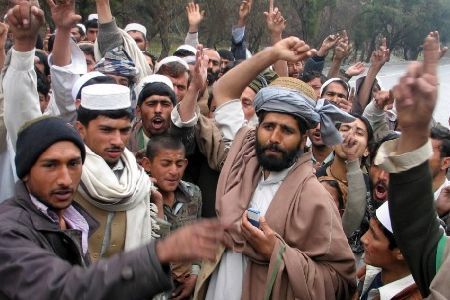
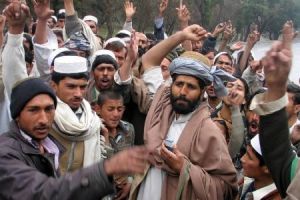 File photo of protesting Afghans
US-led foreign troops in Afghanistan have killed five Afghan civilians in the war-ravaged country, further intensifying security risks to the civilian population in the country.
Hundreds of people in central Afghanistan took to the streets on Thursday to protest the latest killing of the three Afghan civilians by the US-led forces in Ghazni, a Press TV correspondent reported.
The protesters said three Afghan civilians, including a student, were killed in an overnight raid in a remote village in Ghazni on Wednesday.
Carrying a copy of the Holy Quran with five bullet holes in it, the angry Afghans said the US-led troops desecrated the Holy Quran during the raid.
Earlier on Wednesday, two Afghan farmers were also reported killed in the town of Band-e-Chak in Wardak province.
Civilian deaths in US-led night raids have sparked several street protests in Afghanistan.
Earlier on Tuesday, Ghazni residents held a demonstration to protest what they called uncoordinated operations by US-led foreign forces stationed in Afghanistan.
NATO has claimed that the attack was aimed at a suspicious militant base, but Afghan police say no militants were in the area.
Thousands of civilians have lost their lives in attacks by US-led NATO forces occupying Afghanistan since 2001 in supposed effort to bring security to the nation.
Afghan civilian casualties were at record levels in 2010. The number of civilians killed or wounded in the Afghan war increased by 20 percent during the first 10 months of 2010, compared with the same period last year.
Umm al-Fahm neighborhood organizes general strike in response to home demolitions
By Saed Bannoura – IMEMC News – January 06, 2011
After the Israeli government demolished a 3-story building Tuesday in the neighborhood of Umm al-Fahm in East Jerusalem, the residents of the neighborhood declared a general strike in protest of Israel’s demolition policy.
Umm al-Fahm has been at the center of a series of recent demolitions by Israeli authorities, as it is located in an area slated for takeover by the Israeli Jerusalem municipality as part of the ‘E1 Jerusalem Plan’ to ‘Judaize’ East Jerusalem.
All of the businesses in the neighborhood observed the general strike, which began Wednesday morning, and remained closed throughout the day in protest.
Israeli demolitions of Palestinian homes in East Jerusalem have markedly increased over the last year, with Israeli settlers moving into the area after Palestinian residents have been forcibly removed in many cases.
In response to the ongoing demolitions, the residents of Umm al-Fahm organized non-violent demonstrations, protest tents and strikes to challenge the destruction of their homes.
The Palestinian Minister of Housing in the Gaza Strip, Dr. Yousef Al-Mansi, condemned the Israeli demolition policy in a statement issued after the latest home demolition in Umm al-Fahm on Tuesday — a demolition which left a dozen family members homeless.
Israeli police raid leftist homes
By Mya Guarnieri | Ma’an | 05/01/2011
TEL AVIV, Israel — Israeli activists who participate in protests against their country’s separation barrier came under state attack on Wednesday, with special forces entering homes in Tel Aviv.
Israeli special police forces showed up outside one home in central Tel Aviv, shared by a number of left-wing activists. After spending some time outside the residence, forces attempted to enter and conduct a search. Activists said that they were not shown a search permit and refused to submit to the search.
A spokeswoman for the activists, who requested not to be identified, quoted a witness to the incident, who said “there was an aggressive attempt to do a search without a search warrant,” and speculated that the attempt may have been connected to those involved in a protest outside the residence of the US ambassador on 1 January. Protesters gathered outside the building in protest of what were reported to be US-made tear-gas canisters whose fumes killed a Palestinian protester the day before.
“It’s not clear whether it was in connection to the episode at the embassy or if it was the private initiative of the [israeli] police. Their excuse was that they suspected [someone in the house] of holding drugs,” the witness said.
The move comes amidst a general crackdown on left-wing activities. In recent weeks, the Shabak, Israel’s internal security service, has been calling protesters asking them to come in for “friendly chats.” All those who have reported receiving the calls have refused, since by law they are not required to comply with the requests unless they receive an official summons from the police.
Last week, a Tel Aviv court sentenced the prominent left-wing activist Johnathan Pollak to three months in jail for his role in a small, non-violent protest held in Tel Aviv against the Israeli siege on Gaza. Pollak was the only protester who was arrested for the demonstration, which was held in 2008, leading many observers to believe that Pollak is being singled out and punished for his continuing activism, and role as the spokesman for the West Bank’s Popular Organizing Committee, which issues news and testimony from the village of Bil’in.
Earlier in December 2010, Matan Cohen, an Israeli who is active in the Boycott, Divestment and Sanctions movement and is studying in the United States, was detained for several hours in Ben Gurion International Airport upon return to Israel. His luggage was searched and officials told him he was suspected of being involved in “hostile terrorist activities.”
Cohen reported that while he has been questioned briefly upon leaving the country he has never been detained upon arrival.
“This is definitely a step up in the level of political repression against anti-apartheid activists in general, and BDS activists in particular,” Cohen remarked.
Are you a member of a pension plan?
This is what Ontario teachers are doing:
Petition to the Board of Directors of the Ontario Teachers Pension Plan Board
Posted by Farah Rowaysati
Petition
We, members of the Ontario Teachers Pension Plan, ask the Board of Governors of the Ontario Teachers Pension Plan Board to initiate the process that will make the necessary changes in legislation and investment policy which would enable the Plan to:
1. Immediately divest from the following five companies in its portfolio: Lockheed Martin, Finning International, Cement Roadstone Holdings, Siemens AG, and MacDonald, Dettwiler and Associates;
2. Become a signatory to the Principles of Responsible Investment Initiative;
and
3. Divest from, as well as refrain from investing in, any company that contributes to violations of human rights or international law by:
– directly profiting from, or contributing to, the Israeli occupation of Gaza and the West Bank, including East Jerusalem;
– providing products or services that contribute to the construction and maintenance of Israeli settlements and/or the Separation Wall, both of which are illegal under international law;
– providing products or services that contribute to or enable violent acts that target civilians.
Sign petition
Bill being Drafted to Bar International Peace Activists from Entering Israel
Alternative Information Center | January 4, 2010
Knesset Member Yariv Levin, of the right-wing Likud party, together with the pro-settlement group The Legal Forum for the Land of Israel, are currently working on an “anti-subversive” bill aimed at anarchists and supporters of the Palestinian call for Boycott, Divestment and Sanctions (BDS).
If approved the law would allow Israel’s Interior Ministry to bar international activists from entering Israel. The law would apply restrictions to anyone who acts against Israel, denies the Holocaust, works to boycott Israel and/or attempts to place Israeli leaders on international trial for what they did in the line of duty, reported Arutz Sheva.
“The suggested legislation would apply to anyone who incites against the country, carries out verbal or physical attacks, organizes hostile activities or tries to interfere with foreign diplomatic and trade relations,” the news daily reported.
“The aim of the bill is to give the country the tools to deal with hostile elements that work against Israel from within the country and who endanger the security of Israeli citizens as well as foreign trade and diplomatic ties,” explained MK Levin.
“Many people why call themselves call themselves ‘peace activists’, along with all other Israel-haters who often are called ‘human rights activists,’ often act against the rights of Israeli citizens and are free to travel in the country without any restrictions,” added Nochi Eyal, director of the Legal Forum.
This is not the first anti-freedom of speech bill aimed at those critical of Israeli policies.
In summer 2010 the Knesset began hearings on a “Boycott Bill” that was meant to discourage participation, particularly by Israelis, in boycotts of Israel.
Under the new law, any group could sue for damages of up to NIS 30,000 from anyone who launched a boycott against them, or incited for boycott, without having to prove that damage was indeed caused, according to the Israeli news daily Haaretz. An additional sum could then be demanded once damages were proven.
The proposal has yet to move past the initial hearing phase.
‘Israel Navy chasing Gaza-bound Asia 1’
Press TV – January 2, 2011

Israeli Navy vessels
Two warships with Israel’s Navy are reportedly chasing a vessel from Asia 1, an Asia-sourced Gaza-bound aid ship in international waters.
The ship, named Salam, is allegedly carrying tons of medical and food supplies for the Tel Aviv-blockaded Gaza Strip as well as eight human rights activists as part of the sizeable relief mission, which is also known as Asia to Gaza Solidarity Caravan.
The Israeli forces have contacted the ship’s captain, demanding the names of the activists, who are reportedly from Azerbaijan, India, Indonesia, Malaysia and Japan.
The activists say they want to display solidarity with the Palestinian people in their resistance against Israel.
Tel Aviv has been enforcing an all-out land, aerial and naval blockade on the 1.5 million Palestinians in the enclave since mid-June 2007.
Salam left the port of Latakia in the northwest of Syria for the northeastern Egyptian port of el-Arish on Saturday, defying the prospects of an Israeli assault.
Israel’s military, killed nine Turkish activists aboard Freedom Flotilla, an Ankara-backed humanitarian convoy, on May 31.
The Asian convoy, which is joined by activists of 18 different nationalities, has traveled through Pakistan, Iran, Turkey and Lebanon. It was forced to remain in Syria for a week, awaiting Cairo’s authorization to dock at its port.
A seven-member delegation of Iranian lawmakers joined the mission while it was in the Syrian capital, Damascus.
In this regard, an Indian activist on the mission told Press TV last month, “We are completely non-violent. We do not have weapons.”
In case of an attack, “We will face it with non-violence. We’ll face it with a prayer in our hearts,” he added.
Featured Video

Racist Seinfeld Dances for Joy as Bibi Unveils His New Map
or go to
Aletho News Archives – Video-Images
TV Drama Review
Japanese drama projects Japan’s wartime atrocities onto Chinese characters

Global Times | October 25, 2026
By portraying Chinese characters as perpetrators of ruthless violence while casting Japanese Self-Defense Forces (SDF) intelligence operatives as defenders, the season 2 of the Japanese drama Vivant has recently drawn criticism from Chinese netizens, who argue that its depiction turns historical reality on its head while ignoring Japan’s wartime atrocities.
The TBS drama series – a spy suspense story in which an alleged unofficial intelligence unit of the SDF operates across the globe — has attracted a passionate fanbase. Its currently airing season 2 opened with a household rating of 18.8 percent, the highest for a TV drama this year, according toa commentary article by Japanese media Toyo Keizai.
What draws attention is the portrayal of the enemies in the series, the article noted. Scenes in which the Chinese organization subjects kidnapped members of the SDF unit to brutal torture are repeated with unrelenting intensity.
It is rare for Japanese TV dramas to explicitly portray a real-life country as the enemy, the article noted.
Japanese Prime Minister Sanae Takaichi also made a reference to the drama, saying that she has been recording Vivant and hopes to binge-watch it over the year-end and New Year holidays, according to Japanese media outlets.
China’s CCTV News report on Sunday revealed that the drama features scenes in which Chinese personnel cut off the fingers of and stab Japanese intelligence operatives in the abdomen. Such acts bear striking similarities to the torture inflicted on Chinese nationals by invading Japanese troops during the World War II.
The drama distorts the truth by attributing these atrocities to modern Chinese characters. Beneath the surface, it subtly glorifies Japan’s cross-border overseas operations, blurs the functional boundaries of the SDF and implicitly promotes an expansionist narrative, per CCTV News. … continue
Blog Roll
 Aletho News
- EU facing trillion-euro debt hole while seeking more cash for Kiev
- How US, Europe, Persian Gulf states exhausted missile stockpiles, splurged billions to defend Israel
- Up in arms… Koreans reject U.S. empire’s plan to make South Korea the next Ukraine
- Iran, Turkey, Pakistan, Saudi Arabia could advance region-led security framework in Tehran: FM spox
- Netizens condemn Japanese drama for projecting Japan’s wartime atrocities onto Chinese characters
- Racist Seinfeld Dances for Joy as Bibi Unveils His New Map
- A West Bank War for Netanyahu’s Election Campaign, Could It Backfire?
- Yemen denounces European Parliament’s ‘hypocritical’ push to blacklist Ansarullah
- Qalibaf: UAE’s UN bid aims to ‘clear the runway’ for ‘Greater Israel’, whitewash genocide
- Pakistan reopens Iran border after boosting security: Report
- If Americans Knew
- An error has occurred; the feed is probably down. Try again later.
- No Tricks Zone
- Sudden Stratospheric Warming, Powerful El Niño Combination May Lead To Extreme Europe Cold, Energy Crisis!
- Two New Studies Find Thwaites Glacier Melt Cannot Be Driven By Human Activity Or A Warming Ocean
- E-Cars Reduce CO2 Emissions By Only 41% Compared To Internal Combustion Engine Vehicles
- Predictions Made By Renowned Climate Professor Over Past Decades Have Been Proven To Be Poor
- New Study Suggests Large Regions Of The Pacific Ocean Have Been Cooling For The Last 80 Years
- Germany’s Green Energy Debacle: High Energy Costs Force Kahla Porzellan to Close After 182 Years!
- New Study: 50 Years Of The Most Aggressive ‘Net Zero’ Policies Can Only Affect The Global Climate By 0.03°C
- US September “Heat” Was No Record…Many Records Set Decades Ago
- Latest European Green Energy Debacle; Portugal’s Largest Flagship Solar Park Insolvent!
- Green Energy Debacle: German Expert Professor Fritz Vahrenholt Warns Of Severe Economic And Social Consequences

