Two more leftwing activists summoned to a meeting with Israel’s General Security Service
Promised Land | December 13th, 2010
Two Israeli activists that take part in protests in the West Bank have been summoned to informal investigations by Israel’s General Security Service, the Shabak (formally Shin Beit). According to the two, they received phone calls inviting them for what was described as “a talk” with a GSS investigator named Rona.
A few months ago, Yonatan Shapira, a former IDF pilot, was summoned for such a meeting in Tel Aviv with a female investigator calling herself Rona. According to an account Shapira published, the “talk” turned out to be a political interrogation, in which Shapira was asked about his participation in demonstrations in the West Bank and other activities, but was not accused of any illegal actions.
Last week, an activist in Anarchists against the Wall, a leftwing group whose members take part in unarmed demonstrations in the West Bank, was invited to a similar meeting in a police station on Dizengof Street, Tel Aviv. According to his account, he was told by “Rona” that his actions are known and are not considered illegal by the GSS. However, he was warned that “if they do turn illegal, we [the GSS] will be there.”
Today, another Anarchists against the Wall activist received a phone call from “Rona” inviting him to talk to her. The activist asked if this would be a formal interrogation, and if so, said he would like to be summoned by an official subpoena, in writing. According to the activist, “Rona” answered that this was not the case, and the conversation ended.
Palestine Campaigners Claim BDS Success as Edinburgh Council Rejects Veolia
A pro-Palestinian pressure group claimed success last week after Edinburgh Council rejected an attempt by a controversial firm to take over a range of public services in the city.
The Scottish Palestine Solidarity Campaign (SPSC) had argued that Veolia should be excluded from Council contracts because of the company’s involvement in Israel’s Occupation of Palestine.
Veolia had been shortlisted to take over environmental services contracts, including refuse collection and street cleaning, but a Council report published Friday indicated that the firm is no longer being considered. This latest blow for Veolia comes on top of similar multi-billion pound losses around the world, and is likely to add to the pressure on the firm to cease providing waste and transport services to Israel’s illegal settlements in Palestine, including the construction of a tramway that the United Nations Human Rights Council deems, “in clear violation of international law”. The line is set to link Israel with some of its illegal settlements.
Council leaders also heard from leading law firm, Hickman & Rose, who warned that employing the French multinational could expose the local authority to “legal action for failing to take on board their obligation to recognise and comply with their duties and responsibilities under the Geneva Conventions and international law.”
Green Councilor Maggie Chapman, who had campaigned for Veolia’s exclusion, was pleased the Council had moved in line with other local authorities such as Swansea and Dublin who had already chosen to distance themselves from the multinational. “It is not enough for us to use warm words in support of the Palestinian people; we have to act on our convictions. Veolia props up the illegal Occupation by Israel of the Palestinian Territories, and the Council should have no part in such despicable activities.”
The Labour group had also argued for a boycott of the company during the Council’s August meeting. A motion proposed by Councilor Angela Blacklock stated, “Veolia provides services to illegal settlements in Occupied Palestinian land and is therefore complicit in grave breaches of international and human rights law committed by the state of Israel”.
Unison activist, Marlyn Tweedie, is campaigning against the Council’s Alternative Business Model (ABM) plans to privatise public services generally, but said she was pleased about the rejection of Veolia’s bid specifically. “It’s bad enough that the Council intends to privatise essential public services, but it would have really rubbed salt in our wounds if Veolia had won the bid.”
SPSC Chair, Mick Napier, said the decision was “a victory for human rights”. He continued, “We have a duty to stand with the Palestinians and against the Israeli Occupation. Any company that helps maintain that illegal Occupation should not be surprised when local authorities chose to avoid them.”
Argentina Recognizes Palestine Within its 1967 Borders
By Ane Irazabal – IMEMC & Agencies – December 06, 2010
After Brazil’s decision to recognize a Palestinian state within the 1967 borders, the President of Argentina, Cristina Fernandez de Kirchner, confirmed, on Sunday, that she would also recognize an independent Palestine with the same parameters.
The announcement was made by a phone call to the Palestinian President Mahmoud Abbas in which Kirchner added that that her recognition was not just a political gesture, but a moral stand.
On Monday, the General Secretary of the Palestine Liberation Organization, Yasser Abed Rabbo, said that Argentina’s gesture is a sign that the previous decision made by Brazil has encouraged other Latin American countries and hoped also other countries may add on.
Brazil announced its official recognition of a Palestinian state on December 3, responding to a request sent by Abbas on November 24, through a letter from the Brazilian President Luiz Inácio Lula da Silva to Abbas. Lula stressed “the need to achieve the legitimate aspirations of the Palestinian people and to create a secure, democratic and economically viable state, coexisting in peace with Israel.”
After that, Brazil suffered recrimination from the Israeli foreign ministry and several American congressmen, who consider that the Palestinian state cannot be declared unilaterally, but through the Israeli-Palestinian peace talks, which now are on stand by.
More than 100 countries have already recognized an independent Palestine within its ’67 borders, including all Arab countries, most African nations and part of the new Asian economic powers, such as China and India.
Britain: New protests as fees vote looms
Press TV – December 6, 2010
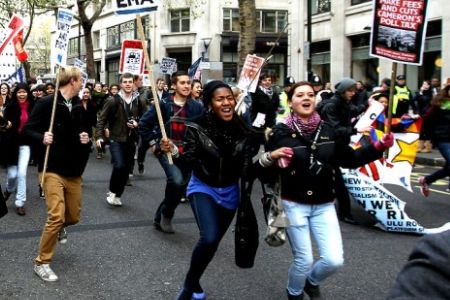
The cities and towns across the UK are bracing for more student protests ahead of a crucial vote in Parliament on plans to increase university tuition fees.
The British student groups and university professors have vowed to step up pressure on Members of Parliament (MPs) to vote against any motion that tightens grip on the students and their families, British media reported.
The pledge came after the country was rocked with a wave of demonstrations and occupations in recent weeks, some of which flared into violence.
A vote on the controversial plan to increase university tuition fees in England and Wales is expected on Thursday, December 9.
The new policy on fees will allow universities to double the current tuition fees from £3,290 per year to around £6,000. Some universities will also be allowed to get special approval from the Office For Fair Access (OFFA) to raise their fees to £9,000 per year.
If approved, the new fee procedure will be applicable by law from the beginning of the academic year of 2012-13.
The University and College Union (UCU) and the National Union of Students (NUS) on Monday announced their plans for the week’s protests in their joint campaign against education cuts.
They revealed plans for demonstrations at universities across the country on Wednesday ahead of Thursday’s vote.
“These proposals, if they go through, will change the entire landscape of education in this country and we must continue to oppose them. We need to expose the damage they will do to our universities, colleges and communities. MPs must be left in no doubt of the strength of opposition to these plans and the consequences of voting for them. We have been overwhelmed by support from people across the country against these plans and we hope they will all join us in making their voice heard this week,” said UCU general secretary, Sally Hunt.
“The joint NUS and UCU march that brought together 50,0000 people on 10 November has provided the spur to a new wave of activism and lobbying, placing the Government’s policy on fees and student support policy under huge pressure. This week we must keep that pressure up as the vote approaches. MPs can be left in no doubt as to the widespread public opposition to these plans or of the consequences of steamrollering them through Parliament,” said NUS President Aaron Porter.
Some trade unions are also urging their members to join the protests, maintaining that students are in the front line of opposition to the government’s massive cuts in public spending.
“This campaign is very much in the front line of the fight back against the ConDem cuts and has united pensioners, students and trade unionists in an imaginative and co-ordinated coalition of resistance. It has exposed the lies and hypocrisy of the LibDems and has opened up serious cracks in the coalition that we can all drive a wedge into,” said Bob Crow, general secretary of the Rail Maritime and Transport (RMT).
“RMT was delighted to have students supporting our picket lines during the last Tube strike and we will make sure that there is a high-profile presence from RMT supporting the students in their action this week,” he said.
Boycott roundup: French companies to drop out of Jerusalem rail project
Report, The Electronic Intifada, 3 December 2010
In a significant victory for the global Palestinian-led boycott, divestment and sanctions (BDS) movement, French companies Veolia and Alstom have dropped out of the Jerusalem light rail project due to sustained pressure from Palestine solidarity groups. The companies were contracted by the Israeli government to construct and manage the tramway linking Jerusalem to several illegal Israeli settlement colonies in the occupied West Bank.
The Associated Press reported on 28 November that Yoni Yitzhak, the spokesperson for Veolia Israel, “denied the company had succumbed to political pressures,” saying that “[a]ll decisions by Veolia Israel are based on financial, not political, considerations (“French firm drops out of Israeli light rail project,” 28 November 2010).
However, a spokesperson for Dan bus lines, an Israeli company that hoped to secure the contract after Veolia dropped out, said that Veolia had told Dan executives that the company had decided to end its involvement in the Jerusalem light rail project specifically because of the mounting BDS campaigns and political pressure, according to the Associated Press report.
Speaking at the recent London session of the Russell Tribunal on Palestine, The Electronic Intifada contributor Adri Nieuwhof testified against Veolia for its involvement in profiting from the illegal settlement industry. Nieuwhof is a human rights advocate whose writing focuses on corporate complicity in violations of international law, including Veolia’s role in the project. The jury subsequently included Veolia in a list of seven corporations it identified with “corporate complicity in Israeli violations of international law.”
The Jerusalem light rail project was designed to accommodate 200,000 Israeli settlers traveling between West Jerusalem and colonies in the West Bank, including East Jerusalem, such as Pisgat Zeev, Neve Yaakov and Ramot.
According to a statement by the Palestinian Boycott, Divestment and Sanctions National Committee (BNC) on 25 November, campaigners are marking this move by Veolia and Alstom as an important activism milestone. The BNC also emphasized that “pressure must be increased to ensure that these companies truly end their involvement in the Jerusalem light rail and in all other Israeli projects that violate international law” (“Veolia and Alstom feel the heat – BNC calls for intensifying pressure!,” 25 November 2010).
The BNC added “Veolia has agreed to sell its shares over a five year period. Not only will it receive [euro] 9 million [US $11.9 million] for its shares, but Veolia will continue to operate a system designed to dispossess Palestinians throughout this period and it is easily conceivable that the deal will break down during the sale process.”
Selling their shares, stated the BNC, does not absolve Veolia nor Alstom of their “legal, moral and political responsibility” toward Palestinians who will continue to suffer injustices because of the rail project, or of their “ongoing complicity in other Israeli projects that contravene international law.”
According to the BNC, campaigners across the globe “successfully secured the exclusion of Veolia from an impressive array of public sector contracts and pension funds.” The BNC cited several instances of Veolia’s loss of billions of dollars worth of public contracts in several countries in Europe, and in Australia and Iran, following effective campaigns by human rights activists.
France
In related news, the BNC also called on the French government to “immediately cease all undemocratic, repressive measures against its own conscientious citizens who promote or engage in nonviolent boycotts, divestment and sanctions campaigns against Israel until it complies with international law” (“Palestinian civil society reaffirms support for persecuted French activists,” 23 November 2010).
The statement follows waves of repressive action by the French government against Palestine solidarity activists working within the growing BDS movement. On 14 October, the BNC reported that a French court dismissed charges of incitement to “discrimination, hatred or violence” brought against Senator Alima Boumediene-Thiery and prominent activist Omar Slaouti, both of whom participated in boycott-related direct actions. “However, a [euro] 1,000 [US $1,300] fine against campaigner Sakina Arnaud for attaching a ‘Boycott Israel’ sticker to a fruit juice carton was upheld the following week,” the BNC stated.
Earlier this week, at least a dozen French BDS activists will appear in court to face similar charges, and other trials will take place over the course of the next year, according to the BNC.
These charges were brought against the French activists by pro-Israel lobby groups. “The self-styled Bureau National de Vigilance Contre l’Antisemitisme [National Bureau for Vigilance Against Anti-Semitism] and other pro-Israel groups claim to have filed over eighty complaints,” the BNC added. “According to activists, police regularly demand the names and addresses of those present at BDS demonstrations.”
Ireland
Boycott, divestment and sanctions campaigners in Ireland welcomed a unanimous vote by the Technical Engineering and Electrical Union (TEEU) to support a comprehensive boycott campaign of Israeli goods and services and “a policy of disinvestment from Israeli companies” as a result of Israel’s ongoing violations of international law and human rights against the Palestinian people.
In a 24 November press release from the Ireland Palestine Solidarity Campaign (IPSC), campaigners say TEEU’s management welcomed the motion, which was submitted to the union’s Executive Management Committee the weekend before (“Another BDS victory: TEEU votes to Boycott Israel,” 24 November 2010).
Upon the passage of the motion, one union delegate remarked “The global trade union movement has consistently demonstrated its commitment to Palestinian rights by adopting labor-led sanctions as a form of effective solidarity with Palestinians. The TEEU should be proud to stand shoulder to shoulder with our Palestinian trade union brothers and sisters, those brave Israelis — Jewish and Arab — who promote BDS, and those trade unions from Britain, to Belgium, to Canada to South Africa and beyond that have taken the principled decision to support BDS.”
Also in Ireland, members of the Dublin Food Co-Op voted overwhelmingly to boycott Israeli-made products during a special general meeting on 25 November. The IPSC stated that this was the third attempt in two years to authorize a boycott of Israeli goods, but after a determined campaign by BDS activists, the motion passed by a 50-6 vote (“Dublin Food Co-Op passes Israeli boycott motion,” 26 November 2010).
In the motion proposal, BDS campaigners called for a boycott of all Israeli products until the state of Israel agrees “to allow humanitarian aid and unarmed peace activists entry into Palestine without the threat of violence and death from Israeli armed forces,” and “agrees to honor United Nations resolutions regarding the unlawful occupation of Palestine in the so-called Israeli ‘settlements.'”
United Kingdom
Thousands of customers of British Telecom (BT) have signed onto a campaign led by a coalition of Palestine solidarity groups calling for an end to the company’s ties with Israeli telecommunications corporation Bezeq International. People who joined the Disconnect Now campaign have emailed BT asking for “an end to the company’s complicity in illegal Israeli settlements in the Occupied Palestinian Territories,” according to a press release from Disconnect Now coalition member group Just Peace for Palestine (“Thousands write to BT about complicity in Israeli occupation,” 24 November 2010).
In January 2010, said the press release, BT welcomed Israeli company Bezeq International, a subsidiary of Bezeq Israel, into its Global Alliance. The Bezeq corporation provides telecommunication services to illegal Israeli settlement colonies in the West Bank, including East Jerusalem.
“Members of the public who contacted BT via email have received a standard reply that while failing to address the main issue of the settlements and human rights, mentions that Palestinian telecommunications company Paltel has an arrangement with Bezeq,” stated the press release. “But in an official statement, Paltel have explained that ‘the Palestinian telecommunications sector is a captive sector in its own market and is forced into having operational relationships with Bezeq and other Israeli operators.'”
Japan
Japanese retail giant MUJI canceled plans to open a store in Israel following a targeted boycott campaign by grassroots Palestine solidarity organizations inside the country and around the region, including South Korea.
Organizers with the Palestine Forum Japan’s Stop!! MUJI Campaign drafted an online petition calling on the company not to open a retail shop in Israel, drawing hundreds of signatures in support. Activists also held solidarity actions in Osaka, where they set up a mock Israeli checkpoint with an “Israeli soldier” who pretended to harass civilians. A video was posted on YouTube showing the Osaka checkpoint action and a meeting between a MUJI store owner and solidarity activists in Kyobashi (“Mock checkpoint in Osaka).
On 1 December, MUJI declared that the company canceled its plans in Israel due to “economic reasons as a result of concrete research” but activists say that MUJI executives had been responding to their emails and telephone calls with careful reconsideration of their Israel plan for political reasons.
Activists say this is the first boycott victory in Japan.
United States — Chicago
Activists with the DePaul University chapter of Students for Justice in Palestine (SJP) released a statement on 29 November admonishing the university’s move to overturn a recent decision to discontinue the sale of Sabra hummus products.
On 11 November, SJP activists wrote to the university administration objecting to the sale of Sabra hummus in campus dining facilities.
The university subsequently suspended sale of Sabra products, but reversed its decision days later, saying that the process needed review by the Fair Business Practices Committee. SJP activists stated that the Sabra products should remain off the shelves until the committee reaches a decision.
In a statement issued after the university reversed its decision, the activists said “SJP’s concerns are based on the activities of Sabra’s parent company, the Strauss Group, an Israel-based corporation which provides vocal and material support to Israeli military practices that stand in direct contravention to international and human rights law,” the group stated (“Public Statement on the Return of Sabra Products to DePaul University,” 29 November 2010).
The group called on DePaul University to “adhere to more ethical business practices by indefinitely suspending Sabra sales and withdrawing financial support from a company openly promoting the endangerment of Palestinian lives.”
“As DePaul students, we are deeply concerned with DePaul University’s support for any company that actively supports Israel’s illegal occupation of Palestinian land,” their statement added. “In light of the Strauss Group’s ongoing support of the Golani and Givati brigades, which both act against international human rights standards, the university’s affiliation with the Strauss Group is inconsistent with DePaul’s Vincentian values. Continued distribution of Sabra hummus products aligns DePaul University with the perpetuation of egregious harms and shocking injustices. Therefore, we call on DePaul to permanently refrain from buying, stocking and using Sabra hummus products.”
New Jersey
In a related issue, students at Princeton University are seeking a referendum to have the student government make a formal request to school dining facilities to provide alternative brands to the Sabra products currently being offered.
Activists with the Princeton Committee on Palestine gathered the two hundred signatures required to introduce a referendum into the student senate. The Daily Princetonian quoted the committee’s president, Yoel Bitran, as stating that “The Princeton Committee on Palestine objects to the fact that Sabra is the only hummus brand that is offered in most university stores and that students who wish to eat this traditional Arab food are forced to buy a product that is connected to human rights abuses against Arab civilians” (“Students campaign for alternative hummus,” 19 November 2010).
The issue will be voted on this week.
Meanwhile, the Strauss Group recently deleted all mentions of their support for the Israeli military from its website. Under the heading “In the Field With Soldiers,” the Strauss Group formerly mentioned that its “connection with soldiers goes as far back as the country, and even further,” and detailed its relationships with Israeli military platoons. The section is now only found in cached versions of the website content.
Tel Aviv-South Africa
Anti-apartheid Israeli activists in Tel Aviv organized a “flash mob” action outside the Tel Aviv Opera House on 15 November, calling on the performers of the visiting Cape Town Opera to boycott Israel.
The action followed a months-long campaign by Palestinian, Israeli and South African activists urging the Cape Town Opera to respect the Palestinian-led call for boycott, divestment and sanctions.
Organizing within the context of the Cape Town Opera activity, South African artists and cultural workers released a declaration in support of a broad-based boycott against the Israeli government and Israeli cultural institutions (“South African Artists Against Apartheid, a declaration,” 1 November 2010).
“As South African artists and cultural workers who have lived under, survived and in many cases resisted apartheid, we acknowledge the value of international solidarity in our own struggle,” read the declaration. “It is in this context that we respond to the call by Palestinians, and their Israeli allies, for such solidarity.”
“As artists of conscience we say no to apartheid — anywhere,” the artists added. “We respond to the call for international solidarity and undertake not to avail any invitation to perform or exhibit in Israel. Nor will we accept funding from institutions linked to the government of Israel. This is our position until such time as Israel, in the least, complies with international law and universal principles of human rights. Until then, we too unite with international colleagues under the banner of ‘Artists Against Apartheid.'”
In October, South African Archbishop Desmond Tutu had called on the Cape Town Opera to cancel their scheduled performances of the American classic Porgy and Bess, stating that Israel was “luring” artists and cultural workers to the Tel Aviv Opera House to advance its “fallacious claim to being a ‘civilized democracy'” (“Tutu urges South African opera not to tour Israel,” Associated Press, 26 October 2010).
A longtime supporter of the boycott movement against Israeli apartheid, Tutu added it would be “unconscionable” for the Cape Town Opera to perform Porgy and Bess, which he said has a “universal message of nondiscrimination.”
Palestine-based news blog The Daily Nuisance produced a video of the flash mob, in which more than two dozen activists participated outside the Opera House (Tel Aviv flash mob).
Gaza Strip
Palestinian soccer players, coaches and athletic clubs in the occupied Gaza Strip released an open letter on 20 November to Michel Platini, president of the Union of European Football Associations, calling on the organization to “reverse apartheid Israel’s participation” in European soccer matches (“An Open letter from Besieged Gaza to Michel Platini and UEFA: Reverse Apartheid Israel’s Participation in European Competitive Football,” 20 November 2010).
In August, the Israeli government denied players from Gaza to travel to Mauritania for a match. A month later, Platini threatened Israel with expulsion from the soccer union if it continued to restrict Palestinian athletes from freedom of movement. “Israel must choose between allowing Palestinian sport to continue and prosper or be forced to face the consequences for their behavior,” he added (“Platini: I’ll kick Israel out of Europe,” Palestine Monitor, 2 October 2010).
The athletes’ letter praised Platini’s remarks, and accounted in detail the various ways in which Israel’s ongoing siege and blockade against the Gaza Strip affects daily life for Palestinians — athletes or not.
“Like all residents of Gaza, footballers are continually deprived entry or exit from what many mainstream human rights organizations call the world’s largest open-air prison,” stated the letter. “You must know that we are still grieving the loss of over 430 of our children, who were among the 1,443 people killed during Israel’s three-week bombing of Gaza in winter 2009. Two of our national football team heroes, Ayman Alkurd and Wajeh Moshate, were among those 1,443. 5,300 more people were injured. Many had their legs amputated. They will never have the chance to play football.”
The authors of the letter, representing more than thirty athletic and civic organizations in Gaza, highlighted the historic anti-racism campaigns by European soccer unions, including UEFA’s recent policy to support referees in stopping games for racist behavior. The letter pointed out that racism “is at the heart of why our national team cannot play abroad. It is the core reason why our sporting equipment does not arrive. It is the reason why our stadiums do not get built and why our football season ends prematurely through resource shortages or violent attacks.
The letter concluded with a plea to Platini and UEFA to rescind Israel’s participation in European competitions until the state’s racist policies end against Palestinians and it abides by international law.
Greek students clash with police
Press TV – December 2, 2010
At least five people have been arrested in fresh clashes between student protesters and police outside of parliament in Athens over government austerity plans.
Security forces used tear gas to disperse a crowd of approximately 1,500 students attempting to march to the British Embassy in Athens.
The demonstrators showed unity with British students by holding banners which read, “Solidarity to the struggle of British students,” Reuters reported.
British university students are facing an almost tripling of their tuition fees by the Conservative-Liberal Democrat coalition government.
The ongoing demonstrations in Greece were sparked by public outrage against economic reforms, which include eliminating over-time pay and bonuses.
The government agreed to the measures in exchange for a EUR 110 billion rescue package from the European Union (EU) and International Monetary Fund (IMF).
In return, the Socialist government has also slashed pensions and salaries, increased taxes and made it easier for the private sector to sack workers and cut wages.
Trade unions are strongly opposed to the measures and have been organizing demonstrations for months now.
They are calling for a nationwide general strike against the EU-IMF bailout on December 15 — the seventh this year.
Student groups are planning sit-ins on university campuses around the country.
Protests will also be held on Monday, December 6, to mark second anniversary of the police shooting of a teenager, which led to nationwide riots.
Sixteen Year-Old Palestinian Boy Reports Abuse During Interrogation in Military Jail
Chronicle of Fear
Popular Struggle Coordination Committee – December 1, 2010
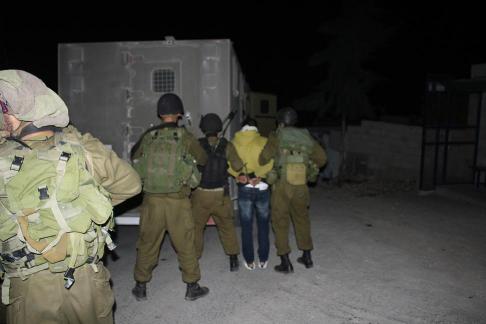 Soldiers escorting the bound and blinfolded Mohammed into a military jeep on the day of his arrest. Photo credit: Hamde Abu Rahmah

Mohammed Abu Rahmah was arrested from his house during a military nighttime raid on his village of Bil’in on November 23rd. Abu Rahmah, the son of imprisoned Bil’in organizer, Adeeb Abu Rahmah, was released without charge on Monday, and reports being harassed and beaten during his questioning.
On November 23rd, 2010, Israeli forces entered the village of Bil’in and stormed the home of imprisoned Bil’in organizer, Adeeb Abu Rahmah. After conducting a short search of the premises, the soldiers arrested Adeeb’s only son, sixteen year old Mohammed, who was taken away bound and blindfolded.
Mohammed reports being taken to the Maccabim military base, where he arrived at about 3 AM. He was then, still handcuffed and blindfolded, transported to the Ofer Military Prison, where the authorities refused to process him. Mohammed was then taken back to the Maccabim military base, where he was held until 11 AM, still with cuffed and blindfolded, and without being allowed to go to toilet.
Finally arriving at Ofer Prison at around noon, where the shackles and blindfold were eventually removed, Mohammed was taken into interrogation without allowing him to catch some sleep. On entering the interrogation room, he was cuffed again in both hands and legs, and sited on a chair in front of a man who introduced himself as “Captain Fares”. The interrogator then told Mohammed that the case against him is rock solid and can lead to a sentence of up to a year in jail. “Captain Fares” then said that the only way for Mohammed to avoid imprisonment is to “cooperate” – by which he meant confessing to the unfounded suspicions against him, and incriminating others.
When Mohammed refused to confess or incriminate others who the interrogator mentioned by name, “Captain Fares” responded by shouting at him, cursing him, and a few times even assaulting him physically with slaps to the face. At some point, as Mohammed kept insisting on his right to remain silent, the cuffs around his wrists and ankles were tightened even more then they were before, and the interrogator grabbed his neck as if he was about to choke him. When Mohammed refused to identify his imprisoned father in a picture shown to him, he was punched in the chest.
After about two hours of violent questioning, Mohammed was asked to sign a paper with a transcript of his interrogation, which he refused to do, and was then physically forced to give his fingerprints.
It is common practice in Israeli interrogation rooms to try and extract confessions and incriminations from detained Palestinian minors using threats and abuse. Many cases and convictions at the military court, including that of Adeeb Abu Rahmah, Mohammed’s father, are based on such incriminations by detained youth.
Mohammed, who since his father’s arrest, 17 months ago, Mohammed serves as the family’s sole provider, was eventually released from custody Monday night (November 29th), on 8,000 NIS bail since the military prosecution could not present evidence justifying his remand.
Arrested while helping farmers in Saffa Valley
Jillian Kestler-D’Amours writing from Saffa Valley, occupied West Bank, Live from Palestine, 29 November 2010
 |
Israeli soldiers detain Israeli and international activists in Saffa Valley, June 2009. (Oren Ziv/ActiveStills) |
It was a bright, warm morning in the occupied West Bank’s Saffa Valley Thursday, 18 November when, without warning, the Israeli occupation forces were upon us. Within moments, five Israeli soldiers were shouting in Hebrew. “You have one minute to leave the area!” they said, before shooting stun grenades at our feet. Moments later, we were told to sit quietly and hand over our passports. A six-hour detention was to follow.
I was detained along with six other internationals, five Israelis and one Palestinian activist in the Saffa Valley, near the occupied West Bank village of Beit Ommar. We were there to accompany Palestinian farmers to their land, and uproot dead bushes and other plants in preparation for planting olive trees later this winter. The army and Israeli media accused us of arson. In reality, small, controlled fires were lit in order to clear the weeds in the Palestinian-owned fields.
Still, we spent the day at the Gush Etzion settlement police station, where Israeli interrogators repeatedly asked us why we had violated a closed military zone order and had committed arson, both untrue charges. We were never presented with a closed military zone order nor did any criminal activity take place that day, as the Israeli police were alleging.
We were released after agreeing to not participate in any demonstrations or visit Beit Ommar, the Saffa Valley and the entire southern West Bank area for a period of 14 days. Exhausted and overwhelmed by it all, I headed home only to read the disturbing Israeli media reports detailing what had happened that day.
We were called anarchist arsonists on Ynet, the online, English-language version of Israeli daily newspaper Yedioth Ahronoth. Ynet quoted Yair Wolf, deputy head of the Gush Etzion Regional Council, who said “The anarchists’ intolerable behavior must be stopped. The foreigners among them must be deported. They only fuel the conflict” (“Suspicion: Anarchists torched field near settlement,” 18 November 2010).
In Wolf’s opinion, it is peace and justice activists working for the self-determination and freedom of Palestinians who are fueling the conflict, not the violent behavior of Israeli settlers like himself who are illegally occupying Palestinian land. His statement would be funny if it didn’t reflect the opinion of such a large segment of Israeli society.
Having had a few days to reflect, I can now view what happened through the lens of the larger picture, no longer blinded by my anger or frustration at an Israeli system that values theft, discrimination and religious-based privilege, while holding human rights and international law in such low regard.
What happened to us is not exceptional. Similar incidents will happen again, week after week, and they need to be viewed in the context of a growing nonviolent Palestinian struggle against Israeli apartheid. Israeli occupation forces are clutching at straws, when they feel it necessary to spend millions of dollars on the man-power needed to arrest activists each week and indiscriminately use tear gas, sound grenades or rubber bullets to disperse nonviolent demonstrations.
What happened to us — no matter how unjust or enraging — is nothing compared to the arbitrary detentions, arrests and prison sentences Palestinians must deal with on a daily basis. More than 9,000 Palestinians are detained each year by Israel and today, more than 7,000 sit in Israeli jails.
And yet in the face of this ever-increasing level of state violence and danger, the steadfastness of Palestinians to fight against the occupation of their lands is strong. It serves as an indispensable model to follow in the struggle for justice in Palestine, and being aware of how each one of us — Palestinian, Israeli, international — can best join in that struggle is crucial.
Originally from Montreal, Jillian Kestler-D’Amours is a reporter and documentary filmmaker based in occupied East Jerusalem. More of her work can be found at http://jilldamours.wordpress.com..
Israel Tries to Improve Its International Image
By Ane Irazabal – IMEMC & Agencies – November 29, 2010
The Israeli foreign ministry has called on 10 of its embassies in Europe to begin an advocacy campaign for Israel, starting with recruiting 1,000 public members. The new policy comes in response to the boycott campaigns against Israel that are gaining support in Europe.
According to The Guardian, the Israeli foreign affairs minister Avigdor Lieberman sent instructions to 10 embassies last week, to start adopting measures in order to improve the image of the country in Europe.
The first order suggested meeting 1,000 people by the middle of January, who should be willing to send positive messages about Israel to the general public. “Jewish or Christian activists, academics, journalists and students, who will be briefed regularly by Israeli officials and encouraged to speak up for Israel at public meetings or write letters or articles for the press,” The Guardian reported.
In addition, the Israeli government will give funds to its embassies in London, Paris, Berlin, Madrid and Rome to hire professional PR firms and lobbyists. The aim will be to research the opinion of the population regarding to Israel’s position about political issues, such as Israeli-Palestinian peace talks, tourism, human rights and Iran.
Lieberman is also planning to meet with the Israeli ambassadors across Europe to plan a joint strategy.
No comment about the issue was made by the Israeli officials, but The Guardian reported that within them “there is anxiety about the way Israel is perceived abroad, particular worry in certain countries in Western Europe.”
It is not the first time that Israel launches a strategic policy to improve its image. The last campaign was held in December 2008 during the war on Gaza. At that time, numerous social media, such as Twitter, Facebook and YouTube were used by the Israeli government promote a pretty picture of the attack.
However, this new policy comes when the cultural and economic boycott campaigns against Israel’s Occupation in Palestine, led by the Boycott, Divestment and Sanctions movement, are gaining importance in Israel and worldwide.
Five Australian Unions Support BDS of Israel
Tania Kepler for the Alternative Information Center (AIC) – 16 November 2010
Five Australian unions have joined the international campaign advocating the boycott of Israeli goods from the occupied West Bank.

The Electrical Trades Union, the Australian Manufacturing Workers Union, the Construction Forestry Mining and Energy Union, the Queensland branch of the Rail Tram and Bus Union and the Finance Sector Union passed a resolution in late October supporting the international boycott, divestment and sanctions campaign against Israel, reported the Jewish Telegraph Agency.
Peter Tighe, national secretary of the Communications Electrical Plumbing Union, told The Australian newspaper, “We are not anti-Jewish, we just think the human misery over there is outrageous.”
Tighe plans to take a resolution to the Australian Council of Trade Unions, the nation’s top union body, endorsing the boycott, according to the JTA.
The union’s announcement came just before Palestine solidarity activists gathered in Melbourne for Australia’s first national BDS conference. Around 100 activists from across Australia participated in the conference, held from October 29-31, during which they worked to establish a national agenda for the BDS campaign, coordinated actions, and participated in workshops and sector-based discussion.
Palestinian artist and activist Rafeef Ziadah was one of the main speakers at the conference.
“There was so much enthusiasm and dedication from the various Palestine solidarity groups. People really put differences aside and decided to work together in a non-sectarian way”, she told Green Left Weekly.
The conference adopted a four-stage calendar of actions for the BDS campaign, including a Christmas consumer boycott campaign, campus actions for the international Israeli Apartheid Week coinciding with Palestinian Land Day on March 30, and other actions coinciding with al-Nakba (the anniversary of the Palestinian expulsion from Israel in 1948) on May 15 and another in late September, reported Green Left.
“The vote on beginning a coordinated BDS campaign across many cities in Australia is … a terrific starting point. [It’s] really what this conference was about, bringing BDS work together and coordinating it,” said Ziadah.
“Getting activists in Australian cities talking about Israel as an apartheid state is a great achievement. The international BDS movement is only five years old, yet already we have students and trade unionists and people from different walks of life working together,” she added, saying, “The key now is doing the rank-and-file education and taking BDS actions.”
Featured Video

Racist Seinfeld Dances for Joy as Bibi Unveils His New Map
or go to
Aletho News Archives – Video-Images
TV Drama Review
Japanese drama projects Japan’s wartime atrocities onto Chinese characters

Global Times | October 25, 2026
By portraying Chinese characters as perpetrators of ruthless violence while casting Japanese Self-Defense Forces (SDF) intelligence operatives as defenders, the season 2 of the Japanese drama Vivant has recently drawn criticism from Chinese netizens, who argue that its depiction turns historical reality on its head while ignoring Japan’s wartime atrocities.
The TBS drama series – a spy suspense story in which an alleged unofficial intelligence unit of the SDF operates across the globe — has attracted a passionate fanbase. Its currently airing season 2 opened with a household rating of 18.8 percent, the highest for a TV drama this year, according toa commentary article by Japanese media Toyo Keizai.
What draws attention is the portrayal of the enemies in the series, the article noted. Scenes in which the Chinese organization subjects kidnapped members of the SDF unit to brutal torture are repeated with unrelenting intensity.
It is rare for Japanese TV dramas to explicitly portray a real-life country as the enemy, the article noted.
Japanese Prime Minister Sanae Takaichi also made a reference to the drama, saying that she has been recording Vivant and hopes to binge-watch it over the year-end and New Year holidays, according to Japanese media outlets.
China’s CCTV News report on Sunday revealed that the drama features scenes in which Chinese personnel cut off the fingers of and stab Japanese intelligence operatives in the abdomen. Such acts bear striking similarities to the torture inflicted on Chinese nationals by invading Japanese troops during the World War II.
The drama distorts the truth by attributing these atrocities to modern Chinese characters. Beneath the surface, it subtly glorifies Japan’s cross-border overseas operations, blurs the functional boundaries of the SDF and implicitly promotes an expansionist narrative, per CCTV News. … continue
Blog Roll
 Aletho News
- EU facing trillion-euro debt hole while seeking more cash for Kiev
- How US, Europe, Persian Gulf states exhausted missile stockpiles, splurged billions to defend Israel
- Up in arms… Koreans reject U.S. empire’s plan to make South Korea the next Ukraine
- Iran, Turkey, Pakistan, Saudi Arabia could advance region-led security framework in Tehran: FM spox
- Netizens condemn Japanese drama for projecting Japan’s wartime atrocities onto Chinese characters
- Racist Seinfeld Dances for Joy as Bibi Unveils His New Map
- A West Bank War for Netanyahu’s Election Campaign, Could It Backfire?
- Yemen denounces European Parliament’s ‘hypocritical’ push to blacklist Ansarullah
- Qalibaf: UAE’s UN bid aims to ‘clear the runway’ for ‘Greater Israel’, whitewash genocide
- Pakistan reopens Iran border after boosting security: Report
- If Americans Knew
- An error has occurred; the feed is probably down. Try again later.
- No Tricks Zone
- Sudden Stratospheric Warming, Powerful El Niño Combination May Lead To Extreme Europe Cold, Energy Crisis!
- Two New Studies Find Thwaites Glacier Melt Cannot Be Driven By Human Activity Or A Warming Ocean
- E-Cars Reduce CO2 Emissions By Only 41% Compared To Internal Combustion Engine Vehicles
- Predictions Made By Renowned Climate Professor Over Past Decades Have Been Proven To Be Poor
- New Study Suggests Large Regions Of The Pacific Ocean Have Been Cooling For The Last 80 Years
- Germany’s Green Energy Debacle: High Energy Costs Force Kahla Porzellan to Close After 182 Years!
- New Study: 50 Years Of The Most Aggressive ‘Net Zero’ Policies Can Only Affect The Global Climate By 0.03°C
- US September “Heat” Was No Record…Many Records Set Decades Ago
- Latest European Green Energy Debacle; Portugal’s Largest Flagship Solar Park Insolvent!
- Green Energy Debacle: German Expert Professor Fritz Vahrenholt Warns Of Severe Economic And Social Consequences

