Arrested while helping farmers in Saffa Valley
Jillian Kestler-D’Amours writing from Saffa Valley, occupied West Bank, Live from Palestine, 29 November 2010
 |
Israeli soldiers detain Israeli and international activists in Saffa Valley, June 2009. (Oren Ziv/ActiveStills) |
It was a bright, warm morning in the occupied West Bank’s Saffa Valley Thursday, 18 November when, without warning, the Israeli occupation forces were upon us. Within moments, five Israeli soldiers were shouting in Hebrew. “You have one minute to leave the area!” they said, before shooting stun grenades at our feet. Moments later, we were told to sit quietly and hand over our passports. A six-hour detention was to follow.
I was detained along with six other internationals, five Israelis and one Palestinian activist in the Saffa Valley, near the occupied West Bank village of Beit Ommar. We were there to accompany Palestinian farmers to their land, and uproot dead bushes and other plants in preparation for planting olive trees later this winter. The army and Israeli media accused us of arson. In reality, small, controlled fires were lit in order to clear the weeds in the Palestinian-owned fields.
Still, we spent the day at the Gush Etzion settlement police station, where Israeli interrogators repeatedly asked us why we had violated a closed military zone order and had committed arson, both untrue charges. We were never presented with a closed military zone order nor did any criminal activity take place that day, as the Israeli police were alleging.
We were released after agreeing to not participate in any demonstrations or visit Beit Ommar, the Saffa Valley and the entire southern West Bank area for a period of 14 days. Exhausted and overwhelmed by it all, I headed home only to read the disturbing Israeli media reports detailing what had happened that day.
We were called anarchist arsonists on Ynet, the online, English-language version of Israeli daily newspaper Yedioth Ahronoth. Ynet quoted Yair Wolf, deputy head of the Gush Etzion Regional Council, who said “The anarchists’ intolerable behavior must be stopped. The foreigners among them must be deported. They only fuel the conflict” (“Suspicion: Anarchists torched field near settlement,” 18 November 2010).
In Wolf’s opinion, it is peace and justice activists working for the self-determination and freedom of Palestinians who are fueling the conflict, not the violent behavior of Israeli settlers like himself who are illegally occupying Palestinian land. His statement would be funny if it didn’t reflect the opinion of such a large segment of Israeli society.
Having had a few days to reflect, I can now view what happened through the lens of the larger picture, no longer blinded by my anger or frustration at an Israeli system that values theft, discrimination and religious-based privilege, while holding human rights and international law in such low regard.
What happened to us is not exceptional. Similar incidents will happen again, week after week, and they need to be viewed in the context of a growing nonviolent Palestinian struggle against Israeli apartheid. Israeli occupation forces are clutching at straws, when they feel it necessary to spend millions of dollars on the man-power needed to arrest activists each week and indiscriminately use tear gas, sound grenades or rubber bullets to disperse nonviolent demonstrations.
What happened to us — no matter how unjust or enraging — is nothing compared to the arbitrary detentions, arrests and prison sentences Palestinians must deal with on a daily basis. More than 9,000 Palestinians are detained each year by Israel and today, more than 7,000 sit in Israeli jails.
And yet in the face of this ever-increasing level of state violence and danger, the steadfastness of Palestinians to fight against the occupation of their lands is strong. It serves as an indispensable model to follow in the struggle for justice in Palestine, and being aware of how each one of us — Palestinian, Israeli, international — can best join in that struggle is crucial.
Originally from Montreal, Jillian Kestler-D’Amours is a reporter and documentary filmmaker based in occupied East Jerusalem. More of her work can be found at http://jilldamours.wordpress.com..
Israel Tries to Improve Its International Image
By Ane Irazabal – IMEMC & Agencies – November 29, 2010
The Israeli foreign ministry has called on 10 of its embassies in Europe to begin an advocacy campaign for Israel, starting with recruiting 1,000 public members. The new policy comes in response to the boycott campaigns against Israel that are gaining support in Europe.
According to The Guardian, the Israeli foreign affairs minister Avigdor Lieberman sent instructions to 10 embassies last week, to start adopting measures in order to improve the image of the country in Europe.
The first order suggested meeting 1,000 people by the middle of January, who should be willing to send positive messages about Israel to the general public. “Jewish or Christian activists, academics, journalists and students, who will be briefed regularly by Israeli officials and encouraged to speak up for Israel at public meetings or write letters or articles for the press,” The Guardian reported.
In addition, the Israeli government will give funds to its embassies in London, Paris, Berlin, Madrid and Rome to hire professional PR firms and lobbyists. The aim will be to research the opinion of the population regarding to Israel’s position about political issues, such as Israeli-Palestinian peace talks, tourism, human rights and Iran.
Lieberman is also planning to meet with the Israeli ambassadors across Europe to plan a joint strategy.
No comment about the issue was made by the Israeli officials, but The Guardian reported that within them “there is anxiety about the way Israel is perceived abroad, particular worry in certain countries in Western Europe.”
It is not the first time that Israel launches a strategic policy to improve its image. The last campaign was held in December 2008 during the war on Gaza. At that time, numerous social media, such as Twitter, Facebook and YouTube were used by the Israeli government promote a pretty picture of the attack.
However, this new policy comes when the cultural and economic boycott campaigns against Israel’s Occupation in Palestine, led by the Boycott, Divestment and Sanctions movement, are gaining importance in Israel and worldwide.
Five Australian Unions Support BDS of Israel
Tania Kepler for the Alternative Information Center (AIC) – 16 November 2010
Five Australian unions have joined the international campaign advocating the boycott of Israeli goods from the occupied West Bank.

The Electrical Trades Union, the Australian Manufacturing Workers Union, the Construction Forestry Mining and Energy Union, the Queensland branch of the Rail Tram and Bus Union and the Finance Sector Union passed a resolution in late October supporting the international boycott, divestment and sanctions campaign against Israel, reported the Jewish Telegraph Agency.
Peter Tighe, national secretary of the Communications Electrical Plumbing Union, told The Australian newspaper, “We are not anti-Jewish, we just think the human misery over there is outrageous.”
Tighe plans to take a resolution to the Australian Council of Trade Unions, the nation’s top union body, endorsing the boycott, according to the JTA.
The union’s announcement came just before Palestine solidarity activists gathered in Melbourne for Australia’s first national BDS conference. Around 100 activists from across Australia participated in the conference, held from October 29-31, during which they worked to establish a national agenda for the BDS campaign, coordinated actions, and participated in workshops and sector-based discussion.
Palestinian artist and activist Rafeef Ziadah was one of the main speakers at the conference.
“There was so much enthusiasm and dedication from the various Palestine solidarity groups. People really put differences aside and decided to work together in a non-sectarian way”, she told Green Left Weekly.
The conference adopted a four-stage calendar of actions for the BDS campaign, including a Christmas consumer boycott campaign, campus actions for the international Israeli Apartheid Week coinciding with Palestinian Land Day on March 30, and other actions coinciding with al-Nakba (the anniversary of the Palestinian expulsion from Israel in 1948) on May 15 and another in late September, reported Green Left.
“The vote on beginning a coordinated BDS campaign across many cities in Australia is … a terrific starting point. [It’s] really what this conference was about, bringing BDS work together and coordinating it,” said Ziadah.
“Getting activists in Australian cities talking about Israel as an apartheid state is a great achievement. The international BDS movement is only five years old, yet already we have students and trade unionists and people from different walks of life working together,” she added, saying, “The key now is doing the rank-and-file education and taking BDS actions.”
‘I am strong. We resist’: An interview in the village of Jeb al Theeb
By The volunteers of the Harvesting Peace Project | Mondoweiss | November 18, 2010
Sitting in one of the houses of Jeb al Theeb, a small village south of Bethlehem, a Palestinian woman describes the living conditions. She is a teacher but in the darkness it is difficult to determine her age. Her home, just as the entire village, is without electricity. The only light that arrives comes from the mega-illumination of the adjacent settlements of El David, Nokdim, and Sde bar.
Can you tell us more about life here in the village?
Jeb al Theeb is a simple Palestinian village inhabited by 150 people, most of whom are young. We don’t have many older people here. The village lacks all types of basic infrastructure and the only roads are unsuitable for cars, forcing the people to travel on foot. There is no school, the children must walk a long way to the nearest one, even in winter with the rains. We no longer have access to our land, shepherds cannot graze their sheep in the pastures and children cannot play in the fields. We have no electricity and therefore cannot use computers or television. The children are unable to study after school, and, as you can see, at 5pm it is already dark. Studying by candlelight creates problems with their eyesight.

A settler and the village of Jeb al Theeb in the background

We’re staying in a house nearby and we have electricity, as do other homes in the area. Why don’t you have it here?
The houses a little further away from the settlements are supplied with electricity simply because they do not represent a direct threat. Our village, on the other hand, is located right next to the Israeli settlements, whose strategy is clearly to deny us electricity as well as other basic necessities.
In addition to electricity, what other basic necessities are you denied?
They often shut off the water and also damage the pipes, which creates many difficulties for us. Water is already scarce here, then we are forced to ration what little we have stored in tanks.
Who do you call when there are problems with the water?
We are located in Area C, so we have no choice but to call the Israelis. They come but they do nothing, nothing ever changes. We have no faith in the Israeli authorities.
In recent months there has been much talk of construction and expansion of the settlements. Are you allowed to build?
Absolutely not. In addition to not being allowed to build or even complete work already begun, houses are demolished by the Israeli authorities. My brother’s house was destroyed.
The other day we saw a settler in a pickup truck enter the village. Do they come here often?
It is as if they live here. They do what they want, when they want.
Do they come to intimidate you? To scare you? To provoke you?
They come for all these reasons. Just the other day, as I walked to work early in the morning, I saw a settler turn a hundred of his goats on the olive trees belonging to a man near the village. The day before, that same man had defended his right to access his lands. The goats damaged both the trees and the olives.

Abu Yassir, a villager in Jeb al Theeb who was attacked by a settler.

We’ve noticed that the settlers are armed. Do they ever attack people in the village?
Unfortunately, yes. One of the most serious cases was that of this elderly man beside me who was beaten with a stick and hit with stones for nothing more than attempting to graze his sheep on his land. As you can see, he suffered a deep wound to the head. He received no immediate treatment due to the isolation of the village. It was only later that he was taken to the hospital in Ramallah where he underwent surgery. Fortunately, he recovered fully.
Was the settler who attacked him prosecuted?
We called the Israeli authorities. They came and wrote a report of the incident, but they did not take any action. It is clear that there is collaboration between the settlers and the Israeli forces.
When was it that your village began to have problems?
More or less 15 years ago when they started to build settlements. As a child I remember playing in the fields, there were flowers in the spring.
How exactly were you informed that you could no longer access your land?
They came to us presenting an official government document, according to which, from that moment on, we were not allowed to enter our lands. The same document gave the settlers the right to shoot anyone who tried. They communicated this to us in person.
Who brought you the document? The IDF soldiers?
No.
The Israeli civil authorities?
No, it was the settlers themselves. As you know, they receive orders from above. The government also provides them with a series of incentives that help them economically. They have sheep, tractors, horses and camels, they have everything.
Now that you can no longer access your land, what is its current status?
I think the settlers go there to take our olives. They certainly take their sheep there to graze, and they eat the leaves and the olives off the trees.
What is that large metal building we see a few hundred meters from here?
It is a plant producing fertilizer that was built two years ago. As you may have noticed it also produces a horrible smell not to mention the fumes coming from its smokestacks. We shut the windows and doors to our houses but the smoke still gets in. Furthermore, it is dealing with chemical substances that cause serious health problems, especially for our children.
Do you think is was located here on purpose?
Maybe. One thing is certain, they don’t not care about us. They just want us to leave and will be happy when we do so.
And have people left the village?
As you can see, there are many houses that have been abandoned by their owners who were tired of the continual harassment and hardships they endured. Life here is impossible. How can it be that in the 21st century we are forced to live without electricity? We don’t have internet, we cannot send email, children cannot watch cartoons on TV.
But I’m not leaving. I could certainly have a more comfortable life elsewhere, but this is where my family is, this is my land. I remain also to keep hope alive.
I am strong. We resist.
Interview by the volunteers of the Harvesting Peace Project
Harvesting Peace is an Italian civilian peace intervention project in Palestine to support the olive harvest and the work of Popular Struggle Coordination Committee (www.popularstruggle.org). The project is promoted by Service Civil International – Italy, Association for Peace and Un Ponte Per. Volunteers provide international accompaniment for four weeks in the village of Jeb al Theeb near Bethlehem, under threat from the nearby illegal settlements and settlers.
http://raccogliendolapace.wordpress.com/
13 activists detained during volunteer work
Ma’an – 18/11/2010
 Israeli soldiers scuffle with human rights activists on the outskirts of the West Bank
village of Beit Ummar near Hebron on July 18, 2009 [MaanImages/Mamoun Wazwaz]
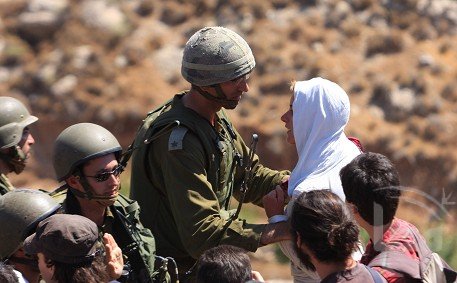
HEBRON — Thirteen activists from a group of 30 were detained by Israeli forces Thursday afternoon while aiding local farmers whose land is set for confiscation by an adjacent settlement, locals from the village of Saffa reported.
Early Thursday morning officials said the activists were escorted to lands belonging to Sheik Mohammad Aady, reportedly slated for annexation the Bat Ayin settlement.
A statement by event organizers said that after half an hour of work, soldiers surrounded the group of volunteers and detained several, including seven Israeli activists.
An Israeli military spokeswoman confirmed the arrests, but said she could not comment on the reasons for the detentions.
Protesting the Hebron Fund, I remember a long afternoon at a segregated swimming hole
By Seán O’Neill | Mondoweiss | November 18, 2010

(Protesters in New York. Photo: Vanissa W. Chan)
Hebron Fund held its annual fundraiser in New York Tuesday night. A report from O’Neill, a former member of Christian Peacemaker Teams in the South Hebron Hills, who attended the protest:
I was just leaving Hebron’s Old City one day in August 2009 when a friend of mine, Hamzi, invited me to go swimming.
He and a few other guys were going for a dip in Abraham’s Well, an ancient spring located in Tel Rumeida, essentially the only neighborhood in the West Bank city where Palestinians and Israeli settlers physically encounter one another on a daily basis.
Whereas in the Old City a complex system of barricades, roadblocks, and checkpoints keeps Palestinians caged in and under the settlement pockets, in Tel Rumeida there is some level of mutual access, albeit unequal and under the watchful eye of Israeli soldiers.
It was a hot, sticky day, and the thought of taking a dip in the cool undeground waters of Abraham’s Well sounded superb. After a long circuitous route, unable to cross Shuhada St., Hebron’s main thoroughfare banned from use by Palestinians, we reached an olive grove just above the well. In our enthusiasm, we didn’t notice the four Israeli soldiers sitting above it until they came running, screaming at us, rifles aimed in our direction. Hamzi explained that we were just on our way down to swim. The soldiers replied that there were a couple Jewish girls there swimming, so we’d have to wait. We began to sit down in the shade of the olive tree next to the soldiers when a soldier began yelling again, shooing us with his free hand, indicating that we were too close.
“He acts like were dogs,” Hamzi muttered to himself as we moved back a few trees.
Occasionally we would crane our necks over the terraced rocks to see if the girls were leaving yet. Noticing this, the soldier berated us again, instructing us to face the other direction, so as not to offend the young women, who by now, done swimming, were having a picnic next to the well. Hamzi and the others stared for a moment, absorbing this latest humiliation, before turning away, powerless. We sat there for about an hour in the midday heat, sweating profusely, debating whether it was worth the wait. Finally one of us, sneaking a look, noticed the girls leaving. We jumped up happily and asked the soldiers if we could now swim.
“No,” one said. “There’s someone else coming.” Indeed, two young Jewish boys had now approached the well and began to disrobe.
“But we’ve been here over an hour,” Hamzi protested. “It’s a hot day. If we have to wait for every Jew in Hebron to swim we’ll never get a turn.”
“Maybe not,” the soldier said, matter-of-factly.
And so we left, hot and irritated. There wasn’t a physical attack or a home bulldozed. No one was arrested or tear gassed. Just another of the thousand daily humiliations that is apartheid Hebron. That was the last day I was in Hebron, and the last time I saw Hamzi, although I didn’t realize it at the time. Shortly thereafter I flew home for a visit and returning a month later discovered I had been banned from re-entry.
Tuesday night in New York was windy, cold and dark, a far cry from that blistering day in August. Strange in a way to think that the men and women in suits and gowns at Chelsea Piers making their way to a dinner cruise on the Hudson River had any connection at all to that conflicted place thousands of miles away. Hamzi and some 160,000 Palestinians in Hebron settled down to bed after celebrating another Eid al Adha in the grip of a suffocating occupation.
Here in New York husbands and wives and their families parked their cars and walked breezily past the indoor soccer fields to a feast of their own, making tax-exempt donations to bankroll Hamzi’s oppression. Tuesday night was the annual dinner of the Hebron Fund, founded in 1979 to raise money for the Hebron settlements. According to the Washington Post, the Hebron Fund and similar organizations have donated $33.4 million since 2004 to the settlement enterprise. Settlements, keep in mind, are illegal according to international law.
This year’s dinner, held on a boat, was styled as the Hebron Aid Flotilla, a perverse celebration of the murder of nine human rights activists by Israeli commandos on the flotilla to Gaza this past May.
The event, however, did not go unnoticed. A couple hundred people gathered at the piers’ entrance in not one, but two protests. On the one hand was a coalition of Palestinian, Jewish, and anti-occupation groups such as Students for Justice in Palestine, Jewish Voice for Peace, Veterans for Peace, Women in Black, Code Pink, and Adalah NY, among others. They stood in a mostly silent vigil with signs reading “End the Siege of Hebron”, “Remove the Settlers”, and “Free Gaza”.
On the other, about 40 feet away, was a protest staged by J Street U, the college branch of the advocacy group which styles itself as pro-Israel, pro-peace. They held Israeli flags and lamented the settlements as an obstacle to a two-state solution. A participant in the J Street protest, Moriel Rothman said of the two protests, “I think that we’re working in parallel. Ultimately we probably want similar things but have different tactics in how to get there.”
An attendee of the fundraiser, who chose to remain anonymous, brushed the protests off, saying, “If you look at the amount of energy that goes into protesting Jewish misconduct, it is disproportionate. The world holds Jews to a higher standard.” He added, referring to the Jewish protesters, “They are introspective. You very seldom see that amongst the Palestinians.”
My first thought at seeing the two different protests was one of dismay. Had the ideology of separation reared its ugly head even here, among the dissenters? On second thought however, in a context in which meaningful dissent has been muffled for so long, a bit of pluralism may not be bad. The groups didn’t agree on tactics, or symbols, or what a solution to the conflict will look like. However, if there is an emerging consensus that the Hebron settlements, at least, are beyond the pale, that on a hot summer day Palestinian residents shouldn’t have to navigate around Jew-only roads to find that the well is closed to Arabs, that just might be progress.
US activists face new repression as political prisoners fight for justice
Nora Barrows-Friedman and Maureen Clare Murphy, The Electronic Intifada, 15 November 2010
For decades the United States government has attempted to criminalize work in the Palestinian community in support of their national liberation cause. But in recent years this repression has increased dramatically. The Electronic Intifada spoke with the daughter of Sami al-Arian and the daughter of Ghassan Elashi — both political prisoners in the US — about the impact this repression has had on their families’ lives. And in an Electronic Intifada exclusive, Hatem Abudayyeh, an organizer and community leader whose home in Chicago was raided by federal agents on 24 September 2010, spoke to the press for the first time about his family’s story.
The Electronic Intifada spoke with al-Arian, Elashi and Abudayyeh as activists across the United States prepare for emergency demonstrations as the subpoenas for three anti-war and solidarity organizers to appear before a federal grand jury in Chicago are being reactivated by the Department of Justice.
The three activists are among the 14 who received subpoenas during and soon after coordinated FBI raids on homes and offices across the Midwestern US on 24 September. The government says that the raids and subpoenas are part of an investigation into “material support” of foreign terrorist organizations but it has not arrested or charged anyone.
A grand jury, no longer in use anywhere outside the US, is an investigative tool that allows the government to compel citizens to testify even if they are not suspected of any crime.
The 14 targeted activists are involved with various peace with justice groups, including the Palestine Solidarity Group-Chicago, Students for a Democratic Society, the Twin Cities Anti-War Committee, the Colombia Action Network, Fight Back! newspaper, the Freedom Road Socialist Organization and the National Committee to Free Ricardo Palmera. All the activists had submitted letters to the US attorney — the local Department of Justice prosecutor who convenes the grand jury — stating their intent not to testify; the Department of Justice had withdrawn the original subpoenas, but the grand jury was still convened.
The three activists receiving reactivated subpoenas are expected to be offered “immunity” — meaning that they face the choice of informing the government about the activities of other organizers or being jailed for the duration of the grand jury, and possibly facing further charges for criminal contempt of court.
“What [the US government] is doing is gathering political intelligence to indict people under this idea of providing material support for terrorism,” attorney Michael Deutsch, part of the legal defense team for the activists, told The Electronic Intifada. “The grand jury is not an independent body. It is controlled by the US Department of Justice and they decide who is subpoenaed and what the outcome of the grand jury investigation is. It is a tool of the FBI and the justice department to repress political activists.”
Deutsch wrote for The Electronic Intifada in 2008: “In the last forty years the government has used the grand jury as a tool of political inquisition subpoenaing and resubpoenaing activists the government knows will refuse to cooperate, stripping them of their constitutional right against self-incrimination and forcing upon them the choice of informing on their movement or going to jail for contempt.”
In an article contributed to the Mondoweiss site, Deutsch explains: “The search warrants and grand jury subpoenas make it quite clear that the federal prosecutors are intent on accusing public nonviolent political organizers … of providing ‘material support,’ through their public advocacy, for the Popular Front for the Liberation of Palestine and the Revolutionary Armed Forces of Colobmia” (“US Justice Department prepares for the ominous expansion of law prohibiting ‘material support’ for terrorism,” 10 November 2007).
The investigation’s legal basis is the bipartisan Antiterrorism and Effective Death Penalty Act passed under the Clinton administration in 1996 and expanded with the bipartisan Patriot Act enacted during the Bush administration. In June of this year the implications of the legislation — already used after 11 September 2001 to shut down major Muslim charities in the US — was broadened even further. According to Deutsch in Mondoweiss, in the decision Holder v. the Humanitarian Law Project, the US Supreme Court “decided that nonviolent First Amendment speech and advocacy ‘coordinated with’ or ‘under the direction of’ a foreign group listed by the Secretary of State as ‘terrorist’ was a crime.”
The “foreign terrorist organization” designation is unilaterally declared by the US Secretary of State and virtually impossible to challenge. The Center for Constitutional Rights describes “the government’s current fervor to use the label of terrorism as a brand for groups and organizations that are not toeing the line on US foreign policy” (“Factsheet: Material Support“).
At the height of the movement to bring an end to white supremacist rule in South Africa — the US was among the apartheid regime’s longest-standing supporters — the Reagan administration declared Nelson Mandela’s party, the African National Congress, a foreign terrorist organization. Critics observe that had these laws been enacted then, the entire anti-apartheid movement in the US, which took direction from the ANC, would have been criminalized for providing “material support to terrorism.”
According to the Center for Constitutional Rights fact sheet, “these material support provisions violate the First Amendment as they criminalize activities like distribution of literature, engaging in political advocacy, participating in peace conferences, training in human rights advocacy and donating cash and humanitarian assistance, even when this type of support is intended only to promote lawful and nonviolent activities.”
These laws have had a tremendously chilling impact on civil liberties and humanitarian and domestic political organizing in the US, particularly amongst the Palestinian, Arab and Muslim communities.
Hatem Abudayyeh
Hatem Abudayyeh was asleep on his parents’ couch the morning of 24 September after spending the night with his mother in the emergency room when his wife frantically called him to report that federal agents had raided their home. A Palestinian community leader and solidarity activist, Abudayyeh is also Executive Director of the Arab American Action Network, which provides social services to thousands of families in and around Chicago.
“I ran into my house, passed all the agents and grabbed my daughter and went into the bedroom with her and held her and made sure she was OK,” Abudayyeh told The Electronic Intifada. Abudayyeh, his wife and five-year-old daughter were mainly confined to their small living room while a multi-agency task force searched through all their belongings.
“I wanted to see what they were searching for and grabbing but they wouldn’t allow us to do that,” Abudayyeh said. “They basically grabbed everything that said ‘Palestine’ on it.” During the search that Abudayyeh said went on for more than three hours, the agents went through his wife and daughter’s personal belongings, the family’s library, CD and DVD cases and financial documents. Amongst the materials confiscated were home movies Abudayyeh’s wife had recorded during a family visit to Palestine this summer.
Abudayyeh eventually learned that the home of his friends Joe Iosbaker and Stephanie Weiner, a Chicago couple who are long-time union and anti-war activists, was raided as well. That same morning more than 70 federal agents raided and served subpoenas to prominent organizers in the Twin Cities and Michigan, and called and otherwise harassed activists throughout the country. The office of the Twin Cities-based Anti-War Committee — which led demonstrations against the Republican National Convention, one of the largest anti-war protests in the US in recent years — was raided as well.
“The most accurate assessment is that on the political level, the wars in Afghanistan and Iraq are not going so well for the administration. There are a lot of developments happening in Colombia and Palestine that are probably also not considered to be what the administration wants to see in those countries,” Abudayyeh said. “This attack on the anti-war movement is another example of the administration, whether Obama’s or Bush’s, trying to criminalize the activities of organizers in the US [working to change] foreign policy in Iraq, Palestine, Afghanistan and Colombia.”
Of the 14 activists targeted on 24 September, Abudayyeh is the only Palestinian or Arab (profiles of those targeted are currently available on stopfbi.net).
“The administration needs to put a local face on the enemy abroad and for many years that has been Arab and Muslim faces. It is interesting that in this case, I’m the only Arab. But the essential goal is the same — to criminalize anti-war activism and criminalize international solidarity activism in defense of a foreign policy that has gone awry and has caused the deaths of many thousands of American troops and many hundreds of thousands of Iraqis and Afghans.”
Abudayyeh and others say there hasn’t been government repression of a social movement in the US on this scale since COINTELPRO — an FBI program implemented in the 1950s and 1960s to infiltrate and disrupt domestic political organizations, particularly the Black Panthers and other oppressed nationality movements.
“We all know what McCarthyism did in this country in the ’50s,” Abudayyeh said. “It’s pretty frightening and disconcerting that in 2010, this can still happen.”
Abudayyeh recognizes that he is hardly the first Palestinian in the US to be targeted for his political views and organizing. “People who are activists in the Palestinian, Arab and Muslim community — especially since 11 September, but for decades before than — have dealt with this government repression,” he said.
Abudayyeh referenced the case of seven Palestinian immigrants and a Kenyan — dubbed the LA 8 — who were subjected to 20 years of prosecution and deportation proceedings for their activities educating Americans about US policy towards Israel and the Palestinians. The US government arrested the eight in 1987 and accused them of organizing in support of a faction of the Palestine Liberation Organization. According to Abudayyeh, persecution of Palestinian activism began with the wave of Palestinian immigrants to the US after Israel’s military occupation of the West Bank and Gaza Strip in 1967.
“What they are targeted for is challenging US policy as it relates to Palestine,” Abudayyeh added. “Israel receives the largest amount of US foreign and military aid … which they use to occupy and oppress Palestinians in Jerusalem, the West Bank and the Gaza Strip and they use that aid to threaten their neighbors, like Syria and Lebanon. Most of the leading activists around the war in Lebanon in 2006 in the US were Palestinians because we saw that as an extension of the war on the Palestinian people. We don’t separate the US occupation and invasion of Iraq from US support of Israel’s oppression of the Palestinian people.”
However, Abudayyeh said, despite this repression the Palestine support movement in the US has only grown, and today’s generation of student activists are doing even stronger work than what was happening during his youth.
“It’s incumbent for us in the US and everywhere else to speak out against these policies … It is probably the main liberation and social justice issue in the world today. I may be the individual who is being targeted today, but this isn’t an issue of an individual or organizations I work for or are affiliated with; it’s a historical repression and attack on the Palestine support movement in the US.”
There have been several other high-profile cases against Palestinian, Arab and Muslim activists since 11 September 2001. Political prisoners continue to serve draconian sentences as the Department of Justice under the Obama administration enforces the policies of the Bush-era PATRIOT Act and the Clinton administration’s material support laws.
Michael Deutsch told The Electronic Intifada that former university professor and stateless Palestinian Dr. Abdelhaleem Ashqar remains in a federal prison in Petersburg, Virginia following his sentence of 135 months for refusing to testify to a grand jury and inform on the activities of other activists in the US and Palestine. Deutsch said that Dr. Ashqar’s legal defense is filing a habeas corpus petition challenging his sentence, arguing that his rights were violated at his trial.
The US government accused Dr. Ashqar and his co-defendant Muhammad Salah, a Palestinian American, of participation in alleged racketeering activity in support of Hamas after dropping initial material support charges. The government presented as evidence a confession Salah made while he was tortured for 80 days in an Israeli prison and the prosecution’s main witnesses were Israeli intelligence agents who were allowed to testify anonymously with severely restricted cross-examination.
Despite vast resources spent by the US government to convict the two, Salah and Dr. Ashqar were acquitted by a jury of all conspiracy and terrorism-related charges. But Salah was convicted of obstruction of justice for filing false answers to interrogatories in a civil case and was sentenced to 21 months in prison, a sentence he has served out.
“No amount of jailing by the court will compel me to testify against others struggling for Palestinian freedom,” Dr. Ashqar stated in an affidavit given on 12 July 2003 published on the Free Dr. Ashqar Committee website (“Case History – 2003 Affadavit of Abdelhaleem Ashqar).
But Ashqar’s 11-year sentence for refusing to testify to a grand jury is unprecedented in US history and contrasts, for example, with the mere 30-month sentence received by Lewis “Scooter” Libby, former chief of staff to US Vice President Richard Cheney who was convicted in 2007 for actively lying to a grand jury investigating the disclosure of classified information about CIA agent Valerie Plame. Libby served no time, however, as then President George W. Bush commuted the sentence on the grounds that it had been “excessive.”
Sami al-Arian
Meanwhile, Dr. Sami al-Arian, a former professor at the University of South Florida and a longtime political and civil rights activist, has been under house arrest for more than two years following nearly a decade of political prosecution by the federal government. In early 2003, the US government launched a much-publicized assault against al-Arian — then-Attorney General John Ashcroft declared that he was among one of the “most dangerous people in the world” — which led to his imprisonment in solitary confinement for 43 straight months during a five-year detention.
 |
Dr. Sami Al-Arian (Arab American News) |
In December 2005, a Florida jury acquitted al-Arian on eight of the seventeen counts, and deadlocked in favor of acquittal on the remaining nine. No guilty verdicts were returned. About five months later, in April 2006, Dr. al-Arian decided to accept a plea agreement from the US government in an effort to spare his family the process of another lengthy trial.
According to the case background, Dr. al-Arian plead guilty to violating a Clinton-era presidential executive order by providing “immigration services” in the 1990s “to persons associated with the PIJ [Palestinian Islamic Jihad], a Palestinian organization listed on the US forbidden organizations (terrorist) list” (“Case background in brief,” Tampa Bay Coalition for Peace). In return, al-Arian agreed to be deported from the US, despite having lived in the country for more than thirty years and despite the fact that he is a stateless Palestinian with no country to return to.
Despite lengthy trials, plea deals and hearings following the acquittals, the Bush administration refused to give up and placed Dr. al-Arian under house arrest in September 2008. After years in detention under deplorable conditions, Dr. al-Arian was convicted of criminal contempt charges relating to another case outside the one in which he had originally been involved. A leading prosecutor who — according to Sami’s daughter Laila al-Arian, has a history of making Islamophobic and anti-Arab comments — tried to force Dr. al-Arian into testifying against another Muslim organization in Virginia.
Laila al-Arian, an award-winning journalist and author, spoke to The Electronic Intifada days after a hearing was canceled at the last minute that could have finally decided whether her father could be released or put back on trial.
“My father refused to testify,” Laila al-Arian said. “If he refused to testify, he would be charged with criminal contempt. And if he did testify, he’d be charged with perjury. The prosecutor tried to put him in a catch-22 situation.”
According to al-Arian, the judge in this criminal contempt case, after reading the arguments, said that the very integrity of the justice department is at stake.
“She said that it was beginning to emerge that there was evidence that my father was misled and lied to by the Department of Justice,” al-Arian said. “Because when they signed a plea agreement with him in Florida in 2006, they told him that he wouldn’t have to cooperate or testify, or be forced to be involved in any other case other than his own. And that they would recommend the minimum sentence and that he would be released and deported. That of course never happened. The judge said if the justice department made this deal with my father then everyone in the justice department would be bound to that.”
The judge scheduled a hearing first in April 2009, but it was canceled. In September 2010, the prosecution asked the judge to reschedule a hearing for 29 October — and it was canceled again, with no reason given.
“It’s difficult to say what this all means,” al-Arian said. “It could be conjecture, but we’re hoping my father will be released and finally deported so that we can all move on with life. It’s been almost eight years since his arrest. Eight years is a very long time. We’re anxious for him to be able to move on. He’s lost so many important years already, and we want him to live as a free man. House arrest is not freedom.”
Because Dr. al-Arian is a stateless Palestinian refugee, it is still unknown to where he could be deported.
“Even if the judge rules in my father’s favor and he is released, he still doesn’t have a country to go to,” al-Arian said. “And we really hope that there will be a country that will open its doors to a persecuted political prisoner and a victim of the Bush administration, a victim of a wave of anti-Palestinian activism. It’s mind-boggling that in the 21st century, there is a group of people who don’t have a country. Hopefully someone will be able to adopt him. It’s one more battle we have to fight.”
Ghassan Elashi and the Holy Land Foundation
Similar to Dr. Sami al-Arian and his family, the founders of a US-based Muslim charity and their families are holding out hope that justice could prevail during a new appeals process.
In 2009, Ghassan Elashi, a Palestinian-American cofounder of the Holy Land Foundation (HLF), once the largest Muslim charity in the US, was sentenced to 65 years following a targeted campaign launched by the Bush administration after 11 September 2001. Based in Dallas, Texas, the HLF sent direct humanitarian aid to Palestinians living under Israeli occupation, as well as to Eastern Europe and across the US. The HLF established food banks on the East Coast, helped victims of the 1995 Oklahoma City bombing and provided assistance after floods and tornadoes devastated parts of Iowa and Texas in the 1990s.
As The Electronic Intifada previously reported, just months after the 11 September 2001 attacks, the US Department of the Treasury froze the HLF’s bank accounts as the executive branch of the US government shut down the organization under the auspices of the Patriot Act. Using the Material Support Law provision, the US State Department accused the five HLF founders — now dubbed the Holy Land Five — of providing “assistance” to designated “terrorist groups” (namely Hamas) in Palestine. The Bush administration immediately closed the organization and issued aggressive charges against the charity workers. The federal prosecution team was allowed to use secret evidence, and there was no hearing before the sentencing of the HLF’s cofounders in 2009.
On 27 October 2010, US Attorney General Eric Holder personally awarded the entire local, state and federal prosecution team involved in the HLF case with the second-highest honor in the justice department — the Attorney General’s Award for Distinguished Service.
Noor Elashi, Ghassan Elashi’s daughter, told The Electronic Intifada that the attorney general’s award comes as the defense team is preparing to argue an appeal in front of a three-judge panel on the grounds that the prosecution team violated the constitution at several instances, including the unprecedented use of an anonymous expert witness. If the panel agrees with just one of the arguments made, Elashi said, then that will invalidate all of the convictions, and the prosecution will have to re-try the case.
Another constitutional violation related to the HLF case was found by a federal judge in Dallas, Texas, on 7 November. Judge Jorge Solis ruled during an appeals process that the unsealing of a document which put 246 individuals and groups on a list of so-called “un-indicted co-conspirators” associated with the HLF violated the constitutional Fifth Amendment due process rights of the North American Islamic Trust (NAIT). In other words, the US government’s prosecution team’s release of this list condemned organizations such as NAIT to guilt by association without affording them their constitutional right to defend themselves in court. In the atmosphere of fear induced after 11 September 2001 such aspersions can be lethal to the reputation of any organization or individual.
However, West Bank-based Ma’an News Agency reported that “despite the Fifth Amendment violation … [Judge] Solis denied NAIT’s request, along with that of the Council on American Islamic Relations and the Islamic Society of North America, to have its name taken off the government’s list, finding ‘ample evidence’ linking it to Holy Land [Foundation]” (“US court ‘should not have publicly released’ co-conspirators list“, 8 November 2010).
“The whole appeals process typically takes a year to two years before an oral argument is made,” Elashi said. “We don’t expect to hear anything soon. It could take anywhere between a few months to a few years … But knowing the relentless nature of the prosecution team, they won’t stop. What’s happened to Sami al-Arian is a perfect example of that.”
For now, the Elashi family is anticipating being able to visit Ghassan in prison for the first time in 18 months. Ghassan is currently being held in a Communications Management Unit (CMU) prison facility in Illinois, a block within some prisons that are nicknamed “little Guantanamos” due to the overwhelming majority of Muslims and persons of Arab and Middle Eastern descent being held in them and the draconian detention conditions that are applied.
According to the Center for Constitutional Rights, people imprisoned in CMU facilities are systematically denied any physical contact with family members and are forbidden from hugging, touching or embracing their children, spouses or loved ones during visits. Phone calls are also severely limited. The center says that the CMU units are “an experiment in social isolation” (“CMUs: The Federal Prison System’s Experiment in Social Isolation“).
“There was a one-year visitation ban that was just lifted,” Elashi said. “On Thanksgiving weekend, my family and I are finally going to see my father. He’s become a ghost-like figure to me. When a loved one is being incarcerated, when the only communication is one 15-minute phone call every two weeks, they really start to sort of dissipate in your eyes. I am looking forward to seeing him.”
The Elashi family will be separated from Ghassan by a plexiglass wall, and they will only be able to communicate through a telephone receiver. The entire conversation, Noor Elashi said, will be live-monitored from the justice department in Washington, DC, and can be terminated at any moment.
“Even when you get to the prison itself, there is this sense that something may happen during the security process that may deny you entry,” Elashi added. “It’s sort of like being at [an Israeli-controlled] border crossing — for example, I’ve never been allowed into Palestine.”
Elashi said that although her family remains hopeful with the appeals process now underway, the widespread attacks on US-based activists and charity workers is increasingly troubling.
“I think that it’s finally hitting closer to home, and is becoming more apparent than ever in 2010 — nearly a decade after 11 September — that everyone’s at risk,” Elashi said.
“Not only people like my father, who founded a charity, but anybody,” Elashi added. “Even a former president of the United States, Jimmy Carter, is at risk of being prosecuted under the Material Support Law because he helped supervise Lebanese elections, and has associated with [Lebanese political movement] Hizballah. American newspapers are at risk, because they’ve printed op-ed pieces by Hizballah and Hamas officials, an act that could be argued that, under the Material Support Law, aids these people and these parties by furthering their goals and giving them a voice.”
Lives disrupted, movements at stake
Amidst the mounting reports of federal raids on the Somali community in the US, the conviction of four African-American Muslim men accused of plotting to bomb a synagogue in what critics say was a case of entrapment, and reports of FBI informants infiltrating the Muslim community in the US, there is a growing movement to fight back against what many view as repressive, racist policies.
Following the raids and subpoenas of the 14 anti-war and solidarity activists in September, emergency demonstrations were held outside of FBI and other federal buildings in at least 62 US cities. Thousands have called in to the offices of President Obama, Attorney General Holder and US Attorney Patrick Fitzgerald. Civil rights and liberties organizations, social justice and faith groups and trade unions have issued dozens of statements of solidarity. Ad-hoc groups have formed around the US to push back against what many view as a test case that will have repercussions for the wider social justice movement in the country. And the first national meeting of the Committee to Stop FBI Repression was held in New York City earlier this month.
“It’s definitely time for Americans, for all of us, to respond to this and join a massive campaign that would really approach Congress about revising the Material Support Law,” Elashi said. “It’s flawed. And it’s one that is responsible for [targeting] many innocent people — not only my father but activists all over the country whose only crimes are supporting the Palestinian cause, as well as causes in Colombia and other places.”
Laila al-Arian echoed this sentiment. “Unfortunately, we’ve seen that the Obama administration isn’t much better than its predecessor when it comes to American Muslims and civil liberties — and even anti-war activists,” she said. “Anyone who’s espousing views that are in any way controversial or unpopular can be a target. It’s just a way to stifle dissent and activism, which are completely lawful activities that are seen as unpopular. I just hope that people begin to make their voices heard when it comes to these kinds of crackdowns.”
Hatem Abudayyeh said that “National organizations like the American-Arab Anti-Discrimination Committee, the Arab American Institute, the National Network for Arab American Communities and other national organizations which have civil rights and liberties at the forefront of their agenda should leverage the relationships they have with the administration, the Department of Justice, the US attorney’s offices to put pressure … to drop this investigation and to end these grand juries.”
“We have powerful institutions and we have prominent individuals across the country from the Arab and Muslim community,” Abudayyeh added. “Those organizations have put their names on to sign-on letters, they’ve made phone calls to US Attorney General Eric Holder and the US attorney and the president, and we need to continue to put that pressure on.”
Meanwhile, the Elashi family prepares to see Ghassan for the first time in a year and a half, the al-Arian family awaits the deportation of Sami, and countless other families pay an unbearable price for their first amendment activity supporting the Palestine liberation struggle.
“In one sense I’m a bit luckier than others,” Abudayyeh said, “because there are some couples in which both partners have been subpoenaed and who have young children. So if they continue to refuse to testify and there’s a possibility they might be held in civil contempt, then they have really difficult decisions to make in terms of their children … I know that my daughter will be in good hands with her mother and my parents and my siblings and everyone else in the extended family providing support.”
Nora Barrows-Friedman is an award-winning independent journalist, writing for The Electronic Intifada, Inter Press Service, Al-Jazeera, Truthout and other outlets. She regularly reports from Palestine.
Maureen Clare Murphy is managing editor of The Electronic Intifada and an organizer with the Palestine Solidarity Group-Chicago.
Teaching The Oppressed How To Fight Oppression
By Ramzy Baroud | Palestine Chronicle | 23 October, 2010
An American activist once gave me a book she wrote detailing her experiences in Palestine. The largely visual volume documented her journey of the occupied West Bank, rife with barbed wires, checkpoints, soldiers and tanks. It also highlighted how Palestinians resisted the occupation peacefully, in contrast to the prevalent media depictions linking Palestinian resistance to violence.
More recently, I received a book glorifying non-violent resistance, and which referred to self-proclaimed Palestinian fighters who renounced violence as “converts”. The book elaborated on several wondrous examples of how these “conversions” came about. Apparently a key factor was the discovery that not all Israelis supported the military occupation. The fighters realized that an environment that allowed both Israelis and Palestinians to work together would be best for Palestinians seeking other, more effective means of liberation.
An American priest also explained to me how non-violent resistance is happening on an impressive scale. He showed me brochures he had obtained during a visit to a Bethlehem organization which teaches youth the perils of violence and the wisdom of non-violence. The organization and its founders run seminars and workshops and invite speakers from Europe and the United States to share their knowledge on the subject with the (mostly refugee) students.
Every so often, an article, video or book surfaces with a similar message: Palestinians are being taught non-violence; Palestinians are responding positively to the teachings of non-violence.
As for progressive and Leftist media and audiences, stories praising non-violence are electrifying, for they ignite a sense of hope that a less violent way is possible, that the teachings of Gandhi are not only relevant to India, in a specific time and space, but throughout the world, anytime.
These depictions repeatedly invite the question: where is the Palestinian Gandhi? Then, they invite the answer: a Palestinian Gandhi already exists, in numerous West Bank villages bordering the Israeli Apartheid Wall, which peacefully confront carnivorous Israeli bulldozers as they eat up Palestinian land.
In a statement marking a recent visit announcement by the group of Elders to the Middle East, India’s Ela Bhatt, a ‘Gandhian advocate of non-violence’, explained her role in The Elders’ latest mission: “I will be pleased to return to the Middle East to show the Elders’ support for all those engaged in creative, non-violent resistance to the occupation – both Israelis and Palestinians.”
For some, the emphasis on non-violent resistance is a successful media strategy. You will certainly be far more likely to get Charlie Rose’s attention by discussing how Palestinians and Israelis organize joint sit-ins than by talking about the armed resistance of some militant groups ferociously fighting the Israeli army.
For others, ideological and spiritual convictions are the driving forces behind their involvement in the non-violence campaign, which is reportedly raging in the West Bank. These realizations seem to be largely lead by Western advocates.
On the Palestinian side, the non-violent brand is also useful. It has provided an outlet for many who were engaged in armed resistance, especially during the Second Palestinian Intifada. Some fighters, affiliated with the Fatah movement, for example, have become involved in art and theater, after hauling automatic rifles and topping Israel’s most wanted list for years.
Politically, the term is used by the West Bank government as a platform that would allow for the continued use of the word moqawama, Arabic for resistance, but without committing to a costly armed struggle, which would certainly not go down well if adopted by the non-elected government deemed ‘moderate’ by both Israel and the United States.
Whether in subtle or overt ways, armed resistance in Palestine is always condemned. Mahmoud Abbas’ Fatah government repeatedly referred to it as ‘futile’. Some insist it is a counterproductive strategy. Others find it morally indefensible.
The problem with the non-violence bandwagon is that it is grossly misrepresentative of the reality on the ground. It also takes the focus away from the violence imparted by the Israeli occupation – in its routine and lethal use in the West Bank, and the untold savagery in Gaza – and places it solely on the shoulders of the Palestinians.
As for the gross misrepresentation of reality, Palestinians have used mass non-violent resistance for generations – as early as the long strike of 1936. Non-violent resistance has been and continues to be the bread and butter of Palestinian moqawama, from the time of British colonialism to the Israeli occupation. At the same time, some Palestinians fought violently as well, compelled by a great sense of urgency and the extreme violence applied against them by their oppressors. It is similar to the way many Indians fought violently, even during the time that Mahatma Gandhi’s ideas were in full bloom.
Those who reduce and simplify India’s history of anti-colonial struggle are doing the same to Palestinians.
Misreading history often leads to an erroneous assessment of the present, and thus a flawed prescription for the future. For some, Palestinians cannot possibly get it right, whether they respond to oppression non-violently, violently, with political defiance or with utter submissiveness. The onus will always be on them to come up with the solution, and do so creatively and in ways that suit our Western sensibilities and our often selective interpretations of Gandhi’s teachings.
Violence and non-violence are mostly collective decisions that are shaped and driven by specific political and socio-economic conditions and contexts. Unfortunately, the violence of the occupier has a tremendous role in creating and manipulating these conditions. It is unsurprising that the Second Palestinian Uprising was much more violent than the first, and that violent resistance in Palestine gained a huge boost after the victory scored by the Lebanese resistance in 2000, and again in 2006.
These factors must be contemplated seriously and with humility, and their complexity should be taken into account before any judgments are made. No oppressed nation should be faced with the demands that Palestinians constantly face. There may well be a thousand Palestinian Gandhis. There may be none. Frankly, it shouldn’t matter. Only the unique experience of the Palestinian people and their genuine struggle for freedom could yield what Palestinians as a collective deem appropriate for their own. This is what happened with the people of India, France, Algeria and South Africa, and many other nations that sought and eventually attained their freedom.
Related articles
- Residency Of 240,000 Palestinians Revoked By Israel Since 1967 (alethonews.wordpress.com)
- Celebrating Palestinian Resistance and Resilience (alethonews.wordpress.com)
- The Taste of Freedom (thedailybeast.com)
Israeli Army Isolates the Village of Nabi Saleh to Prevent Commemorative Folk Festival
By Mays Al-Azza – IMEMC & Agencies – November 12, 2010
After the Fatah movement called the Palestinian people in Ramallah for a folk festival to commemorate late president Yasser Arafat, as a new step in escalating the popular resistance, the Israeli army imposed an intensive blockade upon the village of an-Nabi Saleh, northwest of Ramallah.
Israeli army personnel also erected military barriers to separate the villages of Beit Ramba and Kufr Aein, northwest Ramallah, and tightened measures and obstructed the passage of the vehicles through the Israeli checkpoint, Attara.
Muhammad Tamemi, an official in the media office in Popular Committee Against the Wall and Settlement Construction, stated that Israeli army personnel imposed a blockade upon the village and obstructed the passage of vehicles preventing international peace activists and journalists from entering the village. He pointed out that these measures had been carried out after the Israeli army entered the village at dawn threatening the villagers with harsh measures if the festival went ahead.
He added that Israeli army personnel closed all the entrances of the village and intensified the presence of the soldiers there in order to prevent the residents of the nearby villages from participating in the festival which is scheduled to be held at mid-day.
The Popular committee Against the Wall and Settlement Construction has called the Palestinians to go by foot to participate in the festival and face all the Israeli measures.
Major Dutch pension fund divests from occupation
Adri Nieuwhof and Guus Hoelen, The Electronic Intifada, 12 November 2010
The major Dutch pension fund Pensioenfonds Zorg en Welzijn (PFZW), which has investments totaling 97 billion euros, has informed The Electronic Intifada that it has divested from almost all the Israeli companies in its portfolio.
PGGM, the manager of the major Dutch pension fund PFZW, has adopted a new guideline for socially responsible investment in companies which operate in conflict zones.
In addition, PFZM has also entered into discussions with Motorola, Veolia and Alstom to raise its concerns about human rights issues. All three companies have actively supported and profited from Israel’s occupation of the West Bank (including East Jerusalem) and the Gaza Strip.
Over the past few years, activists in the Netherlands have questioned the two largest pension funds PFZW and ABP about their holdings in companies profiting from the Israeli occupation of Palestine. In September 2009, the Norwegian State Pension Fund decided that it would no longer invest in companies that directly contribute to violations of international humanitarian law. By February 2010, ABP, the largest Dutch pension fund, informed The Electronic Intifada it had also divested from the Israeli company Elbit Systems. At the same time, PFZW confirmed that it held shares in Elbit Systems worth 1.6 million euros.
However, the pension fund was reevaluating its investments in Israeli companies. At the time, PFZW held shares in thirteen Israeli companies, including four banks, several telecommunication companies, construction companies and Elbit Systems. In November 2009, PGGM informed The Electronic Intifada that the fund would approach divestment decisions on “Bank Hapoalim, Bank Leumi and other [Israeli] companies” in a structural manner. This was based on a “new policy on how to deal with investments in companies in the Israeli-Palestinian conflict.” That month, PGGM announced that PFZW was divesting from Africa-Israel for “technical reasons.” Owned by Lev Leviev, Africa-Israel has been involved in the building of illegal settlements in the occupied West Bank.
On 8 November, PGGM spokeswoman Diana Abrahams confirmed in a telephone conversation PFZW’s divestment from almost all Israeli companies. Abrahams could give no further details and referred to PFZW’s 2010 annual report, which will be published next year.
During this period, PGGM has also contributed to the development of guidelines for the United Nations Global Compact. The Global Compact is a strategic policy initiative for businesses that are committed to sustainability and responsible business practices which started in 2000. The initiative is endorsed by chief executives and seeks to align their operations and strategies with ten universally-accepted principles in the areas of human rights, labor, environment and anti-corruption. Last year PGGM was involved in developing a guideline for business operations in combat zones.
The decision by the Dutch pension funds to divest from Israeli companies is yet another indicator for the success of the international boycott, divestment and sanctions campaign. It is likely only a matter of time before these funds and others divest from the international corporations which profit from Israel’s occupation.
Adri Nieuwhof is a consultant and human rights advocate based in Switzerland.
Guus Hoelen, secretary of Werkgroep Keerpunt, involved in divestment campaigns in the Netherlands.
Speaking out on Kashmir and Palestine in the US
Yasmin Qureshi, The Electronic Intifada, 9 November 2010
The United States has become a battleground for both the struggles of the peoples of Palestine and Kashmir, for freedom from military occupation and for justice. Awareness amongst the US public is broadened as the repression of both struggles grows ever more violent, and meanwhile those wishing to stifle debate on these issues in the US resort to harassment and intimidation.
The same day that renowned activist and writer Arundhati Roy commented that “Kashmir was never an integral part of India,” for which her home was later attacked, I was subjected to harassment here in the US while I spoke about the human rights situation in Kashmir. Though not threatened in the way that Roy was, what we both experienced were attempts to silence us. Forces sympathetic to the same right-wing ideology as those who attacked Roy mobilized their ranks by putting out an alert stating: “An Indian Muslim Woman is speaking about azadi [freedom] of Kashmiris and we should protest.”
After my presentation at the main public library in San Jose, California last month, I was told by one member of the audience that “You are the very reason why we Hindus hate Muslims,” and that comment was followed by many that were worse. I was called an extremist and told “Your presentation is a lie; this is India-bashing.” The abuse I received will be familiar to those who have been on the receiving end of the backlash when speaking about the Palestinian cause.
Indeed, a week earlier, Palestinian author Susan Abulhawa was called an extremist by Harvard Professor Alan Dershowitz at the Boston Book Festival after she presented well-established facts about Palestine. He resorted to name calling and ad hominem attacks.
Israel and India are often represented in US media as bastions of democracy in the Middle East and South Asia, respectively. Supporters of the policies of both governments delegitimize any resistance or criticism and discourage revelation of the truth through intimidation and personal attacks.
Kashmir is the most militarized zone in the world with close to 700,000 Indian troops. According to Professor Angana Chatterji of the California Institute of Integral Studies (CIIS), between the years of 1989 and 2000, “In Kashmir, 70,000 are dead, over 8,000 have been disappeared and 250,000 have been displaced … India’s military governance penetrates every facet of life. … The hyper-presence of militarization forms a graphic shroud over Kashmir: detention and interrogation centers, army cantonments, abandoned buildings, bullet holes, bunkers and watchtowers, detour signs, deserted public squares, armed personnel, counter-insurgents and vehicular and electronic espionage” (“Kashmir: A Time For Freedom,” Greater Kashmir, 25 September 2010).
Because she has spoken out, Chatterji has become a target of right-wing Hindutva groups — those espousing an exclusivist Hindu nationalist ideology in India that often denigrates and denies the legitimacy of non-Hindus in India. Hindutva groups in the US and India have attacked her because of her work tracking funding to Hindutva groups from the US after the 2002 pogrom of Muslims in Gujarat and more recently as co-conveyor of the International People’s Tribunal on Human Rights and Justice in Indian-administered Kashmir. Chatterji told me: “I was threatened with rape by Hindutva groups in 2005. Since announcing the Kashmir Tribunal in April 2008, each time I have entered or left India since, I have been stopped or detained at immigration.” Richard Shapiro, her partner and chair and associate professor at CIIS, was banned from entering India on 1 November 2010.
Hindutva groups try to scuttle any broader discussion about human rights violations in Kashmir, the conditional annexation by India in 1947 or right to self-determination by limiting it to the issue of the displacement and killings of the upper caste minority Kashmiri Hindu Pandits in the late 1980s and by insisting that Kashmir is not an international issue.
Similarly, Zionists seeking to draw attention away from Israel’s abuses of Palestinians’ human rights often focus exclusively on suicide bombings or the rule of Hamas. Their aim is to silence any discussion of the historic Palestinian demands for the implementation of the refugees’ right of return, an end to the military occupation in the West Bank and Gaza Strip and equality for Palestinian citizens in Israel.
And the front line in the battle to influence US public opinion towards both the Kashmir and Palestine struggles can be found at the university campus.
“There is a well-orchestrated and funded campaign of intimidation and harassment by Zionist and Hindutva groups on campuses to target academics,” says Sunaina Maira, Associate Professor at the University of California, Davis campus. Zionist academics tried to pressure the University of California, Berkeley to cancel an event last month titled “What Can American Academia Do to Realize Justice for Palestinians,” organized by the Students for Justice in Palestine. In a letter to the school’s chancellor, the groups urged him to withdraw official university sponsorship of the event and publicly condemn the boycott, divestment and sanctions movement against Israeli apartheid at the school’s campus.
A similar attempt was made in 2006 by Indian American members of AIPAC, the powerful pro-Israel lobby, when they tried to cancel a panel titled “South Asian-Arab solidarity against Israeli apartheid” at Stanford University. The objective was to bring South Asians and Arabs together to take a unified stand against US imperialism and Israeli apartheid and speak up against the Zionist-Hindutva alliances. Despite the attempts by outside groups to stifle free speech, both these events eventually did take place on the campuses and were quite successful.
The attempts to silence those who speak out in the US are not the only thing that Kashmir and Palestine have in common. Both Kashmiris and Palestinians are struggling for justice and freedom against highly-militarized occupations. The recent protests by stone-throwing Kashmiri youth drew comparisons to the first intifada in the occupied West Bank and Gaza Strip.
And it is perhaps the linking of these struggles that those who stand in the way of freedom for oppressed peoples fear the most. Notably, Zionists and Hindutva advocates have adopted a similar Islamophobic language and worldview that considers any grievances or struggles by Muslims to be simply a cover for “jihadism” or “wahhabism” and thus justifies treating all such movements for justice — however they are conducted — as “terrorist.”
While the situations in Kashmir and Palestine are not completely analogous, in recent years India and Israel have fostered political and military links, including arms sales, joint intelligence, trade agreements and cultural exchanges.
Historically India has been supportive of the Palestinian struggle. But in 1992 India established diplomatic relations with Israel and ties were further strengthened in 2000 when India Home Minister L.K. Advani visited Israel; Advani is considered the architect of the rise of the Hindutva movement in the 1980s and ’90s. Today India is the largest buyer of Israel’s arms and Israel is training Indian military units in “counter-terrorist” tactics and urban warfare to be used against Kashmiris and resistance groups in northeast and central India.
The repressive governments of both India and Israel enjoy a warm relationship with the the US. Bilateral defense ties between US and India — based on the new strategic realities of Asia — is one of the objectives of US President Barack Obama’s current visit to India, according to the National Bureau of Asian Research (NBR), a Washington-based think tank. The US also gives $3 billion in military aid to Israel annually.
Such alliances between states, which aim to perpetuate injustice and maintain regimes that are rejected by those forced to live under them, underscore the need for education and solidarity among supporters of those long denied their freedom, equality and self-determination.
Those in the US who defend the status quo may resort to tactics of intimidation. But just as state repression in Kashmir and Palestine has failed to quell those struggles for freedom, those of us in the US concerned with justice in Palestine and Kashmir — and the US government’s role in each — will not be intimidated into silence.
Yasmin Qureshi is a San Francisco Bay Area professional and human rights activist involved in social justice movements in South Asia and Palestine. Her article on Kashmir, “Democracy Under the Barrel of a Gun,” was published in June 2010 by CounterPunch and ZCommunications.
BDS and Israel’s Battle for Legitimacy

Do we want the rule of jungle to override the Declarations of Human Rights?
By Samah Sabawi | Palestine Chronicle | November 8, 2010
(Excerpts from a speech presented at the first National BDS Conference in Australia October 2010.)
Israeli propagandists attacking the Boycott Divestment and Sanctions movement often claim that pro-Palestinian activists hide behind words like International Humanitarian Law to promote a hidden agenda aimed at demonizing and deligitmizing Israel. But there is no hidden agenda. We are explicit and clear in what we say and what we call for. We don’t hide behind International Humanitarian Law we stand by it. This is precisely why Israeli propagandists have good reason to worry. Israel knows that its fight to legitimize its behavior cannot be won for as long as the BDS movement continues to expose its violations of IHL. So it is pushing back with its army of lawyers and experts in an effort to exonerate itself of accountability, redefine the rules of IHL and undermine international bodies and institutions. If Israel succeeds, Palestinians will not be the only ones to suffer. The implications of legitimizing Israel’s behavior will have far reaching affects on all citizens of this globe.
In calling on Israel to comply with its obligations under IHL, the BDS movement highlights the strength of the Palestinian cause. Palestinians don’t need to negotiate for rights they are already entitled to, they need to demand these rights. The right of return, the right to citizenship, the right to equality, the right to self determination, the right to live free from occupation, the right to education, the right to freedom of movement, the right to security the right to fair trials etc, these are all non-negotiable human rights Palestinians are already entitled to under IHL.
BDS activists and Palestinian solidarity groups have taken note of that, but we have to be aware that time is precious and we must move fast. Right now, Israel is fighting a ferocious battle, headed by its best lawyers, military experts, politicians and academics to redefine the rule of law. This is especially dangerous because of the close ties they share with countries fighting ‘the war on terror’ such as Canada, Australia, the US, Britain and others who have a vested interest in rolling back international law and eliminating any protection their non-state foes and the civilians they kill maybe entitled to.
Jeff Helper wrote about this in his article The Second Battle of Gaza: Israel’s Undermining of International Law where he identified some of the leading Israeli figures who feature prominently in this campaign. One of them is Asa Kasher, a professor of philosophy and “practical ethics” at Tel Aviv University who wrote in Haaretz in 2009 “We in Israel are in a key position in the development of law in this field because we are on the front lines in the fight against terrorism. This is gradually being recognized both in the Israeli legal system and abroad…What we are doing is becoming the law”.
Another prominent Israeli figure involved in this campaign is former head of Israel’s International Law Division in the Military Advocate General’s office, Daniel Reisner who told Yotam Feldman of Haaretz “International law develops through its violation… an act that is forbidden today becomes permissible if executed by enough countries”. Reisner gave an example of how Israel’s policy of targeted assassinations was initially viewed by most governments and international bodies as illegal; but now it is “in the center of the bounds of legitimacy.”
We see the laws changing in many western democracies as we adopt new ways of dealing with alleged ‘terror’ suspects and anti-war protestors. Recent examples include the FBI raids of homes of anti-war activists in the US, the Canadian Police brutalizing citizens during the G20 protests in Toronto and the WikiLeaks evidence of war crimes committed by the US in Afghanistan [the release of which normalizes the violations, aiding Israel in the process]. Our governments are violating our civil rights, and the rights of the civilians in the countries where they are waging war. Our world is changing. Kasher and the Israeli military establishment know this. The more often so called western democracies apply principles that originated in Israel in places like Afghanistan and Iraq as well as domestically under the cover of a ‘war on terror’ the more chance there is that these new principles will become valuable parts of IHL.
Today, Israel stands in violation of 65 UN Resolutions on issues related to Palestinians refugees, Jerusalem, its borders, its assaults on its neighbors; its violations of the human rights of the Palestinians, its building of illegal colonies and its refusal to abide by the U.N. Charter and the 1949 Fourth Geneva Convention Relative to the Protection of Civilian Persons in Time of War.
As the definition of ‘terror’ stretches, and as the ‘war on terror’ spreads Israel’s campaign to undermine IHL will have a terrible impact on the people of the world. We need these laws to protect us. They are not just some abstract notion that affects someone else in a faraway country. These are laws that touch our lives as civilians everywhere on this planet.
Make no mistake about it, oppression spreads. Powerful states are only too happy to allow Israel to redefine the rules of engagement so they too can practice impunity in their own wars. We the people of the world will be left to pay the heavy price. Do we want to be deprived protection as civilians in times of war? Do we want to be denied fair trials? Do we want to be robbed of our civil liberties? Do we want the rule of jungle to override the Universal Declarations of Human Rights? Do we want to legitimize Israel’s behavior? Today the BDS campaign is not only at the forefront of the battle for Palestinian rights, it is at the forefront of standing up for the rule of International Humanitarian Law.
– Samah Sabawi is a writer playwright and poet. She was born in Gaza and is currently residing in Melbourne Australia.
Featured Video
Anthony Aguilar: The Point of No Return Has Been Reached
or go to
Aletho News Archives – Video-Images
Villains of Judea
David Wurmser
A shadowy neocon strategist spent 30 years maneuvering Washington toward war with Iran
José Niño Unfiltered | November 17, 2026
As American forces clash with Iran in 2026, a decades-long campaign orchestrated from the shadows of Washington has finally reached its climax. Earlier this year, foreign policy strategist David Wurmser openly called for Washington to let Israel start a war of aggression against Tehran, portraying the conflict as a historic reckoning akin to the Soviet collapse. For avid critics of American foreign policy, the current war represents the ultimate triumph of a shadowy Jewish operative who spent over 30 years advancing Israeli strategic priorities inside the highest echelons of the United States government.
Born in Switzerland, David Wurmser earned three degrees from Johns Hopkins University, including a doctorate. He spent 11 years in Navy Reserve intelligence and reached the rank of lieutenant commander. During that service, the Defense Intelligence Agency mobilized him for its Iraq Intelligence Task Force in 1994, 1996 and 1998.
Yet his defining partnership was personal as much as institutional. His Israeli born wife, Meyrav Wurmser, wrote her doctoral dissertation on Revisionist Zionism. In 1998, she cofounded the Middle East Media Research Institute, known as MEMRI, with Yigal Carmon, a former colonel in the Israeli military. Carmon served in Israel Defense Forces intelligence from 1968 to 1988. He later advised prime ministers Yitzhak Rabin and Yitzhak Shamir on counterterrorism.
During the mid-1990s, Wurmser moved seamlessly between Washington institutions and Jerusalem policy circles. … continue
Blog Roll
 Aletho News
- Lebanon on the Brink: How Washington and Tel Aviv Turned the “Peace Process” into an Instrument of Pressure
- Before Laundering The Iran Dirty Bomb Hoax, Jake Tapper Was Israel’s Chief Propagandist For Genocide.
- Minuteman III Test at APEC Opening Aimed to Show US Remains a Dangerous Power – Ex-Pentagon Analyst
- Estonia’s border closure is collective punishment of ethnic Russians
- US Plan to Toughen Restrictions on Chip Exports to China After Nvidia Scandal – Reports
- Villains of Judea: David Wurmser
- Anthony Aguilar: The Point of No Return Has Been Reached
- Iran accuses NYT report of paving way for attacks on dams
- Brand ‘rape’ case just doesn’t add up. Was he framed?
- How The Jensen Huang Chinese Spy Hoax Is Russiagate 2.0
- If Americans Knew
- An error has occurred; the feed is probably down. Try again later.
- No Tricks Zone
- Argentina’s Perito Moreno Glacier Joins Antarctica and Arctic In Defying Doomsday Melt Claims
- New Study: Barents Sea Temperatures Were Warmer And Sea Ice Less Extensive In The 1700s Than Today
- German Authorities Start Initiative To Evaluate Public Register For Climate “Disinformation” Spreaders!
- Zonal Asymmetry of Temperature Change in the Antarctic Circumpolar Current
- New Study: The Net Fossil Fuel Contribution To Rising Atmospheric CO2 Has Been Zero For 500 Years
- Germany’s Green Energy Transition Becoming Increasingly Expensive…Another 6 Trillion Euros!
- Sudden Stratospheric Warming, Powerful El Niño Combination May Lead To Extreme Europe Cold, Energy Crisis!
- Two New Studies Find Thwaites Glacier Melt Cannot Be Driven By Human Activity Or A Warming Ocean
- E-Cars Reduce CO2 Emissions By Only 41% Compared To Internal Combustion Engine Vehicles
- Predictions Made By Renowned Climate Professor Over Past Decades Have Been Proven To Be Poor

