Israeli Military Investigator Admits Failures in Military Investigation of Rachel Corrie’s Killing
Rachel Corrie Foundation | March 18, 2010
March 17, 2010 the Haifa District Court saw a fourth day of testimony in the civil lawsuit filed by Rachel Corrie’s family against the State of Israel for her unlawful killing in Rafah, Gaza. Rachel Corrie, an American human rights defender from Olympia, Washington, was crushed to death on March 16, 2003 by a Caterpillar D9R bulldozer. She had been nonviolently demonstrating against Palestinian home demolitions with fellow members of the International Solidarity Movement (ISM), a Palestinian-led movement committed to resisting the Israeli occupation of Palestinian land using nonviolent, direct action methods and principles.
An Israeli military police investigator, who was part of the team that investigated Rachel’s killing, testified today. In his testimony he stated that:
* He never inspected the site where the killing occurred; nor did he ever sit inside the D9 bulldozer to see for himself the view the driver had and what the field of vision was.
* He admitted that the Israeli military’s D9 bulldozer regulations state that the D9s should not be operated with civilians in close proximity. He failed to question the bulldozer driver about these regulations or make them part of the military police investigation file.
* He received a court order authorizing Rachel’s autopsy under the condition that an official from the U.S. Embassy be present, and at the time informed the court that the condition would be upheld. Subsequently, he made no effort to ensure that this condition was upheld, nor does he know if anyone else did, stating he did not consider the follow-up his responsibility. He also failed to forward the final autopsy report to the court, even though this was required, stating that his commander did not require him to do so and that he simply “did not pay attention” to the court order. Dr. Hiss ultimately performed the autopsy without an American Embassy official present.
* To his knowledge, no ISM member was arrested the afternoon of March 16 for interfering with Israeli military activities.
American eyewitness Gregory Schnabel, the fourth and last eye-witness called to testify, also testified today, providing his account of the killing of Ms. Corrie. Gregory testified that he saw Rachel climb to the top of the pile of dirt being pushed by the bulldozer and that she was visible to the driver. He also testified that a bulldozer had come close to himself and another ISM member that afternoon, stopping just short of hitting them, which led him to believe that the demonstrators were visible to the driver.
The trial will resume on Sunday, March 21, 2010, at 9 a.m. at the district court in Haifa.
Trial updates can be found at the link below:
Rachel Corrie’s sister: U.S. encouraged family to sue Israel
By Akiva Eldar | Haaretz | March 12, 2010
This is Sarah Corrie Simpson’s first visit to Israel. Her younger sister, Rachel Corrie, was killed by an Israel Defense Forces bulldozer in Gaza in 2003, at the age of 23. Now, the family is suing the state in the Haifa District Court.
“I’m glad the day is finally here, that the eyewitnesses are having a chance to talk in a court of law,” she said in an interview with Haaretz on Thursday. “It’s been seven long years.”
The witnesses, who include Rachel’s colleagues in the left-wing International Solidarity Movement, say Rachel climbed atop a mount of dirt to be sure the driver could see her, Simpson said. When he nevertheless kept coming at her, she tried to flee, but tripped and fell. “The bulldozer driver kept driving with the blade down, pushing the dirt over Rachel, and stopped when her body was under the cab.”
“My father served in the military in Vietnam and was responsible for bulldozer operations,” Simpson added. “He said there is no way that what happened to Rachel would have happened on his watch.”
She rejects the IDF’s claim that the area was an active combat zone. The witnesses claim no shots were being fired, she said, so the army could have stopped the operation and removed the demonstrators. But in any case, she added, international law requires soldiers to try to protect civilians even in a war zone.
What brought Rachel, a girl from a good family in Washington state, to the town of Rafah, on the Gaza-Egypt border?
According to Simpson, the September 11, 2001 terror attacks pushed Rachel into political activism. She wanted “to find out what was going on in the world, especially in the Middle East.” She studied Arabic and began meeting with peace activists, including former Israeli soldiers. She wanted to understand America’s role in the Middle East.
Rachel was a pacifist and a pluralist, Simpson added, her views informed by growing up in a Christian family with Jewish, Sikh, Hindu and Muslim in-laws.
After Rachel’s death, Simpson said, “our lives changed instantly.” Her father quit his job, and she herself has devoted herself fully to the political and legal effort to force the IDF to take responsibility for Rachel’s death. Her goal, she said, is to ensure “that something like this will never happen again to any civilian … whether Israeli, Palestinian or internationals.”
Though the Military Police investigated Rachel’s death, neither the family nor the American authorities consider the probe credible.
“There are pieces of evidence we have never been given,” Simpson said. For instance, out of about six hours of video, in color, with complete audio, the family received “14 minutes of tape, a grainy black copy, with incomplete audio.”
Would you want to meet the bulldozer driver?
“Yes, I would. Ultimately, in order to have any kind of restorative healing process occur, I need to be able to hear directly from him what happened that day and how he feels about it. As well, I hope he would be able to hear and somehow understand the impact this has had on my life and the life of my family. A credible investigation is important … but in the end, it is also important that my family and the man who killed Rachel look each other in the eyes. This would be the most difficult and painful thing I can imagine doing, but it’s something I feel is extremely important. But I have no control over this, the Israeli government won’t release his name.”
Asked whether the family was getting support from the U.S. government, Simpson said it was a U.S. government official who first encouraged them to sue the Israeli government.
The family has met with many senior American officials, she added, and more than 70 congressmen signed a letter demanding a serious investigation.
EU found guilty at first session of Russell Tribunal
Ewa Jasiewicz and Frank Barat, The Electronic Intifada, 15 March 2010
 |
The Russell Tribunal on Palestine aims to translate the language and expertise of law into everyday activism. (David Vilaplana/imagenenaccion.org |
The first session of the Russell Tribunal on Palestine (RTP) was heard in Barcelona, Spain earlier this month. The RTP is a peoples’ legal initiative designed to systematically try key actors responsible for the perpetuation of human rights violations in Palestine.
In the frame this time was the European Union (EU). Two days and 21 expert witness testimonies later, the RTP found individual states and the EU as a whole guilty of persistent violations and misconduct with regards to international and internal EU law. These included: assistance in perpetrating the crime of apartheid — deepened in definition as applicable to the violation of the inalienable right of return for refugees and the collective punishment and ghettoization of Gaza; aiding the procurement of war crimes and crimes against humanity particularly with regards to Gaza; and violating the Palestinian right to self-determination, aiding illegal colonization, the annexation of East Jerusalem and theft of natural resources.
We may all know this, but knowing exactly how and through which laws and mechanisms allows for a water-tight case for justice for Palestine and the denormalization of Israel’s occupation.
The RTP’s endorsement of boycott, divestment and sanctions (BDS) as a means to hold Israel and its collaborator states accountable under international law was also a boost to European civil society groups and prominent figures sitting on the fence about the tactic.
The RTP aims to reenergize and popularize the necessary delegitimization of Israeli apartheid, occupation and human rights violations. It’s not just about preventing the crime of silence but also about providing a forum for speaking out, active witnessing and active listening, and to tool up civil society on how to publicize and pressure their governments to abide by the law.
The reason the EU and violation-abetting or non-compliant states have continued to treat the observance of international law and Palestinian rights as a policy issue rather than a legal obligation is because civil society has given them this choice through a lack of pressure in these areas. These states should not have a choice; these legal frameworks are not voluntary or optional once signed, they are obligatory.
The language of international human rights law is dense, inert and dispassionate despite the fact that it has been generated through global anti-colonial, anti-occupation struggle and sacrifice. Nevertheless, it’s a language movements should strategically learn and connect to the real-time, felt-on-the-body, resistance and endurance of the Palestinian people and the policy-makers in our parliaments.
Contextualizing the violence of policies of violation in the small print of complicated contracts and treaties, or in casual conversations in presidential dining rooms in Tel Aviv, was enabled by the RTP.
At the RTP, Veronique De Keyser, a European Member of Parliament from Belgium, testified that during a trip to Israel as part of a delegation of European MPs, she was told by then Israeli Prime Minister Ehud Olmert and Foreign Minister Tzipi Livni that the Israeli government was intent on instrumentalizing Fatah to undermine Hamas. According to her testimony, Olmert and Livni added that Israel had no interest in recognizing a unity government.
Meir Margalit, a former member of the Jerusalem city council, spoke of soldiers demolishing a Palestinian home in the presence of an EU Commissar. When this fact was brought to the attention of the mayor of Jerusalem at the time, Ehud Olmert, it resulted in a delay in the destruction of the home until no MPs were present to witness.
Charles Shamas, a Palestinian legal consultant and founder of the MATTIN group, a voluntary human rights-based partnership in Palestine which focuses on international human rights and international humanitarian law enforcement and third-party state responsibility, mapped the mechanisms by which international law obligations can be triggered in the EU. He explained this could be achieved by targeting obscure internal regulations within EU legal frameworks, deciphering obscure clauses and regulations within EU treaties and targeting them at the appropriate bodies.
Shamas demystified the means by which laws are effectively changed when the EU collaborates in contracts and treaties with Israel. By accepting Israeli definitions of international law rather than its own, the EU is in fact violating its own internal and international laws. For example, a new agreement on civil aviation between the EU and Israel could legitimize the occupation of the Palestinian territories through recognition of airspace and the airports in occupied territory as part of Israel. Shamas cited a challenge to a draft agreement between Europol and the Israeli police authorities which was regarded as unlawful as the police were headquartered in occupied East Jerusalem.
Phil Shiner of Public Interest Lawyers in the UK presented his own experiences to the RTP of attempting to use the British domestic courts to challenge the UK’s failure to fulfill its obligations under international humanitarian law with respect to Israeli activities during its invasion of Gaza last winter. A British court found his claim, which was coordinated with the Palestinian legal organization Al-Haq, to be a matter for “high foreign policy” and denied it. Shiner suggested seeking more compliant alternative EU member state courts to file similar cases.
The applicability of existing international law on conventional weapons was dissected in the context of Israel’s invasion of Gaza by Colonel Desmond Travers, a member of the UN-sponsored Goldstone commission. In his testimony, Travers provided forensic analysis of the flight-path of a flechette dart within the human body. He also discussed Israel’s suspected use of Dense Inert Metal Explosive (DIME) weapons and depleted uranium. Travers also scrutinized Israel’s use of white phosphorous as a weapon rather than an obscurant. Aside for the need for political action to stop Israeli impunity, Travers explained that a ban on certain weaponry altogether including white phosphorous, urgent environmental clean-up and the need for new laws were necessary and should be advocated.
Expert researcher and Middle East specialist Agnes Bertrand detailed the EU’s passive complicity with Israeli violations. Israel has caused an estimated 56.35 million euros worth of infrastructural damage to works funded by the European Community since 2000, with damage suffered during last year’s Gaza invasion amounting to around 12.35 million euros. The EU Commission has no intention of filing for damages or compensation, instead passing the buck to the Palestinian Authority, stating that as the construction aid was given to the PA, it would have to make the claim for it. Yet no legal advice has been forthcoming on how the PA is supposed to do this. The EU’s Association Agreement with Israel, in particular Article 2 and the framing of the dialogue between the EU and Israel were found to be in breach of articles of the International Law Commission and the 1966 covenant on Civil and Political Rights in their exclusion of the observance and inclusion of international law and any references to occupation.
Translating the language and expertise of law into everyday activism as a tool against the attack on the legitimacy of our movement and Palestinian rights is the challenge ahead that the RTP can play a part in. The Barcelona session is only the beginning. The next RTP session will take place in London at the end 2010 and will focus on international corporations profiting from the occupation as well as labor rights in Israel-Palestine. It will be followed by sessions in South Africa focusing on apartheid, and in the United States focusing on the American and UN role in the conflict.
Full findings/conclusions of Barcelona session of Russell Tribunal on Palestine are available at http://www.russelltribunalonpalestine.net/.
Ewa Jasiewicz is a freelance journalist, union organizer and coordinator for the Free Gaza Movement. She was one of the witness for the Russell Tribunal on Palestine.
Frank Barat is coordinator of the Russell Tribunal on Palestine. He can be reached at russelltribunaluk A T googlemail D O T com.
Press TV:
Ahmed Moor: Why I am for academic boycott
Two moral principles that compel us to boycott Israeli academia
By Ahmed Moor | March 12, 2010
The boycott of Israeli academics and academic institutions has always made me a little uneasy. We all read books by Israeli academics that at their humanist best elucidate and inform, and at their racist worst reveal something about the Zionist zeitgeist. I read Ha’aretz, Ynet and the Jerusalem Post on a daily basis – and communicate pretty regularly with Israelis through email (the majority of whom admittedly, are anti-Zionists). Despite all this, I do support the academic boycott. The issue is very muddy, however.
The issue of academic boycotts has achieved renewed attention here in Beirut after a Beirut-based publishing house decided to translate Amos Oz’s novel “A tale of Love and Darkness.” Oz’s books have previously been published in Arabic in both Egypt and Jordan, but the context is a little different here; Lebanon is still at war with Israel and anti-normalization currents remain strong, as they should. More recently, a professor at the American University of Beirut, Sari Hanafi, co-authored a book with two Israelis at Tel Aviv University – something that has angered many people here. Lebanese civil society is currently organizing around the issue, which is an explosive one. Hanafi appears to have made a poor decision.
Academia is usually a bastion of (relative) liberalism anywhere in the world. A recent study helped explain why; it’s something to do with type-casting. Opponents of the academic boycott of Israeli institutions can plausibly argue that Israeli academics mostly need our support and historically resist the jingoistic anti-intellectualism that runs rampant in Zionist society vis-à-vis non-Jewish human rights and anti-Zionism. I am sympathetic to their arguments, which is why I have so much trouble with this issue. But academia is easily segregated into different global disciples. What I mean to draw attention to is the fact that engineers are not post-colonial scholars and vice versa. That fact enables us to draw finer distinctions.
There is a straightforward case for boycotting Israeli engineers and others who directly enhance the occupation by, for instance, building unmanned drones. These are not the cases I wish to discuss here.
Instead, I’ll put forth a hypothetical case. Dr. Z is an anti-Zionist history lecturer at an Israeli institute of higher learning who actively contributes to the delegitimization of Zionism through his research. He feels strongly that Palestine/Israel ought to be one country and that Jewish privilege has no place in a modern democratic state. He is, in every way, an ally to the cause for equal rights in Palestine/Israel. So, why do I feel he should be boycotted?
After a lot of thought and discussion with friends, I managed to identify two principles that offer a decision-making framework on the issue of academic boycott: coercion and parity.
Boycott is a coercive measure adopted to influence the behavior of different actors. Because Israel is a democracy for Jews, it follows that Jewish people in Israel have an opportunity to correct the racist government policies of their government and society. However, there is no evidence that most Israeli Jews have the desire to relinquish Jewish privilege in Palestine/Israel. Many Israelis will decry the evils of occupation and military administration of a civilian population, but very few of those are actively willing to confront the extremists in their midst or in their government. Therefore, our boycott effort is specifically aimed at making the lives of Israeli thought leaders more difficult, so that they can exert the democratic pressure that is their sole purview to bear. It is this coercive element of BDS that compelled Avraham Burg to describe BDS as a form of violence.
I respectfully disagree with Burg; Zionist Israelis can hardly be counted on to relinquish their racial privilege in the absence of pressure. More importantly, BDS is an expression of Palestinian agency which is non-violent according to more traditional definitions of violence. I hope the reader will forgive me for not attempting to define violence in this context.
The case of Dr. Z is resistant to the coercive component of our analysis. As an anti-Zionist Israeli who actively contributes to undermining Zionism, his behavior already conforms to liberalism’s standards, which are our standards. I do not agree with those who argue that if Dr. Z is truly an anti-Zionist, he must leave Israel and all it stands for behind, like the awesome Ilan Pappe. On the contrary, the Palestine/Israel I hope to see one day will rely on these people. Nor does the argument that Dr. Z is a necessary casualty in a sledgehammer boycott, which by definition is all-encompassing, sit well with me. The idea of collateral damage is inherently illiberal and immoral in my view.
This is where the parity principle can be engaged. Much of the important revisionist (post-Zionist?) scholarship that emerged in the past twenty years from Israel – which we rely on a great deal – emerged from an exclusivist Zionist state framework. The archival material available to Israeli researchers is simply not available to Palestinian scholarship. The Zionist state, through its institutions, has created a structural bias for Jewish scholarship in Israel. Whether that material bias is employed by Dr. Z to undermine the state or not is irrelevant in this context. Dr. Z is afforded access, exclusively because of his privileged role as an Israeli Jew. That access is not available to scholars from the Islamic University in Gaza or Birzeit University in the West Bank, for instance. The much more obvious restrictions on movement imposed by Israel on Palestinian scholars only underline my point here.
Forgetting the state of war that exists between Lebanon and Israel for a moment, let Dr. Hanafi travel abroad to promote his book with Israelis when he is capable of traveling abroad to promote a book with Palestinians from the occupied territories. Let Dr. Z promote his anti-Zionist scholarship in tandem with his peers from Al-Azhar University in the Gaza Strip.
This is the principle of parity as I understand it.
Putting aside the theoretical framework, there are particulars which merit discussion. When Benjamin Netanyahu presented his dissembling and obfuscatory vision for a ‘two-state solution,’ Bar Ilan University provided him with a platform for his dissembling and obfuscation. The fact that Bar Ilan University embraced such an intellectually dishonest policy is important (and my claim that Bar Ilan embraced the policy by providing a platform is debatable) but not unique. Academia is supposed to provide a safe haven for competing (but illiberal? Harvard and Kramer?) ideas, and the free marketplace of collective idea adoption by laypeople acts as the litmus test by which all ideas (and products) are tested.
But I believe that the Zionist state has co-opted the intellectual legitimacy afforded by academia to its own ends. One strong example of this was Ehud Barak’s decision to upgrade the status of Ariel College, which sits in an illegal settlement, to Ariel University. In that case, the military governor of the occupied territories made a political decision to enhance the prestige and increase the funding of an institute of higher learning for whatever reason – it’s not important why he did it. To its credit, the Israeli academy strongly protested Barak’s decision.
I am making a personal judgment here that the reader may disagree with, that Israeli academic institutions are not independent of the Zionist states political aims and goals. I believe that Israeli institutions of higher learning are actually Zionist institutions of higher learning partly as a result of structural issues (funding, tenure, access, etc…), but also as a result of lived experience. The daily lives of academics and the environments they exist in inform their scholarship. In the case of Zionist Israel, that experience taints scholarship. It is true that there are Neve Gordons in Israel, but their scarcity and marginalization in the dominant Jewish Israeli society reinforces rather than disqualifies my judgment. Again, the reader may disagree here.
I mentioned earlier that we have relied on Zionist Israeli scholarship for our own understanding of history. And it is true that Zionist Israeli scientists have provided crucial breakthroughs for the material advancement of humanity; an Israeli woman – Ada Yonath – recently received the Nobel Prize in chemistry for her pioneering work in that field. But the gains they have helped us make in medicine, technology, and numerous other fields are subordinated to liberal considerations. Scientific research is already restricted by our ethics. Psychology research, for instance, cannot expose subjects in a study to harm, construed broadly. This was not exactly the case when Stanley Milgram conducted his experiments on human suffering and proximity, from which we learned a lot, but our societies have grown since then. Israeli technology may one day cure me of cancer, but do I really want to live in world where those advancements are evaluated independently of the repressive regime in which they are realized?
To sum up, I believe that there are two moral principles that compel us to boycott Israeli academia. First, we seek to coerce Israeli thought leaders, a large portion of whom are academics, into behaving humanely towards their neighbors by more closely binding their individual activity to that of their state. Second, we seek to enforce parity across scholarship. The Zionist Israeli state is largely responsible for the extant disparities, and we are obliged to treat its academics in the same way.
French protest import of Israeli settlement goods
Press TV – March 8, 2010
Thousands of French protesters have rallied against the import of Israeli goods produced in Palestinian territories.
Monday’s demonstration comes less then a month after the European Union’s Court of Justice ruled that Israeli goods made in Jewish settlements in the occupied West Bank cannot be considered Israeli.
This means that those products cannot benefit from a trade deal giving Israel preferential access to EU markets.
The protesters, who came from all over France, symbolically gathered in the streets of the Mediterranean port of Sete — a hub for the biggest Israeli food exporter, Agrexco.
Over fifty percent of the company, selling over 300,000 tons of fresh fruits and vegetables to Europe, is owned by the Israeli regime.
“The EU and Israel have agreed that Israel will get preferential import taxes on one condition, the goods should not come from occupied territories. But we know Agrexco grows its products in the occupied areas and is still benefiting from tax deductions,” Tannich Coupe Sud de France General Secretary said.
“This is a campaign of stigmatization. It’s not an illusion that the economy will be demolished, it’s the image of Israel that we are trying to attack,” Israeli filmmaker Eyal Sivan who also took part in the event told Press TV.
France is one of Israel’s top ten economic partners, a fact that has disappointed many of the French.
Israeli companies based around the illegal West Bank settlements manufacture a host of products including confectionery, wine, cosmetics and computer equipment.
Palestinians have long argued that since the settlements are not part of Israel, the goods made there should not receive trade privileges.
Pro-Palestinian campaigners have also regularly protested that European supermarkets stock goods with Israeli labels on farm products from the West Bank.
Heckling Israeli ambassador at UCI was right
By Taher Herzallah | OC Register | March 5, 2010
Today, our American civil rights movement is praised worldwide for its humanism, righteousness, and courage. But, it was not always this way.
The same leaders we now hold in high esteem were once labeled as rabble-rousers for their principled and unpopular stands. It is no surprise then, that those who stand today against one of the greatest injustices of our time are similarly labeled. I am in a worldwide movement advocating for the indigenous Palestinian population and opposing the apartheid policies of Israel. The United Nations has condemned Israeli actions with more resolutions than any other nation.
 A protester is escorted out by UCI police after he disrupted the speech by Michael Oren, Ambassador of Israel to the United States.
Leonard Ortiz / The Orange County Register
A protester is escorted out by UCI police after he disrupted the speech by Michael Oren, Ambassador of Israel to the United States.
Leonard Ortiz / The Orange County Register
I know the pain of Israel’s brutal military tactics firsthand. Three members of my immediate family were killed in Gaza last year during “Operation Cast Lead,” in which more than 1,400 Palestinians were killed and more than 5,300 wounded.
Since then, Israel has launched a massive propaganda campaign to transform its image from a war machine to a victimized democracy. Israel’s ambassador to the U.S., Michael Oren, represents the face of this campaign. During his recent appearance at UC Irvine, I took a stand against Oren and the brutal state he represents. I spoke out well within the bounds of my right to free speech and in the peaceful, nonviolent manner adopted by the likes of Rosa Parks and Dr. Martin Luther King, Jr. Since that day, I, along with the other protestors, have been dubbed by the media as the “Irvine 11.”
Today, there are those who see my actions as beyond the exercise of free speech. They reason that regardless of the content of Oren’s speech, it was unacceptable to interrupt him. Since he was an invited guest, he should have been granted respectful silence. I know and agree that not all speech is protected and acknowledge that the First Amendment can be restricted according to time, place, and manner. But UCI’s, and now UC Riverside’s, threats to suspend or even expel us for our actions are unfounded and inconsistent not only with the incident in question, but also with the long American history of protesting public and controversial figures.
During a commencement speech given by President Obama last year at the University of Notre Dame, a group of 10 protestors stood up and chanted, “Abortion is abomination!” After the talk, Obama said, “That’s part of the American tradition we are proud of. And that’s hard too, standing in the midst of people who disagree with you and letting your voice be heard.” The president, a former professor of constitutional law, conceded their speech was protected.
Time and again, hecklers and protestors have been afforded their full First Amendment right of freedom of speech, including at UCI. I cherish this American tradition and am consequently troubled that I am not afforded the same protections as students elsewhere voicing their dissent. Today, I face criminal and university disciplinary action. I suspect that I am being punished because of strict limits on pro-Palestinian speech.
Yet despite the disproportionate ramifications, I stand by my protest. The Palestinian narrative has never been afforded the same exposure or legitimacy as Israel’s, either at UCI or across the nation. I sought to amplify the voices of dissent. Realistically, my action generated far more attention than any question could have to Israel’s 43 years of occupation, ever-expanding illegal Israeli settlements in East Jerusalem and the West Bank, and Israel’s cruel killing and destruction in Gaza just last year.
I note that the free speech rights that Oren’s proponents point to are not available to Palestinians living under Israeli rule. Palestinians cannot hold a simple press conference in occupied East Jerusalem to address Israel’s subjugation without the very real risk of arrest. Israel’s military has bombed and closed Palestinian schools for many years, killing, maiming, and imprisoning thousands of Palestinian students along the way. It is little wonder, then, that I seized the rare opportunity presented by Oren’s visit to make known my vigorous protest against Israeli suppression of Palestinian rights, freedom, and educational aspirations.
We would not be where we are today as a country if people who were politically marginalized had not stood up for their rights. As a student and human rights activist, I expect that our universities will allow space for all points of view, including my nonviolent and heartfelt protestations against Oren’s whitewashing of Israel’s serious human rights abuses against Palestinians.
Moment of truth: time to boycott Israel’s entire range of injustice
Rifat Kassis, The Electronic Intifada, 4 March 2010
Words always matter, and names always have a life of their own. But perhaps Palestine and Israel form a context in which words become positions more dramatically than in many others. The authors of the “Moment of Truth” Kairos document, which is the Christian Palestinians’ statement to the world about the occupation of Palestine and a call for support in opposing it, have repeatedly been asked about the use of the word “boycott.” What exactly does this mean? How far exactly does it go? And what exactly does it call for?
The document calls for a complete system of sanctions of Israel. Not simply a boycott of products generated by settlements or of products in general, or of institutions and organizations that are unabashedly complicit in the occupation, but a total boycott. Our occupation is not selective, and so our opposition must not be.
The injustices perpetrated by the State of Israel affect our economy, our education, our health and our mobility; they inhibit our most quotidian and our most far-reaching freedoms; they stigmatize our language and confine our travel; they stifle what we do and buy and make. The occupation is not a random onslaught of power, and it isn’t conducted on some remote soil: it is a complete matrix of control, a strategic, consistent, deliberate, historically constructed, externally condoned and internally sustained attempt to separate Palestinian and Israel rights and lives in the very place where we make and have always made our home. Boycotting Israel signifies boycotting this entire range of injustice.
The boycott is also the manifestation of our right as Palestinians to decide the terms of our own struggle and our own freedom. This certainly doesn’t mean that we don’t value the input of our supporters, both from within Israel and from elsewhere. But we as Palestinians ultimately have the right to choose our own methods of resistance. Resistance itself is a right guaranteed by international law, as expressed by Article 1(4) of Protocol 1 (additional to the Geneva Conventions), for “conflicts in which peoples are fighting against colonial domination and alien occupation and against racist regimes in the exercise of their right of self-determination.” Boycott — which is a powerful yet totally nonviolent tactic — is part of our choice. Indeed, as is stated in “A Moment of Truth,” boycott and disinvestment are “not revenge but rather a serious action to reach a just and definitive peace that will put an end to Israeli occupation of Palestinian and other Arab territories and will guarantee security and peace for all.”
This assertion responds to some of the criticisms we receive from people inside Israel including and in addition to those who have pro-Israeli beliefs, including some of the criticisms we receive more generally from peace-seeking people. Many want to see a “balanced” solution: they claim that Israelis don’t know what’s happening inside the Occupied Palestinian Territories (OPT) and that they’re not directly involved in the occupation; thus, they think that Palestinians should “dialogue” with them, not boycott them, in order to explain our reality. Our answer, though, is that the boycott, divestment and sanctions (BDS) campaign is the way for them to not only hear about but also see, experience and know what their government is doing in Palestine. The occupation is a hierarchy, and Israelis are on top. Every single Israeli is benefiting from its very existence, and so we call, too, for every Israeli to decide where he or she stands. This responsibility is both collective and deeply personal.
Regrettably, the leftist movement within Israel remains very weak. This weakness relates to the fact that strong criticism of Israel is often ignored or dismissed within the international community: many people fear Israel itself, or fear the stigma of being labeled anti-Semitic. This environment of fear and hesitation thus undermines the movement inside Israel and its endeavor to end the occupation. If Israeli activists are perceived as traitors, and so their numbers (as well as the numbers of their international supporters) wane, the Israeli government can continue to claim that no one in the world actually backs their efforts — especially for boycott.
That said, there are indeed Israelis who not only oppose the occupation in theory but who are also avowed public supporters of the boycott campaign. Neve Gordon is one such person. A political science professor at Ben Gurion University (and an American-born Jew who moved to Israel and has raised his family here), Gordon explained how he reached this conclusion in a 20 August 2009 Los Angeles Times op-ed:
“The myth of the united Jerusalem has led to the creation of an apartheid city where Palestinians aren’t citizens and lack basic services. The Israeli peace camp has gradually dwindled so that today it is almost nonexistent, and Israeli politics are moving more and more to the extreme right. It is therefore clear to me that the only way to counter the apartheid trend in Israel is through massive international pressure. The words and condemnations from the Obama Administration and the European Union have yielded no results, not even a settlement freeze, let alone a decision to withdraw from the occupied territories.”
Boycott us, Gordon urges, “For the sake of our children, I am convinced that an international boycott is the only way to save Israel from itself.”
And we must listen. The Israeli occupation must experience the consequences, and the consequences must be visible, tangible and countable. They must become apparent to the Israeli state and society on every level — cultural, political, economic, and academic — as the international community concretely demonstrates its unwillingness to tolerate the ongoing occupation.
Some voices, mainly in Europe, have criticized the nature of the BDS campaign. Some say that it could easily be associated with the Nazi-era call to “boycott the Jews” and therefore be misconstrued as anti-Semitic. As was mentioned earlier, this is another example of the anxiety that inhibits efforts to end the occupation. Others express the kind of hesitancy we also saw before the call to boycott the apartheid regime in South Africa — a hesitancy that took the stance of “But we don’t want to hurt the blacks.”
If we compare the boycott-related reluctance in the South African context to the similar worries that currently affect the Palestinian context, we must see that there will always be justifications to do nothing; people will always harbor concerns, both ideological and practical, that inhibit them from real involvement. And as long as these hesitations are allowed to win out over action, oppressors will continue to oppress. It must not be so.
Other voices criticize the scope of the boycott. They say that it isn’t strategic or feasible, that it will backfire, that they can’t accept it. However, it must be understood that a total boycott is both reasoned and necessary, and that moral standards put forth by the international community, informing us of what we should and should not do and what we can and cannot say, are precisely what the autonomy and solidarity of the BDS campaign (that is, our autonomy to choose our own ethical and practical terms, and our supporters’ solidarity with that independence) attempts to depart from.
That being said, I would still like to pose the following question to those who criticize a complete boycott: would they accept a boycott of settlement products, or some other kind of selective boycott? If so, then we hope they will carry it out. In short, we hope our supporters will do whatever they can. We’ll continue with our own goals, principles and practices, and will be glad to work with those who wish to participate.
Another commentary on an additional source of criticism: some churches worldwide have likewise expressed their skepticism about our call for boycott, and have pushed us to adopt a more “positive” attitude. To them, we wish to say that there is nothing “positive” about the way the occupation is constricting us. Nor is there anything “positive” about the way the Israeli state responds to our dissent (by repressing it), to United Nations resolutions about refugee rights or illegal settlements or humanitarian crises (by ignoring them), or to the massive and vocal international support for the UN-commissioned Goldstone report (by rejecting it). The lofty goal of “balanced dialogue” is impossible in a place where there is no balance, a place that continues to silence our voices. To consult another model, advocating for “positive engagement” with the South African apartheid regime in order to “convince” it to be more humane in dealing with the oppressed proved to be condescending and ineffective.
Clearly, we receive quite a bit of criticism about the BDS movement, but we rarely receive any suggestions for alternatives — and, indeed, the gravity of the situation in Palestine doesn’t leave room for many of them. If the call for a complete boycott was not “justified” some years back, how can they possibly respond to the overwhelming atrocities committed by Israel in Lebanon and Gaza in 2006, or in Gaza in winter 2008-2009? Exactly how epic a catastrophe is necessary in order to “justify” our own measures of resistance? While we discuss the effectiveness of the BDS movement, Israel continues — in concrete and increasingly extreme ways — to keep Gaza in a choke-hold, demolish houses and evict families in East Jerusalem, to build illegal settlements and evade any commitment to a freeze. Israel is tilting more and more dangerously to the right, and turning more and more irrefutably into an apartheid state. To delay opposition, to delay a boycott, is dangerous, too.
Even more than the word “boycott,” of course, the word “apartheid” garners wrath from Israel’s supporters. Former US President Jimmy Carter knows this well, after he authored Palestine Peace Not Apartheid and was widely criticized by prominent pro-Israel figures in his own country. But Carter stands firm on his use of the term “apartheid.” As he explained to the Israeli daily Haaretz in March 2007, “When Israel does occupy this territory deep within the West Bank, and connects the 200-or-so settlements with each other, with a road, and then prohibits the Palestinians from using that road, or in many cases even crossing the road, this perpetrates even worse instances of apartness, or apartheid, than we witnessed even in South Africa.”
Carter’s words once again call us to boycott as the only way to prevent such apartness from becoming even more profoundly and destructively entrenched. Moreover, the threat — the reality — of this apartness must compel us to carry out a complete boycott, not a selective one. The blockade of Gaza is enacted by the State of Israel; the State is the occupation. They are not separate, and they cannot be separated. We must boycott both.
We must be courageous enough to be honest, both in describing the situation we’re subjected to and in calling for its end. In our document “A Moment of Truth,” we strove for this kind of candor and clarity, and we continue to do so. Without a complete boycott — economic, academic, cultural, political, athletic, artistic and so on — Israel’s unjust and illegal policies will continue, and so will passivity within both the Israeli and the international community. The bloodshed will continue, too.
As churches, we must not simply be “strategic”: we must be prophetic. We must raise our voices, and the boycott will strengthen our words with deeds.
Rifat Kassis is International President of Defence for Children International (DCI) and General Director of its section in Palestine. He is also Coordinator and Spokeperson of Karios Palestine – A Moment of Truth.
118 UN members reaffirm support for Iran’s N-program
Press TV – March 3, 2010

The Non-Aligned Movement (NAM) logo
As the West pushes for new sanctions against Iran, the Non-Aligned Movement (NAM) moves to issue a new statement, voicing its support for Iran’s peaceful nuclear program.
Egypt’s envoy to the International Atomic Energy Agency (IAEA) read the newly-issued NAM statement in a Wednesday meeting of nuclear watchdog’s board of governors.
“NAM confirms the basic and inalienable right of all states to the development, research, production and use of atomic energy for peaceful purposes, without any discrimination and in conformity with their respective legal obligations,” the statement said.
“Therefore, nothing should be interpreted in a way as inhibiting or restricting the right of states to develop atomic energy for peaceful purposes,” it added.
“States’ choices and decisions including those of the Islamic Republic of Iran in the field of peaceful uses of nuclear technology and its fuel cycle policies must be respected,” the 118-member movement said in its statement.
“NAM reaffirms the inviolability of peaceful nuclear activities and that any attack or threat of attack against peaceful nuclear activities, operational or under construction, poses a serious threat to human beings and the purposes of the Charter of the United Nation and of the regulations of the IAEA,” it said.
The statement comes as the West is weighing new sanctions on Iran in an effort to force the country into meeting its demands over its nuclear program.
Meanwhile, China — a veto-wielding member of the UN Security Council — has shrugged off Washington’s call for harsher sanctions against Iran over its nuclear activities, arguing that diplomatic efforts have not yet been exhausted.
Tehran has repeatedly declared that sanctions will not force it to give up the Iranian nation’s legitimate right to access nuclear technology for peaceful purposes.
Pittsburgh Residents want sign honoring general removed
By Joe Smydo, Pittsburgh Post-Gazette | March 02, 2010

Robin Rombach/Post-Gazette
This sign outside Heinz Field and the Carnegie Science Center at Allegheny Avenue on the North Shore honors former CIA director and retired Air Force Gen. Michael V. Hayden, a North Side native.
The anti-terrorism policies of former President George W. Bush stirred passions Monday at a Pittsburgh City Council hearing on whether a street sign honoring former CIA director and retired Air Force Gen. Michael V. Hayden, a North Side native, should be taken down.
Council held the hearing after about 40 residents signed a petition demanding that the sign, on North Shore Drive at Heinz Field, come down because of questions about Gen. Hayden’s legacy. The petition drive was led by Park Place resident Greg Barnhisel, who told council that Gen. Hayden was a leading figure in a Bush administration that wiretapped Americans without warrants and tortured suspected terrorists.
Defending Gen. Hayden was his brother, West View resident Harry Hayden, who said Mr. Barnhisel’s accusations were “wildly inaccurate.”
Harry Hayden said the wiretapping program, called the Terrorist Surveillance Program, enhanced national security. He added that a version of the program is in operation today.
In addition, Mr. Hayden said his brother moved to halt waterboarding of suspected terrorists and ordered the closing of “black site” prisons overseas. He said Gen. Hayden ordered 14 prisoners held in those sites relocated to Guantanamo Bay, Cuba, where they received access to medical care and religious items.
“It hardly sounds like the actions of a man that condones torture,” Mr. Hayden said.
In the end, council members said they didn’t give the go-ahead to put the sign up and didn’t believe they had the authority to remove it.
Joanna Doven, spokeswoman for Mayor Luke Ravenstahl, said the mayor approved the sign and stands by the decision.
While “North Shore Drive” remains the official name, the honorary blue sign pronounces the street “Michael V. Hayden Boulevard.” Mr. Hayden said the sign is about 600 feet from the family’s old home.
In all, the hearing drew about 14 speakers, with about half supporting Gen. Hayden and the others demanding the sign be removed. The supporters mainly were veterans and North Side residents, including some who had long known Gen. Hayden.
Critics included Scilla Wahrhaftig of Park Place, who said controversial anti-terrorism techniques cost America the moral high ground.
“I don’t want this city to be diminished also,” she said.
Mr. Hayden said his brother was honored by the sign and might try to buy it if the city takes it down.
‘Israeli Apartheid Week’ arrives, and so do attacks
By Alex Kane | March 1, 2010
 The sixth annual “Israeli Apartheid Week” kicked off today, starting what will be two global weeks of action across the world meant to highlight Israel’s apartheid system and to build the boycott, divestment and sanctions movement. The global event has come under attack, of course, with the usual conflation of criticism of Israel and anti-Semitism.
In Canada, continuing to strengthen the nation’s standing as “the most pro-Israel country in the world” (as Yves Engler in the Electronic Intifada put it), Ontario’s legislature unanimously passed a resolution last week condemning “Israeli Apartheid Week.”
Canadian publication Shalom Life interviewed the author of the motion, Progressive Conservative Peter Shurman:
“If you’re going to label Israel as apartheid, then you are also calling Canada apartheid and you are attacking Canadian values,” said Shurman. “The use of the phrase ‘Israeli Apartheid Week’ is about as close to hate speech as one can get without being arrested, and I’m not certain it doesn’t actually cross over that line.”
Rabble.ca, a progressive Canadian publication, reports that a separate, but similar resolution on the federal level is to be introduced this week.
The Jerusalem Post is also in on the action in a couple of articles.
The Electronic Intifada has a piece today by an “Israeli Apartheid Week” organizer in Toronto that puts the recent attacks in context, and also says that the campaigns against the event only show that the BDS movement is growing in strength:
Over the years, organizers have faced ongoing institutional harassment, including last-minute cancellation of room bookings and the banning of Apartheid Week materials. In fall 2008, for instance, room bookings for an IAW organizing conference in Toronto were cancelled on short notice by the university under pressure of local Zionist groups. Similarly, in March 2009, the University of Pisa, Italy, denied university venues to IAW organizers. In the same year, the poster for the 5th International Israeli Apartheid Week was banned at Carleton University in Ottawa and Trent University in Peterborough.
IAW has also been the object of investigation by the Canadian Parliamentary Coalition to Combat Anti-Semitism (CPCCA), a highly contentious initiative that has been defined by the Canadian Independent Jewish Voices as an “attempt to attack free speech and silence criticism of the Israeli government’s oppressive and illegal policies” and “to label criticism of Israel and its behavior, as well as organized efforts to change them, as anti-Semitic and to criminalize both.”
Attempts at shutting down IAW on campuses are in line with growing efforts of the Israeli government to crush the BDS movement. To the present time, this crackdown has primarily targeted Palestinian grassroots activists within the occupied West Bank, including Mohammad Othman Jamal Juma’ from the Stop the Wall Campaign, recently released from prison.
However, a recent report published by the Reut Institute, an Israeli think tank, and presented at the 10th Herzliya Conference in February 2010 identifies a global campaign of “delegitimization” of Israel — which includes the BDS movement and IAW — as one that “is effective, possesses strategic significance, and may develop into a comprehensive existential threat within a few years.” As such, it also underlines the need for Israel to engage in a substantial diplomatic counter-effort to sabotage the movement.
While this means that organizers will face increasing obstacles in the coming years, it also testifies to the growing strength of the BDS movement, which has reached fundamental targets in the last year.
EU court strikes blow against Israeli settlers
By Andrew Rettman | EU Observer | February 25, 2010
The EU court in Luxembourg has ruled that Israel cannot pass off products made by its settlers on occupied Palestinian land as its own in order to get customs perks.
The verdict on Thursday (25 February) came in the case of German soft drinks firm Brita, which buys syrups from Israeli company Soda-Club in Mishor Adumin in the occupied West Bank.
Israeli customs authorities had put forward documents saying that the goods were made in Israel and fell under the customs rules of the EU-Israel Association Agreement.
But the court ruling said Soda-Club should have obtained papers from the Palestinian Authority instead if it wanted any customs breaks.
“Products obtained in locations which have been placed under Israeli administration since 1967 do not qualify for the preferential treatment provided for under that [EU-Israel] agreement,” the court explained in a statement, referring to the 1967 Six-Day War.
The ruling sets an EU-wide precedent for Israeli imports to the union, worth €8.8 billion last year.
It is unlikely to have a big financial impact, however. The European Commission says that exports from settlements currently account for just 0.87 percent of the trade volume and are in many cases labeled as such, meaning they pay full EU customs duties.
But the judgment has political weight in the context of long-standing EU complaints that Israeli support for settlers is damaging the Middle East peace process.
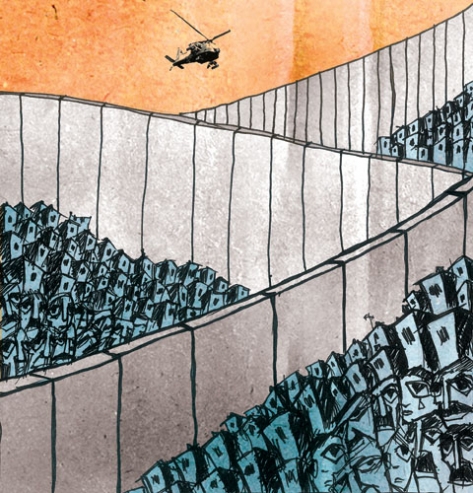
Up against the wall: challenging Israel’s impunity
Jamal Juma’, The Electronic Intifada, 24 February 2010
Six years ago, we were busy preparing for the start of the hearings of the International Court of Justice (ICJ) in The Hague. The world’s highest court was to decide on the legal consequences of Israel’s wall in the occupied West Bank, which together with the network of settlements, military zones and Jewish-only roads annexes around 46 percent of Palestinian West Bank land. The court’s decision, months later, was clear: Israel’s wall is illegal, it needs to be torn down and the international community has an obligation to ensure that it is dismantled.
A victory? Not quite. Until today, neither foreign governments nor the UN have joined the Palestinian communities who have been destroyed by Israel’s wall in their efforts to dismantle it. Still, Palestinian villages show incredible perseverance and creativity in protesting the theft of their land and tearing down pieces of the cement blocks or iron fencing. They do so in the face of overwhelming repression.
The year 2004, when the court was deliberating the case, marked the first wave of repression aimed at the grassroots movement mobilizing against the wall. The key features of the Israeli attacks consisted of killings, mass injuries, arrests and collective punishment measures such as curfews, the closing of access to the villages protesting the wall and the denial of permits for farmers and workers to reach their jobs and lands beyond the wall or the “green line,” the internationally-recognized boundary between Israel and the occupied West Bank. The villages in northwest Jerusalem bore the brunt of Israeli violence.
Today the movement against the apartheid wall is once again in the crosshairs of Israeli repression.
A wave of serial arrests of well-known grassroots human rights defenders began this past summer and escalated in September 2009. A vocal advocate of Palestinian rights, Mohammed Othman, youth coordinator of the Stop the Wall Campaign, was arrested in September when he returned from a speaking tour in Norway. At the beginning of December, Abdullah Abu Rahmah, a key figure in organizing the weekly protests against the wall in the Palestinian village of Bilin, was arrested during a night raid at his home. In mid-December, I was arrested from my home by Israeli forces and taken to an interrogation center where I was kept for one month and then released without charge — a reprisal for my public outcry against Israel’s policies that have reduced Palestine to a number of isolated Bantustans behind cement walls.
We were all interrogated, threatened and intimidated while held in the deplorable conditions of Israeli jails. Othman was released just a day after me, but Abu Rahmah remains in detention.
Similar scenes are playing out in all villages protesting against Israel’s wall across the occupied West Bank. In the Palestinian village of Nilin, to date, Israeli soldiers have shot five persons dead, including a 10-year-old boy, and severely injured almost 500 individuals. Since the beginning of 2010 more than 20 have been arrested.
The arrests do not just focus on active members of the popular committees. Children and minors are particularly targeted because their arrest puts pressure on their families and the community at large. Further, being more vulnerable, Israeli intelligence officers often arrest children to recruit them as collaborators. Lately, in a number of cases, family members of wanted activists have been arrested to pressure those activists to turn themselves in.
Neither I nor other activists in the Stop the Wall Campaign have ever attempted to hide our longtime work as critical voices against Israeli apartheid and the architecture of its occupation. Based on the efforts of the popular committees in each Palestinian village, the Stop the Wall Campaign has been a public and central force of research, analysis and regular news dispatches from our “front line” — our bodies, our voices and our villages up against the wall.
Popular committees have been the basic structure of Palestinian social and political organizing for generations. The creeping criminalization of this social organizing structure therefore not only infringes our right to freedom of expression and association but risks creating a “politicide” and would, if successful, destabilize Palestinian society at its core. During the last six months, this has become Israel’s goal.
In September 2009, at the time when the UN-commissioned Goldstone report was to be officially adopted by the UN Human Rights Council, Palestinian civil society showed its strength in front of Israel and an all-too-compliant Palestinian Authority (PA). The report also contains a chapter describing the sharp increase in Israeli use of force against Palestinians in the West Bank — especially at demonstrations against the wall — during and after the Gaza assault.
The Goldstone report also describes the brutal tactics with which the PA attempted to beat down Palestinian internal dissent at the time. Mahmoud Abbas, president of the Ramallah-based PA, attempted to suppress the findings of the Goldstone report, which corroborates Palestinian and international eyewitness testimonies of war crimes committed by Israel during its invasion of Gaza last winter. After the PA’s action at the Human Rights Council in September 2009, Abbas was met by a hefty uproar within Palestinian society and, eventually, pressured by its own constituents, the PA redacted its position on Goldstone.
Especially now that the president’s mandate is expired (since 26 January — which itself was extended for a year under emergency measures), the PA is keenly aware that it is not strong enough to challenge a united Palestinian society, calling for Israel to be held accountable for its crimes. It is clear that Israel also understands this balance of power and has concluded that Palestinian civil society is a force to be reckoned with and therefore should be weakened, if not eliminated.
In a situation where our top leadership is both de jure out of office and de facto too weak to stand up to Israeli and international pressure to defend our interests, such a weakening of civil society would allow Israel even more room to continue its crimes with impunity.
From the bombs dropped in Gaza on an entrapped civilian population, the repression against human rights defenders and the expansion of illegal settlements in the occupied West Bank and East Jerusalem, to the broad-daylight theft of land and construction of the wall, Israel remains a state that is not held accountable to international law.
Yet there is a window of opportunity opening up in defense of law and Palestinian human rights. In the coming months, the European Union (EU) and its member states will negotiate a new “Action Plan” to implement the EU-Israel Association Agreement.
The fact that this agreement is enacted at all sheds doubts over the acumen of the EU decision-makers: the agreement with Israel seems a contradiction in terms, as article two renders the agreement conditional upon compliance with human rights law and democratic principles. However, to keep a veneer of respect for its own rules and regulations, the EU has started up a “political dialogue” with Israel on its violations of human rights. The result of more than five years of discussions is not only disheartening for Palestinians but also embarrassing for the EU as the only result ever recorded for this “dialogue” is the “willingness” of Israel to talk about the issues.
At last, there seems to be some discontent within EU diplomatic circles about the fact that Israel not only disrespects all human rights and international legal obligations but even imprisons those who try to defend these rights, at a national level and through international advocacy. Yet without sustained civil society pressure, this change in perception will be absorbed into meaningless expressions of “concern,” and no action will be taken.
Member states of the EU have given valuable support to the campaign to release Mohammed Othman and myself. Yet far more decisive pressure from Europe needs to be forthcoming, not just from governments but also from European civil society, to force Israel to change its policies. As long as the EU member states uphold their cooperation agreements with Israel, hide the 2004 International Court of Justice decision against the wall under the carpet, and are unwilling to implement the recommendations of the Goldstone report — even at risk of losing their own credibility — more Palestinian human rights activists will be arrested, detained, tortured, or killed.
An active civil society is a key component of any democratic society and without it justice in Palestine and the rest of the region will remain as elusive as ever.
Jamal Juma’ is a coordinator of the Stop the Wall Campaign. For more information on the campaign visit stopthewall.org.
Featured Video

AIDS Inc. by Gary Null (2007)
or go to
Aletho News Archives – Video-Images
From the Archives
Clash of Civilization, Iran Part II
By Jamal Kanj – Intifada-Palestine.com – January 14, 2011
Israel’s survival kit is: perpetuate conflict, insecurity to rationalize collective hate and finally playing victim.
Devoid of conflict, Israel implodes internally; without hate, Zionism loses its justification; and playing eternal victim to continue blackmailing the West. Absence of this holy trinity, Israel ceases to exist.
From its inception, the house of Zion has mastered exploiting adversarial powers to advance Israel’s cause. For instance, their influence over the Democratic Party in the US began with President Truman’s bid for 2nd term election in 1948.
Responding to strong opposition from Secretary of State General George Marshall and Department experts urging against recognition of Israel, President Truman replied: “I’m sorry gentlemen but I have to answer to hundreds of thousands [Jewish voters] who are anxious for the success of Zionism. I do not have hundreds of thousands of [voting] Arabs among my constituents”
Zionists influence over liberal American politics was matched with the doctrinal school of Conservative theoreticians aligning the Republican Party’s platform with Israel’s objectives. The Neoconservative Zionists, coined Zioncons, invented the “Clash of Civilization” concept to fight Israel’s wars. … continue
Blog Roll
 Aletho News
- 12 Things Your Psychiatrist Was Trained Not to Tell You
- From Unipolar Universalism to Multipolar Civilizational Distinctiveness
- RSF military group defects, joins Sudanese army: State media
- Ireland goalkeeper refuses to play ‘Israel’ as squad weighs boycott
- China pushes back against US on Cuba, Iran
- Ukrainian Soldiers, Potential Mercenaries: Have Gun, Will Travel!
- Burnham’s UN debut… A masterclass in British disinformation
- Iran flights continue despite US aviation sanctions
- Global Tipping Points Lead the World Into a State of Entropy
- The day-after at the White House: USA and Xi Jinping
- If Americans Knew
- Israel forces Gazans to live in constant peril – Daily Update
- Deconstructing Netanyahu’s pants-on-fire UN rant – Daily Update
- Trump betrayed voters with his campaign lies and prioritized a foreign country once he took office
- Netanyahu calls Israel’s war in Gaza ‘opposite of genocide’ in UN speech to near-empty hall
- Settler Kidnappings: Torture, Sexual Abuse and Terrorisation of Palestinian Abductees as Israel Deepens Annexation of West Bank
- Gaza winter nears as 162,000 tents become unusable, raising fears of humanitarian crisis
- Netanyahu says, “It’s the opposite of genocide”; UN says Gaza economy is world’s ‘most severe crisis on record’ – Daily Update
- Israel’s US-Backed Assault on Gaza Has Created the ‘World’s Most Severe Economic Crisis on Record’: UN
- ‘Protecting U.S. Citizens’… From Israel
- ‘This is where I live now, the back of a truck’: a day in the life of a grandmother in Gaza
- No Tricks Zone
- New Study: Earth And Venus Surface Warmth Largely Explained By Convection And Lapse Rate, Not CO2 Or Radiation
- 2025 Nature Paper Claiming Worsening Global Drought Gets RETRACTED …Heavily Flawed
- New Study: ‘Global Drought Shows No Detectable Recent Acceleration Under Climate Warming’
- Economic Masterminds: German Socialists Suggest Taxing Productivity Gains Stemming From Using AI
- The South China Sea Has Not Been Cooperating With The Climate Change Narrative
- Energy Crisis: Germany Enters Heating Season With Historically Low Gas Reserve Fill Levels
- New Study: The Antarctic Ice Sheet Gained Mass From 2020-2024 Due To Staggering Snow And Ice Accumulation
- Study: Ocean Heating Rates From Thousands Of Years Ago ‘Dwarf’ Modern Ocean Heating Rates
- Climate Extremists Target, Attack Large-Scale Power Grid Infrastructure In Germany!
- New Study: Antarctic Ice Melt Has Contributed Less Than 1 Centimeter To Sea Level Rise In The Last 30 Years

