Fiasco In Islington, Part 2

Gilad Atzmon
By Richard Hugus | December 26, 2018
More facts have come to light in the case of Gilad Atzmon and his banning by the Islington Town Council from performing at a jazz concert on December 21, 2018. The original scenario was that one e-mail from one person calling Atzmon an antisemite somehow persuaded the Islington council to take the drastic step of removing Atzmon from a town-owned venue. Many who heard the story felt this was a rash decision which would surely be reversed when the facts were brought to light. But the Council voted to uphold its decision and Atzmon was indeed not allowed to play.
Now it appears that the single complainant – Martin Rankoff – was not just an anonymous fan of Israel but the UK director of Likud-Herut. Herut (or ‘freedom’) was Israel’s founding nationalist party from 1948 until it later merged with Likud. It is a militant and extreme Zionist organization whose roots go in a straight line from Ze’ev Jabotinsky and Menachem Begin up to Benjamin Netanyahu today. Jabotinsky and Begin helped form the Irgun terrorists in 1937. Irgun committed notorious massacres in Palestine leading up to and during the Nakba (or ‘catastrophe’) of 1947-1948. These include the bombing of the King David Hotel in Jerusalem in 1946, killing 91 people, and the massacre at Deir Yassin in 1948 in which 254 unarmed Palestinian villagers were brutally murdered as an incentive for other Palestinians to leave. On its web site Likud-Herut UK lists Jabotinsky and Begin as “visionaries.” Likud-Herut is a member of the World Zionist Organization and the Zionist Federation of the UK who believe in “the inalienable right of all Jews to live and settle in all parts of the Land of Israel.”
In a letter to the New York Times in 1948 Albert Einstein, Hannah Arendt, and others compared Herut to the Nazis and Fascists who had just been defeated in World War II. Referring to this letter, Ramzy Baroud recently wrote, “the ‘Nazi and Fascist’ mentality that defined Herut in 1948 now defines the most powerful ruling class in Israel. Israel’s leaders speak openly of genocide and murder, yet they celebrate and promote Israel as if an icon of civilization, democracy and human rights.”
–
The history of Herut and Likud tells us a great deal about who the people are who complained about Atzmon to Islington Town Council. When Atzmon moved to appeal his being banned, formidable opponents again appeared in the form of the Simkins Law firm, one of the most expensive law practices in Britain, with not one but two partners at Simkins being put on the case. These are Gideon Benaim and Tom Iverson. Benaim recently became well known in Britain for winning an invasion of privacy suit against the BBC on behalf of pop singer Cliff Richard, who said he spent £3.4m ($4.3 million) on the case. Clearly, representation by Simkins doesn’t come cheap. Also listed in Benaim’s resumé as a client is the Las Vegas Sands Corporation which likely has no problem with Simkins’ fees either. The Sands casino is owned by billionaire Sheldon Adelson, who, as it happens, is a primary sponsor of the Likud Party in Israel, led by Benjamin Netanyahu. Adelson owns the newspaper Israel Hayom, a mouthpiece for Netanyahu and Likud.

American businessman and investor Sheldon Adelson with Prime Minister Benjamin Netanyahu at the ceremony of a laying of a cornerstone for new Medicine Faculty buildings at the Ariel University in the West Bank, on June 28, 2017. Photo by Ben Dori/Flash90
It now appears that Atzmon’s banning was not the result of a casual complaint; it was an intentional attack on a well-respected supporter of Palestinian human rights by the Likud organization, directly represented by Martin Rankoff. The attack was followed up by the hiring of a lawyer who has worked for Likud godfather Sheldon Adelson. The connection to these powerful forces may explain why Islington Town Council leader Richard Watts, without any delay or attempt at negotiation, took the step of going straight to a decision to hire an expensive law firm. This is while Islington is facing serious austerity and shortage of funds in its own operating budget. Islington has a population of about 206,000 people. This very month, 43 of those people were counted in one survey as homeless and sleeping on the streets.
Regarding the financial problems of his borough and others around London, Richard Watts, told The Independent in October 2018 :
“unprecedented” funding pressures and demand for adult and children’s social care and homelessness services was “pushing councils to the limit”.
“As a result less money is being spent on the other services that keep our communities running such as libraries, local roads, early intervention and local welfare support,” he added.
Yet, to Watts and his fellow councilors in Islington, backing partisans for a foreign country -Israel- took precedence over the pressing needs of the people whom they are supposed to represent. Either Watts was inexcusably careless with scarce town funds or a deal was made and he knew that he could depend on Likud-Herut to back him. Or, like politicians all across Europe and the US facing the power of the Israel lobby, he knew he couldn’t afford to say no.
According to Simkin’s web site, Gideon Benaim “has extensive expertise in the areas of defamation, privacy, harassment and copyright.” Perhaps it is not a coincidence that immediately after Islington brought in Simkins, identical statements from an unnamed Labour spokesman describing Atzmon as “a vile antisemite” appeared in both the BBC and The Guardian. Perhaps a lawyer experienced in defending people against defamation and harassment would also know how to perpetrate these things. Perhaps this was Benaim’s opening move. Character assassination is a common tactic in cases that have a weak legal foundation, such as this one, as it goes a long way to convicting the accused before their case ever reaches a courtroom.
The involvement of Likud-Herut in the attack on Gilad Atzmon, and Islington’s official backing of that attack, constitutes a monumental scandal. This wasn’t just a stupid mistake; it was a hit. It is an affront to reason that an an arch-racist organization like Likud, who from the beginning have stood for the removal of the people of Palestine from their own land by means of terror, murder, and forced expulsion, could possibly claim they they were defamed by someone pointing out these very crimes. There is a case of defamation here for sure – the defamation of Gilad Atzmon. For Zionists, defamation is nothing more than a tool to destroy opponents who can’t be dealt with by other means. We are long since tired of truth tellers being accused of antisemitism. We’re tired of national and local resources being used to prop up the criminal state of Israel. Coercion by advocates for Israel is at the center of this issue in Islington, as it is in many other towns and many other countries. For the sake of Palestine and our own sovereignty, it has to be called out and stopped.
To sign a petition in support of Gilad click here
Lodge a formal complaint with Islington Council: https://www.islington.gov.uk/contact-us/comments-and-complaints?status=inprogress
Email: assemblyhall@islington.gov.uk
Contact the Council: +4420 7527 2000
To support Gilad’s legal battles: https://donorbox.org/gilad-needs-additional-support
Inside Banksy’s The Walled Off Hotel in Bethlehem
We check in to Banksy’s bizarre Palestinian hotel, where the hospitality is as peculiar as the message is powerful

By Jonathon Cook – The National – December 21, 2018
Anonymous British street artist Banksy made headlines in October when his $1.4 million artwork Girl with Balloon self-destructed by passing through a shredder concealed in its frame at a London auction moments after it had been bought.
But in the Palestinian city of Bethlehem, a much larger Banksy art project – a hotel boasting “the worst view in the world” – appears to be unexpectedly saving itself from similar, planned destruction.
When it opened in March last year, The Walled Off Hotel – hemmed in by the eight-metre-high concrete wall built by Israel to encage Bethlehem – was supposed to be operational for only a year. But nearly two years on, as I joined those staying in one of its nine Banksy-designed rooms, it was clearly going from strength to strength.
Originally, The Walled Off Hotel was intended as a temporary and provocative piece of installation art, turning the oppressive 700-kilometre-long wall that cuts through occupied Palestinian land into an improbable tourist attraction. Visitors drawn to Bethlehem by Banksy’s art – both inside the hotel and on the colossal wall outside – are given a brief, but potent, taste of Palestinian life in the shadow of Israel’s military infrastructure of confinement.
It proved, unexpectedly, so successful that it was soon competing as a top tourist attraction with the city’s traditional pilgrimage site, the reputed spot where Jesus was born, the Church of the Nativity. “The hotel has attracted 140,000 visitors – local Israelis, Palestinians, as well as internationals – since it opened,” says Wisam Salsa, the hotel’s Palestinian co-founder and manager. “It’s given a massive boost to the Palestinian tourism industry.”
Exception to Banksy’s rule
The Walled Off Hotel was effectively a follow-up to Banksy’s “Dismaland Bemusement Park”, created in the more familiar and safer setting of a British seaside resort. For five weeks, that installation in Weston-super-Mare, Somerset, England, offered holidaymakers a dystopian version of a Disney-style amusement park, featuring a nuclear mushroom-cloud, medical experiments gone wrong, boat people trapped on the high seas and the Cinderella story told as a car crash.
But unlike Girl with Balloon and Dismaland, Banksy appears uncharacteristically reluctant to follow through with the destruction of his Bethlehem creation. Some 21 months later, it seems to have become a permanent feature of this small city’s tourist landscape.
Given that Banksy is notoriously elusive, it is difficult to be sure why he has made an exception for The Walled Off Hotel. But given his well-known sympathy for the Palestinian cause, a few reasons suggest themselves. One is that, were he to abandon the hotel, it would delight the Israeli military authorities. They would love to see The Walled Off Hotel disappear – and with it, a major reason to focus on a particularly ugly aspect of Israel’s occupation. In addition, dismantling the hotel might echo rather uncomfortably Israel’s long-standing policy of clearing Palestinians off their land – invariably to free-up space for Jewish settlement.
Israel strenuously claims the wall was built to aid security by keeping out Palestinian “terrorists”. But the wall’s path outside The Walled Off Hotel seals off Bethlehem from one of its major holy sites, Rachel’s Tomb, and has allowed Jewish religious extremists to take it over.
A rare success story
In sticking by the hotel, Banksy appears to have been influenced by Palestinian “sumud”, Arabic for steadfastness, a commitment to staying put in the face of Israeli pressure and aggression. But significantly, there is a practical consideration: The Walled Off Hotel has rapidly become a rare success story in the occupied territories, boosting the struggling Palestinian economy. That has occurred in spite of Israel’s best efforts to curb tourism to Bethlehem, including by making a trip through the wall and an Israeli checkpoint a time-consuming and discomfiting experience.
Israel’s attitude was highlighted last year when the interior ministry issued a directive to travel agencies warning them not to take groups of pilgrims into Bethlehem to stay overnight. After an outcry, the government relented, but the message was clear.
Salsa notes that The Walled Off Hotel has not only attracted a new kind of visitor to Bethlehem, but has also persuaded many to spend time in other parts of the occupied West Bank, too.
Salsa understands the importance of tourism personally. He was an out-of-work guide when mutual friends first introduced him to Banksy in 2005, shortly after the wall cutting off Bethlehem from nearby Jerusalem had been completed. The city was economically dead, with tourists too fearful to visit its holy sites as armed uprisings raged across the occupied territories. The Second Intifada from 2000-2005 was the Palestinians’ response after Israel refused to grant them the viable state most observers had assumed was implicit in the Oslo Accords of the 1990s.
Banksy arrived in 2005 to spray-paint on what was then a largely pristine surface, creating a series of striking images. It unleashed a wave of local and foreign copycats. The wall in Bethlehem quickly became a giant canvas for artistic resistance, says Salsa.
Much later, in 2014, Banksy came up with the idea of the hotel. Salsa found a large residential building abandoned for more than a decade because of its proximity to the wall. In secret, The Walled Off was born. “It was a crazy spot for a hotel,” says Salsa. “It felt like divine intervention finding it. It was close to the main road from Jerusalem so no one could miss us.”
Palestinians’ reality
Importantly, the hotel was also in one of the few areas of Bethlehem inside “Area C”, parts of the West Bank classified in the temporary Oslo Accords as under full Israeli control. That meant the army could not bar Israelis from visiting. “Nowadays there are no channels open between Palestinians and Israelis. So The Walled Off Hotel is a rare space where Israelis can visit and taste the reality lived by Palestinians.
“True, Israelis mostly come to see the art. But they can’t help but learn a lot more while they are here.”
Salsa is happy that the Walled Off Hotel provides a good salary to 45 local employees and their families. His hope in setting up the hotel was to “encourage more tourists to stay in Bethlehem and for them to hear our story, our voice”.
But Banksy’s grander vision had been fully vindicated, he says. “The Walled Off Hotel gives tourists an experience of our reality.
“But it also emphasises other, creative ways to struggle and speak up. It offers art as a model of resistance.
“The hotel magnifies the Palestinian’s voice. And it makes the world hear us in a way that doesn’t depend on either us or the Israelis suffering more casualties.”
Global impact
The hotel’s continuing impact was underscored last month when it featured for the first time at the Palestinian stand at the annual World Travel Market in London, the largest tourism trade show in the world. The event attracts 50,000 travel agents, who conduct more than $4 billion in deals over the course of the show.
Banksy had announced beforehand that he would bring a replica of one of his artworks on the wall just outside the Bethlehem hotel: cherubs trying to prise open two concrete slabs with a crowbar. He also promised a limited-edition poster showing children using one of Israel’s military watchtowers as a fairground ride. A slogan underneath reads: “Visit historic Palestine. The Israeli army liked it so much they never left!” As a result, there was a stampede to the Palestinian stand, one of the smallest, that caught the show’s organisers by surprise.
Rula Maayah, the Palestinian tourism minister, praised Banksy for changing the image of Palestinian tourism by diverting younger people into the West Bank, often during a visit to Israel. “He promotes Palestine and focuses on the occupation, but at the same time he is talking about the beauty of Palestine,” she said.
At the Walled Off Hotel, however, Israel has made it much harder to see the beauty. Most windows provide little more than a view of the wall, which dwarfs in both height and length the Berlin Wall to which it is most often compared. That is all part of the Walled Off “experience” that now attracts not only wealthier visitors keen to stay in one the hotel’s rooms, but a much larger audience of day trippers.
So successful has the Walled Off Hotel proved in such a short space of time that even some locals concede it upstages the Church of the Nativity – at least for a proportion of visitors. A local taxi driver who was guiding two French sisters along the wall outside the hotel said many independent tourists now prioritised it ahead of the church.
Only wanting to be identified as Nasser, he said: “We may not know who Banksy is, but the truth is, he has done us a huge favour with this hotel and his art.”
Sanctuary in a police state
If Dismaland created a dystopian amusement park in the midst of a fun-filled seaside resort, the Walled Off Hotel offers a small sanctuary of serenity – even if a politically charged one – in surroundings that look more like a post-apocalyptic police state.
Along the top of the wall, there are innumerable surveillance cameras, as well as looming watchtowers, where ever-present Israeli soldiers remain out of view behind darkened glass. They can emerge unexpectedly, usually to make raids on the homes of unsuspecting Palestinians.
When I made a trip to the Walled Off in October, I parked outside to find half a dozen armed Israeli soldiers on top of the hotel’s flat roof. When one waved to me, I was left wondering whether I had been caught up in another of Banksy’s famous art stunts. I hadn’t. They were real – there to watch over Jewish extremists celebrating a religious holiday nearby at Rachel’s Tomb.
The hotel’s lobby, though not the rooms, are readily accessible to the public. It is conceived as a puzzling mixture: part cheeky homage to the contrived gentility of British colonial life, part chaotic exhibition space for Banksy’s subversive street art. Visitors can enjoy a British cream tea, served in the finest china, sitting under a number of Israeli surveillance cameras wall-mounted like hunting trophies or alongside a portrait of Jesus with the red dot of a marksman’s laser-beam on his forehead.
A history of resistance
The lobby leads to a museum that is probably the most comprehensive ever to document Israel’s various methods of colonisation and control over Palestinians, and their history of resistance.
At its entrance sits a dummy of Lord Balfour, the foreign secretary who 101 years ago initiated Britain’s sponsorship of Palestine’s colonisation. He issued the infamous Balfour Declaration promising the Palestinians’ homeland to the Jewish people. Press a button and Balfour jerks into life to furiously sign the declaration on his desk. Upstairs is a large gallery exhibiting some of the best of Palestinian art, and the hotel reception organises twice-daily tours of the wall.
Entry to the rooms is hidden behind a secret door, disguised as a bookcase. Guests need to wave a room key, shaped like a section of the wall, in front of a small statue of Venus that makes her breasts glow red and the door open.
A stairway leads to the second and third floors, where the landings are decorated with more fading colonial splendour and Banksy art. Kitsch paintings of boats, landscapes and vases of flowers are hidden behind tight metal gauze of the kind Israel uses to protect its military Jeeps from stone-throwers.
A permanent “Sorry – out of service” sign hangs from a lift, its half-open doors revealing that it is, in fact, walled up.
No mementos
Although the rooms are designed thematically by Banksy, only a few contain original artworks, most significantly in the Presidential Suite.
Hotels may be used to customers taking shampoos and soaps, even the odd towel, as mementos of their stay. But at the Walled Off, the stakes are a little higher. Guests are issued with an inventory they must sign on departing, declaring that they have not pilfered any art from their room. But it is the wall itself that is the dominant presence, towering over guests as they come and go, trapping them in a narrow space between the hotel entrance and an expanse of solid grey.
A proportion visit the neighbouring graffiti shop, Wall Mart, where they can get help on how to leave their mark on the concrete. Most of the casual graffiti is short-lived, with space regularly cleared so that new visitors can scrawl their messages and use art as a tool of resistance.
Protest pieces
Banksy’s better-known artworks, however, are saved from the spray-paint pandemonium elsewhere.
The crowbar-armed cherubs he brought to London were painted in time for Christmas last year, when he recruited film director Danny Boyle – of Slumdog Millionaire fame – to stage an alternative nativity play for local families in the hotel car park. The “Alternativity”, featuring a real donkey and real snow produced by a machine on the Walled Off’s roof, became a BBC documentary. Banksy had once again found a way to persuade prime-time TV to shine a light on Israel’s oppressive wall.
Another artwork is his “Er sorry”, a leftover from the Walled Off’s “apologetic street party” of November last year, marking the centenary of the Balfour Declaration’s signing. Children from two neighbouring refugee camps were invited to wear Union-Jack crash helmets and wave charred British flags. A person dressed as Queen Elizabeth II unveiled “Er Sorry” stencilled into the wall. It served both as a hesitant apology on behalf of Britain and as a play on the initials of the Queen’s official Latin title, Elizabeth Regina.
The event, however, illustrated that Banksy’s subversive message, directed chiefly at western audiences, does not always translate well to sections of the local Palestinian population. The party was hijacked by local activists who stuck a Palestinian flag into the Union Jack-adorned cake and chanted “Free Palestine”.
Is this ‘war tourism’?
Salsa outright rejects claims from some locals and foreign critics that the hotel is exploiting Palestinian misery and is an example of “war tourism”.
He points out: “The Balfour party got the media interested in a story they probably would not have covered otherwise, because it lacked violence and bloodshed.”
He adds that the area of Bethlehem in which the Walled Off is located would have been killed off by the wall were it not for Banksy investing his own money and time in the project. As well as the staff, it has brought work to tour guides, taxi drivers, neighbouring and cheaper hotels, shops and petrol stations. “That is a very important form of resistance,” he says.
It is also a rare example of Palestinians reclaiming land from the Israeli army. On the other side of the wall there had been a large army camp until the hotel started drawing significant numbers of visitors.
“The army didn’t like lots of tourists taking pictures nearby, so they moved further away, out of sight.”
Eternal memories
Canadian tourist Mike Seleski, 30, visited the hotel to see Banksy’s art before standing in front of the wall. He said he had heard about the Walled Off from an Israeli he befriended in Vietnam during a year travelling.
This was a detour from his stay in Israel – his only stop in the occupied territories. “I don’t like the usual tourist experiences,” he said. “It is important to hear the other side of the story when you travel.”
In every one of the 32 countries he has visited, he has stood to be photographed before a famous local spot holding a cardboard sign with words to reassure his worried mother: “Mum – I’m OK.”
In Bethlehem, he said it was obvious he’d take the photo in front of Banksy’s art on the wall, rather than the Church of the Nativity. “You see the wall on TV and forget about it. You get on with your life. But when you stand here, you realise Palestinians don’t have a choice. They simply can’t ignore it.”
Be Offensive and Be Damned: The Cases of Peter Ridd and Tim Anderson
By Binoy Kampmark | Dissident Voice | December 20, 2018
It has been an ordinary year for universities in Australia. While the National Tertiary Education Union pats itself on the back for supposedly advancing the rights and pay of academics, several face removal and castigation at the hands of university management. Consumerism and pay are the sort of quotidian matters that interest the NTEU. Less interesting is the realm of academic ideas and how they clash with the bureaucratic prisons that have been built into universities.
At James Cook University, Peter Ridd was sacked on “code of conduct” grounds applied with a delightful elasticity. He claimed that it was for holding views on climate change out of step with his colleagues, and attacking the credibility of the Australian Institute of Marine Science and the ARC Centre of Excellence for Coral Reef Studies. (The pettiness of such institutions knows no bounds: Ridd’s knuckles were rapped, for instance, for satirising, trivialising or parodying the university.)
At the University of Sydney, Tim Anderson, a full time critic of Western interventions in the Middle East and acquitted for ordering the 1978 Sydney Hilton Hotel bombing, has been suspended pending what would seem to be imminent sacking. Causing “offense” was what mattered.
A cardinal rule applies in this case: Be suspicious of those who use good behaviour as a criterion of policing, notably in an environment where bad behaviour and dangerous ideas should hold sway over meek bumbling and submissiveness. Be wary of the demands to be vanilla and beige – behind them lies administrative venality and the dictates of compliance.
Such rubbery provisions as being “civil” or not causing offense shield the weak, spineless and fraudulent and, most dangerously, create the very same intolerable workplace that managers are supposedly opposed to. Very importantly, such code of conduct regulations are designed to immunise management from questions about their behaviour and often daft directives, letting institutions grow flabby with corruption. Inoculated, that class thrives in its toxicity.
The Deputy Vice-Chancellor of JCU, Iain Gordon, has drawn upon the usual stock nonsense defending the decision regarding Ridd. “The issue has never been about Peter’s right to make statements – it’s about how he has continually broken a code of conduct that we would expect all our staff to stick to, to create a safe, respectful professional workplace.” The thrust of this is simple: Never cause offense; be compliantly decent; be cripplingly dull and go back to your homes in your suburbs living a life unexamined. As an academic, you are merely delivering a service mandated by individuals several steps removed from the education process, not performing an ancient duty to educate mankind.
The code of conduct, the product of a corporatized imbecility, assumes the mantle of dogma in such disputes. “All staff members must comply with the Code of Conduct,” goes Gordon’s official statement in May, with its distinct politburo flavour of placing things beyond debate. “This is non-negotiable. It is a fundamental duty and obligation that forms part of their employment.” Ridd, explains Gordon, “sensationalised his comments to attract attention, has criticised and denigrated published work, and has demonstrated a lack of respect for his colleague and institutions in doing so. Academic rebuttal of his scientific views on the reef has been separately published.”
Anderson, having found himself at stages in the University of Sydney’s bad books, has also run the gauntlet of offensiveness. The specific conduct resulting in his suspension featured lecture materials shown to students suggesting the imposition of a swastika upon Israel’s flag. This was deemed “disrespectful and offensive, and contrary to the university’s behavioural expectations”. Tut, tut, Anderson.
The Sydney University provost and acting vice-chancellor Stephen Garton followed the line taken at JCU towards Ridd with zombie-like predictability. “The university has, since its inception, supported and encouraged its staff to engage in public debate and it has always accepted that those views might be controversial.” But debate – and here, behavioural fetters were again to be imposed – had to be undertaken “in a civil manner.” Contrarianism should be expressed with a good measure of decency.
The letter of suspension from Garton to Anderson is one-dimensionally authoritarian. Principles of academic freedom were supported by the university, but only in “accordance with the highest ethical, professional and legal standards”. But the all supreme, and trumping document, remained the Code of Conduct, capitalised by the bureaucrats as Mosaic Law. “The inclusion of the altered image of the Israeli flag in your Twitter Posts, Facebook Posts and teaching materials is disrespectful and offensive, and contrary to the University’s behavioural expectations and requirements for all staff.”
Some heart can be taken from the protest last Friday on the part of 30 academics who signed an open letter objecting to the treatment meted out to Anderson, stating that academic freedom was “meaningless if it is suspended when its exercise is deemed offensive.” His suspension pending termination of his employment was “an unacceptable act of censorship and a body-blow to academic freedom at the University of Sydney”. Reaction to Ridd has been somewhat cooler.
The point with Anderson is that his views are deemed bad for university business, which tolerates no room for the offensive. This, in a place where the most varied, and, at points, tasteless views, should be expressed. But as universities have become shabby entrepreneurial endeavours which see students as obesely delicious milch cows for their existence, the idea is less important than the process.
As is so often the case of free speech, advocates of it always assume it doesn’t apply to others. It is only to be extolled as a mark on paper and university policy. But never, for instance, challenge inane university policy or the hacks who implement it. Never ridicule ideas that deserve it. Never mock the obscene nature of managerialism’s central principle: massaged incompetence and assured decline. University managers and the colourless suits aided by their ill-tutored human resources goon squads tend to hold sway over opinions, taking against anybody who questions certain aspects of their (non)performance.
The Ridd and Anderson cases, coming from separate parts of the academic spectrum, demonstrate the prevalence of toadyism on the part of those who wish to avoid questioning the rationale of a university’s management process. They also suggest an immemorial tendency of authority to savagely oppress those who ignore it; to manifest its existence through punishment. In truth, it is precisely in ignoring those officials long barnacled upon the research and teaching endeavours of the University and drawing revenue best spent on students and scholars that a grave sin is committed. Such officialdom should be ignored, treated as the bureaucratic irrelevance that it is. Time for sit-ins, occupations, boycotts and a retaking of the University.
Binoy Kampmark was a Commonwealth Scholar at Selwyn College, Cambridge. He lectures at RMIT University, Melbourne and can be reached at: bkampmark@gmail.com.
Let’s Boycott Israel and Its Friends
If you want change, begin to play hardball

By Philip Giraldi • Unz Review • December 18, 2018
In his recent article “Averting World Conflict with China” Ron Unz has come up with an intriguing suggestion for the Chinese government to turn the tables on the December 1st arrest of Meng Wanzhou in Canada. Canada detained Mrs. Meng, CFO of the world’s largest telecoms equipment manufacturer Huawei, at the request of the United States so she could be extradited to New York to face charges that she and her company had violated U.S. sanctions on Iran. The sanctions in question had been imposed unilaterally by Washington and it is widely believed that the Trump Administration is sending a signal that when the ban on purchasing oil from Iran comes into full effect in May there will be no excuses accepted from any country that is unwilling to comply with the U.S. government’s demands. Washington will exercise universal jurisdiction over those who violate its sanctions, meaning that foreign officials and heads of corporations that continue to deal with Iran can be arrested when traveling internationally and will be extradited to be tried in American courts.
There is, of course, a considerable downside to arresting a top executive of a leading foreign corporation from a country that is a major U.S. trading partner and which also, inter alia, holds a considerable portion of the U.S. national debt. Ron Unz has correctly noted the “…extraordinary gravity of this international incident and its potential for altering the course of world history.” One might add that Washington’s demands that other nations adhere to its sanctions on third countries opens up a Pandora’s box whereby no traveling executives will be considered safe from legal consequences when they do not adhere to policies being promoted by the United States. Unz cites Columbia’s Jeffrey Sachs as describing it as “almost a U.S. declaration of war on China’s business community.” If seizing and extraditing businessmen becomes the new normal those countries most affected will inevitably retaliate in kind. China has already detained two traveling Canadians to pressure Ottawa to release Mrs. Meng. Beijing is also contemplating some immediate retaliatory steps against Washington to include American companies operating in China if she is extradited to the U.S.
Ron Unz has suggested that Beijing might just want to execute a quid pro quo by pulling the licenses of Sheldon Adelson’s casinos operating in Macau, China and shutting them down, thereby eliminating a major source of his revenue. Why go after an Israeli-American casino operator rather than taking steps directly against the U.S. government? The answer is simple. Pressuring Washington is complicated as there are many players involved and unlikely to produce any positive results while Adelson is the prime mover on much of the Trump foreign policy, though one hesitates to refer to it as a policy at all.
Adelson is the world’s leading diaspora Israel-firster and he has the ear of the president of the United States, who reportedly speaks and meets with him regularly. And Adelson uses his considerable financial resources to back up his words of wisdom. He is the fifteenth wealthiest man in America with a reported fortune of $33 billion. He is the number one contributor to the GOP having given $81 million in the last cycle. Admittedly that is chump change to him, but it is more than enough to buy the money hungry and easily corruptible Republicans.
In a certain sense, Adelson has obtained control of the foreign policy of the political party that now controls both the White House and the Senate, and his mission in life is to advance Israeli interests. Among those interests is the continuous punishment of Iran, which does not threaten the United States in any way, through employment of increasingly savage sanctions and threats of violence, which brings us around to the arrest of Meng and the complicity of Adelson in that process. Adelson’s wholly owned talking head National Security Adviser John Bolton reportedly had prior knowledge of the Canadian plans and may have actually been complicit in their formulation. Adelson has also been the major force behind moving the U.S. Embassy to Jerusalem, has also convinced the Administration to stop its criticism of the illegal Israeli settlements on Arab land and has been instrumental in cutting off all humanitarian aid to the Palestinians. He prefers tough love when dealing with the Iranians, advocating dropping a nuclear bomb on Iran as a warning to the Mullahs of what more might be coming if they don’t comply with all the American and Israeli demands.
Meanwhile another Israeli, Haim Saban has performed similar work with the Democrats, contributing $5 million to their coffers, making him the top donor to the party. Saban has said that he is a “one issue guy, and my issue is Israel.”
Of course, one might reasonably argue that America’s problem with Jews who are passionately attached to Israel funding and controlling the major political parties is self-generated, that no one should be allowed to fund any political party to such an extent that one obtains control over policies. But that is an argument that will have to be directed at the Supreme Court, which permitted corporations to be treated as persons with its Citizens United ruling, allowing virtually unlimited money to flow into political PACs as a First Amendment right.
The lopsided wag-the-dog relationship with Israel is so dangerous to actual American interests in so many ways that the United States is now approaching a precipice and might soon find itself plummeting to ruin. Israel, not Russia, constantly interferes in the functioning of America’s remaining democracy. Fighting Israel’s wars and protecting it from any criticism have debased the value of being an American citizen and literally impoverished the country under a mountain of debt. The U.S. has been victimized by terrorism, much of which can be traced back to Israeli roots, and Washington is now isolated globally as the United States has become more and more like Israel, a militarized state, politically corrupt and abandoning basic liberties.
How does one right the sinking ship? For starters, the Ron Unz formula for correcting the problem with China provides an excellent roadmap. Israel and its friends do not have a grip on congress, the White House and the media because they are wonderful warm people that others find to be sympathetic. It is difficult even to imagine a scintillating conversation with a malignant toad like Sheldon Adelson. Israel’s ability to corrupt and misdirect is all based on Jewish money, a process in which Zionist oligarchs buy their way to power and access. So the solution is to hit back where it really hurts – boycott Israel and Israeli products and do the same for the companies that are the sources of income for the American Jews who are the principal supporters of the Zionist project.
The United States Congress is currently moving to make it illegal to openly advocate boycotts of Israel or even to inquire about doing so, while 25 states have already also done the same to a greater or lesser extent. Last week a speech therapist in Texas was fired from a job she had held for nine years because she refused to sign an oath affirming that she would not boycott Israel. It is a measure of Jewish power in the U.S. that American politicians choose to provide cover for Israel’s misdeeds even if it means the end of the First Amendment and free speech. But punitive steps intended to intimidate any and all critics of Israel aside, there is no reason why consumers cannot exercise judgement over what they buy and what they are supporting through their spending. If you want to visit Las Vegas, by all means go, but don’t patronize the casinos and hotels owned by Sheldon Adelson, which include The Venetian and Sands Resort.
Democratic party major donor Haim Saban, meanwhile, is a producer of Hollywood children’s entertainment, including the lucrative Power Rangers. You can stop your children from watching his violent programming and tell the network’s advertisers why you are doing so. And then there are businessmen including Bernard Marcus, who is a co-founder of Home Depot and a major supporter of Israel, and Robert Kraft, owner of the New England Patriots. No one really has to spend $1000 to go to a football game, particularly if the owner is a good friend of Benjamin Netanyahu, and if you need something for your home or are seeking entertainment, choose to spend your dollars somewhere else. Readers can do the homework for the businesses and services that they normally patronize. If outspoken advocates for Israel own the company, take your dollars elsewhere.
As it is nearly impossible in the United States to vote for a politician who is in any way critical of Israel, those who are opposed to the terrible damage that the Israelis and their domestic lobby are doing to the U.S. can instead vote with their purchasing power. It does not afford the same pleasure as “throwing the bums out,” but there will be considerable satisfaction in being able to strike back against a powerful lobby that is so hubristic and insensitive to any criticism that it has become completely tone deaf.
Apart from domestic considerations, observers have noted that Israeli treatment of the Palestinians has been worse than apartheid under South Africa yet South Africa was subjected to multiple boycotts and bans on its participation in international fora, to include even sporting competitions. It is past time to do the same to Israel, which has been shooting dead hundreds of unarmed Palestinians for months now without paying any price at all. Boycotting Israel internationally is a good start. It is non-violent and proportionate and it just might be an idea that will spread and finally bring about some payback for what Prime Minister Benjamin Netanyahu and his cabal of war criminals have done and continue to do. As the end of 2018 approaches, it would be something to look forward to if 2019 just might turn out to be the year of the international Israel Boycott.
Philip M. Giraldi, Ph.D., is Executive Director of the Council for the National Interest, a 501(c)3 tax deductible educational foundation that seeks a more interests-based U.S. foreign policy in the Middle East. Website is http://www.councilforthenationalinterest.org, address is P.O. Box 2157, Purcellville VA 20134 and its email is <a:inform@cnionline.org” title=”mailto:inform@cnionline.org” href=”mailto:inform@cnionline.org”>inform@cnionline.org</a:inform@cnionline.org”>.
What Does Israel ‘Occupy’?
By Blake Alcott | Palestine Chronicle | December 17, 2018
In what is written and said about Israel and Palestine the word ‘occupation’ is ubiquitous. But what territory, exactly, is the ethnocratic state occupying? Is it just the Gaza Strip and the West Bank, or all of Palestine?
Everybody agrees that the territories Israel took over in 1967 are occupied. However, both pro-Palestinians and liberal Zionists routinely write of ‘the Occupation’ or ‘occupied Palestine’ to refer to these territories only. The demeaning acronym ‘OPT’ means only the West Bank and Gaza Strip only. But if those territories are ‘occupied’, then by the same token so is the 80% of historic Palestine called ‘Israel’. All of Palestine has been taken over.
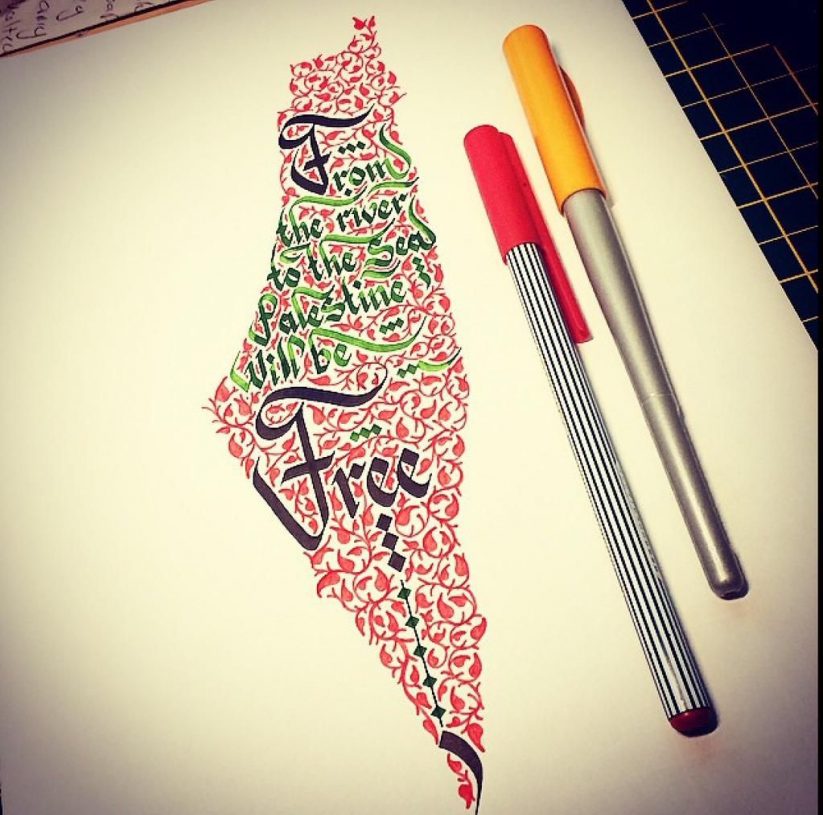
When we demand freedom ‘from the river to the sea’ what are we demanding other than an end to rule, control, and occupation by a non-indigenous Power? When Palestinians use the term ihtilal they always distinguish between the ‘1948 occupation’ and the ‘1967 occupation’. Why, then, does the international discourse in Western languages ignore the 1948 occupation, in denial of the fact that Israel in 1948 merely took over from the British-Mandate occupation of 1917-1948?
Palestine was a British colony, and all colonies by definition are occupied by the colonial Power. And indeed, when we correctly and routinely call Britain’s successor Israel a ‘settler-colony’ we are not just referring to the West Bank and Gaza Strip. Especially since it is thoroughly supported by pro-Zionist forces outside of historic Palestine, all of Palestine is now a settler-colony and thus occupied from the river to the sea. And if the settler-colonialist paradigm is accurate, all non-indigenous Israelis are ‘settlers’, not just those in the West Bank. If we talk of boycotting ‘settlement goods’, that should mean all Israeli goods.
Does this matter? Yes: If it is only the West Bank and Gaza Strip that are occupied, then the rest of Palestine ‘within the Green Line’, is not occupied, and if it is not occupied, what is it then? It can then only be rightfully controlled by Israel, for if you are not ‘occupying’ a territory, it must be yours. Using the term limited to the 1967 occupation thus implies that the Europeans who colonized Palestine under British protection for thirty years are the rightful owners of the land of Palestine. The basic premise of Zionism is conceded.
That is, withholding the epithet ‘occupation’ from today’s Israel normalizes the Zionist Entity’s presence; it pulls the rug out from underneath Palestinian claims to political rights in Palestine. As Colonial Minister Churchill and High Commissioner Samuel wrote in their pathbreaking 1922 White Paper on the Palestine question, one worldwide outside ethno-religious group is in Palestine “by right and not on sufferance” and thus cannot be an Occupier.
Which Narrative?
Denying implicitly in this way that Israel occupies the lands taken over in 1948 is thus a key part of the Zionist narrative that Jews own Palestine, while the diametrically opposing Palestinian narrative claims that rightful ownership lies with the indigenous inhabitants (whatever their ethnicity or religion). It insists that this is the territorial and historical ‘self’ entitled to realize self-determination in non-partitioned Palestine. If moreover, this political ‘self’ consists of all Palestinians, they are all ‘occupied’, and the logic in calling only West Bank or Gazan land ‘stolen’ undermines the unity of all Palestinians.
We similarly identify Israel as an ‘apartheid’ state, exercising and enacting discriminatory separation not only on the Palestinians in ‘Israel proper’ and in the West Bank and Gaza Strip, but as well on the 6 or 7 million Palestinians residing outside of Palestine – as Richard Falk and Virginia Tilley argued in their UNESCWA report in 2017. The Green Line upon which the restricted use of the concepts ‘occupation’ and ‘apartheid’ would rely is historically, ethically and emotionally irrelevant.
A third, ‘liberal-Zionist’ narrative also contends that Israel is occupying only what it took over from the Egyptian and Jordanian occupiers in 1967. This diverges from the Jewish-Israeli mainstream in at least admitting it, but it leaves Israel intact – although, sadly, bereft of ‘Judea and Samaria’. This soft Zionism certainly takes comfort in seeing that some Palestinians and many of their supporters join them in granting that the Jewish state is not guilty of occupying the 1948 territories.
The fatal consequence of this limited use of ‘the Occupation’, in whichever camp, is the implication that once Israel quits doing its occupying of 20% of Palestine (and a part of Syria), as far as its relations with its neighbors goes it reverts to a normal, well-behaved state. The use of this central term is thus a litmus test. If limited to the West Bank and Gaza Strip, Israel is normalized.
A common-language Definition
In common parlance, a state is ‘occupying’ territory if, first, a force or a state has come in from outside the territory in question. Second, that force has established military and political hegemony in that territory. Third, this happens against the will of the indigenous inhabitants.
The second and third conditions obtain in the entirety of Palestine. Disputed is only whether Israel was a force that moved into ‘1948’ Palestine from the outside. Or was it somehow already there? Was it by 1948 somehow also ‘indigenous’, in which case the situation should be described not as an ‘occupation’ but as a victory in a civil war – as the Israeli narrative indeed describes it? Even though the European-Jewish community was obviously vastly ‘less indigenous’ than the Palestinians in terms of length and unbrokenness of habitation, perhaps on 15 May 1948 it suddenly became legitimate.
However, left to their own devices after freed from the Ottoman occupation in 1918, the Palestinians would, by the early 1920s, certainly have constituted their state covering all of Palestine – or perhaps a single sovereign Greater Syria would have emerged covering al-sham, i.e. historic Palestine plus today’s Lebanon, Syria, and Jordan. But instead, outsiders from and in Britain occupied it.
But were the Jewish Agency and its military arm the Haganah, together renamed ‘Israel’ in May 1948, any different from Britain in terms of coming from the outside? The overwhelming majority of Jews in Palestine as of that date was, after all, very recent European immigrants, and given near-unanimous indigenous opposition based on justified fear of political takeover, a necessary condition for their implantation was thirty years of support by colonial Power Britain. ‘British bayonets’ both fostered Jewish military strength and, especially during the years of the 1936-39 Revolt, crushed Arab military as well as political potential. Without this enablement by Britain and its fellow Powers, the self-described Jewish entity would not have had a shred of a plausible claim to statehood in any part of Palestine at the time of the decisive debates of 1947 leading to the Partition Resolution of the UN General Assembly (Resolution 181).
In other words, the most realistic picture of the forces taking over Palestine is of a British/European-Jewish amalgam functioning during three entire decades. It is one occupation, an overlapping transfer of power from protector to protected.
By the way, even the usurped 55% of Palestine recommended for the “Jewish State” by the General Assembly majority had a slight indigenous non-Jewish majority of 509,780 to 499,020 if the 105,000 Bedouins living there were counted, a fact that strengthens the notion of an outside occupier rejected by a majority.
What about the territory conquered during 1948 over and above that 55% granted by the outsiders at the UN, amounting to about half the area it granted to the “Arab State”? Certainly, by any criterion, it is ‘occupied’ – taken by force without even a pretense of legitimacy. It is thus especially egregious to exclude it from the term OPT, the more so as it included the almost-totally indigenous Galilee.
To be consistent and coherent, there is thus no way around terming the whole territory ‘within’ the 1949 armistice line ‘occupied’. As Uri Davis wrote in 1972 in the Journal of Palestine Studies, he “first had to come to grips with the fact that, essentially, the right-wing Zionist contention that there was no essential difference between the colonization of Tel Aviv and Jaffa prior to and immediately after 1948, and the colonization of Hebron in 1967, was correct.”
Examples of the Problem
The Quakers in Britain recently decided to quit supporting the “occupation… now in its 51st year”, thus dating this “illegal occupation” from 1967 only. The other 80% is thus not occupied and of necessity ‘legal’, under legitimate Israeli control. In consequence, since it is this 51-year occupation that motivates the Quakers, they will cease boycotting Israeli goods when the occupation of the West Bank and Gaza Strip is ended, whatever the fate of the other Palestinians. This results from distinguishing between a boycott of ‘settlement-complicit’ goods and the blanket boycott of Israel that would target the source of the problem and be a true successor to the blanket boycott of South Africa which brought down Apartheid.
Another example is the discourse of the large US-based organization which starting in 2001 called itself the “US Campaign to End the Israeli Occupation”. It fought for most Palestinian rights, but as its name suggested most strongly against the occupation of the 1967-occupied areas. Perhaps aware that having ‘Israeli Occupation’ in its title lent implicit recognition to Israel’s permanency, in 2016 it changed its name to “US Campaign for Palestinian Rights”. However, its “common principles” and “Factsheet” still make it clear that the term “military occupation” refers only to what Israel took over in 1967, for conceptually it treats the refugees and the “Palestinian citizens of Israel” separately. Its use of “settlements” refers likewise consistently only to the West Bank.
Part and parcel of this narrative, moreover, is this US Campaign’s support for “all relevant UN resolutions”. This must include the soft-Zionist position of Security Council Resolution 242 which cements the Green Line and the Jewish state on one side of it. The group is also careful to criticize only “Israel’s policies and practices”, not its right to be in Palestine in the first place. Finally, its reference to the “illegal West Bank colonies” implies that the earlier Jewish Agency/Israeli colonization of the bulk of Palestine was legal.
A final example of an ‘occupation’ narrative leaving room for an Israel legitimately present in Palestine is an article in Haaretz on 29 November 2018 by Gideon Levy entitled “Why I am obsessed with Israel’s occupation of the Palestinians”. Said occupation is again that of the West Bank and Gaza Strip. Its main victims, to be sure, are “the Palestinians”, but it also “harms” an Israel worth saving because of its “crucial impact on our daily lives and on the image of this country.”
Referring to Israel’s culture-loyalty, nation-state, nakba, citizenship, and anti-BDS laws Levy even claims that “In the absence of the occupation, all these laws would be redundant.” I interpret this to mean that for him Israel’s worst crime is its treatment of the West Bank and Gaza Strip – a view certain to disappoint the roughly three-quarters of Palestinians living in Israel or outside of Palestine.
Counter-arguments
I have challenged various speakers on their restricted use of the term. The most common answer is that one can’t apply it to all of Palestine because by that logic California – or all of North America, or Australia – would be ‘occupied’.
My first reaction was ‘So what? So be it. If it’s true, deal with it.’ But more deeply, or unconsciously, this answer takes the indigenous conquered less seriously than they deserve, for how could any Native American say anything but Yes, Europeans moved in, took over and occupied their lands? If meant as an assertion that the world’s settler-colonies are somehow legitimate, this is not post-Zionism but simply Zionism.
Another answer is that ‘occupation’ is a specific term in international law and should not be watered down by broader use. But to the extent the term is defined at all in international law, it is not useful for a political discussion; it is only a backdrop for humanitarian rules for treating occupied people in armed conflicts between states.
And in general, terms such as ‘occupation’ which function perfectly well in common and historical language should not be co-opted for specialist purposes. In fact, routinely using the term ‘illegal’ to characterize the 1967 occupation and the ‘settlements’ there – as does even the BDS Movement – doesn’t just imply that the rest is legal, but detracts from more important ethical and political dimensions.
A third answer is that we should not use our terms in ways that regard Palestinians as one polity because this erases the Green Line. The division of Palestine gives (a limited number of) Palestinians leverage at international institutions and courts to plead within the mainstream narrative as political, if not military, equals. The danger of this ‘parity pitfall’ cannot be covered here, but it definitely belongs to the liberal-Zionist narrative that the Israeli state of the two-state solution is rightful.
Israel’s Illegitimacy
The basic, fatal effect of co-opting the Arabic term ‘occupation’ for the 1967 territories only is its implication that a non-occupying, non-Palestinian ethnic state is in legitimate, or at least acceptable, ownership of the rest. This is not compatible with Palestinian self-determination, liberation of the Land, right of return, or anti-Zionism.
In terms of the fashionable ‘rights-based approach’, it is likewise not compatible with all the rights of all the Palestinians because it normalizes the Zionist premise that, ethically, at least in part of Palestine indigenous wishes can be ignored. If this premise is rejected, on the other hand, the Zionist Entity is occupying all of Palestine.
We often advise ourselves to watch our words carefully. Israel spends millions to tailor certain words to serve its goals – ‘right to exist’, ‘return’, ‘democratic and Jewish’, and ‘anti-semitism’ being a few examples – and those in solidarity with Palestine should take a page out of that approach and ask whether the word ‘occupation’ is not worth utmost care.
Both logically and in the context of actively arguing for Palestinian self-determination, joining the Zionist narrative or even just indulging in ambiguity serve no purpose. The time is ripe to say that, if Palestine belongs to the Palestinians, it is not right that Israel occupies it.
Texas school pathologist files lawsuit after being denied work for refusing to sign pro-Israel oath
RT | December 17, 2018
A Texas elementary school speech pathologist has filed a federal lawsuit after her school district refused to renew her contract unless she signed a pro-Israel oath.
Bahia Amawi has worked for the Pflugerville Independent School District since 2009 on a contract basis. Each year when it came to the time to renew her contract, the school district did so. Amawi always signed the correct documents, and had another year of guaranteed employment.
But this year, in August, there was a new addition to the contract papers. That addition was an oath which Amawi was being asked to sign, promising that she “will not boycott Israel during the term of the contract” and will refrain from any action “that is intended to penalize, inflict economic harm on, or limit commercial relations with Israel, or with a person or entity doing business in Israel or in an Israel-controlled territory.”
That was a problem for Amawi, who, along with her family, refrains from buying goods from Israeli companies in support of the global boycott to end Israel’s occupation of the West Bank and Gaza.
But aside from that, Amawi noted that the very fact that this was the only oath she was being asked to sign – and it was to do with Israel – was extremely strange.
“It’s baffling that they can throw this down our throats, and decide to protect another country’s economy versus protecting our constitutional rights,” Amawi, who was born in Austria and is of Palestinian descent, told The Intercept.
She said it was entirely out of the question to sign such an oath, as it would not only be doing Palestinians a disservice, but also Americans.
“I couldn’t in good conscience do that. If I did, I would not only be betraying Palestinians suffering under an occupation that I believe is unjust…but I’d also be betraying my fellow Americans by enabling violations of our constitutional rights to free speech and to protest peacefully,” said Amawi, who has lived in America for the last 30 years and is a US citizen.
Additionally, the disabled, autistic, and speech-impaired students of Pflugerville Independent School District are also losing out. Those who speak Arabic are at a particular disadvantage, as Amawi says she is the only certified child’s speech pathologist in the district that speaks the language.
Amawi’s attorney has filed a lawsuit, alleging a violation of her First Amendment right of free speech.
The oath was produced under a pro-Israel Texas state law enacted on May 2, 2017, which bans state agencies from working with contractors who boycott Israel. When the bill was signed into law by Republican Governor Greg Abbott, he said that “any anti-Israel policy is an anti-Texas policy.”
The law is incredibly far-reaching, and meant that some Hurricane Harvey victims were told they could only receive state disaster relief if they signed the same kind of pro-Israel oath. The author of the bill, State Rep. Phil King, later said that its application to hurricane assistance was a “misunderstanding.”
However, Texas isn’t alone in requiring its contractors not to boycott Israel. A total of 26 states have enacted such laws, and similar bills are pending in 13 other states.
The state laws come as the Trump administration has repeatedly expressed its steadfast support for Israel, opting to recognize Jerusalem as the country’s capital last year. The move led to global protests and condemnation from other UN member states.
French Workers Go on General Strike in Support of Yellow Vests

French lawyers burn legal codes as part of a nation-wide strike against planned justice reform law. | Reuters
teleSUR | December 14, 2018
In solidarity with the popular ‘yellow vests’ movement, France’s workers have gone on national strike Friday, a move called by the General Confederation of Labor (CGT).
“The best way to protest is to go on strike,” the CGT’s Philippe Martinez told BFM TV Friday. “We must multiply actions at companies. We must strike everywhere.”
The French trade union announced the day of action Tuesday after negotiations with the government over unemployment benefits failed.
“The CGT, like the yellow vests, is fighting for claims on salaries, what (French president Emmanuel) Macron announced is not enough because there isn’t any general raise in salaries,” Union representative for health workers Francoise Doriate told Reuters.
“The minimum wage isn’t a minimum wage… the increase of an income tax on only a part of pensioners is a scam and there is a freeze on pensions which means we are losing buying power.”
On Monday, President Macron announced wage rises for the poorest workers and tax cuts for pensioners in further concessions meant to quell weeks of often violent protests that have challenged his authority. However, the government’s decision has been seen by some as a sham.
“Emmanuel Macron thought he could hand out some cash to calm the citizen’s insurrection that has erupted,” Jean-Luc Melenchon, leader of the far-left La France Insoumise, said. “I believe that Act V (of the protests) will play out on Saturday,” he said referring to a new round of protests planned this weekend.
The move to strike puts pressure on companies as labor unions use their collective power to create disruption just as demonstrators prepare for a fifth-weekend wave of protests across the country since the movement began Nov. 17.
“Of course it is not a question of shouting victory but of amplifying the mobilization: that is why all the general assemblies are maintained!” CGT leadership said in a statement.
The administration of Macron also declared a state of economic and social emergency Monday, and requested the cancellation of the ‘yellow vest’ protests this weekend, citing Tuesdays shooting in Strasburg in which three people were killed and 13 others wounded. Police killed the shooter late on Thursday.
Police have been cracking down on the protests using tear gas and water cannon and many fear that the government is preparing a major repression as the movement announces a fifth round of demonstrations.
The leadership of the CGT said the call to strike is in support of the social and wage demands driven by the popular movement of the yellow vests.
Tale of two uprisings: Ukraine’s Maidan got McCain & cookies, French Yellow Vests get shunned
By Robert Bridge | RT | December 13, 2018
Unlike the 2014 Ukraine uprising, which witnessed invasive meddling on the part of US politicians and diplomats, Western support for the French Yellow Vest protests has been conspicuously missing in action.
With the streets of Paris ablaze for a fourth weekend in a row, as a swarm of Yellow Vests assert themselves against a French government which, they argue, has become increasingly detached from the cares of ordinary citizens, support among Western capitals for the protesters is nowhere to be found.
This is a bit odd since the ‘gilets jaunes’ are not just protesting Macron’s (rescinded) plans for a fuel tax, but have released a list of 42 demands they want to see implemented. This includes an increase of the minimum wage, pensions and wages, as well as a halt to illegal immigration into the country. In other words, we are not talking about violent anarchists on the streets of France, but regular citizens. Thus far, the movement enjoys a high level of support among the French, with one poll showing 72 percent siding with the protesters.
The United States and its allies may have trouble explaining their tone-deafness in the face of these legitimate concerns on the part of millions of French citizens. At the very least, their icy silence will reveal a no small amount of double standards and outright hypocrisy since the West rarely misses an opportunity to interfere in the affairs of foreign states – mostly in the Middle East – when ‘democracy’ is purportedly on the line.
Consider Washington’s starkly different attitude to Ukraine’s 2014 Maidan revolution, which brought down the government of Viktor Yanukovich through the explicit support of the United States, as well as a number of influential NGOs operating in the country. Yanukovich committed the unforgivable mistake of thinking he would be allowed to pursue an independent course for his country, despite the fact that since 1992, the US had spent over $5 billion propping up ‘democracy-building programs’ in Ukraine.
Did Kiev really think that Washington would not eventually expect something in return for all those dollars, like maybe deciding who would eventually rule the Eastern European country on Russia’s border? And that is exactly what happened.
When Yanukovich signaled that he would not sign Ukraine up to an EU trade deal, he awoke a sleeping giant below his feet. Several weeks after the announcement, as his country was becoming increasingly divided over its options, the late US Senator John McCain appeared in central Kiev where he tossed dry wood on the smoldering fires by proclaiming at a rally on Independence Square, “Ukraine will make Europe better, and Europe will make Ukraine better… America is with you.”
What could have motivated Washington to pursue such blatant interference in the affairs of Ukraine, while ignoring the French ‘gilets jaunes’ that are now fanning out across France, protesting the neo-Liberal policies of President Emmanuel Macron? Could the answer have anything to do with something as simple as money? That certainly seems to be a large part of the equation.
After all, steering Kiev away from Russia, Western officials understood, would pay off handsome dividends for Western lending institutions, like the International Monetary Fund, which had already lent Kiev billions of dollars to stay afloat. The West was fiercely opposed to the idea of Russia and China becoming ‘lenders of last resort’, a financial and political function that the Western world covets more than any other, with the possible exception of military interventionism against sovereign states.
Fast forward one year after John McCain was agitating rallies in Kiev, and Victoria Nuland was handing out cookies to the protesters, and we find Ukraine, under the new leadership of the US-anointed President Petro Poroshenko, inking a $17.5bn (£11.5bn) loan deal with the IMF, together with the painful austerity measures that always accompany the bags of cash.
Presently, there are no such financial incentives in France that would convince Western capitals to ‘rally on behalf of democracy’ as it had done without delay in Ukraine.
This glaringly hypocritical position with regards to the French protesters reveals a deeply flawed, cart-before-the-horse Western axiom that commands: ‘whatever works to the advantage of Western institutions and its political elite is automatically good for democracy.’ This does not exclude social upheaval and revolution. If violence in the streets translates into the empowerment of Western institutions, not least of all the global financial institutions, then such actions will be rewarded with Western support without a moment’s thought.
Today, Emmanuel Macron, 40, the former Rothschild investment banker known as “president of the rich” by his countrymen, is facing the prospect of an early political demise, no less than Viktor Yanukovich faced in 2014.
Indeed, to say that Macron’s popularity among the French is in the toilet would be putting the situation mildly.
As one local English-language French magazine summed up his plight: Macron is “long-hated by the extreme-leftist groups because of his past as a banker… detested by the far-right because of his pro-European, globalist beliefs and now hated by many ordinary French people, who see him as arrogant, aloof and unsympathetic to their problems.”
Yet, not a single Western politician to date has appeared in the French capital, rallying the protesters and demanding Macron step aside; nor has any top-ranking US diplomat been spotted handing out cookies to the French rabble as Victoria Nuland did in Kiev at the height of Ukrainian tensions.
Incidentally, with such stark images in mind, it seems preposterous that the US can actually accuse Russia of meddling in its political affairs, and without a shred of evidence to back the claims. But I digress.
The simple reason that no Western country has come out to condemn Macron is because he toes the line on neo-liberalism and extreme free-market economics that has ravaged the French middle class to breaking point. The fuel hike was just the proverbial straw that broke the voters’ back.
It would be no exaggeration to say that all segments of French society have become caught up in the protests. Today we see hundreds of French schools, for example, shutting down as students take to the streets to protest Macron’s unpopular education reform. Pensioners are also counted among the protesters after Macron lectured them to stop “whining” about spending cuts, at the very same time he was slashing taxes for the wealthy.
Clearly, there is nothing about Macron that Western leaders can find not to their liking. He is carrying out painful liberal reforms with gusto, and only under pain of usurpation does he backpedal on his political program. Although the rudderless French president may fancy himself as a modern-age Napoleon, acting tough with his subjects to get what he wants, ultimately it will be the French street that decides his fate, which at the moment looks very bleak.
Such a brutal wake-up call may very well be in store for many more Western neo-liberal leaders, who fail to feel the pulse of their people when instituting their unpopular policies, in the weeks and months to come.
French opposition rejects Macron’s concessions to Yellow Vests, some demand ‘citizen revolution’
RT | December 11, 2018
Macron’s concessions to the Yellow Vests has failed to appease protesters and opposition politicians, such as Jean-Luc Mélenchon, who called for “citizen’s revolution” to continue until a fair distribution of wealth is achieved.
Immediately after French President Macron declared a “social and economic state of emergency” in response to large-scale protests by members of the Yellow Vest movement, promising a range of concessions to address their grievances, left-wing opposition politician Mélenchon called on the grassroots campaign to continue their revolution next Saturday.
“I believe that Act 5 of the citizen revolution in our country will be a moment of great mobilization.”
Macron’s promise of a €100 minimum wage increase, tax-free overtime pay and end-of-year bonuses, Mélenchon argued, will not affect any “considerable part” of the French population. Yet the leader of La France Insoumise stressed that the “decision” to rise up rests with “those who are in action.”
“We expect a real redistribution of wealth,” Benoît Hamon, a former presidential candidate and the founder of the Mouvement Génération, told BFM TV, accusing Macron’s package of measures that benefit the rich.
The Socialist Party’s first secretary, Olivier Faure, also slammed Macron’s financial concessions to struggling workers, noting that his general “course has not changed.”
Although welcoming certain tax measures, Marine Le Pen, president of the National Rally (previously National Front), accused the president’s “model” of governance based on “wild globalization, financialization of the economy, unfair competition,” of failing to address the social and cultural consequences of the Yellow Vest movement.
Macron’s speech was a “great comedy,” according to Debout la France chairman, Nicolas Dupont-Aignan, who accused the French President of “hypocrisy.”
Yet many found Melanchon’s calls to rise up against the government unreasonable, accusing the 67-year-old opposition politician of being an “opportunist” and “populist,” who is trying to hijack the social protest movement for his own gain.
The Yellow Vest protests against pension cuts and fuel tax hikes last month were organized and kept strong via social media, without help from France’s powerful labor unions or official political parties. Some noted that such a mass mobilization of all levels of society managed to achieve unprecedented concessions from the government, which the unions failed to negotiate over the last three decades.
While Israel Lobby Blocks BDS in Chile at the Local Level, National-Level BDS Looms
By Whitney Webb | Mint Press News | December 7, 2018
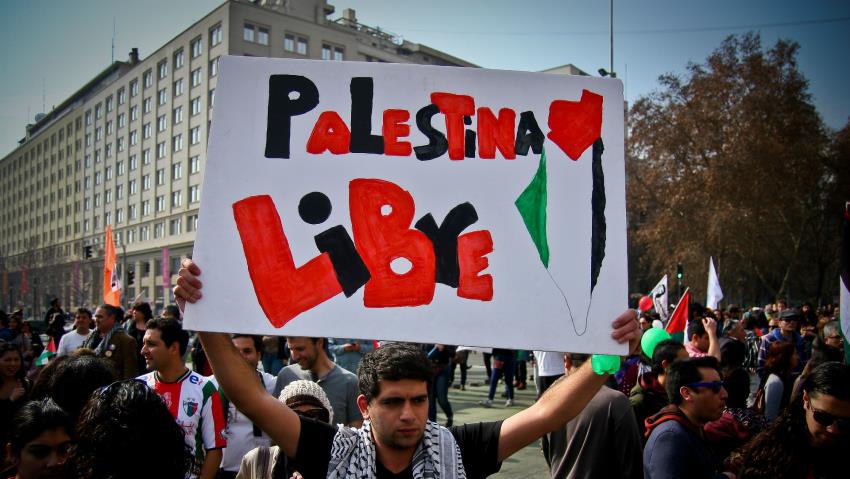
SANTIAGO, CHILE — After the Chilean city of Valdivia became the first municipality in Latin America to support the non-violent Boycott, Divest and Sanctions (BDS) movement this past June, the Chilean government has now ruled that it is illegal to boycott Israel at the municipal level throughout the entire country.
The decision was made by Chilean Comptroller Jorge Bermudez Soto on Wednesday after a long legal battle initiated by the Jewish Community of Chile (Comunidad Judía de Chile) over Valdivia’s decision to boycott Israel.
In June, Valdivia unanimously adopted a measure that specifically declared the municipality as an “Apartheid Free Zone” and prohibited the city from working with any business that benefits or is linked to Israel’s occupation of Palestine and/or Israel’s apartheid policy that targets Palestinians.
According to the text of the declaration, the ban on working with such businesses would remain in effect until Israel ends its occupation of Palestine and dismantles the border wall; until Palestinians are granted fundamental human rights by the Israeli state and are treated as equals under Israeli law; and until the right of return of Palestinian refugees is granted, as stipulated by UN Resolution 194. The initiative had been personally introduced by the city’s mayor, Omar Sabat, who is of Palestinian descent.
However, Bermudez Soto – in representing Chile’s national government – determined on Wednesday that, though the Chilean Constitution gives local governments independence on some matters, the head of the Chilean state has the exclusive right to conduct relations with foreign powers. As a result, Valdivia’s boycott of Israel was determined to be illegal.
Bermudez Soto also went on to state that Valdivia’s boycott violated Chilean law for failing to treat anyone participating in a government bidding process in an “equal and non-discriminatory” fashion. Most importantly, Bermudez Soto noted that this decision applies not only to Valdivia but to all Chilean municipalities, making it illegal to support BDS at the municipal level in Chile. As a result, the decision has made Chile the first country in Latin America to ban support for BDS at the local level.
Bermudez Soto’s language in his decision echoes the four legal complaints filed against Valdivia in June by various Zionist organizations in Chile and abroad. The Jewish Community of Chile, which filed three out of the four complaints, argued that Valdivia’s ban on services linked to the Israeli occupation of Palestine or illegal Israeli settlements violated Chilean laws on equality as well as discrimination in economic matters.
Powerful Zionist forces made Valdivia a target
Unsurprisingly, the Jewish Community of Chile has praised the move, claiming that it is the first step in creating a “Chile free from BDS.” Zionist organizations in the U.S. — including StandWithUs, whose controversial behavior was detailed in a recently leaked Al Jazeera documentary — have praised the Chilean government’s edict as “an example for the rest of the world.”
The Jewish Community of Chile is one of the most powerful organizations of the Zionist lobby in Chile, as it is the Chilean branch of the World Jewish Congress (WJC), an influential international Zionist organization that regularly hosts events with the Israeli government and supports illegal Israeli settlements in the occupied West Bank. The group’s current chairman is David de Rothschild and one of its vice presidents is Argentinian real estate magnate Eduardo Elsztain, who is very close to controversial Hungarian-American billionaire George Soros.
WJC, as evidenced by the presence of several billionaires on its leadership board, is extremely well-funded, with its U.S. offices alone reporting an annual revenue in excess of $22 million. Given the Jewish Community of Chile’s direct association with WJC, it is safe to assume that WJC helped foot the bill for the nearly six-month legal battle aimed at derailing Valdivia’s decision to support BDS in June.
Notably, without this legal action taken by the Jewish Community of Chile and other Zionist lobby organizations in Chile, the June decision to support BDS by Valdivia – a city whose population is under 150,000 – would have likely gone unchallenged.
Prospects good for national BDS action
While the declaration of the illegality of BDS support at the municipal level is being treated by Zionist groups within Chile and beyond as a “BDS fail,” other recent actions at the national level in Chile suggest that Chile could soon follow Ireland and become the next country to support BDS as a nation.
On November 27, the Chilean Congress approved a resolution demanding that the Chilean government “forbid the entry of products manufactured and coming from Israeli colonies in occupied Palestinian territory,” in a vote with 99 in favor and seven against. The resolution mandated that the government explore how a boycott could be implemented nationwide, an important step towards the future passage of a nationwide boycott of Israel. It also recognized East Jerusalem as the capital of Palestine and accused Israel of being an apartheid state.
Given that the recent decision by Chile’s comptroller to make municipal support for BDS illegal relied on the lack of authority Chilean cities have in regards to foreign relations, the nationwide BDS law – which has a good chance of passing Chile’s Congress – could soon deliver a much larger victory for Palestinian rights activists — and one that could not be challenged on the same grounds that were used to nullify Valdivia’s support for the BDS movement.
Whitney Webb is a staff writer for MintPress News and a contributor to Ben Swann’s Truth in Media. Her work has appeared on Global Research, the Ron Paul Institute and 21st Century Wire, among others. She has also made radio and TV appearances on RT and Sputnik. She currently lives with her family in southern Chile.
“Yellow Vests” Protesters Gather in Brussels
Sputnik – 08.12.2018
According to a Sputnik correspondent, Brussels police had blocked the passage to certain busy streets in order to prevent groups of protesters from entering. Special units of the Brussels police are traveling across the city in trucks, while police are also patting down all suspicious individuals coming from the city’s train stations.
Brussels police on Saturday faced off against about 100 “Yellow Vests” protesters on Rue de la Loi, denying them access to the European Quarter, where the demonstrators intended to hold an unauthorised rally.
“Around 100 people have already been detained,” Brussels police spokeswoman Ilse Van De Keere said.
Law enforcement officers had already detained about 70 people earlier on suspicion that they intended to join protesters in various areas of the capital, Ilse Van De Keere told reporters.
On Saturday, Belgian police prepared a thousand special forces officers to combat riots in Brussels. As Ilse Van de Keere emphasised, police had “tried to contact the organisers of the protest rallies scheduled for Saturday to warn about unauthorised gatherings of people, but could not do this because they did not find anyone responsible for organising the protest”.
Many trains this Saturday did not stop at Brussels Central Station; Parc metro station is closed in the centre of the city near government offices. The rest of the city’s subway system is still functioning normally.
French Police Union Calls on Police to Join Yellow Vests’ Protests
Sputnik – 06.12.2018
After the surge in fuel prices in France, the so-called Yellow Vests movement has held protests, calling firstly on the government to lower the prices, and then also on French President Emmanuel Macron to resign. On Wednesday, the French National Assembly approved a moratorium on the planned fuel price hike.
The French labour union Vigi has called on its members working in the national police and in the Ministry of the Interior to start an indefinite strike on Saturday, joining the Yellow Vests movement. The statement was placed on Vigi’s Facebook page on Wednesday.
“The demands made by the Yellow Vests movement related to all of us. The time to organize legally and express solidarity with them for the benefit of all has come”, Vigi’s post reads. “We are being perceived as mercenaries, given bonuses for overtime work, but they cannot compensate for the decisions made by the government.”
The call is directed at “administrative, technical, scientific and state workers/cooks from the Ministry of the Interior”, according to the statement.
“Act IV” of the Yellow Vests’ protests, which is to start on Saturday, will make the government take precautions, as during the previous “Act III”, more than 260 people, including some 80 police, were injured. Earlier, French Interior Minister Christophe Castaner announced that he would reinforce security for next Saturday.
Michel Thooris, the head of the France Police labour union, said that the French government had failed to implement security measures in Paris, noting that “a majority of the French continue to back the movement”. She also highlighted that using the armed forces against civilians would indicate that France is heading towards a civil war.
The protests, which started as a movement against a hike in fuel prices, turned violent, leading to more than 600 people being injured and at least two deaths. The three-week demonstration forced the French government to drop the fuel tax rise from the 2019 budget.
“The government is ready for dialogue and is showing it because this tax increase has been dropped from the 2019 budget bill”, Edouard Philippe, the French prime minister, said on December 5.
Featured Video

Trita Parsi: Israel Set a Trap for Total War in the Region
or go to
Aletho News Archives – Video-Images
From the Archive
Zionism’s Violent Legacy
By Donald Neff | Washington Report On Middle East Affairs | January 1996
On January 4, 1948, Jewish terrorists drove a truck loaded with explosives into the center of the all Arab city of Jaffa and detonated it, killing 26 and wounding around 100 Palestinian men, women and children.[1] The attack was the work of the Irgun Zvai Leumi – the “National Military Organization,” also known by the Hebrew letters Etzel – the largest Jewish terrorist group in Palestine. The Irgun was headed by Revisionist Zionist Menachem Begin and had been killing and maiming Arabs, Britons and even Jews for the previous ten years in its efforts to establish a Jewish state.
This terror campaign meant that at the core of Revisionist Zionism there existed a philosophical embrace of violence. … continue
Blog Roll
 Aletho News
- Trita Parsi: Israel Set a Trap for Total War in the Region
- Trump’s Iran war is on an Israeli leash
- Saudi oil boss issues global supply warning
- Riyadh Says Its Oil System Is Intact. The Numbers Say Otherwise.
- Trump and Netanyahu Want to “Finish the Job” on Iran
- US ‘one-sided dictation’ not Iran’s beliefs makes rational talks impossible: Baghaei
- Iran’s Next Strike May Not Explode. It Could Shut You Down /Col Doug Macgregor
- Iran: US political targets legitimate if assassinations return
- Iraq shuts key border crossing with Iran under US pressure: Report
- Undersea Internet cables could be targeted in retaliation for attacks on Iran: IRGC deputy chief
- If Americans Knew
- The Israel Lobby’s Changing Fortunes
- AIPAC has become such a political liability that it’s shifting to a more “nimble” approach to buying politicians
- At least 160 Israeli settler attacks in 2 weeks
- Will Gaza’s Ancient Christian Community Disappear Forever?
- Israel’s vision of regional security rests on keeping Arab states weak
- Heidi Levine recounts how Palestinian youths helped save her in settler attack
- DAILY UPDATE: Latest essential news on Palestine, Israel, & region
- Trump’s Intensifying Sabotage of the ICC, for Israel’s Sake
- Israeli military detain US and UK volunteers in West Bank including Democratic NY politician Brad Lander
- Americans at National Conservatism Conference held in Israel this year criticize Israel
- No Tricks Zone
- E-Cars Reduce CO2 Emissions By Only 41% Compared To Internal Combustion Engine Vehicles
- Predictions Made By Renowned Climate Professor Over Past Decades Have Been Proven To Be Poor
- New Study Suggests Large Regions Of The Pacific Ocean Have Been Cooling For The Last 80 Years
- Germany’s Green Energy Debacle: High Energy Costs Force Kahla Porzellan to Close After 182 Years!
- New Study: 50 Years Of The Most Aggressive ‘Net Zero’ Policies Can Only Affect The Global Climate By 0.03°C
- US September “Heat” Was No Record…Many Records Set Decades Ago
- Latest European Green Energy Debacle; Portugal’s Largest Flagship Solar Park Insolvent!
- Green Energy Debacle: German Expert Professor Fritz Vahrenholt Warns Of Severe Economic And Social Consequences
- Two More Paleo Reconstructions Affirm Meters-Higher Sea Levels Across Ireland, Brazil 7000-6000 Years Ago
- New Study: Earth And Venus Surface Warmth Largely Explained By Convection And Lapse Rate, Not CO2 Or Radiation

