May welcomes Netanyahu despite atrocities against Palestinians
PressTVUK | Jun 8, 2018
“You shouldn’t be receiving this war criminal!”
Israeli Prime Minister Benjamin Netanyahu is welcomed by EU leaders during European tour but condemned by protestors for crimes against Palestinians at every turn. Amina Taylor files this report.
Israel scores painful own goal in run-up to the World Cup
By James M. Dorsey | The Turbulent World of Mideast Soccer | June 6, 2018
Argentina’s cancellation of a friendly against Israel because of Israeli attempts to exploit the match politically is likely to reverberate far beyond the world of soccer and spotlights the risks of Israeli efforts to persuade the international community to recognize Jerusalem as its capital.
The Argentinian decision suggests that despite the fact several countries, including East European nations, are debating whether to follow US President Donald J. Trump’s decision earlier this year to recognize Jerusalem as the capital of the Jewish state and move the US embassy to the city, Israel is likely to find it difficult to capitalize on the US move in ways that convincingly project widespread international support.
Even worse, the decision illustrates that efforts to force recognition could backfire.
The Argentinian move has buoyed the grassroots Boycott, Divestment Sanctions (BDS) campaign that seeks to isolate Israel in non-violent defense of Palestinian rights after Israel has made countering the movement one of its top foreign policy objectives.
“The cancellation of Israel’s ‘friendly’ match with Argentina is a boost to the Red Card Israel campaign, which has called on FIFA to expel Israel – as it expelled apartheid South Africa – due to its violations against Palestinian football and its disregard for FIFA statutes,” BDS said in a statement.
The cancellation is BDS’s greatest success to date. Before that, it had only persuaded a small number of artists and organizations to boycott Israel.
An online campaign late last year convinced New Zealand singer-songwriter Lorde to cancel a planned concert in Israel. She followed other artists who have cancelled performances, including Elvis Costello, Lauryn Hill and Gorillaz.
The Argentinian decision has prompted concern that it could become the model for similar efforts in the future. One immediate target could be Israel’s scheduled hosting next year of the Eurovision song contest.
Argentina decided to cancel the match in the run-up to this month’s World Cup in Russia after Israel insisted on moving it from the Mediterranean port city of Haifa, home to Israel’s best stadium, to Jerusalem as part of the Jewish state’s 70th anniversary celebrations. Tickets for the Jerusalem match had sold out quickly.
The Israeli embassy in Buenos Aires and Argentinian media said the decision was in response to a series of unidentified “threats and provocations” against star player Lionel Messi and his wife.
“Since they announced they would play against Israel, various terror groups have been sending messages and letters to players on the Argentina national team and their relatives, including clear threats to hurt them and their families. These included video clips of dead children,” said hard-line Israeli Culture and Sports Minister Miri Regev, whom many hold responsible for Israel’s public relations fiasco.
Ms. Regev was referring to video clips that had been circulated by the Islamic State, including pictures of Mr. Messi in an orange jumpsuit and ones that insinuated his beheading. A Palestinian campaign against playing the match in Jerusalem involved images of Mr. Messi’s white and sky-blue striped jersey stained with red paint resembling blood and threats to burn Messi posters.
The Palestine Football Federation (PFF) had early called on its Argentinian counterpart to cancel the match because of the move to Jerusalem, which it described as a violation of world soccer body FIFA’s principle of a separation of sports and politics.
PFF president Jibril Rajoub also urged Palestinian fans to burn pictures of Messi and replicas of his shirt if he played in the match in Jerusalem.
“He’s a big symbol so we are going to target him personally, and we call on all to burn his picture and his shirt and to abandon him. We still hope that Messi will not come,” Mr Rajoub said after talks with Argentinian diplomats based in the West Bank city of Ramallah prior to the cancellation.
It was FIFA’s ban on political interference in soccer that persuaded Argentine President Mauricio Macri to reject a request by Israeli Prime Minister Benyamin Netanyahu to pre-empt the cancellation of the match.
The Israeli failure to have the match played in Jerusalem strengthens not only the BDS movement.
It also boosts Mr. Rajoub’s so far unsuccessful effort to persuade FIFA and the International Olympic Committee to impose sanctions against Israel because of the Israeli settlements in occupied territory and travel restrictions on Palestinian players and other allegedly security-related measures that hinder the development of Palestinian soccer.
Mr. Rajoub and a liberal Israeli newspaper put responsibility for the soccer fiasco at the doorstep of Ms. Regev.
“She’s the main culprit for legitimizing Argentina’s decision not to come… Beyond squandering millions in taxpayer money, in forcing the game to move to Jerusalem, Regev displayed gross intervention… If the game had stayed in Haifa, it would have happened… There’s a saying that a thousand wise men can’t rescue a coin thrown into a well by a fool…. All it takes is one fool to burn down a forest,” said Haaretz reporter Uzi Dann in an article entitled, Who Needs BDS: Israel Scores Spectacular Own Goal in Argentina Soccer Fiasco.
“Instead of soccer, Miri Regev wanted politics and she got politics… It’s a great farce that gives immense momentum to the BDS campaign against Israel”, added Itzik Shmuli, a centre-left member of the Israeli parliament.
Israeli President Reuven Rivlin appeared to echo the sentiment by saying that “the politicization of the Argentinean move worries me greatly” even if he blamed the Argentinians for involving politics by cancelling the match.
Assertions by Israeli officials that the Argentinian decision had handed a victory to terrorism may go down well with hard-line public opinion in Israel as well as supporters of Israel across the globe but is unlikely to help Israel forge bridges to opponents of its policies or facilitate its efforts to get a broader international buy-in of its insistence that Jerusalem is the undivided capital of the Jewish state.
Israeli opposition leader Avi Gabbay pinpointed the potential fall-out of the cancellation of the match when he warned on Twitter: “We just absorbed a shot in the face. This is not just sports. This, unfortunately, could start an international tsunami.”
Dr. James M. Dorsey is a senior fellow at the S. Rajaratnam School of International Studies, co-director of the University of Würzburg’s Institute for Fan Culture, and co-host of the New Books in Middle Eastern Studies podcast. James is the author of The Turbulent World of Middle East Soccer blog, a book with the same title as well as Comparative Political Transitions between Southeast Asia and the Middle East and North Africa, co-authored with Dr. Teresita Cruz-Del Rosario, Shifting Sands, Essays on Sports and Politics in the Middle East and North Africa, and the forthcoming China and the Middle East: Venturing into the Maelstrom
Israel’s red card and own goal
By Yvonne Ridley | MEMO | June 7, 2018
Rotem Kamer, the vice president of the Israeli Football Association, has accused Palestinians of waging “football terror” after Argentina called off a friendly match in Jerusalem. Argentina’s move came after global protests fuelled by the killing and wounding of thousands of Palestinians taking part in the Gaza Strip’s Great Return March protests.
“We are seeing it as crossing a red line and we cannot accept it,” blustered Kamer, without a hint of irony. He and other key figures in the Zionist regime are outraged at the cancellation, especially after tickets for Saturday’s match against Israel sold out within 20 minutes. Criticising human rights and pro-Palestinian protesters, IFA Chairman Ofer Eini stormed, “The aim was to harm our country through soccer.” In fact, the aim of such civil action is to reverse Israeli apartheid and colonial oppression of the people of Palestine.
Israel’s President Reuven Rivlin described the news as “a sad morning for fans” and added his concern about the “politicisation” of Argentina’s decision. Prime Minister Benjamin Netanyahu, meanwhile, tried in vain to salvage the game in a telephone call to Argentinian President Mauricio Macri. His appeal was unsuccessful. Far-right Defence Minister Avigdor Lieberman accused Argentina of folding to “Israeli-hating anti-Semitic terrorist supporters.”
Netanyahu’s government is fuming after being denied the chance to showcase Jerusalem as its “undivided capital”. The decision by Netanyahu to switch the game from Haifa to the Teddy Kollek Stadium built on the site of an ethnically-cleansed Palestinian village, Al-Malha, clearly backfired. It was the switching of venues that many believe prompted Argentina to step back and cancel the match. Culture and sports minister Miri Regev lashed out at critics by claiming ludicrously that, “This is the same terrorism that caused the Munich massacre.”
However, Hugo Moyano, Second Vice President of Argentina’s Football Association (AFA), called the cancellation positive: “It was the right thing to do, it was not worth it,” he told Argentina’s Radio 10. “What happens in these places where so many people are killed cannot be accepted by any human being.” The decision was also welcomed by Argentine striker Gonzalo Higuain, one of the country’s highest-profile players, in an interview with the ESPN television network on Tuesday.
It must now be sinking in with Netanyahu, Rivlin, Eini, his sidekick Kamer and Regev that the Zionist State’s murderous policies have created this massive own goal. Furthermore, their self-righteous indignation and the absurd description of the cancellation as “terrorism” (Israel crying wolf again) conveniently overlooks the fact that Israel has itself crossed many red lines and introduced real terror on many levels when it comes to football, no matter whether it’s the professional game we are talking about, amateur matches or simply a knockabout among friends on the beach. Its murderous acts deserve much more than a paltry red card.
Here are just a few incidents to refresh Israeli memories of what real terror in football means:
13 January, 2009: Three Palestine national team players were killed in separate attacks during Israel’s military offensive against civilians in Gaza called Operation Cast Lead. Targeted within 72 hours of each other, Ayman Alkurd, who also played for his club Falasteen Al-Ryadi, was the first to be killed. Like his team-mates, his home was hit in an air strike. Fellow footballers Wajeh Moshtahe and Shadi Sbakhe, were killed in later Israeli strikes.
30 January 2013: Dzhabrail Aslanbekovich Kadiyev and Zaur Umarovich Sadayev were signed by the notorious Israeli club Beitar Jerusalem. Angry racist fans who regularly chant “Death to all Arabs” torched the club’s offices in protest at the Muslim signings. The club’s fans boast loudly that it has no Arab players. It has also changed its name to “Beitar Trump Jerusalem” in recognition of the US President’s controversial decision to move the US Embassy to the city and recognise it as the capital of Israel.
31 January 2014: Adam Jamous and Jawahar Halbiyeh live in Abu Dis in occupied Jerusalem. As they headed home after football practice they were shot in the legs without warning. Jawahar was shot seven times in his left leg, three times in his right leg, and once in the hand, while Adam was shot three times: twice in his left thigh, and another in his right. Doctors confirmed that neither of them will ever play football again.
9 July 2014: Avid football fans gathered at a beachside cafe in the Al-‘Izbeh area of Khan Younis to watch a FIFA World Cup qualifier between Argentina and the Netherlands. Israel had launched yet another war on Gaza two days earlier, blitzing 750 targets, but this area was not classed as a military zone and the young Palestinians settled down to watch the match in the belief that they were safe. Half an hour later, at 11.30pm, the cafe was shelled. Those killed were: Ahmed Astal, 18; Suleiman Astal, 16; Musa, 16, a cousin of the Astals; Mohammed Ganan, 24; Ibrahim Ganan, 25; Hamdi Sawalli, 20; Ibrahim Sawalli, 28; Salim Sawalli; 23 and Mohammed Fawana, 18.
16 July 2014: Just after 4pm and in the space of 40 seconds, four boys who had been playing football on the beach in Gaza City were killed after an Israeli gunboat fired two shells at them. Aged between seven and 11, two were named Mohammad, one was Zakaria and the youngest was Ahed. All were members of the extended Bakr family. Three others were also injured and given first aid by international journalists who witnessed the atrocity. Hamad Bakr, aged 13, had shrapnel in his chest; his cousin Motasem, 11, suffered head and leg injuries; and Mohammad Abu Watfah, 21, was hit by shrapnel in his stomach.
31 March 2018: This was the day when Israeli snipers killed 17 peaceful protesters at the Great Return March in the Gaza Strip and injured hundreds more. Those wounded included Palestinian footballer Mohammad Khalil whose career was ended after he was shot by an Israeli soldier in both legs. A player for Al-Salah FC, he was shot in his knee by a so-called butterfly bullet which exited one leg and hit his other knee, breaking the bone. He will never play another game of football again and is likely to be bedridden for months.
13 April 2018: Young footballer Attallah Fayoumi, 17, suffered a devastating leg injury after being shot. The wounds required urgent surgery but Israeli forces refused him permission to leave Gaza for a West Bank or Israeli hospital. As the seriousness of his condition worsened doctors were forced to amputate his leg, shattering his dreams of ever becoming a professional footballer.
There are those who believe that Israel deliberately targets Palestinian footballers and other athletes who draw favourable, international attention to Palestine as ambassadors of their sport. Whether traveling abroad from Gaza or moving across the West Bank they are subjected to Israeli interrogations at checkpoints and boundary crossings. In addition to movement restrictions, Israeli forces are suspected of deliberately targeting Palestinian footballers with live ammunition; the evidence is, indeed, mounting.
The Israel Defense Forces boasted during the Great Return March that, “Nothing was carried out uncontrolled; everything was accurate and measured, and we know where every bullet landed.” The army then quickly deleted its incriminating tweet as more evidence of war crimes by its soldiers came to light, but not before a copy was made by the human rights group B’Tselem.
According to Sami Abu Sneima, head of surgery at the European Hospital in the southern Gaza Strip, footballer Attallah Fayoumi is not the only case of a leg amputation since the peaceful protests began at the end of March. “Many people who were shot with live ammunition have had to have their upper or lower limbs amputated,” he explained.
The Ministry of Health in Gaza says the majority of injuries being attended to are in the lower limbs, and while most of the wounds are considered serious, hospitals run on a case-by-case basis. So far, 123 protesters have been killed, with more than 14,000 wounded, according to Palestinian hospital staff. At least 32 people, many of them below 25 years old, have had limbs amputated.
So while Israeli FA chief Ofer Eini claims that the move to get the Argentinian match cancelled was a deliberate attempt to harm the Zionist State he should reflect that no one was killed or injured in the process, unlike the heroic Palestinians taking part in the peaceful resistance of the Great Return March. If he and the thousands of Israeli football fans who’ve lost out really want to vent their anger and frustration at anyone at all, it should be Benjamin Netanyahu and his government’s inhumane treatment of the Palestinian people.
Palestinians thank Argentina for cancelling match with Israel
MEMO | June 6, 2018
Palestinians have thanked the Argentinian football team and star forward Lionel Messi for cancelling their friendly match with Israel scheduled for Saturday, according to the Palestinian Campaign for the Academic and Cultural Boycott of Israel (PACBI).
Football fans and Palestinian human rights supporters had urged the Argentinian team to cancel the match, set to take place in an Israeli stadium built on the ethnically cleansed Palestinian village of Al-Maliha in response to Israel’s violent response to peaceful protesters on the Gaza border that left over 120 dead.
Initially set to be held in Haifa, the Israeli government moved the match to the Jerusalem village, offering the organisers $760,000 in compensation. Israel was reportedly already paying Argentina $3 million to play the match as part of its celebrations to mark 70 years of its independence, when it forcibly expelled more than 750,000 Palestinians from their homes.
“This was all part of the Israeli apartheid regime’s sports-washing policy to use international sporting events to cover up its war crimes and egregious human rights violations against Palestinians. The fact that Argentina fans and human rights activists around the world succeeded in thwarting it gives us a lot of hope,” Omar Barghouti of PACBI said.
In a video message, the football team from the Palestinian town of Nabi Saleh, in the occupied West Bank, thanked Argentina and Lionel Messi. Nabi Saleh is home to Ahed Tamimi, the Palestinian minor serving months in an Israeli prison for slapping a heavily-armed Israeli occupation soldier invading her property.
“You scored a goal for freedom, justice and equality,” the video states.
Two-state solution is dead, Palestinian courage should spur international action
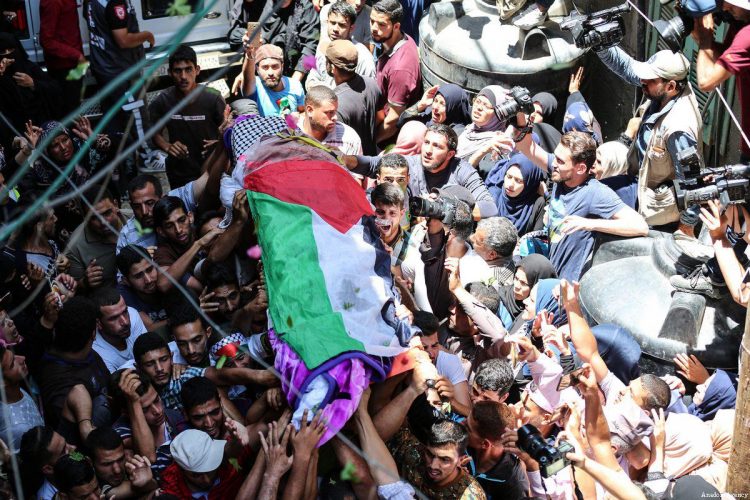
Palestinians attend the funeral of paramedic Razan Al-Najjar, 21, shot dead by Israeli forces while healing the wounded during ‘Great March of Return’ [Mustafa Hassona – Anadolu Agency]
By Rick Sterling | RT | June 4, 2018
After 70 years, the Israeli-Palestinian conflict is still unresolved. The conflict simmers for a few years, then erupts again with new massacres and violence.
After the failure of the two-state solution, recent events have again highlighted the need for a different approach. In the past couple months, Israeli Defence Force (IDF) soldiers have killed 118 Palestinian protesters and seriously wounded many thousands more. The protesters were unarmed and no threat to the soldiers. Gaza hospitals overflowed with victims.
Human rights groups filed a legal petition to make it unlawful for Israeli soldiers to fire on unarmed protesters. Last week the Israeli Supreme Court rejected the petition.
Israeli violence is usually portrayed as a “response” to Palestinian violence, but the reality is the opposite. The sequence of recent events is as follows:
– From the end of March till May 25, Palestinians in Gaza protested against their oppression as close as they could get to the border fences. About 118 were killed and many thousands seriously injured by Israeli snipers. They were all shot inside Gaza.
– On May 27 – 28, the Israeli military launched tank mortars at Palestinian military outposts inside Gaza, killing at least three.
– Next day, on May 29, Palestinian militants launched unguided mortars into nearby Israel. Most of them fell harmlessly and there were no Israeli casualties.
– Then, on May 30, Israeli jets and helicopters launched guided missiles and bombs on 65 different locations within Gaza.
Clearly, the violence started with Israelis killing protesters and then militants inside Gaza, but it’s not portrayed that way. Time magazine began its article with, “Palestinian militants bombarded southern Israel….”
Pro-Israel advocates wish to prevent people from seeing what is really happening. They know the potential damage if people see video such as Israeli snipers celebrating the shooting of unarmed protesters. To prevent this, a proposed law will make it illegal to photograph or video record Israeli soldiers. Palestinian journalists have condemned this attempt to criminalize journalism.
Reality of Israeli occupation
Israel calls itself the “Startup Nation” because of the economic and technological achievements. But in Gaza and the West Bank, Israeli policies and actions strangle the economies and worsen living conditions.
Palestinians in Gaza are kept separate from Palestinians in the West Bank. There is no trade, travel or inter-family visitation. This is in violation of international agreements including the Oslo Accords.
The claim that Israel “departed” Gaza is false. Israel controls the borders, sky and waters around Gaza, a coastal strip just 5 miles wide by 25 miles in length. Unemployment in Gaza is approaching 50 percent, the highest unemployment in the world. Fishermen are prevented from going out into deeper waters and shot at when they go beyond Israel’s imposed zone. Gazan farmers cannot export independently. Israel frequently blocks the import and export of crops and products. It is almost impossible to leave Gaza. Even outstanding students winning international scholarships may have their exit denied. The electrical and water treatment facilities have been bombed and destroyed by Israel. Nearly all the drinking water is contaminated. Israel restricts the amount of food permitted to enter Gaza so there is continual shortage leading to nutritional deprivation, stunted growth and anemia.
This situation is not new. Eighteen years ago, Israeli journalist Amira Hass described the history, the facts and statistics as well as her personal experience living in Gaza in the profound book “Drinking the Sea at Gaza: Days and Nights in a Land Under Siege”. The situation was extremely grim then but keeps getting worse.
At the northern Gaza border, Israel is now building a “sea barrier” extending far out into the Mediterranean. It will be above and below the water line. A major reason for this expensive project is to block sewage and pollution from the waters in front of Gaza. Because of Israeli attacks on sewage treatment and electrical infrastructure, sewage flows into the sea. Last summer, Zikim Beach in southern Israel had to be closed due to the inflow of sewage from Gaza. The ‘sea barrier’ now in construction will block the sea currents. This will keep the Israeli beach clean and greatly compound the problem in Gaza.
The strangulation, impoverishment and oppression are not confined to Gaza. In the West Bank, Israeli settlements continue to expand. This increases the number of checkpoints, restrictions and repression. Travel from Bethlehem to Jerusalem is impossible for most Palestinians. The majority of West Bank water from the aquifers is transferred to Israel or provided cheaply to settlers while Palestinians must buy water and store it in tanks on their rooftops. In the last few years, Israel has made it increasingly difficult or impossible for humanitarian groups to provide medical support including breast cancer screening. A compelling new book titled “The Other Side of the Wall” describes the daily struggle in the West Bank where Palestinians and international allies protest against the theft of land, abuses, random killings and imprisonments.
Defiant Courage
There seems to be a trend towards greater Palestinian unity and strategic agreement. The tens of thousands of Palestinians protesting in Gaza were unarmed and united behind the Palestinian flag rather than separate party or movement flags of Hamas, Islamic Jihad, PFLP, or DFLP.
The Palestinian protesters in Gaza show remarkable courage. Beginning on Friday March 30, they have returned week after week despite seeing thousands of their fellows shot and wounded or killed.
In an article titled “The Gaza Fence that Separates the Brave from the Cowardly”, Amira Hass wrote, “The desperate courage demonstrated by tens of thousands of citizens of Gaza over the past few weeks in general and on Monday in particular hints at the energies, the talents, the dreams, the creativity and the vitality of the inhabitants of this strip of land – who have been subjected to a 27 year policy of closure and siege aimed at suffocating and crushing them.”
Steadfast and persistent
Palestinian resistance continues despite Israeli violence and bloodshed. Seven years ago Palestinian refugees in Syria and Lebanon held “March of Return” protests at the northern borders. Israeli soldiers killed 13 and wounded many more.
In recent days, Gazans have again challenged the Israeli port blockade which prevents ships from departing or arriving. International solidarity with the Palestinian cause is also persistent. Three ships (two Swedish and one Norwegian) recently departed Scandinavia heading for the Mediterranean Sea and Gaza. Named the 2018 Freedom Flotilla, the ships are carrying dozens of international citizens to again demand that Israel stop its blockade of Gaza.
Despite the huge imbalance today, time may be on the side of the Palestinian cause. Systemic apartheid in South Africa existed for a long time and seemed strong. But ultimately it collapsed quickly. The same may unfold in Israel / Palestine.
Today, South Africa is an important supporter of the Palestinian cause. South Africa was the first nation to recall its ambassador to protest the “indiscriminate and grave Israeli attack” in Gaza.
Israel has the military might but Palestinian resistance and courage persists. The Palestinian population is steadfast and growing. They have increasing number of allies who support their cause. Young American Jews are unlike their parents and increasingly critical of Israeli policies. Some courageous Israelis, such as Miko Peled, speak out unequivocally that Israeli apartheid must end and be replaced by one state with democracy and equality for all. A million registered Palestinian refugees live in Lebanon and Syria, patiently waiting. They have not forgotten their legal claim and right to return.
The recent bloodshed and massacres underscore the fact that there is no solution on the current path. It only leads to increasingly unlivable conditions in Gaza plus more illegal settlements and oppression in the West Bank. The so-called “two-state solution” has been dead for many years and should be forgotten. As happened in South Africa, the international community can and should help. It is time to increase international pressure and expand BDS (boycott, divestment and sanctions) against Israel to help bring a peaceful end to this conflict with its constant oppression and recurring massacres.
The alternative is very grim. As described by Israeli journalist Gideon Levy, “The truth is that Israel is well prepared to massacre hundreds and thousands, and to expel tens of thousands. Nothing will stop it. This is the end of conscience, the show of morality is over. The last few days’ events have proved it decisively. The tracks have been laid, the infrastructure for the horror has been cast. Dozens of years of brainwashing, demonization and dehumanization have borne fruit. The alliance between the politicians and the media to suppress reality and deny it has succeeded. Israel is set to commit horrors. Nobody will stand in its way any longer. Not from within or from without.”
Palestinian courage should spur international action.
Rick Sterling is an investigative journalist based in the San Francisco Bay Area. He can be contacted at rsterling1@gmail.com
Read more:
Sacrificing Gaza: The Great March of Zionist Hypocrisy
By Jim Kavanagh | The Polemicist | June 2, 2018
The Great March of Return is a startling, powerful expression of Palestinian identity and resistance. Thousands of Palestinians have come out, bravely and unapologetically, to say: “We refuse to remain invisible. We reject any attempt to assign us to the discard pile of history. We will exercise our fundamental right to go home.” They have done this unarmed, in the face of Israel’s use of deadly armed force against targets (children, press, medics) deliberately chosen to demonstrate the Jewish state’s unapologetic determination to force them back into submissive exile by any means necessary. By doing this repeatedly over the last few weeks, these incredibly brave men, women, and children have done more than decades of essays and books to strip the aura of virtue from Zionism that’s befogged Western liberals’ eyes for 70 years.
What the Israelis have done over the past few weeks—killing at least 112 and wounding over 13,000 people (332 with life-threatening injuries and 27 requiring amputation)—is a historical crime that stands alongside the Sharpeville Massacre (69 killed), Bloody Sunday (14 killed), and the Birmingham Fire Hoses and Police Dog Repression as a defining moment in an ongoing struggle for justice and freedom. Like those events, this month’s slaughter may become a turning point for what John Pilger correctly calls “the longest occupation and resistance in modern times”—the continuing, unfinished subjugation of the Palestinian people, which, like apartheid and Jim Crow, requires constant armed repression and at least occasional episodes of extermination.
The American government, political parties, and media, which support and make possible this crime are disgraceful, criminal accomplices. American politicians, media, and people, who feel all aglow about professing their back-in-the-day support (actual, for some; retrospectively-imagined, for most) of the Civil-Rights movement in the American South and the anti-apartheid struggle in South Africa but continue to ignore the Palestinian struggle for justice against Zionism, because saying peep one about it might cost them some discomfort, are disgraceful, cowardly hypocrites.
You know, the millions of anti-racist #Resistors who are waiting for a quorum of Natalie Portmans and cool elite, preferably Jewish, personalities to make criticism of Israel acceptable before finding the courage to express the solidarity with the Palestinian people they’ve always had in their hearts. Back in the day, they’d be waiting for Elvis to denounce Jim Crow before deciding that it’s the right time to side with MLK, Malcolm, and Fred Hampton against Bull Connor, George Wallace, and William F. Buckley.
Dis/Ingenuity
The bankruptcy of purportedly anti-racist and humanitarian liberal-Zionist ideology and ideological institutions reached an apogee with the eruption of various apologia for Israel in the wake of this crime, not-so-subtly embedded in mealy-mouthed “regret the tragic loss of life” bleats across the mediascape. All the usual rhetorical subjects were rounded up and thrown into ideological battle: “Israel has every right to defend its borders” (NYT Editorial Board); the “misogynists and homophobes of Hamas” orchestrated the whole thing (Bret Stephens); the protestors are either Hamas “terrorists” or Hamas-manipulated robots, to be considered “nominal civilians” (WaPo ). And, of course, the recurring pièce de résistance: Human Shields!
Somewhere in his or her discourse, virtually every American pundit is dutifully echoing the Israeli talking point laid down by Benjamin Netanyahu during the Israeli attack on Gaza in 2014: that Hamas uses the “telegenically dead” to further “their cause.” The whole March of Return action is “reckless endangerment, bottomlessly cynical” (Stephens). Women and children were “dispatched” to “lead the charges” although they had been “amply forewarned…of the mortal risk.” It’s a “politics of human sacrifice” (Jonathan S. Tobin and Tom Friedman), staged by Hamas, “the terrorist group that controls [Gazans’] lives,” to “get people killed on camera.” (Matt Friedman, NYT Op-Ed). The White House, via spokesman, Raj Shah, adopts this line as its official response “The responsibility for these tragic deaths rests squarely with Hamas,” which “intentionally and cynically provoke[ed] this response” in “a gruesome… propaganda attempt.”
Shmuel Rosner takes this “human shields” trope to its ultimate “no apologies” conclusion in his notorious op-ed in the NYT, “Israel Needs to Protect Its Borders. By Whatever Means Necessary.” Feeling “no need to engage in ingénue mourning,” Rosner forthrightly asserts that “Guarding the border [or whatever it is] was more important than avoiding killing.” They want human sacrifice, we’ll give ‘em human sacrifice!
He acknowledges that Gazans “marched because they are desperate and frustrated. Because living in Gaza is not much better than living in hell,” and that “the people of Gaza … deserve sympathy and pity.” But the Palestinians were seeking “to violate [Israel’s] territorial integrity,” so “Israel had no choice” but to “draw a line that cannot be crossed,” and kill people trying to leave that hell. It was “the only way to ultimately persuade the Palestinians to abandon the futile battle for things they cannot get (“return,” control of Jerusalem, the elimination of Israel).” The alternative is “more demonstrations — and therefore more bloodshed, mostly Palestinian.”
Though he acknowledges that “the interests of Palestinians are [not] at the top of the list of my priorities,” Shmuel nonetheless feels comfortable speaking on their behalf. He sincerely “believe[s] Israel’s current policy toward Gaza ultimately benefits not only Israel but also the Palestinians.” Following the wisdom of “the Jewish sages” (featuring Nick Lowe?) he opines: “Those who are kind to the cruel end up being cruel to the kind.”
Fear not, Shmuel, for the pitiable people of Gaza: Knesset member Avi Dichter reassures us that the Israeli army “has enough bullets for everyone. If every man, woman and child in Gaza gathers at the gate, in other words, there is a bullet for every one of them. They can all be killed, no problem.” For their ultimate benefit. Zionist tough love.
There is nothing new here. Israel has always understood the ghetto it created in Gaza. In 2004, Arnon Soffer, a Haifa University demographer and advisor to Ariel Sharon, said: “when 2.5 million people live in a closed-off Gaza, it’s going to be a human catastrophe. … The pressure at the border will be awful. … So, if we want to remain alive, we will have to kill and kill and kill. All day, every day…. If we don’t kill, we will cease to exist.” And when challenged again in 2007 about “Israel’s willingness to do what he prescribes… — i.e., put a bullet in the head of anyone who tries to climb over the security fence,” Soffer replied with a shrug: “If we don’t, we’ll cease to exist.”
Soffer’s only plaint: “The only thing that concerns me is how to ensure that the boys and men who are going to have to do the killing will be able to return home to their families and be normal human beings.” A reprise of Golda Meir’s “shooting and crying” lament; “We can never forgive [the Arabs] for forcing us to kill their children.” Ingénue mourning, anyone?
We can point out the factual errors and concrete cruelties that all these apologias rely on.
We can point out that Hamas did not “orchestrate” these demonstrations, and that the thousands of Gazans who are risking their lives are not instruments. “You people always looked down at us,” one Gazan told Amira Hass, “so it’s hard for you to understand that no one demonstrates in anyone else’s name.”
We can point out that the fence the Israelis are defending is not a “border” (What country are the Gazans in?), but the boundary of a ghetto, what Conservative British PM David Cameron called a giant “prison camp” and Israeli scholar Baruch Kimmerling called “the largest concentration camp ever to exist.” It’s a camp that tens of thousands of Palestinians were forced into by the Zionist army. The right of those families (80% of Gaza’s population) to leave that confinement and go home is a basic human right and black-letter international law.
We can point out that Gazans aren’t just trying to cross a line in the sand, they are trying to break a siege, and that: “The blockade is by definition an act of war, imposed and enforced through armed violence. Never in history have blockade and peace existed side by side. …There is no difference in civil law between murdering a man by slow strangulation or killing him by a shot in the head.” Those were, after all, the words of Israeli Foreign Minister Abba Eban, when he was justifying Israel’s attack on Egypt in 1967. And they are confirmed today by New York judge Mary McGowan Davis, who says: “The blockade of Gaza has to be lifted immediately and unconditionally.”
We can point out that there can be no excuse in terms of modern international law or human rights principles for Israel’s weeks-long “calculated, unlawful” (HRW) mass killing and crippling or unarmed protestors who were standing quietly, kneeling and praying, walking away, and tending to the wounded hundreds of meters from any “fence”—shootings carried out not in any “fog of war” confusion, but with precise, targeted sniper fire (which, per standard military practice, would be from two-man teams).
As the IDF bragged, in a quickly deleted tweet: “Nothing was carried out uncontrolled; everything was accurate and measured, and we know where every bullet landed.” Indeed, as Human Rights Watch reports, senior Israeli officials ordered snipers to shoot demonstrators who posed no imminent threat to life, and many demonstrators were shot hundreds of meters, and walking away, from the fence.
We can point out that the IDF’s quick deletion of that tweet indicates its consciousness of guilt awareness, in the face of proliferating images of gruesome, unsupportable casualties, of how bad a Rosner-like “no apology, no regrets” discourse sounds. After all, it’s hard, since they “know where every bullet landed,” not to conclude the Israelis deliberately targeted journalists and medical personnel, who were never threatening to “violate [Israel’s] territorial integrity.” There have been at least 66 journalists wounded and 2 killed wearing clearly marked blue “PRESS” flak jackets. And everyone should see the powerful interview with Canadian doctor, Tarek Loubani, who was shot in the leg, describing how, after six weeks with no paramedic casualties, suddenly:
in one day, 19 paramedics—18 wounded plus one killed—and myself were all injured, so—or were all shot with live ammunition. We were all… away during a lull, without smoke, without any chaos at all, and we were targeted…So, it’s very, very hard to believe that the Israelis who shot me and the Israelis who shot my other colleagues… It’s very hard to believe that they didn’t know who we were, they didn’t know what we were doing, and that they were aiming at anything else.
It was on another day that this 21-year-old “nominal civilian” nurse, Razan al-Najjar, was killed by an Israeli sniper while tending to the wounded:

Of course, pointing all this out won’t mean anything to these apologists or to those who give them a platform. Everybody knows the ethico-political double standard at work here. No other country in the world would get away with such blatant crimes against humanity without suffering a torrent of criticism from Western politicians and media pundits, including every liberal and conservative Zionist apologist cited above. Razan’s face would be shining from every page and screen of every Western media outlet, day after day, for weeks. Even an “allied” nation would get at least a public statement or diplomatic protest; any disfavored countries would face calls for punishment ranging from economic sanctions to “humanitarian intervention.” Israel gets unconditional praise from America’s UN Ambassador.
Indeed, if the American government “defended” its own actual international border in this way, liberal Zionists would be on the highest of moral saddles excoriating the Trump administration for its crime against humanity. And—forgetting, as is obligatory, the thousands of heavily-armed Jewish Zionists who regularly force their way across actual international borders with impunity—if some Arab country’s snipers killed hundreds and wounded tens of thousands of similarly unarmed Jewish Zionist men, women, children, and paraplegics who were demonstrating at an actual international border for the right to return to their biblical homeland, we all know the howling and gnashing of morally outraged teeth that would ensue from every corner of the Western political and media universe. No “Guarding the border was more important than avoiding killing” would be published in the NYT, or tolerated in polite company, for that scenario.
Nathan J. Robinson got to the bottom line in his wonderful shredding of Rosner’s argument, it comes down to: “Any amount of Palestinian death, however large, was justified to prevent any amount of risk to Israelis, however small.” Western governments and media have fashioned, and are doing their utmost to sustain, an ethico-political universe where Israel can “lay siege to a million people, ‘bomb them occasionally,’ and then kill them when they show up at the wall to throw rocks.”
Is there a way anymore of not seeing the racism of Zionism? Can we just say, once and for all, that the interests of Palestinians—not as pitiable creatures but as active, fully, enfranchised human beings—are not anywhere on the list of Soffer’s or Dichter’s or Rosner’s (or the Western media’s or governments’) priorities, and refuse any of their pitifully disingenuous expressions of concern for the Palestinians’ benefit? Nobody gets to put “For your own benefit,” in front of “Surrender or I’ll put a bullet in your head.” The only concern any of these commentators have for the people of Gaza is that they submissively accept their forced displacement and imprisonment in “the largest concentration camp ever to exist.”
Does the vulgarity of it shock you?
The “human shields, human sacrifice” trope, which all these apologias hang on, is particularly mendacious and hypocritical as used by Zionists. It’s also a classic example of projection.
This is a “human shield”:
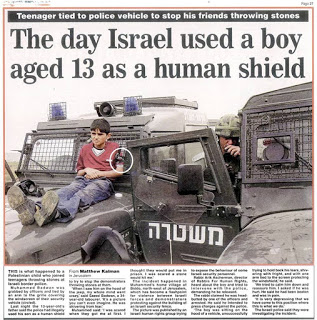
It is Israel which has repeatedly used the specific, prohibited tactic of using children as “human shields” to protect its military forces. According to the U.N. Committee on the Rights of the Child, Israel is guilty of the “continuous use of Palestinian children as human shields and informants.” Besides this namby-pamby UN Committee that no red-blooded American/Zionist would pay any attention to, the High Court of Justice in Israel identified and denounced the “human shield” procedures the IDF acknowledged and defended using 1,200 times. These include “the ‘neighbor procedure,’ whereby neighbors of wanted Palestinians are forced to go into the wanted man’s house ahead of troops, in case it is booby-trapped,” and Israeli “soldiers forcibly position[ing] members of [a] family, including the children, at the windows of [a] home and proceed[ing] to fire from behind them.”
So, when Zionists use a “human shields” argument as a moral cudgel against unarmed civilian protestors, and a moral justification for a powerful army, which brazenly uses children to shield its own soldiers, killing scores of those protestors by the day—well, it’s not a stretch to see this charge is a projection of Zionists’ own pattern of thought and behavior.
Besides being an ongoing tactic of today’s Israeli army, “human shields” and the “human sacrifice” they imply were an integral element of the Zionist narrative—expressly articulated and embraced, with no apology, as a necessity for the establishment of a Jewish State.
Take a look at what Edward Said in 2001 called: “the main narrative model that [still] dominates American thinking” about Israel, and David Ben-Gurion called “as a piece of propaganda, the best thing ever written about Israel.” It’s the “’Zionist epic’…identified by many commentators as having been enormously influential in stimulating Zionism and support for Israel in the United States.” In this piece of iconic American culture, an American cultural icon—more sympathetically liberal than whom there is not—explains why he, as a Zionist, is not bluffing in his threat to blow up his ship and its 600 Jewish refugees if they are not allowed to enter the territory they want:
–You mean you’d still set it [200 lbs. of dynamite] off, knowing you’ve lost?… Without any regard for the lives you’d be destroying?…
Every person on this ship is a soldier. The only weapon we have to fight with is our willingness to die.
–But for what purpose?”
Call it publicity.
–Publicity?
Yes, publicity. A stunt to attract attention… Does the vulgarity of it shock you?
More Zionist tough love.
In the face of the scurrilous “human shield” accusation against Palestinians now being used to denigrate the killed, maimed, and still-fighting protestors in Gaza, we would do well to recall Paul Newman’s Zionist-warrior, “no apology,” argument for 600 telegenically dead Jewish men, women, and children as a publicity stunt to gain the sympathy of the world.
Lest we dismiss this as a fiction, remember that Paul Newman’s fictional boat, Exodus, is based on a real ship, the SS Patria. In 1940, the Patria was carrying 1800 Jewish refugees from Nazi-occupied Europe whom the British authorities refused entry into Palestine. While the Patria was in the port of Haifa, it was blown up and sunk by Munya Mardor on the orders of the Haganah, which did not want Jewish refugees going anywhere but Palestine. At least 267 people were killed. The Haganah put out the story that the passengers had blown up the ship themselves – a story that lasted 17 years, nourishing the imagination of Leon Uris, author of the Exodus fiction. This wasn’t a commander or leading organization urging people to knowingly take a deadly risk in confronting a powerful enemy; it was “their” self-proclaimed army blowing its people up with no warning—and then falsely claiming they did it to themselves! Nobody who wouldn’t use “bottomlessly cynical” to denigrate the Haganah should be using it to denigrate Gazans.
At a crucial moment in history, it was Zionists who practiced a foundational “human shield” strategy, holding the victims of Nazism “hostage” to the Zionist “statehood” project – as none other than the publisher of the New York Times, Arthur Hays Sulzberger, recognized and criticized:
I cannot rid myself of the feeling that the unfortunate Jews of Europe’s D. P. [Displaced Persons] camps are helpless hostages for whom statehood has been made the only ransom. …[W]hy in God’s name should the fate of all these unhappy people be subordinated to the single cry of Statehood?
The Exodus/Patria/Paul Newman/Haganah willingness to blow up hundreds of Jewish refugees in order to force their way into a desired territory was an attitude endemic to the Zionist movement, and enunciated quite clearly by its leader, David Ben-Gurion, as early as 1938: “If I knew it was possible to save all [Jewish] children of Germany by their transfer to England and only half of them by transferring them to Eretz-Yisrael, I would choose the latter.” You want human sacrifice?…
(Sulzberger, by the way, “opposed political Zionism not solely because of the fate of Jewish refugees because he disliked the ‘coercive methods’ of Zionists in this country who use economic means to silence those with differing views.” Yes, the NYT ! So change is possible.)
What’s Right Is Wrong
And here’s the thing: You want to call what the Gazans did—coming out unarmed by the thousands, knowing many of them would be killed by a heavily-armed adversary determined to put them down by whatever means necessary—a “politics of human sacrifice”? You are right.
Just as you’d be right to say that of the Zionist movement, when it was weak and faced with much stronger adversaries. And just as you’d be right to say it of the unarmed, non-violent Civil Rights Movement, when it faced the rageful determination of the immensely more powerful American South, to preserve the century-old Jim Crow apartheid that was its identity, by whatever means necessary.
Princeton Professor Eddie Glaude, Jr. nailed it when, to the visible discomfort of his MSNBC co-panelists, he responded to the invocation of the White House line that it’s “all Hamas’ fault and that they’re using them as tools for propaganda,” with: “That’s like saying to the children in the Children’s March of Birmingham it was their fault that Bull Connor attacked them.”
Civil-rights activists did put children on the front lines, and put their own and those children’s lives in danger to fight and defeat Jim Crow. They knew there were a lot of people armed and willing to kill them. And children, as well as activists, were killed. And those actions were supported (but by no means “orchestrated”) by “extremist” organizations—i.e., the Communist Party. At the time, conservatives attacked Freedom Riders with the same arguments that Zionists are now using to attack Gaza Return Marchers.
All unarmed, non-violent but disruptive, Gandhian strategies to eliminate entrenched systems of colonial-apartheid rule will knowingly sacrifice many lives to attain their victory. Call it a politics of human sacrifice if you want. I won’t make any ingénue objections. But it’s not a sign of the subjugated people’s cynicism; it’s a result of their predicament.
“Human sacrifice” defines the kind of choices a desperate and subjugated people are forced to make in the face of armed power they cannot yet overcome. A militarily-weak insurgent/liberation movement must use an effectively self-sacrificing strategy of moral suasion. That is now a standard and powerful weapon in political struggle. (Though moral suasion alone will not win their rights. Never has. Never will.)
For Gazans, it’s the choice between living in a hell of frustration, misery, insult, confinement, and slow death, or resisting and taking the high risk of instant death. It’s the choice faced by people whose “dreams are killed” by Israel’s siege and forced expulsion, and who are willing to risk their lives “for the world’s attention.” Young men like Saber al-Gerim, for whom, “It doesn’t matter to me if they shoot me or not. Death or life — it’s the same thing.” Or the one who told Amira Hass: “We die anyway, so let it be in front of the cameras.” Or 21-year-old Fathi Harb, who burned himself to death last Sunday. Or Jihadi al-Najjar, who had to make the choice between continuing to care for his blind father (“He was my sight. He helped me in everything, from going to the bathroom to taking a shower to providing for me… I saw life through Jihadi’s eyes.”) or being killed by an Israeli sniper while, as his mother Tahani says “defending the rights of his family and his people.”
Tough choices, to get the world’s attention. This is the kind of choice imposed on the untermenschen of colonial-apartheid regimes. The only weapon they have is their willingness to die. But Gazans won’t get the sympathetically-anguished Paul Newman treatment. Just “bottomlessly cynical.”
Paul’s choice, Sophie’s choice, is now Saber’s and Jihad’s and Fathi’s, and it’s all bad. Maybe some people—comrades and allies in their struggle—have a right to say something about how to deal with that choice. But the one who doesn’t, the one who has no place to say or judge anything about that choice, is the one who is forcing it. Those who are trying to fight their way out of a living hell are not to be lectured to by the devil and his minions.
So, yes, in a very real sense, for the Palestinians, it is a politics of human sacrifice—to American liberals, the gods who control their fate.
By choosing unarmed, death-defying resistance, Palestinians are sacrificing their lives to assuage the faux-pacifist conscience of Americans and Europeans (particularly, I think, liberals), who have decreed from their Olympian moral heights that any other kind of resistance by these people will be struck down with devastating lightning and thunder.
Funny, that these are the same gods the Zionists appealed to to seize their desired homeland, and the same gods the civil-rights activists appealed to to wrest their freedom from local demons of lesser strength. Because, in their need to feel “sympathy and pity,” the sacrifice of human lives seems the only offering to which these gods might respond.
The Nakba Is Now
The Israelis and their defenders are right about something else: They cannot allow a single Gazan to cross the boundary. They know it would be a fatal blow to their colonial-supremacist hubris, and the beginning of the end of Zionism—just as Southern segregationists knew that allowing a single black child into the school was going to be the beginning of the end of Jim Crow. Palestinians gaining their basic human rights means Israeli Jews losing their special colonial privileges.
As Ali Abunimah points out, Arnon Soffer was right, when he said: “If we don’t kill, we will cease to exist,” and Rosner, when he said the Gazans threatened the “elimination of Israel.” To continue to exist as the colonial-apartheid polity it is, Israel must maintain strict exclusionist, “no right of return,” policies. Per Abunimah: “the price of a ‘Jewish state’ is the permanent and irrevocable violation of Palestinians’ rights… If you support Israel’s “right to exist as a Jewish state” in a country whose indigenous Palestinian people today form half the population, then you… must come to terms with the inevitability of massacres.”
What’s happening in Gaza is not only, as Abunimah says, a “reminder… of the original sin of the ethnic cleansing of Palestine and the creation of a so-called Jewish state,” it is a continuation of that unfinished work of the devil. The Nakba is now.
I’m all for everybody on both sides of the issue to be aware of the stakes and risks in this struggle, without any disingenuous denials.
Whether you sympathize with, or denigrate, the choices of people who put their own, their comrades’, and even their children’s, lives at risk is not determined by whether some tactical choices can be characterized as “human shields, human sacrifice”; it’s determined by what they’re fighting for, and what and whom they are fighting against, and where your solidarity lies.
Stage Left
Here’s the core of the disagreement about Gaza (and Palestine in general): There are those—they call themselves Zionists—who think the Palestinians deserve to have been put in that concentration camp, and who stand in solidarity with the soldiers who, by whatever means necessary, are forcing them to stay there. And there are those—the growing numbers who reject Zionism—who stand in solidarity with every human being trying to get out of that camp by whatever means necessary.
There’s a fight—between those breaking out of the prison and those keeping them in; between those seeking equality and those enforcing ethno-religious supremacism; between the colonized and the colonizer. Pick a side. Bret Stephens, Shmuel Rosner, and Tom Friedman have. The New York Times, The Washington Post, and Breitbart have. ABC, CBS, (MS)NBC, and Fox have. The Democrats and Republicans and the Congress and the White House have. And they are not shy about it.
It’s past time for American progressives to clearly and unequivocally decide and declare which side they are on. It’s time for professedly humanitarian, egalitarian, pro-human rights, anti-racist, and free-speech progressives to express their support of the Palestinian struggle—on social media, in real-life conversation, and on the street.
It’s time to firmly reject the hypocritical discourse of those who would have been belittling any expression of sorrow and outrage over Emmet Till, Chaney, Schwerner and Goodman, and the four black schoolgirls killed in Birmingham, while “ingénue mourning” the terrible moral quandary in which those disrupters had put Bull Connor’s boys. Don’t shrink from it, talk back to it—every time. Make them ashamed to be defending colonialism and apartheid with such patently phony arguments.
Politically? At a minimum, demand of any politician who seeks your vote: End the blockade of Gaza, immediately and unconditionally. Support BDS. Refuse any attempt to criminalize BDS and anti-Zionism. Stop blocking UN and ICC actions against Israeli crimes. Restrict arms sales to Israel. Reject the hypocritical Zionist apologetics. Refuse any attempt to censor or restrict the internet. (This last is very important. Nothing has threatened Zionist impunity more than the information available on the internet, and nothing is driving the demand to censor the internet more than the Zionists’ need to shut that off.)
This is a real, concrete, important resistance. What’ll it cost? Some social discomfort? It’s not sniper fire. Not human sacrifice. Not Saber’s choice.
Are we at a turning point? Some people think this year’s massacre in Gaza will finally attract a sympathetic gaze from the gods and goddesses of the Imperial City. Deliberately and methodically killing, maiming, and wounding thousands of unarmed people over weeks—well, the cruelty, the injustice, the colonialism is just too obvious to ignore any longer. And I hope that turns out to be so. And I know, Natalie Portman and Roger Waters and Shakira, and—the most serious and hopeful—the young American Jews in groups like Students for Justice in Palestine and IfNotNow. There are harbingers of change, and we must try.
I also know there is nothing new here. Thirty years ago, a doctor in Gaza said: “We will sacrifice one or two kids to the struggle — every family. What can we do? This is a generation of struggle.” It was obvious thirty years ago, and forty years before that. The Nakba was then. The Nakba is now. Was it ever not too obvious to ignore?
My mother was an actress on Broadway, who once came to Princeton University to share the stage, and her professional skills, with Jimmy Stewart and other amateur thespians. She played the ingénue. Me, I’m not so good at that.
By all means, regarding Palestine-Israel and the sacrifices and solidarity demanded: No more ingénue politics.
Al Quds Day: Supporting Palestinians against Israeli oppression
PressTVUK | June 1, 2018
Ramadan is an opportunity to show solidarity with the Palestinian cause. Annual Al Quds marches will take place around the world next week, renewing a commitment to resistance against Israeli crimes.
See also:
Gaza Palestinians call for supporters around the world to mobilize in solidarity
Plan for mass protests to end the blockade and occupation

Participants in Gaza’s Great March of Return on the eighth Friday of the demonstration.
Contact:
U.S.: Pam Bailey | founder/director, We Are Not Numbers | +1 301-518-0199 | pam@wearenotnumbers.org
Gaza: Ahmed Alnaouq |+972 567676219 | ahmed@wearenotnumbers.org
Protests marking two historic dates are planned along Israel’s massive “security fence” in Gaza June 5 and 8. June 5 is the 51st commemoration of the Israeli invasion and occupation of Gaza, the West Bank and East Jerusalem and on June 7 of the same year, Israel seized control over Jerusalem’s Old City. The committee of Palestinians coordinating the ongoing, mass protests in the Gaza Strip are calling on human rights advocates around the world to mobilize June 5 and 8 in solidarity.
The largest protest in Gaza (as well as in the West Bank) is planned for June 8, since that is a Friday. It also marks the 51st anniversary of the Israeli attack on the USS Liberty in international waters off the Gaza Strip. The intelligence ship was well-marked as an American vessel and only lightly armed. This particular anniversary is ironic, since the Israeli navy just attacked and seized a Palestinian vessel called the Liberty when it attempted to sail out of the Gaza harbor May 29.
“We urge all free people everywhere to join the Palestinians by organizing solidarity events to demand that their governments exert pressure on Israel to end its oppression and occupation of the Palestinian people,” said a statement from the Legal Committee of the National Commission for the Return and Breaking-the-Siege Marches. Specifically, the committee calls on activists to push for a ban on the supply of weapons to Israel and support the public boycott of Israeli products.
“As a nation under occupation, siege and apartheid rule, we need your help to end this oppression, including the blockade of Gaza imposed 12 years ago,” the statement concluded. “We need you to scream out against injustice and double standards and urge your governments to carry out their moral and legal duties to protect the civilians of Palestine.”
Ahmed Alnaouq, project manager for We Are Not Numbers, a youth project in Gaza, notes, “The media and agencies are publishing charts and graphics showing the number of dead and wounded, but it is critical to remember that each one of those numbers represents an unarmed human who had a story to which most of us—even those in the West—could relate. Our team has been busy trying to write those stories so the world cannot hide behind the anonymity of ‘collateral damage’.”
——————————————
WeAreNotNumbers.org—a group of young adults in Gaza whose lives have been forced into a state of limbo by the world’s highest unemployment rate (60 percent among youth), a constant threat of war, a ban on most travel and shortages of electricity averaging 20 hours a day—has worked for the past three years to document the stories of the “silenced voices” in Gaza. Since March 30, when the massive, nonviolent protests began in Gaza, the team has produced regular stories and videos about the “human faces behind the numbers in the news”—including the 128 killed and 13,375 injured by Israeli snipers.
Working for Peace and Justice: Hebron Freedom Fund is a U.S. based 501c3 organization that supports the resiliency and nonviolent efforts of Palestinians living under the most difficult circumstances of Israel’s occupation.
8 things I learned about Palestine while touring 8 Western nations
By Ramzy Baroud | MEMO | May 29, 2018
On 20 February, I embarked on a global book tour that has, thus far, taken me to eight nations. The main theme of all my talks in various cultural, academic and media platforms was the pressing need to refocus the discussion on Palestine on the struggle, aspirations and history of the Palestinian people.
But, interacting with hundreds of people and being exposed to multiple media environments in both mainstream and alternative media, I also learned much about the changing political mood on Palestine in the western world.
While the nations I have visited – the US, Canada, the UK (England and Scotland), the Netherlands, Austria, Australia and New Zealand – do not in any way represent all western countries, the diverse platforms that were available to me allowed me to gain a reasonably good perspective on the ideas, perceptions and attitudes of people in government, media, academia and civil society:
First, the civil society support base for Palestine is growing exponentially, not only in the number of people who are concerned with – or interested in – learning about Palestine, but also in the nature of that engagement as well. The detachment or sense of despair of the past, has all but completely vanished, being replaced with a proactive approach – as in people wanted to be agents of change at local and national levels.
Second, the consensus regarding the support of the Boycott, Divestment and Sanctions (BDS) movement is constantly increasing among unions, churches, university campuses, etc. The old view that BDS was divisive and counter-productive hardly has much traction these days, and most of the remaining debates concerning BDS are not concerned with the ethics of the boycott strategy, but the nature and extent of the boycott.
Third, the degree of decisiveness in supporting Palestinians has also been heightened. The wishy-washy stances that wagered on the Israeli “peace movement’ or Labour Party “doves”, while condemning “extremists on both sides”, has diminishing appeal.
Indeed, the successive Israeli wars on Gaza and the continued siege on the Strip have all gradually, but irreversibly, pushed the narrative on Palestine towards a whole new direction, one that has little room to wait for an Israeli awakening. The recent lethal Israeli response to Gaza’s peaceful Great March of Return protests has further galvanised support for Palestinians, even among relatively apolitical audiences.
Fourth, unable to push back against growing pro-Palestine movements, Israeli and pro-Israel supporters are pushing, like never before, the accusation of anti-Semitism against those who question the Israeli occupation, use the term “Israeli Apartheid” or support BDS.
While the tactic is no longer silencing the discussion on Palestine, it is creating the necessary distraction to divert attention, energy and resources to less urgent issues. A case in point is the British media’s obsession with the, supposedly, rampant anti-Semitism within the Labour Party at a time when thousands of Gazans were injured and scores killed while peacefully protesting in Gaza.
Fifth, young people are less likely to be intimidated by long-standing Israeli tactics. While the older generation of civil society leaders and activists are unwittingly beholden to the many smearing tactics used by Israel and its supporters, the younger generation is not as easily intimidated. Part of the reason is that digital media – social media, in particular – has helped younger people achieve a degree of global connectivity that has heightened their sense of unity and resolve.
The new generation of Palestinian university students and young intellectuals are also reclaiming their role in this trajectory. Their ability to connect with western societies as insiders and outsiders has helped bridge cultural and political gaps.
Sixth, while “One Democratic State Solution” ideas are yet to achieve the critical mass that could, and will, eventually push for a change in policies amongst various governments, the so-called “Two-State Solution” no longer commands a dedicated following. It is almost a complete reversal from the views that permeated during my earlier world tours, nearly 20 years ago.
Seventh, some intellectual, and even civil society circles, are still obstructed by the erroneous thinking that the best way to convey the Palestinian viewpoint is through non-Palestinians. This belief is even championed by some Palestinians themselves (especially members of previous generations who suffered political and cultural marginalisation and discrimination).
Although many anti-Zionist Jewish and Western intellectuals have been placed at the centre stage to articulate a Palestinian message, the alienation of the Palestinians from their own discourse has proven costly. Despite strong and growing support for Palestine, there is still a serious deficiency in an authentic understanding of Palestine and the aspirations of the Palestinian people – their history, culture, everyday realities and viewpoints.
Needless to say, what is needed is an urgent and complete reclamation of the narrative over Palestine and the decolonisation of the Palestinian discourse.
Eighth, the connection between the Palestinian struggle for freedom and that of other indigenous groups is often highlighted, but much more can be done. Israeli supporters are actively pushing the misleading notion that Israelis are the “natives” of the land and are, thus, reaching out to indigenous communities around the world in search for common ground. While the reality is to the contrary, pro-Palestine groups can do much more to link the struggle of the indigenous native Palestinians with that of other indigenous and other oppressed and historically marginalised groups around the world.
A general, but equally important realisation I have experienced throughout my three-month journey has been the numerous personal and group initiatives carried out by thousands of people all over the world in solidarity with the Palestinian people: from 11-year-old Salma, who convinced all of her classmates in Perth, Australia, to write Palestine on the map in her geography class, despite knowing that they would all have been marked down for their action, to the elderly couple in Auckland, New Zealand, who, well into their 80s and walking with much difficulty, continue to hand Palestine flyers to passers-by at a busy street corner, every week, for the last 20 years.
It is these people, and millions like them, who represent the real constituency for Palestine. They are fighters in the trenches of human solidarity that neither Israel, nor anyone else, can possibly defeat.
North Korea raps Israel’s “brutal massacres” in Gaza
Palestine Information Center – May 26, 2018
North Korea has condemned Israel’s use of violence against unarmed Palestinian protesters in Gaza, describing what happened with them as “brutal massacres.”
Kim Yong-nam, head of the Presidium of the Supreme People’s Assembly of North Korea, sent a message of sympathy to Palestinian Authority president Mahmoud Abbas, with the state-run Rodong Sinmun newspaper calling Israel’s actions as a “bloody suppression”.
The newspaper said that Yong-nam in the message expressed deep condolences to the victims and their families.
“He vehemently denounced Israel for its brutal massacres and indiscriminate use of force against peaceful demonstrators demanding their legitimate rights.”
He affirmed North Korea’s unwavering support for and solidarity with the just cause of the Palestinian people and their struggle to build an independent state with east Jerusalem as its capital and obtain their inalienable legitimate rights.
North Korea backs Palestine in its dispute with Israel, an occupying power financed and supported by the US regime.
When North Korea was largely propped up by the Soviet Union during the Cold War, it regularly sent aid and weapons to Palestine.
During the 2014 Gaza War, North Korea also condemned Israel.
The country’s foreign ministry then strongly denounced “Israel’s brutal killings of many defenseless Palestinians through indiscriminate military attacks on peaceable residential areas in Palestine.”
“They are unpardonable crimes against humanity” the ministry said.
Syrian Kurds rally to demand Turkey withdrawal
Press TV – May 26, 2018
Hundreds have demonstrated in Syria’s northeastern city of Qamishli, in response to a call by Kurdish authorities for global protests against Turkey’s military presence in the flashpoint Afrin region.
Turkish forces and allied Syrian militants seized the northwest region of Afrin from Kurdish forces in March, after a two-month military offensive that prompted tens of thousands of people to flee.
Since then, thousands of people displaced from other parts of Syria — notably the Eastern Ghouta suburb of Damascus — have been resettled in the emptied city.
Syria’s Kurds, who have built up their own autonomous administrations in the chaos of the country’s seven-year war, say that amounts to demographic change.
On Saturday, men and women marched through the Kurdish-controlled city of Qamishli to protest Turkey’s military presence.
They waved the yellow, green, and red flag that represents Kurdish part of Syria, as well as signs that read: “No to Turkish occupation.”
Ghassan Juli, a 38-year-old resident of Qamishli, described the Afrin developments as a “disaster.”
“Our people were forced out, and fighters from other areas were brought to live there,” he said.
Her head wrapped in a shawl that matched the Kurdish flag, Bahia Hassan said Afrin’s original residents were afraid to return because of fears of abduction or worse.
“Enough killing, enough kidnapping our boys! Enough killing women and children. We won’t accept this,” said the 45-year-old.
Syria’s Kurds control swathes of the country’s north, and many of those who fled to Afrin escaped into nearby Kurdish-held territory.
Around 135,000 stayed in Afrin, more than a third of them in the urban center that shares the same name, according to the United Nations.
Since war broke out in 2011, half of Syria’s population has been displaced, including more than five million outside the country and another six million internally.
Featured Video

Trita Parsi: Israel Set a Trap for Total War in the Region
or go to
Aletho News Archives – Video-Images
From the Archive
Zionism’s Violent Legacy
By Donald Neff | Washington Report On Middle East Affairs | January 1996
On January 4, 1948, Jewish terrorists drove a truck loaded with explosives into the center of the all Arab city of Jaffa and detonated it, killing 26 and wounding around 100 Palestinian men, women and children.[1] The attack was the work of the Irgun Zvai Leumi – the “National Military Organization,” also known by the Hebrew letters Etzel – the largest Jewish terrorist group in Palestine. The Irgun was headed by Revisionist Zionist Menachem Begin and had been killing and maiming Arabs, Britons and even Jews for the previous ten years in its efforts to establish a Jewish state.
This terror campaign meant that at the core of Revisionist Zionism there existed a philosophical embrace of violence. … continue
Blog Roll
 Aletho News
- Trita Parsi: Israel Set a Trap for Total War in the Region
- Trump’s Iran war is on an Israeli leash
- Saudi oil boss issues global supply warning
- Riyadh Says Its Oil System Is Intact. The Numbers Say Otherwise.
- Trump and Netanyahu Want to “Finish the Job” on Iran
- US ‘one-sided dictation’ not Iran’s beliefs makes rational talks impossible: Baghaei
- Iran’s Next Strike May Not Explode. It Could Shut You Down /Col Doug Macgregor
- Iran: US political targets legitimate if assassinations return
- Iraq shuts key border crossing with Iran under US pressure: Report
- Undersea Internet cables could be targeted in retaliation for attacks on Iran: IRGC deputy chief
- If Americans Knew
- The Israel Lobby’s Changing Fortunes
- AIPAC has become such a political liability that it’s shifting to a more “nimble” approach to buying politicians
- At least 160 Israeli settler attacks in 2 weeks
- Will Gaza’s Ancient Christian Community Disappear Forever?
- Israel’s vision of regional security rests on keeping Arab states weak
- Heidi Levine recounts how Palestinian youths helped save her in settler attack
- DAILY UPDATE: Latest essential news on Palestine, Israel, & region
- Trump’s Intensifying Sabotage of the ICC, for Israel’s Sake
- Israeli military detain US and UK volunteers in West Bank including Democratic NY politician Brad Lander
- Americans at National Conservatism Conference held in Israel this year criticize Israel
- No Tricks Zone
- E-Cars Reduce CO2 Emissions By Only 41% Compared To Internal Combustion Engine Vehicles
- Predictions Made By Renowned Climate Professor Over Past Decades Have Been Proven To Be Poor
- New Study Suggests Large Regions Of The Pacific Ocean Have Been Cooling For The Last 80 Years
- Germany’s Green Energy Debacle: High Energy Costs Force Kahla Porzellan to Close After 182 Years!
- New Study: 50 Years Of The Most Aggressive ‘Net Zero’ Policies Can Only Affect The Global Climate By 0.03°C
- US September “Heat” Was No Record…Many Records Set Decades Ago
- Latest European Green Energy Debacle; Portugal’s Largest Flagship Solar Park Insolvent!
- Green Energy Debacle: German Expert Professor Fritz Vahrenholt Warns Of Severe Economic And Social Consequences
- Two More Paleo Reconstructions Affirm Meters-Higher Sea Levels Across Ireland, Brazil 7000-6000 Years Ago
- New Study: Earth And Venus Surface Warmth Largely Explained By Convection And Lapse Rate, Not CO2 Or Radiation

