Pentagon Capitalism and Silicon Valley: Google’s Drone War Project Shows Big Data’s Military Roots
By Elliott GABRIEL | Mint Press News | April 6, 2018
Google — the advertising and search engine monolith that once touted its official commitment, “Don’t be evil” — has thrown its full weight behind the U.S. military-industrial complex’s fast-advancing unmanned drone program – and more than three thousand of its employees will have none of it.
In a letter to Google CEO Sundar Pichai, over 3,100 employees invoked the now-discarded slogan in an appeal demanding that the company not allow its artificial intelligence technology to be used to improve the targeting capabilities of the United States’ deadly drone fleet. Google’s Project Maven is an AI surveillance engine that uses footage captured by the U.S. Armed Forces’ unmanned aerial vehicles to detect and track objects such as vehicles, while combing through, organizing, and feeding the processed data to the Pentagon.
Watch | Project Maven: The Pentagon’s New Artificial Intelligence
The letter, which is fast making the rounds on Google campuses and internal communication servers, demands the cancellation of the project and the public adoption of a policy pledging that neither Google nor its contractors produce technology for warfare. The letter states:
“This plan will irreparably damage Google’s brand and its ability to compete for talent. Amid growing fears of biased and weaponized AI, Google is already struggling to keep the public’s trust. By entering into this contract, Google will join the ranks of companies like Palantir, Raytheon, and General Dynamics. The argument that other firms, like Microsoft and Amazon, are also participating doesn’t make this any less risky for Google. Google’s unique history, its motto Don’t Be Evil, and its direct reach into the lives of billions of users set it apart.”
However, journalist and author Yasha Levine has explained in his new book Surveillance Valley: The Secret Military History of the Internet that Google has long been a leading Silicon Valley vendor to the U.S. repressive state:
“Over the years, [Google] supplied mapping technology used by the U.S. Army in Iraq, hosted data for the Central Intelligence Agency, indexed the National Security Agency’s vast intelligence databases, built military robots, co-launched a spy satellite with the Pentagon, and leased its cloud computing platform to help police departments predict crime. And Google is not alone. From Amazon to eBay to Facebook … Some parts of these companies are so thoroughly intertwined with America’s security services that it is hard to tell where they end and the U.S. government begins.
The grim calculus of remote-controlled warfare
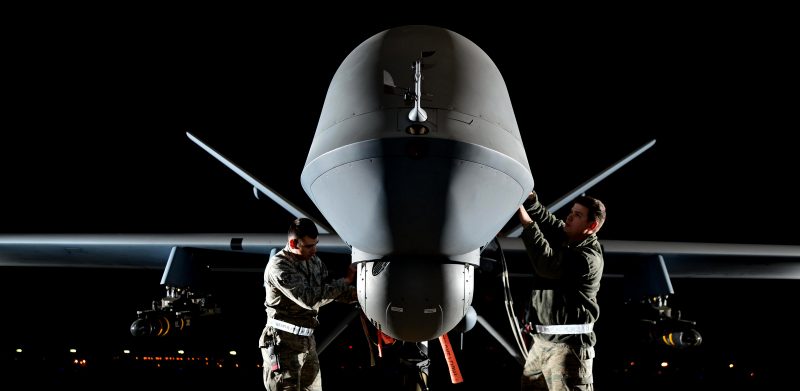
An Air Force RPA reconnaissance drone is retrofitted for use in attack squadron. (Photo: U.S. Air Force)
Thousands of alleged “combatants” have been killed in U.S. drone strikes since the start of the post-9/11 “War on Terror.” Former President Barack Obama ramped up the targeted killing program using drones in 2009, pledging that the use of unmanned aerial platforms was part of a “just war—a war waged proportionally, in last resort, and in self-defense.”
Reports have shown that the use of drones in such locales as Afghanistan, Iraq, Libya, Pakistan, Syria, Yemen and other theaters of operations have claimed a vast number of civilian lives — over 15,000 in 2017, according to surveys. According to New York Times Magazine, which surveyed 150 Coalition drone strikes carried out in Iraq over an 18-month period, one out of every five strikes kills civilians.
Watch | Suffering in Silence: a documentary about the war on terror in Pakistan
The American Civil Liberties Union has denounced the use of such tactics as contrary to international law:
“A program of targeted killing far from any battlefield, without charge or trial … violates international law, under which lethal force may be used outside armed conflict zones only as a last resort to prevent imminent threats, when non-lethal means are not available.
There is very little information available to the public about the U.S. targeting of people far from any battlefield, so we don’t know when, where and against whom targeted killing can be authorized … The secrecy and lack of standards for sentencing people to death, resulting in a startling lack of oversight and safeguards, is one of our prime concerns with this program.”
In 2007 at the height of George W. Bush’s “troop surge” in Iraq, Google enlisted in the “Global War on Terror” in a discrete partnership with Lockheed Martin. While enhanced versions of Google Earth were already at the disposal of government agencies, the tech firm helped to design a Google Earth product for the Pentagon’s National Geospatial-Intelligence Agency that displayed a visual representation of U.S. and Iraqi military bases in Iraq as well as the location of Sunni and Shiite neighborhoods in Baghdad, allowing occupation forces to oversee and manage the bloody fratricidal warfare between the groups as well as the possible location of insurgent organizations within their ranks.
It was during this same year that the development and use of Air Force drones in the Iraqi quagmire dramatically increased, nearly doubling between January and October of 2007.
Google defends its public image (and low-profile military ties)
Claiming that it values the input of its employees as an “important part” of its company culture, Google has promised to address the AI-drone issue without making specific comments on the employees’ demands. In a statement Tuesday, the company said:
“Any military use of machine learning naturally raises valid concerns. We’re actively engaged across the company in a comprehensive discussion of this important topic and also with outside experts, as we continue to develop our policies around the development and use of our machine learning technologies.”
Google has also defended its participation in the Pentagon program with the claim that its usage is specifically for non-offensive purposes and uses open-source object-recognition software based on non-classified data that’s freely available to any users of the Google Cloud, and could in fact save lives while saving labor through the use of AI.
Google’s own top corporate chiefs are quite close to the Pentagon: Google vice president Milo Medin serves on the Department of Defense’s tech advisory body, the Defense Innovation Board, which is also chaired by former Google executive chairman Eric Schmidt, who remains an executive board member at Google’s parent company, Alphabet Inc.
Google itself has long been interested in developing its own line of drone products, including private delivery drones.
The company is also a leader in AI and machine-learning technology. Its subsidiary DeepMind Technologies, Inc. has recently developed a program based on Google Street View that allows AI-based platforms to take part in long-range navigation and cross complicated urban environments. The navigator AI system is capable of steering everything from autonomous, self-driving cars to robotic vacuums and even unmanned drones.
Watch | Eric Schmidt at the Artificial Intelligence and Global Security Summit
Last November in a keynote address on artificial intelligence in warfare before Washington-based think-tank the Center for a New American Security, Schmidt pinned anxiety about his company’s acquisition of DeepMind on “a general concern in the tech community of somehow the military-industrial complex using their stuff to kill people incorrectly, if you will.”
“It comes from a, it’s essentially related to the history of the Vietnam War and the founding of the tech industry,” Schmidt added.

Indeed, Levine argues:
“In the 1960s, America was a global power overseeing an increasingly volatile world: conflicts and regional insurgencies against U.S.-allied governments from South America to Southeast Asia and the Middle East. These were not traditional wars that involved big armies but guerrilla campaigns and local rebellions, frequently fought in regions where Americans had little previous experience. Who were these people? Why were they rebelling? What could be done to stop them? In military circles, it was believed that these questions were of vital importance to America’s pacification efforts, and some argued that the only effective way to answer them was to develop and leverage computer-aided information technology.”
Surveillance capitalism’s military-industrial roots
In a 2014 essay for Monthly Review magazine titled “Surveillance Capitalism: Monopoly-Finance Capital, the Military-Industrial Complex, and the Digital Age,” authors John Bellamy Foster and Robert W. McChesney coined the phrase surveillance capitalism, tracing its origins to the inception of a post-World War II “new Pentagon capitalism” that came to be known as the military-industrial complex.
Under the model – revolutionized by then-Army Chief of Staff and later President Dwight D. Eisenhower – the U.S. technological, scientific research and industrial capacity were to become “organic parts of our military structure” in conditions of national emergency, effectively giving the civilian economy a dual-use purpose. In a 1946 memorandum, Eisenhower noted:
“The future security of the nation… demands that all those civilian resources which by conversion or redirection constitute our main support in time of emergency be associated closely with the activities of the Army in time of peace.”
The model became a permanent feature of the U.S. economy, giving birth to a sprawling military-civilian economic base Eisenhower famously criticized in his 1961 farewell address to the nation. Civilian industry, science, and academia were used alongside an exorbitant and perpetually-expanding war budget to underwrite the Defense Department’s never-ending state of conflict with Cold War enemies and unruly populations, making the world safe for the unchallenged reign of U.S. monopoly capitalism (imperialism) and “pump-priming” the economy whenever an additional surge of “military Keynesian” government spending was required.
Watch | Richard Wolff On Trump’s Defence Spending
According to the popular history of the internet’s origin, it was conceived in 1969 by scientists at the Defense Department’s Advanced Research Projects Agency (ARPA), who sought to create a means of “internetworking” Pentagon-sponsored computer mainframes belonging to government agencies, universities and defense contractors across the United States and NATO bloc. Known as Arpanet, the decentralized system allowed for military nodes – down to a battlefield level – to network and share data quickly and wirelessly. In the event of a nuclear strike or major war where swathes of the network were destroyed, the Arpanet would remain operational.
Levine posits that a primary purpose of conceiving the “information superhighway” was the need for a computerized counterinsurgency tool that could predict and check the “perceived global spread of communism” and provide real-time surveillance of potential threat groups:
“The Internet came out of this effort: an attempt to build computer systems that could collect and share intelligence, watch the world in real time, and study and analyze people and political movements with the ultimate goal of predicting and preventing social upheaval. Some even dreamed of creating a sort of early warning radar for human societies: a networked computer system that watched for social and political threats and intercepted them in much the same way that traditional radar did for hostile aircraft. In other words, the Internet was hardwired to be a surveillance tool from the start. No matter what we use the network for today — dating, directions, encrypted chat, email, or just reading the news — it always had a dual-use nature rooted in intelligence gathering and war.”
The Arpanet system formed the backbone of U.S. military communications from 1969 until 1989, when the World Wide Web was introduced to civilian consumers. The unveiling of the World Wide Web opened the floodgates to the use of the internet by users across the globe, as well as its subsequent commercialization and the resulting dot com boom of the mid-to-late 1990s, when Google was founded.
Watch | Yasha Levine on why we lost our fear of computers as tools of social control
The rapid advance of digital technology has ensured that the U.S. economy — and social life itself — is now dominated by big-data giants like Google, Apple, Facebook and Amazon (GAFA), as well as Microsoft, Intel, Cisco Systems, IBM and Hewlett-Packard. This new technology-dominated market environment, where private user info is parsed, monetized, packaged and sold, has been encapsulated by the well-worn cliché: “data is the new gold.”
Vast strides in biometrics, analytics research, AI, and deep-learning technology – perfected not only by Google but by academic researchers and technology firms across the globe – have vastly boosted the state’s ability to surveil and control populations and police dissent across the globe. Many of the technologies developed by global arms, surveillance, and data-analysis firms are supplied to countries requiring tailor-made solutions to unrest such as India, China, Myanmar, Saudi Arabia, Egypt, Bahrain, and Azerbaijan.
The extent of Silicon Valley’s integration with the U.S. government was laid bare to the public in 2013, when Edward Snowden provided evidence proving that the U.S. National Security Agency (NSA) and Federal Bureau of Investigation (FBI) had direct access to the internal servers of nine major tech firms – AOL, Apple, Facebook, Google, Microsoft, PalTalk, Skype, YouTube, and Yahoo – each of which provided direct access through major internet service providers to the NSA through its secret projects like Boundless Informant and Prism.
Foster and McChesney explained:
“These monopolistic corporate entities readily cooperate with the repressive arm of the state in the form of its military, intelligence, and police functions. The result is to enhance enormously the secret national security state, relative to the government as a whole.
Edward Snowden’s revelations of the NSA’s Prism program, together with other leaks, have shown a pattern of a tight interweaving of the military with giant computer-Internet corporations, creating what has been called a ‘military-digital complex.’ Indeed, Beatrice Edwards, the executive director of the Government Accountability Project, argues that what has emerged is a ‘government-corporate surveillance complex.”
Information superiority and the modern battlefield
At present, the digitalization of the military-industrial complex gives the United States a commanding edge in terms of military technology and high-tech warfare, which is augmented by optical spy satellites capable of capturing remarkably detailed ground-level imagery, successive generations of wireless networking technologies, pattern-recognition and machine-learning systems, and unmanned warfighting platforms.
As a matter of survival, however, all modern militaries – both regular and irregular, large and small – are being forced to adapt to the digitization of warfare. China, Russia, and even non-state actors like Lebanese resistance group Hezbollah are fast making technological advances to keep pace in the informationized battlefield.
The weaponized nature of digital technology is a pandora’s box that may prove impossible to close. Be that as it may, Google’s employees are livid about their participation in these developments:
“We cannot outsource the moral responsibility of our technologies to third parties … Building this technology to assist the U.S. Government in military surveillance – and potentially lethal outcomes – is not acceptable.”
While the tech conglomerate workers’ attempt to decouple Google from the Pentagon may be in vain, one can only applaud their efforts to protest the tech conglomerate’s complicity in the bloodshed wrought by U.S. imperialism through its array of increasingly high-tech implements of death.
Haneyya: Return March battle of awareness
Palestine Information Center – April 7, 2018
 GAZA – Head of Hamas’s Political Bureau Ismail Haneyya on Saturday said that the Palestinian people are capable of challenging the Israeli occupation even under the most difficult circumstances.
Speaking at the funeral of the Palestinian photojournalist Yaser Murtaja in Gaza, Haneyya said that the Great March of Return represents a battle of awareness to emphasize on national constants, most importantly the right of return.
Haneyya praised the courage of journalist Murtaja who sacrificed his life for the sake of conveying truth to the world.
Murtaja died earlier Saturday after he succumbed to a serious injury he sustained after being deliberately shot in the abdomen by an Israeli sniper while covering peaceful protests near the border fence east of Khuza’a town in the southern Gaza Strip.
Hundreds of Palestinian citizens and dozens of journalists took part in Murtaja’s funeral chanting slogans calling for prosecuting Israel’s leaders over their crimes against the Palestinian people.
BDS Movement Calls on Netflix to Remove Series ‘Sanitizing’ Israeli Occupation
teleSUR | April 3, 2018
Pro-Palestinian groups including the Boycott, Disinvestment, and Sanctions (BDS) Movement along with the Palestinian Campaign for the Academic and Cultural Boycott of Israel (PACBI) have called on Netflix to discontinue the series ‘Fauda’ (Chaos in Arabic) for “sanitizing and normalizing war crimes” and “promoting and justifying these grave human rights violations.”
Originally produced by a network named, Yes, the series depicts the Israeli-Palestinian conflict and justifies the crimes against humanity by the Israeli intelligence.
Calling the series, “racist propaganda material for the Israeli occupation army,” the BDS movement wrote a letter to Netflix, the United States-based entertainment company to remove the series.
The series produced by the two former Israeli Defense Forces (IDF) officers is scheduled to be broadcast in May, which also marks the 70th anniversary of the 1948 Nakba (catastrophe) of the Palestinian people.
“The two authors [of the series], who are graduates of one of these teams, without any ambiguity have collaborated with the occupation, colonization and the Apartheid regime,” the letter noted, referring to the series’ creators, Lior Raz and Avi Issacharoff’s former service in elite IDF units.
The series has won over 11 awards at the Israeli Academy for Film and Television awards in March, after which it was picked up by Netflix.
Netflix needs to “stop broadcasting and not to produce the third season of the series and remove the previous seasons” as “the series promotes and legitimizes the war crimes committed by death squads disguised as people pretending to be Arabs,” the BDS movement said in a statement.
“Fauda promotes and legitimizes violent acts committed against Palestinians in the occupied Palestinian territory by Israeli army death squads — the so-called “Mistaravim.” The show’s writers, who were members in these units, have based the series on the war crimes committed by these squads against Palestinians,” PACBI said in a press release.
Adding that if Netflix fails to pay heed to the call of Palestinian social movements, it will face “nonviolent grassroots pressure and possible legal accountability.”
Return marches are humanitarian and a holy duty, insists senior Christian official
MEMO | March 31, 2018
The secretary of the Episcopal Commission for Islamic-Christian Dialogue in Lebanon insisted on Friday that the Palestinian return marches are humanitarian activities and a holy, ethical and national duty, Al-Resalah has reported.
“Any Palestinian resistance action aimed at protecting the country and human dignity is a religious duty guaranteed by all religions,” said Father Antoine Daou. He noted that the aim of the return marches is to achieve freedom and regain rights. “These are spiritual goals also guaranteed by all religions.”
Israel’s fear of such marches, suggested Daou, reflects the aggressive face of the state. “This was evident in its brutal treatment of the unarmed civilians.” Gaza’s residents, he added, are looking for salvation for all oppressed Palestinians. “They are taking the path of freedom which aims to end persecution and oppression.”
The senior Christian official said that such action corrects the moral compass of the Arab nations, which has been lost recently.
7 Palestinians killed, dozens injured as Israel suppresses massive protest in Gaza

Ma’an – March 30, 2018
GAZA CITY – Six Palestinians have been killed by Israeli forces and dozens more injured since early Friday morning, as thousands of Gazans took to the borders with Israel as part of “The Great March of Return” taking place across the besieged coastal enclave to mark the 42nd Land Day.
In 1976, Israeli police shot and killed six Palestinian citizens of Israel as they were protesting the Israeli government’s expropriation of thousands of dunums of Palestinian land. Since then, Palestinians have commemorated March 30 as Land Day with mass protests across the occupied West Bank and East Jerusalem, Gaza, and inside Israel.
A Palestinian farmer was killed around dawn and another was injured as Israeli forces targeted the southern Gazan district of Khan Younis with mortar shells.
Spokesperson of the Gaza Ministry of Health, Ashraf al-Qidra, identified the slain farmer as Omar Sammour, 31, adding that another Palestinian, whose identity remained unknown, was injured during the shelling.
Israeli media reported that Sammour and the other man with him were targeted for approaching the border fence with Israel in a “suspicious manner,” though local sources reported that Sammour was simply gathering crops from his land to sell later in the day.
On Friday afternoon, medical sources confirmed to Ma’an that two more Palestinians were killed during the protest along the border.
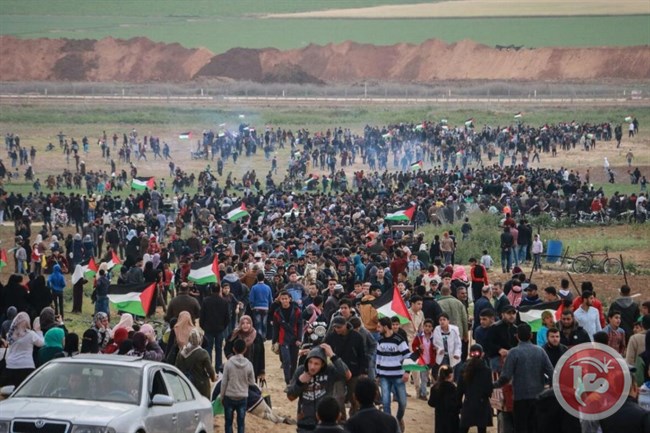
One of the slain Palestinians was identified as Amin Mahmoud Muhammar from Rafah in southern Gaza. His age remained unknown.
The other slain Palestinian was identified as Muhammad Kamal al-Najjar, 25, from eastern Jabaliya in northern Gaza.
Around 2:20 p.m. medical sources told Ma’an that a fourth Palestinian had been killed. He was identified as Muhammad Abu Omar, 19.
Fifteen minutes later, the Gaza Ministry of Health confirmed that a fifth Palestinian had been killed. He was identified as 16-year-old Ahmad Ibrahim Odeh from the northern Gaza Strip.
Around 3:15p.m. the ministry reported that Jihad Freineh, 33, from Gaza City was killed.
Minutes later, the ministry reported that the seventh Palestinian had been killed by Israeli forces. He was identified as Mahmoud Saadi Rahmi, from Gaza City.
Leading up to the march, the Israeli army released a statement saying it had declared the border area along Gaza a “closed military zone,” meaning that any Palestinian who got close to the border fence could risk getting shot.
The Israeli army released statements on Twitter describing the protests as “violent riots.”
“17,000 Palestinians are rioting in 5 locations along the Gaza Strip security fence. The rioters are rolling burning tires and hurling firebombs & rocks at the security fence & IDF troops, who are responding w riot dispersal means and firing towards main instigators,” the statement said.
Despite the Israeli army’s claims, Palestinian activists and leaders in the Gaza Strip have maintained that the “March of Return” was organized as a massive non-violent, weeks-long protest advocating for the return of Palestinian refugees to their original homelands in historic Palestine, now present day Israel.
Leading up to Friday, the first official day of the march — which will continue until the 70th anniversary of the Nakba, or catastrophe, in May — Palestinians set up tents along the border with Gaza, where protesters plan to stay until the Nakba anniversary.
Ismail Haniyeh, head of the Hamas politburo, gave a speech at the March of Return, saying it “demonstrates that there are no alternatives to Palestine and the right of return (for the Palestinian people),” praising the people who left their homes to attend the march.
When speaking about the goal of the march, Haniyeh said it constitutes “the beginning of a return (of the Palestinian people) to the entirety of the land of Palestine.”
“We will not give up and we will not bargain with the Zionist entity over even a small piece of the land of Palestine,” Haniyeh continued, stressing that the Palestinians will reject any deal proposed by the Trump administration.
“Our people went out today to make it clear that we will not give up Jerusalem and that there is no alternative to Palestine and the right of return. We will not accept the right of return staying only a slogan.”
Return March organizers: Israel’s terrorism will not intimidate us
Palestine Information Center – March 28, 2018
 GAZA – National committee for the March of Return, during a press conference held near the Great March of Return’s tent east of Gaza city which was targeted by Israeli gunfire on Wednesday morning, said that Israel will not succeed in terrorizing the Palestinian people.
The committee affirmed that preparations for the Great March of Return are ongoing, calling on the world nations to support this popular movement.
Head of the committee Khalid al-Batsh said that the Great March of Return is a purely peaceful event and that Palestinians are entitled to demand their right of return which is guaranteed by international law.
The PIC reporter said that the Israeli tanks stationed near Gaza’s eastern border fence fired two missiles on Wednesday morning at two sites east of al-Zaitoun neighborhood in Gaza city. No injuries were reported.
Member of the committee Ismail Ridwan warned the Israeli occupation against using violence against the protesters participating in the Great March of Return.
The Islamic Jihad leader Ahmad al-Modallal said that the Israeli occupation is in a state of confusion and trying to thwart this popular movement by various means. He continued to say that Israel will never be able to break the Palestinian will or kill the Palestinian dream of return.
The coordinating committee of the Great March of Return in February announced its intention to launch popular mass demonstrations toward the Palestinian territories occupied since 1948 in demand of the Palestinian refugees’ right of return.
Trinity College Dublin students overwhelmingly back BDS in referendum
MEMO | March 23, 2108
Students at Trinity College Dublin have overwhelmingly voted to support the Palestinian-led Boycott, Divestment, Sanctions (BDS) campaign, with the referendum result announced to cheers and chants.
 Asked whether Trinity College Dublin Students’ Union (TCDSU) should “accept a long-term policy on Palestine and in support of Boycott, Divestment and Sanctions (BDS)”, 64.5 per cent of students voted in favour (1,287 students of a total of 2,050).
The referendum reportedly saw the highest turnout in recent years. As BDS is a “long-term policy”, it required that 60 per cent or above of the students balloted voted in its favour. The referendum was held after students gathered the necessary 500 signatures to put the vote to the student body.
According to The University Times, the long-term policy mandates the union to support the movement and “comply with the principles of BDS in all union shops, trade, business and other union operations”, as well as to lobby the college and the government to adopt a BDS policy.
“The long-term policy would also see the introduction of a boycott, divestment and sanction implementation group within the union,” the paper added.
The incoming TCDSU President Shane De Rís and President-elect of the Graduate Students’ Union (GSU) Oisín Vince Coulter had both urged students to vote in favour of BDS.
“It isn’t uncommon for students and students unions to campaign for the rights of oppressed people at home and around the globe,” De Rís said.
If we can help make a difference by boycotting, divesting, and sanctioning those organisations complicit the oppression of the Palestinian people, then I think it worthwhile to do so.
Vince Coulter added: “We need to show solidarity again with the struggle of the Palestinian people for peace, justice and human rights.”
Read also:
Hamas gets one step ahead of ‘deal of the century’ with five-point strategy

Head of the Political Bureau of Hamas, Ismail Haniyeh delivers a speech during a press conference in Gaza City, Gaza on 23 January 2017 [Ali Jadallah/Anadolu Agency]
MEMO | March 9, 2018
Palestinian sources said that the Chief of the Political Bureau of Hamas movement, Ismail Haniyeh, outlined a five pronged strategy to counter the US-led ‘deal of the century’, in a meeting of various Palestinian factions in Cairo.
The first principle of this strategy is to take on the ‘deal of the century’ by holding all Palestinian factions together – including Fatah movement – to a unified position.
The second prong is “the implementation of reconciliation agreements,” especially the comprehensive agreement which was signed on 4 May 2011, and the executive agreement which was signed on 12 October, 2017.
The third axis is “building strength and resistance until the liberation of Palestine.”
The fourth element is based on “establishing open political relations” with the Arab and Islamic countries to develop an Arab-Islamic safety network that includes especially “Egypt, Saudi Arabia, Jordan, Iran, Turkey” as well as other countries.
The fifth aspect consists of “holding an inclusive national conference” following which there would be “an agreement to adopt a joint political program,” then organising the presidential and legislative elections (inside Palestine) and the National Council.
The sources also stated that the representatives of factions present, including those of Fatah, agreed on two points, confronting the ‘deal of the century’ and the need for reconciliation and national unity.
Convention provokes rage against NDP machine
By Yves Engler · March 1, 2018
They came, mostly young people, to fight for justice. They came to support the rule of international law, to help solve a longstanding injustice through non-violent means; they came to tell an oppressed people you have not been forgotten; they came to do what is right for a left wing political party; they came to speak truth to power.
And how did the left wing party respond? By using the “machine” — orders from on high, backroom arm-twisting, opaque block voting and procedural manoeuvring — to prevent debate. Silence in class!
While NDP insiders probably feel they dodged the “Palestine Resolution” bullet at their recent convention, many party apparatchiks may come to regret their undemocratic moves. Their naked suppression of debate might stir rage against the machine they’ve proved to be. At a minimum it has provoked many to ask why.
Why, when the Palestine Resolution was endorsed unanimously by the NDP youth convention and by over 25 riding associations, did the powers that be not want it even discussed?
Given the resolution mostly restated official Canadian policy, except that it called for “banning settlement products from Canadian markets, and using other forms of diplomatic and economic pressure to end the occupation” one can only assume that the party machine either supports the indefinite Israeli occupation of Palestinian land or has some sort of problem with boycotts and economic sanctions. Clearly the NDP is not against boycotts and economic sanctions in principle since they’ve recently supported these measures against Russia, Venezuela and elsewhere.
If, after a half-century of illegal occupation, one can’t call for boycotting Israeli settlement goods, then when? After a century? Two?
Or is the problem the particular country to be boycotted? Does the NDP hierarchy believe that anti-Semitism can be the only possible motivation for putting economic pressure on Israel to accept a Palestinian state? Or perhaps it is simply a worry that the dominant media would attack the party?
Whatever the ideological reason the bottom line is the Palestine Resolution was buried to ensure it wouldn’t be discussed. When its proponents sought to push it up the priority list at an early morning session before the main plenary, the party hierarchy blocked it. In a poorly publicized side room meeting they succeeded 200 to 189. NDP House Leader Guy Caron mobilized an unprecedented number of current and former MPs, including Murray Rankin, Randall Garrison, Craig Scott, Tracey Ramsey, Alexandre Boulerice, Hélène Laverdière, Nathan Cullen and others, to vote against debating the most widely endorsed foreign policy resolution at the convention (Niki Ashton was the only MP to support re-prioritizing the Palestine Resolution.)
Apparently, the party leadership discussed how to counter the resolution at two meetings before the convention. In a comment on a Guardian story about the need for the NDP to move left, Tom Allen, a staffer for Windsor Tecumseth NDP MP Cheryl Hardcastle, describes “panicked” planning to defeat the resolution. “As for the part about the ‘party establishment (being) easily able to deflect challenges from the left.’ I would respectfully submit that this is wrong. As an NDP staffer I can tell you that it wasn’t easy at all this time and, especially with regards to the ‘Palestinian Resolution,’ which required a great deal of panicked last minute organizing to defeat (and only then by a close margin).”
Why would the party establishment risk turning off so many young activists, exactly the sort of member new leader Jagmeet Singh claims he wants to attract?
A quick look at some of the more prominent supporters of shutting down debate suggests an answer.
Victoria area MPs (defence critic) Randall Garrison and (justice critic) Murray Rankin who voted against debating the Palestine Resolution are members of the Canada Israel Inter-Parliamentary Group and took a Centre for Israel and Jewish Affairs paid trip to Israel in 2016. After the IDF slaughtered 2,200 Palestinians in Gaza in the summer of 2014, Rankin offered words of encouragement to an emergency fundraiser for Israel.
Party foreign critic Hélène Laverdière, who voted to suppress the Palestine Resolution, took a paid trip to the American Israel Public Affairs Committee’s conference in Washington in 2016 and participated in a Jewish National Fund event in Israel.
British Columbia liaison and critic for democratic institutions, Nathan Cullen also voted against debating the Palestine Resolution. “I am strongly in support of Israel”, Cullen bellowed in a 2016 statement about how people should be allowed to criticize that country. In 2014-15 Cullen’s office took in Daniel Gans through CIJA’s Parliamentary Internship Program, which pays pro-Israel university students $10,000 to work for parliamentarians (Gans then worked as parliamentary assistant to NDP MP Finn Donnelly). In 2014 Cullen met representatives of CIJA Pacific Region to talk about Israel, Iran and other subjects. According to CIJA’s summary of the meeting, “Mr. Cullen understood the importance of a close Canada-Israel relationship.”
Maybe the loudest anti-Palestinian at the convention was former president of the Ontario NDP and federal council member Janet Solberg. Unsatisfied as a settler in Toronto, Solberg pursued a more aggressive colonial experience when she moved to historic Palestine as a young adult.
Just before the convention the President of the Windsor-Tecumseh Federal NDP, Noah Tepperman, sent out an email to all riding associations calling on them to oppose Palestine resolutions. In it he claimed, “boycotts based on religion, nationality or place of origin directly contravene the spirit of inclusiveness to which we in the NDP are committed.” He further alluded to an anti-Jewish agenda by connecting the different solidarity resolutions to “a backdrop of already-high-and-rising antisemitism here in Canada as well as abroad.” But, Tepperman sits on the board of the Windsor Jewish National Fund, which is an openly racist organization.
The truth is pro-Israel-no-matter-what-it-does NDP members in positions of power within the party won a narrow battle. How the war goes will depend on the lessons learned by those seeking a party that’s an instrument of real change, that fights against all forms of racism and oppression.
Montreal Gazette’s anti-Palestinian bias
By Yves Engler · February 24, 2018
Shame on the Montréal Gazette. Shame on Dan Delmar. Even when McGill’s uber-Israeli nationalist administration dismisses allegations of “anti-Semitism” the paper and its writer uses them to smear freedom promoting students.
In October Canadian Jewish Political Affairs Committee activist Noah Lew cried “anti-Semitism” after he wasn’t voted on to the Board of Directors of the Students’ Society of McGill University (SSMU). At a General Assembly Democratize SSMU sought to impeach the student union’s president Muna Tojiboeva. The ad-hoc student group was angry over her role in suspending an SSMU vice president and adopting a Judicial Board decision that declared a Boycott, Divestment and Sanctions resolution unconstitutional. While they couldn’t muster the two thirds of votes required to oust the non-Jewish president of the student union, Democratize SSMU succeeded in blocking the re-election of two Board of Directors candidates who supported the effort to outlaw BDS resolutions.
After failing to be re-elected to the Board of Directors at the same meeting Noah Lew claimed he was “blocked from participating in student government because of my Jewish identity and my affiliations with Jewish organizations.” Lew’s claim received international coverage, including coverage in the Gazette.
As she’s done on previous occasions, McGill Principal Suzanne Fortier echoed the Israel activists’ claims. Fortier sent out two emails to all students and faculty about the incident with one of them noting, “allegations have arisen suggesting that the votes against one or more of those directors were motivated by anti-Semitism.” At the time she announced an investigation into the incident.
Released two weeks ago, the investigation dismissed Lew’s claim of anti-Semitism. After interviewing 38 students over three-and-a-half weeks, former Student Ombudsman Dr. Spencer Boudreau concluded that he could “not substantiate the notion that the vote was motivated by anti-Semitism” and couldn’t find “evidence that would equate students’ protests about Israel’s policies with anti-Semitism.” Rather, Boudreau found that the vote was “motivated by politics, that is, based on his [Lew] support for Israel and Zionism and/or for his view of the BDS movement.”
Instead of covering the investigation, the Gazette repeated the Israel nationalist’s baseless smear. A story headlined “Student says anti-Semitism still an issue in McGill student government” quoted Lew and Israel lobby organizations objecting to the report’s findings. The article barely acknowledged the central conclusion of the investigation and failed to quote from it.
Four days after the news story Gazette columnist Dan Delmar criticized the report in a story titled “If anti-Semitism isn’t the problem on campus, what is?” The long-time anti-Palestinian commentator wrote, “for many if not most Canadian Jews, this writer included, the phenomenon of campus anti-Semitism in Canada is a reality and has been particularly problematic for nearly two decades.”
While the Gazette’s attacks are shameful, they are not surprising. The paper has engaged in a multi-year smear campaign against Palestine solidarity activists at McGill. According to a search of the Gazette’s database, the paper has published 12 stories referring to anti-Semitism at McGill since 2014 (I couldn’t find a single Gazette story detailing anti-Black, Asian or indigenous discrimination at the elite university). Rather than a sudden growth of anti-Jewishness, the spate of anti-Semitism stories are a response to students campaigning to divest from corporations complicit in Israel’s occupation. Between 2014 and 2016 there were three votes inspired by the Boycott Divestment and Sanctions movement at biannual SSMU General Assemblies. After two close votes, in February 2016 a motion mandating the student union to support some BDS demands passed the union’s largest ever General Assembly, but failed an online confirmation vote after the McGill administration, Montreal’s English media and pro-Israel Jewish groups blitzed students.
Since that vote Lew and other anti-Palestinian activists have sought to have SSMU define BDS resolutions as unconstitutional. Concurrently, the university’s board of governors is seeking changes to its endowment’s social responsibility criteria, which would effectively block the possibility of divesting from companies violating Palestinian rights or causing climate disturbances.
The Gazette has ignored the Israel activists and administration’s extreme anti-Palestinian measures. The paper has also ignored the administration’s pro-Israel orientation. In May Principal Fortier traveled to that country and in November McGill Vice-Principal Innovation Angelique Mannella participated in an event put on by the explicitly racist Jewish National Fund.
In his column Delmar asks, “If anti-Semitism isn’t the problem on campus, what is?” The answer is obvious: Many students feel embarrassed and angry about their university — and other Canadian institutions’ — complicity in Palestinian dispossession. When they try to channel their emotions into non-violent action to help liberate a long-oppressed people they are blocked by powerful institutions and called names. The problem is the anti-Palestinian bias of those institutions, including the Gazette.
Featured Video

Trita Parsi: Israel Set a Trap for Total War in the Region
or go to
Aletho News Archives – Video-Images
From the Archive
Zionism’s Violent Legacy
By Donald Neff | Washington Report On Middle East Affairs | January 1996
On January 4, 1948, Jewish terrorists drove a truck loaded with explosives into the center of the all Arab city of Jaffa and detonated it, killing 26 and wounding around 100 Palestinian men, women and children.[1] The attack was the work of the Irgun Zvai Leumi – the “National Military Organization,” also known by the Hebrew letters Etzel – the largest Jewish terrorist group in Palestine. The Irgun was headed by Revisionist Zionist Menachem Begin and had been killing and maiming Arabs, Britons and even Jews for the previous ten years in its efforts to establish a Jewish state.
This terror campaign meant that at the core of Revisionist Zionism there existed a philosophical embrace of violence. … continue
Blog Roll
 Aletho News
- Trita Parsi: Israel Set a Trap for Total War in the Region
- Trump’s Iran war is on an Israeli leash
- Saudi oil boss issues global supply warning
- Riyadh Says Its Oil System Is Intact. The Numbers Say Otherwise.
- Trump and Netanyahu Want to “Finish the Job” on Iran
- US ‘one-sided dictation’ not Iran’s beliefs makes rational talks impossible: Baghaei
- Iran’s Next Strike May Not Explode. It Could Shut You Down /Col Doug Macgregor
- Iran: US political targets legitimate if assassinations return
- Iraq shuts key border crossing with Iran under US pressure: Report
- Undersea Internet cables could be targeted in retaliation for attacks on Iran: IRGC deputy chief
- If Americans Knew
- The Israel Lobby’s Changing Fortunes
- AIPAC has become such a political liability that it’s shifting to a more “nimble” approach to buying politicians
- At least 160 Israeli settler attacks in 2 weeks
- Will Gaza’s Ancient Christian Community Disappear Forever?
- Israel’s vision of regional security rests on keeping Arab states weak
- Heidi Levine recounts how Palestinian youths helped save her in settler attack
- DAILY UPDATE: Latest essential news on Palestine, Israel, & region
- Trump’s Intensifying Sabotage of the ICC, for Israel’s Sake
- Israeli military detain US and UK volunteers in West Bank including Democratic NY politician Brad Lander
- Americans at National Conservatism Conference held in Israel this year criticize Israel
- No Tricks Zone
- E-Cars Reduce CO2 Emissions By Only 41% Compared To Internal Combustion Engine Vehicles
- Predictions Made By Renowned Climate Professor Over Past Decades Have Been Proven To Be Poor
- New Study Suggests Large Regions Of The Pacific Ocean Have Been Cooling For The Last 80 Years
- Germany’s Green Energy Debacle: High Energy Costs Force Kahla Porzellan to Close After 182 Years!
- New Study: 50 Years Of The Most Aggressive ‘Net Zero’ Policies Can Only Affect The Global Climate By 0.03°C
- US September “Heat” Was No Record…Many Records Set Decades Ago
- Latest European Green Energy Debacle; Portugal’s Largest Flagship Solar Park Insolvent!
- Green Energy Debacle: German Expert Professor Fritz Vahrenholt Warns Of Severe Economic And Social Consequences
- Two More Paleo Reconstructions Affirm Meters-Higher Sea Levels Across Ireland, Brazil 7000-6000 Years Ago
- New Study: Earth And Venus Surface Warmth Largely Explained By Convection And Lapse Rate, Not CO2 Or Radiation

