Egypt’s Foreign Minister defends mass imprisonment on US visit
Reprieve – February 10, 2016
The Egyptian Foreign Minister has defended his government’s mass imprisonment of political activists, and the use of lengthy pre-trial detention periods, during a visit to Washington DC to meet with US Secretary of State John Kerry among other officials.
In an interview with NPR that aired today, Foreign Minister Sameh Shoukry defended the detention without trial of activists and others arrested at protests in 2013, saying that arrests only took place where protestors didn’t have ‘permits’. Asked why many protestors were still imprisoned and awaiting trial two years later, he said: “It is a long time, but I believe justice has to be given the opportunity, within the impartiality of the judicial system, to ascertain all of the facts and to pass a verdict”.
Mr Shoukry added that “no country” has a perfect human rights record, and that “there will always be ups and downs.” He said that “it is our intention to do everything possible to live up to those [human rights] standards and provide the rights of all individuals.”
Since taking power in July 2013, the Sisi government has overseen thousands of arrests of protestors, journalists and others, many of whom have been put through mass trials that fail to meet international standards. International human rights group Reprieve, which assists several prisoners in Egypt, recently established that between 2014 and the end of 2015, nearly 600 death sentences were handed down, the majority in relation to political charges.
Hundreds of other prisoners are enduring lengthy periods of pre-trial imprisonment; one trial involving 494 people has been postponed 12 times since it began in 2014. The defendants, including Ibrahim Halawa – an Irish student, who is being assisted by Reprieve – are currently understood to be undergoing torture, including forms of ‘crucifixion’ and electrocution. Mr Halawa is one of several prisoners in the trial who were arrested as juveniles, and who are being tried as adults in violation of Egypt’s Child Law.
Reprieve has previously written to Secretary Kerry, asking him to press the Egyptian government to end the use of mass trials and release prisoners who were arrested as juveniles.
Militants attack Red Cross aid convoy near Damascus
Press TV – February 10, 2016
Foreign-backed militants have attacked the International Committee of the Red Cross (ICRC) vehicles carrying humanitarian aid to an area near the Syrian capital, Damascus.
Militants opened fire on convoys from the ICRC and the Syrian Arab Red Crescent (SARC) trying to enter al-Mazaya district in Damascus on Wednesday, Lebanon’s al-Ahed news website reported.
A number of aid workers were injured in the incident and three of them are reportedly in a critical condition.
On Tuesday, the two relief agencies delivered some 6,500 food packages to a number of villages in the town of Souq Wadi Barada.
This came as Syrian forces made fresh gains in areas north of Aleppo. Local residents from the town of Tal Rif’at, which is located around 20 kilometers from the Turkish frontier, together with government forces freed some areas from foreign-backed militants affiliated to al-Nusra Front. At least two people were injured in the operation.
Kurdish fighters also took full control of the town of Meng, located north of Aleppo, Lebanon’s al-Manar television channel reported.
Reports also said that at least 16 al-Nusra militants were killed in Russia’s airstrikes on the coastal Latakia Province.
Elsewhere in the northeastern province of al-Hasakah, a bomb planted in a car went off. Following the blast, clashes erupted between Takfiri militants and army forces, during which a number of people were killed.
The Syrian military backed by volunteer forces has recently inflicted heavy losses on foreign-backed militants during mop-up operations on different fronts. Over the past few weeks, the Syrian forces have also gained more ground against militants north of Latakia.
The conflict in Syria began in March 2011 and has reportedly claimed the lives of more than 260,000 people with millions of Syrians displaced inside and outside the war-torn country.
Occupation Captured
A week of occupation in photos
CPT | February 9, 2016

Getting school supplies through
Pictured here: School books need to pass through the checkpoint in order to get to the Ibrahimi school. Team effort between CPT and one teacher holding the barbwire. (1 Feb 2016)
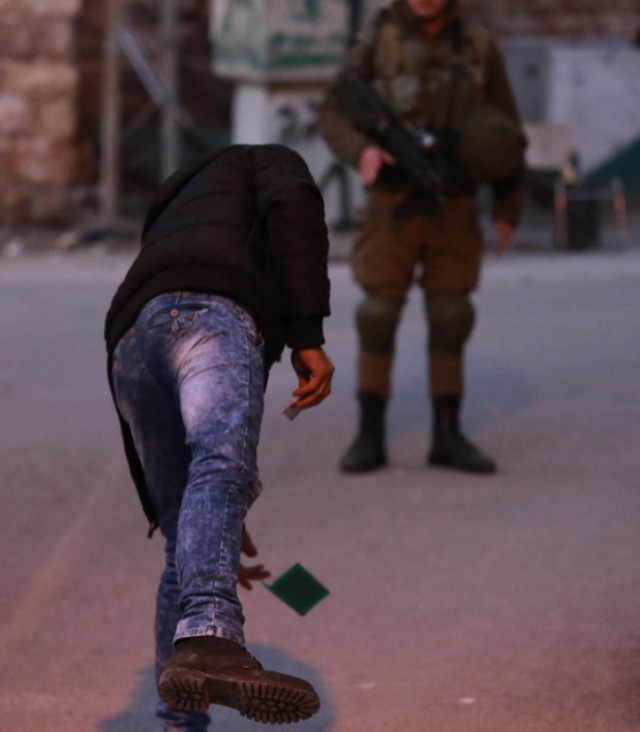
ID check
Pictured here: Regular ID check for a young Palestinian man; here at the military checkpoint set up in front of the house taken over by settlers two weeks ago. Palestinians are asked to stay at a distance and to throw their ID cards on the ground for inspection. (29 Jan 2016)
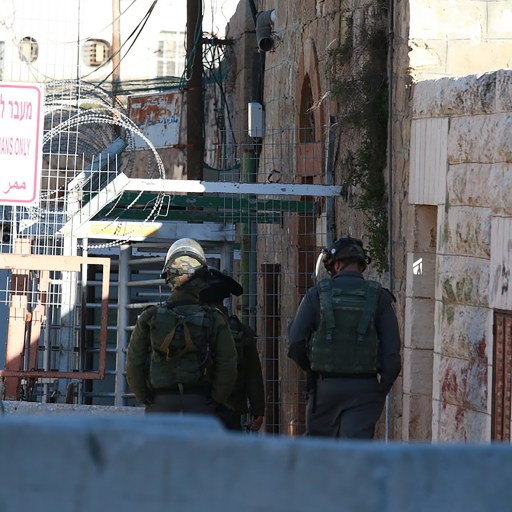
Going back to work
Pictured here: Fully geared up, three IDF soldiers crossed the checkpoint to throw a sound bomb and shoot a rubber bullet to disperse a group of kids. Job done, they’re heading back to their post. (04 Feb 2016)
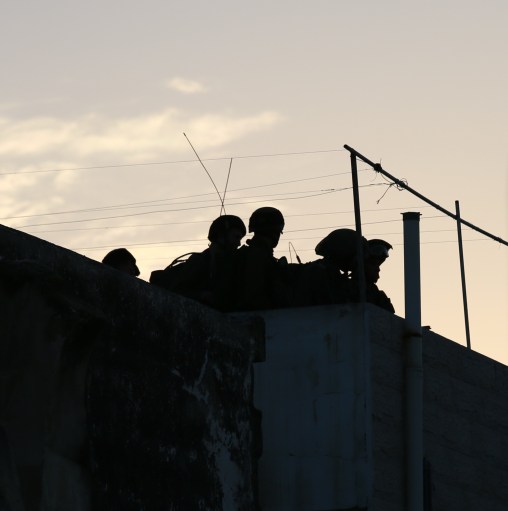
Rooftop shadows
Pictured here: IDF soldiers on the roof of their building in the Old City at dusk, ready to intervene. (25 Jan 2016)
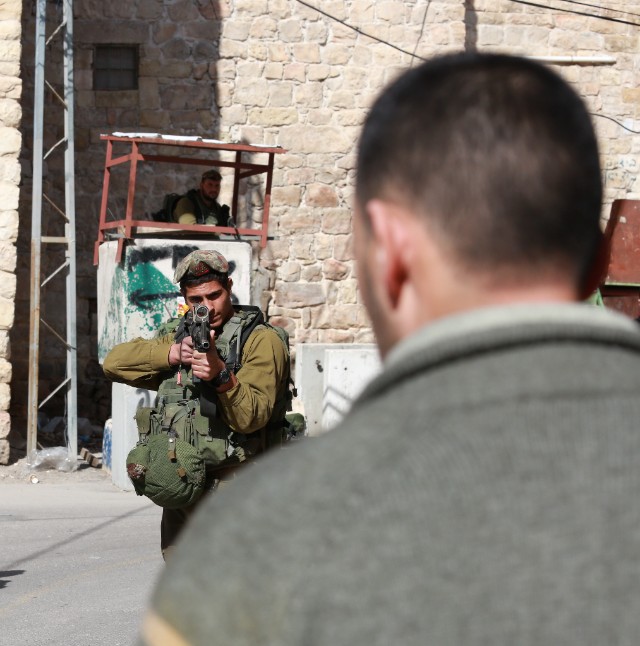
Do not move!
Pictured here: Very zealous IDF soldier, threatening a Palestinian man with his gun who refused to pull his pants down in the middle of the street. (05 Feb 2016)

Full search
Pictured here: Frisks for Palestinians men are common at every checkpoints. (05 Feb 2016)
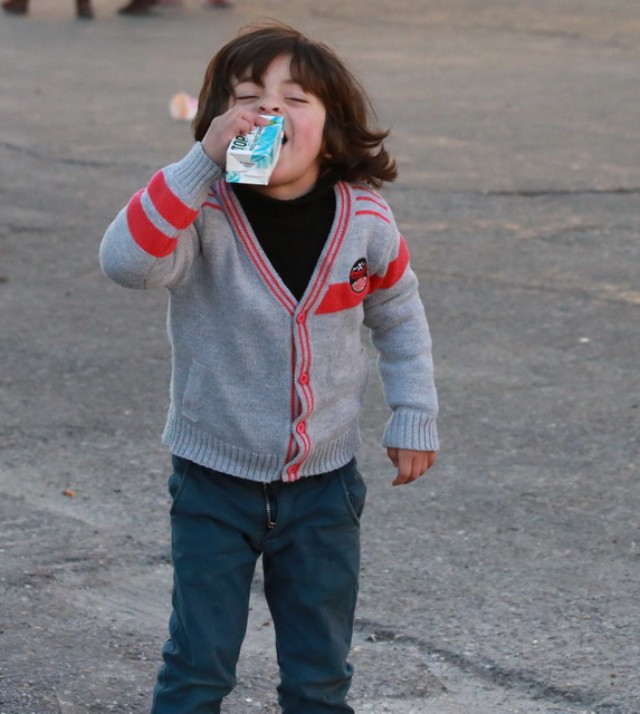
I love pictures
Pictured here: This young boy accompanies CPT every morning at Quitoun checkpoint and loves to pose for pictures, no matter what happens; it looks like it makes his day! (03 Feb 2016)
CPT mailing address: cptheb@cpt.org
Falk reprimands Ban Ki-Moon over truth about Israel’s crimes
‘The politics of deflection’ (shoot the messenger, ignore the message) exposed
By Stuart Littlewood | American Herald Tribune | February 8, 2016
With obvious relish Richard Falk, former professor of international law at Princeton and UN Special Rapporteur on human rights in Occupied Palestine, has issued a well deserved slap on the wrist to UN Secretary General Ban Ki-Moon for his naivety. It follows Israel’s furious reaction to Ban’s remark to the Security Council that “Palestinian frustration is growing under the weight of a half-century of occupation and the paralysis of the peace process”.
The usually timid Ban, suddenly emboldened, also called Israel’s illegal settlement building “an affront to the Palestinian people and to the international community”. He added: “Security measures alone will not stop the violence. They cannot address the profound sense of alienation and despair driving some Palestinians – especially young people.” Whereupon Israel’s prime minister Netanyahu, fresh from approving another 150 squatter homes on stolen Palestinian land, accused the Secretary General of giving a “tailwind to terror”.
Falk penned an open letter to Ban reminding him of his earlier attempts to get Falk dismissed from his UN job for speaking the same truths. “Having read of the vicious attacks on you for venturing some moderate, incontestable criticisms of Israel’s behaviour, I understand well the discomfort you clearly feel. What intrigues and appals me is that while I was Special Rapporteur for Occupied Palestine during the period 2008-2014, you chose to attack me personally in public on several occasions, joining with US and Israel diplomats calling for my dismissal and doing the utmost to undermine my credibility while discharging this unpaid UN job under difficult conditions.
“At the time, I was doing my best to bear witness to some of the same truths about Israel’s unlawful and immoral behavior that recently got you in similar hot water. My UN mandate was to report upon the reality of Israeli violations of international law while sustaining their apartheid regime of oppressive control over the Palestinian people.”
Referring to Ban’s concern that we are reaching “a point of no return” for the two-state solution and his reminder to the Security Council that the UN will “continue to uphold the right of Palestinians to self-determination”, Falk warns that, given present realities, self-determination must be understood as something more than just “another delusionary embrace of a diplomatically negotiated two-state solution”.
He points out that Israel’s leaders want the idea of a Palestinian state abandoned altogether and that reliance on such a discredited diplomatic path [a two-state solution] has resulted over and over again in severe encroachments on occupied Palestine and intense suffering for its people. “Clinging to the two-state mantra is not neutral. Delay benefits Israel, harms Palestine. There is every reason to believe that this pattern will continue as long as Israel is not seriously challenged diplomatically and by the sorts of growing pressures mounted by the international solidarity movement and the BDS campaign.”
Gaza: Reconstruction of 12,000 displaced families’ homes yet to begin
MEMO | February 9, 2016
Around 90,000 Palestinians remain displaced in the Gaza Strip, almost 18 months after the ceasefire that ended Israel’s ‘Operation Protective Edge’ offensive in 2014. Furthermore, the reconstruction or repair of homes of 74 percent of displaced families is yet to even start.
According to UN OCHA, living conditions for the more than 16,000 displaced families are characterised by “overcrowding, limited access to basic services, lack of privacy, tensions with host communities, risks due to unexploded ordnance and exposure to adverse weather.”
By the end of January 2016, only 15 percent of displaced families had been able to return to repaired or reconstructed homes. The repair and reconstruction of an additional 2,000 homes is ongoing, with many of these homes nearing completion.
Israel’s assault on the Gaza Strip in July-August 2014 destroyed 11,000 homes and severely damaged or rendered uninhabitable an additional 6,800 homes.
Intimidating military patrol of Palestinian market
International Solidarity Movement | February 9, 2016
Hebron, Occupied Palestine – On Tuesday, February 9, Israeli forces patrolled the Palestinian market in occupied al-Khalil (Hebron), harassing and intimidating residents.

Israeli forces on their patrol through the Palestinian market
A group of soldiers marched through the souq, the main Palestinian market since the closure of Shuhada Street for Palestinians after the Ibrahimi mosque massacre in 1994. Any male adult or youth was stopped on their way to work and forced by the Israeli soldiers to lift up their shirts and trouser-pants, as well as throw their IDs on the ground. After throwing their IDs on the ground Israeli soldiers ordered the men to move back, so they could pick up the IDs from a ‘safe distance’. Most Palestinians were dismissed after this humiliating procedure, whereas some of them were detained for minutes or violently body-searched.

Violent body-search of Palestinian young man
International human rights defenders documenting the Israeli forces violations of basic human rights of Palestinians, were intimidated and harassed by the Israeli soldiers in an attempt to prevent them from documenting. Soldiers took photos of the internationals with their private phones held right in the volunteers faces and as an intmidation tactic ID-checked them.

Israeli forces taking photos of human rights defenders with their private phones
During the more than one hour patrol Israeli forces repeatedly pointed their assault rifles at the internationals as well as Palestinians.

Israeli soldier ‘ordering’ Palestinians to stop by pointing his gun
Not only adults were surprised and shocked by the sudden presence of heavily-armed soldiers right outside their houses, but also children on their way to school and work. Some children, scared by the soldiers, turned around right away after spotting the soldiers and ran back home instead of continuing their way to school or kindergarten. International human rights defenders walked several scared children past the soldiers so they could safely reach their schools and kindergarten.

Two school girls passing the heavily-armed patrol

A mother waiting with children for the school-bus right opposite a group of soldiers
Israeli minister: Egypt flooding Gaza tunnels at our request
MEMO | February 7, 2016
Israeli Infrastructure Minister Yuval Steinitz has said that Egypt’s new policy of flooding the tunnels between the Gaza Strip and the Sinai Peninsula with seawater had come at Israel’s request.
 “Egyptian President Abdel Fattah al-Sisi is flooding the tunnels on his country’s border with the Gaza Strip with water based on a request by Israel,” Steinitz said at a seminar held Saturday in the southern city of Beer Sheva, according to Israel Radio.
“Security coordination between the two countries [Israel and Egypt] is better than ever,” the minister said at the seminar, at which participants discussed the relationship between the two neighbors.
In recent months, the Egyptian army has begun flooding the network of cross-border tunnels linking Egypt’s Sinai Peninsula to the Gaza Strip with seawater.
Subject to a years-long blockade by Israel and Egypt, the Hamas-run Gaza Strip had come to depend on the tunnel network to import desperately-needed commodities, including food, fuel and medicine.
Steinitz is particularly close to Israeli Prime Minister Benjamin Netanyahu and is a member of the latter’s influential security cabinet.
The Case for Releasing Leonard Peltier
teleSUR | February 5, 2016
 Leonard Peltier has always maintained his innocence and has emphatically maintained that his continued persecution by the U.S. government is politically motivated.
Even Amnesty International, which is cautious about cases it champions, has taken up Peltier’s cause, questioning the fairness of his trial and backs assertions that political considerations likely factored into his treatment by the U.S. justice system.
So why would U.S. authorities single out Peltier and seek his unjust imprisonment?
Peltier was a leading figure within the American Indian Movement (AIM) during its peak in political activity in the 1970’s. Active in defense of his people’s interests and lands from a young age, Peltier rose quickly to occupy a prominent role within the movement.
In 1975, responding to a request by local indigenous people from the Pine Ridge reservation, Peltier traveled to South Dakota. There he worked with the community helping provide security amidst political tensions and violence between rival groups on the reservation.
FBI officials, on a deliberate mission to weaken or destroy leftist organizations, believed that AIM activists were conspiring at Pine Ridge.
“It was not an armed military camp hatching terrorist plans … It was a spiritual camp,” said Peltier.
On June 26, 1975 a massive shootout erupted, which included participants from AIM, the FBI, and paramilitaries hired by the tribal chairman who was opposed to AIM.
When the bullets stopped, two FBI agents and one indigenous man by the name of Joseph Stuntz were dead.
Despite the participation of dozens of people, only AIM members Bob Robideau, Darrell Butler, and Leonard Peltier were brought up on charges related to the deaths of the FBI officials. Robideau and Butler were arrested and charged but ultimately acquitted.
Peltier, fearing that he would not receive a fair trial, fled to Canada. He would eventually be extradited back to the United States based on the testimony of Myrtle Poor Bear, who said she saw Peltier shoot the agents.
Ms. Poor Bear would eventually recant her statements. It is alleged she was not even present at Pine Ridge on the day in question.
Peltier’s trial was held in North Dakota in 1977 and was presided over by Judge Paul Benson, an appointee of conservative President Richard Nixon.
Myrtle Poor Bear was not allowed to testify and submit to the jury that her previous statements were false. Other witnesses would later claim the FBI coerced them into testifying against Peltier. Key evidence that helped exonerate Robideau and Butler was not allowed to be introduced.
The jury found Peltier guilty and he was sentenced to two consecutive life sentences.
It would later be revealed that the prosecution hid thousands of documents related to the case, documents that could have helped prove Peltier’s innocence.
Despite all this, Peltier was denied a retrial in 1986. The judge who presided over that trial, Gerald Heaney, even expressed concern about the administration of justice
He has also been consistently denied parole, most recently in 2009, due to his insistence that he is innocent.
Peltier is now 71-years-old and is not eligible for another parole hearing until 2024. This is why his supporters, who include many notable figures and celebrities, have called for U.S. authorities to release him on humanitarian grounds. Other have specifically called on President Obama to commute Peltier’s sentence before the end of his term.
Closed military zone in Shuhada Street and Tel Rumeida extended yet another month
International Solidarity Movement | February 6, 2016
Hebron, Occupied Palestine – Since the 1st of November 2015 the Tel Rumeida area and Shuhada Street in occupied Al-Khalil (Hebron) has been declared a ‘closed military zone’. The first declaration of the closure was for one month, but since then the order has been extended several times.
The newest order from the 1st of February declares the area as closed till the 1st of March with the chance of extension.

Shuhada Checkpoint (Checkpoint 56)
The closure effects the residents of the area every single day. Every family living in the area has been given a number and was forced to register with the Israeli forces. When entering the area, through checkpoints, the residents have to show ID, give their number and often also answer questions and get bag and body searched. Friends and family of the residents are unable to visit them inside the area; even doctors or craftsmen are completely barred from entering the area.
Furthermore, the closed military zone has led to the eviction of two human rights organisations based in Tel Rumeida. These are now banned from living in their houses and working from their offices and since they are banned from the whole area are not able to observe and document the rampant Israeli human rights violations. The ‘closed military zone’ clearly intends to evict Palestinian residents in order to allow for an expansion of the illegal Israeli settlements, and by evicting human rights defenders to silence the truth on the Israeli forces harassment, attacks and human rights violations.
Ongoing colonization in Hebron: Israeli forces prepare the illegal invasion of Palestinian houses by Israeli settlers
International Solidarity Movement | February 3, 2016
Hebron, Occupied Palestine – On February 3rd 2016, Israeli occupation forces violently opened the door of houses in the vicinity of the Ibrahimi mosque by cutting the door locks with a disk grinder, and then entered these houses.
The houses are located in al-Sahla Street near the Ibrahimi mosque, settlers illegally invaded and occupied them two weeks ago, but were then evicted by the police and army the next morning.
After the Israeli army removed the door-locks of the two houses, Israeli construction workers took the external an internal dimensions of both Palestinian properties as if they are already owned by Israeli settlers. The settlers were protected during their illegal activities by large groups of soldiers.
Palestinian residents who walked trough the checkpoint in front of these houses were body-checked and harassed by the soldiers. The video below illustrates how inhumande and degrading these body-searches and ID-checks are, with soldiers ordering Palestinians to take off clothing regardless of weather and treating them without even a slight bit of dignity.
Featured Video

Trita Parsi: Israel Set a Trap for Total War in the Region
or go to
Aletho News Archives – Video-Images
Book Review
Why the War on Conspiracy Theories Is Bad Public Policy
By Kevin Barrett • Unz Review • February 1, 2019
 A Review of Conspiracy Theories and Other Dangerous Ideas by Cass Sunstein (based on an earlier paper co-authored with Adrian Vermeule); In Defense of Troublemakers: The Power of Dissent in Life and Business by Charlan Nemeth; and Conspiracy Theories and the People Who Believe Them, edited by Joseph E. Uscinski
On January 25 2018 YouTube unleashed the latest salvo in the war on conspiracy theories, saying “we’ll begin reducing recommendations of borderline content and content that could misinform users in harmful ways—such as videos promoting a phony miracle cure for a serious illness, claiming the earth is flat, or making blatantly false claims about historic events like 9/11.”
At first glance that sounds reasonable. Nobody wants YouTube or anyone else to recommend bad information. And almost everyone agrees that phony miracle cures, flat earthism, and blatantly false claims about 9/11 and other historical events are undesirable.
But if we stop and seriously consider those words, we notice a couple of problems. First, the word “recommend” is not just misleading but mendacious. YouTube obviously doesn’t really recommend anything. When it says it does, it is lying. … continue
Blog Roll
 Aletho News
- Araghchi blasts ‘parasitic’ alliance as US taxpayers pay for Israel’s war on Iran
- Easy fix for Europe’s chaos? Stop fueling war against Russia
- Putin’s key remarks on peace talks and Europe’s ‘schizophrenia’
- Trita Parsi: Israel Set a Trap for Total War in the Region
- Trump’s Iran war is on an Israeli leash
- Saudi oil boss issues global supply warning
- Riyadh Says Its Oil System Is Intact. The Numbers Say Otherwise.
- Trump and Netanyahu Want to “Finish the Job” on Iran
- US ‘one-sided dictation’ not Iran’s beliefs makes rational talks impossible: Baghaei
- Iran’s Next Strike May Not Explode. It Could Shut You Down /Col Doug Macgregor
- If Americans Knew
- DAILY UPDATE: Latest essential news on Palestine, Israel, & region
- The Israel Lobby’s Changing Fortunes
- AIPAC has become such a political liability that it’s shifting to a more “nimble” approach to buying politicians
- At least 160 Israeli settler attacks in 2 weeks
- Will Gaza’s Ancient Christian Community Disappear Forever?
- Israel’s vision of regional security rests on keeping Arab states weak
- Heidi Levine recounts how Palestinian youths helped save her in settler attack
- DAILY UPDATE: Latest essential news on Palestine, Israel, & region
- Trump’s Intensifying Sabotage of the ICC, for Israel’s Sake
- Israeli military detain US and UK volunteers in West Bank including Democratic NY politician Brad Lander
- No Tricks Zone
- E-Cars Reduce CO2 Emissions By Only 41% Compared To Internal Combustion Engine Vehicles
- Predictions Made By Renowned Climate Professor Over Past Decades Have Been Proven To Be Poor
- New Study Suggests Large Regions Of The Pacific Ocean Have Been Cooling For The Last 80 Years
- Germany’s Green Energy Debacle: High Energy Costs Force Kahla Porzellan to Close After 182 Years!
- New Study: 50 Years Of The Most Aggressive ‘Net Zero’ Policies Can Only Affect The Global Climate By 0.03°C
- US September “Heat” Was No Record…Many Records Set Decades Ago
- Latest European Green Energy Debacle; Portugal’s Largest Flagship Solar Park Insolvent!
- Green Energy Debacle: German Expert Professor Fritz Vahrenholt Warns Of Severe Economic And Social Consequences
- Two More Paleo Reconstructions Affirm Meters-Higher Sea Levels Across Ireland, Brazil 7000-6000 Years Ago
- New Study: Earth And Venus Surface Warmth Largely Explained By Convection And Lapse Rate, Not CO2 Or Radiation

