FBI cover-up? Dead Oregon rancher’s family call his shooting unjustified for a second time
RT | February 4, 2016
The family of a rancher who was shot by law enforcement during the Oregon standoff is calling the shooting death unjustified for a second time, accusing the FBI and Oregon State Police of a cover-up.
Rancher LaVoy Finicium was shot by Oregon State Police officers during an attempt to stop and arrest the leaders of the Malheur National Wildlife Refuge occupation, then on its 25th day. Protesters took over the refuge’s federal building to protest the arson convictions of two other ranchers, as well as to express anger of federal land policy.
“At this point, based on additional information we have now received, it is our position that not only was the shooting death of LaVoy Finicum completely unjustified, but that the FBI and Oregon State Police may also be engaging in a cover-up, and seeking to manipulate and mislead the media and the American public about what really happened,” read a statement from Finicum’s family, obtained by the Oregonian.
The family said new information from eye witness accounts supplemented their previous accusation that the FBI and OSP could not show any justification for Finicum’s death. One of the passengers riding in the white Jeep driven by Finicum, Shawna Cox, allegedly gave a different account of what happened that day after she was released from custody.
“According to Shawna Cox, they were being fired upon right from the outset at the second stop, before LaVoy exited the vehicle. Bullets had already come through the front windshield…. there was no question that LaVoy was trying to draw gunfire away from the others in the vehicle,” read the statement.
Cox told the family that it was clear LaVoy had his hands in the air and meant to keep them there, not to pull out a firearm.
“[The] best explanation for LaVoy’s arguably furtive hand movements, and why he lowered his hands and reached for his side at one point is because he had already been shot, and he was reaching toward the area where he had been hit as an involuntary physical reflex… before being shot again and collapsing,” read the statement.
Cox told the family that after LaVoy was lying motionless in the snow, federal agents and police “unleashed a barrage of gunfire on LaVoy’s truck and its remaining occupants… Ryan Bundy, Shawna Cox and Victoria Sharp, and shot it repeatedly.”
Cox said Ryan Bundy was wounded during the attack, and that in addition to the gunfire they were “terrorized by repeated smoke and pepper bombs.” She also said law enforcement did not make “any attempt to provide any meaningful or timely medical attention to LaVoy,” according to the statement.
In its previous statement, the family said they thought LaVoy’s movements were animated and said, “there are always at least two sides to every story…they didn’t know exactly what happened.” Now with Cox’s account, they are less convinced about the FBI account.
“After re-reviewing the extended video with better technology, we want to reiterate that we are not accepting at face value the FBI’s statement that LaVoy was actually armed,” the statement said.
Finicum’s family are demanding all applicable audio recordings and sound tracks from the FBI, a full-length unedited video of the operation and complete and close-up images of LaVoy’s truck “following the siege.”
The FBI released a 26-minute aerial video, without audio, of the tactical operation, including graphic footage of the shooting on January 28. The agency said they were releasing the video to counteract inaccurate and inflammatory accusations that the agency had been involved in killing Finicum in “cold blood.” The FBI also held a press conference and issued a formal statement interpreting the video.
The Deschutes County Sheriff’s Office in Oregon, announced Tuesday that an investigation into the shooting won’t be released for another four to six weeks.
The Wages of Plan Colombia Have Been Death

United Self-Defense Forces of Colombia (AUC) paramilitaries patrol a small village. The AUC have been responsible for torture, extrajudicial killings, war crimes and crimes against humanity. Photo: Justice for Colombia
By Daniel Kovalik | teleSUR | February 3, 2016
Plan Colombia’s 15th anniversary will be celebrated in Washington Thursday. But the legacy of the plan is marked by massacres, mass graves, and death squads.
According to Colombia’s Victims Unit, the number of victims of Colombia’s civil war has surpassed 7 million. This number includes those who have been killed, disappeared or displaced since 1956. For a country of under 50 million citizens, these numbers are staggering, and certainly newsworthy, but apparently not for the mainstream media.
Of course, the violence and human rights abuses in Colombia have constituted inconvenient truths for the Western media as the U.S. has been a major sponsor of the violence and abuses in that country.
Indeed, a notable fact in the Colombia Victims Unit report is that “that the majority of victimization occurred after 2000, peaking in 2002 at 744,799 victims.” It is not coincidental that “Plan Colombia,” or “Plan Washington” as many Colombians have called it, was inaugurated by President Bill Clinton in 2000, thus escalating the conflict to new heights and new levels of barbarity. Plan Colombia is a plan pursuant to which the U.S. has given Colombia billions in mostly military and police assistance.
As Amnesty International has explained, these monies have only fueled the human rights crisis in Colombia:
Amnesty International USA has been calling for a complete cut off of US military aid to Colombia for over a decade due to the continued collaboration between the Colombian Armed Forces and their paramilitary allies as well the failure of the Colombian government to improve human rights conditions.
Colombia has been one of the largest recipients of US military aid for well over a decade and the largest in the western hemisphere. . . . Yet torture, massacres, “disappearances” and killings of non-combatants are widespread and collusion between the armed forces and paramilitary groups continues to this day. . . .
“Plan Colombia” — the name for the US aid package since 2000, was created as a strategy to combat drugs and contribute to peace, mainly through military means….
Despite overwhelming evidence of continued failure to protect human rights the State Department has continued to certify Colombia as fit to receive aid. The US has continued a policy of throwing “fuel on the fire” of already widespread human rights violations, collusion with illegal paramilitary groups and near total impunity.
Furthermore, after 10 years and over $8 billion dollars of U.S. assistance to Colombia, U.S. policy has failed to reduce availability or use of cocaine in the US, and Colombia’s human rights record remains deeply troubling. Despite this, the State Department continues to certify military aid to Colombia, even after reviewing the country’s human rights record.
However, what Amnesty International did not explain are two salient facts.
First, the human rights group does not mention that Plan Colombia was initiated in the midst of peace talks between the Colombian government and FARC guerillas, and actually played a key role in derailing these talks, and with them the prospects for peace – prospects which have only been revived recently.
Second, Amnesty International does not mention that the paramilitaries which continue to collaborate with the U.S.-backed military in Colombia were actually a creation of the U.S. Thus, these paramilitaries were the brainchild of the Kennedy Administration back in 1962 – that is, two years before the FARC guerillas were even constituted.
As Noam Chomsky has mentioned a number of times, Kennedy commenced the U.S.’s counterinsurgency program, of which paramilitaries were a key component, in order to combat the scourge of Liberation Theology unleashed by Vatican II. And indeed, as Chomsky has also noted, the U.S. School of the Americas has bragged about how it helped “destroy liberation theology,” which emphasizes the “preferential treatment of the poor.”
Colombia has been ground zero for this plan which has targeted, among others, Catholic clergy for assassination. Accordingly, as documented by the Episcopal Conference of Colombia, over 80 Catholic clergy have been murdered in Colombia since 1984 — including 79 priests and 2 bishops — for the crime of advocating on behalf of the poor.
One brave Colombian Liberation Priest, Father Javier Giraldo sent a letter in September of 2011 to the U.S. Ambassador to Colombia, P. Michael McKinley, imploring him to prevail upon President Barack Obama to reconsider his decision to release millions of dollars in military aid to Colombia in light its abysmal human rights record.
In this letter, Father Giraldo informed the Ambassador that Colombian military’s directive known as EJC 3-10 – a directive based upon General Yarborough’s 1962 recommendation to organize paramilitary groups – is still very much in effect today in the form of paramilitary groups which both the U.S. and Colombian governments attempt to dismiss as mere criminal bands known as “BACRIM.”
According to Father Giraldo, these neo-paramilitary groups, as before, continue to work “in close harmony with the Army and Police” to carry out crimes against humanity, including forced displacement, with the number of internally displaced people in Colombia now at over 6 million; extra-judicial killings which have resulted in the proliferation of mass graves throughout Colombia; and “the systematic crime of forced disappearances, which according to national and international agencies now affects more than 50,000 families.”
And, he also places the responsibility for these continued abuses firmly at the feet of the U.S. Thus, Father Giraldo informs the U.S. ambassador that “[t]he current commanders take part in the same immunity, and impunity and the assistance from your government only reinforces their criminal activity.”
As Father Giraldo explains, the U.S.’s military/paramilitary policy is part and parcel of an unjust economic policy which allows for the unconstrained penetration of Colombia by multinational corporations at the expense of the Colombian people. He states:
The permits issued for mining exploitation to numerous transnational businesses have activated paramilitaries and armed conflict tremendously. They are leaving huge populations of poor people without any land or resources. The destruction of the environment and the destruction of indigenous, campesino and Afro-Colombian communities by these projects are leading to every kind of resistance. This means that the security of these companies and of their destructive projects is only effective with the protection of enormous contingents of paramilitaries secretly co-opted by the armed forces and by the government security agencies, which do not hesitate to murder the leaders of the resistance.
Father Giraldo further describes:
The permanent genocide that is being carried out in Buenaventura, where the neighborhoods and the Community Councils around the port are being invaded by paramilitaries supported or tolerated by the armed forces. They cut people in pieces with horrifying cruelty throwing the body parts in to the sea, if any of them dare to resist the megaproject for the new port. This included the expulsion of people living in the poorest areas and it includes the expropriation of the plots of garbage dumps where these people, in the midst of their misery, have over decades tried to survive.
Not surprisingly, Father Giraldo’s prophetic voice fell on deaf ears, and Obama proceeded with the release of the military aid to Colombia. And, it is the deathly silence over the horrifying human rights situation in Colombia which allows the U.S. to continue its destructive military/economic policy in that country.
Cop Kills Unarmed Man at His Place of Work Over Unpaid Traffic Fines then Gets Huge Promotion

By Claire Bernish | The Free Thought Project | February 2, 2016
Smyrna, GA — After killing Nicholas Thomas on March 24, 2015, under questionable circumstances at the Goodyear store where he was on the job, Smyrna Police Sgt. Kenneth Owens was cleared of any wrongdoing — and is now being promoted to Lieutenant.
“In a release sent to 11Alive News on Tuesday, the Smyrna Police Department confirmed that Owens is being promoted to the rank of Lieutenant effective Monday, February 15, 2016,” the local NBC affiliate reported; and according to that statement, “Sgt. Owens is eligible and qualified for this position as prescribed by departmental policy.”
Considering the questions still surrounding Thomas’ death, his family — as well as many others in the community and elsewhere — would likely beg to differ.
Thomas was working at the Atlanta Goodyear Service Center, when Owens and several other officers came to serve a warrant for an alleged probation violation by the young father — reportedly over traffic violations. Startled by those officers appearance at his workplace, Thomas reportedly jumped into a customer’s Maserati to flee.
“The suspect drove his car toward officers, putting officers in fear for their lives, at which time the officers fired into the vehicle, shooting the suspect,” said Smyrna Police Sgt. Ed Cason the following day, as 11Alive reported at the time.
However, questions arose when the Cobb County Medical Examiner found the bullet had entered Thomas in his upper right back — hardly the location or entry point one would expect if an officer fired into a vehicle because he thought it would run him over.
“Of all the officers there, only one felt his life was threatened,” said Thomas’ family lawyer Mawuli Davis, as The Free Thought Project previously reported. “Unless a car can travel sideways, I don’t know how you can be in fear for your life.”
The Georgia Bureau of Investigation and Cobb County Police Department both asserted the fatal shooting was “justified under the facts and the law.”
That fear of an imminent threat to an officer’s life — the justification for and cause of subsequent no-fault finding in this incident — appear to have been based on Owens’ hypothetical assessment of what Thomas was planning to do.
As Thomas careened around the store’s parking lot, looking for a way out since officers had blocked the only vehicle entry and exit point, Owens and other police jumped out of the way — but he claimed he feared an approaching officer might be struck by the vehicle if Thomas rounded the corner of the store quickly, so he decided to open fire.
Despite these lingering questions surrounding the killing of Thomas, as well as a seemingly loose interpretation of Georgia law, Sgt. Owens will soon be promoted to Lt. Owens — apparently indicating a continuing of the trend of impunity under any circumstances for police in the United States.
And why not? Cops ‘fearing for their lives’ and then killing fleeing motorists seems to be the norm in Police State USA.
Seneca Police Lt. Mark Tiller made the same assertion when he shot and killed 19-year-old Zachary Hammond over the possession of a small amount of marijuana. Officer Ray Tensing was caught on video killing Sam Dubose in a similar fashion. In September, cellphone footage was released showing police murdering 33-year-old John Barry, a mentally ill man who attempted to flee from police during a breakdown.
One of the most disgusting examples of cops claiming to fear for their lives as cars drive off is the case of Officers Derrick Stafford and Norris Greenhouse, Jr., who, in November, opened fire on a car occupied by 6-year-old Jeremy Mardis, killing him and severely injuring his father.
Turkish civil servants asked to report ‘insults’ against president & top officials to police
RT | February 3, 2016
The governor’s office in Isparta, southwestern Turkey, has reportedly sent a request to all state institutions in the province instructing staff to report cases of “insulting” President Recep Tayyip Erdoğan and other top officials straight to the police.
Insulting the president is considered a crime in Turkey and the punishment can be up to four years in jail.
“According to Articles 299 and 125 of the Turkish Penal Code [TCK], an action must be taken for the posts [on social media] including insults against our president and other senior government officials, which have increased lately in direct proportion to the increase in terror activities in our country,” the notification, signed by Isparta Deputy Governor Fevzi Güneş on behalf of Isparta Governor Vahdettin Özkan, stated, Today’s Zaman reported.
The government began its crackdown on Kurdish fighters from the Kurdistan Workers’ Party (PKK), outlawed by Ankara, last July. Turkey’s authorities maintain those killed during the security operation in the southeast were all PKK members. According to Turkish human rights groups, however, more than 160 civilians were killed during the government offensive.
President Erdogan has publicly vowed to continue the operation until the area is cleansed of Kurdish militants. Kurds have long been campaigning for the right to self-determination and greater autonomy in Turkey, where they are the largest ethnic minority.
In mid-Januray, Turkey arrested over a dozen academics for signing a declaration denouncing Ankara’s military operations against Kurdish militants. The move came after over 1,200 scholars were under investigation for criticizing the Turkish State. They were accused of allegedly participating in “terrorist propaganda” after signing a declaration condemning military operations against Kurdish rebels in the southeast. Erdogan described the group of academics as “poor excuses for intellectuals.” He insisted human rights violations in the southeast of the country were being carried out by referring to the Kurdish rebels, not by the state.
The day after Erdogan urged prosecutors to investigate academics, who signed the declaration criticizing military action in the country’s mainly Kurdish southeast, Kemal Kilicdaroglu, leader of the main opposition Republican People’s Party’s (CHP), called the Turkish president “a dictator.”
In January, a local Turkish court dismissed Recep Tayyip Erdogan’s appeal against Kilicdaroglu. The Turkish president was seeking damages after the opposition party leader called him a “thief.” Erdogan’s lawyers demanded 200,000 Turkish lire ($66,000) in damages, saying this was an “attack on his personal rights.”
On Monday, an Ankara court sentenced another Turkish politician Hüseyin Aygün, a former deputy from the CHP party, to 14 months in prison for “publicly insulting” Prime Minister Ahmet Davutoğlu. Aygün rejected all accusations, Haber Turk reported.
The Republican People’s Party has repeatedly accused the government of using counter-terror laws to persecute journalists, saying 156 were arrested in 2015, with 484 legal actions launched against journalists and 774 fired during the year.
Aygün was sentenced to nine months in jail for “inciting people to enmity or hatred or denigration,” Müslim Sarı, another former CHP deputy, wrote on his Twitter.
“This ruling is clear evidence that there [is] no freedom of thought and expression in Turkey and judicial independence has ended too,” Sarı said in another tweet.
Late last month, a Turkish court sentenced a female teacher to almost a year in prison for making a rude gesture at Erdogan (when he was prime minister) at a political rally in 2014.
“The situation for freedom of expression is at an all-time low,” Andrew Gardner, Amnesty’s Turkey researcher, told the Times. “Countless unfair criminal cases have been brought, including under defamation and anti-terrorism laws — even children have been remanded in pre-trial detention,” he said.
Washington gives Israel $100 million to uncover Gaza tunnels
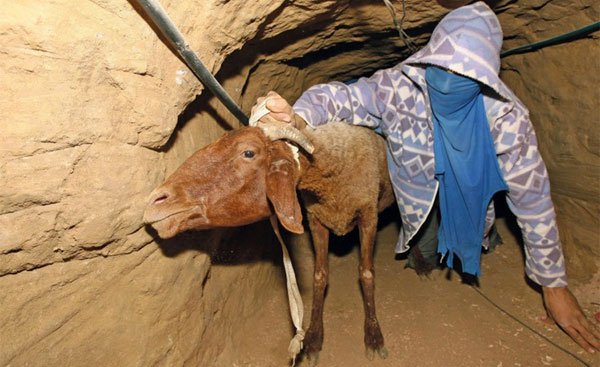
The tunnels are a lifeline for those who live in the beseiged Gaza Strip as they are used to smuggle vital supplies
MEMO | February 2, 2016
Director of Political-Military Affairs at Israel’s Defence Ministry Amos Gilad revealed today that the United States has contributed over $100 million to an Israeli-US technology research project aimed at identifying and locating tunnels on the Gaza Strip border.
In an interview with Army Radio this morning, Gilad stated that intelligence information suggests that there are no such tunnels leading into Israeli territory at the moment.
Defence Ministry official Shalom Gantzer dispelled the fears of Israelis living around the Gaza Strip who have claimed to hear digging noises under their houses, saying that these noises are coming from an electric generator.
Israel’s Channel 10 showed interviews on Saturday with those living near the Gaza border area who had recorded the noises with their mobile phones. They claimed that these noises were the sounds of tunnels being dug from Gaza.
Son of Argentine Indigenous Leader Charged for ‘Threats’
Activist Sergio Chorolque was hit with charges just days after his mother was ordered to remain behind bars

Human rights advocates that support Chorolque have alleged the charges are motivated by him and his mother’s activism. | Photo: Diario Veloz
teleSUR – January 31, 2016
The son of a prominent Argentine indigenous activist was charged Saturday on allegations his advocates say are politically motivated.
Sergio Chorolque is accused of issuing death threats to a municipal worker, and could face up to two years imprisonment.
Human rights advocates that support Chorolque have alleged the charges are motivated by his and his mother’s activism.
Chorolque’s mother Milagro Sala has already been described by some human rights activists as the first political prisoner of the new government of President Mauricio Macri.
The well-known indigenous leader, founder of the 70,000 member Tupac Amaru organization, was arrested on January 16 in the Jujuy on charges of inciting violence after protesting in a month-long sit in against Governor Gerardo Morales, who ordered her arrest.
A judge cleared Sala of those charges on Friday, but before she walked out of jail she was handed down a new set of accusations and ordered to stay behind bars while investigations into charges of “illicit association, fraud, and extortion” are launched at the request of the Jujuy government, local media reported.
As authorities peg various charges on the popular social leader, now one of Sala’s children has been charged with leveling death threats against a labor activist.
According to the conservative Argentine newspaper La Nacion, Morales has had a tense and “estranged” relationship with Sala for years. Morales has also had an antagonistic relationship with the social organizations and collectives with which Sala is aligned. Before her arrest, Sala was protesting in support of various organizations at risk of losing their legal status and social benefits after Morales threatened to suspend them via decree.
Sepur Zarco Trial: Guatemala Women Seek Justice for Sex Slavery
teleSUR – January 30, 2016
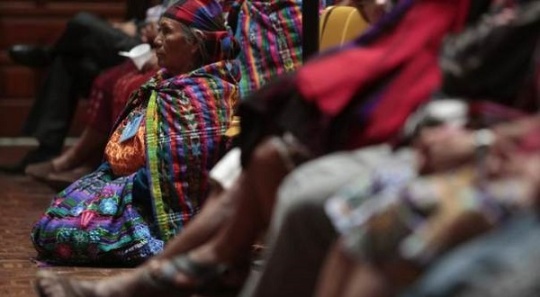
Fifteen Mayan women who were raped and forced to be sex slaves after their husbands were disappeared are demanding justice 30 years after the abuses.
Guatemala is about to launch a landmark trial against former military officers accused of committing sexual enslavement and forced disappearance during the most brutal years of the country’s 36-year civil war.
Here’s what you need to know about the historic trial that is scheduled to kick off Monday, Feb. 1.
1. Fifteen women were sexual and domestic slaves.
Guatemalan soldiers forcibly disappeared 15 men from an eastern Maya Q’eqchi’ village in 1982. It was one of the bloodiest years of Guatemala’s civil war, when dictator Efrain Rios Montt’s military regime was unleashing a scorched earth campaign targeting rural Mayans. After the army disappeared the men, they came back for their wives.
The women were raped and their belongings destroyed. They were taken captive and forced to live at the Sepur Zarco military base, where they were enslaved as domestic servants for the soldiers and systematically raped. The women were forced to labor in 12 hour “shifts,” an abhorrent system that lasted several months.
Though the enslaved shifts ended at the end of 1983, 11 of the 15 women were forced under military threat to stay at Sepur Zarco doing domestic chores for the soldiers for six years until the base closed in 1988. The other four women managed to flee to the mountains with their children where they endured painful hardship for years, including suffering the deaths of most of their children.
All of the women, now in their 70s and 80s, bear enormous physical and emotional trauma from the experience. They also faced stigma in their communities for the violence they endured, and did not share what had happened to them for 30 years, finally coming forward in 2011 to seek justice.
The trial accuses two defendants, former Sepur Zarco chief Esteelmer Reyes Giron and former regional military commissioner Heriberto Valdez Asij, of committing crimes against humanity, including sexual violence and sexual slavery, domestic violence, murder, and forced disappearance. They have been held in remand since 2014 awaiting the trial.
2. The Sepur Zarco case is an internationally historic trial.
The trial of two former military officers for crimes against humanity marks the first time in history that sexual slavery charges are prosecuted at the national level, in the country where the crimes were committed.
The more internationally high-profile case of sexual slavery during armed conflict, the case of Japan’s “comfort women,” was rejected by a Japanese court. Former comfort women subjected to sexual slavery during World War II put Japan on trial in a mock war crimes tribunal in Tokyo in 2000, but the case never officially went to court in the country.
Guatemala’s Sepur Zarco trial could set a new precedent for prosecuting sexual violence in the context of armed conflict, which rights defenders say is one of the most widespread yet under-recognized violations of human rights.
3. It is also a historic trial for Guatemala.
The Sepur Zarco trial marks the first that that Guatemala will consider a sexual violence case as an international crime, which could set a precedent for future trials.
The crime of sexual slavery has been recognized internationally since the early 1900s, when the 1907 Hague Convention prohibited rape and the use of prisoners of war as slaves. The 1926 Slavery Convention elaborated anti-slavery laws with a definition that applies to sexual slavery. The Rome Statute of the International Criminal Court, which came into force in 2002, specifically criminalized sexual slavery.
A standing definition of sexual slavery was detailed in the 1998 U.N. Special Rapporteur’s final report on contemporary forms of slavery, “Systematic Rape, Sexual Slavery, and Slavery-Like Practices During Armed Conflict,” also known as the McDougall Report.
The report defined sexual slavery as “the status or condition of a person over whom any or all of the powers attaching to the right of ownership are exercised, including sexual access through rape or other forms of sexual violence.” More simply put, the McDougall report explained: “Slavery, when combined with sexual violence, constitutes sexual slavery.”
The trial will consider the crimes committed as war crimes and crimes against humanity.
Rape was widespread during the civil war. The Sepur Zarco case has the potential to be a precedent-setting trial to break the cycle of impunity for sexual violence in Guatemala.
4. Rape was a concerted strategy in the civil war.
In 1999, three years after the peace accords were signed in Guatemala, the U.N.-backed Truth Commission investigating civil war atrocities found that rape was systematic and widespread during the conflict. According to the commission, “the rape of women, during torture or before being murdered, was a common practice aimed at destroying one of the most intimate and vulnerable aspects of the individual’s dignity.”
The Truth Commission also found that violence against women, include rape, torture, and murder, was often motivated by their political affiliations, social participation, and ideals, and often combined with other human rights abuses. The report attributed 93 percent of all recorded human rights violations to the state, 85 percent for which the army was responsible.
Despite the countless cases of sexual violence during the civil war, the Sepur Zarco case is the only one that has gone to trial in the country where impunity for war crimes has long remained the norm.
According to the Guatemalan organization Women Transforming the World, sexual violence continues to be inflicted on women by state security forces in conjunction with other human rights violations, such as forced displacement.
5. The victims in Sepur Zarco were targeted for defending their land.
Maya Q’eqchi’ communities in Guatemala have long suffered deep inequality, poverty, and precarious access to land. Before they were disappeared in 1982, the 15 husbands of the victims in the Sepur Zarco case were fighting for legal titles to defend the land they had lived and worked on for years. Because they were standing up for their land rights, they were despised by local large landowners, labeled as leftist insurgents, and made into targets to be silenced.
Land conflicts and unequal ownership are central to the history of Guatemala’s civil war. In 1954, a CIA-backed coup ousted the democratically elected president and reversed the fledgling agrarian reform program that aimed to expropriate idle lands from elite landowners and redistribute land to campesinos. The coup not only triggered more than three decades of civil war, but also helped to lock in one of the most unequal land distribution patterns in Latin America.
Rios Montt’s U.S.-backed bloodshed was nominally a campaign to crush leftist guerrilla uprisings in Guatemala, but in practice many poor Mayan campesinos were targeted as “insurgents” as the military protected the interests of elite landowners.
Photo credit – Reuters
UN says Turkey should investigate reports of rescuers being shot
Press TV – February 1, 2016
The UN High Commissioner for Human Rights has called on Ankara to investigate reports that a number of unarmed people trying to attend to the injured victims of clashes in Turkey’s southeast in late January were themselves shot at.
Ten people were injured when their group, which included two opposition politicians, came under fire while trying to help people injured in earlier clashes in the southeastern town of Cizre in Turkey’s mainly Kurdish southeast on January 20.
Zeid Ra’ad Al Hussein described as “extremely shocking” footage filmed of the incident, which purportedly shows what appear to be a man and woman holding white flags and pushing a cart – possibly carrying bodies – across a street before being shot.
“As they reach the other side, they are apparently cut down in a hail of gunfire,” Zeid said in a statement.
He also expressed concern that the cameraman, who was injured in the shooting, may face arrest under a “clampdown on media.”
Turkey has been engaged in a large-scale campaign against the outlawed Kurdistan Workers’ Party in its southern border region in the past few months. The Turkish military has also been conducting offensives against the positions of the group in northern Iraq.
The operations began in the wake of a deadly July bombing in the southern Turkish town of Suruc. More than 30 people died in the attack, which the Turkish government blamed on Daesh Takfiri terrorist group.
After the bombing, the PKK militants, who accused the government in Ankara of supporting Daesh, engaged in a series of supposed reprisal attacks against Turkish police and security forces, in turn prompting the Turkish military operations.
Intimidation through nightly ‘settler-tour’

Israeli forces blocking the entrance to the Palestinian market
International Solidarity Movement | January 31, 2016
Hebron, Occupied Palestine – On Saturday, 30th January 2016, large groups of settlers, accompanied by heavily-armed soldiers, entered the Palestinian market at night and took it over for about an hour during night-time in occupied al-Khalil (Hebron).
Around 9:30 pm, Israeli settlers from the illegal settlements throughout al-Khalil gathered at Bab al-Baladiyya, from where they walked into the Palestinian souq, the market, surrounded by heavily-armed Israeli forces. The group of more than 50 settlers started a ‘tour’ of the Palestinian market, with Israeli forces ‘guarding’ them throughout the Palestinian market. Palestinian residents were not allowed to pass and forced to wait at a distance, with soldiers repeatedly pointing the lasers from their guns at them to indicate they have to stop. A walk home at night though, for some Palestinians took almost an hour, instead of the usual 10 minutes.
This kind of ‘settler tour’ through the Palestinian market used to take place regularly on Saturday afternoons. During the ‘tour’ Palestinians are often denied to pass, stopped, ID-checked and detained. In the recent months, no ‘settler tours’ took place, but last week they started again with a nightly-tour at 11pm. For the Palestinian residents of the souq, these tours have become a regular form of intimidation and harassment in the past.
Israeli Soldiers Shoot International Activist In Nabi Saleh Protest
IMEMC News | January 28, 2016
Israeli soldiers attacked, Friday, the weekly nonviolent protest in Nabi Saleh village, near Ramallah, and shot an international activist with a live round, while many protesters suffered the effects of tear gas inhalation.
Morad Eshteiwy, coordinator of the Popular Committee in Nabi Saleh village, northwest of Ramallah, said the activist was shot in the leg, and was moved to a local hospital for treatment. He added that many protesters suffered severe effects of tear gas inhalation, after the soldiers used excessive force.
The army surrounded the village, fired many gas bombs, live rounds and rubber-coated steel bullets.
Eshteiwy added that, for the second time in one week, the soldiers sealed the main entrance of the village, forcing hundreds of Palestinians from nearby villages and towns, to take longer, unpaved roads.
Also on Friday, dozens of protesters suffered the effects of tear gas inhalation, after Israeli soldiers attacked the weekly nonviolent protest in Bil’in village, near Ramallah.
‘Hares boys’ sentenced to 15 years after families pay fines
Ma’an – January 29, 2016
RAMALLAH – After a nearly three-year long battle in Israeli military courts, five Palestinian teens from the occupied West Bank village of Hares accused of manslaughter after reportedly throwing stones were on Thursday issued sentences of 15 years, a prisoners’ rights group said.
The case has been disputed in the past by relatives and rights groups, who say that insufficient evidence was provided to prove that the five had any involvement in the death of an Israeli toddler who passed away two years after the teens were accused of throwing stones at her mother’s vehicle, causing it to crash.
A lawyer from the Palestinian Prisoners’ Society, Iyad Mahamid, told Ma’an that the military court issued the sentences to Muhammad Suleiman, Tamer Souf, Ammar Souf, Ali Shamlawi, and Muhammad Kleib.
Relatives of the detainees told Ma’an following a court hearing in December 2015 that the teens would be sentenced to prison terms of 15 years on the grounds that their families pay fines of 30,000 shekels ($7,700) by Jan. 28.
“Hares Boys,” an activist blog dedicated to raising awareness of the teens’ case, posted on their Facebook page “Free the Hares Boys” on Thursday that the families were able to pay the fines in full with the assistance of outside donations.
Failure to pay the fines could have resulted in prolonged sentencing to at least 25 years in prison, according to the Hares Boys blog.
Thursday sentencing marks a poor end to a drawn-out court battle that began after the five were detained by Israeli forces on March 15, 2013. All were 16 and 17 years old at the time of their detention.
Their arrest followed the hospitalization of a three-year-old Israeli girl, Adele Biton, who suffered severe head injuries when her mother’s car collided with a truck near the Israeli mega-settlement of Ariel. The toddler died two years later after suffering complications from pneumonia.
The family believes that while the child died of pneumonia, the severity of her complications was due to injuries sustained after the vehicle accident, according to Israeli media.
The Israeli vehicle had reportedly lost control after being hit by a stone, and the five teens were later accused of throwing stones that day at vehicles driving on Route 5, a highway leading to several nearby Israeli settlements.
Twenty Israeli drivers afterwards filed insurance claims stating that stones hit their cars, but the incidents lacked eyewitness testimony and the police received no calls at the time the teens were throwing stones.
All five denied the allegations, but later signed confessions “after being repeatedly abused in prison and during interrogations,” according to the Hares Boys blog.
The mother of the toddler told Israeli media following Thursday’s sentencing: “It is not much consolation, we would have preferred [the] death [penalty] or life-sentencing. The state did not properly tend to the matter and it didn’t fully enforce the punishment to the fullest.”
The British Parliament on Thursday in response to an online public forum inquiry said an official from the British Embassy in Tel Aviv had met with Chief Military Prosecutor Maurice Hirsch in November to express its concern over the case of the Hares boys, adding that the government would continue to raise the case to Israeli authorities.
The teens’ families as well as rights groups have repeatedly argued over the past three years that the youth were being held without evidence and unjustly prosecuted in a military court system that convicts over 99 percent of Palestinians.
The Hares Boys blog wrote in their defense in 2013: “If the boys are convicted, this case would set a legal precedent which would allow the Israeli military to convict any Palestinian child or youngster for attempted murder in cases of stone-throwing.”
Israeli Prime Minister Benjamin Netanyahu in September declared a “war on stone throwing,” establishing a minimum prison sentence for adults who throw stones as well as allowing Israeli forces to use sniper fire against stone throwers in circumstances that pose mortal danger.
The PM said at the time that there would be “significant fines” for minors who commit such offences, as well as for their parents.
The Knesset had already passed a law in July making penalties for stone-throwing more severe. The new law allowed for stone-throwers to receive a 20-year prison sentence where intent to harm could be proven, and 10 years where it could not.
At the time the bill was passed, Palestinian MK Jamal Zahalka said: “Who will the judge send to prison? He who demolished the home, seized the land, killed the brother, or the boy who threw a stone?”
Israeli forces storm al-Quds University, seize documents
Ma’an – January 29, 2016
JERUSALEM – Hundreds of Israeli soldiers stormed Abu Dis’ al-Quds Open University early Friday and confiscated equipment and documents belonging to its student union, staff members told Ma’an.
Hassan Dweik, the university’s deputy head, said that up to 300 soldiers stormed the campus, holding six security guards in a room and preventing them from leaving for two and a half hours.
He said the soldiers raided the university’s Islamic studies department, as well as its student union offices after smashing their way through their doors.
 Dweik said the soldiers confiscated at least one computer as well as boxes filled with students’ documents.
He said the soldiers fired stun grenades during the raid, and took pictures and measurements of a number of buildings inside the university campus.
He condemned the raid as a dangerous violation against education, and called on international human rights and education rights groups to decry the army’s actions.
An Israeli army spokesperson said she was looking into the reports.
Since a wave of unrest swept the occupied Palestinian territory in October last year, Abu Dis’ Al-Quds University has found itself a focal point of violent clashes between Palestinian students and Israeli soldiers.
A number of Palestinians who allegedly carried out stabbing attacks on Israelis were students there.
These include 19-year-old law student Muhannad Shafiq Halabi, who was shot dead at the beginning of the month after he stabbed to death two Israelis in Jerusalem’s Old City — an act that served to trigger much of the subsequent popular unrest.
Several days before the attack, Israeli media reported that Halabi posted a photograph on Facebook of Diya Talahmeh, another Palestinian studying at al-Quds University who died in unclear circumstances during an encounter with Israeli forces in the West Bank village of Khursa in September.
Israeli forces have regularly stormed university campuses across the occupied Palestinian territory in recent months.
Earlier this month, Birzeit University in Ramallah condemned an Israeli army raid into its campus, during which Israeli forces confiscated and damaged university equipment.
“Birzeit University condemns this attack and the direct violation of the sanctity of the university campus,” the university said. “This is a belligerent military attack on the university and our right to education and all the principles involved in the freedom of education.”
Featured Video
“Historic Russia”: The Land Putin Will Not Give Back
or go to
Aletho News Archives – Video-Images
From the Archive
How Ukraine Tortured and Slaughtered Donbass
By Kit Klarenberg | Al Mayadeen | July 11, 2024
Almost immediately after the proxy war erupted, ISIS-tier footage of the torture and murder of Russians in Ukrainian custody emerged.
On July 6th, the New York Times published an astonishing investigation: In Ukraine, Killings of Surrendering Russians Divide an American-Led Unit. The article documents in grim detail how Chosen Company, an international volunteer battalion for Kiev, routinely executes Russian prisoners of war. It is the very first mainstream admission that this practice – a brazen breach of the Geneva Conventions, and a grave war crime – is widespread among Ukraine’s fighters, both foreign and homegrown. … continue
Blog Roll
 Aletho News
- Burnham tackles Britain’s poverty with aggression in Yemen
- Peace in Ukraine: the easy way – or the hard way
- Trump & the Rrrrussians
- US taxpayer money laundered back through Ukraine – Musk
- Before COVID, an NIH lab chief proposed making a SARS-like bat virus more infectious
- Gates, Bourla on Trial in Netherlands Accused of ‘Great Reset’ Scheme at Vaccine Injury Hearing
- BRITAIN’S WARNING: PREPARE FOR WAR
- “Historic Russia”: The Land Putin Will Not Give Back
- How the Cambridge Analytica scandal still haunts Mark Zuckerberg
- The Ongoing Cancellation Campaign Against a Dissenting Academic in Norway
- If Americans Knew
- DAILY UPDATE: Latest essential news on Palestine, Israel, & region
- Damning report shows the media must confront its failures on Gaza
- BBC senior broadcaster speaks out on Gaza coverage
- Netanyahu vows vast West Bank invasion in response to 20-minute skirmish that left 2 Israeli soldiers and 2 Palestinian fighters dead
- Tied up and tortured: Israel using US-made electroshock weapons on Palestinian detainees
- The outsourced risk: how newsrooms rely on Gaza’s freelancers without protecting them
- Gaza bakeries forced to shut as Israel blocks flour shipments
- Gaza’s breast cancer patients face a deadly wait for treatment amid Israel’s genocide
- DAILY UPDATE: Latest essential news on Palestine, Israel, & region
- The Israel Lobby’s Changing Fortunes
- No Tricks Zone
- Two New Studies Find Thwaites Glacier Melt Cannot Be Driven By Human Activity Or A Warming Ocean
- E-Cars Reduce CO2 Emissions By Only 41% Compared To Internal Combustion Engine Vehicles
- Predictions Made By Renowned Climate Professor Over Past Decades Have Been Proven To Be Poor
- New Study Suggests Large Regions Of The Pacific Ocean Have Been Cooling For The Last 80 Years
- Germany’s Green Energy Debacle: High Energy Costs Force Kahla Porzellan to Close After 182 Years!
- New Study: 50 Years Of The Most Aggressive ‘Net Zero’ Policies Can Only Affect The Global Climate By 0.03°C
- US September “Heat” Was No Record…Many Records Set Decades Ago
- Latest European Green Energy Debacle; Portugal’s Largest Flagship Solar Park Insolvent!
- Green Energy Debacle: German Expert Professor Fritz Vahrenholt Warns Of Severe Economic And Social Consequences
- Two More Paleo Reconstructions Affirm Meters-Higher Sea Levels Across Ireland, Brazil 7000-6000 Years Ago

