Federal Appeals Court: US Citizens Can’t Sue FBI Agents For Torture Abroad
By Kevin Gosztola | ShadowProof | October 26, 2015
A federal appeals court decision effectively grants FBI agents involved in terrorism investigations abroad immunity from lawsuits, which allege torture or other constitutional rights violations.
The D.C. Circuit Court of Appeals ruled against Amir Meshal, an American citizen who was detained and tortured by FBI agents in Kenya, Somalia, and Ethiopia, and declined to permit Meshal to pursue damages for what he endured.
According to the federal appeals court [PDF], allowing Meshal to pursue damages would extend Bivens into a new context: the “extraterritorial application of constitutional protections.”
Bivens is a case that created precedent for bringing cases against federal government officials. However, courts have been extremely reluctant to allow plaintiffs to pursue damages when a case may set a precedent or lead to a court intruding upon national security and foreign policy matters.
In Meshal’s case, U.S. agents and foreign officials are accused of working together. A decision would pass judgment on officials working under a “foreign justice system.” Such “intrusion,” the appeals court claimed, could have diplomatic consequences.
The appeals court quoted prior cases and stated:
Allowing Bivens suits involving both national security and foreign policy areas will “subject the government to litigation and potential law declaration it will be unable to moot by conceding individual relief, and force courts to make difficult determinations about whether and how constitutional rights should apply abroad and outside the ordinary peacetime contexts for which they were developed.” Even if the expansion of Bivens would not impose “the sovereign will of the United States onto conduct by foreign officials in a foreign land,” the actual repercussions are impossible to parse. We cannot forecast how the spectre of litigation and the potential discovery of sensitive information might affect the enthusiasm of foreign states to cooperate in joint actions or the government’s ability to keep foreign policy commitments or protect intelligence. Just as the special needs of the military requires courts to leave the creation of damage remedies against military officers to Congress, so the special needs of foreign affairs combined with national security “must stay our hand in the creation of damage remedies. [emphasis added]
Or, more succinctly, the appeals court claims “special factors counsel hesitation” in allowing Meshal to pursue “money damages.”
The appeals court additionally determined Meshal’s citizenship did not override these “special factors.”
In issuing this decision, the appeals court leaves the issue of remedies for torture to Congress or the Supreme Court and makes it virtually impossible for torture survivors to pursue justice when their rights are supremely violated.
Meshal is Detained Incommunicado, Threatened with Transfer to Israel
Meshal was in the Horn of Africa when, on January 24, 2007, Kenyan soldiers captured and interrogated him. He was “hooded, handcuffed and flown to Nairobi, where he was taken to the Ruai Police Station and questioned by an officer of Kenya’s Criminal Investigation Department” and was told that the police had to “find out what the United States wanted to do with him before he could send him back to the United States.” He remained in detention without access to a telephone or his attorney for a week, according to the U.S. District Court of the District of Columbia’s decision.
On February 3, “three Americans,” who turned out to be FBI agents, interrogated Meshal and told him he would be handed over to the Kenyans and remain stuck in a “lawless country” if he did not cooperate. The agents also accused him of “having received weapons and interrogation resistance training in an al Qaeda camp.” Supervising Special Agent Chris Higgenbotham, one of the officials sued, threatened Meshal with being transferred to Israel where the Israelis would “make him disappear.” Meshal was informed that another U.S. citizen he had met in Kenya, Daniel Maldonado, who was also seized by Kenyan soldiers, “had a lot to say about” him and his story “would have to match.”
Meshal was flown by Kenyan officials to Somalia with twelve others on February 9. He was “detained in handcuffs in an underground room with no windows or toilets,” which was referred to as “the cave.” This was allegedly to prevent pressure from Kenyan courts to halt his detention and interrogation by FBI agents.
About a week later, Meshal was transported in handcuffs and a blindfold to Addis Ababa, Ethiopia. He was held there in incommunicado detention for a week before Ethiopian officials started regularly transporting him to a villa with other prisoners where he could be interrogated by FBI agents. He remained in detention for three months and was moved into solitary confinement twice.
Finally, on May 24, he was taken to the U.S. Embassy in Addis Ababa and flown back to the U.S. He was detained for four months and lost eighty pounds. US officials never charged him with a crime.
Appeals Court Skeptical of US Secrecy Arguments (But That Didn’t Matter)
Although the U.S. government did not invoke the “state secrets privilege,” it put forward a “laundry list of sensitive issues” that would allegedly be implicated if Meshal was able to pursue a lawsuit against FBI agents.
The government claimed it would involve “inquiry” into “national security threats in the Horn of Africa region,” the “substance and sources of intelligence,” and whether procedures relating to counterterrorism investigations abroad “were correctly applied.” Also, the government insisted it would require discovery “from both foreign counterterrorism officials, and U.S. intelligence officials up and down the chain of command, as well as evidence concerning the conditions at alleged detention locations in Ethiopia, Somalia, and Kenya.”
The appeals court appropriately asked in their decision, “Why would an inquiry into whether the defendants threatened Meshal with torture or death require discovery from U.S. intelligence officials up and down the chain of command? Why would an inquiry into Meshal’s allegedly unlawful detention without a judicial hearing reveal the substance or source of intelligence gathered in the Horn of Africa?”
“What would make it necessary for the government to identify other national security threats?” the court additionally asked.
Despite recognizing the unfounded basis for claims about how the lawsuit would risk disclosure of sensitive information, the appeals court chose to be overly cautious and dismiss the case as the government urged.
Appeals Court Overlooks Affidavit from Former FBI Agent
The American Civil Liberties Union, which filed the suit on behalf of Meshal, obtained an affidavit from former FBI Agent Donald Borelli, who unequivocally made clear FBI agents are expected to follow the U.S. Constitution when in territories abroad.
“The FBI’s longstanding commitment to respect the Constitution—including when it acts abroad in respect of U.S. citizens—reflects and implements the long established rule that the Constitution applies to and constrains U.S. government action against U.S. citizens abroad,” Borelli maintained.
In fact, Borelli cited a Supreme Court decision in 1957 involving two U.S. citizens, “who were tried and convicted by court-martial based on allegations they murdered service member spouses on U.S. military bases.”
From the Supreme Court’s ruling:
At the beginning we reject the idea that when the United States acts against citizens abroad it can do so free of the Bill of Rights. The United States is entirely a creature of the Constitution. Its power and authority have no other source. It can only act in accordance with all the limitations imposed by the Constitution. When the Government reaches out to punish a citizen who is abroad, the shield which the Bill of Rights and other parts of the Constitution provide to protect his life and liberty should not be stripped away just because he happens to be in another land. This is not a novel concept. To the contrary, it is as old as government. It was recognized long before Paul successfully invoked his right as a Roman citizen to be tried in strict accordance with Roman law.
Citizens like Meshal are supposed to have protection from unreasonable searches and seizures, however, the lower courts are unwilling to check the power of the Executive Branch. They have chosen to wait until the Supreme Court or Congress acts and that gives someone like Meshal an exceedingly small chance of ever winning justice.
Palestinian Teen Killed In Hebron, Second In Three Hours
IMEMC & Agencies – October 29, 2015
The Palestinian Health Ministry has reported, Thursday, that Israeli soldiers shot and killed a Palestinian teenager, in the southern West Bank city of Hebron, the second Palestinian to be killed in the city in less than three hours.
The Ministry said the slain Palestinian has been identified as Farouq Abdul-Qader Seder, 19 years of age.
He was shot dead in the Shuhada Street, close to the Beit Hadassah illegal Israeli colonialist outpost, in the heart of Hebron city.
The Israeli army claimed the Palestinian “carried a knife, and attempted to stab a soldier,” a claim that was strongly denied by eyewitnesses.
Eyewitnesses also said Israeli soldiers, and extremist colonizers attacked the dead body of the slain Palestinian, and opened fire on the home of resident Hajj Mofeed Sharabati.
The army claims several Palestinian activists, of the Independent Human Rights Committee and Youth Coalition against Settlements, “were hiding in the Sharabati home.”
Farid al-Atrash, head of the Independent Committee for Human Rights in the southern part of the West Bank, said the soldiers attacked him and many Palestinians who were with him when they rushed to the scene, where the Palestinian was killed, after hearing gunshots.
“The soldiers attacked us, and we ran to the home of Mofeed Sharabati,” he stated, “The soldiers and fanatic settlers followed us, and attacked us in his home.”
“We are here, and will remain here; we document the Israeli violations; we defend the legitimate rights of the Palestinians to live in peace and dignity,” he added, “The soldiers also fired a gas bomb targeting the Sharabati home, and surrounded it.”
Also Thursday, soldiers shot and killed Mahdi Mohammad Ramadan al-Mohtasib, 23 years of age, near the Ibrahimi Mosque, in Hebron.
The latest fatal shootings on Thursday bring the number of Palestinians, killed by Israeli army fire in occupied Palestine since the beginning of this month to 68, including 14 children.
49 Palestinians were killed in the West Bank, including Jerusalem, 17 in the Gaza Strip, including a mother and her two years of age child, and one in the Negev, the Palestinian Health Ministry said.
The Ministry added that at least 914 have been shot by live Israeli army fire, while 878 were shot with rubber-coated steel bullets.
It also said that 206 Palestinians suffered fractures and bruises after being beaten by Israeli soldiers and extremist settlers, 14 suffered burns due to Israeli gas bombs and concussion grenades, and more than 5000 Palestinians received treatment for the effects of tear gas inhalation.
Shot woman: Israeli police alter story again
By Jonathon cook | The Bog From Nazareth | October 29, 2015
 The official Israeli story about Israa Abed – the Nazareth woman who was shot six times on Oct 9 by Israeli security forces as she stood motionless in a bus station – has changed so many times, it’s difficult to know what to believe any more. By a small miracle she survived the shooting.
I raised many questions about this incident, based on two videos taken by bystanders, in a post on the day she was shot. That post, including the videos, is available here.
Israa is one of Israel’s 1.6 million Palestinian citizens. She lives in Israel, not the occupied territories.
Let’s be clear: the main reason the police have repeatedly revised their account of the events of Oct 9 is because the visual evidence has conclusively refuted their claims. They have been forced to back-pedal.
Without the video, Israa would have been charged with, and probably convicted of, terrorism offences. In line with threats from Israeli prime minister Benjamin Netanyahu, she would also have risked being stripped of her citizenship.
Originally the police said they “neutralised” Israa after she pulled out a knife and stabbed a security guard at the bus station in the city of Afula. When it was clear no one had been injured, the story changed: she had tried without success to stab the guard.
Then it was reported that the police had shot Israa not because of an attempted attack but because she behaved in a threatening manner towards other people at the bus station.
Now, in the latest version, the police say she did not intend to stab anyone. In the video footage, reports the Haaretz newspaper, she can be seen “standing next to a young ultra-Orthodox man without trying to hurt him”.
Instead, the police say she was depressed and / or mentally unstable and pulled out a knife because she wanted to “induce” the security forces to shoot her.
Pause for a second as you digest that argument. According to the police, Israa went to the bus station with the intention of pulling out a knife but not harming anyone, knowing that doing so would be enough to get her shot and maybe killed. And why would she think that? Because she looks Arab (she wears a headscarf), and, like most Palestinian citizens, understands that in any confrontation with the security services that is reason enough for the police to shoot without justifiable cause.
Even more disconcertingly, the Israeli police seem to agree that Israa’s assumptions were warranted.
Further, the claim that Israa wanted to be shot is pretty convenient for the four security staff who, even according to the official account, fired their weapons at a woman who posed absolutely no threat to anyone at the bus station.
Might they be disciplined, or, more properly, punished, for shooting a woman six times for no reason at all? Apparently not. They have been investigated and it has been decided that “there is no reason to take disciplinary measures against them, given the extenuating circumstances of the incident”. One might well ask: what were those “extenuating circumstances”?
Finally, the police are still claiming that Israa pulled out a knife. Given their series of bogus claims till now, there is no reason to assume even this part of their story to be true.
As I noted in my previous post, a video taken seconds after Israa was shot, when she is lying on the ground, appears to show a pair of sunglasses next to her. A man in jeans and T-shirt goes over to her, ignored by police, and kicks away the sunglasses. Who is that man and why is he interfering with evidence? No one seems to be asking these questions, so we are unlikely to get any answers.
www.haaretz.com/israel-news/1.682928
Young unarmed man murdered in cold blood in Hebron
International Solidarity Movement | October 28, 2015
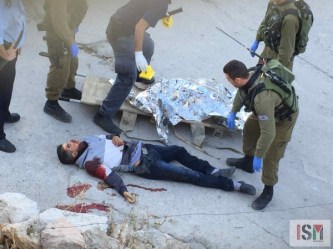 Hebron, Occupied Palestine – Wednesday 28th at 3.25pm a young Palestinian was shot in cold blood in the Tel Rumeida neighborhood in Hebron. Human rights observers from International Solidarity Movement witnessed the young man being murdered while walking in the street near the Gilbert Checkpoint.
The eyewitness from ISM, identified as Orion, states: “I am 100% sure he was unarmed. I saw the two soldiers creeping slowly along the road outside our apartment window with their guns cocked, so I looked down the street to see why. I saw an unarmed man walking normally towards the soldiers and suddenly they shot.”
The young man was shot at a distance of around two meters and at least 12 shots were fired. He died immediately after being shot.
No shouting or running was heard on the site prior to the murder. Minutes prior to the incident, a policewoman was overheard at the Shuhada Street checkpoint 56 saying on her radio “he looks like a good one, shoot him.”
Another activist from the ISM states: “It was just like last night, when they shot Hummam Said. Everything was quiet and suddenly we heard many shots outside our apartment. I am sure he was unarmed and they murdered him for no reason, just like Hammam”
UK supports Dubai police fair, despite UAE torture record
Reprieve | October 28, 2015
UK Trade and Investment (UKTI) is supporting a trade fair hosted by the Dubai police this week, despite widespread use of police torture in the UAE.
The event, the Emirates Security Exhibition and Conference (Emsec), is said by its organizers to be ‘designed to support and encourage UK exports’. It is officially hosted by the Dubai police, though UKTI has organized a reception at the British embassy in Dubai for UK companies taking part.
Human rights organization Reprieve – which assists British and other victims of police torture in the Emirates – has previously raised concerns with UKTI about its support for the event. Reprieve’s research has found that some 75 per cent of prisoners in Dubai Central Jail reported having been tortured into ‘confessing’. They include British citizens who say they were subjected to electric shocks. Despite this, a recommended ‘product requirement list’ given to UK companies ahead of this week’s event included the category ‘Public Order Equipment – Electronic’.
British student Ahmad Zeidan, from Reading, was arrested and tortured in December 2013, and was eventually convicted on the sole basis of a ‘confession’ he signed in Arabic – a language he neither reads nor writes. Ahmad, who initially faced a potential death sentence, recently learned that he was not included in a royal pardon that saw hundreds of other prisoners freed – despite his requests to the UK Foreign Office to support his case.
A 2013 UKTI strategy document unearthed by Reprieve lists security export events such as Emsec as a new priority for the Government, and a Reprieve Freedom of Information request has revealed that last year the government spent £12,000 on encouraging British companies to attend.
The event comes as the UAE was expected to secure re-relection to the United Nations Human Rights Council, in a vote today. In a submission to the body in support of their bid, Emirati representatives said: “Our wish to serve a second term on this esteemed body reflects our view that societies that uphold human rights are more resilient, more sustainable and more secure.”
Commenting, Maya Foa, head of the death penalty team at Reprieve, said: “The Emirati authorities have boasted to the UN about their human rights record, but the reality is dismal. The UAE systematically uses torture to secure convictions – and death sentences – based on bogus statements. British student Ahmad Zeidan is still languishing in prison after he was forced to sign one of these ‘confessions’. Instead of lending UK support to the Emirati police responsible for his torture, the British Government should make clear that we want no part in such abuses – and should demand the release of victims like Ahmad without delay.”
Israel to demolish East Jerusalem home of alleged attacker’s brother
Ma’an – October 27, 2015
JERUSALEM – Israeli authorities on Tuesday delivered a home demolition order to Ibrahim Dwayyat from Sur Bahir in East Jerusalem, the brother of Shurouq Dwayyat, who Israel accuses of attempting to stab an Israeli settler earlier this month.
Their mother told Ma’an that the Israeli municipality claimed the home had been built without the necessary permits.
She said that her son began building the house four years ago and in a few months had planned to get marry and move into the home.
She said that Israeli authorities recently stormed the building where they took photos and took down its measurements.
It was not initially clear whether the demolition was intended as a punitive demolition following an alleged attack by Ibrahim’s 18-year-old sister, Shurouq.
Shurouq was shot and injured by a 35-year-old Israeli settler in Jerusalem’s Old City after she allegedly attempted to stab him on Oct. 7.
Israeli media said at the time that the man sustained light injuries, while medics told Ma’an that Shurouq was shot four times in her upper body, leaving her in serious condition.
Witnesses told Ma’an that she had been assaulted by the Israeli settler and did not have any sharp objects on her at the time of the incident.
After initially being treated at Hadassah Hospital in Ein Karem, Shurouq was later taken to Hasharon prison.
Her mother told Ma’an that several days ago, Israeli forces detained another of her sons, 22-year-old Muhammad, and have since sentenced him to six months of administrative detention, without trial or charge.
She added that Israeli authorities had refused family visits to Shurouq after she was shot.
Earlier this month, Israeli Prime Minister Benjamin Netanyahu called to fast track the demolition of family homes of alleged attackers, following a series of attacks that have left nine Israelis dead.
Human rights groups have criticized Netanyahu’s call as an unlawful form of collective punishment due to its displacement of Palestinians who have not committed crimes.
In a statement released last year, Human Rights Watch stated that the demolitions may also constitute a war crime as they are carried out in occupied territory.
Israeli forces erasing Palestinian lives as if they never existed – 23-year old gunned down in Hebron
International Solidarity Movement | October 28, 2015
Hebron, Occupied Palestine – At 10.30pm last night, Tuesday 27th October 2015, a Palestinian man who has been identified as 23 year old Hammam Said was shot in al-Kahlil (Hebron) at the Gilbert checkpoint, directly outside the ISM apartment. The man was in the H2 neighborhood of Tel Rumeida which was otherwise quiet at the time.
No commotion, shouting or running was heard prior to the six gun shots echoing suddenly through the streets and no other security risk could otherwise be perceived.
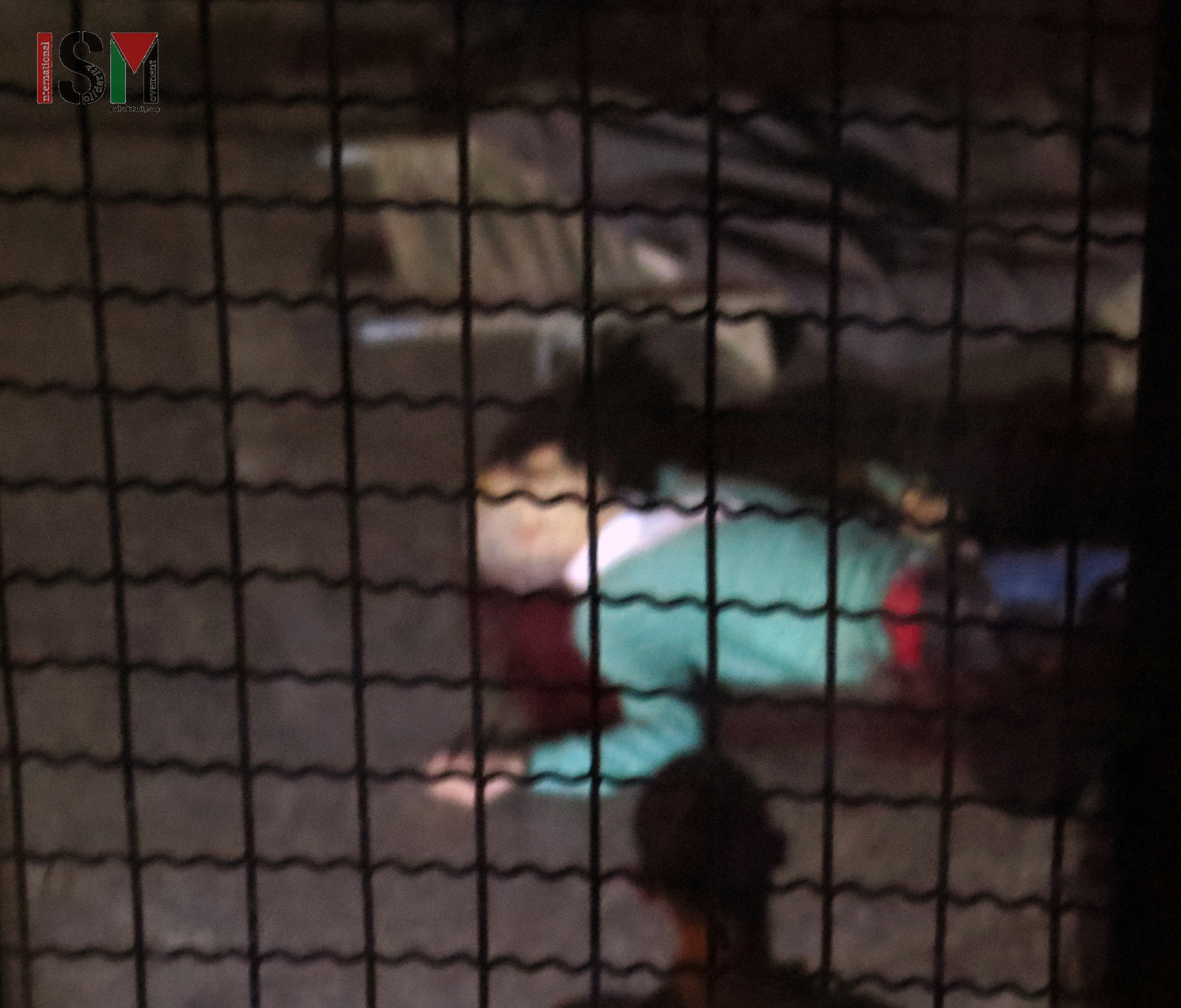
Immediately following the incident, Israeli forces, who are permanently posted at the checkpoint for 24 hours a day, surrounded the body of the fallen man. Within minutes settlers from the nearby illegal settlement arrived and were allowed to approach and photograph the scene. Further forces then arrived, including soldiers and several police vehicles. An Israeli ambulance arrived but no medical aid was delivered to Said, instead paramedics stood close to the bleeding man and watched passively as he died.
Said was then stripped of his clothes, revealing that the gunshot wounds were all on the back of his body. He was then placed in a bodybag and the street was cleaned. By midnight the scene was totally cleared of all evidence of the incident.
A short video shows Hammam after he was stripped of his clothes by Israeli forces:
Eyewitnesses reported that no knife was originally witnessed on the scene, though one appeared after the soldiers surrounded the body. “I cannot say for sure they put the knife there, but I know even 5 seconds after the shooting I looked, I really looked, and I could see nothing. I am 99% sure of it. But afterwards, it was there.” She added “if an attack was planned at this location it wouldn’t even make sense. He was still 20 meters from the soldiers or checkpoint, in the middle of the night. Why would he wave the knife around?”
Extrajudicial executions of this kind are illegal in international law and there is no evidence that warning or deescalating force was applied before the lethal shooting of Said. The checkpoint has a camera positioned above the street and the International Solidarity Movement is demanding that Israeli forces release the raw footage to prove an association between the man and the knife allegedly found at the scene.
An hour and a half after the incident, an eyewitness reported that “it is like nothing happened, there is no bloodstain, nothing but a dog sniffing the ground. The street is eerily quiet and there are just the normal number of soldiers at the checkpoint.” They added that “they cannot really feel like there is a security threat here right now.” An hour after that an illegal settler vehicle was parked by the location of the shooting, playing loud festive music.
Listen to audio of settlers playing party songs after Hammam Said’s blood was washed off the ground:
Said’s death marks four Palestinian deaths in Hebron within two days, and brings the total death toll within the Occupied Territories of Palestine to 64 since the start of October. Hebron has been a centre of the rising tension in the West Bank, and today witnessed extreme suppression of peaceful protests in Bab Al-Zawwiya, when innumerable rounds of teargas were shot directly at dense crowd of demonstrators who were demanding the release of Palestinian corpses killed by Israeli forces.
It is anticipated that with allegations that Said had a knife that no investigation will be launched, yet another Palestinian will be branded as a terrorist, and as a final injustice another family will be denied their rightful mourning rites.
Palestinian MP among 34 issued administrative detention orders
Ma’an – October 27, 2015
RAMALLAH – Israeli authorities issued administrative detention orders against 34 Palestinian prisoners, including a Hamas-affiliated lawmaker, for periods of three to six months on Tuesday, a prisoners’ rights group said.
The Palestinian Prisoner’s Society told Ma’an that some of the detainees have previously spent years in administrative detention, an Israeli practice that allows for internment without trial or charge indefinitely.
The society said that Hamas-affiliated lawmaker Hassan Youssef had been issued a six-month sentence under administrative detention.
Youssef, a member of the Palestinian Legislative Council, Palestine’s parliament, has been imprisoned by Israel on several occasions previously.
Most recently, he was released from Israeli custody in June after spending a year without trial or charge.
Since the start of October Israeli forces have detained around 1,000 Palestinians, according to prisoners’ rights group Addameer.
The 34 newly ordered administrative detainees are listed as follows with the periods of their detainment:
1. Shaher Jamil al-Hih, Hebron, 6 months.
2. Rasmi Jihad Khatib, Hebron, 3 months.
3. Idris Youssef Hassan, Ramallah, 3 months.
4. Hussein Saleh Abu Aker, Bethlehem, 6 months.
5. Ali Abd al-Karim Eweiwi, Hebron, 6 months.
6. Sadeq Muhammad Siyaj, 6 monyhs.
7. Jaafar Muhammad Maloul, Jenin, 3 months.
8. Mahmoud Wajih Qatt, Nablus, 6 months.
9. Nihad Muhammad al-Dib, Hebron, 4 months.
10. Maher Nathmi Jaradat, Hebron, 6 months.
11. Ashraf Muhammad Zaid, Jenin, 3 months.
12. Hatem Hafeth shawamreh, al-Ram, 3 months.
13. Mahmoud Imad Shawqi, Bethlehem, 6 months.
14. Ahmad Jamal Abu Jalaghif, Bethlehem, 4 months.
15. PM Hassan Youssef, Ramallah, 6 months.
16. Wissam Walid Khashan, Jenin, 6 months.
17. Munir Othman Zahran, Ramallah, 4 months.
18. Diyaa Aziz Imla, Hebron, 6 months.
19. Sami Hassan Shqeir, Ramallah, 6 months.
20. Mujahed Haitham Qawasmeh, Hebron, 3 months.
21. Ahmad Jamal Hreimi, Bethlehem, 6 months.
22. Abd al-Ghani Hassan Hammad, Ramallah, 3 months.
23. Ibrahim Khalid Ghafri, Ramallah, 3 months.
24. Muhammad Hani Suman, Bethlehem, 6 months.
25. Ibrahim Muhammad Sweiti, Hebron, 3 months.
26. Hussam Muhammad Abu Dayyeh, Bethlehem, 6 months.
27. Muhammad Atta Zahran, Qalqiliya, 6 months.
28. Muhammad Jamal Youssef, Ramallah, 6 months.
29. Ibrahim Abd al-Rahman Khasib, Ramallah, 3 months.
30. Fayiz Saad al-Rajabi, Hebron, 6 months.
31. Taysir Taleb Abu Snineh, Hebron, 6 months.
32. Diyaa Abd al-Rahim Abu Daoud, Hebron, 6 months.
33. Ahmad Hassan Nasr, Ramallah, 4 months.
34. Fadi Muhammad Srour, Hebron, 6 months.
Judge rejects Obama attempt to conceal Guantanamo force feeding tapes
Reprieve | October 27, 2015
A US District Court judge has rejected the Obama administration’s latest request to conceal tapes of detainees at Guantanamo Bay being force-fed.
Responding to the government’s request to reverse her order handed down in October last year – that the Guantanamo tapes should be released – Judge Gladys Kessler wrote that, “What the Government is really saying is that its classification system trumps the decisions of the federal courts as to the public’s access to official court records; in other words, the Executive Branch (in this case, the Military) purports to be a law unto itself.”
In her ruling today, Judge Kessler described the government’s request as ‘repetitive, speculative, and extremely vague.’ In August, the US government handed to the court censored versions of the tapes which show former detainee Abu Wa’el Dhiab being force-fed. These tapes have been redacted to conceal the identities of those military personnel carrying out the procedure. However, lawyers at international human rights NGO Reprieve – who have seen the redacted versions – have raised concerns that the redactions, especially of sound, are so heavy that they render the tapes nearly incomprehensible. Reprieve lawyers have filed a motion challenging the extent of censorship; that motion is pending.
Today’s judgement means that the US government must continue litigation if it is to successfully conceal the tapes from the American press and public. Alongside lawyers for Mr Dhiab, 16 news outlets – including the New York Times, Associated Press and Guardian – have joined the legal filing seeking release of the Guantanamo tapes to the public on First Amendment grounds.
Cori Crider, Reprieve’s Strategic Director and attorney for the Guantanamo detainees, said: “The Obama administration has dragged its feet for over a year to stop the American press and public seeing a single frame of these tapes. We’re glad the judge has denied the government’s request for a blanket cover-up, but a lot of problems persist – we expect the government to appeal this to the Supreme Court to stop people seeing the truth. Americans have a right to see what continues to be done in their name up to this day. The government should reduce its heavy-handed censorship of the footage, drop the appeals, and release the tapes immediately.”
Saudi authorities arrest father of juvenile set for ‘crucifixion’
Reprieve | October 27, 2015
The father of a juvenile sentenced to death by ‘crucifixion’ in Saudi Arabia has reportedly been arrested.
Mohammed al-Nimr, the father of Ali al-Nimr – a juvenile who has been sentenced to death by ‘crucifixion’ having been arrested when he was 17 for attending protests – was reportedly arrested today on unknown charges. He is currently being held at Al Awamiyah police station where his son and another juvenile – Dawoud al-Marhoon, also sentenced to death for attending protests – were first detained.
Yesterday, the Saudi Arabian ambassador to the UK wrote an article in the Daily Telegraph in which he complained that the UK was not showing enough ‘respect’ to the gulf Kingdom, after a controversial Ministry of Justice bid to work with the Saudi prison system was withdrawn, seemingly on the basis of human rights concerns.
This morning Mohammed al-Nimr has been vocal in calling for a commutation of his son’s death sentence by the Saudi authorities. Earlier this month he gave an interview to CNN in which he said that he and his family were ‘extremely worried’ about his son’s fate.
Kate Higham, caseworker at international human rights NGO Reprieve, said: “It is absolutely outrageous that Mohammed al-Nimr has been arrested, seemingly just for speaking out to save the life of his son. If the Saudi authorities have any concern for due process, human rights, or basic humanity, Mohammed al-Nimr must be released at once. The UK government and all those who have expressed concern about Ali al-Nimr’s case must act now to prevent this illegal detention from continuing, and must re-double their efforts to prevent Ali’s execution – and that of Dawoud al-Marhoon – from happening.”
Saudi Supreme Court approves Sheikh Nimr death penalty
Press TV – October 25, 2015
Saudi Arabia’s Supreme Court has approved the death penalty for prominent Shia cleric Sheikh Nimr al-Nimr, his brother says.
Mohammad al-Nimr, the prominent cleric’s brother, said in a message on social media on Sunday that the Saudi Supreme Court and an appellate court had approved the execution of the Shia cleric and authorized the Saudi Interior Ministry to carry out the sentence.
The execution warrant has been reportedly sent to Muhammad bin Naif bin Abdulaziz Al Saud, the Saudi crown prince, who is also the first deputy prime minister and the minister of interior of Saudi Arabia.
The warrant will now be sent to Saudi Arabia’s ruler Salman bin Abdulaziz Al Saud after the approval of the Interior Ministry.
To be implemented, the warrant must be approved by the Saudi king.
The execution of the Shia cleric can be carried out by the Interior Ministry without any prior warning if the Saudi king signs the order.
Nimr was attacked and arrested in the Qatif region, east of Saudi Arabia, in July 2012, and has been charged with undermining the kingdom’s security, making anti-government speeches, and defending political prisoners. Nimr has denied the accusations.
In October 2014, a Saudi court sentenced Sheikh Nimr to death, provoking huge condemnations and criticism in the Middle East and the world.
Ali Mohammed Baqir al-Nimr, the nephew of the prominent Saudi Shia cleric, has also been also sentenced to death over his alleged role in anti-regime protests in 2012, when he was 17 years old.
“We don’t want anything to happen to him or to Ali or the other young men,” Mohammed al-Nimr said.
Ali Mohammad was arrested during an anti-government protest in Qatif and was later convicted of alleged criminal activities and handed down a death penalty by Saudi Arabia’s Specialized Criminal Court in May 2015.
Peaceful demonstrations erupted in Saudi Arabia’s Eastern Province in February 2011, with protesters demanding reforms, freedom of expression, the release of political prisoners and an end to widespread discrimination against people of the oil-rich region. Several people have been killed and many others have been injured or arrested during the demonstrations.
International rights bodies, including Amnesty International, have criticized Saudi Arabia for its grim human rights record, arguing that widespread violations continue unabated in the oil-rich country even though a new ruler, King Salman bin Abdulaziz Al Saud, has taken the helm of the absolute monarchy.
Settler shoots, critically injures Palestinian near Gush Etzion
Ma’an – October 25, 2015
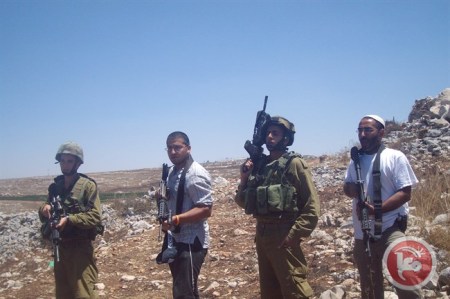
BETHLEHEM – An Israeli settler shot and seriously injured a young Palestinian man on Sunday morning in the Wadi Sair area near the illegal Israeli settlement bloc of Gush Etzion and Sair village, east of Hebron, Palestinian security sources said.
Additionally, the mayor of nearby Sair village reported that seven Palestinians in the village had been shot and injured following the incident.
The settler who shot and critically injured the Palestinian man claimed, according to Israeli reports, that a Palestinian attacked him with a knife.
Palestinian security sources told Ma’an that an Israeli settler shot 20-year-old Azzam Azmi Shalalda four times while he was in his agricultural field, after the actual person suspected of carrying out the alleged attack had reportedly already fled the scene.
After the shooting, Shalalda was evacuated to al-Mamoon clinic in nearby Sair for first aid, before he was taken to al-Ahli Hospital in Hebron. Medics say he is in a critical condition. Shalalda is from the Sair village.
An Israeli army spokesperson said a Palestinian suspect attacked a 40-year-old Israeli after the Israeli man had stepped out of his car to confront Palestinians who were allegedly throwing stones at passing vehicles.
Israeli media outlets reported that the 40-year-old settler was evacuated to Hadassah Hospital in Ein Karem after he was stabbed. He reportedly sustained moderate wounds.
An Israeli army spokesperson said that the alleged Palestinian “assailant fled from the scene,” adding that the reports were initial. The spokesperson had no information of a Palestinian shot or detained during the incident.
Mayor of Sair village, Kayed Jradat, told Ma’an that following the incident, Israeli forces raided Sair village and shot and injured seven Palestinians during the raid.
Doctor Zuheir Jaradat, who works at the town’s al-Mamoon clinic, said one of the victims sustained serious wounds as he was shot in the eye, while another man was hit with a live round in his thigh and was taken to hospital as well.
During the raid, Israeli forces inspected cars and checked the identities of villagers.
Jradat added that Palestinians in the village closed their stores out of fear of attacks by Israeli forces.
An Israeli police spokesperson said the area had been closed off.
Palestinian witnesses told Ma’an that Israeli forces chased a Palestinian vehicle between the southern West Bank towns of Sair and al-Shuyoukh after the incident. They highlighted that the alleged stabber had fled the scene, and an Israeli settler shot another young Palestinian man who had been working in nearby fields.
Featured Video
BRITAIN’S WARNING: PREPARE FOR WAR
or go to
Aletho News Archives – Video-Images
From the Archive
How Ukraine Tortured and Slaughtered Donbass
By Kit Klarenberg | Al Mayadeen | July 11, 2024
Almost immediately after the proxy war erupted, ISIS-tier footage of the torture and murder of Russians in Ukrainian custody emerged.
On July 6th, the New York Times published an astonishing investigation: In Ukraine, Killings of Surrendering Russians Divide an American-Led Unit. The article documents in grim detail how Chosen Company, an international volunteer battalion for Kiev, routinely executes Russian prisoners of war. It is the very first mainstream admission that this practice – a brazen breach of the Geneva Conventions, and a grave war crime – is widespread among Ukraine’s fighters, both foreign and homegrown. … continue
Blog Roll
 Aletho News
- Israel Demolishes Home Of Lebanese Journalist Whose Viral Film Exposed Pager Attack
- Record Oil, Empty Tanks: The UAE’s Miracle Recovery
- Burnham tackles Britain’s poverty with aggression in Yemen
- Peace in Ukraine: the easy way – or the hard way
- Trump & the Rrrrussians
- US taxpayer money laundered back through Ukraine – Musk
- Before COVID, an NIH lab chief proposed making a SARS-like bat virus more infectious
- Gates, Bourla on Trial in Netherlands Accused of ‘Great Reset’ Scheme at Vaccine Injury Hearing
- BRITAIN’S WARNING: PREPARE FOR WAR
- “Historic Russia”: The Land Putin Will Not Give Back
- If Americans Knew
- An error has occurred; the feed is probably down. Try again later.
- No Tricks Zone
- Two New Studies Find Thwaites Glacier Melt Cannot Be Driven By Human Activity Or A Warming Ocean
- E-Cars Reduce CO2 Emissions By Only 41% Compared To Internal Combustion Engine Vehicles
- Predictions Made By Renowned Climate Professor Over Past Decades Have Been Proven To Be Poor
- New Study Suggests Large Regions Of The Pacific Ocean Have Been Cooling For The Last 80 Years
- Germany’s Green Energy Debacle: High Energy Costs Force Kahla Porzellan to Close After 182 Years!
- New Study: 50 Years Of The Most Aggressive ‘Net Zero’ Policies Can Only Affect The Global Climate By 0.03°C
- US September “Heat” Was No Record…Many Records Set Decades Ago
- Latest European Green Energy Debacle; Portugal’s Largest Flagship Solar Park Insolvent!
- Green Energy Debacle: German Expert Professor Fritz Vahrenholt Warns Of Severe Economic And Social Consequences
- Two More Paleo Reconstructions Affirm Meters-Higher Sea Levels Across Ireland, Brazil 7000-6000 Years Ago

