The United Nations’ special rapporteur for the occupied Palestinian territories, Francesca Albanese, has sharply denounced the BBC after the broadcaster aired Israeli regime claims against detained Palestinian paediatrician Dr. Hussam Abu Safiya without challenge.
Reacting to a Monday segment in which BBC News relayed Israeli allegations that Abu Safiya was held over “suspected involvement in Hamas activities,” Albanese called the coverage “scandalous”, pointing to 18 months of arbitrary detention without charge, evidence, or trial and to torture documented by his lawyer, with injuries visible on his body.
She accused the network of amplifying unsubstantiated Israeli accusations against a detained doctor rather than reporting on his condition, describing it as characteristic of BBC journalism “in the time of genocide.”
Karishma Patel, who resigned from the BBC last October over its Gaza coverage, echoed the criticism, saying the broadcaster must stop repeating Israeli claims without flagging the absence of supporting evidence given how precarious Abu Safiya’s life remains.
Edinburgh University’s Nicola Perugini went further, arguing that the segment presented the Israeli military’s framing that razing hospitals and abusing doctors is justified because medical facilities supposedly shielded fighters, without any pushback from the reporter reading it.
Abu Safiya’s deteriorating condition
Abu Safiya, former director of Kamal Adwan Hospital, has been detained since Israeli occupation forces stormed the facility on December 27, 2024, forcing it out of operation despite it being the last functioning hospital in northern Gaza at the time, a raid that came after his son Ibrahim was killed in a strike on the hospital grounds.
More than 555 days into his detention, rights groups confirm that his situation is critical. Amnesty International issued an urgent appeal on July 5, warning that his life is in grave danger and noting that he has been held in solitary confinement since June 3 and denied adequate care for chronic conditions.
Detention upheld despite no charges
“Israel’s” Supreme Court upheld his latest detention order on June 16, extending his imprisonment under the “unlawful combatant” designation until at least October.
A July 2 visit by his lawyer, Nasser Odeh, documented fresh bruising around his head, eyes, and neck, difficulty breathing, and episodes of lost consciousness; Abu Safiya reportedly told Odeh he believes prison authorities intend to kill him.
His son Elyas said in a video message that his father can barely speak and that his face has been disfigured.
Physicians for Human Rights Israel called it among the most disturbing testimonies it has received since the war began.
Abu Safiya is one of at least 737 Palestinian medical workers detained since October 2023, a period in which more than 1,722 health workers have been martyred and nearly all of Gaza’s hospitals damaged or destroyed.
A pattern of bias
The episode fits a broader record of scrutiny facing the BBC over its coverage of the genocide in Gaza. A Centre for Media Monitoring study reviewing over 35,000 pieces of BBC content found Israeli deaths received 33 times more coverage per fatality than Palestinian deaths, with the word “massacre” applied 18 times more often to Israeli casualties and “murder” used 220 times for Israelis against a single instance for Palestinians.
More than 100 BBC staff signed a letter last year accusing the corporation of functioning as a government “mouthpiece”, citing insufficient scrutiny of Israeli statements and content they said resembled military public relations.
The broadcaster also shelved the documentary “Gaza: Doctors Under Attack” after initially approving it, a decision critics called emblematic of editorial self-censorship under political pressure, part of what commentators have termed the BBC’s deepening credibility crisis over its Gaza coverage.
Whether Israelis will ever comprehend the irreparable damage inflicted upon their country’s reputation by their UN Ambassador, Danny Danon, is a moot point. The damage Israel has done to itself through its barbaric practices in occupied Palestine is simply impossible to overcome.
Danon, however, utilises a peculiar approach to defending Israel within international institutions: he relies on bullying, intimidation, and an overt attempt to silence anyone who dares to challenge the official Israeli narrative—particularly women leaders.
Yet, what makes his behaviour most outrageous is his deployment of these abrasive tactics to suppress an issue that demands the utmost sensitivity: the systemic use of sexual violence and human rights abuses against Palestinians.
The confrontation took place during a UN General Assembly session convened to mark the International Day for the Elimination of Sexual Violence in Conflict. Senior UN officials were presenting harrowing findings documenting sexual violence against Palestinian detainees.
True to form, Danon refused to engage with the substance of the reports. For Israeli diplomacy, the enemy is never merely the armed adversary; it is the judge, the independent human rights observer, and the UN investigator whose sole mandate is to document violations of international law.
The immediate target of Danon’s wrath was Pramila Patten, the UN Secretary-General’s Special Representative on Sexual Violence in Conflict. Instead of reflecting on the grim findings, Danon demanded Patten’s resignation. He accused her and the broader international community of harbouring an “obsession” with targeting Israel.
When Vanessa Frazier, the Secretary-General’s Special Representative for Children and Armed Conflict, attempted to intervene on a point of order per established protocol, Danon unleashed a vitriolic verbal assault. Refusing to yield, he shouted over her, ordering her to “be quiet” and drowning out the chamber with his outbursts. “Shame on you. You are part of this obsession,” Danon bellowed.
While such unruly behaviour should have resulted in Danon’s immediate removal from the chamber, the diplomatic asymmetry of the UN prevailed. It was Frazier who found herself trying to de-escalate, politely clarifying that her procedural request was “not personal.” Danon shot back with typical defiance: “You will not be allowed to bully us.”
Herein lies the supreme irony of Israel’s diplomatic relationship with the UN and international law. Israel stands as one of the most egregious, serial violators of international law in modern history—a decades-long pattern of behaviour left unpunished by Western vetoes, which ultimately emboldened it to carry out an ongoing genocide in Gaza. Yet, Israeli officials persistently claim the mantle of the ultimate victim, alleging they are the targets of antisemitism, unfair bias, and now, “bullying” by the very institutions they defy.
But the mountain of evidence cannot be shouted away. According to an extensive report issued by Patten’s office, there are verified patterns of systemic abuse, sexual degradation, and psychological torture weaponised against Palestinian men, women, and children in Israeli detention camps like Sde Teiman.
The weight of this evidence reached such an undeniable threshold that the UN Secretary-General’s office formally added Israel to the global ‘List of Shame’—the blacklist of states committing grave violations against children in armed conflict.
None of this exposure is enough to convince Danon or the broader Israeli political establishment that Israel does not possess a sovereign right to violate international law. In their view, merely pointing out these crimes constitutes an act of aggression.
This systemic denial extends to every facet of the conflict. A comprehensive UN investigation recently concluded that Israel has deliberately targeted Palestinian children in Gaza as a core component of its military campaign.
The numbers are staggering: Between 7 October 2023, and 7 October 2025, an estimated 20,179 Palestinian children were killed—about 30 percent of all Palestinian deaths.
“The evidence shows that Palestinian children have been deliberately targeted and killed by the Israeli security forces,” stated commission chair Srinivasan Muralidhar, noting that Israeli authorities have systematically continued to commit the crime of genocide.
While these findings provide another layer of ironclad legal proof regarding genocidal intent, the true significance of the report lies in its exposure of the rationale behind targeting youth. Typically, the disproportionate slaughter of children and women is dismissed by Western apologists as “collateral damage”. The UN inquiry shattered this defense, offering a far more consequential conclusion: the targeting of Gaza’s children is part of a calculated strategy to destroy the biological continuity and future existence of the Palestinian people in Gaza.
As Muralidhar bluntly summarized: “By targeting children, Israel is attacking the very capacity of the Palestinian people to exist.”
It remains a profound disappointment that the International Criminal Court and the International Court of Justice—often swift to indict war crimes committed elsewhere—continue to move at a glacial pace regarding Israel.
Tragically, the catastrophe continues unabated because there is still no meaningful international mechanism willing to enforce sanctions or employ genuine pressure to halt it.
This is precisely why Danny Danon wants the world to be quiet. His outbursts are not merely directed at UN diplomats; they are directed at global civil society, ordinary citizens, and anyone refusing to look away. Israel demands absolute silence while Palestinians are starved, raped, and murdered. According to its twisted logic, committing these atrocities is an inherent right, and objecting to them is an act of malice.
If this logic is allowed to prevail, it becomes the blueprint for every future aggressor who wishes to kill, rape, and starve a population for geopolitical gain. Palestinians and Lebanese are already forced to inhabit this dystopian reality. Our collective responsibility is clear: we must refuse to be quiet. We must speak out, ensuring our voices drown out the shouts of Danon and his peers, so that murder and systemic violence are never normalised as tools of military necessity.
GAZA – Gaza’s health ministry has denounced the arrest of seven Palestinian Red Crescent paramedics by the Israeli occupation forces on Tuesday morning while they were carrying out their humanitarian duties in the Gaza Strip.
The incident occurred as the medical team was passing through a military checkpoint set up by Israeli forces on Salahuddin road, the main artery connecting central and southern Gaza.
The health ministry explained that the arrests took place while the paramedics were carrying out their usual humanitarian duties of rescuing the wounded and transporting patients.
The ministry noted that the seven paramedics were detained and subjected to harsh on-site interrogations before five were later released, adding that two of them remain in custody at an undisclosed location.
The ministry called for immediate international intervention to secure the release of the remaining paramedics and guarantee their safety.
On May 18, Israeli commandos attacked 54 civilian boats carrying food and medical supplies to Gaza. The boats were near Cypress, nearly 300 miles from Gaza, in international waters.
The Israelis fired at the boats and kidnapped 428 unarmed humanitarian activists. Those people were never charged with any crime. How could they be? When kidnapped, they were exercising their right to sail in international waters. It was the Israelis who were committing the crime of maritime piracy, which carries a penalty of 20 years’ imprisonment.
But piracy and kidnapping were just the initial crimes. Sexual assault, rape, and torture followed. It began almost as soon as the Israeli pirates boarded the victims’ boats. According to Dropsite News, “The flotilla says at least 12 sexual assaults were documented aboard the vessel alone, including anal rape and forcible penetration with a handgun.”
The kidnapping victims were subjected to sadistic sexual abuse in the form of strip-searches accompanied by sexual taunting and groping. Many were raped. Participants described “rubber bullets fired at close range, tasers used on the face and upper body, stun grenades thrown into groups of detainees (and) prolonged stress positions under permanent bright light.” The activists were brutally beaten, emerging with “broken ribs (and) fractures to the torso, shoulders, and back.”
The kidnappers took their victims to the Israeli port of Ashdod for “further beatings, sexual humiliation, prolonged interrogations, and torture.” Israel responded to the media outcry and formal diplomatic protests from twelve governments, including Spain and Italy, by having extremist minister Itamar Ben-Gvir film himself participating in the abuse of the kidnapped civilians. After Ben-Gvir proudly posted his torture selfies on social media, even the US, UK, and Canada protested. Facing universal condemnation, the Israelis finally released their victims four days after the kidnapping, sending most of them on deportation flights to Turkey.
The kidnapped and tortured activists pointed out that the four days of hell they experienced were nothing compared to what Palestinian prisoners endure every single day. They called attention to the fact that Israel is currently imprisoning more than 400 Palestinian children, and that almost three-quarters of the children kidnapped by Israel report experiencing sexual violence or abuse.
Israel’s crimes against the flotilla activists were shocking but not surprising. Israel, after all, is a nation that trains dogs to rape prisoners, as reported by The New York Times. It is a nation with a “right to rape” movement that makes national heroes of prison guards who sodomize people to death. In his article “Israel Is the Global Rape Capital” Elias Akleh describes how “Sadistic sexual rape seems to be an endemic character of the whole Israeli society, making Israel the rape capital of the world, where sexual abuse and rape are not restricted against Palestinians only, but against Jewish Israeli girls in general.”
All of this is just the proverbial tip of an iceberg of evidence that Israel is a nation of sadistic sex criminals. Depraved, violent, sadistic sexual abuse is even part of Israeli Orthodox Jewish religious rituals, as reported by the Jerusalem Post(6/3/2025). Social media is full of pictures posted by Israeli soldiers who murder Palestinian women, dress up in their victims’ bras and underwear, and take selfies.
In relatively normal societies, it is estimated that two per cent or less of the population consists of clinical psychopaths, while 98% are non-psychopathic. Among the Israeli Jewish population, it seems, that ratio is reversed. Polls show that the vast majority of Israeli Jews support the genocide of Gaza, which has featured the murders of tens of thousands of innocent women and children, most of whom have been slowly crushed to death beneath the rubble of their own houses.
None of these crimes could happen without the roughly ten trillion dollars of support Israel has received from American taxpayers. That money has been bestowed on the Dog Rape Nation by our politicians, who are bribed or blackmailed by Israeli agents like Jeffrey Epstein, himself a shining example of Jewish-Israeli sexual psychopathy.
Epstein described himself as “Donald (Trump’s) closest friend for ten years.” But it gets worse. In his 20s, Trump was the protegé of Jewish-Zionist gangster Roy Cohn, a sadistic homosexual pedophile who, according to journalist Anthony Summers, ran an Epstein-style blackmail operation that filmed powerful men, including J. Edgar Hoover, abusing little boys.
And it isn’t just Trump. Our whole political class is compromised. Just look at how they vote on Israel-related issues.
The USA desperately needs a serious, French Revolution style housecleaning.
See Also:
"Sexual violence against young boys and girls. Things that are done in the name of a religious ritual… These rituals, most of which are ancient rituals from the days of Ba'al worship, have not vanished from the world".
Australian activists who took part in the Global Sumud Flotilla for Gaza filed a formal submission with the International Criminal Court (ICC) on 30 May, accusing Israel of war crimes based on documented evidence of torture and sexual violence sustained during their abduction and imprisonment.
The legal filing, submitted by 11 Australian survivors of the Flotilla and their legal team, is supported by dozens of survivor testimonies, video evidence, medical records, and sworn statements.
This evidence details severe beatings and sexual abuse following the 18 May interception of an international aid mission carrying food and medicine to the besieged Gaza Strip in an attempt to break the Israeli blockade of the enclave.
One specific account included in the submission describes an Australian humanitarian worker being forcibly injected with an unidentified substance by Israeli captors.
The submission also incorporates video evidence, including footage posted to social media by Israeli National Security Minister Itamar Ben Gvir, who boasted of the ill treatment and showed handcuffed activists on their knees being taunted by Israeli soldiers.
The Global Sumud Flotilla reports that at least 67 participants suffered injuries during their imprisonment that required medical evaluation, with 12 individuals requiring hospitalization.
One survivor, Australian filmmaker Juliet Lamont, in an interview with Double Down News, recounted being dragged into a shipping container she called a “torture tunnel” where she was placed in a stress position, hands restrained behind her back, and ankles shackled in the dark before being “vaginally raped by one of the male soldiers,” while “other people had guns inserted inside them.”
She added that a 70-year-old woman’s ribs had been broken as “howls of torture and pain” would emit from the same chamber she had been tortured in.
This legal action follows the UN adding Israel to a 2026 blacklist for parties guilty of committing sexual violence in conflict zones. UN Secretary-General Antonio Guterres cited documented “patterns of sexual violence” against detainees, leading to the designation of the Israeli Prison Service on the blacklist.
While Israel’s ambassador to Australia and other Israeli officials have denied these claims, asserting that participants were treated according to established procedures, the Australian government previously sanctioned Minister Ben Gvir for his “shocking and unacceptable” treatment of the detainees.
Returning survivors have expressed outrage at the Australian federal government, noting that Prime Minister Anthony Albanese has declined multiple requests to meet with them.
Flotilla participant Isla Lamont highlighted the contrast of being granted a hearing at the ICC while being ignored by domestic leadership, stating that “If Australian survivors can be heard in The Hague but not in Canberra, something has gone badly wrong”.
The flotilla organizers are now calling for independent international investigations, arms embargoes, and the enforcement of arrest warrants for the officials responsible.
French activists are also pursuing their own separate legal complaint on the “humiliation, rape, and acts of torture” they endured, explicitly declining to cooperate with the French Foreign Ministry’s request for a criminal probe due to their government’s continued diplomatic support for Israel throughout the genocide in Gaza.
A revived attempt to scapegoat a handful of Israeli officials for the crimes of its entire regime structure has again taken off, especially in light of the recent diplomatic fallout over Israeli Security Minister Itamar Ben-Gvir’s public humiliation of Gaza aid flotilla activists. The idea behind this Hasbara campaign is to normalize Israel’s actions.
When Itamar Ben-Gvir posted the video of him mocking the brutal treatment that foreign activists were being subjected to – after being kidnapped in international waters – entitling it “welcome to Israel”, it understandably triggered a diplomatic firestorm. However, the Western leaders who summoned their envoys in response haven’t dared to address the treatment of the activists, including their own citizens, since.
All of this begs the question as to how much authenticity came along with these stances. One point of note is that even Israeli Prime Minister Benjamin Netanyahu joined in with the chorus of condemnation, as did his Foreign Minister Gideon Sa’ar and others. Since that time, at least 15 activists who were part of the latest Global Sumud Flotilla have accused the Israeli military of committing different forms of sexual assault against them, including rape.
The widespread weaponization of sexual violence by the Israeli military and security forces is no new phenomenon, yet it has occurred at a markedly higher frequency over the past few years, and it is something that has solely occurred to international peace activists. Instead, the Israelis have been proven to have implemented a systematic campaign of sexual violence against Palestinians, in particular those who are held hostage in military detention centers and civilians who have been detained in Gaza.
UN and human rights reports, eye witness testimonies, victim accounts, even video and photographic evidence, have all been presented to support the conclusion that sexual violence, including rape, has been used in unprecedented ways against the Palestinian civilian population. Despite all of this, the only mainstream corporate media outlet in the West that dared report on the issue was the New York Times, in a piece that addressed the issue years too late.
These same Western governments have not followed up the summoning of their envoys with any solid action, nor have they made a deal about the testimonies of sexual assault against activists who were kidnapped in international waters. Now, a coordinated media push, within which the Israeli President, Isaac Herzog, has recently participated, seeks to play the “bad apples” public relations strategy.
Smotrich and Ben-Gvir have become popular scapegoats, used to hide a society behind them that supports almost everything they do, even if they seek to be more well hidden. The overwhelming majority of the Israeli public supported their military committing genocide.
In fact, things are so bad that the 10 Israeli soldiers who were accused of gang raping a Palestinian hostage have now become celebrities in their society. Israeli comedians make jokes about the rape of Palestinians with dogs, Israeli politicians openly defend such despicable behavior, and there were even the infamous “right to rape” protests when soldiers were temporarily detained for the acts they committed.
The gang rape incident was not just alleged; it was caught on film and leaked. In the end, all of the Israeli soldiers who committed the violent rape got off scot free. The Israeli military’s top lawyer, who had leaked the video of the incident, something that forced the arrest of the perpetrators, ended up getting arrested herself, resigning from her job, and then made at least two suicide attempts following a string of death threats.
Itamar Ben-Gvir did not sexually assault those 15 activists; it wasn’t Bezalel Smotrich who convinced Israeli society to turn gang rapists into heroes and place them on public television shows. Israel has a citizen army and is a society built around a military culture.
When others try to scapegoat Benjamin Netanyahu, something that you will hear from Western liberals and mainstream Democrats, this, too, is disingenuous. According to polling data, a plurality of Israelis dislike the current Premier, which means it isn’t him that is to blame for the vast majority of Israeli citizens supporting the genocide in Gaza, or even worse, advocating publicly for even harsher means of dealing with Palestinian civilians.
It’s also not only Netanyahu that has openly supported the notion of achieving the “Greater Israel” project, his so-called “moderate” opponent, Yair Lapid, has himself publicly advocated the exact same policy– the only difference is that the opposition leader seeks to be more strategic about stealing territory all the way up to and including Iraq.
The reality is, these Western leaders are fully complicit with the Israelis. They only withdrew their summoned diplomatic envoys because Ben-Gvir’s video embarrassed them, robbing them of the ability to lie and cover up Israel’s blatant crimes against the international activists. It took no courage and it would have been more genuine of them to have endorsed the Israeli Security Minister’s actions.
Why? Because many of these nations that summoned their envoys are openly part of the so-called “Civil Military Coordination Center” (CMCC) that was set up to enforce the Gaza ceasefire and prevent violations of it. Instead, these nations have joined a center that watches Israeli war crimes – including the mass murder of over 900 Palestinians during the ceasefire – in real time, refusing to even leave the center in protest, let alone take any action. They are all directly complicit in the genocide.
What this whole ordeal has proven is just how low Western governments and their stenographers in the media will go in order to cover up the crimes of the Israeli regime. No matter what, they refuse to take a stand. If they had grown a backbone, it could have deterred many of the horrors we see playing out today.
– Robert Inlakesh is a journalist, writer, and documentary filmmaker. He focuses on the Middle East, specializing in Palestine.
From Guantánamo to Palestine, Washington has a long, brutal history of silencing, blacklisting, and deporting rapporteurs who dared tell the truth.
When the United States government decided to impose sanctions against the UN Special Rapporteur for the occupied Palestinian territories, Francesca Albanese, honest defenders of human rights were astonished. The measure, announced in July 2025 by Secretary of State Marco Rubio, was presented as a response to what the U.S. government called the expert’s “illegitimate and shameful efforts” to promote actions by the International Criminal Court (ICC) against Israeli and American officials.
In practice, the sanctions meant much more than a diplomatic gesture. Albanese was included in restriction mechanisms linked to the U.S. financial system, which, in theory, may imply the freezing of assets under American jurisdiction, banking restrictions, and travel limitations. The decision is the most blatant attempt to intimidate a United Nations Special Rapporteur.
The importance of the Italian jurist’s work helps explain why she became one of the main targets of Israel and its Western allies. Since assuming office in 2022, Albanese has produced forceful reports on the Israeli occupation system, describing it as a structure of permanent colonization, segregation, and apartheid. After the beginning of the extermination in Gaza in October 2023, she began arguing that there were plausible elements of genocide in Israel’s military campaign.
Behind diplomatic closed doors, her work came to be seen by Israeli authorities as especially dangerous because it combined denunciations of humanitarian violations with a strategy of international legal accountability.
Despite the exceptional nature of the sanctions, the Albanese case did not emerge out of nowhere. Over the last several decades, the United States developed different methods of pressure against UN Special Rapporteurs considered excessively critical of its foreign policies, its allies, or its domestic human rights situation. Before reaching the point of imposing financial sanctions, Washington had already resorted to diplomatic campaigns, public attacks, attempts at delegitimization, restrictions on access, and political pressure within the Human Rights Council.
The most visible precedents of this pattern lie precisely within the mandate dedicated to the occupied Palestinian territories.
Before Albanese, two Special Rapporteurs became frequent targets of discrediting campaigns: John Dugard and Richard Falk.
A South African jurist and expert in international law, Dugard held the position between 2001 and 2008 and became known for drawing comparisons between the Israeli occupation and the apartheid regime that existed in South Africa. In reports presented to the UN, he argued that the combination of territorial segregation, checkpoints, settlement expansion, and severe restrictions on Palestinian mobility produced a system of domination incompatible with international law.
His positions provoked a strong reaction from Israel and growing discomfort in Washington. American diplomats, although often in a less strident manner than Tel Aviv, demonstrated systematic opposition to the rapporteur’s conclusions within the Human Rights Council, orchestrating pressure campaigns on allies and countries that could influence key votes and decisions.
If John Dugard faced diplomatic resistance and attempts at political disqualification, his successor in the Palestinian mandate, Richard Falk, became the target of a far more aggressive and personalized campaign.
An emeritus professor of international law at Princeton, Falk took office in 2008 and quickly entered into open conflict with Israel and the United States. His criticism of the Israeli occupation, the blockade of Gaza, and the country’s military offensives began generating frequent diplomatic confrontations.
Israel went so far as to bar his entry into the country in December 2008, when Falk attempted to carry out an official UN mission in the occupied territories. Detained at Ben Gurion Airport, he was kept in custody and later deported. The episode triggered protests at the United Nations, since independent experts are, in principle, entitled to access in order to carry out their mandates.
Throughout his period as rapporteur, Falk came to argue that Israeli policies displayed characteristics of colonialism and apartheid, exposing the nature of Zionist oppression over Palestinians. At various moments, American diplomats accused the rapporteur of bias and unfitness for office simply because he did not fully follow the dictates of Tel Aviv and Washington, unlike what they had become accustomed to.
One of the most intense episodes occurred after Falk published comments on the national oppression of Palestinians and American foreign policy. Then-U.S. Ambassador to the UN Susan Rice publicly called for his removal from office, stating that he was “unfit to serve” as Special Rapporteur. Organizations from the Zionist lobby, such as UN Watch, also conducted permanent campaigns for his dismissal, accusing him of antisemitism and conspiracism.
Falk responded by saying he was the target of a systematic attempt at silencing. In interviews and public statements, he described the pressure he faced as a campaign of “personal attacks” intended to divert attention from the Israeli violations documented under his mandate.
Guantánamo and the War Against Anti-Torture Rapporteurs
The pattern of pressure seen in mandates on Palestine — public discrediting, diplomatic pressure, and attempts at institutional marginalization — would reappear on other fronts, especially when UN experts began investigating the consequences of the so-called “war on terror” launched by the United States after the September 11, 2001 attacks.
The issue of torture became one of the main points of friction between Washington and international human rights mechanisms.
One of the most emblematic episodes involved Austrian jurist Manfred Nowak, UN Special Rapporteur on torture between 2004 and 2010. During his mandate, Nowak repeatedly sought unrestricted access to the military prison at Guantánamo Bay, where hundreds of detainees remained without formal trial under accusations of terrorism.
The Bush administration partially accepted a visit but refused conditions considered essential by the United Nations. Among them was the possibility of conducting private interviews with prisoners — a standard procedure in international investigations into torture and mistreatment. Without such guarantees, Nowak refused what would have been a merely symbolic visit.
In public statements, the rapporteur argued that inspections without confidentiality would amount to a “guided tour,” incapable of producing any serious assessment of detention conditions. Even so, after analyzing documents, testimonies from former prisoners, and medical reports, he concluded that certain practices used at Guantánamo could be classified as torture or cruel, inhuman, and degrading treatment.
In the following years, other UN specialists would face similar reactions when addressing the issue.
Juan Méndez, Special Rapporteur on torture between 2010 and 2016, criticized the prolonged use of solitary confinement, classifying certain periods of extreme isolation as a form of psychological torture. American authorities challenged his conclusions and resisted allowing unrestricted access to prisoners.
Another relevant case was that of British expert Ben Emmerson, Special Rapporteur on counterterrorism and human rights. Emmerson called for criminal investigations into the CIA’s secret torture programs, including clandestine prisons (“black sites”) and interrogation techniques used after 9/11.
In a particularly strong position, he argued that it was a “legal obligation” of states to investigate and prosecute those responsible for acts of torture authorized in the name of combating terrorism. The American reaction was predominantly defensive, with officials maintaining that internal investigations had already taken place and rejecting international interference.
More recently, Swiss jurist Nils Melzer, also a rapporteur on torture, faced strong political resistance after denouncing abuses linked to U.S. security policy and the treatment of prisoners in contexts of war and international extradition. Although his case is more closely associated with the treatment of Julian Assange, Melzer also criticized the persistent impunity surrounding post-9/11 abuses.
Marking the 2000 Israeli withdrawal after 22 years of occupation, the Resistance today is still standing strong on the frontlines. Here is a look into the history of occupation and the deterrence written in blood.
Every year, the Resistance and Liberation Day in Lebanon is marked across the country, especially in the South, with ululations echoing through the streets, feet shaking the ground to liberation songs, and motorcades filling the roads of villages and towns. It is a day that recalls the moment southern Lebanon was liberated from 22 years of Israeli occupation on May 25, 2000, marking the defeat of what was once known as an “invincible army”.
But as I write these words today, southern Lebanon is bleeding again. This year, the memory is no longer only about ululations and celebrations; it is about the resilience of the South, the same resilience that made liberation possible in the first place.
Twenty-six years later, the Israeli occupation has not ended its efforts to occupy southern Lebanon, nor its attacks on civilians, nor its broader expansionist agenda. However, since May 25, a new equation of deterrence has been written across the border. And as the occupation escalates, the resistance continues to adapt; as military capabilities evolve on one side, the other continues to consistently work to deter and resist, even with a hefty price paid in blood.
The occupation came first
The Israeli occupation has always sold a false narrative about its occupation and aggression against southern Lebanon by justifying its attacks under the umbrella of so-called security measures, but history has proven otherwise.
Way before any well-established resistance movement was recorded in southern Lebanon, the Israeli occupation invaded the area on November 1, 1948, and occupied 15 villages, simultaneously with the occupation of Palestine. On October 24, the Israeli Carmeli Brigade invaded the town of Houla and committed a massacre, which resulted in at least 67 martyrs.
There were records of 14 massacres in one week during the so-called “Operation Hiram”, which was launched “in a bid to cleanse the area of its population,” according to records by MERIP. As mentioned in its records, Israeli soldiers violently and forcibly expelled the residents of at least seven Lebanese villages in areas near the northern border of Palestine during that period.
The IOF then withdrew from occupied Lebanese villages by mid-March 1949 (Houla, al-Mansoura, Suruh, Ghabbatiyya, Kafr ‘Inan, Marus, al-Ras al-Ahmar, Kafr Bir’im, Iqrit, Iribbin, Mi’ilya, Arab al-Samniyya, and Nabi Rubin), as under the negotiated armistice terms, “Israel” was compelled to withdraw from occupied villages. Seven villages (Ibl al-Qamh, Hounin, al-Nabi Yusha’, Qadas, al-Malikiyya, Salha, and Tarbikha) remained under occupation and were turned into illegal Israeli settlements.
The aggression, however, didn’t stop there. In 1967, the UN ISPAL recorded Israeli massacres in Houla and Hanin.
The second Israeli invasion of southern Lebanon began on March 14, 1978, killing approximately a thousand civilians, before the Israeli occupation forces (IOF) withdrew under the UNSC Resolution 425, which demanded an immediate withdrawal of the IOF and the transfer of control to the UNFIL. But “Israel” transferred control of border areas to Saad Haddad’s “Army of Free Lebanon” (AFL), an Israeli-backed splinter faction of the Lebanese Army, which emerged in 1976, before being renamed the “South Lebanon Army” (SLA) in May 1980.
“Israel” reinvaded Lebanon on June 6, 1982, advancing all the way to Beirut and killing at least 19,000 civilians, before it was forced to withdraw to the so-called “security zone” in southern Lebanon, a point at which a resistance nucleus began to take shape.
Israeli pressure tools in southern Lebanon
The occupation operated through two parallel chains of command: the Israeli Occupation Forces as the occupying power, and the so-called South Lebanon Army (SLA) as “Israel’s” collaborationist force and punching bag, also carrying out different tactics of aggression, targeting the people economically, physically, and psychologically.
One of the crimes carried out by the occupation was the SLA’s practice of forced conscription of Lebanese civilian men. All males over 18 living in the occupied area were required to serve one year as SLA military recruits, effectively fighting for a force occupying their own territory. Human Rights Watch documented that the SLA “filled its ranks through the involuntary conscription of residents of the ‘security zone,’ including children.” Men who refused faced harassment, detention, economic punishment, and their houses were demolished with their families inside.
Khiam Detention Center: Systematic torture
As part of the occupation’s torture tactics was the established Khiam Detention Center in al-Khiam, which was targeted in an Israeli airstrike during the 2006 war on Lebanon and completely razed during the ongoing war today, in an effort to erase the footprints of Israeli barbarism and the subsequent heroic resistance that forced its closure for good.
During the Israeli occupation, the established detention center replaced the Ansar detention camp (located in the southern town of Ansar) and housed more than 5,000 Lebanese citizens, resistance supporters, and fighters, who were held in harsh conditions and subjected to systematic torture by the SLA.
In the center, the Israeli-backed forces exercised extensive torture practices, including electric shocks, prolonged suspension from ceilings, sleep deprivation, deprivation of food and water, and extended solitary confinement, as well as the “red box”, a metal container where the detainee had to sit in a squatting position and the guards would bang on it with metal rods, with the sound reportedly reaching nearby villages.
Additionally, “Israel” denied Red Cross access to detainees despite the evidence of savage torture. The detention system was also reportedly used as a coercive leverage mechanism, with families of detainees pressured to provide information on resistance activities in exchange for updates about, or the release of, their relatives. Today, “Israel” isn’t preventing healthcare workers; it’s deliberately bombing them, alongside journalists, further exposing its savagery against civilians in southern Lebanon and its fear of the truth.
Economic strangulation of occupied South
The Israeli occupation also heavily relied on the economic strangulation of South Lebanon and its people by establishing chokepoints, setting the grounds for economic dependency, destroying the region’s agriculture, and completely isolating the region from the rest of Lebanon.
The IOF’s checkpoint system established economic control as a deliberate instrument of occupation. The occupation installed curfews, bans on night travel, motorcycles, and multiple passengers per vehicle, alongside extensive searches and unpredictable closures. The Awali River checkpoint, which was established in 1982 during the Israeli invasion, became the primary chokepoint for all goods moving between south and north Lebanon, causing delays, confiscations, and arbitrary shutdowns that made normal commerce structurally impossible. Supply chains collapsed, contracts could not be honoured, and agriculture and industry were effectively severed from national markets.
Economic dependency was simultaneously engineered from the other direction. Israeli goods flooded the occupied zone while southern producers were barred from Lebanese markets and forced to sell primarily to “Israel”.
The land itself was targeted. Crop destruction, contamination of farmland with mines, military deployment across cultivated areas, and later use of white phosphorus rendered large tracts unusable. Moreover, significant portions of agricultural land remain inaccessible to this day due to unexploded ordnance.
Approximately 180,000 residents lived outside effective Lebanese state administration for the duration of the occupation. Services, infrastructure, and governance were mediated through the SLA rather than Beirut. Movement restrictions severed access to national courts, healthcare, education, and family networks. Lebanese state investment halted at the occupation perimeter, triggering a long-term demographic displacement.
The cumulative economic disruption did not end with the 2000 withdrawal. The wars of 2006, 2024, and now 2026 have continued the same cycles of infrastructural and agricultural loss, attempting to fracture any attempt at a full economic reset by committing acts of agriecocide and ecocide.
Israeli massacres in southern Lebanon
Beyond the structural violence of occupation, Israeli forces conducted periodic large-scale attacks that killed hundreds of Lebanese civilians, in an effort to carry out mass killings and trigger mass displacement. Some of the notable attacks are the Israeli massacre in 1993 and the April aggression (Udwan Nisan) in 1996.
Israeli massacre in July 1993
“Israel” launched the so-called “Operation Accountability” on July 25, 1993. For seven days, the IOF bombarded southern Lebanese villages with massed artillery and airstrikes. Approximately 118 to 120 Lebanese civilians were killed and close to 500 were wounded. The attack displaced an estimated 300,000 people northward toward Beirut, a displacement that was not incidental but declared as a strategic objective. The IOF’s logic, openly stated by Israeli officials, was to generate a humanitarian crisis.
April aggression in 1996
Known in Lebanon as Udwan Nisan, the April Aggression was carried out for seventeen days from April 11 to 27 in 1996, authorized by Israeli Prime Minister Shimon Peres. The IOF flew over 600 air sorties and fired approximately 25,000 artillery shells against Lebanese territory. Evacuation threats were issued to 86 villages, displacing approximately 400,000 people. Among the deliberate targets struck by a helicopter gunship was an ambulance carrying fleeing civilians near Tyre, killing two women and four children.
On April 18, 1996, at 2:07 in the afternoon, Israeli artillery fired 36 shells at the UNIFIL compound near Qana, which was sheltering between 800 and 845 civilians who had fled the bombardment of surrounding villages. One hundred and six people were killed, among them a disproportionate number of children.
Resistance born under occupation
As it has become clear, before any organized armed group existed in South Lebanon, the region was reeling under Israeli invasions and attacks. The resistance then emerged from the very ground Israeli boots were forced to leave, as the South saw the sprouting of small groups individually targeting the Israeli occupation.
Among the first Lebanese to take up arms were secular leftists. Following the 1978 invasion and “Israel’s” installation of Haddad’s AFL, cadres of the Lebanese Communist Party and the Organization of Communist Action began conducting small-scale armed operations in the South. Simultaneously, the Syrian Social Nationalist Party, with deep roots in southern Lebanese villages, was running parallel operations against Israeli patrols and AFL positions.
These operations were scattered and uncoordinated, but they established something essential: an armed Lebanese refusal of the occupation, rooted in the land itself; a mission protected by international law that broadly acknowledges the right of people under foreign occupation to resist, including the use of armed struggle, to achieve self-determination.
The resistance that eventually drove “Israel” out was never the product of a single sect or ideology. It was communist, nationalist, and Islamic. It was Shia, Sunni, Druze, and Christian, unlike how some try to portray it under tight sectarian titles. What unified these currents was a common geography, the occupied South.
The same occupation planted in the land also saw the blossoming of the Movement of the Deprived, co-founded by Imam Musa al-Sadr and Greek Catholic Bishop Grégoire Haddad in 1974. On January 20, 1975, the military wing was established as the Lebanese Resistance Regiments to fight and repel the occupation. The regiments engaged in operations against the Israelis before evolving toward institutional politics in 1980 after the disappearance of Imam al-Sadr.
34 years after the first Israeli invasion, Hezbollah was formed in 1982 from the very seed that Sayyed al-Sadr had planted against the occupation.
Hezbollah: An imposed deterrent equation
The Islamic Resistance in Lebanon – Hezbollah did not emerge from a conference room; it emerged from under occupation.
The first phase of Hezbollah’s operational strategy was not guerrilla-like in the classical sense. The Resistance group adopted the methodology of strategic coercion through hard-scale operations, designed to make the cost of Israeli presence in Lebanon so high that continued presence became untenable. Hezbollah began engaging in jihadist operations using car bombs.
On November 11, 1982, an explosive-laden truck was driven by a resistance fighter into the Israeli military headquarters in Tyre, before exploding and killing 75 soldiers. A year later, on November 4, 1983, the IOF headquarters in Tyre was bombed again, killing 28 Israelis.
After “Israel’s” partial withdrawal to the so-called “security zone” in 1985, the nature of the campaign shifted. Hezbollah, at the time, fought a grinding occupation over a defined strip of territory rather than a sprawling invasion and carried out large-scale frontal raids on IOF and SLA outposts, which resulted in heavy losses.
Katyusha\Grad rockets: A new deterrent equation
In parallel, the Katyusha\Grad rocket was first used in the mid-1980s and was highly visible on the battlefield in the 1990s. What the Katyusha\Grad introduced was not a military victory but something more durable, a deterrence equation. Hezbollah did not fire the rockets indiscriminately. It fired them in calibrated, declared responses to Israeli strikes on Lebanese civilians, establishing through practice what eventually became an informal but understood rule: attacks on Lebanese civilian areas would be met with rockets into northern “Israel”.
This equation was visible during the aforementioned Israeli aggression in 1993 under “Operation Accountability”, and seventeen days in 1996 under the April aggression, “Israel” unleashed its full air and artillery power on southern Lebanon, and Hezbollah retaliated every single day with Katyusha\Grad rockets on northern occupied Palestine, emptiying Kiryat Shmona, paralyzed the economy in occupied al-Jalil, and placed the Israeli government under unbearable domestic political pressure, pushing it to turn to Washignton and Paris to broker the 1993 and 1996 understandings.
IED war, tactical adaptation
The 1990s were defined by a single tactical contest: Hezbollah’s roadside bombs against any IOF deployment. When the IOF used sniffer dogs to detect wire-triggered devices, Hezbollah concealed IEDs inside fiberglass rocks and switched to radio detonation.
When the IOF swept radio frequencies from Mount Hermon listening posts, Hezbollah switched to cell phone receivers. By the end of the war in 2000, IOF mine-clearing patrols were physically counting rocks along roads to identify which were fiberglass, an image that captured the dramatic shift in the military balance.
By 1998, the rate of operations had reached nearly four operations per day. The attack on the Ansariyye beach landing in September 1997, in which twelve Shayetet 13 commandos were killed in a single night, after Hezbollah obtained Israeli drone reconnaissance footage of the landing zone four days before the operation, demonstrated that Hezbollah had achieved not just tactical superiority but intelligence penetration of IOF operational planning.
On February 28, 1999, the IED campaign reached its peak, with the killing of Brigadier General Erez Gerstein, the senior IOF commander in Lebanon, in a roadside bomb disguised as a rock near Kfar Shouba.
The day of resistance and liberation
By 1995, a paratrooper unit had been disbanded after soldiers refused a Lebanon deployment, and by 2000, 200 IOF soldiers had been imprisoned for refusing to serve in the area, fearing the Resistance’s operations, thus weakening the Israeli occupation.
When “Israel” completed its withdrawal on May 24, 2000, no IOF officer could credibly claim the army had achieved anything in Lebanon. On the contrary, “Israel” had a designed exit scenario, but the Resistance shattered it before it could have been executed.
May 25, 2000, was announced as a national historic day, marking the IOF’s forced, unconditional withdrawal from southern Lebanon, ending an 18-year military occupation.
Martyred Hezbollah Secretary-General, Sayyed Hassan Nasrallah, during his famous Bint Jbeil speech on May 26, 2000, declared that the IOF intended to withdraw gradually over several weeks beyond May 25. When the UN Security Council issued a resolution and UNIFIL arrived to take charge, “Israel” intended to frame the departure as a sovereign, orderly transition and, crucially, could have claimed to be “liberating” the al-Khiam detainees as a gesture of goodwill, to sell the narrative of an Israeli choice rather than Israeli defeat.
But instead, civilians from the occupied villages, side by side with Resistance fighters, broke through to liberated areas in the towns of al-Qantara, Deir Seryan, al-Qusair, and al-Taybeh on May 22 and 23. SLA positions began collapsing one after another in a single night. The central sector of the so-called “security zone” collapsed within hours, and Israeli soldiers fled, leaving everything behind.
On the morning of May 23, 2000, residents of al-Khiam marched to the Khiam Detention Center, chanting Allahu Akbar (God is Great), tore the bars off the cells with their bare hands, and carried the detainees who had been unlawfully imprisoned for months and years, out into the sun. Some fainted, some wept, others kissed the ground; southern Lebanon was liberated.
Today, the pattern has not changed. In the 1990s, Hezbollah defeated “Israel’s” wire-detection technology with fiberglass. In 2006, it defeated “Israel’s” air supremacywith Kornet rockets, and in 2026, it continues to defeat “Israel’s” electronic dominance with a fiber-optic cable, introducing the FPV drone, and more specifically, the Ababil FPV drones.
The occupation, indeed, has become more aggressive and bloodier, but the Resistance has proven to be more adaptable. The equation written on May 25, 2000, endures: that the people of this land, given will and time, can raise the cost of occupation beyond what it can bear. It is being rewritten, kilometer by kilometer, in the hills, forests, and valleys of southern Lebanon, with a spool of cable and a low-cost drone.
The equation Hezbollah established in 2000 was not a peace agreement, a ceasefire, or a diplomatic settlement. It was a demonstrated fact that an occupying army, regardless of its technological superiority, can be forced out through sustained, adaptive resistance that raises the cost of presence beyond what the occupying entity is willing to pay.
Twenty-six years later, that same demonstration is being performed again, and “Israel”, with five divisions on Lebanese soil and an “unlimited budget” allocated to counter $400 drones, is on the wrong side of the equation again. The organization that Israeli officials described as “significantly weakened” after the war in 2024 is conducting an average of 24 separate operations on Israeli soldiers, vehicles, and positions in a single day.
Liberation continues to be rewritten right now, in the hills around al-Khiam and in Bint Jbeil, al-Taybeh, Ayta al-Shaab, al-Naqoura, Maroun al-Ras, Ainata, and al-Ghandouriyeh. It is being rewritten across all of southern Lebanon. And the South, our South, remains steadfast and forever-present, holding steady under the boots of the very men that stand their ground on the frontlines, steadfast and resilient.
And “Israel”? as martyr Sayyed Nasrallah put it during his famous speech in Bint Jbeil, “By Allah, Israel, which owns nuclear weapons and the strongest air fleets in the region, is indeed frailer than a spider web.”
By most accounts, German POWs were treated well by the US Army during World War II. Those sent to the United States had no chance to escape so were loosely guarded as they provided valuable farm labor and lived well. But something happened in 1945 that resulted in abuse and thousands of POWs died.
The Rheinwiesenlager, or Rhine Meadow camps in English, were a group of 19 camps built in Germany by the US Army to hold captured German soldiers during the last months of World War II as millions of German soldiers surrendered. German POWs were herded into outdoor pens and held for months with no shelter, toilets, or beds, while water and food were rationed. The horrible conditions led to the death of thousands. This led to controversy and a US Army investigation determined this abuse caused 3053 deaths. Later investigations by the new West German government claimed between 4000 to 27,000 German prisoners perished in these camps because of poor conditions.
In 1989, Canadian James Bacque authored a book titled: “Other Losses: An Investigation into the Mass Deaths of German Prisoners at the Hands of the French and Americans After World War II”. He had examined US Army records that showed over a million Germans listed as taken prisoner were never recorded as discharged and disappeared. Bacque assumed that most died in captivity due to intentional neglect.
Israel has mass raped and tortured detained activists with the Sumud Flotilla, who were attempting to bring aid to Palestinians in Gaza, multiple victims have revealed.
On Tuesday, Israel kidnapped “430 people onboard 50 ships in international waters”.
Israel’s National Security Minister Ben Gvir released a video showcasing Israeli abuse of the detainees, including by forcing them to kneel while the Israeli national anthem played.
Democracy Now noted , “The video shows dozens of men and women kneeling in rows, with their foreheads to the ground and their hands zip-tied behind their backs at the port in Ashdod”.
Now, released activists from around the world have detailed mass rape, sexual abuse, and torture that Israeli forces unleashed on them while in detention.
A Press release from the Global Sumud Flotilla documented that, “Participants from the Global Sumud Flotilla, now in Istanbul, have begun providing harrowing testimony about widespread abuse, assault and torture: rubber bullets fired at close range, tasers to the face and upper body, stun grenades thrown into groups of detainees, stress positions held for hours under permanent bright light, hijabs (Muslim religious headcovers) forcibly removed, as well as various forms of sexual violence including: humiliating strip searches, sexual taunting, groping and pulling of genitals, and multiple accounts of rape.”
It added, “Some of the most horrifying accounts centre on a single vessel that participants call the ‘torture boat.’ This specific israeli naval vessel with a makeshift prison constructed of barbed wire and metal shipping containers became the primary site of intense violence following the interception; this reflects a small fraction of the patterns of systemic violence and sexual abuse against the Palestinian people at the hands of the israeli regime for decades.”
The activist organization has documented “At least 15 cases of sexual assaults, including rape” along with activists “shot with rubber bullets at close range” and “tens of people’s bones broken”.
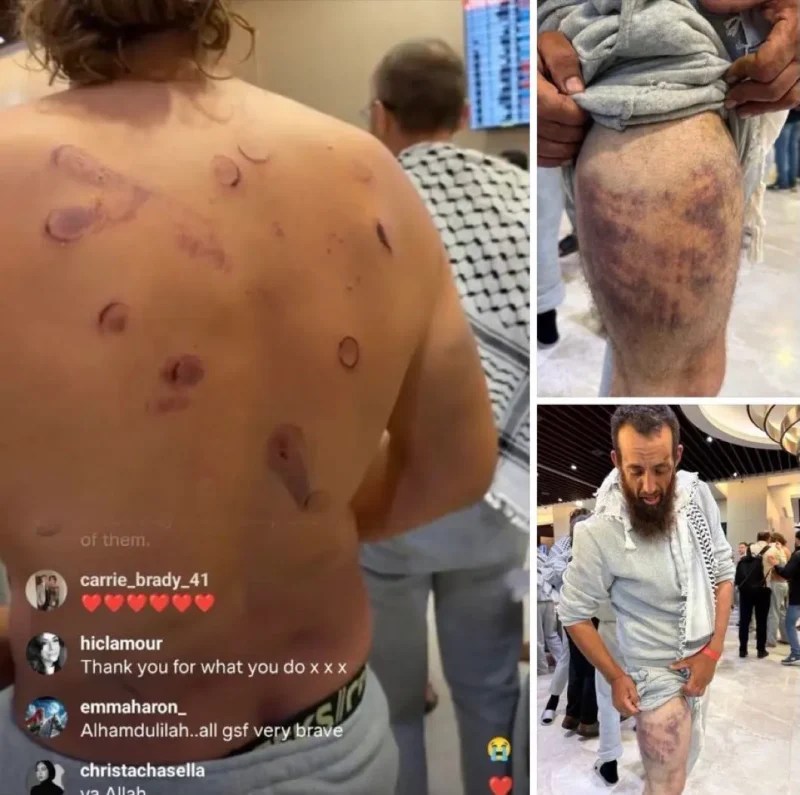
Adrien Jouan, one activist with Global Sumud Flotilla, showed evidence of brutal torture, with severe bruising all over his body.
Another activist on Instagram live showcased severe bruising on his leg.
Released Brazilian activist Thiago Ávila revealed that , “there is no easy way to say it, but I have to say it, people got raped at the Global Sumud Flotilla. These monstrous soldiers raped our participants. It was not one, not two, not three, it’s many cases of sexual violence against our participants on the prison boat on the way to the port of Ashdod, where they got once again beaten up, many people with broken ribs, many people with broken bones in the arms, the collar bone, the ribs”.
Independent journalist Alex Colston, who was part of the Sumud Flotilla, revealed , “I just got out of Israeli prison … I saw people shot point blank with rubber bullets, I myself, I can’t feel my hands because they are all scarred up because they would take the cuffs and they would yank my hand over and over again. When I would be tied or cuffed, they would step on my cuffs. They kicked me in the ribs more times than I can count. I passed out at least one time. … even if you plead for them to stop … Israeli guards were getting obvious pleasure from hurting us as much as they could”.
Handcuffs on my hands and feet. Dragged me. When I couldn’t walk, they dragged me on the ground.
They hit us. Hurt all of us a lot. Handcuffs so tight my hands lost feeling
They laughed all the time. Super sadistic.
Took off my shirt. Took pictures. Mistreated us all night long
Another activist testified that , “I had my hands zip-tied behind my back for so long and it was so tight I almost started vomiting, they slammed my head into a table several times and degraded me as I was strip-searched. They had me in handcuffs for 19 hours to the point my skin had begun to swell around them.”
Australian activist Juliet Lamont revealed , “We had people who were tasered in the face. People were syringed with unknown sedatives. I was put down, cable tied. They put so much water under me for an hour that I thought I was going to drown. I was sexually assaulted in this kind of torture chamber. And five men were bashing me and smashing my face”.
Italian economist, Luca Poggi, who was with the Flotilla activists revealed that “We were stripped, thrown to the ground, kicked. Many of us were Tasered, some were sexually assaulted, and some were denied access to a lawyer”.
The barbaric torture of the Sumud Flotilla activists is just another example of the brutal torture, sexual violence, and rape that Israeli forces unleash on Palestinian detainees daily.
The Palestinian Prisoners Club said on Wednesday that Israel has turned the detention and abduction of international solidarity activists into a systematic policy aimed at intimidating supporters of the Palestinian cause worldwide.
In a statement, the organisation said Israeli authorities seek to send a message that anyone showing solidarity with the Palestinian people could face detention, abuse, arrest and torture.
The statement followed the circulation of videos released by Israeli National Security Minister Itamar Ben-Gvir showing the mistreatment of activists from the Freedom Flotilla Coalition and the “Global Solidarity Flotilla,” who were detained by Israeli forces while attempting to reach the Gaza Strip.
According to the Prisoners Club, Israeli authorities intercepted the activists in international waters and forcibly transferred them to the Port of Ashdod.
The organisation described the scenes shown in the videos as involving humiliation, mistreatment and abuse, arguing that they reflect treatment routinely experienced by Palestinian and Arab detainees in Israeli prisons.
The group further stated that the involvement of Ben-Gvir in the filmed incidents highlighted what it characterised as the broader policy of intimidation directed against international solidarity movements supporting Palestinians.
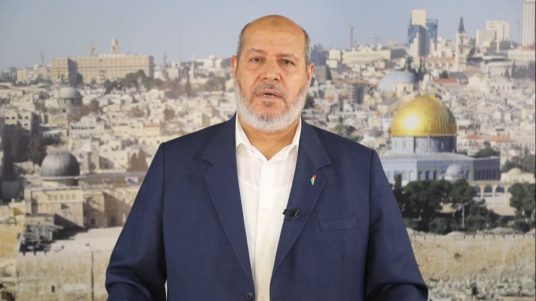
Khalil al-Hayya, head of the Islamic Resistance Movement, Hamas, in the Gaza Strip, said Israel’s attempts to impose its will through assassinations and attacks on political leaders and their families “will fail,” following the assassination of his son Azzam al-Hayya in an Israeli strike on Gaza City.
Speaking during a memorial gathering on Thursday, al-Hayya described the martyrdom of his son, alongside several other Palestinians, including neighbor Hamza al-Sharbasi, as part of a continuing campaign targeting Palestinian families and resistance leaders.
He said the martyrdom of Palestinians would only strengthen the struggle for the liberation of Palestine and Jerusalem, adding that Israel’s efforts to pressure negotiators through violence would not succeed.
Al-Hayya also linked the attack to previous Israeli strikes targeting Hamas negotiators in Qatar last year, saying the Movement continued negotiations “on behalf of its people and national interests,” despite ongoing attacks.
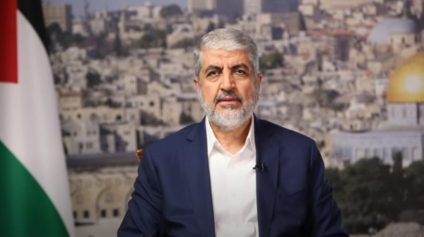
Meanwhile, Khaled Mishaal, head of the Hamas Movement abroad, praised al-Hayya’s resilience during the funeral gathering, describing the loss of multiple sons and relatives as “a great sacrifice.”
Mishaal said Gaza continues to “write epics of steadfastness and sacrifice” despite the Israeli war, siege, and destruction, arguing that the suffering endured by Palestinians increases the responsibility of the wider Arab and Muslim world toward Gaza and the Palestinian cause.
He also called for greater support for Palestinians in Gaza, the West Bank, Jerusalem, and Palestinian prisoners, while stressing that the sacrifices made during the war were “not only for Palestine but for humanity as a whole.”
By Donald Neff | Washington Report On Middle East Affairs | January 1996
On January 4, 1948, Jewish terrorists drove a truck loaded with explosives into the center of the all Arab city of Jaffa and detonated it, killing 26 and wounding around 100 Palestinian men, women and children.[1] The attack was the work of the Irgun Zvai Leumi – the “National Military Organization,” also known by the Hebrew letters Etzel – the largest Jewish terrorist group in Palestine. The Irgun was headed by Revisionist Zionist Menachem Begin and had been killing and maiming Arabs, Britons and even Jews for the previous ten years in its efforts to establish a Jewish state.
This terror campaign meant that at the core of Revisionist Zionism there existed a philosophical embrace of violence. … continue
This site is provided as a research and reference tool. Although we make every reasonable effort to ensure that the information and data provided at this site are useful, accurate, and current, we cannot guarantee that the information and data provided here will be error-free. By using this site, you assume all responsibility for and risk arising from your use of and reliance upon the contents of this site.
This site and the information available through it do not, and are not intended to constitute legal advice. Should you require legal advice, you should consult your own attorney.
Nothing within this site or linked to by this site constitutes investment advice or medical advice.
Materials accessible from or added to this site by third parties, such as comments posted, are strictly the responsibility of the third party who added such materials or made them accessible and we neither endorse nor undertake to control, monitor, edit or assume responsibility for any such third-party material.
The posting of stories, commentaries, reports, documents and links (embedded or otherwise) on this site does not in any way, shape or form, implied or otherwise, necessarily express or suggest endorsement or support of any of such posted material or parts therein.
The word “alleged” is deemed to occur before the word “fraud.” Since the rule of law still applies. To peasants, at least.
Fair Use
This site contains copyrighted material the use of which has not always been specifically authorized by the copyright owner. We are making such material available in our efforts to advance understanding of environmental, political, human rights, economic, democracy, scientific, and social justice issues, etc. We believe this constitutes a ‘fair use’ of any such copyrighted material as provided for in section 107 of the US Copyright Law. In accordance with Title 17 U.S.C. Section 107, the material on this site is distributed without profit to those who have expressed a prior interest in receiving the included information for research and educational purposes. For more info go to: http://www.law.cornell.edu/uscode/17/107.shtml. If you wish to use copyrighted material from this site for purposes of your own that go beyond ‘fair use’, you must obtain permission from the copyright owner.
DMCA Contact
This is information for anyone that wishes to challenge our “fair use” of copyrighted material.
If you are a legal copyright holder or a designated agent for such and you believe that content residing on or accessible through our website infringes a copyright and falls outside the boundaries of “Fair Use”, please send a notice of infringement by contacting atheonews@gmail.com.
We will respond and take necessary action immediately.
If notice is given of an alleged copyright violation we will act expeditiously to remove or disable access to the material(s) in question.
All 3rd party material posted on this website is copyright the respective owners / authors. Aletho News makes no claim of copyright on such material.