Israeli police caught robbing Palestinian workers
Ma’an – May 31, 2012
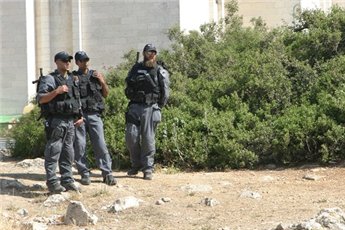
Israeli police gather near Sheikh Jarrah in East Jerusalem. (MaanImages/Mimmi Nietula, File)

TEL AVIV, Israel — Three Israeli policemen were arrested Wednesday on suspicion of beating and stealing from Palestinian workers in Jerusalem, the Israeli daily Haaretz reported.
A police representative told an Israeli court on Thursday that Uziel Hanun, Osama al-Sahly and Reuven Dhokerker regularly used threats to escort Palestinian workers into alleys in the Old City.
“Those who didn’t have money were beaten and sent home, those who did were also beaten, and their money stolen,” the court was told.
Hanun, al-Sahly and Dhokerker were arrested Wednesday after being caught “in the act,” Haaretz reported.
Police officials believe the robberies were systematic, the report said.
The police officers allegedly attacked a worker from Ramallah and took his wages. He then had to ask for money to get home, the police representative told the court.
Egypt prevents aid convoy to Gaza
Palestine Information Center – 29/05/2012
AMMAN, GAZA — European activists have condemned the Egyptian rejection to implement the obtained regulatory approvals in order to reach the Gaza Strip through the Sinai Peninsula.
The General Coordinator of the convoy “right of return”, Kevin Aovindan, stated, in a press conference held in trade unions headquarters in Amman yesterday, that the lack of clarity and the contrast in Egyptian officials’ positions prevented the arrival of the convoy to Gaza through the Egyptian borders.
Aovindan said that the President of the convoy, the British MP George Galloway was in Cairo until May 15, and he left after he had got the Egyptian official approval for the passage of the convoy to the Gaza Strip through Rafah crossing, however Egypt reneged on its approvals.
He added that “the participants in the convoy have spent over 3 weeks in Aqaba to get from the Egyptian authorities the permission to cross into Egypt and then to enter Gaza.
Aovindan said, regarding the aid collected by the convoy, “it will be sent to Gaza through the Jordanian Hashemite Charity Organization in coordination with the Jordanian Professional Associations”.
Meanwhile, the Palestinian government in Gaza has received new commitments from its Egyptian counterpart to allow Qatari fuel to enter the besieged Gaza Strip during the next few days, after contacts between the Palestinian, Qatari, and Egyptian authorities.
The Palestinian foreign minister, Mahmoud Awad, said there are new Egyptian promises to facilitate the passage of Qatari fuel to the only power station in the Gaza Strip, according to Al-Arab newspaper.
The need for the Qatari fuel is increasing these days to operate the power station in Gaza and to alleviate the crisis in the electrical sector for more than four months.
Awad said that the Egyptian government had told them that the full procedures required to start pumping fuel into Gaza are completed, hoping that it will reach Gaza the next few days.
“In the last communications with various parties, we were told that the shipment will arrive in the coming few days,” Awad said, adding that there is no logical reason for the delay.
He called on the Egyptian authorities to press on the occupation to increase the quantity of fuel which will enter daily to Gaza in order not to drag the transport process to operate the power station to relieve the suffering of the Palestinian citizens in Gaza.
The Palestinian foreign minister pointed out that Qatar has borne the full cost of storing and transporting fuel to the Gaza Strip, thanking the Qatari government and the Qatari Emir Sheikh Hamad bin Khalifa Al-Thani for their support for the Gaza strip and their role in transporting the fuel to Gaza.
Awad has praised the Qatari role in solving crisis in Gaza, stressing that the Palestinian people, who defend the dignity of the ummah, will never forget the Qatari position that was always behind them.
Gaza: Farmer targeted by Israeli soldier, shot in the leg
By Rosa Schiano | il Blog di Oliva | May 21, 2012
On Sunday, May 20, an Israeli soldier shot a young Palestinian farmer while on his land in Al-Quara, north east of Khan Younis in the southern Gaza strip.
Waheed Ali Zer, 22 years old, was shot in his left leg and remains hospitalized in Khan Younis’s Nasser hospital. We went to go visit his family and Waheed’s brother Mohammed spoke to us about the events that took place on Sunday.
“After being shot, Waheed began to crawl before being picked up and taken to a first aid point. At the time, I was at university.” Mohammed is a mathematics student at Al-Aqsa University and he intends to pursue a PhD.
Waheed has three brothers and seven sisters, three of which are married. The Zer family’s land is only 500 meters from the Israeli border. Waheed’s uncle told us that the Israeli soldiers will open fire at any time.
“Here in the Kussufim area, tanks and bulldozers will often enter,” says Waheed’s uncle, “until three years ago, there were many trees, olive trees, but they have all been destroyed by the bulldozers. Also here where we are, a house has been demolished by a bulldozer. If there are no tanks and bulldozers available, the Israeli soldiers shoot from the control towers”.
Mohammed told us that Waheed was walking his donkey when he saw a military jeep coming. Mohammed retreated back towards the tent next to his house. An Israeli soldier emerged from the jeep and shot at Mohammed from behind a small hill.
There was no warning, no bullet shots into the air. No notice, just one bullet, which was targeted directly at Waheed.
“My father carried Waheed in his arms while my mother cried,” one of Waheed’s brothers tells us.
We visited the land where Waheed was shot. On this land the family cultivates oranges, eggplants, wheat, and olives. “Our houses are very simple, we have no chance to protect ourselves,” Mohammed’s uncle told us. “The plants and the trees are scared by the Israelis, imagine us!” said Mohammed.
As I looked out across the land I noticed the proximity of military towers. One of the towers is particularly close to their land, with a machine gun visibly located on it. One of Waheed’s aunts approached us. “Our life is very difficult, for this reason the people go closer to the border to collect as much [harvest] as they can,” she says.
Waheed’s family comes from Be’er Sheva. They are refugees like many others after Israel displaced thousands of Palestinians, proclaiming their state.
We went to Nasser hospital in Khan Younis to meet Waheed. His left leg was wrapped in a bandage stained with blood and his bed sheet was also tainted with blood and liquid. He had an expression of suffering on his face after having been operated on while under general anaesthesia. The bullet aimed at him perforated an artery and a nerve.
“I had bought a donkey,” Waheed began to tell us, “and I was taking it towards my land when I saw an [Israeli] jeep coming. A soldier came out of the jeep and shot me. I fell to the ground feeling my head spinning. The bullet entered from one side [of my leg] and exited from the other side. I crawled and my father called an ambulance which took a long time to arrive.”
I asked him if he wants to send a message to the international community and he replied, “I ask for their solidarity with the Palestinian people. I ask them to stop the Israeli attacks.”
During our visit to the hospital other relatives and friends of Waheed arrived. One brought him some food. Waheed smiles to his visitors but his eyes cannot hide his grief. A cotton curtain separates him from the other beds of the crowded hospital.
A nurse arrived to tell us that we should go because the visiting time is over. I left Waheed with the promise of going back to his home for another visit. We will return to their area as an international presence while the international community continues to stay silent in the face of ongoing crimes against the civilians of the Gaza Strip.
Related articles
- 7 casualties in Israeli artillery shelling east of Gaza (alethonews.wordpress.com)
- 18 year old shepherd shot by Israeli soldiers in Jordan Valley (alethonews.wordpress.com)
Attacked By Israeli Fundamentalists In Tel Aviv, Six Female Arab Students Injured
By Saed Bannoura | IMEMC & Agencies | May 29, 2012
Six teenage Arab students of the at-Tur School in Jerusalem were injured, on Thursday, at the Menachem Begin Public Park in the Yarkon area of Tel Aviv, after being attacked by extremist Israelis who hit them with sticks and hurled stones at them.
Member of the Parents Committee at the School, Hatem Khweis, stated that four fundamentalists attacked the students who were on a school field trip in the area, the Wattan News Agency reported.
Khweis added that the fundamentalists hurled stones at students, inflicting concussions and bruises, and that one of the students was moved to a nearby hospital.
He further stated that the school obtained a “security permit” that grants protection for school children during trips, but the protection was not granted due to what the Tel Aviv Municipality called “lack of funding”, Wattan added.
The school Parents Council held Israel responsible for the attack arguing that the assault was racially motivated.
Related articles
- African Immigrants in Tel Aviv Attacked by Racist Israeli Mobs (alethonews.wordpress.com)
- How mainstream Israeli politicians sparked the Tel Aviv race riot (windowintopalestine.blogspot.com)
Two Palestinians arrested as Israeli settlers forcefully enter their property
28 May 2012 | International Solidarity Movement, West Bank
On Friday, May 25, illegal Israeli settlers drove into the village Lubban ash-Sharqiya where they attempted to forcefully enter a family’s home. When Israeli soldiers and policemen arrived at the scene they joined the settlers, supporting’ them whilst they tried to enter the house.
Men of the Palestinian family, together with International Solidarity Movement (ISM) volunteers and other internationals, stood at the gate of the house to prevent the settlers from entering. The father of the household, Khaled Daraghmeh, and his son were then beaten and arrested.
Lubban ash-Sharqiya is a village located some 30 kilometres south of Nablus, adjacent to Route-60, the primary north-south road that runs through the occupied West Bank. The village is surrounded from all directions by 3 illegal settlements: Eli, Shilo, and Ma’le Levona. The illegality of these Israeli colonies has been confirmed by the International Court of Justice and the United Nations Security Council.
On the outskirts of Lubban ash-Sharqiya, near the colony Ma’le Levona, Khaled Daraghmeh lives with his family. Khaled, like many other Palestinian villagers, works as a farmer and is dependent on what the harvest provides him. Living next to Israeli settlements is not an easy fate for Palestinians and Khaled has suffered a lot.
“It began to get really bad about five years ago. That was when the Israeli Occupying Forces (IOF) demolished my first house.” says Khaled.
After his first house was demolished, Khaled moved to his father’s old house just across the road. The peace he sought there did not last long. Only a couple months later, settlers attacked and burned down the entire building. Khaled was then forced to move to a third house, an ancient Ottoman building that also belongs to his father. Here the family lived in one part of the house, using the remaining space as a poultry farm.
The settlers have made it clear, however, that they are determined to get rid of Palestinians in the area. Last Saturday, some 50 settlers forcefully entered the house, removed all the furniture, and burned it. They also poisoned the drinking water of the poultry farm, leading to the death of most of the animals inside.
Now Khaled is frightened of life in his own home. He welded the door to the living area and moved into a small, dark room, where he used to keep animals.
“In the past, I was able to repair or rebuild what the settlers destroyed, but now I have used up all my savings,” says Khaled.
The harassment continues til today. As Khaled worked his land, a settler car stopped at the road and began making phone calls. He feared a new attack and called the ISM, seeking their immediate presence. Upon their arrival, the settlers had already left and everything appeared calm. Later, while the group of Palestinians and internationals sat together having lunch, approximately 20 settlers of all ages arrived and started walking towards the Ottoman house.
Palestinians from the area, accompanied by the ISM, approached the settlers and asked them what they were doing here. They replied that the land was ‘community property’ and that they had the right to be there. Khaled, who owns the land and has all the needed documents to prove it, replied by saying that this is his land, and that he wanted them to leave.
While the discussion continued, an Israeli military jeep with 6 soldiers arrived and began to split up the crowd. A policeman told the settlers that they could not enter the house as it belongs to Khaled and his family. The settlers grew upset with the policeman and screamed that he was a coward and afraid of the internationals and their cameras.
A discussion in Hebrew took place between them and meanwhile another police car arrived and 2 other policemen joined the crowd. After a couple of minutes of heated dialogue, the 3 policemen, the 6 soldiers, and the illegal settlers walked towards the house while the settlers screamed, “you see, you see, now we can enter!”

Jamal Daraghmeh is peppersprayed and loses his shoe in the violent arrest | Katarina Reigo
The Palestinians together with the internationals formed a line at the gate of the house to prevent the approaching group from illegally entering the house. Khaled was wrestled to the ground and beaten by soldiers and police men, even after being handcuffed. When Jamal, Khaled’s 21 year old son, saw his father beaten and attacked, he ran over to try to help. When he reached, the soldiers and policemen attacked Jamal in the same way they did his father.
Khaled’s 17 year old son, Jalad, then tried to help them and was instead attacked by the settlers and pushed away by the soldiers.
As the policemen walked away with the handcuffed men, they struck Jamal in the head a couple of times. The youngest son, Mu’min, 14, was filming the attacks on his brother and father when the policemen tried to kick him in the head. The boot missed him only by a few centimetres. Then policeman pulled the camera out of the teenager’s hands and stole it.
Only moments later, Jamal was pepper sprayed in the face before they forced him into the police vehicle. Khaled was then pushed into the jeep with bleeding hands from the brutal handcuffing.
“This has become normal to us. My father has been arrested 4 times recently and my brothers is beaten up all the time. Mu’min can not even walk to school without the settlers attacking him,” says Jalad.
To survive as a Palestinian living adjacent to these illegal settlements, can, with the assistance of the Israeli Occupation Forces, feel like a losing game. Only last year, 250 to 270 of Khaled’s olive trees were uprooted by settlers. Last week, an entire field of cucumbers was destroyed along with the irrigation system of the family’s land.
These attacks have pushed the Daraghmeh family into the desperate situation they are now in. After being forced to start over again and again, they have no money left. They can not repair the things that are destroyed, leading to a bad harvest, and less income.
Simultaneously, the Israeli state has offered Khaled 5 million shekels (1 million Euros) for his land. But as many other Palestinians, he is rejecting the money, and the resulting ethnic cleansing, and will continue to live and work on his land even if it means sleeping in a small, dark room with no electricity or running water.
Related articles
- Bethlehem: 18 year old Palestinian stabbed (alethonews.wordpress.com)
- Israeli settlers injure three Palestinians, uproot dozens of olive trees in two separate incidents (alethonews.wordpress.com)
- Hebron teen ‘shot by Israeli settler’ (alethonews.wordpress.com)
- Impunity Under the Law: Settler attack in Jabari neighborhood (alethonews.wordpress.com)
Israeli Soldiers Invade Bil’in, Break Into Home Of Local Peace Activist
By Saed Bannoura | IMEMC | May 28, 2012
Late on Sunday night Israeli soldiers invaded the village of Bil’in, near the central West Bank city of Ramallah, and attempted to kidnap a local peace activist, one of the organizers of nonviolent peaceful protests against the illegal Israeli Annexation Wall and settlements in the area.
The Friends of Freedom and Justice Committee in Bil’in (FFJ) reported that resident Hosam Hamad, 33 years old, was not at home when soldiers invaded it. Instead, the soldiers handed his mother a warrant for his arrest.
The FFJ added that the army pushed journalists and cameramen away when they attempted to ask the soldiers why they were trying to take Hamad. They informed them that they were not allowed to document the invasion and did not provide any explanation for their actions.
Bil’in is known for its leading role in creative non-violent resistance against the Annexation Wall and settlements in the area. Peace activists from different parts of the world as well as Israeli activists participate in the weekly non-violent protests.
Israeli soldiers use excessive force against the protesters, and repeatedly kidnap local activists of the non-violent resistance. The army is responsible for hundreds of injuries and several deaths because of its use of force against the protesters.
In 2008, Ashraf Abu Rahma was detained during a nonviolent protest; he was cuffed and blindfolded before one soldier held him while another soldier shot him in the leg.
The shooting was caught on tape by a young Palestinian woman from Bil’in, and was handed to a number of human rights groups to expose the Israeli crime. The soldiers subsequently detained her father as an act of punishment.
Abu Rahma’s brother, Basem, and his sister, Jawaher, were killed by Israeli fire in different non-violent protests against the Wall and settlements.
A statement issued by the spokesperson of the EU’s High Representative, Catherine Ashton, said last Tuesday that the European Union defends the right of Palestinians to hold peaceful protests against illegal Israeli settlement construction on their land.
Related articles
- Al-Ma’sara Village Holds Its Weekly Nonviolent Protest (occupiedpalestine.wordpress.com)
- Undercover Israeli combatants threw stones at IDF soldiers in West Bank (theuglytruth.wordpress.com)
- Three Women Injured Near Bethlehem (altahrir.wordpress.com)
- Minnesota Battle Over Israeli Bonds (alethonews.wordpress.com)
African Immigrants in Tel Aviv Attacked by Racist Israeli Mobs
IMEMC | May 28, 2012
Beginning on Wednesday and continuing through Saturday night, mobs of right-wing Jewish Israelis have attacked the neighborhoods of African immigrants in the southern part of the city of Tel Aviv, throwing stones and bottles at residents and looting shops.
According to an eyewitness report by a volunteer with the Hotline for Migrant Workers in Israel, “[a]fter a dose of racial incitement from the Members of Knesset who addressed them, Miri Regev, Danny Danon, Yariv Levin and Michael Ben-Ari, a handful of the protesters went on to attack Africans and stores owned by them in the Hatikva neighborhood. I arrived in the neighborhood with a camera to document what had happened.”
The eyewitness, identified as Elisabeth Tsurkov, said, “I saw a policeman protecting a group of Eritrean refugees after one of the family members was attacked with a glass bottle while carrying his son, who as a result was dropped to the ground…I saw the blood of a Sudanese refugee on the pavement after he was stoned by a group of Israelis chasing him. I saw a shop owned by an Eritrean refugee, which was looted after its storefront was broken.”
The string of attacks comes in the midst of increasing incitement against the non-white Israeli population, including indigenous Palestinian citizens of Israel and African immigrants into the country, by Israeli politicians and party leaders. Israeli Prime Minister Binyamin Netanyahu recently stated that the African immigrants, many of whom are refugees from war-torn regions, “threaten Israel’s social fabric”, and called for the implementation of policies that would refuse them services, deny them entry, and force the deportation of many who are living in Israel already.
In Tsurkov’s account of the events of the last few days, she wrote, “Some [of the Israeli attackers] called the refugees ‘cockroaches’, a woman said they should be killed and exterminated because non-Jews should not exist in the land of Israel, another of the residents said the refugees’ heads need to be cut like chickens, others simply thought ‘they should be deported back to Sudan.’ The hatred was also directed at the ‘leftists’ whom the residents blamed for the encroachment of refugees in their neighborhood.”
The Hotline for Migrant Workers called on the Israeli government to take responsibility for the situation of migrant workers in Israel, and allow for a legal process for refugees to be allowed to seek asylum in the Jewish state – a status which is currently denied to non-Jews.
Related articles
- Right-wing Israeli MPs whipped up Tel Aviv race riots: reports (theuglytruth.wordpress.com)
- Israel: Race riots and double standards (jeff-goodall.com)
Bethlehem: 18 year old Palestinian stabbed
27 May 2012 | International Solidarity Movement, West Bank
18 year old Saleh al-Zoghayer, who was recently stabbed by Israeli soldiers in Bethlehem, has been at the centre of the media recently. Several contradicting and false reports surfaced along with a shocking photograph of Saleh following the stabbing.
On Sunday, May 20, Saleh took a day off. Leaving his construction job in the town of Tobas, he travelled to Bethlehem to visit doctors there due to an illness. Upon arriving in Bethlehem, it is uncertain as to why, he was instructed by Israeli soldiers to exit the vehicle in which he was a passenger. Saleh found himself in the midst of a bike tour held by illegal Israeli settlers. The tour in question was held for Jerusalem day and was heavily guarded by Israeli Occupation Forces (IOF).
According to Israeli media sources such as Ynet and Hareetz, Saleh attempted to stab an IOF soldier and instead harmed himself. At first, both Palestinian and Israeli news sources suggested that Saleh had died from his injuries but this was not the case.
Saleh’s father, Nidal Mohamad al-Zoghayer, was interviewed by International Solidarity Movement (ISM) volunteers on May 23 and an entirely different story emerged. Nidal says his son is not the “Palestinian terrorist” that Itamar Fleishman of Ynet baselessly suggests. Saleh was on the receiving end of criminal violence, said Nidal, and not from IOF soldiers but from the illegal settlers.
Having been denied permission from Israeli authorities to go visit his son, Nidal relays to ISM what his lawyer said after seeing Saleh with his own eyes.
According to Nidal’s lawyer, Saleh is recovering and in stable condition. He suffered multiple stab wounds, with two perpendicular wounds across his abdomen and one near to his heart. Barely able to sit up in his hospital bed, his legs are tied together at the ankles with cuffs. Three IOF soldiers are positioned at his door at all times.
Nidal tells us the IOF are detaining his son and upon his recovery, Saleh will be charged with ‘assaulting a soldier.’ He finds the IOF’s version of events highly unlikely. If Saleh had indeed attacked a soldier in an area with a large military presence, says Nidal, he would have immediately been shot.
Saleh is not a political activist, said Nidal. “My son has no political affiliation, and has never been detained before this incident. He works 6 days a week, Saturday to Thursday, only to come to Hebron on Friday evening to spend time with his family and friends.”
Illegal settlers are known for their violent behaviour against Palestinian men and women of all ages. Just one day prior to Saleh’s stabbing, settlers attacked the town of Asira Al-Qibliya, shooting live ammunition and injuring several including one man who was shot in the head. Israeli soldiers were present but did not interfere with the settlers’ attack as has become routine in the occupied West Bank.
 Nidal showed photographs of wounds to Saleh’s neck that indicate a struggle as well as further photographs of his son covered in blood, with IOF soldiers standing on his hands.
Nidal says that if the IOF is able to stand by as illegal settlers fire live ammunition at unarmed villagers, then it should not be controversial for him to suggest they stood by and allowed an attack on his son. “There are many cameras in that area and soldiers are on hand 24 hours a day. I want to see the Closed Circuit Television (CCTV) footage of what really happened to my son.”
This would be the only hope for Saleh to prove his innocence as the Israeli military courts are notoriously unjust: 99.74% of cases heard by the military courts against Palestinians in the West Bank end in a conviction. In Israeli military courts, the word of a soldier is enough evidence to convict even a minor.
Saleh was in the midst of saving money for his wedding and the purchase of a home. He is one of 8 children, the eldest of which is currently held in an Israeli prison. Originally having been detained by the Palestinian Authority for his political views, Saleh’s eldest brother was re-incarcerated by the IOF upon his release, without a chance to see his family in between.
Saleh’s uncle, Ahmed al-Zoghayer, also sat down with the ISM. He reenforced Nidal’s belief that if his nephew had attempted to attack a soldier he would have been shot.
Ahmed clarified one of the reasons for Saleh’s presumed death. The ambulance carrying Saleh was late to arrive at the scene. When it arrived, his heart had stopped and he was believed to be dead. Defibrillators were used and his heart began beating again. Saleh was then successfully operated on.
An 18 year old has been accused of attacking an IOF soldier. His family contests this and their demand for CCTV footage has not yet been responded to. ISM supports the call for its obtainment.
Related articles
- Yitzhar settlers attack school children in Urif (alethonews.wordpress.com)
- Teen stabbed by soldiers in ‘stable condition’ (altahrir.wordpress.com)
- OCHA: 160 Palestinians wounded in IOF attacks in one week (windowintopalestine.blogspot.com)
- DFLP leader calls for settler watch groups (occupiedpalestine.wordpress.com)
Featured Video

AIDS Inc. by Gary Null (2007)
or go to
Aletho News Archives – Video-Images
From the Archives
Clash of Civilization, Iran Part II
By Jamal Kanj – Intifada-Palestine.com – January 14, 2011
Israel’s survival kit is: perpetuate conflict, insecurity to rationalize collective hate and finally playing victim.
Devoid of conflict, Israel implodes internally; without hate, Zionism loses its justification; and playing eternal victim to continue blackmailing the West. Absence of this holy trinity, Israel ceases to exist.
From its inception, the house of Zion has mastered exploiting adversarial powers to advance Israel’s cause. For instance, their influence over the Democratic Party in the US began with President Truman’s bid for 2nd term election in 1948.
Responding to strong opposition from Secretary of State General George Marshall and Department experts urging against recognition of Israel, President Truman replied: “I’m sorry gentlemen but I have to answer to hundreds of thousands [Jewish voters] who are anxious for the success of Zionism. I do not have hundreds of thousands of [voting] Arabs among my constituents”
Zionists influence over liberal American politics was matched with the doctrinal school of Conservative theoreticians aligning the Republican Party’s platform with Israel’s objectives. The Neoconservative Zionists, coined Zioncons, invented the “Clash of Civilization” concept to fight Israel’s wars. … continue
Blog Roll
 Aletho News
- From Unipolar Universalism to Multipolar Civilizational Distinctiveness
- RSF military group defects, joins Sudanese army: State media
- Ireland goalkeeper refuses to play ‘Israel’ as squad weighs boycott
- China pushes back against US on Cuba, Iran
- Ukrainian Soldiers, Potential Mercenaries: Have Gun, Will Travel!
- Burnham’s UN debut… A masterclass in British disinformation
- Iran flights continue despite US aviation sanctions
- Global Tipping Points Lead the World Into a State of Entropy
- The day-after at the White House: USA and Xi Jinping
- The Geopolitical Balance in the Red Sea: The UAE Being Displaced by New Players
- If Americans Knew
- Deconstructing Netanyahu’s pants-on-fire UN rant – Daily Update
- Trump betrayed voters with his campaign lies and prioritized a foreign country once he took office
- Netanyahu calls Israel’s war in Gaza ‘opposite of genocide’ in UN speech to near-empty hall
- Settler Kidnappings: Torture, Sexual Abuse and Terrorisation of Palestinian Abductees as Israel Deepens Annexation of West Bank
- Gaza winter nears as 162,000 tents become unusable, raising fears of humanitarian crisis
- Netanyahu says, “It’s the opposite of genocide”; UN says Gaza economy is world’s ‘most severe crisis on record’ – Daily Update
- Israel’s US-Backed Assault on Gaza Has Created the ‘World’s Most Severe Economic Crisis on Record’: UN
- ‘Protecting U.S. Citizens’… From Israel
- ‘This is where I live now, the back of a truck’: a day in the life of a grandmother in Gaza
- In UN Speech, Iran’s President Displays Pictures of Children Killed by US, Brings Attention to Israel’s Nuclear Arsenal
- No Tricks Zone
- New Study: Earth And Venus Surface Warmth Largely Explained By Convection And Lapse Rate, Not CO2 Or Radiation
- 2025 Nature Paper Claiming Worsening Global Drought Gets RETRACTED …Heavily Flawed
- New Study: ‘Global Drought Shows No Detectable Recent Acceleration Under Climate Warming’
- Economic Masterminds: German Socialists Suggest Taxing Productivity Gains Stemming From Using AI
- The South China Sea Has Not Been Cooperating With The Climate Change Narrative
- Energy Crisis: Germany Enters Heating Season With Historically Low Gas Reserve Fill Levels
- New Study: The Antarctic Ice Sheet Gained Mass From 2020-2024 Due To Staggering Snow And Ice Accumulation
- Study: Ocean Heating Rates From Thousands Of Years Ago ‘Dwarf’ Modern Ocean Heating Rates
- Climate Extremists Target, Attack Large-Scale Power Grid Infrastructure In Germany!
- New Study: Antarctic Ice Melt Has Contributed Less Than 1 Centimeter To Sea Level Rise In The Last 30 Years

