Report: Israel issued 13,000 demolition orders against Palestinian real estate
Palestine Information Center – 26/05/2012
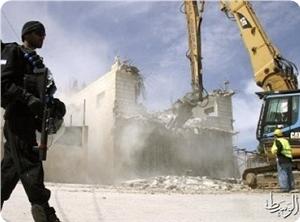 WEST BANK — Haaretz newspaper said the Israeli civil administration issued 13,000 demolition warnings against Palestinians accused of unlicensed construction in Area C of the West Bank.
The newspaper stated in a report that Israel intensified its construction restrictions on the Palestinian citizens in the villages and towns of the West Bank and seeks to prevent them from building through creating criminal files against them.
It said the civil administration increased the issuance of severe penalties against the Palestinians in all villages and towns located within Area C under Israel’s control.
Its report underlined that the civil administration was active recently in the demolition of many Palestinian homes and structures including schools in Al-Khalil city at the pretext of unlicensed construction.
The report pointed to the UN office for the coordination of humanitarian affairs’ recent report which condemned Israel’s restrictions on construction permits for Palestinians and its demolition of their homes while encouraging settlement construction.
Related articles
- Homes Destroyed, Lives Shattered: Criminal Displacement in Occupied Palestine (alethonews.wordpress.com)
- Israeli occupation authorities demolish well near Hebron (alethonews.wordpress.com)
- IDF closes Palestinian school to make way for West Bank training zone (theuglytruth.wordpress.com)
- Center: Israel orders demolition of electricity company (altahrir.wordpress.com)
An Hour Before Release, Prisoner Transferred to Administrative Detention
By William Temple | IMEMC & Agencies | May 24, 2012
In a PNN report today, the Al-Ahrar Centre for Prisoners’ Studies and Human Rights stated that on Wednesday, May 23rd, prisoner Sameh Elaiwe, 50, was transferred from Nablus city to Administrative Detention one hour before his scheduled release date.
Administrative detention is detention without charge or trial that is authorized by administrative order as oppose to a fair and just judicial decree.
Foad al-Khafsh, head of Al-Ahrar, affirmed that on Tuesday the Israeli military brought Elaiwe’s case before the court, accompanied by his lawyer Fares Abu al-Hassan. The court ordered Elaiwe’s release for the following day.
However, Israeli intelligence petitioned to overturn the decision after Elaiwe’s lawyer had left the court, and the Court transferred the prisoner to the administrative detention centre for four months.
Al-Khafsh alleged that Israeli intelligence deliberately intends to break the spirits of the prisoners, and questioned whether the military have actually agreed to stop the policy of Administrative Detention when in fact they appear to be using it more than before the hunger strikes.
More than 25 cases have been transferred to Administrative Detention since the Israeli prisons administration and the Supreme Committee for Prisoners signed their agreement on May 14th.
Related articles
- Hunger strike deal ‘does not end administrative detention’ (alethonews.wordpress.com)
- Israeli occupation authority renews administrative detention of MP Rejoub for fourth time (alethonews.wordpress.com)
- Until Freedom or Martyrdom: Thaer Halahleh on 60 Days of Hunger Strike (alethonews.wordpress.com)
- Free Hanaa Shalabi, End Administrative Detention (alethonews.wordpress.com)
- IOA renews administrative detention of MP Rejoub for fourth time (windowintopalestine.blogspot.com)
The Media’s Mysterious Non-Indians
Who are the “Outsiders” Raping Native American Women?
By ISHMAEL REED | CounterPunch | May 24, 2012
Nicholas D. Kristof of the New York Times has been traveling to “third world” countries to find evidence of male cruelty to women. He’s found plenty. He recently visited a Native-American reservation. His article left out the statistics that show that among American women, Native American women are the only group where outsiders commit the majority of the rapes.
I wrote him a letter asking why? No answer.
The last time I wrote him at least the Times had a black guy reply, vouching for his character.
House Republicans are balking over whether Tribal courts can bring these “outsiders” to justice. Why are Republicans and the Times (NYT, May 23, 2012) protecting these outsiders by not identifying these “non-Indians”?
I visited Sitka, Alaska in October. I was the only black guy in town. So maybe it’s not the brothers, your typical media, literary, Broadway show and Ms.Magazine rapist. Maybe Kristof can tell us who these mystery “non-Indians”are?
Ishmael Reed is the publisher of Konch. The latest issue includes a brilliant take on the post-black entrepreneurs by Houston Baker, Jr. His latest collection of essays, ”Going Too Far: Essays About America’s Nervous Breakdown,” is forthcoming from Baraka Press.
Related articles
- Toxic landfills on or near a Native American Reservation. (sachemspeaks.wordpress.com)
Palestinian farmland exploited for Israeli military exercises
May 22, 2012 | International Solidarity Movement, West Bank
Monday May 21 is the third day in a row of Israeli military exercises in and around the small Palestinian village of Khirbet Atwayel outside Nablus. These exercises prevent the farmers from working on their lands and force the villagers to sleep under the sound of heavy shelling with the constant presence of soldiers.
Khirbet Atweyel is a village located on the slopes West of the Jordan valley. The 18 families that reside there are almost exclusively farmers and have been victims to the actions of the Israeli Occupation Forces (IOF) for a long time.
Every month, Israeli soldiers arrive, erect tents, and stay for a few days while they receive various kinds of military training. These include the shooting of live rounds, rocket missiles, and other heavy artillery. During these days, the farmers are denied entry to their own lands and can only stand aside and watch while soldiers drive their jeeps and other vehicles over the fields.
Volunteers with the International Solidarity Movement (ISM), together with members of the municipality of the nearby town of Aqraba, approached the village on Monday, May 21.
“As usual, the soldiers stop their activities when they see internationals in the village. Only ten minutes ago they were shooting rockets on the hills a couple of hundred meters from the town’s houses,” Basem, the mayor of Khirbet Atwayel says.
Later, whilst two ISM activists attempted to approach the field in order to better photograph the military tents, Israeli soldiers opened fire nearby. The activists were forced to turn around and flee the way they came. A rocket was fired on an adjacent hill, creating an ear piercing bang.
“These rockets are the kind of weapons they usually shoot at night. If you come here between 10-11 p.m. you will find they shoot dozens, making it impossible to sleep,” Basem says.
The military training, however, is only one of many aspects of oppression that the people of Khirbet Atwayel suffer on a daily basis. Like many other villages in the Jordan valley, Khirbet Atwayel is in Area C. It is under full Israeli civil and military control. One result is that the villagers are not allowed to have wells or water cisterns. Instead, they are forced to buy water from Aqraba and transport it in tanks to their houses. This makes the basic necessity of water enormously expensive. Irrigation of crops has become impossible and farmers are left to hope that the winter will bring enough rain.
When asked for his thoughts about the future of his village, Basem replied, “the occupiers are obviously trying to get rid of us, but we were born in this village and this land has been within our families for generations. We will never leave and give up what is rightfully ours.”
Related articles
- Palestinian teen shot during Israeli military training (alethonews.wordpress.com)
- 18 year old shepherd shot by Israeli soldiers in Jordan Valley (alethonews.wordpress.com)
- Israeli Forces Abduct Palestinians From Across the West Bank, Take Them to Unknown Destinations (occupiedpalestine.wordpress.com)
- Israeli military armored vehicle rams Palestinian bus injuring at least 19 passengers (alethonews.wordpress.com)
Israel urged to release satellite TV director
Ma’an – 23/05/2012
BETHLEHEM – Israeli authorities should release the director of a new Palestinian satellite broadcaster who has been detained since Thursday, the Committee to Protect Journalists said Tuesday.
“Israeli authorities should consider the message they are sending by imprisoning the head of a station that covers news about prisoners,” said Mohamed Abdel Dayem, CPJ’s coordinator for Mideast issues.
“Authorities should not be holding Bahaa Khairi Moussa, and certainly not without explanation. He should be released immediately, and the station’s equipment should be returned.”
Moussa, the general director of the Palestine Prisoner Channel, was arrested Thursday in Jenin. Soldiers confiscated his station’s equipment during the raid, his colleagues said.
Reporters Without Borders, meanwhile, strongly condemned the arrest.
“Such abuses aimed at stifling the Palestinian media must cease,” the group said Monday.
“This is the third time since the start of 2012 that the Israeli authorities have victimized a Palestinian media organization. We call for the immediate release of Baha Mousa and the return of all confiscated equipment,” the Paris-based group said in a statement.
It called the raid “illegal under international law” because it took place in Palestinian territory.
In April, soldiers shut down the officers of a new broadcaster in occupied East Jerusalem and in February, soldiers raided two Palestinian TV stations, Watan and Al-Quds TV in Ramallah.
Related articles
- Israel ‘arrests TV director, confiscates equipment’ (alethonews.wordpress.com)
- Israel arrests 800,000 Palestinians since 1948 (alethonews.wordpress.com)
- Israel raids Ramallah TV stations (alethonews.wordpress.com)
Gaza engineer still in isolation despite deal
Ma’an – 22/05/2012
RAMALLAH – A Gaza engineer kidnapped by Israel in the Ukraine last year is the last remaining prisoner held in solitary confinement, after the hunger-strike deal sought to end the practice, his lawyer said Tuesday.
Dirar Abu Sisi is still being held in an isolation cell in Ashkelon prison, while all others have been returned to normal wards, lawyer Karim Karim Ajwah said, noting his case was “kept secret in an unusual way.”
Abu Sisi disappeared in February 2011 while traveling on a train in Ukraine and Israel later announced that it was holding him in a southern Israeli jail.
A former head of the Gaza power plant, he is accused of working with Hamas to improve its rocket technologies.
Abu Sisi threatened to refuse food and water if promises to move him from solitary confinement are not fulfilled.
He asked his lawyer to contact Egypt to intervene in his case, after the country brokered a deal last Tuesday between Israeli authorities and Palestinian prisoners to end a mass hunger strike in Israeli jails.
The agreement included a commitment to move isolated prisoners to normal cells within 72 hours, according to prison representatives.
Related articles
- Israel’s prison regime can no longer go unnoticed (altahrir.wordpress.com)
Settlers shoot Palestinian in head while soldiers stand by
By Haggai Matar | +972 | May 20 2012
A 24 year-old Palestinian was hit in the head from a live round of bullets Saturday in the village of Asira al-Qibliya. B’Tselem footage of the event shows the settlers shooting at the young man, and Israeli soldiers standing by them – doing nothing to prevent it.
According to B’Tselem, the incident started at around 16:30 Saturday, when a group of settlers descended from the extremist settlement Itzhar towards the Palestinian village (as seen in the first video below). According to eye witnesses the settlers – some of them masked and some armed – started fires in the fields near the village and threw stones at Palestinians who moved towards them, who also started throwing stones at the settlers.
Videos shot by residents of Asira al-Qibliya and B’Tselem show a fire in the fields, settlers and Palestinians in confrontation, and soldiers standing near the settlers, yet mostly uninvolved. Amongst the settlers are three people armed with two rifles and one hand-gun, one of them wearing what seems to be a police hat. According to B’Tselem, one of the rifles is a Tavor – commonly seen in the hands of Israeli soldiers.
At one point (between 0:40-0:55 in the video below) one of the settlers is seen aiming his rifle at something, then Palestinians start throwing stones at him, and then he and his partner open intensive fire towards the stone throwers. A soldier nearing the settlers is seen running away back to the direction he and other soldiers were coming from, not preventing the shooting in any way. After a man in a green shirt is hit the soldiers pull back, Palestinians evacuate the man, and the woman with the camera is heard saying the man was shot in the head (Arabic). It would later be found out that the man is 24 year-old Fathi Asira, who is now in a hospital in Nablus. His condition is defined as stable.
It is worth mentioning that throughout the video soldiers are not seen trying to stop the settlers, nor disperse the two crowds in any way, although their intervention could have prevented the injury. It is unclear from the videos who exactly started the fire, as one can see several settlers trying to put it out, and also a Palestinian fire truck. However, the fire is destroying Palestinian fields very close to the village, and did not appear in the first video showing the settlers’ approach – two facts that might support the Palestinians’ claim that it was started by settlers.
The settlement of Itzhar is notorious for its radical extremism, as well as for the many attacks carried by settlers against Palestinians in neighboring villages. The settlement was also attacked itself by Palestinians, including residents of Asira al-Qibilya.
~~~
More from ISM:
Settlements: a culture of impunity to the law
Approximately 700 Israelis live in the illegal Israeli settlement adjacent to Asira al-Qibliya. This colony, like 250 others throughout the West Bank, is considered illegal under international law as a violation of Article 49 of the Fourth Geneva Convention. This illegality has been confirmed by the International Court of Justice and the United Nations Security Council.
The recent attack was only one of many in the history of the village. In 2011, similar attacks occurred on a weekly basis. This year, the settlers have attempted attacks on Asira up to 3 times each month. The Israeli settlers participating in these aggressions are not always inhabitants of the area. Nevertheless, they show their unity by wearing similar coloured cloth, on the most recent occasion white t-shirts. This may be an indication of long-term planning behind the attack.
According to the United Nations Office for the Coordination of Humanitarian Affairs (OCHA), over 90% of complaints regarding settler violence filed by Palestinians with the Israeli police in recent years have been closed without indictment. OCHA reports that, “ the root cause of the settler violence phenomenon is Israel’s decades-long policy of illegally facilitating the settling of its citizens inside occupied Palestinian territory. This activity has resulted in the progressive takeover of Palestinian land, resources and transportation routes and has created two separate systems of rights and privileges, favoring Israeli citizens at the expense of the over 2.5 million Palestinian residents of the West Bank.”
The residents of Asira al-Qibliya are unable to lead a secure life under the constant threat of harassment, intimidation, and attack by the Israeli Occupation Forces and illegal settlers alike.
Related articles
- Israeli Army Closes Investigation Into A-Samuni Family Killings (alethonews.wordpress.com)
- Yitzhar settlers attack school children in Urif (alethonews.wordpress.com)
OCHA Report: “370 Injured During Nakba Commemoration”
By Saed Bannoura | IMEMC News | May 19, 2012
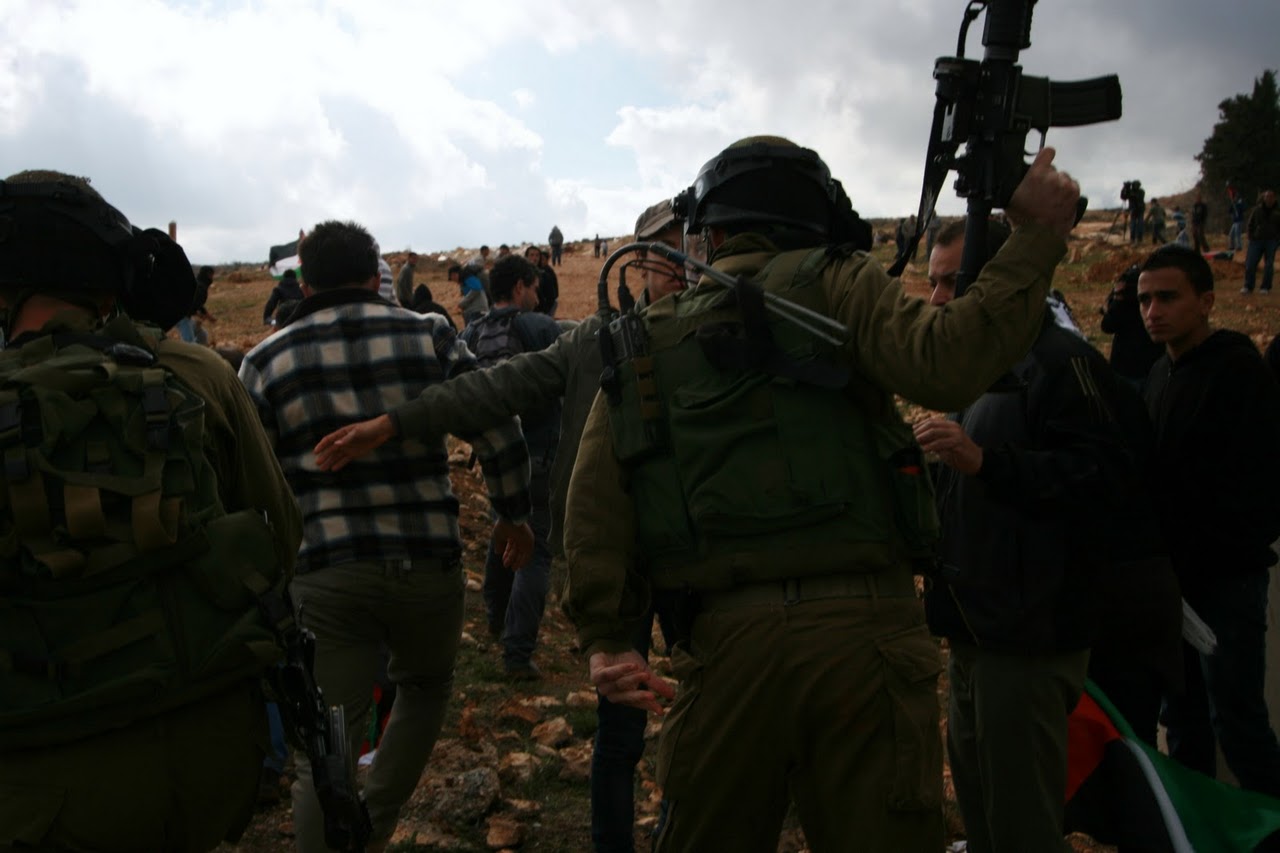
The United Nations Office for the Coordination of Humanitarian Affairs (OCHA) recently issued its weekly report on Israeli violations in the occupied territory for the period between 9- 15 of May, revealing that Israeli soldiers shot at least 370 Palestinians during the Nakba commemoration, and continued their violations in the West bank and the Gaza Strip.
The report indicated that the number of Palestinians injured by Israeli fire since the beginning of this year has reached 1,339, adding that the rate of injuries is 69 a week, comparing to 28 a week last year.
Most of the injuries took place when the soldiers attacked Nakba protests on May 15, especially the protests that were held near the Qalandia terminal, north of Jerusalem, and the Ofer prison terminal near Ramallah.
OCHA further stated that Israel demolished seven Palestinian buildings under the claim that they were built without construction permits.
It said that 27 Palestinians were also injured during a weekly protest against Israeli restrictions preventing Palestinian farmers from reaching their lands near the Qadumim settlement, built on lands that belong to residents of Qalqilia, in the northern part of the West Bank.
OCHA also said that Israeli settlers carried out several attacks against the residents and their lands, leading to several injuries while Israeli settlers cut more than 430 trees, including at least 280 olive trees near Nablus, Salfit and Bethlehem.
The Office said that Israeli settlers cut at least 3,070 trees since the beginning of 2012 (most of them are olive trees), and injured 50 residents.
As for the destruction of property, OCHA stated that, during the reported period, Israel demolished seven Palestinian-owned livelihood structures affecting 40 Palestinians. The buildings are in Burqa in the Nablus district, Al-Jalama near Jenin, and Husan near Bethlehem, in addition to the destruction of a water cistern and the foundations of a house under construction in Beit Hanina neighborhood in East Jerusalem; Israel also issued demolition orders against Palestinian houses in Silwan, in occupied East Jerusalem.
According to OCHA, Israel demolished 285 Palestinian buildings displacing 477 Palestinians, which is a %25 increase comparing structures demolished in 2011.
Israeli soldiers also shot and wounded more than eight Palestinians near the border with Israel, in the Gaza Strip during the reported week. The residents were treated for the effects to teargas inhalation when the soldiers targeted them for “approaching the security fence”; the residents were working in their own lands.
OCHA said that 29 Palestinians were killed in the Gaza Strip and 155 were injured since the beginning of this year.
The Israeli Navy also continued its restrictions and attacks against Palestinian fishermen, as Israel continued to limit the fishing area allotted to Gaza fishermen for only three nautical miles. During the period of this weekly report, the Navy detained fishermen and confiscated their boats; the fishermen were released but the fishing boats remained with Israel.
Fuel shortages and power outages in Gaza continued to hinder the lives of 1.6 million Palestinians in Gaza, while the Gaza Power Plant is only producing 25 megawatts of the needed 80 megawatts.
Fuel smuggling into Gaza via siege-busting tunnels this week was less that %15 of the 800,000 – one million liters of diesel and benzene that used to enter Gaza regularly each day prior the onset of fuel crisis in 2011.
The Palestinian Fishermen Syndicate said that the number of fishing trips conducted in recent months witnessed a sharp decrease (less than four trips a month for each fishing boat) compared to 15 trips a month.
It is worth mentioning that more than 65,000 Palestinians depend on fishing as their only source of livelihood in the Gaza Strip but are suffering due to increased Israeli restrictions. In April, Gaza fishermen fished 99.6 Tons.
Please follow the link for the comprehensive report issued by OCHA in the Occupied Palestinian Territory.
Related articles
- Jewish settlers stealing Palestinian water springs: UN (alethonews.wordpress.com)
- 7 casualties in Israeli artillery shelling east of Gaza (alethonews.wordpress.com)
US: The Shameful Index of Prison Rape
Action on PREA Can End the Violence
By Amy Fettig & Jennifer Wedekind, ACLU National Prison Project | May 17, 2012
Today the Department of Justice released the long-awaited Prison Rape Elimination Act (PREA) regulations, representing the first time that the federal government has issued national standards to help end sexual abuse in correctional facilities. The regulations are two years late and a lot of harm has been done in their absence, but now that they’ve finally been released they can help us protect important constitutional and human rights and ensure safe and fair correctional facilities that assist prisoners in rehabilitation rather than needlessly brutalizing them. The ACLU supports the Department’s efforts to protect and prevent sexual abuse in places of detention, although we regret that immigration facilities are not yet included in these standards.
Sadly, the problem of prison rape is just as pressing now as it was when Congress passed PREA in 2003. Below is the shameful index of prison rape in prisons, jails and youth detention centers across the country. These numbers reflect a national tragedy. But PREA gives us the critical tools to stop rape in our corrections facilities. Now, federal, state and local governments and the public must take strong and continued action to ensure that the promise of PREA becomes a safe and secure reality.
Number of people imprisoned in the United States: 2.3 million
Number of victims of rape or sexual abuse in U.S. prison, jails and juvenile detention facilities in the past year according to the Justice Department: 216,600 (the DOJ admitted it was likely “underestimating the extent of the problem”)
Number of victims of rape or sexual abuse in U.S. prison, jails and juvenile detention facilities since the initial PREA legislation as signed into law (Sept. 4, 2003): 1,884,909
Number of days past the Department of Justice’s deadline (June 23, 2010) for establishing the final standards: 717
Number of victims of rape or sexual abuse in U.S. prison, jails and juvenile detention facilities since the Department of Justice missed its deadline to establish regulations: 411,332
Percentage of youth in state juvenile facilities and large non-state facilities who experienced one or more incidents of sexual victimization in the past 12 months: 12%
Percentage of youth sexually victimized by a corrections staff member: 10.3%
Percentage of former state prisoners reporting one or more incidents of sexual victimization while in jail, prison or post-release community treatment facilities: 9.6%
Percentage of male former state prisoners who identified as homosexual or gay who reported being sexually victimized by another inmate: 39%
Percentage of male bisexual former state prisoners who reported being sexually victimized by another inmate: 34%
Percentage of transgender prisoners reporting being sexually assaulted in prison or jail according to a national survey: 15%
Percentage of black transgender prisoners reporting being sexually assaulted in prison or jail according to a national survey: 34%
Percentage of former state prisoners who experience retaliation in the form of disciplinary charges after reporting sexual victimization by a staff member: 46.3%
Percentage of former state prisoners who reported no facility response at all, after reporting sexual victimization by another prisoner: 37%
Number of states which allow cross-gender pat downs: 30
Number of reported incidents of sexual abuse in immigration detention facilities since 2007: 185
Number of organizations which urged President Obama to instruct the Department of Justice to extend PREA coverage to immigration detention facilities: 38
Number of members of the National Sheriff’s Association, which called on the Department of Justice to extend its PREA regulations to Department of Homeland Security detention centers: 18,000
Related articles
Featured Video

AIDS Inc. by Gary Null (2007)
or go to
Aletho News Archives – Video-Images
From the Archives
Clash of Civilization, Iran Part II
By Jamal Kanj – Intifada-Palestine.com – January 14, 2011
Israel’s survival kit is: perpetuate conflict, insecurity to rationalize collective hate and finally playing victim.
Devoid of conflict, Israel implodes internally; without hate, Zionism loses its justification; and playing eternal victim to continue blackmailing the West. Absence of this holy trinity, Israel ceases to exist.
From its inception, the house of Zion has mastered exploiting adversarial powers to advance Israel’s cause. For instance, their influence over the Democratic Party in the US began with President Truman’s bid for 2nd term election in 1948.
Responding to strong opposition from Secretary of State General George Marshall and Department experts urging against recognition of Israel, President Truman replied: “I’m sorry gentlemen but I have to answer to hundreds of thousands [Jewish voters] who are anxious for the success of Zionism. I do not have hundreds of thousands of [voting] Arabs among my constituents”
Zionists influence over liberal American politics was matched with the doctrinal school of Conservative theoreticians aligning the Republican Party’s platform with Israel’s objectives. The Neoconservative Zionists, coined Zioncons, invented the “Clash of Civilization” concept to fight Israel’s wars. … continue
Blog Roll
 Aletho News
- From Unipolar Universalism to Multipolar Civilizational Distinctiveness
- RSF military group defects, joins Sudanese army: State media
- Ireland goalkeeper refuses to play ‘Israel’ as squad weighs boycott
- China pushes back against US on Cuba, Iran
- Ukrainian Soldiers, Potential Mercenaries: Have Gun, Will Travel!
- Burnham’s UN debut… A masterclass in British disinformation
- Iran flights continue despite US aviation sanctions
- Global Tipping Points Lead the World Into a State of Entropy
- The day-after at the White House: USA and Xi Jinping
- The Geopolitical Balance in the Red Sea: The UAE Being Displaced by New Players
- If Americans Knew
- Israel forces Gazans to live in constant peril – Daily Update
- Deconstructing Netanyahu’s pants-on-fire UN rant – Daily Update
- Trump betrayed voters with his campaign lies and prioritized a foreign country once he took office
- Netanyahu calls Israel’s war in Gaza ‘opposite of genocide’ in UN speech to near-empty hall
- Settler Kidnappings: Torture, Sexual Abuse and Terrorisation of Palestinian Abductees as Israel Deepens Annexation of West Bank
- Gaza winter nears as 162,000 tents become unusable, raising fears of humanitarian crisis
- Netanyahu says, “It’s the opposite of genocide”; UN says Gaza economy is world’s ‘most severe crisis on record’ – Daily Update
- Israel’s US-Backed Assault on Gaza Has Created the ‘World’s Most Severe Economic Crisis on Record’: UN
- ‘Protecting U.S. Citizens’… From Israel
- ‘This is where I live now, the back of a truck’: a day in the life of a grandmother in Gaza
- No Tricks Zone
- New Study: Earth And Venus Surface Warmth Largely Explained By Convection And Lapse Rate, Not CO2 Or Radiation
- 2025 Nature Paper Claiming Worsening Global Drought Gets RETRACTED …Heavily Flawed
- New Study: ‘Global Drought Shows No Detectable Recent Acceleration Under Climate Warming’
- Economic Masterminds: German Socialists Suggest Taxing Productivity Gains Stemming From Using AI
- The South China Sea Has Not Been Cooperating With The Climate Change Narrative
- Energy Crisis: Germany Enters Heating Season With Historically Low Gas Reserve Fill Levels
- New Study: The Antarctic Ice Sheet Gained Mass From 2020-2024 Due To Staggering Snow And Ice Accumulation
- Study: Ocean Heating Rates From Thousands Of Years Ago ‘Dwarf’ Modern Ocean Heating Rates
- Climate Extremists Target, Attack Large-Scale Power Grid Infrastructure In Germany!
- New Study: Antarctic Ice Melt Has Contributed Less Than 1 Centimeter To Sea Level Rise In The Last 30 Years

